
Hubbry Logo
Rational expectationsRational expectationsMain
Open search
Rational expectations
Community hub
Rational expectations
logo
7 pages, 0 posts
0 subscribers
Be the first to start a discussion here.
Rational expectations
from Wikipedia

Rational expectations is an economic theory that seeks to infer the macroeconomic consequences of individuals' decisions based on all available knowledge. It assumes that individuals' actions are based on the best available economic theory and information.

History

[edit]

The concept of rational expectations was first introduced by John F. Muth in his paper "Rational Expectations and the Theory of Price Movements" published in 1961. Robert Lucas and Thomas Sargent further developed the theory in the 1970s and 1980s which became seminal works on the topic and were widely used in microeconomics.[1]

Significant Findings

Muth’s work introduces the concept of rational expectations and discusses its implications for economic theory. He argues that individuals are rational and use all available information to make unbiased, informed predictions about the future. This means that individuals do not make systematic errors in their predictions and that their predictions are not biased by past errors. Muth’s paper also discusses the implication of rational expectations for economic theory. One key implication is that government policies, such as changes in monetary or fiscal policy, may not be as effective if individuals’ expectations are not considered. For example, if individuals expect inflation to increase, they may anticipate that the central bank will raise interest rates to combat inflation, which could lead to higher borrowing costs and slower economic growth. Similarly, if individuals expect a recession, they may reduce their spending and investment, which could lead to a self-fulfilling prophecy.[2]

Lucas’ paper “Expectations and the Neutrality of Money” expands on Muth's work and sheds light on the relationship between rational expectations and monetary policy. The paper argues that when individuals hold rational expectations, changes in the money supply do not have real effects on the economy and the neutrality of money holds. Lucas presents a theoretical model that incorporates rational expectations into an analysis of the effects of changes in the money supply. The model suggests that individuals adjust their expectations in response to changes in the money supply, which eliminates the effect on real variables such as output and employment. He argues that a stable monetary policy that is consistent with individuals' rational expectations will be more effective in promoting economic stability than attempts to manipulate the money supply.[3]

In 1973, Thomas J Sargent published the article “Rational Expectations, the Real Rate of Interest, and the Natural Rate of Unemployment”, which was an important contribution to the development and application of the concept of rational expectations in economic theory and policy. By assuming individuals are forward-looking and rational, Sargent argues that rational expectations can help explain fluctuations in key economic variables such as the real interest rate and the natural rate of employment. He also suggests that the concept of the natural rate of unemployment can be used to help policymakers set macroeconomic policy. This concept suggests that there is a trade-off between unemployment and inflation in the short run, but in the long run, the economy will return to the natural rate of unemployment, which is determined by structural factors such as the skills of the labour force and the efficiency of the labour market. Sargent argues that policymakers should take this concept into account when setting macroeconomic policy, as policies that try to push unemployment below the natural rate will only lead to higher inflation in the long run.[4]

Theory

[edit]

The key idea of rational expectations is that individuals make decisions based on all available information, including their own expectations about future events. This implies that individuals are rational and use all available information to make decisions. Another important idea is that individuals adjust their expectations in response to new information. In this way, individuals are assumed to be forward-looking and able to adapt to changing circumstances. They will learn from past trends and experiences to make their best guess of the future.[1]

It is assumed that an individual's predicted outcome do not differ systematically from the market equilibrium given that they do not make systematic errors when predicting the future.

In an economic model, this is typically modelled by assuming that the expected value of a variable is equal to the expected value predicted by the model. For example, suppose that P is the equilibrium price in a simple market, determined by supply and demand. The theory of rational expectations implies that the actual price will only deviate from the expectation if there is an 'information shock' caused by information unforeseeable at the time expectations were formed. In other words, ex ante the price is anticipated to equal its rational expectation:

where is the rational expectation and is the random error term, which has an expected value of zero, and is independent of .

Mathematical derivation

[edit]

If rational expectations are applied to the Phillips curve analysis, the distinction between long and short term will be completely negated, that is, there is no Phillips curve, and there is no substitute relationship between inflation rate and unemployment rate that can be utilized.

The mathematical derivation is as follows:

Rational expectation is consistent with objective mathematical expectation:
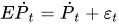
Mathematical derivation (1)

We denote unemployment rate by . Assuming that the actual process is known, the rate of inflation () depends on previous monetary changes () and changes in short-term variables such as X (for example, oil prices):

(1)

Taking expected values,

(2)

On the other hand, inflation rate is related to unemployment by the Phillips curve:

(3) ,

Equating (1) and (3):

(4)

Cancelling terms and rearrangement gives

(5)

Thus, even in the short run, there is no substitute relationship between inflation and unemployment. Random shocks, which are completely unpredictable, are the only reason why the unemployment rate deviates from the natural rate.

Mathematical derivation (2)

Even if the actual rate of inflation is dependent on current monetary changes, the public can make rational expectations as long as they know how monetary policy is being decided:

(1)

Denote the change due to monetary policy by .

(2)

We then substitute (2) into (1):

(3)

Taking expected value at time ,

(4)

Using the Phillips curve relation, cancelling terms on both sides and rearrangement gives

(5)
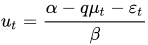
The conclusion is essentially the same: random shocks that are completely unpredictable are the only thing that can cause the unemployment rate to deviate from the natural rate.

Implications

[edit]

Rational expectations theories were developed in response to perceived flaws in theories based on adaptive expectations. Under adaptive expectations, expectations of the future value of an economic variable are based on past values. For example, it assumes that individuals predict inflation by looking at historical inflation data. Under adaptive expectations, if the economy suffers from a prolonged period of rising inflation, people are assumed to always underestimate inflation. Many economists suggested that it was an unrealistic and irrational assumption, as they believe that rational individuals will learn from past experiences and trends and adjust their predictions accordingly.

The rational expectations hypothesis has been used to support conclusions about economic policymaking. An example is the policy ineffectiveness proposition developed by Thomas Sargent and Neil Wallace. If the Federal Reserve attempts to lower unemployment through expansionary monetary policy, economic agents will anticipate the effects of the change of policy and raise their expectations of future inflation accordingly. This will counteract the expansionary effect of the increased money supply, suggesting that the government can only increase the inflation rate but not employment.

If agents do not form rational expectations or if prices are not completely flexible, discretional and completely anticipated, economic policy actions can trigger real changes.[5]

Criticism

[edit]

While the rational expectations theory has been widely influential in macroeconomic analysis, it has also been subject to criticism:

Unrealistic assumptions: The theory implies that individuals are in a fixed point, where their expectations about aggregate economic variables on average are correct. This is unlikely to be the case, due to limited information available and human error.[6]

Limited empirical support: While there is some evidence that individuals do incorporate expectations into their decision-making, it is unclear whether they do so in the way predicted by the rational expectations theory.[6]

Misspecification of models: The rational expectations theory assumes that individuals have a common understanding of the model used to make predictions. However, if the model is misspecified, this can lead to incorrect predictions.[7]

Inability to explain certain phenomena: The theory is also criticized for its inability to explain certain phenomena, such as 'irrational' bubbles and crashes in financial markets.[8]

Lack of attention to distributional effects: Critics argue that the rational expectations theory focuses too much on aggregate outcomes and does not pay enough attention to the distributional effects of economic policies.[6]

See also

[edit]

Notes

[edit]

References

[edit]
[edit]
Revisions and contributorsEdit on WikipediaRead on Wikipedia
from Grokipedia

Rational expectations is a hypothesis in economic theory asserting that individuals form predictions of future economic variables as the best possible unbiased estimates using all available information, such that systematic forecast errors are absent and expectations incorporate an understanding of the underlying economic model. This concept implies that agents' expectations are equivalent to the mathematical conditional expectation given the information set, rendering prediction errors random and uncorrelated with known data. Formulated initially by John F. Muth in a 1961 analysis of price movements in competitive markets, the idea posits that expectations are "rational" insofar as they efficiently utilize probabilistic models of the economy rather than relying on adaptive extrapolations from past errors.
In , rational expectations gained prominence through the work of Robert Lucas and Thomas Sargent in the 1970s, challenging traditional Keynesian models by demonstrating that systematic could not exploit predictable errors in private forecasts, as agents would anticipate and neutralize such interventions. This led to the , which argues that historical econometric relationships may fail under policy changes because agents adjust their behavior based on rational foresight of those shifts, invalidating predictions from reduced-form models estimated on past data. Key implications include the neutrality of anticipated policy in the short run and the emphasis on modeling expectations explicitly in frameworks, influencing central bank practices like . Despite its influence in reshaping macroeconomic and policy evaluation, rational expectations faces empirical scrutiny, with survey data on forecasts often revealing persistent biases and incomplete information use that deviate from strict assumptions. Critics argue the overstates agents' computational capacities and access to information, particularly in heterogeneous or uncertain environments, leading to alternative models incorporating or learning dynamics. Nonetheless, it remains a benchmark for assessing expectation formation, underscoring the causal role of private beliefs in economic outcomes over naive adaptive schemes.

Historical Development

Precursors in Economic Thought

, in his 1930 treatise The Theory of Interest, articulated a framework separating real interest rates from nominal rates influenced by expected changes in the of , implying that economic agents implicitly forecast future inflation to adjust current borrowing and lending decisions. This separation underscored forward-looking behavior, as agents' anticipation of shifts causally determined observed market rates, rather than mere historical averages. Fisher's , building on his earlier 1907 work The Rate of Interest, highlighted how systematic errors in expectation formation could distort intertemporal choices, laying groundwork for models requiring unbiased, information-efficient predictions. Statistical methods from provided another foundation, with Carl Friedrich Gauss's development of the method in 1809 establishing a of optimal by minimizing squared errors under assumed Gaussian disturbances. Gauss demonstrated that this approach yields the best linear unbiased estimator when using all available data, a concept later formalized in the Gauss-Markov theorem, which emphasizes efficient incorporation of information to avoid systematic forecasting biases. In economic contexts, this method anticipated the need for expectations grounded in probabilistic reasoning rather than guesses, influencing later econometric practices for predictive accuracy. The , introduced by Mordecai Ezekiel in 1938 to explain agricultural price cycles, illustrated the instability arising from naive expectations where producers base output solely on prior-period prices. Under such lagged assumptions, markets could diverge into explosive oscillations or converge slowly, depending on supply elasticity relative to demand, revealing the causal inadequacy of backward-looking heuristics in dynamic settings. This analysis, applied empirically to hog and markets, underscored the requirement for expectation mechanisms that stabilize via forward integration of market fundamentals, prompting subsequent refinements toward more realistic formation processes.

John Muth's Original Formulation

John F. Muth formulated the rational expectations hypothesis in his seminal 1961 paper, "Rational Expectations and the Theory of Price Movements," published in . In this microeconomic analysis, Muth posited that economic agents form expectations as informed predictions of future events, equivalent to the predictions derived from the underlying economic theory itself, conditional on all available . Formally, he defined these expectations as the mathematical conditional means given the model's structure and pertinent data, contrasting with formulations that assume limited rationality in forecasting. Muth's motivation stemmed from empirical observations of market efficiency, where actual and behaviors in industries deviated from the volatile cycles predicted by earlier models relying on static or adaptive expectations. He critiqued prevailing dynamic models for underestimating agents' , arguing that expectations should be consistent with the model's equilibrium to avoid systematic forecast errors, thereby privileging data-driven consistency over simplistic rules. Applying the to firm-level decisions, Muth examined inventory management and adjustment processes. In inventory models, agents optimize stock levels based on expected , where rational forecasts minimize deviations from optimal holdings by incorporating full model knowledge. For dynamics, he considered a linear adjustment of the form P˙t=αβut+γEt1(P˙t)\dot{P}_t = \alpha - \beta u_t + \gamma E_{t-1}(\dot{P}_t), where P˙t\dot{P}_t denotes the rate of change, utu_t represents excess , and Et1()E_{t-1}(\cdot) is the expectation operator; under rational expectations, γ=1\gamma = 1, implying that anticipated changes align precisely with the systematic components of the model, excluding unpredictable shocks. These applications demonstrated the hypothesis's superiority over adaptive expectations, which typically amplify oscillations in supply-demand interactions, such as cobweb cycles in agricultural markets. Rational expectations, by contrast, dampen cycle amplitudes and yield predictions closer to observed stability in and production across various sectors, as Muth illustrated through simulations and empirical comparisons. This microfoundational approach emphasized agent-level optimization without invoking aggregate macroeconomic structures, grounding the theory in verifiable firm behaviors rather than unsubstantiated psychological assumptions.

Adoption in New Classical Macroeconomics

The concept of rational expectations was integrated into New Classical macroeconomics in the early 1970s, marking a paradigm shift away from discretionary Keynesian policies reliant on systematic aggregate demand stabilization. Robert Lucas's 1972 paper, "Expectations and the Neutrality of Money," provided a foundational critique by modeling an economy where agents form expectations optimally using all available information, rendering anticipated monetary expansions neutral with respect to real output due to immediate price adjustments that eliminate money illusion. This work highlighted the inconsistency of Keynesian models, which assumed adaptive expectations leading to exploitable policy trade-offs, and emphasized the need for microfounded general equilibrium analysis where individual optimization drives aggregate outcomes. Thomas Sargent and Neil Wallace extended this framework in their 1975 analysis, formalizing the policy ineffectiveness proposition: even unanticipated policy changes fail to systematically influence real variables if they stem from rules that alter the overall policy environment, as rational agents incorporate such shifts into their forecasts, neutralizing real effects beyond initial surprises. Their model underscored that attempts at fine-tuning, such as countercyclical monetary interventions, could induce dynamic inconsistencies, where announced policies deviate from optimal commitments, exacerbating rather than output stabilization. This adoption gained traction amid the 1970s , where U.S. averaged 7.1% annually from 1973 to 1979 alongside rising from 4.9% in 1973 to 7.1% by 1975, defying adaptive expectations models that predicted an inverse - trade-off via lagged adjustments. New Classical models with rational expectations explained this persistence through rapid expectation revisions to supply shocks (e.g., oil price quadrupling in 1973-1974) and inconsistent policies, yielding a vertical long-run consistent with empirical breakdowns of accelerationist relations under backward-looking forecasts. By insisting on equilibrium consistency and agent rationality, the approach defended against Keynesian advocacy for activist intervention, prioritizing rules-based policies to avoid systematic forecast errors.

Core Concepts and Assumptions

Definition of Rational Expectations

Rational expectations constitute the hypothesis that economic agents formulate their predictions of future variables as the conditional mathematical expectation given all available information at the time, yielding the optimal unbiased forecast that minimizes the mean squared error of prediction. This approach posits that expectations are not formed through simplistic extrapolations or biases but through the application of relevant economic theory and data, ensuring alignment between subjective beliefs and objective model-based probabilities. Inherent to this definition is the endogenous role of expectations in shaping outcomes, where agents' optimized forecasts must remain consistent with the realized equilibria of the system to avoid systematic deviations, potentially manifesting as self-fulfilling mechanisms when predictive accuracy reinforces behavioral responses. The hypothesis implies that deviations between actual and expected values, known as forecast errors, exhibit no systematic bias, possessing a mean of zero and lacking serial correlation with prior information sets, as any predictable patterns would be exploited to refine expectations further. This criterion underscores the internal consistency demanded by rational expectations, distinguishing it from inferior forecasting rules that fail to fully incorporate available evidence.

Key Assumptions and First-Principles Basis

The rational expectations hypothesis posits that agents derive forecasts of future economic variables as the mathematical based on their set and the true structural model of the , thereby minimizing squared prediction errors in line with optimal under . This formulation extends principles of rational choice, where agents, acting to maximize expected , efficiently process available data without wasting scarce , ensuring that subjective probabilities align closely with objective outcomes rather than alternative distributions like those from naive . Central to this framework is the assumption of a shared set among agents and common awareness of the relevant , enabling expectations to be internally consistent with the model's dynamics and avoiding divergences that would arise from heterogeneous beliefs or ignorance of key relations. While idealized, this homogeneity facilitates tractable aggregation in theoretical models and reflects the empirical observation that market participants, through repeated interaction, converge on similar assessments of public , such as observable variables or past realizations. The hypothesis further requires the absence of systematic forecast errors, meaning prediction mistakes are uncorrelated with the information set and exhibit zero conditional mean, as any predictable bias would constitute an exploitable deviation from optimality that competitive pressures—via learning, , or direct —would erode over time. In Muth's original empirical application to hog and corn price cycles, this no-bias condition yielded superior explanations of observed fluctuations compared to adaptive expectations models, which implied implausible instability or sluggish adjustment inconsistent with data from U.S. agricultural markets. Approximations incorporating bounded computational limits, while relaxing full model , nonetheless preserve this unbiased core and empirically outperform purely backward-looking alternatives in accuracy across and series.

Distinction from Alternative Expectation Formation Models

Adaptive expectations, pioneered by Phillip Cagan in his 1956 analysis of episodes in post-World War II Europe, form predictions of future variables such as by weighting past observed values with exponentially declining coefficients, inherently lagging behind actual economic shifts. This mechanism implies systematic forecast errors, as agents underreact to new policy announcements or structural changes, potentially destabilizing dynamics like perpetuating through delayed and adjustments. Rational expectations address this deficiency through forward-looking consistency, where agents derive unbiased forecasts from the full model of the economy, incorporating anticipated responses to all relevant information and thereby avoiding the instability inherent in from historical data alone. Extrapolative expectations, akin to adaptive forms but emphasizing linear extensions of recent trends, similarly anchor on historical patterns without probabilistic assessment of future contingencies, fostering overamplification of short-term momentum in asset prices or output growth. In distinction, rational expectations demand information efficiency, treating deviations from equilibrium as transient opportunities for rather than self-reinforcing extrapolations, which aligns with observed market corrections following informational shocks. Keynesian concepts of "animal spirits," invoking non-quantifiable psychological impulses to explain volatility, contrast with rational expectations by downplaying systematic processing in favor of unexplained optimism or pessimism. Rational expectations integrate such behavioral elements only insofar as they reflect rationally updated probabilities, better capturing empirical regularities like rapid asset repricing under the efficient markets hypothesis, where backward-looking models faltered in reconciling 1970s —persistent amid rising —with policy-induced expectation shifts.

Mathematical and Theoretical Framework

Formal Mathematical Definition

The formal mathematical definition of rational expectations holds that agents' subjective expectations of a future economic variable yt+ky_{t+k}, formed at time tt and denoted Etyt+kE_t y_{t+k}, coincide with the objective conditional expectation E[yt+kIt]E[y_{t+k} \mid I_t], where ItI_t denotes the full information set available to agents at time tt, including past observations, model parameters, and structural relations. This equivalence implies that expectations are model-consistent, representing the predicted value derived from the true data-generating process rather than heuristic approximations. The conditional expectation operator E[It]E[\cdot \mid I_t] yields the minimum mean squared error forecast, minimizing E[(yt+kE[yt+kIt])2It]E[(y_{t+k} - E[y_{t+k} \mid I_t])^2 \mid I_t] over all predictors measurable with respect to ItI_t. Consequently, rational expectations ensure unbiasedness, as forecast errors ϵt+k=yt+kEtyt+k\epsilon_{t+k} = y_{t+k} - E_t y_{t+k} satisfy E[ϵt+kIt]=0E[\epsilon_{t+k} \mid I_t] = 0 and are orthogonal to elements in ItI_t, precluding systematic predictability from available information. This formulation aligns with probabilistic inference, where agents update prior beliefs via Bayes' rule to form posterior expectations that reflect the likelihoods implied by the underlying stochastic environment, emphasizing realism in handling uncertainty through conditional probabilities rather than deterministic assumptions.

Derivation in Stochastic Models

In stochastic models, rational expectations equate agents' subjective forecasts to the objective conditional expectations derived from the model's probability distributions and structure. Consider a simple autoregressive process of order 1 (AR(1)): yt=ρyt1+εty_t = \rho y_{t-1} + \varepsilon_t, where ρ<1|\rho| < 1 ensures stationarity and εt\varepsilon_t is white noise with mean zero. Agents, aware of the model parameters, form expectations as Etyt+1=ρytE_t y_{t+1} = \rho y_t, since Etεt+1=0E_t \varepsilon_{t+1} = 0. This derivation follows directly from the law of iterated expectations applied to the process, yielding forecasts that exploit all available information without introducing extraneous lags or adaptive adjustments inherent in non-rational schemes. For broader linear stochastic difference equations incorporating expectations, such as yt=xt+aEtyt+1y_t = x_t + a E_t y_{t+1} where xtx_t follows an exogenous AR(1) process xt=ρxt1+ηtx_t = \rho x_{t-1} + \eta_t, repeated forward substitution under rational expectations produces the solution yt=k=0akEtxt+ky_t = \sum_{k=0}^\infty a^k E_t x_{t+k}, assuming the transversality condition limNaNEtyt+N=0\lim_{N \to \infty} a^N E_t y_{t+N} = 0 holds to rule out explosive bubbles. Substituting the AR(1) for xtx_t yields yt=11aρxty_t = \frac{1}{1 - a \rho} x_t when aρ<1|a \rho| < 1, demonstrating how expectations propagate fundamentals forward indefinitely. The method of undetermined coefficients facilitates solving such systems by conjecturing a linear solution form (e.g., yt=πxty_t = \pi x_t), substituting into the expectational equations, and equating coefficients to solve for unknowns via linear algebra. For instance, in a model with output yty_t and πt\pi_t linked by a and , assume πt=ayt\pi_t = a y_t^* and yt=byty_t = b y_t^* where yty_t^* is a ; plugging in generates a matrix solved for aa and bb, ensuring consistency. This method underscores the fixed-point property of rational expectations equilibria, where conjectured forms self-validate against model implications. In Muth's foundational treatment of price dynamics, supply responds to lagged expected prices amid stochastic shocks modeled as moving average (MA) processes, akin to ARMA representations. For correlated shocks ut=wiεtiu_t = \sum w_i \varepsilon_{t-i}, rational price expectations take the form pte=vjptjp_t^e = \sum v_j p_{t-j}, with coefficients vjv_j solving a recursive that minimizes forecast errors and aligns with the equilibrium law of motion, avoiding inconsistencies like overextrapolation in adaptive expectations that could amplify variances indefinitely. Non-rational alternatives, by contrast, introduce forecast errors systematic with respect to observables, potentially generating unstable paths incompatible with observed data stationarity.

Incorporation into Dynamic Economic Models

In dynamic economic models, rational expectations are incorporated by imposing a consistency condition whereby agents' forecasts of future endogenous variables equal the mathematical expectations derived from the model's equilibrium solution and underlying processes. This fixed-point requirement ensures that expectations are model-consistent, meaning that the perceived law of motion for state variables aligns precisely with the actual dynamics generated by agents' optimizing behaviors and exogenous shocks. Such incorporation resolves potential inconsistencies in forward-looking decisions, as deviations would imply opportunities or unexploited information, leading agents to adjust until equilibrium is restored. Intertemporal optimization under rational expectations typically involves agents solving Bellman equations to maximize lifetime utility subject to budget constraints, yielding first-order conditions known as Euler equations. These equations link current choices, such as consumption or , to expected future marginal utilities or returns, with the expectation operator EtE_t computed using the true conditional distribution of future variables as implied by the model's solution. For example, in a representative-agent framework, the consumption Euler equation is u(ct)=βEt[u(ct+1)(1+rt+1)]u'(c_t) = \beta E_t [u'(c_{t+1}) (1 + r_{t+1})], where uu' is , β\beta is the subjective discount factor, and rt+1r_{t+1} is the real interest rate; rational expectations ensure that EtE_t reflects the equilibrium transition probabilities rather than biased heuristics. This approach extends to multi-sector models, where Euler equations for labor supply, , and production incorporate rational forecasts of wages, prices, and technology shocks. In general equilibrium, rational expectations coordinate decentralized decisions across agents and markets, with flexible prices adjusting to equate and based on rationally anticipated future conditions. This framework highlights a causal mechanism: expectations shape individual optimization, influencing aggregate quantities like output and , which in turn validate or falsify those expectations through feedback loops inherent to the equilibrium. simulations of such models, involving repeated draws from shock distributions, verify this consistency by generating that satisfy the Euler equations and market-clearing conditions endogenously. Comparisons with alternatives, such as adaptive or near-rational expectations, reveal that rational expectations models exhibit superior internal coherence, producing dynamics with appropriate persistence and cross-correlations without error terms. For instance, simulations in linearized rational expectations systems demonstrate reduced forecast errors and better alignment with implied policy functions compared to inconsistent expectation schemes.

Empirical Evidence and Testing

Methods for Testing Rational Expectations

The primary econometric approach to testing rational expectations relies on conditions derived from the hypothesis that forecast errors—defined as the difference between realized outcomes and conditional expectations based on available —should be uncorrelated with variables in the agents' set at the time the forecast is formed. This is implemented by regressing the forecast errors on those variables (or their lags and transformations); under rational expectations, the coefficients on these regressors should be statistically indistinguishable from zero, as any predictability would imply systematic or inefficiency in expectation formation. Tests often employ t-statistics or F-tests on these coefficients, with standard errors adjusted for heteroskedasticity or using methods like Newey-West estimators to ensure valid . A common application uses direct survey-based forecasts, such as those from the Survey of Professional Forecasters (SPF), a quarterly panel dataset originating from the and in 1968, which elicits predictions for macroeconomic variables like , GDP growth, and from professional economists. Forecast errors are computed as actual realizations minus median or mean survey predictions, then subjected to unbiasedness regressions (actual outcome regressed on the forecast, testing for zero intercept and unit slope) and efficiency checks via orthogonality to additional information like past errors, lagged outcomes, or public announcements. These tests assess both weak efficiency (no bias) and strong efficiency (errors orthogonal to the full information set), often pooling cross-sectional forecaster responses or aggregating to time-series medians for robustness. Many empirical tests of rational expectations encounter the joint hypothesis problem, where rejection of or efficiency cannot distinguish between failures of rational expectations and misspecification of the underlying , such as assumptions of neutrality or the correct functional form of expectations. For example, (VAR) frameworks, as developed by Christopher Sims in 1980, impose rational expectations by deriving conditional forecasts from the model's and testing error predictability, but rejections may arise from omitted variables, incorrect lag structures, or invalid cross-equation restrictions rather than irrationality per se. Advanced methods, such as those in Hansen and Sargent's (GMM) framework for linear rational expectations models, address this by estimating structural parameters subject to RE-imposed moment conditions (e.g., errors orthogonal to instruments) and testing overidentifying restrictions via the J-statistic, which evaluates the validity of the full specification. These techniques require specifying instruments from the information set and handling solution methods for forward-looking equations, often using QZ decompositions for stability.

Supporting Empirical Findings

Empirical tests by John Muth in 1961 on U.S. agricultural prices, including hogs, chickens, potatoes, and , demonstrated that rational expectations forecasts outperformed adaptive expectations, with the former explaining price movements more accurately by incorporating all available rather than extrapolating past errors. Subsequent applications of rational expectations competitive storage models to commodity markets have replicated this support, successfully accounting for stylized facts such as price skewness, autocorrelation, and in data from 13 major commodities over extended periods. In inventory management for storable commodities, rational expectations models align with observed behavior, where agents optimally store based on forward-looking predictions of supply shocks and demand, yielding better fits to historical inventory cycles than backward-looking alternatives. The Volcker disinflation period from 1979 to 1983 provides macroeconomic evidence consistent with rational expectations, as inflation expectations adjusted rapidly to the Federal Reserve's credible shift toward tight , resulting in a decline from double-digit peaks to around 3% by 1983 with unemployment peaking at 10.8% but without the prolonged predicted by adaptive expectations models. Calibrated rational expectations models of this episode match observed paths for , , and interest rates, attributing the relatively low output costs to agents' swift updating of expectations under policy . This contrasts with pre-Volcker episodes where persistent reflected lagged adjustments, supporting rational expectations' role in explaining reduced inflation persistence post-1980s.

Counter-Evidence and Methodological Debates

Empirical tests of the rational expectations hypothesis (REH) using survey data have frequently revealed deviations, particularly among . Household inflation expectations often exhibit underreaction to macroeconomic news, such as announcements, with evidence from post-2008 data showing persistent inertia and downward biases during periods of . For instance, U.S. household surveys indicate that expectations respond more strongly to personal economic experiences, like labor market conditions, than to aggregate shocks, leading to forecast errors that are predictable based on past information. In contrast, professional forecasters, such as those in the Survey of Professional Forecasters (SPF), produce expectations closer to rational benchmarks, with smaller biases and better alignment with realized outcomes, suggesting that REH holds more robustly for informed agents. Asset price puzzles, including the excess volatility observed in equity markets relative to dividend fundamentals, have been interpreted as challenges to REH under efficient markets. Robert Shiller's 1981 findings documented volatility in stock prices exceeding what dividend discount models predict under rational expectations, implying overreactions inconsistent with fully informed agents. Defenses attribute this to noise traders—irrational investors whose unpredictable beliefs introduce risk that limits arbitrage by rational agents—rather than a outright failure of rationality among informed participants. Models incorporating noise trader risk demonstrate that such endogenous feedback can amplify volatility without violating REH for fundamental-based traders, as seen in simulations where noise-driven mispricing persists due to incomplete risk-bearing capacity. Methodological critiques highlight that many REH tests are joint hypotheses, simultaneously evaluating expectations formation and underlying model specifications, which can lead to rejections attributable to model error rather than . Early econometric tests, such as those using vector autoregressions, often impose cross-equation restrictions that fail when auxiliary assumptions—like or parameter stability—are violated, confounding interpretation. Small-sample biases in finite data further exacerbate apparent deviations, as rational forecast errors should be orthogonal to sets only asymptotically. Alternative frameworks, such as models, posit that agents approximate rational expectations through recursive or Bayesian updating, converging to RE equilibria in the long run under stability conditions, though empirical convergence can be slow or incomplete in volatile environments. This asymptotic approximation reconciles some survey-based rejections as transitional phenomena rather than permanent refutations.

Policy Implications

The Lucas Critique

The Lucas critique, formulated by economist Robert Lucas in his 1976 paper "Econometric Policy Evaluation: A Critique," argues that traditional econometric models used for yield unreliable results because their estimated parameters are not invariant to changes in rules. These parameters capture agents' behavioral responses, including expectations, which are conditioned on the prevailing policy environment; a shift in policy thus alters expectations and underlying behaviors, rendering historical parameter estimates unstable for counterfactual simulations. Lucas emphasized that such models conflate reduced-form relationships with structural invariants, leading to systematic errors in policy impacts. A core illustration involves attempts at fine-tuning the economy via the tradeoff between and , apparent in U.S. data from the , where policymakers exploited inverse correlations by accepting higher for lower . Under rational expectations, however, agents anticipate systematic policy responses to economic conditions, neutralizing intended effects; for instance, sustained expansionary policies raise expected , prompting wage and price adjustments that shift the short-run upward and erode the tradeoff. This dynamic invalidates multiplier estimates from Keynesian models, which assumed fixed behavioral parameters derived from past data. Empirically, the critique gained traction amid the 1970s in the United States, where averaged over 7% annually from 1973 to 1982 alongside rates exceeding 6%, contradicting the stable downward-sloping observed in the prior decade. Pre-critique econometric models, reliant on 1950s-1960s correlations, failed to anticipate this breakdown, as activist policies—such as those under the Kennedy-Johnson expansions—altered inflationary expectations without delivering sustained gains. Neglecting expectation-driven thus perpetuated flawed predictions, exemplified by overreliance on models that projected persistent tradeoffs even as real-world evidence mounted against them.

Policy Ineffectiveness Proposition

The policy ineffectiveness proposition, advanced by Thomas Sargent and Neil Wallace in 1975, posits that under rational expectations, anticipated or systematic exerts no influence on real economic variables such as output or employment. In their model, economic agents fully incorporate predictable policy actions into their forecasts, leading to immediate adjustments in nominal variables like prices and wages that offset any intended real effects. Consequently, only unanticipated policy shocks—deviations from rational forecasts—can temporarily alter real outcomes, rendering systematic policy neutral with respect to real aggregates. This result derives from the insight that rational agents do not suffer systematic forecast errors regarding policy rules, preventing policymakers from exploiting informational asymmetries to influence real activity. For instance, an announced increase in the money supply growth rate prompts agents to anticipate higher , prompting preemptive wage and price adjustments that maintain real quantities unchanged. The proposition thus highlights monetary neutrality for anticipated changes, confining policy impacts to nominal dimensions unless accompanied by surprises. Empirical corroboration appears in the U.S. of the early 1980s under Chairman , where declined from a peak of 13.5% in 1980 to 3.2% by 1983, accompanied by a milder than forecasts from adaptive expectations models would predict. Traditional Phillips curve estimates implied output losses several times larger, but the observed sacrifice ratio—cumulative output loss per reduction in —was approximately 0.5, aligning with rational expectations equilibria where credible commitment to tight policy rapidly anchored expectations without prolonged real disruptions. This episode underscores how anticipated systematic tightening, devoid of surprises, avoided the high real costs expected under non-rational frameworks. The proposition challenges activist interventionism by demonstrating that discretionary attempts to stabilize output via predictable fail, as agents' foresight ensures self-correction through nominal adjustments rather than sustained real stimulus. It thereby supports reliance on markets' inherent equilibrating mechanisms over efforts to engineer real outcomes through announced rules, as such policies merely redistribute nominal variables without net real gains.

Preference for Rules over Discretionary Policy

In the framework of rational expectations, discretionary suffers from a fundamental time-inconsistency problem, where policymakers announce low- commitments but later deviate by expanding the money supply to exploit short-term trade-offs, leading to unexpected that erodes and boosts temporarily. Rational agents, anticipating this reneging, adjust expectations upward in advance, neutralizing the intended stimulus and resulting in higher average without corresponding gains. Kydland and Prescott demonstrated in that such arises even under optimal planning assumptions, as the under discretion deviates from the cooperative outcome, favoring binding rules to enforce precommitment and align incentives with long-run welfare maximization. Monetary rules, such as a constant growth rate or interest rate feedback mechanisms like the , mitigate this bias by mechanically constraining policy actions, preventing opportunistic deviations that rational expectations render ineffective. These rules ensure predictability, allowing agents to form expectations consistent with policy announcements without fear of exploitation, thereby stabilizing around its natural rate and avoiding the inflationary spirals observed in discretionary regimes. Empirical implementations, including proposal, underscore that rules debunks the myth of fine-tuned activist interventions, as rational foresight limits systematic surprises and prioritizes institutional mechanisms for credibility. Cross-country evidence supports the superiority of rule-like commitments through (CBI), which insulates monetary authorities from political pressures for ary finance. In nations from 1950 to 1989, higher CBI indices correlated with average rates 3.9 percentage points lower, reflecting reduced discretion and more stable expectations. Post-1990s reforms granting statutory —such as New Zealand's 1989 Reserve Bank Act and similar adoptions in and —coincided with sustained declines, from double digits in many cases to below 5% by the early , alongside lower volatility, as rational expectations anchored around credible commitments rather than discretionary promises. Studies across developing economies confirm this pattern, with legal CBI measures associating with 1-2% lower annual , causal bolstered by reforms that enhanced operational without fiscal overrides.

Criticisms and Debates

Theoretical Limitations and Internal Critiques

One prominent internal critique of the rational expectations hypothesis concerns its implicit reliance on of the underlying among agents. For expectations to be rational, individuals must form forecasts using the correct of future variables, which presupposes that they share knowledge of the true structural relations and that this knowledge is mutually recognized to arbitrary orders— an eductive process involving iterative elimination of inconsistent higher-order beliefs. This requirement introduces a logical circularity: agents can only ascertain the equilibrium model after solving for the expectations that define it, yet forming those expectations demands prior knowledge of the model. Roger Guesnerie argues that many rational expectations equilibria fail "eductive stability," meaning they do not survive repeated deletion of implausible anticipations under assumptions, rendering the hypothesis's internal consistency fragile in non-trivial settings. A related limitation arises from the hypothesis's treatment of information processing, where agents are assumed to possess and utilize sufficient data to compute conditional expectations without specifying the minimal informational basis required. Critics contend this overlooks the computational and cognitive demands of deriving equilibrium strategies from first principles, potentially conflating descriptive accuracy with an idealized benchmark that ignores bounded feasibility in belief formation. Defenders counter that rational expectations serves as an asymptotic ideal, where approximate rationality emerges with access to even limited public information, such as past realizations of variables, sufficient to iterate toward consistency without full model specification. Sunspot equilibria further highlight indeterminacy within rational expectations frameworks, where multiple self-consistent outcomes coexist under the same fundamentals, driven by extrinsic, non-fundamental shocks like coordinated beliefs or "." In linear rational expectations models, if the policy response parameter falls below unity in , the solution space expands to include or fluctuations uncorrelated with economic primitives, violating and predictive . This multiplicity implies that rational expectations permits equilibria where aggregate variables respond to arbitrary expectational noise rather than causal fundamentals, challenging the hypothesis's claim to parsimony. Proponents mitigate this by restricting attention to minimal-state-variable solutions, which exclude sunspots and restore under restrictive conditions like forward-looking dominance.

Empirical Shortcomings and Test Failures

Empirical tests of (RE) in forecasting have revealed persistent biases, particularly in survey from professional forecasters. Analysis of the Survey of Professional Forecasters (SPF) indicates that expectations systematically underestimate during periods of rising prices and overestimate it during , violating the unbiasedness condition of RE where forecast errors should be unpredictable using available information. These patterns persist across decades, with regressions showing predictable errors based on past trends, leading to rejections of RE in standard tests. In the , amid post-pandemic supply shocks, SPF participants underestimated persistence, with average errors for near-term forecasts reaching three times pre-2020 levels (approximately 2-3 percentage points versus 0.5-1 point historically), as actual exceeded projections by up to 4 points in 2021-2022. Exchange rate markets provide another domain of empirical challenge, exemplified by the Meese-Rogoff puzzle. In their 1983 study of major currencies (e.g., USD/DEM, USD/JPY from 1973-1982), structural models incorporating RE and economic fundamentals failed to outperform naive random walk forecasts out-of-sample, even when using ex post realized values for variables like money supply and output—errors averaged 10-15% higher than random walks at 1-12 month horizons. This disconnect has endured, with subsequent tests through the 2010s confirming that RE-augmented models (e.g., monetary or flexible-price variants) underperform benchmarks by 5-10% root-mean-square error in floating rate regimes, suggesting agents do not fully incorporate fundamentals as RE posits. Methodological critiques attribute many RE test failures to model misspecification rather than flawed expectations formation. Standard tests often impose auxiliary assumptions (e.g., specific forms or VAR structures) that, when violated by regime shifts or omitted variables, generate spurious rejections; simulations show that even true RE equilibria yield predictable errors under such misspecification. RE thus functions as a rigorous benchmark, exposing weaknesses in alternatives like adaptive expectations, which perform worse in efficient submarkets such as short-term bond yields where forecast errors align closely with RE implications (unbiasedness holds within 1-2 standard errors). While data rejections highlight limitations in broad applications, they underscore RE's utility in constraining implausible alternatives rather than wholesale dismissal.

Behavioral and Heterodox Alternatives

Behavioral economics challenges the rational expectations hypothesis by positing , where agents rely on heuristics and limited information rather than fully optimizing forecasts, as originally conceptualized by Herbert Simon in his 1957 work Models of Man. This approach, advanced by and through in 1979, attributes persistent biases like overconfidence and anchoring to cognitive limitations, which purportedly explain anomalies such as excess volatility in asset prices or slow adjustment to shocks. Empirical studies, however, indicate that while bounded rationality models can replicate short-term deviations, such as hump-shaped responses in real exchange rates to monetary shocks, rational expectations approximations outperform them in long-run forecasting accuracy across macroeconomic datasets, including and output predictions. Critics argue that behavioral models often overfit transient noise rather than identifying robust causal mechanisms, lacking the of consistent optimization that underpin rational expectations' resilience. Heterodox perspectives, particularly Post-Keynesian theories inspired by and G.L.S. , reject rational expectations' reliance on probabilistic forecasting under the premise of fundamental , where future outcomes are inherently non-stationary and unknowable, as Keynes outlined in his 1921 Treatise on Probability. These views emphasize animal spirits and convention-driven expectations over Bayesian updating, claiming that true precludes the error-minimizing predictions central to rational expectations models. Rational expectations counters this by incorporating Bayesian methods to handle evolving information sets, treating uncertainty as resolvable risk through and market discipline, which heterodox frameworks overlook by neglecting agents' incentives to exploit predictable errors. Empirical resilience of rational expectations is evident in its superior fit to on expectation formation, where deviations attributed to fail to persist against of mean-reverting forecast errors in professional surveys. Both behavioral and heterodox alternatives face scrutiny for insufficient , as they prioritize heuristics or irreducible without deriving expectations from maximization and equilibrium consistency, core to rational expectations' theoretical coherence. Rational expectations endures due to its alignment with arbitrage-enforced discipline, where systematic biases would be eroded by profit-seeking agents, a dynamic absent in models that dismiss probabilistic reasoning.

Modern Extensions and Applications

Adaptations for Bounded Rationality and Learning

Adaptive learning mechanisms address by positing that economic agents form expectations through recursive of model parameters, such as via methods, rather than instantaneously achieving full . These processes introduce temporary deviations from rational expectations (RE) equilibria due to incomplete or computational limits, but converge asymptotically to RE under conditions of expectational stability (E-stability). In such setups, agents update beliefs using perceived autoregressive representations of variables, gradually refining forecasts as new data arrives, thereby bridging with the RE hypothesis as a long-run limit case. Marcet and Sargent (1989) established that in linear self-referential stochastic models, constant-gain or decreasing-gain learning leads to convergence of agents' perceived laws of motion to the RE equilibrium, provided the equilibrium satisfies E-stability criteria. This framework maintains the core RE assumption of model-consistent expectations while allowing for realistic learning dynamics; for instance, decreasing gain approximates full over time, whereas constant gain captures persistent updating suitable for non-stationary environments. E-stability requires that the RE solution be under notional perturbations in beliefs, ensuring that adaptive algorithms select the correct equilibrium among multiples. Empirically, models outperform strict RE in replicating macroeconomic , particularly by generating and volatility puzzles without invoking frictions. Applications to New Keynesian frameworks show improved fits to U.S. and output data from the onward, with learning explaining deviations during structural shifts. Post-2008 evidence supports this adaptation, as learning-augmented DSGE models better match subdued responses and prolonged output gaps, attributing persistence to agents' gradual updating of policy rule perceptions rather than immediate RE adjustment. These extensions preserve RE as an empirically attainable benchmark, validated by convergence in simulated and historical data, while accommodating bounded cognition evident in survey forecasts.

Applications in Finance and Asset Pricing

In , rational expectations underpin the (EMH), where security prices instantaneously incorporate all publicly available information as investors optimally forecast future cash flows and risks. This framework implies that abnormal returns cannot be systematically earned by trading on such information, as expectations are unbiased and model-consistent. Empirical validation comes from event studies, which document rapid price adjustments to announcements like releases or mergers, with cumulative abnormal returns stabilizing within minutes to days of the event, leaving negligible post-event predictability. For example, Ball and Brown (1968) analyzed 194 quarterly announcements from 1957 to 1965, finding that 85-90% of the total abnormal return occurs in the month preceding the announcement due to information leakage and immediate market response upon release. Option pricing models exemplify rational expectations through risk-neutral valuation, where are priced as discounted expected payoffs under a equivalent to agents' rational beliefs about underlying asset dynamics. The Black-Scholes-Merton framework (), assuming lognormal diffusion and no , derives option values from the expectation that stock prices follow a martingale after risk adjustment, aligning with rational investors hedging perfectly and forming unbiased forecasts of volatility and drift. This approach has succeeded empirically in pricing European calls and puts, with model-implied volatilities closely matching observed market quotes for short-dated options on liquid underlyings like index futures, as deviations are often attributable to jumps or rather than expectation errors. Rational expectations also address anomalies like the —the observed 6-7% annualized excess return of U.S. stocks over Treasury bills from 1889 to the present, exceeding standard consumption-based benchmarks by factors of 2-3—via habit-formation models that endogenize time-varying . In the Campbell-Cochrane (1999) model, investors' utility depends on consumption relative to a slow-moving external level, leading to countercyclical premia under rational expectations: during recessions, habits bind tightly, amplifying perceived and justifying high required returns on equities to compensate for rare disasters. Calibrated to U.S. data from 1891-1995, the model generates an equity premium of 6.54%, of 0.96%, and volatility matching historical figures (equity std. dev. 15.8%, consumption 1.5%), without relying on implausibly high or low consumption growth.

Recent Developments in Macroeconomic Modeling

Heterogeneous agent New Keynesian () models, developed prominently in the , extend rational expectations frameworks by incorporating household heterogeneity, , and uninsurable income risks into sticky-price environments. These models demonstrate that rational expectations about future policy and shocks, combined with distributional effects, alter aggregate dynamics such as consumption responses to , with hand-to-mouth households amplifying fiscal multipliers while reducing the effectiveness of changes. Unlike representative-agent New Keynesian models, HANK variants reveal how inequality influences inflation-output trade-offs, as lower-wealth agents exhibit higher marginal propensities to consume, leading to distinct welfare implications for redistributionary policies. News shocks—anticipated future productivity or policy changes under rational expectations—have gained traction in 2000s-2020s modeling to explain comovements without relying on implausible contemporaneous shocks. Empirical identification via vector autoregressions with forecast data shows news shocks accounting for up to 50% of output fluctuations, driving booms ahead of actual realizations while aligning with rational foresight about gradual . These extensions preserve rational expectations' core by treating agents as updating beliefs on shock paths, though computational demands in heterogeneous settings have prompted approximations like perturbation methods. Post-2020 inflation episodes provide empirical support for rational expectations in handling supply shocks, where models incorporating broad-based disruptions (e.g., prices, supply chains) and anchored long-run expectations outperform adaptive alternatives in matching U.S. and area data. Rational expectations frameworks, assuming agents correctly anticipate responses to transitory shocks, explain the initial inflation surge followed by without persistent wage-price spirals, as evidenced by decompositions attributing 60-80% of 2021-2022 rises to supply factors rather than demand. Surveys of firm and household inflation expectations from 2022-2024 reveal short-term deviations due to framing or partial information but convergence to model-implied rational benchmarks over horizons, underscoring robustness amid scrutiny. Ongoing refinements address critiques from micro-level surveys (2022-2025), where on expectation errors suggest bounded rationality elements like inattention, yet these prompt hybrid models rather than wholesale rejection of rational foundations. For instance, while full rational expectations in prove computationally intensive for cross-sectional forecasting, empirical tests affirm their predictive power for aggregates, with deviations often attributable to measurement rather than . This evolution integrates rational expectations with realism, enhancing tractability for policy analysis in volatile environments.

References

Add your contribution
Related Hubs
User Avatar
No comments yet.