Hubbry Logo
BorjiginBorjiginMain
Open search
Borjigin
Community hub
Borjigin
logo
8 pages, 0 posts
0 subscribers
Be the first to start a discussion here.
Borjigin
Borjigin
from Wikipedia
Borjigin
ᠪᠣᠷᠵᠢᠭᠢᠨ
Боржигин
Budunzars Clan
CountryMongol Empire, Northern Yuan dynasty, Mongolia, China (Inner Mongolia and Xinjiang)
Place of originKhamag Mongol
Foundedc. 900 AD
(10th-Century)
FounderBodonchar Munkhag
Final ruler
TitlesKhagan, Khan, Ilkhan, Noyan, Tsar
Connected familiesKhiyad
Manghud
Barlas
Tayichuds
Urud
Chonos
Estate(s)Mongolia
Russia
Central Asia
Iran
China
Deposition1930
Cadet branchesAll Genghisids lists:
House of Ogedai
House of Jochids (Girays,
Shaybanids,
Tore),
House of Toluids
Yuan
Hulagu
House of Chagatai

The Borjigin or Borjigids[b] are a Mongol clan founded in the early 10th century by Bodonchar Munkhag.[c] The senior line of Borjigids provided ruling princes for Mongolia and Inner Mongolia until the 20th century.[5] The clan formed the ruling class among the Mongols and other peoples of Central Asia and Eastern Europe. Today, the Borjigids are found in Mongolia, Inner Mongolia, and Xinjiang,[5] and genetic research shows that descent from Genghis Khan and Timur is common throughout Central and East Asia.[according to whom?]

Origin and name

[edit]

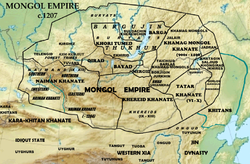
According to The Secret History of the Mongols, the first Mongol was born from the union of a blue-grey wolf and a fallow doe. Their 11th-generation descendant Alan Gua was impregnated by a ray of light[6] and begat 5 sons, the youngest being Bodonchar Munkhag, progenitor of the Borjigids.[7][8] According to Rashid-al-Din Hamadani, many of the older Mongolian tribes were founded by members of the Borjigin clan, including Barlas, Urud, Manghud, Taichiut, Chonos, and Kiyat. Bodonchar's descendant Khabul Khan founded the Khamag Mongol confederation around 1131. His great-grandson Temujin ruled the Khamag Mongol and unified the other Mongol tribes under him, being declared Khagan in 1206 thus establishing the Mongol Empire.

The etymology of the word Borjigin is uncertain.

History

[edit]
The Mongol Empire and its vassals, ca. 1300. The gray area is the later Timurid empire.

Members of the Borjigin clan ruled over the Mongol Empire,[9] dominating large lands stretching from Java to Iran and from Indo-China to Novgorod. Many of the ruling dynasties that took power following the disintegration of the Mongol Empire were of Chinggisid, and thus Borjigid, ancestry. These included the Chupanids, the Jalayirids, the Barlas, the Manghud, the Onggirat, and the Oirats.

In 1368, the Borjigid Yuan dynasty of China was overthrown by the Ming dynasty. Members of this family continued to rule over northern China and the Mongolian Plateau into the 17th century, becoming known as the Northern Yuan dynasty. Descendants of Genghis Khan's brothers, Hasar and Belgutei, surrendered to the Ming in the 1380s. By 1470, the Borjigids power was severely weakened, and the Mongolian Plateau was almost in chaos.

Post-Mongol Empire

[edit]
The Tumens of Mongolia proper and vassal states of the Mongol Empire by 1400

After the breakup of the Golden Horde, the Khiyat tribe of Borjigids continued to rule in Crimea and Kazan until they were annexed by the Russian Empire in the late 18th century. In Mongolia, the Kublaids continued to reign as Khagan of the Mongols, with brief interruptions by the descendants of Ögedei and Ariq Böke.

Under Dayan Khan (1480–1517) a broad Borjigid revival reestablished Borjigid supremacy among the Mongols in Mongolia proper. His descendants proliferated and became a new ruling class. The Borjigin clan was the strongest of the 49 Mongol banners from which the Bontoi clan proper supported and fought for their Khan and for their honor. The eastern Khorchins were under the Hasarids, and the Ongnigud, Abagha Mongols were under the Belguteids and Temüge Odchigenids. A fragment of the Hasarids deported to Western Mongolia became the Khoshuts.

The Qing dynasty respected the Borjigin family and the early emperors married Hasarid Borjigids of the Khorchin. Even among the pro-Qing Mongols, traces of the alternative tradition survived. Aci Lomi, a banner general, wrote his History of the Borjigid Clan in 1732–35.[10] The 18th century and 19th century Qing nobility was adorned by the descendants of the early Mongol adherents including the Borjigin.[11]

Asian dynasties descended from Genghis Khan included the Yuan dynasty of China, the Ilkhanids of Persia, the Jochids of the Golden Horde, the Shaybanids of Siberia and Central Asia, and the Astrakhanids of Central Asia. Chinggisid descent played a crucial role in Tatar politics. For instance, Mamai had to exercise his authority through a succession of puppet khans but could not assume the title of khan himself because he lacked Genghisid lineage.

The word "Chinggisid" derives from the name of the Mongol conqueror Genghis (Chingis) Khan (c. 1162–1227 CE). Genghis and his successors created a vast empire stretching from the Sea of Japan to the Black Sea.

  • The Chinggisid principle,[12] or golden lineage, was the rule of inheritance laid down in the (Yassa), the legal code attributed to Genghis Khan.
  • A Chinggisid prince was one who could trace direct descent from Genghis Khan in the male line, and who could therefore claim high respect in the Mongol, Turkic and Asiatic world.
  • The Chinggisid states were the successor states or Khanates after the Mongol empire broke up following the death of the Genghis Khan's sons and their successors.
  • The term Chinggisid people was used[by whom?] to describe the people of Genghis Khan's armies who came in contact with Europeans. It applied primarily to the Golden Horde, led by Batu Khan, a grandson of Genghis. Members of the Horde were predominantly KıpchakTurkic-speaking people rather than Mongols. (Although the aristocracy was largely Mongol, Mongols were never more than a small minority in the armies and the lands they conquered.) Europeans often (incorrectly) called the people of the Golden Horde "Tartars".

Babur and Humayun, founders of the Mughal Empire in India, asserted their authority as Chinggisids, claiming descent through their maternal lineage.

The Chinggisid also include such dynasties and houses as Giray, Töre, House of Siberia, Ar begs, Yaushev family[13] and other.

The last ruling monarch of Chinggisid ancestry was Maqsud Shah, Khan of Kumul from 1908 to 1930.

Modern relevance

[edit]

The Borjigin held power over Mongolia for many centuries (even during Qing period) and only lost power when Communists took control in the 20th century. Aristocratic descent was something to be forgotten in the socialist period.[14] Joseph Stalin's associates executed some 30,000 Mongols including Borjigin nobles in a series of campaigns against their culture and religion.[15] Clan association has lost its practical relevance in the 20th century, but is still considered a matter of honour and pride by many Mongolians. In 1920s the communist regime banned the use of clan names. When the ban was lifted again in 1997, and people were told they had to have surnames, most families had lost knowledge about their clan association. Because of that, a disproportionate number of families registered the most prestigious clan name Borjigin, many of them without historic justification.[16][17] The label Borjigin is used as a measure of cultural supremacy.[18]

In Inner Mongolia, the Borjigid or Kiyad name became the basis for many Chinese surnames adopted by ethnic Inner Mongols.[9] The Inner Mongolian Borjigin Taijis took the surname Bao (, from Borjigid) and in Ordos Qi (, Qiyat). A genetic research has proposed that as many as 16 million men from populations as far apart as Hazaras in the West and Hezhe people to the east may have Borjigid-Kiyad ancestry.[19] The Qiyat clan name is still found among the Kazakhs, Uzbeks and Nogai Karakalpaks.

Yuan dynasty family tree

[edit]

Genghis Khan founded the Mongol Empire in 1206. His grandson, Kublai Khan, after defeating his younger brother and rival claimant to the throne Ariq Böke, founded the Yuan dynasty of China in 1271. The dynasty was overthrown by the Ming dynasty during the reign of Toghon Temür in 1368, but it survived in the Mongolian Plateau, known as the Northern Yuan dynasty. Although the throne was usurped by Esen Taishi of the Oirats in 1453, he was overthrown in the next year. A recovery of the khaganate was achieved by Dayan Khan, but the territory was segmented by his descendants. The last khan Ligden died in 1634 and his son Ejei Khongor submitted himself to Hong Taiji the next year, ending the Northern Yuan regime.[20] However, the Borjigin nobles continued to rule their subjects until the 20th century under the Qing dynasty.[21][d]

Or in a different version (years of reign over the Northern Yuan dynasty [up to 1388] are given in brackets).

See also

[edit]

Notes

[edit]

References

[edit]

Further reading

[edit]
Revisions and contributorsEdit on WikipediaRead on Wikipedia
from Grokipedia
The Borjigin (Боржигин) were a Mongol clan of noble origin that rose to prominence in the late 12th century, producing Temüjin, who became known as Genghis Khan and unified the Mongol tribes to found the Mongol Empire, the largest contiguous land empire in history spanning Eurasia from the 13th to 14th centuries. Members of the Borjigin clan, as direct descendants of Genghis Khan, ruled over the empire's core territories and its successor states, including the Yuan dynasty in China under Kublai Khan and subsequent emperors who maintained Mongol dominance in East Asia until 1368. The clan's patrilineal genealogy, traced back through figures like Bodonchar Munkhag, emphasized martial prowess and imperial legitimacy, influencing Mongol governance, succession disputes, and genetic lineages observable in modern populations across Asia. Borjigin rulers implemented administrative reforms, merit-based military systems, and expansive conquests that facilitated trade along the , while their decentralized appanage system often led to fratricidal conflicts among khanates like the , , and . The clan's legacy endured in the and various Mongol principalities, with Borjigin descendants claiming authority into later periods, underscoring their enduring role in steppe politics and imperial expansion.

Origins and Etymology

Legendary Ancestry and Name Meaning

The Borjigin clan's name derives from its eponymous legendary ancestor Borjigidai Mergen ("Borjigidai the Wise"), a supreme figure in the clan's mythic patrilineage as recounted in The Secret History of the Mongols. This name has been interpreted by the 14th-century Persian historian Rashid al-Din as signifying "grey-eyed" or closely related shades such as yellowish-grey, reflecting a tied to distinctive physical traits attributed to early members of the Kiyat-Borjigin lineage. This interpretation underscores the clan's self-conception as marked by otherworldly or noble qualities, though it remains symbolic rather than a literal descriptor verifiable through . The Secret History of the Mongols, an anonymous 13th-century chronicle compiled around 1240, recounts the clan's mythic patrilineage originating from the union of Börte Chino—a grey wolf (börte chino denoting "greyish-blue" or "grey wolf")—and Qo'ai Maral, a fallow doe symbolizing beauty and fertility. This foundational narrative, rooted in shamanistic cosmology, evokes the ' adaptive resilience amid hardships, portraying the ancestors as divine emissaries from the eternal blue sky (tengri) rather than historical figures, thereby legitimizing the clan's antiquity through totemic symbolism over genealogical fact. In the genealogy, Borjigidai Mergen is the son of Kharchu and Mongoljin Gua, and the father of Torgoljin Bayan; he serves as the nominal great-great-grandfather of Bodonchar Munkhag, the direct founder of the Borjigin lineage, with the figure sometimes associated circa 747 AD amid potential confusions with other historical personages. Bodonchar Munkhag, the legendary progenitor of the Borjigin within the broader Kiyat tribe, emerges in these traditions as the first to embody this heritage by wandering astray during a hunt, surviving through cunning—such as trailing a wild ass to capture kinless nomads—and thereby founding the line around the early . His , evoking "sole wisdom" or resourceful isolation, highlights the clan's claimed prehistorical depth, predating unified Mongol polities and serving to affirm inherent qualities in oral and textual lore.

Early Historical Emergence

The Borjigin clan, particularly its Kiyat sub-lineage, gained historical prominence within the 12th-century , a loose of tribes including the Tayichiud and other Mongol groups. This coalesced under , a Borjigin leader who unified disparate nomadic bands through military leadership and diplomacy, establishing the first known overarching Mongol structure by the early 1130s. Khabul's tenure involved defensive campaigns against external threats, such as the Jurchen Jin, highlighted by his documented defiance at the Jin court in 1135, where he physically confronted Emperor Taizong, underscoring the confederation's autonomy amid regional power struggles. Following Khabul's death circa 1148, the Borjigin maintained influence through figures like and Hotula Khans, who faced severe setbacks including Ambaghai's capture and execution by the , prompting prolonged revenge feuds that strained tribal resources. , Khabul's grandson and a Kiyat-Borjigin chieftain, assumed a leading role in the by the mid-12th century, directing military actions against rivals like the , whom he defeated in raids that bolstered clan prestige. As chief, Yesugei navigated the confederation's internal dynamics, where the Borjigin coordinated with allied Tayichiud subunits—core components of the Khamag—for collective defense and raiding, while the structure relied on assemblies to resolve leadership transitions. The Borjigin's position was shaped by ongoing 12th-century tribal migrations and feuds across the , where nomadic groups shifted pastures amid climate pressures and competition for grazing lands, fostering both alliances and hostilities. Rivalries with the Merkits, one of the era's major confederations, involved intermittent conflicts over territory and captives, reflecting the precarious balance of power before broader unification efforts; these encounters tested Borjigin resilience without yielding decisive dominance. Such dynamics, rooted in ties and contingencies rather than centralized , positioned the clan amid fragmented loyalties, with empirical records from contemporary chronicles noting the 's estimated several thousand households engaged in seasonal movements and warfare.

Rise to Prominence

Genghis Khan's Unification Efforts

Temüjin, later known as Genghis Khan, was born around 1162 to Yesügei, a chieftain of the Borjigin clan, near the Onon River in present-day Mongolia. Yesügei, who traced his lineage to the clan's legendary founder Bodonchar, arranged Temüjin's betrothal to Börte, daughter of a minor Olkhonud leader, when Temüjin was about nine years old; this alliance aimed to strengthen Borjigin ties amid tribal rivalries. Shortly after, around 1171, Yesügei was poisoned by rival Tatars during a journey, leaving Temüjin, his mother Hö'elün, and siblings destitute and abandoned by former allies, forcing them to forage for survival in the steppes. This early adversity honed Temüjin's resilience, as he navigated internal family conflicts, including killing his half-brother Bekter over scarce resources, and began forging personal loyalties to rebuild Borjigin influence. In the late 1170s or early 1180s, Temüjin married Börte, but she was soon abducted by Merkit raiders seeking revenge for an earlier Borjigin capture of a Merkit bride; this crisis prompted Temüjin to seek aid from his childhood anda (sworn brother) Jamukha and the Kereyid leader Wang Khan (Ong Khan), leading to a successful rescue campaign that recovered Börte and solidified initial alliances. Temüjin and Jamukha then campaigned together against tribes like the Jajirats, but ideological differences—Jamukha favoring aristocratic privilege versus Temüjin's emphasis on loyalty and ability—fractured their partnership by 1186, sparking a rivalry that saw Jamukha briefly defeat and enslave Temüjin. Regrouping with supporters, Temüjin defeated the Tatars in 1202, avenging his father by executing their leaders, and absorbed their forces, demonstrating his strategy of integrating defeated foes rather than exterminating them to expand Borjigin-led coalitions. By 1204–1205, Temüjin had vanquished the Merkits, Naimans, and Jamukha's followers, culminating in Jamukha's execution at his own request to avoid further division; these victories dismantled fragmented tribal structures, enabling a grand kurultai (assembly) on the Onon River in 1206 where Mongol nobles proclaimed Temüjin "Genghis Khan," ruler over unified tribes, and elevated the Borjigins as the Altan Urug (Golden Family), the sole legitimate imperial lineage. To sustain dominance, Genghis restructured the decimal military system and promoted commanders based on demonstrated skill and loyalty rather than birth or clan ties, breaking from nomadic traditions of nepotism and fostering broader allegiance beyond Borjigin kin. This meritocratic approach, evidenced in appointments like Subutai (a former Uriankhai herdsman) to high command, causalized clan consolidation by incentivizing defection from rivals and minimizing internal Borjigin fractures through performance accountability.

Military Strategies and Initial Conquests

Genghis Khan reorganized the Mongol forces into a decimal-based system, forming units such as the arban of 10 warriors, jagun of 100, mingghan of 1,000, and tumen of 10,000, which enhanced command efficiency and tactical flexibility during campaigns from 1206 onward. This structure, drawn from nomadic traditions but systematized under Borjigin leadership, allowed for rapid mobilization of all able-bodied males aged 14 to 60, emphasizing merit over tribal loyalties. Complementing this were composite recurve bows, crafted from horn, wood, and sinew, which enabled warriors to fire accurately from horseback at ranges up to 300 meters, paired with high mobility from multiple remount horses per rider that sustained long pursuits and feigned retreats. These tactics, rooted in steppe warfare, proved decisive in outmaneuvering infantry-heavy foes. The establishment of the yam relay network facilitated intelligence gathering and logistics, with stations spaced every 25-40 kilometers staffed by couriers who could transmit messages across vast distances at speeds up to 300 kilometers per day, informing strategic decisions during expansions. Genghis Khan's forces adopted siege technologies, incorporating Chinese engineers and trebuchets after early encounters, as seen in assaults on fortified cities, which addressed initial weaknesses against walled defenses. Initial conquests targeted the Jin Dynasty starting in 1211, culminating in the capture of Zhongdu (modern ) by 1215 through and tactics, with contemporary records indicating over 500,000 from battles and massacres. The 1219 invasion of the Khwarezmian Empire followed diplomatic insults, involving divided tumens that swiftly overran , , and by 1221, employing terror to induce surrenders; Persian chroniclers like Juvayni reported up to 1.7 million deaths in these regions alone, though modern analyses attribute demographic declines to combined warfare, , and rather than direct killings alone. These policies of , demanding submission or annihilation, underscored the Borjigin strategy's ruthlessness, enabling conquests that halved regional populations in resistant areas per archaeological and textual evidence.

Governance of the Mongol Empire

Administrative Structures and Innovations

Genghis Khan, founder of the Borjigin imperial line, promulgated the in 1206 as a uniform legal code applicable across Mongol territories, emphasizing by prioritizing competence over noble birth for administrative roles, enforcing anti-corruption penalties such as execution for , and instituting through prohibitions on religious discrimination and favoritism. The code's provisions extended to regulating , conduct, and public order, fostering centralized authority while curbing tribal feuds and feudal disputes. To manage communication over vast distances, the Borjigins developed the yam relay system, originating from military needs and formalized under , featuring stations every 15 to 40 miles stocked with horses, provisions, and attendants for couriers traveling up to 200 miles per day. This network, radiating from —the administrative hub established under in the 1230s—enabled efficient decree dissemination and intelligence gathering, sustaining control from to Persia. Fiscal administration relied on periodic censuses for equitable taxation, with ordering registrations in northern around 1230 and extending surveys empire-wide to assess households for tribute in kind, labor, or coin, adapting sedentary models to nomadic oversight. These measures generated revenue streams, such as annual levies yielding millions of ingots from conquered regions, while minimizing direct exploitation through standardized quotas. Collectively, these structures precipitated the , a period of relative security from circa 1250 to 1300 that amplified commerce, as Mongol protection reduced banditry and tolls, correlating with expanded Venetian outposts in the Black Sea and surged Persian silk exports documented in contemporary ledgers. Trade volumes demonstrably rose, with artifacts like Chinese reaching in greater quantities, underscoring the empirical facilitation of Eurasian exchange under Borjigin rule.

Territorial Expansion and Peak Achievements

Under Genghis Khan's leadership from 1206 to 1227, the Mongol forces, drawn from Borjigin-led tribes, rapidly expanded from the Mongolian steppe, conquering the (Tangut) empire by 1227 after campaigns beginning in 1205, and subjugating much of the Jin Dynasty in northern China while destroying the Khwarezmian Empire in between 1219 and 1221, incorporating territories spanning from the to the . These conquests established a core domain of approximately 9 million square miles by the time of Genghis's death, enforced through systematic devastation of resisting cities to deter opposition. Ögedei Khan, ruling from 1229 to 1241, accelerated expansion, completing the fall of the Jin Dynasty in 1234 and launching invasions into Korea, , and , culminating in the in on April 11, 1241, where Mongol armies decisively defeated Hungarian and Templar forces, penetrating as far as the before withdrawing due to Ögedei's death. This era doubled the empire's reach, integrating vast steppes and forests under centralized Borjigin oversight via appointed governors and tribute systems. The empire attained its maximal contiguous extent by 1279 under Kublai Khan's , encompassing 24 million square kilometers from to the Korean Peninsula and Southern after the of the , governing roughly 110 million subjects or one-quarter of the world's population. This peak facilitated the , a period of relative security along trade routes that enabled trans-Eurasian exchanges, including the westward transmission of Chinese gunpowder weaponry and techniques, which Mongol armies adapted and disseminated through and diplomacy. These expansions yielded infrastructural gains, such as the Yam postal relay network spanning 4,000 stations across 100,000 kilometers, enhancing administrative control and commerce, though demographic analyses attribute approximately 40 million deaths between 1206 and 1400 to scorched-earth tactics, , and induced by the campaigns, representing a profound toll amid the territorial maxima.

Succession Crises and Familial Conflicts

Following Ögedei's death in 1241, a prolonged ensued under the regency of his widow Töregene, culminating in the election of their son Güyük as Great Khan in 1246. Güyük's reign, lasting until his death in April 1248 while en route to confront , was marked by efforts to reassert Ögödeid authority, including purges of rivals and resumption of western campaigns, but his sudden demise intensified factional tensions. The subsequent regency of Güyük's widow failed to stabilize the throne, as Ögödeid candidates faced opposition from the Toluid branch, leading to Möngke's election as Great Khan in July 1251 after a at Kodoe Aral. Möngke's ascension represented a Toluid coup against Ögödeid dominance, involving the execution of and purges of rival princes, including Ögödeid and Chagatai claimants, which eliminated threats but entrenched familial divisions. This Toluid-Ögödeid factionalism stemmed from competing claims to the imperial core territories, with Toluids leveraging military loyalty from Hulagu and Kublai's commands to sideline Ögödeid appanages. The rivalry weakened centralized authority, as regional ulus holders increasingly prioritized lineage interests over unified succession. A foundational dispute arose from Jochi's contested paternity, recorded in The Secret History of the Mongols, where Chagatai alleged Jochi was conceived during Börte's captivity among the Merkits, casting doubt on Jochid legitimacy within the Borjigin golden lineage. Despite Genghis Khan's public affirmation of Jochi as firstborn son and heir to western conquests, the rumor fueled enduring Jochid marginalization in core decisions, exacerbating Ögödeid-Toluid biases against them and contributing to the Golden Horde's semi-autonomous trajectory. Genetic studies have since affirmed Jochi's Borjigin descent via Y-chromosome markers, but the medieval controversy persisted as political ammunition, undermining Borjigin cohesion. Möngke's death in August 1259 triggered the , as Kublai proclaimed himself Great Khan in a southern on May 5, 1260, clashing with his brother Ariq Böke's rival election in the Mongol heartland. The conflict, lasting until Ariq Böke's surrender in 1264, pitted Kublai's eastern resources against Ariq Böke's control of , resulting in Kublai's victory but highlighting the empire's shift from elective —nominally favoring designated heirs like Ögedei—to fragmentation, where ulus autonomy eroded imperial unity. This intra-Toluid strife formalized decentralized , as Borjigin princes prioritized personal domains over collective , accelerating the empire's devolution into rival khanates.

Successor States and Dynasties

Yuan Dynasty in China

Kublai Khan, a Borjigin descendant of Genghis Khan, proclaimed the establishment of the Yuan Dynasty in 1271, marking the formal adoption of Chinese imperial nomenclature while retaining Mongol overlordship. This followed the partial conquest of northern China, with the dynasty's full control over the region solidified by the defeat of the Southern Song Dynasty in 1279 at the Battle of Yamen. Kublai's regime pursued sinicization to legitimize rule, incorporating Confucian bureaucracy and Chinese administrative titles, though ultimate authority rested with Mongol elites. Economic policies under the Yuan emphasized infrastructural integration and monetary innovation, including the expansion of the Grand Canal northward to Dadu (modern ) between 1281 and 1293 to facilitate grain transport from southern rice surpluses. Paper currency, initially backed by silver under a precious metal standard, became the sole , consolidating disparate systems from prior dynasties and enabling large-scale trade, though later over-issuance eroded value. Agricultural initiatives, such as improvements and rural cooperatives, supported population recovery from conquest-era depopulation, with Yuan rulers providing tax relief to encourage cultivation. A rigid ethnic privileged at the apex, followed by Central Asian allies (), Chinese, and at the base, restricting the latter's access to high offices and imposing discriminatory laws that barred intermarriage and favored Mongol legal exemptions. This stratification, combined with heavy taxation to fund military campaigns and administrative corruption, fueled Han resentment. The Red Turban Rebellion erupted in 1351 amid famines, floods, and perceived loss, with rebels citing discriminatory policies and economic burdens as grievances. By 1368, Zhu Yuanzhang's forces overthrew the Yuan, expelling Mongol rulers northward and establishing the , as over-taxation and rebellions eroded fiscal and coercive capacity.

Golden Horde and Western Territories

The , or Ulus of , was founded by , a Borjigin descendant through , Genghis Khan's eldest son, following the Mongol invasions of Kievan Rus' that began in late 1237. Batu's forces, numbering around 120,000-150,000 under commanders like , systematically sacked major cities including in December 1237, in February 1241, and Kiev in December 1240, resulting in widespread devastation and population declines estimated at 50% or more in affected regions. These campaigns established Mongol hegemony over the Russian principalities and Pontic-Caspian steppes, with Batu founding the capital Sarai on the lower Volga River around 1242. Borjigin khans governed through an indirect tribute system, extracting —annual payments in silver, furs, and goods—from Rus' states, including Novgorod, which remitted 1,300 silver grivnas or equivalent annually after negotiations in 1259 to avert . Local princes obtained yarlyks (charters of ) from the khan, fostering a political dynamic where loyalty in collection granted privileges; this empowered Moscow's rulers, such as Ivan I (r. 1325–1340), who allied closely with the Horde, collected tributes efficiently, and received the title of , aiding Moscow's ascendancy over fragmented rivals like amid periodic Horde-enforced interventions. While enabling some Rus' consolidation, the system perpetuated economic extraction, with total annual tribute from Rus' lands estimated at 10,000-20,000 silver pounds by the , alongside occasional punitive raids for non-compliance. Özbeg Khan (r. 1313–1341), another Jochi-line Borjigin, formalized as the state religion circa 1313, transitioning from shamanistic Tengriism and aligning the Horde with Muslim trading networks across the steppes, which boosted prosperity through tolls and commerce. This religious shift did not alter core tribute demands on Christian Rus' but influenced diplomacy, as Özbeg maintained suzerainty while intervening less invasively. The khanate's Borjigin rulers endured until the remnant fell to Crimean forces in 1502, after which successor states like the persisted under Jochid lines.

Chagatai Khanate in Central Asia

The Chagatai Khanate encompassed the Central Asian territories granted to Chagatai, the second son of Genghis Khan, following the latter's death in 1227. This ulus included regions from the Altai Mountains to the Amu Darya River, encompassing modern-day Kazakhstan, Uzbekistan, Kyrgyzstan, and parts of Afghanistan and Tajikistan. Chagatai ruled until his death in 1242, emphasizing adherence to Mongol customary law known as the Yasa, which he was tasked with enforcing empire-wide. Unlike other khanates that underwent rapid sedentarization, the Chagatai domain initially preserved nomadic traditions, applying Yasa strictly on the steppes while showing restraint toward sedentary Muslim urban centers. Subsequent rulers faced internal strife, marked by frequent khan overthrows and power struggles among Borjigin descendants and local amirs. The khanate split into western () and eastern () halves by the mid-14th century, exacerbating . Islamic conversions began accelerating in this period; Mubarak Shah became the first to convert around 1266, though his reign ended in deposition, while Tarmashirin Khan (r. 1331–1334) actively promoted Islam, facilitating broader Islamization among the elite and populace. Trade flourished along hubs like and , which served as economic centers linking , Persia, and the West, bolstered by Mongol security over caravan routes. The khanate's political fragmentation peaked in the late , enabling the rise of (Tamerlane), a Turkic-Mongol warlord who was not of Borjigin descent but falsely claimed Genghisid lineage to legitimize his authority. By 1370, had seized control of the western through military campaigns and alliances with local factions, installing puppet khans while wielding de facto power. This conquest effectively absorbed the western territories into the emerging by the 1360s–1370s, with the eastern persisting nominally until the before further fragmentation. The 's emphasis on traditional Mongol law provided a measure of cultural continuity amid these upheavals, distinguishing it from more assimilated successor states.

Ilkhanate in Persia

The was established in Persia by Hülegü Khan, a grandson of from the Borjigin lineage, in 1256 following his campaigns against the Nizari Ismailis and the . Hülegü's forces sacked in 1258, resulting in the death of Caliph and the destruction of the city's infrastructure, which marked the end of the and facilitated Mongol control over and western Persia. This event consolidated the Ilkhanate's authority in the region, spanning Persia, , and parts of and the , with Hülegü adopting the title ilkhan (subordinate khan) to denote nominal allegiance to the Great Khan. Early Ilkhanid patronage emphasized scientific endeavors, exemplified by the construction of the in 1259 under Hülegü's sponsorship and directed by the Persian polymath . The facility featured advanced instruments for astronomical observation, including a large and , fostering empirical studies that influenced later Islamic and European astronomy. Cultural syntheses emerged through integration of Persian administrative traditions with Mongol military structures, including the promotion of historical scholarship; Khan (r. 1295–1304) and his successor Öljeitü commissioned to compile the , a comprehensive world history that documented Mongol genealogy and Persian chronicles. , elevated to , oversaw initiatives in agronomy, including irrigation canal repairs and agricultural reclamation to counteract prior conquest-related disruptions to systems. Religious policies reflected initial Mongol shamanism and Buddhist influences, with early rulers like Hülegü and Abaqa tolerating Buddhist temples and Nestorian Christian communities while imposing limited religious impositions on subjects. This shifted decisively under , who converted to in 1295 amid political alliances, mandating Islamization of the court, destroying Buddhist institutions, and expelling non-converting monks, which aligned the more closely with Persian Muslim society but alienated some Mongol traditionalists. Fiscal policies, reliant on heavy taxation and iqtā' land grants to Mongol elites, enabled revenue extraction but drew criticisms for exploiting agrarian populations through arbitrary levies and , exacerbating economic strains despite Ghazan's reforms to standardize taxes and curb noble abuses. The fragmented after the death of the childless Abu Sa'id in 1335, lacking a clear Borjigin successor, which triggered succession disputes and regional autonomy. Power vacuums led to the rise of local dynasties, including the Jalayirids in and western Persia, and Turkic-Persian warlords, dissolving centralized control by the 1340s amid plagues, revolts, and invasions.

Decline and Fragmentation

Internal Divisions and Civil Wars

Following Kublai Khan's death in 1294, the Borjigin clan's authority fragmented amid recurrent succession disputes among its branches, exacerbated by the appanage system that allocated hereditary ulus territories to princes, prioritizing local allegiances over centralized imperial loyalty. This division, inherited from 's allocations to his sons and grandsons, intensified after the Great Khan's symbolic overlordship waned, as regional Borjigin rulers vied for dominance without mechanisms for enforced unity. In the , these tensions manifested in unstable transitions, such as the power vacuum after Temür Khan's death on October 10, 1307, which led to intrigues among court factions; seized the throne in 1308 amid rival claims, but his financially ruinous policies and early death on April 1, 1311, triggered further upheaval before Ayurbarwada's ascension. Between 1308 and 1333, the Yuan saw seven rapid successions, each marked by noble maneuvering and short reigns averaging under four years, underscoring the clan's inability to stabilize rule without broader Mongol consensus. Similarly, in the , Kaidu's death in 1301 ended prolonged anti-Yuan warfare but unleashed latent Borjigin rivalries between his eastern Naiman-influenced faction and traditional Chagatai lines, culminating in religious and territorial schisms by the 1320s that split the ulus into and appanages. Efforts at , such as Du'a Khan's 1304 treaty with Yuan envoys, proved ephemeral, as appanage holders like Yasaur prioritized local consolidation over joint campaigns. This eroded cohesion is empirically evident in the Chagatai-led invasions of the from 1299 to 1303, where forces under Qutlugh Khwaja—numbering around 100,000 in the 1299 —failed to breach Alauddin Khalji's defenses at the , withdrawing after heavy losses without reinforcement from other Borjigin branches distracted by internal disputes. Subsequent raids, like Targhi's 1303 incursion halted at the Indus, similarly collapsed due to divided command and logistical strains from khanate infighting, contrasting earlier unified Mongol offensives. Kurultais convened post-1294, such as regional assemblies in the eastern steppes, repeatedly failed to restore a nominal Great Khan with real authority, as Borjigin princes from divergent ulus rejected subordination, entrenching independence by the 1310s. The system's causal role in this decline is clear: by devolving obligations to personal retinues rather than imperial levies, it undermined the decimal-based tumen that had enabled conquests, rendering large-scale coordination untenable.

External Pressures and Loss of Legitimacy

In the Yuan dynasty, Borjigin rulers increasingly assimilated into Han Chinese sedentary society, adopting Confucian administrative systems, urban residences in Dadu (modern Beijing), and intermarriage with local elites, which by the 1350s had eroded their distinct nomadic identity and alienated traditional Mongol tribal followers who viewed such changes as a betrayal of Genghisid heritage. This cultural dilution weakened Borjigin legitimacy, as nomadic contingents withheld loyalty during subsequent upheavals, contributing to the dynasty's vulnerability to internal revolt. The , originating in and spreading through Mongol trade routes in the 1340s, inflicted severe demographic and economic damage across the khanates, killing an estimated 20-30% of populations and disrupting pastoral economies reliant on human labor for herding and tribute collection. In the , the plague exacerbated fiscal collapse by decimating urban centers like Sarai and Sarai al-Jadid, leading to abandoned trade posts and reduced tax revenues, which undermined Borjigin khans' ability to maintain military patronage and tribal alliances. Similarly, in the , outbreaks from the 1330s onward, including the death of the last effective Borjigin ruler Abu Sa'id in 1335, accelerated fragmentation by creating power vacuums filled by local Persian and Turkic warlords who challenged Mongol overlordship. Widespread rebellions further eroded Borjigin authority, as plagues compounded famines and floods that sparked peasant uprisings unsupported by tribal levies. The Red Turban Rebellion in the Yuan, erupting in 1351 amid Huang He River floods and grain shortages, mobilized secret societies against discriminatory Mongol policies and heavy taxation, culminating in the capture of Dadu on September 14, 1368, and the flight of north to . In the , plague-induced instability from the 1340s fueled religious revolts and nomadic defections, hastening splits into and by the 1370s, where Borjigin khans lost control to rival Timurid forces. By the 1440s, these pressures manifested in the Golden Horde's decisive dispersal, as plague-weakened Borjigin khans like faced tribal secessions and incursions from rising powers such as the and Kazakh confederations, symbolizing the terminal loss of unified Borjigin supremacy over steppe nomads who increasingly prioritized local autonomy over Genghisid descent claims. This fragmentation reflected broader delegitimization, with Borjigin rulers perceived as ineffective guardians against existential threats, prompting tribes to back non-Borjigin or peripheral leaders for survival.

Enduring Legacy

Genetic Evidence of Descent

In 2003, geneticist Tatiana Zerjal and colleagues published a study analyzing Y-chromosome haplotypes across Asian populations, identifying a specific lineage within C3* (now classified as C2-M217, specifically the "" subclade) that exhibited rapid expansion approximately 1,000 years ago, coinciding with the lifetime of (c. 1162–1227). This haplotype was detected in about 8% of men sampled from a vast region spanning the to the , encompassing 16 populations including , , and , with an estimated 0.5% prevalence in the global male population at the time—equating to roughly 16 million direct patrilineal male descendants. The study's authors attributed this proliferation to the Mongol Empire's conquests, which facilitated extensive and reproductive success among elite males, including those of the Borjigin clan, 's lineage, whose dominance in the empire's power structure provided causal mechanisms for such demographic amplification. Subsequent research has corroborated the star cluster's association with medieval Mongol expansion while refining its details. Population surveys indicate elevated frequencies in core Mongol-influenced groups: for instance, over 30% in certain Kazakh clans like the Kerey, and similarly high rates among and , with Mongolian samples showing C2-M217 subclades comprising 20–30% of Y-chromosomes in Khalkha and other subgroups. A 2018 whole-genome sequencing analysis of 34 C2* individuals pushed the estimated time to (TMRCA) back to around 2,100 years ago, suggesting origins among ordinary pre-empire rather than himself, though the haplotype's explosive growth post-1200 CE aligns with Borjigin-led imperial dynamics of conquest and elite reproduction. This refinement does not negate the empire-scale propagation but highlights that non-paternity events—such as historical doubts over Jochi's (Genghis's eldest son) biological paternity—or contributions from Borjigin relatives could explain the spread, with causal factors rooted in the clan's monopolization of power enabling outsized genetic transmission. Later studies from 2015 to 2024, including analyses of South Siberian lineages and remains, reinforce the haplotype's medieval Mongolian roots without identifying a unique Borjigin marker, as from confirmed members remains scarce. Estimates of living male-line descendants persist around 16 million or more, concentrated in (where roughly one in four to five males may carry related C2 lineages) and , underscoring sustained polygynous effects from the empire's era. Debates persist over alternative founders or pre-Mongol origins, yet the temporal and geographic congruence with Borjigin ascendancy, coupled with the haplotype's absence in pre-conquest samples, supports its linkage to the clan's reproductive amid empire-building.

Modern Descendants and Cultural Claims

Contemporary populations identifying as Borjigin are primarily located in , (China), and (China), where clan affiliation persists through oral traditions, family records, and cultural self-identification rather than formal census categories. In , estimates suggest that approximately one-fifth of the population claims Borjigin descent, reflecting widespread cultural assertions of lineage from the clan's historical prominence, though such claims lack centralized verification and vary by region and tribe. These identifications often intersect with broader Mongolian ethnic identity, but face restrictions in China, where emphasis on Han-centric narratives limits open discussion of clan-specific heritage. Historical precedents for contested Borjigin claims include the Timurids, who propagated a fabricated direct descent from to bolster legitimacy, despite genealogical evidence indicating Timur's Turkic origins and reliance on marriage alliances with actual Genghisids rather than bloodline inheritance. In modern contexts, such assertions continue to spark disputes, exemplified by the 2019 closed-door trial of historian Lhamjab A. Borjigin in , charged with "national " for publishing works on Mongolian cultural history and survivor accounts from the , highlighting tensions between ethnic pride and state policies suppressing perceived separatist narratives. Cultural claims of Borjigin have drawn for romanticizing the legacy, often emphasizing administrative innovations and expansive rule while minimizing the documented brutality of Mongol conquests, such as mass slaughters and forced displacements recorded in Persian and Chinese chronicles. Attributed to in , these narratives prioritize heroic ancestry over comprehensive causal analysis of imperial violence's human costs. Conversely, enduring Borjigin pride has reinforced Mongolian national cohesion , with Genghis Khan's lineage symbolizing resilience and unity, as evidenced by state-sponsored monuments and festivals that integrate heritage into civic identity without endorsing .

Historiographical Assessments and Debates

Scholars have long debated the Borjigin-led Mongol Empire's legacy, with early European and Persian accounts emphasizing widespread devastation and portraying the conquerors as barbaric hordes responsible for unprecedented destruction. Modern reassessments, drawing on archaeological evidence of expanded trade networks and administrative innovations, counter this by highlighting the empire's facilitation of Eurasian through the , a period of enforced stability that boosted overland commerce in goods like , spices, and technologies across continents. These innovations, including standardized weights, relay systems, and merit-based , provided precedents for later imperial governance in regions like Persia and , challenging the reductive narrative of as mere destroyers. Critiques persist regarding the empire's causal role in demographic catastrophes, with estimates attributing 40-60 million deaths to conquests, warfare, and ensuing famines—roughly 10-15% of the global population circa 1200-1300—though such figures must be contextualized against baseline Eurasian warfare norms, where sieges and reprisals routinely inflicted high casualties prior to Mongol campaigns. Historians note that while Borjigin policies amplified mortality through systematic terror tactics, pre-existing conflicts and climatic factors like the Medieval Warm Period's end contributed to vulnerabilities, underscoring that Mongol expansion exacerbated rather than uniquely invented mass violence. Debates intensify over , with Western historiography often amplifying brutality via filtered Persian chronicles (e.g., Rashid al-Din's selective narratives), while Eastern records, such as Yuan annals, document periods of administrative stability and cultural under Borjigin khans, revealing potential biases in Eurocentric interpretations that downplay constructive . Recent genetic studies bolster arguments for the Borjigin's enduring influence, identifying a Y-chromosome tracing to Genghis Khan's era in approximately 8% of men across former Mongol territories and 0.5% globally—evidence of prolific patrilineal propagation that persists undiluted, contradicting assumptions of rapid assimilation or genetic dilution in successor states. These findings, corroborated by analyses, affirm the clan's demographic imprint amid empire fragmentation, prompting reevaluations of historiographical emphases on decline over continuity in Borjigin lineage and cultural transmission.

References

Add your contribution
Related Hubs
User Avatar
No comments yet.