Hubbry Logo
Bass drumBass drumMain
Open search
Bass drum
Community hub
Bass drum
logo
8 pages, 0 posts
0 subscribers
Be the first to start a discussion here.
Bass drum
Bass drum
from Wikipedia
Bass drum
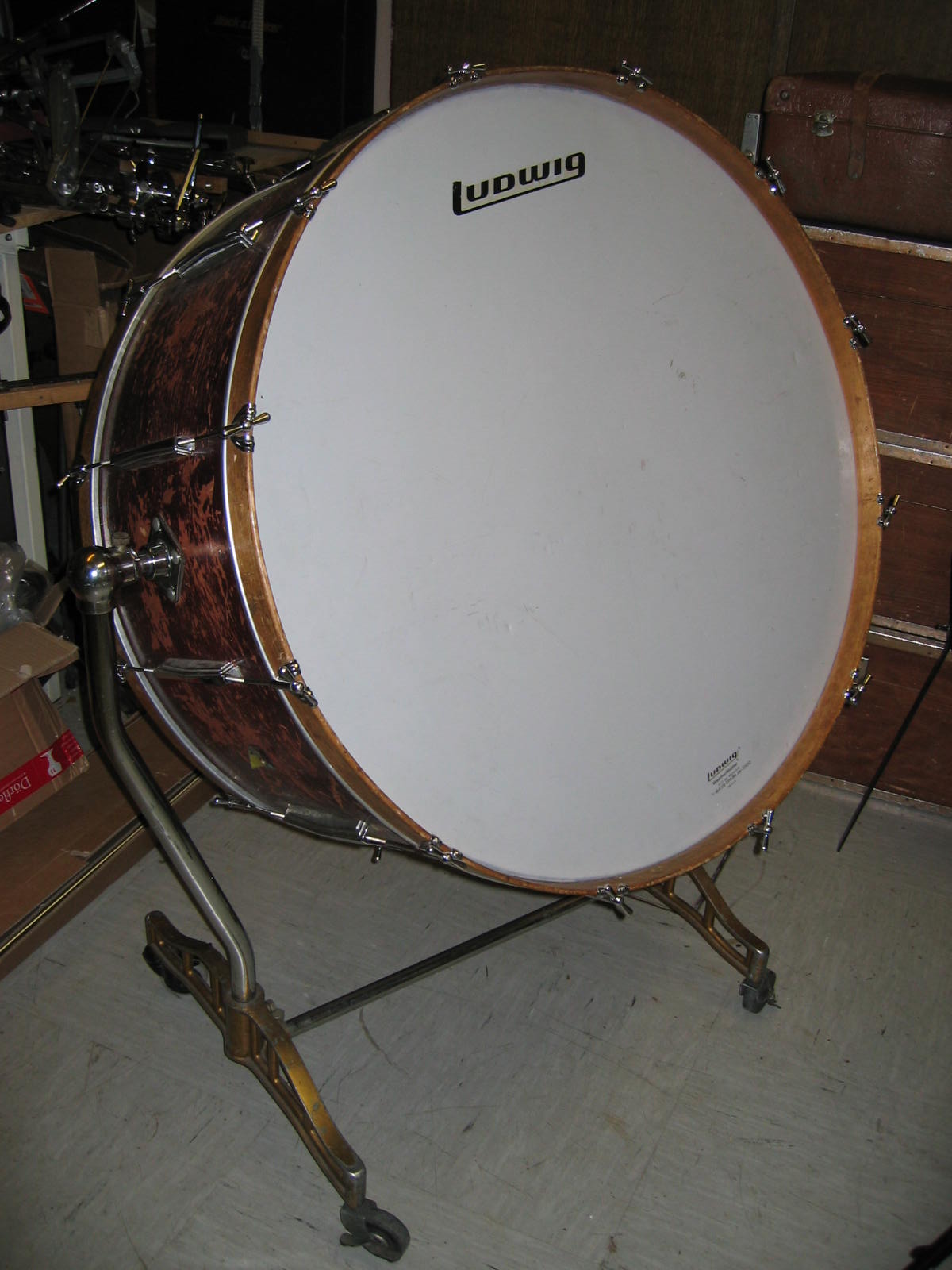
An orchestral bass drum
A pedal bass drum, or kick drum
Percussion instrument
Classification Percussion
Hornbostel–Sachs classification211.212.1
(Individual double-skin cylindrical drums)
DevelopedTurkey
Playing range
Four-on-the-floor, a steady beat maintained by bass drum[1] play within typical rock beat andalone

The bass drum is a large drum that produces a note of low definite or indefinite pitch. The instrument is typically cylindrical, with the drum's diameter usually greater than its depth, with a struck head at both ends of the cylinder. The heads may be made of calfskin or plastic and there is normally a means of adjusting the tension, either by threaded taps or by strings. Bass drums are built in a variety of sizes, but size does not dictate the volume produced by the drum. The pitch and the sound can vary much with different sizes,[2] but the size is also chosen based on convenience and aesthetics. Bass drums are percussion instruments that vary in size and are used in several musical genres. Three major types of bass drums can be distinguished.

  • The type usually seen or heard in orchestral, ensemble or concert band music is the orchestral, or concert bass drum (in Italian: gran cassa, gran tamburo). It is the largest drum of the orchestra.
  • The kick drum, a term for a bass drum associated with a drum kit, which is much smaller than the above-mentioned bass drum. It is struck with a beater attached to a pedal.
  • The pitched bass drum, generally used in marching bands and drum corps, is tuned to a specific pitch and is usually played in a set of three to six drums.

In many forms of music, the bass drum is used to mark or keep time. The bass drum makes a low, boom sound when the mallet hits the drumhead. In marches, it is used to project tempo (marching bands historically march to the beat of the bass). A basic beat for rock and roll has the bass drum played on the first and third beats of bars in common time, with the snare drum on the second and fourth beats, called backbeats. In jazz, the bass drum can vary from almost entirely being a timekeeping medium to being a melodic voice in conjunction with the other parts of the set.

Etymology

[edit]

Bass drums have many synonyms and translations, such as gran cassa (It), grosse caisse (Fr), Grosse Trommel or Basstrommel (Ger), and bombo (Sp).[2]

History

[edit]

The earliest known predecessor to the bass drum was the Turkish davul, a cylindrical drum that featured two thin heads. The heads were stretched over hoops and then attached to a narrow shell.[3][4] To play this instrument, a person would strike the right side of the davul with a large wooden stick, while the left side would be struck with a rod.[5] When struck, the davul produced a sound much deeper than that of the other drums in existence. Because of this unique tone, davuls were used extensively in war and combat, where a deep and percussive sound was needed to ensure that the forces were marching in proper step with one another.[6] The military bands of the Ottoman Janissaries in the 18th century were one of the first groups to utilize davuls in their music; Ottoman marching songs often had a heavy emphasis on percussion, and their military bands were primarily made up of davul, cymbal and kettle drum players.[5]

Davuls were ideal for use as military instruments because of the unique way in which they could be carried. The Ottoman janissaries, for example, hung their davuls at their breasts with thick straps.[3] This made it easier for the soldiers to carry their instruments from battle to battle. This practice does not seem to be limited to just the Ottoman Empire, however; in Egypt, drums very similar to davuls were braced with cords, which allowed the Egyptian soldiers to carry them during military movements.[3]

The davul, however, was also used extensively in non-military music. For example, davuls were a major aspect of Turkish folk dances.[7] In Ottoman society, davul and shawm players would perform together in groups called davul-zurnas, or drum and shawm circles.[7]

  • Long drums

At its peak, the Ottoman Empire stretched from Vienna down to northern Africa and most of the middle east.[8] This long reach meant that many aspects of Ottoman culture, including the davul and other janissary instruments, were likely introduced to other parts of the world. In Africa, the indigenous population took the basic idea of the davul – that is, a two-headed cylindrical drum that produces a deep sound when struck – and both increased the size of the drum and changed the material from which it was made, leading to the development of the long drum.[3] The long drum can be made in a variety of different ways but is most typically constructed from a hollowed-out tree trunk. This is vastly different from the davul, which is made from a thick shell.[9] Long drums were typically 2 meters in length and 50 centimeters in diameter, much larger than the Turkish drums on which they were based. The indigenous population also believed that the tree from which the long drum was made had to be in perfect shape. Once an appropriate tree was selected and the basic frame for the long drum was constructed, the Africans took cow hides and soaked them in boiling hot water, in order to stretch them out.[9] Although the long drum was an improvement on the davul, both drums were nevertheless played in a similar fashion. Two distinct sticks were used on the two distinct sides of the drum itself. A notable difference between the two is that long drums, unlike davuls, were used primarily for religious purposes.[9]

  • Gong drums

As the use of the long drum began to spread across Europe, many composers and musicians started looking for even deeper tones that could be used in compositions. As a result of this demand, a narrow-shelled, single-headed drum called the gong drum was introduced in Britain during the 19th century.[3] This drum, which was 70-100 centimeters in diameter and deep-shelled, was similar to the long drum in both size and construction. When struck, the gong drum produced a deep sound with a rich resonance. However, the immense size of the drum, coupled with the fact that there was not a second head to help balance the sound, meant that gong drums tended to produce a sound with a definite pitch. As a result, they fell out of favor with many composers, as it became nearly impossible to incorporate them in an orchestra in any meaningful way.[3][5]

  • Orchestral bass drums and drum kits

Because they were unable to be used by orchestras, music makers began to build smaller gong drums that would not carry a definite pitch. This smaller version of the gong drum is today called the orchestral bass drum, and it is the prototype with which people are most familiar today. The modern bass drum is used primarily in orchestras. The drum, similar to the davul and long drum, is double-headed, rod tensioned and measures roughly 40 inches in diameter and 20 inches in width.[3] Most orchestral bass drums are situated within a frame, which allows them to be positioned at any angle.[3]

Bass drums are also highly visible in modern drum kits. In 1909, William Ludwig created a workable bass drum pedal, which would strike a two-headed bass drum in much the same way as a drumstick.[10] During the 1960s, many rock ‘n’ roll drummers began incorporating more than one bass drum in their drum kit, including the Who's Keith Moon and Cream's Ginger Baker.[3][10]

Classical music

[edit]

In classical music, composers have much more freedom in the way the bass drum is used than in other genres of music. Common uses are:

  • Providing local "colour"[2]
  • Climactic single strokes[2]
  • Rolls[2]
  • Adding weight to loud tutti sections

Apart from the standard beaters mentioned above, implements used to strike the drum may include keyboard percussion mallets, timpani mallets, and drumsticks. The hand or fingers can also be used (it. con la mano). The playing techniques possible include rolls, repetitions and unison strokes. Bass drums can sometimes be used for sound effects. e.g. thunder, or an earthquake.[5]

Mounting

[edit]
A typically mounted bass drum used for concert bands and orchestras
Improvised bass drum in Trafalgar Square, London

Bass drums are too large to be handheld and are always mounted in some way. The usual ways of mounting a bass drum are:

  • Using a shoulder harness so that the heads are vertical
  • On a floor stand as part of a drum kit. The heads are always vertical when mounted in this way.
  • On an adjustable cradle. In this situation, the heads may be adjusted to any position between vertical and horizontal.
  • It is possible for the bass drum to have a single cymbal mounted on it[2]

Strikers

[edit]

Bass drums can have a variety of strikers depending on the music:

  • A single heavy felt covered mallet (Fr. Mailloche; It. Mazza).[2]
  • When the drum is mounted vertically, the malet above may be held in one hand and a rute held in the other.[2]
  • 2 matching bass drum mallets or a double headed mallet are used for playing drum rolls.[2]
  • When used as part of a drum kit, a variation of the mallet described above is mounted on a pedal and called a beater.

Electronic music

[edit]

In electronic music, bass drums, especially kick drums, are frequently used. Kick drum sounds are prominent in various music styles, including American genres like footwork and African genres such as gqom.[4][6][8]

Kit drumming

[edit]
Drum set used by Alex Van Halen

In a drum kit, the bass drum is much smaller than in traditional orchestral use, most commonly 20 or 22 inches (51 or 56 centimetres) in diameter. Sizes range from 16 to 28 inches (41 to 71 centimetres) in diameter while depths range from 12 to 22 inches (30 to 56 centimetres), with 14 to 18 inches (36 to 46 centimetres) being normal. Vintage bass drums are generally shallower than the current standard of 22 in × 18 in (56 cm × 46 cm).

Sometimes the front head of a kit bass drum has a hole in it to allow air to escape when the drum is struck for shorter sustain. Muffling can be installed through the hole without taking off the front head. The hole also allows microphones to be placed into the bass drum for recording and amplification. In addition to microphones, sometimes trigger pads are used to amplify the sound and provide a uniform tone, especially when fast playing without a decrease in volume is desired. Professional drummers often choose to have a customized bass drum front head, with the logo or name of their band on the front.

The kit bass drum may be more heavily muffled than the classical bass drum, and it is popular for drummers to use a pillow, blanket, or professional mufflers[11] inside the drum, resting against the batter head, to dampen the blow from the pedal, and produce a shorter "thud".

Different beaters have different effects, and felt, wood and plastic ones are all popular. Bass drums sometimes have a tom-tom mount on the top, to save having to use (and pay for) a separate stand or rack. Fastening the mount involves cutting a hole in the top of the bass drum to attach it; "virgin" bass drums do not have this hole cut in them, and so are professionally prized.

Bass drum pedal

[edit]
Ludwig's drum pedal patent
Conventional single pedal

In 1900, Sonor drum company introduced its first single bass drum pedal. William F. Ludwig made the bass drum pedal workable in 1909, paving the way for the modern drum kit.[12] A bass drum pedal operates much the same as the hi-hat control; a footplate is pressed to pull a chain, belt, or metal drive mechanism downward, bringing a beater or mallet forward into the drumhead. The beater head is usually made of either felt, wood, plastic, or rubber and is attached to a rod-shaped metal shaft. The pedal and beater system are mounted in a metal frame and like the hi-hat, a tension unit controls the amount of pressure needed to strike and the amount of recoil upon release.

Double bass drum pedal

[edit]
Tommy Aldridge was an early user of double bass drums in hard rock and heavy metal music.

A double bass drum pedal operates much the same way as a single bass drum pedal does, but with a second footplate controlling a second beater on the same drum. Most commonly this is attached by a shaft to a remote beater mechanism alongside the primary pedal mechanism.[13][14] One notable exception to this pattern is the symmetrical Sleishman twin bass drum pedal.

Original Sleishman twin pedal

Alternatively, some drummers opt for two separate bass drums with a single pedal on each, for a similar effect.

Drop-clutch

[edit]

When using a double bass drum pedal, the foot which normally controls the hi-hat pedal moves to the second bass drum pedal, and so the hi hat opens and remains open. A drop clutch can be used to keep the hi-hat in the closed position, even with the foot removed from the pedal.

Pedal techniques

[edit]

There are 3 primary ways to play single strokes with one foot. The first is heel-down technique, where the player's heel is planted on the pedal and the strokes are played with the ankle. This stroke is good for quiet playing and quick syncopated rhythms. The next technique is heel-up, where the player's heel is lifted off of the pedal and the strokes originate from the hip. The ankle is still flexed with each stroke, but the full weight of the leg can be used to add additional power for louder playing situations. Lifting the heel allows access to several double stroke techniques as well. The third primary technique is the floating stroke where the heel is lifted off the pedal as in heel-up, but the stroke is played primarily from the ankle as in heel-down. This motion can allow greater speed and higher note density at louder volumes but is not efficient for slow tempos or sparse rhythms.[15]

Drummers such as Thomas Lang, Virgil Donati, and Terry Bozzio are capable of performing complicated solos on top of an ostinato bass drum pattern. Thomas Lang, for example, has mastered the heel-up and heel-down (single- and double-stroke) to the extent that he is able to play dynamically with the bass drum and to perform various rudiments with his feet.

In order to play "doubles" on the pedal, drummers can employ 3 main techniques: slide, swivel, or heel-toe. In the slide technique, the pedal is struck around the middle area with the ball of the foot. As the drum produces a sound, the toe is slid up the pedal. After the first stroke, the pedal will naturally bounce back, hit the toe as it slides upwards, and rebound for a second strike. In the swiveling double, the pedal is struck once in the normal manner for the first note, then the heel is immediately rotated around the ball of the foot to the side of the pedal while simultaneously playing a second stroke. This rotation can be to the inside or outside, either will work, and results in a faster second stroke than is ordinarily possible.[15] In the heel-toe technique the foot is suspended above the foot-board of the pedal. The entire foot is brought down and the ball of the foot strikes the pedal. The foot snaps up, the heel comes off the footboard, and the toes come down for a second stroke. Once mastered either technique allows the player to play very fast double strokes on the bass drum. Noted players include Rod Morgenstein, Tim Waterson (who formerly held the world record for the fastest playing on a bass drum, using double bass), Tomas Haake, Chris Adler, Derek Roddy, Danny Carey and Hellhammer. The technique is commonly used in death metal and other extreme forms of music where triggers and double bass are typically employed. Double strokes can only properly replace single strokes for long runs of evenly spaced notes when using triggers or sample replacement as the sound is inherently uneven. Some tempos are only possible with double strokes, however.

Double bass drum

[edit]
Basic double bass drum pattern[16] Play

In many forms of heavy metal and hard rock, as well as some forms of jazz, fusion, and punk, two bass drums are used, or alternatively two pedals on one bass drum. If two drums are used, that is often to give a more impressive appearance on large stages, but sometimes, the second drum is pitched differently to provide some variety in the notes, thus creating a more nuanced sound. The first person to use and popularize the double bass drum setup was jazz drummer Louie Bellson,[17] who came up with the idea when he was still in high school. Ray McKinley was, by 1941, using this setup as well.[18] Double bass drums were popularized in the 1960s by rock drummers Ginger Baker of Cream, Keith Moon of The Who, Mitch Mitchell of the Jimi Hendrix Experience, and Nick Mason of Pink Floyd. After 1970, Billy Cobham and Narada Michael Walden used double kick drum with the jazz fusion project Mahavishnu Orchestra, Chester Thompson with Frank Zappa and Weather Report, Barriemore Barlow with Jethro Tull, and Terry Bozzio with Frank Zappa. For these genres the focus was 'odd-meter grooves and mind blowing solos'.[19] Double bass drumming later became an integral part of heavy metal,[19] as pioneered by the likes of Les Binks, Carmine Appice, Ian Paice, Cozy Powell, Phil Taylor and Tommy Aldridge. American thrash metal band Slayer's former drummer Dave Lombardo was named "the godfather of double bass" by the magazine Drummerworld. Later metal genres including death metal use double kick drumming extensively often with blast beat techniques, whilst focusing on precision, 'endurance', 'speed' and 'rapid footwork'.[19]

Double bass drumming can be achieved with a number of techniques; most commonly, with simple alternating single strokes. However, in order to increase the speed, some drummers use the heel-toe technique; these are essentially double strokes where the drummer can perform two hits with one foot movement, which causes less fatigue at higher tempos.

Notable names that have a hand in raising the bar for double bass drumming, include: Terry Bozzio, Simon Philips, Virgil Donati, Derek Roddy, Gene Hoglan, George Kollias, Bobby Jarzombek and Tomas Haake. Bozzio introduced the ostinato in his "Melodic Drumming and the Ostinato" educational DVDs, playing various drum rudiments on the feet, while freely playing with the hands, creating polyrhythms.[20] Donati is regarded as the first drummer to successfully use inverted double strokes with both feet, in addition to complex, syncopated ostinato patterns.[21] Roddy, Hoglan and Kollias are acknowledged as the leaders of extreme metal drumming with their use of single strokes at 250+ beats per minute, while, Jarzombek and Haake's double bass drumming influenced the djent genre.

The history and development of double bass (as well as notated playing instruction) can be traced in the books Encyclopedia of Double Bass Drumming written by Bobby Rondinelli and Michael Lauren[22] and The Complete Double Bass Drumming Explained written by Ryan Alexander Bloom.[23] In addition to these books, Double Bass Drumming written by Joe Franco and Double Bass Drum Freedom written by Virgil Donati are also commonly used resources for double bass instruction.

In marching bands

[edit]
Cavaliers Bassline 2006

The "bass line" is a unique musical ensemble consisting of graduated pitch marching bass drums commonly found in marching bands and drum and bugle corps. Each drum plays a different note, and this gives the bass line a unique task in a musical ensemble. Skilled lines execute complex linear passages split among the drums to add an additional melodic element to the percussion section. This is characteristic of the marching bass drum—its purpose is to convey complex rhythmic and melodic content, not just to keep the beat. The line provides impact, melody, and tempo due to the nature of the sound of the instruments. The bass line usually has from as many as seven bass drums to as few as two. But most high school drumlines consist of between three and five.

Components

[edit]

A bass line typically consists of four or five musicians, each carrying one tuned bass drum, although variations do occur. Smaller lines are not uncommon in smaller groups, such as some high school marching bands, and several groups have had one musician playing more than one bass drum, usually small ones, with one mounted on top of the other.

The drums are typically between 16" and 32" in diameter, but some groups have used bass drums as small as 14" and larger than 36". The drums in a bass line are tuned such that the largest will always play the lowest note with the pitch increasing as the size of the drum decreases. Individually, the drums are usually tuned higher than other bass drums (drum set kick drums or orchestral bass drums) of the same size, so that complex rhythmic passages can be heard clearly and articulated.

Unlike the other drums in a drumline, the bass drums are generally mounted sideways, with the drumhead facing horizontally, rather than vertically. This results in several things. First of all, to ensure that a vibrating membrane is facing the audience, bass drummers must face perpendicular to the rest of the band and so are the only section in most groups whose bodies do not face the audience while playing. Consequently, bass drummers usually point their drums at the back of the bass drummer in front of them, so that the drum heads will all be lined up, from the audience's point of view, next to one another in order to produce optimal sound output.

Playing

[edit]

Since the bass drum is oriented differently from a snare or tenor drum, the stroke itself is different, but the fundamentals remain the same. The player's forearms should be parallel to the ground and bent at the elbows. The line between their shoulder and elbow should be vertical and the mallet should be held upward at a 45-degree angle.[24] The hands hold bass mallets in such a way as to place the center of the mallet in the center of the head. The mallet shaft bottom should be flush against the bottom part of the hand when playing, differing from other grips typical to percussion instruments.

The motion of the basic stroke is either similar to the motion of turning a doorknob, that is, an absolute forearm rotation, or similar to that of a snare drummer, where the wrist is the primary actor, or more commonly, a hybrid of these two strokes. Bass drum technique sees huge variation between different groups both in the ratio of forearm rotation to wrist turn and the differing views on how the hand works while playing. Some techniques also call for the use of fingers supporting the motion of the mallet by opening or closing, but no matter whether it is open or closed the thumb needs to be close to the rest of the fingers.

However, the basic stroke on a drum produces just one of the many sounds a bass line can produce. Along with the solo drum, the "unison" is one of the most common sounds used. It is produced when all of the bass drums play a note at the same time and with a balanced sound; this option has a very full, powerful sound. The rim click, which is when the shaft (near the mallet head) is struck against the rim of the drum, either solo or in unison. Rimshots are rare on a bass drum and usually only happen on the top drums.[25]

The different positions of the typical five person bass line each require different skills, though not necessarily different levels of skills. Contrary to the popular belief that "higher is better," each drum has its own critical role to play. Bottom, or fifth bass, is the largest, heaviest, and lowest drum in the drumline. Consequently, it is used frequently to help maintain pulse in an ensemble and is thus sometimes referred to as the "heartbeat" of the group (the bottom bass was also often referred to as the "thud" bass in days gone by, indicating that many of their notes were the last one at the end of a phrase). Although this player does not always play as many notes as fast as other bass drummers (the depth of pitch renders most complex passages indistinguishable from a roll), his or her role is essential not only to the sound of the bass line or the drum line, but to the ensemble as a whole, especially in the case of parade bands.

The fourth bass is slightly smaller than the bottom drum (generally two to four inches (51 to 102 mm) smaller in diameter) and can function tonally similar to its lower counterpart, but usually plays slightly more rapid parts and is much more likely to play "off the beat" - in the middle rather than at the beginning or end of a passage. The third bass is the middle drum, both in terms of position and tone. Its function is usually that of the archetypical bass drum. This player plays an integral role in the actual rendering of complex linear passages. The second bass is known for having a job in the drumline. This player's parts are very likely to be directly adjacent to the beginning or end of a phrase and less likely to be on a beat, which is highly counter-intuitive, especially to a new player. Sometimes this drum can function about the same as the top drum, but usually the second and top drummer function as a unit, playing rudimentarily difficult passages split between them.

Top, or first, bass is the highest pitched drum in the bass line and usually starts or ends phrases. The high tension drum heads allow this player to play notes that are just as taxing as those of the snare line, and often the top bass will play a part in unison with the snare line to add some depth to their sound. Some bass lines have more than five bass drums, with the largest being the largest number (bass 7 on a 7 bass line), and the smallest being referred to as first bass.

Marching

[edit]
Purdue University marching band's large bass drum

In a marching band's field show, bass drummers typically face either goal line. It can be difficult to see the drum major and other players on the field when facing away from the center. For this reason, the players may turn to face the opposite direction during a show. Turns are typically done in unison or rippled for a different effect.

With large bass drums, more strength and control is required to turn quickly. Achieving a clean turn requires the player to use large core muscles to stop momentum of the drum at the correct time and direction.

In some marching bands, the bass drum is used to give orders to the band. For example,

  • One stroke is used to order the band (and associated troops) to start/stop marching
  • Two strokes are used to order the band to stop marching
  • Two strong strokes (Double Beat) are used when the music is due to cut off (usually a double beat then three beats and finish)

References

[edit]
[edit]
Revisions and contributorsEdit on WikipediaRead on Wikipedia
from Grokipedia
The bass drum is a large classified as a , characterized by its cylindrical shell and one or two taut drumheads that produce a deep, resonant low pitch of indefinite tone when struck. Typically constructed from wood such as or , or sometimes metal or , the bass drum's shell diameter ranges from about 35 to 100 centimeters, with depths varying by type, and the heads—made of or —are tensioned using rods or screws to achieve the desired boom. Originating from the Middle Eastern , a double-headed cylindrical drum documented as early as the in Turkish and traditional , the bass drum was introduced to in the 18th century through Ottoman bands and quickly adopted for dramatic effects in operas by composers like and Haydn. By the 19th century, it became a staple in orchestral and ensembles, with innovations like the first notated appearing in Berlioz's (1830), and screw-tensioning systems replacing earlier rope methods for more precise tuning. The modern pedal mechanism, patented by the Ludwig Drum Company in 1909, revolutionized its role in drum kits, allowing a single performer to integrate it seamlessly into , rock, and popular genres. Bass drums vary by context and size, including the larger orchestral models (70–100 cm diameter) played with large felt-headed mallets or timpani sticks for broad, echoing strokes; smaller military versions (35–75 cm) for marching bands; and compact drum-kit bass drums (45–70 cm, often 22–24 inches) struck via foot pedal for rhythmic drive in contemporary ensembles. Rare variants like the single-headed gong drum feature a narrower shell for specialized timbres. In performance, it provides foundational pulse and rhythmic emphasis across genres—from setting the in 19th-century battles like Waterloo to underscoring dramatic climaxes in works by , Stravinsky, and Prokofiev—while modern tuning techniques adjust head tension for clarity without targeting a specific pitch.

Fundamentals

Definition and characteristics

The bass drum is a large classified as a , producing low-frequency sounds primarily through the vibration of one or more taut membranes stretched over a resonant body when struck. It features a typically cylindrical shell with a significantly larger than its depth, often equipped with single or double heads made of animal or synthetic materials, allowing for tunable tension to adjust pitch and tone. The instrument's design emphasizes the generation of deep, resonant fundamentals, generally in the range of 40 to 100 Hz, contributing to its characteristic booming, non-pitched or indefinitely pitched that lacks the sharp attack of higher-frequency percussion. Key physical characteristics include a shell ranging from 50 to 100 cm, which enables the production of extended low-end compared to smaller , and the use of both heads to couple vibrations for enhanced sustain and depth. Unlike snare , which are compact (typically 14 inches in ) and incorporate rattling snares for a crisp, high-pitched snap around 200-250 Hz, or tom-toms, which are mid-sized with defined pitches in the 100-200 Hz range, the bass drum prioritizes expansive size and lower pitch for a foundational thump rather than articulate or . This distinction arises from its broader head area and looser tension, focusing on subsonic impact over precision. In musical ensembles, the bass drum serves as the primary provider of rhythmic foundation, establishing the and adding sonic depth to support and melodic elements across genres. Its role involves marking and groove through sustained low-frequency pulses, creating a sense of stability and drive that unifies the ensemble without dominating higher registers.

Types and variations

The bass drum encompasses several distinct types tailored to specific musical ensembles and performance demands, primarily differentiated by their physical structure and acoustic profile. The orchestral bass drum, also known as the concert bass drum or gran cassa, is a large, double-headed instrument designed for symphonic settings, typically featuring a of 32 to 40 inches to produce deep, resonant tones that enhance orchestral depth and drama. In contrast, the marching bass drum is engineered for portability and projection in outdoor or parade contexts, often double-headed with a shallower depth of 12 to 20 inches and diameters ranging from 28 to 32 inches, secured by either traditional tensioning or modern rod-tuning mechanisms for durability during movement. Variations extend to specialized uses, such as the concert bass drum, which is used in concert bands with similar large dimensions to the orchestral model for powerful low-frequency output. In pipe bands, the bass drum is a carried, double-headed instrument optimized for rhythmic foundation alongside , commonly 28 inches in diameter with depths of 12 to 16 inches to ensure clarity and volume in group formations. Hybrid forms offer innovative alternatives for bass effects, exemplified by roto-toms, which are single-headed, tunable drums ranging from 6 to 18 inches in diameter; when set to lower pitches, larger models simulate bass drum timbres through rim-adjusted tension, providing versatility in modern percussion setups. Regional variations highlight historical influences, such as the Turkish , a double-headed cylindrical precursor to Western bass drums, approximately 22 inches in diameter, that delivers contrasting bass and snare-like tones from its dual playing surfaces. For drum kits in rock or jazz contexts, bass drums are generally smaller, with diameters of 18 to 26 inches, balancing portability and punch within a full setup.

Etymology and History

Etymology

The term "bass drum" in English derives from the combination of "bass," referring to low pitch or sound, and "drum," denoting a percussion instrument. The word "bass" originates from Late Latin bassus, meaning "low" or "short," which entered English in the late 14th century and was applied to low musical notes and voices by the mid-15th century, influenced by Italian basso. Meanwhile, "drum" entered English in the early 15th century from Middle Dutch tromme, likely a back-formation from trommelslach ("drumbeat"), and was used to describe a hollow percussion instrument beaten to produce sound. This nomenclature emphasizes the instrument's characteristic low-frequency role in musical ensembles. In 18th-century , the bass drum was commonly known as the "Turkish drum," reflecting its origins in the Ottoman instrument called the davul, a large double-headed drum central to Turkish military music (mehter) and ceremonial traditions since Central Asian times. European languages adopted parallel terms highlighting its size and function, such as French grosse caisse ("large box" or large drum), evoking its box-like shell, and German Grosse Trommel ("large drum"), while Kesselpauke referred to related bass-pitched kettledrums like . As the instrument gained prominence in Western music during the 19th century, terminology shifted toward "bass drum" to underscore its pitch, aligning with orchestral standardization and the influence of Turkish styles in compositions like Haydn's works. In non-Western traditions, distinct names persisted, such as Ottoman Turkish davul for the double-headed cylindrical drum used in folk and military contexts, and Japanese nagado-daiko (or "long-body drum") in taiko ensembles, often played in Shinto shrines and Buddhist temples to produce deep, resonant tones.

Historical development

The bass drum's precursors can be traced to ancient civilizations, where large percussion instruments provided deep resonant tones for rituals and ceremonies. In , barrel-shaped drums, suspended from the musician's neck and struck by hand, appeared during the Middle Kingdom around 2000 BCE, serving as early large-diameter drums capable of low-frequency sounds similar to modern bass drums. Similarly, Mesopotamian art from approximately 2100 BCE depicts frame drums of various sizes, including shallow cylindrical forms that functioned as foundational large percussion instruments in communal and religious contexts. The instrument's form as recognized in emerged through cultural exchanges with the . Derived from the Turkish —a double-headed cylindrical drum used in military ensembles—the bass drum was introduced to Western via Janissary bands during the , when Ottoman influences spread through military interactions and exoticized performances in European courts. This , played with sticks on both heads to produce bass and snare-like effects, evolved into the double-headed European bass drum by the mid-1700s, initially termed the "Turkish drum" for its exotic origins. In the , the bass drum gained prominence in orchestral settings, marking a shift from military to symphonic use. French composer prominently featured it in his Symphonie fantastique (1830), employing the instrument for dramatic rolls and accents to heighten emotional intensity, which helped standardize its role in Western classical music. Concurrently, mechanical innovations addressed the challenges of playing large bass drums single-handedly; crude foot-operated pedals emerged in the late 1880s, allowing drummers to strike the drum while using both hands for other percussion. A pivotal advancement came with the 1909 patent by William F. Ludwig for a spring-driven, free-standing pedal, which revolutionized assembly by enabling efficient bass drum play in ensemble settings. The 20th century saw the bass drum integrate deeply into popular genres, expanding its versatility through technological and stylistic evolutions. In during the , the pedal-equipped bass drum became essential to the emerging , providing steady pulse and improvisational accents in New Orleans ensembles and big bands, as drummers like Zutty Singleton adapted it for syncopated rhythms. By the 1950s, rock 'n' roll amplified its role, with the bass drum driving the backbeat in high-energy performances; early adopters like those in Bill Haley's Comets used compact models for portable, powerful kits that defined the genre's propulsive sound. This period's innovations carried into the 1960s, where setups like Ringo Starr's Ludwig kit—featuring a 22-inch bass drum—popularized larger configurations in rock, influencing global fusions that blended the instrument with traditions from African ensembles to Latin conga groups.

Construction and Design

Materials and components

The shell of a bass drum forms its resonant body and significantly influences the instrument's tone, projection, and . Wooden shells, commonly constructed from or staves of or , provide warm lows and resonant punch due to their natural acoustic properties, making them ideal for versatile applications where depth and sustain are desired. offers even response across frequencies with enhanced low-end warmth, while delivers boosted highs and cutting projection for louder settings. These wood types contribute to through multi-ply , though they may require to withstand heavy playing. Metal shells, typically made from or aluminum, prioritize projection and clarity over warmth, producing a brighter, more focused tone suitable for environments demanding . yields clear highs with balanced mids and lows for all-purpose use, whereas aluminum provides crisp highs and open mids, enhancing sensitivity and color in the sound. These materials offer superior against impacts compared to , with less susceptibility to environmental changes. Acrylic shells, often transparent for visual appeal in performance settings, deliver a powerful attack and strong presence across frequencies, combining aesthetic benefits with robust projection. Bass drums are typically double-headed, featuring a batter head on the striking side and a resonant head on the opposite side, which together shape the overall tone through vibration and air movement. The batter head, directly impacted by the beater, can be single-ply for brighter sensitivity or double-ply for deeper punch and greater durability under repeated strikes. Natural calfskin heads produce a dark, warm tone with a chubby attack and rich overtones but are less durable, as they are prone to weather-induced inconsistencies in tension and pitch. Synthetic heads made from Mylar or plastic, introduced widely since the 1950s, ensure consistent performance unaffected by humidity, offering reliable tone control while mimicking calfskin's warmth in blended formulations. The resonant head, which vibrates in response to air pressure from the batter side, influences sustain and depth; thicker versions (7-10 mil) extend for fuller lows, while thinner ones yield brighter, shorter decay. Single-headed setups, less common for bass drums, result in brighter tone with reduced sustain but are occasionally used for specialized projection. Head choices directly impact durability, with synthetics resisting tears better than natural skins, and pre-muffled designs on either head minimizing unwanted for focused attack. Hardware components secure the heads and enable precise tuning, ensuring structural integrity and tonal consistency. Tension rods, often threaded for fine adjustments like True-Pitch designs, apply even pressure to maintain head tension and facilitate quick tuning changes. Lugs, such as mini-turret styles, mount along the shell to anchor the rods, providing durable support that withstands the stress of bass drum playing without deforming. Hoops, available in wooden forms for natural resonance or metal triple-flange types for rigidity, encircle the shell edges to distribute tension evenly and enhance rimshot durability. Counterhoops, functioning as the inner rims, work in tandem with the outer hoops to clamp the heads securely, allowing for balanced tuning across the drum's perimeter and contributing to overall stability during performance. Internal components fine-tune the bass drum's response by managing and . Dampening mufflers, such as felt strips or pads mounted inside against the batter or resonant head, absorb excess vibrations to reduce and control sustain, promoting a tighter, more defined tone without external additions. Air vents, typically ported holes in the resonant head or shell, regulate internal air to enhance low-frequency projection and allow placement, thereby adjusting the drum's openness and attack for varied tonal needs. These elements improve by preventing pressure buildup and enable customization for specific acoustic environments.

Sizes and configurations

Bass drums vary significantly in size and configuration to suit different musical demands, with diameters typically ranging from 18 to 40 inches depending on the context. For rock kits, standard diameters fall between 20 and 24 inches, providing a balance of punch and projection suitable for amplified settings. In jazz ensembles, larger concert bass drums with diameters of 28 to 32 inches are common, offering deeper resonance for acoustic environments. Orchestral and marching bass drums often measure 32 to 40 inches in diameter, allowing for powerful, room-filling tones in large-scale performances. Depth influences the drum's tonal character and practicality, with shallower shells of 8 to 10 inches used in compact kits for easier transport and tighter response, while deeper shells of 16 to 20 inches enhance sustain and low-end resonance. Marching bass drums frequently feature a uniform depth of 14 inches across various diameters to maintain consistency in tonal progression within an ensemble. Configurations differ based on application, with single-headed designs prevalent in some orchestral settings for simplified tuning and focused articulation, as seen in large bass drums. Double-headed models dominate marching and general use, enabling balanced from both batter and resonant sides. Modern bass drums are typically tunable via rod-tension systems for precise pitch adjustment, whereas rope-tensioned variants persist in historical or traditional contexts for their authentic, adjustable tension via lacing. Custom setups allow for hybrid sizes, such as 24- to 28-inch diameters tailored to fusion genres blending kit and elements, while portable forms with shallower depths suit mobile marching applications and stationary deep-shell versions support fixed orchestral installations.

Playing Techniques and Accessories

Strikers and mallets

Strikers and mallets for bass drums encompass a variety of tools designed to produce different tonal qualities, from warm resonances to sharp attacks, depending on the material and construction. These implements typically consist of a or shaft attached to a striking head, allowing percussionists to control volume, sustain, and articulation through hand strikes in , orchestral, or settings. Felt mallets, often featuring soft, rounded heads, deliver a warm, resonant tone ideal for orchestral applications where blended warmth and sustain are desired. These mallets minimize harsh overtones, providing a full-bodied that integrates well in large ensembles. In contrast, wood or acrylic beaters with harder, denser heads produce a bright, aggressive attack suitable for rock and contexts, emphasizing punch and clarity over prolonged decay. Brushes, consisting of flexible wire or synthetic bristles, offer subtle effects such as metallic buzzing or dull hissing when swept or struck against , enabling nuanced textures in quieter passages. The striking heads commonly incorporate materials like rubber for controlled rebound and balanced volume, leather for an organic punch without excessive brightness, or plastic for precise, defined impacts that enhance articulation. Shaft variations, such as hickory wood for durability and natural feel or fiberglass for lightweight responsiveness, influence grip and swing dynamics, allowing adaptation to extended playing sessions. Selection of strikers and mallets is guided by genre-specific needs, with large-headed designs favored in for extended sustain and , while smaller, compact heads provide the precision required for applications. Innovations such as double-sided mallets, offering contrasting surfaces like felt and wood on opposite ends, and interchangeable heads that allow quick swaps for varying tones, enhance versatility for performers across multiple styles. Some designs integrate with pedal mechanisms for hybrid use, though hand-held variants remain predominant for direct control.

Pedals and mechanisms

The single bass drum pedal is a foot-operated mechanism designed to strike with a beater while allowing the drummer's hands to play other instruments simultaneously. It typically consists of a footboard linked to the beater via a drive system, with an adjustable spring that provides to return the beater to its resting position after each . The spring tension can be tuned to balance responsiveness and control, enabling faster playing or more controlled dynamics depending on the musical context. Early developments of the single pedal emerged in the late to address the need for efficient one-person operation of bass drums in theater and circus ensembles. A foundational was granted to George R. Olney in 1887 for a basic drum pedal (U.S. 357,093), which used a simple linkage to connect foot action to the beater. An improved version with a free-standing, spring-driven mechanism was patented by William F. Ludwig and Theobald V. Ludwig in 1909, introducing greater stability and rebound efficiency that became a standard for commercial production. Two primary drive systems distinguish modern single pedals: direct-drive and chain-drive. Direct-drive pedals connect the footboard directly to the beater shaft via a solid metal linkage or cam, delivering immediate response and power suitable for precise, high-speed strikes, though they can transmit more vibration to the foot. In contrast, chain-drive pedals employ a chain or dual-chain loop between the footboard and cam, offering a smoother, more forgiving action with reduced vibration transfer, which many drummers prefer for extended play and natural feel. Double pedal systems extend the single pedal's functionality by incorporating two beaters operated by one or two footboards, facilitating rapid alternating strokes on a single bass drum or separate drums without requiring additional players. These systems typically feature a master pedal linked to a slave pedal via a drive chain or bar, allowing coordinated action while maintaining independent adjustability for tension and beater angle. Early adoption involved pairing two independent single pedals with dual bass drums, as pioneered by jazz drummer in the , but linked designs soon followed to conserve stage space. The first linked double pedal appeared in the 1940s with the DUBL-PEDL from the DUBL-PEDL Company in , a innovative single-bass-drum setup that included an integrated mechanism, though it remained niche until later commercialization. advanced in the late 1960s with Don Sleishman's Twin Pedal from the Sleishman Drum Company in 1968, which used a robust linkage for reliable dual-beater operation and gained popularity among and drummers seeking efficient double-bass techniques. Although , founded in 1957, contributed to percussion innovations like synthetic heads, double pedal development was driven primarily by specialized hardware firms rather than Remo directly. Drop-clutch mechanisms in bass drum pedals provide quick disengagement of the beater or linkage, essential for rapid setup changes in marching bands or portable kit transitions. These features often involve spring-loaded clamps or levers that release the pedal from the drum hoop or plate with minimal effort, preventing tangles during transport and allowing seamless reconfiguration between concert and marching configurations. Such designs, refined in the mid-20th century, enhance portability without compromising the pedal's core mechanics.

Mounting and positioning

In drum kits, the bass drum is typically positioned on the floor, laid on its side with the front head facing the , and secured using integrated legs or spurs on each side to prevent rolling or movement. These spurs feature convertible tips, such as rubber for hard surfaces or spikes for carpets, ensuring stability during performance. Many bass drums include brackets mounted at the top of the shell to support rack toms or holders, allowing for centralized attachment over the drum for balanced setup. For orchestral use, the bass drum is often suspended from a specialized frame using or rubber straps at multiple points, enabling free swinging and adjustable positioning. This suspension allows the drum to be oriented vertically or at an angle, with common setups tilting it to approximately 45 degrees on a rotating stand to facilitate playing techniques like rolls. Alternatively, it may rest on a dedicated stand, positioned with heads vertical and aligned to the player's left and right for access. In marching bands, bass drums are mounted using carrier frames and harness slings that distribute weight across the player's shoulders and torso for body-worn balance during movement. These or ergonomic carriers feature adjustable aluminum J-arms and belly plates to secure the drum at an optimal height and center it relative to the body, minimizing strain and maintaining stability. Adjustments for height and angle are essential across setups for , with bass drums often tilted slightly forward using spurs or stands to align with pedal mechanisms and promote natural leg positioning. Anti-slip bases or spurs lift the front hoop just off the ground, directing sound outward while allowing fine-tuning of the drum's orientation to fit the player's posture, such as ensuring the right leg forms a 90-degree angle with the pedal board.

Musical Applications

Classical and orchestral use

The bass drum entered Western orchestral scores in the late , often evoking Turkish military influences through its powerful, resonant . incorporated it in his Symphony No. 100, "Military" (1793–1794), using it alongside other percussion like and cymbals to simulate band effects, marking one of its earliest prominent appearances in symphonic music. advanced its integration in (1830), where it features in the percussion section for dramatic emphasis, including the first notated roll performed by two timpanists using timpani mallets to achieve a sustained, ominous effect. In orchestral notation, the bass drum is typically written in the bass clef, with the primary pitch indicated on the line or occasionally C3, reflecting its low fundamental tone around 60–80 Hz depending on size. Dynamics range from pianissimo (pp) for subtle reinforcement of double basses and pizzicato strings to fortissimo (ff) for explosive accents, with single strokes notated as standard noteheads and rolls indicated by lines or three diagonal strokes through the stem for buzz or single-stroke variations. These notations allow composers to specify precise rhythmic and textural roles, often shared among percussionists in the section. Techniques emphasize hand-played mallets to vary , with performers using large felt-headed sticks (7–8 cm ) for full-bodied resonance or harder mallets for sharper attacks in rapid passages. Single strokes are executed from a hand's width above the center of the head for even tone, while rolls involve alternating sticks near the center or wrist rotation for sustain, enabling dynamic control from soft blends to thunderous climaxes. The instrument is positioned in the at the rear center of the , suspended horizontally or angled in a frame near the for optimal projection and balance with low strings and . Composers like innovated its rhythmic role in the early 20th century, employing frequent bass drum strikes in (1913) to drive primal, syncopated pulses that heighten the work's ritualistic intensity and polyphonic complexity. This usage expanded the bass drum beyond mere accent to a core element of metric drive, influencing subsequent modernist scores. In the drum kit configuration central to rock, jazz, pop, and related genres, the bass drum—often called the kick drum—serves as the rhythmic foundation, typically struck via a foot pedal to provide low-end pulse and drive. In , it commonly emphasizes beats 1 and 3 in 4/4 time, creating a steady backbeat that anchors the groove alongside the snare on beats 2 and 4, as exemplified in foundational styles from the onward. This placement delivers propulsion and power, allowing the bass drum to lock with the for a cohesive low-frequency foundation that defines the genre's energetic drive. In jazz and fusion contexts, the bass drum shifts toward more syncopated and interactive roles, often employing lighter "feathering" touches on quarter or eighth notes to support improvisational swings without overpowering the ensemble. Drummer , influential in and eras, utilized a large 14×24-inch bass drum for projection and incorporated early patterns to add complexity and speed to his solos, blending precision with dynamic phrasing. Similarly, in Miles Davis's 1960s-1970s fusion bands, drummers like Tony Williams and integrated rock-inspired bass drum rhythms—such as steady eighth-note patterns—with jazz improvisation, bridging acoustic swing and electric grooves in albums like . These approaches highlight the bass drum's versatility in , adapting from supportive pulse to melodic . Advanced playing techniques enhance the bass drum's expressiveness in these genres, including the heel-toe method, where the heel initiates one stroke and the toes deliver the next for rapid doubles, and the swivel technique, which rotates the ankle for fluid speed without excessive force. In heavy metal subgenres, drumming—using either two pedals on a single drum or dual bass drums—enables relentless 16th-note patterns at speeds up to 200 BPM, as demonstrated by pioneers like those in thrash and , providing an intense, galloping undercurrent that amplifies aggression. Iconic examples include John Bonham's Led Zeppelin grooves from the 1970s, where his 26-inch bass drum and "kick hiccup" doubles—quick heel-toe bursts—infused tracks like with raw power and , influencing rock's hard-hitting aesthetic. The bass drum's role in popular music evolved significantly from the 1940s big band era, where innovators like introduced double bass setups for enhanced soloistic flair in swing ensembles, to post-World War II standardization, featuring a single 20-22-inch drum with chain-drive pedals for portability and volume in small . By the 1960s-1970s, as and fusion hybridized, larger bass drums and beater adjustments allowed for the booming tones in progressive and , while 1980s pushed pedal mechanisms like direct-drive models to sustain high-speed patterns, culminating in contemporary hybrids that blend acoustic kicks with synthesized reinforcement. This progression underscores the instrument's adaptation to amplification, genre fusion, and performance demands in popular settings.

Marching and concert bands

In concert bands, the bass drum provides the foundational deep bass line within wind ensembles, serving as the largest to produce low-frequency resonance that supports the harmonic structure. This instrument is typically tuned with the batter head slightly higher in pitch than the resonant head—often a minor second to —to maximize overtones and fundamental tone, allowing it to blend and match the low register of and woodwind sections without overpowering the . Positioned on a stand for stationary performance, it emphasizes rhythmic over melodic independence, contributing to the overall balance in symphonic wind literature. In marching bands, configurations shift to mobile setups with multiple bass drums, usually played by 3 to 5 performers arranged in a line, each handling a drum of varying (typically 28 to 32 inches) tuned to ascending pitches for sectional rhythms that create melodic contours alongside the percussion battery. Rod tensioning is typically used in modern marching bands for precise tuning and maintenance, while rope tensioning is employed in traditional ensembles like to achieve higher head tension and enhance projection during parades. Techniques such as cross-sticking—where mallets intersect to strike adjacent drums—and patterns ensure precise synchronization, with players maintaining form while carrying the instruments via shoulder harnesses. Historically, the bass drum's role in 19th-century parades involved marking cadences and signaling troop movements, evolving from European traditions into American practices. Modern variations in (DCI) competitions extend these elements, where bass lines of up to five players integrate visual flourishes like synchronized leans, pivots, and formations to amplify the rhythmic drive and aesthetic impact of field shows. These performances demand heightened physical coordination, as the weighted drums challenge balance during intricate patterns, blending auditory power with choreographed precision.

Electronic and synthesized forms

The , released in , introduced one of the earliest influential electronic bass drum sounds through analog synthesis, utilizing a oscillator driven by a bridged-T network that produces a tunable pitch with a variable decay envelope for extended low-frequency . This design allowed the bass drum to function as both a percussive hit and a sustained sub-bass tone, revolutionizing electronic music production by providing a compact, affordable alternative to acoustic drums. In modern digital audio workstations (DAWs), bass drum emulation often relies on sampling, where pre-recorded acoustic or electronic hits are triggered via MIDI notes, incorporating multiple velocity layers to vary dynamics and timbre based on input strength—typically ranging from soft, muffled strikes at low velocities to sharp, resonant attacks at higher ones. Tools like Native Instruments' Battery facilitate this by organizing samples into kits with velocity crossfades, enabling producers to achieve realistic or stylized responses without physical instruments. Producers frequently employ layering techniques, combining multiple bass drum samples or synthesized elements and applying to enhance aggression and harmonic content, particularly in (EDM) genres where the kick drives rhythmic intensity. In hip-hop, pitch-shifting sampled or synthesized bass drums—often lowering the frequency for deeper sub-bass—creates sliding glides that add melodic movement and boom, a staple since the 1990s for tracks emphasizing low-end impact. The evolution of bass drum synthesis traces from analog synthesizers like the Moog, which used low-frequency oscillators and envelope generators to craft punchy, modular kicks in the 1960s and 1970s, to contemporary software plugins that integrate sampling and synthesis. Plugins such as ' Massive employ to emulate and expand on classic sounds like the TR-808, allowing real-time modulation of waveforms, filters, and effects for genre-specific variations in electronic production.

Acoustics and Performance

Sound production and tuning

The bass drum produces sound primarily through the vibration of its drumheads, which are tensioned attached to a cylindrical shell. When the batter head is struck by a beater, the vibrates in complex modes, displacing adjacent air molecules and creating waves that propagate outward; the shell's enclosed air column resonates with these , amplifying low-frequency components and contributing to the instrument's characteristic boom. The of the is determined primarily by the head's , tension, and areal , with the lowest (0,1) mode approximated by f01=2.40482πaTσf_{01} = \frac{2.4048}{2 \pi a} \sqrt{\frac{T}{\sigma}}
Add your contribution
Related Hubs
User Avatar
No comments yet.