


Community hub
Recent from talks
Contribute something
Nothing was collected or created yet.
Lacto vegetarianism
View on Wikipedia
| Plants | Dairy | Eggs | Seafood | Poultry | All other animals | ||
|---|---|---|---|---|---|---|---|
| Vegetarianism | Lacto-ovo vegetarianism | Yes | Yes | Yes | No | No | No |
| Lacto vegetarianism | Yes | Yes | No | No | No | No | |
| Ovo vegetarianism | Yes | No | Yes | No | No | No | |
| Veganism | Yes | No | No | No | No | No | |
| Non-vegetarianism | Flexitarianism | Yes | Yes | Yes | Sometimes | Sometimes | Sometimes |
| Pollotarianism | Yes | Maybe | Maybe | Maybe | Yes | No | |
| Pescetarianism | Yes | Maybe | Maybe | Yes | No | No | |
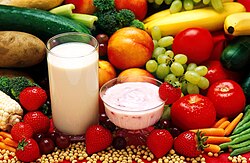
A lacto-vegetarian (sometimes referred to as a lactarian; from the Latin root lact-, milk) diet abstains from the consumption of eggs as well as meat, while still consuming dairy products such as milk, cheese (without animal rennet i.e., from microbial sources), yogurt, butter, ghee, cream, and kefir,[1] as well as honey.
History
[edit]The concept and practice of lacto-vegetarianism among a significant number of people comes from ancient India.[2]
An early western advocate of lacto-vegetarianism was the Scottish physician George Cheyne who promoted a milk and vegetable-based diet to treat obesity and other health problems in the early 18th century.[3][4]
During the 19th century, the diet became associated with naturopathy. German naturopaths Heinrich Lahmann and Theodor Hahn promoted lacto-vegetarian diets of raw vegetables, whole wheat bread, and dairy products such as milk.[5][6][7]
In the 20th century, lacto-vegetarianism was promoted by the American biochemist Elmer McCollum and the Danish physician and nutritionist Mikkel Hindhede.[7][8] In 1918, McCollum commented that "lacto-vegetarianism should not be confused with strict vegetarianism. The former is, when the diet is properly planned, the most highly satisfactory plan which can be adopted in the nutrition of man."[9]
Hindhede became a food advisor to the Danish government during World War I and was influential in introducing a lacto-vegetarian diet to the public.[7][8][10] The system of rationing restricted meat and alcohol so the Danish population were mostly living on a diet of milk and vegetables.[10] During the years of food restriction from 1917 to 1918, both mortality and morbidity decreased;[10] the mortality rate dropped by 34%, the lowest death rate ever reported for Denmark.[8] Hindhede's dieting ideas expressed in his scientific publications, along with those written by other Scandinavian scientists, were translated in German and well received amongst the right-wing political spectrum in post-war Germany.[10] Subsequently, lacto-vegetarianism was strongly supported by German life reformers (Lebensreform) and became influential on some of the leading exponents of the National Socialist movement.[10]
The uric-acid free diet of Alexander Haig was lacto-vegetarian. On this diet only cheese, milk, nuts, certain vegetables, and white bread could be eaten.[11][12][13]
Mahatma Gandhi was a notable lacto-vegetarian, who drank milk daily.[14] In 1931, Gandhi commented that:
I know we must all err. I would give up milk if I could, but I cannot. I have made that experiment times without number. I could not, after a serious illness, regain my strength, unless I went back to milk. That has been the tragedy of my life.[14][15]
In 1936, Narasinh Narayan Godbole authored Milk: The Most Perfect Food, a book defending lacto-vegetarianism and promoting the consumption of dairy products in opposition to meat.[16][17]
Rennet
[edit]Historically most commercial cheese was made with calf rennet, making this an issue for lacto-vegetarians. Fig and thistle rennet were used in ancient times but such plant-based rennets were not suitable for the manufacture of long-ripened cheese varieties so calf rennet became the standard until there was a shortage of supply.[18]
John Smith in his book The Principles and Practice of Vegetarian Cookery in 1860 wrote about a "vegetable rennet" made from the flowers of Galium verum.[19] In 1898, W. A. Macdonald in The Vegetarian magazine commented that fig and thistle rennet had been successful in experiment but only calf rennet had commercial significance.[20] In India in the late 19th-century, the berries from Withania coagulans were used as a vegetarian rennet and sold in powdered capsules.[21][22][23]
Most commercial cheese in the United States is currently made using chymosin. Some vegetarians consider this an acceptable alternative, whilst others do not as the gene used to make microbial chymosin originated from calves.[24]
Religion
[edit]Lacto-vegetarian diets are popular with certain followers of the Dharmic religious traditions such as Hinduism, Jainism, Buddhism, and Sikhism. The core of their beliefs behind a lacto-vegetarian diet is the law of ahimsa, or non-violence.[citation needed]
Hinduism
[edit]According to the Vedas (Hindu holy scriptures), all living beings are equally valued.[25][26] Hindus believe that vegetarianism is vital for spiritual progress.[27] It takes many more vegetables or plants to produce an equal amount of meat,[28] many more lives are destroyed, and in this way more suffering is caused when meat is consumed.[29] Although some suffering and pain is inevitably caused to other living beings to satisfy the human need for food, according to ahimsa, every effort should be made to minimize suffering.[29] This is to avoid karmic consequences and show respect for living things, because all living beings are equally valued in these traditions,[26] a vegetarian diet rooted in ahimsa is only one aspect of environmentally conscious living, relating to those beings affected by our need for food.[29] However, this does not apply to all Hindus; some do consume meat, though usually not any form of beef.
In India, lacto vegetarian is considered synonymous to vegetarian, while eggs are considered a meat product.[30] However, in other parts of the world, vegetarianism generally refers to ovo lacto vegetarianism instead, allowing eggs into the diet.[31]
Many Hindu wrestlers are strict lacto-vegetarians and follow a Sattvic diet. A large part of their diet is milk, ghee, almonds and chickpeas.[32]
Jainism
[edit]In the case of Jainism, the vegetarian standard is strict. It allows the consumption of only fruit and leaves that can be taken from plants without causing their death. This further excludes from the diet root vegetables like carrots, potatoes, onions, garlic, radish, turnips, turmeric, etc since uprooting plants is considered as bad karma in Jainism.[33] Jains also do not consume honey since it is considered as stealing food and also because honey collecting destroys bee hives and bee eggs and bee larvae inside it.[34]
Sikhism
[edit]The Namdharis, a Sikh sect follow a strict lacto-vegetarian diet and have quoted verses from the Guru Granth Sahib endorsing vegetarianism, they also advocate for cow protection.[35][36][37] The Damdami Taksal also cite the Guru Granth Sahib and advocate a strict lacto-vegetarian diet.[38][39] Eating meat is not allowed in any form including eggs, fish and gelatine.[39]
Lacto-vegetarians and vegans
[edit]The primary difference between a vegan and a lacto-vegetarian diet is the avoidance of dairy products. Vegans do not consume dairy products, believing that their production causes the animal suffering or a premature death,[40] or otherwise abridges animal rights.
See also
[edit]References
[edit]- ^ "Becoming a vegetarian". Harvard Health. Oct 2009. Archived from the original on 2017-06-09. Retrieved 18 Nov 2017.
- ^ Spencer, Colin: The Heretic's Feast. A History of Vegetarianism, London: Fourth Estate 1993, p. 69–84. ISBN 1-85702-078-2.
- ^ Kiple, Kenneth F; Ornelas, Kriemhild Coneè. (2000). The Cambridge World History of Food, Volume 2. Cambridge University Press. p. 1556. ISBN 0-521-40215-8
- ^ Beatty, Heather R. (2012). Nervous Disease in Late Eighteenth-Century Britain: The Reality of a Fashionable Disorder. Routledge. pp. 103-104. ISBN 978-1-84893-308-8
- ^ Bergdolt, Klaus. (2008). Wellbeing: A Cultural History of Healthy Living. Polity Press. p. 286. ISBN 978-07456-2913-1
- ^ Puskar-Pasewicz, Margaret. (2010). Cultural Encyclopedia of Vegetarianism. ABC-CLIO. p. 116. ISBN 978-0-313-37556-9
- ^ a b c Treitel, Corinna. (2017). Eating Nature in Modern Germany: Food, Agriculture and Environment, c.1870 to 2000. Cambridge University Press. pp. 77-81. ISBN 978-1-107-18802-0
- ^ a b c Iacobbo, Karen; Iacobbo, Michael. (2004). Vegetarian America: A History. pp. 138-140. ISBN 0-275-97519-3
- ^ McCollum, Elmer Verner (1918). The Newer Knowledge of Nutrition. Macmillan Company. p. 52.
- ^ a b c d e Briesen, Detlef (2017). "What is a healthy diet? Some ideas about the construction of healthy food in Germany since the nineteenth century". In Sebastia, Brigitte (ed.). Eating Traditional Food: Politics, Identity and Practices. Routledge Studies in Food, Society and The Environment. London: Routledge. p. 172. ISBN 978-1-138-18700-9. LCCN 2016021306.
- ^ "Reviewed Work: Uric Acid As A Factor In The Causation Of Disease by Alexander Haig". The British Medical Journal. 2 (2483): 263. 1908.
- ^ Whorton, James C. (1981). "Muscular Vegetarianism: The Debate Over Diet and Athletic Performance in the Progressive Era". Journal of Sport History. 8 (2): 58–75. PMID 11614819.
- ^ Barnett, L. Margaret. (1995). Every Man His Own Physician: Dietetic Fads, 1890-1914. In Harmke Kamminga, Andrew Cunningham. The Science and Culture of Nutrition, 1840-1940. p. 165. Rodopi. ISBN 90-5183-818-2
- ^ a b Phelps, Norm. (2007). The Longest Struggle: Animal Advocacy from Pythagoras to PETA. Lantern Books. pp. 165-166. ISBN 978-1-59056-106-5
- ^ "The Moral Basis of Vegetarianism". Speech delivered by Gandhi at a Social Meeting organised by the London Vegetarian Society, 20 November 1931.
- ^ "Reviewed Work: Milk, The Most Perfect Food by N. N. Godbole, Pandit Madan Mohan Malaviya". Current Science. 5 (11): 600–601. 1937. JSTOR 24204292.
- ^ A. C. D. (1938). "Milk the Most Perfect Food. N. N. Godbole, Benares Hindu Univ., Dipawali, India, 1936". Journal of Dairy Science. 21 (9): 242.
- ^ Fox, Patrick F; McSweeney, Paul L. H; Cogan, Timothy M; Guinee, Timothy P. (2004). Cheese: Chemistry, Physics and Microbiology, Third Edition, Volume 1: General Aspects. Elsevier Academic Press. pp. 1–3. ISBN 0-1226-3652-X.
{{cite book}}: CS1 maint: multiple names: authors list (link) - ^ John, Smith (1860). The Principles and Practice of Vegetarian Cookery. London: Simpkin, Marshall, and Co. p. 26.
- ^ "Is Cheese a Vegetarian Food?". The Vegetarian. 3 (7): 106–110. 1898.
- ^ "Vegetarian Cheese Rennet". The Examiner. July 28, 1883. p. 2. (subscription required)
- ^ "Vegetarian Cheese". The Edinburgh Evening News. August 2, 1883. p. 4. (subscription required)
- ^ Kothavalla, Z. R; Khubchandani, P. G. (1940). "Withania Coagulans as a Vegetable Rennet". Indian Journal of Veterinary Science. 10 (3): 284–288.
{{cite journal}}: CS1 maint: multiple names: authors list (link) - ^ Yacoubou, Jeanne (2012). "Microbial Rennets and Fermentation Produced Chymosin (FPC): How Vegetarian Are They?". The Vegetarian Resource Group. Archived from the original on March 6, 2024.
- ^ Bhagavad Gita 5.18 Archived 2009-09-17 at the Wayback Machine "The humble sages, by virtue of true knowledge, see with equal vision a learned and gentle brahmana, a cow, an elephant, a dog and a dog-eater [outcaste]."
- ^ a b "Animals in Hinduism, second paragraph". Hinduwebsite.com. Retrieved 2014-03-14.
- ^ Filippini, Massimo; Srinivasan, Suchita (2019-10-01). "Impact of religious participation, social interactions and globalization on meat consumption: Evidence from India". Energy Economics. Eighth Atlantic Workshop on Energy and Environmental Economics. 84 104550. doi:10.1016/j.eneco.2019.104550. ISSN 0140-9883. S2CID 211301067.
- ^ "U.S. could feed 800 million people with grain that livestock eat". News.cornell.edu. 1997-08-07. Retrieved 2014-03-14.
- ^ a b c Gabriel Cousens, Spiritual Nutrition: Six Foundations for Spiritual Life and the Awakening of Kundalini, North Athlantic Books, page 251
- ^ "Eggs off menu at schools in Hindu row". thetimes.co.uk. Retrieved 24 February 2023.
- ^ Mariotti, François; Gardner, Christopher D. (2019). "Dietary Protein and Amino Acids in Vegetarian Diets—A Review". Nutrients. 11 (11): 2661. doi:10.3390/nu11112661. PMC 6893534. PMID 31690027.
- ^ Alter, Joseph S. (1992). "The Discipline of the Wrestler's Body". In The Wrestler's Body Identity and Ideology in North India. University of California Press. ISBN 978-0520076976
- ^ Natubhai Shah (2004). Jainism: The World of Conquerors. Motilal Banarsidass Publishers. pp. 249–251. ISBN 978-81-208-1938-2.
- ^ "VEGETARIAN-FOOD AND JAIN-CONDUCT, Honey".
- ^ Clarke, Peter B. (2004). Encyclopedia of New Religious Movements. Taylor & Francis. pp. 425-426. ISBN 978-1134499700
- ^ "Vegetarianism". namdhari-world.com. Retrieved 31 January 2023.
- ^ "A Namdhari Sikh's Testimony". ivu.org. Retrieved 31 January 2023.
- ^ Nesbitt, Eleanor (2015). "The Fools Argue about Flesh and Meat': Sikhs and Vegetarianism". Religions of South Asia. 9 (1): 81–101. doi:10.1558/rosa.v9i1.22123.
- ^ a b "The Fools Argue about Flesh and Meat': Sikhs and Vegetarianism". damdamitaksal.com. Retrieved 12 March 2023.
- ^ Erik Marcus (2000). Vegan: The New Ethics of Eating. McBooks Press, Incorporated. ISBN 978-1-59013-344-6.
External links
[edit]
Lacto vegetarianism
View on GrokipediaDefinition and Core Principles
Dietary Components and Inclusions
Lacto-vegetarian diets consist of plant-based foods augmented by dairy products derived from mammals, such as cows, goats, or sheep.[11] [12] Plant-derived components form the foundation, encompassing fruits, vegetables, whole grains, legumes, nuts, seeds, and plant oils, which provide carbohydrates, fiber, proteins, and essential micronutrients.[13] [2] Dairy inclusions feature milk and its processed forms, including yogurt, cheese, butter, cream, and buttermilk, offering sources of high-quality protein, calcium, vitamin D (when fortified), and saturated fats.[11] [2] These animal-derived items are permitted under the condition that they do not involve the direct consumption of eggs or animal flesh, aligning with the diet's exclusion of oviparous and carnivorous elements.[12] Commonly allowed beverages and sweeteners include water, herbal teas, fruit juices, and honey, though the latter's inclusion varies based on ethical considerations regarding apiculture.[14] Fermented dairy like kefir and certain cultured cheeses further diversify options, contributing probiotics alongside nutritional density.[2]- Fruits and Vegetables: Apples, berries, leafy greens, root vegetables, and cruciferous varieties for vitamins A, C, and K.[13]
- Grains and Legumes: Rice, quinoa, lentils, beans, and chickpeas as staple carbohydrate and protein sources.[2]
- Nuts and Seeds: Almonds, walnuts, chia, and flaxseeds for healthy fats and omega-3 precursors.[14]
- Dairy Products: Pasteurized milk (whole, low-fat, or skim), plain yogurt, hard and soft cheeses (e.g., cheddar, mozzarella), and ghee.[11][12]
Exclusions and Boundaries
Lacto vegetarianism excludes all forms of animal flesh, encompassing red meat from mammals such as beef and pork, white meat from poultry like chicken and turkey, and seafood including fish and shellfish.[2][15] This prohibition extends to processed meats and byproducts derived from slaughtered animals, such as gelatin, which is produced from animal bones and connective tissues.[2] Eggs, including those from chickens, ducks, or other birds, are also strictly avoided, distinguishing lacto vegetarianism from lacto-ovo vegetarianism, which permits egg consumption.[16][17] The boundaries of lacto vegetarianism are defined by its allowance of dairy products—milk, cheese, yogurt, butter, and cream—sourced from living animals without requiring slaughter, in contrast to veganism, which rejects all animal-derived foods including dairy due to ethical concerns over animal exploitation in production.[2][18] This dairy inclusion addresses potential nutritional gaps like vitamin B12 and calcium that arise from broader animal product exclusions, though it draws criticism from stricter ethical perspectives for involving practices such as calf separation in dairy farming.[2] Ovo vegetarianism, by comparison, excludes dairy but allows eggs, creating a complementary boundary that highlights lacto vegetarianism's emphasis on milk-derived nutrition over oviparous products.[17][16] Honey consumption remains a gray area without universal exclusion in lacto vegetarianism, as it is a non-flesh animal product not involving slaughter, though some adherents avoid it on grounds of bee exploitation akin to dairy concerns; standard definitions do not mandate its prohibition.[2] Boundaries with semi-vegetarian diets like pescatarianism or flexitarianism are firmer, as those incorporate fish or occasional meat, respectively, which lacto vegetarianism rejects to maintain consistency in avoiding animal killing for food.[16] These delineations ensure lacto vegetarianism aligns with ethical frameworks prioritizing non-lethal animal use while permitting plant-based foods and dairy without restriction on variety or quantity.[15]Practical Variations Including Rennet Usage
Lacto vegetarianism encompasses dairy products such as milk, butter, yogurt, and cheese, but practical adherence often varies in the treatment of cheeses coagulated with animal-derived rennet, an enzyme complex traditionally extracted from the fourth stomach lining of unweaned calves slaughtered for veal production.[19] This sourcing raises ethical concerns for many adherents, as it involves animal slaughter, prompting some to exclude such cheeses despite the diet's allowance of dairy from living animals.[19] Stricter lacto vegetarians prioritize cheeses made without animal rennet to avoid indirect support for slaughter practices, aligning with broader vegetarian principles that reject by-products of killing animals for food.[19] Alternatives to animal rennet include microbial rennet, derived from genetically modified fungi or bacteria that produce chymosin through fermentation, and vegetable rennet sourced from plant extracts like thistle, fig sap, or cardoon.[20] These substitutes enable cheese production compatible with lacto vegetarian standards, with microbial rennet comprising the majority of non-animal options in commercial cheeses due to its efficacy and cost-effectiveness.[20] In regions like the European Union and United Kingdom, cheeses using non-animal rennet are frequently labeled "suitable for vegetarians," facilitating consumer choice, whereas traditional hard cheeses such as Parmigiano-Reggiano or certain cheddars predominantly employ animal rennet.[21] Variations in practice stem from individual interpretations of dietary boundaries: some lacto vegetarians accept animal rennet cheeses, viewing the enzyme's trace presence (typically less than 0.1% of final weight) and byproduct status as permissible within dairy inclusion, especially if alternatives alter flavor or texture undesirably.[22] Others, influenced by organizations like the Vegetarian Society, which defines vegetarian diets as excluding slaughter by-products including animal rennet, rigorously avoid them and opt for rennet-free fresh cheeses like cottage cheese, ricotta, or cream cheese, which rely on acid or heat coagulation.[23] This spectrum reflects no universal enforcement, with surveys indicating that up to 30-40% of self-identified vegetarians in Western countries may consume unlabeled cheeses containing animal rennet due to lack of awareness or label opacity.[19] To navigate these variations, lacto vegetarians often scrutinize ingredient lists or certifications; kosher and halal cheeses, for instance, universally avoid animal rennet due to prohibitions on mixing milk and meat derivatives, providing a reliable vegetarian option even if not always optimized for lacto preferences excluding eggs.[24] Emerging innovations, such as cheeses coagulated with vegetal rennet combined with microbial transglutaminase for texture enhancement, further expand accessible choices, though consumer acceptance varies based on sensory profiles differing from animal-rennet counterparts.[25]Historical Development
Ancient and Pre-Modern Origins
Lacto-vegetarian practices trace their earliest systematic roots to ancient India, where religious and philosophical developments emphasized non-violence (ahimsa) toward animals while elevating dairy as a permissible, sacred sustenance. During the Vedic period (c. 1500–500 BCE), texts like the Rigveda initially permitted beef consumption among Indo-Aryan pastoralists, reflecting a mixed diet with cattle herding central to economy and ritual. However, cows gradually attained protected status as aghnya (not to be slain), with milk, ghee, and curd praised for ritual purity and nourishment, fostering a shift toward excluding meat while retaining dairy.[26] [27] By the mid-first millennium BCE, influences from emerging ascetic traditions solidified lacto-vegetarianism among Brahmin and other elites, prohibiting eggs—viewed as impure or life-bearing—and meat, but allowing dairy procured without calf separation or harm.[28] [29] Jainism, codified by Mahavira (c. 599–527 BCE), institutionalized one of the strictest forms of lacto-vegetarianism, rooted in absolute ahimsa that barred not only slaughter but any exploitation potentially causing animal suffering, such as modern dairy practices; historical adherents consumed dairy minimally, excluding eggs and even certain plants to avoid microbial harm.[30] [31] This dietary ethic, paralleled in some Hindu and Buddhist sects, persisted pre-modern India, where dairy comprised up to 20-30% of caloric intake in vegetarian households by the medieval era, supported by temple economies and agrarian surplus.[32] Concurrently in the Mediterranean, Pythagoras of Samos (c. 570–495 BCE) prescribed a meat-abstinent regimen for his philosophical school, motivated by metempsychosis (soul reincarnation) and bodily purity, explicitly including dairy like milk and cheese alongside grains, fruits, and honey, while forbidding beans and animal flesh.[33] [34] Pythagorean communities in Croton and beyond practiced this into the Hellenistic period, influencing later Neoplatonists and early Christian ascetics, though dairy inclusion distinguished it from stricter vegan-like abstentions elsewhere. Pre-modern echoes appeared in isolated European hermetic traditions, but lacto-vegetarianism remained marginal outside Indian subcontinent strongholds until Enlightenment revivals.[35]Modern Evolution and Western Adoption
In the 19th century, lacto-vegetarianism emerged as a distinct dietary practice within European naturopathic and health reform movements, particularly in Germany, where it was promoted for its purported physiological benefits over meat-heavy diets. Pharmacist Theodor Hahn, an early advocate, outlined a meat-excluding regimen emphasizing plant foods and dairy in his 1859 publication Die naturgemässe Diät, arguing it aligned with natural human digestion and influenced cultural figures such as composer Richard Wagner.[36] Naturopath Heinrich Lahmann further advanced lacto-vegetarian principles at his Dresden sanatorium, prescribing raw vegetables, whole-grain bread, fruits, nuts, and dairy while limiting refined foods, based on observations of improved patient vitality and reduced disease incidence among adherents.[37][38] These efforts reflected a broader shift toward empirical dietary experimentation amid industrialization's nutritional concerns, with Hahn's ideas contributing to the formation of vegetarian associations by 1890.[36] In Britain, the 1847 founding of the Vegetarian Society in Manchester marked a pivotal organizational step for vegetarianism's modernization, initially advocating a "vegetable diet" that permitted dairy for nutritional completeness while condemning meat and alcohol; egg inclusion varied but lacto forms gained niche support among health reformers.[39] This society, drawing from nonconformist Christian temperance traditions, emphasized verifiable health outcomes like enhanced digestion and longevity, disseminating recipes and pamphlets that integrated dairy to address protein concerns in plant-based eating.[39] The 20th century saw Western adoption of lacto-vegetarianism accelerate through cross-cultural exchanges with Indian traditions, where egg exclusion stems from ahimsa principles prohibiting harm to potential life. Mahatma Gandhi's advocacy for strict lacto-vegetarianism during his 1910s–1940s campaigns influenced Western visitors to India and Theosophical Society members, promoting it as ethically coherent with dairy sourced non-lethally.[40] Post-1947 Indian independence and mid-century migration waves introduced lacto-vegetarian staples like paneer and yogurt-based dishes to Europe and North America, coinciding with yoga's popularization—evidenced by the establishment of over 100 U.S. yoga centers by 1960—that often prescribed egg-free diets for spiritual and digestive purity.[41] Naturopathic legacies persisted, with lacto-vegetarianism appealing to those prioritizing dairy's calcium and protein bioavailability over eggs' potential allergens, though it remained less prevalent than ovo-lacto variants in surveys showing under 5% strict lacto adherence in Western populations by the 1980s.[42]Nutritional and Health Aspects
Key Nutrients from Dairy Integration
Dairy products integrate into lacto-vegetarian diets to supply bioavailable forms of nutrients that are either scarce or less absorbable from plant sources, particularly calcium, vitamin B12, and complete proteins, thereby reducing risks of deficiencies observed in stricter vegetarian variants.[43] Unlike plant-based calcium sources hindered by oxalates and phytates, dairy calcium exhibits superior absorption rates, supporting skeletal integrity and neuromuscular function. A standard 240 mL serving of cow's milk yields about 300 mg of calcium, fulfilling roughly 23-30% of the adult daily recommended intake depending on age and sex.[13][44] Vitamin B12, vital for DNA synthesis, red blood cell production, and myelin sheath maintenance, occurs naturally in dairy at levels sufficient for lacto-vegetarians to meet requirements without fortification or supplements, in contrast to vegan diets where it is entirely absent from unfortified foods.[45] Daily consumption of dairy, such as yogurt or cheese, can provide 0.5-1.2 mcg of B12 per serving, contributing to the 2.4 mcg adult RDA and averting neurological impairments linked to deficiency.[46] Dairy furnishes high-quality proteins with optimal amino acid profiles, including all essential amino acids, boasting digestibility scores above 90% for casein and whey fractions, which aid muscle repair and satiety more effectively than incomplete plant proteins.[46] A cup of milk delivers approximately 8 grams of protein, enhancing overall nitrogen balance in meat-excluding diets.[44] Additional contributions encompass riboflavin (vitamin B2) for flavin coenzyme production in energy metabolism, with dairy accounting for over 10% of daily needs per serving; phosphorus for hydroxyapatite formation in bones, synergizing with calcium; and potassium for electrolyte balance and blood pressure regulation.[47][43]| Nutrient | Primary Role | Typical Dairy Contribution (per 240 mL milk) | % Adult RDA Approximation |
|---|---|---|---|
| Calcium | Bone mineralization, muscle contraction | 300 mg | 23-30% |
| Vitamin B12 | Neurological function, hematopoiesis | 1.1 mcg | 46% |
| Protein | Tissue repair, enzyme synthesis | 8 g | 16% |
| Riboflavin (B2) | Energy metabolism | 0.4 mg | 31% |
| Phosphorus | Bone structure, ATP production | 250 mg | 20-36% |
Evidence-Based Health Benefits
Lacto vegetarian diets, which incorporate dairy products alongside plant-based foods while excluding meat, eggs, and fish, have been associated with several cardiometabolic improvements in observational and interventional studies. A systematic review and meta-analysis of prospective cohort studies found that vegetarian diets, including those with dairy, correlate with a reduced risk of cardiovascular disease (CVD) incidence (relative risk 0.85, 95% CI 0.79-0.92) and CVD mortality compared to omnivorous diets, attributed to lower intakes of saturated fats from red meat and higher fiber consumption.[49] Similarly, these diets show favorable effects on blood lipid profiles, with meta-analyses indicating lower LDL cholesterol and total cholesterol levels in vegetarians versus non-vegetarians, potentially due to dairy's fermented products like yogurt contributing probiotics and plant sterols displacing animal fats.[50] In terms of ischemic heart disease, evidence from pooled cohort data supports a protective effect, with vegetarians exhibiting up to a 25% lower risk compared to omnivores, linked to reduced inflammation markers such as hsCRP observed in systematic reviews of biomarker levels.[51] [52] For type 2 diabetes, randomized trials and meta-analyses demonstrate improved insulin sensitivity and glycemic control in lacto-vegetarian adherents, with dairy calcium potentially aiding beta-cell function and plant polyphenols enhancing insulin signaling.[53] Weight management benefits are also noted, as these diets typically yield lower body mass index (BMI) and adiposity, with cohort studies reporting 1-2 kg/m² reductions attributable to higher satiety from dairy proteins and fiber-rich plants.[7] Regarding cancer risk, large prospective studies, including analyses from the Adventist Health Study, indicate a 10-12% lower overall incidence in vegetarians compared to omnivores, with lacto-ovo variants showing similar patterns for colorectal and digestive tract cancers (hazard ratio 0.78-0.81), possibly from dairy's conjugated linoleic acid and plant antioxidants inhibiting carcinogenesis.[54] [55] [56] Bone health benefits arise from dairy inclusion, enabling lacto vegetarians to meet calcium recommendations (around 1,000 mg/day) without the density deficits seen in egg-excluding vegans; meta-analyses confirm no compromised bone mineral density (BMD) in this group versus omnivores, contrasting with lower BMD in stricter plant-only diets.[57] [58] However, all-cause mortality evidence is inconsistent, with some U.S. population-based cohorts showing no significant difference between lacto vegetarians and omnivores after adjusting for confounders like physical activity and smoking (hazard ratio 0.99, 95% CI 0.80-1.22), highlighting that benefits may stem more from overall lifestyle than diet isolation.[59] These associations hold primarily from observational data, where self-selection into healthier behaviors confounds causality, though short-term trials affirm risk factor reductions.[60]Potential Risks and Mitigation Strategies
Lacto-vegetarians may face a higher risk of vitamin B12 deficiency compared to omnivores, with studies reporting prevalence rates exceeding 40% in some vegetarian populations, though lower than in vegans due to dairy's natural B12 content of approximately 0.3-0.5 μg per 100g in milk and cheese. [61] [62] A 3-month lacto-ovo-vegetarian intervention trial observed significant reductions in serum B12 levels correlated with decreased intake, highlighting potential inadequacy even with dairy reliance. [63] Marginal B12 status can lead to neurological symptoms like fatigue and cognitive impairment if unaddressed. [64] Lactose intolerance affects roughly 65% of the global adult population, with higher rates in Asian, African, and Native American groups, causing gastrointestinal symptoms such as bloating, diarrhea, and abdominal pain upon dairy consumption. [65] In lacto-vegetarians dependent on dairy for calcium and B12, intolerance can necessitate avoidance strategies that risk secondary deficiencies, as evidenced by elevated rickets incidence in some vegetarian cohorts avoiding milk. [66] Additionally, high dairy intake elevates insulin-like growth factor 1 (IGF-1) levels, associated with increased prostate cancer risk in meta-analyses of cohort studies. [7] Concerns over saturated fats in dairy have been overstated; meta-analyses of prospective cohorts indicate no significant association between dairy fat intake and cardiovascular disease (CVD) risk, with some evidence of reduced stroke incidence from total dairy consumption. [67] [68] Biomarkers like circulating odd-chain fatty acids from dairy (e.g., 15:0, 17:0) correlate with 18-27% lower CVD risk in large-scale analyses. [69] Nonetheless, excessive full-fat dairy could contribute to caloric surplus and weight gain if not balanced. Mitigation strategies include regular monitoring of B12 levels via serum tests, with supplementation (e.g., 250 μg cyanocobalamin daily) recommended for those below 200 pg/mL, as dairy alone may not suffice long-term. [61] [70] For lactose intolerance, lactase enzyme supplements enable tolerance of up to 12-15g lactose (equivalent to 1 cup milk) without symptoms in most adults, alongside prioritizing low-lactose options like yogurt or aged cheeses, which retain nutritional benefits. [71] [72] Selecting fermented or organic dairy minimizes IGF-1 elevation and residues, while a diverse plant-based intake addresses iron and zinc via vitamin C pairing for absorption enhancement. [7] Periodic health assessments and consultation with dietitians ensure adequacy, as lacto-vegetarian patterns generally support cardiometabolic health when nutrient gaps are proactively managed. [73]Ethical Foundations
Animal Welfare in Dairy Production
In modern dairy production, a standard practice involves separating calves from their mothers shortly after birth, typically within 24 hours, to facilitate milk collection for human consumption. This early separation induces acute behavioral distress in both cows and calves, evidenced by increased vocalizations, searching behaviors, and elevated cortisol levels in cows, as well as reduced feed intake and play in calves.[74] [75] Systematic reviews indicate that prolonged cow-calf contact beyond the initial days can mitigate some long-term welfare deficits in calves, such as improved social skills and reduced abnormal behaviors, though it may complicate management and disease control in intensive systems.[76] However, immediate separation does not eliminate risks like poor hygiene in calving areas, which can lead to higher calf mortality if not managed rigorously.[74] High genetic selection for milk yield in dairy breeds like Holsteins has correlated with elevated incidences of health disorders compromising welfare. Mastitis, an udder inflammation often resulting from bacterial infection and intensive milking, affects 30-70% of dairy cows annually depending on region and system, causing pain, reduced lying time, lethargy, and economic losses exceeding $70 per cow yearly in some studies.[77] [78] Other production-related issues include lameness from hoof overgrowth and flooring, metabolic disorders like ketosis during early lactation due to negative energy balance, and reduced fertility, with cows in high-yield herds experiencing prolonged postpartum anestrus.[79] [80] These conditions shorten productive lifespans, with many cows culled after 2-4 lactations rather than living out natural spans of 15-20 years.[81] Male dairy calves, deemed economically unviable for milk production, face high culling rates, with approximately 211,000 slaughtered annually in Canada for veal and around 579,000 total calves processed in the U.S. in 2019, a significant portion being males.[82] [83] Globally, millions are affected, often transported young or euthanized on-farm, raising concerns over painful procedures and inadequate housing in veal systems.[84] Unproductive females and spent cows are similarly sent to slaughter, contributing to welfare challenges during transport and depopulation.[85] Pasture-based systems demonstrate welfare advantages over continuous confinement, with lower mastitis prevalence (e.g., 31% vs. 51% in housed Holsteins) and reduced lameness due to natural foraging and space.[86] Emerging practices, such as delayed calf separation and improved housing like softer flooring or automated milking, aim to address these issues, though adoption varies and intensive commercial operations prioritize yield over such reforms. Peer-reviewed assessments emphasize that while genetic and managerial interventions can enhance outcomes, inherent tensions between productivity and welfare persist in scaling dairy output.[87] [88]Philosophical Justifications for Dairy Inclusion
In dharmic philosophies, particularly Hinduism, the inclusion of dairy in vegetarian diets is justified through the principle of ahimsa (non-violence), which prohibits intentional harm or killing but permits the non-coercive harvesting of milk as a natural surplus from cows treated as sacred maternal figures. Proponents argue that in traditional systems, cows are revered and maintained lifelong without slaughter, fostering a symbiotic relationship where milk serves as a sattvic (pure) nourishment aligning with cosmic order (dharma), distinct from the violence of meat consumption. This view holds that ethical dairy practices—such as natural breeding and calf prioritization—avoid exploitation, rendering milk a gift rather than a product of harm.[89][90] Western moral philosophy often differentiates dairy ethically from meat by emphasizing the absence of direct killing: while flesh-eating necessitates ending an animal's life, milk production can theoretically sustain the animal's existence, provided welfare standards minimize suffering. Rights-based arguments, as articulated by thinkers like Tom Regan, posit that animals possess inherent value entitling them to life but not absolute autonomy over bodily products, allowing dairy if obtained without violating life rights—unlike slaughter for meat. This distinction underscores exploitation as a lesser wrong than mortality, enabling lacto-vegetarianism as a compromise preserving animal longevity.[91] Utilitarian frameworks further justify dairy by prioritizing net suffering reduction: meat production incurs higher cumulative pain through routine killing and confinement, whereas dairy, when sourced from humane systems, involves temporary discomfort outweighed by nutritional benefits and avoidance of death, serving as an incremental ethical advance over omnivorism. Philosophers like James Rachels have highlighted death's irremediable severity compared to dairy's reversible harms, arguing that where plant alternatives suffice for most needs, dairy's inclusion facilitates broader adherence to harm-minimization without demanding unattainable perfection. Critics like Peter Singer extend utilitarianism toward veganism due to dairy's indirect cruelties (e.g., calf separation), yet lacto advocates counter that empirical welfare improvements in non-factory models tip the balance toward permissibility.[91][91]Environmental Implications
Resource Efficiency Relative to Meat Diets
Lacto-vegetarian diets, which exclude meat but incorporate dairy products, exhibit lower resource demands compared to omnivorous diets that include meat, particularly in greenhouse gas emissions, land use, and water consumption. This efficiency arises from avoiding the high-input processes of meat production, such as extensive feed crop cultivation and enteric fermentation in ruminants, while relying on dairy systems that yield calories and protein with comparatively less land and water per unit output.[92] A meta-analysis of global farm data indicates that shifting from average omnivorous diets to lacto-ovo vegetarian patterns (closely aligned with lacto-vegetarianism, as eggs contribute minimally to impacts) reduces greenhouse gas emissions by approximately 35%, driven by the substitution of meat with plant and dairy sources.[93] Land use efficiency is notably higher in lacto-vegetarian diets, as meat production, especially beef, occupies vast areas for grazing and feed—accounting for over 70% of agricultural land globally while providing only 18% of calories. Dairy production, by contrast, utilizes about 1-2 square meters of land per kilogram of milk, far less than the 10-20 square meters for beef per equivalent nutritional yield, enabling lacto-vegetarian diets to require 20-50% less total land than meat-inclusive diets in modeled scenarios. Water footprints follow a similar pattern: omnivorous diets demand around 15,000 liters of water per daily ration due to meat's high virtual water content (e.g., 15,000 liters per kg of beef), whereas lacto-vegetarian equivalents use 30-50% less, with dairy's footprint at roughly 1,000 liters per kg of milk versus meat's multiples thereof.[94][92][95]| Resource Metric | Omnivorous Diet (Average) | Lacto-Vegetarian Diet (Estimated Reduction) | Key Driver |
|---|---|---|---|
| GHG Emissions (kg CO2e/day) | ~5-7 | 35% lower (~3.25-4.55) | Meat exclusion, lower ruminant methane[93] |
| Land Use (m²/day equivalent) | ~10-15 | 20-50% lower | Reduced grazing/feed for meat[92] |
| Water Use (liters/day) | ~10,000-15,000 | 30-50% lower | Lower virtual water in dairy vs. beef[95] |