Hubbry Logo
logo
Luke 17
Community hub

Luke 17

logo
0 subscribers

Wikipedia

from Wikipedia
Luke 17
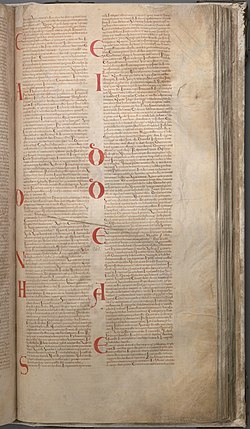
The Latin text of Luke 14:30–19:7 in Codex Gigas (13th century)
BookGospel of Luke
CategoryGospel
Christian Bible partNew Testament
Order in the Christian part3

Luke 17 is the seventeenth chapter of the Gospel of Luke in the New Testament of the Christian Bible. It records "some sayings of Jesus"[1] and the healing of ten lepers.[2] The book containing this chapter is anonymous, but early Christian tradition uniformly affirmed that Luke the Evangelist composed this Gospel as well as the Acts of the Apostles.[3]

Text

[edit]

The original text was written in Koine Greek. Some early manuscripts containing the text of this chapter are:

This chapter is divided into 37 verses. The New King James Version divides it into four sections, headed respectively "Jesus Warns of Offences" (verses 1–4), "Faith and Duty" (verses 5–10), "Ten Lepers Cleansed" (verses 11–19) and "The Coming of the Kingdom" (verses 20–37).[4]

Offences and forgiving of offences (verses 1–10)

[edit]

Verses 1–10 are presented as a single unit in the New International Version. Commenting on the variety of topics covered in the first ten verses, Lutheran biblical writer Harold Buls states that he "assumes that there is logical sequence. The items are not merely picked or chosen by Luke from some outside source".[5]

The first four verses contain a set of "disparate sayings" meant for the community of disciples:[6]: 949 

Verse 1

[edit]
Then He [Jesus] said to the disciples, "It is impossible that no offenses should come, but woe to him through whom they do come!"[7]

Jesus warns of "offences" coming, literally "stumbling blocks" (Greek: τὰ σκάνδαλα, skandala).[8] Other translations used are "obstacles" (Jerusalem Bible), "things that cause people to sin" (Buls) and "temptations to sin" (English Standard Version). These are problems liable to arise within the believing community,[6]: 949  although among the fathers of the early church, a connection was made with the Pharisees, with whom Jesus had been speaking in the previous chapter.[9]

Reflecting on Jesus' assertion that something might be "impossible", Lutheran Pietist Johann Bengel offers as alternative readings, "it is not a thing usual to happen" or "a thing not admissible in the common course of things", noting similarly that at Luke 13:33 Jesus had said that "it is impossible for a prophet to be killed outside of Jerusalem".[10][11]

Verse 2

[edit]
It would be better for him if a millstone were hung around his neck, and he were thrown into the sea, than that he should offend one of these little ones.[12]

The "little ones" are the more vulnerable members of the community of disciples.[6]: 949  The term appears more frequently in Matthew's gospel than in Luke's.[13]

Verses 3b–4

[edit]
If your brother sins against you, rebuke him; and if he repents, forgive him. And if he sins against you seven times in a day, and seven times in a day returns to you, saying, 'I repent', you shall forgive him.[14]

The Jerusalem Bible suggests that "Luke, apparently, is thinking of a matter that concerns only two of the community". Matthew 18 refers to a process of appealing to the community, which is missing from Luke's writing on this subject.[15]

Verse 5

[edit]
And the apostles said to the Lord, "Increase our faith".[16]

Having previously addressed "the disciples" (Luke 16:1 and 17:1), Jesus speaks now to the apostles, who come to him "with a special request". They feel that the moral strength of their faith in Jesus, i.e. just the loving power of their faith, is not great enough for that great task of forgiveness" which has just set for them in the previous verse:[17] Their request is for "stronger energetic faith", better in quality rather than quantitatively more.[17]

Verse 6

[edit]
Mulberry Tree by Vincent van Gogh, now in the Norton Simon Museum in Pasadena, California
And the Lord said, "If you had faith like a grain of mustard seed, you could say to this mulberry tree, 'Be uprooted and planted in the sea', and it would obey you."[18]

The King James Version refers to a sycamine tree.[19] Jewish law prohibited the planting of mulberry trees too close to water cisterns because of their strong rooting systems and the physical damage they could cause.[20]

Verses 7–10

[edit]

Jesus describes a master who expects servants who have worked all day in the fields to serve his evening meal as well before seeing to their own needs. Joachim Jeremias considered this parable on service to be "a self-contained unit", while Paul Minear has commented on the "remarkable" degree of consensus among many biblical commentators as to its meaning. It does not appear in the other gospels but it is considered pre-Lucan, although the positioning of this passage after the reference to "the apostles" in verse 5 may have been a deliberate editorial decision in Luke.[21]

Cleansing ten lepers (verses 11–19)

[edit]
James Tissot, The Healing of Ten Lepers (Guérison de dix lépreux), Brooklyn Museum

This is one of the miracles of Jesus in the Gospels (recorded only in the Gospel of Luke).[22][23] On his way to Jerusalem, continuing the journey he had begun in Luke 9:51, Jesus traveled along the border between Samaria and Galilee. As he was going into a village, ten men who had leprosy met him. They stood at a distance and called out in a loud voice, "Jesus, Master, have pity on us!" When he saw them, he said: "Go, show yourselves to the priests." And as they went, they were cleansed. One of them, when he saw he was healed, came back, praising God in a loud voice. He threw himself at Jesus' feet and thanked him: this man was a Samaritan. Jesus asked: "Were not all ten cleansed? Where are the other nine? Was no one found to return and give praise to God except this foreigner?" Then he said to him: "Rise and go; your faith has saved you."

This miracle has been described as emphasising the importance of faith, for Jesus did not say: "My power has saved you" but attributed the healing to the faith of the beneficiaries.[24][25]

The coming of the kingdom (verses 20–21)

[edit]

Verse 20

[edit]
Now when He was asked by the Pharisees when the kingdom of God would come, He answered them and said, "The kingdom of God does not come with observation";[26]

Verse 21

[edit]
Neither shall they say, Lo here! or, lo there! for, behold, the kingdom of God is within you.[27]

George Leo Haydock suggests that the Pharisees' question is asked "in a mocking and an insulting manner".[28] Buls notes that the enquiry is a 'when?' question whereas Jesus' answer is a 'what?' response: the Pharisees "were expecting the Kingdom of God ... to come soon"; this is "a faulty notion about the character of the Kingdom". Jesus replies that the Kingdom of God does not come "with observation" or "with a visible display":[29] the word Greek: παρατηρήσεως (paratērēseōs, careful observation) appears only here in the New Testament.[30]

In the Greek: η βασιλεια του θεου εντος υμων εστιν, the word εντος (entos) may be translated as either "among" or "within".[31] The more natural meaning is "within",[6] and Baptist theologian John Gill elaborates on how the kingdom of God might be "within" you:

In the elect of God among the Jews, in their hearts; it being of a spiritual nature, and lying in righteousness, and peace, and joy in the Holy Ghost; in the dispossession of Satan, the strong man armed; in the putting down of the old man, sin, with its deceitful lusts, from the throne; and in setting up a principle of grace, as a governing one.[32]

However, reference elsewhere to the Kingdom of God as something which those who respond can "enter into" (see Luke 18: 17, 24-25) argues for the term being understood as "in the midst of you".[6]: 949  The editors of the Jerusalem Bible suggest that "among you" is preferable to "within you" because "within you" does not "furnish as direct an answer to the Pharisees' question".[33]

The day of the Son of Man (verses 22–37)

[edit]

The discourse in Luke 17:22–37 is proper to this gospel. Luke handles the "end of time" in a different manner from Matthew, whose "discourse on the end times" makes use of similar material. Luke makes a clear distinction between Jesus' prophecy of the destruction of Jerusalem (see Luke 21:6–24) and his own coming in glory at the end of time.[34]

Verse 22

[edit]
And he said to the disciples, "The days are coming when you will desire to see one of the days of the Son of Man, and you will not see it".[35]

The phrase "one of the days of the Son of Man" is an unusual New Testament usage. It suggests not the "end-times" or the coming of Jesus in glory, but for the community of disciples whom Jesus has gathered to continue his ministry, some "glimpse" of the Son on Man to sustain them. Franklin notes that Stephen has a vision of the Son of Man in glory before his accusers start to stone him (Acts 7:55-6) and suggests that Jesus may have been referring to a moment such as this.[6]: 950 

See also

[edit]

References

[edit]
[edit]

Grokipedia

from Grokipedia
Luke 17 is the seventeenth chapter of the Gospel of Luke in the New Testament of the Christian Bible, attributed to Luke the physician and companion of Paul, and it records a series of Jesus' teachings and a miracle during his journey toward Jerusalem.[1] The chapter emphasizes themes of sin and forgiveness, the power of faith, humble service to God, gratitude, and the spiritual nature of the Kingdom of God alongside warnings of its sudden future arrival.[2] It forms part of the central section of Luke's Gospel, where Jesus instructs his disciples while en route from Galilee through Samaritan territory to the cross.[3] The chapter opens with Jesus' warnings against causing others to stumble in faith and instructions on rebuking sin while forgiving repentant offenders repeatedly, even up to seven times in a single day (Luke 17:1-4).[1] In response to the disciples' request for increased faith, Jesus teaches that even faith as small as a mustard seed possesses power to accomplish the impossible, such as uprooting a mulberry tree and planting it in the sea (Luke 17:5-6).[2] He follows with the parable of the unworthy servant, illustrating that disciples should serve God dutifully without expecting praise, viewing themselves as unprofitable servants who have merely done their duty (Luke 17:7-10).[3] A notable event in the chapter is the healing of ten men with leprosy, who approach Jesus for mercy while he travels between Samaria and Galilee; he instructs them to show themselves to the priests, and they are cleansed en route, but only one—a Samaritan—returns to give thanks and worship at Jesus' feet, prompting Jesus to affirm that his faith has made him well (Luke 17:11-19).[1] This miracle underscores obedience, the inclusivity of God's mercy beyond ethnic boundaries, and the role of gratitude in receiving full spiritual restoration.[2] The latter portion addresses the Pharisees' inquiry about the Kingdom of God's arrival, with Jesus declaring that it is not observable through signs but is already present among them (Luke 17:20-21).[3] Privately to his disciples, he describes his own impending suffering, the future longing for the days of the Son of Man, and the suddenness of his return, likening it to the days of Noah and Lot when judgment overtook the unprepared amid normal daily life (Luke 17:22-30).[1] Jesus urges detachment from worldly possessions during that time and warns that some will be taken in judgment while others remain, emphasizing vigilance like watching for vultures gathering at a body (Luke 17:31-37).[2]

Background

Historical and Literary Context

The Gospel of Luke, including chapter 17, is traditionally attributed to Luke, identified in the New Testament as a physician and companion of the apostle Paul (Colossians 4:14; 2 Timothy 4:11).[4] While the text itself is anonymous, early church tradition from the second century onward consistently names this figure as the author, portraying him as a Gentile Christian writing to affirm the faith of fellow believers.[4] Scholars generally date the composition to around 80–90 CE, based on its apparent dependence on the Gospel of Mark and allusions to post-apostolic developments in early Christianity.[4] The intended audience comprises primarily Gentile Christians, likely in urban communities influenced by Pauline missions in the Aegean region, as evidenced by the Gospel's emphasis on inclusivity for non-Jews and its polished Greek style aimed at educated readers.[4][5] Luke 17 falls within the Gospel's central "travel narrative" (Luke 9:51–19:27), a prolonged section depicting Jesus' journey from Galilee to Jerusalem, where teachings on discipleship and eschatological expectations dominate.[6] This narrative framework structures much of the material as Jesus instructs his followers amid increasing opposition, highlighting the demands of faithful following in anticipation of his passion and the kingdom's arrival.[7] The journey motif underscores themes of perseverance and preparation, portraying discipleship as an ongoing process shaped by Jesus' path toward suffering and ultimate vindication.[8] Literarily, Luke 17 exemplifies the Gospel's blend of didactic sayings, parables, and miracle accounts, integrated into a cohesive theological narrative.[4] The chapter draws from multiple sources under the two-source hypothesis: the Gospel of Mark for shared Synoptic traditions, the hypothetical Q document for sayings material common to Matthew and Luke, and the L source for unique Lukan elements such as certain parables and healings.[9] This composite approach allows Luke to adapt earlier oral and written traditions into a unified story emphasizing social reversal and divine providence.[4] Composed after the Roman destruction of Jerusalem in 70 CE, the Gospel reflects a historical context of upheaval for Jewish and early Christian communities, including temple loss and sporadic persecution under Roman rule.[10] This backdrop informs recurring motifs of divine judgment on unfaithful institutions and the call to steadfast faithfulness amid trials, as seen in broader Lukan discourses on endurance (e.g., Luke 21:12–19).[11] The post-70 setting likely encouraged the audience to interpret Jesus' teachings as guidance for navigating communal dislocation and maintaining hope in eschatological fulfillment.[10]

Theological Themes

Luke 17 presents radical forgiveness as a defining characteristic of discipleship, emphasizing the imperative to rebuke sin while extending mercy repeatedly upon repentance, mirroring God's own boundless compassion toward humanity. This motif underscores that forgiveness is not optional but essential for community life, reflecting the divine mercy that disciples must emulate in their relationships.[12] The chapter highlights faith as exemplified by the mustard seed—small yet potent—capable of achieving the extraordinary, such as uprooting a mulberry tree, thereby prioritizing the quality and object of faith over its magnitude and promoting humility among believers. This teaching counters the disciples' request for greater faith by affirming that even minimal trust in God suffices for divine empowerment.[13] Service to God is portrayed through the theme of the unworthy servant, who fulfills duties without claiming merit or expecting commendation, reinforcing that obedience is a baseline obligation rather than a basis for reward and cultivating a posture of humble dependence on divine grace.[14] Gratitude emerges as a vital response to God's healing, illustrated by the Samaritan leper's return to offer thanks, which contrasts insider expectations with outsider responsiveness and exemplifies how recognition of divine action fosters deeper wholeness and inclusion across ethnic boundaries. This act of the marginalized figure models authentic faith, blending thanksgiving with glorification of God.[15] Eschatological expectation in Luke 17 blends the kingdom of God's present reality—manifest "among you" through Jesus' ministry—with its future abrupt arrival, akin to the days of Noah and Lot, urging vigilance amid sudden judgment and portraying a realized yet impending divine reign.[16] Throughout, miracles, teachings, and warnings interconnect to depict Jesus as both healer and prophet, whose actions and words reveal God's restorative power and call for faithful response within the broader travel narrative toward Jerusalem.[17]

Content Overview

Narrative Structure

Luke 17 is organized into three primary pericopes, reflecting a deliberate narrative arrangement within the broader travel narrative of Jesus toward Jerusalem (Luke 9:51–19:27). The chapter opens with ethical instructions in verses 1–10, focusing on discipleship responsibilities such as avoiding offenses, practicing forgiveness, and humble service. This unit transitions into the miracle narrative of the healing of ten lepers in verses 11–19, which illustrates themes of gratitude and faith. The chapter culminates in an eschatological discourse on the kingdom of God in verses 20–37, addressing its imminence and the call to vigilance.[18] The progression of these units moves logically from interpersonal ethics—emphasizing sin, forgiveness, and dutiful service among followers—to communal expressions of gratitude in the miracle account, and finally to cosmic judgment and readiness for divine intervention. This structure underscores a deepening scope, starting with daily relational dynamics and escalating to ultimate eschatological realities.[18][19] Transitional elements facilitate this flow, notably the journey motif introduced in verse 11: "Now it came to pass, as He went to Jerusalem, that He passed through the midst of Samaria and Galilee." This phrase links the chapter to the ongoing travel narrative and shifts the scene geographically and thematically. Audience changes also mark transitions: the initial teachings address the disciples and apostles (verses 1–6), the parable speaks to the disciples (verses 7–10), the miracle involves a group of lepers (verses 11–19), and the discourse begins with Pharisees before turning to the disciples (verses 20–37). These shifts highlight varying contexts for Jesus' instructions while maintaining narrative cohesion.[18] Literary devices enrich the pericopes and reinforce their messages. Parables, such as the mustard seed illustration of faith's power (verse 6) and the unworthy servant analogy for humble duty (verses 7–10), employ vivid domestic imagery to convey spiritual truths. Hyperbole intensifies ethical warnings, as in the millstone around the neck for causing offense (verse 2) and the mulberry tree uprooted and planted in the sea (verse 6), emphasizing the gravity and potential of faithful response. Apocalyptic imagery in the final unit draws on biblical precedents, comparing the Son of Man's coming to the days of Noah and Lot (verses 26–30), evoking sudden destruction and urgent discernment amid everyday life.[18][19] A unifying theme of discipleship permeates the chapter, with each unit instructing followers on appropriate responses to Jesus' ministry: ethical conduct in community (verses 1–10), grateful acknowledgment of divine mercy (verses 11–19), and eschatological preparedness (verses 20–37). This thematic thread integrates the diverse elements, portraying discipleship as holistic—encompassing personal integrity, relational gratitude, and expectant vigilance.[18]

Key Teachings and Events

Luke 17 begins with Jesus addressing temptations to sin and the imperative of forgiveness among disciples. He cautions that causing others, particularly the vulnerable, to stumble into sin incurs severe judgment, likening it to being thrown into the sea with a millstone around one's neck. Jesus then instructs that if a brother sins, one must rebuke him, and if he repents, forgive him repeatedly—even up to seven times in a single day.[20][21] The apostles respond by requesting increased faith, prompting Jesus to illustrate its power through a vivid metaphor. He explains that faith as small as a mustard seed would suffice to uproot a mulberry tree and plant it in the sea, emphasizing quality over quantity in belief.[22][21] Jesus continues with the parable of the unworthy servant to underscore dutiful service. In the analogy, a servant who completes his daily labors—plowing or herding—does not expect commendation but simply fulfills his obligation. Likewise, disciples should regard their obedience to God as mere duty, considering themselves unworthy servants who have done only what was required.[23][21] A narrative event follows in which Jesus encounters ten men afflicted with a skin disease while traveling toward Jerusalem. Standing at a distance, they plead for mercy, and Jesus directs them to present themselves to the priests as prescribed by law. As they go, they are cleansed, but only one—a Samaritan—returns to glorify God and fall at Jesus' feet in thanks. Jesus questions the whereabouts of the other nine and affirms that the Samaritan's faith has made him well.[24][21] When Pharisees inquire about the timing of the kingdom of God, Jesus replies that it does not come with observable signs or careful search. Instead, the kingdom is already in their midst.[25][26] Finally, Jesus turns to his disciples, foretelling a time when they will long to see one of the days of the Son of Man but will not witness it. He warns of false claims about the Son of Man's arrival and describes its sudden visibility, like lightning across the sky. Drawing analogies to the days of Noah and Lot, Jesus notes that people will be eating, drinking, and marrying until judgment strikes abruptly, separating the taken from the left behind. He urges remembrance of Lot's wife as a caution against looking back and stresses that on the same night, some will be taken while others remain.[27][21]

Detailed Exegesis

Temptations to Sin and the Duty to Forgive (verses 1–4)

In Luke 17:1–4, Jesus addresses his disciples directly, emphasizing the ethical responsibilities within the community of followers regarding sin and reconciliation. He begins by acknowledging the inevitability of "stumbling blocks" or temptations to sin (Greek: skandala), which are bound to arise in a fallen world, yet pronounces a severe "woe" upon those who introduce them, particularly if they cause vulnerable believers to falter.[2] The term "little ones" here refers not to children but to humble or new disciples who are spiritually susceptible, underscoring Jesus' concern for protecting the weak within the faith community from being led astray by false teaching, harsh words, or moral lures.[2] This teaching highlights communal accountability, where actions of one member impact the whole group of followers.[28] To illustrate the gravity of causing such harm, Jesus employs hyperbolic imagery in verse 2: it would be better for the offender to have a millstone tied around their neck and be thrown into the sea than to face divine judgment for leading a "little one" astray. This vivid metaphor draws from ancient practices of execution and execution, emphasizing the profound consequences of undermining faith in others, far outweighing earthly punishment.[2] Scholars interpret this as a call to self-vigilance among disciples, urging them to avoid mindsets or behaviors that oppose justice and compassion toward the vulnerable. Shifting to proactive response in verses 3–4, Jesus instructs: "If your brother or sister sins against you, rebuke them; and if they repent, forgive them. Even if they sin against you seven times in a day and seven times come back to you saying ‘I repent,’ you must forgive them." The rebuke is framed as an act of love aimed at restoration, requiring the confronter to first examine their own life to ensure humility.[2] The call to forgive repeatedly—symbolized by the number seven, denoting completeness—mirrors God's boundless mercy and demands unlimited grace upon genuine repentance, fostering ongoing reconciliation in the disciple community. This protocol parallels instructions in Matthew 18:15–17, forming a basis for early church discipline practices that prioritized correction and forgiveness to maintain unity.[29]

The Power of Faith (verses 5–6)

In response to Jesus' demanding teachings on avoiding offenses and the imperative to forgive repeatedly (Luke 17:1–4), the apostles appeal to him, saying, "Increase our faith!"[30] This plea reflects their recognition that fulfilling such ethical obligations requires divine empowerment beyond their current capacity, highlighting the disciples' self-perceived inadequacy in the face of rigorous discipleship.[31] Jesus replies, "If you have faith as small as a mustard seed, you can say to this mulberry tree, 'Be uprooted and planted in the sea,' and it will obey you" (Luke 17:6).[32] Here, the mustard seed—derived from the black mustard plant (Brassica nigra), the smallest seed commonly cultivated and known in first-century Palestine—serves as a metaphor for the minimal yet potent nature of genuine faith.[33] The sycamine tree, identified as the black mulberry (Morus nigra), was a familiar sight in the region, valued for its fruit and notorious for its deep, tenacious roots that made uprooting exceptionally difficult.[33] This illustration underscores that even the tiniest faith, when directed toward God, possesses the power to accomplish what appears impossible to human effort alone, critiquing any emphasis on amassing greater quantities of faith rather than cultivating its essential quality of trust.[34] Theologically, this exchange emphasizes faith not as a measure of personal strength or achievement but as reliance on God's sovereign power to enable obedience, particularly in challenging duties like forgiveness.[31] By likening faith to a seed capable of commanding a rooted tree to relocate to the sea—an absurd, hyperbolic image—Jesus illustrates how such trust transforms ordinary believers, empowering them to live out kingdom ethics without demanding spectacular miracles but through steadfast fidelity.[35] This teaching aligns faith with active discipleship, where even small trust yields divine results, fostering humility and dependence on God rather than self-reliance.[31]

Parable of the Unworthy Servant (verses 7–10)

In verses 7–9 of Luke 17, Jesus poses a rhetorical question to his disciples about a master with a servant engaged in routine agrarian tasks: "Will any one of you who has a servant plowing or keeping sheep say to him when he has come in from the field, 'Come at once and recline at table'? Will he not rather say to him, 'Prepare supper for me, and dress properly, and wait on me while I eat and drink. You may eat and drink when you are done'? Does he thank the servant because he did what was commanded?" This scenario illustrates the expected order in a household where the servant's labor—from field work to domestic service—elicits no gratitude, as it constitutes mere obligation rather than extraordinary effort.[36] The portrayal aligns with first-century master-slave dynamics prevalent in the Roman Empire's agrarian society, where slaves, often acquired through war or debt, functioned as property performing essential tasks like plowing fields or herding livestock without prospect of commendation or rest until the master's needs were met.[37] Such relationships emphasized absolute hierarchy and utility, with Greco-Roman sources depicting slaves as inherently subservient, subject to the master's directives in both labor and household roles, reinforcing social norms of unremunerated service.[37] Verse 10 extends the analogy to the disciples' spiritual lives: "So you also, when you have done all that you were commanded, say, 'We are unworthy servants; we have only done what was our duty.'" Here, "unworthy" (Greek: achreios, implying unprofitable or useless in a merit sense) underscores that even comprehensive obedience does not earn divine favor but fulfills a baseline covenantal responsibility, positioning believers as dependent agents rather than autonomous achievers.[36][38] The parable's purpose is to cultivate humility among disciples, particularly in response to prior discussions of faith's potency, by framing service to God as an unmeritorious duty that counters self-congratulation and highlights reliance on grace for any true worth.[38] Theologically, it echoes Old Testament servant motifs, such as Israel's designation as Yahweh's "servant" in the Isaianic poems (e.g., Isaiah 42:1–4; 52:13–53:12), where faithful submission reflects redemption from bondage and covenant loyalty without claim to reward.[38][39] This imagery portrays discipleship as an extension of Israel's redemptive calling, emphasizing obedience as identity rather than achievement.[38]

Healing of the Ten Lepers (verses 11–19)

In Luke 17:11–19, Jesus encounters ten men afflicted with leprosy while traveling along the border between Samaria and Galilee on his way to Jerusalem. As he enters a village, the men approach from a distance and cry out, "Jesus, Master, have pity on us!"—a plea reflecting their ritual impurity and social isolation under Jewish law, which required lepers to maintain separation from the community to prevent contagion or defilement.[40] Jesus instructs them, "Go, show yourselves to the priests," directing them to fulfill the Mosaic requirement in Leviticus 14 for verification of cleansing before reintegration into society. As they obey and depart, they are cleansed en route, demonstrating that healing occurs through faith-obedience rather than immediate touch or ritual.[17][41] Biblical "leprosy" (Greek lepra, from Hebrew tsara'at) encompassed various skin diseases causing discoloration or scaling, such as psoriasis or vitiligo, rather than solely Hansen's disease; these conditions rendered individuals unclean, barring them from temple worship and communal life until priestly inspection confirmed healing.[41][42] The group's mixed composition, including a Samaritan among presumed Jews, highlights ethnic tensions in first-century Palestine, where Samaritans—viewed as religious and ethnic outsiders due to their distinct temple on Mount Gerizim and intermarriage history—were often shunned by Judeans.[43] Upon realizing his healing, only the Samaritan returns, praising God loudly and prostrating himself at Jesus' feet in gratitude, an act of worship that contrasts with the nine others' presumed acceptance of the physical cure without further acknowledgment.[40] Jesus remarks, "Were not all ten cleansed? Where are the other nine? Has no one returned to give praise to God except this foreigner?"—using "foreigner" (allogenes) to underscore the irony of an outsider exemplifying proper response.[17] The episode culminates in Jesus' declaration to the Samaritan: "Rise and go; your faith has made you well" (Greek pistis sou sesoken se, where sozo conveys holistic salvation—encompassing physical healing, deliverance, and spiritual wholeness—beyond mere bodily restoration experienced by all ten.[44] This Lukan motif elevates outsiders like Samaritans as models of authentic faith, critiquing the complacency of religious insiders; similar to the Good Samaritan parable (Luke 10:25–37), it illustrates that gratitude and praise manifest true recognition of God's kingdom work among the marginalized.[17] The narrative thus emphasizes obedience leading to healing, but thanksgiving completing salvation, aligning with Luke's broader theme of reversal where the lowly respond faithfully while the privileged overlook divine mercy.[18]

The Imminent Arrival of the Kingdom (verses 20–21)

In Luke 17:20, the Pharisees inquire of Jesus about the timing of the kingdom of God's arrival, reflecting common first-century Jewish apocalyptic expectations of a visible, dramatic manifestation accompanied by observable signs. Jesus responds that the kingdom does not come with careful observation or portentous displays that one might scrutinize or point to in specific locations, such as "Look, here it is!" or "There!"[45][46] This reply challenges their futurist orientation, emphasizing instead an imminent, non-spectacular presence that defies empirical verification.[45] Verse 21 culminates Jesus' statement with the declaration, "nor will people say, 'Look, here it is,' or 'There it is,' because the kingdom of God is in your midst" (entos hymōn estin), though translations vary due to the ambiguity of the Greek phrase entos hymōn. Traditional renderings like the King James Version opt for "within you," which is sometimes interpreted in mystical, New Thought, or esoteric contexts to argue that salvation involves internal enlightenment, personal spiritual realization, or an inner divine state or consciousness accessible within oneself, independent of external institutions or rituals.[47][48] However, mainstream biblical scholarship rejects this as the primary meaning, favoring translations such as "among you" or "in your midst" (as in NIV, ESV, NASB), indicating the kingdom's tangible presence through Jesus' own ministry and person amid the audience.[46][45] This spatial interpretation aligns with the verse's contrast to the Pharisees' sign-seeking query, positioning Jesus as the embodiment of divine royal presence rather than an inward psychological state, especially given the Pharisees' portrayed unbelief.[46] The "within you" variant, while influential in certain traditions, is less contextually supported, as it would improbably attribute kingdom membership to the skeptical Pharisees.[45] This pericope exemplifies realized eschatology in Luke's Gospel, where the kingdom breaks into history through Jesus' words, healings, and exorcisms, subverting apocalyptic anticipation of a cataclysmic future event with an already operative divine rule.[16] It underscores a theological tension in Lukan thought: the kingdom is dynamically present in Jesus' midst, inviting response and participation now, yet retains a future consummation associated with judgment and full restoration.[45][16] This dual aspect permeates Luke's narrative, portraying the kingdom not as a distant realm but as God's reign actively challenging and transforming human realities from within the community.[16]

Signs of the Son of Man's Coming (verses 22–37)

In Luke 17:22, Jesus addresses his disciples privately, foretelling a time when they will long to see "one of the days of the Son of Man" but will not witness it, evoking a period of intense suffering and persecution before his return.[49] This yearning underscores the delay in the eschatological fulfillment, contrasting with the immediate presence of the kingdom among them, and calls for endurance amid trials.[50] Verses 23–24 warn against false messiahs and reports of the Son of Man's appearance in hidden or localized places, emphasizing that his coming will be as unmistakable as lightning flashing across the sky from one end to the other. This imagery highlights the universal visibility and suddenness of the event, drawing from apocalyptic traditions to assure believers of its irrefutable nature.[49] In verses 25–30, Jesus stresses that the Son of Man must first suffer many things and be rejected by this generation, before likening his coming to the days of Noah and Lot. During Noah's time, people ate, drank, married, and carried on daily life until the flood destroyed them unexpectedly; similarly, in Lot's era, normalcy prevailed until fire and sulfur rained down on Sodom after Lot's escape.[50] These historical analogies illustrate judgment arriving abruptly amid complacency, urging vigilance rather than speculation. Verses 31–33 intensify the theme of urgency, instructing that on the day the Son of Man is revealed, no one on the housetop should descend for possessions, nor should anyone in the field return home; remembering Lot's wife, who looked back and became a pillar of salt, Jesus declares that those who seek to save their life will lose it, but those who lose it will preserve it. This paradox emphasizes detachment from worldly attachments and radical commitment as essential for eschatological salvation.[49] The sudden division of humanity appears in verses 34–36, where two in one bed, two grinding grain together, or two in the field will be separated: one taken and the other left, signifying the inescapable judgment that cleaves families and communities.[50] When the disciples inquire where this will occur, verse 37 responds with the proverb, "Where the body is, there the eagles will gather," evoking the inevitable convergence of scavengers on a corpse to denote the conspicuous site of divine judgment.[51] Interpretations of this passage divide along preterist and futurist lines, with preterists viewing the "coming" as fulfilled in the Roman destruction of Jerusalem in 70 CE, symbolizing Christ's judgment through historical events, while futurists anticipate a literal, cataclysmic return at the end of history. Both perspectives converge on the emphasis for preparedness, as the discourse prioritizes ethical readiness and faithful living over predictive timelines.

References

User Avatar
No comments yet.