
.svg/250px-Coat_of_Arms_of_the_House_of_Lusignan_(Kings_of_Armenia,_Cyprus_and_Jerusalem).svg.png)


.svg/1715px-Coat_of_Arms_of_the_House_of_Lusignan_(Kings_of_Armenia,_Cyprus_and_Jerusalem).svg.png)
Community hub
Recent from talks
Contribute something
Nothing was collected or created yet.
House of Lusignan
View on Wikipedia| House of Lusignan Maison de Lusignan | |
|---|---|
| Crusader royal family | |
.svg) Royal banner of Janus of Cyprus | |
| Country |  Kingdom of France Kingdom of France Kingdom of Jerusalem Kingdom of Jerusalem_as_reported_by_the_Book_of_All_Kingdoms.svg) Kingdom of Cyprus Kingdom of Cyprus Kingdom of Cilician Armenia Kingdom of Cilician Armenia |
| Etymology | From the city of Lusignan, Vienne |
| Place of origin | Poitou, France |
| Founded | 10th century |
| Founder | Hugh I of Lusignan |
| Final ruler | James III |
| Titles |
|
| Motto | Pour Loyauté Maintenir (To retain loyalty) |
| Estate(s) | Château de Lusignan (ancestral seat) Royal Palace (Cypriot seat) |
| Dissolution | 1267 (agnatic line) 1487 (cognatic line) |
The House of Lusignan (/ˈluːzɪn.jɒn/ LOO-zin-yon; French: [lyziɲɑ̃]) was a royal house of French origin, which at various times ruled several principalities in Europe and the Levant, including the kingdoms of Jerusalem, Cyprus, and Armenia, from the 12th through the 15th centuries during the Middle Ages. It also had great influence in England and France.
The family originated in Lusignan, in Poitou, western France, in the early 10th century. By the end of the 11th century, the family had risen to become the most prominent petty lords in the region from their castle at Lusignan. In the late 12th century, through marriages and inheritance, a cadet branch of the family came to control the kingdoms of Jerusalem and Cyprus. In the early 13th century, the main branch succeeded to the Counties of La Marche and Angoulême.
As Crusader kings in the Latin East, they soon had connections with the Hethumid rulers of the Kingdom of Cilicia, which they inherited through marriage in the mid-14th century. The Armenian branch fled to France,[1] and eventually Russia,[2][unreliable source?] after the Mamluk conquest of their kingdom.
The claim was taken by the Cypriot branch,[3][4] until their line failed. This kingdom was annexed by the Republic of Venice in the late 15th century.
First House of Lusignan
[edit]Origins
[edit]
The Château de Lusignan, near Poitiers, was the principal seat of the Lusignans. It is shown at its height in the March illumination in the Trés Riches Heures of the Duc de Berry (circa 1412). Louis XIV fortified it and it was used as a prison, a school—and a handy quarry for building materials. It was leveled to the ground in the 18th century in order to create a park for local residents. Only its foundations remain today. According to folklore, the earliest castle was built by Melusine, a water-spirit.
The lords of the castle at Lusignan became counts of La Marche in the 12th century. They added the county of Angoulême to their holdings in 1220, when Hugh X of Lusignan married Isabella of Angoulême, daughter of Count Aymer of Angoulême and widow of John, King of England. These acquisitions produced complicated titles. For example, Hugh XI of Lusignan was Hugh VI of La Marche and Hugh II of Angoulême. Hugh XIII died in 1303. His sisters, Jeanne and Isabelle, sold the county of Angoulême to Philip IV of France. Hugh was succeeded by his brother, Guy I, who died in 1308, making their sister Yolande Countess of La Marche. After Yolande's death, in 1314, King Philip annexed La Marche.
In France
[edit]Lords of Lusignan
[edit]
- Hugh I (early 10th century)
- Hugh II (died 967)
- Hugh III
- Hugh IV
- Hugh V (died 1060), who married Almodis of La Marche, the daughter of Count Bernard I of La Marche.
Counts of La Marche / Counts of Eu
[edit]- Hugh VI (died 1110), who inherited by collateral succession the County of La Marche (1091) as a descendant of Almodis of La Marche.
- Hugh VII (died 1151)
- Hugh VIII (died 1165), whose younger son was Aimery of Lusignan, the first King of Cyprus also King of Jerusalem
- Hugh IX (died 1219), Count of Eu
Counts of La Marche and Angoulême
[edit].svg)
- Hugh X (died 1249), son of Hugh IX, married Isabelle of Angoulême, thus securing Angoulême (1220)
- Hugh XI (died 1250)
- Hugh XII (died 1270)
- Hugh XIII (died 1303)
- Guy (died 1308)
- Yolande (died 1314)
Guy's sisters, Jeanne and Isabelle, sold Angoulême to Philip IV of France after Guy's death.[6] Yolande sold the fiefs of Lusignan, La Marche and Fougères to Philip IV of France in 1308. They became a part of the French royal demesne and a common appanage of the crown.
Crusader kings
[edit]Aimery at the Jerusalem court
[edit]In the 1170s, Aimery of Lusignan (c.1145-1205) (a younger son of Hugh VIII (died 1165)) arrived in Jerusalem, having been expelled from his realm by Richard the Lionheart, then acting Duke of Aquitaine, which included the family lands of Lusignan near Poitiers. Aimery, named Amalric by outdated scholarship, married Eschiva, the daughter of Baldwin of Ibelin, and entered court circles.
Aimery had also obtained the patronage of Agnes of Courtenay (the divorced mother of King Baldwin IV of Jerusalem and the wife of Reginald of Sidon), who held the county of Jaffa and Ascalon. Agnes appointed Aimery as Constable of Jaffa, and later as Constable of the Kingdom of Jerusalem. Hostile rumours alleged that Aimery was Agnes's lover, but this is questionable. It is more likely that his promotions were aimed at weaning him away from the political orbit of the Ibelin family, who were associated with Raymond III of Tripoli, the cousin of King Amalric of Jerusalem and a former bailli or regent.
Guy of Lusignan
[edit]Aimery’s younger brother, Guy of Lusignan (c.1150-1194), arrived in Jerusalem at some unknown date before Easter 1180, although Ernoul said that he arrived on the advice of Aimery. Some modern historians believe that Guy was already well established in Jerusalem by 1180, but there is no supporting contemporary evidence.[citation needed] Aimery's success certainly facilitated the social and political advancement of Guy.
Older accounts, derived from William of Tyre and Ernoul, claim that Agnes of Courtenay was concerned that her political rivals, headed by Raymond of Tripoli, intended to exercise more control by forcing her daughter, the widowed Sibylla (sister and heir presumptive to King Baldwin IV) to marry a man of their choosing. Agnes was said to have foiled these plans by advising her son Baldwin to have Sibylla married to Guy; however Baldwin, now believed to have been less malleable than earlier historians have portrayed, was considering the international implications of his sister's marriage. The best husband for her would be a knight who could rally external help to the kingdom, and not a local nobleman. As the new King of France, Philip II, was still a minor, Baldwin's first cousin King Henry II of England seemed the best prospect for such help and he owed the Pope a penitential pilgrimage to the Holy Land on account of his responsibility for the murder of Archbishop Thomas Becket. Guy was a vassal of both King Henry and of his son Richard of Poitou (the future King Richard I) and had formerly been rebellious, so they wanted to keep him overseas.
Guy and Sibylla were hastily married at Easter 1180, apparently preventing a coup by Raymond's faction to marry her to Baldwin of Ibelin, the father-in-law of Aimery. By this marriage, Guy became Count of Jaffa and Ascalon and Bailli of Jerusalem. Sibylla already had a son from her first marriage to William of Montferrat, and by Guy she had two daughters, Alice and Mary de Lusignan.

An ambitious man, Guy convinced King Baldwin IV to name him as regent in early 1182. But he and Raynald of Châtillon provoked Saladin, the Sultan of Egypt and Syria, during a two-year period of truce. More important to Baldwin IV's disillusionment with him was Guy's military hesitation during the Siege of Kerak. Throughout late 1183 and 1184 Baldwin IV tried to have his sister's marriage to Guy annulled, showing that Baldwin still held his sister with some favour. Baldwin IV had wanted a loyal brother-in-law, and was frustrated in Guy's hardheadedness and disobedience. Sibylla remained at Ascalon, though perhaps not against her will.

Unsuccessful in prying his sister and close heir away from Guy, the king and the Haute Cour altered the succession. They placed Baldwin V, Sibylla's son from her first marriage, in precedence over Sibylla. They also established a process to choose the monarch afterwards between Sibylla and Isabella (whom Baldwin and the Haute Cour thus recognized as at least equally entitled to succession as Sibylla), though Sibylla was not herself excluded from the succession. After the death of Baldwin V in 1186, Guy and Sibylla went to Jerusalem for the funeral, accompanied by an armed guard. Sibylla was crowned as Queen of Jerusalem, on the condition that she annul her marriage with Guy. In return she could marry whom she chose. Her decision to remarry Guy angered the barons.

Guy's term as king is generally seen as a disaster; he was defeated by Saladin at the Battle of Hattin in 1187, and was imprisoned in Damascus while Saladin reconquered almost the entire kingdom.
Upon his release, Guy and Sibylla sought refuge in Tyre, but were denied entry by rival Conrad of Montferrat, the husband of Isabella. During the Siege of Acre in 1191, Sibylla and their two daughters died. Isabella succeeded to the throne as the queen of Jerusalem. Guy left for Limassol and met with Richard, now king of England. He joined the latter's conquest of Cyprus, which was retaliation for the lord of Cyprus having taken Richard's fiancée as prisoner. Afterwards Richard and Guy returned to the siege of Acre. Richard gave up his claim to Jerusalem and supported Guy, while the king of France and the duke of Austria supported their kinsman Conrad. Guy still saved Conrad's life when he was surrounded by the enemy. Richard put the matter of the kingdom of Jerusalem to a vote, which Conrad won, leaving Guy powerless.
Richard sold Cyprus to the Knight Templars, who in turn sold it to Guy. Guy died in 1194, leaving Cyprus to his older brother Aimery.
Aimery becomes king
[edit]Henry VI, Holy Roman Emperor crowned Aimery as the first king of Cyprus. In 1197 Aimery married Isabella, which brought the crown of Jerusalem back to the Lusignans. One of Aimery's first actions as king was to make a five-year truce with the Ayyubids.
In England
[edit]Meanwhile, in France, Hugh le Brun de Lusignan ("Hugh the Swarthy"), like most of the lords of Poitou, backed Arthur of Brittany as the better heir to Richard the Lionheart when the latter's brother John Lackland acceded to the throne of England in 1199. John's mother Eleanor of Aquitaine traded English claims for their support of her son. To secure his position in La Marche, the widowed Hugh arranged a betrothal with the heiress Isabella of Angoulême. However John obtained her hand first, and married her in August 1200, thus depriving Hugh of La Marche and his brother of Eu in Normandy.
The aggrieved Lusignans turned to their feudal overlord Philip Augustus, King of France, who demanded John's presence – a tactical impossibility – and declared John a "contumacious vassal."[citation needed] As the Lusignan allies managed to detain both Arthur and Eleanor, John surprised their unprepared forces at the castle of Mirebeau in July 1202, and took Hugh prisoner with 200 of his troops. King John's savage treatment of the captives caused outrage among his supporters, and his French barons began to desert him. The Lusignans' diplomatic rebellion resulted in the loss to England of half its territory in France, soon incorporated into his kingdom by Philip Augustus. (The other "half", Aquitaine, remained the possession of John's surviving mother Eleanor of Aquitaine). John died in 1216, leaving his son Henry III as king. His widow Isabella of Angoulême finally married Hugh X of Lusignan in 1220, and bore him five children.

In 1247, Guillaume de Lusignan, a younger son of Hugh X and Isabella, moved from France to England along with two of his brothers at the request of their half-brother King Henry III. Guillaume (known in English as William de Valence) and his brothers were quickly placed in positions of power by the king; William was married to Joan de Munchensi (d. 1307), a granddaughter and heiress to the great William Marshal, 1st Earl of Pembroke and was granted custody of the lands and the title of Earl of Pembroke, giving him great wealth and power in his new land. As a result he was unpopular and was heavily involved in the Second Barons' War, supporting the King and Prince Edward against the rebels led by Simon de Montfort. After the final defeat of the rebels at the Battle of Evesham in 1265, William continued to serve Henry III, and then Edward I, until his death in 1296.
William's eldest surviving son, Aymer de Valence, 2nd Earl of Pembroke (c. 1265–1324), succeeded to his father's estates, but he was not formally recognized as Earl of Pembroke until after the death of his mother Joan in 1307. He was appointed guardian of Scotland in 1306, but with the accession of King Edward II to the throne and the consequent rise of his favourite Piers Gaveston to power, his influence declined and he became prominent among the discontented nobles. In 1312, after the Earl of Warwick betrayed him by executing the captured Gaveston, Aymer de Valence left the allied lords and joined the King. Valence was present at the Battle of Bannockburn in 1314, and later helped King Edward defeat the Earl of Lancaster. However, by the time of his death in 1324, he had again been marginalized at court, and also suffered financial trouble. His wife Mary de Châtillon founded Pembroke College, Cambridge and also Denny Abbey, between Cambridge and Ely, where she spent her last days surrounded by nuns.
Kings of Cyprus
[edit]
| History of Cyprus |
|---|
 |
 Cyprus portal Cyprus portal |
After another six-year truce with the Muslims, Aimery and most of the royal family died. His only surviving son, Hugh, became King of Cyprus in 1205. The kingdom of Jerusalem passed to Maria of Montferrat, eldest daughter of Isabella and Conrad. Hugh married his step-sister, Alice of Champagne, daughter of Isabella and Henry of Champagne. They had three children. Henry, the youngest child and only son, became king in 1218 at eight months of age; Alice officially served as his regent. Her uncle Phillip of Ibelin exercised the real power behind the throne, followed by his brother John of Ibelin, the Old Lord of Beirut.
Henry was crowned at the age of 8 at Santa Sophia, Nicosia, in 1225.[7] His uncle arranged the early coronation in a political maneuver intended to outflank Frederick II, Holy Roman Emperor expected attempt to seize power. Frederick succeeded in 1228 in forcing John of Ibelin to hand over the regency and the island of Cyprus. But, when Frederick left the island in April, John counter-attacked and regained control, which began the War of the Lombards. Henry assumed control of the kingdom when he came of age at 15, in 1232. He became regent of Jerusalem, in 1246, for the infant Conrad IV of Germany, serving as ruler until 1253. Henry was married three times and had only one child, a son Hugh. The boy succeeded him upon his death in 1253, although he was only two months of age. Hugh died in 1267 at age 14, bringing an end to the first House of Lusignan.
Second House of Lusignan
[edit]| History of Armenia |
|---|
 |
| Timeline • Origins • Etymology |

Fall of the Templars
[edit]At that point, Hugh of Antioch, whose maternal grandfather had been Hugh I of Cyprus, took the name Lusignan, thus founding the second House of Lusignan. He succeeded his deceased cousin as King of Cyprus. In 1268, following the execution of Conradin, he was crowned King of Jerusalem. Hugh was frustrated by dealing with the different factions of Jerusalem nobles, and in 1276 he left for Cyprus. Saint Thomas Aquinas wrote On Kingship for Hugh.
In 1284 his son John succeeded him as king of Cyprus and Jerusalem, but died one year later. John is believed to have been poisoned by his brother, Henry. In 1291 the last remnants of the Kingdom of Jerusalem were captured by Al-Ashraf Khalil, the Sultan of Egypt. Henry fled to Cyprus and under his rule, that kingdom prospered. He had the "Haute Cour" keep written records for the first time in their history, and developed them from a simple advisory council into a true court that tried criminals. His goal of reclaiming Jerusalem went unfulfilled, despite alliances with Persia and twice requesting Pope Clement V for assistance.
King Henry suffered from epilepsy, which incapacitated him at times. Some of the nobles grew unhappy with his rule, and he had his brother, Guy, the Constable of Cyprus, executed for conspiring against him. Their brother Amalric, the Lord of Tyre, overthrew him with help from the Knights Templar. The revolt was quick and non-violent. Amalric became regent of Cyprus and Jerusalem, and Henry was exiled to Armenia. There he was imprisoned by Amalric's brother-in-law King Oshin. Amalric repaired relationships with Venice, Genoa, and the Knights Hospitallers, and became popular among the people.
In 1300, the Lusignans, led by Amalric, Lord of Tyre entered into combined military operations with the Mongols under Ghazan to retake the Holy Land, but without success. In 1307 Pope Clement, under pressure from king Philip IV of France ordered that all Templars be arrested and their properties seized, leaving Amalric no choice but to comply. This led to a small uprising and calls for Henry to retake the throne, but it quickly subsided. Among those arrested were several nobles, including two members of the Ibelin family. Amalric was murdered in 1310 by Simon of Montolif. After this King Oshin released Henry II. With the aid of the Hospitallers, Henry regained his throne. Those who had helped Amalric were arrested, including their brother Aimery, who was acting governor following Amalric's murder.
Kings of Armenia
[edit]
In 1342, Amalric's son, Guy de Lusignan, was elected as King of Armenia and took the name Constantine II. He was initially reluctant as the regent, Oshin of Corycos, was rumored to have poisoned the previous king, and killed Guy's mother and two brothers. Under his leadership, the Lusignans tried to impose Western Catholicism and the European way of life on the Armenian people, who had a state religion of the Armenian Apostolic Church. The Armenian leadership largely accepted Catholicism, but the peasantry opposed the changes. Eventually, this led civil strife.[3] Constantine was killed in an uprising in 1344, and the throne passed out of the Lusignan family to his distant cousin Gosdantin; he reigned as Constantine III. Constantine III attempted to kill his cousins, in an attempt to eliminate all potential claimants, but they fled to Cyprus.
Golden Age of Lusignan Cyprus
[edit]Hugh IV de Lusignan became king at age 29, and unlike previous Lusignan monarchs he was content being just King of Cyprus, refusing his son Peter's requests to lead a crusade for Jerusalem. He instead preferred to focus on issues in his realm and was strict on justice. When Peter and his third son John journeyed to Europe he had the man who helped them tortured and hanged, and sent ships to find and imprison his sons. He had a strong interest in art, literature and philosophy, hosting regular philosophical discussions at his summer villa in Lapithos and commissioned Genealogia deorum gentilium by the Italian writer Giovanni Boccaccio. In 1347 Prince Peter de Lusignan founded the Chivalric Order of the Sword, whose motto was Pour Lealte Maintenir the motto of his house.
In 1358 Hugh abdicated the throne, passing it on to his military minded son Peter instead of his grandson Hugh, the heir apparent. Peter believed that since Cyprus was the last Christian stronghold in the mideast it was his duty to fight the Muslims, and raided the coastal ports of the Asia Minor. The people of Korikos asked for protection from the Muslims. Peter sent his kinsman, Sir Roberto de Lusignan to lead the siege of Korikos. The Lusignans succeeded, and the various Muslim leaders united against Peter, launching an assault on Cyprus. Peter united Knights of Saint John from Rhodes, Papal armies, and Mediterranean pirates to defeat the Muslim fleets before they could land. After another defeat at Antalya the remaining emirs in the region offered him tribute, and he accepted, sending the flags, coats of arms, and other symbols of his house to be raised in different cities. Peter personally visited many of the cities he conquered, where he was given trophies, gifts, and was even worshiped by some.
When Peter returned to Cyprus he was in risk of losing his throne. Hugh, his nephew who had previously been the heir apparent, went to Pope Urban V in an attempt to be recognized as king. Peter journeyed to Avignon to present his case. Urban sided with Peter, but Hugh was given a high annual benefit as recompense. Peter also discussed another crusade with the pope, and then decided to visit the other kings and rulers of Europe to strengthen his army. He visited Germany, France, and England, where the famed "Banquet of the Five Kings" took place. In 1363 Peter attended the Congress of Kraków, hosted by King Casimir the Great of Poland. In attendance were Charles IV, Holy Roman Emperor, King Louis I of Hungary, the Valdemar IV of Denmark, and other lords and princes. Among the issues discussed were Peter's crusade, peace treaties between the kings, and the succession for the Polish throne. While there Peter won a royal tournament, adding to his prestige.

While Peter was attempting to launch another crusade and gaining recognition, his brother Prince John ruled as vice-king in Cyprus and faced many challenges. There was an epidemic in 1363 which resulted in the death of many Cypriots, including their sister Eschiva. The Turks heard that the people of Cyprus were dying and took advantage by raiding and pillaging the villages. During this time there were also conflicts between the Genovese navies docked at Famagusta and the native Cypriots. Peter was in Genoa at the time and negotiated peace. He failed to gain the support of the major rulers but set off on a crusade with what men he had. He sacked the city of Alexandria, but was prevented from moving on to Cairo, and succeeded only in angering the Sultan. Peter moved on to Beirut, Tripoli, and in 1368 attempted once again to unite Europe in a crusade. Pope Urban V instead had Peter make peace with the Sultan of Egypt, who was attacking Christian ships in retaliation for Peter's crusade. The increased commerce under Peter's reign led to Famagusta becoming one of the wealthiest cities of its time. It became renowned as a place where the rich could live in lavish surroundings.
While on one of his visits to Rome Peter received word that the barons of Armenia wanted him as king. He returned to Cyprus to find that his queen had been unfaithful while he was away, and he tyrannized all nobles she showed favor to, including his brothers. In 1369 Peter was assassinated while in bed by three of his own knights. During his reign he was known as the epitome of chivalry, and was the greatest king of the Lusignan dynasty. He was succeeded by his 12-year-old son, Peter II.
Peter's brother John served as regent for 12-year-old Peter II. John's appointment was opposed by many, especially Peter's wife Eleanor of Aragon, who suspected John of arranging the assassination. Vowing revenge, Eleanor asked for military aid from Europe in order to punish Peter I's murderers. The Genoese agreed, and invaded in 1373, which led to them capturing Famagusta, the most important port in the region. Peter II recalled forces from cities along the Asian Minor to defend Cyprus, resulting in their loss. He signed a treaty with the Genoese, one of the conditions being that his uncle, James, the youngest brother of his father Peter I, be exiled from Cyprus. This ended the war, but James was captured by the Genoese in Rhodes and held captive in Genoa. After the war Eleanor finally killed Prince John, still under the belief he had murdered her husband. Peter II signed a peace treaty with the Sultan of Egypt, and died in 1382 at Nicosia.
The Parliament of Cyprus decided that James I of Cyprus was to succeed as the new king. Unfortunately James was still a captive of the Genoese. While in captivity he had wed Helvis of Brunswick-Grubenhagen and had 12 children. After agreeing to give the Genoese more rights in Cyprus, he was released. While he was away Cyprus was governed by a council of 12 nobles. Some of the nobles opposed his return, led by the brothers Perotte and Vilmonde de Montolivve, who wished to be kings themselves. In 1385 James returned again, and succeeded, being crowned in Nicosia. In 1388 he was crowned king of Jerusalem, and in 1393, following the death of his cousin Leon of Armenia (Leon V of Lusignan, also called Leo V or Levon), he was crowned king of Armenia. James died in 1398, and was succeeded by his son Janus.
Fall of Armenia
[edit]
After the death of his kinsman, Constantine IV sought an alliance with the Sultan of Egypt, whom Peter had made an enemy. This angered the barons of Armenia, who feared annexation by the sultan, and in 1373 Constantine IV was murdered. In 1374, Leon V de Lusignan was crowned King of Armenia. He was raised in Cyprus after having fled Constantine III, and while there he became a knight in the Order of the Sword, which was founded by King Peter I. In 1375, Armenia was invaded by the Mameluks and Leon was forced to surrender, putting an end to the last fully independent Armenian entity of the Middle Ages after three centuries of sovereignty. The title was claimed by his cousin, James I of Cyprus, uniting it with the titles of Cyprus and Jerusalem.[3] Leon and his family were held captive in Cairo for several years, until King John I of Castile ransomed him and made him Lord of Madrid. He died in Paris in 1393 after trying and failing to gather support for another crusade.
Kings of Jerusalem, Cyprus, and Armenia
[edit]Janus, son of James I and Helvis, married Charlotte de Bourbon and their marriage was described as a "cornerstone in the revitalisation of French culture in the Lusignan court that characterised Janus's rule".[10] Charlotte died on 15 January 1422 of the plague. She was buried in the Royal Monastery of Saint Dominic's in Nicosia. Her many descendants included Queen Charlotte of Cyprus, Queen Jeanne III of Navarre; French Kings Charles VIII, Francis I, Henry II, Francis II, Charles IX, Henry III, Henry IV and the subsequent Bourbon kings; Anne of France, and Mary, Queen of Scots.
As king Janus tried to take back Famagusta, which was still held by the Genoese, but was thwarted by conspirators. In 1403, the governor of Genoa, de Mengre, had talks with Janus' representative Giorgio Billi which ended in an agreement by which the cities remained under Genoese hands. Later, he forced the Cypriot people to pay special taxes to assemble an army and siege machines, and he besieged Famagusta for three years but in vain, since there was access from the sea to the city. In 1406 the siege ended and the Genoese tried to occupy Limassol, but were defeated.
Two years later, the island was affected by epidemics. Simultaneously, there were many raids of locusts on the island, which caused destruction to agriculture. A new epidemic arrived in 1419–20, which probably caused the death of Janus' second wife, Charlotte on 15 January 1422. Because the king was very distraught about her death, the body of the dead queen was moved out of the palace where her funeral was, in order to not be seen by Janus.
Meanwhile, because Cyprus was still a permanent base of campaign for pirates and adventurers, after raids around the Cypriot coasts, Janus had repeated discussions with the Sultan of Egypt via the sultan's representatives. Janus was unable to stop the raids, which gave the Muslims a reason to attack Cyprus. Cypriot nobles and officials of the kingdom participated in the raids.
Barsbay, the Sultan of Egypt, sent military forces to Cyprus several times. A small force, around 1424, attacked Limassol, and in 1425 the Egyptian army attacked Famagusta and then pillaged Larnaca together with the nearby area, including Kiti, Dromolaxia, Kellia, Aradippou and Agrinou. After Larnaca, they went to Limassol, which was also sacked, including the city's castle.
In the summer of 1426, the Mamluks launched a large-scale attack against the island. Led by Tangriver Mohamed and Inal el Kakimi, their army contained over 3,000 men and included Mamliks, Turks and Arabs and arrived at the island with 180 ships near Avdimou. Limassol was again occupied. Janus mustered his army and moved from Nicosia to Limassol. He asked in vain for help from the forces in Europe: the Genoese were his enemies, and the Venetians and others did not want to destroy commercial relations with the sultan.
Following the Battle of Chirokitia (7 July 1426) against the Mamluks, King Janus was captured by the Egyptian forces. He was ransomed after ten months of captivity in Cairo. During his captivity his brother Hugh of Lusignan, Archbishop of Nicosia, took charge of Cyprus.
After their victory, the Mamluks pillaged Larnaca again and then Nicosia, the capital of Cyprus. The royal family retreated to fortified Kyrenia and were rescued. The invaders took a great deal of loot and captives before they left the island.
That disaster, together with the previous raids, the war operations of Janus against Genoese, the epidemics and the invasion of locusts, caused the Cypriot serfs to revolt, as they suffered from living in conditions of utter poverty. The leader of the Cypriot revolutionaries was Alexis, whom they declared as king in Lefkoniko. The revolution was widespread supported by much of the population, who elected their own leaders in many places of Cyprus.
Meanwhile, Janus was humiliated in Cairo: they took him, tied up with chains and riding a donkey, in front of the sultan. He was forced to kneel and worship nine times the soil on which the sultan stepped. Europeans mediated in the case, obtaining the release of Janus after collecting sufficient monies for the required ransoms. Cyprus also had to offer the sultan an annual tax based on income from 5,000 duchies. This tax continued to be paid even after the end of Frankish rule in Cyprus. Together with Janus, some of the captives bought their freedom after their families collected money for ransoms. Those who remained as captives were sold as slaves.
While Janus was captive in Cyprus, the nobles and the royal family members were trying to gain his release, while dealing with Alexis' rebellion. With help from Europe, the rebellion was repressed after 10 months. The rebels' leader was arrested and, after terrible tortures, was executed in Nicosia on 12 May 1427, the same day that King Janus arrived in Paphos from Cairo. He died in 1432 and was succeeded by his son John.

John married Amadea Palaiologina of Monferrato; she died in 1440. After this he married Helena Palaiologina, the granddaughter of Eastern Roman Emperor Manuel II Palaeologus. They had two daughters, the eldest of which, Charlotte, would succeed him as ruler of Cyprus. He also had an illegitimate son, James, by his mistress Marietta de Patras. James was made Archbishop of Nicosia at age 16, but was stripped of his title after murdering the Royal Chamberlain. John eventually forgave him, and appeared to be ready to name James as his successor, but died in 1458 before doing so. He was succeeded by his daughter Charlotte.
Charlotte's reign was troubled and brief. She succeeded in building an alliance with the Genoese, via her marriage to Louis of Savoy, Count of Geneva, but it proved futile. Her half-brother James made an alliance with the sultanate of Egypt Sayf ad-Din Inal. Their combined forces recaptured Famagusta for the Lusignans, and their blockade forced Charlotte to stay in the castle of Kyrenia for three years. In 1463 she and Louis fled Cyprus for Rome, where they were welcomed by Pope Pius II.
James was crowned king and married Catherine Cornaro in 1468 to establish an alliance with Venice. In 1472 Catherine arrived in Cyprus, and James died several months later under suspicious circumstances. Their son James III of Cyprus died at one year of age, bringing an end to the Lusignan kingdoms. However, the last member of the dynasty was Queen Charlotte, who died on 16 July 1487, in Rome.[11]
Legacy
[edit]...the Lusignans also accumulated an impressive array of titles that extended their influence almost as far and wide as the Roman emperors had done.
— Paul Sire, King Arthur's European Realm: New Evidence from Monmouth's Primary Sources[12]
Besides the Cypriot branch, through the acts of the Count of Poitiers, Alphonse de Poitiers, by the 18th century the domains of Lusignans were divided among a number of other branches :
- Lusignan-Lezay
- Lusignan-Vouvant
- Lusignan-Cognac
- Lusignan-Jarnac (the Counts d'Eu)
- Lusignan-Sidon
- The principal branch retains Lusignan and the County of La Marche
Two of the Lusignan domains in France were erected into feudal Marquisates in 1618 and 1722 by Kings Louis XIII and Louis XV respectively.[13]
"Prince" de Lusignan
[edit]In 1880, a former Maronite priest Kalfa Narbei declared that he was a descendant of Guy de Lusignan and styled himself as the Prince of Lusignan of Cyprus, of Jerusalem and of Armenia. He took the name Guy de Lusignan and title of Prince. He started offering self-styled chivalric orders.[14] After the death of Guy/Kalfa Narbei in 1905, his wife Marie's lover became the alleged Grand Master and called himself Comte d'Alby de Gratigny. He became involved in a fake art scandal in 1910.[15][16][17]
Dynastic orders
[edit]The self-styled Prince of the 1880s sold dynastic orders; in some cases, these are based on actual historical orders associated with Lusignan.[14]
- Order of Saint Catherine of Mount Sinai
- Purportedly founded in 1063 by Robert de Lusignan, surnamed "bras-de-fer", for knights on the Crusades making pilgrimage to Saint Catherine's Monastery on Mount Sinai.
- Order of Mélusine
- Purportedly founded in 1186 by Isabella of Ibelin, Queen of Cyprus and Jerusalem. Named after Melusine, legendary fairy wife of Raymond de Forez, founder of the house of Lusignan.
- Order of the Sword of Cyprus or Silence
- Purportedly founded in 1195 by Guy de Lusignan for the Kingdom of Cyprus.
- Order of Saint Blaise of Armenia
- Not revived by the prince, but reputed to have been awarded by the Armenian Kingdom of Cilicia in the twelfth century. Saint Blaise was the family's patron saint.
Castles and palaces
[edit]France
[edit]-
 Château de Lusignan in its heyday the largest castle in France
 -
 Tour Mélusine, built at the end of the 12th century or the beginning of the 13th century to support the fortified town of Vouvant.
 -
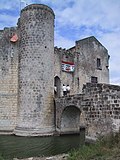
-

-



Jerusalem
[edit]


Cyprus
[edit]-
 Famagusta Royal Palace
 -

-

-
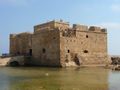
-

-


Armenian Cilicia
[edit]-

-

-

-
 Yılankale "Castle of the Snakes"


.jpg)

In mythology
[edit]Melusine
[edit]
According to European folklore the House of Lusignan was founded by the faerie Melusine. In the legend Melusine was exiled from Avalon and doomed to turn into a serpent from the waist down every Saturday. One day a prince, Raymondin of Poitou, came across her in the woods. He had just killed his uncle in a hunting accident and was distraught. Melusine helped him with this, and he later returned seeking her out. He proposed marriage, and she agreed on the condition that she be left alone every Saturday.
Raymondin agreed, and together they had ten children, founding the dynasty. They built the Château de Lusignan in 15 days, naming it after Melusine. One day Raymondin's brothers asked why she disappeared every Saturday, and Raymondin said that it was a condition of their marriage. One brother spied through the door, and saw Melusine bathing. She was a serpent, or according to some sources, a mermaid, from waist down. He told Raymondin of this, and when Melusine was confronted she wept at the betrayal, turned into a dragon, and flew away. She would fly over the castle whenever a new Lusignan became lord. It is for this reason that a mermaid is the Lusignan crest and dragons were their supporters.[18] These symbols also adorned the family's various castles.
The House of Plantagenet also claims shared ancestry from Melusine.
In popular culture
[edit]- King Peter I of Cyprus is mentioned in The Canterbury Tales.
- Melusine, the mythological founder of the family, is used as the logo for Starbucks.[19]
- Kingdom of Heaven centers on the Battle of Hattin and capture of Jerusalem, with Marton Csokas playing Guy de Lusignan.
- The movie Saladin the Victorious by Egyptian director Youssef Chahine features a female knight Hospitaller by the name of Louisa de Lusignan, played by Nadia Lotfi
- La reine de Chypre, 1841 opera by Fromental Halévy.
- Guy de Lusignan is a main character in Decameron by Giovanni Boccaccio.
- Thomas Aquinas's political treatise, On Kingship, was written for King Hugh III of Cyprus.
- Sir Walter Scott, in Minstrelsy of the Scottish Border (1802–1803), recounts the legend of Melusina, a supernatural creature.
- Letitia Elizabeth Landon recasts Melusine symbolically as a female poet in her poem
 The Fairy of the Fountains.
 - The civil war between James II (called "Zacco") and Charlotte of Cyprus forms the historical background to the events of Dorothy Dunnett's novel Charlotte, Queen of Cyprus, and the death of Zacco and its consequences figure in To Lie With Lions, volumes three and six in her House of Niccolo series.

References
[edit]- ^ Basmadjian, K. J. (Nov–Dec 1920). "Cilicia: Her Past and Future". The New Armenia. 12 (11–12): 168–9.
- ^ The Advocate: America's Jewish Journal, Volume 44. 21 December 1921 p. 628
- ^ a b c Kurdoghlian, Mihran (1996). Badmoutioun Hayots, Volume II (in Armenian). Athens, Greece: Hradaragoutioun Azkayin Oussoumnagan Khorhourti. pp. 29–56.
- ^ Hill, George (2010). A History of Cyprus, Vol. 2 (1 ed.). Cambridge University Press. p. 441. ISBN 978-1108020633. Retrieved 4 June 2015.
- ^ Notes and Queries: A Medium of Intercommunication for Literary Men, General Readers, Etc. Vol. 10. Series 5. London: John Francis, 1878. p. 190
- ^ "Yolanda of Lusignan", Wikipedia, 2019-08-18, retrieved 2020-05-11
- ^ Runciman, p. 180
- ^ "Site officiel du musée du Louvre". Cartelfr.louvre.fr. Retrieved 2012-08-11.
- ^ Basmadjian, K. J. (Nov–Dec 1920). "Cilicia: Her Past and Future". The New Armenia 12 (11-12): 168–9.
- ^ Andrée Giselle Simard, The Manuscript Torino J.II.9: A Late Medieval Perspective on Musical Life and Culture at the Court of the Lusignan Kings at Nicosia, pp.35-36, December 2005, retrieved on 15 June 2009
- ^ Fileti, F. (2000). I Lusignan di Cipro. Florence. p. 79.
{{cite book}}: CS1 maint: location missing publisher (link) - ^ Sire, Paul King Arthur's European Realm: New Evidence from Monmouth's Primary Sources. 2014, McFarland p. 182 0786478012
- ^ Dictionnaire des Titres et des terres titrées en France sous l'ancien régime», Eric Thiou, Éditions Mémoire et Documents, Versailles, 2003
- ^ a b Gillingham, Harrold E. (1935). Ephemeral Decorations. ANS Numismatic Notes and Monographs. Vol. 66. New York: American Numismatic Society. pp. 2–3, 20–31. OCLC 952177109. Retrieved 8 July 2016.
- ^ Order of Melusine
- ^ NY Times, 24 April 1910, D´ Aulby Protege of Pseudo Prince
- ^ Revived and Recently Created Orders of Chivalry
- ^ * Richardson, Douglas (2011). Kimball G. Everingham. In Plantagenet Ancestry: A Study In Colonial And Medieval Families, 2nd Edition. CreateSpace. p. 679. ISBN 1449966314. Google Book Search. Retrieved on November 12, 2014.
- ^ Rippin, Ann (2007). "Space, place and the colonies: re-reading the Starbucks' story". Critical Perspectives on International Business. 3 (2). Emerald Group Publishing: 136–149. doi:10.1108/17422040710744944. ISSN 1742-2043.
Further reading
[edit]- Chisholm, Hugh, ed. (1911). . Encyclopædia Britannica. Vol. 17 (11th ed.). Cambridge University Press. pp. 130–131. Endnotes:
- Louis de Mas Latrie, Histoire de l'île de Chypre sous les princes de la maison de Lusignan (Paris, 1852-1853)
- W. Stubbs, Lectures on Medieval and Modern History (3rd ed., Oxford, 1900)
External links
[edit] Media related to House of Lusignan at Wikimedia Commons
| International | |
|---|---|
| National | |
| Other | |

House of Lusignan
View on GrokipediaOrigins
Legendary Foundations
The legendary origins of the House of Lusignan center on the figure of Melusine, a mythical fairy ancestress depicted in medieval folklore and literature as the mother of the dynasty's progenitors. According to the romance Melusine composed by Jean d'Arras around 1393 for Jean, Duke of Berry—a patron with ties to the Lusignan lineage—Melusine was the daughter of the fairy Pressyne and the mortal King Elinas of Albany (a mythical Scotland). Offended by her father's imprisonment of her mother, Melusine and her sisters confined him in a mountain, incurring a curse from Pressyne that transformed Melusine into a serpent from the waist down every Saturday.[9][10] In the tale, Melusine encounters Raymondin (or Raimond), a Poitevin noble who had accidentally slain his lord while hunting, and aids his redemption by providing supernatural wealth and assistance. She marries him on the condition that he never observe her on Saturdays; violating this, Raymondin spies her bath-time transformation into a half-serpent being. Despite the betrayal, Melusine fulfills her role by magically constructing the Château de Lusignan overnight and bearing ten sons, from whom the Lusignan lords and various European noble houses purportedly descend, including rulers in Poitou, Jerusalem, Cyprus, and Armenia. The legend portrays her departure as a winged dragon from the castle tower upon Raymondin's death, symbolizing ongoing familial protection and vigilance.[9][11] This myth, drawing from earlier 14th-century Poitevin oral traditions and prose chronicles, served to legitimize the Lusignans' authority by invoking supernatural patronage, with the family incorporating serpentine motifs in their heraldry and chronicles. While no historical evidence supports Melusine's existence—the first documented Lusignan lord, Hugh I, appears circa 900 AD—the legend persisted in art, such as the 1410s depiction in Les Très Riches Heures du Duc de Berry, reinforcing the dynasty's prestige amid their expansions into crusader states.[9][12][13]Historical Emergence in Poitou
The House of Lusignan first appears in historical records as lords of Lusignan in Poitou during the early 10th century, amid the fragmented feudal structure of post-Carolingian Aquitaine. The earliest documented figure is Hugh I, surnamed Venator ("the Hunter"), who flourished around 885–930 and is identified in the Chronicle of Saint-Maixent as the progenitor of the seigneurial line controlling the Lusignan estate. This chronicle, compiled by Benedictine monks at the nearby abbey of Saint-Maixent, provides one of the few contemporary attestations of the family's initial holdings, situated in the Vienne valley near modern-day Lusignan, approximately 30 kilometers west of Poitiers. Hugh I's tenure reflects the era's local power dynamics, where minor lords secured forested and strategic lands amid threats from Viking incursions and the weakening authority of regional counts.[14] Succeeding Hugh I was his son, Hugh II, known as Carus ("the Kind"), who died in 967 and is noted in the same chronicle for erecting the original fortress at Lusignan, transforming a rudimentary holding into a defensible stronghold. This construction likely capitalized on the site's natural defenses—a rocky outcrop overlooking the Vienne River—enhancing control over local trade routes and woodlands. The Lusignans' early vassalage tied them to the Counts of Poitiers, whose ducal authority over Poitou derived from William the Pious's 9th-century foundations, obligating military service and homage in exchange for fief tenure. Such arrangements were typical in 10th-century Poitou, where noble families like the Lusignans accrued power by exploiting the counts' distractions with broader Aquitanian conflicts.[14] By the mid-11th century, under lords such as Hugh IV (died c. 1032), the family had consolidated adjacent territories, including forests granted or contested from episcopal oversight by the Bishop of Poitiers, evidencing gradual autonomy from direct comital supervision. Genealogical reconstructions from medieval charters indicate no earlier verifiable ancestors, underscoring the Lusignans' emergence as a distinct lineage tied to this specific Poitevin locale rather than broader Frankish nobility. Their rise paralleled Poitou's stabilization under the Ramnulfid counts, with the Lusignans leveraging martial prowess—evident in later crusading participation—to elevate from peripheral vassals to influential barons by circa 1100.Rise in France
Lords of Lusignan and Local Power
The lordship of Lusignan originated in Poitou during the 10th century, with Hugh Venator identified as the founder of the family and his son Hugh Carus credited with constructing the castle of Lusignan, first documented in 1009. As vassals of the counts of Poitiers, the early Lusignans held allods and benefices surrounding Lusignan, Couhé, and eastern forests, exercising rights to justice and collecting dues within the castellany. They also secured fiefs from ecclesiastical authorities, including lands from the abbey of St-Maixent such as Couhé and forest territories from the bishop of Poitiers.[14] Successive lords expanded local influence through strategic fortifications and feudal arrangements. Hugh IV Brunus, dying around 1032, founded the Notre Dame de Lusignan monastery on 6 March 1025, enhancing prestige and ties to the church. His successors, including Hugh V Pius (died 1060) and Hugh VI, known as the Devil (died 1110), consolidated power; the latter performed homage to St-Maixent Abbey in 1069, an early formalized feudal act that underscored their autonomy while binding them to monastic overlords. By the 12th century, the family controlled a network of castles, including Couhé (fortified under William III), Vouvant (via marriage alliances), Chizé, Civray, Angles, Lezay, and Château-Larcher, enabling dominance over regional trade routes and resources.[14] Marriages fortified their position among Poitevin nobility. Hugh VI wed Audéarde of Thouars, linking to a powerful vicomtal family, while Hugh V's union with Almodis of La Marche and later ties to the Rançon family via Burgundia expanded territorial claims and alliances. These connections supported alignments with the Plantagenet rulers, such as backing Richard I, though tensions erupted in revolts; in 1168, Hugh VII and allies like the viscount of Thouars rebelled against Henry II, leading to the seizure and partial dismantling of Lusignan and other castles. Such conflicts highlighted the Lusignans' capacity to challenge overlords while maintaining core local authority through fortified strongholds and kinship networks.[14][15] By the late 12th century, under Hugh VIII (died 1164) and Hugh IX, the family's power peaked locally before broader expansions, as evidenced by Hugh IX's 1199 acquisition of the county of La Marche through abduction of Queen Eleanor and subsequent recognition by King John on 28 January 1200. This era saw the Lusignans transition from petty lords to regional magnates, leveraging ecclesiastical protections—such as placing lands under abbey suzerainty in the 13th century—to shield holdings from direct royal interference, reflecting pragmatic adaptations to feudal pressures.[14]Expansion through Counties and Alliances
The Lusignan family's expansion in western France during the 12th and early 13th centuries relied heavily on marital alliances that secured control over adjacent counties. A pivotal acquisition occurred through the marriage of Hugh V "le Pieux" de Lusignan to Almodis, daughter of Bernard I, Count of La Marche (d. c.1047), likely in the 1060s or 1070s. Although the union was annulled around 1080–1090, their son Hugh VI "le Diable" de Lusignan (d. 1109/10) inherited the county as its count, establishing Lusignan dominance over La Marche by the early 12th century. This inheritance, passed down through Hugh VII (d. 1151), Hugh VIII (d. c.1172), and Hugh IX "le Brun" (d. 5 November 1219, as Hugh IV of La Marche), solidified the county as a core territory, spanning Limousin and bordering Poitou. Hugh IX further augmented Lusignan holdings by acquiring the seigneuries of Couhé and Châtenay (Château-Larcher) in the 1190s, likely through feudal negotiations and alliances with local Poitevin lords, enhancing their strategic position amid conflicts between the Capetian kings and the Plantagenets. These gains positioned the family as key players in regional power struggles. The most significant addition came under Hugh X de Lusignan (c.1183–1249), who succeeded his father as seigneur of Lusignan and Count of La Marche (as Hugh V) in November 1219. On 23 May 1220, Hugh X married Isabella of Angoulême (c.1188–1246), who had inherited the County of Angoulême from her father Aymer Taillefer upon his death on 11 April 1218; this union made Hugh X count consort, uniting La Marche and Angoulême under Lusignan rule until 1303.[16][17] These county acquisitions, facilitated by female inheritance lines and diplomatic marriages, elevated the Lusignans from castellans of a single fortress to overlords of extensive western French domains, fostering economic resources from tolls, agriculture, and military levies while drawing them into alliances with both French royalty and Anglo-Angevin interests. However, such expansions provoked rivalries, including disputes with the counts of Poitou and eventual confiscations by Philip IV of France in 1308 after the death of Hugh XII.[16]English Connections and Angevin Ties
Marriages and Conflicts with Plantagenets
Hugh X of Lusignan, son of Hugh IX and heir to the lordship, had been betrothed to Isabella of Angoulême as a means to resolve longstanding rivalries between their families, but King John of England married her instead on August 24, 1200, despite her youth (approximately 12 years old) and the existing agreement.[18] This act deepened Lusignan grievances against the Plantagenet crown, as the family viewed it as a breach of feudal obligations, prompting appeals to Pope Innocent III and contributing to regional instability in Poitou and Aquitaine.[19] The Lusignans' resentment persisted, fueling their alignment with Capetian France in subsequent disputes over English-held territories. Following John's death on October 19, 1216, Isabella returned to France and married Hugh X on May 10, 1220, rekindling the union intended by the original betrothal and producing nine children, including Guillaume (William de Valence), Aymar (Aymer de Valence), and others who later integrated into English affairs.[20] [19] This marriage tied the Lusignans directly to the Plantagenet dynasty through Isabella, mother of King Henry III (John's son, born October 1, 1207), yet it did not prevent conflicts; Hugh X's loyalty fluctuated, influenced by territorial ambitions and French overtures.[21] Tensions escalated in 1224 when Hugh X supported a Poitevin revolt against English rule, allying with French forces under Louis VIII, which resulted in the rapid capitulation of English garrisons and the effective loss of Poitou to Capetian control by late that year.[21] Despite the familial connection—Isabella actively corresponded with Henry III during this period—Hugh X prioritized local power, seizing La Rochelle and other key sites.[19] Further conflict arose in the Saintonge War of 1242, triggered by Louis IX's grant of Poitou and Saintonge as an appanage to his brother Alphonse; Hugh X again sided with the French, joining forces that defeated Henry III's army at the Battle of Taillebourg on July 21–22, 1242, forcing the English king's withdrawal and solidifying French dominance in western France.[22] Post-1242, pragmatic reconciliation occurred; Hugh X submitted to Henry III, and in 1247, he dispatched his younger sons, including William and Aymer, to England, where Henry III, seeking loyal Poitevin kin amid domestic baronial unrest, granted them extensive lands, titles, and influence—William becoming Earl of Pembroke that year and Aymer Bishop of Winchester.[23] [24] This integration marked a shift from outright conflict to strategic alliance, though underlying tensions from earlier betrayals lingered in Anglo-French rivalries.[21]Involvement in English Politics
The House of Lusignan's entanglement in English politics arose from the 1220 marriage of Isabella of Angoulême—widow of King John, who died in 1216—to Hugh X of Lusignan, Count of La Marche.[25] This union yielded sons William and Aymer de Valence (born Guillaume and Aymeric de Lusignan), half-brothers to King Henry III. Henry III, seeking to integrate his Poitevin kin, invited the brothers to England in 1247, landing at Dover, and bestowed upon them lands, revenues, and ecclesiastical benefices. William de Valence married Joan de Munchensi, granddaughter and heir of William Marshal, 1st Earl of Pembroke, on 13 August 1247, thereby assuming the titular earldom of Pembroke despite baronial resistance to formal creation. Aymer de Valence, arriving around 1246 and holding prebends such as Tisbury and Wearmouth, was elected bishop of Winchester on 4 November 1250 through Henry's vigorous advocacy; papal confirmation followed on 14 January 1251, though consecration occurred only on 30 May 1260 after prolonged disputes over his suitability.[26] The brothers' swift elevation—William to secular power, Aymer to one of England's richest sees—incited baronial ire, branding the Lusignans as alien favorites who monopolized royal patronage and exacerbated fiscal strains. This discontent fueled the baronial movement culminating in the Provisions of Oxford (1258), which exiled the Lusignans on 14 July; Aymer lost Winchester to a monkish rival, while William fled abroad.[26] William returned in 1261, aligning with royalists in the Second Barons' War; he fought at Lewes on 14 May 1264 before escaping to France, then rejoined forces for the decisive royal victory at Evesham on 4 August 1265 against Simon de Montfort, helping secure Henry's restoration. [27] Aymer died in Paris on 4 December 1260, his heart interred at Winchester in 1262.[26] William persisted as a royal counselor under Edward I, engaging in Welsh and Gascon campaigns until his death on 13 June 1296 at Bayonne.
Crusades and the Levant
Early Crusading Participation
The House of Lusignan's engagement with the Crusades in the Holy Land commenced in the early twelfth century, with Hugh VI of Lusignan joining the Crusade of 1101, a subsequent expedition following the First Crusade.[28] He reached the Kingdom of Jerusalem and participated in the Second Battle of Ramla on 17 June 1102, where he was killed in combat against Fatimid forces.[28] This early involvement demonstrated the family's commitment to the crusading effort, despite the personal cost to its leadership.[29] Subsequent generations continued this tradition during the Second Crusade (1147–1149), as Hugh VII of Lusignan accompanied King Louis VII of France to the Levant, though the campaign achieved limited success against the forces of Zengi and Nur ad-Din.[30] Hugh VII's participation reinforced the Lusignans' ties to the broader French nobility engaged in the reconquest of the Holy Land.[30] By the 1160s, Hugh VIII of Lusignan, lord of Lusignan and father to future crusader leaders Guy and Aimery, traveled from Poitou to Syria in 1163 to aid the Frankish states amid escalating threats from Nur ad-Din.[29] He fought in the Battle of Harim on 11 August 1164, a decisive defeat for the Crusaders, and was captured by Muslim forces, remaining in captivity without returning to France.[29] These expeditions, marked by valor and sacrifice, established the Lusignans' reputation as dedicated crusaders, paving the way for their later prominence in the Latin East.[31]Guy of Lusignan in Jerusalem: Rise and Controversies
Guy of Lusignan, born around 1150 as the youngest son of Hugh VIII, lord of Lusignan in Poitou, arrived in the Kingdom of Jerusalem in the late 1170s, likely seeking fortune after familial conflicts in France that included involvement in a failed ambush leading to his exile.[32] In early 1180, King Baldwin IV arranged Guy's marriage to his sister Sibylla, the widowed heiress whose first husband, William Longsword of Montferrat, had died in 1177, aiming to counter potential coups by Raymond III of Tripoli and Bohemond III of Antioch.[33][3] This union elevated the landless knight to prominence, granting him the title of count of Jaffa and Ascalon, though it drew immediate suspicion from the nobility due to Guy's obscurity and lack of local ties.[3] Following Baldwin IV's death on 16 March 1185, Guy served as regent for the young Baldwin V, Sibylla's son from her first marriage, amid ongoing leprosy afflicting the royal line.[34] Baldwin V died in late summer 1186, triggering a succession crisis; Raymond III claimed guardianship but was outmaneuvered when Sibylla was crowned queen in Jerusalem, after which she annulled her marriage to Guy under pressure only to remarry him immediately, allowing her to crown him as co-ruler King Guy I on the same day.[34] This dual coronation, bypassing the High Court and alternative claimants, was viewed by many barons as an unconstitutional usurpation, exacerbating divisions and rendering Guy deeply unpopular among the Frankish elite, who saw him as an ambitious outsider imposed by Sibylla's personal loyalty rather than merit or consensus.[33][35] Guy's kingship faced immediate military controversies, including the Battle of Cresson on 29 May 1187, where a small Crusader force under his nominal authority suffered a humiliating defeat to Saladin's forces after ignoring Raymond III's counsel against engagement, highlighting tensions between Guy's allies like the Templars and the experienced local lords.[3] The pivotal disaster came at the Battle of Hattin on 4 July 1187, when Saladin besieged Tiberias to lure the Crusader army; despite advice from Raymond III and others to avoid marching into waterless terrain, Guy led approximately 20,000 troops from Sephorie toward Hattin, where dehydration and Muslim harassment decimated the host, resulting in near-total annihilation, the capture of the True Cross, and Guy's own imprisonment.[36][37] Historians attribute the catastrophe to Guy's strategic misjudgments, such as prioritizing relief of Tiberias over preserving the army's strength and failing to secure water sources, though some contemporaries noted the unified response under his command despite internal hatreds.[3][36] This defeat enabled Saladin's capture of Jerusalem on 2 October 1187, cementing Guy's reputation as the king whose decisions precipitated the kingdom's collapse, with baronial opposition persisting even after his ransom in 1188.[37]Aimery's Reign and Shift to Cyprus
Aimery of Lusignan, elder brother of Guy of Lusignan, arrived in the Kingdom of Jerusalem in the late 1170s and rose to the position of constable by 1180, a role that placed him at the center of military administration.[38][29] Following the catastrophic defeat at the Battle of Hattin on July 4, 1187, and the fall of Jerusalem, Aimery shared in the captivity of the Frankish nobility under Saladin until ransomed in 1188.[39] He continued to support his brother Guy, who had briefly reigned as king consort of Jerusalem, during the latter's negotiations with Richard I of England, culminating in the acquisition of Cyprus as a fief in 1192 after its conquest from Isaac Komnenos.[38] Upon Guy's death on July 18, 1194, Aimery, who had already been assisting in the governance of Cyprus, was elected by the island's vassals and high court to succeed as lord, ensuring the continuity of Lusignan authority amid fragile settler loyalty and Byzantine remnants.[38] To legitimize and elevate the regime, Aimery sought recognition from the Holy Roman Emperor Henry VI, accepting vassalage and paying an annual tribute of 5,000 bezants; in return, he was crowned first King of Cyprus on September 28, 1197, in Nicosia, transforming the lordship into a kingdom independent of broader crusader hierarchies.[29] In the same year, Aimery married Isabella I of Jerusalem, widow of Conrad of Montferrat and Henry II of Champagne, following her husband's fatal accident in 1197, thereby assuming the titular throne of Jerusalem as Amalric II and merging the defunct kingdom's prestige with Cypriot realities.[38] This union, while symbolic given the loss of Jerusalemite territories, underscored the dynasty's pivot from the untenable mainland Levant—ravaged by Saladin's conquests and ongoing Muslim pressure—to Cyprus as a viable, defensible base for Frankish power in the eastern Mediterranean.[40] Aimery's eleven-year reign emphasized administrative consolidation, including the establishment of feudal assizes modeled on Jerusalemite customs, fortification of key sites like Nicosia and Famagusta, and diplomatic overtures to Western powers for support against Egyptian threats.[38] He repelled a Mamluk raid in 1198 and maintained uneasy truces, fostering economic recovery through trade with Italian merchants, which stabilized the realm's finances depleted by conquest costs.[29] Aimery died on April 1, 1205, succeeded by his son Hugh I, having successfully reoriented the Lusignan enterprise toward Cyprus as the dynasty's enduring stronghold.[38]Kingdom of Cyprus: The Main Branch
Foundation and Consolidation
The Kingdom of Cyprus was founded following the conquest of the island by Richard I of England in May 1191 during the Third Crusade, after his sister Joan and other ships were mistreated by the island's ruler, Isaac Komnenos, a self-proclaimed Byzantine emperor. Richard's forces defeated Komnenos at Limassol on May 6, 1191, and captured him after further engagements, securing the island by June.[41] Initially sold to the Knights Templar for 40,000 bezants, the burdensome territory was returned; Richard then granted it to Guy of Lusignan, the displaced King of Jerusalem, in 1192 for an initial payment of 60,000 bezants, with the balance covered in installments totaling 100,000.[42] Guy, supported by Richard against rivals in the Holy Land, arrived during the campaign and pledged loyalty, establishing Lusignan rule over Cyprus as a strategic base for Crusader operations.[43] Guy de Lusignan, ruling as lord from 1192 until his death in 1194 without male heirs, focused on consolidating control amid resistance from the Greek Orthodox population. He suppressed revolts, including a notable uprising in 1192 led by locals and former Byzantine officials, executing leaders and fortifying key sites like Nicosia and Famagusta.[44] Guy initiated the Latin feudal settlement by granting fiefs to Frankish knights and barons from the Crusade, dividing the island into seigneuries and introducing Western administrative practices, while maintaining a royal domain around the capital.[45] This period saw the arrival of approximately 800-1,000 Latin settlers, laying the groundwork for a hybrid society under Lusignan overlordship, though tensions with the Greek majority persisted.[29] Upon Guy's death, his brother Aimery of Lusignan assumed regency for Guy's daughters and was recognized as ruler, elevating Cyprus to kingdom status in 1196 through coronation by a papal legate and imperial confirmation from Henry VI.[46] Aimery's marriage to Isabella I of Jerusalem in 1197 extended Lusignan influence, securing his dual kingship until 1205, and he modeled Cypriot institutions—such as the High Court and assizes—on those of Jerusalem to legitimize the realm.[30] Consolidation advanced through a five-year truce with Ayyubid sultan Al-Adil I in 1198, fostering trade and stability, and by integrating military orders like the Templars and Hospitallers into the defense, while Aimery repelled minor Saracen raids and strengthened alliances with Western powers.[47] This era marked the dynasty's entrenchment, with Cyprus serving as a prosperous Crusader outpost amid the mainland's losses.[48]Zenith and Military Achievements
Peter I's reign (1359–1369) represented the military zenith of the Lusignan Kingdom of Cyprus, characterized by aggressive expeditions that briefly expanded influence and revived Western crusading momentum against Mamluk Egypt and its Levantine possessions. Assembling a coalition of Cypriot forces, European knights, and mercenaries, Peter launched preemptive strikes to secure coastal footholds, beginning with the capture of Corycus from the Armenian Kingdom of Cilicia in 1361, which he garrisoned to protect eastern trade routes and Christian interests.[49] This operation underscored Cyprus's role as a naval base, leveraging a fleet of galleys developed under prior rulers for amphibious assaults.[50] The kingdom's most notable achievement came in the Alexandrian Crusade of 1365, when Peter's forces executed a surprise landing on 9–10 October, sacking the Mamluk capital of Alexandria and inflicting heavy casualties before withdrawing due to insufficient siege equipment and reinforcements.[51] This raid, involving up to 165 ships and 1,500 knights, disrupted Mamluk commerce and commerce temporarily elevated Lusignan prestige in Europe, attracting papal indulgences and knightly orders' support, though it yielded no permanent territorial gains.[52] Follow-up campaigns in 1366 targeted Syrian ports like Tripoli and Latakia, while 1367 raids struck Egyptian harbors such as Damietta, capturing vessels and slaves to fund further efforts, yet these strained Cyprus's economy through heavy taxation and noble discontent.[53] Preceding this peak, Hugh III (1267–1284) focused on defensive consolidations amid Mamluk advances, attempting to reinforce Acre before its 1291 fall but arriving too late to halt Baibars's conquests of sites like Caesarea and Haifa; his efforts preserved Cyprus as a refuge for Frankish remnants, enabling later offensives.[4] Amalric of Tyre's 1299–1300 coordination with Mongol Ilkhan Ghazan briefly recaptured Jerusalem and other inland sites, demonstrating opportunistic alliances, but Mamluk counteroffensives under al-Ashraf Khalil ended these gains by 1303.[4] Collectively, these achievements highlighted the Lusignans' adaptation of Poitevin martial traditions to Mediterranean warfare, sustaining the kingdom's autonomy until Venetian interventions eroded its independence.Decline and Internal Challenges
The assassination of Peter I on 16 January 1369 marked a pivotal internal crisis, as disaffected barons, led by Philippe d'Ibelin, stabbed the king in his bedchamber amid grievances over his despotic governance and the economic burdens imposed by extensive crusading expeditions that had depleted royal treasuries.[54] These campaigns, including the 1365 sack of Alexandria, generated short-term prestige but long-term fiscal exhaustion, fostering resentment among the nobility who bore the costs without proportional benefits.[49] Peter's brothers, John and James, have been suspected of complicity, though evidence remains circumstantial from contemporary chronicles.[54] Peter I's young son, Peter II, ascended at age twelve, initiating a contentious regency dominated by family rivalries; initially under uncle John until 1371, the period saw Queen Eleanor of Aragon, Peter's widow, orchestrate John's murder in 1375 as vengeance for the assassination, while allying with Genoese forces against internal foes.[54] James, another uncle and co-regent, was captured by the Genoese in 1373 amid the invasion triggered by coronation unrest, holding Famagusta until 1464 and extracting heavy ransoms that further strained the kingdom's resources.[54] Upon Peter II's death in 1382 without viable heirs, the High Court selected James as James I in 1385 after his release, but his reign perpetuated instability through ongoing baronial discontent and feudal customs that limited royal authority, requiring noble consensus for major decisions.[55] Succession disputes intensified in the fifteenth century under John II (1432–1458), whose illegitimate son James—known as James the Bastard—fomented civil strife by murdering royal officials and challenging the legitimate line; following John's death, James allied with Mamluk Egypt in 1460, deploying foreign troops to oust his half-sister Queen Charlotte, securing the throne as James II amid accusations of political amorality.[56] [55] This reliance on external powers underscored the monarchy's erosion, as baronial factions exploited familial divisions, recurrent regencies empowered nobles, and assassinations eroded legitimacy, collectively undermining centralized control and paving the way for Venetian dominance by 1489.[54]Armenian Interlude
Acquisition of the Crown
The House of Lusignan acquired the crown of the Armenian Kingdom of Cilicia in 1342, following the assassination of King Leo IV on 28 August 1341, which resulted in the extinction of the senior male line of the Hetumid dynasty.[57] Leo IV, the last ruling Hetumid monarch, died without surviving legitimate male heirs, precipitating a succession crisis amid ongoing threats from the Mamluks and internal factions.[57] Guy de Lusignan, a younger son of Amalric I, King of Cyprus (r. 1291–1310), advanced his candidacy through prior marital ties to the Hetumid house, having wed a daughter of Hetoum II, King of Armenia (r. 1289–1293, 1295–1296, 1299).[57] This union, combined with broader interdynastic marriages—such as the 1331 wedding of Constance of Lusignan (daughter of Hugh IV of Cyprus) to Leo IV himself—provided the Lusignans with hereditary claims reinforced by their established influence in the region via Cyprus.[57] In 1342, Guy was elected king by the Armenian barons and high clergy, adopting the regnal name Constantine II to align with local traditions, thus inaugurating Lusignan rule over Cilicia and introducing a more Latin-oriented monarchy.[57] His brief reign until 17 April 1344 solidified the transfer, with subsequent kings from the Cypriot Lusignan branch maintaining the throne through collateral succession amid persistent geopolitical pressures.[57]Reigns and Geopolitical Struggles
The Lusignan branch's rule over Cilician Armenia commenced with Constantine II (Guy de Lusignan), anointed king in 1342 following the death of the previous ruler, but his authority was undermined by pervasive anti-Catholic resistance among the Armenian Orthodox population and nobility, who viewed the Western-oriented dynasty with suspicion.[57] This internal discord, compounded by economic strains and external threats, limited his reign to two years, ending in 1344 without meaningful territorial or political stabilization.[57] Leo V de Lusignan (also Levon V), a distant kinsman raised in France, was crowned king in Sis on 12 May 1374, inheriting a realm already fractured by decades of Mamluk encroachments and factional infighting.[57] His pro-Latin policies exacerbated religious tensions, alienating key Armenian lords who prioritized Orthodox traditions over union with Rome, while Mamluk Sultan al-Ashraf Sha'ban exploited these divisions through sustained military campaigns.[58] In June 1375, Mamluk forces overran the capital, capturing Leo and dismantling the kingdom's remnants, with Sis falling after a brief siege that highlighted the inadequacy of Cilicia's depleted defenses against Egypt's superior armies.[59] Appeals for Crusade aid from European monarchs, including England and France, yielded no substantive intervention, as logistical challenges and competing priorities—such as the Hundred Years' War—rendered distant support impractical.[57] Upon Leo's death in Parisian exile on 29 November 1393, the Armenian crown passed titularly to James I of Cyprus, his cousin and fellow Lusignan, who incorporated the style "King of Armenia" into his regalia but lacked resources or opportunity to contest Mamluk dominance over Cilicia.[60] This unrealized claim persisted in Cypriot royal titulature, reflecting the dynasty's persistent but futile geopolitical aspirations amid rising Ottoman pressures in the Levant.[58] The swift collapse underscored causal factors including chronic underpopulation, reliance on mercenary forces numbering fewer than 10,000 against Mamluk hosts exceeding 20,000, and the failure to forge enduring alliances beyond sporadic Mongol remnants.[59]Fall of Lusignan Armenia
The Kingdom of Cilicia under Lusignan rule faced escalating threats from the Mamluk Sultanate, which had progressively eroded Armenian territories through raids and annexations, including the port of Ayas in 1347.[61] Internal divisions, including noble factions and disputes over religious union with the Latin Church, further weakened the realm during the reigns of Constantine II (1342–1344) and Constantine III (1344–1363), both assassinated amid feudal anarchy. By the 1370s, the kingdom was reduced to a rump state centered on Sis, with Mamluk forces exploiting these vulnerabilities under Sultan Al-Ashraf Sha'ban.[62] Leo V de Lusignan, nephew of Constantine II and a scion of the Cypriot branch, ascended the throne in 1373 or 1374, inheriting a precarious position without significant external support from Cyprus or Europe.[63] His brief reign saw desperate diplomatic overtures to Western powers, but these yielded no military aid. In early 1375, a Mamluk expedition, motivated by Cilicia's strategic location and lingering Mongol alliances, advanced decisively; on April 13, the army stormed Sis after a siege, capturing the capital and effectively dismantling the kingdom's defenses.[64] Leo V attempted flight but was seized alongside key nobles, marking the end of organized Lusignan authority in Cilicia.[65] Imprisoned in Cairo, Leo V languished until 1382, when a ransom negotiated by European intermediaries, including the King of Castile and Pope Urban VI, secured his release. He then toured courts in Rome, Genoa, and France, petitioning for a crusade to reclaim Cilicia, but geopolitical priorities elsewhere—such as Ottoman advances—doomed these efforts. Granted nominal royal status and lands in Burgundy by Charles VI of France, Leo died childless on November 29, 1393, in Paris; his remains were interred at the Basilica of Saint-Denis.[66] With no viable heirs—his daughter Marie predeceased him—the direct Lusignan line in Armenia extinguished, though Cypriot kings retained the titular claim until Venice's conquest in 1489.[67] The Mamluks incorporated Cilicia into their domain, dispersing Armenian elites and ending the kingdom's independence after nearly three centuries.[68]Extinction and Aftermath
Venetian Conquest of Cyprus
The death of James III of Cyprus on 26 August 1474, at the age of one, extinguished the direct male line of the House of Lusignan, leaving his mother, Catherine Cornaro—a Venetian noblewoman who had married James II in 1472—as the island's reigning queen.[69][70] Venice, already influential through Catherine's family ties and the strategic value of Cyprus as a Mediterranean bulwark against Ottoman expansion, began installing baillis (governors) and exerting administrative control from 1474 onward to safeguard its commercial interests in Eastern trade routes.[71] This gradual encroachment transformed Cyprus from an independent crusader kingdom into a de facto protectorate, with Venetian forces suppressing local unrest and fortifying key ports like Famagusta.[72] By the late 1480s, Venice intensified diplomatic pressure on Catherine, isolating her court and leveraging familial obligations to compel abdication amid fears of Ottoman incursions and internal instability.[70] On 14 March 1489, Catherine formally ceded the Kingdom of Cyprus to the Republic of Venice, sailing from Famagusta under escort; the Venetian Senate ratified the annexation shortly thereafter, incorporating the island as an overseas colony without military engagement.[73] This transfer ended 297 years of Lusignan sovereignty, established in 1192, and marked Venice's last major territorial acquisition before the age of gunpowder empires.[72] Catherine received compensatory estates in Veneto, including Asolo, and honorary titles, but Cyprus's feudal structures were dismantled in favor of direct republican governance focused on defense and taxation.[71] The so-called "conquest" relied on inheritance claims via Catherine's Venetian origins rather than conquest by arms, reflecting Venice's preference for legalistic absorption over outright warfare in the post-crusader era.[70] Initial Venetian rule involved heavy fortification investments—such as expanding Nicosia's walls—and suppression of noble revolts, but it provoked resentment among the Frankish aristocracy and Greek Orthodox majority, setting the stage for Ottoman interest.[74] By 1489, Venice controlled approximately 1,000 square miles of arable land and key harbors, extracting revenues from sugar plantations and cotton exports to fund its galley fleet, though the island's population of around 200,000 endured increased corvée labor.[71] This transition preserved Cyprus's Christian character until the Ottoman siege of 1570–1571 but prioritized mercantile extraction over dynastic legitimacy.[72]End of the Direct Line
The direct male line of the House of Lusignan concluded with the death of James III, titular King of Cyprus, on 26 August 1474. Born on 6 July 1473 as the posthumous and only legitimate son of King James II (r. 1460–1473) and his Venetian consort Catherine Cornaro, James III was proclaimed king mere days after his birth, following his father's sudden demise from a suspected poisoning on 7 July 1473.[75] His infancy reign, under his mother's regency, lasted little more than a year before his own death at age one, which contemporary accounts and later historians attribute to poisoning orchestrated by factions seeking Venetian dominance over the island, though definitive proof remains elusive.[76] This event extinguished the patrilineal succession in the Cypriot branch of the dynasty, as James III left no siblings or other direct male heirs; prior kings had relied on a mix of legitimate and illegitimate descendants, but the royal male lineage traced continuously from Aimery I (r. 1196–1205) now terminated. Queen Catherine, lacking Lusignan blood herself, continued to govern until 1489, when she abdicated under Venetian pressure, formally ceding the throne to the Republic of Venice and ending independent Lusignan rule in Cyprus. Collateral branches of the family persisted in France, such as the Poitevin lords of Lusignan, but these held no claim to the eastern kingdoms and dwindled without restoring the dynasty's sovereign status.[75] Historians note that the fragility of the line had been evident earlier, with reliance on cadet and illegitimate offspring after the legitimate male descent faltered in the 14th century under Hugh II (r. 1324–1359), yet James III's passing sealed the irreversible decline amid geopolitical pressures from the Ottoman advance and European rivalries. No substantiated evidence supports survival of direct male pretenders post-1474, rendering claims of continuity speculative and rooted in later genealogical reconstructions rather than primary records.[76]Architectural and Territorial Legacy
Castles and Fortifications in France and Levant
The ancestral seat of the House of Lusignan was the Château de Lusignan in Poitou, initially constructed in the 10th century by Hugues II le Cher as a wooden fortification.[77] Partially dismantled in 1168 by Henry II of England, it was rebuilt in stone starting in 1171 under Hugues VIII de Lusignan, expanding into one of the most formidable castles in medieval France by the 14th century.[77] [78] The structure featured multiple towers, extensive walls, and a donjon, serving as both a military bastion and dynastic symbol amid the family's marcher lordships.[79] Other key fortifications in France under Lusignan control included the Château de Saint-Jean-d'Angle in Saintonge, erected around 1180 by Guillaume de Lusignan with 20-meter-high walls and a characteristic shell-keep design overlooking marshlands for strategic defense.[80] [81] In Vouvant, the Tour Mélusine, a massive keep built at the end of the 12th or beginning of the 13th century, supported the town's defenses as part of the Lusignans' regional holdings in Poitou. The Château de Parthenay, acquired through marital alliances, further bolstered their fortified network in the area, functioning as a regional stronghold during feudal conflicts.[82] In the Levant, the House of Lusignan's direct involvement with fortifications was limited due to the rapid territorial losses following the Battle of Hattin in 1187 under Guy de Lusignan, King of Jerusalem from 1186 to 1192.[83] Rather than constructing new defenses, they relied on pre-existing Crusader castles such as Tyre and Acre for coastal holdouts, with royal oversight focused on coordinating defenses amid Saladin's conquests rather than architectural innovation.[84] No major new fortifications are documented as Lusignan initiatives in the mainland Outremer, as efforts shifted to Cyprus after 1192.[8]Palaces and Structures in Cyprus and Armenia
The Lusignan kings established their primary royal residence in Nicosia, the capital of Cyprus, constructing a palace that exemplified Frankish Gothic architecture adapted to the island's context. Completed around 1211 during the reign of Hugh I, the structure featured large courtyards, intricate passageways, and defensive elements suitable for a crusader outpost.[85] Archaeological excavations in 2002, prompted by urban development, unearthed foundations and artifacts confirming the palace's layout and its role as the administrative hub for the dynasty's nearly three-century rule.[85] Remnants, including Gothic arches, survived into later periods and were repurposed by the British in the 20th century for structures like Government House.[86] Secondary residences and administrative buildings dotted other Cypriot cities, reflecting the dynasty's efforts to consolidate control amid economic prosperity from trade and sugar production. In Famagusta, a major port, Lusignan-era structures incorporated vaulted halls and fortified wings, often blending with Latin ecclesiastical complexes like the nearby cathedral.[87] Limassol hosted palatial ruins from the period, featuring rubble masonry and Gothic tracery that highlighted the rulers' investment in coastal strongholds vulnerable to Genoese raids.[88] These buildings, documented in early 20th-century surveys, underscore the Lusignans' patronage of durable, hybrid styles prioritizing defense and prestige.[89] In Cilician Armenia, where the Lusignans held the throne from 1342 to 1375, architectural legacy was constrained by the kingdom's contraction and Mamluk threats, yielding no major new palaces. The dynasty utilized the pre-existing royal residence at Sis, the capital, perched on the southern peak of a triple-hilled fortress for strategic oversight of the Cilician plain.[90] This complex, integrated into defenses dating to the Rubenid and Hethumid eras, housed kings like Constantine II (1344–1346) and Leo V (1374–1375) until the 1375 siege, when Mamluk forces razed palaces, churches, and walls, obliterating much of the site.[90] Surviving traces, such as throne remnants noted in 19th-century accounts, attest to its role but highlight the Lusignans' reliance on inherited Armenian fortifications rather than extensive rebuilding amid fiscal and military decline.[91]Cultural and Mythical Associations
The Melusine Legend
The Melusine legend, a foundational myth for the House of Lusignan, portrays Mélusine as a fairy ancestress who marries a mortal and establishes the family's castle at Lusignan. In the tale, Mélusine, daughter of the fairy Pressyne and the mortal King Elinas of Albania, imprisons her father in a mountain for his infidelity, earning a curse from her mother to transform into a serpent from the waist down every Saturday. Exiled with her sisters, Mélusine encounters Raymondin of Poitou (or Forez in some variants), a knight who accidentally kills his lord while hunting; she promises to aid him by securing his marriage to her and building the Lusignan fortress overnight using supernatural means.[9][92] Their union produces ten sons, progenitors of noble lines including the Lusignans, who rule Poitou, Jerusalem, Cyprus, and Armenia; the condition of secrecy—that Raymondin must not observe her on Saturdays—is broken when he spies on her bath, revealing her serpentine form, prompting her to flee as a winged dragon while vowing to protect her descendants. The story, rooted in pre-Christian water spirit folklore and human-serpent hybrid motifs, gained literary form in Jean d'Arras's La Noble Histoire de Lusignan (c. 1393), commissioned by Jean, Duke of Berry, blending genealogy, romance, and moral allegory to elevate the Lusignan dynasty's prestige amid their 14th-century decline.[92][13][93] Though lacking historical evidence for Mélusine's existence—the Lusignans trace verifiable origins to Hugh VIII of Lusignan (d. 1171) without fairy lineage—the legend served dynastic propaganda, manifesting in family crests with serpents or dragons and structures like the Tour Mélusine at Vouvant, built c. 1200 as a defensive tower but later mythologized as her work. Folklore persisted, with reports of a spectral dragon over Lusignan castle signaling a lord's death, reinforcing the narrative's cultural endurance despite its ahistorical basis.[9][11]Depictions in Literature and Folklore
The House of Lusignan features prominently in European folklore through the legend of Mélusine, a fairy ancestress said to have founded their dynasty. According to the late 14th-century romance Melusine; or, The Noble History of Lusignan by Jean d'Arras, commissioned by the Lusignans, Mélusine was a half-fairy daughter of a Scottish king and a fairy who imprisoned her father; cursed to transform into a serpent from the waist down every Saturday, she married the mortal Raymondin of Poitou after aiding him in a hunt.[92] She imposed a taboo against seeing her on Saturdays, but Raymondin spied on her in her bath, revealing her form, causing her to flee and haunt the family's castle at Lusignan as a spectral voice or winged serpent.[94] The tale portrays Mélusine constructing the Lusignan castle and other fortifications overnight through supernatural means, symbolizing the dynasty's rapid rise from regional lords to kings.[13] The Lusignans actively promoted this legend to legitimize their rule, incorporating serpentine motifs into their heraldry and chronicles, with the story circulating in oral traditions predating its literary codification around 1393.[9] Manuscripts of Jean d'Arras's work, illustrated with depictions of Mélusine's dual nature—human upper body and serpentine or draconic lower half—spread across Europe, influencing later folklore like mermaid variants and linking the family to mythical origins amid their 12th- to 15th-century expansions into the Crusader states.[92] While rooted in Poitevin oral lore possibly tracing to Celtic or Indo-European motifs of water spirits, the narrative served propagandistic purposes, blending genealogy with myth to elevate the family's prestige during their reigns in Jerusalem, Cyprus, and Armenia.[13] Beyond folklore, individual Lusignans appear in medieval literature; for instance, Guy of Lusignan is referenced in Giovanni Boccaccio's Decameron (c. 1353), portraying him within tales of Crusader-era intrigue and romance, though not central to the narrative. Chronicles like those of the Lusignan era in Cyprus produced French texts from the 1190s to 1470s, embedding family members in epic histories of Outremer, but these blend factual reigns with hagiographic elements rather than pure folklore.[95] No extensive non-Mélusine folklore survives uniquely tied to the house, with depictions largely reinforcing their chivalric and royal self-image against empirical records of geopolitical losses.Modern Pretensions and Historiographical Debates
Claims of Dynastic Continuity
The direct male line of the House of Lusignan ended with the death of King James III of Cyprus on 10 July 1474, at the age of one, following the assassination of his father James II in 1473 and the subsequent Venetian conquest that nullified claims by his mother, Queen Charlotte, who died childless in 1487.[31] Historians regard this as the extinction of the legitimate dynastic line, with no recognized continuation through cognatic descent or adoption maintaining the royal prerogatives of Jerusalem, Cyprus, or Armenia, as the family's rule over these realms relied on male primogeniture and conquest-based inheritance.[96] The Venetian Republic's annexation of Cyprus in 1489 formalized the end of Lusignan sovereignty, transferring control without deference to collateral branches.[31] Modern assertions of dynastic continuity primarily stem from the self-proclaimed Kalfa Nar Bey branch, originating with Guy de Lusignan Calfa Narbei (1831–1906), a Maronite priest and Armenian figure who claimed descent from Guy of Lusignan via an alleged exiled collateral line that survived into the Ottoman era.[97] This group, led in recent decades by figures such as Prince Louis George de Lusignan, maintains a website and chivalric orders asserting unbroken heritage, citing 17th-century figures like Gasparo de Lusignan (d. 1660) as evidence against extinction and invoking symbolic titles over defunct realms.[5] However, these claims lack substantiation in primary genealogical records or peer-reviewed historiography, with contemporary accounts portraying early proponents like Calfa Narbei as engaging in fraudulent schemes to extract funds from European nobility under pretenses of restoring lost thrones.[97] Scholarly consensus dismisses such pretensions as ahistorical, emphasizing the absence of verifiable documentation linking modern claimants to medieval Lusignans beyond fabricated pedigrees, often propagated through private orders rather than established nobility.[97] No major European house or international body recognizes these assertions, which contrast with the dynasty's documented fade into obscurity after 1474, supplanted by Venetian, Ottoman, and later colonial powers without revival of Lusignan legitimacy.[31]Scholarly Views on Extinction and Legacy
Scholars concur that the legitimate male line of the House of Lusignan concluded with the death of James III, titular King of Cyprus and Jerusalem, on August 26, 1474, at the age of one, leaving no heirs from his brief marriage to Charlotte of Bourbon.[29] This event marked the effective extinction of the dynasty's royal branch, as prior rulers had relied on male primogeniture, with female inheritance limited to regency or transmission to allied houses, such as the Savoyards in Armenia after Leo V's deposition in 1375.[57] Collateral branches, including illegitimate descendants of Henry II (d. 1324), persisted into the 17th century but held no sovereign claims and were not integrated into the recognized dynastic succession. Historians like Peter Edbury emphasize that these sidelines lacked the political legitimacy and territorial control defining the Lusignans' medieval prominence, rendering dynastic continuity claims unsubstantiated beyond genealogical curiosity.[98] The dynasty's legacy, per academic analysis, resides in its prolongation of Latin Christian rule in the Levant and eastern Mediterranean, establishing Cyprus as a viable outpost for over two centuries post-1191, when Guy of Lusignan acquired the island after the Third Crusade's failure to reclaim Jerusalem.[29] Edbury notes the Lusignans' administrative acumen, including feudal reorganization, sugar production expansion yielding annual revenues exceeding 100,000 bezants by the 14th century, and diplomatic balancing against Mamluk Egypt and Byzantine remnants, which sustained economic prosperity amid endemic warfare.[99] Their interdynastic marriages—such as Hugh III's claim to Jerusalem in 1268 via his mother's Ibelin lineage—facilitated cultural hybridization, blending Frankish chivalry with Orthodox and Armenian influences, evident in Gothic-Latin ecclesiastical architecture and multilingual courtly patronage.[98] Debates in historiography center less on extinction per se than on the dynasty's causal role in Crusader decline: critics attribute losses like Hattin (1187) under Guy to strategic miscalculations, yet proponents argue the Lusignans' resilience—evident in Peter I's 1365 Alexandria raid capturing 3,000 prisoners—delayed Mamluk dominance until 1291's Acre fall.[29] Modern scholars reject romanticized notions of unbroken descent promoted by pretenders, viewing the house's influence as confined to its tangible contributions: fortified networks from Poitou to Famagusta, which anchored Frankish identity against Islamic reconquest, and a model of adaptable feudalism that outlasted contemporaneous Outremer states by generations.[100] This pragmatic legacy underscores causal realism in medieval power dynamics, prioritizing verifiable territorial and economic outputs over mythic perpetuation.[98]References
- https://en.wikisource.org/wiki/Dictionary_of_National_Biography%2C_1885-1900/William_de_Valence