Hubbry Logo
Tower of DavidTower of DavidMain
Open search
Tower of David
Community hub
Tower of David
logo
8 pages, 0 posts
0 subscribers
Be the first to start a discussion here.
Tower of David
Tower of David
from Wikipedia
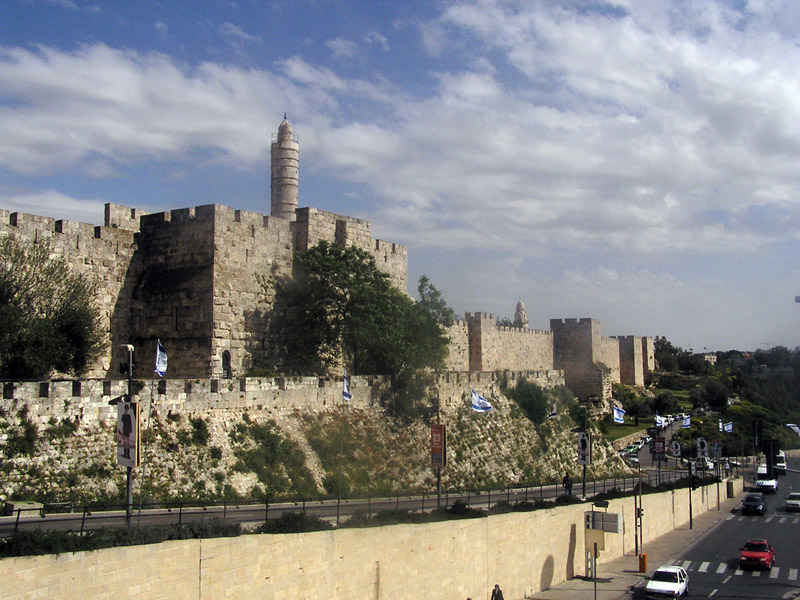
The citadel in 2016

The Tower of David (Hebrew: מגדל דוד, romanizedMigdál Davíd), also known as the Citadel (Arabic: القلعة, romanizedal-Qalʿa), is an ancient citadel and contemporary museum, located near the Jaffa Gate entrance to the Old City of Jerusalem.

The Tower of David and the city wall (2014)

The citadel that stands today dates to the Mamluk and Ottoman periods. It was built on the site of a series of earlier ancient fortifications of the Hasmonean, Herodian, Byzantine and Early Muslim periods, after being destroyed repeatedly during the last decades of Crusader presence in the Holy Land by their Muslim enemies.[1] It contains artifacts from the Iron Age including a quarry dated to the Second Temple period and pottery, fishbones, and other archaeological finds dating from the First Temple Period,[2] and is a venue for benefit events, craft shows, concerts, and sound-and-light performances.

Dan Bahat, an Israeli archaeologist, writes that the original three Hasmonean towers standing in this area of the city were altered by Herod, and that "the northeastern tower was replaced by a much larger, more massive tower, dubbed the 'Tower of David' beginning in the 5th century CE"[3] Originally referring to the Herodian tower in the northeast of the citadel, in the 19th century the name Tower of David began to refer to the 17th-century minaret at the opposite side of the citadel, and since 1967 officially refers to the entire citadel.[4]

The Tower of David hosted several art exhibitions in the 1920s in a period dubbed by some the Tower of David Period in Israeli art.

Names

[edit]
The citadel with the label "David's Tower" appearing in artifacts from 1865 and 1936. The label "Tower of David" is now commonly used to refer to the Ottoman minaret on the south west side of the citadel (shown as a small red circle on the 1936 map).

Tower of David: Herodian tower

[edit]

The name Tower of David was first used for the Herodian tower in the 5th century CE by the Byzantine Christians, who believed the site to be the palace of King David.[3][1] They borrowed the name Tower of David from the Song of Songs, attributed to Solomon, King David's son, who wrote: "Thy neck is like the tower of David builded for an armoury, whereon there hang a thousand bucklers, all shields of mighty men" (Song of Songs, 4:4).[5]

Arabic names

[edit]

An Arabic name of the massive Herodian-Mamluk northeast tower is the Burj al-Qalʾa (برج القلعة, 'Citadel Tower').[6]

During the Early Muslim and Ayyubid periods it was known in Arabic as Miḥrāb Dāwūd, lit.'David's miḥrāb (prayer place)'. Note that there is also another mihrab called Miḥrāb Dāwūd, built into the inner side of the Southern Wall of the Haram esh-Sharif/Temple Mount.[7]

History

[edit]
View of Tower of David from above
Jerusalem Model, Palace of Herod the Great with the three towers (Phasael, Hippicus, Mariamne from left to right)

Hasmonean period

[edit]

During the 2nd century BCE, the Old City of Jerusalem expanded further onto the so-called Western Hill. This 773-metre (2,536 ft) high prominence, which comprises the modern Armenian and Jewish Quarters as well as Mount Zion, was bounded by steep valleys on all sides except for the north. The first settlement in this area was about 150 BCE, around the time of the Hasmonean kings,[3] when what Josephus Flavius called "the First Wall" was constructed.

Herod's towers

[edit]
Large Herodian ashlars topped by smaller Mamluk stones

Herod, who wrested power from the Hasmonean dynasty, added three massive towers to the fortifications in 37–34 BCE. He built these at the vulnerable northwest corner of the Western Hill, where the citadel is now located. His purpose was not only to defend the city, but to safeguard his own royal palace located nearby on Mount Zion.[dubiousdiscuss] Herod named the tallest of the towers, 44 metres (144 ft) in height, Phasael, in memory of his brother who had committed suicide while in captivity. Another tower was called Mariamne, named for his second wife whom he had executed and buried in a cave to the west of the tower. He named the third tower Hippicus after one of his friends. Of the three towers, only the base of one of them survives today—either the Phasael or, as argued by archaeologist Hillel Geva who excavated the citadel, the Hippicus Tower.[8] Of the original tower itself (now called the Tower of David[dubiousdiscuss]), some 16 courses of the Herodian stone ashlars still rise from ground level (partially hidden by a much later built glacis), upon which were added smaller stones in a later period, that added back significantly to the height of the remaining stump of the Herodian tower.

During the Jewish war with Rome, Simon bar Giora made the tower his place of residence.[9] Following the destruction of Jerusalem by the Romans in 70 CE, the three towers were preserved as a testimony of the might of the fortifications overcome by the Roman legions, and the site served as barracks for the Roman troops.

When the Roman Empire adopted Christianity as its favoured religion in the 4th century, a community of monks established itself in the citadel. It was during the Byzantine period that the remaining Herodian tower, and by extension the citadel as a whole,[dubiousdiscuss] acquired its alternative name—the Tower of David—after the Byzantines, mistakenly identifying the hill as Mount Zion, presumed it to be David's palace mentioned in 2 Samuel.[10]

Early Muslims, Crusaders, Ayyubids

[edit]
The tower in 1911
The moat, main gate and tower in 1911

After the Siege of Jerusalem (636–637), the new Muslim rulers refurbished the citadel.[dubiousdiscuss] This powerful structure withstood the assault of the First Crusade in 1099, and surrendered only when its defenders were guaranteed safe passage out of the city.[citation needed]

During the Crusader period, thousands of pilgrims undertook the pilgrimage to Jerusalem by way of the port at Jaffa. To protect pilgrims from the menace of highway robbers, the Crusaders built a tower surrounded by a moat atop the citadel,[dubiousdiscuss] and posted lookouts to guard the road to Jaffa.[dubiousdiscuss] The citadel also protected the newly erected palace of the Crusader kings of Jerusalem, located immediately south of the citadel.[11]

In 1187, Sultan Saladin captured the city including the citadel. In 1239, the Ayyubid emir of Karak, An-Nasir Dawud, attacked the Crusader garrison and destroyed the citadel. In their 1244 siege of the city, the Khwarazmians defeated and banished the Crusaders from Jerusalem for a last time, destroying the entire city in the process. The Mamluk Sultanate destroyed the citadel in 1260.[citation needed][dubiousdiscuss]

Mamluk and Ottoman citadel

[edit]
Masjid Mihrab ed-Dawood, the Ottoman "David's Prayer Niche Mosque", mihrab and minbar

In 1310 the citadel was rebuilt by Mamluk sultan Al-Nasir Muhammad ibn Qalawun, who gave it much of its present shape.[12]

3 Turk. officers on camels before Tower of David, between 1898 and 1917

The citadel was expanded between 1537 and 1541 by the Ottoman sultan Suleiman the Magnificent, whose architects designed a large entrance, behind which stood a cannon emplacement.[dubiousdiscuss] For 400 years, the citadel served as a garrison for Turkish troops. The Ottomans also installed a mosque near the southwest corner of the citadel commonly known as the Mihrab el-Qal'a ed-Dawood ('Prayer niche of David's fortress'),[13] erecting a minaret during the years 1635–1655. In the 19th century the conspicuous minaret, which still stands today, became commonly referred to as the Tower of David. At least two mosques are known to exist within the citadel.[4][14]

During World War I, British forces under General Edmund Allenby successfully captured Jerusalem. Allenby formally proclaimed the event standing on a platform at the outer eastern gate of the citadel.

British and Jordanian periods

[edit]
Main gate to citadel, 1920

During the period of British rule (1917–1948), the High Commissioner for Palestine established the Pro-Jerusalem Society to protect the city's cultural heritage. This organisation cleaned and renovated the citadel and reopened it to the public as a venue for concerts, benefit events and exhibitions by local artists. In the 1930s, a museum of Palestinian folklore was opened in the citadel, displaying traditional crafts and clothing.[15]

Following the 1948 Arab–Israeli War, the Arab Legion captured Jerusalem and converted the citadel back to its historical role as a military position, as it commanded a dominant view across the armistice line into Jewish Jerusalem. It would keep this role until 1967.

Tower of David Museum

[edit]
A Dale Chihuly chandelier hangs in the entrance hall of the Tower of David Museum

Since the Six-Day War in 1967, the citadel's cultural role was revived.[clarification needed]

The Tower of David Museum of the History of Jerusalem was opened in 1989 by the Jerusalem Foundation. Located in a series of chambers in the original citadel, the museum includes a courtyard which contains archeological remains dating back 2,700 years.

The exhibits depict 4,000 years of Jerusalem's history, from its beginnings as a Canaanite city to modern times. Using maps, videos, holograms, drawings and models, the exhibit rooms each depict Jerusalem under its various rulers. Visitors may also ascend to the ramparts, which command a 360-degree view of the Old City and New City of Jerusalem.

As of 2002, the Jerusalem Foundation reported that over 3.5 million visitors had toured the museum.

Archaeology

[edit]
View of archaeological finds in the courtyard and the Ottoman minaret

In 2010, a survey of the site was conducted by Yehudah Rapuano on behalf of the Israel Antiquities Authority (IAA).[16]

See also

[edit]

References

[edit]
[edit]

Further reading

[edit]
Revisions and contributorsEdit on WikipediaRead on Wikipedia
from Grokipedia
The Tower of David (Hebrew: מגדל דוד, Migdal David) is an ancient citadel in the , , situated adjacent to the on the city's southwestern hill. Its prominent northeastern tower, originally Phasael's Tower built by around 20 BCE, survives from the era as part of a larger fortress complex that included three towers for defense and palace functions. The structure originated with Hasmonean fortifications in the BCE, overlying earlier remains possibly dating to the 8th-century BCE reign of King Hezekiah, and has endured sieges, reconstructions, and uses as a military outpost, Crusader palace, and Ottoman barracks across Roman, Byzantine, Islamic, and later periods. The name "Tower of David," applied during the Byzantine period, erroneously associates it with biblical King David, as no archaeological evidence connects the site directly to him. Following Jordanian control after , where it served as a fortress, was captured by Israeli forces in 1967 and repurposed as the Tower of David Museum of the History of , opened in 1989 to exhibit the city's multilayered past through archaeological artifacts, multimedia displays, and restored spaces like the Kishle excavation area revealing 3,000 years of strata. Excavations from 1934–1947 and 1968–1988 uncovered remains from monarchic Judahite to medieval Arab layers, underscoring its role in Jerusalem's defensive western flank. Today, the site functions primarily as a cultural venue rather than a , with ongoing renovations enhancing and preservation of its historical fabric.

Names and Etymology

Herodian Tower and Byzantine Misidentification

The prominent northeast tower of the Citadel, known today as the Tower of David, originates from the period, constructed by around 23 BCE as part of the fortifications protecting his palace on the western hill of . This tower, identified by most scholars as the Phasael Tower named after Herod's brother Phasael, featured a square base measuring approximately 24 meters per side and rose to a height of about 40 meters, designed to serve both defensive and residential purposes with luxurious apartments inside. Flavius describes it in as the tallest of three towers—Phasael, Hippicus, and Mariamne—built to overlook the city and deter attackers, incorporating advanced engineering like massive stones at the base for stability. Following the Roman destruction of in 70 CE, much of Herod's complex was razed, but the robust foundations of the Phasael Tower endured due to their sheer size and construction quality, with some ashlars weighing over 100 tons. In the Byzantine era, beginning around the CE, Christian rulers and pilgrims misidentified this surviving structure as a remnant of David's , erroneously linking it to biblical accounts despite archaeological and textual evidence placing David's on the eastern hill rather than the western site of Herod's . This attribution stemmed from a broader Byzantine tendency to "biblicalize" Jerusalem's , associating prominent ruins with scriptural figures to enhance religious significance, leading to the tower's designation as the "Tower of David" derived from 4:4. The misidentification persisted through subsequent Islamic conquests, with Arabic sources like al-Muqaddasi in the referring to it as "Burj Dawud" while acknowledging its pre-Islamic origins, though without correcting the Davidic link. Modern archaeology, including excavations by the , confirms the tower's masonry through stylistic analysis of headers and stretchers in the walls, distinguishing it from earlier Hasmonean or later medieval additions. This error highlights how post-biblical traditions overlaid historical sites, prioritizing symbolic continuity over precise topography, a pattern evident in other landmarks.

Arabic and Multilingual Designations

In Arabic, the Tower of David citadel is primarily designated as al-Qalʿa (القلعة), a term denoting "the citadel" or "the fortress," reflecting its role as a defensive stronghold without reference to biblical figures. The northeastern tower specifically bears the name Burj al-Qalʿa (برج القلعة), meaning "Citadel Tower," which underscores its architectural prominence within the complex. Early Islamic designations extended the Byzantine-era misidentification of the site as King David's palace by calling it Miḥrāb Dāwūd (محراب داود), or "Prayer Niche of David," associating it with prophetic traditions despite the structure's origins. These Arabic terms persisted through Mamluk and Ottoman periods, often appearing in historical accounts as Qalʿat al-Quds (قلعة القدس), or "Citadel of the Holy [City]," linking the fortress to Jerusalem's sanctity. In contemporary usage, the name Burj Dāwūd (برج داود), directly translating to "Tower of David," is also employed, particularly in tourist and bilingual contexts, though it retains the historical inaccuracy of attributing the tower to the biblical king. Multilingual designations include the Hebrew Migdal David (מגדל דוד), meaning "'s Tower," adopted in modern Israeli to evoke national heritage while acknowledging the site's layered history. In Latin and medieval European texts influenced by , it appears as Turris Davidis, perpetuating the same misnomer from Byzantine sources that conflated the Phasael Tower with David's era. These varied names highlight how linguistic traditions have overlaid functional descriptions with religious and historical interpretations across eras.

Historical Foundations

Hasmonean and Herodian Construction

The , ruling from approximately 140 to 37 BCE, significantly expanded and fortified Jerusalem's defenses, including the western hill area where now stands. Archaeological excavations in 's courtyard have uncovered sections of a Hasmonean wall dating to the 2nd century BCE, part of the "first wall" described by the historian as encircling the Upper City. These fortifications restored and extended earlier walls, incorporating towers and enhancing protection against Hellenistic threats following the . The Hasmoneans constructed a wall flanked by two towers at the of the southwestern hill, safeguarding the city from and supporting their efforts to enlarge Jerusalem's inhabited area. This phase laid foundational defensive structures, with remains visible today beneath later layers, confirming through and the mid-2nd century BCE construction timeline. Following the Hasmonean period, , who seized power in 37 BCE, built upon these foundations by erecting a complex in the Upper City, incorporating three massive towers to bolster fortifications. Named after his brother Phasael (the largest and most prominent), friend Hippicus, and wife Mariamne, these towers were added between 37 and 34 BCE to defend the vulnerable northwest corner. The Phasael Tower, identified as the core of the modern Tower of David, featured a square base approximately 40 cubits (about 60 feet) on each side and rose to 90 cubits (roughly 135 feet) in height, filled internally with compacted earth and stones for stability against siege engines, as detailed by . Herod's construction integrated Hasmonean elements, possibly reconstructing earlier towers, while emphasizing monumental scale with and strategic placement along the palace's northern perimeter. These features not only served military purposes but also symbolized royal authority, with the Phasael Tower designed to rival the Pharos of in grandeur. Only the Phasael Tower's substantial ruins endure, forming the Citadel's southeastern bastion after partial destruction in 70 CE.

Destruction and Early Post-Herodian Phases

During the siege of Jerusalem in 70 CE by Roman forces under Titus, the Herodian citadel, including the Phasael Tower, served as a key defensive point amid the First Jewish–Roman War. Despite intense fighting, the massive towers withstood the assaults, but following the city's capture, Titus ordered the demolition of most of Jerusalem's fortifications and Herod's palace complex to prevent future rebellions. The three principal towers—Phasael, Hippicus, and Mariamne—were explicitly spared, as their solidity exemplified the engineering prowess that Roman valor had subdued, according to the eyewitness account of Flavius Josephus. In the immediate aftermath, the Romans repurposed the southwestern hill site, establishing a camp for the to maintain control over the devastated region. This legionary presence, quartered near the intact Herodian towers, marked the onset of prolonged Roman military occupation, with archaeological evidence indicating the camp's layout integrated surviving structures like the Phasael Tower. The remained stationed there for over two centuries, from circa 70 CE until its relocation in the early CE, during which the area functioned primarily as a garrison rather than a civilian or royal site. The (132–136 CE) prompted further Roman consolidation, culminating in Emperor Hadrian's refounding of Jerusalem as , where the citadel and Phasael Tower were incorporated into the new colonial urban plan as enduring markers of imperial authority. Limited construction occurred during this Roman phase, preserving much of the base amid the shift to pagan temple dedications elsewhere in the city.

Medieval and Early Modern Periods

Islamic, Crusader, and Ayyubid Control

Following the Muslim conquest of in 638 CE by forces under Caliph Umar ibn al-Khattab, —known in as al-Qala'a—served as a key defensive stronghold under successive , Umayyad, and Abbasid administrations, with early refurbishments to maintain its Herodian-era towers and walls against potential Byzantine incursions. Under Fatimid rule from 969 CE, the structure endured internal strife and Seljuk incursions in the late , functioning primarily as a fort overlooking the city's , though specific architectural alterations during this era remain sparsely documented in contemporary accounts. By 1098 CE, Fatimid forces had reasserted control, but the citadel's defenses proved insufficient against the First Crusade's assault. Crusader forces breached Jerusalem's defenses on July 15, 1099 CE, entering via the citadel's vicinity near the and establishing the Latin Kingdom, with the Tower of David repurposed as the royal palace, administrative center, and ultimate redoubt for kings such as Baldwin I. To safeguard pilgrim routes from banditry, Crusaders constructed an additional tower encircled by a moat atop the existing fortifications, reinforced the Phasael Tower (misidentified as David's), and integrated French feudal elements including vaulted knights' halls and arched galleries, transforming it into a comprehensive complex. These enhancements, completed by the mid-12th century, emphasized layered defenses with watchtowers for road surveillance, reflecting the kingdom's reliance on amid ongoing Muslim counteroffensives. Saladin's Ayyubid forces, victorious at the Battle of Hattin on July 4, 1187 CE, besieged Jerusalem from September 20 to October 2, 1187 CE, compelling Balian of Ibelin to surrender the citadel and city after negotiations that allowed Christian evacuation for a modest ransom per person, averting widespread slaughter. In the ensuing Ayyubid era, Saladin initiated fortification upgrades around 1191 CE, including a deeper moat and reinforced outer walls to deter Frankish reprisals, though primary focus remained on the city's broader ramparts. A brief Crusader restoration under the 1229 Treaty of Jaffa returned partial control until 1244 CE, when Ayyubid-allied forces exploited Khwarezmian raids to demolish the citadel's walls, necessitating later reconstructions; a 13th-century Arabic inscription unearthed in excavations confirms ongoing Ayyubid-era masonry additions to the outer defenses.

Mamluk and Ottoman Transformations

Under rule, which began after the defeat of the at Ain Jalut in 1260, the of , incorporating the Tower of David, served primarily as the administrative seat for the local governor while the city walls remained largely unfortified. The structure underwent significant reconstruction in 1310 under Sultan al-Nasir Muhammad ibn Qalawun, who rebuilt the citadel following damage from earthquakes and prior conflicts, incorporating architectural elements such as vaulted halls and defensive towers that form much of the surviving interior layout today. This rebuild emphasized military functionality, with added bastions and gates, though the core Phasael Tower retained its base. Following the Ottoman conquest of Jerusalem in 1517, Sultan ordered renovations to around 1531–1532, as evidenced by an inscription on the outer archway commissioning repairs to the walls and towers for enhanced defense against potential threats. These works included strengthening the fortifications with angled bastions and clearing the , transforming the site into a key garrison for Ottoman forces overlooking . By the , a was added to one of the towers in 1635, reflecting the site's dual role as a outpost and Islamic administrative center. In the , Ottoman governors repurposed parts of the citadel as a residence and , with the construction of the Kishle around 1830 by Ibrahim Pasha during his brief Egyptian occupation, featuring neoclassical elements overlaid on foundations. Throughout the Ottoman era, the complex exemplified Islamic military architecture, with iterative repairs maintaining its role in controlling access to the Old City until . Archaeological evidence, including inscriptions and stratified masonry, confirms these layered transformations preserved earlier structures while adapting to gunpowder-era warfare.

Modern Military and Political Role

British Mandate and Jordanian Occupation

![1936 map of Old City showing David's Tower][float-right] During the British Mandate for Palestine, established after the Ottoman Empire's defeat in , the Tower of David citadel in 's Old City functioned primarily as a security and administrative outpost. British forces under General Edmund Allenby captured on December 9, 1917, with Allenby formally proclaiming the occupation from the citadel's steps on December 11. The adjacent Kishle structure, originally built by the Ottomans in the mid-19th century as military barracks, was repurposed by British authorities as a and detention facility. In the 1940s, it held prisoners including members of Jewish paramilitary groups like the , amid rising tensions between Zionist organizations, Arab nationalists, and Mandate authorities. The citadel's strategic location near made it integral to British efforts to maintain order in the volatile city, though no major battles occurred there during the Mandate period. Preservation efforts were limited; the site was registered under the government's antiquities laws, but military priorities overshadowed archaeological work. Following the 1948 Arab-Israeli War, Jordanian forces seized the Old City, including the Tower of David, on May 28, 1948, after intense fighting that divided . Under Jordanian administration from 1948 to 1967, the citadel was converted into a , reverting to its longstanding role as a defensive stronghold. Jordanian troops garrisoned the site, utilizing its elevated position and fortifications to monitor and enforce control over , which Jordan formally annexed in 1950. During this era, access to was restricted for civilians, and maintenance focused on military utility rather than historical preservation, reflecting Jordan's prioritization of security amid ongoing border skirmishes. Archaeological investigations were minimal, hampered by the political division of the city and Jordanian policies that limited Jewish access to holy sites. The structure sustained no significant damage but remained closed to the public until Israeli forces recaptured it in the 1967 .

Israeli Control and Reunification in 1967

During the period of Jordanian control from 1948 to 1967, the Tower of David Citadel functioned as a military stronghold for the , with its elevated ramparts employed by Jordanian snipers to target Israeli neighborhoods in , contributing to the division of the city and the denial of Jewish access to the Old City and its holy sites. The erupted on June 5, 1967, when launched preemptive strikes against Egyptian forces amid escalating threats; , despite Israeli appeals to remain neutral, joined the Arab coalition by bombarding with artillery, including from positions near the Old City walls. Israeli Defense Forces responded with ground operations, advancing into ; paratroopers breached the on June 7 and secured the Old City after intense urban combat against Jordanian defenders, thereby capturing and reunifying under Israeli control. Immediate post-capture measures included Israeli forces raising their flag over key sites and Defense Minister declaring the city's unity, ending 19 years of Jordanian administration that had desecrated synagogues and restricted non-Muslim worship. The reunification integrated into a singular municipal framework, with applying its laws to via administrative ordinances and guaranteeing access to religious sites for , , and , reversing prior discriminatory policies. Initially retained for military purposes by the IDF, the site's strategic position overlooking the city underscored its role in securing the newly unified capital.

Architecture and Fortifications

Core Structural Elements

The core structural elements of the Tower of David Citadel center on the Herodian-era Phasael Tower, which serves as the southeastern anchor of the fortress. Constructed by around 37–4 BCE, this massive square tower originally reached a height of approximately 145 feet (44 meters) and featured a base roughly 136 feet (41 meters) in length per side. Its lower courses consist of large, finely dressed limestone ashlars, up to 3 meters in height and weighing several tons each, exemplifying techniques with precise joints and marginal drafting. Today, the surviving portion stands about 25 meters (82 feet) tall, with upper sections rebuilt in smaller stones during medieval repairs, including 12th-century Crusader modifications featuring a sloping base. Enclosing the Phasael Tower are the Citadel's curtain walls, originally part of Herod's palace fortifications but reinforced over centuries on earlier Hasmonean foundations dating to the BCE. These walls, up to 5 meters thick in places, incorporate massive stone blocks from the Herodian period, transitioning to smaller in later Islamic and Crusader additions. The structure's layout forms a roughly rectangular , approximately 100 by 80 meters, with internal courtyards and bastions that provided defensive depth. Key access points include monumental gates, such as the Ottoman-era eastern entrance with its stone bridge and arched portal, built atop earlier foundations. Additional core features include the hexagonal appendage to the Phasael Tower's northeast side, added in the to enhance stability and aesthetics, and remnants of other towers like Hippicus to the north, though partially eroded or rebuilt. The overall foundation reflects layered construction: Hasmonean rock-cut elements at the base, overlaid by grandeur, forming a resilient core that withstood sieges and earthquakes through adaptive reinforcements rather than wholesale replacement. This hybrid durability underscores the Citadel's evolution from a royal palace-fortress to a military stronghold, with the Phasael Tower's robust podium enduring as the defining element.

Defensive Features and Evolutions

The foundational defensive features of the Tower of David, or Citadel of , originated in the Hasmonean period during the BCE, when fortifications were constructed at the northwest corner of the Upper City to protect against invasions, lacking natural barriers like cliffs or valleys. These included sturdy walls built at an elevation of approximately 773 meters. Herod the Great significantly enhanced these defenses between 37 and 34 BCE by erecting three massive towers atop the Hasmonean structures: Phasael (the largest, named after his brother, with a 40 by 40 base and 90 cubits height), Hippicus, and Mariamne. The Phasael Tower's base, comprising 16 courses of masonry, forms the core of the modern and provided elevated vantage points for and . These towers fortified the vulnerable northwest approach to Herod's complex and the city, integrating luxury residences with military capabilities. Following partial destruction in 70 CE, the site retained its towers as Roman before Byzantine refurbishments in the 4th–7th centuries CE maintained it as a fortified administrative center. During the Crusader era (1099–1187 CE), defenders added a protective , , and additional tower to safeguard pilgrim routes from bandits, transforming the citadel into a royal stronghold with reinforced north walls. Saladin's Ayyubid forces in 1187 deepened the moat further after capturing , enhancing its role as an obstacle against engines. The Mamluks reconstructed the citadel extensively in 1310 under Sultan , incorporating Hellenistic through Crusader remnants into a cohesive fortress with new towers, gates, and a , emphasizing symbolic military power. Ottoman Sultan expanded it in 1537–1541, adding cannon emplacements and a to the Phasael Tower for improved firepower against emerging threats, while integrating it into the broader city walls. These layered evolutions—from ancient stone towers and walls to medieval moats and early modern adaptations—reflect adaptive responses to evolving warfare technologies and strategic needs.

Archaeological Discoveries

Pre-Museum Excavations

Archaeological investigations at the Tower of David Citadel prior to its conversion into a were sporadic until the mid-20th century. During the British Mandate, C. N. Johns, a British archaeologist, directed excavations in the 1940s that focused on the site's medieval defensive structures, including towers and walls from the Crusader and periods. These efforts documented Ottoman-era modifications but were constrained by the site's active military use. After Israel's reunification of in , systematic pre-museum excavations intensified in the late to assess and preserve the citadel's subsurface layers ahead of public accessibility. Preliminary digs from 1979 to 1980, reported in scholarly journals, exposed foundational elements of the fortifications and earlier strata, including Iron Age quarries. These were expanded into a comprehensive project spanning 1980 to 1988, led by Hillel Geva, Renée Sivan, and Giora Solar on behalf of Israeli antiquities authorities. The work uncovered multi-period artifacts, such as and structural remnants, confirming continuous occupation from the First Temple era onward while prioritizing conservation for interpretive display. These excavations, totaling over a decade of fieldwork, directly informed the site's adaptation as the Tower of David Museum, which opened in 1989 following restoration. Unlike later post-museum probes, such as those at the adjacent Kishle in the , the pre-1989 efforts emphasized broad stratigraphic profiling over targeted artifact recovery, yielding evidence of the citadel's evolution from a Hasmonean outpost to a Byzantine stronghold.

Findings from First Temple to Ottoman Eras

Excavations at the Tower of David site, located in Jerusalem's Old City near , have uncovered multi-layered fortifications spanning from the late to the Ottoman period, revealing the citadel's evolution as a strategic stronghold. The earliest remains date to the First Temple period, specifically the 8th century BCE, including a section of Hezekiah's city wall approximately 7 meters wide, constructed with large boulders and damaged during the Babylonian destruction of 587/6 BCE. In the Hasmonean period (2nd century BCE), archaeologists identified a 4-meter-thick wall with built in two phases using Hellenistic-style ashlars, including headers and stretchers with dressed margins; this structure, known from as the "First Wall," runs northeast-southwest through the site's inner archaeological garden. During the subsequent Herodian era (37–4 BCE), King strengthened these defenses by adding three massive towers—Phasael (22 by 18 meters at the base, with 16 surviving courses reaching 20 meters high), Hippicus, and Mariamne—built atop a raised podium with retaining walls to support his royal palace complex, elevating the ground by about 5 meters. Roman occupation after 70 CE left traces of the Tenth Legion's camp, including clay pipes stamped with "L·X·F" seal impressions. Byzantine-period (4th–7th centuries CE) findings include restored fortifications, fragmentary walls, cisterns, and a lintel inscribed with a cross, indicating continued defensive use amid Christian associations linking the site to King David. Early Islamic (7th–9th centuries CE) layers feature an enclosing citadel with an 8th-century rounded corner tower (10 meters in diameter) and 4-meter-thick walls extending north and west. Crusader (12th century CE) modifications expanded the citadel into a French-style , incorporating earlier walls as an inner terrace buried under 10 meters of debris and adding a , though recent discoveries, including a 1212 CE Arabic inscription in secondary use within foundations, attribute some fortifications previously dated to this era to the Ayyubid period under Al-Mu’azzam Isa, who demolished structures in 1217 to deny them to Crusaders. (13th–16th centuries CE) rebuilds, such as those in 1310 by ibn , integrated prior remains, while Ottoman-era (16th century) excavations by (1537–1541) produced the bulk of the current structure, including high walls, towers, a , a grand entrance, emplacements, and a added to the Phasael Tower; additional artifacts include a medieval and restored mosques like Masjid al-Qala’a (1531–1532) and Masjid e Sayf (1738).

Tower of David Museum

Establishment and Core Mission

The Tower of David Museum, formally established in 1983 as the Tower of David Jerusalem City Museum by the Jerusalem Foundation, originated from planning efforts initiated in 1977 to transform the ancient into a dedicated historical venue. Situated within the 2,500-year-old fortifications adjacent to in 's Old City, the museum repurposed medieval chambers, guard rooms, and archaeological remnants—such as traces of Herod's palace from circa 23 BCE—for its inaugural exhibits. The Jerusalem Foundation, a nonprofit focused on urban development and heritage preservation, spearheaded excavations, exhibit design, and infrastructure to make the site accessible as an educational and cultural hub. The museum's core mission centers on chronicling Jerusalem's 4,000-year , illustrating how a modest settlement in the Judean hills evolved into a pivotal influencing , , , and broader global narratives through the actions and legacies of its inhabitants. Exhibits draw on academic research to depict key eras, from biblical foundations to Ottoman rule and modern statehood, emphasizing Jerusalem's enduring role as Israel's capital and a nexus of monotheistic traditions without shying from its Jewish-centered heritage. This purpose extends to fostering public engagement via displays, guided tours, and events that connect visitors—particularly school groups and international tourists—with the city's archaeological and historical depth. In alignment with its educational mandate, the museum promotes a comprehensive understanding of Jerusalem's complexities, bridging ancient sanctity with contemporary identity, and serves as a platform for exploring Israeli culture and Jewish continuity amid diverse influences. By hosting temporary installations, such as the 1999 Dale Chihuly glass exhibit, it balances historical fidelity with innovative outreach to cultivate appreciation for the site's strategic and symbolic importance across millennia.

Exhibitions and Technological Innovations

The Tower of David Museum's permanent exhibition comprises ten galleries located in the Citadel's restored guard rooms, chronologically tracing Jerusalem's history from its ancient origins over 4,000 years ago to the contemporary period, with emphasis on its centrality to , . These galleries integrate archaeological artifacts, ancient objects, scale models, and elements to depict pivotal events and cultural developments across eras. Temporary exhibitions, hosted in the new entrance pavilion and Citadel spaces, feature works by prominent Israeli and international artists, often exploring themes of Jerusalem's contemporary cultural expressions in , , and . Technological innovations enhance and immersion, including state-of-the-art interactive stations, dynamic wall projections, and immersive video that allow visitors to engage with historical reconstructions. The museum's Night Spectacular and King David shows utilize advanced video mapping, synchronized sound, and lighting projected onto the Citadel's courtyard walls to reenact key historical scenes after dark. Further advancements incorporate (AR) for overlaying digital historical visualizations on physical spaces and (VR) experiences developed through the museum's Innovation Lab, established in 2017 to foster digital heritage technologies. Accessibility features extend these technologies, such as at observation points and multilingual audio guides with descriptive narration.

2023 Renovation and Expansions

The Tower of David Museum underwent a comprehensive project that commenced around 2013 and involved three years of intensive , culminating in its reopening to the public on June 1, 2023. The $50 million initiative, funded primarily through private donations and philanthropic contributions, aimed to modernize the facility while preserving its ancient fortifications, effectively doubling the museum's exhibition space to over 20,000 square meters. Key structural expansions included the construction of a new sunken entrance pavilion adjacent to the citadel's walls, constructed from steel, stone, and glass to integrate seamlessly with the historic site and bypass Gate's security checkpoints for improved visitor flow. enhancements featured two new elevators, ramps, and a chair lift, addressing previous limitations in navigating the multi-level fortress. The project also restored the site's signature , originally built by Ottoman ruler in the , ensuring the preservation of architectural authenticity amid modern upgrades. Exhibition expansions introduced ten new galleries with immersive, technology-driven displays chronicling Jerusalem's 4,000-year history, including interactive holograms, a massive globe projection, and multimedia narratives focused on pivotal eras from biblical times to the present. A permanent core exhibition emphasizes the city's layered cultural and historical significance, positioning the museum as Jerusalem's official historical institution. These developments enhanced the site's role in public education, with curators noting the balance between ancient stonework and cutting-edge installations to foster deeper visitor engagement without altering the citadel's foundational integrity.

Cultural and Religious Significance

Biblical Associations and Jewish Heritage

The Tower of David, known in Hebrew as Migdal David, derives its name from longstanding Jewish tradition associating the site with King David, who conquered the Jebusite stronghold of around 1000 BCE and established it as the capital of the of , as described in 2 Samuel 5:6–9. This biblical account portrays David fortifying the city from the —a terraced structure or citadel—outward, symbolizing the consolidation of Israelite sovereignty over the region previously held by non-Israelite inhabitants. However, archaeological evidence indicates no direct remnants of Davidic-era constructions at itself; the extant towers and walls primarily date to the (2nd century BCE) and Herod the Great's expansions (37–4 BCE), rendering the naming a later attribution rather than a historical fact. The specific phrase "Tower of David" appears metaphorically in the Song of Solomon 4:4, evoking an image of defensive strength and adornment with shields, which later traditions poetically linked to Jerusalem's fortifications without literal correspondence to the site. This traditional linkage underscores the site's enduring role in Jewish heritage as a emblem of biblical kingship and divine promise, reinforced during the Second Temple period when Jewish rulers like the Hasmoneans and Herod integrated it into Jerusalem's defenses. The Citadel, including Phasael's Tower (built circa 20 BCE and standing 136 feet high), served as a strategic bulwark overlooking , protecting the western approach to the and embodying Jewish resilience against invasions. Herod's construction, while influenced by Roman engineering, aligned with Jewish royal architecture of the era, as evidenced by its integration with earlier Hasmonean walls and its function in safeguarding the during periods of relative Jewish autonomy. In Jewish liturgy and historical memory, the location evokes the Davidic covenant (2 Samuel 7), promising an eternal throne in Jerusalem, thus imbuing the Tower with messianic overtones despite its post-biblical origins. The Byzantine-era (4th–7th centuries CE) misidentification of the Citadel as David's palace by Christian sources further entrenched the name in Jewish consciousness, countering external narratives by reclaiming the site's symbolic primacy in Israelite . Throughout medieval and Ottoman periods, Jewish communities in maintained proximity to , viewing it as a testament to ancestral fortitude amid exiles and reconquests, with references in rabbinic texts emphasizing its role in the city's eschatological redemption. This heritage persists in modern Jewish observance, where the Tower's silhouette against the Old City skyline reinforces narratives of continuity from biblical to contemporary sovereignty, grounded in the empirical continuity of 's as a defensible hilltop stronghold.

Symbolic Role in Jerusalem's Identity

The Tower of David, situated at the northwestern corner of Jerusalem's Old City walls near , functions as a prominent visual anchor in the city's silhouette, representing its role as a fortified gateway and enduring sentinel over millennia of conflict and renewal. Originally constructed as part of Herod the Great's palace complex around 19 BCE, with the Phasael Tower forming its core, the structure's upper minaret—added by Sultan Qaitbay in 1504 CE—evolved into the defining feature misattributed to King David by Byzantine Christians around the 5th century CE, a that persisted through Ottoman, British Mandate, and modern eras. This enduring misnomer underscores the Tower's symbolic linkage to biblical narratives of Davidic kingship, despite archaeological evidence confirming its Hasmonean-Herodian foundations, thereby embedding it in Jerusalem's as a emblem of ancient Israelite . In the post- Israeli context, particularly after the 1967 Six-Day War's reunification of the city, the Tower has crystallized as a marker of national resilience and reclaimed heritage, with its exhibitions narrating 's trajectory from ancient to capital of the State of . Official Israeli tourism and heritage narratives position it as a testament to the city's strategic defensibility and cultural continuity, having withstood sieges from Romans in 70 CE to Jordanian forces in , symbolizing Jewish perseverance amid partition and recovery. Recent scholarly examinations highlight a 21st-century shift in global and local iconography, where depictions of increasingly foreground the Tower over Islamic domes, aligning with fortified barriers and assertions of undivided sovereignty in response to stalled peace processes. Biblically evoked in Song of Solomon 4:4 as a tower hung with shields of mighty men, the site evokes themes of martial vigilance and aesthetic grandeur, reinforcing its metaphysical role in as a of divine protection. This multifaceted symbolism—bridging , religious lore, and modern statehood—cements the Tower's centrality to Jerusalem's identity as a of sacred and geopolitical contestation, distinct from transient political claims.

Controversies and Competing Narratives

Claims of Historical Erasure

Critics, particularly from Palestinian advocacy groups and media outlets, have accused the Tower of David Museum of engaging in historical erasure by prioritizing Jewish and Israeli narratives while marginalizing Islamic, Arab, and Palestinian histories of . An in Al Jazeera contended that the museum "weaponises" exhibits to reinforce the Israeli state's founding myth of Palestinian non-existence, noting that while the site's official description highlights its role as a "meeting point of three monotheistic religions," the displays focus predominantly on and modern Israeli achievements, thereby sidelining Palestinian presence. Similarly, Al-Quds Al-Arabi reported on the museum's 2023 reopening after a $50 million renovation and decade-long excavations as an act of "erasing Islamic history," alleging that Israeli authorities repurposed —a site with significant Ottoman and layers—into a venue that overwrites non-Jewish heritage with a Zionist framing. Hamas echoed these sentiments in June 2023, condemning the transformation of of , described by the group as an "ancient Palestinian historical site," into what it called a "Jewish ," claiming this move distorts the site's multi-cultural past to serve Israeli settler-colonial aims. Academic analyses from Palestinian studies outlets have reinforced such critiques, arguing that the 's chronological exhibits promote a teleological continuity from biblical Jewish kingdoms to contemporary , effectively bridging ancient history with Zionist claims while underrepresenting periods of Muslim rule, such as the Ayyubid and Ottoman eras when the citadel served as a key Islamic fortress. These accusations arise amid broader debates over Jerusalem's , where sources like Al Jazeera and Al-Quds—outlets with documented advocacy for Palestinian perspectives—frame the museum's Israeli state affiliation as inherently biasing its curation toward erasure of competing narratives. However, the museum's own documentation emphasizes a comprehensive timeline from settlements through Byzantine, Islamic, Crusader, and Ottoman phases to the present, incorporating artifacts from diverse rulers, though critics maintain this inclusivity is superficial and subordinated to a dominant Jewish interpretive lens. No peer-reviewed archaeological studies have substantiated outright fabrication or omission of material evidence, but the interpretive emphasis has fueled perceptions of selective storytelling aligned with construction.

Archaeological Evidence and Preservation Debates

Archaeological excavations at the Tower of David Citadel have uncovered evidence of fortifications from the Hasmonean period (2nd century BCE), including foundations of the western city wall constructed with large ashlar blocks typical of that era. These findings confirm the site's role in Jerusalem's defensive system before expansions. Subsequent layers reveal reinforcements around 20 BCE, featuring massive towers integrated into the palace complex north of the Upper City. The northeast tower, a prominent surviving element, measures approximately 40 by 40 cubits at its base with walls up to 12 meters thick, aligning with Josephus's description of the Phasael Tower—named for Herod's brother and designed as the largest of three protective structures. Earlier precursors, such as elements linked to Hezekiah's Broad Wall, indicate pre-Hellenistic efforts in the vicinity, though direct attribution to remains debated due to stratigraphic overlaps. Scholarly debates center on tower identifications, with some evidence suggesting the minaret-like structure may correspond to the Hippicus Tower rather than Phasael, based on comparative masonry analysis and Josephus's accounts of post-70 CE Roman modifications. These discussions highlight challenges in reconciling literary sources with physical remains, as later Byzantine, Crusader, and Ottoman additions obscure original contours. Preservation efforts intensified in the to address structural vulnerabilities; in 2023, engineers dismantled and rebuilt the top 10 meters of the main tower using a mix of salvaged original stones and new matching , averting risks from seismic activity and . A multi-year project, begun in 2021, incorporates advanced stabilization techniques while exposing subterranean features for public viewing, though critics question the balance between authentic restoration and for tourism. Debates also arise over excavation priorities, with calls to prioritize layers potentially overshadowed by emphasis on remains, reflecting broader tensions in interpreting Jerusalem's stratigraphic history.

References

Add your contribution
Related Hubs
User Avatar
No comments yet.