Hubbry Logo
Urban warfareUrban warfareMain
Open search
Urban warfare
Community hub
Urban warfare
logo
8 pages, 0 posts
0 subscribers
Be the first to start a discussion here.
Urban warfare
Urban warfare
from Wikipedia

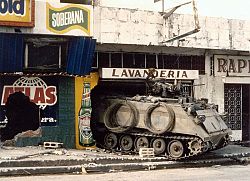
A United States Army M113 armored personnel carrier during the 1989 United States invasion of Panama

Urban warfare is warfare in urban areas such as towns and cities. Urban combat differs from combat in the open at both operational and the tactical levels. Complicating factors in urban warfare include the presence of civilians and the complexity of the urban terrain. Urban combat operations may be conducted to capitalize on strategic or tactical advantages associated with the possession or the control of a particular urban area or to deny these advantages to the enemy.[1] It is arguably considered to be the most difficult form of warfare.[2][3]

Fighting in urban areas negates the advantages that one side may have over the other in armor, heavy artillery, or air support. Ambushes laid down by small groups of soldiers with handheld anti-tank weapons can destroy entire columns of modern armor (as in the First Battle of Grozny), while artillery and air support can be severely reduced if the "superior" party wants to limit civilian casualties as much as possible, but the defending party does not (or even uses civilians as human shields).

Some civilians may be difficult to distinguish from such combatants as armed militias and gangs, and particularly individuals who are simply trying to protect their homes from attackers. Tactics are complicated by a three-dimensional environment, limited fields of view and fire because of buildings, enhanced concealment and cover for defenders, below-ground infrastructure, and the ease of placement of booby traps and snipers.[4]

Military terminology

[edit]
JGSDF soldiers practice MOUT tactics in the Ojojibara Maneuver Area of Sendai, Japan during an exercise in 2004

Historically, the United States Armed Forces has referred to urban warfare as UO (urban operations),[5] but this term has been largely replaced with MOUT (military operations in urban terrain).[6]

The British armed forces terms are OBUA (operations in built-up areas), FIBUA (fighting in built-up areas), or sometimes (colloquially) FISH (fighting in someone's house),[7] or FISH and CHIPS (fighting in someone's house and causing havoc in people's streets/public spaces).[8]

The term FOFO (fighting in fortified objectives) refers to clearing enemy personnel from narrow and entrenched places like bunkers, trenches and strongholds; the dismantling of mines and wires; and the securing of footholds in enemy areas.[9]

Israel Defense Forces calls urban warfare לש"ב (pronounced LASHAB), a Hebrew acronym for warfare on urban terrain. LASHAB in the IDF includes large-scale tactics (such as use of heavy armoured personnel carriers, armoured bulldozers, UAVs for intelligence, etc.), close-quarters battle training for fighting forces (how a small team of infantry soldiers should fight in close and built-up spaces). IDF's LASHAB was developed mainly in recent decades, after the 1982 Lebanon War included urban warfare in Beirut and Lebanese villages, and was further developed during the Second Intifada (2000–2005) in which IDF soldiers entered and fought in Palestinian cities, villages and refugee camps. The IDF has an advanced facility for training soldiers and units in urban warfare.[10]

Urban operations

[edit]
The Battle of Tampere during the 1918 Finnish Civil War was the largest urban warfare in the Nordic war at the time, measured by the number of troops involved.[11] The picture shows the ruins of the city of Tampere after the battle.

Urban military operations in World War II often relied on large quantities of artillery bombardment and air support varying from ground attack fighters to heavy bombers. In the European theatre of war, roughly 40% of battles took place in urban areas.[12] In some particularly vicious urban warfare battles such as Stalingrad and Warsaw, all weapons were used irrespective of their consequences.[citation needed]

Military historian Victor Davis Hanson noted the lethality of urban warfare in the Second World War, "When civilian met soldier in the confined landscapes, the death toll spiked, and it was no surprise that the greatest carnage of World War II—at Leningrad and Stalingrad—was the result of efforts to storm municipal fortresses".[13]

However, when liberating occupied territory some restraint was often applied, particularly in urban settings. For example, Canadian operations in both Ortona and Groningen avoided the use of artillery altogether to spare civilians and buildings,[14][15] and during the Battle of Manila in 1945, General MacArthur initially placed a ban on artillery and air strikes to save civilian lives.

Military forces are bound by the laws of war governing military necessity to the amount of force which can be applied when attacking an area where there are known to be civilians. Until the 1970s, this was covered by the 1907 Hague Convention IV – The Laws and Customs of War on Land which specifically includes articles 25–27. This has since been supplemented by the Additional Protocols to the Geneva Conventions of August 12, 1949, and relating to the Protection of Victims of International and Non-International Armed Conflicts.

Japanese troops in the ruins of Shanghai during the Second Sino-Japanese War

Sometimes distinction and proportionality, as in the case of the Canadians in Ortona, causes the attacking force to restrain from using all the force they could when attacking a city. In other cases, such as the Battle of Stalingrad and the Battle of Berlin, both military forces considered evacuating civilians only to find it impractical.[16]

When Russian forces attacked Grozny in 1999, they conducted a massive artillery and air bombardment campaign in an attempt to smash the city into submission. The Russian Army handled the issue of civilian casualties by issuing an ultimatum urging citizens to leave or be destroyed without mercy.[17] Leaflets dropped on the city read: 'You are surrounded, all roads to Grozny are blocked...Persons who stay in the city will be considered terrorists and bandits and will be destroyed by artillery and aviation. There will be no further negotiations. Everyone who does not leave the city will be destroyed '.[18][17]

Manila, the capital of the Philippines, devastated during the Battle of Manila in 1945

Fighting in an urban environment can offer some advantages to a weaker defending force or to guerrilla fighters through ambush-induced attrition losses. The attacking army must account for three dimensions more often,[19] and consequently expend greater amounts of manpower to secure a myriad of structures, and mountains of rubble.

Ferroconcrete structures will be ruined by heavy bombardment, but it is very difficult to demolish such a building totally when it is well defended. Soviet forces had to fight room by room while defending the Red October Steel Factory during the Battle of Stalingrad, and in 1945, during the race to capture the Reichstag, despite heavy bombardment with artillery at point blank range (including 203 mm howitzers).[20]

It is also difficult to destroy underground or heavily fortified structures such as bunkers and utility tunnels; during the Siege of Budapest in 1944 fighting broke out in the sewers, as both Axis and Soviet troops used them for troop movements.[21]

Analysts debate the scope and size of urban battles in the modern day, as they are unlikely to match the scale of battles in the Second World War. For example, professor Michael C. Desch states that while "enormous forces engaged on both sides in those battles may never be seen in high-intensity urban battles again", that "the large numbers of killed and wounded underline the basic fact that such conflict is extremely lethal", referencing the battles of Stalingrad and Berlin.[22] An article by the Modern War Institute states that while lessons may be taken from Stalingrad, ultimately "Stalingrad took place in a theater with a large number of army groups with a total of a million soldiers involved on each side; modern armies are unlikely to fight with these numbers."[23]

Many analysts, such as former American army general and Commandant of the United States Marine Corps, Charles C. Krulak, and retired military officer and chairman of the urban warfare studies at the Modern War Institute, John Spencer have predicted urban warfare to become the norm in wars.[24][25] Spencer confirmed this to be true in an article in 2024, providing a list of numerous urban battles in the recent decades of the 21st century alone, those being Fallujah, Sadr City, Mosul, Raqqa, Marawi, and now Bakhmut, Mariupol, and Khan Yunis in the 2020s.[25] In 2023, analyst Mikael Weissmann claimed that it is widely agreed upon that urban warfare will be the "battlefields of tomorrow".[3]

Urban warfare tactics

[edit]
Urban warfare is fought within the constraints of the urban terrain.

The characteristics of an average city include tall buildings, narrow alleys, sewage tunnels and possibly a subway system. Defenders may have the advantage of detailed local knowledge of the area, right down to the layout inside of buildings and means of travel not shown on maps.[citation needed]

The buildings can provide excellent sniping posts while alleys and rubble-filled streets are ideal for planting booby traps. Defenders can move from one part of the city to another undetected using tunnels and spring ambushes.[26]

Meanwhile, the attackers tend to become more exposed than the defender as they must use the open streets more often, unfamiliar with the defenders' secret and hidden routes. During a house to house search the attacker is often also exposed on the streets.[citation needed]

Battle of Monterrey, Mexico

[edit]

The Battle of Monterrey was the U.S. Army's first major encounter with urban warfare. It occurred in September 1846 when the U.S. Army under Zachary Taylor invaded the town. The U.S. Army had no prior training in urban warfare and the Mexican defenders hid on rooftops, shot through loopholes, and stationed cannons in the middle of the city's streets. The houses at Monterrey were made of thick adobe, with strong double doors and few windows. The rooftops were lined with a two-foot-tall wall that acted as a parapet for the defending soldiers. Each home was a fort unto itself.[27]

On September 21, 1846, the U.S. Army which included some of its best soldiers, recent West Point graduates, marched down the city's streets and were cut down by the Mexican defenders. They could not see the men hidden behind walls, loopholes, or rooftops. They tried to march straight down the street until the intense fire drove them to hide in adjacent buildings. Taylor tried to move artillery into the city but it could not hit the well-hidden defenders any better than the U.S. soldiers could. Two days later the US again assaulted the city from two sides and this time they fought differently.[28]

Not wanting to repeat the mistakes of the 21st, General William Jenkins Worth listened to his Texan advisers. These men had fought in Mexican cities before at the Battle of Mier in 1842 and the Battle of Bexar in 1835. They understood that the army needed to "mouse hole" through each house and root out the defenders in close combat.[29][30]

Worth's men used pick axes to chip holes in the adobe walls of the homes, in the roof of the house from where the soldiers could drop in, or used ladders to climb to the top of a rooftop and assault the Mexican defenders in hand-to-hand combat. The typical assault on a home would include one man who would run to the door of the house and chip the door away with a pick axe under covering fire. Once the door showed signs of weakening, 3–4 other soldiers would run to the door and barge in with revolvers blazing. Worth lost few men on the 23rd using these new urban warfare techniques.[30]

Battle of Stalingrad

[edit]

The Battle of Stalingrad is largely seen as the defining battle of urban warfare, with the battle commonly studied and referenced in studies of urban warfare. The battle was the single largest and costliest urban battle ever, with it being seen as the worst and most extreme case of urban warfare.[31][23] The Battle of Stalingrad saw all types of MOUT combat techniques.[32] Historian Iain MacGregor states that the "evolution of urban, house-to-house fighting and defending these buildings and built-up areas was seemingly born in Stalingrad in the winter of 1942".[33] The battle "occupies a famous, notorious place in the history of war, particularly urban warfare. It seems to encapsulate and personify it, to provide an instinctive yardstick by which urban warfare can be examined, understood, defined, and assessed" according to military historian Stephen Walsh.[34]

The Soviets used the great amount of destruction to their advantage by adding man-made defenses such as barbed wire, minefields, trenches, and bunkers to the rubble, while large factories even housed tanks and large-caliber guns within.[23] In addition, Soviet urban warfare relied on 20-to-50-man-assault groups, armed with machine guns, grenades and satchel charges, and buildings fortified as strongpoints with clear fields of fire.

Battle of Berlin

[edit]
The Reichstag after its capture in 1945

A Soviet combat group was a mixed arms unit of about eighty men, divided into assault groups of six to eight men, closely supported by field artillery. These were tactical units which were able to apply the tactics of house to house fighting that the Soviets had been forced to develop and refine at each Festungsstadt (fortress city) they had encountered from Stalingrad to Berlin.[35]

A devastated street in Berlin's city centre on July 3, 1945

The German tactics in the battle of Berlin were dictated by three considerations: the experience that the Germans had gained during five years of war; the physical characteristics of Berlin; and the tactics used by the Soviets.

Most of the central districts of Berlin consisted of city blocks with straight wide roads, intersected by several waterways, parks and large railway marshalling yards. The terrain was predominantly flat but there were some low hills like that of Kreuzberg that is 66 metres (217 ft) above sea level.[36][37][38][39]

Much of the housing stock consisted of apartment blocks built in the second half of the 19th century. Most of those, thanks to housing regulations and few elevators, were five stories high, built around a courtyard which could be reached from the street through a corridor large enough to take a horse and cart or small trucks used to deliver coal. In many places these apartment blocks were built around several courtyards, one behind the other, each one reached through the outer courtyards by a ground-level tunnel similar to that between the first courtyard and the road. The larger, more expensive flats faced the street and the smaller, less expensive ones were found around the inner courtyards.[40][nb 1]

Just as the Soviets had learned a lot about urban warfare, so had the Germans. The Waffen-SS did not use the makeshift barricades erected close to street corners, because these could be raked by artillery fire from guns firing over open sights further along the straight streets.[41] Instead, they put snipers and machine guns on the upper floors and the roofs – a safer deployment as the Soviet tanks could not elevate their guns that high. They also put men armed with panzerfausts in cellar windows to ambush tanks as they moved down the streets. These tactics were quickly adopted by the Hitler Youth and the First World War Volkssturm veterans.[41]

To counter these tactics, Soviet submachine gunners rode the tanks and sprayed every doorway and window, but this meant the tank could not traverse its turret quickly. The other solution was to rely on heavy howitzers (152 mm and 203 mm) firing over open sights to blast defended buildings and to use anti-aircraft guns against defenders posted on the higher floors.[41]

Soviet combat groups started to move from house to house instead of directly down the streets. They moved through the apartments and cellars blasting holes through the walls of adjacent buildings (for which the Soviets found abandoned German panzerfausts were very effective), while others fought across the roof tops and through the attics.[41]

These tactics took the Germans lying in ambush for tanks in the flanks. Flamethrowers and grenades were very effective, but as the Berlin civilian population had not been evacuated these tactics inevitably killed many civilians.[41]

First Chechen War

[edit]
A Chechen separatist near the Presidential Palace in Grozny, January 1995

During the First Chechen War most of the Chechen fighters had been trained in the Soviet armed forces. They were divided into combat groups consisting of 15 to 20 personnel, subdivided into three or four-man fire teams. A fire team consisted of an antitank gunner, usually armed with a Russian made RPG-7s or RPG-18s, a machine gunner and a sniper. The team would be supported by ammunition runners and assistant gunners. To destroy Russian armoured vehicles in Grozny, five or six hunter-killer fire teams deployed at ground level, in second and third stories, and in basements. The snipers and machine gunners would pin down the supporting infantry while the antitank gunners would engage the armoured vehicle aiming at the top, rear and sides of vehicles.[42]

Initially, the Russians were taken by surprise. Their armoured columns that were supposed to take the city without difficulty as Soviet forces had taken Budapest in 1956 were decimated in fighting more reminiscent of the Battle of Budapest in late 1944. As in the Soviet assault on Berlin, as a short term measure, they deployed self-propelled anti-aircraft guns (ZSU-23-4 and 2K22M) to engage the Chechen combat groups, as their tank's main gun did not have the elevation and depression to engage the fire teams and an armoured vehicle's machine gun could not suppress the fire of half a dozen different fire teams simultaneously.[42]

In the long term, the Russians brought in more infantry and began a systematic advance through the city, house by house and block by block, with dismounted Russian infantry moving in support of armour. In proactive moves, the Russians started to set up ambush points of their own and then move armour towards them to lure the Chechen combat groups into ambushes.[42]

As with the Soviet tank crews in Berlin in 1945, who attached bedsprings to the outside of their turrets to reduce the damage done by German panzerfausts, some of the Russian armour was fitted quickly with a cage of wire mesh mounted some 25–30 centimetres or 10–12 inches away from the hull armour to defeat the shaped charges of the Chechen RPGs.[42][43]

Operation Defensive Shield

[edit]
Israeli soldiers of the Kfir Brigade during an exercise simulating the takeover of a hostile urban area

Operation Defensive Shield was a counter-terrorism military operation conducted by the Israel Defense Forces in April 2002 as a response to a wave of suicide bombings by Palestinian factions which claimed the lives of hundreds of Israeli civilians. It was in part characterized by alleged usage of human shields by both IDF and Palestinian militants.[44][45]

The two major battles were held in Nablus and Jenin.

In Nablus, the Paratroopers Brigade and the Golani Brigade, backed by reservist armour force and combat engineers with armoured Caterpillar D9 bulldozers, entered to Nablus, killing 70 militants and arresting hundreds, while sustaining only one fatality. The forces deployed many small teams, advancing in non-linear manner from many directions, using snipers and air support. The battle ended quickly with a decisive Israeli victory.[citation needed]

An IDF Caterpillar D9L armoured bulldozer

In Jenin the battle was much harder and fierce. Unlike in Nablus, the forces who fought in Jenin were mainly reserve forces. The Palestinian militants booby-trapped the city and the refugee camp with thousands of explosive charges, some were very large and most were concealed in houses and on the streets.[citation needed] After 13 Israeli soldiers were killed in an ambush combined with booby traps, snipers and suicide bombers, the IDF changed its tactics from slow advancing infantry soldiers backed by attack helicopters to a heavy use of armoured bulldozers. The heavily armoured bulldozers began by clearing booby traps and ended with razing many houses, mainly in the center of the refugee camp. The armoured bulldozers were unstoppable and impervious to Palestinian attacks and by razing booby-trapped houses and buildings which used as gun posts they forced the militants in Jenin to surrender. In total, 56 Palestinians and 23 Israeli soldiers were killed in the battle of Jenin.[citation needed]

Close-quarters battle

[edit]
Simulated city used for training on San Clemente Island

The term close-quarter battle refers to fighting methods within buildings, streets, narrow alleys and other places where visibility and manoeuvrability are limited.[46]

Both close-quarters-battle (CQB) and urban operations (UO) are related to urban warfare, but while UO refers mainly to the macromanagement factor (i.e. sending troops, using of heavy armoured fighting vehicles, battle management), CQB refers to the micromanagement factor—namely: how a small squad of infantry troops should fight in urban environments and/or inside buildings in order to achieve its goals with minimal casualties.[citation needed]

As a doctrine, CQB concerns topics such as:

Military CQB doctrine is different from police CQB doctrine, mainly because the military usually operates in hostile areas while the police operates within docile populations.[citation needed]

Armies that often engage in urban warfare operations may train most of their infantry in CQB doctrine. While training will vary, it generally will focus on what proficiencies each unit possess. This is in opposition to what units may lack in either strength or weapons capabilities. The fundamentals of muzzle awareness and weapons safety are of the utmost importance given the propensity for fratricide due to the confined spaces, as well as the limited avenues of approach.[47]

Urban warfare training

[edit]
Zambraniyah Training Village in Orogrande, New Mexico, United States

Armed forces seek to train their units for those circumstances in which they are to fight: built up, urban areas are no exception. Several countries have created simulated urban training zones. The British Army has established an "Afghan village" within its Stanford Battle Area and the French Army has built several urban training areas in its CENZUB facility.

During World War II, as preparation for the Allied invasion of Normandy, the population of the English village of Imber was evacuated compulsorily to provide an urban training area for United States forces. The facility has been retained, despite efforts by the displaced people to recover their homes, and was used for British Army training for counter-insurgency operations in Northern Ireland. A newer purpose-built training area has been created at Copehill Down, some 3 miles from Imber.

See also

[edit]

Notes

[edit]

Citations

[edit]
  1. ^ Pike 2002.
  2. ^ Spencer, John (March 4, 2020). "The City Is Not Neutral: Why Urban Warfare Is So Hard". Modern War Institute. Retrieved February 24, 2024.
  3. ^ a b Weissmann, Mikael (2023). "Urban Warfare: Challenges of Military Operations on Tomorrow's Battlefield". academic.oup.com. doi:10.1093/oso/9780192857422.003.0007. ISBN 978-0-19-285742-2. Retrieved February 21, 2024.
  4. ^ War in the Streets. The Story of Urban Combat from Calais to Khafji. by Colonel Michael. Dewar Hardcover – January 1, 1992 (ISBN 978-0-7153-9477-9)
  5. ^ Wahlman, Alec (2015). Storming the City: U.S. Military Performance in Urban Warfare from World War II to Vietnam. University of North Texas Press. p. 99.
  6. ^ Bowyer, Richard (2004). Dictionary of Military Terms (3 ed.). Bloomsbury Publishing. p. 162.
  7. ^ Sengupta, Kim (March 24, 2008). "The final battle for Basra is near, says Iraqi general". The Independent. London. Retrieved April 11, 2008.
  8. ^ Hunter, Chris (2009) [2007], Eight Lives Down: The Most Dangerous Job in the World in the Most Dangerous Place in the World (Delta Trade Paperback ed.), Random House, p. 204, ISBN 978-0-553-38528-1
  9. ^ FOFO. Archived February 7, 2016, at the Wayback Machine Retrieved December 7, 2007.
  10. ^ "Urban Warfare Training Center – Simulating the Modern Battle-Field". idf.il. October 26, 2011.
  11. ^ YLE: Suomalaiset kuvaavat sotien jälkiä kaupungeissa – katso kuvat ja tarinat tutuilta kulmilta (in Finnish)
  12. ^ Kitfield, James C. (December 1, 1998). "War in the Urban Jungles". Air & Space Forces Magazine. Retrieved February 24, 2024.
  13. ^ Hanson, Victor Davis (2020). The Second World Wars: How the First Global Conflict Was Fought and Won (Reprint ed.). New York: Basic Books. p. 210. ISBN 978-1541674103.
  14. ^ "Ortona". canadiansoldiers.com. Archived from the original on January 9, 2008.
  15. ^ "In spite of the severe fighting ... great crowds of (Dutch) civilians thronged the streets (of Groningen) — apparently more excited than frightened by the sound of nearby rifle and machine-gun fire. Out of regard for these civilians, the Canadians did not shell or bomb the city, thereby accepting the possibility of delay and additional casualties" (Stacey 1966, Chapter XX: The Rhine Crossing and the 2nd Corps' Advance to the North Sea March 23-April 22, 1945)
  16. ^ Beevor 2002, p. 318.
  17. ^ a b Bagrov, Yuri. "Russia Warns Civilians in Chechnya". Associated Press. Archived from the original on March 2, 2022.
  18. ^ BBC staff 1999, Russia will pay for Chechnya.
  19. ^ Staten, C.L. (March 29, 2003). "Urban Warfare Considerations; Understanding and Combating Irregular and Guerrilla Forces During A "Conventional War" In Iraq". Emergency Response and Research Institute. Archived from the original on June 13, 2006. Retrieved July 22, 2006.
  20. ^ Beevor 2002, p. 354,355.
  21. ^ "World War II: Siege of Budapest". HistoryNet. June 12, 2006. Retrieved April 4, 2024.
  22. ^ Desch, Michael (October 1, 2001). "Soldiers in Cities: Military Operations on Urban Terrain". Monographs, Collaborative Studies, & IRPs. US Army War College Press.
  23. ^ a b c Spencer, John; Geroux, Jayson (June 28, 2021). "Urban Warfare Project Case Study #1: Battle of Stalingrad". Modern War Institute. Retrieved February 27, 2024.
  24. ^ Spencer, John (July 19, 2017). "The City Is the Battlefield of the Future". WSJ. Retrieved February 28, 2024.
  25. ^ a b Spencer, John (February 9, 2024). "War Books: The Urban Battlefield of the Future". Modern War Institute. Retrieved February 21, 2024.
  26. ^ Spencer, John; Geroux, Jayson (February 14, 2022). "Defending the City: An Overview of Defensive Tactics from the Modern History of Urban Warfare". Modern War Institute. Retrieved April 1, 2024.
  27. ^ Glenn, Russell W. (March 6, 2023). "Monterrey, 1846: Still Offering Urban Combat Lessons after all these Years". smallwarsjournal.com. Retrieved April 1, 2024.
  28. ^ Urban Warfare – Battle of Monterrey.com Archived July 7, 2011, at the Wayback Machine
  29. ^ Dishman 2009, p. [page needed].
  30. ^ a b Dishman 2010, p. [page needed]
  31. ^ Intrec Inc (1974). "Weapons Effects in Cities. Volume 1". Technical Report – via DTIC.
  32. ^ McLaurin, R. D.; Jureidini, Paul A.; McDonald, David S.; Sellers, Kurt J. (1987). "Modern Experience in City Combat". Technical Memorandum – via DTIC.
  33. ^ MacGregor, Iain (2022). The Lighthouse of Stalingrad: The Hidden Truth at the Centre of WWII's Greatest Battle. New York: Scribner. p. 173. ISBN 978-1-9821-6358-7.
  34. ^ Walsh, Stephen (2020). "The Battle of Stalingrad, September–November 1942". In Fremont-Barnes, Gregory (ed.). A History of Modern Urban Operations. Palgrave Macmillan. p. 55. ISBN 978-3-030-27088-9.
  35. ^ Beevor 2002, p. 317.
  36. ^ Prakash & Kruse 2008, pp. 44–46.
  37. ^ "A Prussian law of 1875, enacted to cover the streets of Berlin, prescribed that the main streets should be 95 feet or more in width, secondary thoroughfares from 65 to 95 feet and the local streets from 40 to 65 feet." (McDonnald 1951, p. 720)
  38. ^ "The Berlin streets are for the most part very broad and straight. They are surprisingly even; there is not a hill worthy of the name in the whole of the city" (Siepen 2011, p. 7).
  39. ^ "The highest hill in the ridge was the Kreuzberg, which stood at 217 feet (66 m). It became the site of a from the Schinkel-designed monument erected in 1821 and gave its name to the most famous of Berlin's districts" (Urban Land Institute 2006, p. 88).
  40. ^ Ladd 1998, pp. 99–102.
  41. ^ a b c d e Beevor 2002, pp. 316–319.
  42. ^ a b c d Grau 1997
  43. ^ "Then, they went in again for festooning their vehicles with bedsprings and other metal to make the panzerfausts explode prematurely" (Beevor 2002, p. 317)
  44. ^ "EU strongly condemns indiscriminate Hamas rockets on Israel and use of Palestinian population as human shields, 'terrorist groups in Gaza must disarm', calls for 'immediate ceasefire'". Archived December 31, 2014, at the Wayback Machine, European Jewish Press, July 22, 2014.
  45. ^ "European Union: Hamas, other Gaza terror groups must disarm". Archived April 5, 2015, at the Wayback Machine, Haaretz, July 22, 2014.
  46. ^ Military.com. "Navy SEAL Close Quarter Battle (CQB)". Military.com. Retrieved September 28, 2016.
  47. ^ FM 90-10 Military Operations on Urbanized Terrain (MOUT)

References

[edit]
[edit]
Revisions and contributorsEdit on WikipediaRead on Wikipedia
from Grokipedia

Urban warfare consists of armed conflict in urban environments, defined by as operations amid man-made structures superimposed on natural , dense populations, and intricate infrastructure. This form of inherently favors defenders through advantages like cover from buildings and restricted mobility for attackers, leading to prolonged engagements and elevated attrition rates for advancing forces. Empirical analyses of historical battles reveal that urban fighting demands infantry-centric tactics over technological superiority, as structures degrade communications, obscure , and limit mechanized maneuver.
Key challenges include the intermingling of combatants with civilians, which complicates targeting and escalates , alongside destruction of like water and power that exacerbate humanitarian crises. Operations in such settings exact disproportionate costs in time, personnel, and resources compared to open terrain, rendering cities focal points for strategic decisions despite the preference to bypass them. Defining characteristics encompass close-quarters battles within streets, sewers, and high-rises, where small arms and improvised explosives dominate over airpower or due to risks of and structural collapse. Historically, urban warfare has shaped outcomes in sieges from antiquity through battles like Stalingrad and , and into contemporary conflicts such as , underscoring its role in amplifying defensive resilience against superior invaders. Modern trends, with over half the global now residing in cities, heighten the inevitability of such engagements in future peer conflicts, demanding adaptations in and to mitigate inherent asymmetries. Controversies arise from the tension between military imperatives and , as empirical data from recent operations indicate sustained high civilian casualties and infrastructure devastation, often irrespective of intent due to the environment's unforgiving nature. Sources from military institutions, such as U.S. Army analyses, provide robust empirical backing over civilian media accounts, which frequently underemphasize tactical realities in favor of narrative-driven reporting.

Definition and Fundamentals

Military Terminology and Core Concepts

Urban warfare denotes military engagements conducted within densely constructed environments where artificial structures—such as buildings, roads, and subterranean networks—dominate the terrain, either as the primary objective or the primary site of conflict. United States military doctrine defines military operations on urbanized terrain (MOUT) as encompassing all planned and executed actions in such settings, including offensive maneuvers to seize key objectives, defensive postures to hold positions, and stability tasks to secure populations and infrastructure. This framework emphasizes the integration of joint forces to navigate the restrictive mobility and visibility inherent in urban areas, where traditional maneuver advantages are curtailed by vertical development and interconnected systems. Distinct terminology distinguishes urban combat from open-terrain warfare. Fighting in built-up areas (FIBUA), a term originating in British doctrine and adopted by other NATO-aligned forces, specifically refers to tactical engagements within constructed zones, focusing on infantry-led clearing of structures and streets. Operations in built-up areas (OBUA) extends this to broader mission sets, incorporating logistical sustainment and civilian management. These terms underscore the shift from fluid, large-scale battles to methodical, close-proximity fights, where , breaching, and room-to-room advances predominate. Core concepts revolve around the urban battlespace's multidimensionality, extending across subterranean tunnels, ground-level streets, and elevated rooftops or high-rises, which amplifies defensive advantages through inherent cover and concealment. Man-made obstacles, such as barricades and debris, channel movement into predictable avenues, exposing forces to enfilading fire and ambushes, while dense civilian presence mandates adherence to prioritizing discrimination between combatants and non-combatants to limit collateral effects. integration—pairing with armored vehicles, engineers for obstacle reduction, and precision munitions—forms a foundational , as isolated elements isolation and attrition in the terrain's . dominance, including human and signals collection within the urban matrix, remains critical to mapping enemy dispositions amid the fog of limited lines of sight.

Distinct Characteristics of Urban Combat Environments

Urban combat environments feature complex artificial terrain that extends across horizontal, vertical, and subterranean dimensions, including buildings, streets, sewers, and subways, which multiply defensible space—such as a four-story structure expanding coverage approximately five times its footprint—and canalize movement into predictable routes vulnerable to ambush. Dense structures limit fields of observation and fire, often to one block, while creating urban canyons that block visibility, degrade electronic signals, and generate dead spaces for high- and low-angle fires. Varied construction materials, from wood to reinforced concrete, influence weapon penetration—for instance, 120-mm mortars can breach 12 inches of concrete roofs—and rubble from damage further restricts mobility, favoring defenders who can exploit it for obstacles. Unlike open terrain, this compartmentalization fragments operations, reduces large-unit maneuver, and amplifies cover and concealment for threats, necessitating small-unit tactics and multiple breaches for penetration. High population densities, often persisting at around 10% during conflicts, integrate noncombatants into the , elevating risks of , complicating threat identification, and imposing restrictive to minimize civilian casualties. Adversaries may exploit civilians for concealment, deception, or , while cultural and sectarian dynamics demand operational neutrality to avoid alienating locals. Interdependent —spanning energy, transportation, water, and communications—sustains populations but creates cascading failures upon disruption; critical nodes like ports, bridges, and power plants become decisive , vulnerable to and requiring protection to maintain operational . Industrial zones introduce toxic materials hazards, and informal settlements exacerbate sanitation and evacuation challenges in dense areas. Tactical challenges include degraded communications from structural interference and electromagnetic clutter, restricting signals and forcing reliance on decentralized command or alternatives like cellular networks. Engagements predominantly occur at close ranges—90% within 50 meters—heightening , , and casualty rates, which can reach three to six times those in non-urban settings due to intensity and limited standoff. Resource demands escalate, with use five to ten times higher and overall up to fivefold, while environmental factors like wind turbulence in canyons and smoke dissipation along streets complicate , munitions accuracy, and visibility. These elements compress tactical actions into strategic impacts, diminish technological edges in and , and demand 3-5 times normal force ratios for offensive success against prepared defenders.

Historical Evolution

Ancient and Pre-Modern Sieges

Ancient siege warfare primarily targeted fortified urban centers, which functioned as hubs of population, administration, and resources, necessitating tactics that combined , engineering, and direct assault to overcome walls and gates. Besiegers often encircled cities to cut off supplies, inducing among defenders and civilians, while constructing ramps, mines, and earthworks to enable close approach; these methods exploited the static, dense nature of urban defenses, where mobility was restricted by structures and narrow streets. A prominent example is the Assyrian in 701 BCE under , where attackers built earthen ramps—estimated to require 160,000 stones per day from nearby quarries—to elevate battering rams and archers against the city's walls; contemporary palace reliefs illustrate the systematic breaching, followed by storming the defenses, plundering structures, and deporting survivors, highlighting the integration of urban terrain into the assault phase with sappers undermining gates and towers. Roman forces refined these approaches through disciplined engineering and , as seen in the 70 CE siege of Jerusalem by , involving a 5-mile circumvallation wall to isolate the city, construction of massive ramps up to the , and deployment of 18-meter siege towers equipped with and catapults; after breaching outer walls, legionaries engaged in prolonged close-quarters fighting amid buildings and alleys, culminating in the temple's destruction by fire and widespread urban devastation, with estimates of over 1 million casualties from combat, famine, and disease. In the pre-modern era, up through the late medieval period, urban sieges retained core elements of and wall-breaching but incorporated evolving technologies like counterweight trebuchets and early , while post-breach combat often devolved into chaotic , arson, and plunder within densely packed districts. The 1204 by forces demonstrated naval-assisted assaults, with attackers using ship-mounted rams and towers to scale sea walls after a , leading to breaches that enabled knights to overrun wards and markets in hand-to-hand . The 1453 Ottoman siege of Constantinople under Mehmed II exemplified the transition to artillery dominance, with 70 bombards—including one 27-foot gun firing 1,500-pound stone projectiles—pummeling Theodosian Walls over 55 days, creating breaches exploited by infantry in urban assaults amid rubble-strewn streets; defenders relied on chained harbors and urban barricades, but Ottoman numerical superiority (around 80,000 to 7,000) and sustained overwhelmed them, resulting in the city's fall and extensive looting of its Byzantine core.

World War II Urban Battles

Urban warfare during World War II intensified due to the strategic importance of cities as industrial, logistical, and symbolic hubs, forcing combatants into prolonged close-quarters engagements amid dense civilian populations and infrastructure. Battles like Stalingrad exemplified the attritional nature of such fighting, where control of ruins favored defenders employing snipers, ambushes, and improvised explosives, while attackers relied on infantry assaults supported by artillery and tanks constrained by rubble-choked streets. Casualties escalated dramatically; in Stalingrad from August 1942 to February 1943, German forces suffered approximately 400,000 casualties including 91,000 captured, while Soviet losses exceeded 1 million across the broader operation, with urban phases marked by house-to-house combat that negated German blitzkrieg advantages. On the Eastern Front, the in April-May 1945 involved Soviet forces advancing through barricaded streets and fortified buildings, employing massed barrages followed by sweeps, resulting in over 80,000 Soviet deaths and the near-total destruction of the city center. German defenders, including regular troops, SS units, and militias, used sewers, basements, and elevated positions for counterattacks, inflicting heavy losses despite numerical inferiority; total German military casualties approached 100,000, with civilian deaths estimated at 20,000-125,000 from combat and reprisals. The siege of from December 1944 to February 1945 similarly devolved into brutal block-by-block fighting, with Axis forces holding thermal baths and castles as strongpoints against Soviet assaults, yielding 38,000 Hungarian and German deaths alongside 80,000 Soviet casualties. In the of August-October 1944, Polish fighters numbering around 45,000 engaged German occupation forces in guerrilla-style urban combat, capturing key districts through barricades and sewer infiltrations but lacking heavy weapons against SS armored units. The 63-day conflict saw Polish military losses of about 15,000-18,000 killed, German casualties around 2,000-17,000, and up to 200,000 civilian deaths from shelling, airstrikes, and mass executions, culminating in the systematic razing of 85% of the city. Western Allied campaigns featured comparable ferocity, as in the , , December 1943, where Canadian troops faced elite German paratroopers in "mouseholing" tactics—breaching walls to avoid open streets—over eight days, suffering 1,375 casualties while inflicting similar losses and reducing the town to rubble dubbed a "mini-Stalingrad." The , February-March 1945, pitted U.S. forces against fanatical Japanese defenders who fortified buildings and committed atrocities; American casualties totaled 1,010 killed and 5,500 wounded, Japanese around 17,000 dead, and Filipino civilians approximately 100,000 perished amid widespread destruction likened to the worst urban devastation outside and . These engagements underscored urban terrain's role in amplifying defender advantages, logistical strains, and , influencing post-war doctrines on minimizing city fights where possible.

Post-World War II and Contemporary Conflicts up to 2000

![M113 armored personnel carrier during Operation Just Cause in Panama City][float-right] The Second Battle of Seoul, fought from September 20 to 29, 1950, exemplified early post-World War II urban combat as United Nations forces, primarily U.S. Marines, recaptured the South Korean capital from North Korean People's Army troops entrenched in barricaded streets and buildings. House-to-house fighting predominated, with Marines employing flamethrowers, grenades, and small arms to clear fortified positions, while armored vehicles provided limited support due to narrow alleys and rubble. The battle resulted in heavy casualties on both sides, with UN forces suffering approximately 1,200 killed or wounded amid the destruction of much of the city. In the Vietnam War, the during the Offensive, spanning January 31 to March 2, 1968, marked one of the most protracted urban engagements for U.S. forces, involving systematic clearing of a densely built citadel and surrounding neighborhoods held by North Vietnamese Army and Viet Cong units. U.S. Marines and Army troops, supported by South Vietnamese allies, conducted room-to-room assaults, often under sniper fire and booby-trapped structures, leading to over 5,000 enemy killed but at the cost of 216 American deaths and 1,364 wounded in the largest urban battle for the Marine Corps since . The operation highlighted the challenges of in constricted spaces, where and air support were restricted to minimize civilian harm amid an estimated 2,800 deaths. The featured Israeli Defense Forces conducting urban operations in against strongholds, culminating in a from June to August that involved barrages, airstrikes, and advances through multi-story buildings and camps. IDF tactics emphasized mechanized assaults with tanks and , but faced guerrilla ambushes and anti-tank weapons in West 's labyrinthine districts, resulting in the evacuation of PLO fighters after significant infrastructure damage and displacement. Operation Just Cause, launched December 20, 1989, saw U.S. forces engage in urban combat across to depose General , with Rangers and securing key sites like the Rio Hato airfield and central neighborhoods amid PDF resistance using from civilian areas. Paratroopers and units cleared buildings and streets, neutralizing approximately 200 Panamanian combatants while minimizing collateral through precision raids, though looting and sporadic fighting persisted into January 1990. The Battle of Mogadishu on October 3–4, 1993, during , involved U.S. forces in a failed raid against militias in the city's Bakara Market district, where technicals armed with RPG-7s downed two Black Hawk helicopters, forcing a prolonged ground fight with Somali fighters using civilians as shields and firing from populated structures. The 15-hour engagement inflicted 18 U.S. fatalities and 73 wounded on roughly 160 personnel, underscoring vulnerabilities of air-ground coordination in anarchic urban settings against irregulars. In the , the from December 1994 to March 1995 pitted poorly prepared Russian motorized rifle divisions against Chechen fighters who exploited high-rise ruins, sewers, and basements for ambushes, destroying over 100 armored vehicles in the initial assault alone through close-range anti-tank fire. Russian forces relied on indiscriminate bombardment that leveled 70–80% of the city, incurring around 1,500–2,000 deaths before declaring victory, revealing deficiencies in infantry-armor integration and urban training that echoed failures but with modern weapons amplifying attrition.

Tactical and Strategic Approaches

Offensive Maneuvers and

Offensive maneuvers in urban warfare focus on isolating the enemy-held area to disrupt reinforcements and , followed by shaping operations to weaken defenses, and a synchronized assault leveraging to exploit breakthroughs. U.S. Army doctrine, as outlined in ATP 3-06.11 (September 2024), emphasizes task-organizing combat teams with , armor, engineers, and fires to overcome the protective advantages of urban terrain for defenders. Isolation begins with maneuver elements encircling the urban objective, severing external support lines, as seen in the Russian 8th Army's operations around from February to May 2022, where initial encirclement aimed to compel surrender but was protracted by determined Ukrainian resistance at fortified sites like Azovstal. Shaping follows with precision-guided munitions, barrages, and strikes to suppress key strongpoints and command nodes, integrated with information operations to separate combatants from civilians and erode enemy cohesion. The decisive assault phase employs tailored teams: engineers breach obstacles and clear routes, armored vehicles like main battle tanks provide mobile firepower and overwatch along avenues of approach, while dismounted conducts room-to-room clearing supported by direct and indirect fires. In the 2003 Battle of Baghdad, the U.S. 3rd Infantry Division integrated tanks and fighting vehicles with mechanized for a high-speed penetration, dislocating Iraqi regime forces across 50 kilometers of in seven days and rendering conventional defenses ineffective. Similarly, during Operation Phantom Fury in (November-December 2004), U.S. Marines synchronized tank platoons for , squads for block-by-block assaults, and from aircraft delivering over 500 strikes, enabling systematic clearance of over 10,000 structures while neutralizing insurgent cells. This integration mitigates risks from ambushes and improvised explosive devices by distributing threats across arms—instead of isolated advances—though urban density often demands decentralized execution and rapid adaptation to concealed enemy positions. In the 2016-2017 Battle of Mosul, coalition-supported Iraqi forces applied with armored thrusts and artillery, but restricted maneuver spaces and embedded civilians limited fires' precision, prolonging the operation to nine months and highlighting the need for enhanced urban-specific and breaching capabilities.

Defensive Positions and Irregular Warfare

![Chechen fighter positioned at the ruined Presidential Palace during the Battle of Grozny][float-right] Defensive positions in urban warfare leverage the dense built environment to create layered obstacles and firing positions that multiply the defender's effectiveness, often imposing a force ratio disadvantage of 4:1 to 6:1 on attackers due to restricted maneuver space and vulnerability to enfilading fire. Defenders convert buildings into fortified strongpoints by reinforcing walls with sandbags, embedding mines, and erecting barbed wire barriers, as Soviet troops did at Pavlov's House in Stalingrad in 1942, sustaining the position against repeated German assaults for 58 days. Upper floors of structures serve as ideal sites for heavy weapons like antitank guns, providing downward fields of fire and protection from ground-level threats, a tactic German forces employed effectively in Ortona, Italy, in 1943 to destroy advancing Allied tanks. Obstacles such as rubbled buildings, concrete barriers, and hasty barricades from debris or vehicles channel attackers into kill zones while impeding armored advances; in , German engineers demolished structures to form 15-foot-high rubble piles laced with mines, significantly slowing Canadian forces. Mobile elements enhance static defenses through mouseholing—breaching interior walls for concealed movement—and tunnel networks, allowing repositioning under cover, as seen in the 2017 Battle of where militants evaded airstrikes. Pre-positioned caches of ammunition and supplies in concealed locations sustain prolonged resistance without exposing resupply lines. Irregular warfare in urban settings emphasizes asymmetric tactics by non-state or lightly equipped forces, prioritizing mobility and surprise over holding terrain to counter conventional superiority. Chechen irregulars in during the 1994–1995 battle executed hit-and-run antiarmor ambushes, destroying 102 of 120 Russian armored vehicles using RPGs fired from building windows and rooftops, exploiting the city's verticality and density to negate and air support. Organized into small fire teams of three to four fighters within groups of about 20, they employed "hugging" tactics—staying in close proximity to enemy units—to deny indirect fires while shifting positions fluidly in a "defenseless defense." Snipers positioned in concealed urban vantage points inflict disproportionate casualties and disrupt cohesion, as Soviet marksmen like Zaytsev did in Stalingrad, targeting officers to sow confusion. In Hue City during the 1968 , North Vietnamese and irregulars fortified positions in historic structures and used sewers for infiltration, blending defensive strongpoints with guerrilla raids to prolong resistance against U.S. and ARVN forces. Such forces often integrate with civilian populations for concealment, complicating attacker targeting while enabling ambushes and booby traps, though this raises operational challenges related to discrimination under international norms.

Close-Quarters Combat and Building Clearing

Close-quarters combat (CQC), also known as close-quarters battle, encompasses armed confrontations in confined spaces such as buildings, where distances between combatants are minimal, demanding rapid decision-making, precise marksmanship, and coordinated team movements. In urban warfare, building clearing forms a core component of CQC, involving systematic entry and neutralization of threats within structures to secure objectives while minimizing risks to advancing forces. Military doctrines emphasize violence of action—characterized by speed, surprise, and overwhelming force—to disrupt defenders and reduce exposure time. Standard techniques include "stacking," where assault team members position themselves in a linear formation behind the , ready to flow into the room upon breach. Entry methods vary by room configuration: for corner-fed rooms, operators "" corners by incrementally exposing and scanning sectors with their weapon to minimize vulnerability, using techniques like (curving entry to cover opposite walls) or criss-cross (crossing paths to engage center threats). The U.S. Army's 5 outlines a four-man team approach: the first man engages immediate threats, the second covers the opposite sector, while the third and fourth provide rear security and mark the room as cleared. Preferred vertical clearing direction is top-down, forcing enemies toward ground-level support elements for engagement. Precision room clearing prioritizes low-collateral methods over high-intensity suppression, involving deliberate breaching (e.g., shotguns for locks or explosives for doors) followed by immediate threat neutralization and fatal funnel avoidance—the dangerous entry threshold. Risks are amplified in CQC due to reduced reaction times and obscured lines of sight, with incidents arising from misidentification in dynamic entries; historical data from operations like the 2004 Battle of Najaf highlight how close-range rifle and bayonet fights exacerbated such casualties, killing 28 insurgents but risking self-inflicted losses. Hesitation allows ambushes or barricading, while over-reliance on can endanger civilians or adjacent units. Equipment adaptations favor compact, maneuverable weapons: carbines like the M4 series for controllability in tight spaces, supplemented by shotguns (e.g., ) for breaching and close-range with buckshot loads. Non-lethal tools such as flashbangs and ballistic shields enhance entry safety, per U.S. doctrinal updates in ATP 3-06.11, which integrates urban-specific tactics for combat teams. Rear security remains critical to counter flanking threats, with minimal equipment loads preserving mobility amid urban clutter like rubble and furniture.

Operational Challenges

Civilian Integration and Collateral Damage

Urban environments feature dense civilian populations intermixed with combatants, particularly in where fighters deliberately embed among non-combatants to exploit legal and moral constraints on attackers. This integration heightens the risk of , defined as unintended civilian casualties and destruction of civilian infrastructure during military operations. Empirical data from conflicts show urban battles consistently produce disproportionate civilian harm relative to rural engagements, as distinguishing targets amid crowds and structures demands near-perfect , often unattainable under combat conditions. In historical cases, such as the 1945 Battle of Manila, Japanese forces fortified positions within populated areas, contributing to over 100,000 civilian deaths from direct atrocities, artillery, and close-quarters fighting that leveled much of the city. Similarly, the Second Battle of Fallujah in 2004 saw U.S.-led coalition forces confront insurgents using mosques and homes for cover, resulting in approximately 800 civilian fatalities and the displacement of over 200,000 residents amid intensified urban combat. These outcomes illustrate how defensive tactics leveraging civilian proximity amplify collateral risks, as attackers must balance with proportionality under . Contemporary examples, like the 2016–2017 Battle of against , underscore ongoing challenges; estimates indicate at least 9,000 civilian deaths, with coalition airstrikes and artillery responsible for a significant portion, exacerbated by ISIS's systematic use of human shields, including forcing civilians into tunnels and booby-trapped buildings. U.S. Department of Defense assessments for 2017 operations against ISIS reported credible incidents causing around 499 civilian deaths overall, though urban specifics like involved higher localized tolls due to the group's tactic of holding populations to deter advances. Such insurgent strategies shift causal responsibility, as deliberate co-location of military assets with civilians creates dilemmas where inaction prolongs sieges and , while engagement risks incidental harm. Mitigation efforts include precision-guided munitions, real-time intelligence from drones and sensors, and restrictive (ROE) emphasizing "tactical patience" to verify targets and evacuate areas when feasible. DoD protocols, informed by post-strike assessments, prioritize estimation models to adjust munitions and delivery methods, reducing but not eliminating risks in dense settings. However, these measures impose operational costs, such as slowed advances that allow enemies to regroup, potentially increasing total casualties over time. Analytical debates highlight trade-offs: stringent ROE may preserve short-term legitimacy but enable prolonged insurgencies, as evidenced in where delayed clearances correlated with higher aggregate civilian suffering from ISIS governance and .

Terrain, Logistics, and Attrition Factors

Urban terrain fundamentally alters combat dynamics by imposing severe restrictions on maneuver, , and application compared to open environments. Buildings and create compartments that limit visibility to short ranges, often under 100 meters, enabling defenders to exploit ambushes, positions, and improvised explosive devices while attackers face channeled avenues of approach vulnerable to enfilade fire. Vertical structures introduce multi-level fighting, where upper floors command streets below, and subterranean networks like sewers facilitate flanking or reinforcement, complicating and increasing the risk of incidents. Damage from or airstrikes generates rubble that further impedes vehicular mobility, turns roads into kill zones, and provides additional cover, often shifting the terrain from an asset for mechanized forces to a hindrance requiring dismounted dominance. Logistical operations in urban settings demand heightened flexibility and redundancy due to disrupted infrastructure, contested supply routes, and elevated consumption rates. Roads and bridges, prime targets for , fragment rear areas, exposing convoys to constant threat and necessitating escorted, small-unit resupply under fire, as seen in Russian operations in where ammunition usage surged dramatically owing to sustained close-quarters engagements. Evacuation of proves particularly arduous, with medical teams navigating and enemy fire, often relying on armored ambulances or helicopters vulnerable to man-portable air defenses; U.S. emphasizes pre-positioning nodes and alternative routes, yet urban density amplifies delays, with materiel attrition exceeding non-urban baselines by factors of 2-3 for items like small-arms . Water, fuel, and sustainment goods face similar bottlenecks, compounded by civilian interference or looting, forcing forces to allocate combat power to security details that dilute frontline strength. Attrition in urban warfare manifests through accelerated personnel and equipment losses driven by the terrain's intimacy and logistical strains, though empirical data indicates variability rather than uniform escalation. Attackers often endure higher exposure during advances, yet studies show urban daily casualty rates for aggressors averaging lower than in open terrain when force ratios favor them, primarily due to cover mitigating long-range fire; conversely, defenders leverage prepared positions for favorable exchange ratios, as in the Second Battle of Fallujah (November 2004), where U.S.-led coalition forces reported 38 killed and 275 wounded against estimated 1,200-2,000 insurgent fatalities. Psychological stressors like noise, fatigue, and isolation exacerbate attrition, with RAND analyses noting elevated personnel turnover from combat stress in confined spaces, while materiel wear—vehicles bogged in rubble or munitions depleted in room-to-room fighting—compounds operational tempo reductions. Overall, urban attrition favors prepared defenders holding interior lines, imposing a grinding pace that can exhaust attackers' resources before territorial gains, as evidenced by historical sieges where progress stalled despite numerical superiority.

Psychological and Command Impacts

Urban warfare imposes severe psychological burdens on combatants due to the confined, unpredictable nature of the environment, where threats emerge from multiple concealed directions, amplifying and fear responses. Soldiers experience heightened from constant noise, echoes, and limited visibility, which degrade cognitive performance, including speed and accuracy, as evidenced by studies simulating combat-like stress showing decrements in mood and executive function. This stress manifests physiologically through elevated heart rates, surges, and sleep disruption, contributing to acute reactions like dissociation or , with urban settings exacerbating these compared to open battles due to the psychological toll of close-quarters ambiguity. Empirical data from post-combat assessments indicate that urban exposure correlates with elevated PTSD rates, particularly from inflicted by unavoidable civilian proximity and risks, where soldiers report 40% higher behavioral adjustment issues in high-intensity operations. Command structures face profound disruptions in urban operations, as buildings attenuate radio signals and block lines of sight, fragmenting communications and fostering a intensified "fog of war" that delays orders and erodes . Military doctrine highlights how this terrain-induced isolation leads to decentralized at lower echelons, increasing the risk of uncoordinated maneuvers and operational , as seen in analyses of 21st-century engagements where short engagement timelines—often seconds—compound command overload from multiplied avenues of approach. Leaders must contend with , where defenders exploit local knowledge for ambushes, forcing attackers into reactive postures that strain higher command's ability to maintain tempo, with reports noting persistent challenges in synchronizing amid and physical obstructions. These factors elevate attrition not just physically but through psychological fatigue on commanders, who grapple with ethical dilemmas over , potentially leading to hesitation or overcaution that prolongs engagements.

Modern Applications and Innovations

Key 21st-Century Engagements

The Second Battle of Fallujah, occurring from November 7 to December 23, 2004, during the , represented one of the most intense urban combats for U.S. forces since the , involving approximately 10,000–12,000 U.S. and Iraqi coalition troops against 1,000–2,000 insurgents entrenched in the city. Coalition forces employed tactics, including infantry assaults supported by armor, artillery, and close air support, to clear over 10,000 buildings amid booby-trapped structures, fire, and improvised explosive devices; the operation resulted in 95 U.S. fatalities, around 560 wounded, and an estimated 1,200–2,000 insurgent deaths, while displacing much of the civilian population prior to the assault. This engagement highlighted the challenges of deliberate urban clearance, with insurgents leveraging the dense built environment for ambushes and fortified positions, necessitating methodical room-to-room fighting that slowed advances to mere blocks per day. The Battle of Mosul, from October 2016 to July 2017, pitted Iraqi security forces, Kurdish Peshmerga, and coalition advisors against Islamic State (ISIS) fighters holding Iraq's second-largest city, involving over 100,000 troops in assaults on a urban area of about 180 square kilometers populated by up to 1.5 million civilians at the conflict's outset. ISIS defenders, numbering 8,000–12,000, fortified positions with extensive tunnel networks, vehicle-borne improvised explosive devices, and sniper teams, leading to protracted block-by-block fighting that caused an estimated 10,000–40,000 civilian deaths and the destruction of 40,000–50,000 buildings through artillery, airstrikes, and demolitions. Iraqi forces advanced using infantry dismounted assaults backed by armored vehicles and coalition airpower, which conducted over 29,000 strikes, but faced high attrition from attrition warfare and logistical strains in the rubble-choked terrain, ultimately expelling ISIS after nine months at a cost of around 1,000 Iraqi military fatalities. In the ' Battle of Marawi, from May 23 to October 23, 2017, government forces numbering about 20,000 engaged roughly 1,000 ISIS-affiliated militants who seized the city center, leading to five months of urban warfare characterized by close-quarters combat in a 2-square-kilometer area dense with multi-story buildings. Militants used hostages as shields, booby-trapped structures, and foreign fighters for expertise in sniping and IEDs, forcing Philippine troops to rely on squads for building clearances supported by and air strikes that destroyed over 80% of the battle zone; the operation killed over 900 militants and 168 soldiers while rescuing most of 2,000+ civilians, but left the city in ruins requiring years of reconstruction. This conflict underscored the difficulties for smaller armies in sustained urban operations against ideologically motivated holdouts, with limited maneuver space amplifying the defender's advantages in attrition. The Battle of Aleppo, spanning 2012 to December 2016 in Syria's civil war, involved Syrian government forces, backed by Russian airpower and Hezbollah militias, besieging and recapturing eastern Aleppo from rebel groups controlling about half the city, amid a population of around 1 million in contested areas. Intense urban fighting featured tunnel warfare, barrel bombs, and ground assaults on fortified neighborhoods, resulting in tens of thousands of civilian casualties and the destruction of historic sites like the Great Mosque, with Russian airstrikes alone exceeding 1,000 sorties in the final offensive phase. Rebels, numbering several thousand, employed guerrilla tactics including snipers and IEDs but were outmatched by siege tactics that cut supplies, leading to their evacuation after four years of stalemated block fighting that leveled much of the eastern districts. More recently, the from August 2022 to May 2023 in Ukraine exemplified attritional urban warfare, with Russian mercenaries and regular forces assaulting Ukrainian defenders holding the city of about 70,000 pre-war inhabitants through meat-grinder assaults involving small-unit infantry pushes into ruined buildings. Ukrainian forces, reinforced by elite units, utilized fortified positions, drones for targeting, and to inflict heavy casualties—estimated at 20,000–60,000 Russian deaths—while contesting every structure in a fight that reduced the city to rubble over nine months, delaying Russian advances but at the cost of around 10,000–20,000 Ukrainian losses. This engagement demonstrated how modern urban battles can prioritize attrition over maneuver, with both sides leveraging drones and precision fires amid dense civilian remnants, though ultimate Russian capture yielded limited strategic gains due to the pyrrhic nature of the victory. Unmanned aerial vehicles (UAVs) have transformed urban combat tactics, providing persistent surveillance and precision strikes in environments where maneuverability is constrained by structures and civilians. In the 2022-2023 , Ukrainian forces deployed first-person-view (FPV) drones equipped with explosives to target Russian infantry inside buildings, achieving hits with minimal exposure of operators. Similarly, during operations in Gaza starting October 2023, both and Israeli forces utilized commercial-off-the-shelf drones for reconnaissance and kamikaze attacks, highlighting the low cost—often under $500 per unit—and adaptability of such systems to cluttered urban skies. Robotic ground systems and AI-enhanced sensors address the hazards of close-quarters battle, enabling remote scouting and breaching without risking personnel. Israeli Defense Forces have integrated unmanned ground vehicles (UGVs) for detection and explosive ordnance disposal in Gaza's subterranean networks, reducing casualties from booby traps. AI algorithms process multi-sensor data to identify threats in real-time, as seen in where aids drone targeting amid electronic warfare jamming. Precision-guided munitions, often drone-delivered, minimize compared to unguided , though urban density still amplifies risks; for instance, Israeli systems in Gaza employed AI for target discrimination, yet debates persist on error rates in dynamic settings. Emerging trends point toward greater autonomy to counter urban attrition and human limitations. Swarming drone tactics, where coordinated groups overwhelm defenses, were prototyped in Ukraine by 2024, with AI enabling independent navigation in GPS-denied areas via inertial and visual odometry. Lethal autonomous weapons systems (LAWS), capable of selecting and engaging targets without human intervention, are advancing, though international norms lag; NATO assessments indicate robotics will enhance force multiplication in megacity operations by 2030. Exoskeletons and augmented reality overlays for soldiers promise improved mobility and situational awareness, tested in U.S. urban training villages like those at Fort Irwin. Future integrations of quantum sensing for through-wall detection and cyber tools to disrupt adversary networks could redefine control of urban battlespaces, prioritizing speed and lethality over mass.

Training, Doctrine, and Preparation

Specialized Training Regimens

Specialized training regimens for urban warfare prioritize developing proficiency in confined spaces, rapid decision-making under visibility constraints, and coordinated maneuvers amid civilian-like obstacles. These programs typically integrate live-fire exercises, simulated engagements, and doctrinal rehearsals to replicate the multifaceted challenges of city fighting, including vertical terrain exploitation and subterranean navigation. Military doctrines, such as the U.S. Marine Corps' Military Operations on Urbanized Terrain (MOUT) manual, outline phased approaches starting with individual skills like urban marksmanship and escalating to squad-level building clearances. U.S. forces conduct MOUT at dedicated sites like training villages, where soldiers practice entering and clearing structures, employing non-lethal munitions for force-on-force scenarios, and coordinating with elements. These regimens emphasize preliminary conditioning in urban combat skills, enhanced marksmanship under stress, and sustained to counter attrition from prolonged operations. For elite units, programs like Advanced Urban Combat (SFAUC) progress through flat-range firing, close-quarters battle (CQB) drills, and shoothouse iterations to hone instinctive responses in dynamic interiors. The Israel Defense Forces (IDF) maintain one of the most advanced urban training centers, featuring over 600 structures mimicking dense urban layouts, including multi-story buildings and tunnels, to simulate operations against fortified positions. Established over two decades ago and refined through post-conflict analyses, this facility—informally termed "Mini Gaza"—incorporates real-time adaptations from engagements like those in Gaza, focusing on precision strikes, breaching techniques, and minimizing exposure in booby-trapped environments. Recent expansions, such as the "Little Lebanon" site opened in 2025, extend training to northern threat scenarios with Hezbollah-style underground networks. Allied forces, including the Canadian Armed Forces, have adopted urban operations training systems (UOTS) since 2022, deploying modular sites with pyrotechnics and role-players to emulate combat dynamics from low-level platoon tactics to integrated wargaming. Modern enhancements incorporate (VR) simulations for scalable repetition without logistical burdens, haptic feedback for weapon handling realism, and AI-driven scenarios to model adversary behaviors in settings. These tools address resource constraints while preserving core tenets of deliberate exposure to chaos, as evidenced in U.S. Army experiments projecting urban proficiency for rotational units at centralized centers.

Doctrinal Shifts and Lessons Learned

Following the 1993 Battle of Mogadishu, U.S. initially emphasized avoidance of urban environments, viewing them as "complex terrain" that amplified risks to forces and civilians, as outlined in early editions of FM 90-10 (An Infantryman's Guide to Combat in Built-Up Areas). This stance shifted post-2001 with sustained operations in and , where urban enclaves like and necessitated dedicated urban operations doctrine; the U.S. Army's FM 3-06 Urban Operations (2006) formalized integrated tactics, stressing , armor, and precision fires—to mitigate the defender's advantages in cover and concealment. Russian experiences in (1994–1995) similarly prompted doctrinal evolution from massed armored s, which incurred over 1,500 in the first assault due to ambushes and poor -armor coordination, to subsequent reliance on barrages and incremental advances in the second phase, reducing tactical losses but devastating . Key lessons from these engagements underscored the primacy of dismounted for building clearance, with techniques like "mouseholing" (breaching walls rather than using exposed entries) proven effective in Fallujah's Second Battle (November 2004), where U.S. cleared over 10,000 structures amid improvised explosive devices and fortified positions, achieving operational success at the cost of 95 . In (2016–2017), coalition forces learned that massed indirect fires—over 29,000 rounds and 10,000 air strikes—could suppress entrenched defenders like , but required deliberate sequencing to avoid collapsing structures on friendlies or civilians, highlighting the need for real-time fusion to navigate subterranean networks and booby-trapped buildings. Attrition rates remained high for attackers, often 1:1 or worse against prepared defenders, reinforcing first-principles insights that urban terrain favors the side with and local knowledge, regardless of technological superiority. Doctrinal adaptations post-Iraq emphasized scalable training and , with U.S. Army updates in ATP 3-06/MTP 3-06 (2017) incorporating and data to prioritize small-unit initiative over rigid plans, as urban fog-of-war—exacerbated by non-combatants comprising up to 90% of the population in megacities—demands decentralized execution. Russian reforms after integrated for initial breaches, influencing later Syrian operations, while analyses stressed engineering for mobility denial, such as breaching barricades with excavators to counter urban chokepoints. These shifts reject overreliance on standoff precision, recognizing empirical evidence from Hue (1968) to (2022–2023) that close-quarters combat remains unavoidable, with defenders leveraging rubble for improvised fortifications, often prolonging engagements by factors of 3–5 compared to open terrain. Emerging doctrines address mega-urban trends, with U.S. Army concepts like the 2014 Army Operating Concept designating urban as a core domain, advocating multi-domain operations integrating cyber and electronic warfare to disrupt enemy command in dense settings. Lessons from recent fights, including high civilian integration forcing restrained fires, have prompted debates on trade-offs, but causal analysis affirms that unrestrained suppression— as in Russian tactics—accelerates tactical gains at strategic cost to legitimacy, while precision alone fails against adaptive insurgents. Overall, doctrines now converge on hybrid preparation: elite cores augmented by and AI for , validated by simulations drawing from historical data showing urban battles consume 20–30% of total campaign munitions despite comprising smaller areas.

Controversies and Analytical Debates

Rules of Engagement and Effectiveness Trade-offs

Restrictive rules of engagement (ROE) in urban warfare, which prioritize positive identification of combatants and proportionality assessments to comply with international humanitarian law, often impose significant trade-offs between minimizing civilian casualties and preserving combat effectiveness. These rules limit the use of indirect fire, airstrikes, and area suppression in environments where adversaries exploit civilian presence for cover, forcing troops into deliberate, close-range engagements that heighten vulnerability to ambushes and improvised explosive devices. Empirical analyses of urban operations indicate that such constraints reduce a force's technological and firepower advantages, leading to higher attrition rates among friendly forces and extended timelines for achieving objectives, as hesitation in fluid, fog-shrouded battles allows enemies to reposition and reinforce. In the 2016–2017 Battle of Mosul, U.S.-led coalition forces operated under highly restrictive to mitigate amid fighters embedding in civilian infrastructure and using human shields, requiring near-certain threat confirmation before engaging. This approach contributed to a nine-month campaign that liberated the city but resulted in approximately 1,000 coalition and Iraqi troop deaths alongside estimates of 10,000–40,000 civilian fatalities from crossfire, collapsed structures, and limited strikes, underscoring how -driven caution prolonged exposure in a of over 1 million pre-war residents. Military assessments note that these , while aligning with legal mandates, eroded operational tempo by necessitating granular battle damage assessments and legal reviews for each kinetic action, allowing to inflict disproportionate losses through attrition tactics. Conversely, Russian forces during the 1994–1995 Battle of employed less constrained tactics, including massed artillery and aerial bombardment with minimal regard for distinguishing combatants from noncombatants, which devastated Chechen defenses and secured the city in weeks despite initial setbacks. This resulted in 27,000–35,000 civilian deaths from indiscriminate fire that leveled much of the urban core, but it minimized Russian ground troop exposure by leveraging standoff devastation over assaults. Observers attribute the higher civilian toll to the absence of stringent equivalents, which prioritized rapid dominance over precision, yielding quicker outcomes at the expense of post-conflict legitimacy and international condemnation. Doctrinal reviews across Western militaries highlight that in high-density urban settings, overly permissive risks war crimes liability and erodes domestic support, while excessive restrictiveness—often amplified by media scrutiny and pressures—can equate to self-imposed handicaps that favor adaptive insurgents. For example, U.S. Army analyses of operations like recommend integrating with real-time intelligence fusion to balance , yet acknowledge that urban complexity inherently amplifies the dilemma, as empirical casualty ratios show advanced forces with tight suffering 3–5 times higher friendly losses per enemy killed compared to less restrained adversaries. These trade-offs necessitate commander discretion under mission-type orders, where empirical data from simulations and historical cases inform adjustments without violating core legal principles.

Attribution of Casualties and Strategic Narratives

Attributing casualties in urban warfare is complicated by the proximity of combatants and non-combatants, the frequent use of human shields by irregular forces, and , which obscures real-time assessments of fire origins. In dense urban environments, deaths may result from direct engagement, indirect or airstrikes, collapsing structures due to prior damage, or traps, making precise causation difficult without forensic often unavailable amid active fighting. For example, urban battles can yield rates as high as 90% of total deaths, with attribution disputes arising from incomplete data and partisan reporting. Military analyses highlight how defenders embedding among civilians intentionally blur distinctions to complicate attacker targeting, shifting blame for collateral deaths onto advancing forces. In the 2017 Battle of , where U.S.-led coalition forces fought , Airwars documented 744 civilian deaths from coalition strikes based on ground reports, but RAND assessments noted verification challenges due to ISIS's confinement of civilians in combat zones, which inflated risks and muddied responsibility for fatalities from ISIS counterfire or explosives. Similarly, the 2016-2017 Battle of saw over 10,000 civilian deaths by some estimates, with coalition investigations attributing many to ISIS's widespread use of improvised explosive devices and human shielding, rather than solely airstrikes, though human rights organizations emphasized coalition firepower. In the 2016 Battle of Aleppo, casualty attribution fueled intense disputes, with Syrian government sources claiming rebel indiscriminate shelling caused most civilian deaths in opposition-held areas, while groups like the Syrian Network for attributed over 90% to regime and Russian airstrikes, figures contested for reliance on unverified activist reports amid restricted access. These variances underscore systemic issues in data collection, including reliance on local witnesses potentially aligned with one side and undercounting of defender-inflicted casualties due to lack of independent verification. Strategic narratives weaponize these attribution challenges to influence domestic morale, international opinion, and legal scrutiny. Belligerents frame civilian losses to portray opponents as reckless or genocidal, often amplifying unverified claims through media to pressure adversaries via or sanctions. In urban contexts, where high casualty inevitability stems from terrain exploitation by defenders, attackers' narratives emphasize precision efforts and enemy tactics, countering accusations of disproportionality; for instance, U.S. doctrine post-Fallujah stressed investigations into incidents like the 2004 Al Jazeera strike, revealing insurgent use of civilian areas to provoke responses. Defenders, conversely, highlight attacker advances as existential threats justifying civilian proximity, sustaining support despite evidence of deliberate endangerment. Such narratives persist due to information asymmetries, with mainstream outlets often favoring accessible opposition accounts over battlefield forensics, skewing public perception.

References

Add your contribution
Related Hubs
User Avatar
No comments yet.