
.jpg/250px-Mahilioŭ,_ratuša._Магілёў,_ратуша_(2020).jpg)


.jpg/2000px-Mahilioŭ,_ratuša._Магілёў,_ратуша_(2020).jpg)
Community hub
Recent from talks
Contribute something
Nothing was collected or created yet.
Mogilev
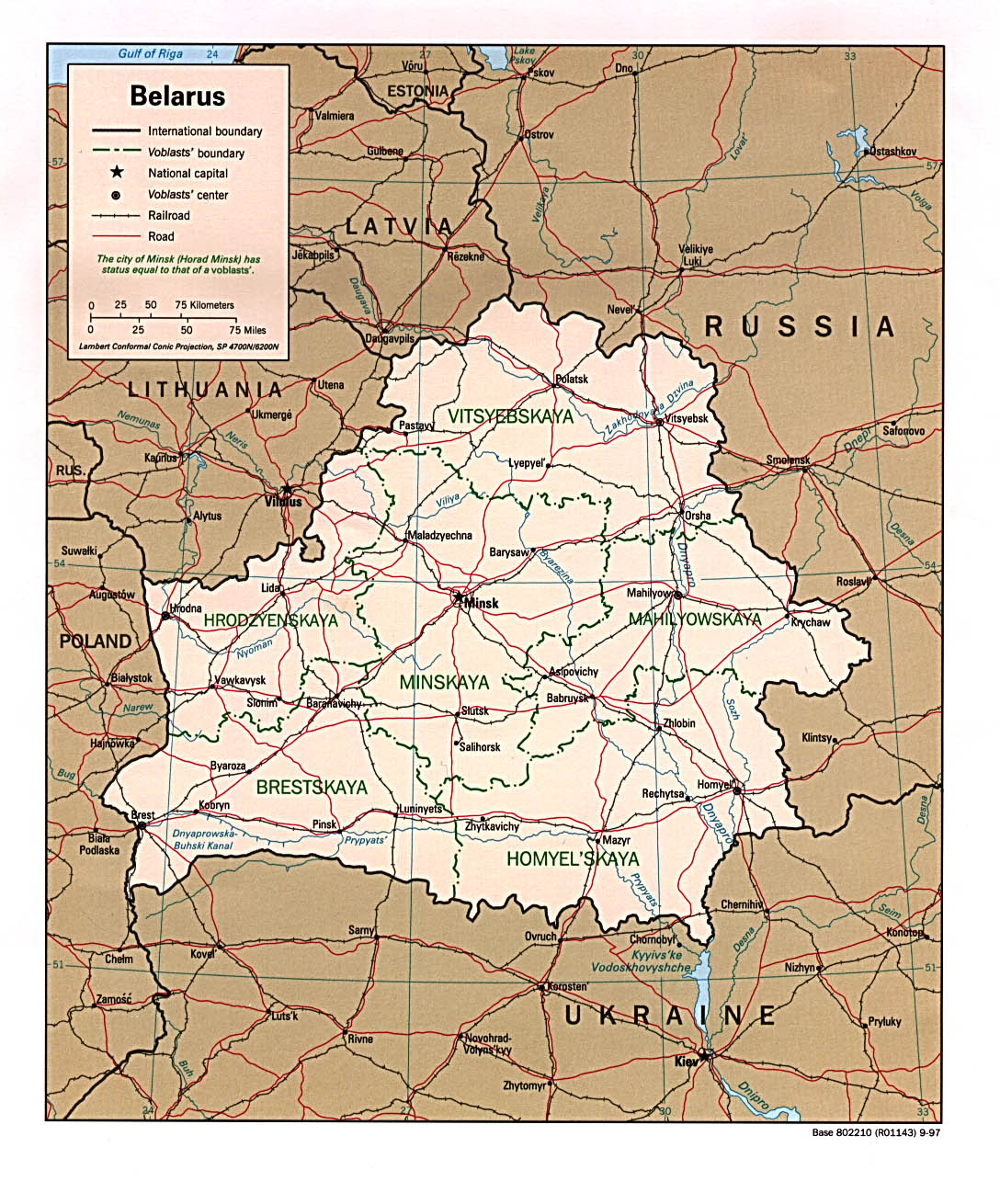
View on WikipediaMogilev, or Mahilyow,[a][4] is a city in eastern Belarus. It is located on the Dnieper River, about 76 kilometres (47 miles) from the border with Russia's Smolensk Oblast and 105 km (65 miles) from Bryansk Oblast. As of 2025, it has a population of 352,896.[2] In 2011, its population was 360,918,[5] up from an estimated 106,000 in 1956. It serves as the administrative centre of Mogilev Region,[2] and is the third-largest city in Belarus.
Key Information

.jpg)
.jpg)

_02.jpg)
.jpg)


Name
[edit]The name Mogilev may be derived from Russian mogila (lit. 'grave') and lev (lit. 'lion'); according to folk legend, the city was named after the grave of a young peasant, which was known as the "Tomb of the Lion", and it was around this burial mound that a fortress was built.[6] Its founding has also been linked to Galician prince Lev Danilovich.[7]
History
[edit].jpg)
The city was first mentioned in historical records in 1267. From the 14th century, it was part of the Grand Duchy of Lithuania, and since the Union of Lublin (1569), it has been part of the Polish–Lithuanian Commonwealth, where it became known as Mohylew. In the 16th and 17th centuries, the city flourished as one of the main nodes of the east-west and north-south trading routes.
In 1577, Grand Duke Stefan Batory granted it city rights under Magdeburg law. In 1654, during the Russo-Polish War (1654–1667), the townsmen negotiated a treaty of surrender to the Russians peacefully, if the Jews were to be expelled and their property divided up among Mogilev's inhabitants. Tsar Aleksei Mikhailovitch agreed to their proposal. However, instead of expelling the Jews, the Russian troops massacred them after they had led them to the outskirts of the town.[8] During this war, the city was besieged twice by the Lithuanian army: in 1655, and in 1660. In 1661, residents started an uprising against the Russian military occupation. The city was set afire by Peter the Great's forces in 1708, during the Great Northern War.[9] After the First Partition of Poland in 1772, Mogilev became part of the Russian Empire and became the centre of the Mogilev Governorate.
In the years 1915–1917, during World War I, the Stavka, the headquarters of the Russian Imperial Army, was based in the city [10] and the Tsar, Nicholas II, spent long periods there as Commander-in-Chief.[11][12]
Following the Russian Revolution, in 1918, the city was briefly occupied by Germany and placed under their short-lived Belarusian People's Republic. In 1919, Mogilev was captured by the forces of Soviet Russia and incorporated into the Byelorussian SSR. Up to World War II and the Holocaust, like many other cities in Europe, Mogilev had a significant Jewish population: according to the Russian census of 1897, out of the total population of 41,100, 21,500 were Jews (i.e. over 50 percent).[13] In 1938 the leadership of Soviet Belarus decided to move the capital of the country from Minsk to Mogilev because Minsk was too close to the then-Polish-Soviet border. Due to that, the now-Mogilev City Council building was built in 1938–1940 to be the government building. It was designed to resemble the Minsk Government building.


During Operation Barbarossa, the city was conquered by Wehrmacht forces on 26 July 1941 and remained under German occupation until 28 June 1944.[15] Mogilev became the official residence of High SS and police leader (HSSPF) Erich von dem Bach. During that period, the Jews of Mogilev were ghettoized and systematically murdered by Ordnungspolizei and SS personnel.[16] Heinrich Himmler personally witnessed the executions of 279 Jews on 23 October 1941. Later that month, several mentally disabled patients were poisoned with car exhaust fumes as an experiment; the method of killing was thereafter applied in several Nazi extermination camps. Initial plans for establishing a death camp in Mogilev were abandoned in favour of Maly Trostenets.
In 1944, with the Mogilev offensive, the devastated city was liberated by the Red Army and returned to Soviet control. Mogilev then was the site of a labour camp for German POW soldiers.
Since Belarus gained its independence in 1991, Mogilev has remained one of its principal cities.
Demographics
[edit]
|
| |||||||||||||||||||||||||||||||||||||||||||||
| Source: pop-stat.mashke.org[17][18][2] | ||||||||||||||||||||||||||||||||||||||||||||||
Religion
[edit]Mohilev was the episcopal see of the Latin Catholic Archdiocese of Mohilev until its 1991 merger into the Roman Catholic Archdiocese of Minsk-Mohilev.
It remains the see of the Eparchy (Eastern diocese) of Mogilev and Mstsislaw in the Belarusian Exarchate of the Russian Orthodox Church.
Economy
[edit]After World War II, a huge metallurgy centre with several major steel mills was built. Also, several major factories of cranes, cars, tractors and a chemical plant were established. By the 1950s, tanning was Mogilev's principal industry, and it was a major trading centre for cereal, leather, salt, sugar, fish, timber and flint: the city has been home to a major inland port on the Dnieper river since and an airport since. Since the fall of the Soviet Union and the establishment of Belarus as an independent country, Mogilev has become one of that country's main economic and industrial centres.[19]
Cityscape
[edit]The town's most notable landmark is the late 17th-century town hall, named the Ratuša (Rathaus), that was built during the times of the Polish–Lithuanian Commonwealth. The grand tower of the town hall sustained serious damage during the Great Northern War and the Great Patriotic War. It was eventually demolished in 1957 and rebuilt in its pre-war form in 2008.
Another important landmark of Mogilev is the six-pillared St. Stanisław's Catholic Cathedral, built in the Baroque style between 1738 and 1752 and distinguished by its frescoes. It became the episcopal see of the Archdiocese of Mohilev (created in 1772, archdiocese after 1782), once (until 1991) the largest Catholic diocese of the world. Now it's the co-cathedral of the Archdiocese of Minsk-Mohilev.
The convent of St. Nicholas preserves its magnificent cathedral of 1668, as well as the original iconostasis, bell tower, walls, and gates. It is currently under consideration to become a UNESCO World Heritage site.[20]
Minor landmarks include the archiepiscopal palace and memorial arch, both dating from the 1780s, and the enormous theater in a blend of the Neo-Renaissance and Russian Revival styles.
At Polykovichi, an urban part of Mogilev, there is a 350-metre-tall (1,150 ft) guyed TV mast, one of the tallest structures in Belarus.
-
 The Convent of St. Nicholas
 -
 Church of the Three Holy Hierarchs

.jpg)
Geography
[edit]Climate
[edit]Mogilev has a warm-summer humid continental climate (Köppen climate classification Dfb) with warm summers and cold winters.
| Climate data for Mogilev | |||||||||||||
|---|---|---|---|---|---|---|---|---|---|---|---|---|---|
| Month | Jan | Feb | Mar | Apr | May | Jun | Jul | Aug | Sep | Oct | Nov | Dec | Year |
| Record high °C (°F) | 9.8 (49.6) |
12.9 (55.2) |
19.3 (66.7) |
29.1 (84.4) |
30.8 (87.4) |
32.6 (90.7) |
34.3 (93.7) |
36.8 (98.2) |
30.6 (87.1) |
25.5 (77.9) |
14.5 (58.1) |
10.9 (51.6) |
36.8 (98.2) |
| Mean daily maximum °C (°F) | −3.0 (26.6) |
−2.5 (27.5) |
3.0 (37.4) |
12.0 (53.6) |
18.6 (65.5) |
21.5 (70.7) |
23.6 (74.5) |
22.7 (72.9) |
16.7 (62.1) |
9.9 (49.8) |
2.3 (36.1) |
−2.0 (28.4) |
10.2 (50.4) |
| Daily mean °C (°F) | −5.3 (22.5) |
−5.5 (22.1) |
−0.8 (30.6) |
6.7 (44.1) |
12.9 (55.2) |
16.1 (61.0) |
18.1 (64.6) |
17.0 (62.6) |
11.6 (52.9) |
6.0 (42.8) |
−0.1 (31.8) |
−4.2 (24.4) |
6.0 (42.8) |
| Mean daily minimum °C (°F) | −7.8 (18.0) |
−8.5 (16.7) |
−4.2 (24.4) |
2.0 (35.6) |
7.3 (45.1) |
10.8 (51.4) |
12.7 (54.9) |
11.6 (52.9) |
7.1 (44.8) |
2.6 (36.7) |
−2.3 (27.9) |
−6.6 (20.1) |
2.1 (35.8) |
| Record low °C (°F) | −37.3 (−35.1) |
−34.7 (−30.5) |
−35.0 (−31.0) |
−17.7 (0.1) |
−4.4 (24.1) |
−0.7 (30.7) |
3.0 (37.4) |
0.9 (33.6) |
−4.8 (23.4) |
−14.8 (5.4) |
−23.5 (−10.3) |
−33.4 (−28.1) |
−37.3 (−35.1) |
| Average precipitation mm (inches) | 39 (1.5) |
34 (1.3) |
39 (1.5) |
41 (1.6) |
53 (2.1) |
75 (3.0) |
81 (3.2) |
65 (2.6) |
55 (2.2) |
54 (2.1) |
45 (1.8) |
41 (1.6) |
622 (24.5) |
| Average rainy days | 8 | 7 | 9 | 12 | 15 | 17 | 15 | 13 | 14 | 15 | 14 | 10 | 149 |
| Average snowy days | 21 | 20 | 13 | 4 | 0.2 | 0 | 0 | 0 | 0.1 | 3 | 12 | 20 | 93 |
| Average relative humidity (%) | 87 | 85 | 80 | 72 | 69 | 74 | 74 | 75 | 80 | 84 | 89 | 89 | 80 |
| Source: Pogoda.ru.net[21] | |||||||||||||
Notable citizens
[edit]
- Rita Achkina, cross country skier
- Matest M. Agrest, ethnologist and mathematician
- Modest Altschuler, orchestra conductor
- Abe Anellis, microbiologist
- Olga Bogdanova, chemist
- Kanstancin Dziubajla (nom de guerre "Dranik") (1988–2022), Belarusian volunteer killed in action defending Ukraine during the 2022 Russian invasion[22]
- Petr Elfimov, musician
- Svetlana Baitova, gymnast
- Ihar Hershankou, serial killer
- Alyona Lanskaya, singer
- Eugenia Logvinovna Lashnyukova, nun
- Joseph Lookstein, Rabbi and President of Bar-Ilan University
- Leonid Isaakovich Mandelshtam, physicist
- Andrey Melnikov, soldier and recipient of Hero of the Soviet Union award
- Andrej Mryj, satirical writer, journalist, translator and a victim of Stalin's purges
- Ivan Nasovič, author of the first Belarusian dictionary
- Stanisław Julian Ostroróg, Polish count, Crimean War veteran, noted Victorian Photographic portraitist, naturalised British subject
- David Pinski, Yiddish playwright
- Simeon Piščević, major-general and governor of Mogilev (1777)
- Lev Polugaevsky, International Grandmaster of chess
- Leo Rogin, Economist and Writer
- Otto Schmidt, scientist, mathematician, astronomer, geophysicist, statesman, academician
- Issai Schur, mathematician
- Spiridon Sobol, Belarusian enlightener and printer; published the first ABC-book in Belarus in 1631
- Mikałaj Sudziłoŭski, revolutionary and scientist
- Sergey Evtuhov (born 1953), painter
Sports
[edit]_-_panoramio.jpg)
City sports teams:
- Football: FC Torpedo Mogilev,[23] FC Dnepr Mogilev and ZhFC Dnepr Mogilev, Nadezhda Mogilev
- Hockey: HK Mogilev
- Volleyball: Mogilev Lions, Kommunalnik
- Handball: Masheka
- Basketball: BC Borisfen
Twin towns – sister cities
[edit] Al Rayyan, Qatar
 Bursa, Turkey
 Changsha, China[25]
 Eisenach, Germany
 Gabrovo, Bulgaria
 Kerch, Ukraine
 Kragujevac, Serbia
- Mykolaiv, Ukraine
- Nanjing, China
 Penza, Russia
- Sokolinaya Gora (Moscow), Russia
 Sumgait, Azerbaijan
 Tabriz, Iran
- Tula, Russia
 Villeurbanne, France
- Wittenberg, Germany
- Pivdenne, Ukraine
- Zhengzhou, China
- Zvenigorod, Russia


Notes
[edit]- ^ US: /məɡɪlˈjɔːf/;[3] Russian: Могилёв, romanized: Mogilyov, IPA: [məɡʲɪˈlʲɵf]; Belarusian: Магілёў, romanized: Mahilioŭ, IPA: [maɣʲiˈlʲou̯].
References
[edit]- ^ British Standard 2979 : 1958, London: British Standards Institution.
- ^ a b c d "Численность населения на 1 января 2025 г. и среднегодовая численность населения за 2024 год по Республике Беларусь в разрезе областей, районов, городов, поселков городского типа". belsat.gov.by. Archived from the original on 29 March 2025. Retrieved 23 June 2025.
- ^ "Definition of MOGILEV".
- ^ Назвы населеных пунктаў Рэспублікі Беларусь: Магілёўская вобласць: нарматыўны даведнік / І. А. Гапоненка і інш.; пад рэд. В. П. Лемуюгова. — Мн.: Тэхналогія, 2007. — 406 с. — ISBN 978-985-458-159-0. (DJVU) (in Belarusian)
- ^ Ярковец, А.И. (2011). "Численность населения на 1 января 2011 года и среднегодовая численность населения за 2010 год по Республике Беларусь в разрезе областей, районов, городов, поселков городского типа". Статистический бюллетень (in Russian). Национальный статистический комитет Республики Беларусь: 21. Archived from the original (PDF) on 2012-02-09. Retrieved 2012-01-13.
- ^ Everett-Heath, John (22 October 2020). "Mahilyow". Concise Oxford Dictionary of World Place Names. Oxford University Press. ISBN 978-0-19-190563-6.
- ^ . Brockhaus and Efron Encyclopedic Dictionary (in Russian). 1906.
- ^ Fishman, David (1995). Russia's First Modern Jews. NYU Press. p. 2. ISBN 0-8147-2614-3.
- ^ Катлярчук, Андрэй (2007). Швэды ў гісторыі й культуры беларусаў (PDF) (in Belarusian). Ėntsyklapedyks. ISBN 978-9856599586.
- ^ Preclík, Vratislav. Masaryk a legie (Masaryk and legions), váz. kniha, 219 pages, first issue vydalo nakladatelství Paris Karviná, Žižkova 2379 (734 01 Karvina, Czech Republic) ve spolupráci s Masarykovým demokratickým hnutím (Masaryk Democratic Movement, Prague), 2019, ISBN 978-80-87173-47-3, pages 36–39, 41–42, 111–112, 124–125, 128, 129, 132, 140–148, 184–199.
- ^ "Mogilev invites tourists to take a stroll with Emperor Nicholas II". Official website of Belarus.
- ^ Massie, Robert (2000) [1967]. Nicholas and Alexandria. New York: Ballantine Books. p. 300. ISBN 0-345-43831-0.
- ^ Zimmerman, Joshua D. (2004). Poles, Jews, and the politics of nationality. Univ of Wisconsin Press. p. 16. ISBN 0-299-19464-7 – via Google Books.
- ^ Breitman, Richard (1998). Official Secrets: What the Nazis Planned, What the British and Americans Knew. New York: Hill and Wang/Farrar Straus & Giroux. p. 66. ISBN 9780809001842.
- ^ "Mogilev The fate of the Jews under the German Invasion & Occupation". Holocaustresearchproject.org. Retrieved 2014-08-09.
- ^ "Jewish Heritage Research Group in Belarus". Jhrgbelarus.org. Archived from the original on 2018-10-02. Retrieved 2014-08-09.
- ^ "Cities & Towns of Belarus". 2024-04-15.
- ^ "Численность населения на 1 января 2024 г. и среднегодовая численность населения за 2023 год по Республике Беларусь в разрезе областей, районов, городов, поселков городского типа". belsat.gov.by. Archived from the original on 2 April 2024. Retrieved 13 April 2024.
- ^ "Mogilev Region". Belarus.by. Govt of Belarus.
- ^ UNESCO World Heritage Centre (2004-01-30). "St. Nicholas Monastery Complex in the city of Mahilyou – UNESCO World Heritage Centre". Whc.unesco.org. Retrieved 2014-08-09.
- ^ "КЛИМАТ МОГИЛЕВА" (in Russian). Weather and Climate (Погода и климат). Retrieved 28 November 2015.
- ^ ""Самыя блізкія пабрацімы называлі яго "Дранік"". У Данецкай вобласьці загінуў яшчэ адзін беларус, які бараніў Украіну ("The closest brothers called him" Dranik "." Another Belarusian defending Ukraine died in Donetsk region) Радыё Свабода (Radio Liberty) (in Belarusian)". Retrieved 14 May 2022.
- ^ FC Torpedo Mogilev (2015-01-30). "Official Website of FC Torpedo Mogilev". torpedomogilev.by. Archived from the original on 2016-01-31. Retrieved 2015-10-16.
- ^ "Города-побратимы". mogilev.gov.by (in Russian). Mogilev. Retrieved 2020-01-13.
- ^ "白俄罗斯莫吉廖夫市". changsha.gov.cn (in Chinese). Changsha. 2020-06-12. Retrieved 2020-07-11.

External links
[edit]

- Mogilev city executive committee
- Photos on Radzima.org
- Historic images of Mogilev
- Mogilev Jewish Center Archived 2010-03-25 at the Wayback Machine
- Jewish Encyclopedia on Moghilef (Mohilev)
- . Encyclopædia Britannica (11th ed.). 1911.
- The murder of the Jews of Mogilev during World War II, at Yad Vashem website
- Mahilyow, Belarus at JewishGen
- City and regional maps of Mogilev
- Zoomable map of Mogilev and Belarus -> In page click КАРТЫ in middle
- Overview map of roads and railways
- General overview of Baltics, Belarus and east-europe
- Belarus, topographic map
- "Baltic countries full detail railway map. Belarus and Baltics in C1 sector". Archived from the original on 23 May 2012.
- General detail, downloadable PDF map of Belarus
| International | |
|---|---|
| National | |
| Geographic | |
| Other | |

Mogilev
View on GrokipediaName and Etymology
Historical Names and Variants
The name Mahilyow in Belarusian (Магілёў) and Mogilyov in Russian (Могилёв) derives from Slavic roots, with common etymological interpretations linking it to mogila ("grave" or "tumulus") and lev ("lion"), potentially referencing a prehistoric burial mound associated with a lion in local folklore or the burial site of a mighty prince named Lev (possibly Lev Vladimirovich, known as Lev the Mighty).[8][4] This compound form appears in medieval chronicles, where the settlement was first documented in 1267 as Mogilev during its time under Lithuanian rule.[3] Historical variants reflect linguistic adaptations across ruling powers and scripts. In Polish and German contexts during the Grand Duchy of Lithuania and Polish-Lithuanian Commonwealth (14th–18th centuries), it was rendered as Mohylew.[9] Yiddish usage, prevalent in Jewish communities from the 16th century onward, favored Mohilev (מאָהליב).[9] Under Russian imperial administration from 1772, standardized spellings included Mogilev and Mogilew in Latin script, with transliterations in 19th-century European records varying as Mogilew, Mogilow, or Moghilev due to phonetic rendering in passports and censuses.[10] Post-1917 Soviet and modern Belarusian usage reverted to phonetic Belarusian forms like Mahilyow, emphasizing local orthography over Russified versions, though Mogilev persists in international English transliteration.[11] These variants underscore the city's position at cultural crossroads, with no single form dominating until 20th-century national standardization.Linguistic and Cultural Significance
Mogilev's linguistic landscape reflects its historical position as a crossroads of East Slavic, Polish-Lithuanian, and Jewish influences, with Belarusian dialects, including the Vitebsk-Mogilev subdialect, forming part of the North-Eastern Belarusian variant.[12] The city's large Jewish community, established by the 16th century, introduced Yiddish as a vernacular, which became central to communal life, education, and cultural expression amid a predominantly Slavic-speaking environment.[9] This multilingualism contributed to Mogilev's role as a minor hub for Yiddish literature and theater, producing figures like David Pinski (1872–1959), a prominent Yiddish playwright whose works drew from local Jewish experiences before he emigrated.[13] Under Soviet administration, Yiddish maintained institutional presence through schools, libraries, and cultural activities, despite broader Russification policies, with Jewish population comprising a significant portion of the city until World War II decimation.[13] Postwar suppression reduced Yiddish usage, aligning with the dominance of Russian in eastern Belarus, where proximity to Russia elevated its prevalence over Belarusian even in urban settings like Mogilev.[14] Today, Russian remains the primary spoken language, while Belarusian holds official status, underscoring a linguistic shift from historical diversity to bilingualism favoring Russian.[15] Culturally, the Yiddish-speaking Jewish milieu enriched Mogilev's heritage, integrating economic roles like trade and craftsmanship with religious and artistic traditions, evident in former synagogues and study houses that shaped community identity.[16] This legacy persists in contemporary Jewish revival efforts, including educational centers and synagogues, reviving elements of pre-Holocaust culture amid Belarus's post-Soviet context.[17] The city's broader cultural fabric, influenced by these layers, positions it as a regional center for historical memory and multicultural narratives, though Soviet-era industrialization overshadowed traditional expressions.[18]Geography
Location and Topography
Mogilev is situated in eastern Belarus, serving as the administrative center of Mogilev Region. The city lies on the banks of the Dnieper River, approximately 76 kilometers from the border with Russia's Smolensk Oblast. Its geographic coordinates are approximately 53°54′N 30°20′E.[19] The terrain surrounding Mogilev is predominantly flat, typical of the broader Mogilev Plain within the East European Plain. The city itself is positioned at an average elevation of 192 meters above sea level, with the Dnieper River valley featuring moderately steep slopes rising 12 to 35 meters, interspersed with ravines and tributary valleys.[1][20][21]Climate and Environmental Factors
Mogilev lies in a humid continental climate zone classified as Dfb under the Köppen-Geiger system, featuring cold, snowy winters and warm summers with moderate precipitation throughout the year.[22] The average annual temperature is 5.4°C, with July as the warmest month, recording an average high of 24.1°C and low of 13.8°C, while January sees the coldest conditions with an average low around -8.5°C.[23] [24]| Month | Avg. Max Temp (°C) | Avg. Mean Temp (°C) | Avg. Min Temp (°C) | Avg. Precipitation (mm) | Avg. Snowfall (mm) |
|---|---|---|---|---|---|
| January | -4.3 | -6.3 | -8.3 | 12 | 59 |
| February | -2.1 | -4.4 | -6.7 | 11 | 46 |
| March | 2.8 | -0.3 | -3.4 | 13 | 40 |
| April | 11.5 | 7.1 | 2.7 | 11 | 5 |
| May | 18.9 | 13.9 | 8.8 | 31 | 2 |
| June | 22.3 | 17.2 | 12.1 | 32 | 0 |
| July | 24.1 | 18.9 | 13.8 | 32 | 0 |
| August | 23.4 | 18.2 | 13.0 | 19 | 0 |
| September | 17.4 | 13.0 | 8.7 | 11 | 0 |
| October | 9.4 | 6.4 | 3.4 | 12 | 3 |
| November | 3.5 | 1.7 | -0.1 | 10 | 17 |
| December | -1.4 | -2.9 | -4.4 | 15 | 66 |
History
Origins and Medieval Development
The area encompassing modern Mogilev shows evidence of early Slavic settlement from the 9th to 10th centuries, with archaeological findings indicating small communities along the Dnieper River, integrated into the sphere of Kievan Rus' by the 10th century.[8] These settlements likely served as trading outposts, benefiting from the river's strategic position for east-west commerce between Rus' principalities and Baltic regions.[4] Mogilev's founding is traditionally dated to 1267, based on chronicles linking it to a fortress constructed by a local ruler named Lev Danilovich Mogiy (or "Mighty Lion"), whose death and burial mound purportedly inspired the city's name, derived from "Mogila" (grave) and "Lev" (lion).[8] This account, while legendary, aligns with mid-13th-century disruptions from Mongol invasions that destroyed prior fortifications in the region, suggesting Mogilev emerged as a rebuilt or new defensive site within the Smolensk Principality.[4] Authentic documentary evidence, however, first confirms the settlement's existence in the late 14th century as a possession granted to Polish Queen Jadwiga, consort of Grand Duke Jogaila of Lithuania, following their 1386 union that formalized ties between Poland and the Grand Duchy of Lithuania (GDL).[29] Under GDL rule from the early 14th century onward, Mogilev transitioned from a frontier outpost to a burgeoning urban center, frequently changing hands among Lithuanian nobility—transferred to Elena Ioanovna in 1503 and later to figures like U. Zenovich in 1514.[8] This period saw the construction of wooden fortifications and ramparts, fostering growth in crafts such as fur-dressing and trade guilds, which laid foundations for its role as a key Dnieper River hub by the early 16th century, though full medieval records remain sparse due to reliance on later chronicles and oral traditions.[8]Early Modern Period and Partitions
During the 16th century, Mogilev developed into the largest city in the Belarusian Dnieper region following its incorporation into the Polish-Lithuanian Commonwealth via the Union of Lublin in 1569, serving as a prominent commercial and craft hub.[1] The granting of the Magdeburg Right in 1592 established municipal self-government, facilitating urban expansion and the erection of a city hall, while internal unrest emerged, as evidenced by a 1606 revolt led by Stahar Mitkovich that temporarily overthrew gentry authority before suppression by 1610.[8] By the early 17th century, the city had become one of the Grand Duchy's foremost manufacturing centers, with the St. Nicholas Monastery founded amid a landscape dominated by Catholicism over Orthodoxy, though the 1596 Union of Brest introduced Uniate elements and Orthodox brotherhoods—such as the 1589 fur-dressers' guild—sustained cultural resistance through schools and a printing house operational from 1616 to 1773.[1] [8] The Russo-Polish War of 1654–1667 inflicted severe damage, with Muscovite occupation on August 25, 1654, after negotiations, followed by recapture in 1661 through a local revolt that seized 986 Russian soldiers; further destruction occurred during the Great Northern War (1700–1721), when Swedish forces occupied the city in July 1708 and razed 1,700 houses in six weeks.[8] The 1698 construction of the Mogilev Town Hall symbolized ongoing civic architecture despite recurrent conflicts.[1] The First Partition of Poland in 1772 annexed the Mogilev Voivodeship, including the city, to the Russian Empire, ending Commonwealth sovereignty and integrating it into imperial administration, with subsequent partitions in 1793 and 1795 confirming Russian control over remaining Polish-Lithuanian territories without altering Mogilev's status.[1]Imperial Russian Era
Following the First Partition of Poland in 1772, Mogilev was annexed by the Russian Empire and designated as the administrative center of the newly formed Mogilev Governorate, which encompassed territories in present-day eastern Belarus and parts of Russia.[1][9] The governorate, established formally in 1777, served as a key unit in the Northwestern Krai, with Mogilev functioning as its capital, overseeing local governance, taxation, and military recruitment.[30] The city's population grew substantially during the 19th century, driven by its position within the Pale of Settlement, where Jews were permitted to reside. In 1777, the governorate recorded 11,455 Jews, comprising a significant portion of urban and rural dwellers.[31] By the 1840s, Mogilev's Jewish community numbered 7,897 residents, and the 1897 imperial census documented 21,539 Jews, accounting for approximately half of the city's total population of around 43,000.[32][9] Economically, the region relied on agriculture, including grain and flax production, with emerging light industries such as tobacco processing and match manufacturing in the city, though heavy industrialization remained limited until the late imperial period.[8] During the Napoleonic Wars, Mogilev experienced military activity as French forces advanced through the region in 1812, though the city avoided direct devastation.[8] In the early 20th century, amid World War I, Mogilev assumed strategic importance as the site of the Stavka, the Russian Imperial Army's supreme headquarters, relocated there in August 1915 following retreats from the front.[33] Emperor Nicholas II established his residence in the city from 1915 to March 1917, overseeing operations from local facilities, which transformed Mogilev into a temporary military capital and hub for logistical coordination.[3][34]World War I, Interwar Period, and Revolution
During World War I, Mogilev emerged as a pivotal military hub when the Russian Empire's Stavka (General Headquarters) was transferred there in August 1915, following retreats from earlier fronts. Tsar Nicholas II assumed supreme command of the armed forces on 23 August 1915 (O.S.; 5 September N.S.) and established his residence in the Governor's House, overseeing operations against the Central Powers from the city until early 1917.[33] [35] The Stavka coordinated major offensives, including the Brusilov Offensive of 1916, amid heavy casualties and logistical strains that contributed to domestic unrest.[36] The February Revolution of 1917 directly impacted Mogilev, where Nicholas II was stationed at Stavka upon receiving news of Petrograd's uprisings on 23 February (O.S.). Isolated by snowstorms and hesitant to deploy troops against civilians, he abdicated on 2 March (O.S.; 15 March N.S.), formally ending the Romanov dynasty; the Provisional Government then controlled the city and its military apparatus.[37] [38] Bolshevik influence spread rapidly, culminating in their seizure of Stavka in early November 1917 (O.S.), which precipitated the armistice with the Central Powers on 15 December and Russia's exit from the war.[39] In the chaotic aftermath, Mogilev fell under German occupation following the Treaty of Brest-Litovsk in March 1918, nominally administered as part of the short-lived Belarusian People's Republic proclaimed that month, though effective control remained with German forces until their withdrawal in late October 1918.[40] Red Army units then secured the area amid the Polish-Soviet War (1919–1921), preventing Polish advances eastward; by 1 January 1919, it was integrated into the newly formed Socialist Soviet Republic of Belarus (SSRB), encompassing the former Mogilev Governorate with its multiethnic population of approximately 50,000, including a significant Jewish community.[41] Through the interwar years, as a voblast (province) center in the Byelorussian Soviet Socialist Republic (formalized 1922), Mogilev underwent Soviet consolidation, including land redistribution under the New Economic Policy and limited cultural policies promoting Belarusian language use in administration and education during the 1920s Belarusianization drive.[42] These efforts waned by the early 1930s amid Russification and prelude to collectivization, with the city's economy oriented toward light industry and agriculture; population grew modestly to around 70,000 by 1939, reflecting migration and Soviet urbanization policies.[13]Soviet Industrialization and Purges
During the interwar Soviet period, Mogilev, as part of the Byelorussian Soviet Socialist Republic established in 1919, experienced the implementation of centralized economic policies aimed at rapid industrialization. The First Five-Year Plan (1928–1932) prioritized the expansion of light industries across Belarus, including textiles, food processing, and wood products in cities like Mogilev, to support urban growth and reduce reliance on agriculture.[43] This initiative contributed to the conurbation of Mogilev and the onset of urbanization, as industrial development drew rural populations into the city and fostered connections with surrounding settlements.[44] By the mid-1930s, local enterprises, building on pre-revolutionary foundations such as textile mills, began scaling production under state directives, though output remained modest compared to heavy industry centers in Russia.[45] The Great Purge (1936–1938), orchestrated by Joseph Stalin to eliminate perceived internal threats, profoundly affected Mogilev's administrative and cultural fabric. In Belarus overall, Soviet repressions from the 1930s onward claimed between 600,000 and 1.5 million victims through arrests, executions, and deportations, with the peak targeting Communist Party members, intellectuals, and ethnic groups.[46] Locally, NKVD operations in Mogilev included the arrest and execution of numerous Jewish religious leaders and community figures on fabricated charges of counter-revolutionary activity, decimating religious and intellectual networks.[47] These purges disrupted industrial planning and local governance, as experienced officials were removed, often replaced by loyal but inexperienced cadres, exacerbating inefficiencies in the ongoing five-year plans. The events exemplified the broader pattern of mass operations under NKVD Order No. 00447, which authorized quotas for repressions without due process.[48]World War II Occupation and Destruction
During Operation Barbarossa, German forces advanced toward Mogilev following the invasion of the Soviet Union on June 22, 1941, encountering Soviet defenses constructed around the city and along the Drut River.[49] The Siege of Mogilev ensued, with elements of the Soviet 13th Army, including the LXI Rifle Corps, resisting encirclement starting around July 12, 1941, thereby delaying German progress by tying down multiple infantry divisions.[50] Intense fighting, including artillery barrages and aerial bombings by German Stukas, devastated infrastructure such as railroad facilities over the 23-day defense period.[51] German troops ultimately captured the city on July 26, 1941, after overcoming the depleted Soviet garrison lacking ammunition and supplies.[52] Under German occupation, Mogilev served as an administrative center in the Reichskommissariat Ostland, hosting a military conference and a special camp for training Soviet POWs as auxiliary forces.[53] The Jewish population, numbering around 30,000 pre-war, faced systematic persecution; many evacuated or fled eastward before occupation, but remaining Jews were confined to a ghetto where mass executions commenced in August 1941, targeting women and children per orders from Heinrich Himmler.[54] [53] Brutal killings by Einsatzgruppen and local collaborators reduced the ghetto population through shootings at sites like the Jewish cemetery and nearby forests, with survivor testimonies documenting an underground resistance group of 55 members, including 22 Jews, attempting sabotage amid the atrocities.[54] Partisan activity in Mogilev Oblast intensified, with Soviet-affiliated groups claiming responsibility for 6,000 to 7,000 German casualties through ambushes and sabotage, though such figures derive from regional Soviet records potentially inflated for propaganda.[55] The city endured further degradation from forced labor, resource extraction, and reprisal actions against civilians suspected of aiding partisans. Soviet forces liberated Mogilev on June 28, 1944, during the Mogilev Offensive as part of Operation Bagration, storming the city and capturing German commander Generalmajor von Erdmannsdorff.[56] The rapid advance involved heavy urban combat across the Dnieper River, exacerbating destruction to buildings and bridges already scarred from 1941.[57] Post-liberation assessments indicated widespread ruin, with the population decimated and infrastructure requiring extensive rebuilding, reflecting the cumulative toll of siege, occupation policies, and recapture battles.[54]Postwar Reconstruction to Independence
Mogilev was liberated from German occupation on June 28, 1944, as part of the Soviet Operation Bagration, which inflicted heavy destruction on the city's infrastructure amid the broader campaign to reclaim Belarusian territories.[56] Postwar efforts prioritized restoring housing, transport, and basic services, with the city serving temporarily as a site for German POW labor camps to aid initial cleanup and rebuilding.[4] By the early 1950s, reconstruction had advanced sufficiently to enable the reopening of cultural institutions, such as the local museum's exhibit on wartime losses and Soviet-era recovery in 1951.[58] Under the Byelorussian Soviet Socialist Republic, Mogilev emerged as a key industrial node, leveraging its central location for manufacturing expansion during the 1950s–1980s. Major facilities included the Mogilev Man-Made Fibre Combine, the Soviet Union's largest producer of Lavsan polyester fiber, alongside plants for electric motors, industrial equipment, synthetic textiles, and consumer goods.[59] The Mogilev Elevator Plant, established in 1966 and operational by 1970, exemplified heavy machinery development, while the Mogilev Wheel Tractor Plant (MoAZ), operational from the late 1950s, specialized in construction vehicles, contributing to urbanization and population influx that tripled city residents from postwar lows to over 300,000 by the late Soviet period.[60][61] These sectors drove economic output but relied on centralized planning, with environmental costs including pollution from chemical production. The 1986 Chernobyl disaster significantly impacted Mogilev Oblast, contaminating 11,200 square kilometers across 14 districts with radioactive fallout, as approximately 70% of the release affected Belarusian territory, prompting resettlement and agricultural restrictions in affected rural areas.[62] This exacerbated health strains from prior industrialization, though Soviet authorities initially downplayed exposures. As the USSR dissolved, Mogilev retained its role as an oblast administrative center, transitioning with Belarus's declaration of independence on August 25, 1991, amid economic disruptions from the Soviet collapse but without major local political upheavals.[59]Post-1991 Developments and Political Events
Following the dissolution of the Soviet Union and Belarus's declaration of independence on August 25, 1991, Mogilev retained its status as a major regional hub and oblast center, with its economy anchored in state-controlled heavy industry sectors such as chemical fibers and machinery production.[63] The post-Soviet transition preserved much of the Soviet-era industrial structure under President Alexander Lukashenko, who assumed office in 1994 after rising through local ranks—including managing a state farm in the Mogilev region in 1987—enabling the city to avoid the sharp deindustrialization seen in Russia and Ukraine by maintaining public ownership of key enterprises.[64][65] Despite this continuity, the local economy grappled with stagnation, contributing to one of Belarus's highest regional poverty rates as of the early 2000s, exacerbated by limited private investment and reliance on subsidized state operations.[66] Urban infrastructure saw incremental changes, including renovations to central spaces like Slavy Square, which underwent multiple reconfigurations reflecting shifts in national symbolism from the 1990s onward, though preservation challenges persisted for post-Soviet wooden residential areas amid modernization pressures.[67][68] Politically, Mogilev remained integrated into Belarus's centralized system, with limited local autonomy under Lukashenko's long-term rule, until unrest escalated during the disputed August 9, 2020, presidential election, which official results awarded Lukashenko a sixth term amid fraud allegations.[69] The city hosted significant demonstrations, including women's marches against the regime in 2020 that drew participants and resulted in detentions, as well as broader protests met with security force responses.[70] Pre-election crackdowns targeted activists, such as the May 8, 2020, detention of human rights defender Aliaksandr Burakou in Mogilev for organizing an anti-arrest protest.[69] Independent media engagement during the uprising was relatively low in Mogilev Oblast, at around 40-50% adoption rates, compared to higher figures in Minsk, indicating subdued informational dissent in the region.[71]Government and Politics
Administrative Structure
Mogilev serves as the administrative center of Mogilev Oblast, one of six regions in Belarus, and holds the status of a city of oblast subordination, granting it administrative equivalence to the oblast's districts.[1] The city's governance is directed by the Mogilev City Executive Committee (Mahilyow Havoradski Vykonavchy Kamitet), a local executive body responsible for implementing national and regional policies, managing public services, urban planning, and infrastructure maintenance.[72] This committee operates under the hierarchical authority of the Mogilev Oblast Executive Committee and the central government in Minsk, with its chairman appointed by the President of Belarus to ensure alignment with state directives.[72] For localized administration, Mogilev is divided into two urban districts (rayons): Leninsky District and Oktyabrsky District, each handling resident services, housing, utilities, and minor infrastructure within their territories.[73] This subdivision was established on December 25, 1962, as part of a post-war reorganization to streamline urban management amid industrial growth.[73] Leninsky District encompasses the northern portion of the city, bordering Oktyabrsky District along the Dniepr River, with its executive office at Prospekt Mira, 55a.[73] It includes key thoroughfares such as Prospekt Mira and streets like Pervomayskaya and Krupskoy, supporting major enterprises and facilities including cultural centers, libraries, medical institutions, and parks.[73] Oktyabrsky District covers the southern area on the left bank of the Dniepr River, with its administration located at Ulitsa Chigrinova, 8a, and features prominent roads like Prospekt Pushkina and Shmidta.[73] It hosts significant industrial sites, retail outlets, and recreational venues such as stadiums.[73] Prior to 1962, the city's administrative setup involved different configurations, but the current dual-district model has remained stable since its formation to facilitate efficient oversight of the urban population, reported at around 192,100 for Leninsky and 171,400 for Oktyabrsky in historical records.[73]Local Governance Under Central Authority
The local governance of Mogilev operates through the Mogilev City Executive Committee (Могилёвский городской исполнительный комитет), which functions as the primary executive body responsible for administering city affairs, including municipal services, urban planning, and budget execution.[72] The committee's chairman, serving as the city's chief executive, is appointed directly by the President of Belarus, ensuring alignment with national priorities over local initiative.[74] This appointment process exemplifies the centralized control inherent in Belarus's administrative system, where the president holds authority to dismiss local heads at the city and district levels.[75] Complementing the executive committee is the Mogilev City Council of Deputies, a representative body elected by residents every four years via secret ballot, with deputy numbers scaled to population size.[76] However, the council's legislative role—such as approving local budgets and ordinances—is effectively subordinate to the executive committee and overriding directives from the central government in Minsk, limiting substantive local autonomy.[77] The executive committee remains accountable to both the president and the Council of Ministers, with fiscal and policy decisions requiring national approval, as evidenced by the committee's role in implementing state-mandated programs like infrastructure projects funded through central allocations.[78] In practice, this structure manifests in tight oversight of local operations; for instance, appointments to key positions within the Mogilev executive framework, including district-level chairs, are routinely announced and confirmed by presidential decree, as seen in multiple 2025 reshuffles affecting Mogilev Oblast entities.[79] Such mechanisms prioritize vertical loyalty to the central authority, constraining independent policy formulation and rendering local governance a conduit for national directives rather than a venue for grassroots decision-making.[75] Reports from independent observers highlight that while nominal self-governance exists through elected councils, executive dominance and central veto powers undermine devolution, fostering a system where local bodies execute rather than originate policy.[80]Role in National Controversies and Protests
Mogilev participated in the nationwide protests that erupted after the August 9, 2020, presidential election, which opposition leaders claimed was marred by widespread fraud securing a sixth term for President Alexander Lukashenko.[81] Local demonstrations in the city aligned with the broader movement demanding electoral transparency and democratic reforms, though specific crowd sizes remain undocumented in independent reports beyond general regional involvement. Security forces responded with arrests and threats, consistent with tactics employed across Belarus to suppress dissent.[82] In the lead-up to the vote, on June 20, 2020, police in Mahilyow (Mogilev) warned protesters of potential force against unauthorized gatherings, signaling early tensions in the city's opposition circles.[83] By October 26, 2020, amid a national opposition strike protesting the election outcome, authorities detained individuals in Mogilev for backing the action, contributing to at least 155 arrests reported that day across multiple cities including Minsk and Grodno.[81] These events underscored Mogilev's integration into the decentralized protest network, where workers and residents coordinated strikes and rallies despite risks of reprisal. The city's role diminished after late 2020 as the government intensified crackdowns, including mass detentions and media restrictions, effectively curtailing sustained public demonstrations.[82] No major national controversies centered exclusively on Mogilev have emerged since, though local human rights efforts, such as resistance to closing the regional Human Rights Center in 2014, reflect ongoing friction with central authorities over civil liberties.[84] Overall, Mogilev's involvement highlights regional echoes of Belarus's authoritarian governance challenges rather than unique flashpoints.Demographics
Population Trends and Migration
The population of Mogilev grew markedly in the postwar decades, expanding from 82,124 in 1950 to approximately 393,000 by 2023, driven primarily by internal migration to support Soviet-era industrialization and urban reconstruction efforts.[85][86] This increase reflected broader patterns of rural-to-urban shifts within Belarus, as workers relocated to the city's expanding factories and infrastructure projects. In recent years, population growth has stagnated, with the metro area recording a mere 0.51% rise from 2022 to 2023 and 0.25% from 2023 to 2024, projecting to 394,873 by 2025.[85][86] The surrounding Mogilev Oblast experienced outright decline, dropping from 981,174 residents in 2023 to 971,365 in 2024, attributable to negative natural population growth (low fertility rates below replacement level and an aging demographic) combined with sustained out-migration.[87] Migration dynamics have shifted from net inflows during the Soviet period to net outflows post-1991, exacerbated by economic stagnation and limited opportunities in regional industry.[88] Belarus-wide net migration stood at -3,034 in 2023, with an estimated 200,000 workers lost nationally between 2018 and 2024 due to emigration for better employment abroad, particularly to Russia, Poland, and Lithuania.[88][89] In Mogilev, as a manufacturing hub, this has manifested in youth and skilled labor drain, intensified after the 2020 political crisis, which prompted tens of thousands of Belarusians—disproportionately from urban centers—to relocate to EU countries like Germany (around 8,000 since 2020) amid crackdowns on dissent.[90] While city-specific emigration data remains limited, regional labor shortages in sectors like chemicals and machinery underscore the impact.[89] Inflows, mainly from rural Belarus or neighboring Ukraine and Russia, have been insufficient to offset these losses.[91]Ethnic, Linguistic, and Social Composition
In the Mogilev Region, ethnic Belarusians constitute 88.7% of the population, reflecting the city's predominant Slavic composition as its administrative center. Russians form the largest minority group, with a notably higher presence in Mogilev and Vitebsk regions compared to western Belarus, comprising around 6-8% regionally based on 2019 census patterns. Smaller minorities include Ukrainians (approximately 1.2%), Poles (0.2%), and others such as Tatars and Armenians, totaling under 4%; Jewish residents, once over 50% in the late 19th century per imperial records, now represent less than 0.1% due to wartime losses and emigration.[5][92][93] Linguistically, Russian predominates in daily use, aligning with national trends where 71.3% of households reported it as the home language in the 2019 census, particularly in eastern urban centers like Mogilev influenced by proximity to Russia and Soviet-era Russification. While 84.9% of Belarusians nationally declare Belarusian as their native tongue, actual proficiency and usage drop to about 23-29% fluency, with urban residents favoring Russian for practical reasons; in Mogilev, this disparity is amplified by industrial and administrative contexts.[94][95] Socially, Mogilev's composition is urban-industrial, with over 75% of the regional population city-dwelling and the city itself fully urban, dominated by working-class families tied to manufacturing and state enterprises. Education levels are moderate, with secondary and vocational training common among the labor force; income inequality remains low by design of state policies, though rural-to-urban migration sustains a mix of skilled workers and pensioners, the latter comprising about 25% nationally and similarly in the region.[5][96]Religion
Historical Religious Dynamics
Mogilev's religious history originated in the Eastern Orthodox tradition of the Slavic principalities, where the city developed as a center of Orthodox Christianity following its founding in 1267. An Orthodox diocese was reestablished in the city in 1632 after earlier suppressions, supporting institutions like the St. Nicholas Monastery complex, which traces its origins to the 17th century and included theological education by 1631.[97][98] Under the Grand Duchy of Lithuania and later the Polish-Lithuanian Commonwealth, religious pluralism emerged, with deliberate imposition of Catholicism and the Uniate (Greek Catholic) Church in Mogilev, transitioning many Orthodox structures toward union with Rome.[8] Judaism took root in the 16th century, when a Jewish individual named Ezofowicz received privileges to collect taxes, marking the initial documented settlement amid the tolerant policies of Lithuanian rulers.[9] Early Jewish communities faced expulsions and conflicts but reestablished themselves, constructing wooden synagogues such as the Cold Synagogue around 1680, featuring interior polychrome decorations from the 1740s. By the late 18th century, Jewish numbers grew substantially; the Mogilev gubernia counted 11,455 Jews in 1777, comprising over half in rural areas.[31] Under Russian imperial rule after the 1772 partition, the Jewish population boomed, reaching 21,539 individuals or approximately 50% of Mogilev's residents by 1897, with diverse prayer houses including Chasidic ones that outnumbered traditional orthodox synagogues in the surrounding region by the 1880s.[99][47] Roman Catholicism gained institutional prominence in the late 18th century with the establishment of the Archdiocese of Mohilev in 1798, which became the largest Catholic metropolis globally under Russian oversight, encompassing much of the empire's Latin-rite faithful and maintaining a co-cathedral in the city.[100] This reflected ongoing Catholic influence from Polish-Lithuanian times, including repurposed structures like an archbishop's palace converted into a synagogue in the 1850s. Religious dynamics involved competition between Orthodoxy and Catholicism, with state policies favoring the former under Russian control while Jewish communities navigated restrictions within the Pale of Settlement, fostering economic integration but periodic tensions, such as 1748 municipal reprimands over Jewish settlement in the city center.[47] The 20th century brought drastic shifts, including World War II massacres that nearly eradicated the Jewish population, followed by Soviet-era suppression of all faiths in favor of atheism.[18]