


Community hub
Recent from talks
Contribute something
Nothing was collected or created yet.
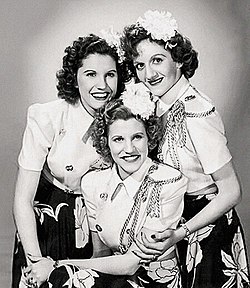
The Andrews Sisters
View on Wikipedia
The Andrews Sisters were an American close harmony singing group of the swing and boogie-woogie eras. The group consisted of three sisters: contralto LaVerne Sophia Andrews (1911–1967), soprano Maxene Anglyn Andrews (1916–1995), and mezzo-soprano Patricia Marie Andrews (1918–2013).[1] The sisters have sold an estimated 80 million records.[2] Their 1941 hit "Boogie Woogie Bugle Boy" can be considered an early example of jump blues. Other songs closely associated with the Andrews Sisters include their first major hit, "Bei Mir Bist Du Schön (Means That You're Grand)" (1937), "Beer Barrel Polka (Roll Out the Barrel)" (1939), "Beat Me Daddy, Eight to the Bar" (1940), "Don't Sit Under the Apple Tree (with Anyone Else but Me)" (1942), and "Rum and Coca-Cola" (1945), which helped introduce American audiences to calypso.
Key Information


The Andrews Sisters' harmonies and songs are still influential today and have been copied and recorded by entertainers such as Patti Page, Bette Midler, Christina Aguilera, The Pointer Sisters, Pentatonix, and others. The group was among the inaugural inductees to the Vocal Group Hall of Fame upon its opening in 1998.[3] Writing for Bloomberg, Mark Schoifet said the sisters became the most popular female vocal group of the first half of the 20th century.[4] They are still widely acclaimed today for their famous close harmonies. They were inducted into the Minnesota Rock/Country Hall of Fame in May 2006.
Early life
[edit]The sisters were born to Olga Bergliot "Ollie" (née Sollie; 1886—1948) and Peter Andreas. Peter Andreas (later "Andrews"), (1890—1949) was Greek and his wife Olga Andrews was of Norwegian ancestry raised in the Lutheran faith. The Sollie family disapproved of Olga's marriage, but the relationship was repaired once their first child, LaVerne, was born July 6, 1911. Their second daughter, Anglyn, died at eight months of age on March 16, 1914. Maxene arrived on January 3, 1916, and Patty was born February 16, 1918.
Patty, the lead singer of the group, was 7 when the trio was formed, and 12 when they won first prize at a talent contest at the local Orpheum Theatre in Minneapolis, where LaVerne played piano accompaniment for the silent film showings in exchange for dancing lessons for her and her sisters. Following the collapse of their father's Minneapolis restaurant, the sisters went on the road to support the family.[5] All three attended Franklin Junior High School and North High School, both in Minneapolis.[6]
Career
[edit]History
[edit]
They started their career as imitators of an earlier successful singing group, the Boswell Sisters, who had been popular until their breakup in 1936.[7] After singing with various dance bands and touring in vaudeville with Leon Belasco (and his orchestra)[8] and comic bandleader Larry Rich, they first came to national attention with their recordings and radio broadcasts in 1937, most notably via their major Decca record hit, "Bei Mir Bist Du Schön" (translation: "To Me, You Are Beautiful"),[9] originally a Yiddish tune, the lyrics of which Sammy Cahn had translated to English and "which the girls harmonized to perfection."[10] They followed this success with a string of best-selling records over the next two years and, by the 1940s, had become a household name.[11]
Instrumental to the sisters' success over the years were their parents, Olga and Peter, their orchestra leader and musical arranger, Vic Schoen (1916–2000), and Jack and David Kapp, who founded Decca Records.
World War II
[edit]
In the years just before and during World War II, the Andrews Sisters were at the height of their popularity, and the group still tends to be associated in the public's mind with the war years. They had numerous hit records during these years, both on their own and in collaboration with fellow Decca Records artist Bing Crosby. Some of these hits had service or military related themes, including "Boogie Woogie Bugle Boy", "Three Little Sisters", "Don't Sit Under the Apple Tree (with Anyone Else but Me)", "A Hot Time In the Town of Berlin" and "Rum and Coca-Cola". The sisters performed their hits in service comedy films, such as Buck Privates[12] and Private Buckaroo.
During the war, they entertained the Allied forces extensively in Africa and Italy, as well as in the U.S., visiting Army, Navy, Marine, and Coast Guard bases, war zones, hospitals, and munitions factories.[13] They encouraged U.S. citizens to purchase war bonds with their rendition of Irving Berlin's song "Any Bonds Today?". They also helped actress Bette Davis and actor John Garfield found California's famous Hollywood Canteen, a welcome retreat for servicemen where the trio often performed, volunteering their personal time to sing and dance for the soldiers, sailors, and Marines (they did the same at New York City's Stage Door Canteen during the war).
While touring, they often treated three random servicemen to dinner when they were dining out. They recorded a series of Victory Discs (V-Discs) for distribution to Allied fighting forces only, again volunteering their time for studio sessions for the Music Branch, Special Service Division, of the Army Service Forces, and they were dubbed the "Sweethearts of the Armed Forces Radio Service" for their many appearances on shows such as Command Performance, Mail Call, and G.I. Journal.[14]
The sisters' 1945 hit "Rum and Coca-Cola" became one of their most popular and best-known recordings, but also inspired some controversy. Some radio stations were reluctant to play the record because it mentioned a commercial product by name, and because the lyrics were subtly suggestive of local women prostituting themselves to U.S. servicemen serving at the naval base on Trinidad. The song was based on a Trinidadian calypso, and a dispute over its provenance led to a well-publicized court case.[15] The sisters later told biographers that they were asked to record the tune at short notice and were unaware either of the copyright issue or of the implications of the lyrics.[16]
Interruption
[edit]
An ad in the 1951 Radio Annual showed photos of the Andrews as children, as contemporary singers, and as old women in the then-future year of 1975, although the act would not make it that long.[17] In the 1950s, Patty Andrews decided to break away from the act to be a soloist.[18] She had married the trio's pianist, Walter Weschler, who became the group's manager and demanded more money for Patty.[1] When Maxene and LaVerne learned of Patty's decision from newspaper gossip columns rather than from their own sister, it caused a bitter two-year separation, especially when Patty sued LaVerne for a larger share of their parents' estate.[19] Patty attributed the breakup to the deaths of their parents: "We had been together nearly all our lives," Patty explained in 1971. "Then in one year our dream world ended. Our mother died (in 1948) and then our father (in 1949). All three of us were upset, and we were at each other's throats all the time."[1] The Andrews Sisters formally broke up in 1953.[18]
Maxene and LaVerne tried to continue the act as a duo and met with good press during a 10-day tour of Australia, but a reported suicide attempt by Maxene in December 1954[20] put a halt to any further tours (Maxene spent a short time in the hospital after swallowing 18 sleeping pills, an occurrence that LaVerne told reporters was an accident). Maxene and LaVerne did appear together on The Red Skelton Show on October 26, 1954, singing the humorous "Why Do They Give the Solos to Patty" as well as lip-synching "Beer Barrel Polka" with Skelton in drag filling in for Patty. This, however, did not sit well with Patty, and a cease-and-desist order was sent to Skelton. The sisters' private relationship was often troubled, and Patty blamed it on Maxene: "Ever since I was born, Maxene has been a problem, and that problem hasn't stopped," she said.[21]
The trio reunited in 1956 and signed a new recording deal with Capitol Records, for whom Patty was already a featured soloist. By this point, however, rock-and-roll and doo-wop were dominating the charts, and older artists were left by the wayside. The sisters recorded a dozen singles through 1959, some of which attempted to keep up with the times by incorporating rock sounds. None of these achieved any major success. In addition, they produced three hi-fi albums, including a vibrant LP of songs from the dancing 1920s with Billy May's orchestra. In 1962, they signed with Dot Records and recorded a series of stereo albums until 1967, both re-recordings of earlier hits which incorporated up-to-date production techniques as well as new material, including "I Left My Heart in San Francisco", "Still", "The End of the World", "Puff the Magic Dragon", "Sailor", "Satin Doll", "Mr. Bass Man", the theme from Come September, and the theme from A Man and a Woman. They toured extensively during the 1960s, favoring top nightclubs in Las Vegas, California, and London, England.[22]
Eldest sister LaVerne died in 1967 at the age of 55 after a year-long bout with cancer,[23] during which she was replaced by singer Joyce DeYoung (May 24, 1926 – March 7, 2014). DeYoung fulfilled concert appearances, including an appearance on The Dean Martin Show on November 30, 1967, but she did not record with Patty and Maxene. LaVerne had founded the original group and often acted as the peacemaker among the three during the sisters' lives, more often siding with her parents, to whom the girls were extremely devoted, than with either of her sisters. Their last appearance together as a trio was on The Dean Martin Show on September 29, 1966.
After LaVerne died, Maxene and Patty continued to perform periodically until 1968, when Maxene became the Dean of Women at Tahoe Paradise College,[24] teaching acting, drama, and speech, and working with troubled teens; and Patty was once again eager to be a soloist.[25]
In 1969, Patty appeared in Lucille Ball's third series Here's Lucy, in the sixth episode of the second season, titled "Lucy and the Andrews Sisters". The episode has Patty enlisting the help of Lucy, her daughter Kim (played by Lucie Arnaz), and her son Craig (Desi Arnaz Jr.) to perform a medley of Andrews Sisters hits for the Andrews Sisters Fan Club reunion. Lucy played LaVerne, Kim (Lucie Arnaz) played Maxene, and Craig (Desi Arnaz Jr.) played Bing Crosby. She also had a cameo as herself, along with many other stars, in the 1970 film The Phynx.
Comeback
[edit]Patty and Maxene's careers experienced a resurgence when Bette Midler covered "Boogie Woogie Bugle Boy" in 1973. The next year, the pair debuted on Broadway in the Sherman Brothers' nostalgic World War II musical: Over Here!, which premiered at the Shubert Theatre to rave reviews. This was a follow-up to Patty's success in Victory Canteen, a 1971 California revue. Over Here! starred Maxene and Patty (with Janie Sell filling in for LaVerne and winning a Tony Award for her performance) and was written with both sisters in mind for the leads. It launched the careers of many now notable theater, film, and television stars, including John Travolta, Marilu Henner, Treat Williams, and Ann Reinking. It was the last major tour for the sisters and was cut short owing to a conflict with the show's producers over pay for the sisters, resulting in the cancellation of an extensively scheduled road tour.[26] Over Here! lasted only a year, and its end marked the last time the sisters would ever sing together.[27]
Patty continually distanced herself from Maxene, until her death, and would not explain her motives regarding the separation. Maxene appealed to Patty for a reunion, personally if not professionally, both in public and in private, but to no avail. Maxene suffered a serious heart attack while performing in Illinois in 1982 and underwent quadruple bypass surgery, from which she successfully recovered. Patty visited her sister while she was hospitalized. Now sometimes appearing as "Patti" (but still signing autographs as "Patty"), she re-emerged in the late 1970s as a regular panelist on The Gong Show. Maxene had a successful comeback as a cabaret soloist in 1979 and toured worldwide for the next 15 years, recording a solo album in 1985 entitled Maxene: An Andrews Sister for Bainbridge Records. Patty started her own solo act in 1980, but did not receive the critical acclaim her sister had for her performances, even though Patty was considered to be the "star" of the group for years. The critics' major complaint was that Patty's show concentrated too much on Andrews Sisters material, which did not allow Patty's own talents as an expressive and bluesy vocalist to shine through.[28]
The two sisters did reunite, albeit briefly, on October 1, 1987, when they received a star on Hollywood's Walk of Fame, even singing a few bars of "Beer Barrel Polka" for the Entertainment Tonight cameras. The 1987 Whittier Narrows earthquake had shaken the area that morning and the ceremony was nearly cancelled, which caused Patty to joke, "Some people said that earthquake this morning was LaVerne because she couldn't be here, but really it was just Maxene and me on the telephone." Besides this, and a few brief private encounters, they remained somewhat estranged for their remaining years, with Maxene dying in 1995.[29]
Shortly after her Off-Broadway debut in New York City in a show called Swingtime Canteen, Maxene suffered another heart attack and died at Cape Cod Hospital on October 21, 1995, making Patty the last surviving Andrews Sister. Not long before she died, Maxene told music historian William Ruhlmann:
I have nothing to regret. We got on the carousel and we each got the ring and I was satisfied with that. There's nothing I would do to change things if I could...Yes, I would. I wish I had the ability and the power to bridge the gap between my relationship with my sister, Patty.[30]
Upon hearing the news of her sister's death, Patty became distraught. Several days later, Patty's husband, Wally, fell down a flight of stairs and broke both of his wrists. As a result, Patty did not attend either the California or New York memorial services for Maxene.[31] Bob Hope said of Maxene's death, "She was more than part of The Andrews Sisters, much more than a singer. She was a warm and wonderful lady who shared her talent and wisdom with others."[30]
As musical innovators
[edit]They found instant appeal with teenagers and young adults who were engrossed in the swing and jazz idioms, especially when they performed with nearly all of the major big bands, including those led by Glenn Miller, Benny Goodman, Buddy Rich, Tommy Dorsey, Jimmy Dorsey, Gene Krupa, Joe Venuti, Freddie Slack, Eddie Heywood, Bob Crosby (Bing's brother), Desi Arnaz, Guy Lombardo, Les Brown, Bunny Berigan, Xavier Cugat, Paul Whiteman, Ted Lewis, Nelson Riddle, and Gordon Jenkins.[citation needed]
Many styles
[edit]While the sisters specialized in traditional pop,[32] swing, boogie-woogie, and novelty hits with their trademark lightning-quick vocal syncopations, they also produced major hits in jazz, ballads, folk, country, seasonal, and religious titles, being the first Decca artists to record an album of gospel standards in 1950.[33] Their versatility allowed them to pair with many different artists in the recording studios, producing Top 10 hits with the likes of Bing Crosby[34] (the only recording artist of the 1940s to sell more records than the Andrews Sisters), Danny Kaye, Dick Haymes, Carmen Miranda, Al Jolson, Ray McKinley, Burl Ives, Ernest Tubb, Red Foley, Dan Dailey, Alfred Apaka, and Les Paul.[35][36] In personal appearances, on radio and on television, they sang with everyone from Rudy Vallee, Judy Garland, and Nat "King" Cole, to Jimmie Rodgers, Andy Williams, and the Supremes.[35][37] Some of the trio's late 1930s recordings have noticeable Boswell Sisters vocal influences.[38]
Marriages, family, and deaths
[edit]LaVerne Andrews married Lou Rogers,[23] a trumpet player in Vic Schoen's band, in 1948. The two remained together until LaVerne's death from liver cancer on May 8, 1967, at the age of 55. Lou died in 1995.[39]
Maxene Andrews married music publisher Lou Levy in 1941, separating in 1949. They adopted a girl and a boy, Aleda Ann and Peter.[40] Levy was the sisters' manager from 1937 to 1951. Later in life, according to her adopted daughter, Maxene entered a thirteen-year relationship with a woman and later spent many years with her manager Lynda Wells as life partners. "To me, being gay was not a central focus of Maxene's life at all," Wells told radio station The Current (KCMP) in a 2019 interview.[41] "Her art was. Her singing was." However, Wells says that their status as companions, and Maxene's health issues as she got older, led Maxene to adopt her as a daughter. "There was no such thing as being married at that time," she said. "During her lifetime, there was no such thing that existed for us."[41] Maxene died October 21, 1995, at age 79. The ashes of LaVerne and Maxene Andrews are interred in the Columbarium of Memory of the Forest Lawn Memorial Park Cemetery in Glendale, California,[28] near the ashes of their parents.
Patty Andrews married agent Marty Melcher in 1947 but left him in 1949, when he pursued a romantic relationship with Doris Day. She then married Walter Weschler, the trio's pianist, in 1951. Patty died of natural causes at her home in Northridge, California, on January 30, 2013, at the age of 94. Weschler, her husband of nearly 60 years, had died on August 28, 2010, at the age of 88.[5][42]
Joyce DeYoung Murray, who replaced LaVerne from late 1966 to 1968, died in March 2014 at the age of 87.
Legacy
[edit]The Andrews Sisters were the most imitated of all female singing groups and influenced many artists, including Mel Tormé, Les Paul and Mary Ford, the Four Freshmen, the Supremes, the Beach Boys, the McGuire Sisters, the Lennon Sisters, the Pointer Sisters, the Manhattan Transfer, Barry Manilow, and Bette Midler.[citation needed] Their style was even emulated internationally; the Harmony Sisters, a popular Finland group that performed from the 1930s to the 1950s, was one such example.[43]
Most of the Andrews Sisters' music has been restored and released in compact disc form. Over 300 of their original Decca recordings, a good portion of which was hit material, has yet to be released by MCA/Decca. Many of their Decca recordings have been used in such television shows and Hollywood movies as Homefront, ER, Agent Carter, The Brink's Job, National Lampoon's Christmas Vacation, Swing Shift, Raggedy Man, Summer of '42, Slaughterhouse-Five, Maria's Lovers, Harlem Nights, In Dreams, Murder in the First, L.A. Confidential, American Horror Story, Just Shoot Me, Gilmore Girls, Mama's Family, War and Remembrance, Jakob the Liar, Lolita, The Polar Express, The Chronicles of Narnia, Molly: An American Girl on the Home Front, Memoirs of a Geisha, and Bon Voyage, Charlie Brown (and Don't Come Back!!). Comical references to the trio in television sitcoms can be found as early as I Love Lucy and as recently as Everybody Loves Raymond. In 2007, their version of "Bei Mir Bist Du Schön" was included in the game BioShock, a first-person shooter that takes place in an alternate history 1960, and later in 2008, their song "Civilization" (with Danny Kaye) was included in the Atomic Age-inspired video game Fallout 3. The 2010 video game Mafia II features numerous Andrews Sisters songs, with "Boogie Woogie Bugle Boy", "Strip Polka" and "Rum and Coca-Cola". The 2011 video game L.A. Noire features the song "Pistol Packin' Mama", where the sisters perform a duet with Bing Crosby.[44] The sisters were again featured in a Fallout game in 2015, when their songs "Pistol Packin' Mama" and "Civilization" were featured in the game Fallout 4.
Christina Aguilera used the Andrews Sisters' "Boogie Woogie Bugle Boy" to inspire her song "Candyman" (released as a single in 2007) from her hit album Back to Basics. The song was co-written by Linda Perry. The London-based trio the Puppini Sisters uses their style harmonies on several Andrews Sisters and other hits of the 1940s and 1950s, as well as later rock and disco hits. The trio have said their name is a tribute to the Andrews Sisters. The National WW2 Museum's Victory Belles pay tribute to the Andrews Sisters, performing their music daily in the Stage Door Canteen in New Orleans. The Manhattan Dolls, a New York City-based touring group, performs both the popular songs sung by the Andrews Sisters and some of the more obscure ones, such as "Well Alright" and "South American Way".[45][46]
In 2008 and 2009, the BBC produced The Andrews Sisters: Queens of the Music Machines, a one-hour documentary on the history of the Andrews Sisters from their upbringing to the present. The North American premiere of the show was June 21, 2009, in their summer vacation enclave of Mound, Minnesota. In 2008, Mound dedicated "The Andrews Sisters Trail". The sisters spent summers in Mound[1] with their uncles Pete and Ed Solie, who had a grocery store there. Maxene Andrews always said that the summers in Mound created a major sense of "normalcy" and "a wonderful childhood" in a life that otherwise centered on the sisters' careers. The Westonka Historical Society has a large collection of Andrews Sisters memorabilia.[47]
In 2019, the Great American Songbook Foundation held an exhibition titled "The Andrews Sisters: Queens of the Jukebox," which led discussions about the lives and impact of the Andrews sisters' careers on the music industry alongside a collection of archival artifacts and historic memorabilia.[48] The Songbook Library & Archives houses most comprehensive collection of Andrews Sisters memorabilia available today.[49]
The Bronx Zoo acquired three young female Asian Elephants in October 1973, which they named Laverne, Maxine (a slightly different spelling), and Patty in honor of the trio. Of the three elephants, Patty still resides at the Bronx Zoo today, while the other two elephants, Laverne and Maxine, died in 1982 and 2018 respectively.
Filmography
[edit]Patty, Maxene, and LaVerne appeared in 17 Hollywood films. Their first picture, Argentine Nights, paired them with another enthusiastic trio, the Ritz Brothers.[50] Universal Pictures, always budget-conscious, refused to hire a choreographer, so the Ritzes taught the sisters some eccentric steps. Thus, in Argentine Nights and the sisters' next film, Buck Privates, the Andrews Sisters dance like the Ritz Brothers.[citation needed]
Buck Privates, with Abbott and Costello, featured the Andrews Sisters' best-known song, "Boogie Woogie Bugle Boy."[51] This Don Raye-Hughie Prince composition was nominated for Best Song at the 1941 Academy Awards ceremony.[52]
Universal hired the sisters for two more Abbott and Costello comedies and then promoted them to full-fledged stardom in B musicals. What's Cookin'?, Private Buckaroo, Give Out, Sisters (in which they disguise themselves as old women as part of the zany plot) and Moonlight and Cactus were among the team's popular full-length films.[53]
The Andrews Sisters sing the title song as the opening credits roll and also perform two specialty numbers in the all-star revue Hollywood Canteen (1944). They can be seen singing "You Don't Have to Know the Language" with Bing Crosby in Paramount's Road to Rio with Bob Hope, that year's highest-grossing movie. Their singing voices are heard in two full-length Walt Disney features: Make Mine Music,[54] in a segment which featured animated characters Johnny Fedora and Alice Blue Bonnet; and Melody Time, in the segment "Little Toot" (both of which are available on DVD today).[citation needed]
Stage and radio shows
[edit]The Andrews Sisters were the most sought-after singers in theater shows worldwide during the 1940s and early 1950s, always topping previous house averages.[55][56][57] The trio headlined at the London Palladium in 1948[58] and 1951.[59] They hosted their own radio shows for ABC and CBS from 1944 to 1951,[60] singing specially written commercial jingles for such products as Wrigley's chewing gum,[61] Dole pineapples,[62] Nash motor cars, Kelvinator home appliances,[63] Campbell's soups, and Franco-American food products.[64] The western-themed The Andrews Sisters' Show (subtitled "Eight-to-the-Bar Ranch"), co-hosted by Gabby Hayes, began in 1944 and featured a special guest every week.[65]
Setting records
[edit]
The trio recorded 47 songs with Bing Crosby, 23 of which charted on Billboard, thus making the team one of the most successful pairings of acts in a recording studio in show business history. Their million-sellers with Crosby included "Pistol Packin' Mama",[66] "Don't Fence Me In",[34] "South America, Take It Away", and "Jingle Bells".[67]
The sisters' popularity was such that after the war, they discovered that some of their records had actually been smuggled into Germany, after the labels had been changed to read "Hitler's Marching Songs". Their recording of "Bei Mir Bist Du Schön" became a favorite of the Nazis, until it was discovered that the song's composers were of Jewish descent. This did not stop concentration camp inmates from secretly singing it, this being most likely because the song was originally a Yiddish song, "Bei Mir Bistu Shein", and had been popularized within the Jewish community before it was recorded as a more successful "cover" version by the Andrews Sisters.[68]
Edward Habib, in the CD liner notes for Songs That Won the War Vol. 2 The Hollywood Canteen, states that the Andrews Sisters' radio transcription of "Elmer's Tune" was "so popular it even played on German radio," noting that "the opposition embraced the Andrews Sisters and their songs in the same way the Allied Forces adopted Lili Marlene."
Along with Bing Crosby, separately and jointly, the Andrews Sisters were among the performers who incorporated ethnic music styles into America's Hit Parade, popularizing or enhancing the popularity of songs with melodies originating in Brazil, Czechoslovakia, France, Ireland, Israel, Italy, Mexico, Russia, Spain, Sweden and Trinidad, many of which their manager chose for them.[69][70]
The Andrews Sisters became the most popular female vocal group of the first half of the 20th century.[71]
- 75–100 million records sold from a little over 600 recorded tunes
- 113 charted Billboard hits, 46 reaching Top 10 status (more than Elvis Presley or the Beatles)
- 17 Hollywood films (more than any other singing group in motion picture history)
- record-breaking theater and cabaret runs all across America and Europe;
- countless appearances on radio shows from 1935 to 1960 (including their own)
- guest spots on every major television show of the 1950s and 1960s, including those hosted by Ed Sullivan, Milton Berle,[72][circular reference] Perry Como,[73] Frank Sinatra,[73] Dean Martin,[73] Sammy Davis Jr.,[73] Johnny Carson,[73] Joey Bishop,[74] Art Linkletter[73] and Jimmy Dean.[73]
Early comparative female close harmony trios were the Boswell Sisters, the Pickens Sisters, and the Three X Sisters.[citation needed]
Repertoire
[edit] |
Discography
[edit]Albums
[edit]- Don't Fence Me In (with Bing Crosby) (1946, Decca)
- The Andrews Sisters (1946, Decca) (No. 5 on Billboard's albums chart)[75]
- A Collection of Tropical Songs (1947, Decca)
- Selections from Road to Rio (with Bing Crosby) (1948, Decca)
- Irving Berlin Songs (1948, Decca)
- The Andrews Sisters in Hi-Fi (1957, Capitol)
- Fresh and Fancy Free (1957, Capitol)
- The Andrews Sisters Sing the Dancing '20s (1958, Capitol)
- Greatest Hits (1961, Dot)
- Great Golden Hits (1962, Dot)
- The Andrews Sisters Present (1963, Dot)
- Greatest Hits Vol. 2 (1963, Dot)
- Great Country Hits (1964, Dot)
- The Andrews Sisters Go Hawaiian (1965, Dot)
- Favorite Hymns (1965, Hamilton)
- The Andrews Sisters – Great Performers (1967, Dot)
- Boogie Woogie Bugle Girls (1973, Paramount)
- The Andrews Sisters in Over Here! (1974, Columbia)
- In The Mood (Famous Twinset Series) (1974, Paramount)
- Sixteen Great Performances (1980, MCA)
- 50th Anniversary Collection Volume One (1987, MCA)
- Christmas With The Andrews Sisters (1988, Pickwick)
- All-Time Favorites (10 Best Series) (1991, Cema)
- Their All Time Greatest Hits (1994, MCA)
- 20th Century Masters – The Millennium Collection: The Best of the Andrews Sisters (2000, MCA)
Chart records
[edit]| Year | Single | Chart positions | ||
|---|---|---|---|---|
| US | US R&B |
US Country | ||
| 1938 | "Bei Mir Bist Du Schön (Means That You're Grand)" | 1 | – | – |
| "Nice Work If You Can Get It" | 12 | – | – | |
| "Joseph, Joseph" | 18 | – | – | |
| "Ti-Pi-Tin" | 12 | – | – | |
| "Shortenin' Bread" | 16 | – | – | |
| "Says My Heart" | 10 | – | – | |
| "Tu-li-Tulip Time" | 9 | – | – | |
| "Sha-Sha" | 17 | – | – | |
| "Lullaby to a Jitterbug" | 10 | – | – | |
| 1939 | "Pross-Tchai (Goodbye)" | 15 | – | – |
| "Hold Tight, Hold Tight (Want Some Sea Food, Mama?)" | 2 | – | – | |
| "You Don't Know How Much You Can Suffer" | 14 | – | – | |
| "Beer Barrel Polka (Roll Out the Barrel)" | 4 | – | – | |
| "Well All Right (Tonight's the Night)" | 5 | – | – | |
| "Ciribiribin (They're So In Love)" (with Bing Crosby) | 13 | – | – | |
| "Yodelin' Jive" (with Bing Crosby) | 4 | – | – | |
| "Chico's Love Song" | 11 | – | – | |
| 1940 | "Say Si Si (Para Vigo Me Voy)" | 4 | – | – |
| "The Woodpecker Song" | 6 | – | – | |
| "Down By the O-Hi-O" | 21 | – | – | |
| "Rhumboogie" | 11 | – | – | |
| "Ferryboat Serenade" | 1 | – | – | |
| "Hit the Road" | 27 | – | – | |
| "Beat Me Daddy, Eight to the Bar" | 2 | – | – | |
| 1941 | "Scrub Me, Mama, With a Boogie Beat" | 10 | – | – |
| "Boogie Woogie Bugle Boy" | 6 | – | – | |
| "I Yi, Yi, Yi, Yi (I Like You Very Much)" | 11 | – | – | |
| "(I'll Be With You) In Apple Blossom Time" | 5 | – | – | |
| "Aurora" | 10 | – | – | |
| "Sonny Boy" | 22 | – | – | |
| "The Nickel Serenade" | 22 | – | – | |
| "Sleepy Serenade" | 22 | – | – | |
| "I Wish I Had a Dime (For Every Time I Missed You)" | 20 | – | – | |
| "Jealous" | 12 | – | – | |
| 1942 | "The Shrine of St. Cecilia" | 3 | – | – |
| "I'll Pray For You" | 22 | – | – | |
| "Three Little Sisters" | 8 | – | – | |
| "Don't Sit Under the Apple Tree" | 16 | – | – | |
| "Pennsylvania Polka" | 17 | – | – | |
| "That's the Moon, My Son" | 18 | – | – | |
| "Mister Five By Five" | 14 | – | – | |
| "Strip Polka" | 6 | – | – | |
| "Here Comes the Navy" | 17 | – | – | |
| 1943 | "East of the Rockies" | 18 | – | – |
| "Pistol Packin' Mama" (with Bing Crosby) | 2 | 3 | 1 | |
| "Victory Polka" (with Bing Crosby) | 5 | – | – | |
| "Jingle Bells" (with Bing Crosby) | 19 | – | – | |
| "Shoo-Shoo Baby" | 1 | – | – | |
| 1944 | "Down In the Valley" | 20 | – | – |
| "Straighten Up and Fly Right" | 8 | – | – | |
| "Tico Tico" | 24 | – | – | |
| "Sing a Tropical Song" | 24 | – | – | |
| "Is You Is Or Is You Ain't My Baby" (with Bing Crosby) | 2 | – | – | |
| "A Hot Time In the Town of Berlin" (with Bing Crosby) | 1 | – | – | |
| "Don't Fence Me In" (with Bing Crosby) | 1 | 9 | – | |
| 1945 | "Rum and Coca-Cola" | 1 | 3 | – |
| "Accentuate the Positive" (with Bing Crosby) | 2 | – | – | |
| "The Three Caballeros" (with Bing Crosby) | 8 | – | – | |
| "One Meat Ball" | 15 | – | – | |
| "Corns For My Country" | 21 | – | – | |
| "Along the Navajo Trail" (with Bing Crosby) | 2 | – | – | |
| "The Blond Sailor" | 8 | – | – | |
| 1946 | "Money Is the Root of All Evil" | 9 | – | – |
| "Patience and Fortitude" | 12 | – | – | |
| "Coax Me a Little Bit" | 24 | – | – | |
| "South America, Take It Away" (with Bing Crosby) | 2 | – | – | |
| "Get Your Kicks On Route 66" (with Bing Crosby) | 14 | – | – | |
| "I Don't Know Why" | 17 | – | – | |
| "House of Blue Lights" | 15 | – | – | |
| "Rumors Are Flying" (with Les Paul) | 4 | – | – | |
| "Winter Wonderland" (with Guy Lombardo) | 22 | – | – | |
| "Christmas Island" (with Guy Lombardo) | 7 | – | – | |
| 1947 | "Tallahassee" (with Bing Crosby) | 10 | – | – |
| "There's No Business Like Show Business" (with Bing Crosby and Dick Haymes) | 25 | – | – | |
| "On the Avenue" | 21 | – | – | |
| "Near You" | 2 | – | – | |
| "The Lady From 29 Palms" | 7 | – | – | |
| "The Freedom Train" (with Bing Crosby) | 21 | – | – | |
| "Civilization (Bongo, Bongo, Bongo)" (with Danny Kaye) | 3 | – | – | |
| "Jingle Bells" (with Bing Crosby)(re-entry) | 21 | – | – | |
| "Santa Claus Is Comin' To Town" (with Bing Crosby) | 22 | – | – | |
| "Christmas Island" (with Guy Lombardo)(re-entry) | 20 | – | – | |
| "Your Red Wagon" | 24 | – | – | |
| "How Lucky You Are" | 22 | – | – | |
| 1948 | "You Don't Have To Know the Language" (with Bing Crosby) | 21 | – | – |
| "Teresa" (with Dick Haymes) | 21 | – | – | |
| "Toolie Oolie Doolie (The Yodel Polka)" | 3 | – | – | |
| "I Hate to Lose You" | 14 | – | – | |
| "Heartbreaker" | 21 | – | – | |
| "Sabre Dance" | 20 | – | – | |
| "Woody Woodpecker" (with Danny Kaye) | 18 | – | – | |
| "Blue Tail Fly" (with Burl Ives) | 24 | – | – | |
| "Underneath the Arches" | 5 | – | – | |
| "You Call Everybody Darling" | 8 | – | – | |
| "Cuanto La Gusta" (with Carmen Miranda) | 12 | – | – | |
| "160 Acres" (with Bing Crosby) | 23 | – | – | |
| "Bella Bella Marie" | 23 | – | – | |
| 1949 | "Christmas Island" (with Guy Lombardo)(re-entry) | 26 | – | – |
| "The Pussy Cat Song (Nyow! Nyot! Nyow!)"(Patty Andrews and Bob Crosby) | 12 | – | – | |
| "More Beer!" | 30 | – | – | |
| "I'm Bitin' My Fingernails and Thinking of You" (with Ernest Tubb) | 30 | – | 2 | |
| "Don't Rob Another Man's Castle" (with Ernest Tubb) | – | – | 6 | |
| "I Can Dream, Can't I?" | 1 | – | – | |
| "The Wedding of Lili Marlene" | 20 | – | – | |
| "She Wore a Yellow Ribbon" (with Russ Morgan) | 22 | – | – | |
| "Charley, My Boy" (with Russ Morgan) | 15 | – | – | |
| 1950 | "Merry Christmas Polka" (with Guy Lombardo) | 18 | – | – |
| "Have I Told You Lately That I Love You" (with Bing Crosby) | 24 | – | – | |
| "Quicksilver" (with Bing Crosby) | 6 | – | – | |
| "The Wedding Samba" (with Carmen Miranda) | 23 | – | – | |
| "I Wanna Be Loved" | 1 | – | – | |
| "Can't We Talk It Over" | 22 | – | – | |
| "A Bushel and a Peck" | 22 | – | – | |
| "Mele Kalikimaka" (with Bing Crosby) | 36 | – | – | |
| 1951 | "A Penny a Kiss, a Penny a Hug" | 17 | – | – |
| "Sparrow in the Tree Top" (with Bing Crosby) | 8 | – | – | |
| "Too Young" (Patty Andrews) | 19 | – | – | |
| 1952 | "Sing, Sing, Sing" | 17 | – | – |
| 1955 | "Suddenly There's a Valley" (Patty Andrews) | 69 | – | – |
Other songs
[edit]Highest chart positions on Billboard; with Vic Schoen and his orchestra, unless otherwise noted:
- "A Bushel and a Peck" (1950) (No. 22)
- "A Hundred and Sixty Acres" (with Bing Crosby) (1948) (No. 23)
- "A Penny a Kiss-A Penny a Hug" (1950) (No. 17)
- "Aurora" (1941) (No. 10)
- "Bella Bella Marie" (1948) (No. 23)
- "Can't We Talk it Over?" (with Gordon Jenkins and his orchestra and chorus) (1950) (No. 22)
- "Charley, My Boy" (with Russ Morgan and his orchestra) (1949) (No. 15)
- "Chico's Love Song" (1939) (No. 11)
- "Christmas Island" (with Guy Lombardo and his Royal Canadians) (1946: No. 7; 1947: No. 20; 1949: No. 26)
- "Ciribiribin (They're So in Love)" (with Bing Crosby & Joe Venuti and his orchestra) (1939) (No. 13)
- "Coax Me a Little Bit" (1946) (No. 24)
- "Corns for My Country" (1945) (No. 21)
- "Cuanto La Gusta" (with Carmen Miranda) (1948) (No. 12)
- "Down By the O-HI-O" (1940) (No. 21)
- "Down in the Valley (Hear that Train Blow)" (1944) (No. 20)
- "East of the Rockies" (1943) (No. 18)
- "(Everytime They Play the) Sabre Dance" (with The Harmonica Gentlemen) (1948) (No. 20)
- "Heartbreaker" (with The Harmonica Gentlemen) (1948) (No. 21)
- "Here Comes the Navy" (1942) (No. 17)
- "Hit the Road" (1940) (No. 27)
- "How Lucky You Are" (1947) (No. 22)
- "I Don't Know Why (I Just Do)" (1946) (No. 17)
- "I Hate to Lose You" (1948) (No. 14)
- "Have I Told You Lately That I Love You?" (with Bing Crosby) (1950) (No. 24)
- "I'll Pray For You" (1942) (No. 22)
- "I'm Biting My Fingernails and Thinking of You" (with Ernest Tubb and The Texas Troubadors directed by Vic Schoen) (1949) (No. 30)
- "I Wish I Had a Dime (For Ev'rytime I Missed You)" (1941) (No. 20)
- "I Yi, Yi, Yi, Yi (I Like You Very Much)" (1941) (No. 11)
- "Jealous" (1941) (No. 12)
- "The Blue Tail Fly (Jimmy Crack Corn)" (with Burl Ives, vocal and guitar accompaniment) (1948) (No. 24)
- "Joseph! Joseph!" (1938) (No. 18)
- "Lullaby to a Jitterbug" (1938) (No. 10)
- "Merry Christmas Polka" (with Guy Lombardo and his Royal Canadians) (1950) (No. 18)
- "Mister Five By Five" (1942) (No. 14)
- "Money Is the Root of All Evil (Take it Away, Take it Away, Take it Away)" (with Guy Lombardo and his Royal Canadians) (1946) (No. 9)
- "More Beer!" (1949) (No. 30)
- "Oh Johnny, Oh Johnny, Oh!" Decca 2840 (1940)
- "On the Avenue" (with Carmen Cavallaro at the piano), Decca 24102 A (1947) (No. 21)
- "One Meat Ball" (1945) (No. 15)
- "Patience and Fortitude" (1946) (No. 12)
- "Pennsylvania Polka" (1942) (No. 17)
- "Pross Tchai (Goodbye-Goodbye)" (1939) (No. 15)
- "Put That Ring On My Finger" (1945)
- "Quicksilver" (with Bing Crosby) (1950) (No. 6)
- "Rhumboogie" (1940) (No. 11)
- "Get Your Kicks on Route 66" (with Bing Crosby) (1946) (No. 14)
- "Says My Heart" (1938) (No. 10)
- "Scrub Me Mama with a Boogie Beat" (1940) (No. 10)
- "Sha-Sha" (with Jimmy Dorsey and his orchestra)(1938) (No. 17)
- "She Wore a Yellow Ribbon" (with Russ Morgan and his orchestra) (1949) (No. 22)
- "Shortenin' Bread" (1938) (No. 16)
- "Sing a Tropical Song" (1944) (No. 24)
- "Sleepy Serenade" (1941) (No. 22)
- "Sleigh Ride" (1950)
- "Sonny Boy" (1941) (No. 22)
- "Sparrow in the Treetop" (with Bing Crosby) (1951) (No. 8)
- "Straighten Up and Fly Right" (1944) (No. 8)
- "Strip Polka" (1942) (No. 6)
- "Sweet Marie" (with Carmen Cavallaro at the piano), Decca 24102 B (maybe 1947?) (No. ?)
- "Tallahassee" (with Bing Crosby) (1947) (No. 10)
- "Teresa" (with Dick Haymes) (1948) (No. 21)
- "That's the Moon, My Son" (1942) (No. 18)
- "The Blond Sailor" (1945) (No. 8)
- "The Freedom Train" (1947) (No. 21)
- "The House of Blue Lights" (with Eddie Heywood and his orchestra) (1946) (No. 15)
- "The Lady from 29 Palms" (1947) (No. 7)
- "The Nickel Serenade" (1941) (No. 22)
- "The Pussy Cat Song (Nyow! Nyot Nyow!)" (Patty Andrews and Bob Crosby) (1949) (No. 12)
- "The Three Caballeros" (with Bing Crosby) (1945) (No. 8)
- "The Wedding of Lili Marlene" (with Gordon Jenkins and his orchestra and chorus) (1949) (No. 20)
- "The Wedding Samba" (with Carmen Miranda) (1950) (No. 23)
- "The Windmill Song" (with Gordon Jenkins and his orchestra) (1951) (No. ?)
- "The Woodpecker Song" (1940) (No. 6)
- "There's No Business Like Show Business" (with Bing Crosby and Dick Haymes) (1947) (No. 25)
- "Three Little Sisters" (1942) (No. 8)
- "Tico-Tico no Fubá" (1944) (No. 24)
- "Ti-Pi-Tin" (1938) (No. 12)
- "Too Young" (Patty Andrews with Victor Young and his orchestra) (1951) (No. 19)
- "Torero" Capitol F 3965 (recorded on March 31, 1958)
- "Tu-Li-Tulip Time" (with Jimmy Dorsey and his orchestra) (1938) (No. 9)
- "Winter Wonderland" (with Guy Lombardo and his Royal Canadians) (1946) (No. 22)
- "The Woody Woodpecker Song" (with Danny Kaye and The Harmonica Gentlemen) (1948) (No. 18)
- "You Call Everybody Darling" (recorded in London with Billy Ternant and his orchestra) (1948) (No. 8)
- "You Don't Have to Know the Language" (with Bing Crosby) (1948) (No. 21)
- "You Don't Know How Much You Can Suffer" (1939) (No. 14)
- "Your Red Wagon" (1947) (No. 24)
Film, theatre, and television
[edit](partial list)
Filmography
[edit]- Argentine Nights (Universal Pictures, 1940)
- Buck Privates (Universal Pictures, 1941)
- In the Navy (Universal Pictures, 1941)
- Hold That Ghost (Universal Pictures, 1941)
- What's Cookin'? (Universal Pictures, 1942)
- Private Buckaroo (Universal Pictures, 1942)
- Give Out, Sisters (Universal Pictures, 1942)
- How's About It (Universal Pictures, 1943)
- Always a Bridesmaid (Universal Pictures, 1943)
- Swingtime Johnny (Universal Pictures, 1944)
- Moonlight and Cactus (Universal Pictures, 1944)
- Follow the Boys (Universal Pictures, 1944)
- Hollywood Canteen (Warner Brothers, 1944)
- Her Lucky Night (Universal Pictures, 1945)
- Make Mine Music (Walt Disney Studios, 1946) – voices only, as singers of one segment
- Road to Rio (Paramount Pictures, 1947)
- Melody Time (Walt Disney Studios, 1948) – voices only, as singers of one segment
- Brother, Can You Spare a Dime? (1975) – newsreel archive footage only
Soundtracks
[edit]- Breach (background music) (2007)
- Land of the Lost (2009)
- Fallout 3 (2008) (Civilization)
- Fallout 4 (2015) (Civilization-Pistol Packin' Mama)
- Mafia II (2010) [Boogie Woogie Bugle Boy – Rum and Coca-Cola – Straighten Up And Fly Right – Strip Polka – Hot Time in the Town of Berlin (with Bing Crosby) – Victory Polka (with Bing Crosby)]
- Bioshock (2006)
- Fallout 76 (2018)
Broadway
[edit]- Over Here! (1974; Shubert Theater, New York City, 9 months)
Dance
[edit]- Company B (1991); Choreographed by Paul Taylor, Performed by Paul Taylor Dance Company, American Ballet Theatre, Miami City Ballet, The Sarasota Ballet, and Pacific Northwest Ballet.
Television
[edit]- Appearance on The Joey Bishop Show
- They were parodied on Sesame Street as the Androoze Sisters (Muppets), named Mayeeme (Audrey Smith), Pattiz (Maeretha Stewart), and Lavoorrnee (Kevin Clash).[76][77]
- Patty Andrews appeared in season two, episode six, of Here's Lucy, entitled "Lucy And The Andrews Sisters", in which Lucy, Kim, and Craig help Patty recreate the Andrews Sisters with Bing Crosby for a one-night only performance at a convention of the Sisters' oldest fan club.
See also
[edit]References
[edit]- ^ a b c d "Last surviving Andrews Sisters member Patty Andrews dies at 94". Fox News. January 30, 2013. Archived from the original on June 18, 2013. Retrieved July 2, 2013.
- ^ "Patty Andrews of Andrews Sisters Dead at 94". Billboard. January 30, 2013. Retrieved September 21, 2020.
- ^ "Vocal Group Hall of Fame – The Andrews Sisters". Archived from the original on May 22, 2013. Retrieved January 31, 2013.
- ^ Schoifet, Mark (January 30, 2013). "Patty Andrews, Last Survivor of Wartime Sister Trio, Dies at 94". Bloomberg. Archived from the original on May 12, 2020. Retrieved August 20, 2019.
- ^ a b "Patty Andrews, last of the famed sisters, dies". StarTribune.com. Associated Press file photo. Archived from the original on February 7, 2013. Retrieved July 2, 2013.
- ^ Minneapolis Tribune, October 9, 1938, pg 21. Retrieved May 10, 2021.
- ^ Berkvist, Robert (January 30, 2013). "Patty Andrews, Singer With Her Sisters, Is Dead at 94". The New York Times (National ed.). New York. p. A21. Retrieved March 14, 2020.
- ^ Shambarger, Peter (Fall 2004). "Book Reviews: Popular, Rock & Country Music – 'The Andrews Sisters: A Biography and Career Record,' by H. Arlo Nimmo". ARSC Journal.
- ^ "Sholom Secunda – The Story of Bei Mir Bist Du Schoen". www.dvrbs.com. Archived from the original on October 20, 2017. Retrieved May 2, 2018.
- ^ Nimmo, H. Arlo (2004). The Andrews Sisters: A Biography and Career Record. McFarland. p. 328. ISBN 9780786432608. Retrieved December 12, 2013.
- ^ Serjeant, Jill (January 30, 2013). "Last of 1940s hitmakers Andrews Sisters dies in California". Reuters. Archived from the original on February 2, 2013. Retrieved February 3, 2013.
- ^ "'The Andrews Sisters: Queen of the Jukebox' [online exhibit]". Great American Songbook Foundation.
- ^ Andrews, Maxene and Bill Gilbert. Over Here, Over There: The Andrews Sisters and the USO Stars in World War II. New York: Kensington Publishing Corp, 1993.
- ^ Bernstein, Adam (January 30, 2013). "Patty Andrews, the last surviving member of the Andrews Sisters, dies at 94". Washington Post. Archived from the original on February 3, 2013. Retrieved February 3, 2013.
- ^ "Columbia Law School & UCLA LAW Copyright Infringement Project". Archived from the original on July 4, 2010. Retrieved October 19, 2018.
- ^ Sforza, John (2000). Swing It!: The Andrews Sisters Story. University Press of Kentucky. p. 76. ISBN 978-0-8131-4897-7.
- ^ 1951 Radio Annual, p.12 (Radio Daily Corp., New York, 1950)
- ^ a b Blaszyk, Amy (January 30, 2013). "Patty Andrews, Leader Of The Andrews Sisters, Dies". National Public Radio. Archived from the original on February 16, 2016. Retrieved February 17, 2016.
- ^ Beverage, Bob; Peluso, Ron. "Christmas of Swing" (PDF). HistoryTheater.com. p. 4. Retrieved February 3, 2013.[permanent dead link]
- ^ Los Angeles Times article (PDF) December 22, 1954.
- ^ Finn, Natalie (January 30, 2013). "Patty Andrews Dies, Singer Was Last Surviving Member of the Andrews Sisters". E Online.com. Archived from the original on February 3, 2013. Retrieved February 3, 2013.
- ^ Nimmo, H. Arlo (January 22, 2004). The Andrews Sisters: A Biography and Career Record. McFarland. ISBN 9780786432608. Retrieved May 2, 2018 – via Google Books.
- ^ a b Los Angeles Times article (PDF) May 9, 1967.(subscription required)
- ^ "St. Petersburg Times – Google News Archive Search". news.google.com. Retrieved May 2, 2018.
- ^ "Andrews Sisters Disolve Group", St. Petersburg Times, August 10, 1968.
- ^ "Andrews Sisters in pay dispute". St. Petersburg Times. December 27, 1974. p. 6–D.
- ^ Wilson, John S. (October 23, 1995). "Maxene Andrews, 79, of the Andrews Sisters". The New York Times. ISSN 0362-4331. Archived from the original on February 5, 2016. Retrieved February 14, 2016.
- ^ a b Sforza, John (January 13, 2015). Swing It!: The Andrews Sisters Story. University Press of Kentucky. ISBN 9780813148977. Retrieved May 2, 2018 – via Google Books.
- ^ Hawn, Jack (October 1, 2010). Blind Journey: A Journalist's Memoirs. Strategic Book Publishing. ISBN 9781609760113. Retrieved May 2, 2018 – via Google Books.
- ^ a b Sforza, John (2004). Swing It!: The Andrews Sisters Story. United States of America: University Press of Kentucky. pp. 171, 289. ISBN 9780813190990.
- ^ Mydans, Sheryl (October 23, 1995). "Maxene Andrews, 79, of the Singing Sisters, Dies". The New York Times. Archived from the original on April 8, 2024. Retrieved April 8, 2025.
{{cite news}}: CS1 maint: bot: original URL status unknown (link) - ^ Bogdanov, Vladimir; Woodstra, Chris; Erlewine, Stephen Thomas (November 9, 2001). All Music Guide: The Definitive Guide to Popular Music. Hal Leonard Corporation. ISBN 9780879306274 – via Google Books.
- ^ gospel (March 24, 2012). "Bing Crosby, Nat King Cole, The Andrews Sisters – May the Good Lord Bless and Keep You – Gospel". Archived from the original on March 14, 2016. Retrieved May 2, 2018 – via YouTube.
- ^ a b Gilliland, John (1994). Pop Chronicles the 40s: The Lively Story of Pop Music in the 40s (audiobook). ISBN 978-1-55935-147-8. OCLC 31611854. Tape 1, side B.
- ^ a b Nimmo, Harry (May 2, 2018). The Andrews Sisters: A Biography and Career Record. McFarland. ISBN 9780786417315. Retrieved May 2, 2018 – via Google Books.
- ^ Nimmo, H. Arlo (January 22, 2004). The Andrews Sisters: A Biography and Career Record. McFarland. ISBN 9780786432608. Retrieved May 2, 2018 – via Google Books.
- ^ Sforza, John (January 13, 2015). Swing It!: The Andrews Sisters Story. University Press of Kentucky. ISBN 9780813148977. Retrieved May 2, 2018 – via Google Books.
- ^ Nimmo, Harry (May 2, 2018). The Andrews Sisters: A Biography and Career Record. McFarland. ISBN 9780786417315. Retrieved May 2, 2018 – via Google Books.
- ^ Arto Nimmo, H (2004). The Andrews Sisters: A Biography and Career Record. McFarland. p. 409. ISBN 9780786432608.
- ^ Arto Nimmo, H (2004). The Andrews Sisters: A Biography and Career Record. McFarland. p. 4. ISBN 9780786432608.
- ^ a b "The Current Rewind: The Andrews Sisters & Lynda Wells". www.thecurrent.org. Archived from the original on June 7, 2019. Retrieved June 7, 2019.
- ^ Potempa, Philip (September 2010). "OFFBEAT: Singer Patty Andrews manager husband dead at age 88". nwitimes.com. Archived from the original on December 1, 2017. Retrieved May 2, 2018.
- ^ "Harmony Sisters laulaa". December 14, 2006. Archived from the original on January 10, 2017. Retrieved April 25, 2017. YLE – Finnish Broadcasting corporation
- ^ Trent Rannells Sr. (January 24, 2013). "L A Noire OST Bing Crosby & The Andrews Sisters Pistol Packin Mama". Archived from the original on March 12, 2016. Retrieved May 2, 2018 – via YouTube.
- ^ WillzUK75 (July 17, 2013). "Flying Legends 2013 Clips featuring the Manhattan Dolls". Archived from the original on December 11, 2021. Retrieved May 2, 2018 – via YouTube.
{{cite web}}: CS1 maint: numeric names: authors list (link) - ^ "The Manhattan Dolls". themanhattandolls.com. Archived from the original on March 17, 2016. Retrieved May 2, 2018.
- ^ "Westonka Historical Society". westonkahistoricalsociety.org. Archived from the original on April 16, 2013. Retrieved May 2, 2018.
- ^ "Andrews Sisters exhibit on display at Palladium". Current Publishing. January 18, 2019.
- ^ "Inside the Archives". Great American Songbook Foundation.
- ^ Los Angeles Times article PDF May 15, 1940.
- ^ "Songs That Won The War Vol. 4 The Home Front" CD program notes by Edward Habib
- ^ "The 14th Academy Awards | 1942". Oscars.org.
- ^ Dick, Bernard F. (January 13, 2015). City of Dreams: The Making and Remaking of Universal Pictures. University Press of Kentucky. ISBN 9780813158891. Retrieved May 2, 2018 – via Google Books.
- ^ Los Angeles Times article (PDF) Hedda Hopper. June 30, 1946.
- ^ "Billboard". September 12, 1942. Retrieved May 2, 2018 – via Google Books.
- ^ "Billboard". January 17, 1942. Retrieved May 2, 2018 – via Google Books.
- ^ "Billboard". July 17, 1943. Retrieved May 2, 2018 – via Google Books.
- ^ Nimmo, H. Arlo (January 22, 2004). The Andrews Sisters: A Biography and Career Record. McFarland. ISBN 9780786432608. Retrieved May 2, 2018 – via Google Books.
- ^ Nimmo, H. Arlo (January 22, 2004). The Andrews Sisters: A Biography and Career Record. McFarland. ISBN 9780786432608. Retrieved May 2, 2018 – via Google Books.
- ^ Nimmo, H. Arlo (January 22, 2004). The Andrews Sisters: A Biography and Career Record. McFarland. ISBN 9780786432608. Retrieved May 2, 2018 – via Google Books.
- ^ Sforza, John (January 13, 2015). Swing It!: The Andrews Sisters Story. University Press of Kentucky. ISBN 9780813148977. Retrieved May 2, 2018 – via Google Books.
- ^ Sforza, John (January 13, 2015). Swing It!: The Andrews Sisters Story. University Press of Kentucky. ISBN 9780813148977. Retrieved May 2, 2018 – via Google Books.
- ^ Cox, Jim (January 25, 2013). Sold on Radio: Advertisers in the Golden Age of Broadcasting. McFarland. ISBN 9780786451760. Retrieved May 2, 2018 – via Google Books.
- ^ Sforza, John (January 13, 2015). Swing It!: The Andrews Sisters Story. University Press of Kentucky. ISBN 9780813148977. Retrieved May 2, 2018 – via Google Books.
- ^ Nimmo, H. Arlo (January 22, 2004). The Andrews Sisters: A Biography and Career Record. McFarland. ISBN 9780786432608. Retrieved May 2, 2018 – via Google Books.
- ^ Gilliland 1994, tape 1, side A.
- ^ MsCatreona (December 30, 2013). "Bing Crosby and The Andrews Sisters: 'Jingle Bells'". Archived from the original on February 1, 2017. Retrieved May 2, 2018 – via YouTube.
- ^ Nimmo, H. Arlo (January 22, 2004). The Andrews Sisters: A Biography and Career Record. McFarland. ISBN 9780786432608. Retrieved May 2, 2018 – via Google Books.
- ^ Greene, Victor (November 23, 1992). A Passion for Polka: Old-Time Ethnic Music in America. University of California Press. p. 134. ISBN 9780520075849. Retrieved May 2, 2018 – via Internet Archive.
the andrews sisters ethnic styles.
- ^ Sforza, John (January 13, 2015). Swing It!: The Andrews Sisters Story. University Press of Kentucky. ISBN 9780813148977. Retrieved May 2, 2018 – via Google Books.
- ^ Schoifet, Mark (January 30, 2013). "Patty Andrews, Last Survivor of Wartime Sister Trio, Dies at 94". Bloomberg L.P. BusinessWeek. Archived from the original on February 3, 2013. Retrieved January 31, 2013.
- ^ III, Harris M. Lentz (May 20, 2014). Obituaries in the Performing Arts, 2013. McFarland. ISBN 9780786476657. Retrieved May 2, 2018 – via Google Books.
- ^ a b c d e f g Sforza, John (January 13, 2015). Swing It!: The Andrews Sisters Story. University Press of Kentucky. ISBN 9780813148977. Retrieved May 2, 2018 – via Google Books.
- ^ "The Joey Bishop Show S3 E31 - Joey & The Andrews Sisters 5/30/64". YouTube. Archived from the original on June 22, 2020. Retrieved May 2, 2018.
- ^ Whitburn, Joel (1996). Top LPs, 1955–1996. Record Research. p. 11. Retrieved July 10, 2025.
- ^ TheOriginalTellyMonster (January 30, 2008). "Sesame Street – Everybody's Song". Archived from the original on March 10, 2016. Retrieved May 2, 2018 – via YouTube.
- ^ Sesame Street (March 27, 2009). "Sesame Street: A New Way to Walk". Archived from the original on December 5, 2017. Retrieved May 2, 2018 – via YouTube.
- Nimmo, H. Arlo. The Andrews Sisters. Jefferson: McFarland & Co, Inc., 2004.
- Sforza, John. Swing It! The Andrews Sisters Story. Lexington: The University Press of Kentucky, 2000.
External links
[edit]| Archives at | ||||
|---|---|---|---|---|
|
||||
| How to use archival material |

- Official website (archived)
- The Andrews Sisters at IMDb
- Patty Andrews at IMDb
- Maxene Andrews at IMDb
- LaVerne Andrews at IMDb
- Patty Andrews at Find a Grave
- Maxene Andrews at Find a Grave
- LaVerne Andrews at Find a Grave
- Robert Boyer Collection of Andrews Sisters Materials in the Great American Songbook Foundation Library & Archives
- "The Andrews Sisters: Queens of the Jukebox" online exhibit at Great American Songbook Foundation
- The Andrews Sisters at MNopedia
- The Andrews Sisters discography at Discogs
- Andrews Sisters at Vocal Group Hall of Fame
- The Andrews Sisters at Discography of American Historical Recordings
- Digitized audio of "We Just Couldn't Say Goodbye" on Soviet-era Ribs (recordings) at YouTube

The Andrews Sisters
View on GrokipediaOrigins and Formation
Family Background and Early Influences
The Andrews Sisters—contralto LaVerne (born July 6, 1911), soprano Maxene (born January 3, 1916), and mezzo-soprano Patty (born February 16, 1918)—were all born in Minneapolis, Minnesota, to parents of Greek and Norwegian descent.[4] Their father, Peter Andreos (later anglicized to Andrews by immigration officials in 1907), emigrated from Greece to the United States in 1908 and settled in Minneapolis, where he opened a Greek-American restaurant on the corner of 38th and Cedar Avenue along with other ventures like pool halls.[2] Their mother, Olga "Ollie" Sollie, was Norwegian-American from a local Minneapolis family and met Peter while working as a waitress in his restaurant; the couple married in 1910 and resided at 1600 Lyndale Avenue North, with the family spending summers in nearby Mound on Lake Minnetonka.[2] The family's financial stability eroded during the Great Depression, leading to the loss of their home and businesses by 1932, after which they lived nomadically in a 1929 Buick while relying on sparse resources.[2] Olga encouraged her daughters' musical talents by entering them in local amateur contests, where they sang at school events, church, and venues like the Orpheum Theatre, winning a 1931 talent competition that launched their vaudeville touring.[2] LaVerne initiated family singing sessions around the home piano, fostering harmony practice among the sisters to support the household.[1] Key early influences included the Boswell Sisters, whose close-harmony style the Andrews emulated from radio broadcasts and records during their childhood.[2] [1] Additional inspirations encompassed vocalists like Ella Fitzgerald and Mel Tormé, shaping their blend of swing, boogie-woogie, and popular tunes amid the era's economic pressures.[1] In 1932, at ages 21, 16, and 14 respectively, they joined Larry Rich's 55-member circus troupe for a 10-month tour, performing over 1,000 shows at fairs and clubs for minimal pay, marking their shift to professional performance.[1] [4]Initial Performances and Development
The Andrews Sisters commenced their joint performances in Minneapolis during the mid-1920s, initially singing at local events, benefits, and on radio stations as children under the guidance of their parents.[1] Their earliest documented recording occurred in late 1930, when they participated in a children's revue, with Patty Andrews aged 12 at the time.[5] A pivotal breakthrough arrived in 1931, when the sisters won first prize in a talent competition at the Orpheum Theatre in Minneapolis, securing an invitation to join bandleader Larry Rich's traveling vaudeville troupe comprising 55 performers.[6][7] This engagement marked their entry into professional circuits, touring vaudeville stages and ballrooms across the Midwest and beyond until parting ways with Rich in 1932.[1] Thereafter, they sustained momentum through independent appearances at fairs, clubs, and additional vaudeville shows, gradually building experience in live settings.[8] During these formative years, the trio honed their close-harmony technique, drawing initial inspiration from the Boswell Sisters' innovative arrangements but adapting to cultivate a brighter, more precise vocal blend suited to their sibling dynamics—LaVerne on bass, Maxene on second harmony, and Patty leading with mezzo-soprano range.[7][8] This development emphasized tight phrasing, rhythmic drive, and genre flexibility, including swing and emerging boogie-woogie elements, which distinguished their act amid the competitive vaudeville landscape of the early 1930s. By the mid-decade, such refinements had solidified their professional foundation, transitioning from regional novelties to poised entertainers poised for broader exposure.[9]Rise to Prominence
Breakthrough Recordings
The Andrews Sisters secured a recording contract with Decca Records in May 1937 after auditioning for label executive Jack Kapp, marking their entry into professional recording following years of live performances.[10] Their debut single, "Why Talk About Love" (Decca 1961), released shortly thereafter, achieved minimal commercial success and failed to chart.[10] The trio's breakthrough arrived with their second Decca release, "Bei Mir Bist Du Schoen" (Decca 1963), an English adaptation of Sholom Secunda's 1932 Yiddish song "Bei Mir Bistu Shein." Recorded on November 16, 1937, and issued in December 1937, the track propelled the sisters to national prominence, reaching number one on the Billboard charts for six weeks in early 1938 and selling over one million copies within months.[11] [12] The song's unexpected appeal stemmed from its catchy harmony-driven arrangement by Decca's musical director Joseph Meyer, blending swing rhythms with the group's precise close-harmony vocals, which resonated amid the era's big band craze and Yiddish-influenced pop trends.[10] This success triggered a string of follow-up hits that solidified their stardom, including "Nice Work If You Can Get It" (peaking at number 12 in 1938) and "Joseph, Joseph" (number 6 in 1938), both capitalizing on the lighthearted, syncopated style that defined their early Decca output.[11] By mid-1938, the sisters had performed the song on national radio broadcasts, amplifying their visibility and leading to vaudeville bookings that drew crowds exceeding 10,000 in some venues.[10] These recordings established the Andrews Sisters as jukebox favorites, with Decca sales figures reflecting over 75 million units sold by the group overall, though early breakthroughs like "Bei Mir" accounted for disproportionate initial momentum.[10]World War II Contributions
The Andrews Sisters significantly boosted American morale through their recordings of upbeat, patriotic songs that resonated with the wartime experience. Their 1941 hit "Boogie Woogie Bugle Boy (of Company B)," recorded on January 2 and featured in the film Buck Privates, depicted a bugler rallying troops with boogie-woogie rhythms, becoming an emblem of military enthusiasm and an early example of jump blues that soldiers adopted in camps.[13] The group also recorded "Any Bonds Today?" in 1941 at the request of the U.S. Treasury Department to promote war bond purchases, with the song's jingle-style lyrics urging civilians to invest in the war effort by buying bonds to finance military operations. These tracks, alongside others like "The Victory Polka" (1943), sold millions of copies during the war years, providing escapist entertainment amid rationing and casualty reports.[2] Following the U.S. entry into World War II after Pearl Harbor on December 7, 1941, the sisters ramped up live performances at domestic military bases, naval stations, munitions factories, and hospitals, often delivering five or six shows per day to entertain personnel and workers supporting the war machine.[14] They participated in United Service Organizations (USO) efforts, with early overseas tours reaching Allied troops in the United Kingdom starting in 1942, where their synchronized harmonies and dance routines offered brief respite from combat duties.[15] In June 1945, they undertook an eight-week USO tour across Europe and the Pacific, performing for thousands of servicemen in forward areas shortly before Japan's surrender on September 2, 1945.[16] Overall, their efforts reached tens of thousands of GIs both stateside and abroad, fostering a sense of homefront solidarity through direct interaction, including signing autographs and sharing meals with troops.[17] Beyond music, the Andrews Sisters contributed to war bond drives by leveraging their popularity to encourage public investment, aligning with government campaigns that raised over $185 billion for the war from 1941 to 1945.[18] Their participation helped frame entertainment as a tool of propaganda, emphasizing themes of resilience and national unity without overt militarism, which sustained civilian support for the Allied cause.[13]Career Evolution and Challenges
Post-War Adaptations
Following World War II, the Andrews Sisters persisted in their recording career with Decca Records, adapting by covering contemporary pop standards to sustain chart presence amid evolving tastes favoring crooners and early rhythm-and-blues influences. Their 1949 rendition of "I Can Dream, Can't I?" reached number one on the Billboard charts, marking one of their last major hits and demonstrating an effort to align with sentimental ballads popular in the late 1940s.[2] Similarly, tracks like "Near You" (1947) and "A Bushel and a Peck" (1950) achieved top-ten status, reflecting attempts to incorporate lighter, novelty elements while retaining their signature close-harmony style.[19] The trio expanded into animated films, lending voices to Disney productions such as Make Mine Music (1946) and Melody Time (1948), which allowed them to reach younger audiences through visual media as radio dominance waned.[20] Live performances continued via radio broadcasts and variety shows, with the sisters maintaining a busy schedule of tours and appearances to capitalize on residual wartime fame. However, marriages—Patty to agent Wally Weschler in 1947, Maxene to music publisher Mac McKenzie in 1947, and LaVerne to contractor Louis Balent in 1946—introduced personal commitments that occasionally disrupted group cohesion and touring intensity.[2] Despite these efforts, the group's adaptations proved insufficient against the encroaching bebop jazz and rock-and-roll precursors, as their swing-rooted sound struggled to fully transition, foreshadowing commercial declines by the early 1950s. Internal tensions exacerbated by business changes culminated in a 1951 disbandment, with LaVerne stepping back from performing to manage investments.[2][21]Declines, Interruptions, and Attempts at Revival
Following the end of World War II in 1945, the Andrews Sisters' popularity waned as public musical preferences evolved toward bebop jazz, rhythm and blues, and the nascent rock and roll genre, which overshadowed their signature swing harmony style rooted in the big band era.[22] Their last major chart success came in the early 1950s, with recordings like "I Can Dream, Can't I?" reaching number one on Billboard in 1949, but sustained hits proved elusive amid these shifts.[5] Internal family discord compounded the commercial pressures, including disputes over finances and creative direction, leading to performance interruptions as early as 1951 when Patty Andrews departed to explore solo work and temporarily aligned with bandleader Buddy Rich.[23] The group formally disbanded in 1953 after escalating conflicts, with Patty citing irreconcilable differences and a desire for individual pursuits, while Maxene and LaVerne accused her of betrayal in signing a solo contract without consultation.[24] Maxene and LaVerne attempted to continue as a duo, releasing singles and performing sporadically, but the effort faltered; Maxene suffered a drug overdose suicide attempt in 1954, attributed to the emotional strain of the split.[25] Patty's solo career yielded moderate success, including television appearances, but lacked the trio's former synergy.[26] Revival efforts began in 1956 with a publicized reunion announcement, leading to new recordings such as "The Naughty Lady of Shady Lane" and limited tours, though feuds persisted and full cohesion eluded them.[27] Sporadic collaborations continued into the 1960s, including guest spots on variety shows, but LaVerne's death from cancer on May 8, 1967, ended any prospect of the original lineup reforming.[28] A 1974 reunion performance at New York's Bottom Line club sparked interest, indirectly inspiring the 1974 Broadway musical Over Here!, which featured their songs and starred sisters like Ann and Nancy Reed in tribute roles, though the Andrews themselves did not perform in it.[29] Maxene and Patty reconciled partially in the 1980s for nostalgia events, but ongoing bitterness prevented sustained revival, with Maxene dying in 1995 and Patty in 2013.[30]Musical Style and Technical Aspects
Harmony Techniques and Arrangements
The Andrews Sisters specialized in close three-part harmony, featuring tight voicings and precise interval stacking that mimicked big band brass and saxophone section writing, such as four-way close position and drop-two voicings.[31] This technique emphasized compact chord structures, often relying on first and second inversions to facilitate smooth voice leading and maintain vocal proximity, avoiding wide spreads that could dilute the blend.[32] Their sibling vocal timbres—LaVerne's lower register anchoring the foundation, Maxene's mid-range support, and Patty's brighter lead—enabled a seamless, unified sound without excessive vibrato or ornamentation, prioritizing rhythmic syncopation over melodic embellishment.[5] Arrangements were predominantly handled by Vic Schoen, who began collaborating with the group in 1937 and developed a signature formula blending swing rhythms with inventive harmonic progressions, including occasional dissonant tensions resolved into consonant releases.[33][34] Schoen's scores integrated the vocal trio tightly with orchestral elements, using jazz-inspired grooves—such as off-beat accents and boogie-woogie bass lines—to propel songs like "Boogie Woogie Bugle Boy" (recorded March 6, 1941), where harmonies stack in parallel motion over driving eighth-note patterns.[34] This approach contrasted with looser barbershop or choral styles by favoring linear, dance-oriented momentum, with the sisters' parts often voiced in root position triads shifted via inversions for fluidity rather than static block chords.[35] In performance and recordings, the group maintained harmony through rigorous rehearsal, achieving intonation accuracy via natural ear training from their vaudeville roots, though Schoen's written charts provided the structural backbone.[34] Their style occasionally incorporated modal mixtures or added sixths for color, but adhered primarily to diatonic frameworks suited to popular standards, ensuring accessibility while delivering a polished, propulsive ensemble effect that sold over 75 million records by 1950.[36][37]Genre Versatility and Innovations
The Andrews Sisters exhibited extensive genre versatility, extending beyond their core swing and boogie-woogie foundations to encompass gospel, Hawaiian music, ballads, folk, country, sambas, calypsos, and even adaptations toward bebop influences as musical trends shifted post-World War II.[38][5] This adaptability stemmed from their tight three-part harmonies, which mimicked brass section dynamics, enabling seamless transitions across rhythmic and melodic demands typically reserved for instrumental ensembles.[39] Their catalog exceeded 600 recordings, reflecting a pragmatic response to commercial opportunities and audience preferences rather than rigid stylistic adherence.[38][1] Key examples illustrate this range: the 1941 release "Boogie Woogie Bugle Boy," which infused boogie-woogie piano riffs with vocal syncopation and military themes, prefiguring jump blues energy in a cappella form.[5] Similarly, "Rum and Coca-Cola" (1945) adopted calypso rhythms from a Trinidadian folk tune, achieving over 7 million sales by blending exotic percussion emulation with their characteristic peppy delivery.[40] Efforts in other idioms included Hawaiian tracks like those evoking island exotica and gospel-infused numbers, showcasing their willingness to experiment with tonal timbres and phrasing to suit diverse arrangements.[38][5] Their innovations lay in pioneering vocal group techniques for upbeat, dance-oriented genres, such as rapid scat-like enunciation and horn-mimicking attacks that injected vitality into harmony singing, influencing subsequent ensembles in pop and jazz fusion.[39] This approach prioritized rhythmic precision over operatic purity, allowing them to compete with big bands by vocalizing brass ostinatos and boogie bass lines, a causal factor in their sustained chart relevance amid stylistic evolutions from sagebrush swing to postwar sambas and calypsos.[40] While not inventors of bebop, their later recordings incorporated its syncopated complexities, demonstrating resilience against emerging soloist-driven jazz paradigms.[40]Personal Lives
Marriages and Relationships
LaVerne Andrews married Louis Anthony Ruggiero, a trumpeter who performed under the stage name Lou Rogers and played in Vic Schoen's orchestra, in 1948; the union endured until her death from cancer in 1967, spanning 19 years.[41] Maxene Andrews wed Lou Levy, the Andrews Sisters' manager and a music publisher, in 1941; the marriage, kept secret from their parents and the press for nearly two years, ended in divorce in 1951.[42][43] Patty Andrews' first marriage was to talent agent and film producer Marty Melcher in 1947, which dissolved in divorce in 1950 after Melcher left her for actress Doris Day.[44] In 1951, she married Melvin "Wally" Weschler, the sisters' longtime pianist, conductor, and later manager, on December 25; this partnership lasted over 58 years until Weschler's death in 2010 at age 88.[45][46] None of the sisters had biological children, though Maxene and Levy adopted two.[47]Individual Health Issues and Deaths
LaVerne Andrews, the eldest sister, battled a prolonged illness before her death on May 8, 1967, at age 55 in Brentwood, California; the primary cause was cancer, complicated by pneumonia in her final days.[48] [49] Her condition, described in contemporary reports as liver cancer, marked the effective end of the trio's original lineup, as no replacement was pursued.[50] Maxene Andrews experienced significant cardiac health challenges, including a heart attack in August 1982 at age 66 following a performance engagement, which necessitated a quadruple bypass surgery; she resumed performing shortly thereafter while monitored.[51] [52] She died on October 21, 1995, at age 79 from another heart attack while vacationing on Cape Cod, Massachusetts.[42] [53] Patty Andrews, the youngest and lead vocalist, outlived her sisters by many years without widely reported chronic health conditions beyond advanced age; she died on January 30, 2013, at her home in Northridge, California, at age 94 from natural causes.[45] [44] [49]Intergroup Conflicts and Controversies
Family Feuds and Legal Disputes
The Andrews Sisters' professional success masked deep-seated family tensions, primarily between lead singer Patty Andrews and her siblings Maxene and LaVerne, fueled by disputes over compensation, management influence, and personal boundaries. These conflicts frequently disrupted their collaborations, leading to periods of non-communication even during performances. In 1952, Patty's marriage to the group's conductor and arranger Walter Weschler intensified rifts when he advocated for increased pay specifically for Patty and himself, prompting rebellion from Maxene and LaVerne. This culminated in the trio's effective breakup in 1953, as Patty transitioned to a solo career at Weschler's encouragement; Maxene and LaVerne contended that the split compromised their collective earnings, resulting in lawsuits exchanged between Patty's camp and her sisters.[54][4] Following LaVerne's death from cancer on May 8, 1967, the discord between Patty and Maxene persisted unabated for over 20 years, with the sisters residing near each other in California's San Fernando Valley yet rarely speaking. Music industry observers attributed the feud partly to ongoing friction between Maxene and Weschler, while Maxene cited exhaustion from the lack of personal autonomy after decades of incessant joint work, and Patty pointed to underlying jealousy. Limited interactions occurred only in 1982, when Patty visited Maxene after a heart attack, and in 1987 during a Hollywood Walk of Fame dedication, but no reconciliation materialized before Maxene's death from a heart attack on October 21, 1995.[44][54] A brief attempt at mending ties came in 1974 with their joint starring role in the Broadway musical Over Here!, which closed after less than a year amid production disagreements that halted a planned national tour; the sisters never performed together again.[54][4]Achievements and Commercial Records
Sales and Chart Performance
The Andrews Sisters sold over 75 million records worldwide during their career, with estimates from record labels placing the figure as high as 90 million.[55][1] They recorded approximately 700 songs and earned nine gold records.[1] On the Billboard charts, the group amassed 113 entries, 46 of which reached the Top 10—a tally exceeding that of Elvis Presley or the Beatles.[55][56] Their chart success spanned from 1938 to 1951, with notable peaks including "Bei Mir Bist Du Schön" at No. 1 in 1937–1938 and "Rum and Coca-Cola" at No. 1 for eight weeks in 1945.[57][1] "I Can Dream, Can't I?" also hit No. 1 in 1949 and remained in the Top 10 for 20 weeks.[1]| Song Title | Peak Position | Year |
|---|---|---|
| Rum and Coca-Cola | 1 | 1945 |
| Bei Mir Bist Du Schön | 1 | 1937 |
| I Can Dream, Can't I? | 1 | 1949 |
| Shoo-Shoo Baby | 1 | 1943 |
| Pistol Packin' Mama | 2 | 1943 |
| Boogie Woogie Bugle Boy | 6 | 1941 |
Awards and Recognitions
The Andrews Sisters were awarded a star on the Hollywood Walk of Fame on October 1, 1987, at 6834 Hollywood Boulevard, recognizing the contributions of Patty, Maxene, and posthumously LaVerne Andrews to the recording industry.[58] In the same year, they received the Medal of Distinguished Public Service from the U.S. Department of Defense, honoring their extensive performances for American troops during World War II, which boosted morale through over 1,500 shows across military bases and battlefronts.[10] The group was inducted into the Vocal Group Hall of Fame in 1998 as part of its inaugural class, acknowledging their pioneering role in close harmony vocal styles and wartime entertainment.[5] Four of their recordings earned induction into the Grammy Hall of Fame, a designation for historically significant works: "Bei Mir Bist Du Schoen" (recorded 1937, inducted 1996), "Boogie Woogie Bugle Boy" (1941, inducted 2000), "Pistol Packin' Mama" (1943, inducted 2008), and "Rum and Coca-Cola" (1945, inducted 2009).[59] These honors reflect their commercial dominance, with the sisters achieving 19 gold record certifications for sales exceeding one million copies each during their active years.[10]Media Appearances and Performances
Film and Soundtrack Roles
The Andrews Sisters entered the film industry in 1940, leveraging their recording success into musical comedy roles primarily with Universal Pictures, where they typically performed as a singing trio integrated into wartime-themed features and service comedies. Their debut was in Argentine Nights, a low-budget musical starring the Ritz Brothers, in which they sang numbers like "Rhumboogie" and supported the film's vaudeville-style humor without substantial acting dialogue.[60][20] This marked the start of approximately 18 film appearances through 1948, mostly B-movies that prioritized their harmonious vocals over narrative depth, aligning with Hollywood's demand for escapist entertainment during World War II.[5] Breakthrough came with Buck Privates (1941), a Universal service comedy co-starring Bud Abbott and Lou Costello, where the sisters played entertainers performing for recruits and introduced "Boogie Woogie Bugle Boy," a song that became their signature hit and propelled the film to commercial success with over 12 million attendees in the U.S.[3] They reprised similar cameo-style roles in subsequent Abbott and Costello vehicles, including In the Navy (1941), featuring songs like "I'll Be with You in Apple Blossom Time," and Hold That Ghost (1941), emphasizing their energetic stage presence amid ghostly hijinks.[60][20] These films grossed significantly, with Buck Privates alone earning Universal approximately $4 million domestically, underscoring the trio's draw as morale-boosting performers.[3] Subsequent Universal productions expanded their repertoire, such as Private Buckaroo (1942), a musical revue with bandleader Harry James, Donald O'Connor, and Peggy Ryan, where they contributed patriotic tunes like "Don't Sit Under the Apple Tree" in a storyline about drafted musicians; the film highlighted their versatility in swing ensembles.[61] They starred in sister-focused vehicles like Give Out, Sisters (1942), portraying vaudeville performers reuniting for a benefit show, and Swingtime Johnny (1943), a shipyard wartime musical with songs including "Pennsylvania Polka."[62] Later entries included Always a Bridesmaid (1943) and Her Lucky Night (1945), both light comedies emphasizing romantic subplots around their performances.[62][60] In animation, the sisters provided vocals for Disney anthology films, singing "The Lord Is Good to Me" in a Johnny Appleseed segment of Melody Time (1948) and contributing to Make Mine Music (1946), roles that extended their influence into family-oriented soundtracks without on-screen presence.[63] Postwar shifts in Hollywood, favoring dramatic narratives over musical revues, limited their live-action roles, though their pre-recorded tracks appeared in later films' soundtracks, such as "Boogie Woogie Bugle Boy" in non-performing contexts.[20] Overall, their film work solidified their status as WWII-era icons, with performances generating hit singles that outsold many contemporaries, though critics noted their limited dramatic range confined them to musical interludes.[5][3]| Film Title | Year | Key Co-Stars/Notes | Notable Songs Performed |
|---|---|---|---|
| Argentine Nights | 1940 | Ritz Brothers; debut feature | "Rhumboogie" |
| Buck Privates | 1941 | Abbott & Costello; service comedy hit | "Boogie Woogie Bugle Boy" |
| In the Navy | 1941 | Abbott & Costello; naval-themed sequel | "I'll Be with You in Apple Blossom Time" |
| Hold That Ghost | 1941 | Abbott & Costello; haunted house comedy | "The Nicolai Polka" |
| Private Buckaroo | 1942 | Harry James, Donald O'Connor; revue format | "Don't Sit Under the Apple Tree" |
| Give Out, Sisters | 1942 | Universal B-musical; sister reunion plot | "Give Out, Sisters" |
| Swingtime Johnny | 1943 | Wartime shipyard setting | "Pennsylvania Polka" |
| Always a Bridesmaid | 1943 | Romantic comedy focus | "Always a Bridesmaid" |
| Melody Time (animation) | 1948 | Disney anthology; vocal-only | "The Lord Is Good to Me" |