Hubbry Logo
SouvenirSouvenirMain
Open search
Souvenir
Community hub
Souvenir
logo
7 pages, 0 posts
0 subscribers
Be the first to start a discussion here.
Souvenir
Souvenir
from Wikipedia

A souvenir (French for 'a remembrance or memory'),[1] memento, keepsake, or token of remembrance[1] is an object a person acquires for the memories the owner associates with it. A souvenir can be any object that can be collected or purchased and transported home by the traveler as a memento of a visit. The object itself may have intrinsic value, or be a symbol of experience. Without the owner's input, the symbolic meaning is lost and cannot be articulated.[2]

As objects

[edit]
Eiffel Tower souvenirs from Paris, France
Souvenir porcelain mug, c. 1900

The tourism industry designates tourism souvenirs as commemorative merchandise associated with a location, often including geographic information and usually produced in a manner that promotes souvenir collecting.

Throughout the world, the souvenir trade is an important part of the tourism industry serving a dual role, first to help improve the local economy, and second to allow visitors to take with them a memento of their visit, ultimately to encourage an opportunity for a return visit, or to promote the locale to other tourists as a form of word-of-mouth marketing. Promotional tchotchke at trade shows serve a similar function.[3] Perhaps the most collected souvenirs by tourists are self-generated: photographs as a medium to document specific events and places for remembrance.[2]

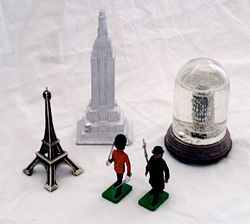
Souvenirs as objects include mass-produced merchandise such as clothing: T-shirts and hats; collectables: postcards, refrigerator magnets, key chains, pins, souvenir coins and tokens, miniature bells, models, figurines, statues; household items: spoons, mugs, bowls, plates, ashtrays, egg timers, fudge, notepads, coasters, and many others.

Souvenirs also include non-mass-produced items such as folk art, local artisan handicrafts, objects that represent the traditions and culture of the area, non-commercial, natural objects such as sand from a beach, and anything else that a person attaches nostalgic value to and collects among their personal belongings. The collecting of natural items such as seashells, plants, or rocks is often discouraged due to ecological damage. Especially the export of endangered plants and animals (or products made of their fur or leather) as souvenirs is strictly regulated by international laws.

A more grisly form of souvenir (here as an example of war booty) in the First World War was displayed by a Pathan soldier to an English Territorial. After carefully studying the Tommy's acquisitions (a fragment of shell, a spike and badge from a German helmet), he produced a cord with the ears of enemy soldiers he claimed to have killed. He was keeping them to take back to India for his wife.[4]

As memorabilia

[edit]
Souvenir Album of Houston, 1891

Similar to souvenirs, memorabilia (Latin for 'memorable (things)'; plural of memorābile) are objects treasured for their memories or historical interest; however, unlike souvenirs, memorabilia can be valued for a connection to an event or a particular professional field, company or brand. Memorabilia can also be related to collections, such as action figures, or video games.

Examples include sporting events, historical events, culture, and entertainment. Such items include: clothing; game equipment; publicity photographs and posters; magic memorabilia; other entertainment-related merchandise & memorabilia; movie memorabilia; airline[5] and other transportation-related memorabilia; and pins, among others.

Often memorabilia items are kept in protective covers or display cases to safeguard and preserve their condition.

As gifts

[edit]
Momiji manju omiyage from Japan

In Japan, souvenirs are known as omiyage (お土産), and are frequently selected from meibutsu, or products associated with a particular region. Bringing back omiyage from trips to co-workers and families is a social obligation and can be considered a form of apology for the traveller's absence.[6] Omiyage sales are big business at Japanese tourist sites. Unlike souvenirs, however, omiyage are frequently special food products, packaged into several small portions to be easily distributed to all the members of a family or a workplace.

Travelers may buy souvenirs as gifts for those who did not make the trip. A common tradition is to bring a thank-you gift for someone who provided a service such as pet sitting during the trip.

In the Philippines a similar tradition of bringing souvenirs as a gift to family members, friends, and coworkers is called pasalubong.

[edit]

See also

[edit]

Media related to Souvenirs at Wikimedia Commons The dictionary definition of souvenir at Wiktionary

References

[edit]
Revisions and contributorsEdit on WikipediaRead on Wikipedia
from Grokipedia
A souvenir is an object acquired or preserved as a tangible reminder of a , place, event, or , typically small, portable, and evocative of associated with or special occasions. The term derives from the French verb souvenir, meaning "to remember" or "to come to mind," which entered English in the late initially as a reference to a "remembrance or " before evolving to denote a physical memento or keepsake by 1782. The practice of collecting souvenirs dates back thousands of years, with ancient Egyptians, Greeks, and Romans bringing home rare artifacts, shells, or inscribed stones from expeditions and voyages as symbols of adventure and status. In medieval Europe, religious pilgrims formalized souvenir acquisition by purchasing lead badges, ampullae filled with holy water, or pebbles from sacred sites like the Holy Land, marking the emergence of an early commercial industry tied to spiritual journeys around 1400 CE. The 17th and 18th centuries saw the rise of the Grand Tour, where wealthy young Europeans—often British—traveled through continental landmarks, collecting coins, prints, sculptures, and decorative items like spoons to demonstrate cultural sophistication upon return. By the late 19th century, industrialization and the advent of mass leisure tourism transformed souvenirs into affordable, mass-produced goods such as postcards, snow globes, and figurines, enabling broader participation among the middle class. In contemporary culture, souvenirs hold profound significance beyond mere novelty, serving as cultural ambassadors that encapsulate local traditions, identities, and narratives while supporting economies worldwide—generating billions in annual revenue for destinations. They foster emotional connections by representing place-based memories and can promote when designed to highlight authentic heritage, such as handmade crafts or eco-friendly items that encourage ethical consumption. However, the of production has sometimes led to commodified or inauthentic replicas, raising debates about their role in preserving versus diluting cultural authenticity.

Definition and Origins

Etymology and Meaning

The word originates from the French verb , meaning "to remember" or "to come to mind," which itself derives from the Latin subvenire, signifying "to come to mind" or "to occur to the mind." This linguistic root underscores the term's fundamental association with and recollection, evolving in English usage during the to denote a physical token that evokes remembrance. While memento serves as a broader Latin-derived term for any reminder of a , event, or , souvenir specifically connotes tangible, often portable objects linked to places visited or events attended, emphasizing their role in preserving sentimental ties to specific locales or occasions. Early English literature reflects this emerging sense, particularly in travel contexts; for instance, in James Douglas's 1782 Travelling Anecdotes, the author describes a "little souvenir" given during a journey as a keepsake of shared experiences. Similarly, Walpole's 1775 letters reference "souvenirs" in the context of marked remembrances, illustrating the word's initial application to memory-laden items in personal correspondence and diaries. In contemporary usage, the defines a souvenir as "something that is given or kept as a reminder of a place, person, event, etc.; a memento, a keepsake," with a particular emphasis on small, inexpensive, and portable items designed for tourists to evoke sentimental value from their travels. This definition highlights the term's portability and emotional resonance, distinguishing it from mere curiosities by its intentional function as a bridge between past experiences and present recollection.

Historical Evolution

The concept of souvenirs emerged in and , where pilgrims to religious sites acquired small tokens such as coins, miniature statues, and engraved glass flasks as mementos of their visits, dating back to the archaic period around 500 BCE and continuing through the late imperial era. These items, often depicting gods, sacred symbols, or local landmarks, allowed travelers to carry home a physical connection to holy places like or the spas of Puteoli and , where souvenir flasks engraved with scenic views were produced in the 3rd and 4th centuries CE. During the medieval period, particularly the from the 11th to 13th centuries, European pilgrims to the intensified the collection of relics and souvenirs, including lead-alloy ampullae filled with holy oil or water from sites like the , and palmers' crosses symbolizing . These artifacts, often mass-molded for distribution at pilgrimage endpoints, served as proof of devotion and protective talismans upon return. In the and early modern eras of the 17th and 18th centuries, the aristocratic Grand Tour across Europe popularized refined souvenirs among British and Northern travelers, such as intricate Venetian glassware from —imitating precious stones like —and plaster replicas of Pompeii excavations, which captured the era's fascination with classical ruins and fueled neoclassical tastes. The 19th century's industrialization transformed souvenirs through , prominently showcased at the 1851 in London's , where affordable items like printed guidebooks, souvenir teaspoons, and miniature models of exhibits were widely sold to the visiting public, democratizing access to commemorative objects. This era's world's fairs further standardized such goods, blending artisanal traditions with mechanized replication to cater to an expanding middle-class audience. The 20th century's post-World War II boom globalized and commercialized souvenirs, driven by affordable and culture; in , the influx of visitors led to the widespread adoption of leis—floral garlands traditionally symbolizing welcome—as iconic mementos, with production scaling to meet tourist demand from the 1950s onward. Similarly, the 1955 opening of in sparked a merchandising revolution, where character-themed items like plush toys and apparel became standardized souvenirs, intertwining personal memories with in the burgeoning theme park industry.

Types and Forms

Physical Objects

Physical souvenirs encompass a wide array of tangible items that travelers acquire to preserve memories of a place, primarily categorized into miniature replicas, local crafts, and consumables. Miniature replicas, such as small-scale models of the or other iconic landmarks, allow visitors to carry a symbolic representation of their destination. Local crafts include artisanal items like Mexican pottery or Hawaiian leis, which highlight regional traditions and skills. Consumables, exemplified by or specialty spices, offer a sensory connection to the locale through taste and edibility. The materials in physical souvenirs vary between natural and synthetic sources, influencing their authenticity and durability. Natural materials, such as shells, stones, wood, terracotta, and fresh flowers, are commonly used to evoke the environment of the origin; for instance, Hawaiian leis traditionally incorporate ti leaves, pikake flowers, kukui nut shells, or tuberose buds to reflect island flora. In contrast, synthetic materials like s, artificial fabrics, and silk substitutes enable and longevity, as seen in plastic-based leis or molded replicas that mimic natural elements without perishing. Textiles, whether natural ( or wool) or synthetic, appear in items like embroidered scarves or woven baskets from regions such as , . Design principles for physical souvenirs emphasize portability, affordability, and representation of the locale to ensure they serve as practical mementos. Portability is achieved through compact, lightweight forms, making items easy to transport without burdening luggage. Affordability targets a broad tourist market with low-cost production, allowing purchases under $20 for most items. Representation of the locale involves incorporating cultural symbols, historical motifs, or landmarks, such as snow globes that encapsulate scenes of famous sites like the , evoking the destination's identity upon shaking. These principles guide the creation of souvenirs that balance functionality with evocative storytelling. Physical souvenirs have evolved from artisanal creations to mass-produced goods, driven by advancements in and the growth of . In ancient and , items like pilgrim badges or chipped relics were handcrafted by local artisans, but industrialization in the late introduced techniques for replicating designs at scale, such as stamped metal teaspoons or molded snow globes. Post-World War II affordable further accelerated this shift, with enabling widespread availability of inexpensive items like keychains and t-shirts. The global souvenir market, valued at approximately $98 billion in , underscores this economic scale, supporting both traditional crafts and industrialized output.

Memorabilia and Collectibles

Memorabilia and collectibles represent a subset of souvenirs that derive their value from association with specific historical events, athletes, or celebrities, often appealing to enthusiasts who view them as investments or cultural artifacts. In sports, items such as Olympic pins trace their origins to the 1896 Games, where hand-made cloth badges in various colors were used to identify officials and athletes, marking the beginning of this enduring tradition. Autographed jerseys from legendary players, like those signed by , exemplify high-demand items, with values ranging from hundreds to thousands of dollars depending on authentication and historical significance. These objects transcend mere keepsakes by connecting collectors to pivotal moments in athletic history. Celebrity and music-related memorabilia similarly capture iconic events, such as the 1969 Woodstock Music and Art Fair, where original tickets and programs serve as rare tangible links to the festival's countercultural legacy. Surviving Woodstock tickets, originally priced at $6 to $18 for three days, now command substantial prices due to their scarcity and cultural resonance. Bandanas and other fabric items from the event, often tied-dyed or printed with festival motifs, also circulate as collectibles, evoking the era's communal spirit. The rarity and value of such items are influenced by factors like limited production runs and provenance; for instance, a series of sterling silver spoons commemorating the 1939 New York World's Fair, featuring designs of the Trylon and Perisphere alongside exhibit halls, were produced in small quantities by makers like Tiffany & Co., making complete sets highly sought after today. Auction records underscore this appreciation, as a Babe Ruth game-used bat from circa 1920-1921 sold for $1.85 million in 2023, setting a benchmark for baseball memorabilia due to photographic evidence of its use. Limited editions from events like the 1939 Fair further enhance desirability, with condition and completeness driving premiums in the market. Collecting communities foster this passion through organized groups and platforms; the National Sports Collectors Convention, held annually since 1980, brings together thousands of enthusiasts for trading, auctions, and exhibits focused on sports items. Online marketplaces like have seen robust growth in sports memorabilia sales, with double-digit increases in 2025 driven by authenticated autographs and game-worn gear, reflecting broader trends in digital accessibility for global collectors.

Experiential and Digital Variants

Experiential souvenirs represent intangible mementos derived from participatory activities during travel, such as wine tastings or hot air balloon rides, which are often preserved through personal journals or official certificates to evoke the sensory and emotional aspects of the experience. For instance, a hot air balloon flight over Napa Valley may culminate in a souvenir certificate of flight, commemorating the aerial views of vineyards and mountains, while a wine tasting tour in Sonoma can be documented in a traveler's journal highlighting the flavors and stories shared by vintners. These variants emphasize the transformation of fleeting events into lasting recollections, differing from traditional physical objects by prioritizing personal narrative over material possession. Digital souvenirs extend this concept into virtual realms, offering non-physical collectibles that replicate or augment travel memories through technology. (VR) tours, such as those recreating via Google Arts & Culture's 360-degree panoramic views, allow users to explore the Incan site's architecture and landscapes remotely, serving as immersive digital mementos. From onward, non-fungible tokens (NFTs) have emerged as blockchain-based digital collectibles in , enabling unique, verifiable ownership of virtual assets like personalized postcards or event proofs from destinations. For example, NFTs can represent exclusive access to virtual experiences or cultural artifacts, with the global NFT market reaching approximately $25 billion in sales volume that year, though it later declined significantly. Apps and platforms facilitate the creation and sharing of these digital variants, turning photos and notes into virtual scrapbooks. Tools like Polarsteps automatically track trips via GPS, compiling maps, photos, and journal entries into shareable digital logs, while mobile apps such as those described in tourism studies generate personalized e-souvenirs by integrating user selfies with destination templates for instant collages. Photo-sharing platforms further enhance this by allowing travelers to curate virtual mementos, such as VR-enhanced photo albums from sites like Athens routes, promoting social exchange without physical waste. The accelerated the adoption of experiential and digital souvenirs due to restrictions, boosting demand for virtual alternatives and remote mementos. This shift contributed to the of , with growing over 110% above pre-pandemic levels by 2024 in key markets. Market projections indicate sustained expansion, as the global and sector—incorporating digital innovations—is expected to contribute $16 trillion to GDP by 2034, driven by tools like NFTs and VR for sustainable, accessible mementos.

Cultural and Social Functions

As Travel Mementos

Souvenirs serve as essential anchors in , transforming ephemeral travel experiences into lasting personal narratives by providing tangible reminders of cultural encounters and adventures. Travelers often select items that encapsulate specific moments, such as acquiring a traditional during a matsuri in , which later evokes the sensory details of colorful parades, traditional music, and local hospitality. This practice helps preserve the emotional and sensory aspects of the journey, turning abstract memories into concrete touchpoints that can be revisited at home. Common rituals associated with souvenirs include meticulous packing to safeguard delicate items during transit, integrating them into displays on dedicated shelves or walls filled with trinkets from various destinations, and leveraging them as catalysts for in social interactions. For example, a collected from a in might prompt recounting tales of sunset walks to family and friends, reinforcing social bonds through shared narratives. Studies highlight that such displays and enhance retention, with souvenirs acting as psychological aids that stimulate recall of positive emotions. Cultural variations in souvenir use reflect diverse approaches to memory preservation; Western tourists frequently favor replicas of landmarks, like the miniatures, to symbolize visited sites and evoke a sense of global exploration. In contrast, indigenous practices often imbue souvenirs with protective or spiritual significance, such as Ainu-inspired motifs in Japanese souvenirs that commemorate cultural immersion while honoring ancestral traditions. Surveys indicate that about 70% of tourists purchase souvenirs, underscoring their widespread role in .

As Gifts and Exchanges

Souvenirs often function as thoughtful gifts in everyday social interactions, particularly within familial and friendly circles during holidays, birthdays, or other celebrations. Travelers commonly select small, portable items like a fridge emblazoned with the from to present to loved ones, symbolizing shared vicarious experiences and reinforcing personal connections. This tradition extends to consumable souvenirs, such as local chocolates or spices, which allow recipients to partake in the destination's flavors without the need for extensive storage. In diplomatic spheres, souvenirs elevate to instruments of international goodwill and negotiation, often customized to reflect cultural motifs or political symbolism. A notable example occurred in 1972 during U.S. President Richard Nixon's historic visit to , where Chairman Mao Zedong's government presented two giant pandas—Ling-Ling and —as a state gift to the American people, marking a pivotal thaw in Sino-U.S. relations. Such exchanges, blending rarity and national pride, have historically paved the way for treaties and alliances by embodying mutual respect. From an anthropological perspective, the exchange of souvenirs embodies principles of reciprocity outlined in Marcel Mauss's seminal 1925 work, The Gift: The Form and Reason for Exchange in Archaic Societies, which posits that gifts impose obligations to give, receive, and reciprocate, thereby sustaining social cohesion. This framework applies to souvenir markets, where vendors and buyers engage in haggling as a ritualized form of gift-like exchange, fostering ongoing relationships beyond mere commerce; for instance, in Philippine culture, —souvenirs brought home from trips—create a "debt of gratitude" () that encourages future returns. Mauss's theory underscores how these interactions in tourist bazaars transform commodities into relational artifacts. Contemporary gift-giving emphasizes presentation and cultural awareness when offering souvenirs, with wrapping in decorative paper or bags enhancing the gesture's intimacy and through engravings or notes adding a touch. However, sensitivity to taboos is crucial; in , presenting a clock as a souvenir constitutes a major , as the phrase for "giving a clock" phonetically resembles "sending someone to their ," evoking rites and ill omens. Adhering to such norms prevents unintended offense and upholds the exchange's positive intent.

Symbolic and Commemorative Roles

Souvenirs often serve as tangible embodiments of , encapsulating and collective narratives. In , the boomerang stands as a prominent example, functioning not only as a practical tool but also as a symbol of Indigenous heritage and national unity. For Aboriginal peoples, the boomerang represents cultural endurance and a deep historical connection to the land, dating back over 10,000 years, while its adoption in broader Australian iconography underscores a national narrative of and diversity. Beyond national symbols, souvenirs play a key role in commemorating personal and social milestones, acting as tokens that evoke shared experiences and transitions in life events. favors, for instance, trace their origins to ancient Roman and medieval European traditions, where small gifts like sugared almonds or bonbonnières were distributed to guests as symbols of prosperity, fertility, and good fortune for the couple's future. These items, often personalized with cultural motifs, reinforce communal bonds and mark the ritual passage from single to married life. Similarly, tokens, such as those associated with traditional materials like for the first year or silver for the twenty-fifth, symbolize the enduring strength and value of marital commitments, drawing from historical customs in and America that celebrate relational longevity. In political contexts, souvenirs function as powerful symbols of and collective resistance, preserving the memory of social movements. During the 1960s anti-war era in the United States, peace buttons emerged as ubiquitous protest artifacts, featuring slogans like "" and peace signs to signify opposition to the and advocate for non-violence; these inexpensive pins, produced in millions, allowed participants to wear their ideology publicly and commemorate rallies. In more recent times, (BLM) merchandise, including T-shirts emblazoned with the movement's slogan and imagery from protests, serves as enduring symbols of the fight against racial injustice and police violence, transforming personal participation into lasting emblems of solidarity and remembrance. From an anthropological viewpoint, these symbolic roles align with Victor Turner's theory of , where souvenirs act as material markers of transitions between social states. In rites of passage, the liminal phase represents a threshold of ambiguity and transformation, during which participants shed old identities and prepare for new ones; gifts and tokens exchanged in such s, including commemorative souvenirs, help anchor these shifts by embodying —a sense of undifferentiated community—and providing enduring reminders of the process. This framework, developed through Turner's studies of Ndembu s in , extends to modern contexts where souvenirs from events or protests delineate personal or collective passages, reinforcing social structures post-liminality.

Production and Economic Aspects

Manufacturing Processes

Souvenirs are produced through a spectrum of methods, ranging from traditional artisanal techniques to modern industrial processes, each influencing the final product's authenticity and scalability. Artisanal manufacturing emphasizes handcrafting by skilled local workers, preserving cultural motifs and materials unique to specific regions. In , , wood carvings—such as figurines, statues, and decorative panels—are meticulously shaped using chisels and knives from native woods like suar or , often by family-run workshops that pass down techniques through generations. Similarly, in Morocco, leather goods like bags, wallets, and babouche slippers are handcrafted in historic tanneries, such as those in Fez, where hides are vegetable-tanned with natural dyes and stitched by hand to create intricate patterns inspired by Berber and designs. These methods prioritize craftsmanship over volume, resulting in one-of-a-kind items that embody regional heritage. Industrial techniques dominate the mass production of affordable souvenirs, enabling global distribution through efficient, automated processes. In China, factories utilize plastic injection molding to create items like keychains, magnets, and figurines by injecting molten polymer into precision molds, allowing for rapid replication of designs at low cost. Screen printing is commonly applied to apparel souvenirs, such as t-shirts and hats, where ink is pushed through a mesh stencil onto fabric to produce vibrant, multi-color graphics in high volumes. Facilities in regions like Yiwu produce a substantial share of the world's small commodities, as the largest wholesale market for such goods, leveraging economies of scale to meet international demand. Supply chains for souvenirs involve sourcing raw materials and labor, with growing attention to and ethics. Materials like sustainable , which regenerates quickly and requires minimal water, are increasingly used for eco-friendly items such as utensils and frames, contrasting with endangered woods like that risk if sourced irresponsibly. Labor practices vary widely; artisanal production often supports local economies through fair wages in community workshops, while industrial settings in some developing regions have faced criticism for exploitative conditions, including long hours and inadequate protections, prompting calls for certifications like . Technological advances have introduced customization options, particularly through , which emerged prominently in the for souvenir production. This additive manufacturing process builds objects layer by layer from digital models using materials like resin or nylon, enabling on-site creation of personalized items such as miniature landmarks or figurines at tourist destinations. By reducing waste and allowing , 3D printing bridges artisanal detail with industrial efficiency, fostering innovative, traveler-specific mementos.

Commercialization and Markets

The commercialization of souvenirs thrives in tourist hotspots, where sales channels like shops, street vendors, and duty-free outlets dominate the market. duty-free retail, a key segment of the global travel retail industry valued at $80.19 billion in 2024, often features souvenirs such as local crafts and branded mementos, capitalizing on travelers' last-minute impulses. Street vendors in bustling areas provide affordable, authentic-feeling items, while duty-free sales exempt purchases from import taxes, enhancing appeal for international buyers. Pricing strategies vary by location; in places like Istanbul's Grand Bazaar, haggling is integral, with vendors quoting initial prices up to twice the expected final amount, allowing buyers to negotiate down by starting offers at 50% or less of the asking price to secure deals on items like ceramics or textiles. Global trade in souvenirs, encompassing novelty gifts and handicrafts, sees and as leading exporters. 's handicraft exports exceed $5 billion annually, dominating mass-produced novelty items shipped worldwide, while 's handicrafts reached $3.8 billion in exports during FY24. In the United States, the gift shops and card stores industry, which includes souvenir sales, generates significant revenue, estimated in the tens of billions annually, with imports of décor, accessories, and novelty goods forming a notable portion despite tariffs impacting costs from key suppliers like . Branding elevates souvenir value through licensing deals that ensure authenticity and leverage cultural icons. For instance, the offers officially licensed replicas of artifacts like the , sold via its boutique to commemorate exhibitions and historical significance. Similarly, produces licensed pins featuring city-specific designs, available through its official shop as collectible mementos from global locations, appealing to music enthusiasts and travelers. Souvenirs significantly contribute to local economies by bolstering tourism-dependent sectors. In , the glass industry, a historic specialty since the 13th century, produces trinkets and luxury items that support jobs and , though the sector has declined amid from cheaper imports; it remains integral to the city's , where generates billions in annual and supports thousands of jobs. This case illustrates how souvenir sales sustain artisan communities and stimulate related services, generating for thousands in production and retail.

Sustainability and Ethical Concerns

The souvenir industry contributes significantly to through the widespread use of single-use plastics in items such as keychains, magnets, and trinkets, which often end up as marine litter after tourist discards. Tourism-related plastic waste, including from souvenirs, has been shown to increase by up to 40% in high-season coastal areas like the Mediterranean, exacerbating and threatening through ingestion and entanglement. Unsustainable sourcing practices further harm ; for instance, the collection of for jewelry and decorative souvenirs damages fragile structures, with estimates from the early indicating 1.5 million live stony corals and 4 million pounds of coral skeletons harvested annually, often through destructive methods like raking and that disrupt and allow to proliferate. Similarly, harvesting seashells and other removes essential habitat components, killing live mollusks and depleting nutrient recyclers on beaches and reefs, contributing to broader imbalance. Ethical concerns in souvenir production center on labor exploitation, particularly in developing regions where low-cost prevails. Reports highlight conditions in factories producing like textiles, carvings, and jewelry, where workers face excessive hours, minimal wages, and unsafe environments, often in countries with weak enforcement of labor standards. In , child labor persists in tourism-related sectors, including souvenir crafts, with significant involvement in services according to ILO reports; as of 2024, global child labor estimates remain at 138 million, with facing persistent challenges in informal sectors like handicrafts. These practices violate international standards and perpetuate cycles among vulnerable communities. To address these issues, initiatives like certifications have emerged for artisan crafts and souvenirs, ensuring producers receive fair wages, safe conditions, and community benefits through organizations such as the World Fair Trade Organization, which supports over 400 member groups worldwide focusing on ethical handicrafts. Since the early 2000s, eco-friendly alternatives have gained traction, with souvenirs made from recycled materials—such as plastic bottles repurposed into bags or accessories—reducing waste and promoting circular economies, as seen in programs converting ocean-bound plastics into tourist items. Regulatory measures include the 1989 Convention on International Trade in Endangered Species () treaty, which banned international commercial trade in , effectively prohibiting ivory carvings and souvenirs to curb elephant and protect populations. Consumer awareness campaigns complement these efforts by educating travelers on the impacts of unsustainable purchases; for example, initiatives urge avoiding marine-derived souvenirs and opting for certified alternatives, fostering demand for ethical products and reducing illegal trade.

Psychological and Modern Perspectives

Emotional and Cognitive Impacts

Souvenirs serve as potent external cues that enhance recall by triggering vivid recollections of past experiences. research indicates that physical objects, such as travel keepsakes, activate sensory and contextual associations stored in , facilitating the retrieval of specific events, emotions, and details that might otherwise fade. For instance, a 2017 study on visitors to , , found that souvenirs significantly contribute to the memorability of trip experiences by acting as tangible anchors for episodic memories. Similarly, a 2024 study published in the journal Annals of Tourism Research demonstrated that everyday souvenirs like fridge magnets effectively cue holiday memories, evoking both positive and negative episodic details with greater intensity than digital photos. This memory-enhancing role extends to broader autobiographical narratives, where souvenirs bridge personal history and . According to a 2020 review in Current Opinion in Psychology, individuals intentionally acquire such possessions to externalize and preserve memories, creating a symbiotic relationship where the object not only prompts recall but also enriches the emotional depth of the remembered event. In qualitative studies, exposure to personal items, including souvenirs, has been shown to elicit "remember" responses—indicating conscious episodic retrieval—more reliably than verbal cues alone, underscoring souvenirs' utility in cognitive processes like . Emotional attachment to souvenirs often manifests through the , a where owners ascribe higher value to items due to personal sentiment rather than objective worth. This phenomenon, first formalized in , intensifies with sentimental objects, as ownership fosters psychological bonds that inflate perceived utility and resistance to divestiture. A 2011 study in the Journal of Consumer Psychology linked emotional attachment—comprising affective reactions and psychological ownership—to amplified endowment effects, explaining why individuals overvalue mementos tied to life milestones. Further research in 2022 found that mementos attenuate the by reducing , increasing willingness to trade or sell even sentimental items. In therapeutic contexts, souvenirs facilitate nostalgia-based interventions that support by processing and fostering resilience. Reminiscence therapy, which leverages nostalgic , uses personal artifacts like keepsakes to evoke positive past experiences, thereby alleviating symptoms of depression and anxiety. A 2025 study in Humanities and Social Sciences Communications highlighted 's analgesic effects, showing that object-triggered reminiscences reduce perceived emotional pain and enhance in clinical settings. For processing, such items aid in integrating loss by providing tangible links to deceased loved ones or disrupted life phases, promoting adaptive without pathological rumination. The notes that induced by personal mementos bolsters social connectedness and meaning-making, supporting . Despite these benefits, souvenirs can contribute to negative cognitive outcomes through clutter accumulation, exacerbating and environmental stress. Excessive sentimental items often lead to hoarding-like behaviors, where the emotional load of discarding triggers avoidance, resulting in disorganized spaces that impair focus and heighten anxiety. A 2025 analysis from Nuvance Health linked cluttered environments—frequently populated by accumulated mementos—to reduced cognitive performance, including poorer attention and elevated levels. This , characterized by mental exhaustion from repeated choices about retention, has spurred decluttering movements like the KonMari method, which emphasize evaluating items' ongoing to mitigate psychological burden. Real Simple's article on mental habits underscores how unaddressed sentimental clutter perpetuates cycles of overwhelm, advocating structured to restore cognitive clarity. In recent years, the souvenir industry has experienced a surge in , driven by mobile apps and AI-powered design tools that enable custom and bespoke creations. Travelers can now use platforms like Printify's integrated tools to upload photos or text for real-time previews on items such as keychains, mugs, or apparel, with production often completed via print-on-demand services. Similarly, technology has become accessible for creating individualized messages on materials like wood or metal, allowing consumers to produce unique mementos on-site at tourist spots or through . This trend, accelerating post-2020, caters to a desire for meaningful, one-of-a-kind items, with market analyses projecting growth for personalized gifts and novelties through 2033. Eco-innovations in souvenirs emphasize biodegradable and zero-waste alternatives, aligning with broader pushes in . For instance, products made from recycled plastics or , such as reusable totes and water bottles, have gained popularity as travelers seek low-impact options, with 64% preferring eco-friendly materials according to 2025 trend reports. Initiatives like zero-waste models in promote non-toxic, reusable souvenirs to minimize environmental footprint, supported by the European Commission's 2023 Waste Framework Directive revisions, which entered force in 2025 and target reductions in and waste across supply chains. Research on eco-souvenirs highlights the role of in boosting purchase intent, particularly through promotions emphasizing sustainable attributes, as seen in studies from where 90% of tourists expressed for verified green products. Technological integration is transforming physical souvenirs into interactive experiences, with (AR) apps overlaying digital content like virtual tours or animations on items such as postcards and magnets. For example, scanning a souvenir might activate a 360-degree view of a , enhancing engagement and educational value for users. technology further ensures authenticity by creating immutable records of a souvenir's origin and sustainability credentials, combating counterfeits in artifacts and increasing consumer trust, as explored in recent studies showing heightened for blockchain-verified items. These advancements build on digital variants by blending physical keepsakes with virtual enhancements. Post-pandemic shifts have elevated local "" souvenirs, with consumers favoring regionally sourced products like artisanal crafts or map-themed novelties to support nearby economies amid travel restrictions. NielsenIQ data indicates a tipping point toward local brands since 2020. This has spurred virtual experiences, where online videos and AR simulations allow remote sharing of local finds, extending the joy of discovery without physical travel.

References

Add your contribution
Related Hubs
User Avatar
No comments yet.