Hubbry Logo
Glomerulus (kidney)Glomerulus (kidney)Main
Open search
Glomerulus (kidney)
Community hub
Glomerulus (kidney)
logo
8 pages, 0 posts
0 subscribers
Be the first to start a discussion here.
Glomerulus (kidney)
Glomerulus (kidney)
from Wikipedia
Glomerulus
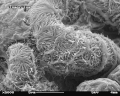
Glomerulus (red), Bowman's capsule (blue) and proximal tubule (green)
Details
Pronunciation/ɡləˈmɛr(j)ələs, ɡl-/
PrecursorMetanephric blastema
LocationNephron of kidney
Identifiers
Latinglomerulus renalis
MeSHD007678
FMA15624
Anatomical terminology

The glomerulus (pl.: glomeruli) is a network of small blood vessels (capillaries) known as a tuft, located at the beginning of a nephron in the kidney. Each of the two kidneys contains about one million nephrons. The tuft is structurally supported by the mesangium (the space between the blood vessels), composed of intraglomerular mesangial cells. The blood is filtered across the capillary walls of this tuft through the glomerular filtration barrier, which yields its filtrate of water and soluble substances to a cup-like sac known as Bowman's capsule. The filtrate then enters the renal tubule of the nephron.[1]

The glomerulus receives its blood supply from an afferent arteriole of the renal arterial circulation. Unlike most capillary beds, the glomerular capillaries exit into efferent arterioles rather than venules. The resistance of the efferent arterioles causes sufficient hydrostatic pressure within the glomerulus to provide the force for ultrafiltration.

The glomerulus and its surrounding Bowman's capsule constitute a renal corpuscle, the basic filtration unit of the kidney.[2] The rate at which blood is filtered through all of the glomeruli, and thus the measure of the overall kidney function, is the glomerular filtration rate.

Structure

[edit]
Renal corpuscle showing glomerulus and glomerular capillaries
Figure 2: (a) Diagram of the juxtaglomerular apparatus: it has specialized cells working as a unit which monitor the sodiujuxtaglomerular apparatus: it has three types of specm content of the fluid in the distal convoluted tubule (not labelled - it is the tubule on the left) and adjust the glomerular filtration rate and the rate of renin release. (b) Micrograph showing the glomerulus and surrounding structures.

The glomerulus is a tuft of capillaries located within Bowman's capsule within the kidney.[2] Glomerular mesangial cells structurally support the tufts. Blood enters the capillaries of the glomerulus by a single arteriole called an afferent arteriole and leaves by an efferent arteriole.[3] The capillaries consist of a tube lined by endothelial cells with a central lumen. The gaps between these endothelial cells are called fenestrae. The walls have a unique structure: there are pores between the cells that allow water and soluble substances to exit and after passing through the glomerular basement membrane and between digitating podocyte foot processes, enter the capsule as ultrafiltrate.

Lining

[edit]
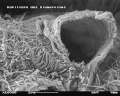
Scanning electron microscope view of the inner surface of an opened (broken) capillary with fenestrae visible (100,000x magnification)

Capillaries of the glomerulus are lined by endothelial cells. These contain numerous pores—also called fenestrae—, 50–100 nm in diameter.[4] Unlike those of other capillaries with fenestrations, these fenestrations are not spanned by diaphragms.[4] They allow for the filtration of fluid, blood plasma solutes and protein, while at the same time preventing the filtration of red blood cells, white blood cells, and platelets.

The glomerulus has a glomerular basement membrane sandwiched between the glomerular capillaries and the podocytes. It consists mainly of laminins, type IV collagen, agrin, and nidogen, which are synthesized and secreted by both endothelial cells and podocytes. The glomerular basement membrane is 250–400 nm in thickness, which is thicker than basement membranes of other tissue. It is a barrier to blood proteins such as albumin and globulin.[5]

The part of the podocyte in contact with the glomerular basement membrane is called a podocyte foot process or pedicle (Fig. 3): there are gaps between the foot processes through which the filtrate flows into Bowman's capsule.[4] The space between adjacent podocyte foot processes is spanned by slit diaphragms consisting of a mat of proteins, including podocin and nephrin. In addition, foot processes have a negatively charged coat (glycocalyx) that repels negatively charged molecules such as serum albumin.

Mesangium

[edit]

The mesangium is a space which is continuous with the smooth muscles of the arterioles. It is outside the capillary lumen but surrounded by capillaries. It is in the middle (meso) between the capillaries (angis). It is contained by the basement membrane, which surrounds both the capillaries and the mesangium.

The mesangium contains mainly:

  • Intraglomerular mesangial cells. They are not part of the filtration barrier but are specialized pericytes that participate in the regulation of the filtration rate by contracting or expanding: they contain actin and myosin filaments to accomplish this. Some mesangial cells are in physical contact with capillaries, whereas others are in physical contact with podocytes. There is two-way chemical cross talk among the mesangial cells, the capillaries, and the podocytes to fine-tune the glomerular filtration rate.
  • Mesangial matrix, an amorphous basement membrane-like material secreted by the mesangial cells.

Blood supply

[edit]
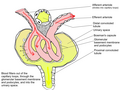
Diagram of the circulation related to a single glomerulus, associated tubule, and collecting system

The glomerulus receives its blood supply from an afferent arteriole of the renal arterial circulation. Unlike most capillary beds, the glomerular capillaries exit into efferent arterioles rather than venules. The resistance of the efferent arterioles causes sufficient hydrostatic pressure within the glomerulus to provide the force for ultrafiltration.

Blood exits the glomerular capillaries by an efferent arteriole instead of a venule, as is seen in the majority of capillary systems (Fig. 4). [3] This provides tighter control over the blood flow through the glomerulus, since arterioles dilate and constrict more readily than venules, owing to their thick circular smooth muscle layer (tunica media). The blood exiting the efferent arteriole enters a renal venule, which in turn enters a renal interlobular vein and then into the renal vein.

Cortical nephrons near the corticomedullary junction (15% of all nephrons) are called juxtamedullary nephrons. The blood exiting the efferent arterioles of these nephrons enter the vasa recta, which are straight capillary branches that deliver blood to the renal medulla. These vasa recta run adjacent to the descending and ascending loop of Henle and participate in the maintenance of the medullary countercurrent exchange system.

Filtrate drainage

[edit]

The filtrate that has passed through the three-layered filtration unit enters Bowman's capsule. From there, it flows into the renal tubule—the nephron—which follows a U-shaped path to the collecting ducts, finally exiting into a renal calyx as urine.

Function

[edit]

Filtration

[edit]
Scheme of filtration barrier (blood-urine) in the kidney. A. The endothelial cells of the glomerulus; 1. pore (fenestra).
B. Glomerular basement membrane: 1. lamina rara interna 2. lamina densa 3. lamina rara externa
C. Podocytes: 1. enzymatic and structural proteins 2. filtration slit 3. diaphragma

The main function of the glomerulus is to filter plasma to produce glomerular filtrate, which passes down the length of the nephron tubule to form urine. The rate at which the glomerulus produces filtrate from plasma (the glomerular filtration rate) is much higher than in systemic capillaries because of the particular anatomical characteristics of the glomerulus. Unlike systemic capillaries, which receive blood from high-resistance arterioles and drain to low-resistance venules, glomerular capillaries are connected in both ends to high-resistance arterioles: the afferent arteriole, and the efferent arteriole. This arrangement of two arterioles in series determines the high hydrostatic pressure on glomerular capillaries, which is one of the forces that favor filtration to Bowman's capsule.[6]

If a substance has passed through the glomerular capillary endothelial cells, glomerular basement membrane, and podocytes, then it enters the lumen of the tubule and is known as glomerular filtrate. Otherwise, it exits the glomerulus through the efferent arteriole and continues circulation as discussed below and as shown on the picture.

Permeability

[edit]

The structures of the layers determine their permeability-selectivity (permselectivity). The factors that influence permselectivity are the negative charge of the basement membrane and the podocytic epithelium, as well as the effective pore size of the glomerular wall (8 nm). As a result, large and/or negatively charged molecules will pass through far less frequently than small and/or positively charged ones.[7] For instance, small ions such as sodium and potassium pass freely, while larger proteins, such as hemoglobin and albumin have practically no permeability at all.

The oncotic pressure on glomerular capillaries is one of the forces that resist filtration. Because large and negatively charged proteins have a low permeability, they cannot filtrate easily to Bowman's capsule. Therefore, the concentration of these proteins tends to increase as the glomerular capillaries filtrate plasma, increasing the oncotic pressure along the glomerular capillary.[6]

Starling equation

[edit]

The rate of filtration from the glomerulus to Bowman's capsule is determined (as in systemic capillaries) by the Starling equation:[6]

Blood pressure regulation

[edit]

The walls of the afferent arteriole contain specialized smooth muscle cells that synthesize renin. These juxtaglomerular cells play a major role in the renin–angiotensin system, which helps regulate blood volume and pressure.

Clinical significance

[edit]

Damage to the glomerulus by disease can allow passage through the glomerular filtration barrier of red blood cells, white blood cells, platelets, and blood proteins such as albumin and globulin. Underlying causes for glomerular injury can be inflammatory, toxic or metabolic.[8] These can be seen in the urine (urinalysis) on microscopic and chemical (dipstick) examination. Glomerular diseases include diabetic kidney disease, glomerulonephritis (inflammation), glomerulosclerosis (hardening of the glomeruli), and IgA nephropathy.[9]

Due to the connection between the glomerulus and the glomerular filtration rate, the glomerular filtration rate is of clinical significance when suspecting a kidney disease, or when following up a case with known kidney disease, or when risking a development of renal damage such as beginning medications with known nephrotoxicity.[10]

History

[edit]

In 1666, Italian biologist and anatomist Marcello Malpighi first described the glomeruli and demonstrated their continuity with the renal vasculature (281,282). About 175 years later, surgeon and anatomist William Bowman elucidated in detail the capillary architecture of the glomerulus and the continuity between its surrounding capsule and the proximal tubule.[11]

See also

[edit]

Additional images

[edit]

References

[edit]

Sources

[edit]
  • Hall, Arthur C. Guyton, John E. (2005). Textbook of medical physiology (11th ed.). Philadelphia: W.B. Saunders. p. Chapter 26. ISBN 978-0-7216-0240-0.{{cite book}}: CS1 maint: multiple names: authors list (link)
  • Deakin, Barbara Young ... [] ; drawings by Philip J.; et al. (2006). Wheater's Functional Histology: a text and colour atlas (5th ed.). [Edinburgh?]: Churchill Livingstone/Elsevier. p. Chapter 16. ISBN 978-0-443068508.{{cite book}}: CS1 maint: multiple names: authors list (link)
Revisions and contributorsEdit on WikipediaRead on Wikipedia
from Grokipedia
The glomerulus (plural: glomeruli) is a specialized network of capillaries forming a tuft within the of the , serving as the primary site for blood filtration in the to produce the initial glomerular filtrate that becomes . Located exclusively in the , each human kidney contains approximately one million glomeruli, which collectively receive about 20% of the for continuous filtration. Structurally, the glomerulus is enclosed by and features a three-layered filtration barrier: the fenestrated of the capillaries (with pores around 70-100 nm), the (a 240-400 nm thick acellular layer rich in and negatively charged proteoglycans), and the podocytes (visceral epithelial cells with interdigitating foot processes forming 25-30 nm filtration slits bridged by slit diaphragms). This barrier allows the passage of water, ions, glucose, and small molecules (under 5-7 nm or ~40-60 kDa) while restricting larger proteins like and all blood cells, driven by hydrostatic pressure gradients from the afferent (inflow) and efferent (outflow) arterioles. Supporting cells include , which provide structural support, regulate blood flow via contraction, and phagocytose debris within the glomerular mesangium. Functionally, the glomerulus performs at a rate of approximately 125 mL/min (or 180 liters per day) under normal conditions, balancing net filtration pressure from glomerular capillary hydrostatic pressure (~55 mmHg) against opposing oncotic and capsular hydrostatic forces. This process is autoregulated to maintain a stable (GFR) despite fluctuations in systemic , primarily through adjustments in arteriole resistance and influenced by the , which senses tubular flow and sodium levels to modulate renin release for blood pressure control. The filtrate, largely protein-free, then proceeds through the renal tubules for selective and to form , enabling the kidneys to maintain fluid, , and acid-base . Damage to the glomerular filtration barrier, such as injury or alterations, underlies most forms of glomerular disease (glomerulopathy), including and , which can progress to and end-stage renal failure if untreated. Thus, the glomerulus is essential not only for waste but also for preserving plasma composition and overall cardiovascular stability.

Anatomy

Glomerular capillaries

The glomerular capillaries constitute the core of the , forming a specialized tuft that serves as the primary site for blood filtration in the . This network arises from the afferent arteriole, which branches into multiple primary capillary loops that interconnect and subdivide to create approximately 20-50 fenestrated capillaries before converging into the . These capillaries are arranged in a compact, spherical tuft embedded within the mesangium, optimizing the surface available for while maintaining structural integrity under high hydrostatic pressure. The endothelial cells lining the glomerular capillaries are uniquely adapted for selective permeability, characterized by a thin, flattened morphology and abundant fenestrations—non-diaphragmed pores measuring 70-100 nm in —that cover up to 30-50% of the luminal surface area. These fenestrations facilitate the free passage of and small solutes from the plasma into the surrounding while excluding larger blood components such as erythrocytes and platelets, thereby initiating the process without compromising vascular barrier function. Individual capillary loops typically measure 200-300 μm in length and 8-10 μm in , yielding a total capillary length of approximately 9.5 mm per glomerulus and a filtration surface area of about 0.008 cm². The total volume occupied by the glomerular capillaries is roughly 500,000-800,000 μm³ per glomerulus, reflecting the substantial endothelial surface dedicated to . Variations in glomerular capillary density and branching patterns occur across species and within the renal cortex, influencing filtration efficiency in different nephron populations. In humans, superficial cortical glomeruli exhibit higher capillary density with more compact branching to support efficient filtration in the outer cortex, whereas juxtamedullary glomeruli display lower density but larger capillary loops and increased branching complexity, adapting to the higher oxygen demands and longer tubular paths in the inner cortex and medulla. These structural differences contribute to heterogeneous renal function, with juxtamedullary capillaries often featuring greater total length per glomerulus to enhance medullary blood flow regulation.

Filtration barrier

The glomerular filtration barrier consists of three layered structures that collectively provide selective permeability, allowing the passage of water and small solutes while restricting larger molecules such as proteins. This barrier is formed by the fenestrated endothelium of glomerular capillaries, the (GBM), and the foot processes with their slit diaphragms. Each layer contributes to size- and charge-based , ensuring the production of an ultrafiltrate that is essentially protein-free under normal conditions. The innermost layer is the glomerular , characterized by fenestrae measuring 50–100 nm in diameter that occupy approximately 20% of the surface area. These fenestrae are coated by a and an endothelial surface layer (ESL) extending up to 200 nm into the vascular lumen, composed of negatively charged glycoproteins and proteoglycans. This layer acts as a primary size-selective barrier, excluding circulating cells and large plasma components greater than 70 nm in diameter. The middle layer, the GBM, is a specialized extracellular matrix approximately 300–350 nm thick, serving as both a structural scaffold and a secondary filtration component. It is primarily composed of (predominantly the α3α4α5 network in mature glomeruli), laminin-521 (α5β2γ1), nidogen-1 and -2, and agrin as the major . The GBM exhibits charge selectivity due to its negatively charged moieties, which repel anionic molecules, while its gel-like structure with pores averaging 4–10 nm further restricts passage based on size. The outermost layer comprises interdigitating foot processes of podocytes, connected by slit diaphragms that bridge filtration slits of 25–30 nm width. These diaphragms are multiprotein complexes dominated by nephrin, a forming the central pore structure, and podocin, which anchors the complex to the . This layer provides the final size- and charge-selective gate, with the slit diaphragm's porous architecture fine-tuning at the nanoscale. Collectively, these layers enable molecular sieving: water, ions, and small solutes (e.g., glucose, ) with effective radii less than 5 nm pass freely, while (66 kDa, hydrodynamic radius ~3.6 nm) is largely restricted through combined size exclusion and electrostatic repulsion. Barrier integrity relies on the maintenance of foot process architecture; effacement of these processes widens slits and compromises selectivity in pathological states.

Mesangium

The mesangium consists of specialized and an associated that occupy the spaces between glomerular , providing structural integrity to the glomerular tuft. are categorized into two main types: intraglomerular (also known as intracapillary) cells, which are located between the capillary loops within the glomerulus and comprise approximately 30-40% of the total glomerular cell population, and extraglomerular cells, which are positioned at the vascular pole and contribute to the . These cells exhibit contractile properties similar to cells, facilitated by actin-myosin filaments and calcium-dependent mechanisms, enabling them to modulate glomerular structure dynamically. The mesangial matrix, synthesized primarily by , is a specialized rich in , , , and proteoglycans such as agrin and , forming a network that supports the glomerular . This matrix typically occupies 20-30% of the glomerular tuft volume in healthy kidneys, serving as a scaffold that anchors loops and maintains overall glomerular shape. In terms of structural functions, the mesangium provides mechanical support to the delicate glomerular , preventing their collapse under pressure, while contraction can regulate the effective surface area available for by altering attachments to the . Beyond structural roles, perform phagocytic functions, actively clearing trapped macromolecules and immune complexes that accumulate in the filtration barrier, thereby helping to maintain its integrity and prevent obstructive damage. This process involves and degradation of substances like IgA1 in immune-mediated conditions. Additionally, engage in through the production of cytokines, such as (PDGF), which acts in autocrine and paracrine manners to regulate mesangial cell proliferation, matrix synthesis, and turnover, ensuring balanced .

Vascular poles

The vascular pole of the glomerulus, also known as the hilum, serves as the entry and exit point for blood vessels, where the afferent and connect to the glomerular capillary tuft, with extensions of the mesangium providing structural support at this junction. The originates from the within the and features a wall composed of cells, enabling and dilation; its diameter measures approximately 20 μm, allowing it to deliver oxygenated blood under to the glomerular capillaries. In contrast, the emerges from the opposite side of the vascular pole and is narrower, with a of about 15 μm, which contributes to higher and maintains elevated hydrostatic pressure within the for efficient . This carries filtered blood away from the , branching into in the cortical nephrons or vasa recta in juxtamedullary nephrons to supply the surrounding tubular structures. The structural differences between the afferent and at the vascular pole facilitate the unique hemodynamic environment of the , where blood flow is autoregulated primarily through adjustments in their to stabilize despite fluctuations in systemic pressure. Associated with the vascular pole is the juxtaglomerular apparatus (JGA), a specialized structure that integrates vascular and tubular elements for local renal regulation. The JGA comprises three main components: the , a group of densely packed columnar epithelial cells in the wall of the that contact the afferent arteriole; juxtaglomerular cells, which are modified cells in the afferent arteriole wall that produce and store renin; and lacis cells, also known as extraglomerular , located between the afferent and and the distal tubule, providing supportive connections and potential signaling functions. Regarding blood flow distribution, each glomerulus receives a portion of the total renal plasma flow, with the kidneys overall accounting for about 20% of ; approximately 20-25% of this incoming renal plasma flow is filtered across the glomerular capillaries per unit, highlighting the efficiency of the vascular pole in directing flow for while preserving autoregulatory stability.

Tubular connections

The forms a double-layered cup-like structure surrounding the glomerular capillaries, consisting of an outer parietal epithelial layer composed of simple squamous epithelial cells and an inner visceral layer made up of podocytes. The parietal layer lines the external aspect of the capsule, while the visceral layer directly invests the capillaries, creating a known as the urinary space or Bowman's space, which has a volume of approximately 6 nL (6 × 10^6 μm³) in humans. This space collects the glomerular filtrate and facilitates its directed flow toward the tubular . Glomerular filtrate, generated by ultrafiltration across the capillary walls, passes through filtration slits formed by interdigitating podocyte foot processes into the urinary space. From there, the filtrate drains directly into the neck of the at the urinary pole of the , marking the transition from the glomerular to the tubular compartment. The attaches seamlessly at this urinary pole, where its initial segment is lined by cuboidal epithelial cells featuring a prominent of microvilli on the apical surface, structurally positioning it for subsequent solute handling. The is approximately 200 μm in diameter, forming a cup-shaped structure that encloses the glomerular tuft, with the urinary space being a narrow cleft (typically 5–20 μm wide). To maintain integrity and prevent back-leakage of filtrate into the surrounding , the parietal epithelial cells are interconnected by tight junctions that form a secondary barrier, restricting paracellular of solutes and macromolecules.

Physiology

Filtration mechanism

The glomerular filtration mechanism is a biophysical process driven by Starling forces that govern the ultrafiltration of plasma across the glomerular capillaries into Bowman's space. The net filtration pressure (NFP) is calculated as the difference between hydrostatic and oncotic pressures: NFP = ( - P_BS) - (π_GC - π_BS), where P_GC represents glomerular capillary hydrostatic (approximately 55 mmHg), P_BS is the hydrostatic pressure in Bowman's space (approximately 15 mmHg), π_GC is the oncotic in the glomerular capillary (starting at approximately 25 mmHg and rising along the capillary length), and π_BS is the oncotic pressure in Bowman's space (approximately 0 mmHg). This results in an initial NFP of about 15-17 mmHg at the afferent end of the capillary, which declines progressively due to the increasing π_GC as is filtered and plasma proteins concentrate. The (GFR) quantifies the volume of filtrate produced and is determined by the equation GFR = K_f × NFP, where K_f is the filtration coefficient reflecting the hydraulic permeability and surface area of the (approximately 12.5 mL/min/mmHg in humans). With an average NFP of around 10 mmHg, this yields a GFR of approximately 125 mL/min, or 180 L/day in healthy adults. The filtration fraction, defined as the ratio of GFR to renal plasma flow, is about 20%, meaning roughly one-fifth of the plasma entering the is filtered, which contributes to the rise in π_GC along the and limits further . Filtration reaches an equilibrium point where NFP approaches zero, typically at the mid-to-end portion of the glomerular , beyond which no additional occurs despite continued blood flow. This equilibrium arises as the concentrating effect on plasma proteins elevates π_GC to balance the hydrostatic driving forces. Solute sieving coefficients determine the composition of the filtrate; for example, has a sieving coefficient of 1 (freely filtered), while has a very low sieving coefficient of approximately 0.0006, ensuring minimal protein loss under normal conditions.

Permeability characteristics

The glomerular filtration barrier exhibits highly selective permeability, allowing the passage of water and small solutes while restricting larger molecules and proteins, primarily through mechanisms of size and charge selectivity. This selectivity ensures that the filtrate remains largely protein-free under normal conditions, maintaining the osmotic and oncotic balance essential for renal function. The barrier's properties are determined by the composite structure of the , (GBM), and slit diaphragms, which collectively form a dynamic . Size selectivity is modeled by the , which posits the existence of restrictive pores with an effective of approximately 4-5 nm for neutral molecules, enabling unrestricted of solutes below this threshold while progressively impeding larger ones. According to this model, fractional clearance of neutral molecules decreases sharply for those exceeding 10 , reflecting the barrier's ability to exclude macromolecules based on . Experimental assessments using graded neutral dextrans have confirmed that the serves as the primary size-selective component, with permeability dropping significantly for dextrans larger than 40 Å in .60448-3/pdf) Charge selectivity complements size-based restriction through the anionic nature of the GBM, which is rich in negatively charged proteoglycans such as , creating an electrostatic barrier that repels similarly charged proteins. This is particularly evident in the low sieving coefficient for , a negatively charged protein, estimated at 10^{-4} to 10^{-5}, far below what alone would predict. The anionic enhances protein exclusion, contributing substantially to the barrier's overall restrictiveness. Permeability coefficients vary across solute types, with hydraulic permeability to being exceptionally high—facilitated by the large fenestrae in the glomerular , which occupy up to 20-30% of the surface area—allowing rapid rates on the order of 125 mL/min in humans. In contrast, solute permeability is markedly lower for macromolecules; for instance, neutral dextrans exceeding 40 Å experience restricted due to the narrow effective pores in the GBM and slit diaphragms. These coefficients underscore the barrier's role in selective , where and ions pass freely while proteins are largely retained. Experimental studies using clearance ratios of neutral versus charged dextran analogs have quantified the charge effect's contribution to protein restriction, demonstrating that anionic dextrans exhibit 20-50% lower fractional clearances than their neutral counterparts of equivalent size, highlighting the electrostatic component's role in enhancing selectivity. Such data, derived from micropuncture and isolated perfused kidney models, affirm that charge selectivity accounts for a significant portion of the barrier's efficiency in preventing proteinuria under physiological conditions. In disease states, disruption of the glomerular barrier's permeability characteristics, such as alterations in pore size or loss of anionic charge, leads to diminished selectivity and the onset of , where proteins like leak into the filtrate at elevated rates. This loss compromises the barrier's integrity, though the precise mechanisms vary across pathologies.

Hemodynamic regulation

Hemodynamic regulation in the glomerulus ensures stable glomerular blood flow and filtration rate (GFR) despite fluctuations in systemic , primarily through intrinsic autoregulatory mechanisms and extrinsic neural and hormonal influences. These processes maintain glomerular (P_GC) and prevent damage from pressure variations, supporting consistent across the glomerular capillaries. Autoregulation of glomerular hemodynamics operates mainly via two intrinsic mechanisms: the myogenic response and (TGF). The myogenic response in the afferent involves vascular contraction in response to increased transmural pressure, which constricts the to limit blood flow into the and stabilize P_GC. This mechanism acts rapidly, within seconds, to counteract pressure rises. Complementing this, TGF is mediated by the cells at the vascular pole, which sense elevated delivery in the distal tubule and release signaling molecules such as and ATP to induce afferent arteriolar , thereby reducing GFR and restoring tubular flow balance. acts primarily through A1 receptors on afferent arteriolar cells, while ATP contributes via P2 receptors, with often derived from ATP breakdown by ecto-5'-nucleotidase. Together, these autoregulatory processes maintain GFR relatively constant over a range of 80-180 mmHg, protecting the from both hypo- and hyperperfusion. Efferent arteriolar tone plays a critical role in sustaining P_GC by modulating outflow resistance, with angiotensin II (Ang II) as a key constrictor. Ang II preferentially constricts the at physiological concentrations, increasing downstream resistance to preserve glomerular hydrostatic pressure even when afferent inflow is reduced, thus supporting GFR during low states. This effect is mediated through AT1 receptors on efferent , and its disruption, as seen in ACE inhibition, lowers P_GC and GFR. Extrinsic factors, including neural and hormonal inputs, fine-tune glomerular hemodynamics. Sympathetic innervation of the renal vasculature increases afferent and efferent arteriolar resistance via α1-adrenergic receptors, reducing renal blood flow and GFR during stress or volume expansion to promote sodium retention. In contrast, prostaglandins, such as PGE2, act as vasodilators on the afferent arteriole, counteracting excessive constriction from Ang II or sympathetic activity to maintain glomerular perfusion; their inhibition by NSAIDs can precipitate acute renal failure in vulnerable states. Flow-dependent mechanisms further contribute to regulation through shear stress-induced . Increased blood flow across the stimulates (NO) production via endothelial (eNOS), promoting afferent arteriolar dilation to accommodate higher flow rates and prevent pressure drops. This NO-mediated response integrates with autoregulation to buffer rapid hemodynamic changes.

Blood pressure control

The glomerulus plays a pivotal role in systemic homeostasis through its integration with the (JGA), which senses renal and initiates hormonal responses to maintain arterial pressure. Renin, an enzyme secreted by juxtaglomerular cells within the JGA, is released in response to decreased (P_GC), reduced delivery to the , or sympathetic beta-adrenergic stimulation, thereby activating downstream pathways to restore blood volume and pressure. This release mechanism ensures that low renal triggers compensatory adjustments to prevent . The renin-angiotensin-aldosterone system (RAAS), initiated by glomerular renin secretion, is central to this regulation. Renin cleaves circulating angiotensinogen to form I, which is then converted to (Ang II) by primarily in the lungs. Ang II preferentially constricts the over the afferent arteriole in the glomerulus, elevating intraglomerular and increasing the fraction (the ratio of to renal plasma flow), which helps sustain glomerular filtration during low systemic states. Additionally, Ang II stimulates the adrenal release of aldosterone, which acts on the distal to enhance sodium , thereby expanding volume and supporting long-term elevation. These actions collectively counteract and by promoting and fluid retention. A key glomerular contribution to blood pressure control is pressure natriuresis, where elevated systemic transmits to the glomerulus, increasing (GFR) and filtered sodium load while disrupting glomerular-tubular balance to reduce proximal tubular . This results in greater sodium and water , which lowers and pressure to restore . The process relies on the glomerulus's ability to adjust dynamically in response to changes, ensuring natriuresis without excessive fluid loss under normal conditions. Baroreceptors in the afferent arteriole wall of the glomerulus further integrate this sensing mechanism, detecting stretch from increased pressure or detecting reduced distension during to directly modulate renin release from adjacent juxtaglomerular cells. This intrarenal provides rapid feedback to fine-tune RAAS activation independently of systemic . In clinical contexts, overactivation of glomerular-mediated RAAS signaling, as seen in , drives compensatory glomerular hyperfiltration to maintain GFR, but this chronic elevation can strain renal function over time.

Pathology

Common glomerular disorders

Glomerular disorders encompass a range of conditions that primarily or secondarily affect the kidney's filtration units, contributing significantly to (CKD) worldwide. These diseases account for 10-15% of end-stage renal disease (ESRD) cases, with primary forms arising directly from glomerular pathology and secondary forms linked to systemic conditions. The global incidence of primary glomerular diseases varies by region but is estimated at approximately 0.2-2.5 per 100,000 population annually, influenced by genetic, environmental, and diagnostic factors. Among primary glomerulonephritides, , also known as Berger's disease, is the most common, representing 20-40% of cases in biopsy series globally, particularly prevalent in and . It typically presents with and , often progressing slowly if untreated. , another primary form, predominates in children, causing up to 80-90% of cases in this population, characterized by sudden-onset and heavy due to podocyte dysfunction. Membranous nephropathy, an autoimmune-mediated primary glomerulopathy affecting adults, features subepithelial immune deposits along the , leading to in about 70-80% of patients at diagnosis. Secondary glomerular disorders often stem from underlying systemic diseases. , the leading cause of end-stage renal disease (ESRD) in developed countries, affects up to 40% of individuals with and initially involves glomerular hyperfiltration, which exacerbates and renal decline over time. , resulting from chronic high , causes progressive glomerular ischemia and sclerosis, accounting for roughly 25-30% of ESRD cases , with higher prevalence in populations of African ancestry. Without intervention, many glomerular disorders carry substantial progression risks, with 20-50% of patients advancing to ESRD within 10 years, underscoring the importance of early detection and to mitigate outcomes.

Pathophysiological mechanisms

Pathophysiological mechanisms in glomerular injury involve a complex interplay of immune, hemodynamic, , and fibrotic processes that disrupt the filtration barrier and lead to progressive dysfunction. Immune-mediated damage often begins with the deposition of immune complexes or antibodies in the , triggering complement and subsequent . In post-streptococcal , streptococcal antigens form immune complexes that deposit in the glomerular mesangium and capillary walls, activating the and recruiting leukocytes, which release proteases and to amplify tissue injury. Similarly, in , anti-double-stranded DNA antibodies deposit in the glomeruli, either as preformed immune complexes or by in situ binding, initiating complement via the classical pathway and promoting endothelial and damage. Hemodynamic stress contributes significantly to glomerular pathology, particularly in conditions like , where chronic induces glomerular hyper. This elevated intraglomerular pressure stretches the (GBM), leading to its thickening through increased synthesis of and , while also exerting mechanical strain on , causing foot process effacement and detachment. loss under such stress impairs the filtration barrier's , as even moderate depletion—such as approximately 20% of —can reduce nephrin expression and slit diaphragm coverage, allowing protein leakage and further hemodynamic compensation in remaining glomeruli. Inflammatory pathways exacerbate glomerular injury through cytokine-mediated responses from resident cells, notably . Upon activation by immune complexes or hemodynamic cues, release pro-inflammatory cytokines such as tumor factor-alpha (TNF-α) and interleukin-6 (IL-6), which promote leukocyte infiltration, endothelial activation, and matrix deposition, ultimately driving . These cytokines also induce and mesangial proliferation, creating a vicious cycle of inflammation and scarring that reduces glomerular capillary surface area. Fibrotic progression in the glomerulus is predominantly driven by transforming growth factor-beta (TGF-β), a key mediator released from injured , , and infiltrating macrophages. TGF-β stimulates proliferation and expansion by upregulating genes for , IV, and proteoglycans, leading to mesangial sclerosis and obliteration of lumens. This matrix accumulation compresses glomerular structures, further impairing and perpetuating podocyte stress, with sustained TGF-β signaling linked to the transition from acute injury to chronic in various glomerular diseases.

Diagnostic approaches

Diagnostic approaches to glomerular function and structure are essential for identifying kidney involvement in various diseases, guiding , and informing therapeutic decisions. These methods encompass non-invasive functional assessments, imaging modalities, invasive procedures like , and emerging biomarkers, with the goal of evaluating filtration capacity, detecting , and characterizing pathological changes. Clinical evaluation typically begins with , , and tests to assess for signs of glomerular injury, such as or . Functional tests provide initial insights into glomerular filtration and proteinuria. Serum creatinine levels are routinely measured to estimate kidney function, with elevations above 1.5 mg/dL (133 µmol/L) indicating potential insufficiency. (eGFR) is calculated using equations such as the CKD-EPI formula for adults or the modified Schwartz equation for children, serving as a key metric for risk stratification; for instance, eGFR below 60 mL/min/1.73 m² prompts further evaluation for . The urine albumin-to- ratio (ACR) is a preferred non-invasive test for detecting early glomerular damage, where values exceeding 30 mg/g signify and increased risk of progression. Total can be quantified via 24-hour urine collection or spot protein-to-creatinine ratio, with targets below 0.5 g/day associated with slower disease advancement. For , the 2025 KDIGO Clinical Practice Guideline provides updated recommendations on and . Imaging techniques offer structural assessment without tissue sampling. Renal ultrasound is the first-line modality to evaluate kidney size, echogenicity, and rule out obstruction or cysts, often revealing increased echogenicity in glomerular disorders. Computed tomography (CT) or (MRI) is employed for more detailed vascular evaluation, such as detecting or secondary causes like tumors in membranous nephropathy. Renal biopsy remains the gold standard for definitive diagnosis, particularly when non-invasive tests suggest glomerular pathology. Performed percutaneously under imaging guidance, it involves processing samples with light to identify glomerular lesions like sclerosis or proliferation, electron to visualize foot process effacement or deposits, and immunofluorescence to detect immune complexes, such as linear IgG in anti-GBM disease. Biopsy findings enable classification of lesions, for example, using the International of Nephrology/Renal Pathology (ISN/RPS) classes for , which range from minimal mesangial involvement (Class I) to advanced sclerosis (Class VI). Indications include unexplained , rapidly progressive , or persistent , with repeat biopsies considered if initial results do not explain clinical progression. Emerging biomarkers complement traditional methods by targeting specific glomerular components. Urine nephrin fragments serve as indicators of podocyte injury in nephrotic syndromes like or , though they are not yet routinely used due to limited validation. Other markers, such as anti-phospholipase A2 receptor (anti-PLA2R) antibodies, offer high specificity (up to 99%) for primary membranous nephropathy diagnosis and prognosis monitoring. Accurate (GFR) measurement is crucial for staging disease severity. clearance represents the gold standard, involving intravenous infusion and timed urine collections to directly quantify filtration, though it is rarely used clinically due to complexity. Practical alternatives include cystatin C-based eGFR, which may provide more accurate estimates in conditions affecting muscle mass, such as in elderly patients or those with glomerular hyperfiltration. These methods help differentiate glomerular from tubular dysfunction and monitor therapeutic responses.

Development and History

Embryonic formation

The embryonic formation of the glomerulus occurs within the metanephros, the definitive kidney structure, beginning around the fifth week of human gestation. The process initiates with the invasion of the metanephric mesenchyme by the ureteric bud, an outgrowth from the Wolffian duct. This interaction induces the metanephric mesenchyme through signaling molecules such as glial cell line-derived neurotrophic factor (GDNF) from the mesenchyme, which promotes ureteric bud branching, and Wnt9b from the ureteric bud, which specifies mesenchymal cells toward a nephrogenic fate. These signals lead to the condensation of mesenchymal cells into pretubular aggregates, which epithelialize to form renal vesicles by approximately week 5. The developmental stages of the glomerulus proceed sequentially from the renal vesicle. The vesicle elongates and invaginates to form a comma-shaped body, followed by further remodeling into an S-shaped body around weeks 6-7, where the proximal segment contacts the ureteric bud and the distal segment begins vascular invasion. Endothelial cells then migrate into the vascular cleft of the S-shaped body, forming a loop stage by weeks 8-9. By week 9, the structure matures into a functional with differentiation and assembly, though nephrogenesis continues until 36 weeks . Key cell types in the glomerulus differentiate from distinct progenitors during these stages. Podocytes arise from the metanephric mesenchyme through mesenchymal-to-epithelial transition, regulated by transcription factors like WT1 and Notch signaling in the S-shaped body. Endothelial cells derive from Flk1-positive angioblasts in the adjacent , which invade the glomerular cleft. Mesangial cells originate from Foxd1-expressing stromal progenitors within the metanephric mesenchyme, providing structural support to the developing capillary tuft. Vascularization of the glomerulus is driven by (VEGF) signaling, primarily secreted by progenitors starting in the S-shaped body stage. VEGF attracts endothelial cells into the cleft, promoting network formation, while subsequent pruning and remodeling establish the afferent and by the capillary loop stage. In humans, this process results in the formation of approximately 900,000 to 1 million glomeruli per by term birth, with nephrogenesis ceasing around 36 weeks and no new glomeruli forming postnatally in full-term infants.

Historical milestones

The understanding of the renal glomerulus has evolved through key anatomical, physiological, and molecular discoveries spanning centuries. In the 1660s, Italian anatomist Marcello Malpighi utilized early to provide the first descriptions of glomerular , initially termed Malpighian corpuscles, within the kidney's vascular structures. His observations, detailed in works such as De viscerum structura exercitatio anatomica (1666), laid the foundational visualization of these capillary tufts as integral to renal architecture. By the 1840s, British surgeon and anatomist William Bowman advanced this knowledge through meticulous histological studies, identifying the glomerular capsule—now known as —and proposing its role in urine . In his seminal 1842 paper published in the Philosophical Transactions of the Royal Society, Bowman described the capsule as a double-walled structure enveloping the glomerular tuft, emphasizing its involvement in separating from formed elements to initiate . This insight shifted perspectives from mere structural description to functional implications, influencing subsequent theories of . The early brought experimental confirmation of glomerular via innovative techniques. In 1924, American physiologists J.T. Wearn and A.N. Richards pioneered the micropuncture method in kidneys, directly sampling fluid from glomerular capsules to demonstrate that the filtrate was essentially protein-free plasma ultrafiltrate. Their findings, published in the American Journal of Physiology, resolved debates on filtration sites by showing low protein concentrations in Bowman's space compared to tubular fluid, establishing the as the primary site of plasma . Ultrastructural insights emerged in the mid-20th century with electron microscopy. During the 1950s, Marilyn G. Farquhar and colleagues utilized this technology to delineate the glomerular filtration barrier, revealing its three-layered composition: endothelial fenestrae, , and slit diaphragms. Farquhar's 1961 study in the Journal of Experimental Medicine, employing the tracer , confirmed the barrier's selective permeability and its role in restricting large molecules, fundamentally shaping models of glomerular selectivity. The molecular era, beginning in the late , uncovered genetic components of glomerular function. In 1998, Karl Tryggvason's team identified the nephrin gene (NPHS1) through positional cloning in Finnish families with , revealing mutations that disrupt slit diaphragm integrity and cause . Published in Molecular Cell, this discovery highlighted nephrin as a critical in the filtration barrier, linking genetic defects to glomerular disease and opening avenues for targeted therapies. Advancements in the have leveraged single-cell sequencing (scRNA-seq) to map glomerular cell heterogeneity at unprecedented resolution. Recent studies, such as those integrating scRNA-seq with , have identified distinct subpopulations and endothelial states in health and disease, enhancing understanding of cellular dynamics in glomerular disorders. For instance, analyses of human kidney biopsies have revealed novel markers for rare glomerular cell types, informing disease-specific trajectories in conditions like .

References

Add your contribution
Related Hubs
User Avatar
No comments yet.