
Message in a bottle
View on Wikipedia
A message in a bottle (MIB), message bottle, or bottled message is a form of communication in which a message is sealed in a container (typically a bottle) and released into a conveyance medium (typically a body of water).[2]
Messages in bottles have been used to send distress messages; in crowdsourced scientific studies of ocean currents; as memorial tributes; to send deceased loved ones' ashes on a final journey; to convey expedition reports; and to carry letters or reports from those believing themselves to be doomed. Invitations to prospective pen pals and letters to actual or imagined love interests have also been sent as messages in bottles.
The lore surrounding messages in bottles has often been of a romantic or poetic nature.
Use of the term "message in a bottle" has expanded to include metaphorical uses or uses beyond its traditional meaning as bottled messages released into oceans. The term has been applied to plaques on craft launched into outer space, interstellar radio messages, stationary time capsules, balloon mail, and containers storing medical information for use by emergency medical personnel.
With a growing awareness that bottles constitute waste that can harm the environment and marine life, environmentalists tend to favor biodegradable drift cards[3] and wooden blocks.[4]
History and uses
[edit]

Bottled messages may date to about 310 BC, in water current studies reputed[6] to have been carried out by Greek philosopher Theophrastus.[7] The Japanese medieval epic The Tale of the Heike records the story of an exiled poet who, in about 1177 AD, launched wooden planks on which he had inscribed poems describing his plight.[8] In the sixteenth century, Queen Elizabeth I reputedly created an official position of "Uncorker of Ocean Bottles", and—thinking some bottles might contain secrets from British spies or fleets—decreed that anyone else opening the bottles could face the death penalty.[7][9] (However, it has been argued that this is a myth.[10]) In the nineteenth century, literary works such as Edgar Allan Poe's 1833 "MS. Found in a Bottle" and Charles Dickens' 1860 "A Message from the Sea" inspired an enduring popular passion for sending bottled messages.[11]
Scientific experiments involving drift objects—more generally called determinate drifters[12]—provide information about currents and help researchers develop ocean circulation maps.[13] For example, experiments conducted in the mid-1700s by Benjamin Franklin and others indicated the existence and approximate location of the Gulf Stream, with scientific confirmation following in the mid-1800s.[3] Using a network of beachcomber informants, rear admiral Alexander Becher is believed to be the first (from 1808–1852) to study travel of so-called "bottle papers" around an ocean gyre (a large circulating current system).[11] In the late 1800s, Albert I, Prince of Monaco determined that the Gulf Stream branched into the North Atlantic Drift and the Azores Current.[14] In the 1890s, Scottish scientist T. Wemyss Fulton released floating bottles and wooden slips to chart North Sea surface currents for the first time.[15] Releasing bottles designed to remain a short distance above the sea bed, British marine biologist George Parker Bidder III first proved in the early twentieth century that deep sea currents flowed from east to west in the North Sea[16] and that bottom feeders prefer to move against the current.[17]
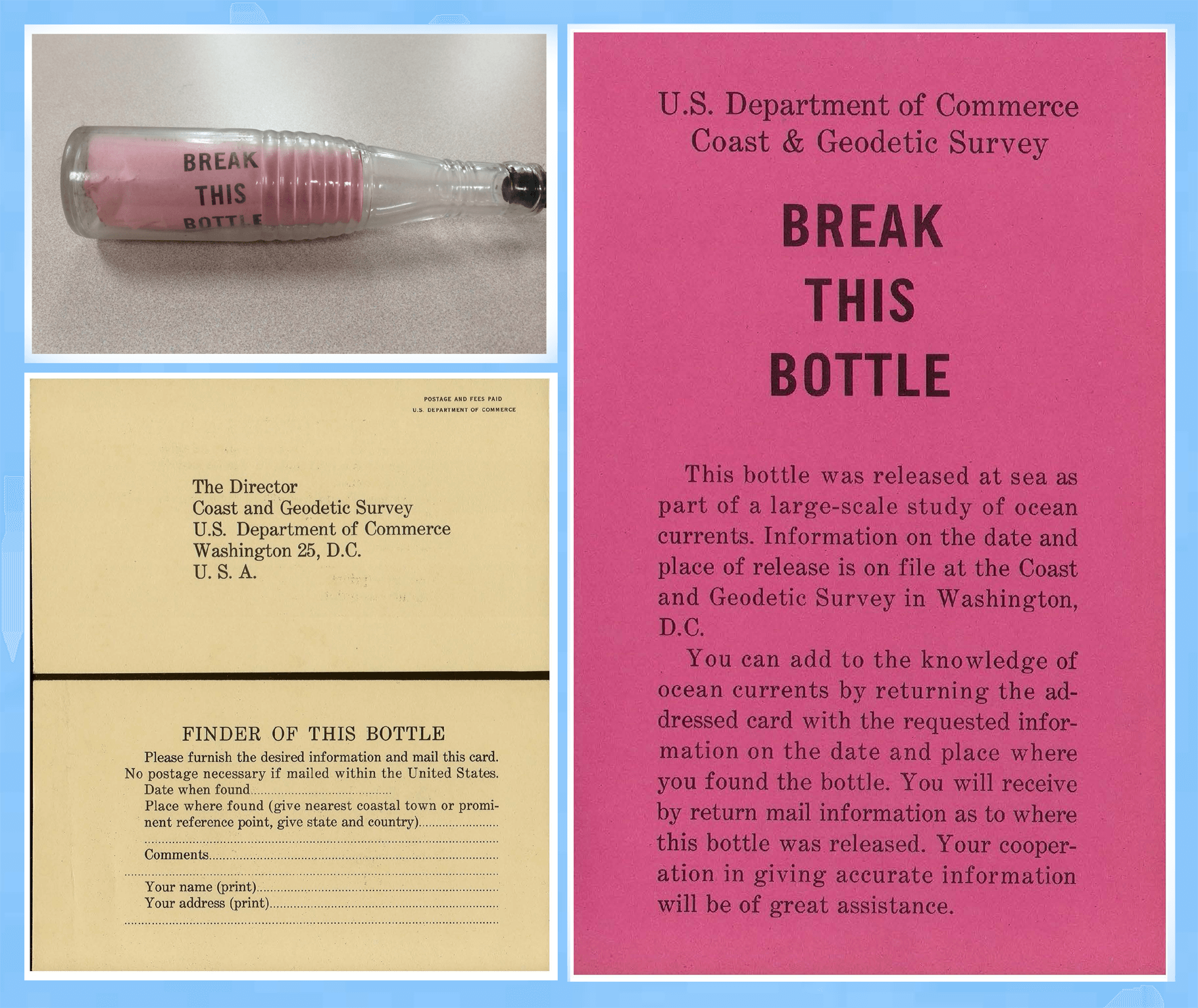
The United States Coast and Geodetic Survey (USC&GS) used drift bottles from 1846 to 1966.[1] More recently, technologies involving satellite tags, fixed current profilers and satellite communication have permitted more efficient analysis of ocean currents: at any given time, thousands of modern "drifters" transmit current position, temperature, velocity, etc., to satellites, thus avoiding conventional drift bottles' dependence on serendipitous finds and cooperation by conscientious citizens.[18]
Drift bottle studies have provided a simple way to learn about non-tidal movement of waters containing eggs and larvae of commercially important fishes, for sharing among fisheries scientists and oceanographers.[13] Such experiments simulate the travel of pollutants[17] such as oil spills,[3] study formation of ocean gyre garbage patches such as the Great Pacific Garbage Patch,[17] and suggest travel paths of invasive species.[3] Persistent currents are detected to allow ships to ride favorable currents and avoid opposing currents.[19] Projected travel paths of navigation hazards, such as naval mines, advise safer shipping routes.[19] Even in inland waterways, drifters wirelessly deliver real-time data on water quality, GPS location, and water velocity, for early warning against flash floods, measuring pollution run-off, and monitoring algal blooms.[20]
Outside science, people have launched bottled messages to find pen pals,[21] "bottle preachers"[22] have sent "sermon bottles",[23] propaganda-bearing bottles have been directed at foreign shores,[24][21][25][26] and survivors have sent poetic loving tributes to departed loved ones[27] or sent their cremated remains (ashes) on a final journey.[28][29]
It was estimated in 2009 that since the mid-1900s, six million bottled messages had been released, including 500,000 from oceanographers.[30]
Bottle design and recovery rates
[edit]

Some bottles are ballasted with dry sand so that they float vertically at or near the ocean surface, and are less influenced by winds and breaking waves than other bottles that are purposely not ballasted.[13] Wooden blocks float higher in the water and thus are more influenced by wind—a design specially suited for simulating travel paths of plastic waste that is less dense than glass containers.[4]
An early-20th-century "bottom" (or seabed) drift bottle design by George Parker Bidder III involved weighting a bottle with a long copper wire that causes it to sink until the wire trails upon the sea bottom, at which time the bottle tends to remain a few inches above the bottom to be moved by the bottom current.[32] A mushroom-shaped seabed drifter design has also been used.[13] Seabed drifters are designed to be scooped up by a trawler or wash up on shore.[7]
Water pressure pressing on the cork or other closure was thought to keep a bottle better sealed;[7] some designs included a wooden stick to stop the cork from imploding.[13] Vessels of less scientific designs have survived for extended periods, including a baby food bottle[33] a ginger beer bottle,[34] and a 7-Up bottle.[35]
A low percentage of bottles—thought by some to be less than 3 percent—are actually recovered, so they are released in large numbers, sometimes in the thousands.[3] Reported recovery rates for large-scale scientific studies vary based on the ocean of release, and range from 11 percent (Woods Hole, 156,276 bottles from 1948 to 1962, Atlantic), to 10 percent (Woods Hole, 165,566 bottles from 1960 to 1970, Atlantic), to 3.4 percent (Scripps Institution, 148,384 bottles from 1954 to 1971, Pacific).[36] Oceanographic drift card recovery rates have ranged from 50 percent if released in densely populated areas (North Sea, Puget Sound) to 1 percent in uninhabited areas (Antarctica).[30] Recovery rates decrease as bottles are released further from shore, with oceanographer Curtis Ebbesmeyer developing a rule of thumb that bottles released more than 160 kilometres (100 miles) from shore have recovery rates below 10 percent, and "only a few percent" of those released more than 1,600 kilometres (1,000 miles) from shore are recovered.[25] About 90 percent of marine debris washes up on less than 10 percent of the world's coastlines, favoring beaches perpendicular to the dominant ocean current.[2] Objects with similar buoyancy characteristics tend to collect together.[2]
A Scripps scientist said that marine organisms grow on the bottles, causing them to sink within eight to ten months unless washed ashore earlier.[37] An unknown number are found but not reported.
Time and distance
[edit]Some drift bottles were not found for more than a century after being launched.[7][16][38][39][40]
Drift bottles and seabed drifters
provide only a birth notice and an obituary –
with no biography.
Woods Hole Oceanographic Inst.[41]
Floating objects may ride gyres (large circulating current systems) that are present in each ocean, and may be transferred from one ocean's gyre to another's.[24] Further, objects may be sidetracked by wind, storms, countercurrents, and ocean current variation.[24] Accordingly, drift bottles have traveled large distances,[17] with drifts of 6,500–9,700 kilometres (4,000–6,000 miles) and more—sometimes traveling 160 kilometres (100 miles) per day—not uncommon.[19] Bottles have traveled from the Beaufort Sea above northern Alaska and northwestern Canada to northern Europe; from Antarctica to Tasmania; from Mexico to the Philippines; from Canada's Labrador Sea and Baffin Bay to Irish, French, Scottish, and Norwegian beaches;[7] from the Galapagos Islands to Australia;[42] and from New Zealand to Spain (practically antipodes).[43] Based on empirical data collected since 1901, a computer program called OSCURS (Ocean Surface Current Simulator) digitally simulates motion and timing of floating objects in and between ocean gyres.[44]
Despite being launched substantial time periods before being found, some bottles have been found physically close to their original launch points, such as a message launched by two girls in 1915 and found in 2012 near Harsens Island, Michigan, U.S.,[45] and a ten-year-old girl's message launched into the Indian River Bay in Delaware, U.S. in 1971 and found in adjacent Delaware Seashore State Park in 2016.[35]
Historical examples
[edit]Historical examples are listed in chronological order, based on year of recovery (when applicable):


Early examples
[edit]- It is reputed[6] that about 310 BC, Aristotle's protégé Greek philosopher Theophrastus used bottled messages to determine if the Mediterranean Sea was formed by the inflowing Atlantic Ocean.[7]
- When Christopher Columbus encountered a severe storm while returning from America, he is said to have written on parchment what he had found in the New World and requested it be forwarded to King Ferdinand and Queen Isabella, enclosed the parchment in a waxed cloth and placed it into a large wooden barrel to be cast into the sea.[48] The communication was never found.[48]
- On April 15, 1841, the Wellington, W.C. Kendrick, Commander, bound "from Madras and Cape bound to London", launched a bottled message in the mid-Atlantic (at 13° N) "for the purpose of throwing some light on the ocean currents".[49]
- In 1847, from the brig Eagle laden with corn for the starving Irish in Waterford, Ireland, master Gregg dropped a bottled message with his location (42.40N, 54.10W) on March 27, requesting the find be sent to the Nautical Magazine (London) for publication to provide information on Atlantic currents. The bottle was retrieved on July 20 by Capt. Robert Oke on the revenue cutter Caledonia[50] off the coast of Newfoundland (46.36N, 55.30W).[51]
- In 1856, a bottle was found on the Hebrides coast, Scotland, containing a note stating a ship, believed to be the SS Pacific, had sunk after a collision with an iceberg.[52][53]
- In February 1862, the Bashford Hall "sent afloat a message in a bottle describing her perilous state." However, she arrived safely at Falmouth, England on March 6, 1862.[54]
- After the January 11, 1866, sinking of the SS London in the Bay of Biscay, bottled messages—reported as "farewell messages from passengers... to friends and relatives in England"—were reportedly found in months following.[55]
- In 1875, ship's steward Van Hoydek and cabin boy Henry Trusillo of the British sailing ship Lennie released 24 bottled messages into the Bay of Biscay, telling of the murder by mutineers of their captain and officers.[56] French authorities soon received the message, rescued Hoydek and Trusillo, and brought the mutineers to justice.[56][57]
- In 1876, on the remote Scottish island of St Kilda, freelance journalist John Sands and marooned Austrian sailors deployed two messages requesting the Austrian Consul rescue them with provisions.[58] The messages, each enclosed in a cocoa tin attached to a sheep's bladder for flotation in an arrangement later called a "St. Kilda mail boat",[59] were discovered in Orkney within nine days and in Ross-Shire after 22 days.[58] Since that time, sending "St. Kilda mail" has become a recreational ritual for island visitors, the containers often riding the Gulf Stream to the British mainland, Shetland, Orkney and Scandinavia.[58]
20th century
[edit]- Message-bearing bottles from Titanic (1912)[60] and Lusitania (1915)[7] have been widely recounted as fact, but even before these bottles were found The Irish News stated in April 1912 that "very many" such stories turn out to be "cruel hoaxes".[60]
- In February 1916, when German Zeppelin L 19 experienced unfavorable weather, battle damage and multiple engine failure after attacking the British Midlands, its commander's last message to superiors and the crew's final letters to relatives were released into the North Sea to be found on a Swedish coast six months later.[61][62] The written descriptions of how a British fishing trawler had refused to rescue the downed Zeppelin's crew—the trawler captain claiming he feared the German airmen would overpower his own unarmed crew—contributed to an enduring international controversy.[63]
- On December 23, 1927, Frances Wilson Grayson, niece of U.S. President Woodrow Wilson, was to attempt to be the first woman to make a transatlantic flight (non-solo). However, her Sikorsky amphibian plane disappeared en route from New York's Long Island to Harbour Grace, Newfoundland, and was never found. A bottled message was found in Salem Harbor, Massachusetts, in January 1929, the unauthenticated message reading, "1928, we are freezing. Gas leaked out. We are drifting off Grand Banks. Grayson."[64]
- In December 1928, a trapper working at the mouth of the Agawa River, Ontario, found a bottled note from Alice Bettridge, an assistant stewardess in her early twenties who initially survived the December 1927 sinking in a blizzard of the freighter Kamloops and, before she herself perished, wrote "I am the last one left alive, freezing and starving to death on Isle Royale in Lake Superior. I just want mom and dad to know my fate."[65]
- In 1929, a bottle that came to be known as the Flying Dutchman was released by a German marine science expedition with instructions for any finders to report the find but return the bottle to the sea.[14] Found at several locations in succession, the Flying Dutchman traveled 25,750 kilometres (16,000 miles) from its release point in the southern Indian Ocean, to Cape Horn in South America, and back through the Indian Ocean to its last reported find in 1935 on the west coast of Australia.[14]
- On the night of March 28, 1941 in the last moments of the Battle of Cape Matapan, aboard the sinking cruiser Fiume, Italian sailor Francesco Chirico wrote a farewell message and threw it overboard in a bottle. Chirico's message, including a note, "Please give news to my dear mother that I die for the homeland...", was found in 1952 near Villasimius, Sardinia.[66]
- On January 7, 1943, a Schweppes lemonade bottle was found near Woolnorth in northwestern Tasmania, containing a penciled message thrown overboard on April 17, 1916, by Australian soldier John Oppy as his troop ship passed between Encounter Bay and Kangaroo Island, South Australia.[67] Oppy himself survived to see the message returned.[67]
The notion of the message in a bottle has come to attain a kind of romanticism, built perhaps on the allure of the exotic mystery its contents might reveal from a faraway place or a long-ago time.
- On Christmas Day 1945, 21-year-old medical corpsman Frank Hayostek threw a message-laden aspirin bottle from his Liberty ship as it approached New York, the bottle being found eight months later near Dingle, County Kerry, by Irish milkmaid Breda O'Sullivan.[69] Her mailed reply began a correspondence that inspired Hayostek to save money for airfare to visit O'Sullivan in 1952.[69] Intense media attention for the "impossibly romantic story",[70] including Time magazine stories, overshadowed their two-week visit, the two parting but corresponding until they married other people in 1958 and 1959.[69] Media attention endured through the sixtieth anniversary of their meeting,[70] 2–3 years after their deaths.[71][69]
- In 1955, a bottle from a 1903 German Antarctic expedition was found in New Zealand, about 5,500 kilometres (3,400 miles) from its launch point between the Kerguelen Islands and Tasmania; however, hydrographers surmise it had drifted around the world many times.[72]
- In 1955, Swedish sailor Åke Viking[a] sent a bottled message "To Someone Beautiful and Far Away" that reached a then 15-year-old Sicilian girl named Paolina, sparking a correspondence that culminated in their marriage in 1958.[74][75] The affair attracted so much attention that 4,000 people celebrated their wedding.[76][73] Paolina and Åke remained married until Åke's death in 2001.[74]
- In 1959 Guinness Brewery launched 150,000 bottles into the Atlantic Ocean and Caribbean Sea in a promotional campaign.[24] It was reported that Inuit hunters on Coats Island, in Canada's Hudson Bay, found 80 of the bottles.[24]
- In 1969, a Canadian scientific expedition dropped a message bottle through a hole in the drift ice at the approximate North Pole. The bottle was found in 1972 in northeast Iceland.[77]
- In May 1976, National Geographic World magazine released 1,000 bottles—250 per week—from the cruise ship Song of Norway, with instructions in five languages to fill out and return cards, in order to help map ocean currents.[78]
- In 1978, a Russian researcher discovered a bottled message in the Franz Josef Land, north of mainland Russia, that was deposited by Karl Weyprecht, leader of the 1872–1874 Austro-Hungarian North Pole Expedition which sought a Northeast Passage.[79][80]
- A message that an American couple released from a cruise ship approaching Hawaii in 1979 was found off Songkhla Beach, Thailand by a former South Vietnamese soldier and his family as they fled that country's communist regime by boat.[81] A correspondence relationship began in 1983, and the couple worked with U.S. Immigration to help the Vietnamese family obtain refugee status in 1985 and move to the U.S.[81]
- In 1991, a bottled message found on Vancouver Island, Canada, urged the release of Chinese dissident Wei Jingsheng.[24][25] According to oceanographer Curtis Ebbesmeyer, the bottle was likely released in 1980 near Quemoy Island, one of many Taiwan propaganda bottles launched toward mainland China.[24][25][82]
- In what was described as "perhaps the most famous message in a bottle love story",[83] in March 1999 a green ginger beer bottle was dredged up by a fisherman off the Essex coast, the bottle containing an 84-year-old letter tossed into the English Channel on September 9, 1914, by British soldier Private Thomas Hughes days before he was killed in fighting in France.[34] Hughes' letter, written for delivery to his wife who had died in 1979, was delivered instead to his then 86-year-old daughter in New Zealand by the fisherman himself, who with his own wife was flown to New Zealand at the expense of New Zealand Post.[34]

21st century
[edit]- A teardrop-shaped bottle was found in March 2002 on a beach in Kent, England, containing an unsigned letter from a French woman expressing her enduring grief over the death of her son at age 13.[84][85] British author Karen Liebreich spent years of research, unsuccessfully trying to find the mother and eventually publishing a book called The Letter in the Bottle (2006).[85] The book was published in French in 2009, sparking huge media coverage[84] that alerted the mother for the first time that her letter had actually been discovered.[85] Saying she initially felt violated by publication of her personal suffering, on condition of continued anonymity, she agreed to tell Liebreich the details of her son's 1981 death in a bicycle accident, her decades of suffering afterwards, and the story surrounding release of her letter from an English Channel ferry.[84][85]
- In May 2005, three days after eighty-eight migrants were abandoned by human smugglers on a disabled boat, the migrants tied an SOS-bearing bottle to a long line of a passing fishing vessel, whose captain alerted authorities to rescue the migrants.[86]
- On December 10, 2006, a bottom drift bottle, released on April 25, 1914, northeast of the Shetland Islands by the Marine Laboratory, Aberdeen, U.K., was recovered by a Shetland fisherman, after the bottle had spent over 92 years at sea.[87]
- In October 2011 in waters off Somalia, the crew of the pirated cargo ship Montecristo used a bottle with a flashing beacon to alert NATO ships that they had retreated to an armored room, permitting a military rescue operation to proceed with knowledge that the crew was not being held hostage.[88]
- In April 2012 a fisherman recovered a bottom drift bottle that had been released 98 years earlier, on June 10, 1914,[7][32] one of 1,890 released by the Glasgow School of Navigation to test undercurrents in the seas around Scotland.[89] The 2012 find occurred east of Shetland by the Copious, the same fishing vessel involved in the 2006 find.[90]
- In a 2013 promotional campaign, Norwegian soft drink company Solo released a 26-foot, 2.7-ton replica soda bottle outfitted with a customized camera, navigation lights, an automatic identification system, a radar reflector, and GPS tracking technology, all powered by solar panels.[91] The craft drifted from Tenerife, Canary Islands, while broadcasting its location, but its electronics were stolen by pirates before its five-month trip terminated at Los Roques archipelago near Venezuela.[92]
- In April 2013, a kite-surfer near the mouth of Croatia's Neretva River recovered a bottle containing a message purporting to have been sent in 1985 from Nova Scotia to fulfill a promise by a "Jonathon" to write to one "Mary".[93] The message received international media attention.[94]
- In March 2014, a fisherman on the Baltic Sea near Kiel recovered a drift bottle containing a Danish postcard dated May 17, 1913, and signed by a then-20-year-old baker's son named Richard Platz, who asked for it to be delivered to his Berlin address.[38] Researchers located Platz's granddaughter, by then 62, and delivered the 101-year-old message to her, Platz himself having died in 1946.[38]

- An April 2015 find on the North Sea island of Amrum, Germany, of a 108-year-old bottle sent by the Marine Biological Association of the United Kingdom in Plymouth, was one of 1,020 released into the North Sea between 1904 and 1906 by former association president George Parker Bidder III.[16]
- In 2016, Cuban migrants who had fled Cuba in a homemade boat, launched a bottled SOS message complaining of their treatment while being detained for 42 days aboard a United States Coast Guard Cutter.[96]
- In late 2016, a barnacle-encrusted, kelp-tangled GoPro video camera was recovered, the camera's memory card preserving footage showing the prelude to the camera's being swept overboard four years earlier, and also recording its first two hours underwater off Fingal Bay, Australia.[97]
- In 2017, a small unmanned boat made by high school students and having solar panels, sensors and camera, drifted on an unexpected path from near Maine, to approach Spain and Portugal, then drift westward back into the Atlantic and northward to be discovered in Benbecula in the western isles of Scotland.[98] The boat had a waterproof pod containing a chip that collected sensor data.[98]
- In July 2017, a Scottish widower seeking female companionship set 2,000 bottled messages adrift at various locations around the U.K., and though claiming he received responses from 50 women, ceased the practice in response to public complaints and an investigation by the Scottish Environment Protection Agency.[99]
- In January 2018, a couple walking on a beach in Western Australia discovered a bottled message that had been launched on June 12, 1886, from the German barque Paula conducting drift bottle experiments for the German Naval Observatory.[39][40] The message's authenticity was corroborated through the ship captain's original Meteorological Journal, and, at 131 years' duration, eclipsed the previous corroborated record duration of 108 years.[39][40] The bottle's thick glass and its opening's narrow bore are thought to have protected the paper from the elements.[39]
- In the summer of 2018, a bottled typewritten message dated March 26, 1930, was discovered in the roof of the twelfth-century Goslar Cathedral in Goslar, Germany, signed by four roofers who bemoaned the economic state of that country.[100] The bottle was discovered by a roofer who was the grandson of one of the signatories, who had been an 18-year-old roofing apprentice in 1930.[100] Goslar's mayor replaced the bottle with a copy of the 1930 message, adding his own confidential message.[100]
- In May 2019, a Gatorade bottle with a four-page letter, written in Spanish, was found in Brown Bay, near Mount Gambier, South Australia. The letter had been sent from Caleta Córdoba, near Comodoro Rivadavia, Argentina by a mother and two children as a loving tribute to their husband and father who had died of a stroke a year earlier.[101]
- In June 2019, three hikers trapped above a waterfall on California's Arroyo Seco tributary released a Nalgene bottled SOS message that was quickly discovered a quarter mile (0.4 km) downstream, allowing them to be rescued by helicopter the following morning.[102][103]
- In late 2019, a bottled message launched on August 1, 1994, by 12-year-old Ryan Mead was found near the mouth of the Taramakau River, New Zealand, the find occurring mere months after Mead died at age 37 in a freak accident inhaling fumes while laying carpet.[104]
- In early 2025, a note was found in a violin crafted by a Polish Jew in the Dachau concentration camp: "Trial instrument, made under difficult conditions with no tools and materials. Dachau. Anno 1941, Franciszek Kempa." The note is interpreted to be that of a master violin maker explaining how he was forced to build an instrument that did not meet his own standards. Kempa survived the Holocaust.[105]
- In July 2025, a message in a bottle was found on Inis Oírr, Galway Bay, Ireland, with a note claiming to be from a crew member of the Taiwanese fishing vessel Yong Yu Sing No. 18 that was abandoned near Midway Atoll (Pacific) in late 2020 or early 2021.[106]
Long-duration events
[edit]Table listing long-duration (>25-year) events involving messages in bottles (scroll):
| Sender | Date released | Place released | Date found | Place found | Duration (years) | Ref. |
|---|---|---|---|---|---|---|
| Pierre-Jacques Féret | 1825-01 | Cité de Limes near Dieppe s | 2024-09 | Cité de Limes near Dieppe | 199 | [107] |
| Chunosuke Matsuyama, seaman | 1784 | Island in Pacific | 1935 | Hiraturemura, Japan | 151 | [7][108] |
| James Ritchie and John Grieve | 1887-10-06 | Edinburgh, Scotland s | 2022-11-13 | Under floorboards of house | 135 | [109] |
| Lighthouse engineers | 1892-09-04 | Rhins of Galloway (lighthouse) s | 2024-11 | Corsewall Lighthouse | 132 | [46] |
| German sailing barque Paula | 1886-06-12 | Indian Ocean, 950 km off Western Australia | 2018-01 | Near Wedge Island, Western Australia |
131.6 | [39][40][95][110] |
| Theatre builders | 1906-10 | King's Theatre, Edinburgh, Scotland s | 2024-12-06 | Behind decorative crown | 118 | [111] |
| Bricklayers Wm Hanley, James Lennon | 1907-07-03 | Montclair State University, N.J.s | 2019 | Wall in College Hall | 112 | [112] |
| Pte Malcolm Neville and William Harley, Australian soldiers | 1916-08-15 | Great Australian Bight | 2025-10 | Wharton Beach, Western Australia | 109 | [113] |
| George Parker Bidder, Marine Biological Association of the U.K. | 1906-11-30 | North Sea | 2015-04-17 | Amrum, Germany | 108 | [16][116][117][118] |
| Karl Weyprecht, co-leader, Austro-Hungarian North Pole expedition | 1874 | Lamont, Franz Josef Land, Russia s | 1978-08 | Lamont, Franz Josef Land, Russia | 104 | [79] |
| School administrators | 1920-09-30 | School cornerstone s | 2024-04 | Owatonna High School, Minnesota, U.S. | 103.5 | [119] |
| Richard Platz | 1913-05-17 | Baltic Sea | 2014-03 | Baltic Sea near Kiel | 101 | [38] |
| Glasgow School of Navigation | 1914-06-10 | Near Scotland | 2012-04 | East of Shetland | 98 | [32][89][90] |
| Selina Pramstaller, Tillie Esper | 1915 | Harsens Island, Michigan, U.S. | 2012 | Harsens Island, Michigan, U.S. | 96 | [45] |
| George Morrow | 1926-11 | Cheboygan, MI, U.S. (presumed) | 2021-06 | Cheboygan River | 94.6 | [120] |
| Marine Laboratory, Aberdeen | 1914-04-25 | Near Scotland | 2006-12-10 | Near Shetland | 92 | [87] |
| Erich Sanitter, Waldenburg | 1929-07-08 | Bay of Danzig | 2019-10 | Vistula Lagoon | 90 | [121] |
| Willi Brandt, roofer, age 18 | 1930-03-26 | Goslar, Germany s | 2018 | Goslar Cathedral roof | 88 | [100] |
| Carl Ott (business owner) | 1930-05-20 | Indianapolis, Indiana, U.S. s | 2017-02 | Construction site | 86 | [122] |
| Thomas Hughes, WWI soldier | 1914-09-09 | English Channel | 1999-03 | Essex, River Thames | 84 | [34] |
| Dachau prisoner Franciszek Kempa | 1941 | Inside violin s | 2025 (before 28 April) | Art dealer in Hungary | 83 | [105] |
| "Flying Squad" joinery team | 1934-07-16 | Viewforth, Edinburgh s | 2016-11 | Wall of building | 82 | [123] |
| John Stapleton Jr. age 14 | 1938-09-05 | Jersey, Channel Islands (deduced) | 2020-02-18 | Jersey, Channel Islands | 81.4 | [124] |
| Navy of Czarist Russia | 1913-07 | Sea of Okhotsk, Russia | 1995 | Near Cordova, Alaska | 81 | [125] |
| (undetermined) | 1935 | Southampton Guildhall, U.K. s | 2016 | Southampton Guildhall, U.K. | 81 | [126] |
| "Jim" (military man) | 1945-03-04 | Virginia Beach, Virginia, Va, US | 2024-08-07 | Odessa, Florida, US | 79 | [127] |
| Herbert E. Hillbrick | 1936 | P&O cruise ship | 2012 | Ninety Mile Beach, NZ | 76 | [128] |
| Victor Elliott, age 13 | 1944-04-25 | Ralston, Oklahoma | 2017-11-11 | Fort Smith, Arkansas | 73 | [129] |
| Lt. Col. Eugene J. McNamara | 1948 | Grand Hotel, Yokohama s | 2016 | New Grand Hotel | 68 | [130] |
| Auschwitz prisoners, age 18–20 | 1944-09-09 | Near Auschwitz camp s | 2009-04 | Wall of bomb shelter | 64 | [131] |
| WHOI | 1956-04-26 | South of Nova Scotia | 2014-01-20 | Sable Island | 57 | [132] |
| U.S. Bureau of Commercial Fisheries | 1962-05 | Gulf of Mexico | 2019-01 | Padre Is. Nat. Seashore, Texas | 56.5 | [133][134] |
| NOAA's NEFSC | 1959-09-19 | Atlantic, off Massachusetts | 2013-12-22 | Martha's Vineyard, Mass. | 54 | [1] |
| Paul Walker, geologist | 1959-07-10 | Ward Hunt Island, N. Canada s | 2013 | Ward Hunt Island, N. Canada | 54 | [135] |
| German Antarctic Expedition | 1903 | Btw. Kerguelen Is., Tasmania | 1955 | New Zealand | 52 | [72] |
| Paul Tsiatsios, motel owner | 1960+ | New Hampshire, U.S. | 2011 | Turks and Caicos | 51 | [136][137] |
| Soviet fishing vessel Sulak | 1969-06-20 | Pacific Ocean | 2019-08-05 | Shishmaref, Alaska | 50 | [138] |
| 13-year-old ship passenger | 1969-11-17 | 100 mi. E. of Fremantle, W. Aus. | 2019-07 | Eyre Peninsula, S. Aus. | 49 | [139][140] |
| Construction workers | 1967-05-19 | Toowoomba, QLD, Australia s | 2016-09-08 | Embedded in concrete | 49 | [141] |
| NOAA Fisheries | 1966 | Bristol Bay, Alaska, U.S. | 2013 | Cold Bay, Alaska, U.S. | 47 | [18] |
| High school science class | 1972-12-01 | Fire Island, N.Y., U.S. | 2019-08 | Brookhaven, L.I., N.Y., U.S. | 46.7 | [142] |
| "Donkeyman" James Robertson | 1970-09-16 | North Sea (assumed) | 2017-01 | Norderney, Germany | 46.2 | [143] |
| Girl, age 6 | 1971-09-06 | Indian River Bay, Delaware, U.S. | 2016-04-22 | Del. Seashore State Park | 44 | [35] |
| Boy, age 14 | 1971-01-15 | Cove Bay, Aberdeen, U.K. | 2015 | Rattray Head, Aberdeenshire | 44 | [144] |
| Girl, age 11 | 1974-08-29 | Old Mission Peninsula, Michigan | 2015 | Old Mission Peninsula, Michigan | 41 | [145] |
| Two junior high school girls | 1975 | Washington state, U.S. | 2015-04-04 | Gulf of Alaska, U.S. | 40 | [146] |
| Print shop worker, age 31 | 1983 | Omaha, Nebraska | 2020-03 | Rock Port, Missouri | 37 | [147] |
| High School Nat. Sci. Club | 1984-07 | Chōshi, Japan | 2021 | Hawaiian Paradise Park | 37 | [148] |
| Boy, age 16 | 1980-05-13 | Albany, W. Australia | 2016-06 | Eucla, W. Australia | 36 | [149] |
| Vacationer | 1981-06-10 | Fernandina Beach, Florida | 2017-06-17 | Little St. Simons Island, Georgia | 36 | [150] |
| Scottish schoolgirl, age 12 | 1994 | Portknockie, Moray, Scotland | 2025 | Lisshelløya island, Vega, Norway | 31 | [151] |
| School; Forfar, Scotland | 1987 (est) | North Sea | 2017-09-29 | Key Largo, Fla. U.S. | 30 | [152] |
| Girl, age 8 | 1988-09-26 | Edisto Beach, South Carolina | 2017-10 | Sapelo Island, Georgia | 29 | [153] |
| Boy, age 12 | 1989-07 | Detroit River | 2017-07-12 | Amherstburg, Ontario | 28 | [154] |
| "Jonathon" | 1985 | Nova Scotia (purported) | 2013-04-17 | Croatia | 28 | [93][94] |
| Father, daughter, age 4 | 1992 | Near Baie Fine, Ontario | 2020-03 | Hiawatha Isl(near Manitoulin Isl, Ont) | 28 | [155] |
| Jack Oppy, Australian soldier | 1916-04-17 | Between Encounter Bay & Kangaroo Island, S. Australia | 1943-01-07 | Woolnorth, NW Tasmania | 26.7 | [67] |
| Manitoba, Canada resident | 1985 | Lake Winnipeg | 2011 | Near Libau, Manitoba | 26 | [156] |
| Fifth grade class | 1993-05 | Delaware River (Kansas) | 2019 | Chester, Illinois | 25 | [157] |
| Ryan Mead, age 12 | 1994-08-01 | Near Greymouth, New Zealand | 2019 | Mouth of Taramakau River, NZ | 25 | [104] |
- s denotes stationary messages (placed on land, not in a body of water).
Popular perceptions
[edit]A hundred billion bottles
- washed up on the shore,
Seems I'm not alone at being alone—
- A hundred billion castaways
- Looking for a home.
Besides interest in citizen science drift-bottle experiments,[32] message-in-a-bottle lore has often been of a romantic or poetic nature.[83] Such messages have been romanticized in literature, from Edgar Allan Poe's 1833 story "MS. Found in a Bottle" through Nicholas Sparks' 1998 Message in a Bottle.[158] Clint Buffington, subject of the 2019 documentary short film The Tides That Bind / A Message in a Bottle Story,[159] surmised in an interview with The Guardian that sending a bottled message expresses a hope to find connection in a fear-filled world.[160] In Newsweek Ryan Bort recounted various historical messages as being cries for help, or "final, poetic words of resignation left behind for (an) indifferent sea", or from "lonely, lovelorn souls, searching for serendipity", or a search for "affirmation ... that comes from somewhere other than yourself".[83] Bort described sending a message in a bottle as a romantic act that has "such a delicious potential for magic" or as "surrendering a part of yourself to something larger", concluding that "every message in a bottle is a prayer".[83]
Finding a bottled message has generally been viewed positively, the finder of a 98-year-old message referring to his find as winning the lottery.[90] However, intense media attention over a personal relationship that resulted from one woman's find, is said to have caused her to remark that had she known what would happen, she would have left the bottle on the beach.[69] Another woman said she initially felt shocked and violated by publication of the personal suffering she had expressed in a bottled letter that she never expected would be found or read.[84][85]
Similar methods using other media
[edit]

The term "message in a bottle" has been applied to techniques of communication that do not literally involve a bottle or a water-based method of conveyance, such as the Europa Clipper plaque (2024),[161] the Pioneer plaque (1972, 1973), the Voyager Golden Record (1977), and even radio-borne messages (see Cosmic Call, Teen Age Message, A Message from Earth), all directed into space.[162][163]
Balloon mail involves sending undirected messages through the air rather than into bodies of water.[163] For example, during the Prussian Siege of Paris (1870–1871) about 2.5 million letters were sent by hot air balloon, the only way Parisians' letters could reach the rest of France.[164]
Stationary time capsules have been termed "messages in a bottle", such as a 1935 message in a lemonade bottle correctly portending difficult times, which was found in 2016 by masons restoring damaged Portland stone at Southampton Guildhall.[126] A geologist left a bottled message in 1959 in a cairn on isolated Ward Hunt Island (Canada, 83°N latitude), allowing its finders in 2013 to determine that a nearby glacier had retreated over 60 metres (200 ft) in the intervening 54 years.[135] More durable examples of time capsules are the Westinghouse Time Capsules of the 1939 and 1964 New York World's Fairs, intended to be opened 5,000 years after their creation.[165]
Prisoners from the Auschwitz concentration camp concealed bottles containing sketches[166] and writings[131] that were found after World War II.
Certain emergency medical services urge patients to record information describing their medical conditions, medications and drug allergies, emergency contacts,[167] as well as advance healthcare directives for when the patients are incapacitated[168] or suffer from dementia or learning difficulties,[169] and place the record as a special "message in a bottle" stored in (conventionally) a refrigerator, where paramedics can quickly locate it.[167][168][169]
Environmental issues
[edit]Plastic bottles are known to constitute plastic marine pollution, and eventually break down into smaller pieces because of ultraviolet light, salt degradation or wave action.[170] Glass bottles can break into sharp-edged pieces, and bottle caps are ingested by sea birds.[170]
Some agencies continue to use drift bottles into the 21st century, but with increased awareness that man-made floating items can harm marine life or constitute waste material,[24][4] biodegradable drift cards[3] and biodegradable wooden drifters[4] with non-toxic ink[170] are gaining favor.
See also
[edit]- Beachcombing
- Drifter (oceanography)
- Earth's black box
- Flotsam, jetsam, lagan and derelict
- Friendly Floatees, plastic bath toys accidentally released in the Pacific in 1992[17]
- Ice rafting
- Swallow float
Notes
[edit]- ^ Some sources give the sailor's surname as Wiking,[73] the variant preferred before the 1889 Swedish spelling reform.
References
[edit]- ^ a b c Dawicki, Shelley (March 14, 2014). "Drift Bottle Found on Martha's Vineyard Has Quite a Story to Tell". NOAA's Northeast Fisheries Science Center (NEFSC). Archived from the original on February 10, 2015.
- ^ a b c Wollan, Malia (March 27, 2015). "How to Find a Message in a Bottle". The New York Times. Archived from the original on March 29, 2015.
- ^ a b c d e f g Penry, Jerry, LS (March 2007). "Message in a Bottle" (PDF). The American Surveyor. Archived (PDF) from the original on September 23, 2014.
{{cite magazine}}: CS1 maint: multiple names: authors list (link) - ^ a b c d Melanie, Hall (October 13, 2016). "Tackling plastic waste in oceans with 'wooden message in a bottle'". Deutsche Welle. Archived from the original on October 18, 2016. A research program from the University of Oldenburg (Germany) involves 100,000 wooden blocks of various thicknesses.
- ^ Verne, Jules (1874). "Chapter 1. The Shark". In Search of the Castaways (Project Gutenberg eBook released August 16, 2014 ed.). J.B. Lippincott & Co., Philadelphia (original publisher). Archived from the original on March 27, 2016.
- ^ a b Ebbesmeyer & Scigliano 2009, p. 229.
- ^ a b c d e f g h i j Berlin, Jeremy (20 September 2012). "Oldest Message in Bottle: Behind History's Famous Floating Notes". National Geographic. Archived from the original on May 6, 2016.
- ^ Ebbesmeyer & Scigliano 2009, pp. 54–55.
- ^ Kraske 1977, pp. 53–56.
- ^ Buffington, Clint. "Queen Elizabeth's "Official Uncorker of Ocean Bottles"".
- ^ a b Ebbesmeyer & Scigliano 2009, pp. 55–56, attributing to Becher, Alexander (1843, 1852). Nautical Magazine and Naval Chronicle.
- ^ Ebbesmeyer & Scigliano 2009, p. 50.
- ^ a b c d e f Dawicki, Shelley (March 14, 2014). "Message in a Bottle: The Story Behind the Story -- Drift Bottles Helped Determine Distribution of Fish Eggs and Larvae". NOAA's Northeast Fisheries Science Center (NEFSC). Archived from the original on July 25, 2016.
- ^ a b c Moody 2010, II. Adrift at Sea.
- ^ "Message in a bottle". News Releases: Scottish Government. August 30, 2012. Archived from the original on April 5, 2017.
- ^ a b c d e Huggler, Justin (August 20, 2015). "World's oldest message in a bottle washes up in Germany after 108 years at sea". The Telegraph. Archived from the original on January 30, 2016.
- ^ a b c d e Boxall, Simon (April 25, 2016). "Why ocean scientists hope someone gets your message in a bottle". The National Post (reprinting from The Conversation). Archived from the original on May 7, 2016. Retrieved April 1, 2020.
- ^ a b "NWFSC's Own Message in a Bottle: Ocean Drifters and Tiny Tags Have Been Telling Stories for Decades". NOAA's NWFSC. 2013. Archived from the original on July 24, 2016.
- ^ a b c Lederer, Muriel (Fall 1971). "Letters from the Sea" (PDF). University of Florida Digital Collections: The Panama Canal Review. Archived (PDF) from the original on September 4, 2016.
- ^ Kennedy, Matt (July 23, 2018). "QUT deploys high-tech "message in a bottle" to fight floods and pollution in river systems". New Atlas. Archived from the original on July 24, 2018.
- ^ a b Ebbesmeyer & Scigliano 2009, pp. 57–58.
- ^ Kraske 1977, pp. 50–52.
- ^ Ebbesmeyer & Scigliano 2009, pp. 62–67.
- ^ a b c d e f g h Krajick, Kevin (2001). "Message in a Bottle" (PDF). University of Washington. Archived (PDF) from the original on September 18, 2016. From Smithsonian, July 2001, pp. 36-42.
- ^ a b c d Heidorn, Keith C. (March 17, 1999). "Of Shoes And Ships And Rubber Ducks And A Message In A Bottle". IslandNet.com. "The Weather Doctor" section. Archived from the original on May 13, 2016. Article updated October 2010.
- ^ Fifield, Ann (April 24, 2018). "With food and facts carried in bottles, activists try to penetrate isolated North Korea". The Washington Post. Archived from the original on April 24, 2018.
- ^ Wright, Shayne (March 21, 2019). "Hobe Sound woman finds mysterious message in bottle on beach". West Palm Beach, Florida: WPFB 25. Archived from the original on March 22, 2019.
- ^ "Woman Finds Ashes and Message in a Bottle, 4 Years After It Was Sent Out to Sea". Inside Edition. November 8, 2017. Archived from the original on November 8, 2017.
- ^ "Cremated remains of Tenn. woman found inside 'message in a bottle'". Nashville, Tennessee: WKRN. May 24, 2019. Archived from the original on June 10, 2019.
- ^ a b Ebbesmeyer & Scigliano 2009, p. 67.
- ^ Ebbesmeyer & Scigliano 2009, pp. 56–57, describing drift casks designed by George W. Melville.
- ^ a b c d Madrigal, Alexis C. (September 5, 2012). "Found: World's Oldest Message in a Bottle, Part of 1914 Citizen-Science Experiment". The Atlantic. Archived from the original on March 4, 2016.
- ^ Peterson, Eric (May 27, 2016). "'Message in a bottle' found in bay apparently dates to Vietnam War era". Fox 11 News (Green Bay, WI, U.S.). Archived from the original on May 28, 2016. • Peterson, Eric (June 1, 2016). "Message in bottle mystery may be getting clearer". Fox 11 News (Green Bay, WI, U.S.). Archived from the original on June 2, 2016.
- ^ a b c d "Sweet message in a bottle". BBC News. May 18, 1999. Archived from the original on October 30, 2009. • Some references (example: Commonwealth War Graves Commission) state that Hughes died twelve days later, not two days later as most popularly reported.
- ^ a b c Carroll, Hannah (June 11, 2016). "45-year-old message in a bottle found, brings nostalgia". The Washington Times. Associated Press. Archived from the original on June 12, 2016.
- ^ Kraske 1977, pp. 88–89.
- ^ Kraske 1977, p. 89.
- ^ a b c d "'World's oldest' message in a bottle arrives home". The Local. Germany. 8 April 2014. Archived from the original on January 14, 2015.
- ^ a b c d e "Oldest message in a bottle found on beach". BBC News. March 6, 2018. Archived from the original on March 7, 2018.
- ^ a b c d Katz, Brigit (March 7, 2018). "131-Year-Old Message in a Bottle Found on Australian Beach". Smithsonian. Archived from the original on March 8, 2018.
- ^ ● Bumpus, Dean F. (1973). "A description of the circulation on the continental shelf of the east coast of the United States". Progress in Oceanography. 6: 150. Bibcode:1973PrOce...6..111B. doi:10.1016/0079-6611(73)90006-2. ● Quotation is freely accessible online from full-text secondary source: Fischer, Hugo B. (January 1980). "Mixing processes on the Atlantic continental shelf, Cape Cod to Cape Hatteras" (PDF). Limnol. Oceanogr. 25 (1): 115. Bibcode:1980LimOc..25..114F. CiteSeerX 10.1.1.509.1774. doi:10.4319/lo.1980.25.1.0114. Archived (PDF) from the original on September 7, 2016.
- ^ White, Jorgia (February 27, 2016). "Queensland police officer finds message in a bottle". Brisbane Times. Archived from the original on March 22, 2016.
- ^ Carter, Charlotte (March 14, 2018). "Message in the bottle from Whangarei to Spain may be a record breaker". New Zealand Herald. Archived from the original on March 14, 2018.
- ^ Ingraham Jr., W. James. "Getting to Know OSCURS, REFM's Ocean Surface Current Simulator". Alaska Fisheries Science Center (NOAA). Archived from the original on November 28, 2016. Originally published in the Alaska Fisheries Science Center Quarterly Report, April–May–June, 1997. Program limited North Pacific from 10° N latitude to the Bering Strait.
- ^ a b Ng, Christina (June 20, 2013). "Michigan Message in a Bottle Mystery Solved". ABC News. Archived from the original on June 20, 2017.
- ^ a b Brown, Angie (9 November 2024). "Hidden message in a bottle found in lighthouse wall after 132 years". BBC. Archived from the original on 9 November 2024.
- ^ a b "At the edge of the world (St Kilda Mailboat)". KildaProjet.com. Le Project Kilda (The Kilda Project). 4 March 2016. Archived from the original on 10 June 2023.
- ^ a b Bergreen, Laurence (September 25, 2012). Columbus: The Four Voyages, 1492-1504 (Reprint ed.). Penguin Books. ISBN 978-0143122104. "Part One: Discovery" (exact page does not show in Google Books preview).
- ^ The Times-Picayune. October 26, 1841. Page 2. No author listed. Republished information that appears to have originated in Guayama, Puerto Rico. Quote: "Ship Wellington of London, W.C. Kendrick, Commander, From Madras and Cape bound to London. Lat. 13 degrees 58' North, Long. 35 degrees 30' West. This bottle is dispatched for the purpose of throwing some light on the ocean currents, and it is earnestly requested that the time and place of finding it may be publicly made known. At Sea, April 15th, 1841."
- ^ Tocque, Philip (1878). Newfoundland: As it was and as it is in 1877. Toronto, Ont.: J.B. Magurn.
- ^ "Memoranda". Morning Courier. St. John's, Newfoundland. 14 Aug 1847. p. 3. Retrieved 7 March 2017. |via=Memorial University of Newfoundland Digital Archives Initiative
- ^ Coogan, Jim (2014). "A Message From the Sea". barnstablepatriot.com. Archived from the original on 24 October 2014.
- ^ "Reminisecence of the Lost Steamship Pacific.; Interesting Statement". The New York Times. 7 August 1861. Archived from the original on 1 November 2023.
From the London Shipping Gazette
- ^ Belfast News-Letter. May 12, 1862. Page 5. Belfast, North Ireland.
- ^ The Hamilton Spectator. Page 3. May 12, 1866. No author listed. Quotes: "The Argus contains an account of certain bottles found on the French coast of the terrible Bay of Biscay." A retelling of this account reveals that the bottles contained "farewell messages from passengers by the London to friends and relatives in England." According to one D.W. Lemmon, presumed drowned: "The ship is sinking," he wrote, "no hope of being saved." Mr. H.F.D. Denis wrote "Adieu, father, brothers and sisters, and my dear Edith. Steamer London, Bay of Biscay. Ship too heavily laden for its size, and too crank. Windows stove in. Water coming in everywhere. God bless my poor orphans. Storm not too violent for a ship in good condition."
- ^ a b "Mutiny and Murder on the High Seas". The Western Star. National Library of Australia (NLA) Trove digitized newspapers. May 13, 1876.
- ^ Kraske 1977, pp. 57–59.
- ^ a b c Murray, Keegan (March 27, 2016). "Sandwick bairns find 'St Kilda Mailboat'". The Shetland Times. Archived from the original on April 16, 2016.
- ^ "St Kilda Mail Boat reaches Norway". Stornoway Gazette. October 28, 2015. Archived from the original on October 29, 2015.
- ^ a b Moloney, Senan (April 2, 2016). "Faces of the Titanic: Jeremiah Burke sent a message in a bottle before his death". IrishCentral.com. Archived from the original on April 15, 2016. Moloney quotes passages from other newspapers, including The Irish News.
- ^ "Das Tragödie von L19 (The tragedy of L19)" (in German). Zeppelin-Museums Tondern (Denmark). Archived from the original on July 2, 2002. Retrieved June 10, 2010.
- ^ "Last Messages from "L 19"". Flightglobal. August 17, 1916. p. 707. Archived from the original on November 4, 2014.
- ^ See "Inside Out investigates why air raid on Midlands led to British fisherman being accused of war crimes". BBC. February 15, 2005. Archived from the original on March 6, 2005.
- ^ Chase, Sean (December 9, 2010). "Vanished at sea -the doomed obsession of Frances Wilson Grayson". The Daily Observer. Archived from the original on April 24, 2017.
- ^ "A shipwreck, a young woman and a message in a bottle". SooToday.com. May 26, 2019. Archived from the original on June 12, 2019.
From the archives of the Sault Ste. Marie Public Library.
Handwriting confirmed by parents. - ^ Sansone, Vito (October 2, 2018). "Il messaggio in bottiglia del marinai" [The sailor's message in the bottle]. La Città di Salerno (in Italian). Archived from the original on March 12, 2020.
- ^ a b c "After Twentyseven Years in Ocean / Bottle Found With Soldier's Note in It / Now Back in Hands of the Writer, Jack Oppy, of Condobolin". Lachlander and Condobolin and Western Districts Recorder. Condobolin, NSW, Australia. February 1, 1943. Archived from the original on September 24, 2019.
- ^ Brown 2016, p. 10.
- ^ a b c d e Quinlan, Ailin (August 5, 2012). "The GI and the Irish colleen". Irish Independent. Archived from the original on August 16, 2016.
- ^ a b See "Message in a Bottle". Documentary on One. RTÉ Radio One. August 4, 2012. Archived from the original on December 27, 2021. Site includes downloadable mp3 podcast.
- ^ "Message in a Bottle". RTE. March 25, 2014. Archived from the original on December 27, 2021.
- ^ a b "Bottles washed up on beaches with various corked messages". The Canberra Times. National Library of Australia (NLA). August 7, 1991. p. 23. Archived from the original on September 6, 2016 – via MyHeritage.com.
- ^ a b Zevi, Tullia (August 14, 1958). "Sea brings girl lover, not dowry". The Charlotte Observer. p. 9C.
- ^ a b Sundblad, Hanna (29 September 2021). "Paolina mötte kärleken via flaskpost: "Vi fick ha poliser på bröllopet"". Hemmets Journal (in Swedish). Archived from the original on 9 October 2025. Retrieved 10 October 2025.
- ^ Breyer, Melissa (August 11, 2013). "Message in a bottle: 8 striking stories of letters sent to sea". Mother Nature Network. Archived from the original on August 16, 2013. • Confirmed accurate, with a 1959 quotation from The American Weekly, at "Man Meets Wife Via Message-in-a-Bottle", hoaxes.org, August 18, 2007 (archive).
- ^ Randazzo, Antonio (2008). "Sposi in bottiglia Siracusa (Spouse in a Bottle -- Syracuse)". Archived from the original on August 15, 2016. Images also here.
- ^ Roots, Fred (14 March 2017). "Why the North Pole matters: An important history of challenges and global fascination". Canadian Geographic. Archived from the original on 6 June 2023.
- ^ "Fishing for Bottles". Wilson Daily Times. Associated Press. July 26, 1976. p. 3.
- ^ a b "Weyprecht-Gedenkveranstaltung in Michelstadt (Odenwald) am 29. März 2006, dem 125. Todestag Karl Wepyrechts (Weyprecht commemorative event in Michelstadt (Odenwald) on 29 March 2006, the 125th anniversary of Karl Weyprecht's death)" (PDF) (in German). Germany: Polarforschung 75. p. 4. Archived (PDF) from the original on July 22, 2016. "brief report ... deposited by Weyprecht under a heap of stones on Lamont Island, well packaged in a hollowed out piece of wood, which in turn was put into a stoneware vessel" (translated).
- ^ "Polarforschung Gestern / Historischer Teil über Carl Weyprecht und die Expedition von 1872-1874 (Polar research yesterday Historical part about Carl Weyprecht and the expedition from 1872-1874)". Carl-Weyprecht.org (in German). 2013. Archived from the original on August 11, 2015. (publication date estimated based on earliest Archive.org archive)
- ^ a b Becklund, Laurie (April 26, 1985). "Bobbing Message at Sea Alters Viet Refugees' Lives : Note in Bottle--a Ticket to Freedom". Los Angeles Times. Archived from the original on March 28, 2012.
- ^ Ebbesmeyer, Curtis; Ingraham, W. James; McKinnon, Richard; Okubo, Akira; Wang, Dong‐Ping; Strickland, Richard; Willing, Peter (1993-04-20). "Bottle appeal drifts across the Pacific". Eos, Transactions American Geophysical Union. 74 (16): 193–194. doi:10.1029/93EO00165. ISSN 0096-3941.
- ^ a b c d e Bort, Ryan (March 7, 2016). "A Brooklyn Artist, the North Atlantic Garbage Patch and the Magic of the Message in a Bottle". Newsweek. Archived from the original on April 16, 2016.
- ^ a b c d Daoust, Phil (August 13, 2010). "I found a message in a bottle". The Guardian. Archived from the original on September 9, 2016.
- ^ a b c d e Liebreich, Karen (June 27, 2010). "The mystery of the message in the bottle". The Daily Telegraph. Archived from the original on June 30, 2010.
- ^ • "Message in bottle saves drifting migrants". CNN. May 31, 2005. Archived from the original on July 29, 2005. • Jimenez, Marianela (May 31, 2005). "Message in bottle saves stranded migrants". The Guardian. Associated Press. Archived from the original on August 29, 2013.
- ^ a b "Oldest message in a bottle". Guinness World Records. February 2, 2012. Archived from the original on February 2, 2012. Guinness web page was subsequently superseded; refer instead to archive link.
- ^ Rawnsley, Adam (October 14, 2011). "Message in a Bottle: Old-School S.O.S. Helps Rescue Hijacked Ship". Wired. Archived from the original on August 17, 2016.
- ^ a b Pfeiffer, Eric (August 30, 2012). "98-year-old message in bottle sets world record". Yahoo News. Archived from the original on July 30, 2016.
- ^ a b c "World record as message in bottle found after 98 years near Shetland". BBC News. August 30, 2012. Archived from the original on December 29, 2015.
- ^ Fincher, Jonathan (April 18, 2013). "Norwegian soda company sets world's largest message in a bottle adrift". Gizmag. Archived from the original on August 27, 2014.
- ^ "Pirates empty big yellow bottle". Canary Islands: Canarian Weekly. September 6, 2013. Archived from the original on July 30, 2016.
- ^ a b "Message in a bottle washes up after 28 years". Australian Broadcasting Corporation (ABC Online); Reuters. April 18, 2013. Archived from the original on April 9, 2014.
- ^ a b Šunjić, Ante (April 17, 2013). "Matea pronašla bocu s porukom o kojoj pišu svi svjetski mediji (Matea found a bottle with a message world media would write about)" (in Croatian). Croatia: Dubrovack Vjesnik. Archived from the original on April 20, 2013.
- ^ a b Hamlyn, Charlotte (March 6, 2018). "Oldest-known message in a bottle found on WA beach 132 years after being tossed overboard". Australian Broadcasting Corporation. Archived from the original on March 6, 2018.
- ^ Oppmann, Patrick (July 21, 2016). "Cubans who climbed lighthouse allege inhumane treatment in U.S. custody". CNN. Archived from the original on July 22, 2016.
- ^ Connell, Tim (November 3, 2016). "GoPro lost at sea is reunited with its owner after four years". Sydney Morning Herald. Archived from the original on November 12, 2016.
- ^ a b Graham, Gillian (June 27, 2017). "Little boat built by students in Kennebunk completes Atlantic crossing". Portland Press Herald. Archived from the original on June 27, 2017.
- ^ "Bottle man lands 50 potential dates". BBC. July 27, 2017. Archived from the original on November 13, 2017.
- ^ a b c d Beck, Luisa (September 19, 2018). "A German roofer working on a cathedral found a message in bottle, written by his grandfather". Washington Post. Archived from the original on September 20, 2018. ("Difficult times of war lie behind us. ... We hope for better times soon to come.")
- ^ Cowie, Tom; Fowler, Michael (November 23, 2019). "Message in a bottle crosses two oceans to land on an Australian beach". The Sydney Morning Herald. Archived from the original on November 27, 2019.
- ^ "Message in a bottle leads to rescue of California family stranded on 40-foot waterfall". CBS News. September 11, 2019. Archived from the original on September 11, 2019.
- ^ Free, Cathy (September 9, 2019). "Trapped at a waterfall, this man sent out an SOS message in a bottle. Someone actually found it downstream". The Washington Post. Archived from the original on September 11, 2019.
- ^ a b Carroll, Joanne (November 22, 2019). "Message in bottle washes up from man who died in 'freak accident' in March". Stuff. New Zealand. Archived from the original on November 23, 2019.
- ^ a b Mouriquand, David, and AP (28 April 2025). "Violin of hope: Secret note hidden in Dachau-built musical instrument found after 80 years". Euronews. Archived from the original on 30 April 2025.
{{cite news}}: CS1 maint: multiple names: authors list (link) - ^ Hickey, Emma (2025-07-29). "Inis Oírr message in a bottle could help solve mystery of missing Taiwanese fishermen". TheJournal.ie. Retrieved 2025-07-29.
- ^ Schofield, Hugh (17 September 2024). "French dig team finds archaeologist's 200-year-old note". BBC News. Archived from the original on 20 September 2024.
- ^ Kraske 1977, pp. 40–41.
- ^ Brown, Angie (2022-11-18). "135-year-old message in a bottle found under floorboards". BBC News. Archived from the original on 29 December 2022.
- ^ "Flaschenpost nach 132 Jahren in Australien gefunden (Bottle mail found in Australia after 132 years)". Österreichischer Rundfunk (Radio Austria). March 6, 2018. Archived from the original on March 6, 2018. Includes English-language video.
- ^ "119-year-old bottle found behind crown above theatre stage". BBC News. 22 February 2025. Archived from the original on 23 February 2025.
- ^ Carter, Barry (November 27, 2019). "Message in a bottle found 112 years later at N.J. college". NJ.com. NJ Advance Media. Archive of related New York Post article.
- ^ Aikman, Ian; Neysmith, Elettra (October 29, 2025). "Messages in a bottle from WWI soldiers found on Australian coast". BBC News. Archived from the original on October 31, 2025.
- ^ Associated Press (October 30, 2025). "WWI soldiers' messages in a bottle found on Australian beach more than 100 years later". CNN. Archived from the original on October 31, 2025.
- ^ "A WWI-era message in a bottle is a letter 'from the grave' for family". ABC News. October 27, 2025. Archived from the original on October 31, 2025.
- ^ "'Oldest' message in a bottle found more than 108 years on". BBC. August 21, 2015. Archived from the original on June 22, 2016.
- ^ "Älteste Flaschenpost der Welt auf Amrum gefunden" [World's oldest message in a bottle found at Amrum]. Norddeutscher Rundfunk (in German). August 19, 2015. Archived from the original on February 4, 2016.
- ^ Swatman, Rachel (March 16, 2016). "Mysterious postcard found on German shore is confirmed as oldest message in a bottle ever". Guinness World Records. Archived from the original on June 24, 2016.
- ^ Cohen, Li (April 26, 2024). "Century-old time capsule found at Minnesota high school during demolition". CBS News. Archived from the original on April 28, 2024.
- ^ Davidson, Kyle (June 23, 2021). "95-year-old message in a bottle found in the Cheboygan River". Detroit Free Press. Archived from the original on June 25, 2021.
- ^ Chudzynski, Tomasz (January 17, 2020). "Rybak wyłowił butelkę z listem z wód Zalewu Wiślanego. Pływała w Bałtyku przez 90 lat (A fisherman fished a bottle with a letter out of the waters of the Vistula Lagoon. It had sailed the Baltic Sea for 90 years)". Głos Pomorza. Archived from the original on January 17, 2020.
- ^ McKinney, Matt (February 24, 2017). "Message in a bottle found in Indianapolis 85 years later leads to life discoveries". WRTV 6 (The Indy Channel). Archived from the original on February 25, 2017.
- ^ Pringle, Fiona (May 20, 2017). "A joiner's note hidden in an Edinburgh shop 80 years ago is reunited with son". Edinburgh Evening News. Archived from the original on May 20, 2017.
- ^ "Jersey message in bottle from 1938 goes to sender's family". BBC. February 24, 2020. Archived from the original on April 22, 2020.
- ^ Ebbesmeyer & Scigliano 2009, pp. 61–62.
- ^ a b "'Message in a bottle' discovered in Southampton". ITV. February 9, 2016. Archived from the original on February 10, 2016.
- ^ Melnick, Kyle (13 August 2024). "Florida woman finds a message in a bottle after Tropical Storm Debby". The Washington Post. Archived from the original on 15 August 2024.
- ^ Tapaleao, Vaimoana (November 15, 2012). "Beachcomber finds note at sea for 76 years". The New Zealand Herald. Archived from the original on September 18, 2016. Metro UK archive at the Wayback Machine.
- ^ Williams, Matt (December 24, 2017). "1944 message in a bottle leads to Temple". Temple Daily Telegram. Texas. Archived from the original on December 25, 2017.
- ^ "Card in a bottle sparks 70-year-old Army mystery in Japan". Stars and Stripes. June 16, 2017. Archived from the original on September 25, 2017. Retrieved 2017-12-28.
- ^ a b • "Builders find Auschwitz message". BBC News. April 27, 2009. Archived from the original on March 7, 2017. Short prisoner list was found in 2009 in a wall of a bomb shelter that prisoners were forced to build. • "Záhadný odkaz väzňov v Osvienčime: Autor je už známy! (Mysterious link from prisoners in Auschwitz: The author is already known!)" (in Slovak). Nový čas. April 30, 2009. Archived from the original on July 29, 2016.
- ^ Lippsett, Lonny (February 6, 2014). "Message Bottled in an Email -- A long-lost legacy of ocean research resurfaces". Woods Hole Oceanographic Institution. Archived from the original on October 25, 2015.
- ^ Hester, Jessica Leigh (February 18, 2019). "Found: A 50-Year-Old Scientific Message, Stuffed in a Bottle". Atlas Obscura. Archived from the original on February 18, 2019.
- ^ de Luna, Marcy (February 21, 2019). "57-year-old message in bottle washes up on Texas shore". Houston Chronicle. Archived from the original on February 21, 2019. May 1962 launch date is estimated; known to be 1962–1963.
- ^ a b Mohan, Geoffrey (December 20, 2013). "Message in a bottle found 54 years later in Arctic". Los Angeles Times. Archived from the original on July 6, 2014.
- ^ "Message in a bottle returns to New Hampshire family 50 years later". BBC. October 26, 2016. Archived from the original on October 27, 2016.
- ^ EndPlay (2016-10-26). "Message in a bottle returned to Hampton Beach after 55 years and 1,400 miles". WFXT. Retrieved 2017-12-29.
- ^ Treinen, Lex (August 13, 2019). "Russian TV tracks down the captain that sent a message in a bottle found in Shishmaref". Anchorage, Alaska: KTUU-2. Archived from the original on August 14, 2019.
- ^ Keeley, Matt (July 23, 2019). "9-Year-Old Finds 50-Year-Old Message in a Bottle, Turns to Facebook to Locate Sender". Newsweek. Archived from the original on August 13, 2019.
- ^ "Message in a Bottle on Australian Beach". Brinkwire. August 12, 2019. Archived from the original on August 15, 2019.
- ^ Harris, Meghan (September 13, 2016). "50-year-old message in bottle dug up in Queens Park". The Chronicle. Australia. Archived from the original on November 18, 2016.
- ^ "Long Island high school's message in a bottle science experiment found 47 years later". ABC 7 News. Chicago. August 5, 2019. Archived from the original on August 6, 2019.
- ^ Ross, Shan (March 5, 2017). "50-year-old 'message in a bottle' traced to Edinburgh sailor". The Scotsman. Archived from the original on March 6, 2017.
- ^ Leatham, Xantha (June 17, 2015). "44-year-old message in a bottle found in Aberdeen". The Scotsman. Archived from the original on January 23, 2016.
- ^ "Man finds Canton woman's message in a bottle 41 years later". Detroit Free Press. May 24, 2019. Archived from the original on June 8, 2019.
- ^ Breslin, Sean (May 7, 2015). "Message in a Bottle Found in Gulf of Alaska 40 Years Later". The Weather Channel. Archived from the original on August 30, 2016.
- ^ Steinmeyer, Trevor (March 29, 2020). "Update: Message In A Bottle Traveled From Omaha To Missouri, Sender And Finder Connect". River Country. News Channel Nebraska. Archived from the original on March 31, 2020.
- ^ Burnett, John (July 14, 2021). "From Japan to HPP: Puna keiki finds 37-year-old message in a bottle". Hawaii Tribune-Herald. Archived from the original on July 15, 2021.
- ^ Morrison, Lisa (June 9, 2016). "Bottle message found decades later". The West Australian. Archived from the original on July 24, 2016 – via Yahoo News Australia.
- ^ Murphy, Eliza (June 21, 2017). "Message in a bottle from 1981 found on Georgia beach: 'Holy cow. It just brings back memories'". ABC News. Archived from the original on November 10, 2017.
- ^ Banks, Ken (2025-06-21). "Moray schoolgirl's message in a bottle gets reply from Norway 31 years later". BBC News. Archived from the original on 21 June 2025.
- ^ Norman, Greg (January 27, 2018). "Message in a bottle from Scotland found its way to Florida more than 30 years later". Fox News. Archived from the original on January 27, 2018.
- ^ Earl, Jennifer (October 17, 2017). "Message in a bottle received 29 years after girl tossed it off S.C. shore". CBS News. Archived from the original on November 4, 2017.
- ^ Gross, Allie (August 6, 2017). "Message in a bottle washes up in Canada, nearly 30 years after being tossed into Detroit River". Free Press. Detroit, Michigan. Archived from the original on August 19, 2017.
- ^ Schlote, Warren (April 1, 2020). "Message in a bottle finally finds a reader after 28 years adrift". Manitoulin Expositor. Manitoulin.ca. Archived from the original on April 3, 2020.
- ^ Parker, Wendy (January 14, 2020). "Manitoba man finds message in a bottle from 1985, spends 9 years tracking down messenger". CBC. Archived from the original on December 7, 2022. (Parker credited as file contributor)
- ^ Hall, Erika (April 5, 2019). "Topeka elementary class puts message in a bottle, found nearly 26 years later". Wichita, KS: KWCH 12. Archived from the original on April 8, 2019.
- ^ Brogan, Jan (February 12, 2013). "Messages in a bottle chart a lifelong romance with the sea". The Boston Globe. Archived from the original on February 17, 2013. ("MS." means manuscript.)
- ^ "The Tides That Bind (2019)". Atlantic City Cinefest. Archived from the original on August 28, 2019.
- ^ Meakin, Nione (interviewer); Buffington, Clint (interviewee) (January 21, 2016). "A message in a bottle ... and a journey round the world". The Guardian. Archived from the original on April 20, 2016.
{{cite news}}:|first1=has generic name (help) - ^ Strickland, Ashley (12 March 2024). "See the new 'golden record' launching to an ocean world this year". CNN. Archived from the original on 17 March 2024.
- ^ Hepburn, Jonathan (February 7, 2016). "Global 'message in a bottle' to be beamed to the stars carrying contributions from the public". Australian Broadcasting Company (ABC). Archived from the original on February 7, 2016.
- ^ a b Keller, C.; Wessolowski, M. (April 5, 2013). "Flaschenpost: Norweger suchen jetzt mit (Message in a Bottle: Norwegians are now seeking)". Zeitungsgruppe Lahn-Dill (MittelHessen = Central Hessian). Archived from the original on February 1, 2015.
- ^ Maher, Louise (February 24, 2016). "Letter flown by balloon out of besieged Paris in 1870 discovered in National Archives". Australian Broadcasting Corporation. Archived from the original on October 27, 2016.
- ^ Sterbenz, Christina (April 30, 2014). "An Incredibly Ambitious Time Capsule Was Sealed 75 Years Ago Today — Here's What's Inside". Business Insider. Archived from the original on March 31, 2016.
- ^ Macbeth, Alex (January 17, 2012). "'Witness to Extermination': Auschwitz Museum Publishes Prisoner Sketchbook". Der Spiegel. Archived from the original on April 18, 2016. Detailed sketches were found in a camp barracks in 1947.
- ^ a b "What is 'Message in a Bottle'?" (PDF). Lions Clubs International - District 105W. 2013. Archived from the original (PDF) on November 10, 2016. Retrieved December 28, 2017.
- ^ a b "13.4 Adult "Do not attempt cardiopulmonary resuscitation" (DNACPR / Advance Decision to Refuse Treatment (ADRT)" (PDF). South Central Ambulance Service NHS Foundation Trust. Archived (PDF) from the original on December 28, 2017. Retrieved December 28, 2017. Similar to DNR (Do not resuscitate) instruction in the U.S.
- ^ a b Smith, Ian (May 21, 2019). "Message in a bottle scheme launched". Berwick Advertiser. Berwick upon Tweed, Northumberland, U.K. Archived from the original on June 12, 2019.
- ^ a b c Sinclair, Jesara (July 30, 2018). "Why throwing a message in a bottle into the ocean might be a bad idea". CBC (Canadian Broadcasting Corporation). Archived from the original on August 27, 2018.
Publications
[edit]- Brown, Paul (2016). Messages from the Sea: Letters and Notes from a Lost Era Found in Bottles and on Beaches Around the World. Superelastic. ISBN 9780995541214.
- Ebbesmeyer, Curtis; Scigliano, Eric (2009). Flotsametrics and the Floating World: How One Man's Obsession with Runaway Sneakers and Rubber Ducks Revolutionized Ocean Science. Collins, an imprint of HarperCollins Publishers. ISBN 978-0-06-155841-2.
- Kraske, Robert (1977). The Twelve Million Dollar Note: Strange but True Tales of Messages Found in Seagoing Bottles. Thomas Nelson (publ.); 1st ed. ISBN 978-0-8407-6575-8.
- Moody, Skye (2010). Washed Up: The Curious Journeys of Flotsam and Jetsam. Sasquatch Books. ISBN 978-1570617386. Archived from the original on September 4, 2016.


| International | |
|---|---|
| National | |
| Other | |

Message in a bottle
View on GrokipediaThis practice has been systematically utilized since 1846, when the U.S. Coast and Geodetic Survey (a predecessor to NOAA) began deploying drift bottles from vessels like the Washington to empirically map surface ocean circulation patterns through finder-reported recovery data.[2][3]
Such experiments have yielded valuable insights into current dynamics, with notable recoveries including bottles adrift for over 50 years, demonstrating long-term transport distances exceeding thousands of kilometers across ocean basins.[4][5]
Beyond oceanography, messages in bottles have served practical roles in maritime distress signaling and personal correspondence, though scientific deployments prioritize standardized postcards with postage for return data, underscoring their utility in causal inference about fluid dynamics over anecdotal or romantic applications.[6][7]
Scientific Principles
Ocean Currents and Drift Dynamics
Ocean surface currents dominate the long-term trajectory of floating bottles, transporting them along prevailing flows shaped by persistent winds, the Coriolis force from Earth's rotation, and density gradients from temperature and salinity variations. These currents form large-scale gyres in each ocean basin, such as the clockwise North Atlantic Gyre, where bottles released in the western Atlantic may loop counterclockwise before potentially stranding on European coasts after months or years. Drift bottle experiments, involving thousands of releases, have empirically mapped these patterns; for instance, 1,514 recoveries from 11,088 bottles deployed off the Mississippi Delta in 1960-1961 revealed dominant eastward and northward surface flows consistent with Gulf of Mexico Loop Current extensions.[8] Beyond pure current advection, wave-induced Stokes drift contributes a net forward velocity to surface objects, arising from the orbital motion of waves where particles return to a slightly advanced position after each cycle, with magnitude scaling as the square of wave amplitude over wavelength. For typical ocean swells, this can add 0.1-1 cm/s to drift speeds, particularly enhancing transport in the direction of dominant wave propagation, and laboratory studies confirm its role in elevating bottle transport above Eulerian current measurements alone.[9][10] Windage, or aerodynamic drag, further modifies paths by imparting leeway—a lateral offset and downwind component—where bottles reach partial equilibrium at angles of 20-40 degrees relative to wind direction, depending on shape and exposure above water; model comparisons with historical bottle data indicate that incorporating both Stokes drift and windage refines predictions of large-scale circulation adherence, as seen in North Atlantic deployments tracking the North Atlantic Current.[11] Ekman transport introduces variability, with surface layers spiraling rightward (in the Northern Hemisphere) under wind stress, leading to net divergence or convergence that bottles sample at depths of 10-50 cm depending on buoyancy. Empirical recoveries from regional studies, such as those in the southern Baltic Sea, demonstrate how short-term wind events can cause extreme separations, with bottles dispersing over 500 km in weeks due to combined current shear and transient forcings, underscoring the chaotic yet statistically predictable nature of drift dynamics.[12] Bottle-specific factors like aspect ratio and density influence these interactions; denser, lower-profile designs minimize windage relative to currents, while elongated shapes amplify wave response, as quantified in controlled flume experiments showing drift enhancements up to 20% for varied geometries.[10] Overall, while bottles provide Lagrangian proxies for surface circulation, their paths integrate multiple forcings, with recovery biases toward coastal zones reflecting Ekman convergence and gyre edge dynamics rather than uniform oceanic sampling.[13]Empirical Data from Deployments
Empirical data from systematic drift bottle deployments have quantified surface current velocities, dispersion rates, and long-term circulation patterns, despite low recovery rates due to bottle loss, non-reporting, and vast ocean expanses. In the German oceanographic program from 1864 to 1933, which included releases from vessels like the barque Paula, thousands of bottles were jettisoned globally, yielding 662 recoveries that traced transoceanic paths and informed early models of gyral flows.[14] Mid-20th-century international efforts amplified these findings, with approximately 300,000 bottles released worldwide between 1956 and 1972 by institutions including the Woods Hole Oceanographic Institution, enabling validation of major features like the North Pacific Gyre through thousands of positional returns.[6] Recovery rates in open-ocean studies generally ranged from 1% to 5%, as bottles followed windage-influenced Lagrangian paths, with mean drifts spanning months to years and distances of thousands of kilometers.[11] Regional deployments yielded higher returns in coastal or semi-enclosed waters. For example, in the English Channel during the 1920s, surface bottle recoveries reached 52%, revealing dominant tidal currents and short-period variability over scales of tens of kilometers.[15] In the western tropical Atlantic, approximately 7.4% of released bottles were recovered, delineating velocity gradients and convergence zones near islands such as Trinidad. More recent student-involved releases in the North Atlantic Subpolar Gyre provide data on temporal variability. From 2001 to 2018, 2,225 bottles were deployed during Arctic Students on Ice expeditions, with 112 (5%) recovered after drifts averaging 1.5 years (ranging from 12 days to 8 years), predominantly in Europe (92%). These trajectories indicated contractions and expansions of the gyre, correlating with observed shifts in the North Atlantic Oscillation.[11]| Deployment Program | Bottles Released | Recoveries | Recovery Rate | Key Empirical Insights |
|---|---|---|---|---|
| German Program (1864–1933) | Thousands | 662 | <1% (implied) | Global current mappings, long-term drifts up to 132+ years[14] |
| Global (1956–1972) | ~300,000 | Thousands | 1–5% | Validation of oceanic gyres and dispersion[6] |
| North Pacific (1964–1968) | 3,840 | 121 | ~3.2% | Subarctic and central gyre pathways[16] |
| N. Atlantic SOI (2001–2018) | 2,225 | 112 | 5% | Gyre variability linked to climatic indices[11] |
Historical Development
Ancient and Pre-Modern Examples
The earliest reputed instance of using sealed containers adrift on the sea for scientific inquiry dates to approximately 310 BC, when Greek philosopher Theophrastus, a pupil of Aristotle, released bottles into the Mediterranean to test whether it connected openly to the Atlantic Ocean or was divided by a land bridge across the Strait of Gibraltar.[17] These experiments aimed to observe if the containers would reach the outer sea, though no recoveries are recorded and accounts vary on whether notes were enclosed.[18] By the 16th century, messages in bottles were recognized in Europe as a potential vector for covert communication, prompting Queen Elizabeth I of England to appoint an "Uncorker of Ocean Bottles" tasked with inspecting washed-up containers for foreign propaganda, spy reports, or intelligence from English fleets and explorers.[17] This official role underscores early awareness of the practice's utility for transoceanic signaling amid naval rivalries, though specific deployments from this era remain undocumented. In the mid-18th century, American polymath Benjamin Franklin utilized drift bottles containing instructional notes to map ocean currents, particularly the Gulf Stream. Starting around 1768 while serving as deputy postmaster general for the American colonies, Franklin released bottles and wooden casks from packet ships crossing the Atlantic, requesting finders to record recovery locations and forward details to him; recoveries confirmed the Stream's path, enabling shorter sailing routes and informing his 1786 chart of the phenomenon.[19] These pre-modern efforts prefigured systematic oceanographic studies, relying on rudimentary empiricism to infer current dynamics without recovered artifacts from antiquity but yielding practical navigational insights by the Enlightenment era.19th Century Systematic Uses
![Paula message in bottle, 1886]float-right In the early 19th century, Rear Admiral Alexander Bridport Becher of the British Royal Navy pioneered systematic tracking of ocean currents using "bottle papers," sealed messages in bottles released at known positions to trace gyre circulations in the Atlantic Ocean. Between 1808 and 1852, Becher compiled data from recovered bottles via a network of beachcombers and sailors, publishing the Bottle Chart of the Atlantic Ocean in 1843 and an updated edition in 1852 that illustrated prevailing drift paths based on empirical recoveries.[20] This approach marked an early shift from ad hoc distress signals to deliberate scientific experimentation, leveraging crowdsourced returns to infer current velocities and directions without advanced instrumentation. Mid-century efforts in the United States advanced these methods under naval officer Matthew Fontaine Maury, who, as superintendent of the U.S. Naval Observatory's Depot of Charts and Instruments from 1844, encouraged mariners to deploy drift bottles recording launch coordinates and dates to map global surface currents. Maury integrated bottle data with ship logbooks, contributing to his seminal 1855 work The Physical Geography of the Sea, which synthesized over 1,000 recoveries to delineate major current systems like the Gulf Stream. Concurrently, the United States Coast and Geodetic Survey initiated formal drift bottle releases on July 27, 1846, from the survey ship Washington off the eastern U.S. seaboard, deploying sealed postcards in bottles to quantify Gulf Stream dynamics; this program yielded foundational data on current speeds averaging 2-4 knots and informed navigational charts.[21][19][2] Toward the late 19th century, German oceanographers expanded large-scale deployments to optimize transoceanic shipping routes. Initiated by Georg von Neumayer in 1864 through the Deutsche Seewarte, the program distributed thousands of pre-printed forms to merchant ship captains, who sealed them in bottles with launch details—including date, latitude, longitude, vessel name, and route—before release at specified positions. By 1886, exemplars like the barque Paula contributed to over 30,000 bottles tracked by 1896, revealing current patterns such as the southward flow of the Benguela Current; recoveries, such as one from Paula documented on June 12, 1886, at 35°13' S, 7°52' E, validated modeled gyres and reduced average sailing times by up to 20 days on India-Europe routes. These systematic releases, continuing into the early 20th century, underscored bottles' utility as low-cost drifters, with recovery rates of 2-5% providing verifiable empirical datasets despite variables like windage and beaching biases.[22][23][24]20th Century Large-Scale Studies
In the early decades of the 20th century, systematic large-scale drift bottle experiments expanded to map ocean surface currents more comprehensively. One notable effort occurred in June 1914, when Captain C. Hunter Brown of the Glasgow School of Navigation released nearly 2,000 numbered bottles off the Outer Hebrides in the North Atlantic to trace North Sea circulation patterns. Of these, over 300 were recovered, revealing predominant eastward and southward drifts influenced by prevailing winds and tidal flows, with average speeds of 5-10 km per day.[25] Mid-century programs scaled up significantly through institutional and international collaborations. From the late 1940s to the 1970s, Dean Bumpus at the Woods Hole Oceanographic Institution (WHOI) directed extensive releases in the North Atlantic, personally deploying over 10,000 bottles and coordinating broader efforts totaling tens of thousands, often from ships like the ketch Caryn. These aimed to quantify current velocities and trajectories, yielding return rates of approximately 10% via public reporting cards, which confirmed gyre-scale circulations and seasonal variations in drift paths.[19][26][6] In the Gulf of Mexico, a targeted study off the Mississippi Delta involved releasing 11,088 bottles in fall 1960 and summer 1961 from stations over 100 miles east of the delta. From 1,514 recoveries, researchers deduced surface currents dominated by the Loop Current, with many bottles stranding along Texas and Florida coasts within months, indicating net westward and southward flows at rates up to 1 knot, modulated by wind slip.[8] Tropical regions saw coordinated releases under programs like those of the Tropical Atlantic Biological Laboratory (TABL), which deployed thousands of bottles from U.S. vessels in the Caribbean Sea and adjacent Atlantic during 1967-1968. Recoveries supported inferences of counterclockwise gyres and equatorial undercurrents, with trajectories aligning empirical data against theoretical models of wind-driven circulation.[27] Globally, between 1956 and 1972, cooperative efforts—tied to initiatives like the International Geophysical Year—resulted in over 300,000 surface bottles and 75,000 seabed drifters released worldwide, providing foundational datasets for validating circulation models despite low overall recovery rates of 2-5%.[6] These studies empirically demonstrated that bottle drifts were biased by windage (up to 3-4% slip velocity) and beaching tendencies, informing refinements in oceanographic modeling.[11]21st Century Personal and Scientific Releases
In the 21st century, scientific deployments of messages in bottles and analogous drifters have emphasized satellite-tracked surface buoys to map ocean currents with greater precision than traditional glass bottles, which lack real-time telemetry. The NOAA Global Drifter Program (GDP), operational since 1979, has deployed over 30,000 drifters by 2023, with thousands released in the 2000s and 2010s to maintain a global array of approximately 1,250 active units measuring near-surface velocities, sea surface temperatures, and atmospheric pressure.[28] These drogued drifters, typically 40 cm in diameter with a subsurface float to minimize wind slippage, follow Lagrangian paths that reveal current structures, such as the North Atlantic subtropical gyre, contributing to climate models and forecasts of phenomena like El Niño.[29] Hourly-resolution datasets from GDP drifters deployed since 2005 have enabled analyses of mesoscale variability, showing velocities up to 0.5 m/s in boundary currents.[30] Traditional bottle releases persist in targeted oceanographic studies for cost-effective, passive tracking in coastal or larval dispersal research. In 2022, NOAA Fisheries released labeled bottles off New England to delineate ocean features influencing fish migrations and nutrient transport, recovering data on drift paths that align with modeled currents but highlight windage errors in undrogued floats.[31] Citizen-science initiatives, such as the One Ocean Expedition's "Message in a Bottle" project launched in the 2020s, deploy plastic bottles with GPS-enabled tags to quantify microplastic trajectories and interactions with marine life, yielding empirical data on beaching rates influenced by wave action and coastal topography.[32] Personal releases by individuals for curiosity, romance, or memorials have continued unabated, often using sealed plastic bottles to withstand modern debris fields. In 2012, a Canadian couple released a note from a Halifax beach expressing affection, which drifted approximately 3,200 km across the Atlantic to wash ashore in Ireland in 2025, demonstrating persistent gyre circulation despite variable wind forcing.[33] Schoolchildren and families have released thousands via organized events; for instance, a French girl sailing in 2014 tossed a bottle into the Atlantic off Africa, recovered in 2025 on a U.S. beach after an 11-year journey, underscoring recovery biases toward populated shorelines.[34] Recovery rates for such amateur efforts remain low, estimated below 1% based on historical analogies adjusted for increased coastal development, with most bottles succumbing to biofouling or fragmentation within 5–10 years.[35]Design and Deployment
Bottle Materials and Construction
Traditional drift bottles used in oceanographic research consist primarily of glass containers selected for their chemical inertness, resistance to biofouling, and sustained buoyancy in seawater. Glass withstands prolonged submersion without significant degradation, unlike many plastics that may leach compounds or fragment under ultraviolet exposure and mechanical stress.[13][36] Construction begins with procuring empty, reusable glass bottles, typically of 250-500 milliliter capacity, cleaned thoroughly to eliminate contaminants that could compromise seals. A data card or message, printed on waterproof or treated paper, is rolled tightly and inserted, followed by sealing with a cork, rubber stopper, or paraffin wax dipped over the closure to achieve watertightness, ensuring the internal contents remain legible for potential recovery years later.[37][38] Scientific designs often incorporate modifications for tracking specific currents, such as seabed drifters featuring a weighted glass bulb with a stem or drogue to sample near-bottom flows while maintaining overall buoyancy. These elements, tested in deployments since the mid-20th century, enhance data accuracy by influencing drift paths predictably.[39] In contrast, contemporary studies simulating plastic pollution deploy replicas mimicking single-use polyethylene terephthalate bottles, constructed with embedded GPS tags or biodegradable inserts to monitor debris trajectories without relying on returns. Such plastic variants prioritize mimicry of environmental persistence over the longevity of glass, reflecting shifts in research objectives from current mapping to pollution dynamics.[40]Launch Techniques and Variables
Launch techniques for messages in bottles primarily consist of manually placing or tossing sealed, buoyant containers into ocean surface waters to initiate passive drift. In oceanographic studies, deployments often occur from research vessels traversing known current pathways, with bottles released at intervals to map flow patterns; for instance, historical experiments involved systematic drops from ships to infer current speeds based on recovery distances and times./01:_Voyage_I_Ocean_Science/04:_Robots_Satellites_and_Observatories/4.01:_Bottles_Drifters_and_Floats) Coastal launches from beaches or piers supplement offshore efforts, particularly for nearshore current assessments, though these risk immediate stranding due to wave action and undertow. Key variables at launch include geographic coordinates, which dictate entry into specific current regimes such as the North Atlantic Current or equatorial countercurrents, profoundly shaping long-term trajectories.[11] Temporal factors, such as season and time of day, modulate initial conditions; seasonal shifts alter current strengths and wind patterns, while diurnal releases reveal tidal influences, with studies in Monterey Bay documenting divergent recovery patterns between morning drops—favoring offshore transport—and afternoon ones, attributed to momentum from prevailing winds and coastal upwelling.[11] Environmental variables at the moment of launch, including wind speed and direction, introduce leeway effects where bottles deviate from pure current-following paths by up to 3-5% of wind velocity, as modeled in drifter dynamics.[41] Wave height and sea state can cause immediate submergence or breakage risks, though empirical recoveries prioritize surface releases to minimize these. Batch size and spacing in multi-bottle deployments provide statistical robustness, enabling probability distributions of drift times and distances, with larger samples mitigating stochastic variability from eddies and storms.[42] Initial release method—gentle placement versus forceful throw—has negligible causal impact post-immersion, as viscous drag rapidly damps momentum relative to persistent current and wind forcing.Recovery Rates and Influencing Factors
Historical drift bottle experiments have yielded recovery rates ranging from less than 3% in open ocean deployments to over 50% in semi-enclosed seas. For instance, George Bidder's 1906 experiment in the North Sea achieved approximately 55% returns, facilitated by regional currents directing bottles toward populated coastlines.[43] In contrast, broader oceanographic programs report lower figures; a 1960-1961 study off the Mississippi Delta recovered 1,514 bottles from 11,088 released, equating to about 13.6%.[8] Modern deployments by institutions like Scripps Institution of Oceanography have seen around 5% recovery from thousands released, while general estimates for both intentional and accidental releases hover below 3%.[11][44]| Study/Program | Releases | Recoveries | Rate | Region |
|---|---|---|---|---|
| Bidder (1906) | Unspecified | Unspecified | ~55% | North Sea[43] |
| Mississippi Delta (1960-1961) | 11,088 | 1,514 | 13.6% | Gulf of Mexico[8] |
| Scripps OOI (various) | Thousands | ~5% | 5% | Global oceans[11] |
| General drift/accidental | Unspecified | Unspecified | <3% | Open oceans[44] |