Hubbry Logo
Motor vehicleMotor vehicleMain
Open search
Motor vehicle
Community hub
Motor vehicle
logo
8 pages, 0 posts
0 subscribers
Be the first to start a discussion here.
Motor vehicle
Motor vehicle
from Wikipedia
The United States has one of the world's highest rates of vehicle ownership per capita in the world, with 850 vehicles in operation (VIO) per 1000 people in 2022.[1]
Electric bicycles parked in Yangzhou's main street, Wenchang Lu. They are a very common form of transport in this city, in some areas almost outnumbering regular bicycles.
British motorcycle manufacturer

A motor vehicle, also known as a motorized vehicle, automotive vehicle, automobile, or road vehicle, is a self-propelled land vehicle, commonly wheeled, that can operate on rails (such as trains or trams), does not fly (such as airplanes or helicopters), does not float on water (such as boats or ships), and is used for the transportation of people or cargo.

The vehicle propulsion is provided by an engine or motor, usually a gasoline/diesel internal combustion engine or an electric traction motor, or some combination of the two as in hybrid electric vehicles and plug-in hybrid vehicles. For legal purpose, motor vehicles are often identified within a number of vehicle classes including cars, buses, motorcycles, off-road vehicles, light trucks, medium trucks and heavy trucks. These classifications vary according to the legal codes of each country. ISO 3833:1977 is the standard for road vehicle types, terms and definitions.[2] Typically, to avoid requiring people with disabilities from having to possess an operator's license to use one, or requiring tags and insurance, powered wheelchairs will be specifically excluded by law from being considered motor vehicles.

As of 2011, there were more than one billion motor vehicles in use in the world, excluding off-road vehicles and heavy construction equipment.[3][4][5] The US publisher Ward's estimates that as of 2019, there were 1.4 billion motor vehicles in use in the world.[6]

Global vehicle ownership per capita in 2010 was 148 vehicles in operation (VIO) per 1000 people.[5] China has the largest motor vehicle fleet in the world, with 322 million motor vehicles registered at the end of September 2018.[7] The United States has the highest vehicle ownership per capita in the world, with 832 vehicles in operation per 1000 people in 2016.[8] Also, China became the world's largest new car market in 2009.[4][5][9] In 2022, a total of 85 million cars and commercial vehicles were built, led by China which built a total of 27 million motor vehicles.[10]

Definitions and terminology

[edit]

In 1968 the Vienna Convention on Road Traffic gave one of the first international definitions of a motor vehicle:

  • (o) “Power-driven vehicle” means any self-propelled road vehicle, other than a moped in the territories of Contracting Parties which do not treat mopeds as motorcycles, and other than a rail-borne vehicle;
  • (p) “Motor vehicle” means any power-driven vehicle which is normally used for carrying persons or goods by road or for drawing, on the road, vehicles used for the carriage of persons or goods. This term embraces trolley-buses, that is to say, vehicles connected to an electric conductor and not rail-borne. It does not cover vehicles, such as agricultural tractors, which are only incidentally used for carrying persons or goods by road or for drawing, on the road, vehicles used for the carriage of persons or goods

— Vienna convention on road traffic

Other sources might provide other definitions, for instance in the year 1977, ISO 3833:1977 provide other definitions.

[edit]
Motor vehicle ownership per 1000 inhabitants in 2014
Trucks' share of U.S. vehicles produced, has tripled since 1975. Though vehicle fuel efficiency has increased within each category, the overall trend toward less efficient types of vehicles has offset some of the benefits of greater fuel economy and reduction of carbon dioxide emissions.[11] Without the shift towards SUVs, energy use per unit distance could have fallen 30% more than it did from 2010 to 2022.[12]

The U.S. publisher Ward's estimates that as of 2010, there were 1.015 billion motor vehicles in use in the world. This figure represents the number of cars, trucks (light, medium and heavy duty), and buses, but does not include off-road vehicles or heavy construction equipment. The world vehicle population passed the 500 million-unit mark in 1986, from 250 million motor vehicles in 1970. Between 1950 and 1970, the vehicle population doubled roughly every 10 years.[3][4][5] Navigant Consulting forecasts that the global stock of light-duty motor vehicles will reach 2 billion units in 2035.[13]

Global vehicle ownership in 2010 was 148 vehicles in operation per 1,000 people, a ratio of 1:6.75 vehicles to people, slightly down from 150 vehicles per 1,000 people in 2009, a rate of 1:6.63 vehicles to people.[5] The global rate of motorization increased in 2013 to 174 vehicles per 1000 people.[14] In developing countries vehicle ownership rates rarely exceed 200 cars per 1,000 population.[15]

The following table summarizes the evolution of motor vehicle registrations in the world from 1960 to 2019:

Historical trend of worldwide vehicle registrations
1960-2017 (thousands)[8][16][17][18][19][20][21]
Type of vehicle 1960 1970 1980 1990 2000 2005 2010 2015 2016 2017 2018 2019
Car registrations(1) 98,305 193,479 320,390 444,900 548,558 617,914 723,567 931,260 973,353 1,015,643 1,042,274 1,083,528
Truck and bus registrations 28,583 52,899 90,592 138,082 203,272 245,798 309,395 332,434 348,919 356,044 389,174 406,770
World total 126,888 246,378 410,982 582,982 751,830 863,712 1,032,962 1,263,694 1,322,272 1,371,687 1,431,448 1,490,298
Note (1) Car registrations do not include U.S. light trucks (SUVs, minivan and pickups) that are used for personal travel. The US accounts these vehicles among trucks.
Alternative fuels and vehicle technology adoption
Annual sales of plug-in passenger cars in the world's top markets between 2011 and 2023

Since the early 2000s, the number of alternative fuel vehicles has been increasing driven by the interest of several governments to promote their widespread adoption through public subsidies and other non-financial incentives. Governments have adopted these policies due to a combination of factors, such as environmental concerns, high oil prices, and less dependence on imported oil.[3][22][23]

Among the fuels other than traditional petroleum fuels (gasoline or diesel fuel), and alternative technologies for powering the engine of a motor vehicle, the most popular options promoted by different governments are: natural gas vehicles, LPG powered vehicles, flex-fuel vehicles, use of biofuels, hybrid electric vehicles, plug-in hybrids, electric cars, and hydrogen fuel cell cars.[3]

Since the late 2000s, China, European countries, the United States, Canada, Japan and other developed countries have been providing strong financial incentives to promote the adoption of plug-in electric vehicle. As of 2020, the stock of light-duty plug-in vehicles in use totaled over 10 million units.[24][25] As of 2019, in addition, the medium and heavy commercial segments add another 700,000 units to the global stock of plug-in electric vehicles.[25] In 2020 the global market share of plug-in passenger car sales was 4.2%, up from 2.5% in 2019.[24] Nevertheless, despite government support and the rapid growth experienced, the plug-in electric car segment represented just about 1 out of every 250 vehicles (0.4%) on the world's roads by the end of 2018.[26]

China

[edit]
The People's Republic of China became the world's largest new car market in 2009.

The People's Republic of China had 322 million motor vehicles in use at the end of September 2018, of which, 235 million were passenger cars in 2018, making China the country with largest motor vehicle fleet in the world.[7] In 2016, the motor vehicle fleet consisted of 165.6 million cars and 28.4 million trucks and buses.[8] About 13.6 million vehicles were sold in 2009, and motor vehicle registrations in 2010 increased to more than 16.8 million units, representing nearly half the world's fleet increase in 2010.[4][5] Ownership per capita rose from 26.6 vehicles per 1000 people in 2006 to 141.2 in 2016.[8]

The stock of highway-legal plug-in electric or new energy vehicles in China totaled 2.21 million units by the end of September 2018, of which, 81% are all-electric vehicles. These figures include heavy-duty commercial vehicles such buses and sanitation trucks, which represent about 11% of the total stock.[27] China is also the world's largest electric bus market, reaching about 385,000 units by the end of 2017.[28][29]

The number of cars and motorcycles in China increased 20 times between 2000 and 2010.[30] This explosive growth has allowed China to become the world's largest new car market, overtaking the US in 2009.[4][9] Nevertheless, ownership per capita is 58 vehicles per 1000 people, or a ratio of 1:17.2 vehicles to people, still well below the rate of motorization of developed countries.[5]

United States

[edit]
Historical evolution of
vehicle ownership rates in the U.S.
(Selected years 1900–2016)[8]
Year Veh. per
1000 people
Year Veh. per
1000 people
Year Veh. per
1000 people
1900 0.11 1940 245.63 1990 773.4
1905 0.94 1945 221.80 2000 800.3
1910 5.07 1950 323.71 2005 837.3
1920 86.78 1960 410.37 2010 808.4
1930 217.34 1970 545.35 2015 821.5
1935 208.6 1980 710.71 2016 831.9

The United States has the second-largest fleet of motor vehicles in the world after China. As of 2016, had a motor vehicles stock of 259.14 million, of which, 246 million were light duty vehicles, consisting of 112.96 million passenger cars and 133 million light trucks (includes SUVs). A total of 11.5 million heavy trucks were registered at the end 2016[8] Vehicle ownership per capita in the U.S. is also the highest in the world, the U.S. Department of Energy (USDoE) reports a motorization rate of 831.9 vehicles in operation per 1000 people in 2016, or a ratio of 1:1.2 vehicles to people.[8]

According to USDoE, the rate of motorization peaked in 2007 at 844.5 vehicles per 1,000 people.[8] In terms of licensed drivers, as of 2009 the country had 1.0 vehicle for every licensed driver, and 1.87 vehicles per household.[31] Passenger car registrations in the United States declined -11.5% in 2017 and -12.8% in 2018.[32]

As of 2016, the stock of alternative fuel vehicles in the United States included over 20 million flex-fuel cars and light trucks, the world's second-largest flexible-fuel fleet in the world after Brazil.[33] However, actual use of ethanol fuel is significantly limited due to the lack of E85 refueling infrastructure.[34]

Regarding the electrified segment, the fleet of hybrid electric vehicles in the United States is the second largest in the world after Japan, with more than four million units sold through April 2016.[35] Since the introduction of the Tesla Roadster electric car in 2008, cumulative sales of highway legal plug-in electric vehicles in the United States passed one million units in September 2018.[36][37] The U.S. stock of plug-in vehicles is the second largest after China (2.21 million by September 2018).[27]

As of 2017, the country's fleet also includes more than 160,000 natural gas vehicles, mainly transit buses and delivery fleets.[38] Despite its relative small size, natural gas use accounted for about 52% of all alternative fuels consumed by alternative transportation fuel vehicles in the U.S. in 2009.[39]

Europe

[edit]
Historical evolution of the Norwegian plug-in electric car segment market share of new car sales and monthly records between 2011 and April 2025. Sources: Norwegian Road Federation (OFV) and Norsk Elbilforening (Norwegian EV Association)

The 27 European Union (EU-27) member countries had a fleet of over 256 million in 2008, and passenger cars accounted for 87% of the union's fleet. The five largest markets, Germany (17.7%), Italy (15.4%), France (13.3%), the UK (12.5%), and Spain (9.5%), accounted for 68% of the region's total registered fleet in 2008.[40][41] The EU-27 member countries had in 2009 an estimated ownership rate of 473 passenger cars per 1000 people.[42]

According to Ward's, Italy had the second highest (after the U.S.) vehicle ownership per capita in 2010, with 690 vehicles per 1000 people.[5] Germany had a rate of motorization of 534 vehicles per 1000 people and the UK of 525 vehicles per 1000 people, both in 2008. France had a rate of 575 vehicles per 1000 people and Spain 608 vehicles per 1000 people in 2007.[43] Portugal, between 1991 and 2002 grew up 220% on its motorization rate, having had in 2002, 560 cars per 1000 people.[44]

Italy also leads in alternative fuel vehicles, with a fleet of 779,090 natural gas vehicles as of June 2012, the largest NGV fleet in Europe.[45] Sweden, with 225,000 flexible-fuel vehicles, has the largest flexifuel fleet in Europe by mid-2011.[46]

More than one million plug-in electric passenger cars and vans have been registered in Europe by June 2018,[47] the world's second largest regional plug-in stock after China.[48][49][50]

Norway is the leading plug-in market in Europe with almost 500,000 units registered as of December 2020.[51] In October 2018, Norway became the world's first country where 10% of all passenger cars on the road are plug-in electrics.[52][53] Also, the Norwegian plug-in car segment market share has been the highest in the world for several years, achieving 39.2% in 2017, 49.1% in 2018, and 74.7% in 2020.[54][55][56]

Japan

[edit]

Japan had 73.9 million vehicles by 2010, and had the world's second largest motor vehicle fleet until 2009.[5] As of 2016, the registered motor vehicle fleet totaled 75.81 million vehicles consisting of 61,40 million cars and 14,41 million trucks and buses.[8] Japan has the largest hybrid electric vehicle fleet in the world.[35] As of March 2018, there were 7.51 million hybrids registered in the country, excluding kei cars, and representing 19.0% of all passenger cars on the road.[57]

Brazil

[edit]
Historical trend of Brazilian production of light-duty vehicles by type of fuel: neat ethanol, flex fuel, and gasoline from 1979 to 2017.[58]

The Brazilian vehicle fleet reached 64.8 million vehicles in 2010, up from 29.5 million units in 2000, representing a 119% growth in ten years, and reaching a motorization rate of 340 vehicles per 1000 people.[59] In 2010 Brazil experienced the second largest fleet increase in the world after China, with 2.5 million vehicle registrations.[5]

As of 2018, Brazil has the largest alternative fuel vehicle fleet in the world with about 40 million alternative fuel motor vehicles in the road. The clean vehicle stock includes 30.5 million flexible-fuel cars and light utility vehicles and over 6 million flex-fuel motorcycles by March 2018;[60] between 2.4 and 3.0 million neat ethanol vehicles still in use,[61][62] out of 5.7 million ethanol only light-vehicles produced since 1979;[63] and, as of December 2012, a total of 1.69 million natural gas vehicles.[45]

In addition, all the Brazilian gasoline-powered fleet is designed to operate with high ethanol blends, up to 25% ethanol fuel (E25).[64][65][66] The market share of flex fuel vehicles reached 88.6% of all light-duty vehicles registered in 2017.[60]

India

[edit]

India's vehicle fleet had the second-largest growth rate after China in 2010, with 8.9%. The fleet went from 19.1 million in 2009 to 20.8 million units in 2010.[5] India's vehicle fleet has increased to 210 million in March 2015.[67] India has a fleet of 1.1 million natural gas vehicles as of December 2011 .[45]

Australia

[edit]

As of January 2011, the Australian motor vehicle fleet had 16.4 million registered vehicles, with an ownership rate of 730 motor vehicles per 1000 people, up from 696 vehicles per 1000 residents in 2006. The motor vehicle fleet grew 14.5% since 2006, for an annual rate of 2.7% during this five-year period.[68]

Motorization rates by region and selected country

[edit]

The following table compares vehicle ownership rates by region with the United States, the country with one of the highest motorization rates in the world, and how it has evolved from 1999 to 2016.

Comparison of motorization rates by region
and selected country (1999 and 2016)
(vehicles per 1,000 people)
Country or region 1999[69] 2006[8] 2016[8]
Africa 20.9 25.2 38.9
AsiaFar East 39.1 49.7 105.6
AsiaMiddle East 66.2 99.8 147.4
Brazil 107.5 129.0 209.3
Canada 560.0 599.6 686.3
Central and South America 133.6 102.4 174.7
China 10.2 26.6 141.2
EuropeEastern Europe 370.0 254.4 362.1
EuropeWestern Europe 528.8 593.7 606.0
India 8.3 11.6 36.3
Indonesia 13.7 31.7 87.2
Pacific 513.9 524.7 634.9
United States 790.1 840.7 831.9

Production by country

[edit]

In 2017, a total of 97.3 million cars and commercial vehicles were built worldwide, led by China, with about 29 million motor vehicles manufactured, followed by the United States with 11.2 million, and Japan with 9.7 million.[70] The following table shows the top 15 manufacturing countries for 2017 and their corresponding annual production between 2004 and 2017.

Annual motor vehicle production by country
Top 15 countries 2017[70]
World
rank
2017
Country 2017 2016 2015 2014 2013 2012 2011 2010 2009 2008 2007 2006 2005 2004
1 China 29,015,434 28,118,794 24,503,326 23,722,890 22,116,825 19,271,808 18,418,876 18,264,761 13,790,994 9,299,180 8,882,456 7,188,708 5,717,619 5,234,496
2 United States 11,189,985 12,198,137 12,100,095 11,660,699 11,066,432 10,335,765 8,661,535 7,743,093 5,709,431 8,672,141 10,780,729 11,263,986 11,946,653 11,989,387
3 Japan 9,693,746 9,204,590 9,278,238 9,774,558 9,630,181 9,943,077 8,398,630 9,628,920 7,934,057 11,575,644 11,596,327 11,484,233 10,799,659 10,511,518
4 Germany 5,645,581 6,062,562 6,033,164 5,907,548 5,718,222 5,649,260 6,146,948 5,905,985 5,209,857 6,045,730 6,213,460 5,819,614 5,757,710 5,569,954
5 India 4,782,896 4,488,965 4,125,744 3,840,160 3,898,425 4,174,713 3,927,411 3,557,073 2,641,550 2,332,328 2,253,729 2,019,808 1,638,674 1,511,157
6 South Korea 4,114,913 4,228,509 4,555,957 4,524,932 4,521,429 4,561,766 4,657,094 4,271,741 3,512,926 3,826,682 4,086,308 3,840,102 3,699,350 3,469,464
7 Mexico 4,068,415 3,597,462 3,565,469 3,365,306 3,054,849 3,001,814 2,681,050 2,342,282 1,561,052 2,167,944 2,095,245 2,045,518 1,684,238 1,577,159
8 Spain 2,848,335 2,885,922 2,733,201 2,402,978 2,163,338 1,979,179 2,373,329 2,387,900 2,170,078 2,541,644 2,889,703 2,777,435 2,752,500 3,012,174
9 Brazil 2,699,672 2,156,356 2,429,463 3,146,118 3,712,380 3,402,508 3,407,861 3,381,728 3,182,923 3,215,976 2,977,150 2,611,034 2,530,840 2,317,227
10 France 2,227,000 2,082,000 1,970,000 1,817,000 1,740,000 1,967,765 2,242,928 2,229,421 2,047,693 2,568,978 3,015,854 3,169,219 3,549,008 3,665,990
11 Canada 2,199,789 2,370,271 2,283,474 2,393,890 2,379,834 2,463,364 2,135,121 2,068,189 1,490,482 2,082,241 2,578,790 2,572,292 2,687,892 2,711,536
12 Thailand 1,988,823 1,944,417 1,915,420 1,880,007 2,457,057 2,429,142 1,457,798 1,644,513 999,378 1,393,742 1,287,346 1,194,426 1,122,712 927,981
13 United Kingdom 1,749,385 1,816,622 1,682,156 1,598,879 1,597,872 1,576,945 1,463,999 1,393,463 1,090,139 1,649,515 1,750,253 1,648,388 1,803,109 1,856,539
14 Turkey 1,695,731 1,485,927 1,358,796 1,170,445 1,125,534 1,072,978 1,189,131 1,094,557 869,605 1,147,110 1,099,413 987,780 879,452 823,408
15 Russia 1,551,293 1,303,989 1,384,399 1,886,646 2,184,266 2,233,103 1,990,155 1,403,244 725,012 1,790,301 1,660,120 1,508,358 1,354,504 1,386,127
World total 97,302,534 94,976,569 90,780,583 89,747,430 87,507,027 84,236,171 79,880,920 77,583,519 61,762,324 70,729,696 73,266,061 69,222,975 66,719,519 64,496,220

See also

[edit]

References

[edit]
[edit]
Revisions and contributorsEdit on WikipediaRead on Wikipedia
from Grokipedia
A motor vehicle is a self-propelled wheeled vehicle designed for operation on roads to transport passengers or cargo, typically powered by an internal combustion engine, electric motor, or other propulsion system. The modern motor vehicle emerged in the late 19th century, with Karl Benz's 1886 Patent-Motorwagen recognized as the first practical automobile featuring an internal combustion engine. By 2024, approximately 1.6 billion motor vehicles circulate worldwide, encompassing passenger cars, trucks, buses, and motorcycles, which collectively enable efficient personal mobility, freight logistics, and urbanization on a global scale. These vehicles have driven economic growth by powering industries that contribute substantially to GDP—such as the U.S. automotive sector supporting nearly 10 million jobs and 5% of national output—while fostering innovations in manufacturing, infrastructure, and energy systems. Notwithstanding these advancements, motor vehicles impose significant externalities, including fuel-derived emissions responsible for a large share of transportation-related greenhouse gases and air pollutants, alongside high rates of roadway fatalities and resource-intensive production processes. Classified broadly by purpose and size into light-duty passenger vehicles, medium- and heavy-duty trucks, buses, and two-wheeled motorcycles, motor vehicles continue to evolve amid pressures for improved fuel efficiency, electrification, and autonomous capabilities to mitigate safety and environmental drawbacks.

History

Early development and precursors

The concept of self-propelled road vehicles emerged in the late with steam-powered prototypes designed primarily for or experimental purposes. In 1769, French engineer constructed the fardier à vapeur, a three-wheeled commissioned by the French to haul cannons. This vehicle, powered by a steam boiler and piston engine, achieved speeds of approximately 2-4 km/h (1.2-2.5 mph) over short distances but proved unstable, crashing into a wall during its 1770 trials due to inadequate steering and braking. Despite its limitations, the fardier is recognized as the first full-scale, self-propelled road vehicle capable of practical operation. Advances in high-pressure steam technology followed in Britain. On December 24, 1801, Cornish demonstrated the "Puffing Devil," a road carriage that successfully ascended a steep hill in , carrying passengers—the first such steam vehicle to do so. Trevithick's design featured a compact and producing around 5-10 horsepower, enabling speeds up to 12 km/h (7.5 mph) on level ground, though it suffered from mechanical failures like explosions during extended use. Subsequent steam carriages by inventors such as and Walter Hancock in the 1820s-1830s operated passenger services in Britain, but regulatory restrictions under the (e.g., 1861's "Red Flag" law requiring a pedestrian flag-bearer ahead of vehicles at 4 mph limits) and inherent drawbacks— including 30-60 minute startup times, frequent water refills, and explosion risks—hindered widespread adoption. The limitations of steam propulsion, rooted in bulky boilers and low energy density of fuel, spurred parallel development of lighter internal combustion engines in the mid-19th century. Early gas engines, like Jean Joseph Étienne Lenoir's 1860 double-acting two-stroke design producing 48 Newtons of torque at 4% efficiency, powered stationary applications but were inefficient for vehicles. Nikolaus August Otto's 1876 four-stroke cycle improved efficiency to 16% and reliability, providing the foundational principle for mobile use. These innovations enabled the first practical automobiles: in 1885, German engineer Karl Benz completed the , a three-wheeled fitted with a single-cylinder, four-stroke gasoline delivering 0.75 horsepower at 250 rpm, achieving speeds up to 16 km/h (10 mph). Patented on January 29, 1886, as DRP No. 37435, it featured innovations like electric ignition, differential gearing, and rack-and-pinion steering, marking the shift from steam's tethered operation to on-demand, fuel-efficient mobility. Independent efforts by , who mounted a high-speed IC on a wooden in 1885, further validated the technology's viability for personal transport.

Mass production and commercialization

pioneered the first stationary automobile in 1901 at the Olds Motor Vehicle Company in , for producing the Curved Dash runabout. This method divided labor into specialized tasks and used conveyor-like movement of on wooden platforms with wheels, boosting output from 425 vehicles in 1901 to 2,500 in 1902 and up to 5,000 annually by 1903, making Oldsmobiles the best-selling U.S. car at the time. Despite a factory fire in 1904 that destroyed prototypes, Olds' approach demonstrated early scalability, though production remained limited compared to later innovations. Henry Ford advanced with the introduction of the Model T in October 1908, priced at $850, featuring a lightweight , a simple 20-horsepower inline-four , and designed for durability on poor roads. Ford's key breakthrough came in with the moving at the Highland Park plant in , where chain-driven conveyors transported past stationary workers, reducing assembly time from over 12 hours to about 93 minutes per vehicle. This efficiency, combined with of suppliers and standardized components, slashed costs; the Model T's price fell to $260 by 1925, equivalent to roughly two months' wages for an average worker. The Model T's production exceeded 15 million units by 1927, dominating the U.S. market with over 50% share in peak years and enabling widespread commercialization by making automobiles affordable beyond elites to farmers, urban workers, and the emerging . Ford complemented this with the $5 daily wage—double prevailing rates—to retain skilled labor and boost consumer purchasing power, further accelerating adoption. Globally, these techniques influenced European manufacturers like and , though U.S. output led, with annual production rising from under 200,000 vehicles in 1907 to over 2 million by 1920, shifting personal mobility from novelty to essential infrastructure. This era also spurred ancillary industries, including roads, refining, and service stations, embedding motor vehicles in daily economic life.

Post-World War II expansion

The end of marked a pivotal shift for the motor vehicle industry, as factories in the United States transitioned from military production to civilian automobiles, unleashing pent-up consumer demand amid economic expansion. Passenger car registrations in the U.S. rose from 25.8 million in 1945 to 40.3 million by 1950, reflecting rapid adoption driven by postwar prosperity, readily available financing, and low fuel prices. Globally, U.S. output dominated, comprising over 80 percent of automobile production in 1950 (excluding commercial vehicles), underscoring the country's industrial lead while other regions recovered from wartime destruction. Infrastructure investments amplified this growth, particularly the , which authorized $25 billion for constructing 41,000 miles of the , facilitating longer-distance travel and suburban migration. These highways reduced congestion and travel times, boosting vehicle miles traveled and embedding automobiles in everyday and , with U.S. production remaining the world's largest until Japan overtook it in 1975. In Europe, governments leveraged vehicle exports to rebuild economies shattered by conflict, with nations like emphasizing efficient manufacturing to regain market share. Japan's recovery exemplified rapid industrialization, starting with limited truck-focused output in the late before pivoting to compact, fuel-efficient "kei" cars suited to resource constraints, which propelled export-led growth. By the , innovations in lean production and enabled Japanese firms to challenge Western dominance, contributing to a worldwide surge in numbers that transformed , , and personal mobility. This era's expansion laid the foundation for , though it also intensified reliance on fossil fuels and sprawl, with total global motor vehicle production rising steadily through the 1970s.

Modern globalization and technological shifts

The globalization of motor vehicle production accelerated in the late , with emerging as a dominant exporter following its postwar industrial recovery. By the , Japanese manufacturers like and captured significant market share in and through efficient production methods and reliable vehicles, prompting the U.S. to impose voluntary export restraints on in 1981, which spurred Japanese firms to establish local assembly plants. joined the ranks of top producers in the mid-, leveraging low labor costs and government support to export vehicles globally. China's entry reshaped the industry from the early 2000s, overtaking as the world's largest producer by 2009 through state-backed investments in capacity and infrastructure, reaching over 30 million units annually by the . This shift globalized supply chains, with automakers sourcing components from low-cost regions in , , and , adopting just-in-time inventory pioneered by to reduce costs but increasing vulnerability to disruptions like the 2021 semiconductor shortage. By 2021, nearly half of global production occurred in , driven by multinational firms localizing assembly to access emerging markets and mitigate tariffs. Geopolitical tensions since have prompted partial reshoring and diversification, though full decoupling remains limited due to entrenched efficiencies in global tiers of suppliers. Technological advancements from the 1990s integrated electronics into vehicles, with engine control units (ECUs) and anti-lock braking systems (ABS) becoming standard by the early 2000s, enabling precise fuel management and safety enhancements amid tightening emissions regulations like the U.S. CAFE standards updated in 2007. Hybrid electric vehicles marked a pivotal shift with Toyota's Prius launch in 1997, combining internal combustion and electric propulsion for improved efficiency without relying solely on batteries. Battery electric vehicles (EVs) gained traction post-2010, with global sales surging from under 1 million in 2012 to 17 million in 2024—about 20% of new car sales—fueled by falling costs (down 89% since 2010) and subsidies in markets like and the . Autonomous driving technologies evolved from DARPA's in 2004–2005, which demonstrated basic self-navigation in unstructured environments, leading to Level 2 systems (e.g., with lane-keeping) deployed by 2015 in consumer vehicles. Full autonomy (Level 4–5) remains limited to testing, constrained by reliability, regulatory hurdles, and edge-case failures, with commercial services operational only in select geofenced areas by 2025. Connected features, enabled by cellular networks and V2X communication standards finalized around 2010, facilitate over-the-air updates and data-driven improvements but raise cybersecurity concerns. These shifts reflect causal drivers like resource scarcity and policy incentives rather than spontaneous market demand alone, with EV dominance projected variably based on subsidy continuity and mineral supply chains.

Definitions and classification

A motor vehicle is generally defined as a self-propelled designed or adapted primarily for use on public roads or highways, propelled by an or motor using mechanical, electrical, or other non-muscular power sources, and capable of carrying passengers, goods, or equipment. This excludes rail vehicles, , , and human-powered conveyances, though motorized bicycles or scooters may fall outside standard classifications if their design prioritizes non-road use or lacks sufficient power for highway operation. Variations exist across jurisdictions; for example, , under 49 U.S.C. § 30102 specifies a motor vehicle as one "driven or drawn by mechanical power and manufactured primarily for use on public streets, roads, and highways," encompassing , trucks, buses, and motorcycles but excluding off-road or recreational vehicles not intended for public thoroughfares. Internationally, the Economic Commission for (UNECE) establishes harmonized classifications through Special Resolution No. 1 (TRANS/WP.29/1045, as amended), which defines vehicle categories for regulatory purposes under the 1958 Agreement on vehicle construction. These include Category M for vehicles carrying passengers (e.g., M1 for cars with up to eight seats plus driver), Category N for goods transport (e.g., N1 for vehicles with gross under 3.5 tonnes), Category L for two- or three-wheeled vehicles, and Category O for trailers, with criteria based on factors such as wheel count, , mass, and propulsion type. The (ISO) complements this via ISO 3833:1977, which standardizes terms for road vehicle types, defining a "motor vehicle" as a road vehicle provided with a driver and propelled by its own means, excluding those solely for rail or off-road use. Legal standards deriving from these definitions mandate compliance for roadworthiness, safety, and environmental performance. In the United States, motor vehicles must meet (FMVSS) under the National Traffic and Motor Vehicle Safety Act of 1966, covering aspects like braking systems, crashworthiness, and lighting, with certification required before sale or import; non-compliance can result in recalls or bans enforced by the (NHTSA). Similarly, the enforces type-approval via Regulation (EU) 2018/858, requiring vehicles to satisfy UNECE technical regulations on emissions (e.g., Euro 6 standards limiting particulate matter to 4.5 mg/km for diesel light-duty vehicles as of September 2014), noise, and pedestrian safety, with periodic inspections (e.g., annual MOT tests in the UK for vehicles over three years old) to verify ongoing adherence. Jurisdictional variations persist; for instance, some U.S. states exempt low-speed vehicles (under 25 mph) from full licensing, while international agreements like the (1968, amended 1993) require motor vehicles to have right- and left-side mirrors and adequate lighting for cross-border operation. These standards prioritize empirical crash data and engineering tests over unsubstantiated policy preferences, though enforcement inconsistencies arise due to differing national priorities, such as stricter emissions in the EU compared to phased implementations in developing markets.

Principal types and variants

Passenger cars, designed primarily for personal transport, constitute the largest category of motor vehicles, encompassing variants such as sedans, hatchbacks, coupes, station wagons, minivans, and sport utility vehicles (SUVs). Sedans typically feature a three-box body configuration separating the engine compartment, passenger cabin, and trunk, offering enclosed seating for four to five occupants. Hatchbacks provide a rear liftgate for easier access, combining passenger and utility space in a more compact form. Coupes emphasize sporty styling with two doors and often reduced rear headroom, while convertibles incorporate retractable roofs for open-air driving. Station wagons extend capacity behind rear seats, minivans prioritize family hauling with sliding doors and flexible seating for up to eight passengers, and SUVs blend car-like handling with elevated ride heights and off-road capability for varied terrains. Commercial vehicles serve freight, , and mass transit needs, subdivided into light-duty trucks (including pickups and panel with gross ratings under 10,000 pounds), medium-duty trucks (10,001–26,000 pounds for regional delivery), heavy-duty trucks (over 26,000 pounds for long-haul freight, often with multiple axles or trailers), and buses (for or private group transport, ranging from transit models to coaches). Pickups feature open cargo beds for hauling materials, enclose loads for security, and articulated trucks couple to semi-trailers for efficiency in volume transport. Buses vary from standard 40-foot models seating 40–50 passengers to articulated double-length versions increasing capacity by 50%. These classifications align with standards like those from the , which define 13 vehicle classes based on axles, tires, and purpose to facilitate and . Two- and three-wheeled motor vehicles, primarily and scooters, offer compact personal mobility, with variants including cruisers for leisure touring, sport bikes for high-performance track use, touring models with weather protection and luggage, and scooters with step-through frames for urban commuting. Global production reflects these categories' scale: in 2022, approximately 85.4 million four-wheeled motor vehicles were manufactured worldwide, dominated by passenger cars at over 70% share, while motorcycle production reached about 57 million units in 2023, concentrated in .

Technical fundamentals

Powertrains and propulsion systems

The powertrain of a motor vehicle encompasses the or motor, transmission, driveshafts, differentials, axles, and associated components that convert stored into mechanical to drive the wheels. systems deliver this via configurations such as (FWD), (RWD), all-wheel drive (AWD), or (4WD), with FWD predominant in passenger cars for its cost-effectiveness and space , RWD favored in trucks and performance vehicles for better , and AWD/4WD enhancing traction in adverse conditions. Transmissions—manual, automatic, or continuously variable (CVT)—modulate speed and to optimize and , with modern automatics incorporating multi-gear setups and electronic controls for seamless shifting. Internal combustion engines (ICE) have powered the majority of motor vehicles since the late , burning liquid fuels like or diesel to drive pistons in a four-stroke cycle of intake, compression, power, and exhaust. The spark-ignition engine, operating on the , was first practically realized by Nikolaus Otto in 1876, enabling widespread adoption in light-duty vehicles due to its power density and refueling convenience. The compression-ignition , developed by with a successful prototype demonstrated in 1897, achieves higher (up to 40-50% in heavy-duty variants) through elevated compression ratios, making it prevalent in trucks, buses, and commercial fleets despite higher emissions requiring aftertreatment systems. ICE vehicles remain dominant globally, comprising over 80% of new sales in 2024, sustained by established fuel infrastructure and lower upfront costs compared to alternatives. Electric powertrains employ one or more electric motors powered by high-voltage batteries, offering superior tank-to-wheel efficiency (around 85-90%) by directly converting electrical energy to torque with minimal losses, versus 20-30% for ICE systems. Battery electric vehicles (BEVs) charge via grid electricity or inductive systems, with global sales surpassing 17 million units in 2024—over 20% of total car sales—driven by advancements in lithium-ion battery density (now exceeding 250 Wh/kg in production packs) and policy incentives, though limited by charging infrastructure and raw material supply chains. Hybrid electric vehicles (HEVs) integrate an with electric motors and batteries for and torque assist, improving overall efficiency without external charging; the , launched in in 1997 as the first mass-produced hybrid sedan, combined a 1.5-liter Atkinson-cycle with nickel-metal batteries, achieving 41 combined in early U.S. models and paving the way for plug-in variants (PHEVs) that extend electric-only range up to 50 miles. Emerging options include hydrogen fuel-cell vehicles, which generate onboard via electrochemical reaction, but represent under 0.1% of sales due to high costs and challenges.

Structural and mechanical components

The , also known as the frame, serves as the primary structural skeleton of a motor vehicle, providing support for the body, , , and suspension while absorbing stresses from road loads and . Common types include the ladder frame, consisting of two longitudinal rails connected by cross members, which offers high torsional rigidity and ease of repair, making it suitable for trucks and off-road vehicles capable of handling payloads exceeding 2,000 kg. In contrast, the unibody or construction integrates the body panels and frame into a single welded shell, reducing overall by up to 20-30% compared to designs and improving through lower mass, though it demands precise manufacturing to maintain structural integrity. , less common in passenger cars, feature a central tubular spine connecting front and rear suspensions, providing a lightweight alternative for sports cars with enhanced handling due to reduced unsprung weight. Body structures encompass the exterior panels, roof, floorpan, and pillars that form the passenger compartment and cargo area, often constructed from high-strength or aluminum alloys to balance crash absorption with lightweighting; for instance, modern unibody designs incorporate ultra-high-strength s comprising over 50% of the in some sedans to meet federal impact standards requiring deformation limits under 56 km/h barrier tests. These components distribute loads via bulkheads and reinforcements, with the body-in-white (unpainted assembled body) undergoing finite element analysis to ensure stiffness exceeding 20,000 Nm/deg in torsion for vehicles. Mechanical components include the suspension system, which connects wheels to the chassis using springs (coil, , or air types), shock absorbers, and control arms to maintain contact with the road; , as in double-wishbone or setups, allows each wheel to respond separately to terrain, reducing body roll by up to 50% compared to solid axles in dynamic maneuvers. systems typically employ rack-and-pinion mechanisms for precise control in front-wheel-drive cars, often augmented by hydraulic or electric power assistance that varies input from 5-10 Nm at low speeds to enhance maneuverability, while systems persist in heavy-duty trucks for durability under loads over 10,000 kg. Braking systems rely on hydraulic actuators to apply via disc rotors (vented for up to 500°C) or mechanisms, with anti-lock braking systems (ABS) modulating pressure at 15-20 Hz to prevent lockup, shortening stopping distances by 10-20 meters from 100 km/h on dry pavement. Drivetrain elements, such as axles, differentials, and constant-velocity joints, transmit from the transmission to ; open differentials distribute power unevenly during turns to minimize scrub, while limited-slip variants use packs or viscous fluids to allocate up to 80% of to the with greater traction, improving on low-mu surfaces. and , integral to mechanical function, feature radial constructions with tread compounds optimized for grip coefficients of 0.8-1.0 on asphalt, supporting dynamic loads via alloy rims rated for impacts per SAE J2530 standards.

Safety and control systems

Control systems in motor vehicles encompass the mechanisms enabling precise operator inputs for direction, speed modulation, and stability, primarily through , braking, and components. systems typically employ a rack-and-pinion mechanism in modern passenger cars, converting rotational input from the into to pivot the front wheels, with hydraulic or electric power assistance introduced in the 1950s and 1980s respectively to reduce driver effort. Braking relies on hydraulic systems using friction from disc or drum mechanisms, with vacuum-boosted master cylinders amplifying pedal force; disc brakes, offering superior heat dissipation and fade resistance, became standard on front wheels by the 1960s in high-performance vehicles. Acceleration control via linkage or electronic pedals governs or motor power delivery, while suspension systems—evolving from leaf springs in early automobiles to independent coil-spring setups pioneered by in 1934—absorb road irregularities to maintain contact and handling. Active safety enhancements augment these controls to prevent loss of traction or stability. Anti-lock braking systems (ABS), mandatory in the U.S. since 2012 for new vehicles, modulate brake pressure to individual wheels during hard stops, preventing lockup and preserving steering capability, though empirical analysis of insurance claims shows no overall reduction in crash rates from ABS alone. (ESC), required federally in the U.S. from 2012, integrates sensors for yaw rate, lateral acceleration, and wheel speed to selectively apply brakes and throttle adjustments, reducing single-vehicle fatal crashes by approximately 40% and fatal rollovers by 70% in passenger cars. Traction control, often paired with ESC, limits wheel spin during acceleration by similar interventions, contributing to overall crash avoidance in low-grip conditions. Passive safety systems mitigate injury consequences when control fails or collisions occur, focusing on occupant restraint and energy management. Seat belts, credited with saving over 330,000 lives in the U.S. from to , reduce frontal crash fatality risk by 45% for front-seat occupants and 60% for rear, with three-point designs standard since the 1950s but mandated nationwide only in 1984 for new cars. Airbags, deploying from steering wheels and dashboards since the 1970s, supplement belts by cushioning impacts, with frontal airbags alone preventing an estimated 1,500-2,000 U.S. deaths annually in the early ; however, their effectiveness drops without belt use, sometimes causing harm in low-speed events. and energy-absorbing steering columns deform to dissipate crash energy, the latter reducing fatalities in frontal impacts by 12.1%. These features, validated through NHTSA's since 1978, have collectively lowered occupant fatality risk by 56% from the late 1950s to models. Despite advancements, human factors like impairment and distraction remain primary crash causes, underscoring that systems enhance but do not supplant attentive driving.

Manufacturing and economics

Production methods and supply chains

Motor vehicle production primarily relies on mass methods, which originated in the early . Ransom Olds implemented the first stationary for automobiles in 1901, enabling higher output through sequential part installation. advanced this with the moving on December 1, 1913, at his Highland Park plant, where conveyor belts transported chassis past workers, slashing Model T production time from over 12 hours to approximately 1.5 hours and reducing costs to $850 per vehicle. This system emphasized , division of labor, and continuous flow, forming the basis for scalable manufacturing that produced over 15 million Model Ts by 1927. Contemporary production incorporates advanced and to enhance precision, speed, and consistency. In 2024, the U.S. automotive sector installed 13,700 industrial , a 10.7% increase from the prior year, accounting for 40% of all new robot deployments in the country. Globally, operational industrial robots reached 4.66 million units in 2024, with the leading adoption at 33% of U.S. installations, primarily for , , and assembly tasks that reduce and labor costs. Techniques like , pioneered by in the 1950s-1970s via just-in-time inventory, minimize waste by synchronizing parts delivery with assembly needs, though this exposes operations to disruptions if suppliers falter. Supply chains for motor vehicles are hierarchical and globalized, structured into tiers where original equipment manufacturers (OEMs) like or Ford procure from Tier 1 suppliers (e.g., major firms providing subsystems like engines or transmissions), who in turn source from Tier 2 and lower tiers for raw materials and components. This multi-tier model, involving thousands of suppliers across continents, optimizes costs through specialization—e.g., electronics from , from —but creates vulnerabilities to geopolitical tensions, , and pandemics, as seen in the 2021 semiconductor shortage that idled plants and cut global output by millions of units. Efforts to mitigate risks include nearshoring and multi-sourcing, yet single dependencies persist, with automakers reducing reliance on sole suppliers post-2020 disruptions. The shift to electric vehicles (EVs) has intensified supply chain concentrations, particularly in batteries. China controls over 75% of global lithium-ion battery cell production, 70% of cathodes, and 85% of anodes as of 2023, leveraging state subsidies and integrated mining-to-manufacturing dominance that raises concerns over raw material access for Western OEMs amid trade restrictions. Battery demand exceeded 750 GWh in 2023, up 40% year-over-year, straining non-Chinese capacities and prompting investments in alternative chemistries like lithium iron phosphate (LFP), where China holds over 98% production share. These dynamics underscore causal risks from over-reliance on geopolitically sensitive regions, with empirical data showing delayed EV ramps due to cathode and electrolyte shortages in 2022-2024.

Global production leaders and statistics

In 2024, global production of motor vehicles, encompassing passenger cars, light commercial vehicles, and heavy trucks, totaled 92.5 million units, a slight decline of 1% from the 93.5 million units produced in 2023. This figure reflects contributions from national manufacturers aggregated by the of Motor Vehicle Manufacturers (OICA), with data sourced from member associations and correspondents. China maintained its position as the dominant producer for the 15th consecutive year, outputting 31.3 million vehicles and capturing approximately 34% of worldwide production. This dominance stems from state-supported expansion in domestic capacity, particularly for passenger cars (27.5 million units) and commercial vehicles (3.8 million units), driven by firms like SAIC, FAW, and Dongfeng alongside joint ventures with foreign brands. The followed with 10.1 million units, primarily from , Ford, and facilities, emphasizing trucks and SUVs amid recoveries post-semiconductor shortages. produced 7.8 million vehicles, led by and , while reached 5.5 million, boosted by and Hyundai's local plants catering to domestic and export markets. Among leading manufacturers by group production volume, topped the list with approximately 10.4 million units, leveraging efficient supply chains in , the , and . followed with around 9 million units across brands like , , and Skoda, though challenged by European demand softness and transition costs to . Hyundai-Kia Group produced about 7.3 million, with strong growth in and , while and each exceeded 6 million, focusing on North American and segments. These volumes approximate sales data due to inventory alignments but are corroborated by industry reports tracking assembly outputs.
RankCountryProduction (million units, 2024)
131.3
210.1
37.8
45.5
53.8
63.7
73.5
82.5
92.4
101.8
The table above summarizes the top 10 producing countries based on OICA-compiled data, highlighting Asia's rising share (over 60% globally) versus declines in amid higher energy costs and regulatory burdens. Production trends indicate a causal link between incentives—such as China's subsidies for scale—and output leadership, though overcapacity risks loom from unsubsidized efficiency gaps relative to Japanese principles.

Economic contributions and trade dynamics

The motor vehicle industry generates significant economic value through direct , supply chains, and ancillary services, supporting millions of jobs and contributing substantially to in major economies. In the United States, the sector drives an annual economic impact of $1.2 trillion, equivalent to approximately 4.8% of GDP, while sustaining 10.1 million jobs across production, , and . Globally, the industry underpins broader economic activity, with 2024 light vehicle reaching 74.6 million units, fostering employment in upstream sectors like , semiconductors, and . In key producing nations, contributions vary by scale and integration. China's dominance in production—exceeding 30 million vehicles annually—bolsters its output, though much domestic consumption limits net gains. Germany's automotive sector accounts for about 5% of national GDP and 17% of total exports, emphasizing high-value engineering exports. In the , direct and indirect from light manufacturing alone supports over 3.3 million positions, with multiplier effects amplifying income and tax revenues exceeding $35 billion from new vehicle sales in 2023. These dynamics highlight the industry's role in , where subsidies and investments in electric vehicles influence competitiveness amid rising input costs like batteries and rare earths. Trade in motor vehicles reflects imbalances driven by production specialization and consumer demand. The recorded a $158 billion automotive trade deficit in 2024, importing $217 billion in vehicles while exporting $59 billion, primarily to , , and . Leading exporters include , , , , and , which together dominate global car shipments by value; for instance, Germany's vehicle exports underpin its surplus, with autos comprising a core component. Tariffs and shifts, such as US-China tensions since 2018, have reshaped flows, prompting nearshoring to and increased intra-regional under agreements like USMCA, though deficits persist due to of assembly.
Top Car Exporters (2024, by Value)Key Markets
, ,
, ,
Domestic, exports to developing markets
,
,
These patterns underscore vulnerabilities to geopolitical risks and technological transitions, with trade growing amid subsidies like the , which favors domestic content over imports.

Societal and infrastructural impacts

Enabling personal mobility and

Motor vehicles have fundamentally enhanced personal mobility by providing individuals with flexible, on-demand transportation independent of fixed public schedules or routes, thereby expanding access to opportunities, , healthcare, and leisure activities. This point-to-point capability reduces travel constraints, particularly in sprawling or rural areas where public transit is limited, allowing users to cover greater distances in less time compared to walking, , or waiting for buses. Empirical studies confirm that vehicle ownership correlates with higher rates, as it overcomes spatial barriers to job searching and commuting; for instance, access to a car increases the probability of among low-income and welfare recipients by facilitating reliable access to distant work sites. In urban contexts, automobiles enable broader labor market participation, with research showing positive effects on weekly work hours and earnings, especially for those without viable alternatives. This enhanced mobility underpins broader by integrating workers into larger, more efficient labor pools and enabling specialization across regions, which first-principles analysis suggests amplifies productivity through . Globally, motor vehicle ownership exhibits a strong positive with GDP , with coefficients around 0.80 in analyses of national data, reflecting how rising incomes fund vehicles that in turn support further expansion via improved market access and reduced transport costs. The relationship is non-linear: ownership grows slowly below $3,000 , accelerates between $3,000 and $10,000, and plateaus at higher levels, as observed in longitudinal data from 1960 to 2015 across developed and emerging economies. Historically, mass motorization in the United States during the , driven by affordable models like the , generated widespread job creation in , roads, and ancillary industries, sustaining prosperity through expanded and efficiencies. In developing countries, motorization has similarly boosted rural market integration and reduced manual labor burdens, correlating with higher living standards despite infrastructure challenges. Economically, motor vehicles facilitate freight and logistics critical to just-in-time production and global trade, with vehicle-dependent systems contributing to GDP growth by lowering logistics costs as a share of output; for example, a 1% increase in vehicle miles traveled per capita has been linked to a 0.9% rise in GDP per capita over short horizons in U.S. data. While correlations do not imply sole causation—factors like policy and infrastructure co-evolve—causal evidence from vehicle access programs shows direct lifts in employment and income, underscoring mobility's role in enabling scale economies without which agglomeration benefits would be curtailed. In post-World War II Europe and Japan, rapid motorization paralleled industrial booms, with vehicle exports and domestic adoption fueling GDP surges through multiplier effects in steel, rubber, and petroleum sectors. Overall, these dynamics illustrate how motor vehicles act as a causal enabler of growth by unlocking human capital and resource flows, though diminishing returns emerge in highly motorized societies with saturated ownership.

Urban form, infrastructure, and land use

Motor vehicles have reshaped urban form by promoting decentralized, low-density development over structures, primarily through enabling longer commutes and separation of residential, commercial, and areas. Empirical analyses across 232 cities in 57 countries reveal that an additional car per 100 inhabitants causally reduces long-run by approximately 2.2% and density by similar margins, as individuals opt for peripheral locations offering larger lots and lower costs at the expense of centrality. A one-standard-deviation increase in rates correlates with roughly 35% lower , underscoring the mechanism where vehicular mobility relaxes spatial constraints imposed by walking or transit. Infrastructure adaptations to motor vehicle dominance involved unprecedented public investments in expansive road networks, prioritizing high-capacity arterials and freeways to sustain throughput amid rising ownership. In the United States, the , signed by President on June 29, initiated the , constructing 41,000 miles of controlled-access highways by 1992, which accelerated by linking urban cores to outlying areas and demolishing inner-city neighborhoods for right-of-way. This system, spanning all 50 states, facilitated a tripling of vehicle miles traveled between 1950 and 1970, directly contributing to land consumption for interchanges and service roads. Globally, similar patterns emerged, though tempered in by restrictions; for example, post-war motorway in countries like and supported peri-urban growth while preserving denser cores through coordinated planning. Land use patterns shifted markedly to accommodate vehicle storage and circulation, with roadways and consuming disproportionate urban acreage. In U.S. metropolitan areas, roadways alone occupy about 25-30% of developed , while off-street surfaces cover over 5% of total urban extent, equivalent to an area larger than several states combined. In city centers of large American municipalities exceeding 1 million residents, infrastructure claims an average 22% of , as mapped in analyses of developable parcels, exemplifying how minimum requirements embedded in since the mid-20th century entrenched auto-centric allocations over mixed-use . These imperatives reduced viable space for and , with causal models attributing suburban fleet expansions to such provisions, though recent reforms in select cities aim to recalibrate toward multifunctionality.

Cultural and lifestyle transformations

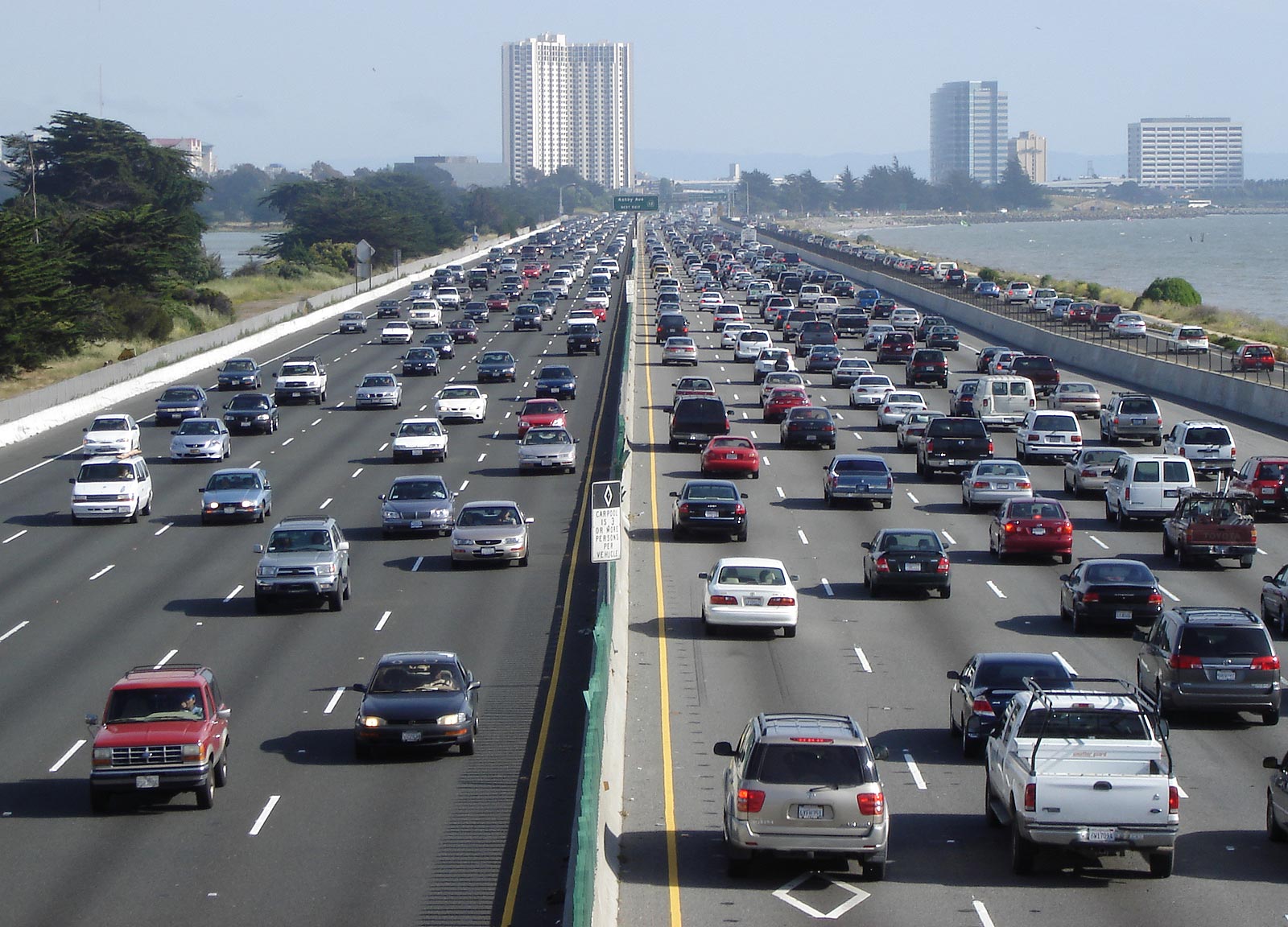
![Interstate 80 Eastshore Freeway, California][float-right] The advent of mass-produced automobiles in the early fundamentally altered personal mobility, granting individuals unprecedented independence from fixed schedules and constraints, as evidenced by the rapid rise in ownership from fewer than 8,000 registered vehicles in the U.S. in 1900 to over 23 million by 1930. This shift enabled spontaneous travel and relocation, reshaping daily routines by allowing workers to live farther from centers and facilitating easier access to remote areas for . In rural contexts, automobiles increased trip frequency to urban amenities, particularly benefiting women by expanding their social and economic horizons beyond farmstead limitations. Leisure activities underwent profound changes, with automobiles catalyzing the popularity of road trips and family vacations; post-World War II, affordable vehicles and fuel prices spurred mass adoption of interstate travel, exemplified by Route 66 becoming a iconic corridor for such outings starting in the late 1940s. Drive-in theaters, , and tourist attractions proliferated to accommodate car-based , transforming vacations from rail-dependent elite pursuits into accessible middle-class endeavors by the . Initially viewed as family-bonding tools, cars also introduced tensions by enabling youth autonomy, such as unchaperoned dating, which challenged traditional parental oversight in the . Car ownership emerged as a cultural of status and the , particularly after Henry Ford's Model T innovations made vehicles affordable for the by 1925, fostering a "car " embedded in media, music, and identity. This ethos extended to suburban expansion, where single-family homes with garages became normative, altering social interactions from neighborhood-centric to vehicle-mediated by the mid-20th century. Globally, similar patterns manifested, though tempered by varying infrastructure; in , automobiles reinforced leisure motoring traditions earlier in the century, while in developing regions, they symbolized modernization amid uneven adoption. Daily lifestyles adapted to automobile dependence, promoting sedentary patterns through services and mall-centric shopping that emerged in the , reducing incidental walking and reshaping community cohesion around parking lots rather than public squares. Empirical from the era indicate that by 1960, U.S. households averaged over one , correlating with extended commutes averaging 20-30 minutes, which expanded options but isolated individuals from walkable social networks. These transformations, while empowering personal agency, also entrenched , as cars facilitated private over communal experiences, a causal dynamic observable in the decline of shared transport's social fabric post-1920s.

Environmental and resource dimensions

Emissions profiles and air quality effects

Motor vehicles emit a range of pollutants through tailpipe exhaust, brake and tire wear, and road abrasion, significantly influencing urban air quality. Primary tailpipe emissions from (ICE) vehicles include (CO₂) as the dominant , alongside (CO), (NOx), particulate matter (PM), and volatile organic compounds (VOCs). Diesel engines typically produce higher NOx and PM levels than engines due to higher combustion temperatures and compression ratios, though they emit slightly less CO₂ per mile traveled under highway conditions. vehicles, conversely, generate more CO and hydrocarbons but lower direct PM. Electric vehicles (EVs) eliminate tailpipe emissions entirely but contribute non-exhaust PM from increased vehicle weight accelerating wear, partially offset by reducing brake dust by up to 83% compared to ICE vehicles. Road transport accounts for substantial shares of urban pollutants: in the contiguous United States, on-road emissions contribute 4–33% of ambient VOCs, NOx, and PM₂.₅ concentrations, varying by season and region. Globally, transport represents about 23% of energy-related CO₂ emissions, with urban passenger vehicles driving localized spikes in NOx (up to 50% in some cities) and PM precursors. Non-exhaust sources, such as tire PM₁₀ emissions estimated at 1.1 mg per vehicle-kilometer, now rival exhaust contributions in electrified fleets due to heavier average EV mass. These emissions degrade air quality by forming () through photochemical reactions between and VOCs, and by directly depositing PM₂.₅, which penetrates deep into lungs. and PM₂.₅ from vehicles exacerbate respiratory , , and premature mortality; for instance, vehicle-related PM₂.₅ in major Chinese urban agglomerations was linked to approximately 78,200 premature deaths annually as of recent estimates. Worldwide, tailpipe emissions contributed to around 361,000 premature deaths from PM₂.₅ and in 2010, with diesel particularly implicated in urban formation and acute respiratory irritation. Long-term exposure to these pollutants correlates with increased risks of tissue damage and chronic conditions, underscoring vehicles' causal role in localized air quality burdens despite regulatory reductions in per-vehicle emissions.
PollutantPrimary Vehicle SourcesKey Air Quality Effects
CO₂Tailpipe (all ICE fuels)Global warming; minimal direct local impact
NOxTailpipe (higher in diesel)Ozone formation, acid rain, eutrophication
PM₂.₅/PM₁₀Tailpipe (diesel), brakes, tiresRespiratory/cardiovascular harm, visibility reduction
VOCsTailpipe (gasoline), evaporationOzone precursor, toxic (e.g., benzene)
COIncomplete combustion (gasoline)Hypoxia at high concentrations

Lifecycle resource demands and waste

The production of a typical vehicle requires substantial raw materials, with an average U.S. body comprising approximately 65% , 13% aluminum, 4% magnesium, 6% plastics and polymers, alongside rubber, , and petroleum-derived components. and aluminum dominate due to their structural roles, sourced primarily from mining and bauxite extraction, respectively, which involve energy-intensive processes like and . Battery electric vehicles (BEVs) impose additional demands for critical minerals, including , , , and rare earth elements, with a single EV battery requiring up to 8 kg of , 35 kg of , and smaller quantities of , extracted via that generates significant and risks. These materials' supply chains are concentrated, with over 70% of from the Democratic Republic of Congo, amplifying geopolitical vulnerabilities in resource availability. Energy consumption in vehicle manufacturing is dominated by material processing and assembly, accounting for roughly 20-30% of a 's total lifecycle use, with production alone consuming up to 20 GJ per due to operations. usage is likewise concentrated in upstream stages, with over 95% of lifecycle water consumption (52-83 cubic meters per ) occurring during extraction and part fabrication, particularly in aluminum which requires 15-20 cubic meters per via the . For BEVs, battery cell production elevates these demands, as extraction via evaporation ponds in arid regions like South America's consumes vast water volumes—up to 500,000 liters per of —exacerbating local scarcity without proportional offsets in current scales. At end-of-life, over 50 million vehicles globally become waste annually, yielding recoverable metals but also hazardous residues like fluids, tires, and plastics if not managed. In the European Union, regulatory targets mandate 95% reuse or recovery and 85% recycling by weight for vehicles dismantled after 2015, with 22 member states achieving 85% or higher reuse/recycling rates in 2022, facilitated by depollution protocols removing oils, batteries, and airbags prior to shredding. Globally, recycling efficiency varies, with metals like steel and aluminum recycled at 90-95% rates due to economic incentives, but plastics and composites often landfilled at 50% or more, contributing to persistent waste volumes; BEV batteries pose emerging challenges, with cobalt and lithium recovery rates below 5% in many regions as of 2023, though pilot programs aim for 95% material recapture to mitigate mining pressures. Lifecycle assessments indicate that while internal combustion engine vehicles generate diffuse waste from fuel production, BEVs concentrate disposal risks in battery minerals, underscoring the need for scaled recycling infrastructure to offset upstream extraction demands.

Policy debates and empirical sustainability assessments

Policies promoting the phase-out of internal combustion engine (ICE) vehicles in favor of battery electric vehicles (BEVs) have intensified, including the European Union's 2035 ban on new ICE sales and California's analogous targets, which proponents argue accelerate decarbonization while critics contend they impose high costs and overlook grid dependencies. Subsidies such as the U.S. federal EV tax credit, offering up to $7,500 per vehicle until its 2025 elimination, have been debated for distorting markets and yielding marginal emissions reductions relative to expenditures exceeding $1 million per avoided ton of CO2 in some analyses. Fuel economy standards like the U.S. (CAFE) rules have faced scrutiny for rebound effects, where efficiency gains lead to increased vehicle miles traveled, partially offsetting emissions savings estimated at 1-2% net reduction per tightening cycle. Empirical lifecycle assessments (LCAs) of BEVs versus vehicles reveal that BEVs typically achieve 50-70% lower (GHG) emissions over their full lifecycle in regions with cleaner grids, such as the or U.S. averages, but upfront battery emissions—often 2-5 times higher than equivalents—can delay points to 20,000-50,000 miles depending on carbon intensity. In coal-reliant grids like parts of or , BEVs may emit comparably or more GHGs than efficient vehicles until grid decarbonization advances, underscoring that vehicle hinges on upstream sources rather than tailpipe zero-emissions claims alone. Sustainability assessments extend to resource demands, where BEV battery production requires 3-10 times more critical minerals like , , and than ICE vehicles, contributing to mining-related habitat loss, water depletion, and social disruptions in extraction hotspots such as the Democratic Republic of Congo and . While recycling rates remain below 5% globally, impeding circularity, studies project that scaling BEV fleets could strain supplies, potentially elevating prices and environmental costs without advanced recovery technologies. Critiques from academic sources emphasize that EV-focused policies may exacerbate inequalities by prioritizing affluent urban adopters and overlooking non-climate impacts like particulate emissions from tire wear, which BEVs amplify due to higher vehicle weights. Evaluations of efficacy, such as U.S. standards tightening from 2012-2025, confirm absolute emissions declines from new but attribute only 10-20% of total sector reductions to efficiency mandates, with broader factors like slower vehicle turnover and consumer shifts to SUVs diluting impacts. In , aggressive EV incentives achieved 80%+ by 2023, yet lifecycle GHG benefits are tempered by imported and footprints, highlighting that subsidies excel at but falter in holistic without complementary measures like sourcing reforms. These assessments reveal a causal gap between and empirical outcomes, where mandates risk over-reliance on unproven amid vulnerabilities.

Usage patterns and statistics

Global ownership and motorization metrics

As of , the global stock of passenger cars stood at approximately 1.475 billion units, representing a motorization rate of 182 cars per 1,000 people based on a world population exceeding 8 billion. Including commercial vehicles such as trucks and buses, total motor vehicle ownership estimates reach about 1.645 billion units, yielding a broader motorization rate of roughly 203 vehicles per 1,000 inhabitants. These figures derive from automotive market analyses aggregating national registration data, though exact counts vary due to differences in reporting standards and undercounting in informal economies. Passenger cars constitute the majority of the global fleet, comprising over 85% of total vehicles in use, with commercial vehicles accounting for the remainder; this composition has remained stable amid annual production of around 90-95 million new motor vehicles worldwide. Growth in ownership has accelerated in emerging markets, driven by rising incomes and urbanization, outpacing developed regions where saturation limits expansion—global stock increased by about 2-3% annually in recent years, tempered by vehicle lifespans averaging 10-15 years before scrappage. Motorization metrics highlight stark global imbalances, with the aggregate rate masking rates exceeding 800 per 1,000 in high-income nations versus under 50 in many low-income countries; empirically, with GDP exceeds 0.8, underscoring as the primary causal driver rather than policy alone. Data reliability depends on self-reported national statistics compiled by organizations like the of Motor Vehicle Manufacturers (OICA), which prioritize producer nations but may lag in comprehensive low-income coverage.

Regional disparities and influencing factors

Motor vehicle ownership rates exhibit stark regional disparities, driven primarily by levels. In high-income regions such as and , rates often surpass 500 vehicles per 1,000 inhabitants, reflecting widespread accessibility and infrastructure support. For instance, the averaged 574 passenger cars per 1,000 inhabitants as of 2024 data. In contrast, low-income regions in and typically register below 50 vehicles per 1,000 people, constrained by limited and underdeveloped networks. The predominant influencing factor is , which exhibits a strong positive with ownership across regions. Empirical analyses confirm that serves as the key determinant, enabling households to afford initial purchase costs, , maintenance, and . In rapidly industrializing economies like , ownership rates have risen sharply—from around 171 per 1,000 in 2018 to higher levels by 2024—alongside GDP growth, though still trailing advanced economies. Conversely, in , rates remain low at approximately 30 per 1,000, reflecting persistent constraints despite scale. Infrastructure quality and public transportation alternatives further modulate disparities. Regions with extensive road networks and sparse public transit, such as rural areas , foster higher ownership to meet travel demands over long distances. In densely urbanized settings like parts of or Asia's megacities, robust rail and bus systems reduce the necessity for private vehicles, suppressing ownership rates relative to income. policies, including fuel subsidies, import tariffs, and emission standards, also shape adoption; for example, high taxes in some European countries temper growth despite affluence. Cultural and geographic elements contribute marginally but notably. In car-centric societies like the , vehicle ownership aligns with lifestyle norms emphasizing and suburban living, sustaining high rates even amid rising fuel costs. Arid or regions may face elevated expenses, deterring ownership, while tropical developing areas contend with poor durability from weather, amplifying maintenance barriers. These factors interact with economic baselines, underscoring that disparities stem fundamentally from causal chains of accumulation, infrastructural , and incentives rather than isolated cultural preferences.

Projections and trend analyses

The global light-duty vehicle fleet, encompassing passenger cars and light trucks, is anticipated to expand significantly through mid-century, primarily due to sustained and in developing regions, with stock levels potentially surpassing 2 billion units by 2050 under baseline economic assumptions that do not fully account for disruptive shifts like widespread shared mobility. In non- countries, motorization rates—measured as vehicles per 1,000 people—are projected to rise from current levels below 100 in many areas to approach 200-300 by 2050, correlating with GDP increases that historically drive vehicle acquisition until saturation points around 500-600 vehicles per 1,000 in high-income economies. motorization rates, already near 530 vehicles per 1,000, are expected to stabilize or slightly decline amid aging fleets and slower population growth. Electrification trends indicate a gradual substitution of vehicles, with the conventional light-duty fleet projected to peak around 2038 before modest declines as (EV) penetration accelerates, reaching 34% of the fleet and 28% of the non- fleet by 2050 in scenarios incorporating current policies and technology costs. Global EV stock (excluding two- and three-wheelers) is forecasted to grow from approximately 30 million in 2022 to 240 million by 2030 under stated policies, representing about 17% of the total light-duty fleet, though this assumes continued subsidies and infrastructure buildout that have faced delays in practice. Annual light-duty vehicle sales are expected to hover around 85 million units in 2025, with EVs comprising roughly 20-25% of new sales, but projections beyond 2030 vary widely based on battery supply chains and policy enforcement, with optimistic net-zero pathways requiring 60% EV sales share by 2030 to align with emissions targets—a threshold unmet in baseline economic modeling without aggressive mandates. In , vehicle fleet size could double by 2050 from current levels of around 50 million, propelled by middle-class expansion and investments, though low baseline motorization (under 50 vehicles per 1,000 in most nations) underscores the potential for to affordable EVs if grid reliability improves; however, empirical data from similar transitions in suggest internal combustion dominance persists without subsidies due to cost and fueling advantages. Shared mobility and autonomous vehicles (AVs) are hyped as ownership disruptors, with surveys indicating 46% of consumers open to forgoing private cars for alternatives by the , yet causal analyses reveal limited evidence of reduced ownership rates, as often complement rather than substitute personal vehicles, particularly in suburban or rural contexts where utilization favor ownership. Projections for shared AVs to capture 50% of miles traveled in developed countries by 2040 rely on regulatory approvals and liability resolutions, which remain uncertain given historical delays in AV deployment scaling beyond controlled pilots. Overall, trend analyses emphasize that while technological shifts may temper growth in per ownership, demographic pressures and income elasticities will sustain fleet expansion absent countervailing factors like urban densification or price shocks.

Safety records and regulatory evolution

Historical accident data and causal factors

In the , motor vehicle fatalities peaked at over 52,000 in 1970, declining to approximately 36,000 by 2019 before rising to 42,721 in 2022 and falling to an estimated 40,901 in 2023, reflecting a 4.3% decrease from the prior year. Fatality rates per 100,000 have improved markedly since the mid-20th century; for instance, the rate per 10,000 registered dropped from 33.38 in 1913 to 1.57 in 2023, a 95% reduction attributable to advancements in , , and . Globally, deaths numbered around 1.19 million in 2021, equating to a rate of 15 deaths per 100,000 , with approximately 1.2 million annual fatalities representing 2.3% of all global deaths; while overall numbers have shown modest declines since 2010 (about 5%), regional variations persist, including a 17% increase in . Empirical analyses consistently identify as the primary causal factor in motor vehicle crashes, accounting for 94% of incidents according to the National Highway Safety Administration's (NHTSA) review of crash data. The NHTSA's National Motor Vehicle Crash Causation Survey (NMVCCS), examining over 5,000 crashes from 2005-2007, assigned critical reasons—defined as the immediate precipitating event—to drivers in 93% of cases, with recognition errors (e.g., inattention or ) at 41%, decision errors (e.g., excessive speed or impairment) at 33%, and performance errors (e.g., non-compliance with controls) at 7%; vehicle factors contributed to only 2%, and environmental factors to 4%. These human-centric causes align with first-principles assessments of driver agency, where behavioral choices directly initiate kinematic chains leading to collisions, though interactions with road geometry or can amplify risks without being primary. Secondary factors, such as roadway design deficiencies or mechanical failures, play marginal roles but warrant scrutiny for their contributory effects; for example, poor or wet surfaces exacerbate human errors rather than independently causing crashes in most sets. Speeding and alcohol impairment emerge as recurrent decision errors, with NHTSA linking them to 26% and 31% of fatalities, respectively, underscoring enforcement's role in mitigating behavioral risks over passive infrastructural fixes. Despite gains reducing per- fatality rates by over 90% historically, rising vehicle miles traveled and persistent human factors have offset absolute declines, highlighting the limits of technological interventions absent behavioral accountability.

Evolving standards and enforcement mechanisms

Vehicle safety standards originated in the mid-20th century amid rising traffic fatalities, with the enacting the National Traffic and Motor Vehicle Safety Act of 1966, which established the (NHTSA) and introduced (FMVSS) effective January 1, 1968, mandating features such as side marker lights, collapsible columns, and improved braking systems. These standards evolved from basic mechanical safeguards to comprehensive requirements, including mandatory seat belts by 1968 and head restraints by 1969, reducing occupant ejection risks through empirical testing showing their efficacy in frontal impacts. By the , standards incorporated dual front airbags and anti-lock braking systems (ABS), with NHTSA data indicating that such passive and active safety features cumulatively saved over 27,000 lives annually by 2012 compared to 115 in 1960. In , harmonized regulations under the Economic Commission for Europe (UNECE) framework began in the 1950s but gained momentum with the 2007 General Safety Regulation, expanding to mandatory () by 2014, which studies attribute to a 20-50% reduction in single-vehicle crashes. The 2019 General Safety Regulation (EU 2019/2144) marked a shift toward intelligent systems, requiring advanced driver-assistance systems (ADAS) like autonomous emergency braking (AEB) for pedestrians and cyclists from 2022 for new models and 2024 for all registrations, projected to prevent 25,000 fatalities by 2038 through real-world data on collision avoidance. , established in 1997 as a voluntary program, influences standards by rating vehicles on crash tests and safety assists, pressuring manufacturers via market incentives rather than direct mandates, with protocols updated biennially to include vulnerable road user protection and lane-keeping assist. Enforcement mechanisms rely on pre-market certification, post-market surveillance, and penalties. In the , NHTSA enforces FMVSS through manufacturer self-certification verified by independent crash testing at facilities like the Vehicle Research and Test Center, with non-compliance triggering recalls—over 1,000 annually—and civil penalties up to $25,000 per violation, escalating for knowing failures. The agency's (NCAP), updated in November 2024 to include blind-spot intervention and pedestrian AEB, uses star ratings to inform consumers without regulatory force. European enforcement falls to type-approval authorities under the , conducting audits and random checks, with the Market Surveillance Regulation enabling product withdrawals for defects; non-adherence to GSR can result in bans and fines up to 4% of global turnover under broader EU law. Recent developments, such as NHTSA's 2025 automated vehicle framework amending standing orders for crash reporting and FMVSS modernization for , address emerging risks by requiring data transparency while avoiding overregulation that could stifle innovation, as evidenced by exemptions for low-volume AV producers. These evolutions reflect causal links between rigorous testing, empirical outcomes like EU's 36% fatality drop since versus US increases, and adaptive enforcement to balance safety gains against verifiable technological feasibility.

Technological mitigations and their efficacy

Airbags, introduced widely in the , reduce driver fatalities by an estimated 11% across all crash types, with greater efficacy—up to 29%—in frontal impacts where deployment occurs. Side-curtain and torso airbags further decrease driver death risk by 37% and 26%, respectively, in driver-side collisions involving another vehicle. These passive restraints complement seat belts, yielding combined mortality reductions of up to 67% versus no restraint use, though benefits diminish without belt compliance. Antilock braking systems (ABS), mandatory in many markets since the early , exhibit neutral overall impact on fatal crash rates for passenger cars, as reductions in multi-vehicle collisions offset increases in single-vehicle run-off-road events. ABS lowers fatal rollover risk on wet roads by preventing skids, but dry-road data show a 51% rise in such fatalities, attributed to overconfidence in during braking. For motorcycles, correlates with a 31% drop in fatal crashes per registered vehicle year. Electronic stability control (ESC), required in U.S. vehicles since 2012, substantially curbs fatal single-vehicle crashes by 31% for passenger cars and 50% for SUVs, primarily by mitigating loss-of-control scenarios like spins and rollovers. Independent analyses confirm ESC's role in 13-58% fewer rollover incidents resulting in injury, with higher efficacy for sport utility vehicles due to their higher center of gravity. Advanced assistance systems (ADAS), including braking (AEB), demonstrate improving real-world efficacy, reducing front-to-rear crashes by 49% in equipped vehicles from model years 2015-2023. AEB effectiveness rose from 46% in 2015-2017 models to 52% in 2021-2023 models, reflecting and refinements, though performance varies by speed and environmental conditions. Forward collision warning alone cuts rear-end crashes by 41%, but full AEB systems achieve broader prevention, with up to 79% avoidance in simulated low-speed rear-end scenarios. Limitations persist, including reduced utility in detection without dedicated modes and potential over-reliance fostering riskier . Overall, NHTSA evaluations indicate these technologies have saved thousands of lives since widespread adoption, though causal attribution requires controlling for concurrent improvements in roads and enforcement.

Innovations and future trajectories

Electrification and alternative power shifts

Electric vehicles, powered by rechargeable batteries rather than internal engines, trace their origins to prototypes developed in the early , with practical models emerging by the in and the . By the late 1890s and early 1900s, electric cars comprised about one-third of vehicles on U.S. roads, favored for quiet operation and lack of compared to or alternatives, but their dominance waned after 1912 due to Henry Ford's mass-produced Model T, abundant cheap , and advancements in starter motors eliminating hand-cranking for engines. Renewed interest arose in the amid oil crises, leading to limited production like the GM EV1 in 1996, followed by hybrid introductions such as Toyota's Prius in 1997, which combined electric and powertrains. The modern surge began with Tesla's Roadster in 2008, leveraging lithium-ion batteries for extended range and accelerating commercialization. Global sales of battery electric and plug-in hybrid vehicles reached approximately 17 million units in 2024, capturing over 20% of new car sales worldwide, up 25% from 2023, though growth varied regionally with China accounting for 66% of the market at over 11 million units. Battery electrics dominated at 62.5% of electric sales, while plug-in hybrids held 37.5%, reflecting preferences for longer-range options amid charging infrastructure limitations. In Norway, policy incentives like tax exemptions propelled plug-in electric vehicles to over 80% market share by 2023, sustained into 2024, demonstrating how subsidies and mandates can drive adoption in small, affluent markets with clean grids. Conversely, Europe's overall electric sales dipped 3% in 2024 due to subsidy phase-outs and economic pressures, while U.S. share hovered at 8.1%. Alternative powertrains beyond batteries include hydrogen fuel cells, (CNG), and biofuels, but their adoption remains marginal compared to . Hydrogen fuel cell vehicles numbered fewer than 50,000 globally by 2024, constrained by scarce refueling stations and high production costs, though they offer rapid refueling and longer ranges suitable for heavy-duty applications. and vehicles captured 14.9% of U.S. Class 8 sales in 2024, appealing for fleet operators seeking lower emissions and fuel costs in regions with gas , yet diesel persisted at over 85%. Biofuel-compatible flex-fuel vehicles, prevalent in since the 2003 ethanol mandate, enabled over 90% of new cars to run on sugarcane-derived by 2008, reducing oil imports but facing scalability limits from and feedstock competition. Empirical lifecycle assessments indicate battery electric vehicles emit 41-70% fewer greenhouse gases over their lifetime than comparable vehicles when charged on average global grids, though upfront manufacturing emissions from battery production—equivalent to 2-5 years of ICE operation—elevate totals in coal-dependent regions like parts of or . Battery supply chains pose environmental risks, including water-intensive lithium and cobalt mining that has polluted ecosystems in the of Congo and South America's "," alongside concerns like child labor in artisanal cobalt extraction. Recycling rates lag below 5% globally, exacerbating , while grid integration challenges include increased straining aging without corresponding upgrades. These factors underscore that electrification's net benefits hinge on cleaner decarbonization and sustainable sourcing, rather than assuming inherent superiority over improved ICE efficiency.

Autonomy, connectivity, and software integration

Autonomous driving systems in motor vehicles are classified by the Society of Automotive Engineers (SAE) into six levels, from Level 0 (no automation) to Level 5 (full automation without human intervention in any conditions). As of 2025, most production vehicles operate at Level 2 or Level 2+ advanced driver-assistance systems (ADAS), which require constant human supervision for steering, acceleration, and braking, such as Tesla's Autopilot and Full Self-Driving (FSD) beta deployed in over 4 million vehicles globally. Higher levels remain limited: Level 3 systems, allowing hands-off driving in specific conditions, are rare and confined to premium models like Mercedes-Benz's Drive Pilot in select U.S. markets, while Level 4 deployments, such as Waymo's robotaxis, operate only in geofenced urban areas like Phoenix and San Francisco, accumulating millions of miles but facing scalability issues due to mapping and sensor dependencies. Level 5 autonomy has not been commercially achieved, as vehicles still struggle with unstructured environments, adverse weather, and edge cases that human drivers handle intuitively. Safety data for autonomous systems is inconclusive and often derived from company-reported metrics rather than comprehensive independent audits. NHTSA investigations highlight incidents, including Waymo's 464 reported crashes in 2025 through August, many involving rear-end collisions or failures to yield, though Waymo claims its vehicles cause fewer at-fault incidents per mile than human benchmarks. Cruise, a General Motors subsidiary, scaled back operations after a 2023 pedestrian-dragging incident, resuming limited testing by 2025 but with reduced fleet sizes. Tesla's vision-only FSD approach, relying on cameras without lidar, has enabled broader data collection from real-world driving but correlates with higher disengagement rates and NHTSA probes into crashes, including 13 fatalities linked to Autopilot misuse as of mid-2025. Comparative analyses indicate autonomous vehicles may reduce certain crash types, like rear-end collisions, by up to 90% in controlled insurance claims data, but overall fatality rates remain comparable to or higher than human-driven vehicles in unsupervised modes due to brittleness in novel scenarios. Causal factors include overreliance on probabilistic AI models, which falter in low-probability events, underscoring that human oversight mitigates errors more effectively than current algorithms in diverse real-world conditions. Connectivity features integrate vehicles with external networks via (V2X) communication, encompassing vehicle-to-vehicle (V2V), vehicle-to-infrastructure (V2I), and vehicle-to-pedestrian (V2P) protocols to enhance . (C-V2X), leveraging for low-latency data exchange, has emerged as the dominant standard by 2025, with U.S. plans mandating its implementation for safer intersections and hazard warnings, projecting up to 80% reduction in non-impaired crashes through preemptive alerts. Adoption lags due to costs and allocation disputes, with only about 5% of new vehicles equipped in 2025, primarily in and where regulatory incentives accelerate deployment. systems like Apple CarPlay and dominate connectivity for navigation and entertainment, but cybersecurity vulnerabilities in V2X expose risks of hacking, as evidenced by simulated attacks disrupting traffic signals in lab tests. Software integration has shifted vehicles toward software-defined architectures, enabling over-the-air (OTA) updates to refine performance, add features, and address defects without physical service visits. Tesla pioneered OTA since 2012, delivering billions of miles of iterative improvements to FSD via fleet data, though hardware limitations in older models (e.g., HW3) have prompted legal challenges over unfulfilled autonomy promises. General Motors expanded OTA to 4.5 million vehicles by 2025 through its Vehicle Intelligence Platform, tying warranty coverage to timely updates—skipping them voids claims for software-related failures, reflecting causal links between outdated code and malfunctions like unintended acceleration. Ford and others follow suit, with OTA capacity projected to grow 10-fold via centralized computing, but persistent issues include download failures (affecting 20-30% of attempts) and compatibility constraints that limit scalability compared to consumer electronics. This integration promises longevity through remote enhancements but introduces dependencies on cloud connectivity and manufacturer control, potentially exacerbating repair monopolies and data privacy concerns under regulations like the EU's GDPR. Overall, while autonomy, connectivity, and software advance efficiency, empirical evidence reveals persistent gaps in reliability, with full realization hindered by physical-world complexities beyond algorithmic prediction.

Challenges in adoption and scalability

The transition to electrified motor vehicles encounters significant supply chain constraints, particularly in sourcing critical minerals such as lithium, cobalt, and nickel essential for battery production. Global EV battery demand is forecasted to exceed 3 terawatt-hours annually by 2030, up from approximately 1 terawatt-hour in 2024, amplifying pressures on mining output and refining processes, where China controls over 60% of capacity for key materials like graphite and refined lithium. These dependencies expose manufacturers to geopolitical risks, trade restrictions, and shortages exacerbated by rapid demand growth, with some U.S. battery projects canceled in early 2025 due to escalating costs and policy shifts. Disruptions from events like semiconductor shortages and prior COVID-19 impacts have further delayed scaling, hindering the ability to meet projected vehicle production targets without diversified, non-Chinese sourcing. Charging infrastructure scalability remains a core barrier, as electrical grids in many regions lack the capacity to support mass EV integration without upgrades that could take years and billions in investment. In , energy capacity constraints were cited by over 80% of charging network operators as their primary concern, with public stations growing slower than EV sales—leading to reliability issues like out-of-service chargers misreported as available. More than 90% of charging occurs at private residences, but expanding public networks faces challenges, permitting delays, and insufficient ultra-fast options, contributing to persistent and slow adoption rates outside subsidized markets. Consumer and economic hurdles compound these issues, with high upfront costs—often exceeding $40,000 for entry-level models—and charging times deterring 50-60% of potential buyers in surveys from the U.S. and . Regulatory inconsistencies, including varying incentives and emissions mandates, add uncertainty, while battery lifecycle environmental costs, such as , raise questions about net sustainability gains absent recycling advancements. Autonomous vehicle deployment faces parallel scalability obstacles, including unresolved technical reliability in handling rare edge cases and complex real-world environments, which demand vast testing datasets and computational resources beyond current capabilities. Regulatory frameworks, often rooted in human-driver assumptions, risk stifling innovation by imposing lengthy approvals that outpace technology evolution, while public skepticism—fueled by high-profile incidents—creates psychological barriers, with adoption surveys indicating low trust in fully driverless systems. Infrastructure adaptations, such as smart road integrations and liability reallocations, require coordinated investments across jurisdictions, delaying fleet-scale rollout projected into the 2030s. Connectivity-dependent features, like vehicle-to-everything communication, further strain bandwidth and cybersecurity protocols, amplifying vulnerabilities in scaled networks.

References

Add your contribution
Related Hubs
User Avatar
No comments yet.