



Community hub
Recent from talks
Contribute something
Nothing was collected or created yet.
Multipath propagation
View on Wikipedia | This article needs additional citations for verification. (October 2021) |
In radio communication, multipath is the propagation phenomenon that results in radio signals reaching the receiving antenna by two or more paths. Causes of multipath include atmospheric ducting, ionospheric reflection and refraction, and reflection from water bodies and terrestrial objects such as mountains and buildings. When the same signal is received over more than one path, it can create interference and phase shifting of the signal. Destructive interference causes fading; this may cause a radio signal to become too weak in certain areas to be received adequately. For this reason, this effect is also known as multipath interference or multipath distortion.
Where the magnitudes of the signals arriving by the various paths have a distribution known as the Rayleigh distribution, this is known as Rayleigh fading. Where one component (often, but not necessarily, a line of sight component) dominates, a Rician distribution provides a more accurate model, and this is known as Rician fading. Where two components dominate, the behavior is best modeled with the two-wave with diffuse power (TWDP) distribution. All of these descriptions are commonly used and accepted and lead to results. However, they are generic and abstract/hide/approximate the underlying physics.
Interference
[edit]
Multipath interference is a phenomenon in the physics of waves whereby a wave from a source travels to a detector via two or more paths and the two (or more) components of the wave interfere constructively or destructively. Multipath interference is a common cause of "ghosting" in analog television broadcasts and of fading of radio waves.


The condition necessary is that the components of the wave remain coherent throughout the whole extent of their travel.
The interference will arise owing to the two (or more) components of the wave having, in general, travelled a different length (as measured by optical path length – geometric length and refraction (differing optical speed)), and thus arriving at the detector out of phase with each other.
The signal due to indirect paths interferes with the required signal in amplitude as well as phase which is called multipath fading.
Examples
[edit]In analog facsimile and television transmission, multipath causes jitter and ghosting, seen as a faded duplicate image to the right of the main image. Ghosts occur when transmissions bounce off a mountain or other large object, while also arriving at the antenna by a shorter, direct route, with the receiver picking up two signals separated by a delay.

In radar processing, multipath causes ghost targets to appear, deceiving the radar receiver. These ghosts are particularly bothersome since they move and behave like the normal targets (which they echo), and so the receiver has difficulty in isolating the correct target echo. These problems can be minimized by incorporating a ground map of the radar's surroundings and eliminating all echoes which appear to originate below the ground or above a certain height (altitude).
In digital radio communications (such as GSM) multipath can cause errors and affect the quality of communications. The errors are due to intersymbol interference (ISI). Equalizers are often used to correct the ISI. Alternatively, techniques such as orthogonal frequency division modulation and rake receivers may be used.

In a Global Positioning System receiver, multipath effects can cause a stationary receiver's output to indicate as if it were randomly jumping about or creeping. When the unit is moving the jumping or creeping may be hidden, but it still degrades the displayed accuracy of location and speed.
In wired media
[edit]Multipath propagation is similar in power line communication and in telephone local loops. In either case, impedance mismatch causes signal reflection.
High-speed power line communication systems usually employ multi-carrier modulations (such as OFDM or wavelet OFDM) to avoid the intersymbol interference that multipath propagation would cause. The ITU-T G.hn standard provides a way to create a high-speed (up to 1 gigabit per second) local area network using existing home wiring (power lines, phone lines, and coaxial cables). G.hn uses OFDM with a cyclic prefix to avoid ISI. Because multipath propagation behaves differently in each kind of wire, G.hn uses different OFDM parameters (OFDM symbol duration, guard interval duration) for each media.
DSL modems also use orthogonal frequency-division multiplexing to communicate with their DSLAM despite multipath. In this case the reflections may be caused by mixed wire gauges, but those from bridge taps are usually more intense and complex. Where OFDM training is unsatisfactory, bridge taps may be removed.
Mathematical modeling
[edit]
The mathematical model of the multipath can be presented using the method of the impulse response used for studying linear systems.
Suppose you want to transmit a single, ideal Dirac pulse of electromagnetic power at time 0, i.e.

At the receiver, due to the presence of the multiple electromagnetic paths, more than one pulse will be received, and each one of them will arrive at different times. In fact, since the electromagnetic signals travel at the speed of light, and since every path has a geometrical length possibly different from that of the other ones, there are different air travelling times (consider that, in free space, the light takes 3 μs to cross a 1 km span). Thus, the received signal will be expressed by
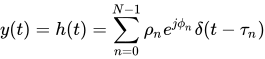
where is the number of received impulses (equivalent to the number of electromagnetic paths, and possibly very large), is the time delay of the generic impulse, and represent the complex amplitude (i.e., magnitude and phase) of the generic received pulse. As a consequence, also represents the impulse response function of the equivalent multipath model.


More in general, in presence of time variation of the geometrical reflection conditions, this impulse response is time varying, and as such we have


Very often, just one parameter is used to denote the severity of multipath conditions: it is called the multipath time, , and it is defined as the time delay existing between the first and the last received impulses



In practical conditions and measurement, the multipath time is computed by considering as last impulse the first one which allows receiving a determined amount of the total transmitted power (scaled by the atmospheric and propagation losses), e.g. 99%.
Keeping our aim at linear, time invariant systems, we can also characterize the multipath phenomenon by the channel transfer function , which is defined as the continuous time Fourier transform of the impulse response


where the last right-hand term of the previous equation is easily obtained by remembering that the Fourier transform of a Dirac pulse is a complex exponential function, an eigenfunction of every linear system.
The obtained channel transfer characteristic has a typical appearance of a sequence of peaks and valleys (also called notches); it can be shown that, on average, the distance (in Hz) between two consecutive valleys (or two consecutive peaks), is roughly inversely proportional to the multipath time. The so-called coherence bandwidth is thus defined as

For example, with a multipath time of 3 μs (corresponding to a 1 km of added on-air travel for the last received impulse), there is a coherence bandwidth of about 330 kHz.
See also
[edit]- Choke ring antenna, a design that can reject extraneous reflection signals
- Diversity schemes
- Doppler spread
- Fading
- Lloyd's mirror
- Olivia MFSK
- Orthogonal frequency-division multiplexing
- Rician fading
- Signal flow
- Two-ray ground-reflection model
- Ultra wide-band
- Rake receiver
References
[edit]
 This article incorporates public domain material from Federal Standard 1037C. General Services Administration. Archived from the original on 2022-01-22.
| Terrestrial |
| ||||||||||||
|---|---|---|---|---|---|---|---|---|---|---|---|---|---|
| Satellite |
| ||||||||||||
| Codecs | |||||||||||||
| Subcarrier signals | |||||||||||||
| |||||||||||||


Multipath propagation
View on GrokipediaFundamentals
Definition and Principles
Multipath propagation refers to the phenomenon in which electromagnetic waves or signals from a transmitter reach the receiver via multiple indirect paths, in addition to any direct line-of-sight (LOS) path, due to interactions such as reflection, diffraction, scattering, or refraction with environmental obstacles like buildings, terrain, or atmospheric layers.[3] This contrasts with single-path propagation, where the signal travels solely along the LOS route without significant environmental interference, resulting in a more predictable but limited range.[3] In multipath scenarios, the multiple signal components arrive with varying amplitudes, phases, and time delays, potentially leading to interference effects.[3] The basic principles of multipath propagation are rooted in wave theory, particularly the Huygens-Fresnel principle, which posits that every point on a wavefront acts as a source of secondary spherical wavelets that interfere to form the subsequent wavefront, enabling the description of diffraction and scattering processes.[3] At high frequencies, where the signal wavelength is much smaller than the size of surrounding obstacles, geometric optics approximations like ray tracing become effective for modeling these paths, treating signals as rays that reflect, diffract at edges, or scatter off surfaces.[3] This wavelength-obstacle size relationship determines the dominance of multipath: shorter wavelengths (higher frequencies) enhance ray-like behavior and distinct path formation, while longer wavelengths may lead to more diffuse propagation.[3] A representative diagram of multipath illustrates a transmitter emitting a signal that follows a direct LOS path to the receiver, alongside reflected paths bouncing off nearby surfaces (e.g., ground or walls) and diffracted paths bending around obstacles, all converging at the receiver with phase differences.[3] Early observations of multipath effects emerged in radio wave experiments during the late 19th and early 20th centuries, building on foundational work by James Clerk Maxwell, who in 1864 theoretically predicted electromagnetic waves, and Heinrich Hertz, who experimentally confirmed their propagation in 1887.[3] Guglielmo Marconi's pioneering wireless telegraphy trials from 1897 to 1901 demonstrated transatlantic signal reception in 1901–1902, which puzzled contemporaries due to the signals' apparent circumvention of Earth's curvature via ionospheric reflections—a rudimentary multipath mechanism not fully understood until ionospheric research in the 1920s.[4] These experiments highlighted non-LOS propagation, shifting recognition from purely ground-wave assumptions to the role of environmental reflections in enabling long-distance communication.[4]Causes in Propagation Media
Multipath propagation arises from several fundamental physical mechanisms in the propagation medium that cause electromagnetic waves to deviate from a single direct path, resulting in multiple arrival paths at the receiver. These mechanisms include reflection, diffraction, scattering, and refraction, each governed by wave interactions with environmental obstacles and atmospheric conditions.[3][5] Reflection occurs when an electromagnetic wave encounters a large surface, such as buildings, the ground, or bodies of water, that is much larger than the signal's wavelength, causing the wave to bounce back with the angle of incidence equal to the angle of reflection. This process generates delayed signal copies that follow indirect routes to the receiver. In urban environments, reflections off building facades and vehicles are particularly prominent, creating clusters of multipath components.[5][3][6] Diffraction takes place when a wave meets an obstructive edge or corner, such as the rooftop of a building or a hilltop, larger than its wavelength, leading the wave to bend around the obstacle and propagate into shadowed regions. This phenomenon is explained by Huygens' principle, where secondary wavelets emerge from the edge to continue propagation. Diffraction is especially relevant in terrains with sharp obstructions, allowing signals to reach areas without line-of-sight.[7][6][3] Scattering happens when a wave interacts with small objects or rough surfaces, such as foliage, street signs, or irregular terrain, that are comparable to or smaller than the wavelength, resulting in random redirection of the signal energy in multiple directions. The degree of scattering increases with surface roughness and the density of scatterers, dispersing the wave into numerous weak components. This is common in vegetated areas or cluttered urban settings where small-scale irregularities dominate.[5][7][6] Refraction involves the bending of a wave as it passes through regions of varying medium density, such as atmospheric layers or the ionosphere, following Snell's law where the wave speed changes alter its direction. This mechanism is prominent in tropospheric ducts or during ionospheric disturbances, creating curved paths that extend signal range beyond the horizon. Weather conditions like temperature inversions can enhance refractive effects by creating gradient layers in the atmosphere.[7][5][3] The prevalence of these mechanisms varies with environmental factors. In urban areas, dense buildings amplify reflections and scattering, leading to higher multipath density compared to rural settings where open terrain favors diffraction and ground reflections. Frequency plays a key role, as higher frequencies (e.g., above 30 MHz) experience reduced diffraction but increased scattering from small obstacles, while lower frequencies propagate more readily via ground waves. Terrain features like hills promote diffraction, and vegetation such as trees induces scattering through leaf and branch interactions. Weather phenomena, including rain and fog, exacerbate scattering and refraction, particularly at millimeter-wave frequencies where attenuation from precipitation can significantly alter path creation.[3][6][5]Effects on Signals
Interference Patterns
In multipath propagation, signals arriving via multiple paths superimpose at the receiver, resulting in interference patterns determined by their relative amplitudes and phases. This superposition can lead to variations in the received signal strength, where the combined effect is the vector sum of the individual path contributions.[8] Constructive interference occurs when multipath components arrive in phase, aligning their electric fields to amplify the resultant signal amplitude, potentially increasing it by up to 6 dB in two-path scenarios compared to a single path. This enhancement arises because the phases of the signals are multiples of , allowing coherent addition that boosts the overall field strength.[3] Destructive interference, conversely, happens when path components are out of phase by odd multiples of , causing partial or complete cancellation of the signal and forming nulls where the received amplitude approaches zero. For instance, a phase offset of between two equal-amplitude paths results in total cancellation, significantly attenuating the signal.[8] Phase differences between multipath components originate from variations in path lengths , given by , where is the signal wavelength; these differences, combined with the speed of light , determine whether interference is constructive or destructive.[3] Multipath-induced delay spread refers to the temporal dispersion caused by differing arrival times of path components, quantified as , which smears the signal in time and contributes to intersymbol interference in broadband systems.[9] The resultant electric field at the receiver is modeled as the complex sum , where is the amplitude of the -th path and its phase, illustrating how phase alignment dictates the interference outcome.[10] Phasor diagrams visualize this process by representing each multipath component as a vector with magnitude and angle ; constructive interference corresponds to vectors aligning closely, yielding a longer resultant phasor, while destructive cases show opposing vectors that shorten or nullify the sum.[11]Fading and Distortion
Multipath propagation leads to signal fading, where the received signal amplitude varies due to the constructive and destructive interference of multiple path components. This fading manifests as rapid fluctuations in signal strength, degrading communication reliability. In environments without a dominant line-of-sight (LOS) path, such as urban areas with scattering, the envelope of the received signal follows a Rayleigh distribution, characterized by the probability density function (PDF) where is the envelope amplitude and is the root-mean-square (RMS) value of the envelope.[12] This model assumes numerous independent multipath components with random phases, resulting in deep fades where the signal can drop below noise levels.[13] In scenarios with a strong LOS component alongside multipath, the fading envelope follows a Rician distribution, which includes a non-zero mean and exhibits less severe fades compared to Rayleigh.[14] Flat fading occurs when the signal bandwidth is narrower than the channel's coherence bandwidth, causing uniform amplitude and phase variations across the entire signal spectrum without introducing distortion in the time domain.[14] This type of fading primarily affects the signal's overall strength, leading to probabilistic outage events modeled by Rayleigh or Rician statistics. In contrast, frequency-selective fading arises when the signal bandwidth exceeds the coherence bandwidth, resulting in different frequency components experiencing varying attenuation and phase shifts.[14] This selectivity causes pulse broadening, where the received pulse spreads in time due to differing path delays, leading to intersymbol interference (ISI) in digital systems.[15] Doppler spread introduces time-varying characteristics to the channel when transmitter, receiver, or scatterers are in motion, shifting the frequency of each multipath component based on the relative velocity and angle of arrival.[14] The maximum Doppler shift , where is the velocity, the carrier frequency, and the speed of light, determines the spread, causing the channel to decorrelate over time scales shorter than the coherence time . In digital communications, these effects distort the waveform, closing the eye diagram and increasing bit error rates by overlapping consecutive symbols.[15] For example, in mobile scenarios, rapid channel variations from Doppler exacerbate ISI in frequency-selective channels, compounding the distortion from multipath delays.[14]Applications and Examples
Wireless Communication Scenarios
In mobile radio systems, multipath propagation is particularly pronounced in urban canyons, where signals reflect off tall buildings, creating multiple delayed paths that interfere with the direct signal and cause fast fading. This phenomenon leads to rapid signal fluctuations as the receiver moves, impacting the reliability of cellular networks such as GSM and LTE, where the coherence time can drop to milliseconds in dense environments. Indoor wireless environments, like those using Wi-Fi, experience multipath due to reflections from walls, furniture, and ceilings, resulting in root-mean-square (RMS) delay spreads typically up to 100 ns, which broadens the channel impulse response and complicates high-data-rate transmissions. These effects are more severe in non-line-of-sight (NLOS) configurations, where the signal arrives via scattered paths, increasing inter-symbol interference in standards like IEEE 802.11. In satellite communications, multipath propagation manifests through ionospheric scintillation, where electron density irregularities refract signals, and tropospheric multipath from atmospheric layers, both degrading GPS accuracy by introducing phase errors and pseudorange biases up to several meters. These impairments are critical for navigation receivers, as they can cause signal fading and positioning errors in real-time applications. Broadcasting systems, such as FM radio and television, encounter multipath in hilly terrain, where echoes from slopes create "ghosting" in TV images or audible distortions in FM audio, with delay spreads extending reception ghosts by tens of microseconds. In such landscapes, the reflected paths can arrive with significant Doppler shifts due to terrain undulations, exacerbating signal distortion for fixed and mobile receivers. A notable case in modern systems is 5G millimeter-wave (mmWave) bands, operating at 28 GHz or higher, where short wavelengths amplify multipath severity through frequent blockages and rich scattering, leading to sparse but strong NLOS components that can boost coverage but also cause deep fades if not mitigated by beamforming. This propagation behavior necessitates advanced antenna arrays to exploit multipath for spatial multiplexing in urban deployments.[16] To characterize these effects, measurement techniques like channel sounding are employed in field tests, using wideband signals such as pseudonoise sequences to capture the impulse response and resolve multipath components with nanosecond resolution. These sounders enable empirical modeling of delay profiles and angular spreads, informing system design for diverse wireless scenarios.[17]Wired and Optical Media
In wired and optical media, multipath propagation manifests through guided wave phenomena where signals travel via multiple internal paths within the transmission structure, leading to dispersion and distortion. Unlike free-space propagation, these effects arise primarily from the geometry and material properties of the medium rather than external environmental reflections. This results in more predictable but material-dependent multipath behaviors, such as mode coupling or reflections at discontinuities. In coaxial cables, multipath effects can occur due to the excitation of higher-order propagation modes beyond the dominant transverse electromagnetic (TEM) mode, particularly in larger-diameter or multimode designs at higher frequencies. This modal dispersion causes different modes to propagate at varying velocities, spreading the signal pulse and introducing intersymbol interference. Reflections from impedance mismatches at connectors or bends further contribute to multipath-like echoes, exacerbating distortion in high-speed applications. Twisted-pair wires, commonly used in Ethernet and telephony, experience multipath propagation mainly through crosstalk between adjacent pairs and reflections caused by impedance mismatches at junctions, splices, or terminations. These reflections generate "ghost" signals that arrive delayed relative to the direct path, mimicking multipath interference and degrading signal integrity, especially in unshielded twisted-pair (UTP) configurations. The twisting geometry mitigates some crosstalk by canceling electromagnetic coupling, but mismatches can still produce significant echoes in long runs. Optical fibers exhibit pronounced multipath effects due to modal propagation. In multimode fibers, light travels through multiple spatial modes with differing path lengths and velocities, resulting in intermodal dispersion that broadens pulses. Single-mode fibers, designed to support only one spatial mode, are less affected by intermodal dispersion but remain susceptible to birefringence-induced multipath, where polarization modes propagate at slightly different speeds, causing polarization mode dispersion (PMD). PMD arises from intrinsic fiber asymmetries and external stresses, leading to differential group delays on the order of picoseconds per kilometer. A key difference from wireless propagation is that wired and optical media confine signals to fixed paths, minimizing variability from atmospheric or terrain-induced reflections and emphasizing material-dependent effects like mode-dependent loss or birefringence. Historically, early telephone lines suffered from multipath-like echoes due to reflections in open-wire circuits, which were mitigated by the introduction of loading coils around 1900 by inventors like Michael Pupin and George Campbell; these coils increased line inductance to reduce distortion and attenuation at voice frequencies. In multimode optical fibers, the delay spread from intermodal dispersion can reach up to several microseconds over kilometer lengths, severely limiting bandwidth-distance products in step-index designs.Modeling and Analysis
Mathematical Formulations
Multipath propagation channels are commonly modeled using the time-domain impulse response, which captures the superposition of delayed signal components arriving via different paths. The channel impulse response is expressed as where is the number of paths, denotes the complex amplitude (incorporating attenuation and phase shift) of the -th path, and is the corresponding propagation delay.[14] This formulation assumes a linear time-invariant channel for simplicity, though extensions to time-varying cases include explicit time dependence in and .[14] The frequency-domain representation provides insight into frequency-selective effects, obtained via the Fourier transform of the impulse response: This transfer function reveals periodic notches where destructive interference occurs, spaced by approximately , the inverse of the maximum delay spread.[14] Such variations lead to frequency-selective fading when the signal bandwidth exceeds the coherence bandwidth , with as the root-mean-square delay spread. In multipath environments, path loss deviates from free-space propagation due to coherent summation of path components. The effective path loss modifies the free-space formula by a multipath gain factor, yielding assuming equal path lengths for phase-only differences , where accounts for initial phases. This accounts for constructive or destructive interference, potentially amplifying or attenuating the received power beyond free-space predictions. A foundational approximation is the two-ray ground-reflection model, which considers a direct line-of-sight path and a single reflection from a flat ground plane. The received electric field is approximated as where is the transmitted field strength, is the wavenumber, and are the direct and reflected path lengths, and is the ground reflection coefficient (typically for horizontal polarization at grazing incidence).[18] For large distances (, with antenna heights and ), this simplifies to , resulting in a power decay and 40 dB/decade loss slope.[18] These models originate from derivations rooted in Maxwell's equations, which govern electromagnetic wave propagation. Under high-frequency approximations (wavelength much smaller than scatterer dimensions), solutions reduce to geometric optics, enabling ray-tracing techniques. Rays are traced from transmitter to receiver, with path phases computed as , incorporating propagation distance and reflection/diffraction angles .[19] Boundary conditions at interfaces yield reflection coefficients via Fresnel equations, transitioning from full-wave solutions to asymptotic ray paths for computational tractability.[19] Statistical models, such as the Saleh–Valenzuela model for clustered multipath in indoor environments, represent paths as clusters with rays having Gaussian angles of arrival and delays following exponential distributions. Geometry-based stochastic channel models, like those in the COST 259 or 3GPP standards, incorporate environmental geometry with random parameters for urban and rural scenarios.[20] Key assumptions underpin these formulations, including far-field conditions where the receiver lies beyond the Fraunhofer distance, allowing planar wavefront approximations and neglecting near-field curvature effects.[21] Scatterers are often modeled as isotropic to ensure uncorrelated scattering in wide-sense stationary uncorrelated scattering (WSSUS) channels, simplifying covariance functions for statistical analysis.[21] These tie briefly to fading statistics, such as Rayleigh distributions for the envelope magnitude under isotropic scattering without a dominant path.[14]Simulation Techniques
Simulation techniques for multipath propagation enable researchers and engineers to computationally replicate complex propagation environments, allowing for the prediction and analysis of signal behavior without extensive physical measurements. These methods apply mathematical formulations of channel impulse responses through software and hardware implementations, facilitating the study of effects like fading and interference in controlled settings. By modeling multiple signal paths, including reflections, diffractions, and scattering, simulations help optimize wireless systems for scenarios such as urban mobile communications or indoor networks. Ray-tracing simulations form a cornerstone of deterministic modeling for multipath propagation, employing geometric optics principles to trace signal paths in three-dimensional environments. These techniques launch rays from the transmitter, accounting for reflections off surfaces, diffractions at edges, and scattering from objects, to compute arrival times, amplitudes, and phases at the receiver. Software like Remcom's Wireless InSite implements shoot-and-bounce ray (SBR) algorithms, which iteratively propagate rays until their energy falls below a threshold, generating detailed power delay profiles for frequencies from sub-6 GHz to millimeter waves. For instance, in indoor 6G network simulations, Wireless InSite has been used to model multipath in cluttered spaces, predicting received power with high fidelity by incorporating material properties and antenna patterns. Validation against measurements often shows root-mean-square errors in path loss below 5 dB in urban and indoor settings. Statistical channel models provide efficient ways to simulate the probabilistic nature of multipath fading, particularly in mobile scenarios where exact path geometries are impractical to compute. The Jakes' model, a seminal sum-of-sinusoids approach, generates Rayleigh fading envelopes by superimposing multiple Doppler-shifted sinusoids to mimic the Clarke's U-shaped power spectrum from isotropic scattering. Introduced in the 1970s and refined in subsequent works, it simulates time-varying channels with correct autocorrelation and Doppler spread for single-antenna systems, commonly used for bit error rate analysis in GSM or LTE. Extensions like the modified Jakes' model support multiple uncorrelated fading waveforms for MIMO simulations, ensuring statistical properties match theoretical distributions. These models are computationally lightweight, enabling real-time emulation of fading depths up to 30-40 dB in vehicular environments.[22][23] Monte Carlo methods offer a stochastic approach to multipath simulation by randomizing path parameters such as reflection angles, delays, and gains to produce ensemble statistics of channel responses. In wireless channel modeling, rays or photons are launched with probabilistic distributions based on environmental scattering, aggregating outcomes over thousands of iterations to estimate impulse responses and power delay profiles. This technique excels in diffuse environments like indoor optical wireless links, where it calculates multipath dispersion by tracing photon paths until detection, achieving accuracy within 10% of measured delay spreads. For radio propagation over irregular terrains, Monte Carlo integration estimates path loss variability, incorporating randomness in terrain heights and vegetation attenuation. The method's strength lies in its flexibility for complex geometries, though it requires optimization to reduce computational load, such as importance sampling to focus on significant paths.[24][25] Hardware-in-the-loop (HIL) emulation integrates physical devices with real-time fading simulators to test systems under realistic multipath conditions, bridging simulation and deployment. Fading emulators like Keysight's PROPSIM or Spirent's Vertex apply tapped-delay-line models to inject multipath delays, Doppler shifts, and impairments into live signals, supporting up to 32x32 MIMO configurations at bandwidths exceeding 1 GHz. In vehicular testing, these systems emulate high-velocity scenarios with RMS delay spreads up to 500 ns, reproducing measured channel statistics from drive tests. Spirent's SimHIL platform, for example, synchronizes GNSS signals with multipath effects for receiver validation, achieving latency below 1 μs. This approach allows precise control over path parameters, enabling reproducible experiments that correlate simulated fading with over-the-air performance metrics like throughput degradation.[26][27][28] Modern software tools like MATLAB's Communications Toolbox streamline multipath simulations through object-oriented implementations of tapped-delay-line (TDL) models, where each tap represents a resolvable path with configurable delays and gains. The toolbox'scomm.RayleighChannel or nrTDLChannel objects generate fading processes compliant with 3GPP standards, simulating MIMO channels with correlated scattering for 5G NR evaluations. For predictive advancements post-2020, integration of machine learning enhances these tools; for instance, neural networks trained on ray-tracing data can forecast power delay profiles in dynamic urban settings, improving efficiency and accuracy compared to traditional methods. These AI-driven simulations leverage datasets from measurements to refine models, enhancing accuracy in non-line-of-sight scenarios.[29][30][31]
Validation of simulation techniques typically involves comparing generated power delay profiles against empirical data collected via channel sounders, ensuring models capture real-world multipath characteristics. Metrics such as root-mean-square delay spread and kurtosis of the profile are evaluated, with discrepancies often minimized through parameter tuning; for example, ray-tracing outputs from Wireless InSite have matched measured profiles in indoor WLAN environments with correlation coefficients exceeding 0.9. In statistical validations, simulated fading distributions are tested against Kolmogorov-Smirnov criteria using drive-test data, confirming adherence to Rayleigh or Ricean assumptions. AI-enhanced models are validated against measured datasets, showing improved accuracy in delay spread predictions for varied terrains. Such comparisons underscore the reliability of simulations for system design, highlighting areas like high-mobility Doppler effects where hybrid approaches yield the best fidelity.[32]