



Community hub
Recent from talks
Contribute something
Nothing was collected or created yet.
Stack effect
View on WikipediaThe stack effect or chimney effect is the movement of air into and out of buildings through unsealed openings, chimneys, flue-gas stacks, or other purposefully designed openings or containers, resulting from air buoyancy. Buoyancy occurs due to a difference in indoor-to-outdoor air density resulting from temperature and moisture differences. The result is either a positive or negative buoyancy force. The greater the thermal difference and the height of the structure, the greater the buoyancy force, and thus the stack effect. The stack effect can be useful to drive natural ventilation in certain climates, but in other circumstances may be a cause of unwanted air infiltration or fire hazard.
In buildings
[edit]Since buildings are not totally sealed (at the very minimum, there is always a ground level entrance), the stack effect will cause air infiltration. During the heating season, the warmer indoor air rises up through the building and escapes at the top either through open windows, ventilation openings, or unintentional holes in ceilings, like ceiling fans and recessed lights. The rising warm air reduces the pressure in the base of the building, drawing cold air in through either open doors, windows, or other openings and leakage. During the cooling season, the stack effect is reversed, but is typically weaker due to lower temperature differences.[1]
In a modern high-rise building with a well-sealed envelope, the stack effect can create significant pressure differences that must be given design consideration and may need to be addressed with mechanical ventilation. Stairwells, shafts, elevators, and the like, tend to contribute to the stack effect, while interior partitions, floors, and fire separations can mitigate it. Especially in case of fire, the stack effect needs to be controlled to prevent the spread of smoke and fire, and to maintain tenable conditions for occupants and firefighters.[2] While natural ventilation methods may be effective, such as air outlets being installed closer to the ground, mechanical ventilation is often preferred for taller structures or in buildings with limited space. Smoke extraction is a key consideration in new constructions and must be evaluated in design stages.[3]
The stack effect can also exacerbate the spreading of fire, especially in tall buildings where design flaws allow the formation of unwanted drafts. Examples include Kaprun tunnel fire, King's Cross underground station fire and the Grenfell Tower fire, as a result of which 72 people died.[4] The latter of these was in part exacerbated by the stack effect, when a cavity between the outer aluminium cladding and the inner insulation inadvertently formed a chimney and drew the fire upwards.[5][6]
Usefulness in passive cooling
[edit]Some buildings are designed with strategically placed openings at different heights to induce the stack effect where cool air enters through low-level windows or vents, and warm air escapes through higher-level openings like skylights, roof vents, or clerestory windows. This vertical movement of air creates a natural ventilation system that can significantly reduce indoor temperatures. Combining the stack effect with cross ventilation, where airflow moves across the building from one side to the other, can enhance the overall cooling effect.[7][8]
The stack effect is used both in traditional buildings and modern green architecture. Examples of traditional usage include the wind towers common in Middle Eastern architecture, which capture and direct cooler breezes into the building while expelling hot air to maintain comfortable indoor temperatures.[9] Contemporary sustainable buildings often make use of the stack effect along with related non-electric techniques like ground coupling, earth sheltering, and evaporative cooling to enhance the passive cooling profile of a building. By carefully designing the building's structure, orientation and ventilation paths, architects can leverage the stack effect to reduce reliance on mechanical cooling systems and improve overall energy efficiency.[8]
Normal and reverse stack effect
[edit]Two regimes of stack effect can exist in buildings: normal and reverse. Normal stack effect occurs in buildings which are maintained at a higher temperature than the outdoor environment. Warm air within the building has a low density (or high specific volume) and exhibits a greater buoyancy force. Consequently, it rises from lower levels to upper levels through penetrations between floors. This presents a situation where floors underneath the neutral axis of the building have a net negative pressure, whereas floors above the neutral axis have a net positive pressure. The net negative pressure on lower floors can induce outdoor air to infiltrate the building through doors, windows, or ductwork without backdraft dampers. Warm air will attempt to exfiltrate the building envelope through floors above the neutral axis.
Mechanical refrigeration equipment provides sensible and latent cooling during summer months. This reduces the dry-bulb temperature of the air within the building relative to the outdoor ambient air. It also decreases the specific volume of the air contained within the building, thereby reducing the buoyancy force. Consequently, cool air will travel vertically down the building through elevator shafts, stairwells, and unsealed utility penetrations (i.e., hydronics, electric and water risers). Once the conditioned air reaches the bottom floors underneath the neutral axis, it exfiltrates the building envelopes through unsealed openings such as through dampers, curtainwall, etc. The exfiltrating air on floors underneath the neutral axis will induce outdoor air to infiltrate the building envelope through unsealed openings.
In flue gas stacks and chimneys
[edit]
The stack effect in industrial flue gas stacks is similar to that in buildings, except that it involves hot flue gases having large temperature differences with the ambient outside air. Furthermore, an industrial flue gas stack typically provides little obstruction for the flue gas along its length and is, in fact, normally optimized to enhance the stack effect to reduce fan energy requirements.
Large temperature differences between the outside air and the flue gases can create a strong stack effect in chimneys for buildings using a fireplace for heating.
Before the development of large volume fans, mines were ventilated using the stack effect. A downcast shaft allowed air into the mine. At the foot of the upcast shaft a furnace was kept continuously burning. The shaft (commonly several hundred yards deep) behaved like a chimney and air rose through it drawing fresh air down the downcast stack and around the mine.
Cause
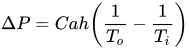
[edit]There is a pressure difference between the outside air and the air inside the building caused by the difference in temperature between the outside air and the inside air. That pressure difference ( ΔP ) is the driving force for the stack effect and it can be calculated with the equations presented below.[10][11] The equations apply only to buildings where air is both inside and outside the buildings. For buildings with one or two floors, h is the height of the building. For multi-floor, high-rise buildings, h is the distance from the openings at the neutral pressure level (NPL) of the building to either the topmost openings or the lowest openings. Reference[10] explains how the NPL affects the stack effect in high-rise buildings.
For flue gas stacks and chimneys, where air is on the outside and combustion flue gases are on the inside, the equations will only provide an approximation and h is the height of the flue gas stack or chimney.
Induced flow
[edit]The draft (draught in British English) flow rate induced by the stack effect can be calculated with the equation presented below.[12][13] The equation applies only to buildings where air is both inside and outside the buildings. For buildings with one or two floors, h is the height of the building and A is the flow area of the openings. For multi-floor, high-rise buildings, A is the flow area of the openings and h is the distance from the openings at the neutral pressure level (NPL) of the building to either the topmost openings or the lowest openings. Reference[10] explains how the NPL affects the stack effect in high-rise buildings.
For flue gas stacks or chimneys, where air is on the outside and combustion flue gases are on the inside, the equation will only provide an approximation. Also, A is the cross-sectional flow area and h is the height of the flue gas stack or chimney.
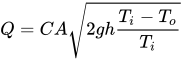
where: Q = stack effect draft (draught in British English) flow rate, m3/s A = flow area, m2 C = discharge coefficient (usually taken to be from 0.65 to 0.70)[14] g = gravitational acceleration, 9.81 m/s2 h = height or distance, m Ti = average inside temperature, K To = outside air temperature, K
where: Q = stack effect draft flow rate, ft3/s A = area, ft2 C = discharge coefficient (usually taken to be from 0.65 to 0.70)[14] g = gravitational acceleration, 32.17 ft/s2 h = height or distance, ft Ti = average inside temperature, °R To = outside air temperature, °R
This equation assumes that the resistance to the draft flow is similar to the resistance of flow through an orifice characterized by a discharge coefficient C.
See also
[edit]- HVAC (heating, ventilation and air conditioning)
- Ventilation shaft
- Solar chimney
- Solar updraft tower
- Draft (boiler)
- Inco Superstack
- Ekibastuz GRES-2 Power Station
- Windcatcher
- Cross ventilation
References
[edit]- ^ http://www.mdpi.com/2071-1050/9/10/1731/pdf Resolving Stack Effect Problems in a High-Rise Office Building by Mechanical Pressurization | date=September 2017| access-date=2020-08-01 | Jung-yeon Yu; Kyoo-dong Song; and Dong-woo Cho
- ^ NIST Technical Note 1618, Daniel Madrzykowski and Stephen Kerber, National Institute of Standards and Technology
- ^ "Smoke Simulation: Heat and Smoke Extraction for Building Design". SimScale. 2019-04-23. Retrieved 2019-07-04.
- ^ "Grenfell Tower final death toll: police say 71 lives lost as result of fire". The Guardian. 16 November 2017. Retrieved 16 November 2017.
- ^ "Met Police Statement. Update: Grenfell Tower fire investigation". MPS. 6 July 2017. Archived from the original on 20 June 2018. Retrieved 6 July 2017.
- ^ Griffin, Andrew (14 June 2017). "The fatal mistake made in the Grenfell Tower fire". The Independent. Archived from the original on 14 June 2017. Retrieved 16 June 2017.
- ^ Holder, Hugh (2020-11-20). "Stack Effect Strategies for Tropical Homes". Architropics. Retrieved 2024-08-07.
- ^ a b Rezadoost Dezfuli, Raziyeh; Bazazzadeh, Hassan; Taban, Mohsen; Mahdavinejad, Mohammadjavad (2023-12-01). "Optimizing stack ventilation in low and medium-rise residential buildings in hot and semi-humid climate". Case Studies in Thermal Engineering. 52 103555. doi:10.1016/j.csite.2023.103555. ISSN 2214-157X.
- ^ Hosseini, S. H.; Shokry, E.; Ahmadian Hosseini, A. J.; Ahmadi, G.; Calautit, J. K. (2016-12-01). "Evaluation of airflow and thermal comfort in buildings ventilated with wind catchers: Simulation of conditions in Yazd City, Iran". Energy for Sustainable Development. 35: 7–24. Bibcode:2016ESusD..35....7H. doi:10.1016/j.esd.2016.09.005. ISSN 0973-0826.
- ^ a b c Magyar, Zoltán. "Natural Ventilation Lecture 2" (PDF). Archived from the original (PDF) on 12 February 2020. Retrieved 12 February 2020.
- ^ "Educational Package Ventilation - Lecture 3 : Mechanical (forced) ventilation" (PDF). www.energiazero.org. IDES_EDU / Intelligent Energy Europe. 28 October 2011. Retrieved 4 October 2019.
- ^ Andy Walker (2 August 2016). "Natural Ventilation". WBDG - Whole Building Design Guide. National Institute of Building Sciences. Retrieved 1 April 2020.
- ^ Steve Irving; Brian Ford; David Etheridge (2010). AM10 Natural ventilation in non-domestic buildings. CIBSE. ISBN 9781903287569.
- ^ a b Boonyaputthipong, Chumnan (2018). "Stack Effect Ventilation in Different Climates" (PDF). Journal of Building Energy & Environment. 1 (1): 24–29.
External links
[edit]Stack effect
View on GrokipediaPhysical Principles
Cause and Mechanism
The stack effect, also known as the chimney effect, originates from buoyancy forces arising due to air density differences induced by temperature variations between the interior and exterior of a vertical structure. Warmer interior air expands and becomes less dense than cooler exterior air, causing the buoyant warm air to rise under gravity while displacing denser cold air downward.[3][9][10] This density disparity generates a hydrostatic pressure gradient that differs between the interior and exterior air columns. In a typical scenario with warmer interior air, the pressure drop with height is smaller inside due to lower density, resulting in lower interior pressure at the base relative to the exterior and higher interior pressure at the top. Air thus infiltrates through lower-level openings driven by the external overpressure and exfiltrates via upper openings due to internal overpressure, establishing upward convective flow.[11][12][7] The neutral pressure plane, where interior and exterior pressures equilibrate, typically occurs at mid-height in symmetric structures but shifts based on opening sizes and temperature differentials, modulating the direction and magnitude of airflow across the envelope.[13][14]Mathematical Formulation
The stack effect generates a pressure difference over a vertical distance due to the hydrostatic imbalance from differing air densities, expressed as , where m/s² is gravitational acceleration, is outdoor air density, and is indoor air density.[15][7] Applying the ideal gas law at constant pressure yields , so , with temperatures in absolute scale (e.g., Kelvin).[15] This assumes isothermal columns within each air mass, negligible humidity effects, and no viscous losses or external pressures.[15] The neutral pressure plane, where , divides upward and downward flows and is located at height from the building base, given by for a continuous vertical opening of enclosure height , with for normal (upward) stack effect.[7] For discrete horizontal openings, adjusts based on area ratios (top) and (bottom): under normal conditions.[7] The effective at any elevation relative to is then .[15] Airflow through an orifice of area driven by this follows from Bernoulli's equation, , where (typically 0.6–0.7) is the discharge coefficient and or average density.[7] Substituting and approximating yields , with the distance from neutral plane to opening midpoint; units often adapt to imperial (e.g., cfm, ft², ft, °R) in building standards.[8][16] Literature variants use in the denominator or empirical constants (e.g., ASHRAE factors for unequal openings), reflecting minor density averaging differences, but the form aligns with indoor-referenced buoyancy.[16]Influencing Factors
The magnitude of the stack effect, which drives buoyancy-induced airflow in vertical enclosures such as buildings or chimneys, is primarily determined by the temperature difference between the interior and exterior air (ΔT). This difference creates a density gradient, with warmer, less dense air rising and cooler, denser air descending, generating a hydrostatic pressure differential proportional to ΔT; larger ΔT amplifies the pressure gradient and thus the airflow velocity.[17][18] In winter conditions, for instance, indoor heating can produce ΔT values exceeding 20°C in temperate climates, intensifying upward flow from lower to upper levels.[19] Building height (h) exerts a linear influence on the stack pressure differential, as the buoyancy force accumulates over the vertical air column; empirical models show ΔP scaling directly with h, such that structures over 100 meters exhibit significantly stronger effects than low-rise ones, often leading to infiltration rates that challenge HVAC balance in high-rises.[17][18] For example, in super-tall buildings exceeding 300 meters, stack pressures can reach several pascals at the base during cold weather, comparable to moderate wind loads.[18] The configuration and size of openings, including inlets at lower levels and outlets at upper levels, modulate airflow by altering flow resistance; balanced, large openings (e.g., equivalent area exceeding 1% of floor area) maximize stack-driven ventilation rates, while imbalances shift the neutral pressure plane and reduce net flow.[20] Building envelope airtightness further influences this, as lower leakage resistance in modern sealed facades can inadvertently heighten uncontrolled infiltration under stack forces, with studies indicating up to 50% variation in flow based on leakage distribution.[10] Wind speed and direction interact with stack effect as competing or augmenting forces via external pressure differentials; low wind speeds (under 2 m/s) allow thermal buoyancy to dominate, but higher velocities can oppose inflow at leeward openings, reducing effective stack ventilation by 20-50% in cross-ventilation scenarios.[21][22] Other factors, such as humidity-induced density variations or mechanical pressurization, play secondary roles but can alter the neutral plane height in mixed-mode systems.[7]Applications in Buildings
Natural Ventilation and Passive Cooling
The stack effect enables natural ventilation by leveraging buoyancy-driven airflow, where warmer, less dense indoor air ascends and exits through high-level openings, creating negative pressure that draws cooler outdoor air in through low-level inlets.[23] This mechanism operates independently of wind, relying on vertical temperature gradients to induce continuous air movement in enclosed spaces like atria or chimneys.[24] In buildings, strategic placement of vents exploits this effect to promote cross-ventilation or single-sided flow, enhancing air exchange rates without energy input.[25] For passive cooling, stack ventilation removes heat gains from solar radiation, occupancy, and equipment, reducing indoor temperatures during occupied hours. Field studies in residential structures demonstrate that multi-chimney stack systems under cold climates achieve measurable airflow, with velocities correlating to height differences and temperature deltas as low as 5-10°C.[26] In subtropical environments, stack-assisted ventilation has lowered peak indoor temperatures by 3-5°C and relative humidity by 10-15%, extending comfort hours without mechanical systems.[27] Efficiency gains include up to 69% improvement in overall building cooling performance when integrated with solar stacks, as modeled in low- to medium-rise designs.[24] Applications span commercial and residential buildings, such as open stairwells providing stack effect pathways while adhering to fire safety codes.[28] Solar-enhanced stacks, featuring dark-absorbing surfaces to amplify buoyancy, sustain ventilation rates of 5-10 air changes per hour in favorable conditions, minimizing reliance on air conditioning and cutting energy use by 20-40% in mild climates.[29] In multi-story configurations, skycourts or courtyards amplify the effect, channeling exhaust air upward to precondition incoming flows.[23] Proper sizing of openings—typically 1-2% of floor area for inlets and outlets—ensures balanced flow and prevents short-circuiting.[30]Normal and Reverse Stack Effect
The normal stack effect occurs when indoor air temperature exceeds outdoor temperature, as during heating seasons, causing warmer, less dense indoor air to rise via buoyancy and establish a vertical pressure gradient.[31] This produces positive pressure above the neutral pressure level (NPL)—the elevation where indoor and outdoor pressures equilibrate—and negative pressure below, driving outdoor air infiltration through lower openings such as foundation cracks, doors, and leaks in ductwork or vents in unconditioned spaces such as attics, while expelling indoor air via upper vents or leaks.[14] This infiltration can draw cold air inward through HVAC ducts when the system is off, increasing heating demands.[32] Pressure differentials typically reach 4 pascals per story in multi-story buildings, intensifying with height and temperature gap; for instance, a 600 ft structure with 70°F indoor and 0°F outdoor air yields about 164 Pa at the top.[14][31] In natural ventilation applications, this upward flow aids passive cooling by inducting fresh air at the base, though it elevates heating demands through excess infiltration.[5] The reverse stack effect manifests when indoor air cools below outdoor levels, often in summer with air conditioning, inverting the density gradient and pressure distribution.[14] Negative pressure prevails above the lowered NPL, and positive pressure below, resulting in indoor air exfiltration at lower levels and outdoor air infiltration at upper ones.[31] This yields weaker forces, around 1.5 pascals per story, owing to smaller typical temperature differences.[14] For building ventilation, the downward flow can expel heat-laden air through basements but may introduce humidity or pollutants via roof intakes, complicating passive strategies and prompting designs with adjustable upper vents to harness the reversal for enhanced cooling.[5] Both effects shift the NPL seasonally—higher in winter, lower in summer—affecting air leakage paths and energy performance.[14] In tall structures, normal effect pressures can resist door opening at lower entries, necessitating features like revolving doors, while reverse dynamics alter moisture risks across floors.[14] Unmitigated stack flows increase infiltration rates, boosting energy consumption for conditioning; winter chimney velocities can peak at 10 m/s, underscoring the need for balanced HVAC integration.[5]Fire Spread and Safety Implications
In building fires, the stack effect is amplified by the buoyancy of hot smoke and combustion products, generating significant pressure differentials that drive rapid vertical transport through shafts, stairwells, and other unsealed openings. This mechanism draws cooler air from lower levels into the fire zone while propelling smoke upward, accelerating the spread of heat, toxic gases, and flames to upper floors beyond the compartment of origin.[31][33] In high-rise structures, where height exacerbates pressure gradients—potentially reaching several Pascals per floor—the stack effect poses acute safety risks by contaminating primary evacuation routes like stairwells with smoke, reducing visibility and oxygen levels, and hindering occupant egress. Fire engineering analyses indicate that this upward flow can overwhelm passive barriers and mechanical ventilation systems, particularly when combined with wind or bidirectional flows in multi-story shafts, leading to tenable conditions deteriorating within minutes on floors above the fire.[34][35] Fires originating at lower levels amplify these effects, as incoming air sustains combustion while distributing products of incomplete combustion, such as carbon monoxide, to heights exceeding 100 meters in simulations of unmitigated scenarios.[36][37] Safety implications extend to firefighting operations, where stack-induced flows complicate hose stream application and positive pressure ventilation tactics, potentially drawing smoke into adjacent zones or reversing expected plume behavior. Recent assessments, including full-scale tests under winter conditions, reveal that stack pressures can negate smoke extraction efficacy, underscoring the need for robust, height-specific design standards to prevent scenarios where evacuation times exceed critical exposure limits—often under 5 minutes for untenable smoke layers.[38][35] Without accounting for these dynamics, reliance on generic smoke control may foster overconfidence in system performance, as evidenced by post-incident reviews highlighting stack effect as a factor in delayed upper-floor notifications and increased lethality risks.[33]Applications in Chimneys and Stacks
Flue Gas Exhaust and Dispersion
The stack effect generates a natural draft in chimneys and industrial stacks by exploiting the buoyancy of hot flue gases, which are less dense than ambient air, creating a pressure differential that induces upward flow and exhausts combustion products from the base.[39] This buoyancy-driven mechanism is essential for removing flue gases in systems like thermal power plants, where temperatures of exhaust gases often range from 300°C to 600°C, producing draft velocities sufficient to overcome frictional losses in the stack. In many designs, this natural draft supplements or assists induced draft fans, enhancing overall exhaust efficiency without relying solely on mechanical power.[39] For atmospheric dispersion, the stack effect contributes to plume rise, where buoyant flue gases continue ascending beyond the stack exit due to initial momentum and thermal uplift, effectively increasing the release height and promoting dilution in the atmosphere.[40] Taller stacks, often exceeding 150 meters in industrial applications such as coal-fired power plants, leverage this effect to minimize ground-level concentrations of pollutants like sulfur dioxide (SO₂) and nitrogen oxides (NOₓ) through enhanced vertical mixing and reduced downwash under calm wind conditions.[41] However, excessive reliance on stack height for dispersion has been regulated; under U.S. EPA guidelines established in 1985, "good engineering practice" limits allowable stack height credit to 2.5 times the sum of facility height and adjacent building width to prevent circumvention of emission controls via mere dilution.[42] [43] Dispersion modeling, such as Gaussian plume models, incorporates stack effect parameters like exit velocity (typically 10-20 m/s) and temperature differential to predict pollutant trajectories, accounting for factors including atmospheric stability and wind shear that can either amplify or counteract buoyant rise.[44] Empirical studies show that in neutral stability conditions, plume rise from buoyant stacks can add 2-5 times the physical stack height, significantly lowering predicted maximum ground concentrations compared to non-buoyant releases.[45] Despite these benefits for local air quality, tall stack dispersion has been criticized for transferring pollutants to regional scales, contributing to issues like acid rain, as documented in assessments of pre-1990 U.S. coal plant operations where stacks over 150 meters were common.[41] Modern designs balance stack effect utilization with emission reduction technologies to comply with stricter standards, such as those under the Clean Air Act Amendments of 1990.[43]Induced Flow Enhancement
In flue gas stacks and industrial chimneys, the stack effect induces a natural upward flow of combustion products through buoyancy, enhancing exhaust efficiency by generating a thermal draft without mechanical assistance. This process relies on the lower density of hot flue gases compared to ambient air, creating a pressure difference that draws in fresh air at the base and expels gases at the top.[46] The resulting draft improves combustion by ensuring adequate oxygen supply and complete removal of byproducts, thereby optimizing fuel efficiency and reducing emissions.[47] The enhancement of induced flow is primarily governed by the stack height and the temperature differential between flue gases and surroundings. Draft pressure increases linearly with height, as taller structures accumulate greater hydrostatic pressure gradients from density differences. For instance, elevating flue gas temperatures from ambient levels heightens buoyancy, proportionally boosting the draft according to the relation ΔP ≈ g h ρ (ΔT / T), where g is gravitational acceleration, h is height, ρ is ambient density, ΔT is the temperature difference, and T is the average absolute temperature.[48] Minimizing flow resistances, such as through smooth linings or reduced bends, further amplifies effective flow rates, which scale with the square root of the pressure differential.[49] In practice, this mechanism allows industrial facilities to leverage stack heights of 100 to 300 meters for substantial draft gains, often sufficing for high-volume operations like coal-fired boilers where mechanical induced draft fans might otherwise be required. Sealing leaks and excluding excess cold air infiltration prevents dilution of hot gases, preserving density contrasts and maximizing enhancement.[50] Such optimizations have been documented to improve draft by addressing pressure losses, enabling reliable performance across varying ambient conditions.[49]Challenges and Criticisms
Energy Inefficiency and Infiltration Issues
The stack effect generates vertical pressure gradients in buildings due to buoyancy-driven air density differences, prompting uncontrolled infiltration at lower levels and exfiltration at upper levels, which elevates heating and cooling demands by introducing unconditioned outdoor air.[51][13] In heating seasons, warmer indoor air rises and escapes through upper leaks, drawing in colder exterior air via lower envelope breaches, thereby increasing thermal losses and HVAC energy consumption.[51] In buildings with ductwork routed through unconditioned spaces such as attics or crawl spaces, the negative pressure at lower levels can draw cold outdoor or attic air into the structure through leaks in ductwork, unsealed vents, or pathways in those spaces, causing cold air to enter through vents and exacerbating energy losses even when the HVAC system is not operating.[32] This process is exacerbated in taller structures, where pressure differentials scale with height, amplifying airflow through unintended paths like stairwells, shafts, and facade gaps.[13] Empirical studies of high-rise apartments demonstrate pronounced floor-level disparities in energy use attributable to stack-induced infiltration. In a 12-story Pittsburgh building, lower floors exhibited 28% higher energy consumption than the average, primarily from elevated infiltration rates during cold weather, while upper floors (excluding the top) showed 32% lower usage due to reduced inflow.[51] Measurements in a 13-story facility revealed natural infiltration rates of 0.2 air changes per hour (ACH) without mechanical ventilation, rising to 0.44 ACH with systems active—rates that often exceed ASHRAE standards for controlled ventilation and contribute to inconsistent indoor conditions.[51] These variations underscore how stack pressures interact with building envelope tightness, where poor sealing intensifies energy penalties by permitting higher leakage volumes.[52] Beyond direct thermal losses, infiltration driven by the stack effect introduces moisture, pollutants, and contaminants from outdoors, complicating humidity control and potentially degrading indoor air quality while further straining dehumidification or filtration systems.[52] In cooling climates, the reverse stack effect—where cooler indoor air sinks—can pull in warm, humid exterior air, heightening latent cooling loads and overall inefficiency.[13] Sealing envelope leaks has been shown to mitigate these issues by curtailing infiltration rates, thereby lowering total building energy use, though quantification varies by climate, height, and construction quality.[52] In unsealed or retrofitted older high-rises, such inefficiencies can account for a substantial portion of unexplained energy variances across seasons and orientations.[51]Operational Problems in High-Rise Structures
The stack effect in high-rise buildings generates substantial pressure differentials along the building height, particularly during cold weather when indoor-outdoor temperature differences exceed 20°C, leading to operational disruptions in mechanical systems and occupant access.[10] Lower floors face negative pressures drawing air inward through leaks, while upper floors experience positive pressures forcing air outward, which complicates routine functions like door actuation and vertical transport.[53][54] Elevator operations are frequently impaired, with doors jamming against rails or failing to close due to stack pressures exceeding 50 Pa in structures over 100 meters tall, necessitating manual overrides or supplemental HVAC pressurization to restore functionality.[54][55] In severe cases, such as buildings with unvestibule lobbies, these pressures cause doors to reopen repeatedly or stick, increasing wear on mechanisms and elevating emergency evacuation risks if doors cannot be operated reliably.[56][57] Interior doors, especially in stairwells and corridors, may slam shut violently from sudden pressure equalization or prove difficult to open manually against the airflow, contributing to noise levels up to 70 dB from air rushing through shafts.[58][59] These issues extend to HVAC exhaust systems, where stack-induced flows overwhelm dampers, causing inconsistent ventilation rates and requiring continuous adjustments to prevent backdrafting or overexhaust.[10] Overall, such problems demand targeted interventions like zoned pressurization to maintain operational integrity without excessive energy penalties.[57]Mitigation and Control Strategies
Design Interventions
Enhancing the airtightness of the building envelope and internal partitions represents a primary design intervention to mitigate stack effect-induced infiltration and energy losses in high-rise structures. Simulations in Nordic climates demonstrate that internal air tightness plays a dominant role in reducing vertical air pressures, with improved sealing minimizing drafts, noise, and heat loss compared to external envelope enhancements alone.[60] Standards such as ASTM E283, specifying air leakage rates below 0.948 m³/m·h at 300 Pa, guide envelope specifications to limit buoyancy-driven flows.[10] Compartmentalization through horizontal and vertical separations further controls airflow paths. Horizontal barriers, such as airtight floor assemblies and ceilings, restrict air movement between levels, while vertical partitions in cores like stairwells and elevator shafts segment pressure zones to dampen stack pressures.[10] In tall buildings, these spatial arrangements prevent excessive air exchange, with studies showing reduced stack effect in multifamily residences when combined with envelope tightening.[60] At building entrances, incorporating vestibules or revolving doors minimizes ground-level infiltration, where stack pressures are most pronounced due to neutral pressure planes near the base in winter.[10] Elevator machine rooms and shafts benefit from dedicated airtight enclosures to isolate them from occupied spaces, limiting leakage that exacerbates drafts and odors.[10] These passive strategies, informed by buoyancy principles, prioritize causal reduction of temperature-driven density differences over mechanical overrides.[60]Measurement and Modeling Techniques
Field measurements of stack effect typically employ differential pressure sensors, such as micromanometers or electronic transducers, positioned at various building heights to quantify hydrostatic pressure gradients induced by indoor-outdoor temperature differences. These devices detect pressure differentials across leakage paths, like doors and windows, with resolutions down to 0.1 Pa, essential for tall structures where gradients can exceed 10 Pa per 100 m height in cold climates. Complementary instrumentation includes thermistors or resistance temperature detectors for vertical temperature profiles and hot-wire anemometers or pitot tubes for airflow velocities at openings, enabling validation of buoyancy-driven infiltration rates. Tracer gas techniques, using releases of sulfur hexafluoride or nitrous oxide with concentration sampling, further quantify net airflow volumes influenced by stack pressures.[61][62][63] In operational high-rise buildings, specialized protocols pair absolute barometric (AB) pressure sensors at upper and lower elevations to compute real-time stack differentials, accounting for wind and HVAC interactions; this method has demonstrated accuracy within 5% of theoretical values in structures over 200 m tall. Full-scale wind tunnel simulations replicate stack pressures by applying equivalent wind-induced differentials to scaled models, isolating buoyancy effects for validation against on-site data. Such measurements inform mitigation by identifying neutral pressure levels, where indoor-outdoor pressures equilibrate, often shifting with seasonal ΔT values from 10-20°C in winter.[61][59][7] Modeling techniques range from analytical hydrostatic approximations to computational simulations. The fundamental pressure difference is derived from the ideal gas law and buoyancy, expressed as , where is air density, is gravity, is height difference, is temperature differential, and is average absolute temperature; empirical constants adjust for non-ideal orifice flows. Network airflow models, such as those in COMIS or CONTAM software, represent buildings as interconnected zones with stack-driven pressure nodes, solving mass conservation equations to predict infiltration under variable leakage areas (e.g., 0.5-2% of floor area). These zonal approaches efficiently handle multi-story geometries but assume one-dimensional flow.[7][63][54] For detailed spatial resolution, computational fluid dynamics (CFD) solves Navier-Stokes equations with Boussinesq approximations for buoyancy, simulating three-dimensional velocity fields and turbulence (e.g., via k-ε models) in geometries like atriums or shafts; validations against field data show errors below 15% for pressure profiles in 300 m towers. Hybrid methods integrate machine learning regressions on CFD outputs or historical measurements to forecast stack impacts under climate-specific ΔT, aiding design iterations for dampers or vestibules. Routine analyses, like NIST's STACK program, iteratively compute neutral planes and flows from building parameters, revealing sensitivities to opening sizes where doubling leaks can triple infiltration.[5][64][7]| Technique | Key Tools/Methods | Applications | Limitations |
|---|---|---|---|
| Field Pressure Measurement | Differential transducers, AB sensor pairs | Real-time ΔP monitoring in high-rises | Sensitive to wind/HVAC interference; requires multi-point setup |
| Analytical Modeling | Hydrostatic equations (e.g., ΔP ∝ h ΔT) | Quick neutral plane estimation | Ignores flow paths, assumes uniform T |
| Network/Zonal Models | CONTAM, COMIS software | Airflow prediction for mitigation design | Lumped parameters overlook 3D effects |
| CFD Simulations | ANSYS, OpenFOAM with buoyancy terms | Detailed flow visualization in complex geometries | Computationally intensive; needs validation data |