


Community hub
Recent from talks
Contribute something
Nothing was collected or created yet.
Order of Saint John (chartered 1888)
View on Wikipedia
| Most Venerable Order of the Hospital of St John of Jerusalem | |
|---|---|
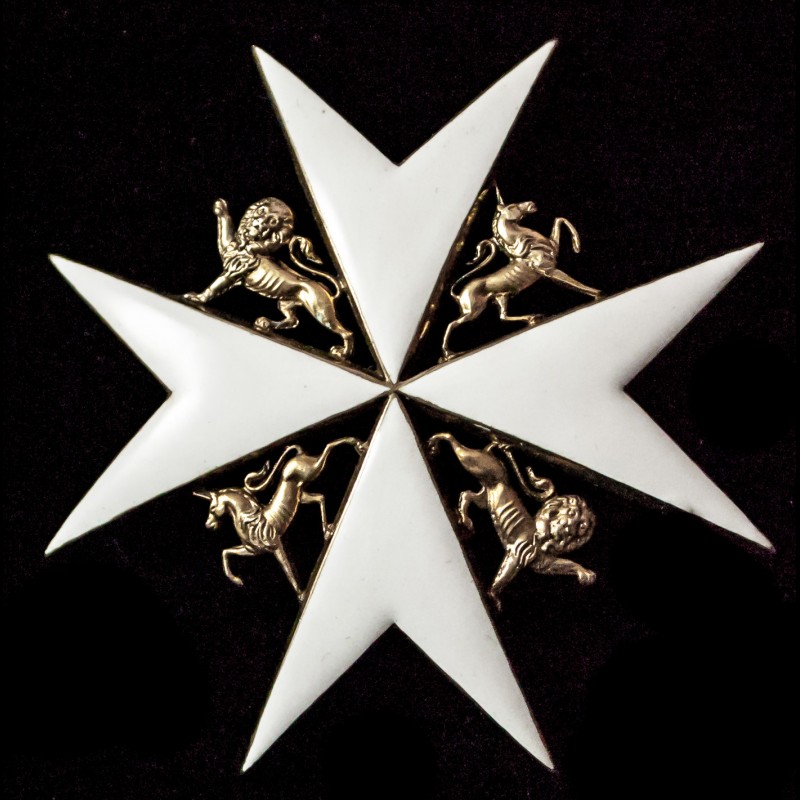
 Breast star of a Knight of Grace of the Order of St John | |
| Type | Order of chivalry |
| Established | 1888 |
| Motto | Pro Fide Pro Utilitate Hominum[1] |
| Eligibility | Service to the order |
| Status | Extant |
| Sovereign Head | Charles III |
| Grand Prior | The Duke of Gloucester |
| Lord Prior | Mark Compton |
| Grades |
|
| Precedence | |
| Next (higher) | Dependent on State |
| Next (lower) | Dependent on State |
_ribbon_-vector.svg) Ribbon of the order | |
The Most Venerable Order of the Hospital of Saint John of Jerusalem (French: l'Ordre très vénérable de l'Hôpital de Saint-Jean de Jérusalem),[n 1] commonly known as the Order of St John,[3] and also known as St John International,[4] is an order of chivalry constituted in 1888 by royal charter from Queen Victoria and dedicated to St John the Baptist.
The order traces its origins back to the Knights Hospitaller in the Middle Ages, the oldest surviving chivalric order which is generally considered to be founded in Jerusalem in 1099, which was later known as the Order of Malta. A faction of them emerged in France in the 1820s and moved to Britain in the early 1830s, where, after operating under a succession of grand priors and different names, it became associated with the founding in 1882 of the St John Ophthalmic Hospital near the old city of Jerusalem and the St John Ambulance Brigade in 1887.
The order is found throughout the Commonwealth of Nations,[5] Hong Kong, the Republic of Ireland, and the United States of America,[6] with the worldwide mission "to prevent and relieve sickness and injury, and to act to enhance the health and well-being of people anywhere in the world."[6] The order's approximately 25,000 members, known as confrères,[5] are mostly of the Protestant faith, though those of other Christian denominations, as well as adherents of other religions are accepted into the order. Except via appointment to certain government or ecclesiastical offices in some realms, membership is by invitation only and individuals may not petition for admission.
The Order of St John is perhaps best known for the health organisations it founded and continues to run, including St John Ambulance and St John Eye Hospital Group. As with the order, the memberships and work of these organisations are not constricted by denomination or religion. The order is a constituent member of the Alliance of the Orders of Saint John of Jerusalem. Its headquarters are in London and it is a registered charity under English law.[7]


History
[edit]Emergence
[edit]In the 1820s, those Knights of Malta residing in France granted knighthoods to certain people of various Christian denominations who provided support to the Order in England.[8]
In 1823, the Council of the French Langues—a French state-backed and hosted faction[9] of the Order of Malta (Sovereign Military Hospitaller Order of St John of Jerusalem of Rhodes and of Malta)—sought to raise through private subscription sufficient money to restore a territorial base for the Order of Malta and aid the Greek War of Independence.[9] This was to be achieved by issuing bonds in London to form a mercenary army of demobilised British soldiers using readily available, cheap war surplus. A deal transferring various islands to the Order of Malta, including Rhodes when captured, was struck with the Greek rebels,[10] but, ultimately, the attempt to raise money failed when details leaked to the press, the French monarchy withdrew its backing of the Council, and the bankers refused the loan.[10] The Council was re-organised and the Marquis de Sainte-Croix du Molay (previously number two of the Council and a former Order of Malta administrator in Spain[9]) became its head. In June 1826, a second attempt was made to raise money to restore a Mediterranean homeland for the Order when Philippe de Castellane, a French Knight of Malta, was appointed by the Council to negotiate with supportive persons in Britain. Scotsman Donald Currie[11] was in 1827 given the authority to raise £240,000. Anyone who subscribed to the project and all commissioned officers of the mercenary army were offered the opportunity of being appointed knights of the Order. Few donations were attracted, though, and the Greek War of Independence was won without the help of the knights of the Council of the French Langues. Castellane and Currie were then allowed by the French Council to form the Council of the English Langue, which was inaugurated on 12 January 1831, under the executive control of Alejandro, conde de Mortara, a Spanish aristocrat. It was headquartered at what Mortara called the "Auberge of St John",[12] St John's Gate, Clerkenwell.[13] This was the Old Jerusalem Tavern, a public house occupying what had once been a gatehouse to the ancient Clerkenwell Priory,[14][15] the medieval Grand Priory of the Knights Hospitaller, otherwise known as the Knights of Saint John. The creation of the langue has been regarded either as a revival of the Knights Hospitaller[16] or the establishment of a new order.[17][18][19]

The Reverend Sir Robert Peat, the absentee perpetual curate of St Lawrence, Brentford, in Middlesex, and one of the many former chaplains to Prince George (Prince Regent and later King George IV), had been recruited by the Council as a member of the society in 1830. On 29 January 1831, in the presence of Philip de Castellane and the Agent-General of the French Langues, Peat was elected prior ad interim.[20] Then, on the grounds that he had been selling knighthoods, Peat and other English members of the organisation expelled Mortara, with the backing of the Council of the French Langues, leading to the existence of two competing English chivalric groups between early 1832 and Mortara's disappearance in 1837. On 24 February 1834, three years after becoming prior ad interim, in order to publicly reaffirm his claim to the office of Prior and in the hope of reviving a charter of Queen Mary I dealing with the original English branch of the Order of Malta, Peat took the oath de fideli administratione in the Court of the King's Bench, before the Lord Chief Justice.[20][21] Peat was thus credited as being the first Grand Prior of the association, but in January 1919 "W.B.H." wrote to the journal Notes & Queries: "His name is not in the knights' lists, and he was never 'Prior in the Sovereign Order of St. John of Jerusalem': he became an ordinary member of that Order on Nov. 11, 1830."[22]

Sir Robert Peat died in April 1837 and Sir Henry Dymoke was appointed Grand Prior and re-established contact with the knights in France and Germany, into which the group had by that time expanded.[23] However, until the late 1830s, only the English arm of the organisation had considered itself to be a grand priory and langue of the Order of St John, having never been recognised as such by the established order. Dymoke sought to rectify this by seeking acknowledgement from the headquarters of the Roman Catholic Sovereign Military Order of Malta, but its then Lieutenant Grand Master, Philippe de Colloredo-Mansfeld, refused the request. In response to this rebuff, the English body declared itself to be the Sovereign Order of St John in England, under the title The Sovereign and Illustrious Order of Saint John of Jerusalem, Anglia,[24] thereby emphasising the order's independence and claim to direct and continuous succession from the Order of St John that was established in the 11th century. This new entity grew its membership over the ensuing three decades and, in 1861, William Montagu, 7th Duke of Manchester, agreed to become its grand prior. Additionally, an associated national hospitaller organisation was formed with a corps of ambulances.
Order of St John of Jerusalem in Great Britain
[edit]In 1871, the Duke of Manchester instituted a new constitution, which again changed the order's name, offering the more modest Order of Saint John of Jerusalem in England, abandoning the pretension to the title of "Sovereign Order".[25] Five years later, Princess Alexandra was appointed a Lady of Justice, and this was followed by her husband, Albert Edward, Prince of Wales (later King Edward VII) becoming a Knight.[26] Two years later, Sir Edmund Lechmere bought St John's Gate as the order's headquarters; the property was initially leased from Lechmere, before the order acquired the freehold in 1887.[14] In 1877, the order established various St John Ambulance associations in major railway centres and mining districts, so that railway men and colliers could learn how to treat victims of accidents with first aid; in 1882, the Grand Priory founded a hospice and ophthalmic dispensary in Jerusalem (known today as the St John of Jerusalem Eye Hospital Group); and, by 1887, had established the St John Ambulance Brigade, which undertook practical and life-saving work.
The name given in 1888, when the order was first constituted as the present order of chivalry by Queen Victoria's royal charter was Grand Priory of the Order of the Hospital of Saint John of Jerusalem in England. This was changed by the royal charter of 1926 to the Grand Priory in the British Realm of the Venerable Order of the Hospital of Saint John of Jerusalem and further in 1936 to the Grand Priory in the British Realm of the Most Venerable Order of the Hospital of Saint John of Jerusalem.[27] In 1961, it played a role, together with the Protestant Continental branches of the original Order of Saint John (the "Johanniter Orders" in Germany, the Netherlands, Sweden, and elsewhere), in the establishment of the Alliance of the Orders of Saint John of Jerusalem and thereafter finally received (through an agreement in 1963) collateral recognition by the Order of Malta. Its most recent royal charter was granted in 1955, with a supplemental charter issued in 1974,[28] recognising the worldwide scope of the organisation by setting its present name. In 1999, the order received special consultative status from the United Nations Economic and Social Council.[6]
Structure
[edit]_-_1928.jpg)
Officers
[edit]Charles III is at the apex of the Order of St John as its Sovereign Head,[29] followed by the Grand Prior—since 1975, Prince Richard, Duke of Gloucester.[28][30][31] He, along with the four or five other Great Officers—the Lord Prior of St John, who acts as the lieutenant of and deputy to the Grand Prior; the Prelate, who is an Anglican bishop; the Deputy Lord Prior (or more than one depending on the Grand Prior's needs), who acts accordingly as a lieutenant and deputy to the Lord Prior; and the Sub-Prelate, who has interests in the commanderies and associations of the organisation[32]—as well as the Priors and Chancellors of each of the order's eight priories and the Hospitaller make up the Grand Council.[28][33][34] On recommendation of that body, the Grand Prior appoints all the Grand Officers, besides himself,[35] and may also appoint members of either Grade I or Grade II as other officers, known as the Principal Officers,[36] such as the Secretary-General and Honorary Officers, such as the Genealogist,[37] (currently Peter O'Donoghue, York Herald) and Director of Ceremonies, who all hold office for a period not exceeding three years;[38] the latter position currently being held by Alan Cook, a former Essex Police chief inspector on behalf of Major James Kelly.[39] The Grand Prior may also appoint a Secretary of the Order, who holds office at the pleasure of the Grand Prior or until resignation.[40] A subset of the Grand Council is the Honours and Awards Committee, which considers all recommendations for appointment or promotion into the grade of Bailiff or Dame Grand Cross, appointment or promotion into any grade of a person not resident within any priory's territory, and advises the Grand Council in respect of the award of its Lifesaving Medal and Service Medal.[41]
List of grand priors
[edit]Since the Order's Royal Charter of 1888, the Grand Prior has been appointed by the Sovereign Head and has always been a member of the British royal family.
- The Reverend Sir Robert Peat (1831–1837)[42]
- Sir Henry Dymoke (1838–1847)[42]
- Lieutenant Colonel Sir Charles Montolieu Lamb (1847–1860)[42]
- Rear Admiral Sir Alexander Arbuthnott (1860–1861)[42]
- William Montagu, 7th Duke of Manchester (1861–1888)[42]
- Albert Edward, Prince of Wales (1888–1901)[42]
- George, Prince of Wales (1901–1910)[42]
- Prince Arthur, Duke of Connaught and Strathearn (1910–1939)[42]
- Prince Henry, Duke of Gloucester (1939–1974)[42]
- Prince Richard, Duke of Gloucester (1975–present)[42]
List of priors
[edit]From 1888 until 1943, this office was styled "Sub Prior" and from 1943 until 1950 it was named "Prior."[43]
Sub-priors
[edit]- Prince Albert Victor, Duke of Clarence and Avondale (1888–1892)[43]
- Prince George, Duke of Cornwall and York (1893–1901)[43]
- John Hope, 1st Marquess of Linlithgow (1906–1907)[43]
- Vacant (1908–1910)[43]
- Henry Holland, 1st Viscount Knutsford (1910–1914)[43]
- Robert Windsor-Clive, 1st Earl of Plymouth (1915–1923)[43]
- Aldred Lumley, 10th Earl of Scarbrough (1923–1943)[43]
Priors
[edit]- Ivor Windsor-Clive, 2nd Earl of Plymouth (1943)[43]
- George Villiers, 6th Earl of Clarendon (1943–1946)[43]
- John Loder, 2nd Baron Wakehurst (1947–1950)[43]
Lord priors
[edit]- John Loder, 2nd Baron Wakehurst (1950–1969)[42]
- Harold Caccia, Baron Caccia (1969–1981)[43]
- Sir Maurice Dorman (1982–1985)[43]
- Alan Cathcart, 6th Earl Cathcart (1986–1987)[43]
- Ralph Grey, Baron Grey of Naunton (1988–1990)[43]
- Samuel Vestey, 3rd Baron Vestey (1991–2001)[43]
- Colonel Eric Barry (2002–2008)[43]
- Anthony Mellows (2008–2014)
- Neil Conn (2014–2015)
- Sir Malcolm Ross (2016–2019)
- Mark Compton (2019–present),[44] present at the 2023 Coronation.[45]
Grades
[edit]After the officers of the Order follow members, who are divided into six hierarchical grades, all having accordant post-nominal letters.[46] Grade I is limited to only the members of the Grand Council plus no more than 21 others,[47] though royalty and heads of state of any country may be appointed as a Bailiff or Dame Grand Cross without counting towards the complement.[48] All Priors, should they not already be in the grade or higher, are appointed Knight or Dame upon their assignment.[49] Knights and Dames of Justice, along with all Bailiffs and Dames Grand Cross, formerly were entitled to nominate two personal Esquires, just as each Knight or Dame of Grace could nominate one personal Esquire, subject to the Grand Council's scrutiny.[50]
| Grades of the Order of St John | |||||
|---|---|---|---|---|---|
| Grade | Grade I | Grade II | Grade III | Grade IV | Grade V |
| Title (English) | Bailiff/Dame Grand Cross | Knights/Dames of Justice or Grace | Commander/Chaplain | Officer | Member |
| Title (French)[n 1] | Bailli/Dame grand-croix | Chevalier/Dame de justice ou de grâce | Commandeur | Officier | Membre |
| Post-nominal letters | GCStJ | KStJ/DStJ | CStJ/ChStJ | OStJ | MStJ |

Knights and Dames receive the accolade from the Grand Prior when they are touched on the shoulder with a sword and are given their robes and insignia. However, jurisdiction dependent, post-nominal letters of the order are not used outside the organisation itself, and a Knight and Dame may not use the prefix Sir or Dame,[51][52][53][54][55] though they may request from their local heraldic authority a personal coat of arms, should they not already be entitled to use one, and have it adorned with emblems of the Order of St John. Bailiffs and Dames Grand Cross additionally have the right to be granted heraldic supporters for life. Further, membership only grants precedence within the Order, which is graded as follows:[56]
- The Sovereign Head
- The Grand Prior
- The Lord Prior of St John
- The Prior of a Priory or the Knight or Dame Commander of a Commandery when within the territory of the establishment
- The Prelate of the Order
- The Deputy Lord Prior or the Deputy Lord Priors and if more than one by seniority in their grade
- The Sub-Prior of the Order
- Former Great Officers
- Bailiffs and Dames Grand Cross
- The Prior of a Priory or the Knight or Dame Commander of a Commandery outside the territory of the establishment
- Members of the Grand Council not included above by seniority in their grade
- The Principal Officers by seniority of their office
- The Sub-Prelates and the Honorary Sub-Prelates
- The Hospitaller of the Order
- Knights and Dames
- Chaplains
- Commanders
- Officers
- Members (formerly Serving Brothers and Serving Sisters)
- Priory Esquires (Priory Esquires are not members of the Order)
Precedence within each grade is dictated by date of appointment,[57] save for those in Grade I who are either a head of state or royal, in which case they all precede other members in their grade as follows:[56]
- Members of the Sovereign's family
- Heads of state from the Commonwealth of Nations
- Foreign heads of state
- Members of other Commonwealth royal families
- Members of foreign royal families
Awards are presented within the order: the Priory Vote of Thanks, the St John's Provincial/Territorial Commendation (in Canada), the Life Saving Award (Without Risk) in Silver, and the Service Medal of the Most Venerable Order of the Hospital of St John of Jerusalem.[58]
Priories and commanderies
[edit]
Following constitutional changes made in 1999, the Priory of England and The Islands was established (including the Commandery of Ards in Northern Ireland) alongside the existing Priories of Wales, Scotland, Canada, Australia (including the Commandery of Western Australia), New Zealand, South Africa, and the United States.[6] In 2013, the Priory of Kenya and in 2014 the Priory of Singapore were formed. Each is governed by a prior and a priory chapter. Commanderies, governed by a Knight or Dame Commander and a commandery chapter,[59] may exist within or wholly or partly without the territory of a priory, known as Dependent or Independent Commanderies, respectively.[60] Any country without a priory or commandery of its own is assumed into the "home priory" of England and The Islands, many of these being smaller Commonwealth of Nations states in which the order has only a minor presence.[n 2]
The Order of St John is said to have arrived in Canada in 1648, as the second Governor of New France, Charles de Montmagny, was a member of the original order, but it was not until 1883 that the first branch of the modern organisation was established in the Dominion, at Quebec City, growing to 12 branches by 1892.[61] The Order of St John today constitutes part of the Canadian national honours system and the priory, established in 1946 out of the Commandery of Canada, is the largest outside of the United Kingdom,[62] with some 6,000 members.[63] The governor general, serves as the prior and chief officer in Canada, while lieutenant governors act as the vice-priors, overseeing the administration of the order in their respective province.[62] These individuals thus automatically become Knights or Dames of Justice upon their assuming viceregal office.
An American Society of the Order of St John was established in 1957 as a foundation to assist the order with charitable work, after 1961 focusing its efforts specifically on the St John Ophthalmic Hospital in Jerusalem and some other organisations aiding the sick. This branch was successful enough that Queen Elizabeth II in 1996 officially created the Priory of the United States of America, the seventh priory at the time, with John R. Drexel as the first prior. By late 2000, the US Priory had approximately 1,100 members. As citizens of a country that did not have the sovereignty of the Order of St John vested in its head of state, American inductees who first joined the new priory were specifically asked to only "pay due obedience" to the governing authorities of the order "in all things consistent with your duty to your own country," thus eliminating any question of loyalty to a foreign head of state superseding American postulants' duties as US citizens.
Associations
[edit]- Americas: Antigua; Barbados; Bermuda; Dominica; Grenada; Guyana; Jamaica; Saint Lucia; Trinidad and Tobago
- Africas: Eswatini (formerly Swaziland); Ghana; Mauritius; Malawi; Nigeria; Tanzania; Uganda; Zambia; Zimbabwe
- Asia Pacific: Fiji; India; Papua New Guinea; Solomon Islands; Sri Lanka
- Europe and Middle East: Cyprus; Gibraltar; Malta
Vestments and insignia
[edit]Upon admission into the Order of St John, confrères are presented with appropriate insignia, each level and office being depicted by different emblems and robes for wear at important occasions for the order. Common for all members of the Order is the badge, consisting of an eight-pointed Maltese Cross (embellished in the four principal angles alternately with two lions passant guardant and two unicorns passant).[64] That for the Sovereign Head is gold with arms of white enamel and the embellishments rendered in gold, all surmounted by a jewelled St Edward's Crown, while those for the Officers of the order are the same save for the Grand Prior's having the crown made only of gold; the Lord Prior's having in place of the St Edward's Crown the coronet in gold of Albert, Prince of Wales (later Edward VII); and the Prelate's having instead a representation of a mitre in gold.[65] Thereafter, the badges are prescribed as follows:[66]
| Insignia of the Order of St John | ||||||
|---|---|---|---|---|---|---|
| Grade | Bailiffs/Dames Grand Cross | Knights/Dames of Justice | Knights/Dames of Grace | Commanders | Officers | Members |
| Insignia | 
|

|

|

|

| |
| Diameter | 82.5 millimetres (3.25 in) 57.2 millimetres (2.25 in) suspended |
57.2 millimetres (2.25 in) | 44.4 millimetres (1.75 in) | |||
| Material | Enamel | Silver | ||||
| Backing and embellishments |
Gold | Silver | ||||
All Bailiffs and Dames Grand Cross may wear their badges at the left hip on a 101.6 millimetres (4.00 in) (for men) or 82.5 millimetres (3.25 in) (for women) wide, black watered silk ribbon over the right shoulder and from a 16.5 millimetres (0.65 in) wide black band at the collar. Male Knights Justice or Grace and Commanders wear their badges on a 16.5mm wide ribbon at the neck, while Officers and Members have theirs on a 38 millimetres (1.5 in) straight ribbon suspended from a medal bar on the left breast. Females in all grades have the option of wearing their insignia on a ribbon bow pinned at the left shoulder.[67] Bailiffs and Dames Grand Cross, Knights and Dames of Justice or Grace, and chaplains may all also wear a breast star,[68] which appears the same as their badges, only at a diameter of 88.9 millimetres (3.50 in) and without embellishments for those in Grade I and 76 millimetres (3.0 in) for those in Grade II.[69] Further, those in these groups are also given a button for wear on the lapel of non-formal civilian clothing, for events such as business meetings of the order.[70] In general, the insignia of the Order of St John may be worn at all occasions where other decorations are worn, not only those connected with the ceremonies of the order.[71]

All members of the Order are also required to wear specific robes for formal occasions of the society, including a mantle, sopra vest, and hat. The mantles of the Sovereign Head and Grand Prior are all of black silk velvet and lined with white silk, the Sovereign Head's mantle is differentiated by an additional train. Bailiffs and Dames Grand Cross and, before 1926, Knights of Justice formerly wore black silk robes with a lining of the same material and colour; these members now wear the same mantle as Commanders and Officers, which are made of black merino wool faced with black silk. The only other unique mantles are those of the Medical Officer of the St John Ophthalmic Hospital, which bears a special pattern,[72] and of chaplains, which is a black silk robe with full sleeves. Each cloak also bears on its left side a rendition of the order's star in white silk: the Sovereign Head, Grand Prior, and those in the first two grades of the order all have a 300 millimetres (12 in) diameter emblem; the Sovereign's and Grand Prior's are of white silk with gold adornments, the former's also surmounted by a St Edward's Crown, while those for Bailiffs and Dames Grand Cross, Knights and Dames of Justice, and Knights and Dames of Grace are rendered in white linen, the first two groups having embellishments in gold silk, the latter in white silk. Similarly, the star for Commanders and Officers is of white linen with white silk ornamentation, though they are only 228.6 millimetres (9.00 in) and 152.4 millimetres (6.00 in) in diameter, respectively. The secretaries of the order, the priors and the commanders also wear the badge superimposed upon two goose quill pens embroidered saltire-wise in white silk.[72]
The sopra (or supra) vest is a long drape of thin, black cloth that buttons close down the neck and to one side, falling to the ankles and cut so as to entirely cover the body. It is similar to a cassock, though it is actually derived from the supra vesta—a black surcoat worn in the mid-13th century by the Knights of St John. Confrères in Grade I have a plain, white, 300mm diameter Maltese Cross on their sopra vests, while members of Grades II and III, plus chaplains, have a plain garment, though the wearer's Order of St John insignia is displayed outside the vest, 152mm below the collar. Clerical inductees of the order may, when officiating, wear over their cassock and surplice a mozzetta of black with red lining, edging, and buttons, a 76mm wide star worn on the left breast and the accordant badge suspended at the neck.[73] When full mantles and sopra vests are worn a black velvet Tudor-style hat is included.[74]
Eligibility and appointment
[edit]
The Sovereign Head confirms all appointments to the order as he, in his absolute discretion, shall think fit,[75] though the constitution does impose certain limitations: the maximum number of members is set at 35,000,[76] and appointees may not be under the age of 18.[77] Recommendations are made by the Grand Council and those selected have generally acted in such a manner as to strengthen the spirit of mankind—as reflected in the order's first motto, Pro Fide—and to encourage and promote humanitarian and charitable work aiding those in sickness, suffering, and/or danger—as reflected in the order's other motto, Pro Utilitate Hominum.[78][79]
To be inducted, new members must recite the organisation's declaration:
I do solemnly declare that I will be faithful and obedient to The Order of St John and its Sovereign Head as far as it is consistent with my duty to my [sovereign/president] and to my country; that I will do everything in my power to uphold its dignity and support its charitable works; and that I will endeavour always to uphold the aims of this Christian order and to conduct myself as a person of honour.[80]
Those who are Christians additionally recite the following:
I solemnly declare that I personally profess the Christian faith and accordingly that I believe in God the Father, God the Son and God the Holy Spirit.[81]
Notwithstanding the order's promotion of Christian values of charity and its official stance that the order has a "Christian character", its Grand Council has since 1999 affirmed that "profession of the Christian Faith should not be a condition of membership of the Order." The issue of the order's Christian character and the issue of "inclusive membership" was dealt with in the Grand Council's Pro Fide Report in 2005, wherein it was said that the order's life is shaped by Christian faith and values, but that "[r]ather than the emphasis being primarily upon 'spiritual beliefs or doctrine' it is on works of mercy rendered through St John". Therefore, while the Great Officers are required to profess the Christian faith, the same is "not an essential condition of membership" and "[t]he onus is on the man or woman who is invited to the privilege of membership to decide whether he or she can with a good conscience promise to be faithful to the stated aims and purposes of this Christian lay order of chivalry." On the subject of inclusive membership, the report stated "Christian hospitality is a criterion which can be applied to the Order's relationships to persons of other religious faiths", and "the Order needs to be characterized by a hospitable disposition towards other faith traditions while holding fast to its own origins and foundational identity in Christian faith."[82]
Order of wear
[edit]Admission to or promotion within the Order of St John does "not confer any rank, style, title, dignity, appellation or social precedence whatsoever".[83] Its place in the order of wear varies from country to country. Unlike those of other hierarchical orders, all grades of the Order of St John rank between the order's predecessor and successor. Some examples follow:
| Country | Preceding | Following |
|---|---|---|
 Australia Australia(Order of Wearing) |
Medal of the Order of Australia (OAM) | Distinguished Conduct Medal (DCM) (if awarded prior to 6 October 1992)[n 3] Conspicuous Service Medal (CSM)[n 4] |
 Canada Canada(Order of wear) |
Member of the Royal Victorian Order (MVO) | Grand Officer of the National Order of Quebec (GOQ) |
 New Zealand New Zealand(Order of wear) |
Royal Red Cross (Class II) (ARRC) | Distinguished Conduct Medal (DCM)[85][86] |
 United Kingdom United Kingdom
|
Current Bailiffs and Dames Grand Cross
[edit]- Sovereign Head: King Charles III
- Grand Prior: Prince Richard, Duke of Gloucester KG GCVO GCStJ, appointed Grand Prior and Bailiff Grand Cross in 1975
- Bailiffs and Dames Grand Cross
See also
[edit]- Service Medal of the Order of St John
- Donat of the Order of Saint John
- Sovereign Military Order of Malta
- List of the priors of Saint John of Jerusalem in England
- List of bailiffs and dames grand cross of the Order of St John
- Order of Saint John (Bailiwick of Brandenburg)
- Museum of the Order of St John
Notes
[edit]- ^ a b For use in Canada, in accordance with the country's policy of official bilingualism.
- ^ Those countries with Associations of the Order of St John are: Antigua and Barbuda, Barbados, Bermuda, Cyprus, Dominica, Fiji, Ghana, Gibraltar, Grenada, Guyana, India, Jamaica, Malawi, Malaysia, Malta, Mauritius, Montserrat, Namibia, Nigeria, Pakistan, Papua New Guinea, Saint Lucia, Solomon Islands, Sri Lanka, Swaziland, Tanzania, Trinidad and Tobago, Uganda, Zambia, and Zimbabwe.[6]
- ^ The "Australian Honours Order of Wearing" stipulates: "All Imperial British awards made to Australian citizens after 5 October 1992 are foreign awards and should be worn accordingly."[84] Generally, foreign awards are worn after Australian awards and postnominals of foreign awards are not recognised.
- ^ The Most Venerable Order of Saint John is listed in the Australian Honours Order of Wearing to indicate where any awards within the Order of St John should be worn (including those awarded after 1992); however, the Service Medal of the Order of St John should be worn as a Long Service Medal after all other Imperial Long Service awards. Post-nominals within the Order of St John are not recognised as notified in the Governor-General's media release of 14 August 1982.[55]
References
[edit]- ^ Elizabeth II 2004, p. 10, s. 3
- ^ Elizabeth II 2004, p. 10, s. 2.1.k
- ^ Elizabeth II 2004, p. 6.
- ^ "Our History". St John International. Archived from the original on 2014-08-27. Retrieved 26 August 2014.
The Order of St John, now known as St John International
- ^ a b "Who We Are". The Order of St. John. Archived from the original on 9 June 2009. Retrieved 9 August 2009.
- ^ a b c d e "Canada Wide > About Us > The Order of St. John". St. John Ambulance Canada. Archived from the original on 27 September 2013. Retrieved 10 August 2009.
- ^ "The Most Venerable Order of the Hospital of St John of Jerusalem (The Order of St John), registered charity no. 235979". Charity Commission for England and Wales.
- ^ Notes for New Members of the Order of St John. Venerable Order of St John. 2024. p. 3.
In the 1820s the Knights of Malta living in France offered knighthoods to specific people supporting the Order in Great Britain, irrespective of their Christian denomination.
- ^ a b c Riley-Smith 2013, p. 55.
- ^ a b Sire 1996, p. 249.
- ^ "Burke's Peerage – The Official Website". burkespeerage.com. Retrieved 2019-07-04.
- ^ "Religious Houses: House of Knights hospitallers | British History Online". www.british-history.ac.uk.
- ^ Riley-Smith 1994, pp. 124–5.
- ^ a b Temple 2008.
- ^ Old Jerusalem Tavern, 1 St Johns Square, Clerkenwell, London, The Historical street & Pub History directory of London, Essex, Kent, Hertfordshire, Cambridgeshire, Middlesex, Suffolk, Berkshire, Buckinghamshire, Sussex, Oxfordshire, Gloucestershire, Hampshire, Devon, Somerset & Dorset.[full citation needed]
- ^ "The Order of the Hospital of Saint John of Jerusalem", Encyclopedia Britannica (14th ed.), Washington: Benton Foundation, 1966, archived from the original on October 20, 2007, retrieved 28 March 2015
- ^ "The Military Orders". Ritterhaus Bubikon. Archived from the original on 2 April 2015. Retrieved 26 March 2015.
- ^ Ellul, Max J. (2011). The Sword and the Green Cross: The Saga of the Knights of Saint Lazarus from the Crusades to the 21st Century. Bloomington: AuthorHouse. p. 304. ISBN 978-1-4567-1420-8.
- ^ The Most Venerable Order of the Hospital of Saint John of Jerusalem (PDF), The Order of Australia Association, archived from the original (PDF) on 2015-04-02, retrieved 28 March 2015
- ^ a b King 1924, p. 113.
- ^ Riley-Smith 1994, pp. 125–6.
- ^ W.B.H. (January 1919). "Rev. Sir Robert Peat". Notes & Queries. 5 (12). London: Oxford Journals: 23. doi:10.1093/nq/s12-V.88.23-d (inactive 12 July 2025). ISSN 0029-3970.
{{cite journal}}: CS1 maint: DOI inactive as of July 2025 (link) - ^ Riley-Smith 1994, pp. 126–8.
- ^ Turner, William Barwell. Heraldic notes by William Barwell Turner. Retrieved 19 December 2022.
- ^ Guy Stair Sainty, Rafal Heydel-Mankoo, World Orders of Knighthood and Merit, Vol. 1 (2006), p. 81
- ^ Townend, Peter, ed. (1970). Burke's Peerage & Baronetage (105th ed.). London: Burke's Peerage Ltd. p. lxvii (ROYAL LINEAGE).
- ^ Elizabeth II (1955), "Royal Charter, 1955", in Elizabeth II (ed.), Royal Charters and Statutes of the Most Venerable Order of the Hospital of St. John of Jerusalem (PDF), Preamble, Westminster: Queen's Printer (published 2004), p. 3, archived from the original (PDF) on 13 June 2011, retrieved 9 August 2009
- ^ a b c "Who We Are > About the Order > Structure and Governance". The Order of St John. Archived from the original on 27 August 2009. Retrieved 9 August 2009.
- ^ Elizabeth II (1955), "The St. John Statutes 1974 to 2003", in Elizabeth II (ed.), Royal Charters and Statutes of the Most Venerable Order of the Hospital of St. John of Jerusalem (PDF), s. 5.1, Westminster: Queen's Printer (published 2004), p. 12, archived from the original (PDF) on September 27, 2013, retrieved 9 August 2009
- ^ Royal Family website. www.royal.gov.uk qv: Grand Prior of St John [full citation needed][dead link]
- ^ Elizabeth II 2004, p. 12, s. 6.
- ^ Elizabeth II 2004, p. 13, s. 8.1.a–8.1.d
- ^ "Structure and Governance" (PDF). The Order of St. John. Archived from the original (PDF) on 2 September 2009. Retrieved 9 August 2009.
- ^ Elizabeth II 2004, p. 15, s. 13.1
- ^ Elizabeth II 2004, p. 14, s. 8.3
- ^ Elizabeth II 2004, pp. 15, s. 9.1–9.2
- ^ Elizabeth II 2004, p. 15, s. 11.1
- ^ Elizabeth II 2004, p. 14, s. 8.6
- ^ www.stjohnengland.org.uk
- ^ Elizabeth II 2004, p. 12, s. 7.4
- ^ Elizabeth II 2004, pp. 18–19, s. 16.3.a–16.3.e
- ^ a b c d e f g h i j k Tozer, Charles W. (1975). The Insignia and Medals of the Grand Priory of the Most Venerable Order of the Hospital of St. John of Jerusalem. London, GBR: J. B. Hayward and Son. p. 78.
- ^ a b c d e f g h i j k l m n o p q McCreery, Christopher (2008). The Maple Leaf and the White Cross: A History of St. John Ambulance and the Most Venerable Order of the Hospital of St. John of Jerusalem in Canada. Toronto: Dundurn Press. pp. 238–239. ISBN 978-1-55002-740-2. OCLC 696024272.
- ^ "Appointment of Great Officers". St John International. September 2016.
- ^ "Coronation order of service in full". BBC News. 5 May 2023. Retrieved 6 May 2023.
- ^ Elizabeth II 2004, p. 30, s. 32.1
- ^ Elizabeth II 2004, p. 35, s. 37.2.a
- ^ Elizabeth II 2004, p. 35, s. 38.1
- ^ Elizabeth II 2004, p. 36, s. 38.4
- ^ Elizabeth II 2004, p. 36, s. 39
- ^ "Post Nominals & Form of Address". Royal Heraldry Society of Canada. Retrieved 9 November 2010.[permanent dead link]
- ^ "About the Order of St John > Glossary". Order of St. John. Archived from the original on 26 August 2010. Retrieved 9 November 2010.
- ^ Office of the Governor General of Canada. "It's an Honour > Additional Information". Queen's Printer for Canada. Retrieved 9 November 2010.
- ^ The Australian Army (2001), Army Protocol Manual, Australian Government Publishing Service, p. AL1
- ^ a b Office of the Governor-General of Australia (25 September 2007), Order of Wearing Australian Honours and Awards (PDF), Australian Government Publishing Service, p. 5, archived from the original (PDF) on 11 February 2014, retrieved 24 March 2011
- ^ a b Elizabeth II 2004, p. 37, s. 41.1
- ^ Elizabeth II 2004, p. 37, s. 41.2
- ^ Government of Canada (2013), Honours and Recognition for the Men and Women of the Canadian Armed Forces (PDF), Ottawa: Queen's Printer for Canada, p. 12, retrieved 16 November 2015
- ^ Elizabeth II 2004, p. 19, s. 18.2
- ^ Elizabeth II 2004, p. 20, s. 20.2.a–20.2.b
- ^ "Canada Wide > About Us > History > Our History in Canada". St. John Ambulance Canada. Archived from the original on 4 October 2009. Retrieved 10 August 2009.
- ^ a b "Canada Wide > About Us > The Order of St. John > The Order of St. John in Canada". St. John Ambulance Canada. Archived from the original on 4 October 2009. Retrieved 10 August 2009.
- ^ "Canada Wide > About Us > Corporate Information > Priory Chapter". St. John Ambulance Canada. Archived from the original on 4 October 2009. Retrieved 10 August 2009.
- ^ Elizabeth II (2003), The St. John (Order) Regulations, 2.i, Westminster: Queen's Printer, p. 29, retrieved 10 August 2009
- ^ Elizabeth II 2003, p. 34, s. 5.i–5.iv
- ^ Elizabeth II 2003, p. 34, s. 4
- ^ Elizabeth II 2003, pp. 36–37, s. 7.ii–7.iv
- ^ Elizabeth II 2004, p. 35, s. 6
- ^ Elizabeth II 2003, p. 38, s. 9.ii–9.v
- ^ Elizabeth II 2003, p. 39, s. 11.i
- ^ Elizabeth II 2003, p. 33 s. 3
- ^ a b Elizabeth II 2003, p. 40, s. 15.ii–15.vii
- ^ Elizabeth II 2003, p. 42, s. 19.ii
- ^ Elizabeth II 2003, p. 41, s. 18
- ^ Elizabeth II 2004, p. 12, s. 5.2
- ^ Elizabeth II 2004, p. 35, s. 37.1
- ^ Elizabeth II 2004, p. 32, s. 33.2
- ^ Elizabeth II 2004, pp. 10–12, s. 4.a–4.b
- ^ Elizabeth II 2004, p. 32, s. 33.1.c
- ^ Elizabeth II 2004, p. 32, s. 34
- ^ Notes for New Members of the Order of St John. Venerable Order of St John. 2024. p. 15.
- ^ Order of St John, Grand Council Pro Fide report, 2005. [full citation needed]
- ^ Elizabeth II 2004, p. 31, s. 32
- ^ Office of the Governor-General of Australia (25 September 2007), Order of Wearing Australian Honours and Awards (PDF), Australian Government Publishing Service, p. 1, archived from the original (PDF) on 11 February 2014, retrieved 24 March 2011
- ^ New Zealand Defence Force. "Medals Home > general medals information > order of wear". Queen's Printer for New Zealand. Retrieved 30 July 2009.
- ^ "No. 62529". The London Gazette (1st supplement). 2019-01-11. pp. 326–329. Order of Wear
- ^ "No. 51767". The London Gazette. 16 June 1989. p. 7104.
- ^ "No. 59053". The London Gazette. 5 May 2009. p. 7604.
- ^ The Canada Gazette
- ^ "No. 63692". The London Gazette. 9 May 2022. p. 8838.
- ^ "Tom Budd installed as the new Chancellor of St John". 7 September 2023.
- ^ "Cameron Oxley promoted to Bailiff Grand Cross". www.stjohninternational.org. 16 February 2024. Retrieved 2024-02-16.
- ^ Stuart Waetzel promoted to Bailiff Grand Cross www.stjohninternational.org
- ^ a b "Order of St John". London Gazette. 24 June 2025. Retrieved 25 June 2025.
Bibliography
[edit]- Elizabeth II (1974), "Supplemental Royal Charter, 1974", in Elizabeth II (ed.), Royal Charters and Statutes of the Most Venerable Order of the Hospital of St. John of Jerusalem, 5, Westminster: Queen's Printer (published 2004), p. 6, archived from the original on 5 March 2017, retrieved 1 December 2016
- Hoegen Dijkhof, Hans J. (2006). The Legitimacy of Orders of St. John: A Historical and Legal Analysis and Case Study of a Para-Religious Phenomenon. Leiden: University of Leiden. ISBN 90-6550-954-2.
- King, E. J. (Earl of Scarbrough) (1924). The Grand Priory of the Order of the Hospital of St. John of Jerusalem in England. Literary Licensing, LLC. ISBN 978-1-4940-5105-1.
{{cite book}}: ISBN / Date incompatibility (help) - McCreery, Christopher (2008). The Maple Leaf and the White Cross: A History of St. John Ambulance and the Most Venerable Order of the Hospital of St. John of Jerusalem in Canada. Toronto: Dundurn Press. ISBN 978-1-55002-740-2.
- Temple, Philip, ed. (2008). "St John's Gate and St John's Lane". South and East Clerkenwell. Survey of London. Vol. 46. New Haven, London: English Heritage. pp. 142–63. ISBN 978-0-300-13727-9.
- Riley-Smith, Jonathan (1994). "The Order of St John in England, 1827–1858". In Barber, Malcolm (ed.). The Military Orders: Fighting for the Faith and Caring for the Sick. Aldershot: Variorum. pp. 121–38. ISBN 0-86078-438-X.
- Riley-Smith, Jonathan (2013). The Crusades, Christianity, and Islam. Columbia University Press. ISBN 978-0-231-51794-2.
- Sire, H. J. A. (1996). The Knights of Malta. Yale University Press. ISBN 978-0-300-06885-6.
- Stephens, Edward Bell (1837). The Basque Provinces: Their Political State, Scenery, and Inhabitants; With Adventures Among the Carlists and Christinos. Whittaker & Co.
Further reading
[edit]- When was the Venerable Order founded, and by whom?, Museum of the Order of St John, Clerkenwell, London (archived 2 April 2015)
- The British Order of Saint John (F.Velde)
- "The Order of St John Regulations" (PDF). Order of St. John. 2003. Archived from the original (PDF) on 15 December 2013. Retrieved 10 December 2013.
External links
[edit]
| Protestant orders |
|  |
|---|---|---|
| Original Catholic order | ||

| Establishments |
| ||||||||
|---|---|---|---|---|---|---|---|---|---|
| Related topics | |||||||||
_BAR.svg)
_BAR.svg)


.svg)


_ribbon.png)


_ribbon.png)

_ribbon.png)
_ribbon.png)
_ribbon.png)


_ribbon.png)
_ribbon.png)


_ribbon.png)
_ribbon.png)

_ribbon.png)


_ribbon.png)


_ribbon.png)
_ribbon.png)
_ribbon.png)
_ribbon.png)
_ribbon.png)
_ribbon.png)

_ribbon.png)
_ribbon.png)
_ribbon.png)


Order of Saint John (chartered 1888)
View on GrokipediaHistory
Origins and emergence
The Order of Saint John traces its historical roots to the medieval Knights Hospitaller, established in Jerusalem around 1048–1099 as a Benedictine hospital dedicated to caring for poor, sick, and injured pilgrims during the Crusades.[5] Under the leadership of Gerard, its founder, the institution received papal recognition in 1113, evolving by 1128 under Raymond du Puy into a military order that combined charitable hospitaller duties with armed protection of Christian pilgrims and territories.[5] In England, the Hospitallers founded a priory at Clerkenwell in the 1140s, amassing significant landholdings and influence until the Protestant Reformation led to its dissolution on 7 May 1540 by King Henry VIII, who seized the order's properties; the last prior, Sir William Weston, reportedly died of grief on the same day.[5] The 19th-century revival of the order in England emerged amid a broader romantic fascination with medieval chivalry and was notably influenced by Freemasonic circles, which preserved and ritualized elements of knightly traditions.[6] A central figure in these efforts was the Reverend Sir Robert Peat, an Anglican cleric and former chaplain to King George IV, who in 1831 became the first Grand Prior of the revived English langue (branch) after swearing an oath de fideli in the Court of King's Bench to restore the privileges granted by the 1557 charter of Queen Mary.[5] Peat's leadership formalized the revival's structure, drawing on historical precedents to reestablish the order's presence at its ancient Clerkenwell headquarters.[5] These efforts culminated in the establishment of the Order of St John of Jerusalem in England in 1874 under Sir Edmund Lechmere's involvement, emphasizing a return to the original charitable mission of operating hospitals and providing aid to pilgrims and the vulnerable.[5] This focus on medical relief directly inspired the parallel development of St John Ambulance for first aid training and services.[5]Charter and establishment
The Order of Saint John (chartered 1888) traces its formal establishment to the revival efforts of 19th-century British societies dedicated to humanitarian aid, which culminated in the granting of a royal charter by Queen Victoria on 14 May 1888. This charter officially constituted the organization as the Most Venerable Order of the Hospital of St John of Jerusalem, recognizing it as a royal order of chivalry under the British Crown.[7][1] The charter outlined the Order's initial objectives as the promotion of charitable works centered on healthcare and relief efforts, specifically including the advancement of first aid training through the St John Ambulance Association, the provision of ambulance transport services via the St John Ambulance Brigade, and support for the St John Eye Hospital in Jerusalem, which had been established in 1882 to provide free treatment irrespective of faith or background. These aims emphasized practical humanitarian service, filling gaps in public health infrastructure at the time.[3][7] Among the first officers appointed under the charter were Queen Victoria as Sovereign Head, a role that positioned the monarch at the apex of the Order's hierarchy, and Albert Edward, Prince of Wales (later King Edward VII), as the inaugural Grand Prior, responsible for overseeing operations. Prince Albert Victor, Duke of Clarence and Avondale, served as the first Sub-Prior, assisting in administrative and ceremonial duties.[7][8] The charter incorporated the Order as a charitable entity, enabling it to operate legally as a nonprofit focused on welfare activities while maintaining its chivalric structure. Its early headquarters were established at St John's Gate in Clerkenwell, London, a historic site linked to the medieval priory of the Knights Hospitaller, symbolizing continuity with the Order's ancient roots.[3][1]Expansion and modern role
Following its establishment, the Order of Saint John significantly expanded its operations during the World Wars, leveraging its ambulance and medical services to enhance its global presence. During World War I, the Order maintained the St John Ambulance Brigade Hospital in Étaples, France, from 1915 to 1919, which became the largest voluntary hospital unit for the British Expeditionary Force, treating over 35,000 patients with surgical and convalescent care across 744 beds by war's end.[9] This effort, staffed by 241 Brigade members and supported by Voluntary Aid Detachment nurses, demonstrated the Order's capacity for large-scale medical response, boosting its international reputation and leading to broader adoption of its training models abroad. In World War II, the Order provided 249 ambulances that traveled nearly 6 million miles, transporting 681,531 patients, while operating nearly 250 auxiliary hospitals and convalescent homes that treated over 500,000 individuals; it also trained 298,343 people in first aid by 1940 and supported the liberation of Bergen-Belsen by delivering aid to 53,000 survivors.[10] These contributions, including personnel deployments to France and aid to prisoners of war through Commonwealth networks, solidified the Order's role in multinational humanitarian efforts and facilitated its postwar extension into over 40 countries.[11] Post-1945, the Order adapted to peacetime needs, particularly in the UK where the National Health Service assumed ambulance responsibilities, shifting focus toward specialized charitable initiatives. The 1960s marked a period of internal reorganization to streamline governance and expand outreach, alongside heightened emphasis on the St John Eye Hospital Group—originally founded in 1882 but significantly developed postwar with new clinics in Jerusalem, the West Bank, and Gaza to provide free eye care amid regional conflicts—and youth programs like the longstanding Cadets initiative, which trained young volunteers in first aid to build future humanitarian capacity.[12][3] By the late 20th century, these efforts had transformed the Order into a network of priories and associations emphasizing preventive health and community resilience. As of the end of 2024, the Order's membership included 22,235 formal members and 168,376 volunteers worldwide (totaling over 190,000 participants), enabling robust humanitarian aid in disasters such as conflicts in Gaza, where the Eye Hospital Group treated 31,309 patients in 2024 alone through emergency response plans.[4] This scale supported assistance to more than 2.2 million people in emergencies globally in 2024. Recent initiatives have included the launch of the Global Leadership Development Programme in 2024, featuring online training components for 23 participants from 16 countries to foster international coordination, and expanded partnerships in global health, such as the Mother and Baby Programme reaching 240,435 individuals in sub-Saharan Africa with maternal care, now extending to Kenya in 2025 following adaptations to post-2020 pandemic challenges.[4]Organization
Leadership and officers
The leadership of the Order of Saint John is headed by the Sovereign Head, who is the reigning British monarch and holds ultimate authority over the Order as granted by the Royal Charter of 1888.[1] Currently, His Majesty King Charles III serves in this role, providing ceremonial oversight and approval for major appointments and activities.[13] The Grand Prior acts as the principal leader of the Order, presiding over its ceremonial and administrative functions, including installations and international coordination among priories.[1] The position is appointed by the Sovereign Head and has traditionally been held by members of the British royal family since 1888, reflecting the Order's close ties to the Crown.[14] A notable transition occurred in 1974, when Prince Richard, Duke of Gloucester, succeeded his father, Prince Henry, Duke of Gloucester, who had served from 1939 to 1974.[15] The Sub-Prior assists the Grand Prior in these duties, particularly in ceremonial proceedings and support for priory-level operations.[1] Other key officers include the Prelate, who serves as the spiritual leader, offering guidance on the Order's religious foundations and conducting blessings during investitures.[1] The Chancellor manages the honours and awards process, chairing the Order Honours and Awards Committee to ensure equitable recommendations for membership and decorations.[1] The Registrar maintains official records of membership, appointments, and priory affiliations, while the Secretary-General oversees day-to-day administration, including international relations and monitoring unrecognized orders through the Unrecognised Orders Monitoring Group.[1] Appointments to these leadership roles are made by the Sovereign Head on the recommendation of the Grand Council, with eligibility generally restricted to individuals of noble birth, high social standing, or exceptional merit in service to the Order's charitable aims.[14] The process emphasizes continuity and alignment with the Order's traditions, often involving consultation among senior members.Historical Grand Priors (1888–2025)
The following table lists the Grand Priors since the Order's chartering in 1888, highlighting key transitions and tenures based on official records.[15]| Tenure | Grand Prior | Notes |
|---|---|---|
| 1888–1901 | Prince Albert Edward, Prince of Wales (later King Edward VII) | First royal Grand Prior, appointed upon chartering. |
| 1901–1910 | Prince George, Prince of Wales (later King George V) | Continued royal tradition during early expansion. |
| 1910–1939 | Prince Arthur, Duke of Connaught and Strathearn | Oversaw growth amid global conflicts. |
| 1939–1974 | Prince Henry, Duke of Gloucester | Served during and after World War II; longest modern tenure until succession. |
| 1975–present | Prince Richard, Duke of Gloucester | Appointed in 1975; current leader as of 2025, focusing on international humanitarian efforts. |
Membership grades
The Most Venerable Order of the Hospital of St John of Jerusalem, chartered in 1888, structures its membership into five principal grades, reflecting levels of service and precedence within the order. These grades are Bailiff or Dame Grand Cross, Knight or Dame of Justice or Grace, Commander or Chaplain, Officer, and Member. Each grade carries specific post-nominal letters and associated privileges, such as the right to vote in the Chapter General for the highest two grades. Numerical limits apply to senior grades to maintain exclusivity, with the highest grade restricted to no more than 30 active members, excluding certain ex-officio positions held by great officers, heads of state, or members of the royal family.[14][1] The highest grade, Bailiff or Dame Grand Cross (post-nominal: GCStJ), recognizes pre-eminent service to the order's humanitarian mission and is reserved for its most distinguished members. Knights or Dames of Justice or Grace (KStJ or DStJ) denote outstanding contributions, with "Justice" signifying active service roles and "Grace" for honorary appointments; this grade is capped at approximately 5% of total membership. The third grade encompasses Commanders (CStJ) for exceptional service and Chaplains (ChStJ), the latter historically for ordained ministers but integrated into the Commander grade since 2003 while retaining prior seniority. Officers (OStJ) honor distinguished service, comprising about 25% of members, while Members (MStJ) represent the entry level for notable contributions, forming over 60% of the order. Lower grades (IV and V) distinguish between serving members, who actively participate in priory activities, and honorary members, who support the order through patronage without operational duties.[14][1][14]| Grade | Title | Post-nominal | Approximate Proportion | Key Privilege |
|---|---|---|---|---|
| I | Bailiff/Dame Grand Cross | GCStJ | Limited to 30 active | Voting in Chapter General; bear supporters to arms |
| II | Knight/Dame of Justice or Grace | KStJ/DStJ | <5% | Voting in Chapter General; display arms on badge |
| III | Commander/Chaplain | CStJ/ChStJ | ~10% | Seniority-based precedence |
| IV | Officer | OStJ | ~25% | Suspension of riband from armorial bearings |
| V | Member | MStJ | >60% | Basic membership rights |
Subdivisions and international presence
The Order of Saint John is organized into 11 priories, each serving as a major administrative division responsible for overseeing activities within specific regions and led by a prior who presides over a chapter of members. Examples include the Priory of England and the Islands, the Priory of Scotland, the Priory in the USA, the Priory of Canada, the Priory of Australia, the Priory of New Zealand, the Priory of South Africa, the Priory of Kenya, the Priory of Wales, the Priory of Hong Kong, and the Priory of Singapore. These priories maintain local governance structures to manage membership, charitable initiatives, and ceremonial functions tailored to regional contexts.[16] Complementing the priories are 5 commanderies, which function as intermediate subdivisions often situated in areas with significant but more localized operations, each directed by a commander and supported by a chapter. Notable commanderies include the Commandery of Ards in Northern Ireland, the Commandery of Western Australia, and those in the Bailiwicks of Guernsey, Jersey, and the Isle of Man. These units facilitate closer coordination of activities in insular or peripheral territories, ensuring alignment with the Order's broader objectives.[16] The Order extends its reach through 27 associations in countries lacking priories or commanderies, establishing a global network spanning more than 40 nations, primarily in English-speaking regions but also including places like Ghana, Fiji, Cyprus, Barbados, and Mauritius. These associations operate under the oversight of nearby priories, adapting the Order's principles to local needs while promoting membership and support for humanitarian efforts. International coordination occurs via St John International, a secretariat based in London that handles global communication, honors administration, best-practice sharing, and resource allocation across all subdivisions. Regional offices within priories further enable on-the-ground implementation.[16][17][18] As a founding member of the Alliance of the Orders of Saint John of Jerusalem—comprising the Order alongside the Sovereign Military Order of Malta, the Bailiwick of Brandenburg of the Chivalric Order of Saint John, the Johanniter Orde in Nederland, and the Johanniterorden in Sweden—the organization participates in collaborative humanitarian projects, policy discussions, and periodic inter-order meetings to advance shared chivalric and charitable goals. The next such meeting is scheduled for 2025 in London, hosted by the Order. In 2025, membership stands at approximately 21,000 individuals distributed across the priories, commanderies, and associations, with the largest concentrations in the United Kingdom, North America, and Australasia. These subdivisions collectively underpin the Order's charitable activities, such as first aid training and community support.[17][19][20]Mission and activities
Charitable objectives
The Order of Saint John, chartered in 1888, is dedicated to St John the Baptist and committed to serving the sick, poor, and vulnerable, reflecting its historical roots as the Knights Hospitaller founded around 1070 to aid pilgrims in Jerusalem.[1][3] Its core charitable objectives, as defined in the Royal Charter granted by Queen Victoria, are to encourage and promote all works of humanity and charity for the relief of persons in sickness, distress, suffering, or danger, without distinction of race, class, or religion.[21] These objectives guide the Order's mission to lead in first aid and medical responses to community healthcare needs worldwide, operating as an international family of charities focused on inclusivity across faiths.[1] The Order's activities are underpinned by chivalric principles including courage, honour, justice, courtesy, love, joy, peace, kindness, goodness, faithfulness, gentleness, and self-control, adapted for modern charitable service to deliver care with excellence and devotion.[1] Key focus areas encompass healthcare provision, first aid training, eye care through the St John Eye Hospital in Jerusalem—which treats patients regardless of faith or wealth—and disaster relief efforts globally.[3][1] Registered as a charity in the United Kingdom (No. 235979), the Order's annual reports highlight its scale, such as training over 1.8 million people in first aid and providing services to 1.5 million individuals in 2024, underscoring its impact on health and well-being.[22][4]Association with St John Ambulance
St John Ambulance serves as the primary operational arm of the Order of Saint John for delivering first aid and medical training initiatives worldwide, a role formalized following the Order's royal charter in 1888, which empowered it to oversee and direct such activities.[23] Established initially as the St John Ambulance Association in 1877, it evolved under the Order's guidance to provide structured public education in first aid, with the Brigade component added in 1888 to mobilize trained volunteers for emergency response.[24] This integration aligns with the Order's broader charitable objectives of community health support, positioning St John Ambulance as its key vehicle for practical humanitarian efforts.[25] Governance ties the Order closely to St John Ambulance operations, with members of the Order appointed to serve on the boards of national St John Ambulance associations, ensuring alignment with the Order's ethos and strategic priorities. Priories, as the Order's territorial subdivisions, provide oversight to these national entities, delegating day-to-day management while retaining authority over policy, honors, and ethical standards; for instance, the Priory Council in England holds joint meetings with the St John Ambulance Board to coordinate decisions.[26] This structure facilitates unified leadership, with the Order's Grand Council at the apex coordinating international consistency across more than 40 countries.[24] The partnership extends to shared initiatives that engage communities and build capacity, including the Cadet programs for youth aged 10-17, which teach first aid skills, leadership, and volunteering under the joint auspices of the Order and St John Ambulance, operating in units across multiple nations to foster long-term humanitarian involvement.[27] International volunteer deployments represent another collaborative effort, where trained St John Ambulance personnel, often Order members or affiliates, are mobilized for global disaster response and medical aid, coordinated through the International Office to support emergencies in regions like disaster zones and conflict areas.[28] Funding flows from the Order to bolster St John Ambulance activities, with donations raised by the Order and its priories directly supporting operational costs for training, equipment, and deployments; in England alone, the Priory contributed through shared fundraising that generated £15.6 million in voluntary income in 2024.[26] This financial linkage sustains the network's scale, enabling a global volunteer force of almost 170,000 as of 2024, who deliver first aid training to millions and respond to emergencies annually.[4]Insignia and regalia
Vestments
The vestments of the Order of Saint John, worn during formal ceremonial occasions such as investitures, chapter meetings, and religious services, primarily comprise the mantle and sopra-vest, both in black to symbolize humility and devotion.[29] The mantle is a long, sleeveless cloak constructed from black merino wool with organ pleating, fastened at the shoulder by a cord and featuring a white eight-pointed Maltese cross appliquéd on the left breast; this cross, adopted from the historic Knights Hospitaller tradition, represents the eight beatitudes from the Gospel of Matthew (Matthew 5:3–10), embodying spiritual virtues such as mercy, purity of heart, and peacemaking.[29][30] The size and embellishment of the cross vary by membership grade: for Bailiffs/Dames Grand Cross (Grade I) and Knights/Dames of Justice (Grade II), it measures 305 mm and is gold-embellished on a silk-faced background; for Knights/Dames of Grace (Grade II), it measures 305 mm and is white enamel on a silk-faced background; for Commanders (Grade III), it is 229 mm in white enamel on white silk; and for Officers and Members (Grades IV and V), it is 152 mm in white enamel on white silk.[29] Higher grades, such as Dames Grand Cross, wear a sash beneath the mantle, while the Sovereign Head's mantle features a white silk lining and an Imperial Crown above the badge.[29] The sopra-vest, a long black coat that buttons closely over formal attire to cover the shirt and trousers, complements the mantle and includes a plain white cross or badge suspended below the collar, depending on the wearer's grade: a 305 mm cross for Grade I, or a badge on ribbon for Grades II and III.[29] A black velvet Tudor-style hat is worn with both garments to complete the ensemble.[29] These vestments are restricted to official Order events to maintain dignity and are not permitted for social functions.[29] Variations accommodate gender and roles: dames wear the same mantle and sopra-vest as knights but suspend the badge from a ribbon over the right shoulder when not in full robes, and they may adapt the attire with evening gowns on less formal occasions.[29] Chaplains and ministers of religion don clerical robes, such as a cassock and surplice (or equivalent for other denominations), with a 76 mm badge on the tippet and a chaplain's badge around the neck, topped by a black velvet cap edged in red.[29][31] On collar days—special occasions designated for full honors—knights and dames of Grades I and II wear white-tie evening dress with the order's star (if held) on the left breast and the badge suspended from a ribbon around the neck, coordinating with the vestments' badges for a unified appearance.[32][29]Badges and medals
The badges and medals of the Order of Saint John (chartered 1888) serve as symbols of membership grades and recognition for service within its charitable mission. The primary breast badge for knights and other members is an eight-pointed Maltese cross in white enamel, set in silver or gold depending on the grade, and embellished in each of its four principal angles alternately with a crowned lion and a crowned unicorn; the badge is surmounted by a crown composed of four crosses and four fleurs-de-lis.[33][13] Dimensions vary by rank, with knights of Grace or Justice wearing a 57 mm badge suspended from a black ribbon—while higher grades like Commanders use the same size in silver.[29] The Service Medal of the Order, instituted in 1899, recognizes long and exemplary service, particularly among volunteers contributing at least 60 hours annually for 10 years; it features the obverse design of Queen Victoria's effigy, reverse with the Order's motto "Pro Fide" and "Pro Utilitate Hominum," and is struck in silver, suspended from a black ribbon.[34][1] Additional periods of service are marked by silver bars with laurel motifs, though no distinct gold, silver, or bronze variants exist in official descriptions.[35] For Bailiffs or Dames Grand Cross, the highest grade, the insignia includes an 83 mm gold-embellished badge on a 102 mm red moiré sash for Bailiffs Grand Cross or 57 mm for Dames Grand Cross and a 92 mm unembellished gold breast star pinned to the left breast; official regulations specify no gold collar chain, though a 57 mm or 83 mm neck badge may be worn on a 38 mm red ribbon with gold bands for ceremonial purposes.[29] These elements attach to the Order's vestments, such as black mantles, for formal investitures.[29] Wearing conventions emphasize formality: full-size badges and medals are positioned on the left breast or sash during daytime or uniform attire, with up to four stars arranged in a triangular formation if multiple grades warrant them; for evening wear, miniatures scaled to 25 mm on 16 mm ribbons are mounted on a bar, allowing overlap if exceeding four items, and suspended from bows for women.[29][35] Rosettes or lapel pins in grade-appropriate metals (gold beasts for Justice, silver for Grace) substitute when full insignia are not worn.[35]Membership
Eligibility criteria
Membership in the Most Venerable Order of the Hospital of St John of Jerusalem, chartered in 1888, is restricted to individuals who have rendered distinguished service in fields aligned with the Order's mission, including healthcare, charitable work, and public welfare, or who have made notable contributions that further its Principal Objects. Candidates must demonstrate good service through sustained voluntary commitment, leadership, or exceptional acts that support the Order's aims, such as advancing first aid, medical care, or humanitarian efforts via its associated organizations like St John Ambulance or the St John Eye Hospital.[14][36][37] The Order is open to persons of any gender, with statutes employing inclusive terminology such as "Knight or Dame" to encompass both men and women, and actively promoting diversity in nominations. There is no minimum service duration specified for initial eligibility, though promotions to higher grades require escalating levels of notable, distinguished, or outstanding contributions. Applicants must be at least 18 years of age at the time of admission.[14][36] Eligibility extends internationally, though the Order maintains a preference for citizens of Commonwealth realms where it holds official priories and commanderies; however, it accepts nominations from volunteers, specialists, and supporters worldwide who align with its values. While there is no formal religious test, candidates must respect the Christian principles that underpin the Order's heritage and make a declaration of faithfulness and obedience upon admission, implying a dedication to its inspirational foundations. The Order welcomes individuals from diverse faiths or none, provided they acknowledge and support its Christian nature.[14][1][16] Certain exclusions apply, including current membership in "Specified Bodies"—unauthorized organizations using names or emblems resembling those of the Order, such as false Johannine orders. Nominations undergo vetting to ensure the candidate's good standing, absence of conflicts of interest (e.g., familial or business ties influencing the proposal), and verification of service claims, with final recommendations handled by the Order's Honours and Awards Committee and approval by the Grand Prior or Chapter General.[14][36]Appointment and investiture
The process for appointing members to the Most Venerable Order of the Hospital of St John of Jerusalem begins with nominations submitted by existing members, often through priories, commanderies, or designated officers, highlighting candidates' contributions to the Order's charitable objectives.[36] These nominations are assessed by Priory Honours and Awards Committees or the central Order Honours and Awards Committee, which evaluate eligibility based on service merit and alignment with the motto Pro Fide and Pro Utilitate Hominum.[14] The committees forward recommendations to the Grand Prior for preliminary approval before submission to the Sovereign Head—currently King Charles III—for final sanction, with all appointments published in the London Gazette.[14] Investiture ceremonies formalize admission and promotions, typically conducted by a Prior, Deputy Prior, or Chancellor at significant locations such as the historic St John's Gate in Clerkenwell, London, or dedicated priory chapels worldwide.[38] [39] The ritual commences with postulants signing a declaration affirming fidelity to Christian principles and the Order's aims, followed by an oath pledging obedience to its governing authorities and dedication to humanitarian service.[14] [39] During the ceremony, citations detailing the postulant's achievements are read aloud, after which the presiding officer presents the grade-specific insignia—such as a neck badge, breast star, or mantle—symbolizing the member's new status and responsibilities.[39] Postulants then sign the Homage Roll to complete their investiture, marking full integration into the Order.[14] These events occur regularly, with promotions to higher grades awarded based on sustained exemplary service following initial appointment.[36]Recognition
Precedence in orders of chivalry
In the United Kingdom's official order of wear for honours, decorations, and medals, as published by the Central Chancery of the Orders of Knighthood, the Most Venerable Order of the Hospital of St John of Jerusalem is positioned immediately after the Royal Victorian Order and before the Imperial Service Order, reflecting its status as a royal order of chivalry dedicated to humanitarian service.[40] This placement, current as of the 2019 update and unchanged through 2025, situates it among the higher-tier orders but after the principal orders like the Bath and St Michael and St George. The order's insignia, including the eight-pointed Maltese cross badge, are worn in this sequence during formal occasions.[41] The higher grades of the order, such as Bailiff or Dame Grand Cross (GCStJ) and Knight or Dame of Justice or Grace (KStJ/DStJ), hold precedence equivalent to those in the Order of the Bath, with the KStJ/DStJ ranking alongside the Knight Commander (KCB) in ceremonial and post-nominal usage, though without conferring titular knighthood in the peerage sense.[42] Lower grades like Commander (CStJ) align with Companion-level honours (CB), ensuring the order's distinctions are worn after substantive knighthoods of the realm but prior to imperial service and gallantry medals. This structure underscores the order's charitable focus over military or state service precedence. Internationally, the Order of Saint John maintains mutual recognition with the Sovereign Military Order of Malta through the Alliance of the Orders of Saint John, formed in 1963 and bolstered by formal cooperation agreements since 1974, which facilitate the reciprocal wearing of insignia and joint protection of heraldic symbols.[43] These arrangements, administered via joint working groups on topics like heritage preservation, affirm the order's place within the broader tradition of Johannine chivalric bodies without implying diplomatic equivalence. Historically, the order's precedence was elevated by a royal warrant and supplemental charter in 1926 under King George V, which renamed it the Grand Priory in the British Realm of the Venerable Order of the Hospital of Saint John of Jerusalem, granting it enhanced formal status as a venerable royal institution and integrating it more firmly into the British honours hierarchy.[1] This change built on the original 1888 charter from Queen Victoria, solidifying its position ahead of non-royal decorations while maintaining its non-state character.Current senior members
The Most Venerable Order of the Hospital of St John of Jerusalem, chartered in 1888, is led by its Sovereign Head, His Majesty King Charles III. The Grand Prior, the second-highest position, is held by His Royal Highness Prince Richard, Duke of Gloucester KG GCVO GCStJ, who has served since 1975.[44] The Sub-Prior, responsible for assisting the Grand Prior in ceremonial and administrative duties, is Dr Michel C. Doré GCStJ, appointed on 24 June 2025.[45] The Chancellor, who oversees the Order's honours and awards committee, is Thomas Matthew Budd GCStJ, installed in September 2023.[46] The Prelate, a senior ecclesiastical role, is held by Archbishop Emeritus Sir David Moxon KNZM GCStJ, appointed on 24 June 2025.[45] Bailiffs and Dames Grand Cross (GCStJ) represent the highest grade of membership, limited to individuals of pre-eminent service, with appointments approved by the Sovereign. As of November 2025, notable living holders include:| Name | Role/Notes | Appointment/Promotion Year |
|---|---|---|
| HRH The Duke of Gloucester KG GCVO | Grand Prior | 1975 |
| Thomas Matthew Budd | Chancellor | 2023 (to GCStJ) |
| Dr Michel C. Doré | Sub-Prior | 2025 |
| Archbishop Emeritus Sir David Moxon KNZM | Prelate | 2025 |
| Sir David Hempleman-Adams KCVO OBE DL | Former Prior, Priory in the USA; adventurer and philanthropist | 2025 (promotion to GCStJ) |
| Stuart Waetzel | Chancellor, Priory for South Africa | 2025 |