Hubbry Logo
logo
Olfactory receptor neuron
Community hub

Olfactory receptor neuron

logo
0 subscribers
Read side by side
from Wikipedia
Olfactory receptor neuron
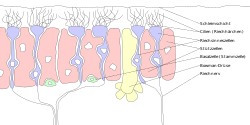
Labels in German. "Zellen" = "cell", "riech" = "smell", "Riechnerv" = olfactory nerve, "cillien" = cilia.
Details
SystemSmell
LocationOlfactory epithelium in the nose
ShapeBipolar sensory receptor
FunctionDetect traces of chemicals in inhaled air (sense of smell)
NeurotransmitterGlutamate[1]
Presynaptic connectionsNone
Postsynaptic connectionsOlfactory bulb
Identifiers
MeSHD018034
NeuroLex IDnifext_116
THH3.11.07.0.01003
FMA67860
Anatomical terms of neuroanatomy
Plan of olfactory neurons
Olfactory sensory neurons (OSNs) express odorant receptors. The axons of OSNs expressing the same odorant receptors converge onto the same glomerulus at the olfactory bulb, allowing for the organization of olfactory information.

An olfactory receptor neuron (ORN), also called an olfactory sensory neuron (OSN), is a sensory neuron within the olfactory system.[2]

Structure

[edit]

Humans have between 10 and 20 million olfactory receptor neurons (ORNs).[3] In vertebrates, ORNs are bipolar neurons with dendrites facing the external surface of the cribriform plate with axons that pass through the cribriform foramina with terminal end at olfactory bulbs. The ORNs are located in the olfactory epithelium in the nasal cavity. The cell bodies of the ORNs are distributed among the stratified layers of the olfactory epithelium.[4]

Many tiny hair-like non-motile cilia protrude from the olfactory receptor cell's dendrites. The dendrites extend to the olfactory epithelial surface and each ends in a dendritic knob from which around 20 to 35 cilia protrude. The cilia have a length of up to 100 micrometres and with the cilia from other dendrites form a meshwork in the olfactory mucus.[5] The surface of the cilia is covered with olfactory receptors, a type of G protein-coupled receptor. Each olfactory receptor cell expresses only one type of olfactory receptor (OR), but many separate olfactory receptor cells express ORs which bind the same set of odors. The axons of olfactory receptor cells which express the same OR converge to form glomeruli in the olfactory bulb.[6]

Function

[edit]

ORs, which are located on the membranes of the cilia have been classified as a complex type of ligand-gated metabotropic channels.[7] There are approximately 1000 different genes that code for the ORs, making them the largest gene family. An odorant will dissolve into the mucus of the olfactory epithelium and then bind to an OR. ORs can bind to a variety of odor molecules, with varying affinities. The difference in affinities causes differences in activation patterns resulting in unique odorant profiles.[8][9] The activated OR in turn activates the intracellular G-protein, GOLF (GNAL), adenylate cyclase and production of cyclic AMP (cAMP) opens ion channels in the cell membrane, resulting in an influx of sodium and calcium ions into the cell, and an efflux of chloride ions. This influx of positive ions and efflux of negative ions causes the neuron to depolarize, generating an action potential.

Desensitization of olfactory neuron

Desensitization

[edit]

The olfactory receptor neuron has a fast working negative feedback response upon depolarization. When the neuron is depolarizing, the CNG ion channel is open allowing sodium and calcium to rush into the cell. The influx of calcium begins a cascade of events within the cell. Calcium first binds to calmodulin to form CaM. CaM will then bind to the CNG channel and close it, stopping the sodium and calcium influx.[10] CaMKII will be activated by the presence of CaM, which will phosphorylate ACIII and reduce cAMP production.[11] CaMKII will also activate phosphodiesterase, which will then hydrolyze cAMP.[12] The effect of this negative feedback response inhibits the neuron from further activation when another odor molecule is introduced.

Number of distinguishable odors

[edit]

A widely publicized study suggested that humans can detect more than one trillion different odors.[13] This finding has been disputed. Critics argued that the methodology used for the estimation was fundamentally flawed, showing that applying the same argument for better-understood sensory modalities, such as vision or audition, leads to wrong conclusions.[14] Other researchers have also showed that the result is extremely sensitive to the precise details of the calculation, with small variations changing the result over dozens of orders of magnitude, possibly going as low as a few thousand.[15] The authors of the original study have argued that their estimate holds as long as it is assumed that odor space is sufficiently high-dimensional.[16]

Other animals

[edit]

Dogs Compared to humans, dogs have a larger number of olfactory receptor neurons and a larger olfactory bulb, resulting in a remarkably sensitive sense of smell, which is used by law enforcement to detect dangerous and illegal substances and biological scents, as well as by agricultural and conservation scientists to detect other living organisms, such as plant parasites, endangered animals, invasive species and even microorganisms.[17]

See also

[edit]

References

[edit]
[edit]
Revisions and contributorsEdit on WikipediaRead on Wikipedia
from Grokipedia
Olfactory receptor neurons (ORNs), also known as olfactory sensory neurons, are specialized bipolar sensory cells located in the olfactory epithelium of the nasal cavity that detect odorant molecules in inhaled air and transduce chemical signals into electrical impulses to initiate the sense of smell.[1][2] These neurons express G-protein-coupled receptors (GPCRs) on their cilia, which bind specific odorants dissolved in the nasal mucus, triggering a cascade that leads to depolarization and action potential generation.[2][3] Structurally, ORNs feature a single dendrite extending from the apical surface into the mucus layer, terminating in multiple non-motile cilia that house the odorant receptors and increase the surface area for odor detection.[1][3] At the basal surface, they possess thin, unmyelinated axons that bundle together to form the olfactory nerve (cranial nerve I), passing through the cribriform plate of the ethmoid bone to synapse in the olfactory bulb's glomeruli.[1][2] Each ORN expresses only one type of odorant receptor from a large gene family—approximately 400 functional types in humans—enabling the discrimination of thousands of distinct odors through combinatorial coding.[3][2] The olfactory epithelium, where ORNs reside, lines the superior region of the nasal cavity, including the superior nasal concha and roof near the cribriform plate, spanning approximately 5–10 cm² in humans and containing roughly 6–20 million ORNs.[1][3] Upon odorant binding, the activated GPCRs stimulate adenylate cyclase to produce cyclic AMP (cAMP), which opens cyclic nucleotide-gated ion channels, allowing influx of Na⁺ and Ca²⁺ ions to depolarize the neuron and propagate signals to mitral and tufted cells in the olfactory bulb for further processing.[2][3] This pathway bypasses the thalamus, projecting directly to cortical areas like the piriform cortex, underscoring the olfactory system's unique role in rapid, emotionally salient sensory integration.[2] A distinctive feature of ORNs is their capacity for regeneration; unlike most neurons, they have a lifespan of 30 days to one year and are continuously replaced by basal stem cells in the olfactory epithelium every 6–8 weeks in rodents, with ongoing regeneration in humans, aiding resilience against environmental damage from pollutants or pathogens.[1][3] This neurogenesis, supported by sustentacular (support) cells and Bowman's glands that secrete protective mucus, ensures sustained olfactory function throughout life.[1][2] Disruptions in ORN function, such as from viral infections including COVID-19 or genetic defects in receptor genes, can lead to anosmia (loss of smell), highlighting their critical role in behaviors like feeding, mating, and danger avoidance.[2][4]

Overview

Definition and location

Olfactory receptor neurons (ORNs) are specialized bipolar sensory neurons that detect and transduce odorant molecules in the nasal cavity into electrical signals for the sense of smell.[1] These neurons feature a single dendrite extending apically to the nasal surface, where it terminates in cilia that interact with airborne odorants, and an unmyelinated axon projecting basally to the olfactory bulb.[1] ORNs are primarily located in the olfactory epithelium, a pseudostratified neuroepithelium that lines the roof of the nasal cavity in vertebrates, adjacent to the cribriform plate of the ethmoid bone.[2] This positioning allows direct access to inhaled air currents carrying odorants. Within the epithelium, ORNs are embedded among sustentacular (supporting) cells, which provide structural support and detoxification; basal cells, serving as stem cells for neuronal regeneration; and Bowman's glands, which secrete mucus to maintain the ionic environment around the cilia.[1] Modern understanding of their fine details, including ciliary architecture, emerged in the 1950s through electron microscopy studies of the olfactory mucosa.[5]

Role in olfaction

Olfactory receptor neurons (ORNs) serve as the primary sensory detectors in the olfactory system, initiating the process of smell by transducing chemical stimuli from the environment into neural signals. Located in the olfactory epithelium of the nasal cavity, these bipolar neurons extend cilia into the nasal mucus where odorant molecules bind to specific receptors on their surface. Upon binding, this interaction triggers a conformational change in the receptor protein, leading to the generation of an electrical signal that propagates along the neuron's axon. This conversion of chemical cues into action potentials is fundamental to olfaction, allowing the detection of a vast array of volatile compounds at low concentrations.[6] The axons of ORNs bundle together to form the olfactory nerve, also known as cranial nerve I, which passes through the cribriform plate of the ethmoid bone to reach the olfactory bulb. In the bulb, these unmyelinated axons converge and synapse with mitral and tufted cells within specialized structures called glomeruli, marking the first relay station in the central olfactory pathway. This precise topographic organization ensures that signals from ORNs expressing the same receptor type converge on the same glomerulus, facilitating the spatial coding of odor information for higher brain processing.[2][7] A key feature enabling odor discrimination is the "one receptor-one neuron" principle, whereby each ORN expresses only a single functional olfactory receptor gene from a large family, approximately 400 in humans.[8][9] This singular expression pattern allows individual ORNs to respond selectively to specific odorants or structurally related groups, contributing to the system's ability to distinguish thousands of distinct smells through combinatorial activation across the neuronal population. Violations of this rule are rare and generally do not occur in mature neurons, underscoring its role in maintaining specificity.[8]

Anatomy and structure

Cellular morphology

Olfactory receptor neurons (ORNs), also known as olfactory sensory neurons, exhibit a distinctive bipolar architecture characteristic of specialized sensory cells. The soma, or cell body, is located within the olfactory epithelium lining the nasal cavity, positioned among supporting cells and basal stem cells. From the soma extends a single, unmyelinated dendrite that projects apically toward the epithelial surface, terminating in a swollen structure called the dendritic knob. Conversely, a single unmyelinated axon arises from the basal aspect of the soma, extending through the cribriform plate of the ethmoid bone to synapse in the olfactory bulb. This bipolar configuration enables direct transduction of environmental odorants at the periphery while facilitating neural transmission to the central nervous system.[10][11] The dendritic knob represents the primary site of odorant interaction, serving as the apex from which multiple non-motile cilia protrude into the overlying mucus layer. Typically, each ORN bears 10 to 30 cilia emanating from the knob, forming a meshwork that maximizes surface area for odorant binding. These cilia vary in length, ranging from approximately 2 μm in immature forms to up to 200 μm in mature neurons, depending on species and regional positioning within the nasal cavity; in humans, lengths often fall between 50 and 100 μm. The knob itself is a bulbous expansion, roughly 2-3 μm in diameter, ensuring the cilia are optimally positioned within the aqueous mucus environment for efficient molecular diffusion and detection.[12][13][14] At the basal end, the unmyelinated axons of ORNs converge and bundle into fascicles known as fila olfactoria, which collectively form the olfactory nerve (cranial nerve I). These bundles, numbering around 15-20 per human nasal cavity, lack myelin sheaths, a feature that supports rapid, albeit slower than myelinated fibers, propagation of action potentials over the short distance to the brain—approximately 1-2 cm. The absence of myelin also correlates with the regenerative capacity of ORNs, as these neurons continuously turnover throughout life. This axonal organization ensures that signals from thousands of ORNs expressing the same receptor type converge onto specific glomeruli in the olfactory bulb, enabling precise odor coding.[7][15] In humans, the olfactory epithelium houses an estimated 6 to 10 million ORNs, distributed across a surface area of about 2.5 cm² per nasal cavity, underscoring the system's high sensitivity and discriminatory power. This density allows for robust sampling of the air stream, with ORNs comprising the majority of the epithelial cell population alongside sustentacular and basal cells. Variations in neuron density occur zonally, with higher concentrations in the superior regions of the nasal cavity where airflow is optimal for odorant delivery.[7]

Subcellular components

Olfactory receptor neurons (ORNs) feature specialized non-motile cilia that extend from the dendritic knob into the nasal cavity, exhibiting a canonical 9+2 microtubule arrangement typical of motile cilia but lacking the dynein arms required for movement, thereby adapting these structures primarily for chemosensory detection rather than propulsion.[16] These immotile cilia, numbering around 10–30 per neuron and measuring 50–60 μm in length, form a brush-like array that maximizes surface area for odorant interaction.[17] The cilia are immersed in a layer of serous mucus secreted by Bowman's glands within the olfactory epithelium, which serves to solubilize hydrophobic odorants and facilitate their diffusion toward the ciliary membrane.[18] This aqueous mucus environment, rich in odorant-binding proteins, maintains a stable interface that prevents desiccation and supports the selective transport of volatile molecules to the sensory surface.[19] In the axonal compartment, ORNs display dynamic growth cones at their distal tips during embryonic and regenerative development, enabling guided navigation through the cribriform plate toward the olfactory bulb via responsiveness to guidance cues such as Sonic hedgehog.[20] Upon reaching the bulb, these axons converge into glomeruli, where presynaptic terminals accumulate synaptic vesicles containing glutamate, supporting excitatory transmission to postsynaptic mitral and tufted cells.[21] To sustain the energy demands of continuous sensory signaling, ORNs maintain a high density of mitochondria concentrated in the dendritic knob and proximal dendrite, generating ATP through oxidative phosphorylation to power ion pumps and maintain ionic gradients during odorant-induced depolarization.[22] This localization ensures rapid local energy supply, critical for the high metabolic rate of these neurons amid their ongoing turnover.[22]

Molecular and cellular mechanisms

Olfactory receptors

Olfactory receptors are seven-transmembrane G-protein-coupled receptors (GPCRs) expressed on the surface of olfactory receptor neurons, forming the largest multigene family in the human genome.[9] In humans, this family comprises approximately 391 putatively functional genes and around 465 pseudogenes, totaling over 850 loci, which encode proteins specialized for detecting odorant molecules.[9] These receptors are primarily localized to the cilia of olfactory sensory neurons in the nasal epithelium, where they initiate odor detection.[23] A fundamental principle of olfactory receptor expression is the "one receptor per neuron" rule, enforced by allelic exclusion, which ensures that each olfactory neuron expresses only a single receptor allele from the vast repertoire.[24] This monoallelic and monogenic selection mechanism promotes odor specificity by preventing co-expression of multiple receptors in the same neuron, thereby allowing precise mapping of odorants to distinct neural pathways. The process involves stochastic choice followed by negative feedback to stabilize expression of the selected gene while silencing others.[25] The binding diversity of olfactory receptors arises from their conserved structure, featuring a hydrophobic binding pocket within the transmembrane domain that accommodates a wide range of odorant molecules through non-covalent interactions.[26] Olfactory receptors are classified into two main types: class I receptors, which are more ancient and typically respond to hydrophilic odorants via a conserved vestibular-binding pocket, and class II receptors, predominant in terrestrial vertebrates and tuned to hydrophobic ligands.[27] This structural variation enables the detection of diverse chemical classes, from polar compounds in aquatic environments to volatile organics in air.[28] Genetically, olfactory receptor genes are organized in clusters distributed across nearly all human chromosomes, with subfamilies often spanning up to 100 genes per locus to facilitate coordinated regulation.[23]

Signal transduction pathway

In olfactory receptor neurons, the signal transduction pathway is initiated when an odorant binds to a G protein-coupled receptor (GPCR) on the surface of the neuronal cilia. This binding induces a conformational change in the GPCR, which activates the heterotrimeric G protein Golf by promoting the exchange of GDP for GTP on its α-subunit. The activated Golfα then dissociates and stimulates adenylyl cyclase type III, an enzyme embedded in the ciliary membrane, to catalyze the conversion of ATP to cyclic AMP (cAMP) and pyrophosphate (PPi).[29][11] The reaction catalyzed by adenylyl cyclase is:
ATPcAMP+PPi \text{ATP} \rightarrow \text{cAMP} + \text{PP}_\text{i}
This increase in intracellular cAMP concentration directly gates cyclic nucleotide-gated (CNG) ion channels in the ciliary membrane, which are permeable primarily to Na+ and Ca2+ ions. The influx of these cations through the CNG channels generates a depolarizing receptor current, initiating the electrical signal in the neuron.[30][6] The pathway incorporates amplification mechanisms at multiple stages to enhance sensitivity. A single activated GPCR can stimulate numerous Golf molecules, leading to substantial cAMP production. Furthermore, the entering Ca2+ activates calcium-gated chloride (Cl-) channels, such as TMEM16B (also known as anoctamin-2), resulting in Cl- efflux due to the elevated intracellular Cl- concentration in these neurons; this secondary current contributes significantly to the overall depolarization, amplifying the initial signal by up to 80% in some species like mice.[31][32] Recent studies as of 2025 have further elucidated how these chloride channels sparsify sensory representations in the olfactory system.[33]

Physiology

Odor detection process

Olfactory receptor neurons (ORNs) detect odors through a physiological process initiated by the inhalation of air carrying odorant molecules into the nasal cavity. These volatile compounds dissolve in the aqueous mucus layer that coats the olfactory epithelium, forming a thin barrier approximately 10-20 μm thick. Hydrophobic odorants, which constitute many common scents, are facilitated in crossing this mucus by odorant-binding proteins, enabling diffusion toward the non-motile cilia extending from the dendritic knobs of ORNs. This delivery mechanism ensures that odorants reach receptor sites embedded in the ciliary membrane, where detection occurs at remarkably low concentrations—often in the parts-per-billion range for highly sensitive odors such as certain amines or thiols, allowing the system to perceive subtle environmental cues.[34][35][36] Upon diffusion to the cilia, odorant molecules bind to G protein-coupled olfactory receptors expressed on the ORN surface, initiating receptor activation. This binding triggers a cascade that produces a graded receptor potential—a localized depolarization in the cilium and dendrite—proportional to the number of activated receptors. If the receptor potential exceeds a threshold voltage, typically around -40 to -50 mV, it propagates as action potentials along the ORN axon. The sensitivity of this activation varies by receptor type; for instance, trace amine-associated receptors (TAARs) can respond to specific odorants at sub-picomolar concentrations, setting the lower limits for detection in individual ORNs.[37][38] The resulting action potentials encode odor intensity through frequency coding, where the firing rate of the ORN increases with odorant concentration, typically ranging from 1 to 100 Hz under physiological sniffing conditions. At low concentrations, sparse spiking occurs; higher levels elicit bursts of activity, though rapid sniffing (around 5 Hz) can filter responses by merging currents and reducing reliability at intermediate intensities. Each ORN is tuned to a specific subset of odors due to its single olfactory receptor type, limiting broad responsiveness but enabling combinatorial coding across the population of approximately 6 million ORNs in humans, where unique odor identities emerge from the pattern of activated neurons.[38][39]

Neural transmission and coding

Olfactory receptor neurons (ORNs) transmit olfactory signals via their axons, which project from the olfactory epithelium through the cribriform plate to the olfactory bulb. Axons from ORNs expressing the same odorant receptor converge onto multiple specific glomeruli (approximately 16 per receptor type in humans) in the olfactory bulb, ensuring that odor information from a particular receptor type is spatially organized. In humans, this convergence involves approximately 1,000 ORNs per glomerulus on average, given the estimated 6 million total ORNs, approximately 400 functional odorant receptor types, and roughly 5,500 glomeruli, resulting in a convergence ratio of about 14 glomeruli per receptor type.[40][41][42][43] Within the glomeruli, ORN axons form excitatory axodendritic synapses with the primary dendrites of mitral and tufted cells, the principal output neurons of the olfactory bulb. The neurotransmitter released at these synapses is glutamate, which depolarizes the postsynaptic mitral and tufted cells, initiating signal propagation to higher brain centers. This synaptic transmission amplifies the odor-induced action potentials from ORNs, transforming peripheral sensory input into a centralized neural code.[44][45] Olfactory coding relies on both spatial and temporal patterns to represent odor identity and quality. Spatially, the activation of specific glomeruli forms a topographic map in the olfactory bulb, where the pattern of activated glomeruli corresponds to the odorant's molecular features; in humans, the approximately 5,500 glomeruli provide a high-resolution spatial code, as confirmed by recent transcriptomic and optogenetic studies mapping glomerular positions and responses. Temporally, ORNs and downstream mitral cells exhibit burst firing patterns, with odor-evoked spikes occurring in synchronized oscillations that encode concentration and dynamics, enhancing discrimination of complex odor mixtures.[42][46][47]

Adaptation and desensitization

Olfactory receptor neurons (ORNs) undergo short-term adaptation primarily through calcium-dependent modulation of cyclic nucleotide-gated (CNG) channels, which reduces their sensitivity to cyclic AMP (cAMP) within seconds of sustained odorant stimulation. Odorant binding to G protein-coupled olfactory receptors activates adenylyl cyclase, increasing cAMP levels and opening CNG channels to permit cation influx, including Ca²⁺. The resulting elevation in intracellular Ca²⁺ concentration binds to calmodulin (CaM), forming a Ca²⁺/CaM complex that directly associates with the intracellular domain of the CNG channel—specifically the CNGA2 and CNGB1b subunits—thereby decreasing the channel's affinity for cAMP by up to 10-fold and accelerating channel closure. This feedback mechanism limits excessive depolarization and prevents signal overload during continuous exposure. Additionally, Ca²⁺ influx indirectly promotes phosphorylation of CNG channel subunits by Ca²⁺-dependent kinases, such as CaM kinase II (CaMKII), further reducing cAMP sensitivity and contributing to the rapid attenuation of the receptor current.[48][49][50] Long-term desensitization in ORNs occurs over minutes to hours and involves the downregulation and internalization of odorant receptors to sustain sensory range in varying odor environments. Prolonged activation leads to phosphorylation of the receptor's C-terminal tail by G protein-coupled receptor kinases (GRKs), particularly GRK3, creating a binding site for β-arrestin2. β-Arrestin2 recruitment sterically hinders further G protein coupling, terminating signaling, and facilitates clathrin-mediated endocytosis of the receptor-arrestin complex into early endosomes. Internalized receptors are either degraded in lysosomes or trafficked to recycling endosomes for return to the ciliary membrane, effectively reducing the number of available receptors on the cell surface and diminishing responsiveness to the specific odorant. This process is agonist-specific and helps maintain olfactory discrimination by selectively attenuating responses to persistent stimuli.[51][52][53][54] Recovery from both short- and long-term adaptations restores ORN sensitivity and is modulated by the intensity and duration of prior odor exposure. For short-term effects, Ca²⁺ extrusion via plasma membrane Ca²⁺-ATPase (PMCA) and Na⁺/Ca²⁺ exchangers rapidly lowers ciliary Ca²⁺ levels, dissociating Ca²⁺/CaM from CNG channels and enabling dephosphorylation by protein phosphatases, thereby reinstating cAMP sensitivity within tens of seconds to minutes upon odor removal. Long-term recovery entails dephosphorylation of internalized receptors by protein phosphatase 2A (PP2A) in endosomes, promoting β-arrestin2 dissociation and receptor recycling via Rab GTPases to the plasma membrane, a process that can take 30 minutes to several hours depending on odor concentration—higher concentrations prolong internalization and delay return. These mechanisms ensure dynamic adjustment, with lower odor intensities allowing faster recovery to baseline sensitivity.[55][56][57] These adaptation processes have critical behavioral relevance, allowing ORNs to detect novel or changing odors amid continuous background scents, thereby enhancing olfactory acuity in natural environments. Studies in vertebrate models demonstrate that prolonged odor exposure results in 50-90% loss of sensitivity in affected ORNs, facilitating contrast enhancement and preventing sensory saturation without compromising overall detection thresholds.[58][59]

Development and maintenance

Embryonic development

Olfactory receptor neurons (ORNs) originate from the olfactory placode, a specialized thickening of the cranial non-neural ectoderm that forms during early embryonic development. In human embryos, the nasal placodes, which give rise to the olfactory epithelium containing ORNs, appear between the third and fourth weeks of gestation as paired ectodermal thickenings in the rostrolateral head region.[60][61] The differentiation of ORN progenitors into mature neurons is regulated by a cascade of basic helix-loop-helix (bHLH) transcription factors, including Mash1 (also known as Ascl1) and NeuroD. Mash1 initiates the proneural state in olfactory progenitors derived from the placode, promoting commitment to the neuronal lineage and activating downstream factors like Neurogenin1 (Ngn1), which in turn drives further differentiation.[62] NeuroD acts later in the process, facilitating terminal differentiation and the singular choice of an olfactory receptor gene from the large repertoire, ensuring each ORN expresses only one receptor type to establish odor specificity. This guided differentiation begins shortly after placode formation, leading to the initial expression patterns of olfactory receptors in clusters of nascent neurons. Axon pathfinding from differentiating ORNs to the nascent olfactory bulb is directed by guidance cues such as netrins and slits. Netrins, acting through receptors like DCC (deleted in colorectal carcinoma), attract ORN axons toward the ventral midline and olfactory bulb anlage, ensuring initial targeting to specific glomerular zones.[63] Conversely, slits function as repellents via Robo receptors, preventing aberrant crossing and refining axon coalescence within the bulb's ventral regions to match receptor identity.80591-7) In mammals, including humans, ORNs begin morphological differentiation by weeks 8–11 of embryonic development, with initial receptor expression patterns emerging asynchronously across the olfactory epithelium. By week 7, ORNs are distinguishable with developing dendrites, and around week 14, they exhibit cilia with the characteristic 9×2+2 microtubular structure essential for odor detection.[64][65] These early ORNs connect to the forming olfactory bulb, establishing the basic topographic map of receptor expression by week 10–11.[66]

Adult regeneration and turnover

Olfactory receptor neurons (ORNs) exhibit a finite lifespan of approximately 30 to 60 days, necessitating continuous replacement to sustain olfactory sensitivity. This turnover is driven by neurogenesis within the olfactory epithelium, where basal stem cells serve as the primary source of new neurons throughout adulthood. Horizontal basal cells function as multipotent progenitors that actively generate both neuronal and non-neuronal lineages even during normal physiological turnover, ensuring the epithelium's structural and functional integrity. While detailed studies are primarily from rodents, human ORN turnover is believed to be similar (30–60 days), with age-related decline contributing to clinical olfactory loss.[15][67][68] The regenerative process relies on a hierarchy of basal cells, with horizontal basal cells contributing to ongoing renewal and globose basal cells providing structural support to the proliferating progenitors. Newly generated ORNs faithfully express a single olfactory receptor gene, a process stabilized by epigenetic mechanisms that form a feedback loop to lock in the chosen receptor and suppress others. This "epigenetic trap" involves signaling cascades that maintain monoallelic expression, preventing aberrant co-expression and preserving odor specificity.[67][69] Aging significantly impairs this regenerative capacity, with studies in rodents showing reduced proliferation of basal cells and diminished neurogenesis, leading to a progressive decline in ORN turnover that correlates with olfactory deficits in older individuals. Environmental factors, such as air pollutants, further compromise regeneration by inducing inflammation and oxidative damage to the olfactory epithelium, thereby reducing the progenitor pool. Recent research highlights the potential to enhance turnover through modulation of growth factor signaling, including fibroblast growth factor (FGF) pathways that promote basal cell proliferation and neuronal differentiation in experimental models.[70][71][72]

Comparative aspects

Variations in vertebrates

Olfactory receptor neurons (ORNs) exhibit significant variations across vertebrate species, reflecting adaptations to diverse ecological niches and sensory demands. In mammals, the number of ORN types and total ORN population varies widely, influencing olfactory acuity. Humans possess approximately 400 functional olfactory receptor gene types, expressed in 10–20 million ORNs, enabling detection of a broad but limited range of odors.[9][7] In contrast, dogs have around 1,100 olfactory receptor gene types and approximately 220 million ORNs, which supports their superior odor discrimination and tracking abilities compared to humans.[73][74] Aquatic vertebrates, such as fish, display structural differences in ORNs suited to detecting water-soluble odorants, unlike the air-borne volatiles processed by terrestrial species. Fish ORNs predominantly feature microvilli on their apical surfaces, facilitating interaction with hydrophilic molecules dissolved in water, and include ciliated, microvillous, and crypt types intermingled in the olfactory epithelium.[75][76] In terrestrial vertebrates like mammals, ORNs typically bear cilia, which are optimized for volatile, lipophilic odorants in air, though some microvillous cells exist in accessory systems.[77] Expansions and contractions in olfactory receptor gene repertoires further highlight vertebrate diversity. Elephants exhibit one of the largest known expansions, with approximately 2,000 functional olfactory receptor genes, likely aiding in the detection of complex social and environmental scents crucial for their herd-based lifestyle.[78] Birds, conversely, maintain a smaller repertoire of about 500 olfactory receptor genes, adapted to aerial navigation and foraging, with integration of olfactory signals alongside visual and trigeminal inputs rather than a dedicated vomeronasal organ.[79][80] Structural adaptations in the olfactory bulb also vary, particularly for pheromone processing. In rodents, the accessory olfactory bulb contains macroglomeruli—enlarged glomerular structures—that receive inputs from vomeronasal ORNs specialized for pheromones, enabling rapid detection of social cues like those involved in mating and aggression.[81][82]

Differences in invertebrates

In invertebrates, olfactory receptor neurons (ORNs) exhibit structural and functional adaptations suited to diverse environments, particularly in arthropods like insects and crustaceans. In insects such as Drosophila melanogaster, ORNs are housed within specialized cuticular structures called sensilla, primarily located on the antennae, which serve as the main olfactory organs.[83] These sensilla, including basiconic, trichoid, and coeloconic types, feature pores and tubules that allow odorant molecules to access the dendritic cilia of the enclosed ORNs, enabling detection of volatile airborne cues.[84] Each sensillum typically contains 1–4 ORNs, and in Drosophila, approximately 60 distinct types of ORNs exist, each tuned to specific odorants through unique receptor expression profiles.[85][86] Unlike vertebrate ORNs, which rely on G-protein-coupled receptors (GPCRs), insect olfactory receptors (ORs) function as heteromeric ligand-gated ion channels that directly open upon odorant binding to depolarize the neuron.[87] These receptors consist of an odorant-specific tuning OR subunit co-expressed with a conserved chaperone subunit known as Orco (odorant receptor co-receptor), which is essential for trafficking the complex to the dendritic membrane and forming the functional ion channel.[88] Orco enables non-selective cation influx, amplifying the signal for neural transmission.[89] This channel-based mechanism contrasts with the metabotropic signaling in vertebrates, reflecting an evolutionary divergence in odor transduction.[87] In crustaceans, such as lobsters and crabs, ORN equivalents are found in aesthetasc sensilla on the antennules, which detect waterborne odors in aquatic environments.[90] These neurons often exhibit bimodal sensitivity, integrating olfactory and mechanosensory inputs, as seen in hooded sensilla where ORNs respond to chemical stimuli alongside mechanical cues from water currents.[91] Crustacean olfactory receptors are primarily ionotropic receptors (IRs), ligand-gated ion channels structurally and functionally analogous to insect IRs, which bind odorants to directly gate ion flow without second messengers.[92] This invertebrate architecture supports simpler odor coding compared to vertebrates, with fewer synaptic glomeruli in the primary olfactory brain center—around 50 in Drosophila antennal lobes versus thousands in mammalian olfactory bulbs—allowing efficient processing of environmental cues with reduced neural complexity.[93][94]

References

User Avatar
No comments yet.