


Community hub
Recent from talks
Contribute something
Nothing was collected or created yet.
Sri Vaishnavism
View on Wikipedia
 | |
| Regions with significant populations | |
|---|---|
| India, Nepal | |
| Religions | |
| Vaishnavism (Hinduism) | |
| Scriptures | |
| Vedas, Upanishads, Bhagavad Gita, Brahma Sutra, Pancharatra, Prabandham[2][3] | |
| Languages | |
| Tamil, Sanskrit |
| Part of a series on |
| Vaishnavism |
|---|
 |
| Part of a series on |
| Hinduism |
|---|
 |

Sri Vaishnavism (Sanskrit: श्रीवैष्णवसम्प्रदाय, romanized: Śrīvaiṣṇavasampradāya) is a denomination within the Vaishnavism tradition of Hinduism,[4] predominantly practiced in South India. The name refers to goddess Lakshmi (also known as Sri), as well as a prefix that means "sacred, revered", and the god Vishnu, who are together revered in this tradition.[5][6]
The tradition traces its roots to the ancient Vedas and Pancharatra texts, popularised by the Alvars and their canon, the Naalayira Divya Prabandham.[7][8][9] The founding of Sri Vaishnavism is traditionally attributed to Nathamuni of the 10th century CE;[10] its central philosopher has been Ramanuja of the 11th century, who developed the Vishishtadvaita ("qualified non-dualism") Vedanta sub-school of Hindu philosophy.[11][12] The tradition split into two denominations around the 16th century. The Vadakalai sect vested the Vedas with the greatest authority and follow the doctrine of Ramanuja and Vedanta Desika, whereas the Tenkalai sect vested the Naalayira Divya Prabandham with the greatest authority and follow the principles of Manavala Mamunigal.[13][14] The Telugu Brahmins of the Sri Vaishnava tradition form a single distinct sect called the Andhra Vaishnavas, and are not divided into the Vadakalai and Tenkalai denominations, unlike the Tamil Iyengars.[15]
Etymology
[edit]The name Sri Vaishnavism (IAST: Śrīvaiṣṇavism) is derived from two words, Sri and Vaishnavism. In Sanskrit, the word Sri refers to goddess Lakshmi as well as a prefix that means "sacred, revered", and god Vishnu who are together revered in this tradition.[4][6] The word Vaishnavism refers to a tradition that reveres god Vishnu as the supreme god.[16] The followers of Sri Vaishnavism are known as the Sri Vaishnava(s) (IAST: Śrīvaiṣṇava, श्रीवैष्णव).[17]
History
[edit]Theological origins
[edit]The tradition traces its roots to the primordial start of the world through Vishnu, and to the texts of Vedic era with both Sri and Vishnu found in ancient texts of the 1st millennium BCE particularly to the Puranas, Upanishads, and the Bhagavad Gita.[8][14]
Historical origins
[edit]The historical basis of Sri Vaishnavism is in the syncretism of two developments. The first is Sanskrit traditions found in ancient texts such as the Vedas and the Agama (Pancaratra, Vaikhanasa), and the second is the Tamil traditions found in early medieval texts (Tamil Prabandham)[18] and practices such as the emotional songs and music of Alvars that expressed spiritual ideas, ethics and loving devotion to god Vishnu.[19][8][9] The Sanskrit traditions likely represent the ideas shared in ancient times, from the Ganges river plains of the northern Indian subcontinent, while the Tamil traditions likely have roots in the Kaveri river plains of southern India, particularly what in modern times are the coastal Andhra Pradesh, Karnataka and Tamil Nadu region.[20]
The tradition was founded by Nathamuni (10th century), who combined the two traditions, by drawing on Sanskrit philosophical tradition and combining it with the aesthetic and emotional appeal of the Bhakti movement pioneers called the Alvars.[10] Sri Vaishnavism developed in Tamil Nadu in the 10th century, after Nathamuni returned from a pilgrimage to Vrindavan in north India (modern Uttar Pradesh).[19]
Nathamuni's ideas were continued by Yamunacharya, who maintained that the Vedas and Pancaratras are equal, devotional rituals and bhakti are important practices.[10] The legacy of Yamunacharya was continued by Ramanuja (1017-1137),[21] but they never met.[22] Legend goes that Ramanuja saw Yamunacharya's corpse, which had three fingers curled. Ramanuja was told that they represented the three wishes that Yamunacharya had revealed before he passed. One of the wishes was that Ramanuja should write a commentary on the Brahma Sutras.[23] Ramanuja, a scholar who studied in an Advaita Vedanta monastery and disagreed with some of the ideas of Advaita, became the most influential leader of Sri Vaishnavism.[24][25] He developed the Visistadvaita ("qualified non-dualism") philosophy.[10]
Around 14th century, Ramanandi Sampradaya split from it.[26][27] Around the 18th century, the Sri Vaishnava tradition split into the Vadakalai ("northern culture", Vedic) and Tenkalai ("southern culture", Bhakti).[13][14] The Vadakalai placed more emphasis on the Sanskrit traditions, while the Tenkalai relied more on the Tamil traditions.[28] This theological dispute between the Vedic and Bhakti traditions traces it roots to the debate between Srirangam and Kanchipuram monasteries between the 13th and 15th century.[13] The debate then was on the nature of salvation and the role of grace. The Bhakti-favouring Tenkalai tradition asserted, states Patricia Mumme, that Vishnu saves the soul like "a mother cat carries her kitten", where the kitten just accepts the mother while she picks her up and carries.[13] In contrast the Vedic-favouring Vadakalai tradition asserted that Vishnu saves the soul like "a mother monkey carries her baby", where the baby has to make an effort and hold on while the mother carries.[13] This metaphorical description of the disagreement between the two sub-traditions, first appears in the 18th-century Tamil texts, but historically refers to the foundational ideas behind the karma-marga versus bhakti-marga traditions of Hinduism.[29]
Reverence for Vishnu and Lakshmi
[edit]Along with Vishnu, and like Shaivism, the ultimate reality and truth is considered in Sri Vaishnavism to be the divine sharing of the feminine and the masculine, the goddess and the god.[30] Sri (Lakshmi) is regarded as the preceptor of the Sri Vaishnava sampradaya. Goddess Sri has been considered inseparable from god Vishnu, and essential to each other, and to the act of mutual loving devotion. Sri and Vishnu act and cooperate in the creation of everything that exists, and redemption.[30] According to some medieval scholars of Sri Vaishnava theology, states John Carman, Sri and Vishnu do so using "divine knowledge that is unsurpassed" and through "love that is an erotic union".[30] But Sri Vaishnavism differs from Shaivism, in that Vishnu is ultimately the sole creator, preserver and destroyer of the universe while Sri Lakshmi is the medium for salvation, the kind mother who recommends to Vishnu and thereby helps living beings in their desire for redemption and salvation.[30] In contrast, in Shaivism, the goddess (Shakti) is the energy and power of Shiva and she is the equal with different roles, supreme in the role of creator and destroyer.[31]
The prefix Sri is used for this sect because they give special importance to the worship of the Goddess Lakshmi, the consort of Vishnu, who they believe to act as a mediator between God Vishnu and man.[30][32]
Philosophy
[edit]Vishishtadvaita
[edit]Sri Vaishnavism's philosophical foundation was established by Ramanuja, who started his Vedic studies with Yadava Prakaasa in an Advaita Vedanta monastery.[24] Ramanuja brought Upanishadic ideas to this tradition, and wrote texts on qualified monism, called Vishishtadvaita in the Hindu tradition.[33][34] His ideas are one of three subschools in Vedanta, the other two are known as Adi Shankara's Advaita (absolute monism) and Madhvacharya's Dvaita (dualism).[33]
Vishishtadvaita asserts that Atman (souls) and Brahman[note 1] are different, a difference that is never transcended.[35][36] God Vishnu alone is independent, all other gods and beings are dependent on him.[37] However, in contrast to Dvaita Vedanta philosophy of Madhvacharya, Ramanuja asserts "qualified non-dualism",[38] that souls share the same essential nature of Brahman,[38] and that there is a universal sameness in the quality and degree of bliss possible for human souls, and every soul can reach the bliss state of God himself.[35][39] While the 13th- to 14th-century Madhvacharya asserted both "qualitative and quantitative pluralism of souls", Ramanuja asserted "qualitative monism and quantitative pluralism of souls", states Sharma.[40] The other philosophical difference between Madhvacharya's Vaishnavism Sampradaya and Ramanuja's Vaishnavism Sampradaya,[note 2] has been on the idea of eternal damnation; Madhvacharya believed that some souls are eternally doomed and damned, while Ramanuja disagreed and accepted the Advaita Vedanta view that everyone can, with effort, achieve inner liberation and spiritual freedom (moksha).[42][43]
Theology
According to Sri Vaishnavism theology, moksha can be reached by devotion and service to the Lord and detachment from the world. When moksha is reached, the cycle of reincarnation is broken and the soul is united with Vishnu, though maintaining their distinctions, in Vaikuntha, Vishnu's heaven.[45] Moksha can also be reached by total surrender (saranagati), an act of grace by the Lord.[46]
God, according to Ramanuja's Sri Vaishnavism philosophy, has both soul and body; all of life and the world of matter is the glory of God's body.[25] The path to Brahman (Vishnu), asserted Ramanuja, is devotion to godliness and constant remembrance of the beauty and love of personal god (saguna Brahman, Vishnu).[25][34][47] Ramanuja's theory posits both Brahman and the world of matter are two different absolutes, both metaphysically real, neither one false or illusive, and saguna Brahman with attributes is also real.[34]
Comparisons with Advaita Vedanta
[edit]Ramanuja accepted that the Vedas are a reliable source of knowledge, then critiqued other schools of Hindu philosophy, including Advaita Vedanta, as having failed in interpreting all of the Vedic texts.[48] He asserted, in his Sri Bhashya, that purvapaksin (previous schools) selectively interpret those Upanishadic passages that support their monistic interpretation, and ignore those passages that support the pluralism interpretation.[48] There is no reason, stated Ramanuja, to prefer one part of a scripture and not other, the whole of the scripture must be considered on par.[48][49] One cannot, according to Ramanuja, attempt to give interpretations of isolated portions of any scripture. Rather, the scripture must be considered one integrated corpus, expressing a consistent doctrine.[48] The Vedic literature, asserted Ramanuja, mention both plurality and oneness, therefore the truth must incorporate pluralism and monism, or qualified monism.[48]
This method of scripture interpretation distinguishes Ramanuja from Adi Shankara.[49] Shankara's exegetical approach Samanvayat Tatparya Linga with Anvaya-Vyatireka,[50] states that for proper understanding all texts must be examined in their entirety and then their intent established by six characteristics, which includes studying what is stated by the author to be his goal, what he repeats in his explanation, then what he states as conclusion and whether it can be epistemically verified.[51][52] Not everything in any text, states Shankara, has equal weight and some ideas are the essence of any expert's textual testimony.[49] This philosophical difference in scriptural studies, helped Shankara conclude that the Principal Upanishads primarily teach monism with teachings such as Tat tvam asi, while helping Ramanuja conclude that qualified monism is at the foundation of Hindu spirituality.[48][53][54]
Comparisons with Protestant Christianity and Buddhism
[edit]John Carman, a professor at the Harvard Divinity School, states that some of the similarities in salvation ideas in Sri Vaishnavism and Protestant Christian doctrines of divine grace are striking.[55] Both accept God as a personal concept, accept devotee's ability to relate to this God without human intermediaries, and accept the idea of sola gratia – salvation through faith by the grace of God alone, such as those found in Martin Luther's teachings.[55] While both Sri Vaishnavism and Protestant Christianity accept a supreme God and shares ideas on the nature of salvation, they differ in their specifics about incarnation such as Jesus Christ being the only incarnation in Christianity, while Sri Vaishnavism accepts many incarnations (avatar) of Vishnu.[56] Christian missionaries in 19th century colonial British India, noted the many similarities and attempted to express the theology of Christianity as a bhakti marga to Hindus, along the lines of Sri Vaishnavism, in their mission to convert them from Hinduism to Christianity.[57]
Similar teachings on the nature of salvation through grace and compassion, adds Carman, are found in the Japanese scholar Shinran's text on Jodo Shinshu sect of Buddhism, even though non-theistic Buddhism and theistic Sri Vaishnavism do differ in their views on God.[55] Similarly, Pure Land Buddhists also maintain a desire to be reborn in the highest heaven where one may learn the purest form of moksha from buddhas and bodhisattvas such as Avalokiteśvara; this reflects the desire of all Vaishnava to be born in Vaikuntha where the highest form of meditation on Narayana occurs.
Texts and scholarship
[edit]Sri Vaishnavism philosophy is primarily based on interpreting Vedanta, particularly the Upanishads, the Bhagavad Gita, the Brahma Sutras and the Narayaniya section of the Mahabharata.[8][58] The Vaishnava Agama texts, also called the Pancaratra, has been an important part of Sri Vaishnava tradition.[10][59] Another theological textual foundation of the tradition are the Tamil bhakti songs of the Alvars (7th to 10th century).[12] The syncretic fusion of the two textual traditions is sometimes referred to as the Ubhaya Vedanta, or dual Vedanta.[12] The relative emphasis between the two has been a historic debate within the Sri Vaishnavism tradition,[2] which ultimately led to the schism into the Vatakalai and Tenkalai sub-traditions around the 18th century.[13][14]
Nathamuni
[edit]Nathamuni collected the poems of Nammalvar, in the form of Divya Prabandham, likely in the 9th century CE,[60] or the 10th century.[10] One of his lasting contributions was to apply the Vedic theory of music on all the Alvar songs using Sanskrit prosody, calling the resulting choreography as divine music, and teaching his nephews the art of resonant bhakti singing of the Alvar songs.[60] This precedence set the guru-sisya-parampara (teacher-student-tradition) in Sri Vaishnavism.[61] This style of education from one generation to the next, is a tradition called Araiyars, states Guy Beck, which preserved "the art of singing and dancing the verses of the Divya Prabandham" set in the sacred melodies and rhythms described in the Vedic texts.[61]
Nathamuni's efforts to syncretically combine the Vedic knowledge and Alvar compositions, also set the precedence of reverence for both the Vedas and the Alvar bhakti ideas. Nathamuni's scholarship that set Alvar songs in Vedic meter set a historic momentum, and the liturgical and meditational songs continue to be sung in the modern era temples of Sri Vaishnavism, which is part of the service called cevai (Sanskrit: Seva).[60][62]
Nathamuni is also attributed with three texts, all in Sanskrit.[60] These are Nyaya Tattva, Purusha Nirnaya and Yogarahasya.[63] The Yogarahasya text, states Govindacharya, is a meditational text, includes the eight limb yoga similar to that of Patanjali, but emphasizes yoga as "the art of communion with God".[63] The Nyaya Tattva text survives only in quotes and references cited in other texts, and these suggest that it presented epistemic foundations (Nyaya) including the philosophical basis for the Hindu belief on the existence of "soul" (Atman), in contrast to Indian philosophies such as Buddhism that denied the existence of soul.[64][65] Nathamuni, for example asserts,
If "I" did not refer to the true self, there would be no interiority belonging to the soul. The interior is distinguished from the exterior by the concept "I". The aspiration, "May I, having abandoned all suffering, participate freely in infinite bliss", actuates a person whose goal is liberation to study scriptures etc. Were it thought that liberation involved the destruction of the individual, he would run away as soon as the subject of liberation was suggested... The "I", the knowing subject, is the inner self.
— Nyayatattva, Nathamuni, ~9th-10th century, Translator: Christopher Bartley[65]
Yamunacharya
[edit]Yamunacharya was the grandson of Nathamuni, also known in Sri Vaishnava tradition as Alavandar, whose scholarship is remembered for correlating Alvar bhakti theology and Pancaratra Agama texts to Vedic ideas.[66] He was the acharya (chief teacher) of Sri Vaishnavism monastery at Srirangam, and was followed by Ramanuja, even though they never met.[22] Yamunacharya composed a number of works important in Sri Vaishnavism, particularly Siddhitrayam (about the nature of Atman, God, universe), Gitarthasangraha (analysis of the Bhagavad Gita), Agamapramanya (epistemological basis of Agamas, mapping them to the Vedas), Maha Purushanirnayam (extension of Nathamuni's treatise), Stotraratnam and Chathuh shloki (bhakti strota texts).[66]
Yamunacharya is also credited with Nitya Grantha and Mayavada Khandana. The Nitya Grantha is a ritual text and suggests methods of daily worship of Narayana (Vishnu).[67] The 10th century Mayavada Khandana text, together with Siddhitrayam of Yamunacharya predominantly critiques the philosophy of the traditionally dominant school of Advaita Vedanta in Hindu philosophy, but also critiques non-Vedic traditions.[68]
Ramanuja
[edit]The Sri Vaishnava tradition attributes nine Sanskrit texts to Ramanuja[69] – Vedarthasamgraha (literally, "Summary of the Vedas meaning"[note 3]) Sri Bhasya (a review and commentary on the Brahma Sutras), Bhagavad Gita Bhashya (a review and commentary on the Bhagavad Gita), and the minor works titled Vedantadipa, Vedantasara, Gadya Traya (which is a compilation of three texts called the Sharanagati Gadyam, Sriranga Gadyam and the Vaikuntha Gadyam), and Nitya Grantham.
Some modern scholars have questioned the authenticity of all but the three of the largest works credited to Ramanuja; the following texts are considered as authentically traceable to Ramanuja – Shri Bhashya, Vedarthasamgraha, and the Bhagavad Gita Bhashya.[69][71]
Ramanuja's scholarship is predominantly founded on Vedanta, Upanishads in particular.[70][72] He never claims that his ideas were original, but his method of synthesis that combined the Vedic ideas with popular spirituality, states Anne Overzee, is original.[72] Ramanuja, wrote his biographer Ramakrishnananda, was "the culmination of the movement started from the Vedas, nourished by the Alvars, Nathamuni and Yamuncharya".[72]
Ramunaja himself credits the theories he presents, in Vedarthasamgraha, to the ideas of ancient Hindu scholars such as "Bodhyana, Tanka (Brahmanandin), Dramida (Dravidacarya), Guhadeva, Kapardin and Bharuci".[72][73][note 4] The 11th-century scholarship of Ramanuja emphasized the concept of Sarira-Saririn, that is the world of matter and the empirical reality of living beings is the "body of Brahman",[note 5] everything observed is God, one lives in this body of God, and the purpose of this body and all of creation is to empower soul in its journey to liberating salvation.[75][76]
Post Ramanuja period authors
[edit]After Ramanuja several authors composed important theological and exegetical works on Sri Vaishnavism. Such authors include Parsara Bhattar, Nadadoor Ammal, Sudarshan Suri, Pillai Lokacharya, Vedanta Desika, Manavala Mamunigal, Periyavachan Pillai and Rangaramanuja Muni.[77][78][79][80]
Organisation
[edit]The Sri Vaishnavism tradition has nurtured an institutional organization of mathas (monasteries) since its earliest days, particularly from the time of Ramanuja. After the death of Yamunacharya, Ramanuja was nominated as the leader of the Srirangam matha, though Yamunacharya and Ramanuja never met.[22] Amongst other things, Ramanuja is remembered in the Sri Vaishnavism tradition for his organizational skills and the lasting institutional reforms he introduced at Srirangam, a system paralleling those at Advaita monasteries of his time and where he studied before joining Srirangam matha. Ramanuja travelled and founded many Sri Vaishnavism mathas across India, such as the one in Melukote.[81][82] The Sri Vaishnavism tradition believes that Ramanuja started 700 mathas, but historical evidence suggests several of these were started later.[83]

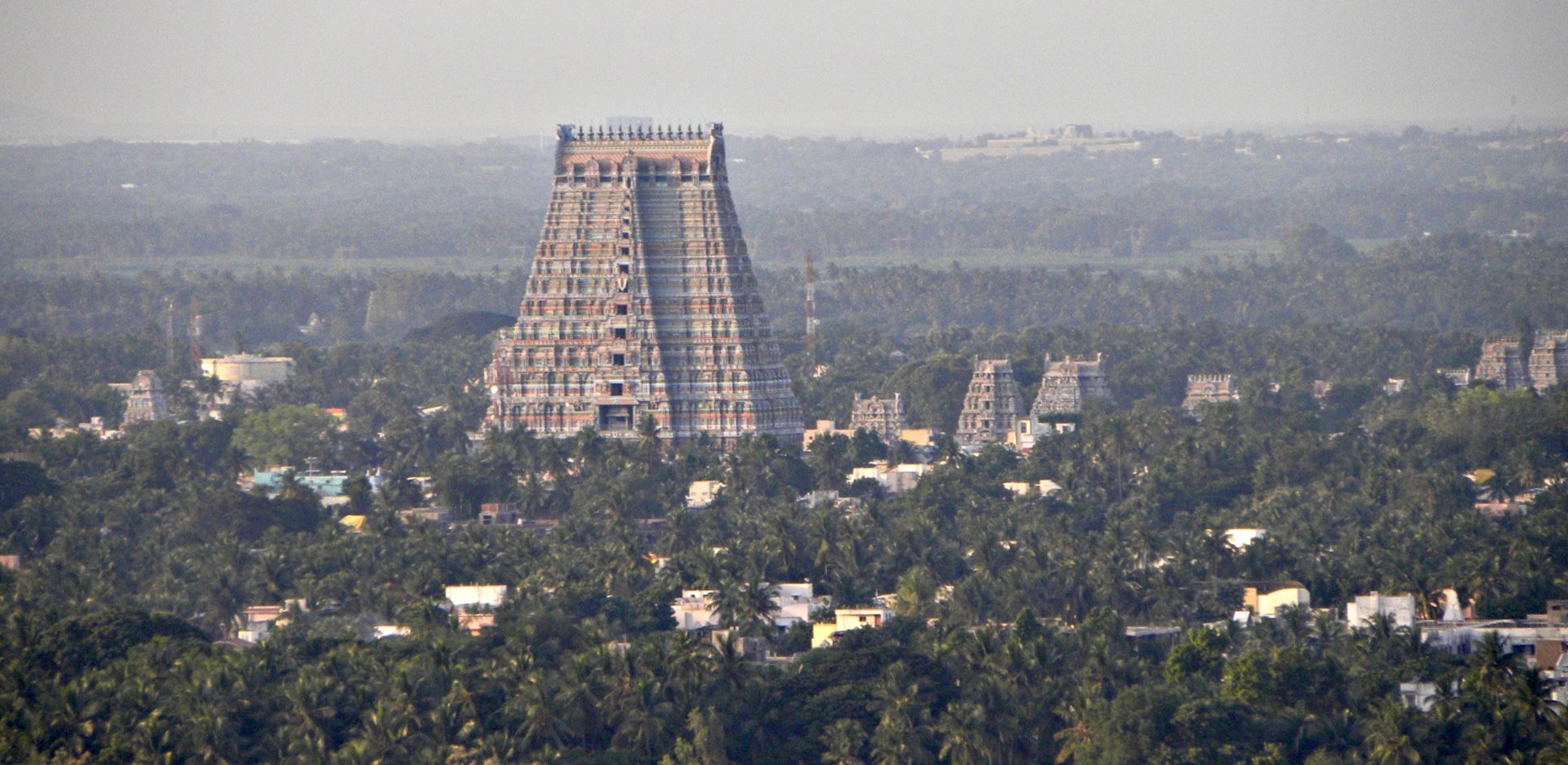
_Vellai_Gopuram_of_Hindu_temple_Sri_Ranganathaswamy_Srirangam_Thiruvarangam_Tiruchirapalli_India_2014.jpg)
Right: A Srirangam temple tower constructed by Ahobila Mutt monastery.[84]
The matha, or a monastery, hosted numerous students, many teachers and an institutionalized structure to help sustain and maintain its daily operations. A matha in Vaishnvaism and other Hindu traditions, like a college, designates teaching, administrative and community interaction functions, with prefix or suffix to names, with titles such as Guru, Acharya, Swami, and Jiyar.[85]
A Guru is someone who is a "teacher, guide or master" of certain knowledge.[86] Traditionally a reverential figure to the student in Hinduism, the guru serves as a "counselor, who helps mold values, shares experiential knowledge as much as literal knowledge, an exemplar in life, an inspirational source and who helps in the spiritual evolution of a student."[87]
An Acharya refers to either a Guru of high rank, or more often to the leader of a regional monastery.[88][89] This position typically involves a ceremonial initiation called diksha by the monastery, where the earlier leader anoints the successor as Acharya.[88][90] A Swami is usually those who interact with community on the behalf of the matha. The chief and most revered of all Vaishnava monasteries, are titled as Jeer, Jiyar, Jeeyar, or Ciyar.[83]
The Sri Vaishnavism mathas, over time, divided into two, those with Tenkalai (southern) tradition and Vadakalai (northern) tradition of Sri Vaishnavism.[91] The Tenkalai-associated mathas are headquartered at Srirangam, while Vadakalai mathas are associated with Kanchipuram. Both these traditions have from 10th-century onwards considered the function of mathas to include feeding the poor and devotees who visit, hosting marriages and community festivals, farming temple lands and flower gardens as a source for food and worship ingredients, being open to pilgrims as rest houses, and this philanthropic role of these Hindu monasteries continues.[92] In the 15th-century, these monasteries expanded by establishing Ramanuja-kuta in major South Indian Sri Vaishnavism locations.[92] The organizationally important Sri Vaishnavism matha are:
- Tenkalai tradition
- Sriranganarayana Jiyar Matha at Srirangam, Tamil Nadu[91][93]
- Vanamamalai Jiyar Matha at Nanguneri, Tamil Nadu[83][93]
- Perarulala Yatiraja Ramanuja Jiyar Matha at Thirukkurungudi, Tamil Nadu[83][93]
- Yatiraja Matha at Sriperumbudur, Tamil Nadu[93]
- Udaiyavar Koil Jiyar Matha at Alvar Tirunagari, Tamil Nadu[93]
- Emperumanar Jiyar Matha at Tirukkovalur, Tamil Nadu[93]
- Andal Jeeyar Mutt at Srivilliputtur, Tamil Nadu
- Yadugiri Yathiraja Mutt at Melkote, Karnataka[93]
- Periya and Cinna Jiyar Matha at Tirupati and Tirumala, Andhra Pradesh[93]
- Vadakalai tradition
- Brahmatantra Parakala Matha at Mysore, Karnataka[83][93]
- Ahobila Jiyar Matha at Ahobila, Andhra Pradesh[83][93]
- Andavan Ashramam at Srirangam, Tamil Nadu[93]
Vadakalai and Tenkalai denominations
[edit]The Sri Vaishnava tradition is classified into two major denominations called the Vadakalai ("northern art") and Tenkalai ("southern art").[28][94] The northern and southern denominations of Sri Vaishnavism refer respectively to Kanchipuram (the northern part of Tamil country) and Srirangam (the southern part of Tamil country and Kaveri river delta area where Ramanuja wrote his Vedanta treatises from).[13][14][95] These denominations arose as a result of philosophical and traditional divergences in the post-Ramanuja period. The Vadakalai placed emphasis on Sanskrit scriptures such as the Vedas and Pancharatra texts, while the Tenkalai highlighted Tamil texts such as the Naalayira Divya Prabandham of the Alvars.[28][96] The philosophies of Pillai Lokacharya and Vedanta Desika, which evolved consequently, were stabilized by Manavala Mamunigal and Brahmatantra Svatantra Jiyar respectively. When the schism weakened, Vadakalai tradition split into Munitreyam, Ahobila Matha, and Parakala matha. Similarly, Tenkalai tradition split into Kandadais, Telugu Sri Vaishnavas, Soliyar, and Sikkiliyar.[93]
From the ancient period, the Sri Vaishnavism movement flourished in Tamilakam owing to its social inclusiveness, where devotion to the supreme deity (Vishnu) was open without limitation to gender or caste, a tradition led by Alvars in the 7th and the 8th centuries.[97][98] Ramanuja philosophy negated caste, states Ramaswamy.[99] Ramanuja, who led from the Srirangam temple, welcomed outcastes into temples and gave them important roles in temple duties. Medieval temple records and inscriptions suggest that the payments and offerings collected by the temple were shared regardless of caste distinctions.[100]
Scholars offer differing views on the relative approach of the two denominations on caste and gender. Raman states that Tenkalai did not recognise caste barriers and were more liberal in assimilating people from all castes, possibly because this had been the tradition at Srirangam from the earliest days of Sri Vaishnavism.[100] In contrast, Sadarangani states that it was Vadakalai who were more liberal and who did not recognise caste barriers, possibly because they were competing with the egalitarian Virashaiva Hindus (Lingayatism) of Karnataka.[101] Both sects believe in initiation through Pancha Samskara.[102] This ceremony or rite of passage is necessary for one to become a Vaishnava. It is performed by both Brahmins and non-Brahmins in order to become Vaishnavas.[103] Some non-Brahmin Vaishnavas include Telugu Naidu, Tamil Vanniyar and Namadhari.[104] Only those Vaishnavas who are of brahmin caste call themselves as Sri Vaishnavas.[105]
The Tenkalai tradition brought into their fold artisanal castes into community-based devotional movements. Raman states, "it can almost be said that the Tenkalai represented the anti-caste tendencies while the Vadakalai school championed the cause of purity of the Vedic tenets."[100] The Tenkalai held, adds Raman, that anyone can be a spiritual teacher regardless of caste.[100]
The Vadakalai tradition states Sadarangani in contrast to Raman's views, were the liberal cousin of Tenkalai and therefore more successful in gaining devotees, while in southern Tamil lands Shaivism prospered possibly because of "Tenkalai school of Vaishnavism being narrow and orthodox in approach".[101] The Vadakalai school not only succeeded in northern Tamil lands, she adds, but spread widely as it inspired the Bhakti movement in north, west and east India, bringing in Bhakti poet saints from "entire cross-section of class, caste and society".[101]
Tenkalai ("southern art") - Manavala Mamunigal
[edit]The Ranganathaswamy Temple, Srirangam belongs to the Tenkalai/Thennacharya tradition and is considered as one of the important sites of Sri Vaishnava tradition. All the functionaries and priests are the descendants of the 74 disciples appointed by Ramanuja and belong to the Tenkalai line without any exceptions.[106]

Characteristics
[edit]The Tenkalai place higher importance to Tamil slokas than Sanskrit, and lay more emphasis on the worship of Vishnu. The Tenkalai accept prapatti as the only means to attain salvation.[107] They consider Prapatti as an unconditional surrender.[108] The Thenkalais follow the Tamil Prabandham,[109] and assert primacy to rituals in Tamil language.[110] They regard kaivalya (detachment, isolation) as an eternal position within the realm of Vaikuntha (Vishnu's 'eternal abode' or heaven), though it only exists at the outer most regions of Vaikuntha. They further say that God's seemingly contradictory nature as both minuscule and immense are examples of God's special powers that enable Him to accomplish the impossible.
According to the Tenkalai, exalted persons need not perform duties such as Sandhyavandanam; they do so only to set a good example. They don't allow the ringing of bells during worship. The Tenkalai forbid widows to shave (tonsure) their head, quoting the Parashara Smriti.[111] while Vadakalais support the tonsure quoting the Manusmriti,[112]
Demographics
[edit]
The Tenkalai trace their lineage to Mudaliyandan, nephew of Ramanuja[113] The Tenkalai are followers of the philosophy of Pillai Lokacharya and Manavala Mamuni,[114][115] who is considered to be the reincarnation of Ramanuja by the Tenkalai.[note 6]
Many of the main preceptors of Sri Vaishnavism and their descendants, before and after Ramanuja, belong to the Tenkalai denomination.
Notable Tenkalai people
[edit]- Srinivasa Ramanujan (1887–1920), Indian mathematician.[116][note 7]
- K.S. Krishnan (1898–1961), Indian physicist.[117]
- B.K.S Iyengar (1918–2014), Founder of the "Iyengar Yoga" style of Yoga.[118]
- Alasinga Perumal (1865–1909), Disciple of Swami Vivekananda and one of the founders of Brahmavadin which later became Vedanta Kesari.[119][120][121]
- Sujatha (1935–2008), Writer, editor and engineer; key person behind development of the Electronic Voting Machine, for which he was awarded the VASVIK Industrial Research Award.[122][failed verification]
- Ariyakudi Ramanuja Iyengar (1890–1967), Renowned musician and architect of modern Carnatic music.[123][124][125]
- J. Jayalalithaa (1948-2016), Renowned actress and six times chief minister of Tamil Nadu.[126]
Vadakalai ("northern art") - Vedanta Desika
[edit]
Characteristics
[edit]The Vadakalai are followers of Ramanuja and Vedanta Desika,[127][128][129] who founded the Vadakalai sampradaya[130] based on the Sanskritic tradition.[131] They lay more emphasis on the role of Lakshmi i.e. Sri, and uphold Sanskrit Vedas as the ultimate "Pramanam" or authority, although Ubhaya Vedanta[note 8] is used to infer from and establish the doctrine of Vishishtadvaita. The Vadakalai infer that all of the Alvars compositions are derived from the Vedas, and believe that the latter is the ultimate source to reference and defend the doctrine. The Vadakalai lay emphasis on Vedic norms[note 9] as established by Brahmanical tradition.
The Vadakalai ardently follow the Sanskrit Vedas,[109] and the set of rules prescribed by the Manusmriti and Dharma Shastras.[132][133] The sect is based on the Sankritic tradition,[134] and the set of rules prescribed by the Manusmriti and other Dharma Shastras.[132][133] In Sanskrit the Vadakalai are referred to as Uttara Kalārya.[135]
Traditionally, the Vadakalai believe in practising Karma yoga, Jnana yoga and Bhakti yoga, along with Prapatti, as means to attain salvation.[136][137] Also, they consider Prapatti as an act of winning grace.[108]
The tilaka (urdhva pundra) mark of the Vadakalai men is a symbolic representation of Vishnu's right foot. Since Vishnu's right foot is believed to be the origin of the river Ganga, the Vadakalai contend that his right foot should be held in special veneration, and its sign impressed on the forehead. They also apply a central mark (sricharanam) to symbolise the goddess Lakshmi (Vishnu's wife), along with the tiruman (urdhva pundra).[138] The Urdhva Pundra that is vertical and faces upwards denotes that it helps one in reaching Vaikuntha (the spiritual abode of Vishnu), and is also considered to be a warder of evil. Vadakalai women apply a red central mark along with namam only, symbolising Lakshmi seated on a lotus on their foreheads.
Guru Parampara
[edit]
The Vadakalai sect traces its lineage back to Thirukurahi Piran Pillan, Kidambi Acchan and other direct disciples of Ramanuja, and considers Vedanta Desika to be the greatest Acharya of the post Ramanuja era.[127][139][140]
The Vadakalai community consists of the following groups, based on the sampradaya followed:
- Pancharatra – Followers of Srimad Azhagiya Singar (Srinivasacharya) of Ahobila Mutt.[141][142][143][144] The majority of Vadakalais belongs to this group.[145] His disciples established Mutts at different places in North India, including Varanasi, Chitrakoot and Pushkar.
- Munitraya – Followers of Srimad Andavan of Andavan Ashramams,[146][147] and Swayamacharyas.[148] The Srirangam Srimad Andavan Ashramam, Poundarikapuram Andavan Ashramam, and most of the present-day Vadagalai 'svayam-acharya purusha' families are directly connected to this acharya parampara, and follow the worship and ritual patterns outlined by]Gopalarya Mahadesikan.
- Periya Andavan Srinivasa Mahadesikan;
- Parakala – They are mostly followers Brahmatantra Swatantra Jeeyar of Parakala Mutt, Mysore. Founded in 1399 by Brahmatantra Parakala Jeeyar, the peetadhipathis of this mutt are the preceptors of the royal family of Mysore Kingdom, Wadiyars. This has stayed as a royal mutt of the kings since then, and is a mutt for all Iyengars under this category.[149][better source needed]
Demographics
[edit]Traditionally, places of high importance with significant Vadakalai populations included Kanchipuram, Kumbakonam, Tiruvallur, Mysore and Kurnool district.[135][150][151][152][153][154] However, today much of the people have moved to the big cities.
In Vrindavan, the Jankivallabh Mandir of Keshighat is a prominent Vadakalai Sri Vaishnava monastic institution and is associated with the spiritual lineage of the Ahobila Mutt. The present Azhagiya Singar has visited this well known institution in the past as well as recently. It is presently headed by Swami Sri Aniruddhacharyaji Maharaj.
In Rajasthan the Jhalariya Mutt is one of the most prominent Mutts and its branches have spread over to the neighbouring regions of Gujarat and Maharashtra. Sri Swami Balmukundacharyaji was a distinguished scholar and renowned Acharya of this Mutt.
Notable Vadakalai people
[edit]- Gopala Bhatta Goswami (1503–1578), born a Vadakalai Iyengar, one of the Six Goswamis of Vrindavan in Chaitanya Vaishnavism, and a highly revered Guru in ISKCON.[155]
- Chakravarti Rajagopalachari (1878–1972), Indian politician and activist of the Indian independence movement. Premier of Madras (1937–1939), Governor of Bengal (1946–1948), Governor-General of India (1948–1950), Union Home Minister (1950–1952) and Chief Minister of Madras state (1952–1954). Founder of Swatantra party.[156]
- C. V. Rungacharlu (1831–1883), Diwan of Mysore kingdom from 1881 to 1883.[157]
- T. S. S. Rajan (1880–1953), Indian politician and freedom-fighter. Member of the Imperial Legislative Council (1934–1936), Minister of Public Health and Religious Endowments (Madras Presidency) (1937–1939), Minister of Food and Public Health (Madras Presidency) (1946–1951).[158]
- Tirumalai Krishnamacharya (1888–1989), an influential Yoga teacher, healer and scholar.
- Agnihotram Ramanuja Tatachariar (1907–2008), renowned vedic scholar, and recipient of two national awards for his contribution to Vedic studies and Sanskrit literature.[159]
- Krishnamachari Srikkanth (b. 1959), Indian Cricket Player
- R. Madhavan (b. 1970), Indian film actor[160]
Temples following Srivaishnava Sampradaya
[edit]- Divya Desams
- Abhimana Kshethrams
- Ranganathaswamy Temple, Srirangam
- Venkateswara Temple, Tirumala
- Andal Temple, Srivilliputtur
- Namagiri Thayar Sametha Narasimhaswamy perumal temple, Namakkal
- Sita Ramachandraswamy temple, Bhadrachalam
- Cheluvanarayana Swamy Temple
- Chakrapani Temple, Kumbakonam
- Sarangapani temple, Kumbakonam
- Ranganathaswamy Temple, Srirangapatna
- Ulagalantha Perumal Temple, Kanchipuram
- Parthasarathy Temple, Triplicane
- Bhu Varaha Swamy temple
- Varadharaja Perumal Temple, Kanchipuram
- Ashtabujakaram
- Adikesava Perumal Temple, Kanyakumari
- Pandava Thoothar Perumal Temple
- Rajagopalaswamy Temple, Mannargudi
- Ulagalantha Perumal Temple, Tirukoyilur
- Mudikondan Kothandaramar Temple
- Thirupullabhoothangudi Temple
- Kola Valvill Ramar Temple, Tiruvelliyangudi
- Vijayaraghava Perumal temple
- Ramaswamy Temple, Kumbakonam
- Yadadri Lakshmi Narasimha Swamy Temple
- Sri Lakshmi Narayana Temple, Sainikpuri, Secunderabad
- Ranganathaswamy Temple, Jiyaguda
See also
[edit]Notes
[edit]- ^ Brahman is the metaphysical ultimate unchanging reality in Vedic and post-Vedic Hinduism, and is Vishnu in Sri Vaishnavism.
- ^ These two Vaishnavism traditions are respectively called the Sri Vaishnava sampradaya and the Brahma sampradaya.[41]
- ^ This work is predominantly about the Hindu scriptures called the Upanishads which Ramanuja held as the essence of the Vedas.[70]
- ^ The texts of most of these scholars is lost to history.
- ^ Brahman is the Vedic concept of metaphysical unchanging reality.[74]
- ^ He is also known by many other names, such as Azhagiya Manavala Mamunigal, Sundhara Jamatara Muni, Ramya Jamatara Muni, Ramya Jamatara Yogi, Varavaramuni, Yathindhra pravanar, Kanthopayantha, Ramanujan ponnadi, Soumya jamathru yogindhrar, Koil Selva manavala mamunigal etc. He also has the titles Periya Jeeyar, Vellai Jeeyar, Visthavak sikhamani, Poi IllAtha Manavala Mamuni.
- ^ Ramanujan's father belongs to Thenkalai sect while his mother belongs to Vadakalai sect
- ^ The Sanskrit Vedas and the Dravida Veda, the composition of Alwars, which are held in equal esteem
- ^ Also known as anushtaanams
References
[edit]- ^ Faiths across Time [4 volumes]: 5,000 Years of Religious History [4 volumes]. Bloomsbury Publishing USA. 15 January 2014. ISBN 978-1-61069-026-3.
- ^ a b Ranjeeta Dutta 2007, pp. 22–43.
- ^ John Carman & Vasudha Narayanan 1989, pp. 3–8.
- ^ a b Matchett 2000, p. 4, 200.
- ^ Matchett 2000, p. 4, 77, 200.
- ^ a b John Carman & Vasudha Narayanan 1989, pp. xvii, 3–4.
- ^ Lester 1966, pp. 266–269.
- ^ a b c d Francis Clooney & Tony Stewart 2004, pp. 167–168.
- ^ a b John Carman & Vasudha Narayanan 1989, pp. 3–4, 36–42, 181.
- ^ a b c d e f Flood 1996, p. 136.
- ^ Morgan 1953.
- ^ a b c John Carman & Vasudha Narayanan 1989, pp. 3–4.
- ^ a b c d e f g Mumme 1987, p. 257.
- ^ a b c d e Bryant 2007, pp. 286–287.
- ^ Bhattacharya, Jogendra Nath (1896). Hindu Castes and Sects: An Exposition of the Origin of the Hindu Caste System and the Bearing of the Sects Towards Each Other and Towards Other Religious Systems. Thacker, Spink. p. 98.
The Sri Vaishnavas among the Telingana Brahmans form a distinct caste called Andhra Vaishnava. They are not sub-divided as Vadgala and Tengala like their co-religionists of Dravida
- ^ Stephan Schuhmacher (1994). The Encyclopedia of Eastern Philosophy and Religion: Buddhism, Hinduism, Taoism, Zen. Shambhala. p. 397. ISBN 978-0-87773-980-7.
- ^ श्रीवैष्णव, Sanskrit-English Dictionary, Koeln University, Germany (2011)
- ^ Klaus K. Klostermaier (1984). Mythologies and Philosophies of Salvation in the Theistic Traditions of India. Wilfrid Laurier University Press. p. 102. ISBN 978-0-88920-158-3.
- ^ a b Flood 1996, p. 135-136.
- ^ John Carman & Vasudha Narayanan 1989, pp. 3–5.
- ^ John Carman 1974, pp. 45, 80.
- ^ a b c Jon Paul Sydnor (2012). Ramanuja and Schleiermacher: Toward a Constructive Comparative Theology. Casemate. pp. 20–22 with footnote 32. ISBN 978-0227680247.
- ^ "Ramanuja | Internet Encyclopedia of Philosophy". Retrieved 21 July 2023.
- ^ a b Patrick Olivelle (1992). The Samnyasa Upanisads : Hindu Scriptures on Asceticism and Renunciation. Oxford University Press. pp. 10–11, 17–18. ISBN 978-0-19-536137-7.
- ^ a b c J.A.B. van Buitenen (2008), Ramanuja - Hindu theologian and Philosopher, Encyclopædia Britannica
- ^ "Ramanandi Sampradaya".
- ^ Tattwananda, Swami (1984), Vaisnava Sects, Saiva Sects, Mother Worship (1st revised ed.), Calcutta: Firma KLM Private Ltd., p. 10
- ^ a b c Flood 1996, p. 137.
- ^ Mumme 1987, pp. 257–266.
- ^ a b c d e John Carman 1994, p. 151.
- ^ John Carman 1994, pp. 151–152.
- ^ Tapasyananda 2011, p. 53.
- ^ a b Bruce M. Sullivan (2001). The A to Z of Hinduism. Rowman & Littlefield. p. 239. ISBN 978-0-8108-4070-6.
- ^ a b c Joseph P. Schultz (1981). Judaism and the Gentile Faiths: Comparative Studies in Religion. Fairleigh Dickinson University Press. pp. 81–84. ISBN 978-0-8386-1707-6.
- ^ a b Stafford Betty (2010), Dvaita, Advaita, and Viśiṣṭādvaita: Contrasting Views of Mokṣa, Asian Philosophy: An International Journal of the Philosophical Traditions of the East, Volume 20, Issue 2, pages 215-224
- ^ Edward Craig (2000), Concise Routledge Encyclopedia of Philosophy, Routledge, ISBN 978-0415223645, pages 517-518
- ^ Sharma 1994, p. 373.
- ^ a b Stoker 2011.
- ^ Sharma 1994, pp. 373–374.
- ^ Sharma 1994, p. 374.
- ^ Klostermaier 2007, p. 304.
- ^ Sharma 1994, pp. 374–375.
- ^ Bryant 2007, pp. 361–362.
- ^ John Carman & Vasudha Narayanan 1989, p. 6.
- ^ Flood 1996, p. 136-137.
- ^ Flood 1996, p. 137: the tenkalai emphasized the Tamil scriptures and surrender to the Lord by his grace.
- ^ Jon Paul Sydnor (2012). Ramanuja and Schleiermacher: Toward a Constructive Comparative Theology. Casemate. pp. 10–11. ISBN 978-0227680247.
- ^ a b c d e f Shyam Ranganathan (2011), Rāmānuja (c. 1017 - c. 1137), IEP, York University
- ^ a b c John Carman 1994, p. 86.
- ^ Mayeda 2006, pp. 46–53.
- ^ Mayeda & Tanizawa (1991), Studies on Indian Philosophy in Japan, 1963–1987, Philosophy East and West, Vol. 41, No. 4, pages 529–535
- ^ Michael Comans (1996), Śankara and the Prasankhyanavada, Journal of Indian Philosophy, Vol. 24, No. 1, pages 49–71
- ^ John Carman 1994, pp. 86–88.
- ^ Julius Lipner (1986), The Face of Truth: A Study of Meaning and Metaphysics in the Vedantic Theology of Ramanuja, State University of New York Press, ISBN 978-0887060397, pages 120-123
- ^ a b c John Carman 1994, pp. 117–118, 148–153.
- ^ John Carman 1994, pp. 196–197, for context see 190-201.
- ^ Klostermaier 2007, pp. 387–389.
- ^ Lester 1966, pp. 266–282.
- ^ Klostermaier 2007, p. 487.
- ^ a b c d Constance Jones; James D. Ryan (2006). Encyclopedia of Hinduism. Infobase. p. 490. ISBN 978-0-8160-7564-5.
- ^ a b Guy L. Beck (2012). Sonic Liturgy: Ritual and Music in Hindu Tradition. University of South Carolina Press. pp. 119–120. ISBN 978-1-61117-108-2.
- ^ Guy L. Beck (2012). Sonic Liturgy: Ritual and Music in Hindu Tradition. University of South Carolina Press. pp. 118–127. ISBN 978-1-61117-108-2.
- ^ a b Alkandavilli Govindacharya (1906). The Life of Râmânujâchârya: The Exponent of the Viśistâdvaita Philosophy. S. Murthy. pp. 9–10 with footnotes.
- ^ John Sheveland (2013). Piety and Responsibility: Patterns of Unity in Karl Rahner, Karl Barth, and Vedanta Desika. Ashgate Publishing. pp. 113–114. ISBN 978-1-4094-8144-7.
- ^ a b Christopher Bartley (2011). An Introduction to Indian Philosophy. Bloomsbury Academic. pp. 177–178. ISBN 978-1-84706-449-3.
- ^ a b Dalal 2010, p. 399.
- ^ C. R. Sreenivasa Ayyangar (1908). The Life and Teachings of Sri Ramanujacharya. R. Venkateshwar. pp. 130 footnote 2.
- ^ M.C. Alasingaperumal (1900). The Brahmavâdin, Volume 5. Madras: Brahmavâdin Press. pp. 466–467.
- ^ a b Jon Paul Sydnor (2012). Ramanuja and Schleiermacher: Toward a Constructive Comparative Theology. Casemate. pp. 2–4. ISBN 978-0227680247.
- ^ a b Jon Paul Sydnor (2012). Ramanuja and Schleiermacher: Toward a Constructive Comparative Theology. Casemate. p. 4. ISBN 978-0227680247.
- ^ Robert Lester (1966), Ramanuja and Shri Vaishnavism: the Concept of Prapatti or Sharanagati, History of Religion, Volume 5, Issue 2, pages 266-282
- ^ a b c d Anne Hunt Overzee (1992). The Body Divine: The Symbol of the Body in the Works of Teilhard de Chardin and Ramanuja. Cambridge University Press. pp. 30–31. ISBN 978-0-521-38516-9.
- ^ R. Balasubramanian (2000). Advaita Vedānta. Munshiram Manoharlal. p. 9. ISBN 978-81-87586-04-3.
- ^ Jeaneane D. Fowler (2002). Perspectives of Reality: An Introduction to the Philosophy of Hinduism. Sussex Academic Press. p. 49. ISBN 978-1-898723-94-3.
- ^ Anne Hunt Overzee (1992). The Body Divine: The Symbol of the Body in the Works of Teilhard de Chardin and Ramanuja. Cambridge University Press. pp. 63–85. ISBN 978-0-521-38516-9.
- ^ Julius Lipner (1986). The Face of Truth: A Study of Meaning and Metaphysics in the Vedantic Theology of Ramanuja. State University of New York Press. pp. 37–48. ISBN 978-0-88706-038-0.
- ^ Ayyangar, C. R. Sreenivasa (1908). The Life and Teachings of Sri Ramanujacharya. R. Venkateshwar.
- ^ Seshadri, K. (1998). Srivaishnavism and Social Change. K.P. Bagchi & Company. ISBN 978-81-7074-198-5.
- ^ Paniker, K. Ayyappa (1997). Medieval Indian Literature: Surveys and selections. Sahitya Akademi. ISBN 978-81-260-0365-5.
- ^ Rajagopalachariar, T. (1982). The Vaishnavite Reformers of India: Critical Sketches of Their Lives and Writings. A.D. Publications.
- ^ Jerry L. Walls (2010). The Oxford Handbook of Eschatology. Oxford University Press. pp. 182–183. ISBN 978-0-19-974248-6.
- ^ Brian A. Hatcher (2015). Hinduism in the Modern World. Routledge. p. 27. ISBN 978-1-135-04631-6.
- ^ a b c d e f Dalal 2010, p. 385.
- ^ Renganathan, L. (5 January 2012). "Rajagopuram — pride of Srirangam". The Hindu.
- ^ Vasudeva Rao (2002). Living Traditions in Contemporary Contexts: The Madhva Matha of Udupi. Orient Blackswan. pp. 33–45. ISBN 978-81-250-2297-8.
- ^ Stefan Pertz (2013), The Guru in Me - Critical Perspectives on Management, GRIN Verlag, ISBN 978-3638749251, pages 2-3
- ^ Joel Mlecko (1982), The Guru in Hindu Tradition Numen, Volume 29, Fasc. 1, pages 33-61
- ^ a b Jeffery D. Long (2011). Historical Dictionary of Hinduism. Scarecrow. p. 24. ISBN 978-0-8108-7960-7.
- ^ Vasudha Narayanan (2009). Hinduism. The Rosen Publishing Group. pp. 50–51. ISBN 978-1-4358-5620-2.
- ^ Tamara I. Sears (2014). Worldly Gurus and Spiritual Kings: Architecture and Asceticism in Medieval India. Yale University Press. pp. 68–70, 121–122, 159–160. ISBN 978-0-300-19844-7.
- ^ a b Steven Paul Hopkins (2002). Singing the Body of God. Oxford University Press. pp. 71–74. ISBN 978-0-19-802930-4.
- ^ a b K.V. Raman (2003). Sri Varadarajaswami Temple, Kanchi: A Study of Its History, Art and Architecture. Abhinav Publications. pp. 137–138. ISBN 978-81-7017-026-6.
- ^ a b c d e f g h i j k l Dutta, Ranjeeta (2015). "Reading Community Identities and Traditions: The History and Representation of the Shrivaishnavas of South India". Studies in Humanities and Social Sciences. 18 (1–2): 141–68. S2CID 161734042.
- ^ Gough 1965, p. 25.
- ^ Geoffrey Oddie (2013). Hindu and Christian in South-East India. Routledge. pp. 94 footnote 7. ISBN 978-1-136-77377-8.
Quote: In this context, 'north' refers to the northern region of the Tamil country with its capital at Kanchipuram (a historical seat of Sanskrit learning) and 'south' refers to the Kaveri delta with its capital at Srirangam - one of the sacred bastions of Tamil culture."
- ^ Mumme 1987, pp. 257–265.
- ^ C. J. Bartley (2013). The Theology of Ramanuja: Realism and Religion. Routledge. pp. 1–4. ISBN 978-1-136-85306-7.
- ^ P. T. Narasimhachar (2001). The Hill Temple. Sahitya Akademi. pp. xviii. ISBN 978-81-260-0814-8.
- ^ Ramaswamy, Vijaya (1985), Textiles and weavers in medieval South India, Oxford University Press, p. 61, ISBN 978-0-19-561705-4, retrieved 17 April 2016
- ^ a b c d K.V., Raman (2003), Sri Varadarajaswami Temple, Kanchi: A Study of Its History, Art and Architecture, Abhinav Publications, pp. 132–133, ISBN 9788170170266, retrieved 16 April 2016
- ^ a b c Neeti M. Sadarangani (2004). Bhakti Poetry in Medieval India: Its Inception, Cultural Encounter and Impact. Sarup & Sons. pp. 19–20. ISBN 978-81-7625-436-6.
- ^ Roshen Dalal. Hinduism: An Alphabetical Guide. Penguin Books India, 2010. p. 385.
- ^ Gengnagel, Jörg; Hüsken, Ute; Raman, Srilata (2005). Words and Deeds: Hindu and Buddhist Rituals in South Asia. Otto Harrassowitz Verlag, 2005. p. 91. ISBN 9783447051521.
- ^ Young, Katherine (2021). Turbulent Transformations: Non-Brahmin Śrīvaiṣṇavas on Religion, Caste and Politics in Tamil Nadu. Orient BlackSwan. ISBN 978-81-949258-8-0.
- ^ Jagadeesan, N. (1977). History of Sri Vaishnavism in the Tamil Country: Post-Ramanuja. Koodal Publishers.
Tirukkachchi Nambi and Pillai Uranga Villi Dasar, great names in Sri Vaishnava tradition, cannot be called Sri Vaishnavas because they were not Brahmins.
- ^ Madabhushini Narasimhacharya. Sri Ramanuja. Sahitya Akademi, 2004. p. 27.
- ^ Coward 2008, p. 141.
- ^ a b Thomas Manninezhath (1993). Harmony of Religions: Vedānta Siddhānta Samarasam of Tāyumānavar. Motilal Banarsidass. pp. 35–. ISBN 978-81-208-1001-3.
- ^ a b "Tamil Nadu, Religious Condition under Vijaya Nagar Empire". Tamilnadu.ind.in. Retrieved 4 January 2012.
- ^ Srinivasan & Mukherjee 1976.
- ^ Pg.66 The Indian historical review, Volume 17; Indian Council of Historical Research, Vikas Pub. House
- ^ Pg.65 The Indian historical review, Volume 17; Indian Council of Historical Research, Vikas Pub. House
- ^ "Swami Mudaliandan Thirumaligai". www.mudaliandan.com. Retrieved 14 April 2016.
- ^ Pandey, Vraj Kumar (2007). Pg.86 Encyclopaedia of Indian philosophy, Volume 1, by Vraj Kumar Pandey, Anmol Publications. Anmol Publications. ISBN 9788126131129. Retrieved 4 January 2012.
- ^ Subrahmanian, N.; Tamil̲An̲Pan̲; Jeyapragasam, S. (1976). Pg.108 Homage to a Historian:a festschrift – by N. Subrahmanian, Tamilanpan, S.Jeyapragasam, Dr. N. Subrahmanian 60th Birthday Celebration Committee, in association with Koodal Publishers. Retrieved 4 January 2012.
- ^ Srinivasa Ramanujan Aiyangar; Bruce C. Berndt; Robert Alexander Rankin (2001). Ramanujan: Essays and Surveys. American Mathematical Soc. pp. 89–. ISBN 978-0-8218-2624-9.
- ^ D. C. V. Mallik (10 September 2000). "K. S. Krishnan and the Kodaikanal Observatory" (PDF). Current Science. 79 (5). Archived from the original (PDF) on 8 August 2017. Retrieved 9 July 2023.
- ^ Ram Godar (27 December 2013), Guruji B.K.S. Iyengar's 95th Birthday Celebrations, archived from the original on 14 December 2021, retrieved 9 April 2016
- ^ Parlato, Frank Jr. "People that Swami Vivekanand- Frank Parlato Jr". www.vivekananda.net. Archived from the original on 11 April 2013. Retrieved 9 April 2016.
- ^ "Memoirs of European travel I". www.ramakrishnavivekananda.info. Retrieved 9 April 2016.
- ^ "Complete_Works_of_Swami_Vivekananda_-_Vol_7" (PDF).
- ^ "Prolific Tamil writer Sujatha passes away". The Hindu. 28 February 2008. ISSN 0971-751X. Retrieved 9 April 2016.
- ^ "Ariyakudi" (PDF). Archived from the original (PDF) on 22 April 2016. Retrieved 14 April 2016.
- ^ "The first crossing". The Hindu. 14 January 2007. ISSN 0971-751X. Retrieved 14 April 2016.
- ^ "ARIYAKUDI". www.carnatica.net. Retrieved 14 April 2016.
- ^ "Why was Iyengar Brahmin J Jayalalithaa buried instead of being cremated". DNA India.
- ^ a b T. V. Kuppuswamy (Prof.), Shripad Dattatraya Kulkarni (1966). History of Tamilakam. Darkness at horizon. Shri Bhagavan Vedavyasa Itihasa Samshodhana Mandira. p. 166.
- ^ Sociology of religion, Volume 1 – by Joachim Wach, University of Chicago press, 1944. 3 November 1958. p. 129. Retrieved 20 November 2011.
- ^ Kabir, the apostle of Hindu-Muslim unity: interaction of Hindu-Muslim ideas in the formation of the bhakti movement with special reference to Kabīr, the bhakta – Muhammad Hedayetullah, Motilal Banarsidass publication, 1977. p. 107. Retrieved 20 November 2011.
- ^ "Britannica Online Encyclopedia". Britannica.com. Retrieved 20 November 2011.
- ^ "Astadasabhedanirnaya". Adityaprakashan.com. Retrieved 20 November 2011.
- ^ a b Nisith Ranjan Ray (1993). Dimensions of National Integration: The Experiences and Lessons of Indian History. Punthi-Pustak & Institute of Historical Studies. p. 150. ISBN 978-81-85094-62-5.
- ^ a b The Indian Historical Review. Vol. 17. Vikas Publishing House. 1990. p. 65.
- ^ "Astadasabhedanirnaya". Adityaprakashan.com. Retrieved 4 January 2012.
- ^ a b Students' Britannica India. p. 205. Retrieved 20 November 2011.
- ^ Dharma (1 February 1996). Philosophy of Nārāyaṇīyam: Study, Text & Śloka Index. Nag Publishers. p. 199. ISBN 978-81-7081-337-8.
- ^ "Srimad Rahasya Traya Sara by Shri Vedanta Desika – under the subtopic Upaya Vibhaga Adhikara". munitrayam.org. Archived from the original on 16 March 2012. Retrieved 4 January 2012.
- ^ Modern India and the Indians, by M.Monier Williams. 26 July 2001. p. 194. Retrieved 20 November 2011.
- ^ Wach, Joachim (11 June 1991). Pg.129 Sociology of religion, Volume 1 – by Joachim Wach, University of Chicago press, 1944. University of Chicago Press. ISBN 9780226867083. Retrieved 4 January 2012.
- ^ Hedayetullah, Muhammad (1977). Pg.107 Kabir, the apostle of Hindu-Muslim unity: interaction of Hindu-Muslim ideas in the formation of the bhakti movement with special reference to Kabīr, the bhakta – Muhammad Hedayetullah, Motilal Banarsidass publication, 1977. Motilal Banarsidass. ISBN 9788120806115. Retrieved 4 January 2012.
- ^ Tirupati Balaji was a Buddhist shrine, Sanjivan Publications, 1991. Retrieved 20 November 2011.
- ^ "Vadakalai Srivaishnava Festivals' Calendar – The source mentions Pancharatra & Munitraya Krishna Jayantis celebrated by Ahobila Mutt & Andavan Ashrams respectively". Trsiyengar.com. Archived from the original on 3 October 2011. Retrieved 20 November 2011.
- ^ "Ahobila Mutt's Balaji Mandir Pune, Calendar – The calendar mentions Ahobila Mutt disciples celebrating Krishna Jayanti as "Pancharatra Sri Jayanti"". Sribalajimandirpune.com. Archived from the original on 9 October 2011. Retrieved 20 November 2011.
- ^ The Cultural Heritage of India: Sri Ramakrishna centenary memorial, published by – Sri Ramakrishna centenary committee. 16 July 2009. p. 1000. Retrieved 20 November 2011.
- ^ Rāmānuja sampradāya in Gujarat:a historical perspective. Somaiya Publications. p. 31. Retrieved 20 November 2011.
- ^ Srivaishnavism and social change – by K.seshadri, K.P.Bagchi & co publishers. p. 82. Retrieved 20 November 2011.
- ^ The Cultural Heritage of India:The Religious. Ramakrishna Mission, Institute of Culture. 1956. p. 182.
- ^ "Sri Parakala Matham > Sri Matham > History".
- ^ Studies in history, Volume 1, Issue 1; Jawaharlal Nehru University. Centre for Historical Studies. Sage. 1979. p. 14. Retrieved 20 November 2011.
- ^ Gazetteer of South India, Volume 2 – By W. Francis, Mittal Publications. p. 561. Retrieved 20 November 2011.
- ^ Indian philosophy & culture, Volumes 3–4; Vrindāvan (India) Institute of Oriental Philosophy, Vaishnava Research Institute, Vrindāban, India. 1 January 1984. p. 33. Retrieved 20 November 2011.
- ^ Ontological and morphological concepts of Lord Sri Chaitanya and his mission, Volume 1; Bhakti Vilās Tīrtha Goswāmi Maharāj, Navadwīpa Dhām Prachārini Sabha; Pub' – Sree Gaudiya Math, 1994. 2 October 2009. p. 240. Retrieved 20 November 2011.
- ^ Studies in social history: modern India; O. P. Bhatnagar, India. University Grants Commission, University of Allahabad. Dept. of Modern Indian History; St. Paul's Press Training School, 1964. 1 January 2006. p. 129. Retrieved 20 November 2011.
- ^ "The Life of Srila Gopala Bhatta Goswami; His Vadakalai origin is mentioned in the article, where Vadakalai is spelled as "Badagalai"(Some in Northern India often substitute the alphabet V with B)". Prabhupadanugas.eu. 22 January 2011. Retrieved 20 November 2011.
- ^ "TimesContent – Photo of Rajagopalachari – He wears the Vadakalai Tilak on his forehead". Retrieved 20 November 2011.
- ^ Jogendra Nath Bhattacharya (1896). Hindu Castes and Sects: An Exposition on the Origins of Hindu caste system. Thacker, Spink & Co. p. 78.
- ^ Jawaharlal Memorial Fund (1972). Selected Works of Jawaharlal Nehru. Orient Longman. p. 440.
- ^ "A Vedic scholar enters his 100th year". The Hindu. India. 30 March 2007. Archived from the original on 12 October 2007. Retrieved 20 November 2011.
- ^ "ReelshowInt MAG". Mag.reelshowint.com. 15 June 2010. Archived from the original on 28 March 2012. Retrieved 20 November 2011.

Bibliography
[edit]- Bryant, Edwin Francis (2007), Krishna: A Sourcebook, Oxford University Press, ISBN 978-0-19-803400-1
- John Carman (1974). The Theology of Rāmānuja: An Essay in Interreligious Understanding. Yale University Press. ISBN 978-0-300-01521-8.
- John Carman; Vasudha Narayanan (1989). The Tamil Veda: Pillan's Interpretation of the Tiruvaymoli. University of Chicago Press. ISBN 978-0-226-09306-2.
- John Carman (1994). Majesty and Meekness: A Comparative Study of Contrast and Harmony in the Concept of God. Wm. B. Eerdmans. ISBN 978-0-8028-0693-2.
- Francis Clooney; Tony Stewart (2004). Sushil Mittal and Gene Thursby (ed.). The Hindu World. Routledge. ISBN 978-1-134-60875-1.
- Coward, Harold G. (2008), The perfectibility of human nature in eastern and western thought, SUNY Press, ISBN 9780791473368
- Dalal, Roshen (2010). Hinduism: An Alphabetical Guide. Penguin Books. ISBN 978-0-14-341421-6.
- Ranjeeta Dutta (2007). "Texts, Tradition and Community Identity: The Srivaisnavas of South India". Social Scientist. 35 (9/10): 22–43. JSTOR 27644238.
- Flood, Gavin D. (1996), An Introduction to Hinduism, Cambridge University Press
- Gough, Kathleen (1965), Rural Society in Southeast India, Cambridge University Press, ISBN 978-0-521-04019-8
- Srinivasan, S.; Mukherjee, D.P. (1976). "Inbreeding among Some Brahman Populations of Tamil Nadu". Human Heredity. 26 (2): 131–136. doi:10.1159/000152794. PMID 950239.
- Klostermaier, Klaus K. (2007), A Survey of Hinduism (3 ed.), State University of New York Press, ISBN 978-0-7914-7081-7
- Lester, Robert C (1966). "Rāmānuja and Śrī-vaiṣṇavism: The Concept of Prapatti or Śaraṇāgati". History of Religions. 5 (2): 266–282. doi:10.1086/462526. JSTOR 1062115. S2CID 162224010.
- Matchett, Freda (2000), Krsna, Lord or Avatara? The relationship between Krsna and Visnu: in the context of the Avatara myth as presented by the Harivamsa, the Visnupurana and the Bhagavatapurana, Surrey: Routledge, ISBN 978-0-7007-1281-6
- Mayeda, Sengaku (2006). A thousand teachings : the Upadeśasāhasrī of Śaṅkara. Motilal Banarsidass. ISBN 978-81-208-2771-4.
- Morgan, Kenneth W. (1 January 1987). The Religion of the Hindus. Motilal Banarsidass Publishing House. p. 228. ISBN 978-81-208-0387-9.
- Mumme, Patricia Y. (1987). "Grace and Karma in Nammāḻvār's Salvation". Journal of the American Oriental Society. 107 (2): 257–266. doi:10.2307/602834. JSTOR 602834.
- Sharma, Chandradhar (1994). A Critical Survey of Indian Philosophy. Motilal Banarsidass. ISBN 978-81-208-0365-7.
- Stoker, Valerie (2011). "Madhva (1238-1317)". Internet Encyclopedia of Philosophy. Retrieved 17 April 2016.
- Tapasyananda (2011), Bhakti Schools of Vedanta, Ramakrishna Mission
- Thurston, Edgar; K. Rangachari (1909). "Brahmin". Castes and Tribes of Southern India Volume I – A and B. Madras: Government Press.
Further reading
[edit]- Dictionary of Hindu Lore and Legend (ISBN 0-500-51088-1) by Anna Dallapiccola
- The Vernacular Veda: Revelation, Recitation, and Ritual (Univ of South Carolina Press, Columbia, South Carolina, U.S.A. 1 January 1994), by Vasudha Narayanan
- Understanding Hinduism, (ISBN 1844832015), by Vasudha Narayanan
Sri Vaishnavism
View on GrokipediaOrigins and Terminology
Etymology
The term Sri Vaishnavism (Sanskrit: Śrīvaiṣṇavism) derives from two primary components: Śrī, which in Sanskrit refers to the goddess Lakshmi, the divine consort of Vishnu, and also functions as an honorific prefix denoting sacredness, reverence, or auspiciousness; and Vaiṣṇavism, denoting the broader tradition of devotion to Vishnu as the supreme deity.[6] [7] This nomenclature underscores the tradition's distinctive theological emphasis on the inseparable unity of Vishnu and Lakshmi (Śrī), wherein Lakshmi mediates divine grace toward devotees, distinguishing it from other Vaishnava sects that may not accord her such a central, co-essential role.[6] The suffix Vaishnava itself originates from Viṣṇu, the name of the preserver deity in the Hindu trimurti, compounded with the agentive suffix -a or -āna in Sanskrit grammar to signify a follower or devotee, a usage traceable to Vedic and post-Vedic texts where Vaiṣṇava denotes adherents of Vishnu-centric worship.[8] The prefix Sri elevates the term to highlight the tradition's roots in South Indian temple-based practices, formalized through the philosophical systematization by acharyas like Ramanuja in the 11th century CE, who integrated Tamil devotional hymns (Alvar poetry) with Sanskrit scriptural authority to emphasize ubhaya-vedanta (dual Vedic tradition).[7]Theological Foundations
Sri Vaishnavism's theological foundations rest on Vishishtadvaita Vedanta, a qualified non-dualistic philosophy systematized by Ramanuja (1017–1137 CE) in works such as the Sri Bhashya.[9] This school posits Vishnu (Narayana) as the supreme Brahman, a personal deity endowed with infinite auspicious qualities (kalyan gunas) and inseparable from his consort Lakshmi, who mediates grace toward devotees.[9][10] Central to Vishishtadvaita is the distinction between Brahman, individual souls (jivatmans or chits), and insentient matter (achit or prakriti), all deemed real and eternal.[10] Souls and matter constitute the "body" of Brahman in a dependent, organic relationship, akin to a body animated and controlled by its soul, ensuring inseparability while preserving distinctions of essence and function.[9][11] This framework reconciles Vedic texts affirming unity (abheda shruti) and difference (bheda shruti) by viewing the cosmos as qualified modes (prakaras) of the divine, rejecting Advaita's dismissal of worldly reality as illusion (maya).[11][9] Liberation (moksha) arises through bhakti (loving devotion) or prapatti (total self-surrender), practices that invoke divine grace for release from samsara and eternal service in Vaikuntha, Vishnu's transcendent realm.[10][9] Unlike merger into an impersonal absolute, moksha preserves the devotee's individuality in blissful communion, grounded in scriptural authorities including the Vedas, Upanishads, Bhagavad Gita, and the Alvar saints' Divya Prabandham.[10] Ramanuja established 74 teaching centers to propagate these doctrines, embedding them in temple worship and community practice.[9]Historical Emergence
The historical emergence of Sri Vaishnavism is rooted in the bhakti movement of South India, particularly through the contributions of the Alvars, a group of twelve Vaishnava poet-saints active between the 6th and 9th centuries CE. These devotees composed Tamil hymns extolling Vishnu and his incarnations, amassing over 4,000 verses that emphasized emotional surrender and temple-based worship, diverging from ritualistic Vedic practices toward accessible devotion. Scholarly consensus, based on linguistic analysis and epigraphic evidence, dates the Alvars to this period, though traditional accounts place figures like Nammalvar centuries earlier.[12][13] A pivotal development occurred in the 10th century CE with Nathamuni (c. 824–924 CE), regarded as the foundational acharya of the tradition. Residing near the Srirangam temple, Nathamuni retrieved and compiled the Alvar hymns into the Nalayira Divya Prabandham, arranging them into musical recitations (araippadai) for liturgical use in Vishnu temples. This integration elevated the Tamil works to the status of "Dravida Veda," bridging vernacular bhakti with Pancharatra Agamic rituals and Sanskrit scriptures, thereby crystallizing an organized sectarian identity.[14][3] Nathamuni's efforts established the guru-parampara lineage, fostering doctrinal continuity and temple-centric practices that distinguished Sri Vaishnavism from broader Vaishnava currents. His grandson, Yamunacharya (c. 916–1036 CE), further systematized theological defenses against rival schools, recruiting disciples and solidifying the sampradaya's institutional framework prior to Ramanuja's philosophical synthesis. This pre-Ramanuja phase, spanning Alvar devotion to acharyic compilation, marked the causal transition from scattered bhakti expressions to a cohesive tradition centered on Vishishtadvaita precursors and Vishnu-centric worship in Tamil Nadu.[3][15]Philosophical Framework
Vishishtadvaita Vedanta
Vishishtadvaita Vedanta, propounded by Ramanuja (1017–1137 CE), constitutes the foundational philosophical system of Sri Vaishnavism, articulating a form of qualified non-dualism wherein the ultimate reality, Brahman identified as Vishnu (Narayana), is the singular substantive principle qualified by inseparable attributes of conscious souls (chit) and insentient matter (achit).[16] This ontology posits three eternal, real categories: Iswara (the supreme Lord Vishnu), individual souls eternally dependent on Him, and the material universe as His body-like mode, rejecting the Advaita Vedanta notion of the world as illusory (maya) while affirming distinctions within an overarching unity analogous to the soul-body relation, where the body qualifies but does not subsume the soul's independence.[17] Ramanuja's Sri Bhashya, a commentary on Badarayana's Brahma Sutras completed around 1120 CE, systematically defends this framework against rival interpretations, emphasizing scriptural authority from the Upanishads, Bhagavad Gita, and Brahma Sutras to establish Vishnu's personal, sovereign nature over impersonal abstraction.[18] Central to Vishishtadvaita is the doctrine of aprthak-siddhi, or inseparable dependence, whereby souls and matter inhere in Brahman as its essential qualities without losing their substantive reality or plurality; souls possess inherent consciousness and bliss but remain eternally subservient to Vishnu, achieving liberation (moksha) not through identity merger but via eternal, blissful service (kainkaryam) in His divine realm, Vaikuntha.[19] Epistemologically, Ramanuja validates three primary means of knowledge (pramanas): perception (pratyaksha), inference (anumana), and verbal testimony (shabda), with Vedic scriptures holding paramount validity due to their divine origin and coherence, subordinating reason to revelation while critiquing pure rationalism for its limitations in grasping transcendent reality.[17] This contrasts with Advaita's reliance on undifferentiated intuition, as Vishishtadvaita integrates empirical experience and devotional praxis, asserting that true knowledge arises from grace-enabled surrender (prapatti) to Vishnu, fostering ethical action and temple-based worship as corollaries to philosophical insight.[10] Ramanuja's innovations extend to soteriology, where bhakti (devotion) serves as the efficacious path to moksha, mediated through qualified surrender rather than ascetic renunciation or ritualistic jnana alone; in works like the Gita Bhashya (c. 1115 CE), he interprets Krishna's teachings in the Bhagavad Gita as endorsing Vishnu-centric theism, wherein liberated souls retain individuality to eternally contemplate and serve the Lord, embodying a realistic pluralism grounded in scriptural exegesis over speculative metaphysics.[18] Critics from Dvaita traditions, such as Madhva (1238–1317 CE), contested this qualified unity as compromising divine transcendence, yet Vishishtadvaita's enduring influence lies in its reconciliation of monistic unity with theistic relationality, informing Sri Vaishnava ritual, ethics, and community structures through rigorous textual fidelity.[16]Core Doctrines: Brahman, Souls, and Cosmos
In Sri Vaishnavism, the metaphysical framework posits three co-eternal and mutually dependent categories of reality: Īśvara (Brahman, identified as Vishnu or Narayana), chit (sentient souls or jīvas), and achit (insentient matter or prakṛti).[20] These realities are inseparable, with chit and achit forming the "body" of Īśvara in a subordinate, organic relation analogous to a soul animating its body, termed śarīra-śarīri bhāva.[21] This doctrine rejects the illusory nature of the world (māyā) in Advaita Vedanta, affirming the substantive reality of all three as modes (prākāra) of Brahman.[22] Īśvara, the supreme Brahman, is the independent, omnipotent controller possessing infinite auspicious qualities such as omniscience, omnipresence, and infinite bliss (sat-cit-ānanda).[20] As the inner soul (antaryāmin) of the cosmos, Īśvara sustains and pervades chit and achit without being limited by them, maintaining their distinction while unifying them under divine sovereignty.[23] This personalistic conception emphasizes Īśvara's relational attributes, including grace (kṛpā) toward devotees, distinguishing it from impersonal absolutism.[24] Chit comprises an infinite multitude of individual souls (jīvas), each atomic in size, eternal, and inherently possessing consciousness (jñāna), will (icchā), and capacity for bliss (ānanda), yet veiled in saṁsāra by karma-induced ignorance.[22] Jīvas are distinct from one another and from Īśvara but entirely dependent, existing as eternal servants (śeṣa) in aprthak-siddhi relation—inseparable yet non-identical—to the divine.[25] Liberation (mokṣa) involves realizing this subordination through bhakti or prapatti, attaining eternal service in Vaikuṇṭha without merging identity.[26] Achit encompasses all insentient entities, including the material universe, time, and subtle elements (tanmātras), which are real, eternal potentials transformed by Īśvara's will into manifested forms.[27] Like chit, achit serves as Īśvara's body, devoid of independent agency but integral to divine manifestation, ensuring the cosmos's purposeful order under theistic governance rather than mechanistic illusion.[20] This triad underscores causal realism, where creation, sustenance, and dissolution stem from Īśvara's sovereign intent, verifiable through scriptural exegesis of texts like the Śrī Bhāṣya.[28]Epistemology and Path to Liberation
In Vishishtadvaita Vedanta, the epistemology of Sri Vaishnavism recognizes three primary means of valid knowledge (pramanas): direct perception (pratyaksha), inference (anumana), and verbal testimony (shabda), with the latter—rooted in the infallible Vedas—holding paramount authority for apprehending ultimate reality, including the nature of Brahman as Vishnu.[16] Perception provides immediate sensory data, while inference derives conclusions from established premises, but both are subordinate to scripture when addressing transcendental truths, as reason alone cannot independently verify divine attributes or the soul's dependence on God.[29] This framework validates knowledge that affirms the reality of the qualified non-dual Brahman, individual souls, and matter, rejecting illusionist views by insisting on the substantive existence of the world as God's body.[30] The path to liberation (moksha) in Sri Vaishnavism centers on attaining eternal, blissful communion with Vishnu in Vaikuntha, where the soul retains its distinct individuality while engaging in unceasing service and contemplation of the divine, free from rebirth (samsara).[31] Ramanuja delineates two principal soteriological means: bhakti-yoga, a rigorous discipline of devoted meditation on Vishnu's auspicious qualities (kalyan gunas) to cultivate unwavering knowledge of one's subordination to Him, and prapatti (total self-surrender), an accessible act of entrusting one's protection entirely to God's grace, performed once with the six elements of resolve, knowledge of defects, acceptance of grace, rejection of other means, resolve not to repeat faults, and constant remembrance.[32] Bhakti requires sustained practice aided by karma and jnana as auxiliaries, suitable for those with capacity, whereas prapatti democratizes liberation for all souls, emphasizing unqualified dependence on Vishnu's compassion without prerequisite qualifications.[33] This dual approach underscores causal realism in soteriology: liberation arises not from self-effort alone but from the efficacious grace of Vishnu, who removes obstacles and grants release upon the devotee's sincere appeal, as evidenced in Ramanuja's commentaries on the Bhagavad Gita and Brahma Sutras.[34] Post-Ramanuja developments, such as those by Vedanta Desika, refine prapatti as involving perpetual mental surrender post-performance, ensuring alignment with empirical devotion observed in temple rituals and Acharya lineages.[35] Empirical validation lies in the tradition's scriptural exegesis and experiential reports of transformative devotion among practitioners, prioritizing Vedic authority over speculative philosophy.[36]Scriptural and Scholarly Tradition
Revelatory Texts: Divya Prabandham and Agamas
The Divya Prabandham, or Nalayira Divya Prabandham, consists of roughly 4,000 Tamil verses composed by the twelve Alvars, devotional poet-saints active mainly from the 6th to 9th centuries CE, who extolled Vishnu through emotive bhakti poetry.[37][38] These works, spanning diverse meters and themes of surrender and divine grace, were compiled into their canonical form by the theologian Nathamuni around the 10th century CE, who retrieved forgotten hymns via divine revelation, organized them systematically, and adapted them for musical recitation in temple rituals.[39] In Sri Vaishnavism, the Prabandham holds revelatory authority akin to the Vedas, underpinning the tradition's emphasis on accessible, vernacular devotion that complements Sanskrit scriptures, and it remains integral to daily worship, festivals, and soteriological teachings across both Thenkalai and Vadakalai sects.[39][38] The Agamas constitute the ritualistic and temple-oriented revelatory corpus in Sri Vaishnavism, with the Pancharatra and Vaikhanasa traditions serving as primary authorities for iconography, consecration, and worship protocols derived from Vishnu-centric texts predating the Common Era. The Pancharatra Agamas, comprising 108 principal Samhitas that outline a theistic cosmology and bhakti-infused rites open to broader participation, gained precedence in the sampradaya through endorsements by figures like Ramanuja, who integrated them with Vishishtadvaita philosophy for comprehensive temple practices. The Vaikhanasa Agama, more conservatively Vedic in orientation and emphasizing priestly (dvija) exclusivity, governs rituals in select ancient shrines but is subordinated to Pancharatra in most Sri Vaishnava contexts due to the latter's alignment with egalitarian devotional access. Together, these Agamas ensure doctrinal fidelity in praxis, distinguishing Sri Vaishnavism from other Vaishnava lineages by mandating Vishnu's supremacy in all ceremonial details.Vedic and Puranic Authorities
Sri Vaishnavism upholds the Vedas as the paramount shruti authority, interpreting their hymns and Upanishadic passages to affirm Vishnu (Narayana) as the supreme, personal Brahman endowed with infinite auspicious qualities. Key Vedic references include Rigvedic hymns invoking Vishnu's cosmic strides and preservation role, while Upanishads provide the philosophical core; for instance, the Taittiriya Upanishad describes Brahman as satyam jñānam anantam (truth, knowledge, infinite), which Ramanuja's school glosses as Narayana's sat-chit-ānanda nature, distinct from impersonal interpretations by subordinating unqualified unity to qualified non-dualism.[40][41] The Chandogya Upanishad's teaching on food, vital breath, mind, and bliss as graded realities culminating in Brahman supports the tradition's view of a differentiated yet unified cosmos under Vishnu's lordship, with Ramanuja reconciling tat tvam asi as the soul's attributive dependence on the divine body-soul relation rather than identity erasure.[9] The Mahanarayana Upanishad, appended to the Taittiriya, explicitly praises Narayana as the inner controller of all gods and the Vedic essence, stating "Narayana is the Supreme Reality" and invoking him as the refuge beyond samsara, aligning directly with Sri Vaishnava soteriology of exclusive devotion.[42] These Vedic texts are deemed self-validating and eternal, with acharyas like Nathamuni compiling supportive shrutis to counter rival Vedantic schools, privileging passages that integrate personalism and bhakti over abstract monism.[11] Puranic authorities, as smriti extensions of Vedic revelation, elaborate Vishnu's supremacy through narrative and doctrine; the Vishnu Purana, classified among the sāttvika Puranas, systematically outlines the śarīra-śarīri bhāva (body-soul inseparability) between Vishnu and the universe, positing creation as his organic manifestation sustained by his will.[43][44] Ramanuja cites it extensively in Śrī Bhāṣya to validate qualified non-dualism against Advaita, emphasizing Vishnu's role as creator, sustainer, and destroyer per Puranic cosmology. The Bhagavata Purana complements this by detailing Vishnu's avatars, especially Krishna's lilas, and advocating prapatti (surrender) as the Vedic path to liberation, with its verses on bhakti equated to Upanishadic wisdom in tradition.[43] These Puranas are authenticated through consistency with shruti, rejecting interpolations that contradict Vishnu paratva (supremacy), as discerned by acharyas via first-order scriptural cross-verification.[45]Contributions of Early Acharyas: Nathamuni and Yamunacharya
Nāthamuni, active in the 10th century CE, is credited with reviving the Sri Vaishnava sampradaya by systematically collecting the 4,000 Tamil verses (Nalayira Divya Prabandham) of the twelve Ālvārs, which had been preserved orally among devotees.[46] He traveled to retrieve these hymns from scholars at Naimisharanya and arranged them into a coherent anthology, setting them to Vedic meters (chandas) to affirm their scriptural authority equivalent to the Veda.[47] This compilation bridged the Tamil devotional tradition with Sanskrit Vedic orthodoxy, enabling their recitation in Vishnu temples during rituals, a practice that persists in Sri Vaishnava worship.[1] Nāthamuni also authored Yogarahasya, a treatise on yogic disciplines aligned with Vaishnava meditation, and Nyayatattva, which addressed logical foundations for devotional epistemology, thereby establishing early doctrinal coherence in the tradition.[14] Yamunāchārya (also known as Ālavandār), Nāthamuni's grandson and designated successor, born around the early 10th century CE, advanced Sri Vaishnava philosophy by synthesizing bhakti with rational inquiry, laying groundwork for Vishishtādvaita.[48] His Siddhitrayam, comprising Ātma-siddhi, Īśvara-siddhi, and Prapancha-siddhi, systematically argues for the qualified non-dual nature of reality, distinguishing the eternal soul (ātman), supreme Brahman (Vishnu), and the dependent material world, while refuting rival schools like Advaita and Sānkhyā through scriptural exegesis.[49] This triadic framework provided a causal realist ontology emphasizing Vishnu's sovereignty and the soul's dependence, influencing subsequent acharyas.[50] Yamunāchārya further composed Gītārtha-saṃgraha, a commentary on the Bhagavad Gītā upholding devotion (bhakti) and surrender (prapatti) as paths to liberation, and devotional hymns like Stotra-ratnam and Chatush-sloki, which express unqualified reliance on divine grace.[51] His debates with non-Vaishnava scholars and institutional efforts at Srirangam temple reinforced the sampradaya's intellectual and ritual vitality, ensuring continuity until Ramanuja's era.[52]Central Figure and Legacy
Ramanuja's Life and Works
Rāmānuja was born circa 1017 CE in Śrīperumbūdur, near modern Chennai in Tamil Nadu, into a Brahmin family, according to traditional accounts, though some modern scholarship suggests a later floruit around 1077–1157 CE.[16] He exhibited prodigious intellectual talent early on and formed a close friendship with Kāñcīpurna, a Śūdra temple servant in Kāñcīpuram, defying prevailing caste conventions.[16] After his father's death, Rāmānuja relocated to Kāñcīpuram, where he married as a youth and initially studied Vedānta philosophy under the Advaita-leaning teacher Yādavaprakāśa, whose interpretations of scripture he increasingly contested.[16] These doctrinal disagreements escalated, culminating in an assassination attempt by Yādavaprakāśa's disciples, from which Rāmānuja escaped with aid from loyal students.[16] Subsequently, Rāmānuja received initiation into the Viśiṣṭādvaita tradition through Kāñcīpurna and his brother Mahāpūrṇa, who imparted the esoteric meanings of the Divya Prabandham, the Tamil devotional corpus of the Āḷvārs.[16] He sought the ailing Yamunācārya, a pivotal predecessor in the tradition, in Śrīraṅgam, but arrived after Yamunācārya's death; symbolically touching his master's feet in a gesture of discipleship, Rāmānuja was then endorsed by Yamunācārya's disciples as successor.[16] Renouncing household life following irreconcilable differences with his wife over his egalitarian associations, Rāmānuja assumed leadership at the Śrīraṅgam temple, reforming rituals to emphasize accessibility and devotion for all castes.[16] He undertook extensive travels across India, engaging in public debates with rival philosophers, establishing Viśiṣṭādvaita study centers, and converting communities to Vaiṣṇavism, while facing persecution from Chola rulers hostile to his teachings, prompting temporary exile to the Hoysala kingdom.[16] Rāmānuja's enduring legacy rests on his prolific writings, which systematically expound Viśiṣṭādvaita as a qualified non-dualistic realism reconciling devotion with scriptural authority.[16] His magnum opus, the Śrī Bhāṣya, is a comprehensive commentary on Bādarāyaṇa's Brahma Sūtra, defending the qualified unity of Brahman (Viṣṇu), individual souls, and matter against Advaita monism and other schools.[16] The Bhagavad Gītā Bhāṣya interprets the Gītā as a guide to bhakti-yoga, portraying Kṛṣṇa as the supreme personal deity accessible through surrender.[16] In the Vedārthasaṅgraha, he summarizes his theistic ontology, epistemology, and soteriology, drawing on Vedic, Pāñcarātra, and Āḷvār texts.[16] Additional attributed works include shorter Brahma Sūtra commentaries like Vedāntasāra and Vedāntadīpa (whose authenticity is debated), the Nityagrantha on daily rituals, and the Gadya Traya—three Sanskrit prose hymns on prapatti (self-surrender) to Viṣṇu (Śaraṇāgati Gadya, Śrīraṅga Gadya, Vaikuṇṭha Gadya)—though scholarly consensus questions their direct authorship.[16] These texts prioritize empirical realism, devotional epistemology via scripture and perception, and liberation through grace-enabled surrender over ritualistic karma.[16] Rāmānuja passed away circa 1137 CE in Śrīraṅgam, where his samādhi remains a focal point of pilgrimage, having consolidated Sri Vaiṣṇavism as a philosophically robust, inclusive tradition.[16]Post-Ramanuja Acharyas: Pillai Lokacharya and Vedanta Desika
Pillai Lokacharya (c. 1205–1311 CE), a key post-Ramanuja acharya born in Srirangam, systematized Vishishtadvaita teachings through eighteen rahasya granthas composed in Manipravalam, a blend of Tamil and Sanskrit.[53] These works, including Mumukshuppadi, Tattvatrayam, and Sri Vachanabhushanam, provide detailed exegeses of the rahasyatrayam—the three secret mantras (dvaya, ashtakshara, and charama shilokam)—central to Sri Vaishnava soteriology.[54] Lokacharya's philosophy privileges prapatti (total self-surrender to Vishnu) as the sole, effortless means to moksha, portraying the soul as utterly dependent on divine grace without preparatory disciplines like karma or jnana yoga, which he deemed superfluous for qualified aspirants.[55] This emphasis on passive reliance on Vishnu's compassion, viewing the devotee as akin to a helpless child before a parent, laid the doctrinal foundation for the Tenkalai tradition, prioritizing the Tamil Divya Prabandham alongside Vedic texts in an "Ubhaya Vedanta" framework.[56] Vedanta Desika (1268–1369 CE), born Venkatanatha in Thooppul near Kanchipuram to Anantasuri and Totaramba, emerged as a polymath defender of Ramanuja's legacy against rival schools like Advaita Vedanta.[57] Over his 101-year life, he authored more than 100 works across Sanskrit, Tamil, Prakrit, and Manipravalam, including philosophical treatises like Tattvatika (a commentary on Ramanuja's Sri Bhashya) and Tattvamuktakalapa, which rigorously delineate the ontology of Brahman as the qualified whole encompassing inseparable souls (chit) and matter (achit).[58] Desika's contributions extended to polemics refuting opponents through logical analysis, stotras such as Hayagriva Stotram and Gopala Vimsati extolling Vishnu's forms, and poetic innovations like Yadavabhyudayam, an epic on Krishna.[59] His epistemology integrates pramana (valid knowledge sources) with empirical validation, advocating bhakti-yoga involving sustained effort in devotion and ritual alongside prapatti, thus fostering an active, intellectually robust path to liberation that underpins the Vadakalai tradition's stress on Vedic primacy and human agency within divine sovereignty.[60] Though contemporaries with no recorded personal rivalry, their interpretive divergences—Lokacharya's accent on unqualified grace versus Desika's on synergistic effort and scriptural dialectics—crystallized into the Tenkalai-Vadakalai schism by the 14th century, enriching Sri Vaishnavism's devotional and philosophical depth without altering core Vishishtadvaita tenets.[61] Both acharyas upheld Ramanuja's qualified non-dualism, emphasizing Vishnu's supremacy, the soul's eternal servitude, and liberation via grace-mediated surrender, while adapting teachings to counter contemporary challenges like Shaiva and Advaita influences.[59]Devotional Practices and Rituals
Bhakti and Prapatti as Soteriological Means
In Sri Vaishnavism, bhakti-yoga (the path of devotion) constitutes one primary soteriological means to moksha (liberation), involving the sustained, loving meditation on Vishnu's auspicious qualities (kalyaṇa-guṇas) and forms, coupled with moral discipline, scriptural study, and ritual observance to purify the soul (jīva).[62] This practice demands qualifications such as detachment from worldly attachments and eligibility through prior karmic merits, leading to release from the cycle of rebirths (saṃsāra) and eternal service in Vishnu's divine realm, Vaikuntha.[63] Ramanuja, in his commentary on the Bhagavad Gītā (e.g., 18.66), equates bhakti with total surrender, portraying it as an active, ongoing engagement that culminates in divine grace removing obstacles to liberation.[64] Prapatti (self-surrender or śaraṇāgati), the complementary or alternative path, emphasizes complete dependence on Vishnu's grace (anugraha), acknowledging the soul's inherent incapacity for self-reliant salvation due to its bondage by karma.[65] Performed once as a decisive act, prapatti comprises six integral components (aṅgas): (1) ānukūlyasaṅkalpa, resolve to act in accordance with divine will; (2) prātikūlyavarjana, rejection of actions contrary to it; (3) mahāviśvāsa, unshakeable faith in Vishnu's compassion; (4) kārpaṇya, recognition of personal helplessness; (5) ātmanikṣepa, offering of the self; and (6) goptṛpūrvaka-vākyaśeṣatva, perpetual reliance on the Lord as protector. This method grants immediate eligibility for moksha upon death, bypassing the rigorous prerequisites of bhakti-yoga and making liberation accessible to all souls irrespective of caste or capacity.[66] While Ramanuja integrated prapatti as preparatory or synonymous with bhakti in texts like the Śrī Vaikuṇṭha Gadya, subsequent acharyas such as Pillai Lokacharya and Vedānta Deśika formalized it as an independent, superior means for the unqualified, arguing that divine grace alone suffices without human effort.[63][67] Both paths underscore Vishnu's sovereignty and the soul's eternal subordination, rejecting self-powered liberation in favor of relational dependence, with prapatti often invoked in daily recitations like the Gītagovinda or Divya Prabandham hymns to reinforce surrender. Empirical accounts from Sri Vaishnava hagiographies, such as those of the Ālvārs, illustrate devotees attaining visionary grace through these practices, evidencing their causal efficacy in fostering liberation-oriented transformation.[62]Temple Worship and Vaikhanasa/Pancharatra Agamas
Temple worship in Sri Vaishnavism centers on the archa form of Vishnu, regarded as a merciful divine manifestation enabling direct devotion through icon worship, distinct from abstract meditation. This practice, emphasized by Ramanuja (1017–1137 CE), involves elaborate daily rituals known as shatkalam, comprising six services from dawn to night, including ceremonial bathing (abhishekam), adornment (alankaram), food offerings (naivedyam), and recitation of sacred texts. These rituals facilitate bhakti and prapatti, positioning the deity as both sovereign and intimate benefactor.[68][69][70] The Vaishnava Agamas, particularly Pancharatra and Vaikhanasa, provide the scriptural basis for these temple practices, detailing idol consecration, architectural norms, priestly conduct, and festival observances. Pancharatra Agama, comprising over 200 texts attributed to divine revelations across five nocturnal sessions involving Vishnu's aspects, integrates philosophical doctrines with ritual elaboration, aligning closely with Vishishtadvaita by affirming Vishnu's supremacy and qualified non-dualism. Vaikhanasa Agama, rooted in Vedic traditions and ascribed to sage Vaikhanas, emphasizes fire sacrifices (homam) and stricter purity codes, deriving authority from texts like the Vaikhanasa Shrauta Sutra. Both systems uphold iconic worship as superior for mass accessibility, yet differ in liturgical details: Pancharatra employs a solar calendar and permits broader initiations, while Vaikhanasa adheres to lunar timings and restricts priesthood to hereditary lineages trained from conception.[71][72][73] Ramanuja actively reformed temple worship to prioritize Pancharatra, viewing it as more adaptable for integrating Dravida elements like the Divya Prabandham into services, thus broadening devotional access beyond Vedic exclusivity. In temples like Srirangam, he supplanted local or Vaikhanasa rites with Pancharatra protocols, arguing for its philosophical congruence with Ramanuja's theology and practical efficacy in fostering universal surrender. This preference stemmed from Pancharatra's emphasis on bhakti-infused rituals over Vaikhanasa's ritualism, enabling Ramanuja's vision of inclusive temple-centric piety. Consequently, most Sri Vaishnava temples in South India, such as those in the 108 Divya Desams, follow Pancharatra, except outliers like Tirupati, which retains Vaikhanasa. Priests (archakas) are typically Pancharatra-trained Bhattar families, ensuring ritual continuity.[74][75][76][5]Festivals, Pilgrimages, and Daily Observances
Sri Vaishnavism emphasizes elaborate temple festivals, with Brahmotsavam being the most prominent annual event in major Vishnu temples such as Srirangam and Tirupati. This nine- to ten-day celebration, conducted during the Vaisakha month (April-May) or other specified periods like Asvayuja, involves processions of the deity on various vahanas (mounts) including horse, elephant, and chariot forms, symbolizing Brahma's offering of worship to Vishnu.[77][78] Vaikuntha Ekadashi, observed on the eleventh day of the waxing moon in Margashirsha (typically December-January), holds central importance, marking the opening of Vaikuntha's gates for devotees. In Sri Vaishnava temples, this entails all-night vigils, fasting, recitation of scriptures, and special darshan through the northern gate, believed to grant liberation equivalent to observing all other Ekadashis.[79][80] Pilgrimages center on the 108 Divya Desams, Vishnu temples sanctified by the Alvars' hymns, with 105 located in India and Nepal, one in the Milky Ocean (Tiruparkadal), and two in celestial realms. Devotees undertake yatras to visit all accessible 106 terrestrial sites, a practice deemed meritorious for attaining moksha, often organized regionally like the Tondainadu circuit of 22 temples.[81][82] Daily observances follow the Pancharatra Agama's pancha-kala-kriya framework, encompassing fivefold duties: abigamanam (temple visit), upadanam (gathering materials), ijya (worship), svadhyayam (scriptural study), and yogam (meditation). Practitioners perform sandhyavandanam thrice daily, home puja with Ashtakshara mantra recitation, and selfless service (seva), as outlined in texts like the Nitya Grantha.[83][46][84]Sectarian Divisions
Vadakalai Tradition
The Vadakalai tradition, also known as the northern or body-up school within Sri Vaishnavism, emerged in the 14th century as a distinct interpretive lineage following the teachings of Ramanuja, centered primarily in Kanchipuram. It traces its philosophical authority to Vedanta Desika (1268–1369), a prolific scholar born in Thooppul near Kanchipuram to traditional Sri Vaishnava parents, who composed over 100 works defending Visishtadvaita against rival schools like Advaita.[85][46] This sect emphasizes the Sanskrit Vedas and Upanishads as paramount scriptural sources, prioritizing logical reasoning (tarka) and Vedic orthodoxy over the Tamil Divya Prabandham, while upholding the qualified non-dualism (Visishtadvaita) where individual souls and matter are real, dependent attributes of Vishnu.[46][86] Doctrinally, Vadakalai theology invokes the markata nyaya (monkey analogy), portraying the devotee's role in salvation as active clinging to divine grace akin to a monkey grasping its mother, requiring personal effort alongside God's mercy, in contrast to passive dependence. Prapatti (self-surrender) is viewed as one of multiple soteriological paths, including bhakti yoga, with bhakti considered superior for qualified aspirants, and Lakshmi (Sri) holding co-essential status with Narayana as a necessary mediator for liberation. The tradition rejects kaivalya (soul isolation) as inferior and non-eternal, insisting on eternal service in Vaikuntha without graded bliss levels, and maintains post-liberation caste distinctions in subtle body form to preserve varnashrama dharma. Acharyas must be Brahmins by birth, reflecting a conservative stance on spiritual authority.[46][86] Practices include the distinctive U-shaped urdhva pundram (tilak) marked in white clay with a central yellow line symbolizing Lakshmi between Vishnu's feet, applied during rituals. Domestic worship incorporates a bell for invoking the deity, sraddha ceremonies on Ekadashi, and strict adherence to Pancharatra Agamas in temple service, with sannyasis accepting food only from orthodox Brahmin Vaishnavas. Vadakalai followers prioritize Vedic mantras in Sanskrit for initiation, omitting the syllable "Om" in the ashrama traya mantras taught to non-Brahmins to align with scriptural precedents.[46] Key institutions include the Parakala Mutt in Mysore, founded under Vedanta Desika's lineage, serving as a pontifical center for guru-parampara transmission and scholarly defense of the tradition. The sect's emphasis on intellectual rigor and preservation of Vedic purity positioned it as a bulwark against philosophical challenges, producing commentaries like Desika's Satadushani refuting Advaita in 100 points, though this orthodoxy has drawn critiques for rigidity in social inclusivity.[85][46]Tenkalai Tradition
The Tenkalai tradition, often termed the Southern School of Sri Vaishnavism, traces its doctrinal foundations to the 13th-14th century teachings of Pillai Lokacharya (1264–1327 CE), who emphasized prapatti (complete self-surrender to Vishnu) as the exclusive means to salvation, rendering human effort secondary to divine grace.[87] This perspective likens the devotee to a kitten carried effortlessly by its mother, contrasting with active striving, and positions the Alvars' Tamil Divya Prabandham as equivalent in authority to the Sanskrit Vedas for spiritual guidance.[46] Revitalized in the 15th century by Manavala Mamunigal (1370–1443 CE), who authored 19 works primarily in Tamil and Manipravalam to propagate these ideas, the tradition gained institutional strength through his establishment of monastic centers and commentaries reinforcing unqualified surrender.[88] Mamunigal's efforts centered in Srirangam, where he debated rivals and ordained disciples across social strata, fostering a community less bound by ritual purity norms and more focused on devotional accessibility.[89] His legacy includes promoting the Yathiraja Vimsati, extolling Ramanuja's role in revealing surrender's efficacy.[90] Doctrinally, Tenkalai theology underscores Vishnu's unprompted compassion (sahagrahana prapatti), where Lakshmi's mediatory role aids but does not condition grace, and liberated souls enjoy near-divine powers without independent creation.[91] Ritually, it favors simpler tilak markings (a straight vertical line) and integrates folk elements with Agamic worship, prioritizing emotional bhakti over intellectual analysis.[92] This approach historically appealed to broader Tamil demographics, enabling temple access for non-Brahmins under Mamunigal's influence, though priestly roles remained hereditary.[93] Prominent mathas like those in Srirangam and Tirupati perpetuate Tenkalai lineages, with acharyas initiating through samashrayanam emphasizing Tamil hymns alongside Sanskrit texts.[94] The tradition's emphasis on grace's sufficiency has sustained its dominance in southern temples, influencing festivals like the annual Adhyayana Utsavam reciting the Divya Prabandham in full.[95]Key Differences: Doctrinal, Ritual, and Social
The doctrinal differences between Vadakalai and Tenkalai primarily revolve around the means to salvation (moksha), with Vadakalai emphasizing a synergistic approach of divine grace and human effort through bhakti-yoga and ritual observance, while Tenkalai stresses absolute surrender (prapatti) as the exclusive, effortless path reliant on Vishnu's irresistible grace.[96][86] Vadakalai interprets prapatti as requiring an active positive act of commitment alongside bhakti, viewing the devotee's role analogously to a baby monkey clinging to its mother (markata nyaya), whereas Tenkalai sees it as a passive mental acceptance without effort, likened to a kitten carried effortlessly by its mother cat (marjara nyaya).[96][86] Further divergences include the status of Lakshmi, whom Vadakalai regards as co-infinite with Vishnu and a direct means (upaya) to salvation, in contrast to Tenkalai's view of her as atomic like the soul and merely a compassionate mediator; the nature of kaivalya (isolation of the soul), deemed non-eternal and inferior by Vadakalai but eternal in Tenkalai's outer Vaikuntha; and the treatment of sins, which Vadakalai holds are overlooked by the Lord post-surrender, while Tenkalai posits they ultimately please Him as prompting grace.[96][86] These positions stem from interpretations of Ramanuja's works, with Vadakalai aligning more closely with Vedanta Desika's emphasis on Vedic authority and obligatory duties like sandhyavandana even after prapatti, and Tenkalai following Pillai Lokacharya's prioritization of the Tamil Divya Prabandham over Sanskrit texts for soteriological emphasis.[97][95] Ritual distinctions are evident in symbolic practices and liturgical preferences, notably the urdhva pundram (sacred tilak), applied by Vadakalai as two straight vertical lines symbolizing steadfast devotion and Vedic orthodoxy, and by Tenkalai as a curved Y-shape evoking a seated cow or the mythical conch and discus, reflecting their grace-centric theology.[95] Vadakalai rituals prioritize Sanskrit mantras and texts like the Sri Bhashya in temple worship and daily observances, maintaining stricter adherence to varnashrama duties as integral to spiritual progress, whereas Tenkalai incorporates Tamil hymns from the Nalayira Divya Prabandham prominently and views such duties as optional or exemplary rather than essential post-prapatti.[96][97] Both sects follow Pancharatra and Vaikhanasa Agamas for temple rites, but disputes over liturgical language and acharya-specific commentaries have led to segregated worship spaces in shared temples since the 14th-15th centuries.[95] Socially, the schism has fostered distinct institutional identities, with Vadakalai communities often centered around mathas like Ahobila and Parakala, upholding more rigid caste hierarchies and varnashrama dharma even after initiation, positioning prapatti as compatible with ongoing social duties, while Tenkalai groups, linked to lineages like Vanamamalai, emphasize post-surrender equality and broader accessibility through grace, though in practice both retain Brahmin-dominated priesthoods and have contested temple administrations, as seen in historical litigations over control in sites like Srirangam.[98][95] These differences, enumerated traditionally as 18 points encompassing grace, mediation, and duties, originated as interpretive variances post-Ramanuja (around the 13th-14th centuries) but solidified into endogamous social divisions by the 16th century, influenced by regional patronage and acharya veneration—Vedanta Desika for Vadakalai and Manavala Mamunigal for Tenkalai—without altering core Vishishtadvaita tenets.[86][97]Institutional and Social Structures
Guru Paramparas and Mathas
In Sri Vaishnavism, guru paramparas refer to the unbroken lineages of spiritual teachers tracing back to Sriman Narayana as the primordial guru, followed by Sri Mahalakshmi, Vishvaksena, and the Azhvars, culminating in Ramanuja as the preeminent acharya who systematized Visishtadvaita philosophy.[99] These lineages emphasize direct discipleship, with thaniyans (eulogistic verses) recited daily to honor the succession of acharyas, ensuring doctrinal continuity and personal initiation through samashrayanam.[100] Post-Ramanuja, the paramparas bifurcate: the Tenkalai branch descends primarily through Pillai Lokacharya's disciples, prioritizing bhakti and prapatti as emphasized in texts like the Sri Vachana Bhushanam, while the Vadakalai lineage follows Vedanta Desika's tradition, incorporating reasoned inquiry alongside devotion as outlined in works such as the Rahasya Traya Sara.[101] Mathas, or monastic centers, serve as institutional anchors for these paramparas, propagating teachings, conducting rituals, and training disciples, with Ramanuja credited for establishing 74 such centers across South India to institutionalize Sri Vaishnava practices.[102] Prominent Vadakalai mathas include Sri Ahobila Matha, founded around 1400 CE at Ahobilam by Athivan Satakopan (also known as Van Satakopa Jeeyar), which upholds the Munitraya tradition and oversees temple administrations while emphasizing Vedanta Desika's commentaries.[103] Similarly, Sri Brahmatantra Swatantra Parakala Matha, established in 1268 CE during the Hoysala Empire at Mysore, traces its lineage to Appan Lakshminarayanachariar and focuses on ritual purity, Vedic scholarship, and the worship of Lakshmi Hayagriva, maintaining branches across Karnataka and beyond.[104] Srirangam Srimad Andavan Ashramam, originating over 300 years ago, reinforces Vadakalai doctrines through upadesa and publications, linking back to Vedanta Desika via the Manavalamamunigal line.[105] Tenkalai institutions, often integrated with major temples like Srirangam, feature mathas such as the Pedda Jeeyangar and Chinna Jeeyangar mutts, which prioritize the Azhvar hymns and Pillai Lokacharya's teachings, fostering a more temple-centric authority over independent monastic hierarchies.[106] These mathas and paramparas collectively sustain Sri Vaishnava soteriology by providing avenues for diksha, scriptural exegesis, and community oversight, though sectarian differences influence their ritual emphases and tilak practices.[107]Priesthood and Temple Administration
In Sri Vaishnava temples, the priesthood consists primarily of hereditary Brahmin archakas (priests) trained from childhood in the ritual prescriptions of the Vaikhanasa or Pancharatra Agamas, which govern daily worship, festivals, and consecration rites. These priests, often descendants of lineages established by early acharyas or temple founders, perform archanai (personal invocations), abhishekam (ritual bathing of deities), and other sevas (services) to ensure the deity's perpetual satisfaction and the devotees' spiritual merit. The hereditary nature stems from the requirement for lifelong immersion in esoteric knowledge, oral transmission of mantras, and physical purity standards outlined in the Agamas, rendering external recruitment impractical without risking ritual invalidity.[108][109] A prominent example is the Sri Venkateswara Temple in Tirumala, administered by the Tirumala Tirupati Devasthanams (TTD), where four hereditary priest families—Paidipalli, Gollapalli, Peddinti, and Tirupatamma—trace descent from Gopinathacharyulu, the 15th-century inaugurator versed in Vaikhanasa Agama. These families rotate duties for the deity's core rituals, with the pradhana archaka (chief priest) earning approximately ₹82,000 monthly as of 2018, alongside other head priests receiving comparable stipends from temple revenues exceeding ₹3,000 crore annually. Ramanuja (1017–1137 CE), the foundational acharya, reorganized priesthood at Srirangam Temple by integrating Pancharatra traditions and appointing 74 simhasanadhipatis (pontiffs) whose descendants continue as key functionaries, emphasizing doctrinal fidelity over prior Vaikhanasa exclusivity.[110][111][112] Temple administration blends traditional oversight by hereditary trustees or matha heads with modern state intervention, particularly in South India. Major Sri Vaishnava shrines like those in Tamil Nadu fall under the Hindu Religious and Charitable Endowments (HR&CE) Department since the 1951 Madras Act, which empowers government boards to manage finances, land, and secular operations while delegating rituals to Agama-qualified priests. In Andhra Pradesh, TTD operates as a semi-autonomous trust under state legislation, handling endowments from over 50 million annual pilgrims but facing disputes, such as the 2018 reinstatement of hereditary archakas after non-family appointments sparked protests over ritual authenticity. Court rulings, including a 2022 Madras High Court decision, affirm that Agamic temples must appoint archakas per scriptural qualifications—typically Brahmin and hereditary—rejecting blanket state policies favoring caste-neutral hiring to preserve doctrinal integrity.[113][114][110] Sectarian nuances influence administration: Tenkalai-dominated temples like Srirangam prioritize qualified Iyengar Brahmins aligned with Manavala Mamunigal's lineage, while Vadakalai institutions may emphasize Sanskrit proficiency and stricter ritual orthodoxy. Mutt jeeyars (pontiffs), such as those of Vanamamalai, occasionally assume administrative roles to safeguard traditions amid state oversight, as seen in their 18th-century takeover of temple governance. This structure underscores a tension between preserving esoteric expertise and adapting to legal mandates, with empirical evidence from revenue audits showing state control correlating with improved infrastructure but occasional mismanagement allegations.[115][116]Community Dynamics: Caste Roles and Inclusivity Claims
In Sri Vaishnavism, caste roles traditionally align with varnashrama dharma, where Brahmins, often termed Iyengars or Ayyangars, dominate priestly functions, Vedic recitation, and acharya lineages, reflecting their scriptural authority in ritual purity and knowledge transmission.[117] Non-Brahmin devotees, including those from Shudra and other backgrounds integrated via the sampradaya, engage in devotional service (kainkaryam), temple maintenance, and bhakti practices but are typically barred from performing archakatva (priesthood) or certain agamic rituals reserved for the twice-born.[118] This hierarchy persists in temple administration, where Brahmin supremacy ensures adherence to Vaikhanasa and Pancharatra agamas, though community texts emphasize functional differentiation over inherent superiority among initiated Sri Vaishnavas.[46] Inclusivity claims center on Ramanuja's (1017–1137 CE) reforms, which promoted spiritual egalitarianism by asserting that prapatti (self-surrender to Vishnu) qualifies any jiva for moksha regardless of varna, challenging Advaitic exclusivity and integrating non-Brahmin Alvars like Nammalvar into canonical reverence.[119] He reportedly opened temple entry—such as at Srirangam—to marginalized groups, initiated low-caste disciples like the hunter Guhaperumal and untouchable Kanchipurna, and rejected caste-based discrimination in samashrayana (initiation), fostering a mass movement beyond elite confines.[28] These actions, corroborated in hagiographic accounts and sectarian histories, positioned Vishishtadvaita as accessible to all castes, with Sri Vaishnava texts limiting varnas to four scriptural categories (Brahmana, Kshatriya, Vaishya, Shudra) rather than myriad jatis.[120] Notwithstanding doctrinal assertions of unity in devotion—"no caste exclusivity among Vaishnavas"—practical dynamics reveal enduring social boundaries, including endogamous marriages within Brahmin sub-groups and segregated dining or upanayana (sacred thread ceremony) confined to Sāttinār (upper varnas).[118][121] Sectarian texts and practices, such as those in Vadakalai and Tenkalai lineages, uphold these distinctions for ritual efficacy, with Brahmin acharyas mediating access to esoteric knowledge, thus tempering inclusivity claims with hierarchical realism rooted in dharmic causality.[117] Empirical observations in South Indian Sri Vaishnava centers, like mathas and divyadesams, confirm that while bhakti erodes some barriers, caste informs community identity and resource allocation, as non-Brahmin converts form distinct lineages without altering priestly monopolies.[46]Controversies and Critiques
The Vadakalai-Tenkalai Schism
The Vadakalai-Tenkalai schism within Sri Vaishnavism originated as interpretive differences in Visishtadvaita philosophy following Ramanuja's era (1017–1137 CE), crystallizing into distinct sects by the 14th–16th centuries amid political and institutional influences.[122] Key figures shaping the divide include Vedanta Desika (1269–1369 CE), whose followers formed the Vadakalai (northern) tradition emphasizing Vedic orthodoxy, and Pillai Lokacharya (1264–1327 CE), whose lineage evolved into the Tenkalai (southern) school prioritizing Alvars' Tamil hymns.[123] The split intensified during Vijayanagara Empire patronage (c. 1336–1646 CE), where rival sects vied for temple control, such as in Srirangam, exacerbating doctrinal and ritual variances.[95] Doctrinally, the core contention revolves around moksha attainment: Vadakalai advocates combined effort through bhakti-yoga and prapatti (surrender), viewing divine grace as responsive to human initiative, akin to a monkey clinging to its mother; Tenkalai insists on effortless prapatti alone, likening it to a kitten carried by its mother, underscoring unconditional grace without preparatory acts.[86] [96] Vadakalai upholds Lakshmi's mediatory role in salvation and equates her auspicious qualities with Vishnu's, while Tenkalai regards her as inseparable yet subordinate, emphasizing direct Vishnu-centric dependence.[123] Scriptural emphasis diverges, with Vadakalai privileging Sanskrit Vedas alongside Divya Prabandham, and Tenkalai elevating the Tamil Prabandham as equivalent to Vedas for accessibility.[124] Ritually, distinctions include the tiruman (sacred mark): Vadakalai apply a straight U-shaped white line topped with a red streak forming a Y, symbolizing conch and discus; Tenkalai use a curved white base with a continuous red line. Vadakalai recitation of the ashtakshara mantra ("Om Namo Narayanaya") includes the syllable Om for initiates, while Tenkalai omits it for non-Brahmins to ensure purity.[124] [98] Socially, Vadakalai maintains stricter Brahmin-centric practices and caste observance, whereas Tenkalai promotes broader inclusivity, reflecting Ramanuja's non-Brahmin disciples.[125]
The schism lacked overt rivalry between Desika and Lokacharya, emerging post-mortem through disciples' interpretations and institutional rivalries, culminating in 18th-century disputes over temple ritwiks resolved partly by colonial arbitration.[126] [127] Despite claims of philosophical unity, practical divisions persist in mathas, priesthoods, and community endogamy, with no fundamental Visishtadvaita deviation but amplified emphases on grace versus agency.[96][123]