


Community hub
Recent from talks
Contribute something
Nothing was collected or created yet.
Fiat Fiorino
View on Wikipedia
| Fiat Fiorino | |
|---|---|
 Fiat Fiorino 2008 | |
| Overview | |
| Manufacturer | Fiat |
| Production | 1977–2024 1980–present (Latin America) |
| Body and chassis | |
| Class | Panel van Pickup Leisure activity vehicle |
| Chronology | |
| Predecessor | Fiat 500 Commerciale/Furgoncino |
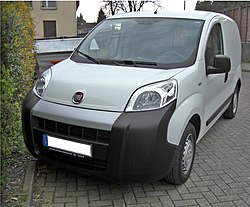
The Fiat Fiorino is a small commercial vehicle produced by the Italian car manufacturer Fiat since 1977. Its first two generations have been the panel van derivatives of other small models, such as the Fiat 127 and Fiat Uno, while the current third generation was developed jointly with PSA Peugeot Citroën (both of which merged into Stellantis), and is based on the Fiat Small platform.
The current generation, the Sevel LAV, is also built with a passenger body style, as the Fiat Qubo, and is marketed along with its rebadged versions, the Citroën Nemo and the Peugeot Bipper. It is positioned below the Fiat Doblò, the Citroën Berlingo, and the Peugeot Partner, in each manufacturer's model line up.
The name comes from the fiorino d'oro, an old Italian coin normally translated into English as the Florin.[1]
First generation (1977–1988)
[edit]| First generation (147) | |
|---|---|
.jpg) Fiorino van, original 127-based design | |
| Overview | |
| Also called | Fiat 127 Fiorino Fiat 147 Pick-Up/City (Brazil)[2] Emelba 127 Poker |
| Production | 1977–1988 1989–1995 (Argentina) |
| Assembly | Mirafiori, Turin, Italy Betim, Brazil (Fiat Automóveis) Córdoba, Argentina (Sevel) Catalonia, Spain (Emelba) |
| Body and chassis | |
| Layout | Front-engine, front-wheel-drive |
| Related | Fiat 127 Fiat 147 |
| Powertrain | |
| Engine | |
| Dimensions | |
| Wheelbase | 2,225 mm (87.6 in) |
| Length | 3,835 mm (151.0 in) |
| Width | 1,564 mm (61.6 in) |
| Height | 1,810 mm (71.3 in) |
| Curb weight | 870 kg (1,918 lb) |
Originally called Fiat 127 Fiorino, the first generation (Codeproject Type 147) was based on the Series 2 Fiat 127 with the back being a van box, i.e. a 1.3 metres (4 ft 3 in) tall "high cube" design,[1] an arrangement subsequently emulated by several European automakers. The platform is a stretched version of the Brazilian 147 with a different rear suspension.
It was launched in early November 1977 as a panel van with the same 903 cc (100 GL.000) OHV inline-four petrol engine as used in the Fiat 127.[1] In March 1979 the 1050 cc OHC Fiasa engine was added, as was the glazed passenger version (Panorama).[3] 1979 was also when right-hand drive production began, enabling sales in the United Kingdom and other nations that drive on the left. British buyers were only offered the larger 1.05-litre engine.[4]
In 1981 Mirafiori production came to an end, bringing with it a change to the front appearance of most European-market Fiorinos. The car now received the 147's taller front sheetmetal with an additional air intake beneath the grille rather than the original 127's design. The Italian-made 903 cc engine was dropped, while the new 1301 cc (127 D.000) SOHC diesel engine was introduced. While the Brazilian 147 passenger version received a facelift with square headlights (called "Europa"), the Fiorino largely soldiered on with the original sheetmetal. The Pick-up City and better equipped versions of the Fiorino van used the new Europa front beginning in 1982.
For right-hand drive markets, the Fiorino kept the original 127 underpinnings and design. These cars were available only as vans, with either a flat roof or with the "Hi-Top" roof and were built by Bertone, who was also assembling the X1/9 and the Ritmo Cabriolet for Fiat.[5] The 127-series Fiorino received a light facelift in 1985, including Fiat's five-bar grille, the Ducato's wing mirrors, and a five-speed manual transmission.[6] Production ended in late 1987, still using the original sheetmetal with quarterlights in the front doors.
After the standard car version of the 127 was replaced by the Uno in 1983, Fiat dropped the "127" portion of the name in Europe, and called the vehicle simply Fiorino.[2] In September 1980, the Fiorino was launched in Brazil, based on the locally built Fiat 147, and fitted with its 1.3-liter engine.[7] It was initially available as a van only, in either panelled or glazed form, and had a payload of 420 kg (926 lb). Fiat had already been offering a pick-up using the 147's shorter bodywork since late 1978 ("147 Pickup", available with the 1050 or the 1300 engine), but in 1981 this was changed over to the longer Panorama/Fiorino chassis.[8][9] The longer pick-up was available as a standard version, and from 1982 also as the better equipped 147 City, which received the square forward leaning headlights of the 1981 facelift model. Another facelift was launched in 1983, with the new front grille based on the South American Fiat 127/147 Unificata. In South America, this new front was only gradually introduced as some lower cost versions retained the original design until 1986.[10]
From 1982 Brazilian Fiorino buyers could choose from at least four versions of the high cube design.[10] The Furgão was a two-seater panel van, the Vetrato was a glazed two-seater van, and the new Combinata received removable facing benches (seating six additional passengers with a minimum of comfort) at the rear. These three versions all received a cargo divider, unlike the Settegiorni which was a station wagon with seating for five.[10] This was also new for 1982 and was the equivalent of the European Fiorino Panorama/Combi model.
In Europe, Fiat sold the Ognitempo kit to transform the Fiorino into a camper.
Production
[edit]The Fiorino was assembled from 1977 to 1981 in the Mirafiori factory in Turin, Italy, alongside the Fiat 127. In 1980, production began in the Minas Gerais plant, Brazil where the Fiat 147 (and related 127 Panorama) were manufactured. In 1981, production for the European market was transferred from Mirafiori to Minas Gerais. Cars for right-hand drive markets (and some other European markets) were built by Bertone until late 1987, using the original 127 front design.[5]
After Brazilian production ceased in 1988, the tooling was transferred to Argentina. The Fiorino continued to be manufactured by Sevel Argentina from August 1989 as a van or pickup and sold for the local market. The Argentinian cars were equipped with a locally made 1.3-liter petrol engine (a version of the Fiat 128 SOHC engine) or the Brazilian-made 1.3 diesel with 60 and 45 hp (44 and 33 kW) respectively. The petrol engine was later replaced with a low compression, low octane version of the more modern 1.4-liter engine as also seen in the Spazio/Vivace.[11] 25,035 units of the first generation Fiorino were built in the Córdoba factory between 1989 and 1995,[11] and a total of 250,545 units of the Fiorino were built in the Betim factory in Brazil between 1980 and 1988. Of these, 172,086 were vans[12] and 78,459 were pick-up versions[13] respectively. The pick-up was very successful in Brazil's home market, with over three quarters of the production staying at home while nearly 90 percent of the Fiorino vans built went to export, mainly to Europe.[12][13]
Spanish version
[edit]In Spain, a commercial vehicle based on the SEAT 127 (a Spanish version of the Italian 127 built under license Fiat by SEAT) was produced from 1980 by coachbuilder Emelba and called the Emelba 127 Poker.[14]
The 127 Poker has a similar "high cube" box design of the Fiorino, but different rear doors, rear lights, and rear suspension. The 127 Poker was designed by Elba Design studio and was available as a panel van, passenger version, and coupe utility (pick up). It was fitted with the 903-cc Fiat petrol engine and was sold directly through SEAT dealerships in Spain.
Production ended in 1986 when it was replaced by the Panda-based SEAT Terra, which shares its engine with the SEAT 127. The Spanish 127 Poker was built at the headquarters of Emelba in Girona, Catalonia.
-
 Fiat Fiorino Hi-Top Van, 147-based model (1981-1983)
 -
 1983 Fiat Fiorino Combinata, Unificata design
 -
 Fiat Fiorino Combi, rear view
 -
 Emelba 127 Poker pick up (on the left)


Engines
[edit]
|
| |||||||||||||||||||||||||||||||||||||||||||||||||||||||||||||||||||||||
Second generation (1988–2014)
[edit]| Second generation (146) | |
|---|---|
 Fiat Fiorino Panorama (phase III) | |
| Overview | |
| Also called |
|
| Production | 1988–2013 1995–2014 (Argentina) |
| Assembly | Betim, Brazil (Fiat Automóveis) Córdoba, Argentina (Sevel) Manta, Ecuador (Noboa / Coenansa) [15] |
| Body and chassis | |
| Body style | panel van pick-up |
| Layout | Front-engine, front-wheel-drive |
| Platform | Type One |
| Related | Fiat Uno/Mille (146) Fiat Duna/Penny/Elba |
| Powertrain | |
| Engine |
|
| Transmission | 4-speed manual 5-speed manual |
| Dimensions | |
| Wheelbase |
|
| Length |
|
| Width |
|
| Height |
|
| Kerb weight | 950–1,025 kg (2,094–2,260 lb) |
| Chronology | |
| Successor | Fiat Doblò (Europe) Fiat Strada (pick-up) |
In 1987, the second generation version (project code: Type 146) was released, based on the Brazilian Uno-derived Fiat Duna sedan. While similar in appearance to the European Uno, the Duna had a more robust chassis and was more suitable as the basis for a commercial vehicle.[3] The new Fiorino was available in panel van (Fiorino Cargo), passenger (Fiorino Panorama), and pickup body styles. European sales commenced in 1988. In Venezuela, the pickup version was sold as the Premio Pickup, linking it to the related sedan model. The original pickup version (1988-1992) was sold as the Uno Pickup in Brazil but later joined the Fiorino lineup.[9]
The Fiorino sold over 250,000 units in the European market by the end of 2000. The Fiorino ceased to be imported to the United Kingdom in 2001, a year after production for European export had ceased.
The original engines available were the 1301 cc Fiasa petrol engine, producing 50 kW (68 hp), and the 1.7-liter diesel with 44 kW (60 hp). In 1989 the Brazilian-made Fiorino became the first vehicle to be fitted with a new 1.5-liter derivative of the long running Fiasa engine.[16] This undersquare engine produces 67.2 hp (49.4 kW) and 118 N⋅m (87 lb⋅ft) at the time of introduction.[16] In Europe, this was also available with a three-way catalyst and fuel injection, a version which produced 55 kW (75 hp) at 5600 rpm.[17]
Continental European buyers could also get the 128-based 1.1-litre engine, producing 40 kW (54 hp) at 5500 rpm.[17] In European markets, the phase I Fiorino pickup was only available with the diesel engine.[18]
First facelift (phase II)
[edit]In 1992, a facelifted Fiorino debuted with styling inspired by the Fiat Tipo.[19] It also received a re-engineered platform, a new interior, and optional cleaner engines. The diesel was modified with a new induction system and injector pump, making for smoother running and cleaner emissions at the cost of a small power loss - down two horsepower, to 43 kW (58 hp).[20] Catalyzed versions received a marginally smaller fuel tank, at 52 L (13.7 US gal) rather than 54 L (14.3 US gal), to provide space for the converter.[21]
Second facelift (phase III)
[edit]In 1994, a new version based on the Fiat Mille platform debuted. While the front design remained initially unchanged, it sat on a longer wheelbase and the new rear side panels had single side windows (or single blank pressings) rather than the multiple divisions of the original model. The gas cap was now covered by an integrated flap, rather than being exposed as before. European-market diesels now received exhaust gas recirculation to meet new emissions standards, although power remained at 43 kW (58 hp). Petrol versions received the 1.4-liter "Tipo" engine, although Brazilian buyers were also offered the option of a one-liter model to suit that country's tax structure. The one-liter engine produces 41.3 kW (56.1 hp) at 6000 rpm, providing a top speed of 138 km/h (86 mph) and a 500 kg (1,102 lb) payload. The catalyzed 1.4-liter engine, as sold in Europe, develops 50 kW (68 hp).[22]
The phase III version was assembled in the Minas Gerais plant and remained on sale in Brazil, Paraguay, Argentina, and Chile until the end of 2013, in anticipation of the requirement for dual SRS airbags and ABS brakes in the Brazilian market from 2014 onwards. The last facelift for the European market included a grille without a horizontal bar and took place in 1997. The phase III Fiorinos received another new grille for 2001, which was updated again in 2002 as Fiat's five-bar logo was replaced with the new centenary, wreath-style logo.
ABS and driver SRS airbag had been available as extra-cost options for the second generation Fiorino from the end of 1998 to 2001, but since the dashboard could not fit a passenger airbag without extensive changes, it was more cost-effective to phase it out and replace it with a newer model.
The second-generation Fiorino was also assembled in Argentina by Sevel Argentina. Over 1,000,000 Fiorinos have been sold in South America.
Third facelift (phase IV)
[edit]In 2004, a facelifted version was released with the Fiat Doblò front style. In 2009, Fiat introduced a new version with the red Fiat logo on the front.
Brazilian production of the second generation of Fiorino ended in December 2013 when the new generation (based on the platform of the new Brazilian Fiat Uno) was unveiled. The Fiorino had been the leader of the segment in Brazil for 23 consecutive years.[23] A total of 981,922 Fiorinos was built in Betim, Brazil: 775,620 Cargo/Panorama[24] and 206,302 pick-ups.[25]
-
 Pre-facelift Fiorino Panorama (phase I)
 -
 Phase I Fiorino pickup; note exposed fuel cap
 -
 1993 Fiorino Van (Phase II; original rear design and facelift front)
 -
 The 1997-2001 facelift version of the Fiorino Panorama (phase III)
 -
 1999 Fiat Fiorino panel van (phase IIIa), rear view
 -
 Brazilian-market Fiorino phase IIIb, 2001-2004 facelift model with new grille
 -
 2008 Fiat Fiorino Cargo, Brazilian version (phase IV)


.jpg)
.jpg)

Engines
[edit]Available engines were the Fiat 1.7 L 8V diesel (naturally aspirated or turbocharged), the 1.3-litre "Fiasa" engine, the 1.2 L and the 1.4 L 8V Fire, and for South America, the Fiasa Flex 1.0 L and 1.5 L 8V. In Brazil, both versions of the later 1242 cc engines were available with flexible fuel technology.
- 1.0 L petrol
- 1.2 L Fire petrol
- 1.4 L petrol
- 1.5 L flex fuel (spi and mpi versions)
- 1.7 L diesel and turbodiesel
Third generation
[edit]Europe (2007–2024)
[edit]| Third generation (225) | |
|---|---|
 Fiat Fiorino, one of the three versions of the Sevel LAV | |
| Overview | |
| Also called | |
| Production | 2007–2024[26] 2008–2017 (Citroen Nemo and Peugeot Bipper) 2008–2024 (Fiat Qubo) |
| Model years | 2008–2020 (Fiat Qubo; but for some regions only) |
| Assembly | Turkey: Bursa (Tofaş) |
| Designer | Flavio Manzoni |
| Body and chassis | |
| Body style | 3-door panel van 5-door MPV (Qubo) 5-door passenger van |
| Layout | Front-engine, front-wheel-drive |
| Platform | FCA Small platform |
| Related | Fiat Grande Punto Fiat Linea Opel Corsa D |
| Powertrain | |
| Engine | Petrol: 1.4 L PSA TU3 I4 1.4 L FCA Fire I4[nb 1] Petrol CNG: 1.4 L FCA Fire Natural Power I4[nb 2] Diesel: 1.3 L MultiJet[broken anchor] I4 1.4 L Ford DV4 I4 HDi[nb 3] |
| Transmission | 5-speed manual 6-speed manual 5-speed automated manual 6-speed automated manual |
| Dimensions | |
| Wheelbase | Fiat: 2,513 mm (98.9 in) |
| Length | Fiat: 3,864–3,964 mm (152.1–156.1 in) Citroën/Peugeot: 3,860 mm (152 in) |
| Width | Fiat: 1,716 mm (67.6 in) Citroën/Peugeot: 1,710 mm (67 in) |
| Height | Fiat: 1,721 mm (67.8 in) Citroën/Peugeot: 1.720 m (67.7 in) |
| Kerb weight | 1,165 kg (2,568 lb) |
| Chronology | |
| Successor | Citroën Berlingo/Peugeot Rifter/Fiat Doblò |
The third generation Fiat Fiorino (Type 225) leisure activity vehicle was unveiled in October 2007, and went on sale in February 2008. The Fiorino shares architecture and body work with the Citroën Nemo and Peugeot Bipper under the Sevel joint venture between Fiat and PSA Peugeot Citroën (which has merged to Stellantis since 2021). Production began in November 2007.
Built by Tofaş in Bursa, Turkey, they are produced in both panel van and passenger body styles, and are situated below the larger LAVs Fiat Doblò, Citroën Berlingo and Peugeot Partner, in their manufacturers' line ups. Fiat also retails its passenger model as the Fiat Qubo, with the Fiorino name designating the commercial models.
The Fiorino and its siblings are based on the Fiat Grande Punto Small platform, with a wheelbase of 2,513 millimetres (98.9 in). This project can be seen as a breakthrough in Tofaş history as it carried most of the development work in addition to responsibility for its assembly.


Fiat launched their passenger carrying equivalent at the Geneva Motor Show in March 2008. It is branded as the Fiat Qubo. A derivative of the Fiorino (a small MPV), a passenger version of the Fiorino was unveiled in June 2008. This version is suitable for up to five people and can be equipped with different engines, including a 1.3 Multijet diesel (75 PS) or 1.4 litre petrol engine with 73 hp (54 kW).
In some countries (such as Turkey), the passenger version Qubo was sold as the "Fiorino Panorama".
As of 2020, the Fiat Qubo passenger variant is no longer available in certain regions, but remains in others.[28] The Fiorino commercial version remains available.
Peugeot Bipper and Citroën Nemo (2008–2017)
[edit]

The Citroën Nemo is a badge engineered van launched in January 2008 by Citroën.[29] The vehicle is the result of a partnership between Fiat, PSA Peugeot Citroën and Tofaş. The other platform derivatives are the Peugeot Bipper and the Fiat Fiorino.
The Citroën Nemo Combi (then, Nemo Multispace) is a small MPV, which was also introduced in 2008, and is based on the same platform.
In April 2010, during a routine evasive manoeuvre test, conducted in Germany, the vehicle rolled over. The shape of the vehicle; as a high bodied, short wheelbase van caused the roll. The addition of Electronic stability control (ESC) would likely have prevented this but was not available as standard or as an option on the Nemo.[30]


The Peugeot Bipper is a small delivery van sold by French automaker Peugeot since May 2008.[29] It shares its body, platform and most components with the contemporary Citroën Nemo and Fiat Fiorino.
The Citroën Nemo, Fiat Fiorino III, and Peugeot Bipper were developed jointly with Tofaş, following an agreement signed on 31 March 2005. The vans are manufactured on behalf of all the partners in Bursa by Tofaş.
The Bipper is marketed as a "mini cargovan" designed for big and small cities, cheaper and a little smaller than the Peugeot Partner.
The Peugeot Bipper Tepee is a small MPV, which was also introduced in 2008, and is based on the same platform.
2016 facelift
[edit]

In April 2016, Fiat Professional introduced a facelift for the Fiorino range, featuring a new front bumper with a chrome strip that incorporates the design of the Doblò and Ducato brothers. Also new are the alloy wheels and plastic covers. Inside the new steering wheel is a new infotainment system developed by Magneti Marelli with a 5-inch touchscreen that integrates car radio, satellite navigation, bluetooth, USB, and AUX. The engine range consists of the 1.4 petrol Fire with 77 horsepower, the 1.4 Natural Power petrol/methane, and the diesel 1.3 Multijet with 80 and 95 horsepower. Fiat also introduced a low emission version called EcoJet available with a 1.3 diesel engine with manual or an automated manual gearbox (called Comfort-Matic, an evolution of the previous Dualogic); the EcoJet has low rolling impact tires and a variable displacement oil pump. Trim levels include Cargo, Combined and Panorama versions, which also includes the Adventure set-up (available in all three versions) with raised trim and suspension, M+S tires, specific alloy wheels, additional bumper bands and Traction+ differential lock electronic system.[31][32]
The PSA brand versions, on the other hand, were not updated and went out of production in December 2017.[33]
In July 2018, the Fiat Fiorino engines were re-homologated Euro 6D-Temp.
In February 2022, the new Fiat logo is adopted at the front of the vehicle.[34]
Engines
[edit]| Name | Fuel | Engine type | Volume | Output | Engine code | Emission standard | CO2 emissions (g/km) | Notes |
|---|---|---|---|---|---|---|---|---|
| 1.4 8V | Gasoline | 4 Cyl Inline 8v OHC | 1,360 cc (83 cu in) | 73 hp (54 kW) | PSA TU3 | Euro 4 | 152 | |
| 1.4 8V | bi-fuel Gasoline-CNG | 4 Cyl Inline 8v | 1,368 cc (83.5 cu in) | 69 hp (51 kW) | Fiat Fire Natural Power | Euro 5 | 114 | Only for Fiat Qubo |
| 1.3 16V | Diesel | 4 Cyl Inline 16v DOHC | 1,248 cc (76.2 cu in) | 75 hp (55 kW) | Fiat Multijet | Euro 4 | Only for Fiat Fiorino and Qubo | |
| 1.3 16V | Diesel | 4 Cyl Inline 16v DOHC | 1,248 cc (76.2 cu in) | 76 hp (56 kW) | Fiat Multijet | Euro 5 | 113 | |
| 1.3 16V | Diesel | 4 Cyl Inline 16v DOHC | 1,248 cc (76.2 cu in) | 96 hp (71 kW) | Fiat Multijet | Euro 5 | ||
| 1.4 8V | Diesel | 4 Cyl Inline 8v OHC | 1,398 cc (85.3 cu in) | 70 hp (51 kW) | PSA DV4 HDi | Euro 4 | 119 | Only for Citroën Nemo & Peugeot Bipper (2007-2010) |
Sales and production figures
[edit]| Year | Production | Sales | Notes | ||||
|---|---|---|---|---|---|---|---|
| Nemo | Qubo | Bipper | Nemo | Qubo | Bipper | ||
| 2009 | TBA | TBA | 32,300[35] | TBA | TBA | 34,300[35] | |
| 2010 | TBA | TBA | 42,900[35] | TBA | TBA | 44,500[35] | |
| 2011 | 33,406[29] | TBA | 34,760[29] | 34,304[29] | TBA | 34,354[29] | Total Nemo production reaches 154,959 units. Total Bipper production reaches 142,671 units.[29] |
| 2012 | 27,500[36] | TBA | 24,200[36] | 28,500[36] | TBA | 26,000[36] | Total Nemo production reaches 182,400 units. Total Bipper production reaches 166,900 units.[36] |
Latin America (2013–present)
[edit]| Fiat Fiorino (327) | |
|---|---|
_(cropped).jpg) Fiat Fiorino (pre-facelift) | |
| Overview | |
| Also called | Ram ProMaster Rapid (Mexico) Ram V700 Rapid (South America) Ram V700 (South America) Peugeot Partner Rapid (Brazil; 2022–present) |
| Production | October 2013–present |
| Model years | 2014–present |
| Assembly | Brazil: Betim |
| Body and chassis | |
| Platform | FCA Economy |
| Related | Fiat Uno (327) |
| Powertrain | |
| Engine |
|
| Transmission | 5-speed manual |
| Dimensions | |
| Wheelbase | 2,717 mm (107.0 in)[37] |
| Length | 4,384 mm (172.6 in)[37] |
| Width | 1,809 mm (71.2 in)[37] |
| Height | 1,900 mm (74.8 in)[37] |
| Kerb weight | 1,117 kg (2,463 lb)[37] |

In 2013, a new version of the Fiat Fiorino (different from the European version) was introduced in Brazil, where it is also produced. As the previous Fiorino was based on the first generation Fiat Uno and its later Fiat Mille evolution, the new Fiorino is based on the second generation Fiat Uno (327), an all new model launched in 2010. The vehicle was introduced in October 2013 as a 2014 model, at the 19th edition of the Fenatran (International Road Cargo Transportation Show, held in São Paulo), alongside the Uno Furgão — the panel van version of the Uno it is based on.[38]

The Brazilian-spec Fiorino is sold under the Ram Trucks division in Mexico as the Ram Promaster Rapid and in Chile, Bolivia, Colombia, and Peru as the Ram V700 Rapid.
In December 2021, Fiat presented a facelift of the model with minor visual changes, as a 2022 model. Since May 2022, the Brazilian-spec Fiorino is also sold under the Peugeot in Brazil, as Partner Rapid.[39]
Until 2024, the Fiorino was offered with the 1.4 Evo Flex flexible fuel 1,368 cc four-cylinder used in the Uno, from the Fire engine family.[37] It produces 85 or 88 hp (63 or 65 kW) at 5,750 rpm and 122 or 123 N⋅m (90 or 91 lb⋅ft) at 3,500 rpm, when running on petrol or ethanol fuel respectively.[38] In 2025, the 1.4 Evo Flex was replaced by the 1.3 16V Firefly Flex.[40]
Sales
[edit]| Year | Brazil | Mexico | Argentina | |
|---|---|---|---|---|
| Fiat | Peugeot | |||
| 2002 | 7,980[41] | |||
| 2003 | 7,389[42] | |||
| 2004 | 8,970[43] | |||
| 2005 | 12,501[44] | |||
| 2006 | 12,325[45] | |||
| 2007 | 16,033[46] | |||
| 2008 | 18,143[47] | |||
| 2009 | 17,074[48] | |||
| 2010 | 17,413[49] | |||
| 2011 | 18,025[50] | |||
| 2012 | 14,321[51] | |||
| 2013 | 12,435[52] | |||
| 2014 | 23,824[53] | |||
| 2015 | 14,983[54] | 5,205[55] | ||
| 2016 | 9,760[56] | 7,185[57] | ||
| 2017 | 10,947[58] | 382[59] | 8,221[60] | |
| 2018 | 13,547[61] | 4,884[62] | 6,917[63] | |
| 2019 | 17,237[64] | 4,043[62] | 4,109[65] | |
| 2020 | 17,852[66] | 4,005[67] | 2,126[68] | |
| 2021 | 20,602[69] | 3,647[70] | 1,695[71] | |
| 2022 | 20,953[72] | 1,146[72] | 1,477[73] | 1,283[74] |
| 2023 | 21,865[75] | 1,716[75] | 3,962[76] | |
| 2024 | 20,208[77] | 761[78] | ||
| 2025 | 21,329[79] | 525[80] | ||
Notes
[edit]References
[edit]- ^ a b c "Nachrichten" [News]. Auto Motor und Sport (in German). No. 23/1977. Stuttgart: Vereinigte Motor-Verlag GmbH & Co KG. 23 November 1977. p. 6.
- ^ a b "Fiat 147 history". Clube147.hpg.ig.com.br. Archived from the original on 14 April 2010. Retrieved 30 September 2010.
- ^ a b Huhn, Hans-Georg. "Fiorino Historie" [Fiorino history]. fiorino-topviva-und-tucan44.de (in German). Archived from the original on 4 March 2016.
- ^ "Fiat tradesman's van hits the shops soon". Commercial Motor. Vol. 150, no. 3821. 17 August 1979. p. 4. Archived from the original on 12 March 2021.
- ^ a b Weatherley, Brian (7 January 1984). "Urban Space Van". Commercial Motor. Vol. 159, no. 4050. pp. 17–18. Archived from the original on 12 March 2021.
- ^ "Facelift for Fiat's Fiorino van". Commercial Motor. Vol. 161, no. 4121. 18 May 1985. p. 14. Archived from the original on 13 March 2021.
- ^ Alvares, Leandro (23 September 2020). "40 anos de vocação para o trabalho" [A 40-year vocation for work] (in Portuguese). FCA Group: Latam Region. Archived from the original on 3 December 2020.
- ^ "Grandes Comparativos: Pampa x City x Saveiro x Chevy". Quatro Rodas. Retrieved 9 April 2019.
- ^ a b Matsubara, Vitor (29 July 2015). "9 picapes emblemáticas feitas no Brasil" [9 emblematic pickups, made in Brazil]. Quatro Rodas (in Portuguese). Archived from the original on 8 August 2020.
- ^ a b c "Fiat 147, um pequeno que foi grande em significado" [Fiat 147, a small car of great significance]. Best Cars (in Portuguese). 8 July 2016. pt. 4. Archived from the original on 26 July 2020.
- ^ a b "Sevel: Fiat 147 Fiorino". Coche Argentino. Fco. Álvarez. 18 May 2009. Archived from the original on 28 January 2019.
- ^ a b "147 Fiorino 1980 - 1988". Mundo FCA: FCA Press (in Portuguese). Fiat Chrysler Automobiles. Archived from the original on 4 June 2016.
- ^ a b "147 Pickup / City 1979 - 1988". Mundo FCA: FCA Press (in Portuguese). Fiat Chrysler Automobiles. Archived from the original on 21 November 2018.
- ^ "Emelba 127 Poker". Debates.coches.net. 19 February 2010. Retrieved 30 September 2010.
- ^ "Grupo Fiat se reestructura". 26 January 2003.
- ^ a b Dantas, André (23 June 2012). "Motor FIASA: uma história recheada de técnica" [The FIASA engine: a story stuffed with tech] (in Portuguese). AUTOentusiastas Classic. Archived from the original on 8 August 2020.
- ^ a b Rex, Rainer, ed. (July 1989), Lastauto Omnibus Katalog 1990 [Truck and bus catalog] (in German), vol. 19, Motor-Presse-Verlag GmbH und Co. KG, pp. 75, 152, 81531/89001
- ^ Lastauto Omnibus Katalog 1990, p. 150
- ^ "Nuovo Fiorino, più spazio e più chili" [New Fiorino; more space and more kilos]. Archivio Storico (in Italian). Corriere della Sera. 24 December 2009. Archived from the original on 16 June 2012.
- ^ "Uno changes for Fiorino". Commercial Motor. Vol. 175, no. 4458. Reed Business Publishing Ltd. 6 February 1992. p. 15. Archived from the original on 3 July 2019.
- ^ Fiorino (Brochure) (in Greek), Fiat Greece, 1993, p. 4
- ^ "Revamped Fiorino". Commercial Motor. Vol. 180, no. 4563. Reed Business Publishing Ltd. 7 April 1994. p. 12. Archived from the original on 2 July 2021.
- ^ "Novo Fiat Fiorino 2014" Fiat Press Brazil[permanent dead link]
- ^ "FCA PRESS". www.fcapress.com.br. Retrieved 9 April 2019.
- ^ "FCA PRESS". www.fcapress.com.br. Retrieved 9 April 2019.
- ^ "Tofas 2023 Annual Report, page 51" (PDF).
- ^ "Peugeot Bipper CNG" (PDF). Erdgasfahren.ch. Retrieved 29 July 2013.[permanent dead link]
- ^ "Fiorino Combi". Fiat Professional (in Turkish). Retrieved 26 March 2023.
- ^ a b c d e f g "PSA Annual Report 2012" (PDF). Car manufacturers. PSA. Retrieved 12 April 2013.[permanent dead link]
- ^ Hard, Gordon (27 April 2010). "Nemo rolls over in moose test due to lack of ESC". ConsumerReports.org. Archived from the original on 15 June 2013. Retrieved 5 April 2013.
- ^ "Fiat Professional presents the complete, refreshed line-up at the IAA in Hannover". Fiat Professional. 21 September 2016. Archived from the original on 24 July 2018. Retrieved 24 July 2018.
- ^ "Nuovo Fiorino: il van creato per la città". Fiat Professional. 31 March 2016. Retrieved 24 July 2018.
- ^ "PSA says new Peugeot, Citroen and Opel vans will set benchmark for segment". Automotive News Europe. 13 February 2018. Retrieved 28 July 2018.[permanent dead link]
- ^ "Fiat Fiorino yenilendi!". Motor1.com (in Turkish). Retrieved 2 September 2022.
- ^ a b c d "Engine specs from PSA Peugeot Citroën" (PDF). Creator and designer. PSA Peugeot Citroën. Archived from the original (PDF) on 5 June 2017. Retrieved 29 November 2012.
- ^ a b c d e Memento Mars 2013 (in French), PSA Peugeot Citroën, 21 February 2013, p. 50, archived from the original on 11 March 2013
- ^ a b c d e f g "Nuevo Fiat Fiorino—Caracteristicas tecnicas" (PDF). autoblog.com.ar (in Spanish). Retrieved 31 August 2015.
- ^ a b "Nova Fiorino e Novo Uno Furgão são lançados". noticiasautomotivas.com.br (in Portuguese). 27 October 2013. Archived from the original on 30 October 2013. Retrieved 31 August 2015.
- ^ "Primeiro contato Peugeot Partner Rapid 2023: os detalhes do Fiorino francês". Motor1.com (in Brazilian Portuguese). Retrieved 4 September 2022.
- ^ "Fiat Fiorino e Peugeot Partner Rapid agora usam motor 1.3 Firefly de 107 cv". Motor1 (in Brazilian Portuguese). 15 January 2025. Retrieved 29 September 2025.
- ^ "Brazil 2002". Fenabrave. 3 February 2022. Archived from the original on 16 June 2008. Retrieved 24 January 2025.
- ^ "Brazil 2003" (PDF). Fenabrave. 3 February 2022. Retrieved 6 January 2023.
- ^ "Brazil 2004". Fenabrave. 3 February 2022. Retrieved 6 January 2023.
- ^ "Brazil 2005". Fenabrave. 3 February 2022. Retrieved 6 January 2023.
- ^ "Brazil 2006". Fenabrave. 3 February 2022. Retrieved 6 January 2023.
- ^ "Brazil 2007". Fenabrave. 3 February 2022. Retrieved 6 January 2023.
- ^ "Carros mais vendidos do Brasil em 2008". AUTOO (in Brazilian Portuguese). 4 January 2025.
- ^ "Carros mais vendidos do Brasil em 2009". AUTOO (in Brazilian Portuguese). 4 January 2025.
- ^ "Carros mais vendidos do Brasil em 2010". AUTOO (in Brazilian Portuguese). 4 January 2025.
- ^ "Carros mais vendidos do Brasil em 2011". AUTOO (in Brazilian Portuguese). 4 January 2025.
- ^ "Carros mais vendidos do Brasil em 2012". AUTOO (in Brazilian Portuguese). 4 January 2025.
- ^ "Carros mais vendidos do Brasil em 2013". AUTOO (in Brazilian Portuguese). 4 January 2025.
- ^ "Carros mais vendidos do Brasil em 2014". AUTOO (in Brazilian Portuguese). 4 January 2025.
- ^ "Carros mais vendidos do Brasil em 2015". AUTOO (in Brazilian Portuguese). 4 January 2025.
- ^ Auto Dato (Ventas 2015, Argentina: El Volkswagen Gol fue el rey)
- ^ "Carros mais vendidos do Brasil em 2016". AUTOO (in Brazilian Portuguese). 4 January 2025.
- ^ Auto Dato (Ventas 2016, Argentina: Chevrolet continúa en ascenso)
- ^ Auto Dato (Ventas 2017, Brasil: Las matriculaciones cerraron en alza por primera vez en cuatro años)
- ^ Inegi (Datos Primarios 2017)
- ^ Auto Dato (Ventas 2017, Argentina: Dos pick-ups en el Top 10)
- ^ Auto Dato (Ventas 2018, Brasil: Volkswagen crece con fuerza)
- ^ a b Inegi (Datos Primarios)
- ^ (Ventas 2018, Argentina: Jeep logra ingresar al Top 10)
- ^ Auto Dato (Ventas 2019 brasil el año Cerro en Positivo)
- ^ Auto Dato (Ventas 2019, Argentina: Una caída del 42,7% marcó el peor registro en 13 años)
- ^ "Carros mais vendidos do Brasil em 2020". AUTOO. 13 May 2021. Retrieved 17 January 2023.
- ^ Inegi (Venta al público de vehículos ligeros por marca, modelo y segmento Diciembre 2020)
- ^ Auto Blog Argentina (Así fueron las ventas totales en 2020)
- ^ "Carros mais vendidos do Brasil em 2021". AUTOO. 3 January 2021. Retrieved 17 January 2023.
- ^ García, Gerardo (8 January 2022). "Los 379 autos más vendidos de México en 2021: la lista completa del ranking de ventas". Motorpasión México (in Spanish). Retrieved 17 January 2023.
- ^ "Así fueron las ventas totales en 2021". Motor1.com (in Spanish). Retrieved 17 January 2023.
- ^ a b "Carros mais vendidos do Brasil em 2022". AUTOO. 3 February 2022. Retrieved 17 January 2023.
- ^ García, Gerardo (6 January 2023). "Los 371 autos más vendidos de México en 2022: el ranking completo con todos los modelos". Motorpasión México (in Spanish). Retrieved 17 January 2023.
- ^ "Así fueron las ventas en diciembre (y totales) 2022". Motor1.com (in Spanish). Retrieved 17 January 2023.
- ^ a b "Carros mais vendidos do Brasil em 2023". AUTOO. 8 February 2023. Retrieved 27 March 2024.
- ^ García, Gerardo (10 January 2024). "Los autos más vendidos en México en 2023: así queda el ranking con los 389 modelos". Motorpasión México (in Spanish). Retrieved 27 March 2024.
- ^ "Carros mais vendidos do Brasil em 2024". AUTOO (in Brazilian Portuguese). 4 January 2025.
- ^ "Carros mais vendidos do Brasil em 2024". AUTOO (in Brazilian Portuguese). 4 January 2025.
- ^ "Carros mais vendidos do Brasil em 2025". AUTOO. 5 January 2026. Retrieved 5 January 2026.
- ^ "Carros mais vendidos do Brasil em 2025". AUTOO. 5 January 2026. Retrieved 5 January 2026.
External links
[edit]
| Related companies |
|  | ||||||||||
|---|---|---|---|---|---|---|---|---|---|---|---|---|
| Current models |
| |||||||||||
| Historic models (List) |
| |||||||||||
| Concept models | ||||||||||||
| Racing cars | ||||||||||||
| Modified Racing cars | ||||||||||||
| Abarth cars | ||||||||||||
| Armored vehicles | ||||||||||||
| People | ||||||||||||

A brand of Stellantis | ||||||||||
| Current vehicles |
|  | ||||||||
| Historic vehicles |
| |||||||||
| Motorsport |
| |||||||||
| Concept cars | ||||||||||
| Related topics | ||||||||||
A marque of Stellantis | ||||||||
| Current models |
|  | ||||||
| Historic models | ||||||||
| Concepts, prototypes |
| |||||||
| Motorsport |
| |||||||
| Regional operations | ||||||||

Fiat Fiorino
View on GrokipediaOverview
Development history
In the 1970s, Fiat pursued a strategy to diversify its commercial vehicle offerings by repurposing existing passenger car platforms for utilitarian applications, particularly adapting the compact Fiat 127 supermini to create a dedicated panel van for light cargo transport.[9][10] The resulting Fiat Fiorino emerged as a practical derivative, retaining the 127's front-wheel-drive layout and transverse engine while incorporating a boxy rear extension with a raised roof to maximize load capacity for urban use.[11][12] Launched in 1977, the Fiorino marked Fiat's entry into the small commercial van segment, with initial production at the historic Mirafiori plant in Turin, Italy, where it was built alongside the donor 127 model.[11][13] First sales commenced in 1978, targeting small businesses and delivery services in Europe.[14] This development occurred amid Italy's economic recovery from the 1973 oil crisis, which emphasized the need for fuel-efficient, maneuverable vehicles suited to congested city environments and cost-conscious operators.[15] The Fiorino's design prioritized practicality for short-haul urban logistics, aligning with Fiat's broader push toward efficient compact models in the post-crisis era.[9] Production extended to Brazil from 1980, where the model was localized on the Fiat 147 platform (the South American variant of the 127), achieving significant output for regional markets until the first generation concluded around 1988.[16][17]Design philosophy and variants
The Fiat Fiorino's design philosophy centers on creating a versatile, compact commercial vehicle that leverages passenger car underpinnings to achieve cost efficiency and ease of manufacturing, allowing for shared components with models like the Fiat Grande Punto while prioritizing urban maneuverability and load-carrying capability.[18] This approach emphasizes modularity, enabling adaptations between cargo and passenger roles without compromising on practicality, with external dimensions kept under 4 meters in length—specifically 3.86 meters for key iterations—to facilitate city driving.[19] The core focus remains on maximizing payload capacity, reaching up to 610 kg including the driver, alongside internal cargo volumes of around 2.5 cubic meters, which can expand to 2.8 cubic meters via foldable seating, underscoring a balance between compactness and utility.[19] Primary variants of the Fiorino include the standard panel van for pure cargo transport, featuring an enclosed load area with smooth side panels for easy branding or customization, and passenger-oriented models such as the Combi version, which accommodates up to four occupants with added seating and storage.[20] Over time, the lineup evolved to incorporate leisure adaptations like the Qubo, a multi-purpose variant with enhanced interior flexibility for family or recreational use, and specialized concepts such as the Portofino show van, designed explicitly for holiday and leisure applications.[18][21] Earlier iterations also offered pickup truck configurations, reflecting an initial emphasis on basic open-bed utility before shifting toward more enclosed, multi-role designs.[22] Across generations, the Fiorino incorporates consistent features that enhance its adaptability, including wide-opening sliding side doors for convenient access in tight spaces and optional high-roof configurations to increase headroom and loading height.[20][18] Interiors are highly customizable, with removable or foldable elements like passenger seats that extend the flat load floor to over 2 meters in length, supporting both commercial payloads and personal cargo needs.[19] In terms of safety and utility innovations, the Fiorino prioritizes robust, practical protections over advanced luxury systems, with anti-lock braking system (ABS) becoming a standard feature in later models to improve control during emergency stops, complemented by electronic brakeforce distribution (EBD) for balanced stopping power.[2] Additional elements, such as large bumpers and side impact strips, provide low-speed collision resistance, aligning with the vehicle's emphasis on everyday durability and functionality rather than high-end sophistication.[19]First generation (1977–1988)
Production and markets
The first-generation Fiat Fiorino was primarily manufactured at the Mirafiori plant in Turin, Italy, from 1977 to 1981. Production expanded to the Betim plant in Brazil starting in 1980, where 250,545 units were assembled for the first-generation model (172,086 vans and 78,459 pick-ups) until 1988. Secondary assembly of a carryover design occurred in Córdoba, Argentina, from 1989 to 1995, resulting in 25,035 units built. Initial market focus was on Europe, particularly Italy and Spain, before expanding to South America. In Spain, SEAT produced a locally adapted version through a joint venture with Fiat, featuring different badging and designated as the Emelba 127 Poker or SEAT Fiorino, assembled in Catalonia from 1980 to 1986. This rollout supported Fiat's strategy to leverage regional partnerships for broader distribution in key export markets. A facelift in 1980 aligned the Fiorino's styling with updates to the Fiat 127 platform. Production faced challenges in the 1980s due to supply chain disruptions, including high absenteeism, labor strikes, and economic pressures that reduced output at Italian facilities.[23] These issues contributed to overall declines in Fiat's vehicle manufacturing during the period, prompting cost-cutting measures and efficiency improvements. The first-generation Fiorino was succeeded by the second generation in 1988.Body styles and features
The first-generation Fiat Fiorino was offered in several body styles tailored for commercial and light passenger use, including the standard panel van for enclosed cargo transport, a pickup variant with a drop-side bed for open loading, and a basic passenger conversion with seating for up to five occupants. These configurations were built on the Fiat 127 platform, emphasizing practicality for small businesses and urban delivery.[24] With overall dimensions of 3.835 meters in length and a wheelbase of 2.225 meters, the Fiorino provided a compact footprint suitable for city navigation while offering a payload capacity of 420–600 kg (varying by market) and a cargo volume of approximately 2.5 m³ in the panel van configuration. Key utility features included rear-hinged cargo doors for easy access to the load area, foldable front passenger seats that could extend the cargo space, and a minimalistic dashboard carried over from the Fiat 127, featuring basic analog gauges and no standard power steering to keep costs low.[24] Despite its rust-prone body construction, which required regular maintenance in humid environments, the Fiorino proved durable for urban use due to its simple, robust design.[25] Optional glazing kits allowed for window additions to the panel van, enhancing versatility for mixed cargo-passenger roles, while powertrain integration ensured adequate performance for loaded operations without compromising the vehicle's lightweight structure.[26]Powertrains
The first-generation Fiat Fiorino was powered by inline-four engines derived from the Fiat 127 supermini, with options evolving over its production run to include both petrol and diesel variants suited for light commercial duties. Initial models from 1977 to 1981 featured a 0.9-liter OHV petrol engine (903 cc) producing 45 hp (33 kW) at 5,500 rpm and 64 N⋅m (47 lb⋅ft) of torque. From 1979, this was supplemented by a 1.05-liter OHC petrol engine (1,049 cc) delivering 50 hp (37 kW) at 5,600 rpm and 77 N⋅m (57 lb⋅ft) of torque. In Brazil, based on the Fiat 147 platform, a 1.3-liter OHC petrol/ethanol engine (1,297 cc) was offered from 1980, producing 57–61 hp (42–45 kW) and 96–97 N⋅m (71–72 lb⋅ft). A 1.3-liter OHC diesel (1,301 cc) became available from 1981, offering 45 hp (33 kW) at 4,300 rpm and 76 N⋅m (56 lb⋅ft) of torque, with later versions up to 60 hp in some markets. All models used front-wheel drive with a 4- or 5-speed manual transmission. Performance emphasized economy and reliability, with top speeds around 120–140 km/h and fuel consumption of 7–9 L/100 km depending on engine and load. [27]| Engine Type | Displacement | Power (hp / kW) | Torque (N⋅m) | Years Available | Notes |
|---|---|---|---|---|---|
| 0.9L OHV Petrol | 903 cc | 45 / 33 | 64 | 1977–1981 | Initial engine |
| 1.05L OHC Petrol | 1,049 cc | 50 / 37 | 77 | 1979–1988 | Europe primary |
| 1.3L OHC Petrol/Ethanol | 1,297 cc | 57–61 / 42–45 | 96–97 | 1980–1988 | Brazil market |
| 1.3L OHC Diesel | 1,301 cc | 45–60 / 33–44 | 76 | 1981–1988 | Introduced later |
Second generation (1988–2014)
Platform and initial launch
The second-generation Fiat Fiorino represented a major redesign, shifting to the Fiat Uno (Type 146) platform for the European market to enhance versatility and efficiency in light commercial applications.[28] In South America, it utilized the Fiat Uno platform, adapting the model to regional production and demands. Launched in Italy in 1988 and in Brazil in 1990, this generation emphasized practicality for urban delivery and small business use. Key to the initial design was a lengthened wheelbase measuring 2.37 meters, which boosted interior space and raised the payload capacity to 650 kg compared to the first generation. This configuration also introduced the Combi passenger variant, a multi-purpose body style with seating for up to five occupants, expanding the model's appeal beyond pure cargo duties.[28] Production began at Fiat's Bologna facility in Italy for European distribution and at the Betim plant in Brazil for South American markets. Initial market penetration was robust in Italy and Brazil, where the vehicle's affordability and durability suited local logistics needs, while exports to Africa and the Middle East further solidified its global footprint in emerging economies.[29]Facelifts and evolutions
The second generation Fiat Fiorino experienced a series of facelifts and evolutions across its production run, reflecting Fiat's efforts to modernize the model while maintaining its utility-focused design. These updates addressed styling, durability, safety, and efficiency, adapting the vehicle to evolving regulatory standards and market demands in Europe and Latin America. Phase I (1988–1993) retained basic styling cues from the Fiat Uno platform, including angular lines and simple interior adjustments for improved cargo accessibility and driver comfort.[30] Minor tweaks focused on practicality, such as enhanced door mechanisms and basic trim options, without major aesthetic overhauls. Phase II (1993–1997) introduced the first significant facelift, featuring rounded headlights for a softer appearance and improved rust protection through galvanized body panels to extend service life in harsh conditions.[31] The second facelift in Phase III (1997–2003) brought Euro 3 emissions compliance and a revised grille design for better visual integration, alongside a Panda-inspired rear configuration in select markets to boost load space versatility.[32] Aerodynamic refinements, including smoother underbody panels, contributed to modest fuel efficiency gains. Phase IV (2003–2014) marked the third facelift, with a modernized dashboard incorporating ergonomic controls and standard ABS braking for enhanced stability.[33] Safety evolved further with the addition of driver and passenger airbags in later models, while subtle body reshaping improved aerodynamics and reduced drag for better economy. Production concluded in Europe in 2006 with the transition to the third generation, but continued in Brazil until 2013 to meet local demand.[34]Powertrains
The second-generation Fiat Fiorino offered a range of petrol and diesel engines derived from Fiat's existing lineup, tailored for light commercial use with options varying by region and production phase. These powertrains emphasized reliability and economy, with outputs suited to urban and light-duty applications. In Europe and early production, petrol options included the FIRE series inline-four engines: a 999 cc unit producing 45 hp, a 1,108 cc variant at 50 hp, and a 1,116 cc engine delivering 54 hp. Later models added a 1,301 cc petrol engine with 63 hp. In South America, particularly Brazil, flex-fuel capable versions of the 1,368 cc FIRE Evo engine were introduced, producing up to 85 hp on gasoline or ethanol. Diesel engines were provided by the Sofim 8140 series, including a 1,367 cc unit at 57 hp, a 1,698 cc version offering 72 hp, and a 1,910 cc option at 63 hp for heavier-duty variants. These naturally aspirated diesels focused on torque for load-carrying, with the 1.7-liter model providing around 118 Nm. All models featured front-wheel drive with a 5-speed manual transmission as standard; no automatic options were available. Performance prioritized practicality, with top speeds ranging from 130–150 km/h and fuel economy of 6–8 L/100 km for petrol and 7–9 L/100 km for diesels, depending on engine, load, and configuration.| Region | Engine Type | Displacement | Power (hp) | Torque (Nm) | Transmission Options |
|---|---|---|---|---|---|
| Europe | 1.0L Petrol (FIRE) | 0.999 L | 45 | ~75 | 5-speed manual |
| Europe | 1.1L Petrol (FIRE) | 1.108 L | 50 | ~82 | 5-speed manual |
| Europe | 1.1L Petrol (146) | 1.116 L | 54 | ~86 | 5-speed manual |
| Europe/South America | 1.3L Petrol (146/FIRE) | 1.301 L | 63 | ~98 | 5-speed manual |
| South America | 1.4L FIRE Evo Flex | 1.368 L | 85 | ~123 | 5-speed manual |
| Europe/South America | 1.4L Diesel (Sofim) | 1.367 L | 57 | ~103 | 5-speed manual |
| Europe/South America | 1.7L Diesel (Sofim) | 1.698 L | 72 | ~118 | 5-speed manual |
| Europe/South America | 1.9L Diesel (Sofim) | 1.910 L | 63 | ~123 | 5-speed manual |
Third generation (2007–present)
European model (2007–2024)
The third-generation Fiat Fiorino, introduced for the European market in late 2007, represented a significant evolution in small commercial vehicles, emphasizing urban practicality and versatility. Unveiled on November 28, 2007, with sales commencing at the end of that year, the model was produced at the Tofaş plant in Bursa, Turkey, as part of a joint development effort with PSA Peugeot Citroën to create a shared light commercial vehicle platform.[35] This platform, derived from the Fiat Grande Punto's architecture, enabled a compact yet functional design tailored for city environments.[36] Measuring 3.96 meters in length, the Fiorino offered a payload capacity of up to 660 kg and a cargo volume of 2.8 cubic meters when the front passenger seat was folded, making it suitable for light delivery and trades work without sacrificing maneuverability.[37] The panel van body style featured asymmetric rear doors opening to 180 degrees for easy loading, while the Fiorino Combi provided a passenger-oriented version with seating for five, later rebranded as the leisure-focused Qubo variant, which remained available until its discontinuation in 2019.[38] An Adventure variant, introduced around 2012, offered enhanced ground clearance and off-road capabilities for light-duty applications.[39] Targeted primarily at urban fleets such as couriers, craftsmen, and service providers, the Fiorino's 9.95-meter turning circle and low-profile exterior facilitated navigation through congested streets.[35] Inside, the cabin adopted a modern, car-like layout with an ergonomic dashboard, multiple storage compartments, and optional climate control for enhanced driver comfort during long shifts.[40] Advanced features included an available audio-telematics system supporting CD/MP3 playback, Bluetooth connectivity, and navigation integration, alongside improved acoustic insulation to reduce road noise and vibrations.[40] In later production years, the Fiorino Combi passenger variant, particularly the 2023 model, offered cruise control, standard on the Premio trim and potentially requiring installation or activation in base models. The system was primarily operated via buttons on the steering wheel and required a minimum vehicle speed of 40 km/h to engage. Activation involved turning on the cruise control, setting the current speed with the SET button, adjusting the speed using + (increase) and - (decrease) buttons, deactivating by pressing the brake pedal, OFF button, or CANCEL button, and resuming the previous set speed with the RES button. For detailed operating instructions, consult the vehicle's owner's manual or an authorized Fiat dealer.[41] Production of the European-spec model concluded in December 2024, driven by the inability to meet impending Euro 7 emissions standards without major redesigns.[42]PSA rebadged versions (2008–2017)
In 2007, Fiat and PSA Peugeot Citroën established a joint venture to co-develop a new family of small light commercial vehicles, resulting in the production of rebadged versions of the third-generation Fiat Fiorino for the PSA brands.[43] This collaboration allowed PSA to offer nearly identical vehicles under their own branding, leveraging Fiat's platform while incorporating minor brand-specific adaptations.[44] The Peugeot Bipper and Citroën Nemo were launched in 2008, available as panel vans for cargo duties and passenger versions badged as the Bipper Tepee and Nemo Multispace, respectively, with seating for up to five occupants.[43][45] Production occurred exclusively at the Tofaş facility in Bursa, Turkey, a joint operation involving Fiat, ensuring shared manufacturing efficiencies across the models.[43][46] These PSA variants differed from the Fiat Fiorino primarily in badging, interior trim details, and engine tuning, with the Bipper and Nemo favoring PSA's 1.4-liter HDi diesel engine producing 75 horsepower, though options for shared powertrains like Fiat's 1.3-liter Multijet diesel were available in some markets.[47] Both maintained the same practical specifications as the base Fiorino, including a maximum payload of 660 kg and a load volume of up to 2.8 cubic meters, optimized for urban delivery and versatility.[48] The partnership extended the cooperation until 2017, after which PSA discontinued the Bipper and Nemo to prioritize their proprietary platforms and larger models amid softening demand for subcompact vans in Europe.[49][50]Facelifts and updates
The third-generation Fiat Fiorino, introduced in 2007 for the European market, underwent several updates to meet evolving emissions standards, enhance efficiency, and incorporate modern features while maintaining its compact utility focus. These revisions ensured compliance with stricter EU regulations and improved drivability without major structural changes. In 2012, Fiat introduced a minor revision to align the Fiorino with Euro 5 emissions norms, primarily through updated engine calibrations and exhaust systems on the existing 1.3 MultiJet diesel and 1.4 petrol units. This update, which included a 95 bhp 1.3-litre MultiJet II diesel and a 73 bhp 1.4-litre petrol option, helped reduce NOx and particulate emissions while preserving the vehicle's low running costs and urban maneuverability.[51] A more significant facelift arrived in 2016, featuring a redesigned front fascia with a new bumper incorporating a chrome strip and integrated fog lights, alongside revised rear bumpers and optional 15-inch alloy wheels for a refreshed appearance. The interior saw enhancements like a restyled dashboard, a new steering wheel, and a 5-inch touchscreen infotainment system supporting Bluetooth and USB connectivity, improving user interface and integration. Noise, vibration, and harshness (NVH) levels were refined through better insulation materials and suspension tweaks, contributing to a quieter cabin during city driving. This model year also marked the shift to Euro 6-compliant engines, with the 1.3 MultiJet II diesel available in 80 hp and 95 hp variants, achieving lower CO2 emissions (around 110-120 g/km) and fuel economy up to 67.3 mpg (UK) in combined cycles.[52][53][54] Subsequent updates in the late 2010s and early 2020s focused on emissions compliance and minor tech additions to extend the model's lifecycle. By 2020, select trims added a digital instrument cluster option, providing clearer readability for speed, fuel, and trip data via an LCD panel integrated into the dashboard. Compliance upgrades for Euro 6d standards were implemented progressively from 2018, culminating in a 2021 revision that introduced Euro 6D-Final certification via optimized selective catalytic reduction (SCR) systems, including AdBlue urea injection for diesel engines to further curb NOx output. These changes applied to the 1.3 MultiJet2 turbodiesel (80 hp and 95 hp), ensuring real-world emissions testing alignment without sacrificing payload capacity up to 660 kg.[55][56] In its final production years through 2024, the Fiorino incorporated basic advanced driver assistance systems (ADAS) such as lane-keeping assist and driver attention monitoring on higher trims, enhancing safety for urban delivery operations. These features, combined with the emissions tech, allowed Fiat to extend production at the Tofaş plant in Turkey until the model's phase-out, prioritizing regulatory adherence and fleet reliability over extensive redesigns. Post-2016 facelift engine pairings remained centered on the efficient 1.3 MultiJet2 diesel, paired with a five-speed manual or optional automated transmission for seamless integration with the updated chassis.[55][57]Latin American model (2013–present)
The Latin American version of the third-generation Fiat Fiorino was introduced in October 2013 at the Fenatran trade show in São Paulo, Brazil, as a regional adaptation tailored for South American markets. Built on the platform of the second-generation Fiat Uno (Project 327), it replaced the previous second-generation model and marked Fiat's emphasis on versatile light commercial vehicles for emerging economies. Production takes place at Fiat's Betim facility in Minas Gerais, Brazil, enabling efficient local manufacturing to meet demand in the region.[34][58] Designed with adaptations for Latin American conditions, the Fiorino incorporates flex-fuel engine technology to support Brazil's widespread use of ethanol-gasoline blends, enhancing fuel flexibility and environmental compatibility. The chassis is reinforced to handle rough roads common in urban and rural areas, contributing to its durability in diverse terrains. Measuring 4.03 meters in length, it provides a payload capacity of 635 kg, balancing compactness for city navigation with sufficient load-carrying ability for small businesses.[59][60] Available primarily as a cargo van for commercial use, the model also offers a passenger variant known as the Fiorino Rapid, accommodating up to five occupants with configurable seating for mixed cargo and personnel transport. From 2022, it has been rebadged and sold as the Peugeot Partner Rapid in Brazil, sharing the same platform and components under the Stellantis alliance while featuring minor styling differences like a distinct grille.[61][58] Production continues as of 2025 at the Betim plant, with the model remaining a staple in Brazil's light commercial vehicle segment. A 2022 facelift introduced updated exterior styling, a revised dashboard inspired by the Fiat Strada, and enhanced interior features including a touchscreen infotainment system with connectivity options like Bluetooth and smartphone integration. In 2025, the powertrain was updated by swapping the previous 1.4-liter engine for a more efficient alternative.[62][63] In the 2023 model year, particularly in the Combi passenger variant, the Fiorino offered cruise control (piloto automático) in certain trim levels, operated primarily via steering wheel-mounted controls (though some configurations may use a column stalk). The usage typically involves the following steps:- Activate the system by pressing the cruise control ON/OFF button (indicator light illuminates).
- Bring the vehicle to the desired speed (generally above 40 km/h).
- Press the SET button to lock in and maintain the current speed.
- Adjust the set speed upward using the + button or downward using the - button.
- Temporarily deactivate by pressing the brake or clutch pedal.
- Resume the previously set speed by pressing the RES button.
- Fully deactivate by pressing the ON/OFF button again.
Powertrains
The third-generation Fiat Fiorino employs efficient powertrains designed for urban commercial use, with options varying by region to meet local fuel preferences and emissions standards. In the European market, the lineup includes a 1.4-liter naturally aspirated petrol engine (Fire series) delivering 73 horsepower and 11.3 kg·m (111 Nm) of torque at 3,000 rpm.[64] This entry-level option prioritizes simplicity and low maintenance for light-duty tasks. A bi-fuel 1.4-liter Natural Power gasoline/CNG variant produces 70 horsepower and 10.6 kg·m (104 Nm) of torque.[65] Complementing the petrol variant, European models feature the 1.3-liter Multijet II turbodiesel engine in outputs ranging from 75 to 96 horsepower, with maximum torque of 20.4 kg·m (200 Nm) available from 1,500 rpm across variants.[66] These diesel units, equipped with a diesel particulate filter (DPF), achieved Euro 6 emissions compliance starting with the 2016 facelift to align with stricter European regulations.[67] In Latin America, the Fiorino was powered by a 1.4-liter Fire E.torQ flex-fuel engine (gasoline/ethanol compatible) producing 85 horsepower on gasoline and 88 horsepower on ethanol until the end of 2024.[36] For the 2025 model year, this was replaced by the more efficient 1.3-liter Firefly flex-fuel engine, offering 99 horsepower on gasoline (107 horsepower on ethanol) and 12.5 kg·m (127 Nm) of torque.[68] All third-generation Fiorino models utilize front-wheel drive with 5-speed manual transmissions as standard; higher-output European diesels pair with a 6-speed manual, while base versions avoid automatic options.[66] The 2025 Latin American update introduces an optional continuously variable transmission (CVT) for smoother operation in stop-start traffic.[68] Performance across the range emphasizes practicality, with top speeds of 150–165 km/h and combined fuel economy between 4.5 and 6.5 L/100 km depending on engine and load.[69] The 2025 Firefly engine upgrade boosts power over the prior E.torQ while enhancing efficiency through optimized combustion and lighter components.[68]| Region | Engine Type | Displacement | Power (hp) | Torque (kg·m / Nm) | Transmission Options |
|---|---|---|---|---|---|
| Europe | 1.4L Petrol (Fire) | 1.4 L | 73 | 11.3 / 111 | 5-speed manual |
| Europe | 1.4L Natural Power (Gasoline/CNG) | 1.4 L | 70 | 10.6 / 104 | 5-speed manual |
| Europe | 1.3L Multijet Diesel | 1.3 L | 75–96 | 20.4 / 200 | 5/6-speed manual |
| Latin America (pre-2025) | 1.4L Fire E.torQ Flex | 1.4 L | 85–88 | 11.7 / 115 | 5-speed manual |
| Latin America (2025+) | 1.3L Firefly Flex | 1.3 L | 99 (107 on ethanol) | 12.5 / 127 | 5-speed manual, optional CVT |
Production and legacy
Sales figures
The first generation Fiat Fiorino (1977–1988) proved popular as a compact commercial vehicle in Europe and select export markets during a period of economic recovery and demand for affordable light vans.[70] The second generation (1988–2014) saw significantly higher volumes, with over 1 million units sold in South America, driven by local production in Brazil and Argentina tailored to regional needs for durable, low-cost utility vehicles. In Brazil, the model became a dominant player in the commercial segment amid economic liberalization and fleet expansions.[27] For the third generation (2007–present), European sales of the Fiat Fiorino and its PSA rebadged siblings—the Peugeot Bipper and Citroën Nemo—highlighted early success with 44,500 Bipper registrations in 2009 and 34,300 Nemo registrations in 2010 as the shared platform gained traction in urban delivery fleets.[71] In Latin America, the model has sold approximately 180,000 units in Brazil as of 2023, including around 20,000 units in 2024, reflecting niche adoption in the region's light commercial market.[72] Overall, the Fiorino has maintained strength in the commercial vehicle segment across generations, particularly in emerging markets, but experienced a decline in Europe post-2020, with Fiat brand sales dropping 20% in 2024 amid the shift toward electrification and stricter emissions regulations.[73]Market impact and discontinuation
The Fiat Fiorino has significantly influenced the compact van segment by pioneering the concept of affordable, car-derived light commercial vehicles, offering a practical alternative to traditional boxy designs through its use of passenger car platforms like the Fiat 127, Uno, and later Panda architectures. This approach emphasized urban maneuverability, fuel efficiency, and low operating costs, setting a benchmark for city delivery and small business use that encouraged competitors to develop similar versatile models.[74][75] The model's impact is evident in its dominance within key markets, particularly as a staple in Italian and Brazilian commercial fleets, where it has maintained leadership in the van category for over a decade, underscoring Fiat's strength in providing reliable workhorses for everyday logistics. Its shared development with PSA siblings—the Citroën Nemo and Peugeot Bipper—further amplified its influence, as the trio collectively reshaped expectations for compact vans with modular designs and shared components.[76][77][78] In terms of recognition, the third-generation Fiorino, along with its PSA counterparts, was awarded the International Van of the Year title in 2009 by a panel of European commercial vehicle journalists, praised for its innovative urban capabilities and efficiency. It also received the 2008 Fleet World Honours Best New Van accolade in the UK, highlighting its practical advancements. Reliability assessments in European tests have consistently noted the Fiorino's strong performance, with minimal major issues reported beyond routine maintenance, contributing to its reputation for dependability in demanding fleet operations.[79][80][2] The European production of the Fiorino concluded in 2024 without a direct replacement, as Stellantis shifted focus toward electrification amid declining demand for small diesel vans and broader industry pressures to meet stringent emissions regulations. This discontinuation aligns with Fiat's commitment to an all-electric lineup by 2030, though hints of future compact offerings emerge from the expanded Panda family, which includes van variants to address similar urban needs. In contrast, production persists in Latin America, where the model remains a budget-friendly option and market leader in countries like Brazil, ensuring its continued relevance in emerging economies.[5][77][81] Overall, the Fiorino symbolizes Fiat's versatility in commercial vehicles, blending passenger car comfort with cargo utility to sustain a legacy of accessibility and adaptability, particularly in fleet-dominated regions where it continues to support small-scale entrepreneurship.[82]References
- https://commons.wikimedia.org/wiki/File:Fiat_Fiorino_Panorama_Gen2_000_Facelift_3_1997-2000_frontleft_2012-05-19_U.jpg