


Community hub
Recent from talks
Contribute something
Nothing was collected or created yet.
Neoprene
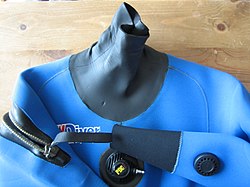
View on Wikipedia A neck seal, wrist seal, manual vent, inflator, zip and fabric of a neoprene dry suit. The soft seal material at the neck and wrists is made from single backed closed-cell foam neoprene for elasticity. The slick unbacked side seals against the skin. The blue area is double-backed with knit nylon fabric laminated onto closed cell foamed neoprene for toughness. Some insulation is provided by the suit, and the rest by garments worn underneath.
| |
 Chemical structure of the repeating unit of polychloroprene
| |
| Identifiers | |
|---|---|
| ECHA InfoCard | 100.127.980 |
| EC Number |
|
CompTox Dashboard (EPA)
|
|
| Properties | |
| Density | 1.23 g/cm3 (solid) 0.1-0.3 g/cm3 (foam) |
Except where otherwise noted, data are given for materials in their standard state (at 25 °C [77 °F], 100 kPa).
| |

Neoprene (also polychloroprene) is a family of synthetic rubbers that are produced by polymerization of chloroprene.[1] Neoprene exhibits good chemical stability and maintains flexibility over a wide temperature range. Neoprene is sold either as solid rubber or in latex form and is used in a wide variety of commercial applications, such as laptop sleeves, orthopaedic braces (wrist, knee, etc.), electrical insulation, medical gloves, liquid and sheet-applied elastomeric membranes or flashings, and automotive fan belts.[2]
Production
[edit]Neoprene is produced by free-radical polymerization of chloroprene. In commercial production, this polymer is prepared by free radical emulsion polymerization. Polymerization is initiated using potassium persulfate. Bifunctional nucleophiles, metal oxides (e.g. zinc oxide), and thioureas are used to crosslink individual polymer strands.[3]
History
[edit]Neoprene was invented by DuPont scientists on April 17, 1930, after Elmer K. Bolton of DuPont attended a lecture by Fr Julius Arthur Nieuwland, a professor of chemistry at the University of Notre Dame. During the his work on acetylene, Nieuwland produced divinyl acetylene, a jelly that firms into an elastic compound similar to rubber when passed over sulfur dichloride. After DuPont purchased the patent rights from the university, Wallace Carothers of DuPont took over commercial development of Nieuwland's discovery in collaboration with Nieuwland himself and DuPont chemists Arnold Collins, Ira Williams, and James Kirby.[4] Collins focused on monovinyl acetylene and allowed it to react with hydrogen chloride gas, manufacturing chloroprene.[5]
DuPont first marketed the compound in 1931 under the trade name DuPrene,[6] but its commercial possibilities were limited by the original manufacturing process, which left the product with a foul odor.[7] A new process was developed, which eliminated the odor-causing byproducts and halved production costs, and the company began selling the material to manufacturers of finished end-products.[7] The demand for the material rose very rapidly: in 1932, approximately 8,000 pounds of neoprene were produced, in 1933 approximately 52,000 pounds were produced, and this amount doubled annually for the following five years.[8]
For quality control, the trademark DuPrene was restricted to apply only to the material sold by DuPont.[7] Since the company itself did not manufacture any DuPrene-containing end products, the trademark was dropped in 1937 and replaced with a generic name, neoprene, in an attempt "to signify that the material is an ingredient, not a finished consumer product".[9] DuPont then worked extensively to generate demand for its product, implementing a marketing strategy that included publishing its own technical journal, which extensively publicized neoprene's uses as well as advertising other companies' neoprene-based products.[7] By 1939, sales of neoprene were generating profits over $300,000 for the company (equivalent to $6,800,000 in 2024).[7]
Mechanical properties
[edit]The high tensile performance of neoprene is a result of its highly regular backbone structure, which causes neoprene to undergo strain crystallization under tensile loading.[10] A two parameter (strain rate and temperature) hyperelastic model can accurately capture much of the mechanical response of neoprene.[11]
Exposure to acetone and heat have been shown to degrade the tensile strength and ultimate elongation of neoprene, likely due to a loss of plasticizers as well as an increase in crosslinking during heat exposure.[12] The response of neoprene to thermal aging depends not just on the highest temperature it is exposed to, but also on the exact temperature-time profile; this is a result of the competing factors of scission of the main polymer chain and oxidative cross-linking.[13] Chain scission leads to degradation, embrittlement, and a loss of toughness.[14] Oxidation reactions in the presence of heating leads to increased cross-linking, which in turn causes hardening.[13] The interplay of both these factors determines the resulting effect on material mechanical properties; cross-linking is thought to dominate for neoprene.[13][15]
As neoprene is used to make electric cable jackets in nuclear power plants, the effect of gamma radiation on the mechanical properties of neoprene has also been investigated. Chain scission, possibly triggered by free radicals from irradiated oxygen, deteriorates its mechanical properties.[16] Likewise, the tensile strength, hardness, and ultimate elongation of neoprene can also be degraded upon exposure to microwave radiation, which is of interest in the devulcanization process[17] Finally, ultraviolet radiation is seen to decrease the mechanical properties of neoprene, which is important for outdoors applications of neoprene.[18]
| Property | Value |
|---|---|
| Ultimate tensile strength | 27.579 MPa (4000 PSI)[10] |
| Young's modulus | 6.136 MPa (890 PSI)[19] |
| Ultimate elongation | 600%[10] |
| Hardness (Durometer) | 30–95[10] |
| Glass transition temperature | -43°C[10] |
| Storage modulus (measured at 1 Hz) | 7.83 MPa (1135.646 PSI)[20] |
| Loss modulus (measured at 1 Hz) | 8.23 MPa (1193.661 PSI) [20] |
Applications
[edit]General
[edit]
Neoprene resists degradation more than natural or synthetic rubber. This relative inertness makes neoprene well suited for demanding applications such as gaskets, hoses, and corrosion-resistant coatings.[1] It can be used as a base for adhesives, noise isolation in power transformer installations, and as padding in external metal cases to protect the contents while allowing a snug fit. It resists burning better than exclusively hydrocarbon based rubbers,[21] resulting in its appearance in weather stripping for fire doors and in combat related attire such as gloves and face masks. Because of its tolerance of extreme conditions, neoprene is used to line landfills. Neoprene's burn point is around 260 °C (500 °F).[22]
In its native state, neoprene is a very pliable rubber-like material with insulating properties similar to rubber or other solid plastics.
Neoprene foam is used in many applications and is produced in either closed-cell or open-cell form. The closed-cell form is waterproof, less compressible and more expensive. The open-cell form can be breathable. It is manufactured by foaming the rubber with nitrogen gas, where the tiny enclosed and separated gas bubbles can also serve as insulation. Nitrogen gas is most commonly used for the foaming of neoprene foam due to its inertness, flame resistance, and large range of processing temperatures.[23]
Civil engineering
[edit]Neoprene is used as a component of elastomeric bridge bearings, to support heavy loads while permitting small horizontal movements.[24]
Aquatics
[edit]Neoprene is a popular material in making protective clothing for aquatic activities. Foamed neoprene is commonly used to make fly fishing waders, wetsuits, and drysuits as thermal insulation. The foam is quite buoyant, and divers compensate for this by wearing weights.[25] Foam neoprene compresses under pressure.[26]
Some wet suits are of the "super-flex" variety, which uses spandex in the knit liner fabric.[27][28] A drysuit is similar to a wetsuit, but uses thicker and more durable neoprene to create an entirely waterproof suit that is suitable for wear in extremely cold water or polluted water.[citation needed]
Home accessories
[edit]Neoprene is used for lifestyle and other home accessories including laptop sleeves, tablet holders, remote controls, mouse pads, and cycling chamois.
Music
[edit]The Rhodes piano used hammer tips made of neoprene in its electric pianos, after changing from felt hammers around 1970.[29]
Neoprene is also used for speaker cones and drum practice pads.[30]
Hydroponic gardening
[edit]Hydroponic and aerated gardening systems make use of small neoprene inserts to hold plants in place while propagating cuttings or using net cups. Inserts are relatively small, ranging in size from 1.5 to 5 inches (4 to 13 cm). Neoprene is a good choice for supporting plants because of its flexibility and softness, allowing plants to be held securely in place without the chance of causing damage to the stem. Neoprene root covers also help block out light from entering the rooting chamber of hydroponic systems, allowing for better root growth and helping to deter the growth of algae.[citation needed]
Face mask
[edit]During the COVID-19 global pandemic, neoprene was identified by some health experts as an effective material to use for home made face masks.[31] Some commercial face mask manufacturers that use neoprene have claimed 99.9% filtration for particles as small as 0.1 microns.[32] The size of coronavirus is identified to be on average 0.125 microns.[33]
Other
[edit] | This section needs additional citations for verification. (May 2024) |

Neoprene is used for Halloween masks and masks used for face protection, to make waterproof automotive seat covers, in liquid and sheet-applied elastomeric roof membranes or flashings, and in a neoprene-spandex mixture for manufacture of wheelchair positioning harnesses.
In tabletop wargames, neoprene mats printed with grassy, sandy, icy, or other natural features have become popular gaming surfaces. They are durable, firm and stable, and attractive in appearance, and also favoured for their ability to roll up in storage but lie flat when unrolled.
Because of its chemical resistance and overall durability, neoprene is sometimes used in the manufacture of dishwashing gloves, especially as an alternative to latex.
In fashion, neoprene has been used by designers such as Gareth Pugh,[34] Balenciaga,[35] Rick Owens, Lanvin, and Vera Wang.
Precautions
[edit]Some people are allergic to neoprene while others can get dermatitis from thiourea residues left from its production.[36]
The most common accelerator in the vulcanization of polychloroprene is ethylene thiourea (ETU), which has been classified as a reproductive toxin. From 2010 to 2013, the European rubber industry had a research project titled SafeRubber to develop a safer alternative to the use of ETU.[37]
See also
[edit]References
[edit]- ^ a b Werner Obrecht, Jean-Pierre Lambert, Michael Happ, Christiane Oppenheimer-Stix, John Dunn and Ralf Krüger "Rubber, 4. Emulsion Rubbers" in Ullmann's Encyclopedia of Industrial Chemistry, 2012, Wiley-VCH, Weinheim. doi:10.1002/14356007.o23_o01
- ^ "Technical information — Neoprene" (PDF). Du Pont Performance Elastomers. October 2003. Archived from the original (PDF) on 2008-08-29. Retrieved 2008-02-06.
- ^ Furman, Glenn E. (14 October 2005). "Chloroprene Polymers". Encyclopedia of Polymer Science and Technology. Wiley Online Library. doi:10.1002/0471440264.pst053. ISBN 0471440264.
- ^ Carothers, Wallace H.; Williams, Ira.; Collins, Arnold M.; Kirby, James E. (November 1931). "Acetylene Polymers and Their Derivatives. Ii. A New Synthetic Rubber: Chloroprene and ITS Polymers". Journal of the American Chemical Society. 53 (11): 4203–4225. Bibcode:1931JAChS..53.4203C. doi:10.1021/ja01362a042.
- ^ Smith, John K. (January 1985). "The Ten-Year Invention: Neoprene and Du Pont Research, 1930-1939". Technology and Culture. 26 (1): 34–55. doi:10.2307/3104528. JSTOR 3104528. S2CID 113234844.
- ^ "Neoprene: 1930 - Overview". DuPont Heritage. DuPont. Archived from the original on 9 March 2012. Retrieved 29 March 2011.
- ^ a b c d e Hounshell, David A.; Smith, John Kenly (1988). Science and Corporate Strategy: Du Pont R&D, 1902-1980 (Repr. ed.). Cambridge [Cambridgeshire]: Cambridge University Press. pp. 253–257. ISBN 0-521-32767-9.
- ^ Smith, John K. (1985). "The Ten-Year Invention: Neoprene and Du Pont Research, 1930-1939". Technology and Culture. 26 (1): 34–55. doi:10.2307/3104528. ISSN 0040-165X. JSTOR 3104528.
- ^ "Neoprene: 1930 - In Depth". DuPont Heritage. DuPont. Archived from the original on 10 May 2011. Retrieved 29 March 2011.
- ^ a b c d e Harris, Cyril M.; Piersol, Allan G., eds. (2002). Harris' shock and vibration handbook. McGraw-Hill handbooks (5th ed.). New York: McGraw-Hill. pp. Ch. 33. ISBN 978-0-07-137081-3.
- ^ Trivedi, A. R.; Siviour, C. R. (2020-09-01). "A Simple Rate–Temperature Dependent Hyperelastic Model Applied to Neoprene Rubber". Journal of Dynamic Behavior of Materials. 6 (3): 336–347. Bibcode:2020JDBM....6..336T. doi:10.1007/s40870-020-00252-w. ISSN 2199-7454.
- ^ Gao, Pengfei; Tomasovic, Beth (November 2005). "Change in Tensile Properties of Neoprene and Nitrile Gloves After Repeated Exposures to Acetone and Thermal Decontamination". Journal of Occupational and Environmental Hygiene. 2 (11): 543–552. Bibcode:2005JOEH....2..543G. doi:10.1080/15459620500315964. ISSN 1545-9624. PMID 16276643. Archived from the original on 2024-05-13. Retrieved 2024-05-13.
- ^ a b c Alazhary, Sharif; Shaafaey, Mamoon; Bahrololoumi, Amir; Dargazany, Roozbeh (2024-03-18). "Investigating the effects of sequential aging temperature profiles on the response of neoprene rubber". Journal of Polymer Research. 31 (4): 102. doi:10.1007/s10965-024-03910-y. ISSN 1572-8935.
- ^ Fayolle, Bruno; Richaud, Emmanuel; Colin, Xavier; Verdu, Jacques (2008). "Review: degradation-induced embrittlement in semi-crystalline polymers having their amorphous phase in rubbery state". Journal of Materials Science. 43 (22): 6999–7012. Bibcode:2008JMatS..43.6999F. doi:10.1007/s10853-008-3005-3. ISSN 0022-2461. Archived from the original on 2024-09-07. Retrieved 2024-05-13.
- ^ Ito, Masayuki; Okada, Sohei; Kuriyama, Isamu (1981-01-01). "The deterioration of mechanical properties of chloroprene rubber in various conditions". Journal of Materials Science. 16 (1): 10–16. Bibcode:1981JMatS..16...10I. doi:10.1007/BF00552053. ISSN 1573-4803. Archived from the original on 2024-09-07. Retrieved 2024-05-13.
- ^ Ito, Masayuki; Okada, Sohei; Kuriyama, Isamu (1981-01-01). "The deterioration of mechanical properties of chloroprene rubber in various conditions". Journal of Materials Science. 16 (1): 10–16. Bibcode:1981JMatS..16...10I. doi:10.1007/BF00552053. ISSN 1573-4803. Archived from the original on 2024-09-07. Retrieved 2024-05-13.
- ^ Scagliusi, Sandra; Araújo, Sumair G.; Landini, Liliane; Lugão, Ademar B. (2009). "STUDY OF PROPERTIES OF CHLOROPRENE RUBBER DEVULCANIZATE BY RADIATION IN MICROWAVE" (PDF). 2009 International Nuclear Atlantic Conference. Archived (PDF) from the original on 2024-05-13. Retrieved 2024-05-13.
- ^ Chou, Hsoung-Wei; Huang, Jong-Shin (2008-12-05). "Effects of ultraviolet irradiation on the static and dynamic properties of neoprene rubbers". Journal of Applied Polymer Science. 110 (5): 2907–2913. doi:10.1002/app.28903. ISSN 0021-8995. Archived from the original on 2024-09-07. Retrieved 2024-05-13.
- ^ "MatWeb - The Online Materials Information Resource". www.matweb.com. Archived from the original on 2024-09-07. Retrieved 2024-05-13.
- ^ a b Luo, Xiangcheng; Chung, D. D. L. (2000-01-01). "Vibration damping using flexible graphite". Carbon. 38 (10): 1510–1512. Bibcode:2000Carbo..38.1510L. doi:10.1016/S0008-6223(00)00111-1. Archived from the original on 2024-09-07. Retrieved 2024-05-13.
- ^ "Neoprene - polychloroprene". DuPont Elastomers. Archived from the original on 2008-01-11. Retrieved 2008-04-09.
- ^ "3E Protect" (PDF). MSDS.DuPont.com. Archived (PDF) from the original on 27 October 2011. Retrieved 14 October 2017.
- ^ Maier, Clive; Calafut, Teresa (1998). "Additives". Polypropylene: The Definitive User's Guide and Databook. Plastics Design Library.
- ^ Damon Allen.Stiffness Evaluation of Neoprene Bearing Pads under Long-Term Loads. A Dissertation Presented to the Graduate School of The University Of Florida in Partial Fulfillment of the Requirements for the Degree of Doctor of Philosophy. University Of Florida 2008
- ^ "Weight Systems". Archived from the original on 2024-09-07. Retrieved 2024-02-02.
- ^ "Neoprene foam types for all applications-What foam is right for you?". 2017-03-04. Retrieved 2025-07-24.
- ^ "Wetsuit lining". srface.com. Archived from the original on 28 December 2021. Retrieved 28 December 2021.
- ^ "Face Fabrics". PerfectEx.com. 17 April 2020. Retrieved 28 December 2021.
- ^ "Steve's Corner - Hammer Tips". FenderRhodes.com. Archived from the original on 15 October 2017. Retrieved 14 October 2017.
- ^ "4 Great Drum Mutes". Making Music. February 20, 2015. Retrieved December 7, 2018.[permanent dead link]
- ^ "Coronavirus Face Masks: What You Should Know". Web MD. November 8, 2019. Archived from the original on September 7, 2024. Retrieved June 17, 2020.
- ^ "RZ Mask FAQ". RZ Face Mask. March 11, 2020. Archived from the original on June 17, 2020. Retrieved June 17, 2020.
- ^ Fehr, A. R.; Perlman, S. (February 12, 2015). "Coronaviruses: An Overview of Their Replication and Pathogenesis". Coronaviruses. Methods in Molecular Biology. Vol. 1282. pp. 1–23. doi:10.1007/978-1-4939-2438-7_1. ISBN 978-1-4939-2437-0. PMC 4369385. PMID 25720466.
- ^ "Dress | Gareth Pugh". Victoria and Albert Museum. December 2, 2011. Archived from the original on 2024-08-13. Retrieved 2024-08-13.
- ^ "Dress | Nicolas Ghesquière". Victoria and Albert Museum. December 2, 2011. Archived from the original on 2024-08-13. Retrieved 2024-08-13.
- ^ Stern, E. B.; Callinan, N.; Hank, M.; Lewis, E. J.; Schousboe, J. T.; Ytterberg, S. R. (1998). "Neoprene splinting: dermatological issues". The American Journal of Occupational Therapy. 52 (7): 573–578. doi:10.5014/ajot.52.7.573. ISSN 0272-9490. PMID 9693703.
- ^ "A Safer Alternative Replacement for Thiourea Based Accelerators in the Production Process of Chloroprene Rubber". cordis.europa.eu. Archived from the original on 2023-05-24. Retrieved 2024-04-25.
External links
[edit]


| Authority control databases: National |
|---|
Neoprene
View on GrokipediaChemistry and Structure
Chemical Composition
Neoprene, chemically known as polychloroprene, is a family of synthetic rubbers formed by the polymerization of chloroprene monomer, systematically named 2-chlorobuta-1,3-diene. This monomer features a conjugated diene structure with a chlorine atom substituted at the 2-position, enabling the formation of a polymer chain that mimics the elasticity of natural rubber while incorporating enhanced stability traits. The base repeating unit in polychloroprene arises primarily from 1,4-addition during polymerization, resulting in the trans-configured structure -[CH₂-C(Cl)=CH-CH₂]-. Minor contributions from 1,2- and 3,4-addition produce syndiotactic and other irregular units, such as -[CH₂-CH(Cl)-CH=CH₂]- for 1,2-addition, which disrupt chain regularity and reduce overall crystallinity, influencing the material's flexibility and processing characteristics.[9][4] The synthesis of polychloroprene relies on free radical emulsion polymerization conducted in an aqueous medium to produce a latex that can be coagulated into solid rubber. Initiation occurs when a water-soluble initiator, typically potassium persulfate, decomposes to generate sulfate radicals that abstract hydrogen or add to the chloroprene monomer, starting chain growth. Propagation proceeds via successive addition of chloroprene molecules to the radical-ended chain, favoring 1,4-trans addition due to the monomer's electronic structure, though competing 1,2- and 3,4-pathways occur to varying degrees based on temperature and catalysts. Termination involves radical recombination or disproportionation, often controlled by chain-transfer agents to regulate molecular weight and prevent excessive crosslinking. This process yields a polymer with approximately 60-80% conversion before monomer recovery, ensuring a predominantly amorphous structure suitable for vulcanization. The chloroprene monomer's structural features are pivotal to polychloroprene's performance: the conjugated diene backbone provides the entropic elasticity essential for rubber-like behavior upon stretching and recovery, while the adjacent chlorine atom sterically hinders and electronically deactivates the carbon-carbon double bonds in the polymer. This deactivation reduces susceptibility to oxidative attack, ozone cracking, and chemical degradation, conferring superior resistance compared to unsubstituted polydienes like polyisoprene. The polar chlorine also enhances intermolecular interactions, contributing to the polymer's moderate crystallinity under strain, which further bolsters tensile strength and durability without compromising flexibility.[10][11]Polymer Variants
Polychloroprene, the primary polymer behind neoprene, exists in various structural forms influenced by polymerization conditions and modifications, including amorphous, semi-crystalline, and copolymer variants. The base polymer chain predominantly features trans-1,4 addition units, comprising approximately 80-90% of the structure, which imparts semi-crystallinity due to the ability of these segments to align and form ordered regions.[12] This semi-crystalline nature arises from the regular arrangement of the chlorine-substituted backbone, contrasting with the more random cis-1,4 configuration in natural rubber, where the chlorine atom enhances molecular polarity and intermolecular bonding strength.[13] The glass transition temperature is typically around -40°C, allowing flexibility at low temperatures, while the melting point of crystalline domains falls typically in the 40–75 °C range, depending on the variant and crystallization conditions.[14][15] Commercial variants of polychloroprene are categorized into G-type, W-type, and T-type based on copolymerization agents and processing aids that alter crystallization rates and processability. G-type neoprene, a sulfur-modified copolymer using thiuram disulfide, exhibits rapid crystallization, making it suitable for applications requiring quick set-up, such as adhesives, and is often used with sulfur vulcanization systems.[4] W-type variants, modified with mercaptans, demonstrate slower crystallization and improved resistance to low-temperature stiffening, providing better balance in copolymer forms for general elastomeric uses.[4] T-type neoprene consists of highly cross-linked, pre-vulcanized gels that resist crystallization altogether, enhancing extrudability and calendering without excessive tackiness.[4] Specialized modifications extend neoprene's forms beyond standard elastomers. Expanded neoprene, or neoprene foam, is created by incorporating blowing agents like azodicarbonamide during vulcanization, generating a closed-cell structure for lightweight, insulating variants while maintaining the base polymer's polarity-driven properties.[16] Thermoplastic neoprene variants involve blending polychloroprene with thermoplastics such as polypropylene or PVC, improving melt processability and recyclability without sacrificing the chlorine-induced bonding characteristics.[17] Adhesive-grade neoprene, often based on G-type copolymers like Neoprene AD, features tailored molecular weight and tackifiers to optimize green strength and final bond polarity, distinguishing it from bulk elastomer forms.[18] Recent developments as of 2023 include reprocessable polychloroprene variants using dynamic vulcanization agents like 2,2'-dithiodipyridine, enabling recyclability while preserving mechanical properties.[19]History and Development
Discovery and Invention
Neoprene, known chemically as polychloroprene, emerged from DuPont's efforts to develop synthetic alternatives to natural rubber amid the 1920s global rubber crisis, characterized by soaring prices due to the British Stevenson Plan's production restrictions and rising demand from the automobile industry.[20] This scarcity, with rubber prices peaking at over $1 per pound in 1925, prompted U.S. chemical firms like DuPont to invest in polymer research, building on earlier work with isoprene derivatives and acetylene chemistry.[21] The breakthrough occurred on April 17, 1930, when DuPont chemists Arnold M. Collins, Ira Williams, and James E. Kirby, under the direction of Wallace H. Carothers, discovered the polymerization of chloroprene into a rubber-like material.[22] Collins serendipitously identified chloroprene as a product of vinylacetylene reacting with hydrochloric acid, while Williams and Kirby advanced the emulsion polymerization technique to yield elastic polymers superior in stability to natural rubber.[23] This innovation stemmed from Carothers' broader macromolecular research at DuPont's Experimental Station in Wilmington, Delaware, where the team explored acetylene-based monomers to mimic rubber's properties.[24] Early experiments involved converting acetylene into vinylacetylene via catalytic dimerization, followed by the addition of hydrochloric acid to form chloroprene (2-chloro-1,3-butadiene), which was then polymerized using free-radical initiation in emulsion systems.[23] These processes, detailed in a seminal 1931 publication, demonstrated chloroprene's rapid polymerization to form tough, resilient solids, marking a pivotal step in synthetic elastomer development.[23] DuPont filed for a patent on chloroprene polymerization in 1931, securing rights to the core technology.[22] Initially named "Duprene" upon its announcement on November 3, 1931, the material was rebranded as Neoprene in 1937 to emphasize its neoteric nature and avoid trademark conflicts with other DuPont products.[2]Commercialization and Evolution
DuPont launched neoprene commercially in 1932, marking the first synthetic rubber produced on a large scale in the United States, initially under the trade name DuPrene.[2] The company began production at its Deepwater, New Jersey facility, with early output scaling from experimental batches to an initial capacity of approximately 1,000 tons per year by the mid-1930s, before expanding to 5,000 tons annually to meet growing demand.[22] This launch positioned neoprene as a versatile alternative to natural rubber, particularly valued for its resistance to oil, chemicals, and aging. During World War II, demand surged due to shortages of natural rubber and neoprene's non-flammable properties, leading to its widespread use in military gear, seals, gaskets, and protective equipment for vehicles and machinery.[25] U.S. government initiatives accelerated synthetic rubber production, with neoprene comprising a key portion of the output to support wartime needs.[26] In the post-1950s era, neoprene production evolved significantly with a shift from acetylene-derived chloroprene—derived from lime and coal-based processes—to petroleum-based feedstocks like butadiene, which lowered costs and increased scalability as petrochemical infrastructure expanded.[27] By the 1960s, this transition had become dominant due to rising acetylene prices and abundant petroleum supplies.[27] DuPont discontinued the DuPrene trademark in 1937, adopting the generic term "neoprene" to reflect its broad applicability, a status that solidified in the 1980s as key patents expired, enabling global manufacturing expansion.[28] Companies like Denka (formerly Denki Kagaku Kogyo) and Showa Denko in Japan emerged as major producers, contributing to worldwide capacity reaching over 200,000 tons by the early 1980s.[29] In the 2020s, innovations have focused on sustainability, with prototypes of bio-based neoprene emerging that incorporate up to 30% renewable feedstocks such as soybean, castor, or algal oils to reduce reliance on fossil fuels and lower carbon footprints by 20-40%.[30] Companies like Asahi Kasei are exploring bio-precursors for chloroprene production to address environmental concerns.[31] The global neoprene market, now producing around 285,000 metric tons annually, is projected to grow at a compound annual growth rate (CAGR) of 2.9% through 2030, reaching approximately 330,000 tons, driven primarily by demand in automotive components like seals and hoses, as well as construction applications such as roofing and adhesives.[32] This expansion reflects neoprene's enduring role in high-performance elastomers amid ongoing adaptations to regulatory and sustainability pressures.[33]Production
Raw Materials
Neoprene production primarily relies on chloroprene as the key monomer, a chlorinated derivative of butadiene or acetylene that forms the backbone of the polychloroprene polymer. Chloroprene is predominantly synthesized via the butadiene route, involving chlorination of 1,3-butadiene—obtained from petroleum cracking processes—to produce crude chlorinated butadienes, followed by isomerization and dehydrochlorination steps.[34][35] Alternatively, the acetylene route, which dimerizes acetylene (derived from natural gas via methane pyrolysis or calcium carbide) to vinylacetylene and then hydrochlorinates it, persists in regions like China but has largely been supplanted globally due to higher energy demands.[34][36] These petrochemical feedstocks dominate global supply chains, with major producers sourcing butadiene from refineries in the Middle East, North America, and Asia, ensuring scalability but tying production to fossil fuel availability. Global neoprene production capacity is approximately 290 thousand metric tons in 2025, primarily from major manufacturers such as Dow Chemical, Tosoh Corporation, and Denka Company, with significant output in North America, Asia, and Europe.[33][37] The synthesis of neoprene via emulsion polymerization incorporates various additives to stabilize the reaction and control polymer characteristics. Emulsifiers, such as soaps or anionic surfactants, are essential for forming a stable aqueous dispersion of chloroprene monomers, preventing phase separation during polymerization.[38][39] Initiators like persulfates (e.g., potassium persulfate) generate free radicals to kickstart the polymerization at temperatures around 10–50°C, influencing reaction kinetics and yield.[40] Modifiers, particularly mercaptans such as dodecyl mercaptan, act as chain-transfer agents to regulate molecular weight, reducing viscosity and improving processability without compromising final properties.[41] Auxiliary materials are compounded into the latex or dry polymer to enhance neoprene's performance during vulcanization and end-use. Reinforcing fillers like carbon black (e.g., N550 or N772 grades) or precipitated silica improve tensile strength, abrasion resistance, and modulus by interacting with polymer chains, with carbon black offering superior reinforcement in high-wear applications.[42][43] Zinc oxide serves as a critical vulcanizing agent in neoprene, promoting crosslinking with metal oxides like magnesia to form a stable network, typically at levels of 5–10 parts per hundred rubber (phr) for optimal cure rates and heat resistance.[42][44] Supply chain dynamics significantly influence neoprene economics, with petroleum price volatility in 2025—driven by geopolitical tensions and fluctuating crude oil at around $62 per barrel (as of November 2025)—directly affecting butadiene costs and producer margins.[45][46] In Q2 2025, U.S. neoprene prices fell to approximately 6974 USD/MT amid lower feedstock expenses, yet ongoing instability underscores the need for diversified sourcing.[47] Emerging sustainability efforts include research into bio-based acetylene from biomass, showing potential for reduced carbon emissions (around 27%) compared to traditional coal-derived methods, though commercial scale remains limited as of late 2025.[48]Manufacturing Processes
Neoprene is primarily produced through free radical emulsion polymerization of chloroprene monomer in aqueous media. This process occurs in specialized reactors maintained at temperatures between 10°C and 50°C to control the reaction kinetics and achieve desired polymer chain lengths. The reaction is initiated by water-soluble free radical initiators, such as persulfates, which generate radicals that propagate the polymerization of chloroprene into polychloroprene latex.[49][39][50] The manufacturing begins with the formation of a stable emulsion by dispersing chloroprene monomer in water using surfactants and protective colloids, followed by the addition of initiators and chain transfer agents to regulate molecular weight. Polymerization proceeds until a conversion rate exceeding 70% is reached, at which point free radical scavengers are introduced to terminate the reaction and prevent excessive branching. Unreacted chloroprene is then stripped from the latex through steam distillation or vacuum evaporation to minimize residual monomer content, ensuring product purity. The resulting latex is coagulated by adding acids, such as hydrochloric or hydroxyacetic acid, or salts like calcium chloride, which destabilize the emulsion and precipitate the polymer as crumb or sheets; this coagulated material is subsequently washed, dried in hot air ovens or mills, and compounded with fillers, plasticizers, and stabilizers for further processing.[49][51][52] Following polymerization and initial processing, neoprene undergoes vulcanization to enhance its mechanical properties through cross-linking. This curing step typically involves compounding the polymer with metal oxides, such as magnesium oxide (MgO) and zinc oxide (ZnO), which act as vulcanizing agents by reacting with allylic chlorines on the polymer chains to form ionic cross-links. The mixture is then heated to 140–160°C under pressure in molds or extruders for 10–60 minutes, depending on the formulation, to achieve optimal cross-link density without over-curing.[53][42] While emulsion polymerization dominates commercial production, variations include suspension polymerization for specialty grades requiring higher purity or specific particle morphologies, where chloroprene droplets are suspended in water without emulsifiers and polymerized under controlled agitation. Additionally, as of 2025, advancements in continuous flow reactors have improved efficiency by enabling steady-state operation, reducing batch-to-batch variability, and lowering energy consumption in large-scale neoprene adhesive production lines.[54][55]Properties
Chemical Properties
Neoprene, or polychloroprene, exhibits excellent resistance to oils, greases, ozone, and weathering, primarily due to the saturation of its polymer chain by chlorine atoms, which inhibits oxidative and degradative reactions common in unsaturated elastomers.[4] This inherent chemical stability allows neoprene to maintain integrity in environments exposed to atmospheric oxygen, sunlight, and ozone without significant cracking or embrittlement.[4] In contrast, its resistance to acids and bases is moderate; it withstands dilute solutions effectively but may degrade under prolonged contact with concentrated strong acids or alkalies.[4] The material demonstrates good thermal stability, with decomposition initiating above 200°C through dehydrochlorination, releasing hydrogen chloride (HCl) gas.[56] Neoprene also features low permeability to gases such as oxygen, which contributes to its durability in applications requiring barrier properties against air or other gases.[57] Neoprene possesses inherent flame retardancy, characterized by a limiting oxygen index (LOI) of approximately 28%, enabling it to self-extinguish in air due to the release of HCl during combustion, which dilutes flammable volatiles and inhibits further burning.[58] Post-vulcanization, neoprene is insoluble in most common solvents, owing to its cross-linked network structure; however, it exhibits swelling in aromatic hydrocarbons such as benzene or toluene, potentially leading to dimensional changes under exposure.[59]Physical and Mechanical Properties
Neoprene, or polychloroprene, possesses a density typically ranging from 1.23 to 1.25 g/cm³, which contributes to its lightweight yet robust structure in various formulations. Hardness can be tailored across a broad spectrum of 40 to 95 Shore A, allowing for applications requiring either flexibility or rigidity, with lower values providing greater pliability and higher values enhancing durability under load.[60] These properties can vary depending on the specific formulation, including fillers and curing systems. In terms of mechanical performance, neoprene demonstrates tensile strength between 10 and 25 MPa, enabling it to withstand significant stress without failure, as evidenced by typical values around 18 MPa in specialized compounds.[61] Elongation at break reaches 300% to 800%, reflecting its excellent stretchability and recovery, with common measurements exceeding 500% under standard testing.[61] Neoprene exhibits good tear resistance, supporting its use in environments prone to ripping or puncturing.[62] The Young's modulus lies approximately in the 1-5 MPa range, indicating a balance of stiffness and elasticity characteristic of soft elastomers.[63] Neoprene exhibits high resilience, with rebound values of 60-80%, which underscores its ability to rapidly return to original shape after deformation, minimizing energy loss in dynamic applications.[64] Fatigue resistance is notable, coupled with low compression set under strain—typically 20-35% at 25% compression (ASTM D395 Method A)—ensuring dimensional stability over repeated cycles.[65] The material's service temperature range spans -40°C to 100°C for continuous exposure, maintaining integrity without significant degradation.[66] Heat aging tests reveal good retention of key properties, such as tensile strength and elongation, following 168 hours at 100°C, highlighting its thermal endurance.[62]| Property | Typical Value/Range | Test Method/Reference |
|---|---|---|
| Density | 1.23-1.25 g/cm³ | ASTM D792 |
| Hardness | 40-95 Shore A | ASTM D2240[60] |
| Tensile Strength | 10-25 MPa | ASTM D412[61] |
| Elongation at Break | 300-800% | ASTM D412[61] |
| Tear Resistance | Good | ASTM D624[62] |
| Young's Modulus | ~1-5 MPa | Literature review[63] |
| Rebound Resilience | 60-80% | ASTM D1054, ASTM D2632[64] |
| Compression Set (25% strain) | 20-35% | ASTM D395[65] |
| Service Temperature Range | -40°C to 100°C | Manufacturer specs[66] |
| Heat Aging (168 h at 100°C) | Good retention | ASTM D573[62] |