


Community hub
Recent from talks
Contribute something
Nothing was collected or created yet.
Poway, California
View on Wikipedia
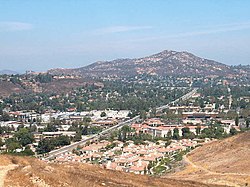
Poway (/ˈpaʊ.eɪ/) is a city in San Diego County, California, United States. Poway's rural roots influenced its motto "The City in the Country". The city had a population of 48,841 as of the 2020 United States census.[6]
Key Information


Poway is part of San Diego's North County.[7]
History
[edit]The Kumeyaay people lived in the area for centuries before the Spanish colonization of the region. Artifacts such as arrowheads, spear points, metates, grinding stones, and pottery found along the bed of Poway Creek all indicate an early Kumeyaay presence. Various pictographs adorn many of Poway's boulders, and modern dating techniques suggest these paintings date to the 16th century and earlier.[8]
European settlement
[edit]In the late 18th century, Mission San Diego de Alcalá kept cattle in the valley. Documents of Mission San Diego de Alcala record the name of the valley as "Paguay" as early as 1828. The name "Poway" is likely derived from a Kumeyaay term meaning "arrowhead" (pawii) or "watering hole" (paguay).[9][10] Other sources suggest that "Paguay" means "the meeting of little valleys" or "end of the valley".[11][12] Some controversy also surrounds the proper spelling; historically it has also been written by the Mexican authorities as Paguai.[13] It has also been written as Paui, Pauai, Pauy, and Powaii.[citation needed]
For approximately a century, Poway served as a stock range for the mission and local ranchos. In September 1839, Corporal Rosario Aguilar was granted Rancho Paguai a ranch in the valley and it was confirmed on May 22, 1840, but he refused it, becoming juez de paz in 1841 and moving instead to San Juan Capistrano.[13][14]
American settlement
[edit]American settlers began to come to the valley for farming purposes in the late antebellum period. Few records of this time have survived, and not until 1894 and the inception of the Poway Progress was the town's history regularly recorded. In 1887, about 800 people lived and farmed in Poway. Around the start of the 20th century, Poway farmers had moderate success in the production and vending of fruit, grain, and dairy products. The expansion, however, failed to follow agricultural success.
Poway has a creek and fertile soil, but the lack of easily available water prevented the settlement from attracting large-scale farmers and the accompanying population growth. In 1954 the Poway Municipal Water District was established to utilize water from the Colorado River Aqueduct. In 1957, following the sewer system's completion, developers built housing tracts.
It became a city on December 1, 1980.[15] It was nicknamed "the City in the Country". Poway no longer relies on agriculture for its primary source of income and has instead transitioned into a residential community for those who work for employers in and around the San Diego area. According to a recent state government estimate, the population of Poway has grown since that last census to 50,542.[16] It has been designated a "Tree City"[17] for the last decade.
Major portions of the town were evacuated during both the 2003 Cedar Fire and 2007 Witch Creek Fire.[citation needed]
In 2004, the City of Poway adopted the 1st Light Armored Reconnaissance Battalion, 1st Marine Division, based out of nearby Camp Pendleton. The Fred L. Kent Post 7907 of the Veterans of Foreign Wars has been the official go-between with the battalion, which has been redeployed at least once to Iraq since its adoption.
The pop-punk bands Blink-182, Unwritten Law, Pivit and the Frights originated in Poway, California.
Agriculture
[edit]The Homestead Act of 1862 encouraged Westward migration, and many of Poway's first white settlers came to farm. The fecund soil proved well-suited to a variety of crops, including peaches, Muscat grapes, apricots, pears, hay, and alfalfa. Some farmers captured swarms of wild bees and cultivated honey. Dairying also proved lucrative. Most families kept a cow for milk and butter, chickens for eggs and meat, and perhaps a hog to sustain them while they farmed. Crops sold well around the San Diego area. Between the seasons of 1894 and 1896, the Poway Progress reported agricultural information:
Muscat grapes are beginning to ripen, and the San Diego market is getting a supply of the fine article Poway always produces. ... The season has been a prolific one for bees, thirty of forty stands the present season from a single captured swarm a year or two ago. ... The peach is a good article, and Poway produces it to perfection. Poway pears will compare with any grown in the state.[citation needed]
The success of these crops depended on the annual winter rainfall, and remained subject to variations in precipitation until the establishment of the Poway Municipal Water District in 1954. With water readily available, the town's farming interest shifted to two principal crops: avocados and citrus fruits. With water came new residents, and the former farm town transformed into a locale full of small commercial businesses and shopping centers.
Religion
[edit]The Community Church of Poway, the town's first church, has remained in operation since 1887, making it the house of worship with the longest continual operation in San Diego County.[citation needed] Living Way Church, a non-denominational Protestant church, through Berean Bible College, is the only church currently in Poway that offers Bible college classes. There are two Catholic churches in Poway: St. Michael's[18] and St. Gabriel's.[19]
There is a Jewish community, with a Reform synagogue, a Conservative synagogue, and an Orthodox synagogue. On April 27, 2019, the Orthodox synagogue, Chabad of Poway, was the site of an attack in which four people were shot—one of whom was killed—during Passover services.[20]
A Sikh temple, one of several in San Diego County, is found in Poway. Two Kingdom Halls of Jehovah's Witnesses are located in Poway. There are nine congregations of the Church of Jesus Christ of Latter-day Saints located in Poway that meet in three meetinghouses.[citation needed]
Education
[edit]Poway established its school district in 1871, but did not have a schoolhouse until 1885, when a one-room school was built at Midland Road about a 2–3-minute walk south of the Templar's Hall. The site is still in use today as an elementary school (Kindergarten through 5th grade), though it was torn down and rebuilt in 1945, and renovated again in 2004–2006. First through eighth graders were included in one classroom. Children learned to read and write using slates, and eventually progressed to study subjects such as arithmetic, spelling, English, language (German or Latin), grammar, history, and geography. Students did not usually attend high school, and had to travel to Escondido if they wished to do so. In 1909, only three students from Poway graduated from high school. Women who went on to more school from there usually had teaching ambitions. Education, while compulsory and considered a worthwhile pastime, had few far-reaching applications for Poway's farmers' children. Enrollment in the Poway School 1st–8th grades did not reach 100 until 1932.
Transportation
[edit]Poway's transportation history parallels that of the rest of early California. In 1888, the first stagecoach began to serve the towns from San Diego to Escondido, including Poway. The stage made one stop in town, at the Poway Post Office, and also delivered mail to the farmers who would wait along the road for its arrival. The men would trot alongside the coach and inquire as to the state of the mail and thus receive letters without requiring it to stop. Eight to ten passengers could accompany the stagecoach on its three-day journey for a modest $1.00 fee, or purchase a round trip for the bargain price of $1.50. The route itself, though not treacherous when passing through Poway, did pose a significant challenge to the team and driver at various points. Windy mountain trails often caused the stage to turn over, spilling both mail and passengers onto the rocky turf. The city of San Diego discontinued the stage line in 1912, when the advent of the automobile facilitated an easier and less time-consuming method of mail delivery. Poway established a County Road Station in 1920 to oil and maintain the roads so that automobiles could use them with ease. The road station remained in operation until 1961, when Poway achieved an 80% paved road rate. To this day, though, the town still boasts a number of dirt roads, for use by cars, horses, bikes, and pedestrians. Portions of what is currently Pomerado Road, a major north–south artery, were once U.S. Route 395 in California.[21]
Water
[edit]Poway's greatest change started in the 1950s when water came to the valley. On January 29, 1954, an election was held on the formation of the Poway Municipal Water District, which passed with an overwhelming majority of 210 ayes to 32 nays. At the second election on March 25, 1954, the citizens voted to annex to the San Diego County Water Authority. At a third election held April 22, 1954, the citizens voted to incur bonded debt of $600,000 to build a water system. The first water delivery was made in July 1954 to Gordon's Grocery on Garden Road. In 1972 Poway Dam was built to provide a dependable supply of water.[22]
In 1957, the Pomerado County Water District was organized to provide sewer service to 1,610 acres (6.5 km2) along Pomerado Road. In 1959 the first subdivision homes were built and sold as Poway Valley Homes and Poway's population began to climb. On December 1, 1980, the City of Poway incorporated and the two districts, Poway Municipal Water and Pomerado County Water, became part of the City structure. The district issued a restriction for watering lawns. It allowed people to water their lawns three days a week. After a short time, restrictions were lifted.
Geography
[edit]Poway is east of the city of San Diego and south of the city of Escondido. Nearby communities include Rancho Bernardo, Sabre Springs, Scripps Ranch, Rancho Peñasquitos, and Ramona to the east.
According to the United States Census Bureau, the city covers an area of 39.2 square miles (102 km2), 99.78% of it land, and 0.22% of it water. The confluence of the 33rd parallel north and 117th meridian west is located on a hillside in a private property.
Climate
[edit]Poway has a borderline semi-arid climate (Köppen: Bsh) and hot-summer Mediterranean climate (Köppen: Csa) with hot summers and cool, wet winters.
| Climate data for Poway Valley, CA (extremes from weather.com) | |||||||||||||
|---|---|---|---|---|---|---|---|---|---|---|---|---|---|
| Month | Jan | Feb | Mar | Apr | May | Jun | Jul | Aug | Sep | Oct | Nov | Dec | Year |
| Record high °F (°C) | 95 (35) |
96 (36) |
100 (38) |
103 (39) |
105 (41) |
110 (43) |
114 (46) |
112 (44) |
111 (44) |
105 (41) |
100 (38) |
92 (33) |
114 (46) |
| Mean daily maximum °F (°C) | 67 (19) |
67 (19) |
70 (21) |
72 (22) |
76 (24) |
81 (27) |
82 (28) |
81 (27) |
77 (25) |
72 (22) |
68 (20) |
67 (19) |
73 (23) |
| Mean daily minimum °F (°C) | 44 (7) |
45 (7) |
49 (9) |
53 (12) |
57 (14) |
61 (16) |
62 (17) |
61 (16) |
55 (13) |
48 (9) |
46 (8) |
43 (6) |
52 (11) |
| Record low °F (°C) | 22 (−6) |
25 (−4) |
28 (−2) |
31 (−1) |
39 (4) |
43 (6) |
45 (7) |
46 (8) |
39 (4) |
35 (2) |
26 (−3) |
23 (−5) |
22 (−6) |
| Average precipitation inches (mm) | 2.69 (68) |
3.02 (77) |
2.41 (61) |
0.97 (25) |
0.26 (6.6) |
0.10 (2.5) |
0.03 (0.76) |
0.09 (2.3) |
0.20 (5.1) |
0.57 (14) |
1.28 (33) |
1.93 (49) |
13.55 (344) |
| Source 1: [23] | |||||||||||||
| Source 2: weather.com(extremes)[24] | |||||||||||||
Demographics
[edit]| Census | Pop. | Note | %± |
|---|---|---|---|
| 1960 | 1,921 | — | |
| 1970 | 9,422 | 390.5% | |
| 1980 | 32,263 | 242.4% | |
| 1990 | 43,516 | 34.9% | |
| 2000 | 48,044 | 10.4% | |
| 2010 | 47,811 | −0.5% | |
| 2020 | 48,841 | 2.2% | |
| U.S. Decennial Census[26] 1860–1870[27][28] 1880-1890[29] 1900[30] 1910[31] 1920[32] 1930[33] 1940[34] 1950[35] 1960[36][37] 1970[38] 1980[39] 1990[40] 2000[41] 2010[42] 2020[43] | |||
2020
[edit]| Race / Ethnicity (NH = Non-Hispanic) | Pop 2000[44] | Pop 2010[45] | Pop 2020[43] | % 2000 | % 2010 | % 2020 |
|---|---|---|---|---|---|---|
| White alone (NH) | 37,092 | 33,041 | 28,896 | 77.20% | 69.11% | 59.16% |
| Black or African American alone (NH) | 752 | 722 | 663 | 1.57% | 1.51% | 1.36% |
| Native American or Alaska Native alone (NH) | 159 | 149 | 81 | 0.33% | 0.31% | 0.17% |
| Asian alone (NH) | 3,530 | 4,750 | 6,643 | 7.35% | 9.93% | 13.60% |
| Native Hawaiian or Pacific Islander alone (NH) | 127 | 101 | 107 | 0.26% | 0.21% | 0.22% |
| Other race alone (NH) | 97 | 74 | 240 | 0.20% | 0.15% | 0.49% |
| Mixed race or Multiracial (NH) | 1,313 | 1,466 | 3,194 | 2.73% | 3.07% | 6.54% |
| Hispanic or Latino (any race) | 4,974 | 7,508 | 9,017 | 10.35% | 15.70% | 18.46% |
| Total | 48,044 | 47,811 | 48,841 | 100.00% | 100.00% | 100.00% |
The 2020 United States census reported that Poway had a population of 48,841. The population density was 1,249.8 inhabitants per square mile (482.6/km2). The racial makeup of Poway was 62.6% White, 1.5% African American, 0.6% Native American, 13.8% Asian, 0.2% Pacific Islander, 7.2% from other races, and 14.0% from two or more races. Hispanic or Latino of any race were 18.5% of the population.[46]
The census reported that 98.8% of the population lived in households, 0.6% lived in non-institutionalized group quarters, and 0.7% were institutionalized.[46]
There were 16,383 households, out of which 37.6% included children under the age of 18, 65.4% were married-couple households, 4.3% were cohabiting couple households, 19.4% had a female householder with no partner present, and 10.9% had a male householder with no partner present. 14.5% of households were one person, and 7.9% were one person aged 65 or older. The average household size was 2.94.[46] There were 13,198 families (80.6% of all households).[47]
The age distribution was 23.1% under the age of 18, 7.6% aged 18 to 24, 23.0% aged 25 to 44, 28.1% aged 45 to 64, and 18.1% who were 65 years of age or older. The median age was 42.0 years. For every 100 females, there were 97.0 males.[46]
There were 16,877 housing units at an average density of 431.9 units per square mile (166.8 units/km2), of which 16,383 (97.1%) were occupied. Of these, 75.1% were owner-occupied, and 24.9% were occupied by renters.[46]
In 2023, the US Census Bureau estimated that 17.8% of the population were foreign-born. Of all people aged 5 or older, 75.6% spoke only English at home, 9.9% spoke Spanish, 4.6% spoke other Indo-European languages, 8.2% spoke Asian or Pacific Islander languages, and 1.8% spoke other languages. Of those aged 25 or older, 93.8% were high school graduates and 53.4% had a bachelor's degree.[48]
The median household income in 2023 was $143,825, and the per capita income was $62,061. About 2.7% of families and 5.2% of the population were below the poverty line.[49]
2010
[edit]The 2010 United States census[50] reported that Poway had a population of 47,811. The population density was 1,220.7 inhabitants per square mile (471.3/km2). The racial makeup of Poway was 36,781 (76.9%) White, 783 (1.6%) African American, 265 (0.6%) Native American, 4,853 (10.2%) Asian, 106 (0.2%) Pacific Islander, 2,944 (6.2%) from other races, and 2,079 (4.3%) from two or more races. Hispanic or Latino people of any race numbered 7,508 (15.7%).
The Census reported that 47,261 people (98.8% of the population) lived in households, 284 (0.6%) lived in non-institutionalized group quarters, and 266 (0.6%) were institutionalized.
There were 16,128 households, out of which 6,493 (40.3%) had children under the age of 18 living in them, 10,523 (65.2%) were opposite-sex married couples living together, 1,675 (10.4%) had a female householder with no husband present, 742 (4.6%) had a male householder with no wife present. There were 580 (3.6%) unmarried opposite-sex partnerships, and 111 (0.7%) same-sex married couples or partnerships; 2,469 households (15.3%) were made up of individuals, and 1,185 (7.3%) had someone living alone who was 65 years of age or older. The average household size was 2.93. There were 12,940 families (80.2% of all households); the average family size was 3.23.
In the city, 11,948 people (25.0%) were under the age of 18, 3,912 people (8.2%) were 18 to 24, 10,496 people (22.0%) 25 to 44, 15,555 people (32.5%) 45 to 64, and 5,900 people (12.3%) were 65 years of age or older. The median age was 41.3 years. For every 100 females, there were 97.1 males. For every 100 females age 18 and over, there were 94.5 males.
There were 16,715 housing units at an average density of 426.8 units per square mile (164.8 units/km2), of which 12,000 (74.4%) were owner-occupied, and 4,128 (25.6%) were occupied by renters. The homeowner vacancy rate was 1.1%; the rental vacancy rate was 5.5%. 35,111 people (73.4% of the population) lived in owner-occupied housing units and 12,150 people (25.4%) lived in rental housing units.
Economy
[edit]Top employers
[edit]According to the city's 2019 Comprehensive Annual Financial Report,[51] the top ten employers in the city are:
| # | Employer | # of Employees |
|---|---|---|
| 1 | General Atomics Aeronautical Systems | 7,160 |
| 2 | Geico Direct | 1,720 |
| 3 | Poway Unified School District | 1,366 |
| 4 | Delta Design, Inc. | 750 |
| 5 | Pomerado Hospital | 740 |
| 6 | Mitchell Repair Information Company | 400 |
| 7 | Sysco | 385 |
| 8 | Walmart | 370 |
| 9 | Arch Health Partners | 300 |
| 10 | Costco Wholesale | 295 |
Parks and recreation
[edit]
- Aubrey Park
- Blue Sky Ecological Reserve[52]
- Old Poway Park[52] (home to the Poway–Midland Railroad[53] and Poway Historical and Memorial Society)
- Starridge Park
- Poway Community Park[52]
- Lake Poway[52]
Hiking trails
[edit]
Government
[edit]Poway incorporated as a general law city in December 1980. Like most California cities, it uses a council/manager form of government. City policies are set by a five-member city council which includes a directly elected mayor. The mayor and councilmembers are elected at-large to overlapping four-year terms. Council appoints the deputy mayor, the city attorney, and the city manager.[54][55]
State and federal representation
[edit]In the California State Legislature, Poway is in the 40th senatorial district, represented by Republican Brian Jones, and in the 75th Assembly district, represented by Republican Carl DeMaio.[56]
In the United States House of Representatives, Poway is in California's 48th congressional district, represented by Republican Darrell Issa.[57]
County representation
[edit]In the San Diego County Board of Supervisors, Poway is in County Supervisor District 2 East County and is represented by Joel Anderson.[57]
Education
[edit]Presently, the Poway Unified School District (PUSD) has grown to twenty-five elementary schools (kindergarten to 5th grade), six middle schools (6th–8th grades), six high (9th–12th grades) schools, a home-schooling program, and a K–8 school. PUSD has a record of high performance.[58] One of its students, Anurag Kashyap (an eighth-grader at the time), became the 2005 National Spelling Bee champion after winning on the word "appoggiatura". Poway Adult School was established in 1963 by the Poway Unified School District. Poway Adult School is a provider of adult education services in the City of Poway and its surrounding communities. Poway Adult School offers adult education courses for adults in the areas of high school diploma, GED, HISET, adult basic education, ESL, parenting classes, community education courses, and career technical education courses (CTE). Poway Adult School also offers a robust selection of short-term CTE courses in certified nurse assistant, real estate, court reporting, financing, computers, and more. Poway Adult School offers a wide range of community education courses for the community such as yoga, music classes, and much more. Poway Adult School is a member of the Education to Career Network of North San Diego County. ETCN is one of 71 consortiums in California and is funded by the California Adult Education Program.
Poway High School
[edit]Poway High School operates as part of the Poway Unified School District. The school's athletic teams, the Titans, participate in wrestling, lacrosse, baseball, softball, water polo, football, cross country, and 11 other sports.[59]
Infrastructure
[edit]The San Diego Metropolitan Transit System (MTS) operates public transportation in Poway. MTS routes 944 and 945 connect the city to the Sabre Springs and Rancho Bernardo transit centers.
Notable people
[edit] | This list of people may not follow Wikipedia's verifiability policy. (October 2019) |
- Miguel Berry, soccer player[60]
- Bruce Bochy, former Major League Baseball catcher and manager of the San Diego Padres, San Francisco Giants, and Texas Rangers
- Fletcher Bowron, mayor of Los Angeles 1938–53
- Tom Brunansky, former Major League Baseball outfielder
- Lloyd M. Bucher, U.S. naval officer, commanding officer of USS Pueblo (AGER-2)
- Jeromy Burnitz, former Major League Baseball outfielder
- Brian Patrick Butler, actor and filmmaker[61]
- David Buttolph, American film composer who scored over 300 movies[1] and TV shows in his career
- Brandon Call, actor, Step By Step, Baywatch
- Luis Castillo, former defensive end for the San Diego Chargers
- Tom DeLonge, guitarist/singer of the rock band Blink-182, also known for Box Car Racer and Angels & Airwaves
- Alex Dickerson (born 1990), Major League Baseball outfielder for the Atlanta Braves
- Lauren Elaine, celebrity fashion designer, actress, and model, known for her movie roles and appearances in Dierks Bentley's music videos
- Roger Guy English, Guinness World Record holder
- Antonio Gates, former tight end for the San Diego/Los Angeles Chargers
- David Goeddel, biotechnologist and scientist
- Tony Gwynn, member of Baseball Hall of Fame, retired San Diego Padres star, and former manager of SDSU Aztecs baseball team
- Christy Hemme, actress, model, and former professional wrestler
- Charley Hoffman, PGA Tour professional golfer
- Mary Ann Horton, computer expert
- Connor Joe, Major League Baseball outfielder
- David Justice, former Major League Baseball outfielder
- Anurag Kashyap, winner of the 2005 Scripps National Spelling Bee and 2008 Teen Jeopardy Tournament
- Aimee La Joie, actress and TikToker
- Lorenzo Lamas, actor
- Bobby Lee, actor and stand-up comedian
- Shawne Merriman, former outside linebacker for the San Diego Chargers and Buffalo Bills
- Trevi Moran, singer and YouTube personality
- Phil Nevin, former Major League Baseball player for the San Diego Padres
- Tyler Nevin, former Major League Baseball player playing in Nippon Professional Baseball as of 2025.
- Shaun Phillips, former National Football League outside linebacker for the San Diego Chargers
- Kelsey Plum, professional basketball player for the Los Angeles Sparks in the WNBA
- Scott Raynor, original drummer of the rock band Blink-182
- Mark Risley, Emmy-winning director
- Scott Simpson, former PGA golfer and 1987 U.S. Open Champion
- Jeff Smith, American player of gridiron football
- Jesse Taylor, MMA fighter
- Lindsay Taylor, professional basketball player
- Unwritten Law, punk rock band
- Steve Vaus (aka Buck Howdy), four-time Grammy Award nominee, 2010 Grammy winner; elected Mayor of Poway in 2014
- Nick Vincent (born 1986), Major League Baseball pitcher in the Minnesota Twins organization, former San Diego Padres player
- Matt Wilhelm, former National Football League middle linebacker for the San Diego Chargers
See also
[edit]References
[edit]- ^ "California Cities by Incorporation Date". California Association of Local Agency Formation Commissions. Archived from the original (Word) on February 21, 2013. Retrieved August 25, 2014.
- ^ a b "City Council". Poway, CA. Retrieved October 12, 2025.
- ^ "Official Website". Poway, CA. Retrieved January 13, 2015.
- ^ "2019 U.S. Gazetteer Files". United States Census Bureau. Retrieved July 1, 2020.
- ^ "Poway". Geographic Names Information System. United States Geological Survey, United States Department of the Interior. Retrieved December 30, 2014.
- ^ "Poway city; California". United States Census Bureau. Retrieved May 16, 2023.
- ^ Berndes, Barry (November 9, 2025). "Poway Is North County's "City in the Country"". sandiegan.com. Retrieved November 9, 2025.
- ^ Himchak, Elizabeth Marie (January 10, 2019). "Technology is revealing area's hidden rock art". Pomerado News. Retrieved December 7, 2019.
- ^ Ted Couro and Christina Hutcheson (1973). "Dictionary of Mesa Grande Diegueño". Malki Museum Press, Morongo Indian Reservation, Banning, California.
{{cite journal}}: Cite journal requires|journal=(help) - ^ "Kumeyaay Placenames". August 18, 2022.
- ^ "Poway History | Poway, CA - Official Website". poway.org. Retrieved October 28, 2016.
- ^ "Poway, CA - Official Website | Official Website".
- ^ a b Bancroft, Hubert Howe (February 15, 1886). The works of Hubert Howe Bancroft. A. L. Bancroft. ISBN 9780331755978. Retrieved February 15, 2019 – via Google Books.
{{cite book}}: ISBN / Date incompatibility (help) - ^ Smythe, William Ellsworth (February 15, 1913). San Diego and Imperial counties, California: a record of settlement, organization, progress and achievement. The S.J. Clarke Publishing Company. p. 401. Retrieved February 15, 2019 – via Internet Archive.
- ^ "5 Years of Cityhood : Poway Discovers ‘Quality Begets Quality’", by Tom Gorman, Los Angeles Times, December 2, 1985
- ^ "State Adds 444,000 In 2005; 2006 Population Nears 37.2 Million" (PDF) (Press release). May 1, 2006. Archived from the original (PDF) on June 22, 2006. (estimate)
- ^ "Sterling Communities - the Arbor Day Foundation".
- ^ "St. Michael's". Archived from the original on March 23, 2016. Retrieved February 15, 2019.
- ^ "St Gabriel Church Poway". St Gabriel Church Poway. Retrieved February 15, 2019.
- ^ Davis, Kristina; Parvini, Sarah (April 27, 2019). "Multiple people shot in attack on Poway synagogue; police detain man for questioning". Los Angeles Times. Retrieved April 27, 2019.
- ^ "Floodgap Roadgap – Old Highway 395, Part 4: Pomerado Road/Historic Route US 395 in Poway and Rancho Bernardo (1935-1950), Lake Hodges Crossing and Old Highway Trail (1935-1955)".
- ^ Jones, J. Harry (December 5, 2019). "Poway's water woes due to out-of-compliance infrastructure, state official says". Los Angeles Times. Retrieved December 7, 2019.
- ^ "Poway historic weather averages". Intellicast. Retrieved February 19, 2010.
- ^ "Monthly Weather-Poway, CA". weather.com. Retrieved September 11, 2023.
- ^ "Poway Valley - NWS San Diego NOAA Online Weather Data". Retrieved February 8, 2021.
- ^ "Decennial Census by Decade". United States Census Bureau.
- ^ "1870 Census of Population - Population of Civil Divisions less than Counties - California - Almeda County to Sutter County" (PDF). United States Census Bureau. Archived from the original (PDF) on January 26, 2025 – via Wayback Machine.
- ^ "1870 Census of Population - Population of Civil Divisions less than Counties - California - Tehama County to Yuba County" (PDF). United States Census Bureau. Archived from the original (PDF) on February 2, 2025 – via Wayback Machine.
- ^ "1890 Census of Population - Population of California by Minor Civil Divisions" (PDF). United States Census Bureau. Archived from the original (PDF) on March 11, 2025 – via Wayback Machine.
- ^ "1900 Census of Population - Population of California by Counties and Minor Civil Divisions" (PDF). United States Census Bureau. Archived from the original (PDF) on March 4, 2025 – via Wayback Machine.
- ^ "1910 Census of Population - Supplement for California" (PDF). United States Census Bureau. Archived from the original (PDF) on April 4, 2025. Retrieved February 4, 2025 – via Wayback Machine.
- ^ "1920 Census of Population - Number of Inhabitants - California" (PDF). United States Census Bureau. Archived from the original (PDF) on April 28, 2025 – via Wayback Machine.
- ^ "1930 Census of Population - Number and Distribution of Inhabitants - California" (PDF). United States Census Bureau. Archived from the original (PDF) on March 17, 2025 – via Wayback Machine.
- ^ "1940 Census of Population - Number of Inhabitants - California" (PDF). United States Census Bureau. Archived from the original (PDF) on January 26, 2025 – via Wayback Machine.
- ^ "1950 Census of Population - Number of Inhabitants - California" (PDF). United States Census Bureau. Archived from the original (PDF) on February 19, 2025 – via Wayback Machine.
- ^ "1960 Census of Population - Number of Inhabitants - California" (PDF). United States Census Bureau. Archived from the original (PDF) on March 22, 2025 – via Wayback Machine.
- ^ "1960 Census of Population - General population Characteristics - California" (PDF). United States Census Bureau. Archived from the original (PDF) on March 22, 2025 – via Wayback Machine.
- ^ "1970 Census of Population - Number of Inhabitants - California" (PDF). United States Census Bureau. Archived from the original (PDF) on February 26, 2025 – via Wayback Machine.
- ^ "1980 Census of Population - Number of Inhabitants - California" (PDF). United States Census Bureau. Archived from the original (PDF) on January 26, 2025 – via Wayback Machine.
- ^ "1990 Census of Population - Population and Housing Unit Counts - California" (PDF). United States Census Bureau. Archived from the original (PDF) on January 26, 2025 – via Wayback Machine.
- ^ "2000 Census of Population - Population and Housing Unit Counts - California" (PDF). United States Census Bureau. Archived from the original (PDF) on March 22, 2025 – via Wayback Machine.
- ^ "2010 Census of Population - Population and Housing Unit Counts - California" (PDF). United States Census Bureau. Archived from the original (PDF) on March 28, 2025 – via Wayback Machine.
- ^ a b "P2: Hispanic or Latino, and Not Hispanic or Latino by Race – 2020: DEC Redistricting Data (PL 94-171) – Poway city, California". United States Census Bureau.
- ^ "P004: Hispanic or Latino, and Not Hispanic or Latino by Race – 2000: DEC Summary File 1 – Poway city, California". United States Census Bureau.
- ^ "P2: Hispanic or Latino, and Not Hispanic or Latino by Race – 2010: DEC Redistricting Data (PL 94-171) – Poway city, California". United States Census Bureau.
- ^ a b c d e "Poway city, California; DP1: Profile of General Population and Housing Characteristics - 2020 Census of Population and Housing". US Census Bureau. Retrieved May 31, 2025.
- ^ "Poway city, California; P16: Household Type - 2020 Census of Population and Housing". US Census Bureau. Retrieved May 31, 2025.
- ^ "Poway city, California; CP02: Comparative Social Characteristics in the United States - 2023 ACS 5-Year Estimates Comparison Profiles". US Census Bureau. Retrieved May 31, 2025.
- ^ "Poway city, California; DP03: Selected Economic Characteristics - 2023 ACS 5-Year Estimates Comparison Profiles". US Census Bureau. Retrieved May 31, 2025.
- ^ "2010 Census Interactive Population Search: CA – Poway city". U.S. Census Bureau. Archived from the original on July 15, 2014. Retrieved July 12, 2014.
- ^ "City of Poway CAFR". Retrieved August 31, 2022.
- ^ a b c d e f g "Poway, CA - Official Website | Official Website". poway.org. Retrieved February 15, 2019.
- ^ "Poway-Midland Railroad". Archived from the original on March 13, 2013. Retrieved February 15, 2019.
- ^ "City Council". Poway, CA. Retrieved March 10, 2015.
- ^ "Poway History". Poway, CA. Retrieved March 10, 2015.
- ^ "Final Maps". We Draw the Lines CA. 2020 California Citizens Redistricting Commission. Retrieved May 16, 2023.
- ^ a b Anderson, Joel. "District 2 Boundaries". Retrieved January 5, 2024.
- ^ Sorensen, Emily (September 4, 2013). "Poway Unified sees mixed results with latest test scores". Pomerado News. Retrieved January 21, 2016.
- ^ "Poway Unified - Athletics | Poway High School". Poway Unified School District. Retrieved November 25, 2021.
- ^ "Miguel Berry". Major League Soccer. Retrieved January 23, 2025.
- ^ Gallant, Julie (February 20, 2024). "Poway actress stars in dark comedy showing at Oceanside International Film Festival". Poway News Chieftain. Retrieved February 23, 2024.
External links
[edit]

| County |  | ||||||||
|---|---|---|---|---|---|---|---|---|---|
| Cities |
| ||||||||
| CDPs 20k+ | |||||||||
| Reservations |
| ||||||||
| Bodies of water | |||||||||
| Sub-regions | |||||||||
| Parks and monuments | |||||||||

| International | |
|---|---|
| National | |
| Geographic | |
| Other | |

Poway, California
View on GrokipediaHistory
Indigenous and Pre-Colonial Era
The region encompassing present-day Poway was inhabited by the Kumeyaay people, specifically the Ipai subgroup, who maintained territories across northern [San Diego](/page/San Diego) County for thousands of years before European contact, with archaeological records indicating human presence in the broader area dating back at least 10,000 years.[4][5] The Kumeyaay organized into autonomous family-based bands without centralized authority, relying on oral traditions, kinship ties, and localized resource management for social cohesion.[5] The name "Poway" originates from the Kumeyaay word pauwai, denoting the topographic feature of converging valleys or hills, reflective of the area's rolling terrain formed by ancient geological uplift and erosion.[6][2] Kumeyaay subsistence centered on hunter-gatherer practices adapted to the local chaparral shrublands, oak savannas, and riparian zones, involving seasonal foraging for acorns (processed into mush via bedrock mortars), grasses, seeds, and roots, supplemented by hunting rabbits, deer, and birds using bows, snares, and communal drives.[7][8] Migration patterns followed resource cycles, with higher-elevation summer camps for cooler conditions and lower valleys in winter, ensuring self-sufficiency amid variable rainfall and fire-prone ecosystems maintained through controlled burns.[7] Excavations at sites like the Pauwai archaeological locale in Poway have uncovered grinding slicks, stone tools, and pottery fragments consistent with late prehistoric Kumeyaay occupation, evidencing small-scale villages or processing stations rather than large sedentary settlements, underscoring adaptive, low-impact land use.[9]Spanish and Mexican Periods
The region encompassing modern Poway fell within the territorial influence of Mission San Diego de Alcalá, established on July 16, 1769, by Franciscan friar Junípero Serra as the first Spanish mission in Alta California. However, as an inland valley approximately 20 miles northeast of the coastal mission site, Poway experienced limited direct Spanish settlement or infrastructure development during the mission period (1769–1821); it primarily served as a peripheral foraging and grazing area for mission livestock and expeditions, with Spanish soldiers and missionaries occasionally traversing the area en route to interior explorations.[6] Indigenous Diegueño (Kumeyaay) populations continued to predominate, engaging in traditional acorn gathering, hunting, and small-scale agriculture, though contact with Spaniards introduced Old World diseases—such as smallpox and measles—that caused significant demographic declines across the mission system's broader catchment, with empirical mission records indicating native neophyte populations at San Diego dropping from peaks of around 1,000 to under 500 by the early 1800s due to mortality rates exceeding 50% in some years from epidemic outbreaks and harsh labor conditions.[10] Following Mexican independence from Spain in 1821, the secularization of missions under the Mexican government's 1833–1834 decrees redistributed former mission lands, aiming to convert them into private ranchos for cattle raising to supply the hide-and-tallow trade.[11] In Poway's vicinity, this led to sparse European activity, with the most notable attempt being Rosario Aguilar's 1830 petition for a 8,900-acre land grant known as Rancho Paguay (or Paguai), intended to cover the core Poway valley for ranching purposes.[12] The grant was never finalized, as Aguilar failed to meet requirements such as stocking the land with sufficient cattle within one year and establishing residency, leaving the area largely ungranted and underutilized amid broader Mexican land policies that favored large, inefficient haciendas owned by elites, which prioritized export-oriented cattle over diversified agriculture and contributed to economic stagnation by concentrating landholdings and limiting capital investment.[12] Native communities persisted with coerced labor systems tied to nearby ranchos and residual mission operations, but overall European population remained minimal—fewer than a dozen families in the extended San Diego backcountry—reflecting the era's focus on coastal presidios and ports rather than interior colonization.[6]Early American Settlement and Agriculture
The arrival of American settlers in Poway began in earnest after the Mexican-American War, with Philip Crosthwaite establishing the first known Anglo homestead in 1859 by constructing an adobe ranch house and initiating cattle ranching operations near present-day Creekside Plaza.[2] This marked the transition from communal Mexican land grants to private property claims under U.S. homestead laws, though early efforts were limited by rugged terrain and sparse infrastructure. Additional homesteaders followed in the 1860s, drawn by fertile valley soils, but settlement remained modest, with a post office formalized in 1870 to support isolated ranchers and farmers.[2] By the 1880s, Poway had evolved into a small agricultural community of approximately 800 residents focused on self-sustaining farming, with families relying on manual labor and local resources rather than external aid. Key crops included Muscat grapes for premium raisins that garnered awards and high prices in San Francisco markets, alongside orchards of peaches, apricots, olives, oranges, and lemons, as well as grain, alfalfa, and watermelons.[13] [2] Livestock pursuits encompassed dairying and poultry, particularly turkeys, while beekeeping supplemented incomes; irrigation depended on approximately 15 inches of annual rainfall supplemented by hand-dug wells, as local creeks provided inconsistent flows amid frequent droughts that tested viability.[13] Economic vulnerabilities arose from poor transportation—produce was hauled by wagon over steep grades to San Diego—and market fluctuations, yet the valley's productivity supported modest prosperity into the early 1900s.[13] Community cohesion formed around practical institutions like the 1871 Poway School District, which served family-oriented settlers emphasizing education and mutual support, reflecting patterns of pioneer self-reliance in remote areas.[2] These early efforts laid groundwork for diversified farming but faced ongoing constraints from water scarcity and isolation, underscoring the causal role of environmental limits in shaping settlement scale before infrastructure improvements.[13]Post-Incorporation Growth and Suburbanization
Poway incorporated on December 1, 1980, as a general-law city with a council-manager form of government, enabling residents to secure local authority over planning and zoning to safeguard its semi-rural identity as the "City in the Country."[1][14] This structure prioritized controlled expansion, with early policies emphasizing preservation of open spaces and low-density development amid pressures from San Diego's urban sprawl.[15] Post-incorporation, Poway experienced rapid population growth, rising from roughly 20,000 residents in 1980 to 47,811 by 2010 and 48,841 by 2020, driven primarily by commuter influx from San Diego's burgeoning tech and defense industries. The development of the 700-acre Poway Business Park in the late 1980s attracted over 500 companies, bolstering local employment while channeling residential expansion into single-family homes on larger lots.[2] Zoning ordinances enforcing minimum lot sizes and setbacks reinforced property owners' rights to maintain spacious, low-density neighborhoods, causally drawing affluent families seeking affordable acreage relative to coastal areas.[16] Infrastructure improvements, including extensions along State Route 67 and integration with Interstate 15, facilitated access but exacerbated traffic congestion from suburban buildup.[17] Rapid development strained municipal finances initially, though sales tax revenues doubled to $1.7 million within five years, supporting services; however, ongoing challenges include mitigation fees for regional congestion and resident opposition to denser projects amid persistent gridlock.[15][18][19]Geography
Location and Physical Features
Poway occupies a position in the northern part of San Diego County, California, situated approximately 20 miles inland from the Pacific Ocean coastline.[20] The city lies northeast of downtown San Diego, with boundaries adjoining Escondido to the north, Scripps Ranch to the southwest, and Ramona to the east, encompassing a total land area of 39 square miles primarily consisting of valleys and rolling hills.[21][22] Elevations within Poway vary significantly, ranging from 450 feet near the city center to 2,700 feet in the surrounding hills, contributing to a topography shaped by ancient marine terraces and fault-related uplifts.[1] The city's landscape is dominated by chaparral shrubland, a native Mediterranean-type ecosystem characterized by dense, fire-adapted vegetation such as chamise and manzanita, which supports biodiversity including endemic plant species and wildlife like deer and birds of prey.[23] However, this vegetation type exhibits high flammability, with historical fire return intervals of 30 to 100 years; frequent burns shorter than this interval promote conversion to invasive annual grasslands, reducing native biodiversity and elevating future fire intensity.[24] Local assessments identify invasive non-native species, including fennel and pampas grass, as exacerbating wildfire risks by altering fuel loads and outcompeting natives.[25] Hydrologically, Poway's terrain features drainage patterns influenced by the Lake Poway reservoir in its eastern sector, a man-made facility completed in 1956 for water storage that also aids in modulating local runoff during storms.[26] Proximity to Interstate 15, located about 3 miles to the west, facilitates connectivity but underscores the area's transition from rural valleys to suburban development amid natural topographic constraints.[1] Flood risks remain minor overall, affecting roughly 17% of properties due to episodic heavy precipitation overwhelming channels in lower valleys, mitigated by maintained storm drains and reservoir capacity.[27][28]Climate and Environmental Conditions
Poway experiences a hot-summer Mediterranean climate characterized by mild, wet winters and hot, dry summers, with temperatures typically ranging from a low of 43°F to a high of 85°F annually. Winters, from December to March, feature average highs around 65°F and lows near 45°F, while summers from June to September see average highs of 80°F and lows of 60°F, with rare extremes below 36°F or above 93°F.[29] Precipitation averages 12 inches per year, concentrated between November and March, with February recording the highest monthly total at approximately 2.7 inches; the period from late April to early November remains largely rainless.[29][30] The region's chaparral-dominated landscape contributes to periodic drought cycles and elevated wildfire vulnerability, driven by natural factors such as Santa Ana winds, low humidity, and accumulated dry fuels in fire-adapted ecosystems. Historical data indicate recurrent fire events tied to these variability patterns rather than solely external forcings. The 2007 Witch Fire, ignited on October 21 amid high winds, scorched 7,247 acres within Poway city limits, destroying 90 homes, damaging Lake Poway Park and the Blue Sky Ecological Reserve, and prompting evacuations across affected zones.[31][32][33] Local adaptation emphasizes empirical risk reduction through vegetation management, including mandatory defensible space zones extending 100 feet from structures, where native brush must be cleared to a maximum height of three inches and plantings spaced to limit fire spread. Following the 2007 fires, Poway designated high fire hazard severity zones and requires annual brush clearance inspections for properties adjacent to open spaces, alongside ongoing efforts like the removal of hazardous trees from evacuation routes to enhance access during outbreaks. These measures prioritize direct mitigation of fuel loads over predictive modeling.[34][35][36][37]Demographics
Population and Growth Trends
The population of Poway grew rapidly during the mid-20th century amid suburban expansion in northern San Diego County. The 1960 United States Census recorded 1,921 residents, a modest base reflecting its rural character prior to widespread development.[38] By the 1970 Census, the population had surged to 9,422, a 390% increase attributable to post-World War II migration and infrastructure improvements facilitating commuter access to urban centers.[38] This trajectory accelerated after Poway's incorporation as a city in 1980, with the Census that year enumerating 32,263 inhabitants.[38] Subsequent decades saw continued but moderating growth, peaking near 50,000 before stabilizing. The 1990 Census reported 43,517 residents, followed by 48,265 in 2000, driven in part by annexations of adjacent unincorporated lands that expanded the city's boundaries by approximately 1,000 acres between 1980 and 1990.[39] The 2010 Census counted 47,811, a slight decline from 2000 reflecting national housing market adjustments, while the 2020 Census recorded 48,945, indicating resilience through modest net in-migration and natural increase. Annual estimates from the U.S. Census Bureau show a peak of around 50,096 in 2016, followed by gradual contraction to 48,515 by 2023, a 0.46% year-over-year decrease amid broader California out-migration trends but buffered by Poway's appeal as a family-oriented suburb with strong schools and low crime rates.[3][39]| Census Year | Population |
|---|---|
| 1960 | 1,921 |
| 1970 | 9,422 |
| 1980 | 32,263 |
| 1990 | 43,517 |
| 2000 | 48,265 |
| 2010 | 47,811 |
| 2020 | 48,945 |