Hubbry Logo
Jumping stiltsJumping stiltsMain
Open search
Jumping stilts
Community hub
Jumping stilts
logo
8 pages, 0 posts
0 subscribers
Be the first to start a discussion here.
Jumping stilts
Jumping stilts
from Wikipedia

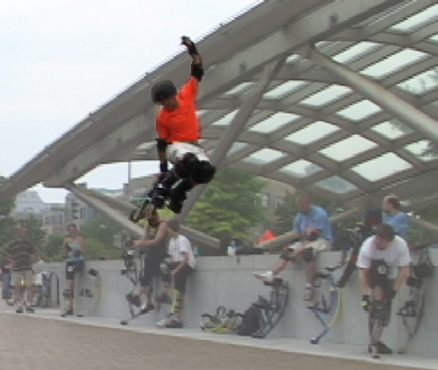
A man performs a grab at the Capital Bocking USA Meetup.
A powerbocker
A pair of M60 Powerizers
A pair of Powerskips

Jumping stilts, bounce stilts or spring stilts are special stilts that allow the user to run, jump and perform various acrobatics. Spring stilts using fiberglass leaf springs were patented in the United States in 2004 under the trademark "PowerSkip", marketed for recreational and extreme sports use.[1] Spring stilts are often mostly made of aluminium. Using these stilts is also called "bocking" or "powerbocking", derived from Alexander Böck, the stilts' inventor.

Powerbocking

[edit]

The act of "bocking" or "powerbocking" includes jumping, running, and performing acrobatics with elastic-like spring-loaded stilts.[2] They can be used to jump great distances and allow the user to bounce over people and cars and to perform backflips.[citation needed] For some, it is an extreme sport; for others, it is a form of exercise, artistic expression and a form of entertainment.

The stilts are often referred to generically as bocks or powerbocks; as power stilts, jumping stilts, bounce stilts or spring stilts; or by their brand name.

Description

[edit]

Each boot consists of a foot-plate with snowboard type locking straps, rubber foot pad which is also commonly called a hoof, and a fibreglass leaf spring. Using only their weight, and few movements, the user is generally able to jump 3–5 ft (1–1.5 metres) off the ground and run up to 20 mph (32 km/h). They also give the ability to take up to 9-foot (2.7 metres) strides.

Jumping stilts were used in the closing ceremony of the 2008 Olympic games in Beijing.[citation needed]

Brands

[edit]

They were originally patented by Alexander Böck, from Germany (European Patent EP 1 196 220 B1 on 2 July 2003, US Patent No. 6,719,671 B1 on 13 April 2004, both with a priority date of 20 July 1999), as "Powerskip". Many people also use common brand names to refer to them generically.[3] Common brand names are 7 League Boots, Air-Trekkers, Powerizers, Pro-Jump, and Powerskips.[4]

Risks

[edit]

On 4 December 2010 Samuel Koch was heavily injured during the show Wetten, dass..? during a stunt where he attempted to jump over multiple moving cars in succession. He failed to clear one of the moving vehicles and was left tetraplegic after suffering severe injuries to his neck and spine.

Competition

[edit]

Two competitions exist in France: the Nancy Power Days (since 2009) in Nancy[5] and the Riser Winter Cup (since 2015) in Lille.[citation needed]

Similar devices

[edit]

Though similar in appearance, jumping stilts are not to be confused with the use of prosthetic devices such as those used by paralympic runners Oscar Pistorius or Jonnie Peacock.

Moon shoes and PyonPyon jumpers[6] are earlier attempts at jumping shoes using a different technique. Some are still popular today. There is a Swiss product "Kangoo Jumps", with cantilever springs under the shoes, which is promoted more for fitness than large leaps.[7] Rocket boots were designed in the 1970s for the Russian Army, and use combustion pistons rather than springs for a similar effect.

Similar devices appear in the Portal video game series, allowing the protagonist, Chell, to survive falls from great height unharmed. Though, they do not affect her ability to walk or jump.

An English folklore figure spring-heeled Jack has been conjectured by some investigators to have been a prankster using spring-loaded leaping aids as early as 1837.

Spring stilts using steel coil springs, an antecedent of the pogo stick, were attempted in the 19th century.[8][9]

References

[edit]
[edit]
Revisions and contributorsEdit on WikipediaRead on Wikipedia
from Grokipedia
Jumping stilts, also known as powerbocks or spring-loaded stilts, are wearable mechanical devices that attach to a user's lower legs via straps and cuffs, featuring a curved that stores upon compression and releases it to propel the user into enhanced jumps and strides, allowing heights of up to 2 meters (6.6 feet) and speeds approaching 40 km/h (25 mph). Invented by German engineer Alexander Boeck in the late 1990s, the modern jumping stilt design draws inspiration from , such as the kangaroo's , and was first patented in in 2003 (EP 1 196 220 B1) and in the United States in 2004 (US Patent No. 6,719,671 B1) under the "PowerSkip." The device consists of key components including a foot pedal or base plate, a with rotary bearings for leverage, a calf support, and the arc-shaped that functions like a synthetic , transmitting force primarily through the during use. The activity of using jumping stilts, termed powerbocking or bocking, has evolved into an involving , racing, and freestyle performances, with participants achieving feats like 9-foot strides and rapid directional changes. It promotes by engaging nearly all muscle groups and burning calories at a rate five times that of , though it carries risks of from falls at high speeds, necessitating protective gear such as helmets and . Notable achievements include for the fastest 100 meters (13.45 seconds by Ben Jacoby in 2018) and the fastest mile (6 minutes 20 seconds by William Serra in 2021), highlighting their role in athletic innovation.

History

Invention and Patenting

The modern jumping stilt, a device enabling enhanced jumping and running through spring-assisted locomotion, traces its origins to 19th-century precursors that utilized steel coil springs for similar purposes. One early example is the spring-stilt patented by George H. Herrington in 1881, which featured wooden stilts with compression springs under each foot to facilitate bounding movement, though these were limited by the weight and energy inefficiency of steel components. The foundational innovation for contemporary jumping stilts came from German engineer Alexander Böck, who began developing the device in 1996 through his company, Alexander Böck Sportartikel GmbH. Böck's design, initially named "PowerSkip," addressed the limitations of prior steel-based systems by incorporating lightweight fiberglass-reinforced leaf springs, allowing for greater and release to achieve trampoline-like jumps. Early prototypes were constructed between 1997 and 1998, focusing on ergonomic attachment to the user's legs via a leverage mechanism with rotary pin bearings and connecting rods for stable rebound. Initial testing of these prototypes emphasized recreational applications, such as bounding across varied terrains to simulate strides, with Böck prioritizing user safety and mobility in non-competitive settings. Böck filed a German patent application in December 1999, which served as the priority document for the European patent application filed in 2000 and granted in 2003 (EP 1 196 220 B1), marking the official recognition of PowerSkip as a spring system for personal locomotion. The patent for Böck's invention, US Patent 6,719,671 titled "Device for helping a to walk," was granted on April 13, 2004, explicitly claiming the arc-shaped design that distinguished it from heavier coil antecedents by enabling efficient, step-by-step jumping without excessive fatigue. This patent solidified Böck's contribution as the basis for all modern jumping stilts, shifting the focus from rudimentary 19th-century experiments to practical, high-performance recreational equipment.

Popularization and Cultural Impact

Jumping stilts began gaining mainstream attention in the mid-2000s as an innovative tool for extreme sports and entertainment, following their initial by German engineer Alexander Böck in the late . By 2006, brands like Poweriser were marketing them as fun fitness gadgets that enabled users to achieve impressive jumps and speeds through curved springs attached to the legs. This positioning helped introduce the device to recreational audiences in , where it was promoted for its blend of athletic training and acrobatic potential. A significant boost to their visibility came during the 2008 Beijing Olympics closing ceremony, where acrobats performed dynamic routines using bouncy stilts strapped to their feet, weaving among dancers and unicyclists in a vibrant display of futuristic movement. The global broadcast of this event, viewed by millions, highlighted jumping stilts as a symbol of innovative physical expression, sparking interest beyond professional athletics. By 2009, commercialization accelerated in , with products becoming available in and the , contributing to a surge in recreational adoption amid growing fitness trends. The device's popularity further spread through online media and community activities in the late 2000s and early 2010s, fostering dedicated groups of enthusiasts. Viral footage from events like the 2008 Olympics and early user demonstrations on platforms such as amplified its appeal, inspiring amateur challenges and stunts. In educational settings, such as universities in , students formed informal groups for powerbocking— the term for jumping stilt activities—evidencing the emergence of subcultures around the sport by 2010. This grassroots enthusiasm, combined with European manufacturers' expansion into international markets, solidified jumping stilts' place in global fitness and entertainment scenes, though interest has since stabilized around niche communities.

Design and Mechanics

Key Components

Jumping stilts primarily consist of aluminum frames that provide and while minimizing overall weight for user mobility. These frames are typically constructed from aluminum alloys, such as 6063 series, formed into struts and braces to withstand dynamic loads. The energy-storage elements are curved leaf springs made from fiberglass composites, specifically glass fiber-reinforced synthetic materials, with one spring per leg attached to the frame via bearings and connecting rods. These springs, often arc-shaped for optimal flex, are used in modern constructions like those patented by Alexander Böck. Foot attachments feature adjustable base plates or integrated boots secured by straps, including knee or calf bands with clamps or buckles for a firm fit around the leg and shin. Many designs incorporate padded shin guards and Velcro-style fasteners to enhance comfort and prevent slippage during attachment. Sizing variations allow adjustment for user heights ranging from approximately 4'6" to 6'6", accommodating children to adults, with typical weight capacities up to 220 pounds to ensure safe load distribution across the components.

Operational Principles

Jumping stilts function through a mechanism of storage and release, primarily enabled by leaf springs attached to the lower leg and foot assembly. Upon , the user's body weight compresses these springs, converting from impact into . This compression absorbs a significant portion of the , reducing stress compared to normal running or jumping. The stored energy is then rapidly released during the push-off phase, propelling the user upward and forward with amplified , mimicking the observed in certain . This elastic mechanism provides key biomechanical advantages, extending the effective length of the lower limbs and altering dynamics. Users can achieve strides of approximately 6 to 9 feet and vertical jumps of feet, with expert practitioners reaching up to ; running speeds can attain 20 miles per hour or more under optimal conditions. These enhancements arise from the springs' ability to store and return efficiently, allowing for greater horizontal and vertical displacement per step than unaided movement. Kinematic analyses confirm that the introduce a pronounced vertical in the , with speeds around 1.4 m/s in controlled walking, though higher velocities are possible with practice. User interaction with the stilts demands precise control for effective energy transfer and stability. Balance is maintained through forward body lean to initiate strides and coordinated arm swings to counter rotational forces, integrating upper-body dynamics with lower-limb . Efficient use requires core strength to stabilize the against the springs' and extensive practice to synchronize muscle activation with the elastic cycle, ensuring maximal energy utilization. The system's performance is limited by the springs' stiffness, which must be tuned to the user's body weight—typically via model selection for load ranges like 155–200 pounds—to optimize compression and . Improper fit or mismatched diminishes return , leading to reduced propulsion and increased fatigue, as the springs may not fully engage or overload the user's musculoskeletal system.

Usage and Activities

Powerbocking Techniques

Powerbocking, also known as bocking, refers to the activity of using spring-loaded jumping stilts to perform jumping, running, and acrobatic movements, with the term derived from the surname of inventor Alexander Boeck. This sport emphasizes dynamic motion, where participants leverage the stilts' elastic properties to achieve enhanced height and speed in movements. Basic techniques in powerbocking begin with mounting and dismounting the stilts, which involves strapping the frames securely to the lower legs and using a support structure or assistant for initial balance, allowing most users to stand and walk unaided within 10 to 20 minutes. Forward running strides are executed by leaning the body forward, bending at the knees, and pushing off the springs in a rhythmic motion, achieving average speeds of around 14 mph (23 km/h) after brief familiarization. Simple jumps, such as bunny hops, involve a preparatory crouch followed by an explosive upward , enabling heights of several feet with the springs' return facilitating the motion. These foundational skills rely on the stilts' mechanical principles, where springs compress and rebound to amplify leg power. Advanced maneuvers expand on these basics to include backflips, side jumps, and freestyle routines, where practitioners rotate fully in the air or incorporate directional leaps for fluid sequences. Backflips require precise timing to tuck the body mid-air while the springs propel upward, often reaching heights exceeding 8 feet (2.4 meters). Side jumps involve lateral shifts combined with rotation, demanding and spatial awareness to land safely. Freestyle routines integrate these elements into choreographed performances, such as somersaults or chained jumps, typically performed by experienced users in controlled environments. Training progression in powerbocking starts on flat, soft surfaces to build balance and , progressing from static standing to short runs and low jumps within the first hour of practice. Once basic proficiency is achieved—often after 1 to 2 hours—trainees advance to incorporating obstacles like low hurdles or uneven terrain, focusing on timing and body control to prevent falls. Advanced skills, including flips and routines, necessitate guided sessions in groups or with instructors, emphasizing gradual increases in complexity to develop the required strength and coordination over multiple practice sessions.

Broader Applications

Jumping stilts, building on the foundational activity of powerbocking, find broader utility in fitness regimens where they provide an intense cardiovascular workout, engaging multiple muscle groups for enhanced strength and . Users can achieve significant expenditure through bounding exercises. These devices are incorporated into dynamic fitness sessions, such as workouts or group classes, to promote full-body activation including , legs, and back. In therapeutic contexts, jumping stilts support rehabilitation efforts for lower-body conditions by facilitating low-impact movement that aids in retraining and balance improvement. Research analyzing human with these devices highlights their role in altering dynamics during locomotion, potentially benefiting patients recovering from injuries under professional supervision. Beyond fitness and , jumping stilts enhance through visually striking performances in street shows, corporate events, and themed attractions. Professional acts feature performers executing high-energy routines on spring-loaded stilts, captivating audiences at festivals or promotional gatherings with flips and dynamic interactions. Examples include circus-style presentations where stilted artists incorporate LED lighting or acrobatic elements for immersive experiences at public events. Military applications remain limited, with occasional exploration in and mobility drills to simulate enhanced terrain navigation, though widespread adoption has not occurred.

Manufacturers and Brands

Major Producers

Powerskip, the pioneering brand originating from the of German Alexander Böck, represented a cornerstone in jumping stilt production historically. Böck developed the initial design in 1999 and secured a in 2004, establishing Powerskip as a German-based manufacturer renowned for high-end models featuring customizable springs that enhanced performance and user adaptation. However, as of 2025, the original Powerskip brand has limited availability, with production largely ceased. Air-Trekkers emerged as a prominent in the mid-2000s, with operations active by 2008, emphasizing entry-level affordability to broaden accessibility for recreational users. While historically positioned in North American markets, including , it remains available through online retailers like Amazon as of 2025, though prominence has waned with the sport's decline. Powerizers, a brand marketed as PowerStriders and oriented toward , focused on durable constructions suitable for beginners, contributing to the sport's growth in hobbyist circles since the early . It is still referenced in sales, often under generic production. In , 7 League Boots, produced by an Austrian company, stood out for performance-oriented designs with responsive components and quality materials, appealing to advanced users and professionals until its discontinuation. As of 2025, models are sold out, with only parts available. Pro-Jump offers lightweight variants that prioritize agility and ease of use for diverse activities and remains available through online sellers as of 2025. The jumping stilts market remains niche and has declined in popularity since the , dominated by small-scale and generic manufacturers, many based in —particularly —for cost reduction. Current active brands include Skyrunner and A-Jump Pro, the latter used by professionals such as performers. Pair prices as of 2025 typically range from $100 to $500 depending on quality and features.

Product Variations

Jumping stilts are available in various sizes tailored to user body types and weights, with adult models typically accommodating individuals from 110 to 220 pounds (50 to 100 kg) and featuring adjustable straps and frames for heights between 5'2" and 6'6" (157 to 198 cm). Youth or junior models, such as those in the C-Series and F-Series, are designed for children weighing 66 to 110 pounds (30 to 50 kg), with shorter frames and lighter components to ensure proper fit and safety for younger users. These size variations allow for customizable leg length and calf support, reducing strain during extended use. Material upgrades distinguish entry-level from advanced models, with basic versions using aluminum alloy frames and springs for durability and affordability. models incorporate carbon reinforcements in springs and frames, providing greater elasticity and reduced weight—often under 3 kg per stilt—for professional athletes seeking higher jumps up to 7 feet (2.1 m). Softer springs, commonly made from reinforced with lower stiffness ratings, are featured in beginner models to minimize impact during initial training sessions. Specialized types cater to specific activities, including freestyle models with flexible aluminum frames and enhanced articulation for and tricks, enabling smoother turns and aerial maneuvers. Endurance versions, such as fitness-oriented variants with stiffer springs and reinforced aluminum construction, support by optimizing energy return and stability over extended periods. Accessories enhance usability and safety, including optional knee pads for joint protection, spring covers to prevent debris accumulation, and transport cases for storage and travel. These add-ons can increase overall pricing, with base models starting at around $100 and feature-rich variants up to $500 as of 2025, depending on material quality and included components. Major producers like Pro-Jump and Skyrunner provide these variants to meet diverse user needs.

Safety and Risks

Common Injuries

Users of jumping stilts, also known as powerbocks, commonly experience impact-related injuries due to falls from the elevated height provided by the devices, which position the feet approximately 18 inches above the ground. These injuries frequently include sprains and fractures to the ankles and knees, as well as head trauma from backward falls. Forward falls can also lead to , , and hand injuries when users attempt to break their impact with outstretched arms. A notable case illustrating the severity of such risks occurred in 2010, when German stunt performer attempted to over moving cars while wearing spring-loaded jumping stilts during a of the television show Wetten, dass..?. Koch failed to clear the final vehicle, striking his head and sustaining a broken neck, spinal injuries, and blood clots, which resulted in and permanent from the neck down. Overuse injuries from repetitive bouncing on jumping stilts often manifest as muscle strains and chronic joint stress, particularly in the , with higher incidence among beginners due to unfamiliarity with the device's dynamics. studies on users of similar rebounding devices, such as Kangoo Jumps, reveal a high prevalence of knee abnormalities, including in 88.9% of cases, quadriceps in 80.6%, and patellofemoral damage in 72.2%, indicating significant repetitive stress on lower limb . The high-energy of these impacts exacerbate the potential for such overuse issues. Overall, research on jumping stilts injuries remains limited, with no comprehensive formal studies available to quantify incidence rates or long-term effects, though concerns have been raised by medical professionals regarding the growing popularity of the activity.

Preventive Measures

To minimize the risks associated with jumping stilts, users should prioritize protective gear, including certified helmets to safeguard against head impacts, and pads to cushion joint stress during falls, and guards to prevent fractures from outstretched arms. These items are particularly essential for beginners, who face a higher likelihood of imbalance and tumbles while learning basic balance. Training protocols emphasize supervised instruction from qualified coaches to build foundational skills safely, beginning on soft surfaces like grass or padded mats to reduce impact forces during initial practice sessions. Progressive skill development, starting with short stationary balances and advancing to controlled walks before attempting jumps, helps avoid overexertion and muscle strain by allowing gradual adaptation to the device's biomechanics. Manufacturers and sports organizations recommend at least one-hour introductory lessons for novices to achieve basic proficiency. Adhering to usage guidelines is critical, including strict compliance with manufacturer-specified weight limits—typically 66-220 pounds (30-100 kg) depending on the model—to ensure structural integrity and optimal spring performance. Regular inspections before each use are necessary, checking for cracks in the springs, loose fittings, worn padding, or signs of , with immediate replacement of any damaged components to prevent . Users should avoid wet, slippery, uneven, or inclined terrain, as well as crowded areas, to maintain stability and reduce tripping hazards. There are no universal regulatory standards for jumping stilts, but manufacturers and recreational sports bodies recommend a minimum age of 8 years for child models, based on sufficient height (at least 4 feet) and weight capacity to handle the device safely. These practices collectively address potential hazards like joint injuries and falls by promoting cautious, informed use.

Competitions and Events

Notable Competitions

One of the earliest and most prominent jumping stilt competitions is the Nancy Power Days, held annually in , since 2009. This event features freestyle performances and speed challenges, drawing participants from to showcase acrobatic jumps and runs on urban courses. Another key French competition is the Riser Winter Cup, organized biennially in from 2015. Focused on winter conditions, it includes adapted courses that test participants' through extended sessions of bounding and navigation in cooler environments. Jumping stilt events have expanded internationally by the , with notable gatherings in the United States such as Capital Bocking USA, an annual meetup held in , from 2009 to at least 2012. This competition incorporated racing, jumping contests, and group challenges, attracting dozens of experts and beginners nationwide. Common formats across these competitions include categories for high jumps, sprints over varied terrain, and obstacle courses that emphasize agility and control, often integrating powerbocking techniques like flips and bounds. Organizationally, these events are primarily managed by informal enthusiast groups and local clubs, such as DC Power Stilts in the and French associations like those under Freestyle EU, with no formal Olympic recognition but connections to broader extreme sports communities through training federations.

Records and Achievements

Jumping stilts have seen several notable records established through organized events and verified attempts, particularly in height and speed categories. The highest verified jump on spring-loaded stilts stands at 2.76 meters (9 feet 0.66 inches), achieved by Lars Oetken in , , on August 10, 2013. This feat highlights the potential for vertical propulsion using the devices, with unofficial marks in European competitions during the 2010s reportedly approaching 3 meters, though not formally ratified. In terms of speed achievements, the fastest 100-meter sprint on spring-loaded stilts is 13.45 seconds, set by Ben Jacoby in , , on October 5, 2018, equating to an average speed of approximately 27 kilometers per hour (16.8 miles per hour). Additional distance records include the fastest mile at 6 minutes and 20 seconds by William Serra in , , on August 6, 2021, and the fastest 400 meters at 1 minute 7.49 seconds by Miles McDonald in , , on August 14, 2014. Prominent athletes have driven these accomplishments, including Samuel Koch, a German stunt performer known for high-profile jumps over moving vehicles on spring-loaded stilts prior to a 2010 accident that ended his career. Modern competitors such as Ben Jacoby and Lars Oetken have dominated record lists, while participants in events like the Nancy Power Days have included international talents like Russian athlete Mikhail Piulunkovskii, who claimed an unofficial high jump record with a front flip in 2016. Key milestones in the sport include the inaugural Nancy Power Days competition in 2009, marking the first major international gathering for jumping stilt athletes in , which helped formalize competitive standards. By the early 2020s, events had evolved to incorporate team-based formats like relays, though competitive activity saw limited major developments after 2021 due to the impacts of global events. As of 2025, the competitive scene remains niche, with activity primarily in informal enthusiast gatherings and no major new international competitions reported.

Similar Devices

Spring-Loaded Alternatives

Spring-loaded alternatives to jumping stilts encompass a range of devices that incorporate springs or similar elastic mechanisms to facilitate enhanced vertical movement or low-impact locomotion, often prioritizing recreational or fitness applications over high-performance . Moon shoes, also known as bouncers, consist of mini trampoline-like discs attached directly to the user's shoes via adjustable straps, creating a bouncy platform for the feet. These devices, produced by companies like Big Time Toys, enable short, repetitive jumps that promote balance and coordination, typically suitable for children up to 130 pounds and shoe sizes up to adult 9. Unlike jumping stilts, which support extended strides and higher elevations, moon shoes focus on contained, low-height bouncing for indoor or outdoor play, simulating a reduced-gravity effect through their elastic bungee or spring elements. Kangoo Jumps are rebound boots featuring curved, patented spring systems integrated into the soles, designed primarily for and rather than acrobatic feats. Developed as a fitness tool, these boots absorb up to 80% of impact forces on joints during use, while increasing burn by 25-50% compared to standard running. Suitable for users across various fitness levels, Kangoo Jumps emphasize cardiovascular benefits and low-impact , with models accommodating weights up to 100 kilograms and available in adult, junior, and children's sizes. Rocket boots represent prototype or conceptual spring-assisted devices, often employing coil springs, pistons, or mechanisms to deliver short bursts of for enhanced speed or jumping. In the , Soviet Viktor Gordeyev patented a pair of mechanical boots powered by small gasoline engines and pistons, intended to allow users to run at speeds up to 22 by mimicking pogo-like extensions. Similar designs, such as those explored in contexts, have remained largely experimental or fictional in popular media, focusing on temporary boosts rather than sustained mobility. Pogo sticks are single-unit, vertical-jumping devices comprising a pole with footrests, handles, and a central spring mechanism that compresses upon to store and release energy for successive bounces. Originating as a walking aid in the early , modern pogo sticks use coiled steel springs to propel users upward, with the spring's converting to during extension. This design excels in isolated vertical leaps but lacks the bilateral stride capability of jumping stilts, making it ideal for tricks or endurance jumping in place. Jumping differ fundamentally from traditional , which are rigid pole-like structures designed primarily for elevating the user to greater heights for balance, performance, or practical tasks such as , without any integrated mechanisms. In contrast, jumping incorporate elastic springs—typically made of or carbon fiber—that act as and release systems, compressing upon to absorb impact and then recoiling to propel the user forward or upward, enabling enhanced running speeds and jump heights of up to 2 meters. This dynamic design translates walking forces more efficiently through multi-segment articulating bases, reducing loss compared to the static provided by conventional . Unlike prosthetic devices such as the Flex-Foot, which are medical implants or attachments classified by the FDA as therapeutic tools for amputees to restore natural , absorb shock during ambulation, and support activities like running at various impact levels, jumping stilts serve as recreational augmentations for able-bodied individuals. Prosthetics like the Flex-Foot family prioritize anatomical alignment, energy return for daily mobility, and customization for limb replacement, often featuring carbon fiber blades tuned for sprinting or jumping in a clinical context to mimic biological limbs. Jumping stilts, however, attach externally over intact legs to amplify athletic performance without medical intent, focusing on extreme sports rather than rehabilitation or correction. Jumping stilts also stand apart from fictional mobility aids depicted in media, such as the long fall boots in the video game Portal, which are engineered conceptually to dissipate from high-altitude drops for safe landing without upward or repeated . Real-world jumping stilts emphasize safety through controlled energy rebound for voluntary jumps and runs, avoiding the sci-fi exaggeration of indefinite fall protection while adhering to biomechanical limits. Legally, jumping stilts are categorized by the USPTO under Class 482 as non-medical exercise devices intended for physical conditioning and muscle development through or vaulting activities, exempt from FDA as powered exoskeletons or prosthetics. This consumer product status raises ethical concerns regarding potential misuse, such as unsupervised racing on public surfaces, which could lead to injuries without the oversight applied to medical aids.

References

Add your contribution
Related Hubs
User Avatar
No comments yet.