


Community hub
Recent from talks
Contribute something
Nothing was collected or created yet.
Enema
View on Wikipedia

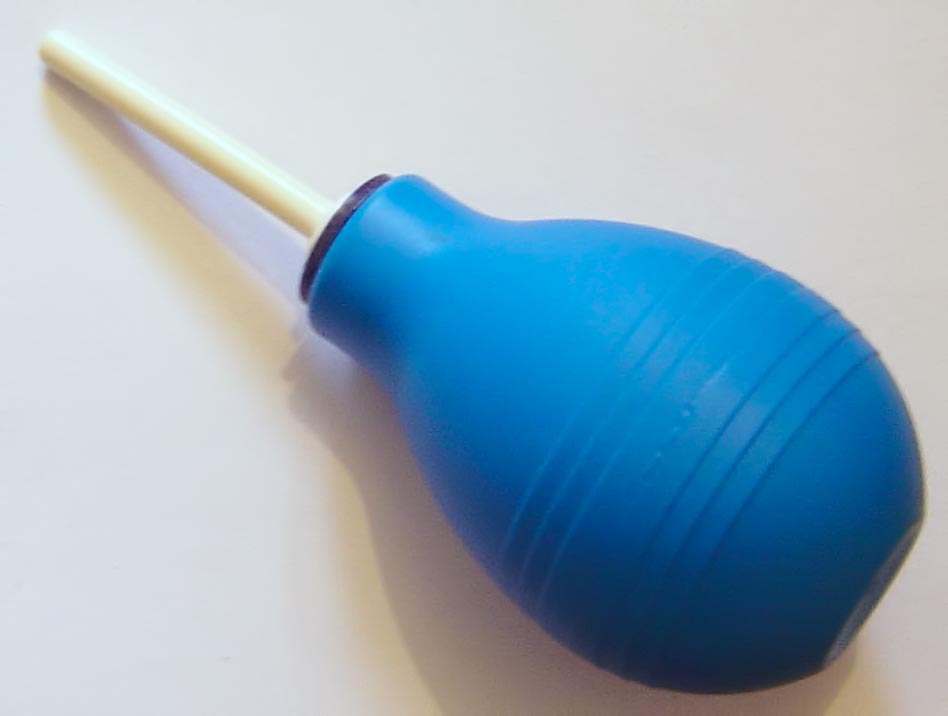
An enema, also known as a clyster, is the rectal administration of a fluid by injection into the lower bowel via the anus.[1] The word enema can also refer to the liquid injected,[2][3] as well as to a device for administering such an injection.[4]
In standard medicine, the most frequent uses of enemas are to relieve constipation and for bowel cleansing before a medical examination or procedure;[5] also, they are employed as a lower gastrointestinal series (also called a barium enema),[6] to treat traveler's diarrhea,[7] as a vehicle for the administration of food, water or medicine, as a stimulant to the general system, as a local application and, more rarely, as a means of reducing body temperature,[1] as treatment for encopresis, and as a form of rehydration therapy (proctoclysis) in patients for whom intravenous therapy is not applicable.[8]
Medical usage
[edit]The principal medical usages of enemas are:
Bowel cleansing
[edit]Acute treatments
[edit]As bowel stimulants, enemas are employed for the same purposes as orally administered laxatives: to relieve constipation; to treat fecal impaction; to empty the colon before a medical procedure such as a colonoscopy. When oral laxatives are not indicated or sufficiently effective, enemas may be a sensible and necessary measure.[9]
A large volume enema[10] can be given to cleanse as much of the colon as possible of feces.[11][12] However, a low enema is generally useful only for stool in the rectum, not in the intestinal tract.[13]
Such enemas' mechanism consists of the volume of the liquid causing a rapid expansion of the intestinal tract in conjunction with, in the case of certain solutions, irritation of the intestinal mucosa which stimulates peristalsis and lubricates the stool to encourage a bowel movement.[14] An enema's efficacy depends on several factors including the volume injected and the temperature and the contents of the infusion.[9] For the enema to be effective, the patient should retain the solution for five to ten minutes, as tolerated.[5][14] or, as some nursing textbooks recommend, for five to fifteen minutes or as long as possible.[15]
Large volume enemas
[edit]

For emptying the entire colon as much as feasible[12] deeper and higher enemas are utilized to reach large colon sections.[9] The colon dilates and expands when a large volume of liquid is injected into it. The colon reacts to that sudden expansion with general contractions, peristalsis, propelling its contents toward the rectum.[5]
Soapsuds enema is a frequently used synonym for a large volume enema (although soap is not necessary for effectiveness).[5]
A large volume enema may be used in a home setting to relieve occasional constipation, although medical care may be required for recurring or severe cases of constipation.[5]
Water-based solutions
[edit]Plain water can be used, functioning mechanically to expand the colon, thus prompting evacuation.
Normal saline is least irritating to the colon. Like plain water, it simply functions mechanically to expand the colon, but having a neutral concentration gradient, it neither draws electrolytes from the body, as happens with plain water, nor draws water into the colon, as occurs with phosphates. Thus, a salt water solution can be used when a longer retention period is desired, such as to soften an impaction.
Castile soap is commonly added because its irritation of the colon's lining increases the defecation urgency.[15] However, liquid handsoaps and detergents should not be used.[5]
Glycerol is a specific bowel mucosa irritant serving to induce peristalsis via a hyperosmotic effect.[16] It is used in a dilute solution, e.g., 5%.[17]
The 2-4-6 Enema: Consists of 2 ounces of glycerin, 4 ounce of Epsom salt, mixed with 6 ounces of water, injected into the rectum, retained for five minutes. This small injection will produce several copious movements.
Other solutions
[edit]Equal parts of milk and molasses were heated to slightly above normal body temperature.[18] Neither the milk sugars and proteins nor the molasses are absorbed in the lower intestine, thus keeping the water from the enema in the intestine.[19] Studies have shown that milk and molasses enemas have a low complication rate when used in the emergency department[20] and are safe and effective with minimal side effects.[21]
Mineral oil functions as a lubricant and stool softener, but may have side effects including rectal skin irritation and oil leakage.[22]
Micro-enemas
[edit]
ATC codes for drugs for constipation — enemas
[edit]| ATC code A: Alimentary tract and metabolism |
|---|
|
| Other ATC codes |
ATC code A06 Drugs for constipation is a therapeutic subgroup of the Anatomical Therapeutic Chemical Classification System, a system of alphanumeric codes developed by the World Health Organization (WHO) for the classification of drugs and other medical products.[23][24][25] Subgroup A06 is part of the anatomical group A Alimentary tract and metabolism.[26]
Codes for veterinary use (ATCvet codes) can be created by placing the letter Q in front of the human ATC code: for example, QA06.[27]
National versions of the ATC classification may include additional codes not present in this list, which follows the WHO version.
- A06AG01 Sodium phosphate
- A06AG02 Bisacodyl
- A06AG03 Dantron, including combinations
- A06AG04 Glycerol
- A06AG06 Oil
- A06AG07 Sorbitol
- A06AG10 Docusate sodium, including combinations
- A06AG11 Sodium lauryl sulfoacetate, including combinations
- A06AG20 Combinations
Single substance solutions
[edit]![[icon]](https://en.wikipedia.org/wiki/File:Wiki_letter_w_cropped.svg) | This section needs expansion. You can help by adding to it. (March 2019) |
In alphabetical order
- Arachis oil (peanut oil) enema is useful for softening stools which are impacted higher than the rectum.[28]
- Bisacodyl stimulates enteric nerves to cause colonic contractions.[29][30]
- Dantron is a stimulant drug and stool softener[31] used alone or in combinations in enemas.[32] Considered to be a carcinogen[33] its use is limited, e.g., restricted in the UK to patients who already have a diagnosis of terminal cancer and not used at all in the USA.
- Docusate[34][35]
- Glycerol has a hyperosmotic effect and can be used as a small-volume (2–10 ml) enema (or suppository).[16]
- Mineral oil is used as a lubricant because most of the ingested material is excreted in the stool rather than absorbed by the body.[36]
- Sodium phosphate.[37][38] Also known by the brand name Fleet. Available at drugstores; usually self-administered. Buffered sodium phosphate solution draws additional water from the bloodstream into the colon to increase the effectiveness of the enema. But it can irritate the colon, causing intense cramping or "griping."[39] Fleet enemas usually cause a bowel movement in 1 to 5 minutes. Known adverse effects.
- Sorbitol pulls water into the large intestines, causing distention, stimulating the bowels' normal forward movement. Sorbitol is found in some dried fruits and may contribute to the laxative effects of prunes.[40] and is available for taking orally as a laxative.[41][42] As an enema for constipation, the recommended adult dose is 120 mL of 25-30% solution, administered once.[43] Note that Sorbitol is an ingredient of the MICROLAX Enema.
Compounded from multiple ingredients
[edit] | This section needs expansion. You can help by adding to it. (March 2019) |
In alphabetical order of the original brand names
Klyx contains docusate sodium 1 mg/mL and sorbitol solution (70%)(crystallising) 357 mg/mL and is used for faecal impaction or constipation or colon evacuation prior medical procedures,[44] developed by Ferring B.V.
Micralax (not to be confused with MICROLAX®)[45]
MICROLAX® (not to be confused with Micralax) combines the action of sodium citrate, a peptidising agent which can displace bound water present in the faeces, with sodium alkyl sulphoacetate, a wetting agent, and with glycerol, an anal mucosa irritant and hyperosmotic. However, also sold under the name "Micralax", is a preparation containing sorbitol rather than glycerol;[46] which was initially tested in preparation for sigmoidoscopy.[47]
Micolette Micro-enema® contains 45 mg sodium lauryl sulphoacetate, 450 mg per 5 ml sodium citrate BP, and 625 mg glycerol BP[48] and is a small volume stimulant enema suitable where large-volume enemas are contra-indicated.[28]
Chronic treatments
[edit]Transanal irrigation
[edit]TAI, also termed retrograde irrigation, is designed to assist evacuation using a water enema[49] as a treatment for persons with bowel dysfunction, including fecal incontinence or constipation, especially obstructed defecation. By regularly emptying the bowel using transanal irrigation,[50] controlled bowel function is often re-established to a high degree, thus enabling a consistent bowel routine development.[50] Its effectiveness varies considerably, some individuals experiencing complete control of incontinence but others reporting little or no benefit.[49]
An international consensus on when and how to use transanal irrigation for people with bowel problems was published in 2013, offering practitioners a clear, comprehensive and straightforward guide to practice for the emerging therapeutic area of transanal irrigation.[50]
The term retrograde irrigation distinguishes this procedure from the Malone antegrade continence enema, where irrigation fluid is introduced into the colon proximal to the anus via a surgically created irrigation port.[51]
Bowel management
[edit]Patients who have a bowel disability, a medical condition which impairs control of defecation, e.g., fecal incontinence or constipation,[52] can use bowel management techniques to choose a predictable time and place to evacuate.[52] Without bowel management, such persons might either suffer from the feeling of not getting relief or soil themselves.[52]
While simple techniques might include a controlled diet and establishing a toilet routine,[52] a daily enema can be taken to empty the colon, thus preventing unwanted and uncontrolled bowel movements that day.[53]
Contrast (X-ray)
[edit]
In a lower gastrointestinal series an enema that may contain barium sulfate powder or a water-soluble contrast agent is used in the radiological imaging of the bowel. Called a barium enema, such enemas are sometimes the only practical way to view the colon relatively safely.[6]
Failure to expel all of the barium may cause constipation or possible impaction[54] and a patient who has no bowel movement for more than two days or is unable to pass gas rectally should promptly inform a physician and may require an enema or laxative.[55]
Medication administration
[edit]The administration of substances into the bloodstream. This may be done in situations where it is undesirable or impossible to deliver a medication by mouth, such as antiemetics given to reduce nausea (though not many antiemetics are delivered by enema). Additionally, several anti-angiogenic agents, which work better without digestion, can be safely administered via a gentle enema.
Topical administration of medications into the rectum, such as corticosteroids and mesalazine, is used in the treatment of inflammatory bowel disease. Administration by enema avoids having the medication pass through the entire gastrointestinal tract, therefore simplifying the delivery of the medication to the affected area and limiting the amount that is absorbed into the bloodstream.
Rectal corticosteroid enemas are sometimes used to treat mild or moderate ulcerative colitis. They may also be used along with systemic (oral or injection) corticosteroids or other medicines to treat severe disease or mild to moderate disease that has spread too far to be effectively treated by medicine inserted into the rectum alone.
Inhibiting pathological defecation
[edit]- Traveller's diarrhea's symptoms treated with an enema of sodium butyrate, organic acids, and A-300 silicon dioxide can be successfully decreased with lack of observed side effects.[7]
- Shigellosis treatment benefits from adjunct therapy with butyrate enemas, promoting healing of the rectal mucosa and inflammation, but not helping in clinical recovery from shigellosis. Use of an 80 ml of a sodium butyrate isotonic enema administered every 12 hours has been studied and found effective.[56]
Other
[edit]- There have been a few cases in remote or rural settings, where rectal fluids have been used to rehydrate a person. Benefits include not needing to use sterile fluids.[57]
- Introducing healthy bacterial flora through infusion of stool, known as a fecal microbiota transplant, was first performed in 1958 employing retention enemas. Enemas remained the most common method until 1989, when alternative administration means were developed.[58] As of 2013, colonoscope implantation has been preferred over fecal enemas because by using the former method, the entire colon and ileum can be inoculated, but enemas reach only to the splenic flexure.[59]
- A patient unable to be fed otherwise can be nourished by an enteral administration of predigested foods, which is known as a nutrient enema.[60] This treatment is ancient, dating back at least to the second century CE when documented by Galen,[61] and commonly used in the Middle Ages,[62] remaining a common technique in 19th century,[63] and as recently as 1941 the U. S. military's manual for hospital diets prescribes their use.[64] Nutrient enemas have been superseded in modern medical care by tube feeding and intravenous feeding.[citation needed]
- Enemas have been used around the time of childbirth; however, there is no evidence that this practice is beneficial and it is now discouraged.[65]
Adverse effects
[edit]Improper administration of an enema can cause electrolyte imbalance (with repeated enemas) or ruptures to the bowel or rectal tissues which can be unnoticed as the rectum is insensitive to pain,[66] resulting in internal bleeding. However, these occurrences are rare in healthy, sober adults. Internal bleeding or rupture may expose the individual to infections from intestinal bacteria. Blood resulting from tears in the colon may not always be visible, but can be distinguished if the feces are unusually dark or have a red hue. If intestinal rupture is suspected, medical assistance should be obtained immediately.[14] Frequent use of enemas can cause laxative dependency.[67]
The enema tube and solution may stimulate the vagus nerve, which may trigger an arrhythmia such as bradycardia.
Enemas should not be used if there is an undiagnosed abdominal pain since the peristalsis of the bowel can cause an inflamed appendix to rupture.
There are arguments both for and against colonic irrigation in people with diverticulitis, ulcerative colitis, Crohn's disease, severe or internal hemorrhoids or tumors in the rectum or colon. Its usage is not recommended soon after bowel surgery (unless directed by one's health care provider). Regular treatments should be avoided by people with heart disease or kidney failure. Colonics are inappropriate for people with bowel, rectal or anal pathologies where the pathology contributes to the risk of bowel perforation.[68]
Recent research has shown that ozone water, which is sometimes used in enemas, can immediately cause microscopic colitis.[69]
A recent case series[70] of 11 patients with five deaths illustrated the danger of phosphate enemas in high-risk patients.
History
[edit]Etymology
[edit]Enema entered the English language c. 1675 from Latin in which, in the 15th century,[3] it was first used in the sense of a rectal injection,[2] from Greek ἔνεμα (énema), "injection", itself from ἐνιέναι (enienai) "to send in, inject", from ἐν (en), "in" + ἱέναι (hienai), "to send, throw".[71]
Clyster entered the English language in the late 14th century from Old French or Latin, from Greek κλυστήρ (klyster), "syringe", itself from κλύζειν (klyzein), "to wash out",[72] also spelled glister in the 18th century.[73] It is a generally archaic word used more particularly for enemas administered using a clyster syringe.
Ancient and medieval
[edit]Africa
[edit]The first mention of the enema in medical literature is in the Ancient Egyptian Ebers Papyrus (c. 1550 BCE). One of the many types of medical specialists was a Nery-Pehuyt, the Shepherd of the Anus. Enemas administered many medications.[74] There was a Keeper of the Royal Rectum[75] who may have primarily been the pharaoh's enema maker. According to Egyptian mythology, the god Thoth invented the enema.[76]

In parts of Africa, the calabash gourd is used traditionally to administer enemas. On the Ivory Coast the narrow neck of the gourd filled with water is inserted the patient's rectum and the contents are then injected by means of an attendant's forcible oral inflation, or a patient may self-administer the enema by using suction to create a negative pressure in the gourd, placing a finger at the opening, and then upon anal insertion, removing the finger to allow atmospheric pressure to effect the flow. In South Africa, Bhaca people used an ox horn to administer enemas.[77] Along the upper Congo River an enema apparatus is made by making a hole in one end of the gourd for filling it, and using a resin to attach a hollow cane to the gourd's neck. The cane is inserted into the anus of the patient who is in a posture that allows gravity to effect infusion of the fluid.[78]
Americas
[edit]The Olmec used trance-inducing substances ceremonially from their middle preclassic period (10th through 7th centuries BCE) through the Spanish Conquest. These were ingested via enemas administered using jars, among other routes.
As further described below in religious rituals, the Maya in their late classic age (7th through 10th centuries CE) used enemas for, at least, ritual purposes, Mayan sculpture and ceramics from that period depicting scenes in which, injected by syringes made of gourd and clay, ritual hallucinogenic enemas were taken.[79] In the Xibalban court of the God D, whose worship included ritual cult paraphernal, the Maya illustrated the use of a characteristic enema bulb syringe by female attendants administering clysters ritually.[80][81]
For combating illness and discomfort of the digestive tract, the Mayan also employed enemas, as documented during the colonial period, e.g., in the Florentine Codex.[79]
The indigenous peoples of North America employed tobacco smoke enemas to stimulate respiration, injecting the smoke using a rectal tube.[82][83]
A rubber bag connected with a conical nozzle, at an early period, was in use among the indigenous peoples of South America as an enema syringe,[84] and the rubber enema bag with a connecting tube and ivory tip remained in use by them; in contrast, in Europe a syringe was still the usual means for conducting an enema.[85]
Asia
[edit]In Babylonia, by 600 BCE, enemas were in use. However, it appears that initially they were in use because of a belief that the demon of disease would be driven out of the body by utilizing an enema.[86] Babylonian and Assyrian tablets c. 600 BCE bear cuneiform inscriptions referring to enemas.[87]
In China, c. 200 CE, Zhang Zhongjing was the first to employ enemas. "Secure a large pig's bile and mix with a small quantity of vinegar. Insert a bamboo tube three or four inches long into the rectum and inject the mixture" are his directions, according to Wu Lien-teh.[88]
In India, in the fifth century BCE, Sushruta enumerates the enema syringe among 121 surgical instruments described. Early Indian physicians' enema apparatus consisted of a tube of bamboo, ivory, or horn attached to the scrotum of a deer, goat, or ox.[86]
In Persia, Avicenna (980–1037 A. D.) is credited with the introduction of the "clyster-purse" or collapsible portion of an enema outfit made from ox skin or silk cloth and emptied by squeezing with the hands.[87]
Europe
[edit]
Hippocrates (460–370 BCE) frequently mentions enemas, e.g., "if the previous food which the patient has recently eaten should not have gone down, give an enema if the patient be strong and in the prime of life, but if he be weak, a suppository should be administered, should the bowels be not well moved on their own accord."[89]
In the first century BCE the Greek physician Asclepiades of Bithynia wrote "Treatment consists merely of three elements: drink, food, and the enema".[90] Also, he contended that indigestion is caused by particles of food that are too big and his prescribed treatment was proper amounts of food and wine followed by an enema which would remove the improper food doing the damage.[91]
In the second century CE the Greek physician Soranus prescribed, among other techniques, enemas as a safe abortion method,[92] and the Greek philosopher Celsus recommended an enema of pearl barley in milk or rose oil with butter as a nutrient for those with dysentery and unable to eat,[93] and also Galen mentions enemas in several contexts.[61]
In medieval times appear the first illustrations of enema equipment in the Western world, a clyster syringe consisting of a tube attached to a pump action bulb made of a pig bladder.[citation needed] A simple piston syringe clyster was used from the 15th through 19th centuries. This device had its rectal nozzle connected to a syringe with a plunger rather than to a bulb.[citation needed]
Modern Western
[edit]

Beginning in the 17th century, enema apparatus was chiefly designed for self-administration at home, and many were French as enemas enjoyed wide usage in France.[93]
In 1694 François Mauriceau in his early-modern treatise, The Diseases of Women with Child, records midwives and man-midwives commonly administered clysters to labouring mothers just before their delivery.[94]
Clysters were administered for symptoms of constipation and, with more questionable effectiveness, stomach aches and other illnesses.[when?][citation needed][95]

In 1753, Johann Jacob Woyts described an enema bag prepared from a pig's or beef's bladder attached to a tube as an alternative to a syringe.[96]
In the 18th century Europeans began emulating the indigenous peoples of North America's use of tobacco smoke enemas to resuscitate drowned people.[97] Tobacco resuscitation kits consisting of a pair of bellows and a tube were provided by the Royal Humane Society of London and placed at various points along the Thames.[93] Furthermore, these enemas came to be employed for headaches, respiratory failure, colds, hernias, abdominal cramps, typhoid fever, and cholera outbreaks.[97]
Clysters were a favourite medical treatment in the bourgeoisie and nobility of the Western world up to the 19th century. As medical knowledge was fairly limited at the time, purgative clysters were used for a wide variety of ailments, the foremost of which were stomach aches and constipation.[9]
According to the duc de Saint-Simon, clysters were so popular at the court of King Louis XIV of France that the duchess of Burgundy had her servant give her a clyster in front of the King (her modesty being preserved by an adequate posture) before going to the comedy. However, he also mentions the astonishment of the King and Mme de Maintenon that she should take it before them.[98]
In the 19th century, many new types of enema administration equipment were devised. Devices allowing gravity to infuse the solution, like those mentioned above used by South American indigenous people and like the enema bag described by Johann Jacob Woyts, came into common use. These consist of a nozzle at the end of a hose that connects a reservoir, either a bucket or a rubber bag filled with liquid and held or hung above the recipient.[93]
In the early 20th century the disposable microenema, a squeeze bottle, was invented by Charles Browne Fleet.[99]
Society and culture
[edit]Alternative medicine
[edit]Relatively benign
[edit]Colonic irrigation
[edit]The term "colonic irrigation" is commonly used in gastroenterology to refer to the practice of introducing water through a colostomy or a surgically constructed conduit as a treatment for constipation.[100] The Food and Drug Administration has ruled that colonic irrigation equipment is not approved for sale for general well-being[101] and has taken action against many distributors of this equipment, including a Warning Letter.[102]
Colon cleansing
[edit]The same term is also used in alternative medicine where it may involve the use of substances mixed with water to detoxify the body. Practitioners believe the accumulation of fecal matter in the large intestine leads to ill health.[103] This resurrects the old medical concept of autointoxication which was orthodox doctrine until the end of the 19th century but has now been discredited.[104][105][106]
Kellogg's enemas
[edit]In the late 19th century, Dr. John Harvey Kellogg made sure that every patient's bowel was plied with water, from above and below. His favorite device was an enema machine ("just like one I saw in Germany") that could run fifteen gallons of water through a person's bowel in seconds. Every water enema was followed by a pint of yogurt—half was eaten, the other half was administered by enema "thus planting the protective germs where they are most needed and may render most effective service." The yogurt served to replace "the intestinal flora" of the bowel, creating what Kellogg claimed was a completely clean intestine.[107]
Dangerous
[edit]Bleach enemas
[edit]Chlorine dioxide enemas have been fraudulently marketed as a medical treatment, primarily for autism. This has resulted, for example, in a six-year-old boy needing to have his colon removed and a colostomy bag fitted,[108][109] complaints to the FDA reporting life-threatening reactions,[110] and even death.[111]
Proponents falsely claim that administering enemas to autistic children results in the expulsion of parasitic worms ("rope worms"), which are fragments of damaged intestinal epithelium that are misinterpreted as being human pathogens.[112][113] Oral and rectal use of the solution has also been promoted as a cure for HIV, malaria, viral hepatitis, influenza, common colds, acne, cancer, Parkinson's, and much more.
Chlorine dioxide is a potent and toxic bleach[114] that is relabeled for "medicinal purposes" to a variety of brand names including, but not limited, to MMS, Miracle Mineral Supplement, and CD protocol.[115] For oral use, the doses recommended on the labeling can cause nausea, vomiting, diarrhea, and potentially life-threatening dehydration.[116]
No clinical trials have been performed to test the health claims made for chlorine dioxide, which originate from former Scientologist Jim Humble[117] in his 2006 self-published book, The Miracle Mineral Solution of the 21st Century[118] and from anecdotal reports. Humble coined the name MMS. Sellers sometimes describe MMS as a water purifier to circumvent medical regulations.[119] The International Federation of Red Cross and Red Crescent Societies rejected "in the strongest terms" reports by promoters of MMS that they had used the product to fight malaria.[120]
Coffee enemas
[edit]Well documented as having no proven benefits and considered by medical authorities as rash and potentially dangerous is an enema of coffee.[104][121]
A coffee enema can cause numerous maladies including infections, sepsis (including campylobacter sepsis), severe electrolyte imbalance, colitis, polymicrobial enteric sepsis, proctocolitis, salmonella, brain abscess, and heart failure,[122][123][124][125][126][127][128][129][130][excessive citations] and deaths related to coffee enemas have been documented.[131]
Gerson therapy includes administering enemas of coffee,[132] as well as of castor oil and sometimes of hydrogen peroxide or of ozone.[133]
Some proponents of alternative medicine have claimed that coffee enemas have an anti-cancer effect by "detoxifying" metabolic products of tumors[122] but there is no medical scientific evidence to support this.[121][123][134]
Recreational usage
[edit]
Pleasure
[edit]Enjoyment of enemas is known as klismaphilia, which medically is classified as a paraphilia.[135][136] A person with klismaphilia is a klismaphile.
Both women and men may enjoy sexual enema play, heterosexually and homosexually, experiencing sexual arousal from enemas which they find gratifying or sensual[137][138] and which can be an auxiliary to, or even a substitute for, genital sexual activity.[137][138]
Klismaphiles may perceive pleasure from a large, water-distended belly, or the feeling of internal pressure. An enema fetish may include sexual attraction to the involved equipment, processes, environments, situations, or scenarios.[139] Klismaphiles can gain satisfaction of enemas through fantasies, by actually receiving or giving one, or through the process of eliminating steps to being administered one (e.g., under the pretence of being constipated).[138]
That some women use enemas while masturbating was documented by Alfred Kinsey in Sexual Behavior in the Human Female: "There were still other masturbatory techniques which were regularly or occasionally employed by some 11 percent of the females in the sample... Douches, streams of running water, vibrators, urethral insertions, enemas, other anal insertions, sado-masochistic activity, and still other methods were occasionally employed, but none of them in any appreciable number of cases."[140]
Other sexually related uses
[edit]Besides klismaphilia, the intrinsic enjoyment of enemas, there are other uses of enemas in sexual play.[141]
BDSM
[edit]
Enemas are sometimes used in sadomasochistic activities[142][143] for erotic humiliation[144] or for physical discomfort.[145]
Rectal douching
[edit]Another sexual use for enemas is to empty the rectum as a prelude to other anal sexual activities such as anal sex,[146] possibly reducing risk of infection.
This is different from klismaphilia, in which the enema is enjoyed for itself and as a part of sexual arousal and gratification.[146]
Rectal douching is a common practice among people who take a receptive role in anal sex[147] although rectal douching before anal sex may increase the risk of transferring HIV,[148] hepatitis B,[149] and other diseases.[150]
Intoxication
[edit]Noting that deaths have been reported from alcohol poisoning via enemas,[151] an alcohol enema can be used to very quickly instill alcohol into the bloodstream, absorbed through the membranes of the colon. However, great care must be taken as to the amount of alcohol used. Only a small amount is needed as the intestine absorbs the alcohol far more quickly than the stomach.
When enema is prescribed for the administration of drugs or alcohol, a cleansing enema may first be used to clean the colon to help increase the rate of absorption.[152]
Religious rituals
[edit]All across Mesoamerica ritual enemas were employed to consume psychoactive substances, e.g., balché, alcohol, tobacco, peyote, and other hallucinogenic drugs and entheogens, most notably by the Maya, thus attaining more intense trance states more quickly. Mayan classic-period sculpture and ceramics depict hallucinogenic enemas used in rituals.[79] Some tribes continue the practice today.[153]
With historical roots in the Indian subcontinent, enemas in Ayurveda, called Basti or Vasti, form part of Panchakarma procedure in which herbal medicines are introduced rectally.[154]
Punitive usage
[edit]Enemas have also been forcibly applied as a means of punishment.
Political dissenters in post-independence Argentina were given enemas of chili pepper and turpentine.[155] Turpentine enemas are very harsh purgatives.[156]
In the Guantanamo Bay Detention Camp, the Senate Intelligence Committee report on CIA torture documented instances of enemas being used by the Central Intelligence Agency to ensure "total control" over detainees.[157] Enemas, officials said, are uncomfortable and degrading.[158] The CIA forced nutrient enema on detainees who attempted hunger strikes, documenting "With head lower than torso … sloshing up the large intestines … [what] I infer is that you get a tube up as you can … We used the largest Ewal [sic] tube we had" wrote an officer,[159] and "violent enemas" is how a detainee described what he received.[160]
In arts and literature
[edit]Written literature
[edit]In the Dionysus' satyr play Limos, Silenus attempts to give an enema to Heracles.[161]
In Shakespeare's play Othello (Act II, Scene I) Iago says: "Yet again your fingers to your lips? would they were clyster-pipes for your sake!"[162]
In Cervantes' Don Quixote, a narrative to Sancho includes "The Knight of the Sun ... bound hand and foot ... was administered a clyster of snow water and sand that almost disracted him"[163]
In the 17th century, satirists made physicians a favorite target, resembling Molière's caricature whose prescription for anything was "clyster, bleed, purge," or "purge, bleed, clyster".[164]
In Molière's play The Imaginary Invalid, Argan, a severe hypochondriac, is addicted to enemas as indicated by such lines as when Bĕralde asks, "Can't you be one moment without a purge?"[165]
In George Orwell's novel Nineteen Eighty-Four, the narrator notes, "Sexual intercourse was to be looked on as a slightly disgusting minor operation, like having an enema."[166]
In Grace Metalious's novel Peyton Place, the town doctor tells of "a young boy with the worst case of dehydration I ever saw. It came from getting too many enemas that he didn't need. Sex, with a capital S-E-X.".[167] As a teenager, the boy enjoys receiving enemas from his mother.[168]
In Flora Rheta Schreiber's book Sybil, Sybil's psychiatrist asks her "What's Mama been doing to you, dear?... I know she gave you the enemas."[169]
TORCH SONG by Anne Roiphe, Farrar Straus & Giroux, RELEASE DATE: Jan. 1, 1976
Film
[edit]In The Right Stuff, during flight training astronaut Alan Shepard retains a barium enema,[170] given two floors away from a toilet, embarrassedly riding a public elevator wearing a hospital gown and holding the enema bag with its tip still inserted in him.[171][172]
Water Power is a Pornographic film by Gerard Damiano loosely based on the real-life exploits of Michael H. Kenyon, an American criminal who pleaded guilty to a decade-long series of armed robberies of female victims, some of which involved sexual assaults in which he would give them enemas.[173]
Song
[edit]The lyrics of Frank Zappa's song "The Illinois Enema Bandit" are concerned with Michael H. Kenyon's sexual assaults which included administering involuntary enemas.[174]
The album Enema of the State by blink-182 is titled with the word in it. It features a nurse on the cover.
Tool's song "Ænema" from their album titled Ænima is so named because of the lyrics that describe how the singer wants Los Angeles to be "flushed away" in a collapse of the San Andreas Fault, a direct reference to comedian Bill Hicks' "Arizona Bay" routine, thus delivering a much-needed "enema" to the country.
Monument
[edit]A 365-kilogram (805-pound) brass statue of a syringe enema bulb held aloft by three cherubs stands in front of the "Mashuk" spa in the settlement of Zheleznovodsk in Russia. Inspired by the 15th century Renaissance painter Botticelli, it was created by a local artist who commented, "An enema is an unpleasant procedure as many of us may know. But when cherubs do it, it's all right." When unveiled on 19 June 2008, a banner on one of the spa's walls declared "Let's beat constipation and sloppiness with enemas." The spa lying in the Caucasus Mountains region, known for dozens of spas that routinely treat digestive and other complaints with enemas of mineral spring water, the director commented "An enema is almost a symbol of our region."[175][176] It is the only known monument to the enema.[177]
See also
[edit]
References
[edit]- ^ a b Cullingworth, A Manual of Nursing, Medical and Surgical:155
- ^ a b "enema noun". Noah Webster's American Dictionary of the English Language. Merriam-Webster. Retrieved 15 April 2019.
- ^ a b "Enema". The Free Dictionary. TheFreeDictionary.com. Retrieved 15 April 2019.
- ^ "enema". Dictionary.com. sAsk.com. Retrieved 15 April 2019.
- ^ a b c d e f "Soapsuds enema". Biology-Online Dictionary. Biology-Online. Retrieved 6 August 2014.
- ^ a b MedlinePlus Encyclopedia: Barium enema
- ^ a b Krokowicz, L.; MacKiewicz, J.; Wejman-Matela, A.; Krokowicz, P.; Drews, M.; Banasiewicz, T. (19 October 2014). "Management of traveller's diarrhoea with a combination of sodium butyrate, organic acids, and A-300 silicon dioxide". Przeglad Gastroenterologiczny. 9 (5). U.S. Department of Health & Human Services, National Institutes of Health (NIH): 285–290. doi:10.5114/pg.2014.46164. PMC 4223117. PMID 25396003.
- ^ Bruera, E; Pruvost, M; Schoeller, T; Montegjo, G; Watanabe, S (April 1998). "Proctoclysis for Hydration of Terminally Ill Cancer Patients". Journal of Pain and Symptom Management. 15 (4): 216–9. doi:10.1016/S0885-3924(97)00367-9. PMID 9601155.
- ^ a b c d Clemens, Katri E.; Faust, Markus; Jaspers, Birgit; Mikus, Gerd (June 2013). "Pharmacological treatment of constipation in palliative care". Current Opinion in Supportive and Palliative Care. 7 (2): 183–191. doi:10.1097/SPC.0b013e32835f1e17. PMID 23478431. S2CID 3283246.
- ^ "high enema". Medical Dictionary. Merriam-Webster. Retrieved 17 February 2018.
- ^ "Administering an Enema". Care of patients. Ternopil State Medical University. 14 July 2015. Archived from the original on 23 February 2018. Retrieved 17 February 2018.
- ^ a b Rhodora Cruz. "Types of Enemas". Fundamentals of Nursing Practice. Professional Education, Testing and Certification Organization International. Retrieved 17 February 2018.
- ^ "low enema". Medical Dictionary. Merriam-Webster. Retrieved 17 February 2018.
- ^ a b c Martelli, Mary Elizabeth. "Enema administration". Encyclopedia of Nursing and Allied Health. Archived from the original on 23 January 2008. Retrieved 11 January 2008 – via FindArticles.
- ^ a b Marilee Schmelzer; Lawrence R. Schiller; Richard Meyer; Susan M. Rugari; Patti Case (November 2004). "Safety and effectiveness of large-volume enema solutions". Applied Nursing Research. 17 (4): 265–274. doi:10.1016/j.apnr.2004.09.010. PMID 15573335.
- ^ a b "Glycerin Enema". Drugs.com. Retrieved 9 September 2018.
- ^ Bertani E, Chiappa A, Biffi R, Bianchi PP, Radice D, Branchi V, Spampatti S, Vetrano I, Andreoni B (2011). "Comparison of oral polyethylene glycol plus a large volume glycerine enema with a large volume glycerine enema alone in patients undergoing colorectal surgery for malignancy: a randomized clinical trial". Colorectal Disease. 13 (10): e327 – e334. doi:10.1111/j.1463-1318.2011.02689.x. PMID 21689356. S2CID 32872781.
- ^ Nicholls, Pam Hufford; Metules, Terri J (April 2001). "Some old-fashioned enemas still work and are still used". RN. 64: 80.
- ^ Ingelfinger, Franz J. (1954). "Treatment of Chronic Constipation". Clinical and Patient Services > Tutorials for Patients & Families. 58 (4): 503–512. Bibcode:1954NYASA..58..503I. doi:10.1111/j.1749-6632.1954.tb45865.x. PMC 5251364. PMID 29831395. Retrieved 12 September 2018.[permanent dead link]
- ^ Gary M. Vilke; Gerard DeMers; Nilang Patel; Edward M. Castillo (June 2015). "Safety and Efficacy of Milk and Molasses Enemas in the Emergency Department". The Journal of Emergency Medicine. 48 (6). American Academy of Emergency Medicine: 667–70. doi:10.1016/j.jemermed.2015.01.035. PMID 25850633. S2CID 9638496. Retrieved 19 March 2019.
- ^ Kimberley Wallaker; Ezio Fortuna; Stuart Bradin; Michelle Macy; Michelle Hassan; Rachel Stanley (November 2014). "Milk and Molasses Enemas: Clearing Things Up". Journal of Emergency Nursing. 40 (6). The Emergency Nurses Association: 546–551. doi:10.1016/j.jen.2013.08.012. PMID 24182894. Retrieved 19 March 2019.
- ^ "Mineral Oil rectal enema". Drugs, Devices & Supplements. Cleveland Clinic. Retrieved 1 April 2019.
- ^ "ATC (Anatomical Therapeutic Chemical Classification System) – Synopsis". National Institutes of Health. Retrieved 1 February 2020.
- ^ "Anatomical Therapeutic Chemical (ATC) Classification". World Health Organization. Retrieved 3 January 2022.
- ^ "Structure and principles". WHO Collaborating Centre for Drug Statistics Methodology. 15 February 2018. Retrieved 3 January 2022.
- ^ "ATC/DDD Index 2022: code A06". WHO Collaborating Centre for Drug Statistics Methodology.
- ^ "ATCvet Index 2022: code QA06". WHO Collaborating Centre for Drug Statistics Methodology.
- ^ a b "NHS Grampian Medicines Management – Laxatives". NHS Grampian Campaign. National Health Service. 2011. Retrieved 4 March 2019.[permanent dead link]
- ^ Engelhorn, Robert; Seeger, Ernst; Zwaving, Jan H. (2000). "Laxatives". Ullmann's Encyclopedia of Industrial Chemistry. doi:10.1002/14356007.a15_183. ISBN 3-527-30673-0.
- ^ "Label: FLEET- bisacodyl enema". Retrieved 3 March 2019.
- ^ Sykes, Nigel P. (2011). "Constipation during active cancer therapy". Supportive Oncology. pp. 177–186. doi:10.1016/B978-1-4377-1015-1.00018-7. ISBN 978-1-4377-1015-1.
- ^ "A06AG Enemas". WHO Collaborating Centre for Drug Statistics Methodology. World Health Organization. 13 December 2018. Retrieved 3 March 2019.
- ^ "Report on Carcinogens, Fourteenth Edition". Report on Carcinogens. National Toxicology Program, Department of Health and Human Services (HHS). November 2016. Retrieved 3 March 2019.
- ^ "Docusate sodium". 18 December 2004.
- ^ "Colace Microenema: Indications, Side Effects, Warnings". Drugs.com.
- ^ "206. Food-grade mineral oil (FAO Nutrition Meetings Report Series 48a)". inchem.org. Archived from the original on 6 August 2007.
- ^ "Sodium Phosphates Enema". Retrieved 3 March 2019.
- ^ "Sodium Phosphate Rectal". Retrieved 3 March 2019.
- ^ "Fleet Enema Side Effects". www.drugs.com. Drugs.com. Retrieved 12 July 2021.
- ^ Stacewicz-Sapuntzakis, Maria; Bowen, Phyllis E.; Hussain, Erum A.; Damayanti-Wood, Bernadette I.; Farnsworth, Norman R. (July 2001). "Chemical Composition and Potential Health Effects of Prunes: A Functional Food?". Critical Reviews in Food Science and Nutrition. 41 (4): 251–286. doi:10.1080/20014091091814. PMID 11401245. S2CID 31159565.
- ^ "ACS :: Cancer Drug Guide: sorbitol". Archived from the original on 30 June 2007.
- ^ "Drugs & Medications".
- ^ "Sorbitol". Retrieved 3 March 2019.
- ^ "Klyx". NHS Grampian Campaign. National Health Service. March 2017. Archived from the original on 6 March 2019. Retrieved 4 March 2019.
- ^ "NHS Grampian – Laxatives". Latest medicine updates. electronic Medicines Compendium (eMC). 16 May 2011. Retrieved 4 March 2019.
- ^ "Microlax Enema". NPS MedicineWise. National Prescribing Service. 2018. Retrieved 4 March 2019.
- ^ W. Lieberman (1964). "Rapid patient preparation for sigmoidoscopy by microenema". American Journal of Proctology. 15: 138–41. PMID 14139893.
- ^ "Micolette Micro-enema". Latest medicine updates. 10 July 2015. Retrieved 4 March 2019.
- ^ a b Emmanuel, A V; Krogh, K; Bazzocchi, G; Leroi, A-M; Bremers, A; Leder, D; van Kuppevelt, D; Mosiello, G; Vogel, M; Perrouin-Verbe, B; Coggrave, M; Christensen, P (20 August 2013). "Consensus review of best practice of transanal irrigation in adults". Spinal Cord. 51 (10): 732–738. doi:10.1038/sc.2013.86. PMID 23958927.
- ^ a b c [1], Consensus review of best practice of transanal irrigation in adults A V Emmanuel et al. Spinal Cord 2013.
- ^ Spinelli, Michele; Sampogna, Gianluca; Rizzato, Luigi; Spinelli, Antonella; Sammartano, Fabrizio; Cimbanassi, Stefania; Montanari, Emanuele; Chiara, Osvaldo (23 April 2021). "The Malone antegrade continence enema adapting a transanal irrigation system in patients with neurogenic bowel dysfunction". Spinal Cord Series and Cases. 7 (1): 34. doi:10.1038/s41394-021-00397-3. ISSN 2058-6124. PMC 8065210. PMID 33893272.
- ^ a b c d "Bowel Management After Spinal Cord Injury". sci-info-pages.com. 2 June 2019.
- ^ Peña A, Guardino K, Tovilla JM, Levitt MA, Rodriguez G, Torres R Bowel management for fecal incontinence in patients with anorectal malformations Pediatr. Surg. 33:1 133–7 1998
- ^ "aGastroenterology Tests and Procedures – Barium Enema". Health Library. Johns Hopkins School of Medicine. Retrieved 1 April 2019.
- ^ "Barium/Gastroview Enema". Our Services. Southwest Medical Center in Liberal, Kansas, USA. Retrieved 1 April 2019.
- ^ Raqib, R.; Sarker, P.; Mily, A.; Alam, N. H.; Arifuzzaman, A. S.; Rekha, R. S.; Andersson, J.; Gudmundsson, G. H.; Cravioto, A.; Agerberth, B. (10 May 2012). "Efficacy of sodium butyrate adjunct therapy in shigellosis: a randomized, double-blind, placebo-controlled clinical trial". BMC Infectious Diseases. 12 111. U.S. Department of Health & Human Services, National Institutes of Health (NIH). doi:10.1186/1471-2334-12-111. PMC 3447723. PMID 22574737.
- ^ Tremayne, Vincent (23 September 2009). "Proctoclysis: emergency rectal fluid infusion". Nursing Standard. 24 (3): 46–48. doi:10.7748/ns2009.09.24.3.46.c7271. PMID 19856644.
- ^ Bakken, Johan S.; Borody, Thomas; Brandt, Lawrence J.; Brill, Joel V.; Demarco, Daniel C.; Franzos, Marc Alaric; Kelly, Colleen; Khoruts, Alexander; Louie, Thomas; Martinelli, Lawrence P.; Moore, Thomas A.; Russell, George; Surawicz, Christina; Fecal Microbiota Transplantation Workgroup (December 2011). "Treating Clostridium difficile Infection With Fecal Microbiota Transplantation". Clinical Gastroenterology and Hepatology. 9 (12): 1044–1049. doi:10.1016/j.cgh.2011.08.014. PMC 3223289. PMID 21871249.
- ^ Olga C. Aroniadis; Lawrence J. Brandt (January 2013). "Fecal microbiota transplantation: past, present and future". Current Opinion in Gastroenterology. 29 (1). Lippincott Williams & Wilkins: 79–84. doi:10.1097/MOG.0b013e32835a4b3e. PMID 23041678. S2CID 39943619.
- ^ "nutrient enema". The Free Dictionary. TheFreeDictionary.com. Retrieved 1 May 2019.
- ^ a b Mattern, Susan P. (2008), Galen and the Rhetoric of Healing, Johns Hopkins University Press, Maryland, USA: Johns Hopkins University Press, pp. 31, 145, 149, ISBN 978-0-8018-8835-9
- ^ Short AR, Bywaters HW (June 1913). "Amino-Acids and Sugars in Rectal Feeding". Br Med J. 1 (2739): 1361–1367. doi:10.1136/bmj.1.2739.1361. JSTOR 25302025. PMC 2299894. PMID 20766702.
- ^ Mackenzie JW (March 1943). "The nutrient enema". Arch. Dis. Child. 18 (93): 22–27. doi:10.1136/adc.18.93.22. PMC 1987791. PMID 21032242.
- ^ "War Department Technical Manual Hospital Diets" (PDF). Technical Manuals. United States Department of War. 13 October 1941. Archived from the original (PDF) on 2 May 2019. Retrieved 1 May 2019.
- ^ "Enemas during labour". Cochrane Database of Systematic Reviews: Plain Language Summaries. National Institutes of Health (NIH). 4 July 2013. Archived from the original on 20 January 2014. Retrieved 14 June 2016.
- ^ Lee, Seokyoun; Kwon, Jungnam; Lee, Junhee (8 July 2020). "Rectal perforations caused by cleansing enemas in chronically constipated patients: Two case reports". SAGE Open Medical Case Reports. 8 2050313X20938251. doi:10.1177/2050313X20938251. PMC 7346698. PMID 32685153.
- ^ "Fleet Enema Rectal: Uses, Side Effects, Interactions, Pictures, Warnings & Dosing". WebMD.
- ^ "Colon Hydrotherapy". Aetna IntelliHealth. 1 July 2005. Archived from the original on 7 August 2007. Retrieved 23 April 2007.
- ^ Eliakim R, Karmeli F, Rachmilewitz D, Cohen P, Zimran A (4 January 2004). "Ozone Enema: A Model of Microscopic Colitis in Rats". Digestive Diseases and Sciences. 46 (11): 2515–20. doi:10.1023/A:1012348525208. PMID 11713963. S2CID 11489322.
- ^ Ori Y, Rozen-Zvi B, Chagnac A, Herman M, Zingerman B, Atar E, Gafter U, Korzets A (2012). "Fatalities and Severe Metabolic Disorders Associated With the Use of Sodium Phosphate Enemas". Archives of Internal Medicine. 172 (3): 263–5. doi:10.1001/archinternmed.2011.694. PMID 22332159.
- ^ "enema (n.)". Online Etymology Dictionary. Douglas Harper of the LNP Media Group. Retrieved 15 April 2019.
- ^ "clyster (n.)". Online Etymology Dictionary. Douglas Harper of the LNP Media Group. Retrieved 29 December 2019.
- ^ Benjamin Rush (1769). Medical observations and inquiries. Vol. 3 (The Second ed.). London. pp. 250, 251, 252. Retrieved 22 January 2022.
{{cite book}}:|work=ignored (help) - ^ Magner, A History of Medicine:31
- ^ Magner, A History of Medicine:30
- ^ Magner, A History of Medicine:26
- ^ Annals of the South African Museum, page 18
- ^ Friedenwald & Morrison, 'Part I:75-76
- ^ a b c F. J. Carod-Artal (1 July 2011). "Hallucinogenic drugs in pre-Columbian Mesoamerican cultures". Neurología. 30 (1): 42–49. doi:10.1016/j.nrleng.2011.07.010. PMID 21893367.
- ^ Parsons and Carlson:92
- ^ de Smet PA, Hellmuth NM (1986). "A multidisciplinary approach to ritual enema scenes on ancient Maya pottery". J Ethnopharmacol. 16 (2–3): 213–62. doi:10.1016/0378-8741(86)90091-7. PMID 3528674.
- ^ Hurt, Raymond; Barry, J. E.; Adams, A. P.; Fleming, P. R. (1996), The History of Cardiothoracic Surgery from Early Times, Informa Health Care, p. 120, ISBN 978-1-85070-681-6
- ^ Nordenskiold, Erland (1929), "The American Indian as an Inventor", Journal of the Royal Anthropological Institute, 59: 277, doi:10.2307/2843888, JSTOR 2843888
- ^ Friedenwald & Morrison, Part II:261
- ^ Friedenwald & Morrison, Part II:240
- ^ a b Friedenwald & Morrison, Part I:77
- ^ a b Page, Sidney G. (2 April 1955). "A Comparative Clinical Study of Several Enemas". Journal of the American Medical Association. 157 (14): 1208–1210. doi:10.1001/jama.1955.02950310034008. PMID 14353661.
- ^ Friedenwald & Morrison, 'Part I:77–80
- ^ Friedenwald & Morrison, 'Part I:71
- ^ Scarborough, The Drug Lore of ASCLEPIADES of Bithynia:44
- ^ Scarborough, The Drug Lore of ASCLEPIADES of Bithynia:46
- ^ Soranus (1956). Soranus' Gynecology. Translated by Owsei Temkin. JHU Press. pp. 62–67. ISBN 978-0-8018-4320-4.
{{cite book}}: ISBN / Date incompatibility (help) - ^ a b c d "Information Sheet:21 Enemas" (PDF). Information Sheets. Museum of the Royal Pharmaceutical Society, London. Archived from the original (PDF) on 6 March 2016. Retrieved 3 January 2020.
- ^ Dunn, P. M. (1991). "Francois Mauriceau (1637-1709) and maternal posture for parturition". Archives of Disease in Childhood. 66 (1 Spec No): 78–79. doi:10.1136/adc.66.1_Spec_No.78. PMC 1590357. PMID 1996901.
- ^ Liu, L. W. (2011). "Chronic Constipation: Current Treatment Options". Canadian Journal of Gastroenterology. 25 (Suppl B): 22B – 28B. doi:10.1155/2011/360463. PMC 3206558. PMID 22114754.
- ^ Friedenwald & Morrison, Part II:245
- ^ a b Sterling Haynes (December 2012). "Special feature: Tobacco smoke enemas". British Columbia Medical Journal. Doctors of BC. Retrieved 29 March 2019.
- ^ Saint-Simon, Memoires, vol. 10, ch. 4.
- ^ "Fleet" (PDF). A Supplement to The News & Advance. The News & Advance. 27 April 2014. Archived from the original (PDF) on 3 January 2020. Retrieved 3 January 2020.
- ^ Locke, G.Richard; Pemberton, John H.; Phillips, Sidney F. (December 2000). "AGA technical review on constipation". Gastroenterology. 119 (6): 1766–1778. doi:10.1053/gast.2000.20392. PMID 11113099.
- ^ "Subpart F—Therapeutic Devices Sec. 876.5220 Colonic irrigation system". Code of Federal Regulations, Title 21 Food and Drugs, Subchapter H – Medical Devices, Part 876 – Gastroenterology-Urology Devices. FDA. 1 April 2007. Archived from the original on 30 November 2002.
- ^ Department of Health and Human Services (21 July 1999). "Warning letter to Dotolo Research Corp" (reprint by Casewatch). FDA. Retrieved 31 December 2007.
- ^ Whorton J (2000). "Civilisation and the colon: constipation as the "disease of diseases"". BMJ. 321 (7276): 1586–9. doi:10.1136/bmj.321.7276.1586. PMC 1119264. PMID 11124189.
- ^ a b Ernst, E. (June 1997). "Colonic Irrigation and the Theory of Autointoxication: A Triumph of Ignorance over Science". Journal of Clinical Gastroenterology. 24 (4): 196–198. doi:10.1097/00004836-199706000-00002. PMID 9252839.
- ^ Kaiser (1985). "The Case Against Colonic Irrigation". California Morbidity (38).
- ^ Chen TS, Chen PS (1989). "Intestinal autointoxication: a medical leitmotif". Journal of Clinical Gastroenterology. 11 (4): 434–41. doi:10.1097/00004836-198908000-00017. PMID 2668399.
- ^ "Dr. John Harvey Kellogg". Great American Quacks. Museum of Quackery. Retrieved 12 February 2018.
- ^ Sophie Norri; Lucy Clarke-Billings (8 August 2017). "Secret Facebook group reveals how parents use bleach enemas on autistic children in bid to 'cure' disability". Daily Mirror. Reach plc. Retrieved 24 March 2019.
- ^ Toby Meyjes (7 August 2017). "Mother 'investigated for giving son bleach enema to "cure" his autism'". Metro (British newspaper). DMG Media. Retrieved 24 March 2019.
- ^ Lisa Bartley (29 October 2016). "Group of SoCal parents secretly try to cure kids with autism using bleach". ABC 7 News. American Broadcasting Company. Retrieved 24 March 2019.
- ^ Frances Ryan (13 July 2016). "The fake cures for autism that can prove deadly". The Guardian. Retrieved 24 March 2019.
- ^ "The truth about chlorine dioxide and other miracle cures for autism". Health24. 11 November 2015. Retrieved 24 March 2019.
- ^ Sidney Baker; Ali Carine; Suruchi Chandra; Kelly M. Barnhill; John Green; Maya Shetreat-Klein; Vicki Kobliner; Dana Laake; Elizabeth Mumper; Nancy O'Hara; William Parker (12 July 2015). "Warning Against Chlorine Dioxide Use". Autism is Treatable. Autism Research Institute. Archived from the original on 30 March 2019. Retrieved 24 March 2019.
- ^ "PubChem Database. Chlorine dioxide, CID=24870". PubChem. National Center for Biotechnology Information. Retrieved 24 March 2019.
- ^ "The Parents Who Give Their Children Bleach Enemas to 'Cure' Them of Autism". vice.com. 12 March 2015. Archived from the original on 24 March 2019. Retrieved 24 March 2019.
- ^ "FDA Warns Consumers of Serious Harm from Drinking Miracle Mineral Solution (MMS)". U.S. Food and Drug Administration. 3 February 2011. Archived from the original on 3 February 2011. Retrieved 24 March 2019.
- ^ "Parents Are Making Their Children Drink Bleach to 'Cure' Them of Autism". Newsweek/Yahoo News. 22 March 2019.
- ^ Jim Humble (2006). The Miracle Mineral Solution of the 21st Century. Jim Humble. (self published)
- ^ Jensen, Erik (9 January 2010). "Deadly chemical being sold as miracle cure". The Sydney Morning Herald. Retrieved 24 March 2019.
- ^ "IFRC strongly dissociates from the claim of a 'miracle' solution to defeat malaria" (Press release). International Federation of Red Cross and Red Crescent Societies. 15 May 2013. Archived from the original on 24 February 2021. Retrieved 24 March 2019.
- ^ a b Shils ME, Hermann MG (April 1982). "Unproved dietary claims in the treatment of patients with cancer". Bull N Y Acad Med. 58 (3): 323–40. PMC 1805327. PMID 7052177.
- ^ a b Lee CJ, Song SK, Jeon JH, Sung MK, Cheung DY, Kim JI, Kim JK, Lee YS (2008). "Coffee enema induced acute colitis". The Korean Journal of Gastroenterology = Taehan Sohwagi Hakhoe Chi. 52 (4): 251–254. PMID 19077527.
- ^ a b "Colon Therapy". American Cancer Society. 11 January 2008. Archived from the original on 24 April 2015. Retrieved 13 May 2011.
- ^ Margolin KA, Green MR (1984). "Polymicrobial enteric septicemia from coffee enemas". The Western Journal of Medicine. 140 (3): 460. PMC 1021723. PMID 6710988.
- ^ Eisele JW, Reay DT (1980). "Deaths related to coffee enemas". JAMA: The Journal of the American Medical Association. 244 (14): 1608–1609. doi:10.1001/jama.1980.03310140066036. PMID 7420666.
- ^ Keum B, Jeen YT, Park SC, Seo YS, Kim YS, Chun HJ, Um SH, Kim CD, Ryu HS (2010). "Proctocolitis Caused by Coffee Enemas". The American Journal of Gastroenterology. 105 (1): 229–230. doi:10.1038/ajg.2009.505. PMID 20054322. S2CID 19156781.
- ^ "Livingston-Wheeler Therapy". Memorial Sloan Kettering Cancer Center. 9 May 2011. Retrieved 13 May 2011.
- ^ William T. Jarvis, Ph.D., National Council Against Healthcare Fraud, "Cancer Quackery". Accessed 11 July 2012.
- ^ Centers for Disease Control (CDC) (1981). "Campylobacter sepsis associated with "nutritional therapy"--California". MMWR Morb. Mortal. Wkly. Rep. 30 (24): 294–5. PMID 6789105.
- ^ Keum B, Jeen YT, Park SC, Seo YS, Kim YS, Chun HJ, Um SH, Kim CD, Ryu HS (2010). "Proctocolitis caused by coffee enemas". Am. J. Gastroenterol. 105 (1): 229–30. doi:10.1038/ajg.2009.505. PMID 20054322. S2CID 19156781.
- ^ Eisele JW, Reay DT (October 1980). "Deaths related to coffee enemas". JAMA. 244 (14): 1608–9. doi:10.1001/jama.1980.03310140066036. PMID 7420666.
- ^ "The Gerson Institute — Alternative Cancer Treatment". Archived from the original on 1 April 2003.
- ^ Weitzman S (1998). "Alternative Nutritional Cancer Therapies". International Journal of Cancer. 78 (S11): 69–72. doi:10.1002/(SICI)1097-0215(1998)78:11+<69::AID-IJC20>3.0.CO;2-7. PMID 9876483. S2CID 20633344.
- ^ Cassileth B (February 2010). "Gerson regimen". Oncology (Williston Park, N.Y.). 24 (2): 201. PMID 20361473.
- ^ Paraphilias from Psychology Today
- ^ Denko, JD. (April 1973). "Klismaphilia: enema as a sexual preference. Report of two cases". Am J Psychother. 27 (2): 232–50. doi:10.1176/appi.psychotherapy.1973.27.2.232. PMID 4704017.
- ^ a b Agnew, 1982
- ^ a b c Denko, JD. (April 1976). "Amplification of the erotic enema deviance". Am J Psychother. 30 (2): 236–55. doi:10.1176/appi.psychotherapy.1976.30.2.236. PMID 937588.
- ^ Brame et al., Different loving – The World of Sexual Dominance and Submission:517
- ^ Kinsey, Alfred Charles (1953), Sexual Behavior in the Human Female, Bloomington, Indiana, U.S.A.: Indiana University Press, ISBN 978-0-253-33411-4
{{citation}}: ISBN / Date incompatibility (help) - ^ , Klismaphilia:76
- ^ Brame et al., Different loving – The World of Sexual Dominance and Submission:513,516
- ^ Agnew, 2000:74,77,78,79
- ^ Brame et al., Different loving – The World of Sexual Dominance and Submission:515,516,520
- ^ Brame et al., Different loving – The World of Sexual Dominance and Submission:513,517
- ^ a b Agnew, 2000:76
- ^ Javanbakht, Marjan; Stahlman, Shauna; Pickett, Jim; LeBlanc, Marc-André; Gorbach, Pamina M (December 2014). "Prevalence and types of rectal douches used for anal intercourse: results from an international survey". BMC Infectious Diseases. 14 (1): 95. doi:10.1186/1471-2334-14-95. PMC 4015843. PMID 24555695.
- ^ Carballo-Diéguez, Alex; Bauermeister, José A.; Ventuneac, Ana; Dolezal, Curtis; Balan, Ivan; Remien, Robert H. (2007). "The Use of Rectal Douches among HIV-uninfected and Infected Men who Have Unprotected Receptive Anal Intercourse: Implications for Rectal Microbicides". AIDS and Behavior. 12 (6): 860–866. doi:10.1007/s10461-007-9301-0. ISSN 1090-7165. PMC 2953367. PMID 17705033.
- ^ Schreeder, M. T.; Thompson, S. E.; Hadler, S. C.; Berquist, K. R.; Zaidi, A.; Maynard, J. E.; Ostrow, D.; Judson, F. N.; Braff, E. H.; Nylund, T.; Moore, J. N.; Gardner, P.; Doto, I. L.; Reynolds, G. (1982). "Hepatitis B in Homosexual Men: Prevalence of Infection and Factors Related to Transmission". Journal of Infectious Diseases. 146 (1): 7–15. doi:10.1093/infdis/146.1.7. ISSN 0022-1899. PMID 7086206.
- ^ de Vries, Henry J.C.; van der Bij, Akke K.; Fennema, Johan S.A.; Smit, Colette; de Wolf, Frank; Prins, Maria; Coutinho, Roel A.; MorrÉ, Servaas (2008). "Lymphogranuloma venereum proctitis in men who have sex with men is associated with anal enema use and high-risk behavior". Sexually Transmitted Diseases. 35 (2): 203–208. doi:10.1097/OLQ.0b013e31815abb08. PMID 18091565. S2CID 2065170.
- ^ "The Enema Within". Darwin Awards. 2008. Retrieved 11 January 2008.
- ^ de Boer AG, Moolenaar F, de Leede LG, Breimer DD (1982). "Rectal drug administration: clinical pharmacokinetic considerations". Clin Pharmacokinet. 7 (4): 285–311. doi:10.2165/00003088-198207040-00002. PMID 6126289. S2CID 41562861.
- ^ Diamond, Jared M. (1992). The Third Chimpanzee: The Evolution and Future of the Human Animal (P.S.). New York, N.Y.: Harper Perennial. p. 432. ISBN 978-0-06-084550-6.; pp. 201
- ^ "Basti: Medicated Enema Therapy".
- ^ Domingo Faustino Sarmiento (1845). Facundo: Civilización y barbarie. Translated by Kathleen Ross. University of California Press (published 2003). p. 210. ISBN 0-520-23980-6.
{{cite book}}: ISBN / Date incompatibility (help) - ^ "Turpentine enema". Biology-Online Dictionary. Biology-Online. Retrieved 20 April 2019.
- ^ Rushe, Dominic; MacAskill, Ewen; Cobain, Ian; Yuhas, Alan; Laughland, Oliver (9 December 2014). "Rectal rehydration and waterboarding: the CIA torture report's grisliest findings". The Guardian. Retrieved 13 March 2015.
- ^ Neil A. Lewis (1 January 2005). "Fresh Details Emerge on Harsh Methods at Guantánamo". Archives – 2005. The New York Times. Retrieved 20 April 2019.
- ^ "Controversial 'rectal feeding' technique used to control detainees' behaviour". The Guardian. 9 December 2014. Retrieved 20 April 2019.
- ^ The Editorial Board (5 June 2015). "A Detainee Describes More C.I.A. Torture". Editorial. The New York Times. Retrieved 22 April 2019.
- ^ Shaw, Carl A. (2014). Satyric Play: The Evolution of Greek Comedy and Satyr Drama. Oxford, England: Oxford University Press. p. 15. ISBN 978-0-19-995094-2.
- ^ William Shakespeare (1603). "Othello, the Moore of Venice". Retrieved 27 March 2019.
- ^ Friedenwald & Morrison, Part I:99
- ^ Magner, A History of Medicine:218
- ^ Molière (10 May 2018). "?Molière at Versailles". Theater in Translation. The Mercurian. Retrieved 18 July 2020.
- ^ Orwell, George (1949). 1984. New York: Harcourt, Brace and Company. ISBN 978-0-15-166035-3.
{{cite book}}: ISBN / Date incompatibility (help) - ^ Thomas Mallon; Anna Holmes (4 March 2014). "What's It Like Reading 'Peyton Place' Today?". Book Review. The New York Times. Retrieved 18 April 2019.
- ^ R. Saint Claire (20 September 2016). "My Return to Peyton Place". Ex Libris Regina. R. Saint Claire. Archived from the original on 19 February 2019. Retrieved 18 April 2019.
- ^ Debbie Nathan (14 October 2011). "A Girl Not Named Sybil". The New York Times Magazine. Retrieved 21 April 2019.
- ^ Vincent Canby (21 October 1983). "'Right Stuff,' on astronauts". Film. The New York Times. Retrieved 27 March 2019.
- ^ "The Right Stuff". Teach with Movies. Retrieved 27 March 2019.
- ^ "The Right Stuff". IMDb. Retrieved 27 March 2019.
- ^ "Water Power". Adult DVD Talk.
- ^ Mick Ireland (9 June 1975). "Enema bandit suspect faces hearing today". Illinois Digital Newspaper Collections. University of Illinois at Urbana–Champaign. Retrieved 27 March 2019.
- ^ "Russian monument to enemas inspired by Botticelli". Reuters Life!. Reuters. 19 June 2008. Retrieved 12 April 2019.
- ^ "Enema monument unveiled Russian resort". NBC News. 19 June 2008. Retrieved 12 April 2019.
- ^ "Monument to Enemas". Places. Atlas Obscura. Retrieved 12 April 2019.
Sources
- Agnew, Jeremy (October 1982). "Klismaphilia—A Physiological Perspective". American Journal of Psychotherapy. 36 (4): 554–566. doi:10.1176/appi.psychotherapy.1982.36.4.554. PMID 7158678.
- Agnew, Jeremy (January 2000). "Klismaphilia". Venereology. 13 (2).
- Brame, Gloria; Brame, William D.; Jacobs, Jon (1993). Different loving – The World of Sexual Dominance and Submission. Villard Books. ISBN 978-0-6797-6956-9.
- Cullingworth, Charles James (1883). A Manual of Nursing, Medical and Surgical. Cambridge, England: Cambridge University Press (published 2009). ISBN 978-1-4590-1939-3.
{{cite book}}: ISBN / Date incompatibility (help) - Friedenwald, Julius; Morrison, Samuel (January 1940). "The History of the Enema with Some Notes on Related Procedures (Part I)". Bulletin of the History of Medicine. 8 (1). Johns Hopkins University Press: 68–114. JSTOR 44442727.
- Friedenwald, Julius; Morrison, Samuel (February 1940). "The History of the Enema with Some Notes on Related Procedures (Part II)". Bulletin of the History of Medicine. 8 (2). Johns Hopkins University Press: 239–276. JSTOR 44442727.
- Magner, Lois (1992). A History of Medicine. Boca Raton, Florida: CRC Press. ISBN 978-0-8247-8673-1.
- Parsons, Lee Allen; Carlson, John B. (1988). The Face of Ancient America: The Wally and Brenda Zollman Collection of Precolumbian Art. Indianapolis, Indiana, United States: Indianapolis Museum of Art. ISBN 978-0-936260-24-2.
- Scarborough, John (1975). "The Drug Lore of ASCLEPIADES of Bithynia". Pharmacy in History. 17 (2): 43–57. JSTOR 41108902. PMID 11609880.
External links
[edit]
"A professional nursing instructional video demonstrating administering a cleansing enema". Taber's Medical Dictionary. K. A. Davis Company. Retrieved 17 July 2014.

-solution.jpg)


| International | |
|---|---|
| National | |
| Other | |

Enema
View on GrokipediaAn enema is a procedure in which a liquid solution is introduced into the rectum and lower colon through the anus to stimulate bowel movements, primarily for relieving constipation or preparing the colon for diagnostic examinations such as X-rays.[1][2] The fluid, often saline, soap suds, or phosphate-based, softens stool and promotes evacuation by distending the rectum and triggering peristalsis, with retention times varying from minutes to hours depending on the type.[3] Enemas have been employed medically since ancient civilizations, including Egyptians and Greeks, who used them for purging and health maintenance, evolving into modern applications like barium enemas for imaging abnormalities in the large intestine.[4][5] While effective for acute fecal impaction or pre-procedure cleansing, improper administration—particularly the use of improvised high-pressure methods such as garden hoses connected to tap water—can lead to severe complications including rectal or colonic perforation, electrolyte imbalances, or ischemic colitis, particularly in vulnerable populations like the elderly or those with chronic constipation. Case reports have documented life-threatening outcomes from such practices, including peritonitis, sepsis, and the need for emergency surgeries like Hartmann’s procedure.[6][7][8][9][10] Despite their utility, routine use for unsubstantiated detox purposes lacks empirical support and carries unnecessary risks.[1]
Definition and Basic Principles
Mechanism of Action
An enema functions primarily through mechanical distension of the rectum and lower colon, where the introduced fluid volume stretches the bowel walls, activating mechanoreceptors that trigger the rectoanal inhibitory reflex and initiate peristaltic contractions to expel contents.[11] This reflex involves sensory nerves in the rectal mucosa signaling the enteric nervous system and parasympathetic pathways, leading to relaxation of the internal anal sphincter and coordinated colonic motility within minutes to facilitate defecation.[12] In addition to distension, certain enema solutions enhance efficacy via osmotic or irritant effects; for instance, hypertonic phosphate enemas draw water into the lumen osmotically, hydrating and softening impacted stool while directly irritating the mucosa to augment contractions.[7] The physiological response relies on the colon's innate absorption and secretion dynamics, but enema volumes (typically 100-1000 mL depending on type) overwhelm local reabsorption capacity, promoting net fluid retention in the lumen and rapid evacuation rather than systemic uptake.[13] Saline or tap water enemas primarily leverage hydrostatic pressure and dilution to loosen fecal matter without significant mucosal irritation, whereas lubricant-based variants like mineral oil reduce friction and coat stool for easier passage.[14] Overall, the mechanism avoids reliance on oral transit time, targeting distal bowel segments directly for immediate effects, though efficacy diminishes if proximal impactions exist beyond the reach of the fluid (generally limited to the sigmoid and descending colon).[15]Types and Administration Methods
Enemas are classified primarily by their purpose and composition, including cleansing, retention, medicated, and carminative types.[16] Cleansing enemas, the most common variety, introduce fluid to stimulate evacuation of feces from the rectum and lower colon, typically using solutions such as normal saline, tap water, or soap suds; large-volume versions employ 500 to 1,000 milliliters to flush higher into the colon, while small-volume options use 100 to 250 milliliters for targeted relief, such as the commonly used pear-style enema bulb size N9 (also referred to as size 9) with a capacity of approximately 240 ml, often employed for colon cleansing or constipation relief.[11][17][18] Sodium phosphate-based cleansing enemas, like those in disposable applicators, act rapidly by drawing water into the bowel via osmosis, often producing effects within 1 to 5 minutes. For example, the Fleet Saline Enema, a common disposable sodium phosphate enema, contains monobasic sodium phosphate monohydrate 19 g and dibasic sodium phosphate heptahydrate 7 g per 118 mL delivered dose (the unit delivers 118 mL, with the bottle containing approximately 133 mL total solution). The recommended adult dose is one bottle (118 mL) rectally once per 24 hours, producing a bowel movement in 1-5 minutes. A higher-volume variant, Fleet Enema EXTRA, delivers 197 mL with the same active ingredient amounts. For disposable sodium phosphate enemas (e.g., Fleet Enema or Phosfoenema), the recommended positions for administration are lying on the left side with knees bent or the knee-chest position to ensure better access and retention; insertion should not be performed while standing or sitting on the toilet. After inserting the tip and squeezing the bottle to administer the solution, hold briefly for retention, then sit on the toilet to expel the contents.[11][19][20][21] Retention enemas are designed to be held in the rectum for extended periods, avoiding immediate expulsion; examples include mineral oil enemas (100 to 150 milliliters), which lubricate and soften hardened stool over 30 minutes to several hours, and glycerin enemas (often administered as suppositories), which act as osmotic laxatives by drawing water into the rectum to soften stool and stimulate peristalsis, typically producing a bowel movement within 15-60 minutes.[16][22][23] Medicated enemas deliver therapeutic agents directly to the colonic mucosa, such as corticosteroids or mesalamine for inflammatory bowel conditions, with volumes tailored to the drug (often 60 to 120 milliliters) and retention times of 30 minutes or more to allow absorption.[16] Carminative enemas, like those combining milk and molasses, aim to relieve gas and distension by breaking up fecal masses, using small volumes (180 to 240 milliliters) infused and retained briefly to induce peristalsis.[16] Administration typically involves the patient assuming a left lateral ([Sims'] position](/page/Sims'_position) with knees drawn toward the chest to straighten the rectum, though alternatives include the knee-chest or dorsal recumbent postures for accessibility.[22] The rectal tip—whether from a bulb syringe, disposable applicator, or gravity bag with tubing—is lubricated with petroleum jelly or water-soluble gel, then inserted 2 to 4 inches (5 to 10 centimeters) into the anus in adults (1 to 1.5 inches in children), directing it toward the umbilicus to avoid mucosal trauma; clamping the tube prevents premature flow.[22][24] For gravity-fed systems, the bag is elevated 12 to 18 inches (30 to 45 centimeters) above the rectum to regulate inflow at approximately 100 milliliters per minute, with the patient instructed to breathe deeply and relax the anal sphincter; post-infusion, retention for 5 to 10 minutes is advised for cleansing types before evacuating into a bedpan or toilet.[24][25] Prepackaged enemas simplify the process by squeezing the bottle directly after tip insertion, but all methods require hand hygiene, glove use, and monitoring for discomfort or leakage to minimize risks.[22]Evidence-Based Medical Applications
Constipation and Bowel Preparation
Enemas provide rapid relief for acute constipation and fecal impaction by introducing fluid into the rectum, which softens stool and stimulates peristalsis through distension and osmotic effects.[11] Common types include saline (sodium phosphate) enemas such as Fleet Saline Enema, which contains monobasic sodium phosphate monohydrate 19 g and dibasic sodium phosphate heptahydrate 7 g per 118 mL delivered dose (with an extra volume variant delivering 197 mL but containing the same active ingredient amounts), drawing water into the colon osmotically for evacuation within 1-5 minutes and considered fast-acting for occasional constipation with a recommended adult dose of one bottle once per 24 hours,[20][21] glycerin enemas, which act as hyperosmotic laxatives by drawing water into the rectum to soften stool and stimulate peristalsis, typically producing bowel movement within 15-60 minutes,[26] soap suds enemas generate foam to irritate the rectal mucosa mildly, promoting expulsion, while mineral oil enemas lubricate hardened stool for easier passage.[27] Milk and molasses enemas have demonstrated an 88% success rate in alleviating constipation in emergency department patients, with volumes of 5-6 mL per pound of body weight.[28] Microenemas, such as those containing sodium citrate and lauryl sulfoacetate, offer benefits over oral laxatives or suppositories for occasional relief, based on real-world user data.[29] In pediatric cases, enemas match polyethylene glycol (PEG) solutions in disimpacting fecal impaction but may increase transient incontinence.[30] For older adults unable to tolerate oral agents, enemas effectively address impaction, though phosphate variants require caution due to electrolyte risks.[31] No significant differences in stool output efficacy exist among sodium phosphate, soap suds, and other formulations in children treated for constipation.[27] However, repeated use can disrupt colonic muscle tone, potentially worsening chronic constipation over time.[11] For bowel preparation prior to procedures like colonoscopy, enemas serve as adjuncts rather than primary agents, as they inadequately cleanse the proximal colon compared to oral purgatives.[32] European Society of Gastrointestinal Endoscopy guidelines recommend against routine enema use, favoring split-dose low-volume oral regimens for superior cleansing.[32] In constipated patients, pre-purgative enemas improve right colon cleansing adequacy.[33] Large-volume enemas may be attempted on procedure day for residual effluent, but full-dose oral preparations remain standard for reliable, rapid colonic emptying without histologic residue.[34] Enemas suffice for flexible sigmoidoscopy but fail to visualize the entire colon effectively when used alone.[35]Diagnostic and Therapeutic Procedures
Diagnostic procedures utilizing enemas primarily involve contrast-enhanced imaging to evaluate the structure and function of the lower gastrointestinal tract. The barium enema, a radiographic examination, introduces barium sulfate suspension into the rectum to coat the colonic mucosa, enabling X-ray visualization of abnormalities such as polyps, strictures, diverticula, inflammatory bowel disease, or colorectal cancer.[36][37] Performed under fluoroscopy, the procedure allows real-time observation during contrast instillation and evacuation, with patients typically positioned in various orientations to ensure complete colonic filling. Preparation includes bowel cleansing via oral laxatives or additional enemas to minimize fecal residue, though usage has declined since the advent of optical colonoscopy, which permits biopsy.[38][39] Air-contrast or water-soluble contrast enemas serve diagnostic roles in specific pediatric conditions, notably intussusception, where telescoping of bowel segments causes obstruction. Ultrasound or contrast enema confirms the diagnosis by revealing the "target" or "coiled spring" sign, with hydrostatic pressure from the enema fluid aiding in both identification and potential reduction of the intussusceptum.[40] In adults, diagnostic enemas may precede anorectal manometry to assess sphincter function in disorders like fecal incontinence or pelvic floor dyssynergia, though evidence for routine enema use in such preparations remains limited to procedural standardization rather than diagnostic enhancement.[41] Therapeutically, enemas facilitate non-surgical reduction of intussusception, particularly in children under 3 years, with air or liquid contrast enemas achieving success rates of 70-90% under fluoroscopic guidance, thereby averting laparotomy in most cases. The mechanism relies on pneumatic or hydrostatic pressure to disinvaginate the bowel, with post-reduction observation to confirm stability.[40] In acute colonic pseudo-obstruction (Ogilvie's syndrome), water-soluble contrast enemas, such as diatrizoate meglumine, promote decompression by osmotic effects that draw fluid into the lumen, resolving dilation in select patients unresponsive to conservative measures or neostigmine, though randomized data on efficacy are sparse.[42] For partial large-bowel obstructions, particularly distal ones, water-soluble contrast enemas demonstrate therapeutic potential by facilitating resolution in up to 50% of cases through hyperosmolar fluid shifts that soften impactions or reduce edema, as evidenced by studies showing sensitivity and specificity exceeding 95% for predicting non-operative success.[43] However, enemas are contraindicated in complete mechanical obstructions or suspected perforation due to risks of barotrauma or rupture, with guidelines emphasizing judicious use only after imaging confirms suitability.[44] Empirical outcomes underscore that while effective in targeted scenarios, broader therapeutic claims lack robust randomized controlled trials, prioritizing endoscopic or surgical interventions for definitive management.[45]Medication and Nutrient Delivery
Rectal administration of medications via enema allows for both local and systemic drug delivery, bypassing hepatic first-pass metabolism and enabling rapid absorption through the rectal mucosa's vascular drainage into the inferior vena cava. This route is particularly useful for patients unable to tolerate oral intake, such as those with nausea, vomiting, or gastrointestinal obstruction, and for targeting colonic diseases directly. Enemas facilitate delivery of anti-inflammatory agents for inflammatory bowel disease (IBD), where drugs like mesalamine or hydrocortisone are retained in the rectum to achieve high local concentrations with reduced systemic side effects compared to oral formulations.[13][46] For systemic effects, enemas have been employed in acute settings, including anticonvulsants like diazepam in gel or solution form for status epilepticus, achieving bioavailability up to 100% in some formulations due to the rectum's lipid-rich epithelium favoring lipophilic drugs. Analgesics such as paracetamol (acetaminophen) administered rectally via enema demonstrate pharmacokinetics comparable to intramuscular routes in pediatric patients, with peak plasma levels occurring within 1-2 hours, though absorption variability arises from rectal pH, volume retention, and fecal content. Phenobarbital microenemas, delivered via catheters like the Macy Catheter, provide therapeutic serum levels for seizure control in hospice or emergency settings, with studies showing faster onset than suppositories due to solution form allowing quicker mucosal contact.[47][48][49] Nutrient enemas, known as proctoclysis, historically served as a means of hydration and partial nutrition from the 1870s to the early 20th century, particularly for patients with bowel obstructions or post-surgical recovery, using infusions of milk, eggs, beef broth, or saline solutions administered at rates of 100-200 mL per hour. These were advocated by physicians like John B. Murphy, who reported sustaining patients for weeks via rectal routes, but empirical data indicated limited caloric absorption—typically under 500 kcal daily—due to the colon's primary role in water reabsorption rather than nutrient uptake, rendering it inefficient compared to modern enteral or parenteral feeding. Contemporary use is confined to palliative care for hydration in dehydrated patients refusing intravenous access, with evidence supporting fluid absorption rates of 200-500 mL per session but negligible protein or carbohydrate assimilation beyond electrolytes.[50][51][50] Despite these applications, rectal delivery's efficacy is constrained by factors like incomplete retention (enemas often expel within minutes), drug instability in colonic fluids, and interpatient variability in mucosal permeability, limiting its adoption beyond niche scenarios; systematic reviews emphasize suppositories over enemas for most non-colonic indications due to better tolerability and predictability.[52][13]Risks, Adverse Effects, and Safety Considerations
Common and Minor Risks
Abdominal cramping and discomfort are among the most frequently reported minor side effects of enema administration, arising from the mechanical distension of the rectum and colon by the infused fluid.[53][54] These sensations typically occur during or shortly after fluid introduction and resolve once evacuation begins, though they may be more pronounced in first-time users or with larger volumes.[55][56] Rectal irritation or mild mucosal inflammation can result from the enema solution's osmotic effects or direct contact, particularly with hypertonic solutions like phosphate-based enemas, leading to transient burning or stinging at the insertion site.[11][55] In individuals with pre-existing conditions such as hemorrhoids or anal fissures, minor rectal bleeding or heightened discomfort may occur due to mechanical trauma from the nozzle or expulsion process.[57] Glycerin enemas, commonly used for constipation relief, frequently cause side effects including abdominal cramps, gas, rectal irritation, burning sensation, and diarrhea. Glycerin enemas are not indicated for treating diarrhea and may worsen symptoms if misused.[58][59] Bloating or a sensation of fullness in the lower abdomen is common immediately post-administration, stemming from retained fluid stimulating colonic peristalsis before evacuation.[54] Nausea may occasionally accompany these effects, especially if the procedure induces reflexive vagal responses, but it generally subsides rapidly.[53] Proper lubrication of the nozzle and slow infusion rates can mitigate many of these minor risks, as supported by procedural guidelines emphasizing gradual administration to minimize distension-related discomfort.[55] Extreme temperatures in enema fluids, particularly cold or ice-cold solutions, can cause pain, discomfort, and abdominal cramping due to irritation of rectal tissues. Medical guidelines recommend using fluids at room temperature to prevent these minor adverse effects.[11]Severe Complications and Evidence of Harm
Colorectal perforation represents a critical risk associated with enema administration, particularly in vulnerable populations such as the elderly or those with compromised bowel integrity, with reported incidences ranging from 0.02% to 0.23% for cleansing enemas.[6][60] This mechanical injury can result from high pressure, improper technique, or underlying pathology, leading to fecal peritonitis, sepsis, and mortality rates exceeding 20% in affected cases due to delayed diagnosis.[61][62] Documented instances include perforations from barium enemas, fleet enemas, and self-administered high-volume water enemas, particularly those involving improvised devices such as garden hoses or water hoses connected directly to a tap water supply. These can generate uncontrolled high hydrostatic pressure, leading to rectal or colonic perforation. This may result in severe abdominal pain, fecal peritonitis, sepsis, and potentially fatal outcomes. Additional risks include infection due to non-sterile equipment and contamination with bacteria or chemicals from the hose. Case reports frequently document such complications in elderly patients with chronic constipation, often requiring emergent surgical interventions such as Hartmann’s procedure.[63][64][65][9][10][66] In patients with abdominal hernias, including inguinal and parastomal types, enemas pose a risk of exacerbating the hernia due to increased intra-abdominal pressure. This can potentially lead to bowel strangulation, ischemia, or perforation, especially if the hernia contains bowel loops. Such perforations are rare overall but documented in cases involving hernias.[7] Phosphate-based enemas, such as sodium phosphate preparations, carry substantial risks of severe electrolyte derangements, including hyperphosphatemia, hypocalcemia, and hypernatremia, which can precipitate tetany, cardiac arrhythmias, and acute kidney injury, particularly in patients with renal impairment, dehydration, or infancy.[67][68] Even standard doses have been linked to fatalities, with case reports documenting at least 12 deaths and numerous instances requiring intensive care for hypotension and metabolic acidosis.[69][70] These effects arise from rapid phosphate absorption across the colonic mucosa, disrupting calcium-phosphate homeostasis and exacerbating underlying comorbidities.[71] Tap water enemas pose a hazard of water intoxication via colonic absorption of hypotonic fluid, inducing hyponatremia that manifests as seizures, persistent hiccups, choreoathetosis, or cerebral edema, with pediatric cases highlighting heightened vulnerability due to immature renal regulation.[72][73] Repeated administrations amplify this risk, as evidenced by reports of severe neurological symptoms requiring hypertonic saline correction.[74][75] Sepsis emerges as a downstream consequence of perforation or contamination, with enema-related fecal spillage fostering bacterial translocation and septic shock, contributing to mortality in up to 4% of complicated constipation treatments.[7] Non-sterile homemade preparations further elevate infection odds, underscoring the need for clinical oversight to mitigate systemic inflammatory responses.[76][77] Rare additional harms include rectal necrosis and ischemic colitis from chemical irritation or glycerin formulations, amplifying overall procedural lethality in predisposed individuals.[62][78] Extreme temperatures in enema fluids present further severe risks. Very cold or ice-cold enemas can cause significant pain, discomfort, and abdominal cramping due to irritation of rectal tissues. Medical guidelines recommend using enema fluids at room temperature or body temperature to avoid these effects. In rare cases, particularly with large volumes of very cold fluid retained, hypothermia—a potentially life-threatening drop in core body temperature—may occur.[11][79]Contraindications and Proper Usage Guidelines
Enemas are contraindicated in individuals with suspected or confirmed bowel obstruction or perforation, as administration may exacerbate the condition or lead to rupture.[80][81] Similarly, they should be avoided in cases of acute abdominal pain of undetermined etiology, recent abdominal surgery, or severe neutropenia/thrombocytopenia, where increased intra-abdominal pressure or procedural trauma could precipitate complications such as bleeding or infection. Abdominal hernias (including inguinal and parastomal) are often listed as contraindications for enemas or colonic irrigation due to the risk that increased intra-abdominal pressure may exacerbate the hernia, potentially leading to bowel strangulation, ischemia, or perforation, especially if bowel loops are present.[82] Patients with immunocompromise (e.g., those undergoing chemotherapy) or inflammatory bowel disease face heightened risks of mucosal damage or systemic infection, rendering enemas inadvisable without specialist oversight.[7][83] Pre-existing kidney disease, heart conditions, or constipation accompanied by nausea, vomiting, or cramps also warrant avoidance, particularly with hyperosmotic solutions like sodium phosphate, due to potential electrolyte imbalances or dehydration.[84] Proper usage requires strict adherence to volume limits, frequency restrictions, and procedural techniques to minimize risks such as rectal irritation, perforation, or electrolyte disturbances. Enemas should be administered exclusively using sterile, purpose-designed enema kits; improvised methods such as garden hoses or direct tap water connections are highly dangerous and strongly discouraged by medical professionals due to the risks of perforation from uncontrolled high pressure, contamination, and infection. For sodium phosphate enemas, the U.S. Food and Drug Administration specifies no more than one dose within 24 hours for adults, as exceeding this can cause acute phosphate nephropathy or renal failure, with documented cases reported as of 2014.[85][86] Solutions should be administered at room temperature or body temperature (lukewarm), avoiding fluids that are too hot or too cold, to prevent pain, irritation, thermal injury, or hypothermia, with the enema bag positioned 12-18 inches above the rectum for controlled flow at approximately 100 ml/min.[87][24] In rare cases involving large volumes of very cold fluids that are retained, hypothermia may occur. Although cold enemas have occasionally been used under medical supervision for therapeutic cooling in cases of severe hyperthermia or high fever, self-administration carries significant risks and should be avoided without professional guidance.[11][79][88]- Preparation: Wash hands thoroughly; lubricate the nozzle tip generously; position the patient on the left side with knees drawn up or in the knee-chest position (kneeling with head and chest lowered and buttocks raised). For disposable sodium phosphate enemas (e.g., Fleet Enema or Phosfoenema), the patient must be lying down during administration rather than standing or sitting on the toilet, as this position provides better access and promotes effective retention.[89][11]
- Insertion: Advance the tube no more than 4 inches into the rectum, never forcing it to avoid tissue damage.[15]
- Administration: Clamp the tube initially to expel air, then allow slow infusion while instructing the patient to relax and breathe deeply; retain for 5-15 minutes if possible, but evacuate promptly if cramping occurs. For disposable sodium phosphate enemas, gently insert the tip, squeeze the bottle to administer the contents, remove the tip, remain in the lying position briefly (typically a few minutes or as tolerated to allow distribution), then sit on the toilet to expel the contents.[89][11][84]
- Post-use: Monitor for bleeding, persistent pain, or absence of bowel movement within 30 minutes, seeking immediate medical attention if present.[90]