Hubbry Logo
Hard clamHard clamMain
Open search
Hard clam
Community hub
Hard clam
logo
8 pages, 0 posts
0 subscribers
Be the first to start a discussion here.
Hard clam
Hard clam
from Wikipedia

Hard clam
Scientific classification Edit this classification
Kingdom: Animalia
Phylum: Mollusca
Class: Bivalvia
Order: Venerida
Superfamily: Veneroidea
Family: Veneridae
Genus: Mercenaria
Species:
M. mercenaria
Binomial name
Mercenaria mercenaria

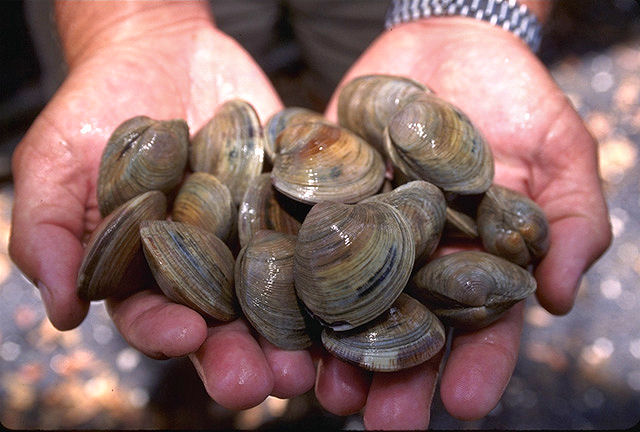
The hard clam (Mercenaria mercenaria), also known as the round clam, hard-shell (or hard-shelled) clam, or the quahog,[a] is an edible marine bivalve mollusk that is native to the eastern shores of North America and Central America from Prince Edward Island to the Yucatán Peninsula. It is one of many unrelated edible bivalves that in the United States are frequently referred to simply as clams. Older literature sources may use the systematic name Venus mercenaria; this species is in the family Veneridae, the venus clams.

Confusingly, the "ocean quahog" is a different species, Arctica islandica, which, although superficially similar in shape, is in a different family of bivalves: it is rounder than the hard clam, usually has a black periostracum, and there is no pallial sinus in the interior of the shell.

Alternative names

[edit]
Left valve interior of Mercenaria mercenaria.

The hard clam has many alternative common names. It is also known as the Northern quahog, round clam, or chowder clam.[1]

In fish markets, there are specialist names for different sizes of this species of clam. The smallest legally harvestable clams are called countnecks or peanuts, next size up are littlenecks, then topnecks. Above that are the cherrystones, and the largest are called quahogs or chowder clams.[2]

The most distinctive of these names is quahog (/ˈkhɒɡ/ KOH-hog, /ˈkwɔːhɒɡ/ KWAW-hog, or /kwəˈhɒɡ/ kwə-HOG, also spelt quahaug, quohog or cohog).[3][4] The word comes from the Narragansett word "poquauhock", which is similar in Wampanoag and some other Algonquian languages; it is first attested in North American English in 1794.[5][6] Native polities on the eastern Atlantic seaboard made valuable beads called wampum from the shells, especially those colored purple; the species name mercenaria is related to the Latin word for commerce. Today people living in coastal New England still use Algonquian words for the clam, as they have done for thousands of years.

In many areas where aquaculture is important, clam farmers have bred specialized versions of these clams with distinctions needed for them to be distinguished in the marketplace. These are quite similar to common "wild type" Mercenaria clams, except that their shells bear distinctive markings. These are known as the notata strain of quahogs, which occur naturally in low numbers wherever quahogs are found.[7]

Distribution

[edit]
An old quahog shell that has been bored (producing Entobia) and encrusted after the death of the clam

Western Atlantic Ocean: Hard clams are quite common throughout New England, north into Canada, and all down the Eastern seaboard of the United States to Florida; but they are particularly abundant between Cape Cod and New Jersey, where seeding and harvesting them is an important commercial form of aquaculture. For example, the species is an important member of the suspension-feeding, benthic fauna of the lower Chesapeake Bay.

Rhode Island is situated right in the middle of "quahog country" and has supplied a quarter of the U.S.'s total annual commercial quahog catch. The quahog is the official shellfish of the U.S. state of Rhode Island and is the namesake of the fictional Rhode Island town featured in the animated sitcom Family Guy. The species has also been introduced and is farmed on the Pacific coast of North America and in Great Britain and continental Europe. It reproduces sexually by females and males shedding gametes into the water.[2]

Habitat

[edit]

Shallow water: found intertidally on sand flats, at low tide. Hard Clams are found spread throughout the South Atlantic Region. They can be found at a depth of 15 meters or more.

Parasite

[edit]

Quahog parasite unknown (QPX)[8] is a parasite that affects the hard shell clam Mercenaria mercenaria. While little is known about the disease, research is currently under way in several laboratories.[9] This research is fueled by the need to inform aquaculturists, who suffer financially because of the mortality rates in clams that QPX inflicts and the ensuing years in which runs must be left fallow to clear the disease. It was discovered along the coast of Cape Cod, Massachusetts in 1995.

Quahog parasite X (or quahog parasite unknown [QPX]) disease of the hard clam Mercenaria mercenaria is caused by a poorly known protistan parasite. Its DNA sequence analysis places the QPX parasite among the thraustochytrid stramenopiles. The QPX parasite is unicellular and possesses at least one flagellum, like most other stramenopile organisms. Thraustochytrids are common protists in marine sediments and the water column, but only a few thraustochytrids are known as parasites of marine animals. Although QPX disease was first recorded on the Atlantic coast of Canada in the early 1960s, it did not become a major economic problem until its appearance in cultured clams at Prince Edward Island, Massachusetts in 1992, and Virginia in 1997. Infected clams are characterized by the presence of blisters or pustules in the mantle and later by gaping and death.[10]

Human use

[edit]
Steamed clams
Raw top neck clams in New Jersey.

In coastal areas of the New England states, Long Island, and New Jersey, restaurants known as raw bars or clam bars specialize in serving littlenecks and topnecks raw on an opened half-shell, usually with a cocktail sauce with horseradish, and often with lemon. Sometimes littlenecks are steamed and dipped in butter, though not as commonly as their soft-shelled clam cousin the "steamer". Littlenecks are often found in-the-shell in sauces, soups, stews, and clams casino, or substituted for European varieties such as the cockle in southern European seafood dishes. The largest clams are quahogs or chowders and cherrystones; they have the toughest meat and are used in such dishes as clam chowder, clam cakes, and stuffed clams, or are minced and mixed into dishes that use the smaller, more tender clams.

Historically, Native Americans used the quahog as a component in wampum, the shell beads exchanged in the North American fur trade.[11] The Narragansetts used the hard clam for food and ornaments.[12]

A population of hard clams exists in Southampton Water in Hampshire, England. Originally bred in the warm water outflows at Southampton Power Station for use as eel bait, the population became self-sustaining and can now be found in Southampton Water and has also spread to Portsmouth Harbour and Langstone Harbour.

Clams and red tide

[edit]

The term "red tide" refers to an accumulation of a toxin, such as saxitoxin, produced by marine algae.[13][14] Filter-feeding shellfish are affected, such as clams, oysters, and mussels.[13][14] As they filter microorganisms, clams ingest K. brevis algae. This algae accumulates in the clams' tissues and is toxic to humans when they are consumed. The toxin affects the human central nervous system.[13] Eating contaminated shellfish, raw or cooked, can be fatal.[13] Some other kinds of algal blooms make the seawater appear red, but red tide blooms do not always discolor the water, nor are they related to tides.[13]

Notes

[edit]

References

[edit]
Revisions and contributorsEdit on WikipediaRead on Wikipedia
from Grokipedia
The hard clam, scientifically known as Mercenaria mercenaria and commonly referred to as the northern quahog, is a bivalve mollusk characterized by a thick, subovate shell up to 5 inches (13 cm) in length, featuring concentric ridges and varying in external color from white to gray or brown. This species inhabits sandy or muddy bottoms in intertidal and subtidal zones of estuaries, bays, and coastal waters, where it burrows partially into the sediment using a muscular foot and extends paired siphons for filter feeding on and suspended particles. Native to the Atlantic coast of from the to the , with introductions to the Pacific coast and parts of , it plays a vital ecological role as a suspension feeder that improves by removing sediments and excess nutrients, while serving as prey for predators such as crabs, fish, birds, and gastropods. Commercially significant, the hard clam supports major fisheries and operations, harvested at various sizes (e.g., littlenecks at 1 inch, chowder clams over 3 inches) for consumption raw, steamed, or in dishes like chowder, with individuals capable of living up to 20 years. Reproduction occurs through during warmer months (typically June to August in northern ranges, spring to fall in southern areas) when water temperatures reach 20–26°C, with mature females releasing 2–25 million eggs per spawning season and males broadcasting into the water column. Eggs develop into trochophore larvae within 12–14 hours, progressing to free-swimming veliger larvae that settle as juveniles after 6–10 days, achieving market size in 12–24 months under optimal conditions. The species thrives in salinities of 20–35 ppt (larvae tolerate 20–35 ppt) and requires stable substrates with moderate tidal flow, adequate oxygen (>4 ppm), and dense algal food sources, though adults tolerate a broader range of conditions than larvae. Ecologically, hard clams contribute to in coastal habitats by stabilizing sediments and cycling nutrients, but populations face threats from overharvesting, habitat loss, , and predation, prompting conservation efforts like broodstock sanctuaries in regions such as Virginia's Back River .

Taxonomy and nomenclature

Classification

The hard clam is scientifically classified as Mercenaria mercenaria (Linnaeus, 1758), with the junior synonym Venus mercenaria. It belongs to the domain Eukaryota, kingdom Animalia, phylum , class , subclass Autobranchia, infraclass , order Venerida, superfamily Veneroidea, family , and genus Mercenaria. This taxonomic placement reflects its status as a marine bivalve within the diverse family, which encompasses numerous clam species valued in fisheries worldwide. Within the genus Mercenaria, M. mercenaria is closely related to its sister Mercenaria campechiensis (the southern quahog), with overlapping ranges in the western Atlantic facilitating potential hybridization. Studies have documented hybrid offspring between M. mercenaria and M. campechiensis, particularly in regions like the southeastern U.S. coast, where environmental stressors such as low can enhance hybrid survival rates compared to pure parental lines. Evolutionarily, Mercenaria mercenaria is part of the family, which originated in the but underwent significant radiation during the epoch, leading to diversification among hard-shelled bivalves adapted to coastal environments. Fossil records of the Mercenaria from Miocene deposits along the Atlantic and Gulf Coastal Plains confirm its ancient lineage, with M. mercenaria emerging as the dominant extant among the two surviving members of the genus. Subspecies include the nominate M. m. mercenaria along the Atlantic coast and M. m. texana in the .

Common names

The hard clam, scientifically known as Mercenaria mercenaria, is referred to by several common names that reflect its widespread use in North American fisheries and culture. Primary common names include northern quahog, hard-shell , and round clam, emphasizing its robust shell and circular shape. Regional variations highlight indigenous and local influences: "quahog" derives from the Narragansett term "poquauhock" and is prevalent in , while "hardshell" is commonly used in the Mid-Atlantic region; an earlier Algonquian form, "pooquaw," appears in historical records from Lenape-influenced areas around . In commercial markets, names are often size-based to denote harvest stages and suitability for trade: the smallest harvestable sizes are called countnecks or peanuts (under 1.5 inches), followed by littlenecks (1.5–2 inches), cherrystones (2–3 inches), and the largest as chowder clams or quahogs (over 3 inches). A bred variant known as the notata strain features distinctive dark zigzag or chevron markings on the shell, used in aquaculture to identify hatchery-reared individuals from wild stocks. In , the quahog holds official status as the state shell, designated in to recognize its cultural and economic importance.

Physical characteristics

Shell morphology

The hard clam, Mercenaria mercenaria, possesses an equivalved shell that is ovate to subtrigonal in outline, thick and heavy, providing robust protection for the soft tissues within. The two valves are roughly equal in size, with a length reaching up to 125 mm (approximately 5 inches), and the shell's height typically about 5/6 of its length. This shape features a prominent, anteriorly positioned umbo and a broadly rounded posterior margin, facilitating efficient burrowing into subtidal sediments. The exterior surface is smooth to slightly rough, marked by prominent concentric growth lines or ridges that reflect incremental deposition over time, becoming more pronounced toward the shell's ventral margin. The hinge plate is well-developed, featuring three cardinal teeth in each that interlock to maintain alignment and secure closure, along with a rough, tooth-like area posterior to the beaks. Internally, the shell is smooth, with margin attaching along the pallial line to support valve movement. Coloration varies across individuals and strains, with the exterior generally grayish-white to tan, often accented by irregular reddish-brown or rays radiating from the umbo. The interior is typically white with a distinctive tinge near the umbo and along the posterior adductor muscle scar. A notable genetic variant, the "notata" strain commonly selected in , exhibits bold, zigzag stripes on the exterior surface, though this pattern offers no apparent adaptive advantage beyond . Individuals typically reach an average adult size of 50-75 mm in length, with rapid growth in the first 1-2 years allowing market-sized clams to attain 45-50 mm within 12-24 months under optimal conditions. Growth rates subsequently slow after about 5 years, influenced by environmental factors, though exceptionally long-lived specimens can exceed 100 years, with the verified maximum age recorded at 106 years. The thick, heavy shell serves a critical adaptive role by resisting predation, particularly from crustaceans and gastropods, with predation rates dropping sharply once shells exceed 25 mm in length due to increased thickness and strength. This durability, combined with the shell's streamlined form, enables the clam to submerge deeply in , enhancing survival in dynamic coastal environments.

Internal anatomy

The hard clam (Mercenaria mercenaria) follows the standard bivalve , featuring a soft, bilaterally symmetrical body housed within two hinged valves. A prominent foot, plow-shaped and white in color, facilitates burrowing into sandy or muddy substrates. Two adductor muscles—one anterior and one posterior—contract to close the valves tightly, securing the animal against predators. , a thin tissue layer enveloping the visceral mass, lines the shell interior and maintains the mantle cavity, which is divided into and exhalant chambers by the gills. Paired extend from the posterior end: the shorter siphon, fringed with small tentacles, draws in water laden with food particles, while the exhalant siphon expels filtered water, feces, and pseudofeces; these siphons are fused along much of their length for efficiency in shallow burrows. The digestive system is adapted for filter feeding and includes labial palps flanking the mouth, which sort edible particles from debris before directing them via the to the . Within the , a rotating crystalline style grinds ingested material against a chitinous gastric shield, while surrounding digestive diverticula secrete enzymes for breakdown and absorption. The coiled intestine traverses the visceral mass, often looping around the gonads, before terminating at the in the exhalant . The gills, or ctenidia—comprising two demibranchs (inner and outer) per side with filamentary lamellae—function in both respiration, facilitating oxygen exchange with , and food capture, trapping particles in via ciliary action. Circulation occurs via an open system, where hemolymph—a colorless fluid akin to blood—bathes tissues directly within hemocoelic spaces. The heart, situated in the dorsal pericardial cavity, consists of a single ventricle flanked by paired auricles, pumping hemolymph through anterior and posterior aortae into sinuses; an aortic bulb serves as a reservoir. The nervous system is decentralized, featuring three paired ganglia: cerebral (above the esophagus for sensory integration), pedal (in the foot for locomotion), and visceral (for visceral functions), interconnected by commissures and nerves to coordinate burrowing, valve closure, and feeding. Reproductive organs reflect the species' gonochoristic nature, with distinct individuals. Gonads form as diffuse follicles interspersed throughout tissue and visceral mass, producing or ova that mature seasonally. Gametes are released into the suprabranchial chamber of the mantle cavity and subsequently expelled through the exhalant for in the . Key sensory structures include paired statocysts embedded in the pedal ganglia of the foot, which detect gravity and aid in orientation during burrowing. The , a ridge-like chemosensory organ on the inner mantle surface near the inhalant , monitors water quality by sensing , toxins, and particulates to regulate valve gaping and feeding.

Distribution and habitat

Native and introduced ranges

The hard clam (Mercenaria mercenaria) is native to the western , with its range extending along the North American coastline from the in southward through the to Laguna Madre, . Within this distribution, populations are most abundant from , , to , where suitable estuarine and coastal habitats support high densities. The highest population densities occur in areas such as and , with records of up to 3.1 clams per square meter in the lower portion of . Genetic analyses reveal fine-scale population structure, with distinct variations observed across a 1,500 km span of the native range, reflecting limited and local adaptations. Human activities have facilitated the introduction of the hard clam to non-native regions, primarily for aquaculture and bait purposes. On the Pacific coast of North America, introductions began in the late 19th and early 20th centuries, establishing populations in California and Washington state. In Europe, the species was introduced starting in the 1930s, notably to Great Britain, where it has become self-sustaining in Southampton Water since a successful 1925 stocking effort, and has since spread to nearby areas like Portsmouth and Langstone Harbours. Range expansions, both natural and anthropogenic, are driven by larval dispersal through ocean currents, which can transport planktonic larvae over considerable distances, as well as intentional stocking for commercial purposes. may further influence distribution by warming coastal waters, potentially enabling poleward shifts in the native range or enhancing establishment in introduced areas. Although not globally endangered and not evaluated by the , the hard clam experiences local population declines in parts of its native range due to overharvesting, prompting conservation measures in regions like .

Environmental preferences

The hard clam (Mercenaria mercenaria) occupies depths ranging from intertidal zones to subtidal waters up to 15–18 m, with the majority of individuals found in shallow areas less than 5 m deep. It favors substrates of fine sand or muddy sand, burrowing into them to depths typically ranging from 1–2 cm in stable subtidal environments to up to 20 cm in intertidal areas to prevent during low . Optimal water quality conditions include salinities of 20–30 ppt, where feeding, growth, and rates are maximized, though adults can tolerate 12–45 ppt. Temperatures between 20–26.6°C support peak larval and juvenile growth, with overall tolerance extending from below 5°C () to 35°C. Dissolved oxygen levels exceeding 4 mg/L are required for larval development and growth. The demonstrates resilience to hypoxic conditions by tightly closing its shell valves, enabling at dissolved oxygen concentrations below 1 mg/L for periods up to three weeks without significant impairment. However, it shows sensitivity to elevated , as larval growth halts at levels of 3–4 g/L, and to , performing poorly in areas with degraded or pH below 7.0. In terms of microhabitat, hard clams frequently occur in seagrass beds, which provide shelter and enhanced recruitment, or burrowed adjacent to oyster reefs, where densities can reach 6–24 individuals per square meter amid shell clusters for protection from currents and predators.

Life history

Reproduction

The hard clam, Mercenaria mercenaria, exhibits gonochorism, with individuals developing as either males or females and maintaining separate sexes throughout most of their adult lives. Although some sources suggest protandry, histological evidence indicates primarily gonochoristic with hermaphroditism in fewer than 1% of cases. Sex is typically determined early in ontogeny, around the time of sexual maturity at approximately one year of age and a shell length of 35 mm, resulting in a sex ratio close to 1:1 in mature populations. Spawning in M. mercenaria is triggered primarily by environmental cues, including water temperatures exceeding 20°C and abundance of food resources, which promote maturation and release. This broadcast spawning varies regionally, with a single season from May to October in northern temperate regions peaking in July-August, and prolonged spawning with spring and fall peaks in southern areas; males release first into the , often stimulating nearby females to spawn through chemical cues. Fertilization is external and takes place in the , where and eggs mix freely. Females produce and release 1 to 40 million eggs over the spawning season, averaging about 25 million depending on environmental conditions and individual health, while males discharge millions of per event to ensure successful fertilization. increases with clam size and age, with large adults capable of producing up to 40 million eggs through multiple spawning episodes. Following , embryos develop into free-swimming larvae.

Growth and development

The development of the hard clam (Mercenaria mercenaria) begins with , producing embryos that rapidly progress through larval stages. Within 10-12 hours post-fertilization, the trochophore emerges as a free-swimming form lacking a shell. This stage lasts approximately 24 hours before transitioning to the veliger , which develops a shell and becomes planktonic, feeding on . The straight-hinge veliger stage occurs at a size of 90-140 μm, typically within the first 1-5 days of the veliger phase, which overall endures 7-21 days depending on and food availability. The pediveliger stage marks the final larval phase, lasting 8-20 days at sizes of 170-230 μm, during which the larva develops a foot and eye spots to actively seek suitable substrates for settlement. Settlement occurs when the pediveliger into a juvenile spat at 200-300 μm after 10-25 days of total larval development, losing the velum and developing siphons while immediately burrowing into for protection. Juveniles reaching about 1 mm in shell length after 4-6 weeks post-settlement. Juvenile growth is initially rapid, with clams attaining 20-30 in shell length during the first year, supported by high metabolic rates and abundant resources. Growth subsequently slows to 2-5 per year as the clam matures, influenced by environmental factors, though variability exists across populations. Under typical conditions, hard clams reach the legal harvest size of 38 in 3-4 years. Hard clams exhibit of up to 106 years, though most live 20-40 years, with age determined by counting annual growth rings on the shell, which reflect seasonal deposition patterns. Mortality is exceptionally high during the larval phase, exceeding 90% from to settlement due to predation, environmental stressors, and dispersal challenges. Survival rates improve markedly post-settlement as juveniles and develop thicker shells, reducing vulnerability to predators.

Ecology

Feeding and behavior

The hard clam, Mercenaria mercenaria, is a suspension that draws water into its mantle cavity through the inhalant , where it passes over the gills to trap food particles before being expelled via the exhalant . The gills, equipped with mucous sheets and cilia, capture , , and other suspended , primarily particles ranging from 2 to 50 μm in size. A large adult clam can achieve a clearance rate of approximately 7–8 liters of water per hour, effectively removing microscopic and from the surrounding water. During digestion, captured particles are bound by on the gills and transported to the labial palps, which sort and direct edible material into the while rejecting non-nutritious . In the stomach, further sorting occurs via the crystalline style and gastric shield, separating digestible organics from inorganic waste, with the latter forming pseudofeces that are expelled through the inhalant siphon as -bound clumps. This selective process allows the to maximize uptake from its diet while minimizing expenditure on indigestible matter. Burrowing behavior enables the hard clam to maintain a semi-infaunal lifestyle, using its muscular foot to extend, swell, and contract repeatedly to dig into soft sediments up to 15 cm deep. Individuals often reposition themselves in response to tidal cycles, burrowing deeper at to avoid exposure and emerging slightly at high tide to access better flow for feeding. While buried, the clam extends its fused siphons to the sediment surface for feeding and respiration without fully exposing its body, a strategy that reduces predation risk. Activity patterns in M. mercenaria are influenced by environmental cues, with siphon extension and feeding often peaking during high submersion in intertidal habitats, aligning with diurnal and tidal rhythms. In conditions of low dissolved oxygen, below approximately 5 mg/L, clams reduce pumping and burrowing activity to conserve , though they remain tolerant down to 1 mg/L for extended periods with depressed . Ecologically, a single adult filters substantial volumes of water, enhancing water clarity by removing and suspended particulates, which promotes better light penetration for growth. Through this process, hard clams contribute to nutrient cycling by assimilating organics and excreting bioavailable forms; they also enhance microbial in surrounding sediments, converting nitrates to nitrogen gas and reducing risks. but they also bioaccumulate toxins such as and algal biotoxins from contaminated waters.

Predators and parasites

The hard clam, Mercenaria mercenaria, faces predation from a variety of marine organisms across its life stages, with juveniles being particularly vulnerable due to their smaller size and shallower burial depths. Principal predators include crustaceans such as the (), which detects clams via chemical cues and crushes their shells, often achieving higher success rates in mud substrates compared to sand. Gastropods like the (Busycon carica) and the invasive veined rapa whelk () drill into or engulf clams, contributing to localized declines in bivalve densities, as observed in where rapa whelk abundance correlated with reduced hard clam populations since the late 1990s. Other notable predators encompass echinoderms such as the sea star (Asterias forbesi), which pries open shells; demersal fish including the (Tautoga onitis); and shorebirds like the (Haematopus palliatus), which targets intertidal individuals. Humans represent a significant anthropogenic predator through commercial harvesting, which has historically shaped population structures but is regulated to sustain stocks. Parasitic threats to M. mercenaria include the protist Quahog Parasite Unknown (QPX; Mucochytrium quahogii, Labyrinthulomycota), an opportunistic pathogen that invades mantle and gill tissues, forming lesions and inducing mortality events of 80–95% in aquacultured stocks under stress conditions like low temperatures and high salinities. QPX outbreaks have been documented since the 1990s in regions including Prince Edward Island, Cape Cod, and Virginia, where it persists in environmental reservoirs such as sediments and seawater, exacerbating losses in dense populations. In southern ranges, the protozoan Perkinsus marinus (causing Dermo-like infections) occurs at varying prevalences, though hard clams exhibit lower susceptibility than oysters, with infections detected via thioglycollate culture in Florida aquacultured stocks. Bacterial pathogens such as Vibrio species (e.g., V. alginolyticus) trigger immune challenges and tissue degradation, particularly in juveniles, while trematode metacercariae encyst in the digestive gland, eliciting granuloma formation but typically causing sublethal effects rather than widespread mortality. To counter these biotic pressures, hard clams employ both behavioral and physiological defenses. The thick, concentrically ridged shell provides mechanical protection against crushing or predators, while rapid burrowing into sandy substrates—deepening burial in response to sea star presence—reduces encounter rates and detection. Upon perceiving threats via chemical signals from predators or injured conspecifics, clams retract siphons and decrease pumping rates, minimizing exposure and energy expenditure during filter-feeding. Immunologically, circulating hemocytes facilitate , encapsulation of parasites like QPX, and oxidative bursts to eliminate invaders, with elevated hemocyte activity observed following Vibrio or QPX challenges. These interactions profoundly influence hard clam , with predators driving size-selective mortality that limits juvenile and favors larger individuals in predator refuges like shell hash or deeper sands, resulting in lower densities in soft, predator-prone sediments. Parasites such as QPX diminish by impairing and in stressed cohorts, while Perkinsus and infections compound vulnerabilities in warmer southern habitats, collectively shaping distribution patterns and necessitating habitat choices that balance with evasion.

Human interactions

Culinary and cultural significance

The hard clam, known regionally as the quahog, littleneck, or cherrystone depending on size, features prominently in various culinary preparations, particularly along the eastern seaboard of the . Smaller littlenecks are often served raw on the half-shell, prized for their briny flavor and tender texture, while cherrystones are commonly steamed or grilled with , , and until the shells open, typically in 5-8 minutes. Larger quahogs are ideal for chowders; in , they provide a creamy base when chopped and simmered with potatoes, onions, and cream, contrasting with the tomato-based style that highlights their subtle sweetness. Other dishes include , where baked quahogs are topped with breadcrumbs, bacon, and peppers, and stuffed clams or "stuffies," a specialty blending chopped clams with breadcrumbs, linguica, and spices. Historically, Native American tribes such as the Narragansett and in the harvested hard clams for food over 2,700 years ago, as evidenced by shell middens in [Rhode Island](/page/Rhode Island), and used the thick shells to craft tools and ornaments. The shells, particularly the purple-hued portions of the quahog, were fashioned into beads—small cylindrical tokens drilled and polished by hand—serving as symbols of agreements, history, and spiritual significance rather than mere currency among tribes like the Haudenosaunee and Algonquin. These beads facilitated intertribal trade and diplomacy, with Europeans adopting in the for exchanges, extending its role until the mid-1800s. In contemporary culture, the hard clam holds symbolic status as Rhode Island's official state shellfish, designated in 1987 to honor its economic and traditional importance. Annual events like Quahog Week, held each May since 2016, celebrate this legacy through restaurant specials, markets, and educational activities promoting local harvesting and cuisine. The clam appears in American folklore and literature as a motif of coastal life, such as in Native tales of gossiping clams or regional stories evoking resilience, and inspires like shell sculptures and jewelry. Nutritionally, hard clams offer high-quality protein at approximately 15 grams per 100 grams of raw edible portion, with low fat content (about 1 gram) and low carbohydrates (about 2.6 grams), making them a lean seafood option. They are rich in omega-3 fatty acids (around 400 mg per 100 grams), providing cardiovascular benefits, and serve as an excellent source of iron, vitamin B12 (over 188% of daily value), selenium, and phosphorus, supporting immune function and energy metabolism. Modern culinary trends emphasize sustainable harvesting of hard clams, with organizations promoting hand-raking and regulated to minimize environmental impact while enhancing through the clams' natural filtration. Fusion dishes incorporate quahogs into global cuisines, such as Asian-inspired stir-fries or Mediterranean pastas, reflecting growing demand for versatile, eco-friendly .

Commercial aquaculture and fisheries

The commercial fisheries for the hard clam (Mercenaria mercenaria), also known as the northern quahog, primarily involve wild harvest using hand-held implements such as , , forks, and shovels to minimize disturbance. Mechanical dredging is restricted or banned in many areas, including since 1969, to protect clam beds and reduce . In the United States, wild landings averaged 3,254 metric tons annually from 2018 to 2022, with 2022 reaching 3,577 metric tons valued at $56.5 million; contributed approximately 192 metric tons in that period, accounting for about 15% of reported landings from assessed northeastern states (, , New York, ). Aquaculture production has grown significantly, supplementing wild stocks through hatchery-reared clams that are cultured to market size. Larvae are produced in controlled hatcheries and fed until reaching about 1 mm, after which they are transferred to nurseries for further growth before deployment. The notata strain, a shell color variant prized for its aesthetic appeal in markets, is commonly selected in hatcheries despite offering no known growth or survival advantages over wild types. Grow-out occurs via bottom culture on the seafloor or in off-bottom trays to protect against predators, with relay programs transferring sublegal clams to cleaner waters for natural depuration before harvest. In 2019, U.S. output reached 10.7 million pounds (approximately 4,856 metric tons) valued at $122 million, with leading production. The dominates global hard clam production and trade, exporting to markets in and where demand for fresh and processed clams supports cultural dishes like chowders and stir-fries. Annual U.S. export values for clams, including hard clams, contribute to a broader trade exceeding $50 million, though specific hard clam figures are integrated into total bivalve shipments. Fisheries and aquaculture are managed through state-specific regulations, including harvest quotas and minimum size limits of 38 mm (1.5 inches) in several regions to ensure reproductive maturity before exploitation. Restoration efforts, such as planting hatchery seed in degraded habitats like , aim to rebuild stocks depleted by historical pressures, with programs monitoring population recovery through surveys. Key challenges include , which has reduced wild populations since the mid-20th century, and loss from coastal development and , further straining natural . Introduced hatchery strains, particularly the notata variant, pose genetic risks by potentially reducing diversity in wild populations through interbreeding and , compromising resilience to environmental stressors.

Health and environmental risks

Hard clams (Mercenaria mercenaria) can pose health risks to humans primarily through the accumulation of biotoxins and during filter feeding in contaminated waters. (PSP) occurs when clams ingest toxic dinoflagellates such as Alexandrium spp. or Dinophysis spp., which produce saxitoxins that the clams bioaccumulate in their tissues. Consumption of affected raw or undercooked clams leads to symptoms including tingling and numbness around the mouth and lips, progressing to facial and limb , dizziness, and in severe cases, within hours. To mitigate PSP, the U.S. (FDA) oversees monitoring under the National Shellfish Sanitation Program, closing harvest areas when toxin levels exceed 80 μg STX equivalents per 100 g of tissue and issuing bans until levels subside. Bacterial contamination represents another significant risk, particularly from and , which thrive in warm coastal waters and can contaminate clams during growth or post-harvest handling. These pathogens cause vibriosis, with symptoms ranging from to severe infections; V. vulnificus is especially dangerous for immunocompromised individuals, potentially leading to septicemia and death if raw clams are consumed. Quahog parasite unknown (QPX), a protistan affecting hard clams, has no direct zoonotic impact on humans but indirectly reduces shellfish supply through high mortality rates in infected populations, exacerbating shortages. Environmentally, overharvesting has depleted hard clam stocks in regions like the U.S. mid-Atlantic, disrupting benthic habitats and reducing , as seen in historical collapses from illegal in the and . practices can spread diseases like QPX between wild and farmed stocks and alter through for traits like disease resistance, potentially reducing adaptability in natural populations. While hard clams bioaccumulate pollutants such as (e.g., mercury, ) and PCBs from sediments, posing transfer risks to predators including humans, their filter-feeding also provides services by improving water clarity, removing excess , and supporting restoration efforts in eutrophic estuaries. Mitigation strategies include depuration, where clams are held in clean seawater to purge bacteria and some contaminants, effectively reducing Vibrio levels, though it is less effective against heat-stable biotoxins like saxitoxins. Thorough cooking eliminates bacterial risks by killing pathogens but does not degrade PSP toxins, underscoring the need for pre-harvest monitoring. In restoration projects, reintroducing hard clams enhances water quality and habitat resilience, as demonstrated in Shinnecock Bay where clam populations improved clarity and reduced algal blooms.

References

Add your contribution
Related Hubs
User Avatar
No comments yet.