Hubbry Logo
RadhaniteRadhaniteMain
Open search
Radhanite
Community hub
Radhanite
logo
8 pages, 0 posts
0 subscribers
Be the first to start a discussion here.
Radhanite
Radhanite
from Wikipedia
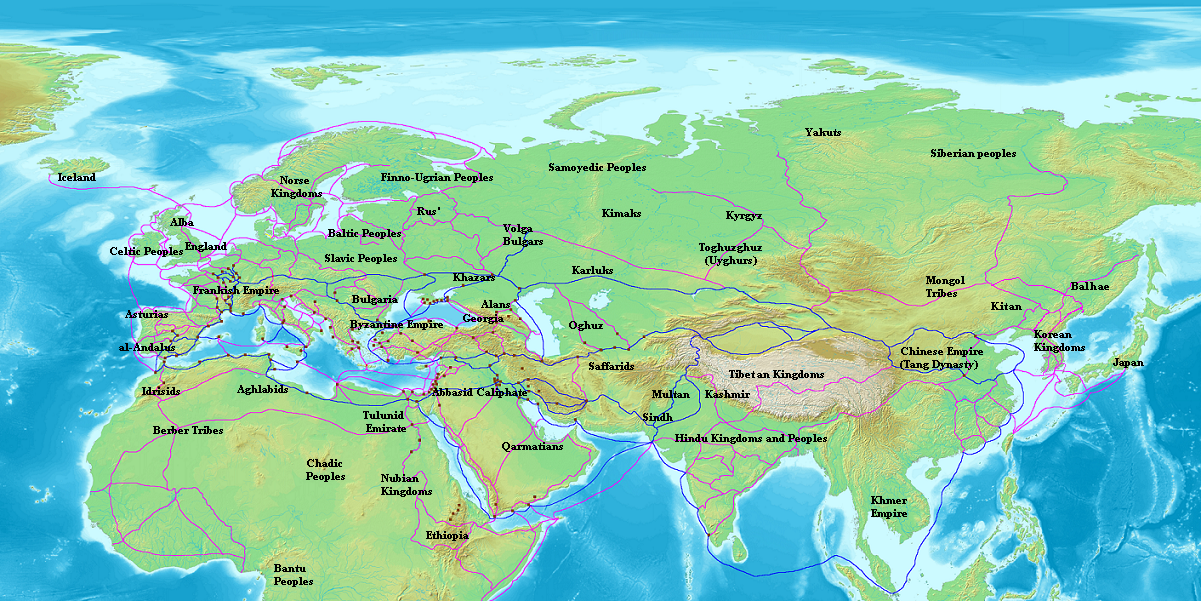
Map of Eurasia showing the trade network of the Radhanites (in blue), c. 870 AD, as reported in the account of Ibn Khordadbeh in the Book of Roads and Kingdoms; other trade routes of the period are shown in purple.

The Radhanites or Radanites (Hebrew: רדנים, romanizedRadanim; Arabic: الرذنية, romanizedar-Raðaniyya) were early medieval Jewish merchants, active in the trade between Christendom and the Muslim world during roughly the 8th to the 10th centuries. Many trade routes previously established under the Roman Empire continued to function during that period, largely through their efforts. Their trade network covered much of Europe, North Africa, the Middle East, Central Asia, and parts of India and China.

Only a limited number of primary sources use the term, and it remains unclear whether they referred to a specific guild, to a clan, or generically to Jewish merchants in the trans-Eurasian trade network.

Name

[edit]

Several etymologies have been suggested for the word "Radhanite". Many scholars, including Barbier de Meynard and Moshe Gil, believe it refers to a district in Mesopotamia called "the land of Radhan" in Arabic and Hebrew texts of the period.[1]

Another hypothesis suggests that the name might be derived from the city of Ray (Rhages) in northern Iran. Still others think the name possibly derives from the Persian terms rah "way, path" and dān "one who knows", meaning "one who knows the way".[2]

Two western Jewish historians, Cecil Roth and Claude Cahen, have suggested a connection to the name of the Rhône River valley in France, which is Rhodanus in Latin and Rhodanos (Ῥοδανός) in Greek. They claim that the center of Radhanite activity was probably in France as all of their trade routes began there.[3]

English-language and other Western sources added the suffix -ite to the term, as is done with ethnonyms or names derived from place names.[4]

Activities

[edit]

The activities of the Radhanites are documented by Ibn Khordadbeh – the postmaster, chief of police (and spymaster) for the province of Jibal, under the Abbasid Caliph al-Mu'tamid – when he wrote Kitab al-Masalik wal-Mamalik (Book of Roads and Kingdoms), in about 870. The Radhanites are otherwise not attested.[1] Ibn Khordadbeh described the Radhanites as sophisticated and multilingual. He outlined four main trade routes used by the Radhanites in their journeys;[2] all four began in the Rhone Valley in southern France and terminated on China's east coast. Radhanites primarily carried commodities that combined small bulk and high demand, including spices, perfumes, jewelry, and silk. They are also described as transporting oils, incense, steel weapons, furs, and slaves.

Text of Ibn Khordadbeh's account

[edit]

In his Book of Roads and Kingdoms (Arabic: كِتَاب ٱلْمَسَالِك وَٱلْمَمَالِك, Kitāb al-Masālik wa-l-Mamālik), Ibn Khordadbeh listed four routes along which Radhanites traveled in the following account.[3]

These merchants speak Arabic, Persian, Roman,[5] the Frank,[6] Spanish, and Slav languages. They journey from West to East, from East to West, partly on land, partly by sea. They transport from the West eunuchs, female slaves, boys, brocade, castor, marten and other furs, and swords. They take ship from Firanja (France[7]), on the Western Sea, and make for Farama (Pelusium). There they load their goods on camel-back and go by land to al-Kolzum (Suez), a distance of twenty-five farsakhs. They embark in the East Sea and sail from al-Kolzum to al-Jar and al-Jeddah, then they go to Sind, India, and China. On their return from China they carry back musk, aloes, camphor, cinnamon, and other products of the Eastern countries to al-Kolzum and bring them back to Farama, where they again embark on the Western Sea. Some make sail for Constantinople to sell their goods to the Romans; others go to the palace of the King of the Franks to place their goods. Sometimes these Jewish merchants, when embarking from the land of the Franks, on the Western Sea, make for Antioch (at the head of the Orontes River); thence by land to al-Jabia (al-Hanaya on the bank of the Euphrates), where they arrive after three days' march. There they embark on the Euphrates and reach Baghdad, whence they sail down the Tigris, to al-Obolla. From al-Obolla they sail for Oman, Sindh, Hind, and China.
These different journeys can also be made by land. The merchants that start from Spain or France go to Sus al-Aksa (in Morocco) and then to Tangier, whence they walk to Kairouan and the capital of Egypt. Thence they go to ar-Ramla, visit Damascus, al-Kufa, Baghdad, and al-Basra, cross Ahvaz, Fars, Kerman, Sind, Hind, and arrive in China.
Sometimes, also, they take the route behind Rome and, passing through the country of the Slavs, arrive at Khamlidj, the capital of the Khazars. They embark on the Jorjan Sea, arrive at Balkh, betake themselves from there across the Oxus, and continue their journey toward Yurt, Toghuzghuz, and from there to China.[8]

Historical significance

[edit]
A caravan of dromedaries in Algeria. Much of the Radhanites' overland trade between Tangier and Mesopotamia was by camel.

During the Early Middle Ages, Muslim polities of the Middle East and North Africa and Christian kingdoms of Europe often banned each other's merchants from entering their ports.[9] Privateers of both sides raided the shipping of their adversaries at will. The Radhanites functioned as neutral go-betweens, keeping open the lines of communication and trade between the lands of the old Roman Empire and the Far East. As a result of the revenue they brought, Jewish merchants enjoyed significant privileges under the early Carolingian dynasty in France and throughout the Muslim world, a fact that sometimes vexed local Church authorities.

While most trade between Europe and East Asia had historically been conducted via Persian and Central Asian intermediaries, the Radhanites were among the first to establish a trade network that stretched from Western Europe to Eastern Asia.[10] They engaged in this trade regularly and over an extended period of time, centuries before Marco Polo and Ibn Battuta brought their tales of travel in the Orient to the Christians and the Muslims, respectively. Ibn Battuta is believed to have traveled with the Muslim traders who traveled to the Orient on routes similar to those used by the Radhanites.

While traditionally many historians believed that the art of Chinese papermaking had been transmitted to Europe via Arab merchants who got the secret from prisoners of war taken at the Battle of Talas, some believe that Jewish merchants such as the Radhanites were instrumental in bringing paper-making west.[11] Joseph of Spain, possibly a Radhanite, is credited by some sources with introducing the so-called Arabic numerals from India to Europe.[12] Historically, Jewish communities used letters of credit to transport large quantities of money without the risk of theft from at least classical times.[13] This system was developed and put into force on an unprecedented scale by medieval Jewish merchants such as the Radhanites; if so, they may be counted among the precursors to the banks that arose during the late Middle Ages and early modern period.[14]

Some scholars believe that the Radhanites may have played a role in the conversion of the Khazars to Judaism.[15] In addition, they may have helped establish Jewish communities at various points along their trade routes, and were probably involved in the early Jewish settlement of Eastern Europe, Central Asia, China and India.

Much of the Radhanites' Indian Ocean trade was via coastal cargo ships such as this dhow.

Ibn al-Faqih's early 10th century Book of the Countries mentions them, but much of Ibn al-Faqih's information was derived from Ibn Khordadbeh's work.[16]

Disappearance

[edit]

The activities of the Radhanites appear to cease during the 10th century. The causes may have been the fall of Tang China in 908, followed by the collapse of the Khazarian state at the hands of the Rus' some sixty years later (circa 968–969). Trade routes became unstable and unsafe, a situation exacerbated by the rise of expansionist Turco-Persianate states, and the Silk Road largely collapsed for centuries. This period saw the rise of the mercantile Italian city-states, especially the maritime republics, Genoa, Venice, Pisa, and Amalfi, who viewed the Radhanites as unwanted competitors.

The Radhanites had mostly disappeared by the end of the 10th century; there have been suggestions that a collection of 11th century Jewish scrolls discovered in a cave in Afghanistan's Samangan Province in 2011 may represent a remnant of Radhanites in that area.[17]

The economy of Europe was profoundly affected by the disappearance of the Radhanites. For example, documentary evidence indicates that many spices in regular use during the early Middle Ages completely disappeared from European tables in the 10th century. Jews had previously, in large parts of Western Europe, enjoyed a virtual monopoly on the spice trade.[18] The slave trade appears to have been continued by other agents, for example, for the year 1168, Helmold von Bosau reports that 700 enslaved Danes were offered for sale in Mecklenburg by Slavic pirates.[4] In the Black Sea area, slave trade appears to have been taken over by the Tatars, mostly selling enslaved Slavs to the Ottoman Turks.[5]

See also

[edit]

Notes

[edit]

References

[edit]
Revisions and contributorsEdit on WikipediaRead on Wikipedia
from Grokipedia
The Radhanites were a network of Jewish merchants operating during the , from approximately the 8th to the 10th centuries, who facilitated long-distance across by linking the Christian West with the Islamic East and further to . Their activities were documented primarily in sources, with the most detailed account provided by the 9th-century Persian geographer in his , describing them as sophisticated, multilingual traders fluent in , Persian, Greek, Frankish, Spanish, and Slavic languages. outlined four principal routes they traversed, involving maritime voyages from to or Antioch, overland camel caravans through and the , and extensions via the or to reach and , enabling the exchange of such as spices, silks, and furs from the East for Western exports including swords, furs, and slaves—specifically eunuchs, female slaves, and boys. As neutral intermediaries unbound by the religious conflicts between Christian and Muslim polities, the Radhanites played a key role in sustaining economic connections during the Carolingian era, potentially introducing innovations like letters of credit for banking and even paper-making to , though their dominance in has been debated, with some evidence suggesting they were prominent but not monopolistic. Their networks declined by the late 10th century amid the collapse of the in and the fragmentation of the , giving way to emerging Italian merchant guilds.

Etymology and Origins

Derivation of the Name

The designation "Radhanite" stems from the term al-Rādhāniyya, introduced by the 9th-century Persian geographer in his treatise Kitāb al-Masālik wa-al-Mamālik (), compiled around 846–847 CE, where he describes Jewish merchants operating extensive overland and maritime trade routes. Many historians, including Moshe Gil, link this name to Rādhān, a historical district in south of in present-day , attested in and Hebrew sources as a Jewish-inhabited area, implying that the Radhanites may have originated from or maintained strong ties to this regional community. Alternative derivations propose a Persian etymology, interpreting "Radhanite" as a compound of rah (road or path) and dān (one who knows), yielding "those who know the way," an apt descriptor for expert caravan traders navigating complex Eurasian networks. Other theories connect the name to European locales, such as the Rhone River valley (Latin Rhodanus) in or the estuary, suggesting these as potential starting points for westward trade extensions, though such links rely more on phonetic similarity than direct textual evidence. Scholars debate whether al-Rādhāniyya signified a broad category of Jewish traders or a narrower entity, such as a professional guild, extended family clan, or localized Mesopotamian Jewish cohort, given Ibn Khordadbeh's singular, detailed portrayal and the scarcity of parallel references, which contrast with more generic terms for Jewish commerce in contemporaneous Islamic texts.

Proposed Geographical and Cultural Origins

The Radhanites likely emerged as a distinct group of Jewish merchants in the Radhan district of southern Mesopotamia (present-day Iraq) during the 8th and 9th centuries CE, a region centered near modern Baghdad under Abbasid administration. This geographical attribution stems from the etymological link between their name and Rādhān, an administrative province documented in early Islamic sources as encompassing fertile lands along the Euphrates, conducive to trade hubs. Jewish settlements in this area traced back to the Babylonian exile (6th century BCE onward), where communities maintained commercial acumen in overland routes, as evidenced by Talmudic-era references to Mesopotamian Jewish involvement in regional exchange networks. Culturally, their origins reflect adaptations within the , leveraging familial and communal bonds to build trust-based systems for commerce across fragmented polities—a causal necessity in the absence of state monopolies post-Sassanid collapse (651 CE). These networks, rooted in endogamous family enterprises documented in geonic correspondence from Babylonian academies like Sura and , enabled risk-sharing and enforcement of contracts via religious and ties, rather than imperial edicts. Such structures positioned Radhanites as active entrepreneurs capitalizing on Abbasid openness to non-Muslim traders, diverging from interpretations that downplay diaspora agency in favor of viewing them solely as intermediaries in exogenous systems. Empirical support remains textual rather than archaeological, with no dedicated Radhanite artifacts identified, though broader Mesopotamian Jewish —such as inscriptions and merchant seals from 8th-century sites—attests to thriving commercial activity amid continuity. Theories positing alternative origins, like or Persia, lack direct textual or regional ties and appear less substantiated by primary geographic descriptors.

Primary Historical Sources

Ibn Khordadbeh's Description

, a Persian and director of the Abbasid postal and intelligence service (barīd) in the province of Jibāl, compiled the earliest known detailed reference to the Radhanites (al-Rādhaniyya) in his (Book of Roads and Kingdoms), written circa 870 CE. As an official tasked with monitoring communications and traveler movements across the , his account likely drew from intercepted reports, waystation logs, and informant networks rather than direct observation, providing an administrative perspective on non-Muslim traders who navigated routes partially outside Abbasid control. This positions the description as grounded in operational intelligence on commerce, though constrained by the absence of primary merchant documents or corroboration from Radhanite participants themselves. Khordadbeh portrays the Radhanites as elite Jewish merchants distinguished by their linguistic versatility and extensive itineraries: "These merchants speak Arabic, Persian, Greek, Latin, Frankish, Andalusian, and Slavic; they travel from west to east and from east to west, sometimes by land, sometimes by sea." This multilingualism—spanning Semitic, Indo-European, and Romance languages—enabled direct negotiation across diverse polities, from Frankish Europe to Slavic territories and Byzantine domains, underscoring logistical sophistication in an era of fragmented linguistic barriers. He specifies that groups of these traders, numbering from tens to hundreds, originated in the Rhōne Valley of southern France (Firanja) and extended to China (Ṣīn), facilitating bidirectional exchange over distances exceeding 4,000 miles. The account delineates four principal overland and maritime routes, emphasizing connectivity from to while skirting or integrating Muslim territories:
  • Route 1 (maritime-western): Departing the Rhōne, traders sailed the Mediterranean to Farama (, ), then across the to the ports of and finally to , returning via the same path with eastern goods.
  • Route 2 (northern overland): From the Rhōne to the Slavic lands (Ṣaqāliba), then eastward through to the region, continuing to and back via the same arc.
  • Route 3 (Byzantine-Black Sea): Via to the , onward to the and Persia, reaching and then , with a reverse journey incorporating Persian intermediaries.
  • Route 4 (southern maritime): From the Rhōne to Syrian ports like Antioch or Laodicea, then sea voyage to and , looping back through entrepôts to the Mediterranean.
These paths highlight adaptive hybrid transport—combining galleys, dhows, camels, and wagons—to evade tariffs or hostilities, though Khordadbeh omits specifics on , durations, or risks, limiting the account to topological outlines verifiable through his intelligence sources. The description's empirical tone, derived from caliphal oversight of flows, contrasts with legendary narratives, yet its singularity as a contemporary source invites caution against overgeneralization without archaeological or archival cross-verification.

Other Contemporary References

Ibn al-Faqih, writing in the early in his Kitāb al-Buldān (Book of the Countries), provides one of the few additional references to Radhanite-like Jewish merchants, describing their multilingual capabilities and overland routes from the Mediterranean to , though this account closely parallels and likely derives from Ibn Khordadbeh's earlier work without introducing novel details. Other geographical texts from the 9th-10th centuries, such as those compiling Persian traditions, occasionally allude to Jewish trading networks handling slaves and like furs and swords, but these mentions remain fragmentary and non-independent, reinforcing dependence on a singular descriptive core rather than broadening evidential scope. Non-Arabic sources yield no explicit citations of Radhanites by name, with Carolingian-era documents instead noting generic Jewish merchants active in European commerce. Charters from the reign of (768–814 CE) and his successors document privileges extended to Jewish traders, including protections for transporting goods and evading certain monopolies through kin-based connections, which align circumstantially with Radhanite operational patterns but offer no direct or route specifics. Christian , such as those chronicling Frankish interactions with eastern traders, reference Jewish intermediaries in slave and spice exchanges around 800–900 CE, yet these lack the ethnic or designation "Radhanite," suggesting the term's confinement to Abbasid administrative and geographical lore. Cairo Genizah fragments, primarily from the 10th–12th centuries, preserve letters and contracts evidencing Jewish networks trading in slaves, textiles, and aromatics across the Mediterranean and , providing indirect analogs to Radhanite activities but temporally offset and undocumented in self-identified Radhanite terms. The paucity of primary Radhanite-authored records—absent in these fragments or Persian commercial papyri—underscores evidentiary limitations, prioritizing verifiable excerpts over speculative extrapolations from later evidence.

Trade Networks and Operations

Described Trade Routes

, an Abbasid postal director writing around 846–847 CE, detailed four principal itineraries traversed by Radhanite merchants in his Kitāb al-Masālik wa-al-Mamālik, emphasizing their adaptability across diverse terrains via ships, camels, river vessels, and overland caravans. These routes linked the Frankish realms in to the eastern extremities of the and beyond, navigating Mediterranean seas, North African deserts, Mesopotamian rivers, and Central Asian steppes, with segments prone to risks such as in the Indian Ocean approaches or banditry in remote frontiers. The first route commenced by sea from across the Mediterranean to in Egypt's , followed by caravan to , then maritime passage via the to ports like al-Jar or on the , extending overland or by coastal vessel toward , and before looping back through to or Frankish territories. A second itinerary involved shipping from to Antioch in , then overland to al-Jabia in and river navigation along the to , continuing via the to al-Ubulla near for sea voyages to , , and . A third path proceeded overland from France or Spain southward to Sus al-Aksa in Morocco, eastward through Tangier and Kairouan in Tunisia to Egypt, then via Ramleh, Damascus, al-Kufa, Baghdad, Basra, Ahvaz, Fars, and Kerman toward Pakistan, India, and China, relying predominantly on camel and pack-animal trains across Saharan and Near Eastern deserts. The fourth route originated in Rome or southern Europe, crossing into Slavic territories, proceeding to Khamlidj in Khazaria, traversing the Caspian Sea by ship to the southeast, then overland via Balkh and the Oxus River to the yurt encampments of nomadic groups like the Toghuzghuz en route to China, highlighting exposure to steppe hazards including seasonal flooding and tribal conflicts. These pathways underscore the Radhanites' logistical versatility, integrating fluvial transport on rivers like the and for efficient bulk movement in , while maritime segments via or similar vessels facilitated long-haul crossings of the , adapting to winds and coastal currents despite navigational perils in uncharted waters. Overland extensions demanded resilience against arid expanses and high-altitude passes in , where reliance mitigated but amplified vulnerability to environmental extremes.

Goods and Commodities Exchanged

The Radhanites transported high-value, low-bulk commodities that facilitated long-distance without requiring large-scale capital , as described in the 9th-century account of in . From the Frankish west, they carried eunuchs, female slaves, boys, fabrics, castor, and other furs, and swords, which were particularly prized in eastern markets for their quality and rarity. Slaves, often Slavic (Saqāliba), formed a primary , meeting high demand in caliphal harems and households where eunuchs served as guards and administrators, reflecting the economic incentives of the era's labor markets rather than modern ethical overlays. In the opposite direction, Radhanites imported luxury goods from Asia and the Islamic world, including silk, musk, aloes, camphor, cinnamon, and other spices, which commanded premium prices in Europe due to their scarcity and utility in perfumery, medicine, and elite consumption. These items, alongside occasional ivory and perfumes, underscored the Radhanites' role in arbitrage, exploiting regional scarcities—furs and blades for steppe nomads and caliphs, spices for Frankish nobility—while family-based operations allowed specialization in perishables like spices versus durables like silks, minimizing spoilage risks on extended caravans.
Trade DirectionKey CommoditiesMarket Demand Notes
West to EastEunuchs, slaves (e.g., Slavic), furs (, ), swords, High value in Islamic and eastern elites for labor, status symbols, and weaponry; slaves topped export lists per .
East to West, spices (, etc.), , aloes, , perfumesScarce luxuries in for textiles, scents, and preservation; enabled profit margins through bulk efficiency.

Linguistic and Logistical Capabilities

The Radhanites demonstrated exceptional linguistic proficiency, speaking at least six languages in addition to Hebrew, which allowed them to negotiate contracts and conduct trade directly across linguistically diverse realms without relying on interpreters. In his 9th-century Book of Roads and Kingdoms, the Persian geographer described these merchants as fluent in , Persian, Greek (termed "Roman"), Frankish, Spanish, and Slavic tongues. This multilingualism was essential for traversing territories under Christian, Muslim, and pagan rule, from the Frankish kingdoms to the and Slavic lands, enabling precise dealings in goods, slaves, and intelligence without translation delays or misunderstandings that plagued less versatile traders. Logistically, the Radhanites leveraged kinship-based networks within communities to establish trust, secure warehousing, and facilitate credit extensions, minimizing vulnerabilities in regions prone to and political . These familial and communal ties functioned as precursors to formalized bills of exchange, permitting merchants to issue promissory notes redeemable at distant outposts through verified kin or coreligionists, thus avoiding the perils of transporting bulk coinage over thousands of miles. Such systems relied on shared religious obligations and reputational enforcement rather than state-backed institutions, reflecting adaptations to ' exclusion from landownership and monopolies in agrarian societies, which funneled their into portable, relational enterprises grounded in and verifiable reciprocity. This approach sustained operations across hybrid land-sea itineraries, including caravans, relays, and voyages, as outlined in contemporary accounts.

Broader Historical Context

Position in Eurasian Commerce

The Radhanites operated within the complex geopolitical landscape of 8th- to 10th-century , characterized by the Abbasid Caliphate's expansion after its founding in 750 CE, the Carolingian Empire's consolidation following Charlemagne's imperial coronation in 800 CE, and the Tang Dynasty's fragmentation in the wake of the (755–763 CE). Byzantine–Arab wars, including major campaigns from the 7th to 9th centuries, severely disrupted routes, diverting commerce toward overland paths and creating niches for adaptable intermediaries amid these imperial transitions. Their conferred a degree of neutrality, positioning them as intermediaries unaligned with either Christian or Muslim state agendas, which enabled cross-confessional dealings in regions where traders encountered barriers in Frankish territories or Persian merchants faced constraints in Christian domains. This status yielded privileges from Carolingian rulers and Abbasid officials, allowing the Radhanites to navigate hostilities and sustain connectivity between , the Islamic world, and eastern realms during a time of ideological fragmentation. In competition with Arab-dominated Indian Ocean networks and Persian Silk Road operators, as well as northern European actors like Vikings, the Radhanites occupied a specialized role in high-value, long-distance exchanges rather than bulk commodities. Evidential proxies for their scale include references to eastern aromatics reaching Carolingian , indicative of sustained but niche flows of luxury imports documented in 9th-century accounts, without evidence of monopoly or overwhelming dominance.

Interactions with Political Entities

Radhanites navigated political landscapes by forging pragmatic relationships with rulers across Islamic and Christian domains, leveraging their trade expertise to secure protections and concessions. In Abbasid territories, their conferred dhimmi status, entitling them to legal safeguards under Islamic law in exchange for the poll tax, which enabled relatively secure transit through caliphal lands despite occasional enforcement of sumptuary restrictions or temporary expulsions. This framework contrasted with Frankish Europe, where Charlemagne's capitularies, such as the 797 affirming Jewish rights to commerce and synagogues, provided targeted privileges to merchants like the Radhanites, though subject to royal oversight and vulnerability to ecclesiastical pressures or local levies. Diplomatic exchanges between and around 797–802, involving embassies that conveyed silks, spices, and an as gifts, underscore the Radhanites' potential utility as intermediaries, given their documented multilingualism in Romance, Slavic, , Persian, and Frankish tongues, which aligned with the logistical demands of such missions. While primary accounts like the Royal Frankish Annals do not explicitly identify Radhanites, contemporary descriptions of Jewish traders as neutral envoys between and the suggest their involvement in sustaining these channels amid Byzantine blockades and territorial rivalries. Tensions with political authorities often centered on fiscal extraction, as rulers imposed transit duties or confiscations on Radhanite to fund campaigns; for instance, Abbasid governors levied tolls on overland routes from to the Mediterranean, prompting merchants to diversify paths or negotiate exemptions through demonstrated economic value. In , Carolingian kings balanced revenue demands with incentives for , issuing safe-conducts that mitigated but did not eliminate risks of arbitrary taxation, reflecting the inherent merchant-state frictions where evasion tactics, such as underreporting , were inferred from broader patterns in medieval but lacked Radhanite-specific attestation.

Economic and Cultural Impact

Contributions to Trade Connectivity

The Radhanites enhanced trade connectivity across by channeling from to , including , spices, perfumes, and jewels, which supported elite consumption in the during the 8th and 9th centuries. These imports, transported via overland routes through Persia and the Mediterranean, preceded Crusader-era expansions and integrated Eastern commodities into Frankish markets without reliance on direct Byzantine intermediaries. Their operations along four primary routes originating in southern France and extending to China fostered market linkages by enabling bidirectional flows of high-value items, such as European furs, swords, and slaves eastward, thereby incentivizing sustained commercial exchanges amid fragmented political landscapes. As neutral actors navigating Christian, Muslim, and pagan territories, they bridged confessional divides, promoting transactions that connected Afro-Eurasian economic zones. Proficiency in multiple languages—Persian, , Greek, Frankish, Spanish, and Slavic—combined with kinship networks allowed repeated dealings that minimized risks and intermediaries, effectively lowering transaction costs and amplifying overall volumes. This relational framework, akin to coalition-based enforcement in contemporaneous Jewish groups, supported scalable without exclusive control, as Radhanites paralleled Sogdian traders in Central Asian hubs.

Role in Knowledge and Technology Transfer

The Radhanites' documented equipped them to serve as incidental conduits for intellectual exchange during their extensive travels. According to the 9th-century Persian geographer in his , these merchants spoke , Persian, Greek (referred to as Rūmī or Roman), Frankish, Spanish, and , facilitating interactions across linguistic barriers from to . This proficiency, combined with their literacy—presumed given their role in long-distance commerce—likely enabled the opportunistic transport of manuscripts or verbal , though no primary records confirm systematic textual conveyance. Some historians posit that Radhanites contributed to the diffusion of classical Greek and Persian scientific works toward the Islamic world, leveraging their neutral status amid Christian-Muslim tensions to bridge scholarly communities. For instance, their routes overlapped with paths where Hellenistic texts, preserved in Syriac or Pahlavi, could have passed to Abbasid translators in around the 8th-9th centuries, potentially accelerating the . However, such involvement remains speculative, as direct attributions in surviving sources like those of al-Kindī or Hunayn ibn Ishāq emphasize court-sponsored efforts over merchant networks, underscoring Radhanites as secondary carriers rather than initiators. Empirical links to specific technologies are tenuous; while Radhanites traded eastern luxuries like , which appears in Carolingian medical recipes circa 800 CE (e.g., the Lorsch pharmacopeia), this reflects broader Eurasian commerce rather than unique Jewish agency. Claims of their pivotal role in introducing production techniques or astronomical instruments to Frankish courts lack corroboration, with evidence pointing to Byzantine gifts to (e.g., silkworms received in 797 CE) and Carolingian astronomy deriving mainly from monastic computus traditions. Overall, their contributions aligned with trade's causal spillover effects—facilitating through mobility—but exaggerated portrayals of overlook parallel vectors like Nestorian or intermediaries, prioritizing verifiable over unsubstantiated cultural primacy.

Decline and Legacy

Factors Contributing to Disappearance

The Radhanites' prominence in long-distance Eurasian trade waned by the late , primarily due to cascading political disruptions that severed key overland routes. The collapse of the in 907 CE fragmented eastern termini of the networks, curtailing access to Chinese markets and commodities like silk and that had sustained Radhanite caravans. Concurrently, the Khazar Khaganate's decline—marked by devastating raids from the Kievan Rus' and , culminating in the sack of its capital around 965–969 CE—closed vital Volga-Caspian corridors, which Radhanites had relied upon for safe passage between , the Islamic world, and . These events eroded the geopolitical stability that had enabled multi-ethnic merchant relays, as fragmented successor states imposed erratic tolls and hostilities that raised costs beyond viability for specialized long-haul operations. In , the rise of Turkic powers, including the Qarakhanid conquest of the by 999 CE, further destabilized transcontinental paths through and , introducing nomadic incursions that preyed on merchant convoys and shifted control to militarized regimes less tolerant of foreign traders. The Fatimid Caliphate's expansion from into (conquered 969 CE) indirectly compounded these issues by prioritizing maritime and Mediterranean routes for spice and luxury imports, diminishing the relative efficiency of overland alternatives that Radhanites dominated. Competition intensified from emerging Italian city-states like , , and , whose naval innovations and direct sea links to Byzantine and Levantine ports from the 10th century onward bypassed hazardous inland trails, capturing spice and silk flows with lower risks and faster turnaround. Internally, these external shocks prompted Jewish trading communities to pivot toward localized commerce within stable regions, such as or , abandoning the linguistic and logistical specialization required for Radhanite-style odysseys spanning thousands of miles. Without the imperial buffers of the Abbasids, , or Tang, the causal chain of secure relays broke, rendering the Radhanite model obsolete as risk-averse merchants favored shorter, community-embedded networks over perilous global .

Long-Term Influences and Debates

The detection of East Asian mitochondrial DNA haplotypes in Ashkenazi Jewish populations, especially among eastern subgroups, provides genetic evidence of long-term intermixtures traceable to Silk Road commerce around the 8th-10th centuries, potentially linked to Radhanite travels extending to China. A 2015 analysis of mtDNA from over 23,000 individuals identified shared eastern Eurasian lineages between Ashkenazi Jews and Chinese populations, estimating admixture events consistent with medieval overland trade rather than later migrations. These haplotypes, comprising haplogroups like D4 and M8a, occur at frequencies of 1-3% in tested Ashkenazi samples, supporting gene flow from transient unions along Eurasian routes where Radhanites operated as intermediaries. The Radhanite model of kin-based, multilingual long-distance trade established institutional precedents for subsequent commerce, shaping the operational strategies of Sephardic merchants in the 11th-13th century Mediterranean and Ashkenazi traders at fairs. By fostering networked communities across Persia, the , and , they exemplified adaptive neutrality in cross-cultural exchanges, a pattern echoed in later Sephardic ventures post-1492 expulsion and Ashkenazi roles in peripheries. Scholarly debates contrast narratives of rupture—positing a sudden 10th-century due to Abbasid fragmentation—with evidence for continuity through adaptive decline, where Radhanite descendants integrated into regional economies as maritime routes via and supplanted overland paths by the . This view prioritizes causal shifts like Seljuk disruptions and Italian monopolies over of mythic disappearance, aligning with archaeological traces of persistent Jewish trading enclaves in and the into the 12th century.

Scholarly Analysis and Controversies

Assessments of Influence and Exaggeration

Historians such as Michael McCormick have assessed the Radhanites as instrumental in revitalizing Eurasian during the 8th–10th centuries, leveraging multilingual proficiency in at least six languages to bridge Christian, Muslim, and Asian markets, thereby sustaining flows of spices, silks, and slaves critical to post-Roman economic recovery. Ibn Khordadbeh's circa 846–885 CE account, the primary documentation, underscores their role in four transcontinental itineraries, from Frankish ports to Tang China, countering narratives that minimize Jewish contributions to medieval amid historical prejudices against acknowledging such agency. Critiques of exaggeration highlight the singular reliance on Ibn Khordadbeh's description, with no surviving Radhanite contracts, letters, or artifacts to verify the purported scope, suggesting descriptions may inflate their prominence to emphasize Jewish ingenuity or fit broader geographic agendas. Scholars like Michael Toch dismiss monopoly claims as ahistorical myths, positing Radhanites as a niche cadre of family-based traders excelling in high-risk luxuries— slaves from to , from —rather than dominant controllers overshadowed by larger Arab and Rus' volumes. Balanced scholarly views affirm empirical significance in slave and spice circuits, evidenced by Ibn's specifics like exporting 500–600 Slavic captives per expedition, yet subordinate to competitive networks; this tempers both overstated popular depictions of Eurasian mastery and biased understatements denying Jewish participation in commodified , grounded instead in source-attested realities.

Evidence Limitations and Methodological Critiques

The historical record of the Radhanites relies predominantly on a single ninth-century text by , the , which provides a brief description of their routes and activities without independent corroboration from other contemporary sources. This singular dependency introduces risks of , as subsequent scholarship has often extrapolated expansive networks and influences from this isolated account, potentially overlooking its limitations as an administrative or geographic compendium rather than a dedicated chronicle. No direct archaeological artifacts or inscriptions have been identified as distinctly Radhanite, reflecting the ephemeral nature of operations that left few material traces amid broader Eurasian flows dominated by perishable goods and transient . Methodological critiques highlight how early Orientalist interpretations, emerging from nineteenth-century European , sometimes amplified the of Radhanite itineraries to fit narratives of medieval connectivity, thereby inflating their perceived centrality without sufficient cross-verification against regional economic records. Conversely, contemporary analyses occasionally exhibit reticence in addressing the slave trade component explicitly noted in — involving the transport of eunuchs, slaves, and boys from to Islamic and Asian markets—possibly influenced by sensitivities around Jewish historical roles in such commerce, leading to underemphasis relative to other traded commodities like spices and silks. To mitigate these evidential gaps, truth-seeking approaches advocate cross-referencing with indirect proxies, such as the Cairo Genizah documents from the tenth to thirteenth centuries, which illuminate broader Jewish mercantile patterns in the and Mediterranean but postdate the core Radhanite era and lack explicit references to the group. Scholars should prioritize of incentives—such as Abbasid fiscal demands and Carolingian surpluses—over unsubstantiated claims of Radhanite dominance, integrating numismatic and textual evidence from multiple linguistic traditions to test rather than assume the scope of their operations. This rigorous filtering counters both hyperbolic reconstructions and selective omissions, grounding assessments in verifiable economic dynamics.

References

Add your contribution
Related Hubs
User Avatar
No comments yet.