
Regenerative process
View on Wikipedia
In applied probability, a regenerative process is a class of stochastic process with the property that certain portions of the process can be treated as being statistically independent of each other.[2] This property can be used in the derivation of theoretical properties of such processes.
History
[edit]Regenerative processes were first defined by Walter L. Smith in Proceedings of the Royal Society A in 1955.[3][4]
Definition
[edit]A regenerative process is a stochastic process with time points at which, from a probabilistic point of view, the process restarts itself.[5] These time point may themselves be determined by the evolution of the process. That is to say, the process {X(t), t ≥ 0} is a regenerative process if there exist time points 0 ≤ T0 < T1 < T2 < ... such that the post-Tk process {X(Tk + t) : t ≥ 0}
- has the same distribution as the post-T0 process {X(T0 + t) : t ≥ 0}
- is independent of the pre-Tk process {X(t) : 0 ≤ t < Tk}
for k ≥ 1.[6] Intuitively this means a regenerative process can be split into i.i.d. cycles.[7]
When T0 = 0, X(t) is called a nondelayed regenerative process. Else, the process is called a delayed regenerative process.[6]
Examples
[edit]- Renewal processes are regenerative processes, with T1 being the first renewal.[5]
- Alternating renewal processes, where a system alternates between an 'on' state and an 'off' state.[5]
- A recurrent Markov chain is a regenerative process, with T1 being the time of first recurrence.[5] This includes Harris chains.
- Reflected Brownian motion is a regenerative process (where one measures the time it takes particles to leave and come back).[7]
Properties
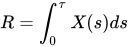
[edit]- By the renewal reward theorem, with probability 1,[8]
![{\displaystyle \lim _{t\to \infty }{\frac {1}{t}}\int _{0}^{t}X(s)ds={\frac {\mathbb {E} [R]}{\mathbb {E} [\tau ]}}.}](https://wikimedia.org/api/rest_v1/media/math/render/svg/6be9350adf772ff867cbb45a686b909bb1e86cac)
- where is the length of the first cycle and is the value over the first cycle.

- A measurable function of a regenerative process is a regenerative process with the same regeneration time[8]
References
[edit]- ^ Hurter, A. P.; Kaminsky, F. C. (1967). "An Application of Regenerative Stochastic Processes to a Problem in Inventory Control". Operations Research. 15 (3): 467–472. doi:10.1287/opre.15.3.467. JSTOR 168455.
- ^ Ross, S. M. (2010). "Renewal Theory and Its Applications". Introduction to Probability Models. pp. 421–641. doi:10.1016/B978-0-12-375686-2.00003-0. ISBN 9780123756862.
- ^ Schellhaas, Helmut (1979). "Semi-Regenerative Processes with Unbounded Rewards". Mathematics of Operations Research. 4: 70–78. doi:10.1287/moor.4.1.70. JSTOR 3689240.
- ^ Smith, W. L. (1955). "Regenerative Stochastic Processes". Proceedings of the Royal Society A: Mathematical, Physical and Engineering Sciences. 232 (1188): 6–31. Bibcode:1955RSPSA.232....6S. doi:10.1098/rspa.1955.0198.
- ^ a b c d Sheldon M. Ross (2007). Introduction to probability models. Academic Press. p. 442. ISBN 0-12-598062-0.
- ^ a b Haas, Peter J. (2002). "Regenerative Simulation". Stochastic Petri Nets. Springer Series in Operations Research and Financial Engineering. pp. 189–273. doi:10.1007/0-387-21552-2_6. ISBN 0-387-95445-7.
- ^ a b Asmussen, Søren (2003). "Regenerative Processes". Applied Probability and Queues. Stochastic Modelling and Applied Probability. Vol. 51. pp. 168–185. doi:10.1007/0-387-21525-5_6. ISBN 978-0-387-00211-8.
- ^ a b Sigman, Karl (2009) Regenerative Processes, lecture notes