


Community hub
Recent from talks
Contribute something
Nothing was collected or created yet.
Rivne
View on Wikipedia
Rivne (/ˈrɪvnə/ RIV-nə; Ukrainian: Рівне, IPA: [ˈr⁽ʲ⁾iu̯ne] ⓘ) is a city in western Ukraine. The city is the administrative center of Rivne Oblast (province), as well as the Rivne Raion (district) within the oblast.[2] It has a population of 243,873 (2022 estimate).[3]
Key Information


_%D0%A4%D0%B0%D1%81%D0%B0%D0%B4.JPG)

.jpg)


In the spring of 1919, it also served as a provisional seat of the Ukrainian government throughout the ongoing war with Soviet Russia. Between World War I and World War II, the city was located in Poland as a district-level (county) seat in Wolyn Voivodeship. At the start of World War II in 1939, Rivne was occupied by the Soviet Red Army and received its current status by becoming a seat of regional government of the Rivne Oblast which was created out of the eastern portion of the voivodeship. During the German occupation of 1941–44 the city was designated as a capital of German Ukraine (Reichskommissariat Ukraine).
Rivne is an important transportation hub, with the international Rivne Airport, and rail links to Zdolbuniv, Sarny, and Kovel, as well as highways linking it with Brest, Kyiv and Lviv. Among other leading companies there is a chemical factory of Rivne-Azot (part of Ostchem Holding).
Names
[edit]History
[edit]Middle Ages
[edit]Rivne was first mentioned in 1283 in the Polish annals Rocznik kapituły krakowskiej[5][6] as one of the inhabited places of Halych-Volhynia near which Leszek II the Black was victorious over a part of the Grand Ducal Lithuanian Army. Following the Kingdom of Galicia–Volhynia's partition after Galicia–Volhynia Wars in the late 14th century, it was under the rule of Grand Duchy of Lithuania and in 1434 the Grand Duke of Lithuania Švitrigaila awarded the settlement to a Lutsk nobleman Dychko.[5] In 1461 Dychko sold his settlement to Prince Semen Nesvizh.[5][6] In 1479 Semen Nesvizh died and his settlement was passed to his wife Maria who started to call herself princess of Rivne.[6] She turned the settlement into a princely residence by building in 1481[5] a castle on one of local river islands and managed to obtain Magdeburg rights for the settlement in 1492 from the King of Poland Casimir IV Jagiellon.[6] Following her death in 1518, the city was passed on to the princes of Ostrog and declined by losing its status as a princely residency.[5]
In 1566 the town of Rivne became part of newly established Volhynian Voivodeship. Following the Union of Lublin in 1569, it was transferred from the Grand Duchy of Lithuania to the Kingdom of Poland.[5][6] The city had a status of a private town held by nobles (Ostrogski and Lubomirski families). Following the Second Partition of Poland in 1793 Rivne became a part of the Russian Empire, and in 1797 it was declared to be a county level (uyezd) town of the Volhynian Governorate.
World War I
[edit]
During World War I and the period of chaos shortly after, it was briefly under German, Ukrainian, Bolshevik, and Polish rule. During April–May 1919 Rivne served as the temporary capital[citation needed] of the Ukrainian People's Republic. In late April 1919 one of the Ukrainian military leaders Volodymyr Oskilko attempted to organize a coup-d'état against the Directorate led by Symon Petliura and the cabinet of Borys Martos and replace them with Yevhen Petrushevych as president of Ukraine. In Rivne, Oskilko managed to arrest most of the cabinet ministers including Martos himself, but Petliura at that time was in neighboring Zdolbuniv and managed to stop Oskilko's efforts. At the conclusion of the conflict, in accordance with the Riga Peace Treaty of 1921, it became a part of Polish Volhynian Voivodeship, a situation which would last until the Second World War. Before World War II, Rivne (Równe) was a mainly Jewish-Polish city (Jews constituted about 50% of the city's population, and Poles 35%).
World War II
[edit]In 1939, as a result of the Molotov–Ribbentrop Pact and the partition of Poland, Rivne was occupied by the Soviet Union. Starting December of that year Rivne became the center of the newly established Rivne Oblast in the Ukrainian SSR.
.jpg)
On 28 June 1941 Rivne was invaded by the 6th army of Nazi Germany. On 20 August, the Nazis declared it the administrative center of Reichskommissariat Ukraine. A Gestapo prison opened on Belaia Street.[7][better source needed] Roughly half of Rivne's inhabitants were Jewish.
On 6–8 November, 17,500 Jewish adults from Rivne were shot to death or thrown alive into a large pit in a pine grove in Sosenki, a nearby wooded area (sometimes referred to as Sosenki Forest), and 6,000 Jewish children suffered the same fate at a nearby site.[8] From 8-13 November German actor Olaf Bach was flown to the city to perform for the German forces.[citation needed] The city's remaining Jews were sent to Rivne Ghetto. In July 1942, they were sent 70 km (43 mi) north to Kostopil and shot to death.
On 2 February 1944, the city was captured by the Red Army in the Battle of Rivne, and remained under Soviet control until Ukraine regained its independence on the break-up of the USSR in 1991. Poles from Rivne were deported to Poland's new borders after 1945.
Post-war era
[edit]In 1958, a TV tower began broadcasting in the city; in 1969, the first trolley ran through the city; in 1969, Rivne airport opened. In 1983, the city celebrated its 700th anniversary.
On 11 June 1991, the Ukrainian parliament officially renamed the city Rivne according to the rules of Ukrainian orthography. It had previously been known as Rovno.[2]
Russo-Ukrainian War
[edit]On 14 March 2022, Rivne TV Tower has experienced heavy missile attack by Russian troops. The tower was damaged and an administrative room was destroyed. As a result of attack 20 people were killed and nine injured.[9][10][11]
Population
[edit]| Year | Pop. | ±% |
|---|---|---|
| 1897 | 24,573 | — |
| 1921 | 30,482 | +24.0% |
| 1939 | 43,000 | +41.1% |
| 1959 | 59,598 | +38.6% |
| 1970 | 115,541 | +93.9% |
| 1979 | 178,956 | +54.9% |
| 1989 | 227,925 | +27.4% |
| 2001 | 248,813 | +9.2% |
| 2011 | 249,840 | +0.4% |
| 2022 | 243,873 | −2.4% |
| Source: [12] | ||
Ethnic groups
[edit]Distribution of the population by ethnicity according to the 2001 Ukrainian census:[13]
Language
[edit]Distribution of the population by native language according to the 2001 census:[14]
| Language | Number | Percentage |
|---|---|---|
| Ukrainian | 225 899 | 92.08% |
| Russian | 18 346 | 7.48% |
| Other or undecided | 1 078 | 0.44% |
| Total | 245 323 | 100.00 % |
According to a survey conducted by the International Republican Institute in April–May 2023, 96% of the city's population spoke Ukrainian at home, and 3% spoke Russian.[15]
Geography
[edit]Climate
[edit]Rivne has a moderate continental climate with cold, snowy winters and warm summers. Snow cover usually lasts from November until March.[16] The average annual precipitation is 598 mm (24 in) June and July being the wettest months and January and February the driest.
| Climate data for Rivne, Ukraine (1991–2020, extremes 1951–present) | |||||||||||||
|---|---|---|---|---|---|---|---|---|---|---|---|---|---|
| Month | Jan | Feb | Mar | Apr | May | Jun | Jul | Aug | Sep | Oct | Nov | Dec | Year |
| Record high °C (°F) | 13.9 (57.0) |
16.7 (62.1) |
26.2 (79.2) |
30.5 (86.9) |
33.0 (91.4) |
34.2 (93.6) |
35.3 (95.5) |
37.0 (98.6) |
36.4 (97.5) |
26.2 (79.2) |
21.2 (70.2) |
14.5 (58.1) |
37.0 (98.6) |
| Mean daily maximum °C (°F) | −0.9 (30.4) |
0.7 (33.3) |
6.2 (43.2) |
14.5 (58.1) |
20.3 (68.5) |
23.4 (74.1) |
25.3 (77.5) |
25.0 (77.0) |
19.3 (66.7) |
12.7 (54.9) |
5.6 (42.1) |
0.5 (32.9) |
12.7 (54.9) |
| Daily mean °C (°F) | −3.4 (25.9) |
−2.4 (27.7) |
1.9 (35.4) |
9.0 (48.2) |
14.4 (57.9) |
17.8 (64.0) |
19.5 (67.1) |
18.9 (66.0) |
13.7 (56.7) |
8.1 (46.6) |
2.7 (36.9) |
−1.8 (28.8) |
8.2 (46.8) |
| Mean daily minimum °C (°F) | −5.9 (21.4) |
−5.2 (22.6) |
−1.8 (28.8) |
3.7 (38.7) |
8.9 (48.0) |
12.3 (54.1) |
14.0 (57.2) |
13.1 (55.6) |
8.7 (47.7) |
4.2 (39.6) |
0.2 (32.4) |
−4.1 (24.6) |
4.0 (39.2) |
| Record low °C (°F) | −34.5 (−30.1) |
−32.6 (−26.7) |
−26.3 (−15.3) |
−11.5 (11.3) |
−3.8 (25.2) |
2.0 (35.6) |
5.7 (42.3) |
1.8 (35.2) |
−3.5 (25.7) |
−10.0 (14.0) |
−20.1 (−4.2) |
−26.1 (−15.0) |
−34.5 (−30.1) |
| Average precipitation mm (inches) | 32 (1.3) |
31 (1.2) |
35 (1.4) |
38 (1.5) |
66 (2.6) |
75 (3.0) |
94 (3.7) |
58 (2.3) |
58 (2.3) |
45 (1.8) |
36 (1.4) |
41 (1.6) |
601 (23.7) |
| Average extreme snow depth cm (inches) | 6 (2.4) |
7 (2.8) |
5 (2.0) |
0 (0) |
0 (0) |
0 (0) |
0 (0) |
0 (0) |
0 (0) |
0 (0) |
1 (0.4) |
4 (1.6) |
7 (2.8) |
| Average rainy days | 8 | 7 | 10 | 13 | 15 | 17 | 16 | 12 | 15 | 13 | 12 | 11 | 149 |
| Average snowy days | 17 | 17 | 10 | 3 | 0.2 | 0 | 0 | 0 | 0.03 | 1 | 8 | 15 | 71 |
| Average relative humidity (%) | 86.9 | 84.6 | 77.8 | 67.2 | 68.3 | 71.5 | 73.5 | 71.3 | 76.7 | 81.2 | 87.2 | 88.6 | 77.9 |
| Source 1: Pogoda.ru[17] | |||||||||||||
| Source 2: NOAA (humidity 1991–2020)[18] | |||||||||||||
Industry
[edit]During Soviet times the provincial town was transformed into an industrial center of the republic. There were two significant factories built. The first was a machine building and metal processing factory capable of producing high-voltage apparatus, tractor spare parts and others. The other was a chemical factory and synthetic materials fabrication plant. Light industry, including a linen plant and a textile mill, as well as food industries, including milk and meat processing plants and a vegetable preservation plant, have also been built. In addition the city became a production center for furniture and other building materials. [citation needed]
Landmarks
[edit]
As an important cultural center, Rivne hosts a humanities and a hydro-engineering university, as well as a faculty of the Kyiv State Institute of Culture,[citation needed] and medical and musical as well as automobile-construction, commercial, textile, agricultural and cooperative polytechnic colleges. The city has a historical museum.
Following the fall of the Soviet Union, the monument for the Soviet hero Dmitry Medvedev was removed, and the Nikolai Kuznetsov monument was moved to another location within the city. Instead, in order to reflect the controversial history of the region the monuments for "People who died in the honor of Ukraine", and "Soldiers who died in local military battles" were installed.
Buildings
[edit]
- Church of the Assumption (1756)
- Cathedral of the Intercession (2001)
- Cathedral of the Ascension (1890)
- A classicism-style gymnasium building (1839)
- During Soviet times the center of the city from Lenin street to Peace Avenue (1963 architects R.D. Vais and O.I. Filipchuk) was completely rebuilt with Administrative and Public buildings in neo-classical, Stalinist style.
Memorials
[edit]The following memorials are found in Rivne:[19]
- Monument to the 25th Anniversary of the Liberation of Rivne from the Fascists, Mlynivs'ke Highway
- Monument to the Victims of Fascism, Bila Street Square (1968, by A.I. Pirozhenko and B.V. Rychkov, architect-V.M.Gerasimenko)
- Bust on the Tomb of Partisan M. Strutyns'ka and Relief on the Tomb of Citizens S. Yelentsia and S. Kotiyevs'koho, Kniazia Volodymyra Street, Hrabnyk Cemetery
- Monument to the Perished of Ukraine, Magdeburz'koho Prava Plaza
- Communal Grave of Warriors, Soborna Street

Memorial to Warriors' Glory, Dubenska Street, Rivne Military Cemetery - Monument of Eternal Glory, Kyivs'ka Street
- Monument to Taras Shevchenko, T.G. Shevchenko Park; Statue on Nezalezhnosti Plaza
- Memorial to Warriors' Glory, Dubens'ka Street, Rivne Military Cemetery (1975, by M.L. Farina, architect-N.A. Dolgansky)
- Monument to the Warrior and the Partisan, Peremohy Plaza (1948 by I.Ya. Matveenko)
- Monument to Colonel Klym Savura, Commander of the Ukrainian People's Army, Soborna Street
- Monument to Symon Petliura, Symon Petliura Street
- Monument to N.I. Kuznetsov (bronze and granite, 1961 by V.P Vinaikin)
- In 1992, a 20,000-square-metre (4.9-acre) memorial complex was established at the site of the World War II massacre to commemorate the 17,500 Jews murdered there in November 1941 during the Holocaust, marking the mass grave with an obelisk inscribed in Yiddish, Hebrew and Ukrainian.[20] On 6 June 2012, the World War II Jewish burial site was vandalised, as part of an antisemitic attack.[21]
- Monument to the victims of the Chernobyl disaster, Simon Petliura Street
- Statue and Plaza dedicated to Maria Rivnens'ka, Soborna Street

Popular culture references
[edit]- In his memoir A Tale of Love and Darkness, Israeli author Amos Oz describes Rivne through the memories of his mother and her family, who grew up in the city before emigrating to Israel in the 1930s.[22]
- Rivne was mentioned several times in The Tale of the Nightly Neighbors, a 1992 episode of the Canadian-American TV show Are You Afraid of the Dark?, being referred to by a variation of its pre-1991 name (either Ravno or Rovno).
- In Leonard Bernstein's operetta Candide, the character of The Old Lady sings an aria "I am easily assimilated", in which she refers to her father having been born in Rovno Gubernya
Sport
[edit]Rugby
[edit]- RC Rivne (1999)
Speedway
[edit]The Rivne Speedway Stadium hosts the speedway club Rivne Speedway.[23][24][25]
The stadium opened on 24 May 1959.[citation needed] The venue has hosted significant speedway events including a qualifying round of the Speedway World Championship in 1962.[26][27] and 1991.
Notable people
[edit].jpg)


.jpg)
- Anna Belfer-Cohen (born 1949), Israeli archaeologist and paleoanthropologist
- Dahn Ben-Amotz (1924–1989), Israeli radio broadcaster, journalist, playwright and author
- Ancestors of Leonard Bernstein (1918–1990), the American composer include his father, Samuel, who was born in Berezdiv and his mother, Jennie, born in Sheptevoka in the Rovno region. In Bernstein's operetta Candide, the character of The Old Lady sings an aria, "I am easily assimilated", in which she refers to her father as having been born in Rovno Gubernya
- Zuzanna Ginczanka,(1917–1945), Polish poet of the interwar period.
- Erast Huculak (1930–2013), Canadian businessman, public figure and philanthropist
- Artem Kachanovskyi (born 1992), 2-dan professional Go player, three-time European Champion, Editor-in-chief of the European Go Journal.[28][29]
- Jan Kobylański (1923–2019), Polish-Paraguayan businessman, founder of the Union of Polish Associations and Organizations in Latin America
- Olga Kulchynska (born 1990), Ukrainian soprano opera singer
- Sophie Irene Loeb (1876–1929), American journalist and social welfare advocate
- Yuriy Lutsenko (born 1964), politician and Prosecutor General of Ukraine, 2016 to 2019
- Oksana Markarova (born 1976), Minister of Finance, 2018 to 2020 and diplomat
- Nazar Nebozhynskyi (1999–2022), Ukrainian athlete, soldier, Hero of Ukraine
- Natalya Pasichnyk (born 1971), Swedish-Ukrainian classical pianist, she lives in Stockholm
- Olga Pasichnyk (born 1968), Polish-Ukrainian classical soprano singer, she lives in Poland
- Both parents of the Argentinian poet Alejandra Pizarnik (1936-1972) emigrated from Rivne to Buenos Aires in 1934
- Stanisław Albrecht Radziwiłł (1914–1976) Polish nobleman, a scion of the House of Radziwiłł
- Shmuel Shoresh (1913–1981), Israeli politician, member of the Knesset from 1955 until 1969
- Boris Smolar (1897–1986), American journalist and newspaper editor
- Mira Spivak (born 1934), member of the Senate of Canada representing Manitoba
- Anna Walentynowicz (1929–2010), Polish free trade union activist and co-founder of Solidarity
- Brenda Weisberg (1900–1996), Russian-American screenwriter of monster movies, thrillers & family films
- Wladimir Wertelecki (born 1936), pediatrician, medical geneticist and teratologist in the US
- Anatolii Yarovyi, lawyer
- Yaroslav Yevdokimov (born 1946), baritone singer.[30]
- Vsevolod Zaderatsky (1891–1953), Russian Imperial and Ukrainian Soviet composer, pianist and teacher
- Yana Zinkevych (born 1995), Ukrainian member of parliament and military veteran
- Moishe Zilberfarb (1876-1934), Ukrainian politician, diplomat, and public activist
- Maksym Kryvtsov (1990–2024), Ukrainian poet, public figure, volunteer, soldier of the Armed Forces of Ukraine, and participant in the Russian-Ukrainian war
- Grygorii Tsekhmistrenko (1994–2023), Canadian civic activist, volunteer medic of Ukrainian origin, soldier of the International Legion of the Armed Forces of Ukraine, participant of the Russian-Ukrainian war
Sport
[edit]- Serhiy Honchar (born 1970), professional road racing cyclist
- Serhiy Lishchuk (born 1982), basketball player, Valencia BC legend, nicknamed "the Ukraine Train"
- Mykhailo Romanchuk (born 1996), swimmer, silver & bronze medallst at the 2020 Summer Olympics
- Viktor Trofimov (1938–2013), former Soviet international speedway rider
- Alla Tsuper (born 1979), Ukrainian and Belarusian aerial skier and gold medallist at the 2014 Winter Olympics
- Ancestors of Demian Maia (born 1977), UFC Fighter, BJJ Champion and ADCC Champion. His grandfather Stefan Szwec came from Rovno, village of Shpaniv to Brazil in 1926. Demian Maia’s grandmother, Eugenia Kirilchuk, also came from Rovno region.
International relations
[edit]Twin towns – Sister cities
[edit]Rivne is twinned with:
 Vidin in Bulgaria
 Kobuleti in Georgia
 Oberviechtach in Germany
 Gdańsk in Poland
- Lublin in Poland
- Piotrków Trybunalski in Poland
- Radomsko County in Poland
- Zabrze in Poland
 Zvolen in Slovakia
 Federal Way in the United States[31]
- East Brunswick, New Jersey in the United States


Gallery
[edit]-
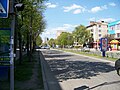 Prospect Myru (Peace Avenue)
 -
 Soborna (Cathedral) Street
 -
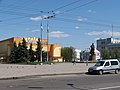 Independence square with cinema and statue of Taras Shevchenko
 -
 Railway terminal
 -
 Saint Peter and Paul church
 -
 Saint Nicholas Monastery


See also
[edit]Notes
[edit]References
[edit]- ^ a b Young Ukrainian mayor offers hope of a new politics Archived 2021-03-24 at the Wayback Machine UkraineAlert by Brian Mefford, Atlantic Council (22 March 2021)
- ^ a b On bringing the name of Rovno city and Rovno Oblast in accordance to rules of Ukrainian spelling Archived 2015-10-05 at the Wayback Machine. Ukrainian parliament. 11 June 1991
- ^ Чисельність наявного населення України на 1 січня 2022 [Number of Present Population of Ukraine, as of January 1, 2022] (PDF) (in Ukrainian and English). Kyiv: State Statistics Service of Ukraine. Archived (PDF) from the original on 4 July 2022.
- ^ "Про приведення назви міста Ровно і Ровенської області у відповідність до правил українського правопису". zakon.rada.gov.ua.
- ^ a b c d e f Bovhyria, A. Rivne (РІВНЕ) Archived 2018-05-22 at the Wayback Machine. Encyclopedia of History of Ukraine.
- ^ a b c d e History of Rivne (Історія Рівне) Archived 2018-05-22 at the Wayback Machine. Ukraine-in portal.
- ^ Burds, Jeffrey (2013). "Holocaust in Rovno: The Massacre at Sosenki Forest, November 1941" (PDF). www.jewishgen.org. p. 86. Archived (PDF) from the original on 7 December 2019. Retrieved 13 April 2020.
- ^ This Ukrainian City Was Once Home to a Vibrant Jewish Community. Now Its Grand Synagogue Is a Sports Hall, Haaretz
- ^ "Атака на телевежу Рівненщини: підтверджено вже 20 загиблих, можливо, є шанси врятувати ще одну людину, - голова ОВА". LB.ua. Retrieved 16 March 2022.
- ^ "Удар по телевежі на Рівненщині: кількість загиблих зросла до 19". www.ukrinform.ua (in Ukrainian). Retrieved 16 March 2022.
- ^ "Number of victims of missile strike on Rivne's TV tower grown to 19, removal of rubble continues – local authorities". Interfax-Ukraine. Retrieved 16 March 2022.
- ^ "Cities & Towns of Ukraine".
- ^ "Національний склад міст".
- ^ "Рідні мови в об'єднаних територіальних громадах України" (in Ukrainian).
- ^ "Municipal Survey 2023" (PDF). ratinggroup.ua. Retrieved 9 August 2023.
- ^ "Rivne, Ukraine Climate Data". Climatebase. Archived from the original on 22 May 2013. Retrieved 21 January 2013.
- ^ Погода и Климат – Климат Ровно [Weather and Climate – The Climate of Rivne] (in Russian). Weather and Climate (Погода и климат). Archived from the original on 3 March 2021. Retrieved 8 November 2021.
- ^ "Rivne Climate Normals 1991–2020". World Meteorological Organization Climatological Standard Normals (1991–2020). National Centers for Environmental Information. Archived from the original on 22 April 2025. Retrieved 22 April 2025.
- ^ (in Ukrainian) Рівне, план міста, 1:12000. Міста України. Картографія.
- ^ "Memorial to the Murdered Jews of Rivne". Information Portal to European Sites of Remembrance. Berlin, Germany: Stiftung Denkmal für die ermordeten Juden Europas. Archived from the original on 6 February 2020. Retrieved 5 February 2020.
- ^ "В Ривне вандалы осквернили место массового расстрела евреев". MIG news.com.ua. 7 June 2012. Archived from the original on 8 June 2012. Retrieved 27 July 2012.
- ^ Oz, Amos, 2004, A Tale of Love and Darkness, pp. 132-190.
- ^ "Speedway Club". Rivne Speedway 1959. Archived from the original on 24 January 2024. Retrieved 24 January 2024.
- ^ "Speedway Veterans Open Cup". Mogul Oil. Retrieved 24 January 2024.
- ^ "ROVNO - Ukraine". Speedway Plus. Retrieved 24 January 2024.
- ^ "1962 World Championship". Metal Speedway. Retrieved 20 January 2024.
- ^ "1962 World Championship". Speedway.org. Retrieved 20 January 2024.
- ^ "European Pros - Artem Kachanovskyi". www.eurogofed.org. Retrieved 26 February 2022.
- ^ "European Go Journal". eurogojournal.com. Retrieved 26 February 2022.
- ^ Артист Ярослав Евдокимов рассказал «ОГ» о своих корнях Archived 2015-05-03 at the Wayback Machine Областная газета, 12 ноября 2013
- ^ "Federal Way welcomes Rivne, Ukraine as sister city". March 4, 2022. Retrieved Mar 18, 2022.
Maps
[edit]- (in Ukrainian) Рівне, план міста, 1:12000. Міста України. Картографія.
- infomisto.com — map of the Rivne, information and reference portal.
External links
[edit]


- Official website of Rivne City Council and Rivne City Administration Archived 2007-11-01 at the Wayback Machine (in Ukrainian)
- Rivne Bird webcam Archived 28 November 2020 at the Wayback Machine (in Ukrainian)
- Rivne Places of Interest (in English)
- Rowno, a Memorial to the Jewish Community of Rowno, Volyn (Rivne, Ukraine) (in English)
- The Jewish Community of Rivne Archived 21 September 2020 at the Wayback Machine, The Museum of the Jewish People at Beit Hatfutsot (in English)
- Rivne, Ukraine at JewishGen
| International | |
|---|---|
| National | |
| Geographic | |
| Other | |

Rivne
View on GrokipediaRivne is a city in northwestern Ukraine that serves as the administrative, economic, and cultural center of Rivne Oblast.[1] The city covers an area of 62.7 square kilometers and has a population of approximately 250,000 residents.[1] First documented in historical records dating to 1283, Rivne has evolved from a medieval settlement into a modern regional hub.[2] The city's economy is diversified, encompassing manufacturing sectors such as machinery, food processing, woodworking, and furniture production, supported by its strategic location and infrastructure conducive to business development.[3][4] It also features mining and energy supply industries, contributing to its role as one of Ukraine's cities with a favorable economic climate for entrepreneurship.[5][6] Rivne's historical significance includes its position within the Polish-Lithuanian Commonwealth, later the Russian Empire, and the Soviet Union, before becoming part of independent Ukraine in 1991.[7] Notable landmarks include the Rivne Regional Drama and Music Theater and educational institutions like the National University of Water and Environmental Engineering, underscoring its cultural and academic prominence in western Ukraine.[8] The city maintains a strategic position near the border with Belarus, facilitating trade and regional connectivity.[9]
Names and Etymology
Historical and Alternative Names
Rivne's earliest recorded mention dates to 1282, when it appears in historical documents as the site of a battle between Polish Prince Leszek Czarny and Lithuanian noble Vitoldas (Vitenas).[10] Subsequent medieval references, including those from 1283, describe it in the context of regional conflicts within the Kingdom of Galicia–Volhynia, using variants approximating "Riwne" in Old East Slavic sources.[11] Under Polish-Lithuanian Commonwealth rule from the 14th to 18th centuries, the settlement was known as Równe, reflecting Polish linguistic conventions and administrative documentation.[12] During the period of Russian Empire control after the Partitions of Poland (1793–1917), the name standardized to Rovno (Ровно) in official Russian usage, which emphasized phonetic adaptation to Russian orthography.[13] In Yiddish, spoken by the significant Jewish population, it was rendered as Rovne (ראָוונע), as evidenced in community records and literature from the 19th and early 20th centuries.[12] These multilingual designations underscored Rivne's position in multi-ethnic territories, with Polish, Russian, and Yiddish forms persisting into the interwar Second Polish Republic era (1918–1939), where Równe remained prevalent in Polish governance.[14] Following Soviet incorporation after World War II, Rovno dominated in Cyrillic-based administration until Ukraine's independence. On 11 June 1991, shortly before formal independence, the Verkhovna Rada standardized the name to Rivne (Рівне) to conform to contemporary Ukrainian orthographic norms, replacing the Russified Rovno form used in Soviet-era Ukrainian transliteration.[11] This adjustment aligned with broader post-Soviet efforts to revive indigenous linguistic standards amid national reassertion.[15]Linguistic Origins
The name Rivne (Ukrainian: Рівне) originates from the East Slavic linguistic root denoting flat or level terrain, specifically tied to the Ukrainian adjective рівний (rivnyy), meaning "even," "flat," or "smooth." This derivation reflects the city's position amid the expansive Polesian plains in northern Volhynia, where the landscape features minimal elevation changes and broad, undifferentiated lowlands formed by glacial and fluvial processes during the Pleistocene epoch.[8] The term aligns with Proto-Slavic rovьnъ, an adjective reconstructed from comparative Slavic morphology to signify level ground or equality in elevation, as evidenced by cognates in modern Slavic languages such as Russian ровный (rovnyy, "even") and Polish równy ("flat" or "equal"). No primary linguistic evidence supports pre-Slavic substrates, such as hypothetical Indo-European or Finno-Ugric influences, despite occasional speculative claims in regional folklore; such assertions lack attestation in archaeological or onomastic records predating Slavic settlement in the region around the 6th century CE. Comparative toponymy within Ukraine reinforces this Slavic hydraulic and topographic basis. For instance, rivnyna (рівнина), the Ukrainian term for "plain" or "steppe," directly parallels the city's name and appears in hydronyms like the nearby Ustia River basin, where flat alluvial deposits dominate. Similar formations occur in other East Slavic locales, such as the village of Rivne in Lviv Oblast, which shares the same root and terrain association, indicating a pattern of descriptive naming for low-relief geographies rather than ethnic or mythical connotations. Polish variants like Równe preserve the phonetic and semantic integrity, evolving under shared Common Slavic phonology without introducing non-native elements. This etymological consistency underscores a purely Slavic genesis, unadulterated by later imperial overlays like Russian Ровно (Rovno), which retained the core meaning but adapted orthography during the 19th-century Russification period.[16][13]Geography
Location and Physical Features
Rivne is situated at coordinates 50°37′N 26°15′E in the northern part of Rivne Oblast, northwestern Ukraine.[17] The city lies on the banks of the Ustia River, a small waterway in the Horyn River basin.[18] It is positioned approximately 328 kilometers west of Kyiv by road.[19] The municipal area spans 64 square kilometers, encompassing flat to gently rolling terrain at the transition between the northern Polesian Lowland and the southern Volhynian Upland.[8][20] Elevations in the vicinity range from about 150 to 200 meters above sea level, with the Ustia River contributing to local drainage and minor valley features.[18] Rivne's location lies roughly 200 kilometers east of the Polish border, placing it within the broader Volhynian geographic region.[4]Climate and Environmental Conditions
Rivne experiences a humid continental climate classified as Dfb under the Köppen-Geiger system, characterized by cold, snowy winters and warm summers without dry seasons.[21] The average annual temperature is approximately 8.7°C, with January averages around -5°C (ranging from highs near -1°C to lows of -9°C) and July averages near 18°C (highs up to 26°C and lows around 15°C).[22] Winters last about four months, often featuring persistent snow cover and frequent fog due to temperature inversions over the region's flat terrain and proximity to rivers.[23] Annual precipitation totals roughly 650-750 mm, distributed relatively evenly but with peaks in summer months like June and July, when convective storms contribute to heavier rainfall. The area is susceptible to occasional summer droughts, particularly in recent decades, as prolonged dry spells have reduced soil moisture in western Ukraine's agricultural zones.[24] Winters see lower precipitation, mostly as snow or sleet, exacerbating foggy conditions that can persist for days and impact visibility.[24] From 2020 to 2025, temperature records indicate mild warming trends consistent with broader Ukrainian patterns, with warm-season increases of 0.3-0.5°C per decade observed in regional data.[24] The Russo-Ukrainian War, beginning in 2022, disrupted industrial emissions in Rivne Oblast through reduced operations and population displacements, leading to localized improvements in air quality metrics like CO concentrations (down ~3-4% in early war phases across Ukraine).[25] However, episodic spikes in particulate matter from distant wildfires and military logistics have occasionally elevated PM levels, though Rivne's western location has limited direct exposure compared to eastern regions.[26] Overall, baseline air quality remains moderate, with PM2.5 averages below 15 μg/m³ in non-event periods, supported by the area's low-density forests and wetlands that aid natural filtration.[27]History
Origins and Medieval Period
Rivne emerged as a fortified settlement within the Principality of Galicia-Volhynia during the 13th century, positioned as a strategic border outpost amid the fragmented Rus' polities to defend against incursions from nomadic groups and rival principalities.[10] The site's initial development centered on a wooden fortress, typical of defensive structures in the region that relied on local timber and elevation for protection, facilitating control over trade routes linking Kyiv to Volodymyr-Volynskyi.[10] This location underscored its role in the principality's efforts to consolidate authority in Volhynia following the Mongol disruptions to Kievan Rus' after 1240, when Batu Khan's forces subjugated much of the area, imposing tribute and periodic raids that hampered centralized governance. The fortress likely served as a vantage for monitoring threats from the steppe, with archaeological evidence from similar Volhynian sites indicating earthworks and palisades augmented by watchtowers. The settlement's earliest surviving record dates to 1282, chronicled in Polish annals as the location of a skirmish between Polish Prince Leszek II the Black and Lithuanian forces under Duke Vitenas, highlighting Rivne's frontier volatility even before full Mongol consolidation.[10] Throughout the late 13th and 14th centuries, Rivne and surrounding Volhynian territories suffered repeated devastation from Tatar-Mongol raids emanating from the Golden Horde, which targeted undefended wooden structures and disrupted agrarian economies; these incursions, peaking after the 1241 sack of Kyiv, reduced populations and stalled urban growth, with local chronicles noting widespread burning and enslavement in the principality.[28] The principality's weakening culminated in the death of King Yuri II Boleslav in 1340, fragmenting control and exposing Rivne to power vacuums exploited by Poland and Lithuania.[10] By the mid-14th century, specifically the 1350s, Rivne fell under the Grand Duchy of Lithuania's dominion as Gediminas's successors incorporated Volhynia to counter Polish expansion and Horde influence, integrating it into a multi-ethnic realm where Ruthenian customs persisted under Lithuanian overlordship.[5] Rebuilt amid these shifts, the town regained viability as a commercial node on revived trade paths, benefiting from Lithuania's relative stability against Horde raids compared to southern Rus' lands. By the late 14th century, Rivne obtained Magdeburg rights, granting self-governance, market privileges, and legal autonomy to burghers, which spurred craft guilds and fairs while embedding it in feudal hierarchies.[10] In the 1430s, amid the Polish-Lithuanian union's deepening ties via the 1385 Krewo agreement, Rivne transitioned to private ownership by regional nobility of Polish-Lithuanian orientation, such as precursors to the Ostrozky family, instituting manorial systems where lords extracted rents and labor from peasants, solidifying feudal land tenure over princely domains.[10] This arrangement prioritized noble patronage for defense and development, reflecting causal incentives in medieval Eastern European polities where fragmented sovereignty favored privatized fiefs for loyalty and revenue.Early Modern Era (16th-19th Centuries)
Following the Union of Lublin in 1569, Rivne was incorporated into the Polish Crown as part of the Polish-Lithuanian Commonwealth, shifting administrative control from the Grand Duchy of Lithuania to a more centralized Polish-dominated structure that facilitated economic integration across the federation.[10] This transition encouraged Jewish settlement, with records indicating a Jewish presence in Rivne by the 16th century, growing to 890 Jews in the town and 296 in surrounding villages by 1765, driven by opportunities in trade and crafts amid the Commonwealth's relative religious tolerance compared to Western Europe.[29][30] The weakening of the Polish-Lithuanian Commonwealth amid internal divisions and external pressures led to the Second Partition of Poland in 1793, whereby Rivne was annexed by the Russian Empire and integrated into the Volhynia Governorate as the center of Rovno County (uyezd), elevating its status as an administrative hub with established markets for local goods.[10][30] Under Russian rule, Rivne's economy oriented toward export-oriented agriculture and forestry, with periodic fairs supporting commerce in regional products. In the 19th century, infrastructure improvements transformed Rivne from a modest administrative outpost into a key nodal point, including the completion of the Odesa-Warsaw railway line in 1873, followed by connections to Lviv-Kovel in 1890 and Brest-Rivne, which lowered transport costs and expanded markets for grain, timber, and forest products.[10][14] These developments, spurred by imperial efforts to modernize logistics in the Pale of Settlement periphery, boosted Rivne's role in exporting lumber, grains, and ancillary goods like hops and dairy, linking local estates to broader Russian and European trade networks.[14]World War I and Interwar Years
During World War I, Rivne lay on the Eastern Front within the Russian Empire's Volhynia Governorate, experiencing intense combat as Russian forces retreated amid the German Gorlice-Tarnów Offensive. German troops captured the city in late September 1915 during the Rovno Offensive (27 August–15 October 1915), holding it until the armistice in 1918. The occupation entailed systematic requisitions of food, livestock, and labor, exacerbating wartime shortages and contributing to civilian flight; the surrounding region's depopulation was severe, with battles and scorched-earth tactics displacing thousands and reducing local agricultural output.[31] Following the war's end, Rivne briefly fell under the control of the Ukrainian People's Republic (UNR) in late 1918, serving as its temporary capital in spring 1919 amid conflicts with Bolshevik forces in eastern Volhynia and Polish advances in the west. UNR Directory government operations relocated there in April 1919 to evade Soviet encirclement, but Polish forces recaptured the city by May, incorporating it into the Second Polish Republic after the Polish-Soviet War concluded with the Treaty of Riga on 18 March 1921. This period of flux saw sporadic fighting, further straining resources and delaying reconstruction.[32] Under interwar Polish administration, Rivne functioned as a county seat in the Wołyń Voivodeship, with a population of approximately 28,000 in 1920—rising modestly thereafter—dominated by Jews (around 77% or 21,702 individuals in 1920, declining relatively to about 60% by 1931 with 22,737 Jews). Poles constituted the second-largest group (increasing due to administrative colonization policies), followed by Ukrainians, reflecting Polish efforts to bolster ethnic Polish presence through settlement and employment preferences. The economy centered on small-scale crafts, trade, and limited state enterprises, hampered by its status as a border town with Soviet Ukraine, where customs tariffs restricted cross-border commerce and fostered smuggling rather than sustained growth; no major industries developed, and over 50% of residents were employed in non-productive sectors like administration by 1931.[13][33]World War II, Nazi Occupation, and the Holocaust
Following the Soviet annexation of Rivne (then Rovno) in September 1939 under the Molotov-Ribbentrop Pact, the city fell to German forces on July 16, 1941, during Operation Barbarossa, as part of the rapid advance into western Ukraine.[34] The region was incorporated into the German-administered Reichskommissariat Ukraine, led by Erich Koch, where Nazi policies prioritized exploitation and extermination. Initial anti-Jewish violence included pogroms incited by retreating Soviet authorities' executions of prisoners, which locals blamed on Jews, leading to spontaneous killings by Ukrainian militias before systematic German actions. Ukrainian auxiliary police and militias collaborated with Einsatzgruppen units, such as Sonderkommando 4a, in rounding up and murdering Jews in the early occupation phase, with evidence from German reports documenting local participation in pogroms and mass shootings across Volhynia.[34] [35] A major escalation occurred on November 7-9, 1941, when German forces, assisted by Ukrainian collaborators, conducted the Sosenki Forest massacre, shooting over 17,500 Jewish adults in pits near the city outskirts as part of the "Holocaust by bullets."[36] Approximately 6,000 Jewish children were killed separately at another site around the same time, with perpetrators using machine guns and forcing victims to undress before execution to facilitate body disposal. Survivors, numbering around 5,000, were confined to the Rovno Ghetto established in December 1941 in the city's Wola Uzacka district, where forced labor and starvation prevailed under guard by Ukrainian police. The ghetto was liquidated on July 13-14, 1942, with remaining inmates trucked to Kostopil and shot in a quarry, completing the annihilation of Rivne's Jewish population, estimated at over 23,000 victims city-wide by mid-1943.[36] [34] The Red Army liberated Rivne on January 27, 1944, during the Rovno-Lutsk offensive, encountering minimal resistance as German forces retreated amid Soviet advances. Post-liberation, Soviet authorities suppressed investigations into local collaboration, prioritizing anti-fascist narratives that downplayed Ukrainian auxiliary roles in the killings to consolidate control.[34]Soviet Period (1944-1991)
The Red Army recaptured Rivne from Nazi occupation in early 1944, initiating a period of Soviet administrative consolidation marked by the suppression of Ukrainian nationalist insurgents, including the Ukrainian Insurgent Army (UPA), through deportations and purges that targeted perceived anti-Soviet elements in western Ukraine.[30] Forced collectivization of agriculture followed, with peasant farms in Rivne Oblast integrated into collective farms (kolkhozy) by 1949, often amid resistance that delayed full implementation compared to eastern Ukraine; this process disrupted local farming efficiencies by prioritizing state quotas over productivity, leading to chronic shortages.[37][38] Under centralized planning, Rivne was designated an industrial hub, with major factories established for machine building, including production of tractor assemblies, high-voltage electrical equipment, and metal processing components, alongside food processing facilities tied to the oblast's agricultural output.[10] This industrialization drive, peaking in the 1960s, spurred population influx for labor needs, expanding the city's residents significantly as rural migrants and specialists relocated, though inefficiencies in resource allocation—such as overemphasis on heavy industry at the expense of consumer goods—foreshadowed broader Soviet economic rigidities.[18] Soviet cultural policies promoted Russification by elevating Russian as the lingua franca in administration, education, and media, suppressing Ukrainian-language publications and favoring Russian influx in urban technical roles, which causally contributed to minor demographic shifts toward bilingualism in industrial centers like Rivne; however, strong local Ukrainian identity and resistance limited pervasive assimilation, preserving a dominant Ukrainian ethnic and linguistic base.[39][40] The 1986 Chernobyl disaster deposited radioactive fallout across northern and western Ukraine, contaminating soils and water in Rivne Oblast zones with cesium-137 levels exceeding 37 kBq/m² in affected areas, necessitating restrictions on agriculture and milk production that exacerbated food insecurities.[41][42] By the Brezhnev era (1964–1982), stagnation set in, with Rivne's infrastructure—roads, housing, and utilities—lagging due to misallocated investments and bureaucratic inertia, yielding low productivity gains despite nominal industrial output and contributing to systemic decay evident in unmaintained facilities by the late 1980s.[43]Independence Era (1991-2014)
Following Ukraine's declaration of independence on August 24, 1991, a national referendum on December 1 confirmed the Act of Declaration of Independence with 92.3% approval overall, though support in Rivne Oblast reached approximately 96%, reflecting strong regional sentiment for sovereignty amid the Soviet collapse.[44][45] The immediate post-independence transition involved dismantling central planning, but this yielded severe contractions, with Ukraine's GDP falling 9.7% to 22.7% annually from 1991 to 1996, accompanied by hyperinflation peaking at over 10,000% in 1993 that devastated household savings and industrial output.[46] In Rivne, as in much of western Ukraine, these shocks hit light manufacturing and agricultural processing hardest, exacerbating unemployment and prompting informal coping mechanisms like barter economies, while systemic corruption—rooted in opaque privatization—allowed politically connected elites to acquire state assets at undervalued prices, distorting market signals and perpetuating inefficiency.[47] Economic stabilization emerged in the early 2000s, driven by agricultural output rebounding after 1999 due to devaluation-boosted exports and individual farm consolidation, with Rivne's fertile Polissia region contributing through grain, dairy, and potato production that offset industrial stagnation.[48] Light industries, including textiles and food processing, saw modest revival via private investment, though growth remained uneven, hampered by corruption that favored rent-seeking over innovation and infrastructure maintenance. Population dynamics reflected these strains: Rivne's numbers declined steadily from emigration, with Ukraine losing about 2.5 million residents between 1991 and 2004, primarily young workers seeking opportunities in Poland and beyond, leading to labor shortages and aging demographics.[49] Limited infrastructure investments, such as patchy road repairs on key routes like the E40 highway through Rivne, provided some connectivity gains but failed to reverse overall degradation of Soviet-era networks, underscoring the causal drag of fiscal constraints and graft on capital allocation.[50] By 2013, Rivne experienced relative pre-war stability, with GDP per capita rising modestly from low 1990s baselines, yet persistent corruption and oligarchic influence fueled public discontent. Negotiations for an EU Association Agreement, aimed at deeper market integration, initially promised export diversification for Rivne's agro-sector but were suspended by President Viktor Yanukovych on November 21, 2013, triggering Euromaidan protests nationwide, including large gatherings in Rivne demanding anti-corruption reforms and European alignment over Russian customs union ties. These events highlighted market reforms' mixed legacy: partial recovery through private initiative but undermined by institutional capture, setting the stage for broader political upheaval without yet disrupting local stability.[46]Russo-Ukrainian War (2014-Present)
In the initial phase of the Russo-Ukrainian War following Russia's annexation of Crimea in March 2014 and the ensuing conflict in Donbas, Rivne, located in western Ukraine far from the front lines, avoided direct ground combat but functioned as a logistics and supply hub for Ukrainian military efforts. Local residents contributed to volunteer initiatives, including aid collection and personnel recruitment for battalions deployed to eastern Ukraine, reflecting regional mobilization amid hybrid threats such as Russian-backed insurgencies.[51] The full-scale Russian invasion launched on February 24, 2022, spared Rivne from territorial occupation, yet the city and surrounding oblast became targets for Russian aerial campaigns aimed at disrupting Ukrainian infrastructure. Russian forces conducted multiple missile and drone strikes on energy facilities in Rivne Oblast, causing recurrent power outages and damage to critical systems. For instance, a drone attack on May 29, 2024, resulted in partial blackouts across parts of the oblast.[52] Similar strikes hit an energy facility on August 26, 2024, exacerbating vulnerabilities in the power grid.[53] By December 25, 2024, a massive Russian assault triggered emergency power cuts in several Rivne communities, underscoring the pattern of targeted degradation of civilian infrastructure.[54] These attacks, often involving Shahed drones and cruise missiles, inflicted limited but persistent harm, with casualties remaining low compared to frontline regions—such as one civilian injured in a large-scale drone barrage on June 9, 2025, described as the most extensive aerial operation against the oblast to date.[55] Rivne absorbed a substantial influx of internally displaced persons (IDPs) from eastern and southern Ukraine, straining local resources while bolstering the regional population amid the humanitarian crisis. By mid-2025, western oblasts like Rivne hosted hundreds of thousands of IDPs collectively, with the city prioritizing community-led accommodation and integration efforts. In response to blackouts from energy strikes, Rivne implemented decentralized resilience measures, including local territorial defense units and energy-efficient protocols such as distributed generation and civilian preparedness training, reducing dependency on centralized aid. Infrastructure repairs focused on rapid restoration of power lines and facilities, highlighting causal links between Russian precision strikes and localized disruptions rather than widespread devastation.[56]Demographics
Population Dynamics and Trends
The population of Rivne experienced significant fluctuations tied to major historical events. Prior to World War II, the city had approximately 57,000 residents in 1939, reflecting growth from earlier decades driven by regional trade and administration under Polish rule.[57] The Nazi occupation from 1941 to 1944 resulted in catastrophic losses, including the near-total extermination of the Jewish community through ghetto liquidation and mass shootings, alongside combat casualties and destruction, reducing the postwar population sharply before Soviet reconstruction efforts.[57] Under Soviet administration from 1944 onward, Rivne's population rebounded through state-directed industrialization, which attracted internal migration for factory jobs in cement, machinery, and chemicals, alongside natural growth policies. The 1989 census recorded 191,505 inhabitants.[58] By the 2001 Ukrainian census, this had risen to 245,289, marking peak expansion from postwar recovery and urban development.[59] Post-independence demographic pressures reversed this trajectory temporarily. From the 1990s, economic transition shocks, hyperinflation, and job scarcity spurred emigration, particularly of working-age individuals to Poland and other EU states, compounded by a total fertility rate averaging around 1.2 births per woman—well below replacement level—and elevated mortality from health crises like cardiovascular diseases.[60] These factors contributed to stagnation, with the population hovering near 245,000 through the 2010s despite some internal migration gains. The ongoing Russo-Ukrainian War since 2014, intensifying after the 2022 invasion, introduced countervailing dynamics: outflows of residents fleeing mobilization or insecurity were partially offset by influxes of internally displaced persons (IDPs) from eastern and southern Ukraine seeking relative safety in western regions like Rivne. As of 2021 estimates, the resident population stood at 250,000, with a density of approximately 4,000 persons per km² across the city's 62.7 km² area.[1][5] Aging demographics are pronounced, with about 19% of the population aged 60 and over in 2021, reflecting low birth rates and longer life expectancies straining pension systems and labor supply.[1]| Year | Population | Key Driver |
|---|---|---|
| 1939 | ~57,000 | Prewar growth under Polish administration[57] |
| 1989 | 191,505 | Soviet industrialization and migration[58] |
| 2001 | 245,289 | Postwar recovery peak (census)[59] |
| 2021 | 250,000 | War-related IDP influx balancing outflows (estimate)[1] |
Ethnic Composition
According to the 2001 All-Ukrainian Census, the population of Rivne Oblast was 95.9% ethnically Ukrainian, with Russians comprising 2.6%, Poles 0.2%, and Belarusians 0.1%; smaller groups such as Jews, Armenians, and Roma each accounted for less than 0.1%. [61] In the city of Rivne specifically, census-derived data indicate a slightly lower Ukrainian share at 91.6%, Russians at 6.8%, Poles at 0.6%, Belarusians at 0.4%, and other ethnicities (including Jews, Moldovans, Armenians, and Roma) totaling under 1%. [62]| Ethnic Group | Rivne City (%) | Rivne Oblast (%) |
|---|---|---|
| Ukrainian | 91.6 | 95.9 |
| Russian | 6.8 | 2.6 |
| Polish | 0.6 | 0.2 |
| Belarusian | 0.4 | 0.1 |
| Other | <1.0 | <1.0 |
Language Distribution and Usage
According to the 2001 Ukrainian census, Ukrainian was the native language of 97.2% of the population in Rivne Oblast, with Russian accounting for 2.7% and other languages, including trace amounts of Polish and Belarusian, making up the remaining 0.1%.[66] These figures reflect the region's longstanding linguistic homogeneity, where Ukrainian has served as the predominant vernacular in daily communication, family life, and local institutions since at least the interwar period. In the city of Rivne specifically, language patterns mirror the oblast, with Ukrainian dominating urban settings and minimal Russian usage outside of historical Soviet-era holdovers among a small minority.[67] Public language usage in Rivne aligns closely with native speaker distributions, with Ukrainian prevailing in education, media, and administration. Schools and universities operate primarily in Ukrainian, and local broadcasting emphasizes the state language, contrasting with higher Russian penetration in eastern Ukraine. Bilingualism rates remain low relative to Russophone regions; surveys indicate that in western Ukraine, including Rivne, fewer than 10% of residents report frequent Russian use in private spheres, compared to over 50% bilingual practices in the east.[68] This limited bilingualism stems from weaker Soviet Russification impacts in the west, where Ukrainian cultural continuity persisted more robustly. Following the 2014 Revolution of Dignity, language policy shifts reinforced Ukrainian's role without generating assimilation disputes in Rivne, as usage was already entrenched. The 2019 Law on Ensuring the Functioning of the Ukrainian Language as the State Language mandated its priority in public domains like services and media, accelerating a pre-existing trend toward fuller institutional adoption.[69] The ongoing Russo-Ukrainian War has further solidified this, with regional surveys showing sustained or increased Ukrainian preference amid national de-Russification efforts, countering external claims of imposed Russophone normalization across Ukraine.[70] No verified reports of language-based tensions or forced shifts have emerged in Rivne post-2014, underscoring the organic dominance of Ukrainian in the area's social fabric.[71]Government and Administration
Municipal Governance
Rivne employs a mayor-council system of municipal governance, as established under Ukraine's framework for local self-government, where the mayor serves as the executive head and the city council functions as the legislative body responsible for approving budgets and local policies.[72] The Rivne Territorial Community encompasses the city and surrounding areas, with the mayor accountable to both the council and judicial oversight mechanisms, including anti-corruption bodies like the National Anti-Corruption Bureau of Ukraine (NABU).[73] Oleksandr Tretyak was elected mayor in November 2020, marking a shift toward younger leadership, but a court suspended him for one year in July 2023 after finding him guilty of corruption offenses related to procurement irregularities.[73] As of October 2025, Viktor Shakyrzian, the secretary of the Rivne City Council, acts as mayor under wartime emergency powers invoked by Ukraine's martial law regime, which has centralized authority to address security imperatives amid the ongoing Russo-Ukrainian War.[74][75][76] City council elections, last held in 2020, remain suspended due to martial law prohibiting local voting during active conflict, as affirmed by a Verkhovna Rada resolution in October 2025 ensuring continuity of existing councils without new polls.[76] This suspension extends emergency powers to the acting mayor, limiting electoral accountability while prioritizing operational stability. Historical Soviet-era practices of centralized control and limited transparency continue to influence local administration, fostering critiques of entrenched corruption despite judicial interventions like Tretyak's suspension.[73] Ukraine's broader anti-corruption reforms have shown progress, with the OECD noting advancements in policy implementation and institutional frameworks as of 2025, though local-level enforcement in cities like Rivne remains uneven, as evidenced by ongoing prosecutions.[77][78] These mechanisms, including court-mandated suspensions, provide some accountability, yet Soviet legacies of patronage networks persist, underscoring the need for sustained judicial independence amid wartime strains.[79]Administrative Role in Rivne Oblast
Rivne functions as the administrative center of Rivne Oblast, a designation established in December 1939 when the oblast was formed within the Ukrainian Soviet Socialist Republic following the Soviet annexation of the region.[5] This central role involves housing the Rivne Oblast State Administration, which executes regional executive authority, including policy implementation, resource allocation, and oversight of subordinate territorial units. The oblast spans 20,100 square kilometers and is home to approximately 1.14 million residents as of recent estimates.[11] In line with Ukraine's 2020 administrative reform—part of decentralization initiatives launched in 2014 to consolidate governance and boost local efficiency—the oblast now consists of four raions: Rivne Raion, Dubno Raion, Sarny Raion, and Varash Raion.[80] These changes reduced the previous 20 raions, aiming to streamline administration while devolving powers to amalgamated territorial communities (hromadas) for improved service delivery and fiscal autonomy.[81] Amid the Russo-Ukrainian War, Rivne Oblast's administration coordinates regional defense preparations, including fortification construction along northern borders and support for units like the 104th Territorial Defense Brigade.[82] It also manages welfare responses, such as aid distribution and civil protection, leveraging decentralized structures to address wartime disruptions while maintaining essential public services.[83]Economy
Industrial Base and Key Sectors
Rivne's industrial economy is dominated by light manufacturing sectors, particularly woodworking and furniture production, which leverage the region's abundant timber resources from surrounding forests covering approximately 20% of Rivne Oblast's territory.[4] Local firms account for over 65% of Ukraine's national plywood output and 22% of chipboard production, with major operations including the Kostopil Plywood Plant and foreign-invested entities like Swisspan Limited and Ukrainian Sawmills, employing thousands in sawmilling and panel manufacturing.[84] In 2023, Kronospan launched a €200 million oriented strand board (OSB) production line in the oblast, targeting exports primarily to the European Union and United States markets.[85] Food processing constitutes another core sector, processing agricultural outputs such as dairy, meat, and grains from the oblast's fertile Polissia lowlands, with facilities focused on beverages, confectionery, and canned goods.[7] This industry benefits from proximity to raw material sources, supporting small-to-medium enterprises (SMEs) that dominate local output, as SMEs comprise over 99% of Rivne's business entities and drive regional value-added through value-chain integration.[86] Chemical manufacturing, led by PJSC Rivneazot, specializes in nitrogen fertilizers and ammonia, utilizing natural gas inputs to produce key agrochemicals essential for Ukraine's agricultural sector; the plant's capacity exceeds 1 million tons annually under pre-2022 operations.[7] Machine-building and metalworking supplement these, with firms producing agricultural equipment and components, though on a smaller scale compared to woodworking, reflecting a post-Soviet shift away from heavy industry toward resource-efficient processing.[87] Overall, these sectors emphasize SME-led production and EU-oriented exports under the Deep and Comprehensive Free Trade Area agreement, with woodworking products forming a significant share of cross-border shipments due to geographic adjacency to Poland and quality certifications.[4][88]Economic Challenges and Recent Developments
The Russian full-scale invasion in February 2022 triggered a sharp economic contraction in Rivne Oblast, mirroring Ukraine's national GDP drop of 29.1% that year due to disrupted supply chains, mobilization of workforce, and infrastructure vulnerabilities. Local facilities faced direct threats from drone strikes, including attacks on critical infrastructure in Rivne in December 2024 and a massive June 2025 assault involving dozens of drones that injured civilians and strained regional operations.[89] [55] National GDP recovery—over 5% growth in 2023 and approximately 3% in 2024—provided partial spillover to Rivne through remittances, internal trade stabilization, and reduced national shortages, though oblast-level output remained hampered by energy blackouts and export barriers.[90] Projections for 2025 indicate national growth slowing to 2.5-3.3%, with Rivne's gains vulnerable to ongoing aerial threats and aid fluctuations rather than robust domestic drivers.[91] [90] This rebound has been heavily reliant on Western financial aid exceeding $100 billion since 2022, masking structural weaknesses like overdependence on external funding without corresponding peace dividends or export resurgence.[92] Unemployment in Rivne Oblast lingered around 10% through 2024-2025, driven by war-related emigration of skilled workers—contributing to a national brain drain of professionals—and military conscription, though partially offset by internally displaced persons (IDPs) providing low-to-mid-skill labor influxes to local services and light industry.[93] Despite these pressures, endogenous efforts persisted, including foreign investments in industrial parks; Austrian firm Kronospan launched a €200 million oriented strand board production line in the Rivne region in 2024, attracting private capital amid state incentives for war-resilient zones.[94] Rivne advanced sustainability initiatives as Ukraine's sole participant in the EU's NetZeroCities pilot program, enacting 2024 measures for emissions data collection and a 30% reduction target by 2030, positioning the city for potential green investments despite wartime constraints.[95] [96] These steps highlight localized resilience, yet overall economic stability hinges on de-risking from aid dependency and aerial disruptions, with causal links to prolonged conflict underscoring the limits of exogenous support without territorial security.[97]Infrastructure
Transportation Networks
Rivne functions as a regional transportation hub in western Ukraine, primarily reliant on road and rail networks for connectivity to Kyiv, Lviv, and border crossings toward Poland. The European route E373, a 590-kilometer highway linking Kyiv through Korosten, Sarny, and Rivne to Poland, serves as the primary arterial route, facilitating freight and passenger traffic.[1] National highways such as the M19 extend connections westward to the Polish border at Yahodyn, while the oblast's total road network encompasses approximately 5,100 kilometers of paved and unpaved routes supporting local and inter-regional movement. Rail infrastructure centers on the Rivne railway station, integrated into Ukrzaliznytsia's broad-gauge network, with lines extending eastward to Kyiv via Sarny and northward toward Brest in Belarus (though cross-border services halted post-2022). The oblast maintains 448.8 kilometers of operational rail lines, enabling passenger and cargo transport, though connections to Lviv require transfers at junctions like Zdolbuniv. Intercity and suburban bus services operate from the central Rivne bus station, linking to over 80 domestic and European destinations via operators including FlixBus, with routes emphasizing affordability and frequency for regional travel.[98] A minor river port on the Horyn River handles limited inland navigation, overshadowed by road and rail dominance in freight logistics.[99] Rivne International Airport (UKLR/RWN) primarily accommodates general aviation, cargo charters, and emergency operations, with no regular scheduled domestic or international passenger flights operational as of 2020 and Ukrainian civil aviation suspended nationwide since February 2022 due to security risks from the Russian invasion. Since the full-scale invasion began on February 24, 2022, transportation networks have encountered systematic disruptions, including Russian missile and drone strikes on rail junctions and roadways, necessitating train rerouting, temporary halts averaging 6-12 hours per incident, and extensive repairs to bombed infrastructure. Although Rivne's western location has limited direct hits relative to frontline areas, interconnected national corridors remain exposed, with cumulative war damages to Ukrainian roads exceeding billions in reconstruction costs by early 2024.[100][101][102][102]Energy, Utilities, and Urban Development
Rivne's energy sector relies heavily on district heating systems fueled primarily by natural gas, which supply the majority of residential and public buildings during winter months.[103][104] These systems, inherited from Soviet-era infrastructure, face vulnerabilities due to Ukraine's overall dependence on imported gas and centralized grids, exacerbated by Russian missile and drone strikes targeting energy facilities since 2022.[105] In Rivne, strikes in November 2024 damaged infrastructure, contributing to regional blackouts amid nationwide power disruptions that affected western Ukraine, including scheduled outages to manage grid strain.[106][107] To enhance resilience, local utilities have adopted cogeneration units (CGUs) provided by USAID, enabling three district heating companies in Rivne Oblast to maintain uninterrupted heat supply even during outages as of December 2024.[108] International partnerships, including Danish feasibility studies and EU-funded projects, are modernizing the district heating network with a focus on efficiency and reduced gas reliance, selecting Rivne for sustainable reconstruction pilots completed by October 2025.[109][103] Pilot initiatives for renewable integration include solar panel installations on public buildings and utilities, supported by grants from the NetZeroCities EU mission, which designated Rivne as Ukraine's first participant in 2024 for climate-neutral urban upgrades like building retrofitting.[95][110] Five CGUs in the region were certified to EU standards in 2025, promoting decentralized generation to mitigate blackout risks.[111] Urban development in Rivne centers on a housing stock dominated by postwar Soviet-era prefabricated apartment blocks, constructed mainly between 1960 and 1980, which form the bulk of multi-story residential areas and exhibit high energy inefficiency due to poor insulation.[112][113] These structures, typical of Ukrainian microrayons, have prompted efficiency drives under 2023-2025 initiatives, including thermal modernization and solar retrofits to reduce heating demands amid wartime constraints.[95] Local efforts prioritize resilience upgrades over new construction, aligning with national decarbonization goals while addressing the legacy of centralized Soviet planning that prioritized quantity over sustainability.[114][115]Culture and Landmarks
Architectural and Historical Sites
The Assumption Church, constructed in 1756 in the Tyutkivskyi suburb of Rivne, represents one of the city's earliest surviving wooden religious structures, funded by local parishioners and featuring a single-dome design with a notable iconostasis.[116] This 18th-century edifice exemplifies traditional Ukrainian wooden architecture, though the ongoing conflict has impacted some historical wooden churches in the region.[117] A prominent example of 19th-century classicism is the former men's gymnasium building, erected in 1839 at the initiative of Prince Frederick Lubomirski and now housing the Rivne Regional Museum of Local Lore.[118] The structure served educational purposes historically, with figures like historians P. Kulish and M. Kostomarov associated with it, and has been preserved as a key architectural landmark.[118] [119] Soviet-era developments include the Rivne Academic Ukrainian Music and Drama Theatre, with its troupe originating in 1939 but the current building completed around 1960 as part of Theater Square's urban planning.[120] [121] This modernist structure, featuring rooftop sculptures, reflects post-war reconstruction efforts and administrative architecture from the mid-20th century.[122] Remnants of late 19th- to early 20th-century fortifications, such as Defensive Fort No. 6, form part of an earthen defensive system encircling Rivne, built during the Russian Empire's border fortification expansions.[123] These earthworks, integrated into the landscape, have endured with minimal alteration, underscoring the city's strategic historical role.[123] Despite Russian strikes on Rivne since 2022 causing damage to residential and infrastructural sites, assessments indicate minimal impact on core architectural landmarks like the gymnasium and theater, with preservation efforts prioritizing heritage amid broader wartime destruction.[124] [125]Memorials and Commemorative Sites
The Sosenki Forest memorial complex, located approximately 7 kilometers from Rivne's city center, commemorates the massacre of approximately 17,500 Jewish residents of the Rivne ghetto, including elderly individuals, women, and children, who were shot and buried alive by Nazi forces and their collaborators on November 6-8, 1941.[126] This site, often compared to Babi Yar for its scale, features a mass grave surrounded by stelae inscribed with victims' names in Yiddish and a central monument detailing the atrocities committed by "Hitler's fascist hangmen."[36] The memorial was established in 1992 to preserve the specificity of Jewish suffering amid broader wartime narratives.[127] A separate monument at the former entrance to the Rivne ghetto honors the Jewish victims confined there from November 1941 until its liquidation in late 1942, when remaining inhabitants were deported to extermination camps or executed locally.[128] This site underscores the ghetto's role in systematic Nazi extermination policies, enforced with assistance from local auxiliary police, without inscriptions diluting the ethnic targeting of Jews.[129] Soviet-era monuments, such as the obelisk marking the 1944 liberation of Rivne by Red Army forces on Mlynivske Highway and a pedestal-mounted SU-100 tank dedicated to liberating soldiers, reflect the official narrative of victory over fascism but have faced scrutiny and partial removal under Ukraine's decommunization laws since 2015, prioritizing factual historical reckoning over ideological glorification.[130] In response to the Russian invasion beginning in 2022, Rivne has erected memorials to fallen Ukrainian defenders, including stelae and plaques such as the one unveiled in 2025 for volunteer Oles Samchuk at Rivne Lyceum No. 9, emphasizing individual sacrifices in territorial defense without conflating them with prior conflicts' complexities.[131] These sites maintain inscriptions focused on empirical losses, avoiding unsubstantiated claims of moral equivalence across eras.[132]Cultural Life and Traditions
Cultural life in Rivne centers on Volhynian-Polissian folklore traditions, which emphasize seasonal rituals and communal festivals rooted in agrarian cycles. The Procession of Bush rite, a folk art festival held annually in nearby Svarytsevychi village since at least the early 2000s, reenacts ancient Slavic customs with participants carrying decorated bushes symbolizing renewal, accompanied by songs and dances preserved in the Rivne oblast.[133] Similarly, the Ancient Boats Festival on Basiv Kut Lake, organized from 2020 onward, features workshops in traditional crafts, archery, and boat rides evoking prehistoric Volhynian water-based livelihoods, drawing families to authentic Ukrainian games and cuisine.[134] Theater and music scenes reflect a blend of classical Ukrainian drama and regional intangible heritage. The Rivne Oblast Academic Ukrainian Music-Dramatic Theater, operational since 1939 with a capacity of 621 seats, stages productions drawing on national literary traditions while incorporating local Polissian musical elements identified for safeguarding in ethnographic studies of the area.[120] [135] Music festivals like Art Jazz Cooperation, initiated in 2007, have hosted international performers, fostering a jazz scene amid broader efforts to document and revive Polissian folk songs and instruments unique to Rivne's northern districts.[136] Orthodox Christian practices dominate religious traditions, aligned with the Eastern rite prevalent in western Ukraine. Annual processions, such as the July 2024 Prayer for Peace in Zorya village under the Rivne Diocese of the [Ukrainian Orthodox Church](/page/Ukrainian_Orthodox Church), gather parishioners for liturgical walks emphasizing communal supplication amid geopolitical tensions.[137] These events perpetuate Byzantine-influenced rituals, including hymns and icon veneration, which form the core of local spiritual identity without significant syncretic influences from pre-Christian folklore. Following Ukraine's independence in 1991, cultural revival prioritized Ukrainian-language expressions over Soviet-era Russification, with Rivne witnessing renewed focus on folk music documentation in the Polissian region to preserve dialects and melodies threatened by urbanization.[135] Jewish cultural traditions, once vibrant with over 40% of pre-World War II Rivne's population being Jewish, saw virtually no revival post-Holocaust, as the near-total annihilation of the community—exceeding 20,000 victims by 1942—left negligible institutional continuity, with contemporary efforts limited to historical commemoration rather than active practice.[138] The Russo-Ukrainian war since 2022 has shifted cultural expressions toward themes of resilience, with theaters like Rivne's adapting to wartime constraints through reduced live performances and emphasis on patriotic narratives, mirroring national trends where arts reinforce national unity amid infrastructure threats, including drone strikes on Rivne oblast in 2025.[139] [55] While direct physical damage to cultural venues in Rivne remains limited compared to eastern regions, the conflict has accelerated digital dissemination of folklore and music to sustain traditions among displaced populations.[140]Education and Institutions
Educational System
The primary and secondary educational system in Rivne operates under Ukraine's national framework, emphasizing compulsory education from ages 6 to 17 through general secondary schools conducted primarily in Ukrainian. These institutions cover primary (grades 1-4), basic secondary (grades 5-9), and upper secondary (grades 10-12) levels, with a focus on foundational subjects including language, mathematics, and sciences. Vocational training complements this by offering programs for skilled trades, such as those at Higher Vocational School No. 1 in Rivne, which prepares students for professions requiring practical competencies like manufacturing and services over 1-3 year durations.[141][142] Enrollment in Rivne's secondary schools aligns with regional patterns, serving a student population impacted by urban demographics, though exact city figures remain tied to oblast-wide data showing sustained participation despite disruptions. Literacy rates in Ukraine, including Rivne, approach 100% for adults and youth, reflecting historical investments in universal basic education predating recent conflicts. Quality metrics, such as learning outcomes, correlate with per-pupil funding levels, which have strained under wartime reallocations, leading to variability in resource availability for curricula and facilities.[143][144] The ongoing war has introduced challenges including teacher shortages from mobilization and emigration, with national surveys indicating 39-47% of educators facing access issues to tools and stable staffing. In Rivne, a relatively stable western oblast, infrastructure damage is limited compared to frontline areas, but indirect effects like population outflows have reduced enrollment and heightened emphasis on STEM subjects to build resilience against talent loss. Vocational programs, such as those modernized with EU support at Rivne's College of Restaurant and Hotel Business, prioritize employable skills in sectors like hospitality and brewing to address labor gaps causally linked to underfunding and conflict-induced disruptions.[145][146][147]Higher Education and Research
![National University of Water and Environmental Engineering building in Rivne][float-right] The primary higher education institution in Rivne focused on humanities is Rivne State University of the Humanities (RSHU), a public university established in 1998 that offers bachelor's, master's, and doctoral programs in fields such as history, political science, international relations, music, and documentation studies.[148] RSHU emphasizes training in social sciences and arts, with faculties dedicated to philology, law, and pedagogy, though its research output remains regionally oriented with limited international publications.[149] Engineering and environmental sciences are led by the National University of Water and Environmental Engineering (NUWEE), the largest higher education establishment in Rivne Oblast, tracing its origins to 1915 and specializing in water management, hydraulic engineering, ecology, and related technical disciplines.[150] NUWEE provides over 120 programs across bachelor's, master's, and PhD levels, with research centers focusing on environmental protection and resource utilization, contributing to regional infrastructure projects in water and land management.[151] The private International University of Economics and Humanities (MEGU), founded in 1993 as the first private institution in western Ukraine, complements these with programs in economics, management, and humanities, though its scale and research impact are smaller compared to state universities.[152] Research activities in Rivne's institutions prioritize applied fields like agriculture-related environmental engineering at NUWEE and social sciences at RSHU, but face constraints from limited funding and international collaboration, with few partnerships beyond occasional Erasmus+ exchanges.[153] Since Russia's 2022 invasion, universities have adapted by expanding online learning platforms and incorporating defense-related curricula, including compulsory military training for male students starting in the 2024-2025 academic year, to maintain continuity amid disruptions like infrastructure risks and faculty mobilization.[154] These measures have enabled enrollment stability, though overall academic output has declined due to war-induced brain drain and resource shortages affecting empirical research in technical sectors.[155]Sports and Leisure
Prominent Sports Activities
Football maintains a strong presence in Rivne through professional and amateur levels, with NK Veres Rivne competing in the Ukrainian Premier League, the country's top division, drawing local fan participation and supporting regional youth development programs.[156] [157] Amateur leagues operate under the Rivne Oblast structure, fostering grassroots involvement in matches and tournaments that engage hundreds of players annually across divisions. Motorcycle speedway features the Rivne City Sports and Technical Club, which fields teams and hosts national and international events, including the Open Ukrainian Championship memorial tournament on August 30, 2025, attracting riders for competitive heats on the local track.[158] The club's youth section emphasizes training for juniors, promoting technical skills and safety in a sport with dedicated local followings despite limited national infrastructure.[159] Rugby union is represented by RC Rivne (also known as Rivne Giants), an established club organizing annual events like the Christmas Rugby Festival held on December 21, 2024, at the local sports hall, involving teams from the region and building community ties through contact play and skill drills.[160] The club recruits via open training sessions, supporting participation amid Ukraine's growing but niche rugby scene.[161] Since Russia's full-scale invasion in February 2022, organized sports in Rivne have faced disruptions from mobilization, venue restrictions, and logistical challenges, reducing formal league schedules and Olympic pathway opportunities, with no Rivne athletes qualifying for the 2024 Games.[162] [163] Local adaptations persist, as seen in the 2025 Nova Poshta Half Marathon drawing over 1,300 runners, highlighting running's role in community resilience and physical maintenance during wartime constraints.[164] Adaptive sports festivals for veterans further underscore fitness initiatives for rehabilitation, prioritizing endurance over elite competition.[165]Facilities and Events
Rivne's primary sports venue, Avangard Stadium, accommodates football and multi-purpose events with a capacity supporting local competitions, though maintenance has been strained by resource shortages amid the ongoing conflict.[166] The city maintains a speedway track linked to its historical racing club, enabling track events when operational, but regular upkeep has diminished since 2022 due to wartime disruptions.[167] Municipal gyms, including facilities like Port Fitness and E.g.o. Club, offer weight training and cardio equipment for public use, with several centers reporting consistent but limited access influenced by energy constraints and prioritization of essential services.[168][169] Annual sports gatherings in Rivne, such as regional athletic meets and club tournaments, have been significantly curtailed since Russia's full-scale invasion in February 2022, shifting from pre-war frequencies of multiple events per season to sporadic local ones.[170] International matches, including potential speedway or multi-sport exchanges, remain suspended due to security risks and logistical barriers, with no resumption reported as of 2025. In response to the war, select facilities have adapted for military-related activities, including tactical training exercises in the Rivne region and adaptive sports programs for veterans to support physical rehabilitation and morale.[171][165] For instance, a 2025 adaptive sports festival utilized local venues for therapeutic events aimed at wounded personnel, emphasizing low-impact activities over competitive spectacles.[165]Notable Individuals
Figures in Politics and History
Oleksandr Tretyak, elected mayor of Rivne in November 2020 at age 34, represented a generational shift in local governance, defeating established candidates amid voter frustration with prior administrations' handling of infrastructure and corruption issues.[72] His tenure has emphasized transparent urban planning and community engagement, though challenged by the ongoing Russo-Ukrainian War's disruptions to municipal services starting February 2022.[172] Vitaliy Koval served as head of Rivne Oblast State Administration from April 2019 until his replacement in December 2023, overseeing regional economic stabilization and civil defense preparations following Russia's full-scale invasion.[173] Appointed under President Zelenskyy, Koval prioritized agricultural output—Rivne's key sector, contributing over 20% to oblast GDP—and coordinated humanitarian aid distribution, with the region hosting displaced persons from eastern Ukraine numbering in the tens of thousands by mid-2022.[174] His administration faced criticism for delays in fortification projects against potential incursions, reflecting broader causal tensions between central funding constraints and local execution.[173] Oleksandr Koval succeeded as Rivne Oblast governor in December 2023, inheriting wartime responsibilities including mobilization and energy infrastructure resilience amid rolling blackouts from Russian strikes on national grids.[173] Previously in regional administrative roles since 2021, he has focused on decentralizing defense logistics, leveraging Rivne's position as a rear-area hub 400 km from front lines.[173] In the Soviet era, Rivne's local administrators operated under centralized Communist Party control after the oblast's formation in December 1939, implementing collectivization that displaced thousands of private farmers by 1940, though specific figures like oblast first secretaries remain sparsely documented in declassified records due to archival restrictions.[175] Wartime governance from 1941 to 1944 fell under Nazi Reichskommissariat Ukraine, with Rivne as its de facto capital, enforcing exploitative labor policies that extracted resources for the German war effort while suppressing Ukrainian nationalist elements.[176] Soviet partisans conducted sabotage in the vicinity, commemorated post-war for disrupting supply lines, but their impact was marginal compared to broader Eastern Front dynamics.[177] ![Memorial to Soviet partisans and victims in Rivne][center]Cultural and Scientific Contributors
Rivne's cultural landscape includes contributions from local writers and artists rooted in the region's diverse heritage, particularly its interwar Jewish community, which fostered Yiddish literary and musical traditions before the Holocaust decimated it. Testimonies from survivors, such as those compiled in memorial volumes, serve as enduring cultural artifacts, documenting pre-war communal life and resistance through oral histories and personal narratives that inform modern Ukrainian-Jewish literature.[178] For instance, figures like Moshe Klezmer, a violinist active in early 20th-century Rivne, exemplified the klezmer tradition that blended Eastern European Jewish folk music with local influences.[179] Contemporary poets from Rivne Oblast, such as Kateryna Mikhalitsyna, born in 1982 in Mlyniv, have advanced Ukrainian children's literature and verse, translating works and editing anthologies that emphasize regional folklore and identity.[180] Visual artists like Oksana Ivanyuk, born in 1964 in Zorya village within the oblast, produce paintings drawing on Ukrainian rural motifs and abstract forms, exhibited nationally and contributing to the post-independence revival of regional art scenes.[181] In scientific domains, Rivne Oblast has produced researchers advancing medical and physical sciences. Georges Charpak, born on August 1, 1924, in Dubrovytsia, received the 1992 Nobel Prize in Physics for inventing particle detection technologies like the multiwire proportional chamber, which revolutionized high-energy physics experiments.[182] Neurologist Volodymyr Kozyavkin, born June 9, 1947, in Ostrozhets (Mlynivsky District), developed the Kozyavkin method—a neurodevelopmental treatment combining physiotherapy and biomechanics for cerebral palsy patients—establishing international clinics based on empirical outcomes from over 70,000 cases.[183] Locally, Liliya Tryfonyuk, a Rivne-based doctor, was named "Scientist of the Year 2024" for contributions to medical research, reflecting ongoing work at oblast institutions like Rivne State University of Humanities.[184] These figures underscore Rivne's role in fostering empirical innovation amid regional universities' focus on applied sciences.[185]Athletes and Entertainers
Olha Mashanienkova, a triple jumper from Rivne, won Ukraine's first gold medal at the 2023 European Youth Olympic Festival in Maribor, Slovenia, with a jump of 13.20 meters in the final.[186] Rivne maintains a strong tradition in motorcycle speedway through the local Rivne Speedway club, which fields teams in Ukrainian championships and has hosted events like qualifiers for the European U21 Individual Speedway Championship.[187] Associated riders include veteran Vladimir Trofimov, who competed internationally and was highlighted in commemorative races for his contributions to the club's legacy during the Soviet era and beyond.[188] In rugby league, the RC Rivne Giants compete in national tournaments, supplying players to Ukraine's international squads via affiliations with clubs like the Wests Knights; club member Serhii Polishchuk has been noted for his participation amid broader national team preparations.[189][190] The team has featured in Ukrainian Men's Rugby League Cup finals alongside regional rivals.[191]International Ties
Sister Cities and Partnerships
Rivne maintains 20 formal partnerships as of 2025, comprising 18 international sister cities or equivalent ties and two domestic ones with Ukrainian municipalities affected by conflict: Sievierodonetsk (agreement signed April 17, 2007) and Kupyansk (April 22, 2024).[192] These relationships prioritize tangible outcomes like expertise sharing in reconstruction, energy efficiency, and humanitarian logistics over ceremonial exchanges, particularly since Russia's 2022 invasion, which has channeled aid flows through established networks while constraining new cultural initiatives due to security risks.[192] Pre-invasion pacts, such as with Bulgaria's Vidin (renewed October 26, 2001, originating in the Soviet era), focused on economic linkages like trade and infrastructure, yielding sustained benefits including named commemorations (e.g., Vidin Street in Rivne).[192] Recent additions emphasize wartime solidarity and EU-aligned development, with Polish partners dominating due to geographic proximity and Poland's role in hosting Ukrainian refugees and facilitating EU accession support.[192] Beyond bilateral twinnings, Rivne engages in multilateral EU frameworks, notably as a 2023 pilot city in the NetZeroCities initiative under Horizon Europe, collaborating with 52 other European municipalities on data-driven energy scenario modeling and decarbonization strategies to achieve net-zero emissions by 2030.[95] This program delivers practical gains, including technical assistance for Rivne's community energy passport and climate adaptation plans, advancing municipal resilience without relying on symbolic gestures.[96]| Country | Partner | Agreement Date |
|---|---|---|
| Poland | Piotrków Trybunalski | June 7, 1997 |
| Poland | Zabrze | January 25, 2001 |
| Slovakia | Zvolen | June 16, 1998 |
| Poland | Radomsko County | March 19, 2013 |
| Poland | Lublin | October 1, 2013 |
| Poland | Gdańsk | May 20, 2010 |
| Monaco | Principality of Monaco | May 16, 2015 |
| Georgia | Kobuleti | April 19, 2016 |
| Germany | Oberviechtach | April 11, 2006 |
| Bulgaria | Vidin | Renewed October 26, 2001 |
| Poland | Jelenia Góra | September 30, 2022 |
| United States | East Brunswick | April 24, 2022 |
| Germany | Essen | February 23, 2023 |
| Germany | Pankow (Berlin district) | July 12, 2023 |
| Sweden | Lund | June 13, 2024 |
| Norway | Fredrikstad | November 30, 2024 |
| Poland | Olsztyn | February 17, 2025 |
| United States | Federal Way | Protocol of intent (2022) |