Hubbry Logo
Signalling controlSignalling controlMain
Open search
Signalling control
Community hub
Signalling control
logo
8 pages, 0 posts
0 subscribers
Be the first to start a discussion here.
Signalling control
Signalling control
from Wikipedia

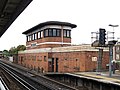
Class 66 at Bardon Hill signal box in Leicestershire, England. It is a Midland Railway signal box dating from 1899, although the original mechanical lever frame has been replaced by electrical switches. Seen here in 2009.

On a rail transport system, signalling control is the process by which control is exercised over train movements by way of railway signals and block systems to ensure that trains operate safely, over the correct route and to the proper timetable. Signalling control was originally exercised via a decentralised network of control points that were known by a variety of names including signal box (International and British) and interlocking tower (North America). London Underground call them signalling cabins,[1] and the Great Central Railway referred to them as signal cabins. Currently these decentralised systems are being consolidated into wide scale signalling centres or dispatch offices. Whatever the form, signalling control provides an interface between the human signal operator and the lineside signalling equipment. The technical apparatus used to control switches (points), signals and block systems is called interlocking.

History

[edit]
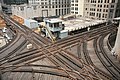
Signal box and tracks at Deval interlocking, Des Plaines, Illinois, USA, in 1993

Originally, all signaling was done by mechanical means. Points and signals were operated locally from individual levers or handles, requiring the signalman to walk between the various pieces of equipment to set them in the required position for each train that passed. Before long, it was realized that control should be concentrated into one building, which came to be known as a signal box. The signal box provided a dry, climate-controlled space for the complex interlocking mechanics and also the signalman. The raised design of most signal boxes (which gave rise to the term "tower" in North America) also provided the signalman with a good view of the railway under his control. The first use of a signal box was by the London & Croydon Railway in 1843 to control the junction to Bricklayers Arms in London.[2]

With the practical development of electric power, the complexity of a signal box was no longer limited by the distance a mechanical lever could work a set of points or a semaphore signal via a direct physical connection (or the space required by such connections). Power-operated switch points and signaling devices greatly expanded the territory that a single control point could operate from several hundred yards to several miles.[3] As the technology of electric relay logic was developed, it no longer became necessary for signalmen to operate control devices with any sort of mechanical logic at all. With the jump to all electronic logic, physical presence was no longer needed and the individual control points could be consolidated to increase system efficiency.

Another advancement made possible by the replacement of mechanical control by all-electric systems was that the signalman's user interface could be enhanced to further improve productivity. The smaller size of electric toggles and push buttons put more functionality within reach of an individual signalman. Route-setting technology automated the setting of individual points and routes through busy junctions. Computerized video displays removed the physical interface altogether, replacing it with a point-and-click or touchscreen interface. Finally, the use of Automatic Route Setting removed the need for any human input at all as common train movements could be fully automated according to a schedule or other scripted logic.

Signal boxes also served as important communications hubs, connecting the disparate parts of a rail line and linking them together to allow the safe passage of trains. The first signaling systems were made possible by technology like the telegraph and block instrument that allowed adjacent signal boxes to communicate the status of a section of track. Later, the telephone put centralized dispatchers in contact with distant signal boxes, and radio even allowed direct communication with the trains themselves. The ultimate ability for data to be transmitted over long distances has proven the demise of most local control signal boxes. Signalmen next to the track are no longer needed to serve as the eyes and ears of the signaling system. Track circuits transmit train locations to distant control centers and data links allow direct manipulation of the points and signals.

While some railway systems have more signal boxes than others, most future signaling projects will result in increasing amounts of centralized control relegating the lineside signal box to niche or heritage applications.

Naming

[edit]

In any node-based control system, proper identification is critical to ensuring that messages are properly received by their intended recipients. As such, signaling control points are provided with names or identifiers that minimize the likelihood of confusion during communications. Popular naming techniques include using nearby geographic references, line milepost numbers, sequence numbers, and identification codes. Geographic names can refer to a municipality or neighborhood, a nearby road or geographic feature, local landmarks, and industry that may provide the railway with traffic or railway features like yards, sidings, or junctions.

On systems where Morse code was in use it was common to assign control locations short identification codes to aid in efficient communication, although wherever signalling control locations are more numerous than mileposts, sequence numbers and codes are more likely to be employed. Entire rail systems or political areas may adopt a common naming convention. In Central Europe, for example, signalling control points were all issued regionally unique location codes based roughly on the point's location and function,[4] while the American state of Texas sequentially numbered all interlockings for regulatory purposes.[5]

As signaling control centers are consolidated it can become necessary to differentiate between older style boxes and newer train control centers, where signalmen may have different duties and responsibilities. Moreover, the name of the signaling center itself may not be employed operationally in preference to the name of individual signaling workstations. This is especially true when signaling centers control large amounts of territory spanning many diverse lines and geographical regions.

In most cases where the control locations are still in the field adjacent to railway tracks, the name or code of the control point is plainly labeled on the side of the signal box structure as an extra visual reminder to the train operators where they are. Moreover, wayside signals may also be equipped with identification plates that directly or indirectly indicate who controls that signal and that stretch of the line.

Control apparatus

[edit]

Lever frame

[edit]
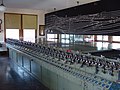
A mechanical lever frame inside the signal box at Knockcroghery in Ireland

The earliest signal boxes housed mechanical lever frames. The frame was usually mounted on a beam beneath the operating floor. Interlocking was attached to the levers, which ensured that signals showed the correct indication concerning the points and were operated in the right order. Wires or rods, connected at one end to the signals and points and the other to levers in the signal box, ran alongside the railway.

In many countries, levers are painted according to their function, e.g. red for stop signals and black for points, and are usually numbered, from left to right, for identification. In most cases, a diagram of the track and signaling layout is mounted above the lever frame, showing the relevant lever numbers adjacent to the signals and points.

Hand-powered interlockings were referred to as 'Armstrongs' and hand throws in the United States.

Power frames have miniature levers and control the signals and points electrically. In some cases, the interlocking was still done mechanically, but in others, electric lever locks were used.

In a few cases, signals and points were operated pneumatically upon operation of the appropriate lever or slide.

Control panel

[edit]

In a signal box with a control panel, the levers are replaced by buttons or switches, usually appropriately positioned directly onto the track diagram. These buttons or switches are interfaced with an electrical or electronic interlocking. In the UK, control panels are of the following types:

Trimley Junction IFS panel in the 1988 replacement signal box; built by BREL York
Individual function switch (IFS)
A separate button/switch is provided for each signal and each set of points. This type of panel is operated similarly to a lever frame. The signalman must move each set of points to the desired position before operating the switch or button of the signal reading over them.
This type of panel needs the least complex circuitry but is not suited to controlling large or busy areas.
One control switch (OCS)
A separate switch/button is provided for every signaled route. There will be as many switches/buttons per signal as there are routes (i.e. signaled destinations) from that signal. To set the desired route, the relevant switch or button is operated. All points within the route are automatically set to the required position.
Individual points switches are provided, but they are normally left in the central position, which allows the points to be automatically set by the action of setting a route.
Entrance-exit (NX)
This type of panel has one switch/button provided for every signal (except that some panels have separate 'entrance' and 'exit' devices). To set a route, the signalman operates the device for the 'entrance' signal, followed by the device for the 'exit' (destination) signal. All points within the route are automatically set to the required position and, provided all the points are detected by the interlocking in the correct position, the entrance signal will clear.
Individual points switches are provided, but they are normally left in the central position, which allows the points to be automatically set to the normal or reverse position by the action of setting a route.

Similar principles of operation as described above are applicable throughout the world.

Video display unit

[edit]
A modern VDU-based signalling control system, as would be found in a ROC in the United Kingdom.

Modern signal boxes tend to be provided with VDU based, or similar, control systems. These systems are less expensive to build and easier to alter than a traditional panel. In the UK, large modern signal boxes are typical of the Integrated Electronic Control Centre type, or, more recently, of the Rail Operating Centre variety. Variations of these control systems are used throughout the world.

Present day

[edit]
Signal box in Krzeszowice, Poland, in 2008

While rare, some traditional signal boxes can still be found. Some still control mechanical points and signals, although in many cases, the lever frame has been removed or is out of use, and a control panel or VDU has been installed. Most modern countries have little, if any, mechanical signalling remaining on the rail system. Both in the UK and Ireland, however, mechanical signalling is still relatively common away from the busiest lines; in Europe, there is also a considerable amount in Germany, Poland, and the Czech Republic. Traditional signal boxes can be found on many heritage railways.

The modern control centre has largely replaced widespread signal cabins. These centres, usually located near main railway stations, control the track network electrically or electronically.

Signal gantry

[edit]
[edit]

See also

[edit]

References

[edit]

Notes

[edit]
[edit]
Revisions and contributorsEdit on WikipediaRead on Wikipedia
from Grokipedia
Signalling control refers to the integrated systems and processes in railway operations that regulate train movements to ensure , prevent collisions, and optimize , primarily through mechanical, electric, or electronic signals, interlockings, and block systems. At its core, signalling control functions as a sophisticated framework, akin to a railway-specific system, where lineside signals—often colour-light or LED-based—indicate whether a train may proceed, the speed to maintain, or the route ahead. These systems incorporate automatic block signalling, which divides tracks into sections (blocks) to maintain safe distances between trains, and interlockings, which mechanically or electronically link points (movable rails at junctions), signals, and derails to avoid conflicting movements. The design adheres to principles, ensuring that in case of failure, signals default to a restrictive state (e.g., ), prioritizing over . Key to its operation are regulatory standards enforced by bodies like the (FRA) in the United States and , which mandate rigorous design, installation, maintenance, and inspection to mitigate risks such as false proceed signals or activation failures at grade crossings. Modern advancements, including and digital traffic management, are enhancing capacity and reliability by shifting more control to in-train displays and automated oversight, reducing reliance on lineside . Overall, signalling control underpins the safe and efficient movement of billions of passengers and billions of tons of freight annually across global rail networks.

Fundamentals

Definition and Purpose

Signalling control refers to the integrated systems and processes used to regulate movements through signals, interlockings, block systems, and other apparatus, which may operate locally, automatically, or remotely from centralized points, ensuring the safe separation of and route integrity. Signalling systems can operate automatically, where signals change based on track circuits detecting without human intervention, or manually/centrally, where operators set routes from control points. These systems encompass both hardware and software that monitor track and authorize movements, forming a critical layer of railway designed to safeguard operations across networks. The primary purpose of signalling control is to prevent collisions and derailments by enforcing block systems, which divide the railway into sections (blocks) where occupancy is continuously monitored. In absolute block systems, no may enter an occupied block, providing strict protection against following or opposing movements; in contrast, permissive block systems allow entry into an occupied block but require to proceed at restricted speeds while prepared to stop. This framework manages line capacity on single- and double-track sections, optimizes traffic flow, and supports speeds up to 125 mph or higher in upgraded corridors by dynamically adjusting movement authorities. Centralized forms of signalling control, along with systems, significantly reduce compared to purely manual methods at individual locations, enabling more efficient train scheduling and higher throughput on busy lines. It also integrates with automatic train protection (ATP) systems, which enforce speed limits and signal aspects on board the train to avert overspeeding or signal-passed-at-danger incidents. These integrations enhance overall safety, with ATP providing enforcement of signalling instructions. Signalling control has evolved from rudimentary local methods, such as flagmen manually directing trains, to sophisticated integrated networks that coordinate operations over vast territories. Global adoption varies by region, with traditional mechanical lever frames remaining in use for localized control in parts of the , while the emphasizes (CTC) systems for remote management of extensive routes.

Basic Principles

The block system forms the foundational principle of railway signalling control, dividing the track into fixed sections known as blocks to ensure that only one occupies any given block at a time, thereby preventing collisions by maintaining safe separation distances. In this system, signals at the entrance to each block indicate whether the subsequent block is clear for entry, with the block section typically extending from one stop signal to the next. Two primary methods govern block operations: , where a train must stop until the block ahead is confirmed clear, and permissive block signalling, which allows entry at reduced speeds if the block is occupied but the preceding train has passed a specified point, provided visibility and conditions permit. This approach relies on continuous monitoring of block occupancy to issue movement authorities only when safe. Interlocking complements the block system by mechanically, electrically, or electronically preventing the setup of conflicting routes through the alignment of points (switches) and signals, ensuring that once a route is selected, opposing or overlapping paths cannot be activated until the has cleared the section. Key principles include route locking, which secures points and signals in position until the passes a detection point, and flank protection, which safeguards against side impacts from adjacent routes. For instance, in a junction, ensures that a signal for a diverging route cannot clear if the main route is occupied, with release mechanisms like time-based or train-passed locking to restore availability. These arrangements apply universally across mechanical and digital implementations to enforce safe route setting. Signal aspects provide drivers with clear visual indications of permitted actions, using standardized colors such as for stop, for caution (proceed at reduced speed, preparing to stop at the next signal), and for proceed at full speed. Aspects may combine multiple lights, like double for distant signals indicating the need to approach the next signal prepared to stop, with additional modifiers such as flashing to denote two clear blocks ahead. Signalling systems distinguish between speed signalling, which primarily conveys maximum safe speeds based on block occupancy (e.g., restricting to 35 mph), and route signalling, which specifies the path taken (e.g., over for a diverging route at normal speed). These aspects integrate with block and logic to guide flow without ambiguity. Fail-safe design is integral to signalling control, ensuring that any system failure—such as power loss or component malfunction—defaults to the safest state, typically signals reverting to red (stop) to halt movements and prevent hazards. This is achieved through vital relays and redundant circuits that monitor critical functions like track occupancy and point positions, de-energizing to a safe configuration if discrepancies arise. For example, relays remain locked in safe mode until proven alignment, providing layered redundancy against single-point failures. Such principles underpin the reliability of block and route operations. Effective signalling requires accurate train detection to confirm block occupancy and enable route setting, primarily through track circuits or axle counters. Track circuits operate on an electrical principle where a low-voltage circuit across the rails is shunted (short-circuited) by a train's wheels and s, interrupting the current to indicate presence and trigger a occupied state. Variants include DC for short sections and AC for longer or electrified tracks, with insulated rail joints defining boundaries. Axle counters, alternatively, detect trains by counting axles entering and exiting a section via sensors, declaring the block clear only if counts balance, offering advantages like immunity to rail contaminants over unlimited distances. Both methods integrate with to release routes once detection confirms clearance.

Historical Development

Early Mechanical Systems

The origins of mechanical signalling control in railways trace back to the early 1840s, driven by the need to manage increasing train traffic and prevent collisions on expanding networks. The world's first dedicated signal box was established in 1843 by the and Croydon Railway at Bricklayers Arms Junction in , where signals were operated via mechanical levers connected by wires and rods to control points and signals at the junction. This innovation centralized control, allowing a to monitor and adjust track configurations from a single location, marking a shift from ad-hoc and flags used on earlier lines. signals, featuring pivoting arms to indicate "clear" or "stop" positions, had been introduced shortly before by engineer Gregory on the same railway at in 1842, providing a visual means to convey instructions over distances without relying solely on human messengers. A pivotal advancement came with the development of mechanical interlocks, which physically prevented conflicting signal and point settings to avoid misroutings. In 1856, English engineer John Saxby patented the first comprehensive mechanical interlocking system, integrating levers in a frame so that pulling one lever would lock out incompatible others, ensuring safe routing of trains. This built on earlier rudimentary attempts, such as the embryonic interlocking at Bricklayers Arms in 1843, and became a cornerstone of mechanical signalling by enforcing operational discipline. In practice, signalmen operated these systems by pulling or releasing levers—typically up to 50 or more in larger frames—which transmitted force through rigid rods for points (up to about 350 yards) and flexible wires for signals (extending to 1-2 miles). Communication between adjacent signal boxes relied on bells for train notifications and, in some cases, telescopes for visual confirmation of distant signals, enabling coordinated block working where sections of track were kept clear. Despite these innovations, early mechanical systems had significant limitations that constrained operations. The reliance on manual labor made them intensive, with signalmen working long shifts in often cramped boxes exposed to the elements. Wire connections were highly sensitive to weather, as temperature fluctuations caused expansion or contraction, leading to signal misalignments that required frequent adjustments. These systems were suited only to low-speed operations, generally under 30 mph, as the mechanical delays and visibility issues limited their effectiveness at higher velocities. Mechanical failures, such as rod breakages or lever jams, were common, posing safety risks and necessitating constant maintenance. By 1900, the had over 12,000 signal boxes in operation, reflecting the system's widespread adoption amid rapid rail expansion. In the United States, mechanical block systems—adapting similar and principles—emerged in the , with the first block system implemented in 1863 on the Philadelphia and Trenton Railroad between Trenton and , which was part of the system, to manage freight traffic.

Transition to Electric and Electronic

The transition to electric and electronic signalling systems in the early marked a significant departure from mechanical limitations, enabling greater reliability and expanded operational scope. Power-operated frames emerged as a key electrification milestone, with early trials of electric levers conducted in the UK during the 1890s by W.R. Sykes, whose interlocking signal company installed large-scale systems by 1904 at St. Enoch's Station in . These innovations replaced manual lever pulls with electrically driven mechanisms, allowing signalmen to control points and signals over distances exceeding 10 miles through electric point machines that eliminated the need for short-range mechanical rods and wires. The first all-electric power signalling plant in Europe was installed in 1895 at Westend on Berlin's Ringbahn by , demonstrating the feasibility of fully electrified operations without pneumatic or hydraulic intermediaries. Relay-based interlockings further advanced logic in the 1920s, introducing vital relays that ensured safety without physical mechanical connections between levers and trackside equipment. In the , General Railway Signal (GRS) developed the Type E vital relay around 1927, which became a standard for creating robust, electrically independent interlocking circuits that prevented conflicting routes. These relays used electromagnetic principles to enforce conditions, allowing for more complex layouts and reducing maintenance compared to mechanical frames. By the 1930s, route-relay interlockings (RRI) were introduced in both the and , with GRS pioneering the system in 1937 to enable pre-set route selection via rather than individual lever operations. In the , the concept built on Great Western Railway's 1927 route-setting trials at Newport, evolving into full RRI installations post-World War II, such as the world's largest at in 1951, which controlled 827 routes using factory-wired relay panels. World War II accelerated the adoption of electric systems due to extensive damage to mechanical signalling infrastructure from bombing raids, which disrupted rod-and-wire connections and lever frames across networks. The war's intensification of rail traffic—amid staff shortages and infrastructure vulnerabilities—highlighted the resilience of electric alternatives, prompting rapid post-war retrofits to relay-based setups for quicker repairs and capabilities. Early electronic advancements in the began replacing bulky banks with solid-state logic, exemplified by British Railways' 1961 prototype at on the Western Region, which tested transistor-based interlocking to simplify circuits. This trial reduced the number of relays from thousands in traditional panels to hundreds, minimizing wiring complexity and failure points while maintaining vital safety functions through electronic redundancy. Despite these progresses, the shift to electric and electronic systems faced substantial challenges, including high retrofitting costs for integrating power frames into legacy mechanical layouts and the need to overhaul wiring over vast networks. Standardization issues persisted pre-ETCS, with national variations in codes and interface protocols leading to problems and fragmented upgrades, particularly on heritage lines where incomplete left vulnerabilities.

Control Apparatus

Mechanical Lever Frames

Mechanical lever frames formed the core of early railway signalling control systems, consisting of a bank of manually operated levers mounted within a rigid frame, typically constructed from wood or , and housed in a dedicated signal box. These levers were arranged in a horizontal or slightly inclined row, often at spacings of 4 to 6 inches between centers, with each lever dedicated to a specific function such as operating a signal, point (switch), or facing point lock. Connections to remote trackside equipment were achieved through horizontal rodding for nearby mechanisms or wire pulleys for longer distances, allowing operation over spans up to several miles while transmitting the signalman's pull or release. Frames varied in size, with smaller installations featuring 10-20 levers and larger ones accommodating over 100, exemplified by the 180-lever frame at Shrewsbury's Severn Bridge Junction in the UK, built in 1903 by the London and North Western Railway. Operation required the signalman to follow a precise sequence to ensure safe train movements, beginning with pulling the relevant point levers to set the desired route before advancing the corresponding signal lever, as premature signal clearance could lead to derailments. was enforced mechanically through devices like tappet locks, where protruding "tappets" on each lever physically blocked conflicting movements; for instance, Saxby & Farmer's tappet system, introduced in 1888 following their original interlocking of 1856, used sliding bars and notches to prevent a signal lever from being pulled unless all associated points were correctly positioned and locked. Detection of point positions was provided by mechanical feedback rods running back to the frame, confirming via lever locks that the points had fully moved before allowing signal operation, thus verifying no obstructions or failures in the transmission. This system relied entirely on physical force from the signalman, with no electrical components, ensuring through impossibility of unsafe combinations. Prominent examples include the McKenzie & Holland frames introduced in the 1870s, which became a standard in British railways with their compact 4-inch lever spacing and robust wire-pull mechanisms, influencing designs across the and exported to colonies like . In Ireland, the signal box, dating to around 1904, featured a preserved mechanical frame that controlled a level crossing and loop until the station's full closure in 1963, though it remained a block post for some years thereafter and stands as a rare intact example today. These frames exemplified the era's engineering, balancing complexity with reliability in busy junctions. Maintenance of mechanical lever frames demanded regular hands-on intervention to counteract wear from constant use, including daily of levers, pulleys, and rodding joints with light machine oil to minimize and prevent binding. Adjustments were essential to compensate for wire stretch over time, achieved by tensioning screws or compensators at the frame ends, ensuring precise transmission without slack that could delay operations or cause false detections. Mechanical contacts for point detection required periodic cleaning and alignment to maintain accurate feedback, with overall inspections focusing on rod alignment and lock integrity to avoid safety lapses. The use of mechanical lever frames declined sharply after the as railways modernized to electro-mechanical and digital systems for greater efficiency, with Britain's 10,000 boxes in 1948 reduced to around 4,000 by 1970 and fewer than 100 operational mainline examples by 2025, per Network Rail's centralization plans. However, over 100 are preserved on heritage lines, such as those at and Barnham Junction, maintaining operational frames for educational and tourist purposes.

Electro-Mechanical Panels

Electro-mechanical panels represent a transitional technology in railway signalling, combining electrical relays with manual control interfaces to enable remote operation of signals and points over extended areas, superseding purely mechanical systems while predating fully digital solutions. These panels typically feature a physical layout mimicking the track diagram, allowing signalmen to select routes intuitively without direct mechanical linkages. Developed in the early , they rely on relay-based logic to enforce safety rules, such as preventing conflicting routes, through electromagnetic circuits that automate much of the process once a route is initiated. In the , Centralized Traffic Control (CTC) panels, pioneered in the 1920s, enabled dispatchers to manage extensive track sections remotely. Key types include Entrance-Exit (NX) panels, introduced in the UK from onward, which display a track diagram with illuminated sections and buttons for route selection. In an NX panel, the signalman identifies the entry point to a section via a knob or switch and the desired exit via a button, prompting the system to align points and clear signals automatically along the chosen path. Another variant is the One-Control Switch (OCS) system, designed for simplified routing where a dedicated switch or button corresponds to each possible route from a signal, streamlining operations in less complex junctions by directly activating the full route sequence without separate entry-exit selections. Essential components encompass miniature levers or switches for route initiation, illuminated track diagrams using lamps to indicate and route status, and extensive relay rooms housing thousands of electromechanical —often free-wired with plugs for and expansion. For instance, Westinghouse-style relay interlockings, such as those employing Q-series , form the backbone of these panels, with each relay performing specific logic functions like route locking or point detection through interconnected circuits. These relay assemblages, sometimes numbering in the thousands for large installations, occupy dedicated rooms adjacent to the control panel to manage the electrical logic remotely from the tracks. In operation, the signalman selects a route using buttons or switches on the panel, which energizes relays to verify track occupancy, positions, and compute conditions before remotely setting signals and points via electrical power. The relays ensure logic, such as approach locking to hold routes once initiated, and provide visual feedback through panel indicators, allowing control over dispersed interlockings without physical presence at each site. This relay-mediated process minimizes in route setting compared to manual methods while maintaining electrical for reliability. Notable examples include the UK's Integrated Power Signalling (IFS) systems from the 1950s, which adapted electro-mechanical panels with individual function switches to replicate lever-frame operations electrically for power signalling in modernized boxes. In the , CTC panels exemplified this technology by enabling a single to manage over 100 miles of track, as seen in expanded installations beyond the initial 40-mile New York Central setup in 1927. Compared to mechanical frames, electro-mechanical panels facilitate control over vastly larger territories—up to 200 tracks in complex yards—through remote electrical actuation, though they require substantial space for rooms that can span entire buildings. Despite ongoing modernization, these panels remain in service as of 2025 on non-urban lines where cost-effective reliability outweighs the need for full digital upgrades, particularly in legacy networks transitioning slowly to electronic systems.

Digital Video Display Units

Digital Video Display Units (VDUs) represent a pivotal advancement in signalling control, utilizing computer-based interfaces to replace traditional physical panels with dynamic, screen-based representations of the track layout. These systems typically employ high-resolution monitors or configurations in centralized control rooms, displaying mimic diagrams that replicate the network's schematic in real time. Operators interact with these diagrams using input devices such as mice, trackballs, or touch interfaces to select and set routes by clicking on signal and point icons, enabling precise control over movements without mechanical levers. The emphasizes ergonomic layouts to support extended operational shifts, often incorporating multiple screens for overview, detailed sectional views, and auxiliary data like timetables or alerts. Globally, similar systems include the (ETCS) in and Positive Control (PTC) displays in the . In operation, VDU systems like the UK's Integrated Electronic Control Centre (IECC) integrate software-driven logic, typically implemented through solid-state processors, to validate route requests and prevent conflicts by automatically checking track occupancy and point positions. When a route is selected, the system highlights the path on the mimic diagram, issues visual and auditory alarms for any violations—such as overlapping routes or unauthorized occupations—and logs all actions for regulatory audits and incident reviews. This software reduces in routine tasks while allowing manual overrides for exceptional circumstances, with route confirmation displayed instantaneously on the VDU to facilitate swift . For instance, in busy junctions, the system can prioritize routes based on predefined rules, alerting operators to potential delays. Key features of modern VDU interfaces include real-time train position tracking, often derived from track circuits, axle counters, or emerging GPS-based systems for enhanced accuracy in non-electrified sections, enabling operators to monitor train progress dynamically on the display. Automatic route release mechanisms, such as , free up sections after a train passes a designated point, typically within 120 seconds in block systems, minimizing manual intervention and optimizing capacity. Comprehensive event logging captures every route setting, release, and alarm activation, supporting post-event and compliance with safety standards. These capabilities are exemplified in the UK's Rail Operating Centres (ROCs), where facilities like the York ROC—opened in to handle extensive networks, including integration with the for cross-border interoperability via radio-based communication overlays—employ scalable IECC VDUs to manage extensive networks. Despite their efficiency, VDU-based systems introduce challenges, including heightened cybersecurity vulnerabilities due to networked components that could be targeted by or unauthorized access, potentially disrupting signalling operations as seen in recent rail incidents. Operators require specialized training to master the digital interface, shifting from physical to software-based workflows, which demands ongoing programs focused on human factors and rapid fault diagnosis. Transitional deployments often hybridize VDUs with legacy relay interlockings, necessitating careful synchronization to maintain safety during upgrades.

Modern Implementations

Centralized Control Centers

Centralized control centers consolidate signaling operations into large-scale regional hubs, enabling efficient oversight of extensive networks from a single location. In the , plans to implement 12 Rail Operating Centres (ROCs) to replace more than 800 traditional signal boxes, with several operational as of 2025 and the transition ongoing. These centers are staffed around the clock by teams of signallers working in shifts, who use video display units (VDUs) to monitor and adjust signals, points, and movements across vast areas. This structure supports remote management of hundreds of miles of track, integrating voice radio communications and GPS tracking for real-time coordination with train crews, while incorporating backup sites to maintain continuity during disruptions. The operational model emphasizes reliability through redundant systems, such as configurations that provide capabilities to mitigate single-point failure risks inherent in centralized setups, where a primary site outage could otherwise impact broad regions. For instance, in the , dispatch centers integrated with (PTC) systems exemplify similar approaches, using (CTC) to enforce safety overlays like automatic speed enforcement and collision avoidance across freight and passenger lines. These parallels highlight global adaptations to enhance resilience, with backup protocols ensuring that control can shift seamlessly to secondary facilities during power failures or cyber threats. Adopting centralized centers yields significant benefits, including substantial cost savings from reduced staffing needs—consolidating hundreds of local operators into fewer specialized teams—and accelerated incident response times, as controllers can rapidly assess and resolve issues across interconnected routes. has invested significantly in this transition as part of broader signaling renewals, such as the Cardiff Area project. However, challenges persist, particularly the vulnerability to concentrated failures, which are countered through layered redundancies but require ongoing investment in cybersecurity and infrastructure hardening. By 2025, centralization has advanced in urban networks across the and , where regulatory mandates and high traffic densities have driven integration of ROC-like facilities, boosting capacity and reliability. In contrast, developing regions exhibit partial adoption, limited by funding and legacy , though international standards from bodies like the promote gradual expansion to improve safety and efficiency worldwide. Recent initiatives, such as the November 2025 action plan, emphasize accelerated ERTMS rollout to support further centralization.

Advanced Digital Technologies

Communications-based train control (CBTC) represents a pivotal advancement in urban rail signalling, utilizing radio communication for continuous, automatic train positioning and control without reliance on fixed blocks. This technology enables moving-block operations, where trains are tracked in real-time relative to one another, allowing headways as short as under one minute and significantly boosting capacity on dense networks. The New York City MTA's 2025-2029 Capital Plan includes funding for CBTC upgrades on lines such as the A (including Rockaway branches and Shuttle) and portions of the J and , as part of broader signal modernization efforts budgeted at $5.4 billion, aiming to modernize ageing signals and enhance service reliability. The (ETCS), part of the broader (ERTMS), standardizes signalling across networks to promote and safety. ETCS operates at Levels 1 through 3, with Level 1 providing continuous supervision via balises and intermittent radio updates, Level 2 relying on continuous radio communication through for to minimize lineside infrastructure, and Level 3 enabling full moving-block operations with train integrity monitoring. The 2025 update to EN 16494 specifies requirements for ERTMS trackside boards, including provision, visibility, and readability, to further enhance cross-border compatibility and reduce maintenance costs. Integration of (AI) and into signalling systems is transforming predictive and conflict avoidance. Tools like Tracsis's 2025 computer-aided dispatch (CAD) platforms leverage AI for real-time data analysis, optimizing train paths to preempt delays and collisions in . In shunting yards, AI-driven handles routine tasks such as and , reducing manual interventions and improving throughput. Emerging 2025 trends include digital twins for signalling simulation, creating virtual replicas of rail systems to test scenarios and predict failures in real-time. is gaining traction for secure, tamper-proof data exchange in distributed signalling networks, ensuring integrity for cross-operator communications. The global railway signalling market is projected to exceed $30 billion by 2030, driven by these digital innovations and demand for efficient infrastructure. These technologies enhance safety by automating critical functions, potentially reducing human error-related incidents by up to 50% through precise positioning and automated braking. However, their deployment necessitates dedicated spectrum for rail communications, with ongoing ITU standardization efforts focusing on bands like 1900 MHz to support future-ready mobile communication systems for railways (FRMCS).

Infrastructure and Conventions

Signal Gantries

Signal gantries are elevated structures designed to support multiple railway signals over tracks, enabling clear visibility for drivers on multi-track lines and high-speed routes. In the , these gantries often feature multi-head masts accommodating 4-aspect color-light signals, which display red, yellow, double yellow, and green aspects to indicate stopping, caution, preliminary caution, and clear respectively, particularly on high-speed lines where extended braking distances require advanced warning. and spindle types are commonly used for spanning multiple tracks, positioning signals at optimal heights above the rails for sighting distances exceeding 1,000 meters on express routes. The design of signal gantries has evolved significantly since the 1920s, when early truss structures supported incandescent color-light signals introduced by the Southern Railway to replace arms amid growing and traffic volumes. By the late , these transitioned to more robust steel frameworks, and into the , modular LED-based systems have become standard, offering up to 90% energy savings compared to filament bulbs and enabling remote diagnostics through integrated control links that monitor signal health in real-time. Modern LED gantries reduce maintenance needs by eliminating fragile filaments and support multi-aspect configurations with programmable theatre route indicators for junctions, where illuminated arrows guide drivers to specific diverging paths. Integration with railway control systems allows signal gantries to be operated remotely from centralized centers, where operators set aspects via apparatus that ensures safe routing through junctions. For instance, junction signals on gantries use routes to display directional indicators, preventing conflicts by coordinating with points and track circuits over fiber-optic or radio links. These systems synchronize gantry signals with video display units in control rooms, providing operators with real-time status updates for efficient . Prominent examples include the United Kingdom's (WCML), where upgrades in the 2010s installed over 70 new signal posts and gantries as part of a £250 million improvement between and , enhancing capacity for 140 mph trains with 4-aspect LED signals. In the United States, overhead gantries support clear signals on multi-track corridors, displaying green-over-red aspects to indicate unrestricted speed, as seen on busy freight lines managed under guidelines. Ongoing renewals, such as the 2025 £20 million contract for 28 structures and six gantries north of on the WCML, continue to modernize these installations for reliability. Maintenance of signal gantries emphasizes durability through standards like those from the American Railway Engineering and Maintenance-of-Way Association (AREMA), which specify robust foundations and corrosion-resistant materials for signal structures to withstand environmental loads, including high winds and seismic activity. These guidelines ensure long-term stability for overhead installations, with periodic inspections focusing on structural integrity and electrical connections to minimize downtime.

Naming and Identification

In railway signalling control, naming and identification systems provide standardized labels for signal boxes, control centers, points, and other elements to facilitate precise communication, , and operational coordination among staff. These conventions enable quick references during radio transmissions or incident reports, such as instructing "Signal 456 to " to halt a train at a specific location. Historically, early systems relied on descriptive names tied to geographic features or functions, evolving toward alphanumeric codes for efficiency as networks expanded and increased. This shift, prominent from the late onward, reduced ambiguity in multi-line operations and supported the transition to centralized control. In the , signal boxes and associated elements follow conventions established by British Railways and maintained by , using prefix codes derived from the controlling box's name or location, followed by numbers for specific assets. For instance, points—switches allowing trains to change tracks—are often denoted with the controlling signal's identifier plus "P," such as "1P" for points at signal 1, while position indicators employ four-letter codes like NWK (normal working) or RWK (reverse working). Historic examples include the Bardon Hill signal box in , a mechanical installation opened in 1899 that retains its original name reflecting the local quarry hill. Globally, variations adapt to regional infrastructure and needs. In the United States, control points—key locations for routing—are numbered by mileposts, such as CP-123 indicating a point near milepost 123 on a subdivision, aiding dispatchers in vast networks. For European cross-border operations, the (ERTMS) employs harmonized identifiers like ETCS location markers, which are trackside transponders assigning unique numerical tags to positions for seamless control without national discrepancies. As of 2025, digital advancements in Rail Operating Centres (ROCs) integrate (GIS) codes into mapping software, overlaying alphanumeric identifiers with geospatial data for real-time visualization and fault isolation. Network Rail's National Electronic Sectional Appendix (NESA) exemplifies this, providing exportable infrastructure data including signal and point locations to support ERTMS deployments on routes like the . Meanwhile, heritage practices preserve original descriptive names for preserved signal boxes, enhancing by maintaining cultural links to Victorian-era railways, as seen in over 20 Grade II-listed structures.

References

Add your contribution
Related Hubs
User Avatar
No comments yet.