


Community hub
Recent from talks
Contribute something
Nothing was collected or created yet.
Hygrometer
View on Wikipedia
| Humidity and hygrometry |
|---|
 |
| Specific concepts |
| General concepts |
| Measures and instruments |
A hygrometer is an instrument that measures humidity: that is, how much water vapor is present.[1] Humidity measurement instruments usually rely on measurements of some other quantities, such as temperature, pressure, mass, and mechanical or electrical changes in a substance as moisture is absorbed. By calibration and calculation, these measured quantities can be used to indicate the humidity. Modern electronic devices use the temperature of condensation (called the dew point), or they sense changes in electrical capacitance or resistance.
The maximum amount of water vapor that can be present in a given volume (at saturation) varies greatly with temperature; at low temperatures a lower mass of water per unit volume can remain as vapor than at high temperatures. Thus a change in the temperature changes the relative humidity.
A prototype hygrometer was invented by Leonardo da Vinci in 1480. Major improvements occurred during the 1600s; Francesco Folli invented a more practical version of the device, and Robert Hooke improved a number of meteorological devices, including the hygrometer. A more modern version was created by Swiss polymath Johann Heinrich Lambert in 1755. Later, in the year 1783, Swiss physicist and geologist Horace Bénédict de Saussure invented a hygrometer that uses a stretched human hair as its sensor.
In the late 17th century, some scientists called humidity-measuring instruments hygroscopes; that word is no longer in use, but hygroscopic and hygroscopy, which derive from it, still are.
Classical hygrometer
[edit]Ancient hygrometers
[edit]Crude hygrometers were devised and developed during the Shang dynasty in Ancient China to study weather.[2] The Chinese used a bar of charcoal and a lump of earth: its dry weight was taken, then compared with its damp weight after being exposed in the air. The differences in weight were used to tally the humidity level.
Other techniques were applied using mass to measure humidity, such as when the air was dry, the bar of charcoal would be light, while when the air was humid, the bar of charcoal would be heavy. By hanging a lump of earth on one end of a staff and a bar of charcoal on the other end and attaching a fixed lifting string to the middle point to make the staff horizontal in dry air, an ancient hygrometer was made.[3][2]
Metal-paper coil type
[edit]The metal-paper coil hygrometer is very useful for giving a dial indication of humidity changes. It appears most often in inexpensive devices, and its accuracy is limited, with variations of 10% or more. In these devices, water vapor is absorbed by a salt-impregnated paper strip attached to a metal coil, causing the coil to change shape. These changes (analogous to those in a bimetallic thermometer) cause an indication on a dial. There is usually a metal needle on the front of the gauge that points to a scale.
Hair tension hygrometers
[edit]
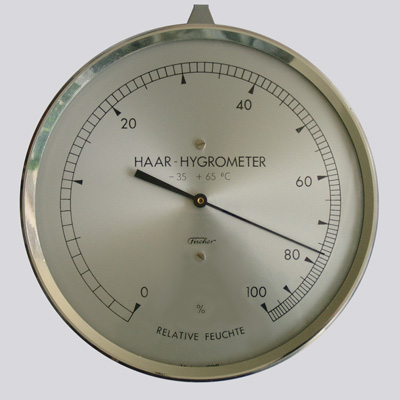
These devices use a human or animal hair under some tension. (Whalebone and other materials may be used in place of hair.) The hair is hygroscopic (tending toward retaining moisture); its length changes with humidity, and the length change may be magnified by a mechanism and indicated on a dial or scale. Swiss physicist and geologist Horace Bénédict de Saussure was the first to build such a hygrometer, in 1783. The traditional folk art device known as a weather house also works on this principle.
It consists of a human hair eight or ten inches [20 or 25 cm] long, b c, Fig. 37, fastened at one extremity to a screw, a, and at the other passing over a pulley, c, being strained tight by a silk thread and weight, d.
— John William Draper, A Textbook on Chemistry (1861)
The pulley is connected to an index which moves over a graduated scale (e). The instrument can be made more sensitive by removing oils from the hair, such as by first soaking the hair in diethyl ether.[4]
Psychrometer (wet-and-dry-bulb thermometer)
[edit]
A psychrometer, or a wet and dry-bulb thermometer, consists of two calibrated thermometers, one that is dry and one that is kept moist with distilled water on a sock or wick.[5] At temperatures above the freezing point of water, evaporation of water from the wick lowers the temperature, such that the wet-bulb thermometer will be at a lower temperature than that of the dry-bulb thermometer. When the air temperature is below freezing, however, the wet-bulb must be covered with a thin coating of ice, in order to be accurate. As a result of the heat of sublimation, the wet-bulb temperature will eventually be lower than the dry bulb, although this may take many minutes of continued use of the psychrometer.

Relative humidity (RH) is computed from the ambient temperature, shown by the dry-bulb thermometer and the difference in temperatures as shown by the wet-bulb and dry-bulb thermometers. Relative humidity can also be determined by locating the intersection of the wet and dry-bulb temperatures on a psychrometric chart. The dry and wet thermometers coincide when the air is fully saturated, and the greater the difference the drier the air. Psychrometers are commonly used in meteorology, and in the heating, ventilation, and air conditioning (HVAC) industry for proper refrigerant charging of residential and commercial air conditioning systems.
Sling psychrometer
[edit]
A sling psychrometer, which uses thermometers attached to a handle, is manually spun in free air flow until both temperatures stabilize. This is sometimes used for field measurements but is being replaced by more convenient electronic sensors. A whirling psychrometer uses the same principle, but the two thermometers are fitted into a device that resembles a ratchet or football rattle.
Chilled mirror dew point hygrometer
[edit]Dew point is the temperature at which a sample of moist air (or any other water vapor) at constant pressure reaches water vapor saturation. At this saturation temperature, further cooling results in condensation of water. Chilled mirror dewpoint hygrometers are some of the most precise instruments commonly available. They use a chilled mirror and optoelectronic mechanism to detect condensation on the mirror's surface. The temperature of the mirror is controlled by electronic feedback to maintain a dynamic equilibrium between evaporation and condensation, thus closely measuring the dew point temperature. An accuracy of 0.2 °C is attainable with these devices, which correlates at typical office environments to a relative humidity accuracy of about ±1.2%. Older chilled-mirrors used a metallic mirror that needed cleaning and skilled labor. Newer implementations of chilled-mirrors use highly polished surfaces that do not require routine cleaning.
More recently, spectroscopic chilled-mirrors have been introduced. Using this method, the dew point is determined with spectroscopic light detection which ascertains the nature of the condensation. This method avoids many of the pitfalls of the previous chilled-mirrors and is capable of operating drift free.
Chilled-mirrors remain the reference measurement for calibration of other hygrometers. This is due to their fundamental first-principle nature that refers to the core of condensation physics and measures temperature, which is one of the base quantities of the International System of Quantities (length, time, amount of substance, electric current, temperature, luminous intensity, mass).[6]
Modern hygrometers
[edit]Capacitive
[edit]When cost, space, or fragility are important, other types of electronic sensors are used, at the price of lower accuracy. Capacitive hygrometers measure the effect of humidity on the dielectric constant of a polymer or a metal oxide. When calibrated, their accuracy at relative humidities between 5% and 95% is ±2% RH; uncalibrated, this is two to three times worse. Capacitive sensors are robust against effects such as condensation and temporary high temperatures,[7] but subject to contamination, drift and aging effects. They are, however, suitable for many applications.
Resistive
[edit]In resistive hygrometers, the change in electrical resistance of a material due to humidity is measured.[7] Typical materials are salts and conductive polymers. Resistive sensors are less sensitive than capacitive sensors – the change in material properties is less, so they require more complex circuitry. The material properties also tend to depend both on humidity and temperature, which means in practice that the sensor must be combined with a temperature sensor. The accuracy and robustness against condensation vary depending on the chosen resistive material. Robust, condensation-resistant sensors exist with an accuracy of up to ±3% RH (relative humidity).
Thermal
[edit]In thermal hygrometers, the change in thermal conductivity of air due to humidity is measured. These sensors measure absolute humidity rather than relative humidity.[7]
Gravimetric
[edit]A gravimetric hygrometer extracts the water from the air (or other gas) and weighs it separately, for example by weighing a desiccant before and after it has absorbed the water. The temperature, pressure and volume of the resulting dry gas are also measured, providing enough information to calculate the amount of water per mole of gas.[8][9]
This is considered the most accurate primary method of measuring absolute humidity[citation needed], and national standards based on it have been developed in US, UK, EU and Japan. However, the inconvenience of using such devices means they are usually only used to calibrate less accurate instruments, called Transfer Standards.
Optical
[edit]An optical hygrometer measures the absorption of light by water in the air.[10] A light emitter and a light detector are arranged with a volume of air between them. The attenuation of the light, as seen by the detector, indicates the humidity, according to the Beer–Lambert law. Types include the Lyman-alpha hygrometer (using Lyman-alpha light emitted by hydrogen), the krypton hygrometer (using 123.58 nm light emitted by krypton), and the differential absorption hygrometer (using light emitted by two lasers operating at different wavelengths, one absorbed by humidity and the other not).
Applications
[edit]
Aside from greenhouses and industrial spaces, hygrometers are also used in some incubators, saunas, humidors and museums. They are also used in the care of wooden musical instruments such as pianos, guitars, violins, and harps which can be damaged by improper humidity conditions. Hygrometers play a big part in firefighting as the lower the relative humidity, the more vigorously fuels may burn.[11] In residential settings, hygrometers are used to assist in humidity control (too low humidity can damage human skin and body, while too high humidity favors growth of mildew and dust mite). Hygrometers are also used in the coating industry because the application of paint and other coatings may be very sensitive to humidity and dew point.
Difficulty of accurate humidity measurement
[edit]Humidity measurement is among the most difficult problems in basic metrology. According to the WMO Guide, "The achievable accuracies [for humidity determination] listed in the table refer to good quality instruments that are well operated and maintained. In practice, these are not easy to achieve." Two thermometers can be compared by immersing them both in an insulated vessel of water (or alcohol, for temperatures below the freezing point of water) and stirring vigorously to minimize temperature variations. A high-quality liquid-in-glass thermometer if handled with care should remain stable for some years. Hygrometers must be calibrated in air, which is a much less effective heat transfer medium than is water, and many types are subject to drift[12] so need regular recalibration. A further difficulty is that most hygrometers sense relative humidity rather than the absolute amount of water present, but relative humidity is a function of both temperature and absolute moisture content, so small temperature variations within the air in a test chamber will translate into relative humidity variations.
In a cold and humid environment, ice may sublimate on the sensor head, whether it is a hair, dew cell, mirror, capacitance sensing element, or dry-bulb thermometer of an aspiration psychrometer. The ice on the probe matches the reading to the saturation humidity with respect to ice at that temperature, i.e. the frost point. However, a conventional hygrometer is unable to measure properly under the frost point, and the only way to go around this fundamental problem is to use a heated humidity probe.[13]
Calibration standards
[edit]Psychrometer calibration
[edit]Accurate calibration of the thermometers used is fundamental to precise humidity determination by the wet-dry method. The thermometers must be protected from radiant heat and must have a sufficiently high flow of air over the wet bulb for the most accurate results. One of the most precise types of wet-dry bulb psychrometer was invented in the late 19th century by Adolph Richard Assmann (1845–1918);[14] in English-language references the device is usually spelled "Assmann psychrometer." In this device, each thermometer is suspended within a vertical tube of polished metal, and that tube is in turn suspended within a second metal tube of slightly larger diameter; these double tubes serve to isolate the thermometers from radiant heating. Air is drawn through the tubes with a fan that is driven by a clockwork mechanism to ensure a consistent speed (some modern versions use an electric fan with electronic speed control).[15] According to Middleton, 1966, "an essential point is that air is drawn between the concentric tubes, as well as through the inner one."[16]
It is very challenging, particularly at low relative humidity, to obtain the maximal theoretical depression of the wet-bulb temperature; an Australian study in the late 1990s found that liquid-in-glass wet-bulb thermometers were warmer than theory predicted even when considerable precautions were taken;[17] these could lead to RH value readings that are 2 to 5 percent points too high.
One solution sometimes used for accurate humidity measurement when the air temperature is below freezing is to use a thermostatically controlled electric heater to raise the temperature of outside air to above freezing. In this arrangement, a fan draws outside air past (1) a thermometer to measure the ambient dry-bulb temperature, (2) the heating element, (3) a second thermometer to measure the dry-bulb temperature of the heated air, then finally (4) a wet-bulb thermometer. According to the World Meteorological Organization Guide, "The principle of the heated psychrometer is that the water vapor content of an air mass does not change if it is heated. This property may be exploited to the advantage of the psychrometer by avoiding the need to maintain an ice bulb under freezing conditions.".[18][19]
Since the humidity of the ambient air is calculated indirectly from three temperature measurements, in such a device accurate thermometer calibration is even more important than for a two-bulb configuration.
Saturated salt calibration
[edit]Various researchers[20] have investigated the use of saturated salt solutions for calibrating hygrometers. Slushy mixtures of certain pure salts and distilled water have the property that they maintain an approximately constant humidity in a closed container. A saturated table salt (sodium chloride) bath will eventually give a reading of approximately 75%. Other salts have other equilibrium humidity levels: Lithium chloride ~11%; Magnesium chloride ~33%; Potassium carbonate ~43%; Potassium sulfate ~97%. Salt solutions will vary somewhat in humidity with temperature and they can take relatively long times to come to equilibrium, but their ease of use compensates somewhat for these disadvantages in low precision applications, such as checking mechanical and electronic hygrometers.
See also
[edit]References
[edit]- ^ This is different from measuring the moisture content of something non-gaseous like soil, where liquid water is part of the measurement.
- ^ a b Hamblyn, Richard (2010). The Invention of Clouds: How an Amateur Meteorologist Forged the Language of the Skies. Pan Macmillan (published June 4, 2010). pp. 16–17. ISBN 978-0-330-39195-5.
- ^ Selin, Helaine (2008). Encyclopaedia of the History of Science, Technology, and Medicine in Non-Western Cultures (2nd ed.). Springer (published April 16, 2008). p. 736. ISBN 978-1-4020-4559-2.
- ^ Draper, John William (1861). A Textbook on Chemistry. Harper & Bros. p. 55.
- ^ Gorse, C.; Johnston, D.; Pritchard, M. (2012). A Dictionary of Construction, Surveying, and Civil Engineering. Oxford Quick Reference. OUP Oxford. p. 960. ISBN 978-0-19-104494-6. Retrieved 13 September 2018.
- ^ "SI Units". NIST. 12 April 2010.
- ^ a b c D.K. Roveti. Choosing a Humidity Sensor: A Review of Three Technologies, Sensors Magazine (2001).
- ^ "NIST Gravimetric Hygrometer for Verification of NIST Humidity Standards and for Research on Humidity Properties". National Institute of Standards and Technology. 20 May 2013. Retrieved 16 February 2023.
- ^ Wexler, Arnold; Hyland, Richard W. (May 1, 1964). "The NBS standard hygrometer". www.nist.gov. National Bureau of Standards. Retrieved July 21, 2017.
- ^ "Spectral hygrometer - AMS Glossary". glossary.ametsoc.org. Retrieved 2019-01-16.
- ^ How Does Humidity Impact Firefighting?
- ^ catching the drift Archived May 9, 2008, at the Wayback Machine
- ^ Makkonen, Lasse; Laakso, Timo (2005). "Humidity Measurements in Cold and Humid Environments". Boundary-Layer Meteorology. 116 (1): 131–147. Bibcode:2005BoLMe.116..131M. doi:10.1007/s10546-004-7955-y. S2CID 122407569.
- ^ "Aßmann, Adolph Richard Archived 2011-06-16 at the Wayback Machine" by Guido Heinrich
- ^ "Smithsonian Catalog of Meteorological Instruments in the Museum of History and Technology" Prepared by W. E. Knowles Middleton
- ^ A History of the Thermometer ISBN 0-8018-7153-0 by W. E. Knowles Middleton, Johns Hopkins Press 1966
- ^ J. Warne, The Practical Impacts of RTD and Thermometer Design on Wet and Dry Bulb Relative Humidity Measurements. Bureau of Meteorology, Melbourne (1998).
- ^ World Meteorological Organization (WMO) (2008). WMO Guide to Meteorological Instruments and Methods of Observation. WMO-No. 8. (Seventh edition, 2008), Chapter 4: Measurement of humidity, Section 4.2.5: Heated psychrometer (see p. 101 of the PDF) (PDF). Geneva: World Meteorological Organization. p. 681. Retrieved 21 October 2023.
Deprecated edition of this guide first published in 1950
- ^ World Meteorological Organization (WMO) (2021). WMO Guide to Instruments and Methods of Observation. WMO-No. 8. (Eighth edition, 2021), Volume 1 – Measurement of meteorological variables, Chapter 4: Measurement of humidity, Section 4.3: The psychrometer (see p. 167 of the PDF). Geneva: World Meteorological Organization. p. 1389. ISBN 978-92-63-10008-5. Retrieved 21 October 2023.
The first edition of this guide was published in 1950
- ^ Salt Calibration of Hygrometers
External links
[edit]

- IMA moisture measurement training site
- USATODAY.com: How a Sling Psychrometer Works
- NIST page on humidity calibration
- Article on difficulty of humidity calibration
- Article on RH sensors
- NOAA homepage for cryogenic chilled-mirror frostpoint hygrometers
| International | |
|---|---|
| National | |
| Other | |

Hygrometer
View on GrokipediaFundamentals
Definition and Principles
A hygrometer is a device that measures the amount of water vapor present in the air or other gases, typically quantifying humidity in terms of relative humidity (RH), absolute humidity, or dew point temperature.[10] These measurements are essential for assessing the moisture content in gaseous environments, where water vapor exists as an invisible gas mixed with dry air or other components.[8] The fundamental principles of hygrometry rely on the physics of water vapor in gases, particularly the concept of partial pressure as described by Dalton's law of partial pressures. Humidity arises from the evaporation of water into the gas phase, where the rate of evaporation depends on the difference between the saturation vapor pressure and the actual partial pressure of water vapor. Absolute humidity is defined as the mass of water vapor per unit volume of the gas (often in grams per cubic meter), representing the total amount of moisture present regardless of temperature. In contrast, relative humidity expresses the moisture level as a percentage of the maximum possible at a given temperature, calculated as the ratio of the actual partial pressure of water vapor () to the saturation vapor pressure () at that temperature: The dew point is the temperature at which the current water vapor content would saturate the air, meaning at that lower temperature.[11][12] This key equation for relative humidity derives from the ideal gas law applied to water vapor treated as an ideal gas. The ideal gas law states , or in terms of density, the partial pressure of water vapor , where is the absolute humidity (mass density of water vapor), is the universal gas constant, is the absolute temperature, and is the molar mass of water. For saturation conditions, , where is the saturation vapor density. The ratio simplifies to , as the temperature-dependent factors cancel out. Saturation vapor pressure itself emerges from the equilibrium between evaporation and condensation: at saturation, the rate of molecules escaping the liquid surface equals the rate returning from the vapor phase, a balance influenced by temperature via the Clausius-Clapeyron relation, though approximated here through the ideal gas behavior for dilute vapors.[13] Evaporation proceeds when , driving net moisture transfer into the gas until equilibrium is achieved, while exceeding leads to condensation.[14] The term "hygrometer" originates from the Greek "hygros," meaning wet or moist, combined with "metron," meaning measure, and was coined in the 1660s from the French "hygromètre." This nomenclature reflects the instrument's purpose in quantifying atmospheric moisture through these physical principles.[15]Measured Parameters
Hygrometers measure several key parameters that quantify atmospheric moisture, each providing distinct insights into humidity levels. The primary parameters include relative humidity (RH), expressed as a percentage (%), which represents the ratio of the current vapor pressure to the saturation vapor pressure at a given temperature.[16] Dew point temperature (Td), measured in degrees Celsius (°C), is the temperature at which air becomes saturated with water vapor, leading to condensation.[16] Absolute humidity indicates the mass of water vapor per unit volume of air, typically in grams per cubic meter (g/m³), though the SI unit is kilograms per cubic meter (kg/m³).[17] Specific humidity, a dimensionless ratio (kg/kg), measures the mass of water vapor per unit mass of moist air.[18] The mixing ratio, also dimensionless (often g/kg in practice), quantifies the mass of water vapor per unit mass of dry air and is closely related to specific humidity, differing only slightly since specific humidity accounts for the total air mass including vapor.[18] Conversions between these parameters rely on established formulas that account for temperature and pressure dependencies. A common approximation for dew point from temperature (T in °C) and RH is , useful for quick estimates in meteorology.[19] More precise calculations use the Magnus formula for saturation vapor pressure () over liquid water: where is in hectopascals (hPa) and T is in °C; the actual vapor pressure is then , and Td solves .[20] Absolute humidity can be derived from vapor pressure using the ideal gas law for water vapor, while specific humidity and mixing ratio interrelate as , with both convertible from dew point via saturation pressures.[18] In SI units, RH is percentage-based (dimensionless), Td and related temperatures in kelvin (K) or °C, absolute humidity in kg/m³, and specific humidity or mixing ratio in kg/kg.[17] Relative humidity is the most commonly reported parameter in practical applications due to its intuitive scale from 0% to 100%, facilitating everyday weather communication and comfort assessments.[16] However, dew point provides greater precision, especially at low humidity levels, as it directly reflects absolute moisture content independent of air temperature, avoiding the variability in RH that occurs with temperature fluctuations.[21] For sub-zero conditions, the frost point replaces the dew point, defined as the temperature at which water vapor deposits directly as ice at constant pressure, essential for accurate measurements in cold environments.[22] Psychrometers derive these parameters from wet-bulb depression, linking temperature differences to vapor pressure.[16]Historical Development
Ancient Hygrometers
The earliest documented attempts at humidity detection in ancient China date to the Western Han dynasty around 120 BCE, as described in the text Huai-Nan-Zi, where a method involved suspending a feather and a piece of charcoal in the air to compare their relative weights as an indicator of atmospheric moisture—the charcoal absorbed humidity and became heavier in damp conditions, while the feather remained lighter.[23] In ancient Greece, around the 4th century BCE, philosophers such as Aristotle and his successor Theophrastus explored concepts of atmospheric moisture in works like Aristotle's Meteorology and Theophrastus's On Weather Signs, relying on qualitative observations of natural phenomena, such as the behavior of hygroscopic materials like straw or papyrus that altered in length or flexibility with humidity changes, to inform weather predictions without formalized devices.[24] These early approaches highlighted empirical recognition of humidity's effects on organic materials but lacked precision or standardization. By the late 15th century, European inventors advanced rudimentary hygroscopes—non-quantitative humidity detectors—building on gravimetric principles. Nicolaus Cusanus proposed a simple balance loaded with wool to detect moisture absorption by weight differences around 1450 CE.[25] Leonardo da Vinci refined this concept in his designs from the 1480s and early 1500s, sketching instruments in the Codex Atlanticus that used absorbent materials like sponges, cotton, or animal membranes suspended to show expansion or contraction in response to air humidity, often integrated with mechanical linkages for visual indication.[25] These devices operated on the principle of material deformation or weight variation due to water vapor sorption, providing a qualitative sense of dampness for practical applications such as storing goods or forecasting weather. Despite their ingenuity, ancient and early hygroscopes were inherently limited to qualitative assessments, offering no numerical scales, calibration standards, or reproducible measurements, which restricted their utility to binary indications of "dry" or "humid" conditions. These pre-scientific methods laid foundational empirical insights that influenced later quantitative developments in the 17th century.18th and 19th Century Inventions
The 18th and 19th centuries marked a pivotal era in hygrometry, driven by Enlightenment-era scientific inquiry and the demands of the Industrial Revolution for precise environmental data. Inventors shifted from rudimentary qualitative indicators to instruments capable of quantitative assessment, laying the groundwork for modern meteorology. Key developments focused on absorption-based and evaporative principles, enabling reliable measurements of relative humidity and supporting the expansion of observational networks. Swiss polymath Johann Heinrich Lambert advanced hygrometer design in the mid-18th century through his work on atmospheric humidity. In 1755, he created one of the first practical hygrometers, employing organic materials for moisture absorption to detect changes in air humidity.[26] By 1769, Lambert published an extensive essay detailing the construction and calibration of absorption hygrometers, including variants using silk threads and catgut for chemical uptake of water vapor, which allowed for more synchronized readings with thermometers.[27] These innovations emphasized empirical calibration against known evaporation rates, providing a foundation for subsequent quantitative devices. A major breakthrough came in 1783 with Swiss physicist and geologist Horace Bénédict de Saussure's invention of the hair hygrometer. This device utilized stretched human hair as a hygroscopic sensor, where length changes due to moisture absorption were mechanically linked to a scale for direct humidity readings.[28] Saussure calibrated his instrument against evaporation experiments, achieving accuracy sufficient for meteorological use, and patented variations that became standard in early weather stations.[29] The hair hygrometer's simplicity and portability facilitated widespread adoption, influencing observations in Europe and enabling the first systematic climate data collection. The early 19th century introduced psychrometric methods, with German inventor Ernst Ferdinand August patenting the psychrometer in 1818. This instrument paired two mercury thermometers—one dry and one with a wet bulb covered in muslin—to measure the cooling effect of evaporation, from which relative humidity could be calculated using empirical tables.[30] August's design represented the first dedicated use of mercury thermometers in such evaporative setups, improving precision over earlier wet-bulb concepts. Refinements followed, notably by French physicist Henri Victor Regnault in the 1840s, who enhanced wet-bulb accuracy through better ventilation and calibration techniques, reducing errors in humidity derivations to under 5% in controlled tests. Regnault's 1845 descriptions of improved psychrometers, including ether-based variants for dew-point verification, standardized the method for global meteorological stations.[31] Overall, these 18th- and 19th-century inventions transformed hygrometry from an artisanal pursuit to a scientific tool, powering the establishment of national weather services and contributing to foundational climate records.Mechanical Hygrometers
Hair Tension Types
Hair tension hygrometers operate on the principle that human or animal hair, composed primarily of keratin, is hygroscopic and undergoes reversible elongation when exposed to water vapor. As relative humidity (RH) increases, the hair absorbs moisture, causing its length to expand by approximately 2 to 3 percent from dry to saturated conditions, with a typical maximum elongation of about 2.5 percent at high RH levels.[32][33] This dimensional change is mechanically amplified through a bundle of multiple hair strands, often 10 to 20, connected in parallel under tension to a spring-loaded lever system that drives a pointer across a calibrated dial, providing a direct analog reading of RH.[34][35] These instruments are typically calibrated for an RH range of 20 to 80 percent, where they achieve an accuracy of ±3 percent, though performance is most reliable between 30 and 90 percent RH.[34][36] Calibration involves adjusting the pointer against known humidity standards, such as saturated salt solutions, but readings can drift due to temperature variations (optimal in 0 to 50°C) and gradual hair degradation from contaminants or repeated moisture cycles, necessitating periodic recalibration every few months. Key advantages of hair tension hygrometers include their low cost (often under $50 for basic models) and passive operation without requiring external power, making them suitable for portable or remote field use. However, they exhibit hysteresis, where the hair's response lags during rapid humidity changes, leading to errors up to 5 percent between adsorption and desorption cycles, and have a limited operational lifespan of 1 to 2 years before significant degradation reduces sensitivity.[37] Since the 1940s, modern variants have incorporated synthetic fibers, such as nylon or polyimide, in place of natural hair to enhance stability, reduce hysteresis, and extend service life while maintaining the same tension-based mechanism.[33][35] This innovation, building on the original hair tension design invented by Horace-Bénédict de Saussure in 1783, improves temperature resilience (up to -35 to +65°C) and minimizes maintenance needs compared to untreated hair.[38][39]Coil and Organic Material Types
Coil and organic material types of mechanical hygrometers rely on the hygroscopic properties of certain organic substances or composites, which expand or contract in response to changes in atmospheric moisture, causing a coiled structure to twist and indicate relative humidity (RH). These instruments typically feature spiral or helical coils constructed from materials such as whalebone, goldbeater's skin—an organic membrane derived from animal intestines—or paper strips impregnated with hygroscopic salts like lithium chloride. The degree of twist in the coil is directly proportional to RH levels, with some designs exhibiting angular changes of up to 90 degrees over the humidity range.[40][41] In operation, one end of the coil is fixed, while the other is connected to a mechanical linkage, such as a pointer or lever arm, that traverses a calibrated dial to display RH readings. A notable early example is the metal-paper coil hygrometer, developed in the mid-19th century, which combines a thin strip of parchment or paper coated with hygroscopic substances bonded to a phosphor bronze ribbon formed into a tight helix; humidity absorption causes differential expansion between the organic layer and the metal, inducing torsion in the coil and movement of the indicator. This twisting mechanism amplifies small dimensional changes for practical measurement, similar in principle to the expansion seen in hair tension hygrometers but leveraging rotational dynamics for greater sensitivity in compact designs.[42][43] Performance characteristics of these hygrometers include limited accuracy, typically with errors of ±10% or more RH, with reliable sensitivity across the 5–100% RH range, though optimal operation occurs between 10% and 90% RH where material responses are most linear. However, the organic components are susceptible to fatigue from repeated cycling, hysteresis effects, and degradation over time, necessitating regular recalibration—often annually—and protection from extreme temperatures or contaminants.[44][41] These coil-based instruments found widespread application in analog recording devices, such as barographs and thermohygrographs, enabling continuous tracing of humidity variations on chart paper alongside pressure and temperature data; their mechanical reliability supported meteorological observations until the widespread adoption of electronic sensors in the 1980s.[41]Psychrometric Hygrometers
Wet-and-Dry Bulb Method
The wet-and-dry bulb method, also known as the psychrometric technique, measures relative humidity by comparing the temperatures indicated by two thermometers: a dry-bulb thermometer that records the ambient air temperature , and a wet-bulb thermometer covered with a wetted wick that cools to the wet-bulb temperature due to evaporative cooling. The difference between these temperatures, termed the wet-bulb depression , arises from the latent heat required for water evaporation from the wick, which is supplied by the surrounding air; this depression is larger in drier air where evaporation is more rapid. This method relies on the principle that the rate of evaporation is proportional to the difference between the saturation vapor pressure at the wet-bulb temperature and the actual vapor pressure in the air, allowing indirect determination of humidity without direct measurement of water vapor content.[45] The key relationship is given by the psychrometric equation for actual vapor pressure : where is the saturation vapor pressure at the wet-bulb temperature, is atmospheric pressure, and is the psychrometric constant, approximately for well-ventilated conditions at standard pressure. This equation derives from an energy balance at the wet-bulb surface, equating the sensible heat transfer from air to the bulb (proportional to ) with the latent heat of evaporation (proportional to the vapor pressure deficit ), assuming steady-state conditions and Lewis relation between heat and mass transfer coefficients. The psychrometric constant incorporates factors such as the specific heat of air, latent heat of vaporization, and the ratio of molecular weights of dry air to water vapor, making the formula semi-empirical but widely validated for practical use.[46][47] To determine relative humidity (RH), the vapor pressure is first computed from the equation, then RH is calculated as , where is the saturation vapor pressure at the dry-bulb temperature; this can be done using psychrometric charts, tables, or computational formulas for efficiency. The method requires proper ventilation around the wet bulb (typically 1-5 m/s airflow) to ensure accurate evaporation and minimize radiation errors, achieving an accuracy of approximately RH under these conditions. The wet-and-dry bulb method was first described by James Hutton in 1792, and the term "psychrometer" was coined in 1818 by German physicist Ernst Ferdinand August; this technique remains a reference standard for humidity measurement due to its thermodynamic basis and reliability in controlled settings.[30][48][49]Aspirated and Sling Variants
Aspirated and sling psychrometers represent enhancements to the basic wet-and-dry bulb psychrometer, incorporating forced ventilation to accelerate evaporation from the wet bulb and achieve more reliable measurements in varying environmental conditions. These designs address limitations of stationary setups, where insufficient natural airflow can lead to prolonged stabilization times and inaccuracies due to uneven convection, by ensuring consistent air movement over the thermometers.[50][51] The sling psychrometer consists of a pivoted frame holding a dry-bulb thermometer and a wet-bulb thermometer covered with a moistened wick, rotated manually by the user to generate airflow. Operation involves whirling the device at 120 to 180 revolutions per minute for approximately 1 to 1.5 minutes until the wet-bulb temperature stabilizes, after which readings are taken to calculate relative humidity using psychrometric tables or charts. This method reduces measurement time compared to non-ventilated versions and minimizes errors from ambient air currents by promoting uniform evaporation.[52][50] Aspirated psychrometers employ mechanical means to drive air past the thermometers, providing greater precision for professional applications such as meteorology. The Assmann psychrometer, developed by Richard Aßmann in the late 1880s, uses a clockwork fan to maintain an airflow speed of 3 to 5 meters per second across the bulbs, enclosed in radiation shields to further reduce external influences. This design became a standard for weather stations, enabling accurate humidity assessments in field conditions where manual operation is impractical.[53][54][55] These variants offer improved accuracy, typically achieving relative humidity measurements within ±2% when properly maintained and operated by trained users, outperforming non-aspirated methods in low-airflow environments. Specific protocols emphasize wick maintenance and whirling in areas with minimal ventilation to ensure consistent results, as outlined in standards for environmental monitoring.[50][56][57] Modern adaptations retain the thermodynamic principle of wet-bulb depression but incorporate digital thermometers and built-in fans for automated aspiration, simplifying operation while preserving portability for fieldwork. Devices like fan-assisted digital psychrometers maintain airflow rates similar to traditional models, displaying relative humidity directly without manual calculations.[58][59]Modern Sensor-Based Hygrometers
Capacitive and Resistive Sensors
Capacitive hygrometers operate on the principle that a hygroscopic dielectric material, typically a polymer or ceramic film, is sandwiched between two electrodes to form a capacitor. As relative humidity (RH) increases, water vapor is absorbed by the dielectric, raising its permittivity and thus increasing the capacitance in proportion to the RH level.[60] This relationship is often modeled by the equation where is the change in capacitance, is the baseline capacitance, is the sensitivity factor (typically around 0.2–0.5 pF/% RH depending on the material), and RH is expressed as a fraction.[61] These sensors achieve accuracies of ±2% RH over a wide range and exhibit fast response times of less than 10 seconds for a 63% step change under typical airflow conditions.[62] Resistive hygrometers, in contrast, measure humidity through changes in electrical resistance of a hygroscopic salt film, such as lithium chloride, deposited on an insulating substrate between conductive electrodes. Moisture absorption by the salt increases ionic conductivity, thereby decreasing resistance exponentially with rising RH.[63] These sensors are favored for low-cost applications due to their simple construction but are susceptible to contamination and drift, limiting long-term stability.[64] The development of thin-film capacitive and resistive sensors accelerated in the 1960s with advances in microfabrication, enabling compact designs; polymer dielectrics like polyimides enhanced sensor durability and integration into digital systems. Early commercial thin-film capacitive sensors, such as Vaisala's HUMICAP introduced in 1973, built on this foundation to provide reliable electronic alternatives to mechanical hygrometers.[65] In comparison, capacitive sensors are preferred for their superior long-term stability and full-range operation from 0% to 100% RH, while resistive types offer greater simplicity and lower power consumption for disposable or short-term uses.[64] Both types outperform mechanical methods in response speed but require periodic calibration against reference standards like gravimetric techniques to maintain accuracy.[63]Thermal and Gravimetric Methods
Thermal hygrometers operate on the principle that the thermal conductivity of air varies with its water vapor content, as water vapor has a lower thermal conductivity than dry air (approximately 0.016 W/m·K for water vapor versus 0.026 W/m·K for dry air at 25°C). This results in the thermal conductivity λ of moist air decreasing proportionally with increasing absolute humidity.[63] The typical setup employs a dual-sensor configuration: two identical hot-wire or thin-film thermistors or resistors serve as heating and sensing elements. One sensor is exposed to the sample gas (moist air), while the other acts as a reference in dry air or a controlled dry environment. The difference in heat dissipation, manifested as a change in electrical resistance due to cooling rates, is measured. The absolute humidity is then calculated from the ratio of thermal conductivities, often using the relation , where is the water vapor density, and are the thermal conductivities of dry and sample air, respectively, and is a calibration constant derived from the sensitivity . These devices achieve accuracies of ±1% relative humidity (RH) in the range of 0-50% RH, making them suitable for precise absolute humidity measurements.[63][66] Thermal hygrometers find applications in monitoring humidity in clean gases, such as in semiconductor manufacturing processes or high-purity gas analysis, where contamination-free environments are essential. However, they exhibit limitations, including slow response times for transient humidity changes due to the diffusive nature of thermal equilibration, typically on the order of seconds to minutes.[67] Gravimetric hygrometers represent the gold standard for humidity measurement, providing direct traceability to SI units by quantifying the mass of water vapor in a known volume of air. The procedure involves passing a measured volume of sample gas through an absorbing medium, such as phosphorus pentoxide (P₂O₅) or magnesium perchlorate, which chemically binds the water vapor. The increase in mass of the absorbent is precisely weighed using a microbalance, and the absolute humidity is computed as the ratio of absorbed water mass to the gas volume, adjusted for temperature and pressure. This method aligns with standardized protocols like ASTM E104 for controlled humidity environments, though it is primarily executed in laboratory settings with high-precision volumetric flow control. Uncertainties are exceptionally low, typically below 0.2% RH, enabling their use in calibrating other hygrometer types, including capacitive sensors.[68][69] Gravimetric methods ensure traceability for national metrology institutes, supporting applications in standards validation and high-accuracy environmental testing. Their primary limitations include the destructive nature of the absorption process, which prevents real-time monitoring, and confinement to laboratory use due to the need for extended equilibration times—up to several hours at low humidities—and specialized equipment.[68][70]Optical and Chilled Mirror Types
Optical hygrometers measure water vapor concentration by detecting the absorption of light at specific infrared wavelengths, such as approximately 1.37 μm, where water vapor exhibits strong absorption lines.[71] This approach leverages the principle that the amount of light absorbed is proportional to the number of water vapor molecules along the optical path. Tunable diode laser spectroscopy (TDLS) is a widely adopted technique in optical hygrometers, enabling high-precision measurements with accuracies reaching parts per million (ppm) volume mixing ratios in the upper troposphere and lower stratosphere. For instance, intercomparisons of TDLS-based instruments have demonstrated good agreement during airborne campaigns. The fundamental equation governing absorption in these systems is the Beer-Lambert law, expressed aswhere is the transmitted light intensity, is the initial intensity, is the absorption cross-section of water vapor at the selected wavelength, is the density of water vapor molecules, and is the optical path length.[72] By tuning the diode laser to a water vapor absorption line and measuring the attenuation, the partial pressure or mixing ratio of water vapor can be derived with minimal interference from other atmospheric gases. Chilled mirror hygrometers provide a direct measurement of dew point temperature by cooling a polished mirror surface until water vapor condenses as dew or frost, at which point the condensation scatters light and is detected optically.[73] A feedback servomechanism, typically using a photodetector and thermoelectric cooler, automatically adjusts the mirror temperature to maintain the exact onset of condensation, ensuring the measured temperature corresponds to the dew point.[74] These instruments achieve high accuracy, with uncertainties as low as ±0.1°C in dew point temperature, and are traceable to national standards through calibration.[73] Response times typically range from 1 to 5 minutes, depending on airflow and humidity levels, making them suitable for steady-state monitoring.[75] Recent developments include Peltier-based non-cryogenic chilled mirror designs, such as the SKYDEW hygrometer introduced in 2025, which eliminates the need for liquid coolants and enables reliable water vapor measurements from the surface up to 25 km altitude in the stratosphere.[76] This innovation supports applications in aviation and high-altitude research by providing robust performance without cryogenic maintenance. Both optical and chilled mirror types offer advantages over other sensors, including insensitivity to common contaminants like dust or oils that could affect mechanical or capacitive devices, and operational dew point ranges spanning -75°C to +50°C or wider in advanced configurations.[73] They are particularly valued in cleanroom environments and meteorological stations for their precision in low-humidity conditions, often serving as transfer standards calibrated against gravimetric methods for absolute accuracy.[77]