Hubbry Logo
Space adaptation syndromeSpace adaptation syndromeMain
Open search
Space adaptation syndrome
Community hub
Space adaptation syndrome
logo
8 pages, 0 posts
0 subscribers
Be the first to start a discussion here.
Space adaptation syndrome
from Wikipedia
Space adaptation syndrome
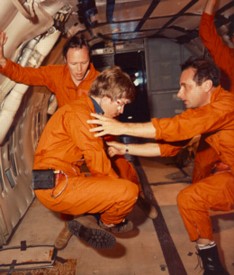
NASA astronauts acclimating themselves to space adaptation syndrome in a KC-135 airplane that flies parabolic arcs to create short periods of weightlessness.[1] In about two thirds of the passengers, these flights produce nausea,[2][3] giving the plane its nickname "vomit comet".
SpecialtySpace medicine Edit this on Wikidata
Prevalence50% of individuals

Space adaptation syndrome (SAS) or space sickness is a condition experienced by as many as half of all space travelers during their adaptation to weightlessness once in orbit.[4] It is the opposite of terrestrial motion sickness since it occurs when the environment and the person appear visually to be in motion relative to one another even though there is no corresponding sensation of bodily movement originating from the vestibular system.[5]

Presentation

[edit]

Space motion sickness can lead to degraded astronaut performance.[6]: 32  SMS threatens operational requirements, reduces situational awareness, and threatens the safety of those exposed to micro-g environments.[6] Lost muscle mass leads to difficulty with movement, especially when astronauts return to Earth. This can pose a safety issue if the need for emergency egress were to arise. Loss of muscle power makes it extremely difficult, if not impossible, for astronauts to climb through emergency egress hatches or create unconventional exit spaces in the case of a crash upon landing. Additionally, bone resorption and inadequate hydration in space can lead to the formation of kidney stones, and subsequent sudden incapacitation due to pain.[7] If this were to occur during critical phases of flight, a capsule crash leading to worker injury and/or death could result. Short-term and long-term health effects have been seen in the cardiovascular system from exposure to the micro-g environment that would limit those exposed after they return to Earth or a regular gravity environment. Steps need to be taken to ensure proper precautions are taken into consideration when dealing a micro-g environment for worker safety.[8][9] Orthostatic intolerance can lead to temporary loss of consciousness due to the lack of pressure and stroke volume. This loss of consciousness inhibits and endangers those affected and can lead to deadly consequences.[10]

Cause

[edit]

Your body just isn't built to deal with zero-gravity. But there's no way of predicting how someone will handle it. Someone who gets car-sick all the time can be fine in space - or the opposite. I'm fine in cars and on rollercoasters, but space is a different matter.

When the vestibular system and the visual system report incongruous states of motion, the result is often nausea and other symptoms of disorientation known as motion sickness. According to contemporary sensory conflict theory, such conditions happen when the vestibular system and the visual system do not present a synchronized and unified representation of one's body and surroundings. This theory is also known as neural mismatch, implying a mismatch occurring between ongoing sensory experience and long-term memory rather than between components of the vestibular and visual systems, emphasizing "the limbic system in integration of sensory information and long-term memory, in the expression of the symptoms of motion sickness, and the impact of anti-motion-sickness drugs and stress hormones on limbic system function. The limbic system may be the neural mismatch center of the brain."[12] At present a "fully adequate theory of motion sickness is not presently available" but at present the sensory conflict theory, referring to "a discontinuity between either visual, proprioceptive, and somatosensory input, or semicircular canal and otolith input", may be the best available.[13] Space adaptation syndrome or space sickness is a kind of motion sickness that can occur when one's surroundings visually appear to be in motion, but without a corresponding sense of bodily motion. This incongruous condition can occur during space travel when changes in g-forces compromise one's spatial orientation.[5] According to Science Daily, "Gravity plays a major role in our spatial orientation. Changes in gravitational forces, such as the transition to weightlessness during a space voyage, influence our spatial orientation and require adaptation by many of the physiological processes in which our balance system plays a part. As long as this adaptation is incomplete, this can be coupled to nausea, visual illusions, and disorientation."[5] Sleep deprivation can also increase susceptibility to space sickness, making symptoms worse and longer-lasting.[12]

According to the sensory conflict hypothesis, space sickness is the opposite of the kinds of motion-related disorientation that occur in the presence of gravity, known as terrestrial motion sickness, such as becoming carsick, seasick, or airsick. In such cases, and in contrast to space sickness, one's surroundings seem visually immobile (such as inside a car or airplane or a cabin below decks) while one's body feels itself to be in motion. Contemporary motion sickness medications can counter various forms of motion disorientation including space sickness by temporarily suppressing the vestibular system, but are rarely used for space travel because it is considered better to allow space travelers to adapt naturally over the first one to seven days rather than to suffer the drowsiness and other side effects of medication taken over a longer period. However, transdermal dimenhydrinate anti-nausea patches are typically used whenever space suits are worn because vomiting into a space suit could be fatal by obscuring vision or blocking airflow. Space suits are generally worn during launch and landing by NASA crew members and always for extra-vehicular activities (EVAs). EVAs are consequently not usually scheduled for the first days of a mission to allow the crew to adapt, and transdermal dimenhydrinate patches are typically used as an additional backup measure.

Management

[edit]

Just as space sickness has the opposite cause compared to terrestrial motion sickness, the two conditions have opposite non-medicinal remedies. The idea of sensory conflict implies that the most direct remedy for motion sickness in general is to resolve the conflict by re-synchronizing what one sees and what one feels. For most (but not all) kinds of terrestrial motion sickness, that can be achieved by viewing one's surroundings from a window or (in the case of seasickness) going up on deck to observe the seas. For space sickness, relief is available via the opposite move of restricting one's vision to a small area such as a book or a small screen, disregarding the overall surroundings until the adaptation process is complete, or simply to close one's eyes until the nauseated feeling is reduced in intensity during the adjustment period. Some research indicates that blindness itself does not provide relief; "Motion sickness can occur during exposure to physical motion, visual motion, and virtual motion, and only those without a functioning vestibular system are fully immune.[12]

As with sea sickness and car sickness, space motion sickness symptoms can vary from mild nausea and disorientation to vomiting and intense discomfort; headaches and nausea are often reported in varying degrees. The most extreme reaction yet recorded was that felt by Senator Jake Garn in 1985 on Space Shuttle flight STS-51-D. NASA later jokingly began using the informal "Garn scale" to measure reactions to space sickness. In most cases, symptoms last from 2–4 days. When asked about the origins of "Garn", Robert E. Stevenson said:[14]

Jake Garn was sick, was pretty sick. I don't know whether we should tell stories like that. But anyway, Jake Garn, he has made a mark in the Astronaut Corps because he represents the maximum level of space sickness that anyone can ever attain, and so the mark of being totally sick and totally incompetent is one Garn. Most guys will get maybe to a tenth Garn if that high. And within the Astronaut Corps, he forever will be remembered by that.

Garn's purpose on the mission was in part to subject him to experiments on space motion sickness.[15] Predicting whether someone will experience space sickness is not possible. Someone who suffers from car sickness may not suffer from space sickness, and vice versa.[11] In excellent physical condition, Garn did not become sick on the vomit comet before STS-51-D.[15] All three astronauts on Skylab 3 suffered from nausea, although the three on Skylab 2 had not; the illness affected their work during the first few days, worrying NASA doctors.[16]

Experienced aviators and space travelers can suffer from space sickness. Garn began piloting at the age of 16[15] and piloted a variety of military aircraft for 17,000 hours—more than any NASA astronaut—before STS-51-D. Charles D. Walker became ill on the same flight despite having flown on the shuttle before.[17][18] While the Skylab 3 crew quickly recovered—whether by eating six smaller meals instead of three larger ones, or just by becoming used to space—one of the Skylab 4 crew became sick despite anti-nausea medication.[16] Steven Smith estimated that on four shuttle flights he threw up 100 times.[11]

Space sickness that occurs during space flight can also continue for days after landing, until the vestibular system has again adapted to gravity.[19]

History

[edit]

In August 1961, Soviet cosmonaut Gherman Titov became the first human to experience space sickness on Vostok 2; he was the first person to vomit in space.[20]

Apart from that record, space motion sickness was effectively unknown during the earliest spaceflights (Mercury, Gemini series) probably because these missions were undertaken in spacecraft providing very cramped conditions and permitting very little room for head movements; space sickness seems to be aggravated by being able to freely move around, especially in regard to head movement, and so is more common in larger spacecraft.[21]

See also

[edit]

References

[edit]
Revisions and contributorsEdit on WikipediaRead on Wikipedia
from Grokipedia
Space adaptation syndrome (SAS), commonly referred to as space motion sickness, is a transient neurovestibular disorder that affects roughly 70% of astronauts during the initial 1–3 days of exposure to microgravity, characterized by symptoms such as , , , and as the body adapts to the absence of gravitational forces. The condition arises primarily from sensory conflicts between the in the and visual cues, exacerbated by head movements and fluid shifts in the body, leading to maladaptive responses similar to terrestrial . Symptoms of SAS can vary in severity but often include lightheadedness, headache, pallor, cold sweating, epigastric discomfort, and impaired concentration, with vomiting occurring in about 20–50% of affected individuals depending on the mission. These manifestations typically resolve within 72 hours as the neurovestibular system recalibrates, though some astronauts experience prolonged effects, and a related postflight re-adaptation syndrome may cause similar issues upon return to Earth's gravity, including balance disturbances lasting days to weeks. The underlying mechanisms involve the reinterpretation of signals—normally indicating and linear —in a weightless environment, triggering inappropriate reflexive responses that contribute to the syndrome's onset. Management strategies include prophylactic medications like or , behavioral countermeasures such as restricting head movements during the acute phase, and ongoing research into vestibular training to mitigate incidence rates, which remain a significant operational concern for missions. Despite its prevalence, SAS rarely compromises mission safety, as symptoms are self-limiting and do not persist beyond the adaptation period for most crew members.

Definition and Overview

Definition

Space adaptation syndrome (SAS), also known as space motion sickness, is a transient disorder characterized by symptoms such as , , and disorientation that astronauts experience during the initial period of adaptation to microgravity environments. This condition typically manifests within the first few days of and resolves as the body adjusts to , affecting the sensory integration systems involved in balance and orientation. The condition was first observed in the during early space programs, particularly following reports from Soviet cosmonauts in missions like Vostok and Voskhod. Unlike terrestrial , which arises from conflicting sensory cues in the presence of gravity, SAS occurs in the absence of gravitational forces, resulting in unique vestibular-visual mismatches where the brain struggles to reconcile visual perceptions with altered signals. At its core, SAS stems from disruptions in the otolith organs of the , which normally detect linear and gravity but become unreliable in microgravity, leading to perceptual conflicts between vestibular, visual, and proprioceptive inputs. This physiological basis underscores SAS as a specific form of neurovestibular maladaptation unique to space travel.

Significance in Space Travel

Space adaptation syndrome (SAS) poses significant operational challenges during the initial phases of space missions, impairing astronaut performance and potentially delaying critical activities. Symptoms typically manifest within the first 1-3 days of microgravity exposure, leading to reduced crew efficiency that can postpone extravehicular activities (EVAs), scientific experiments, and emergency responses until adaptation occurs, usually by mission day 3 or 4. For instance, during the Skylab 3 mission in 1973, the second crew experienced symptoms of space motion sickness shortly after arriving at the station, which delayed their first spacewalk by one week and required adjustments to mission timelines, highlighting how SAS can disrupt early mission objectives. Additionally, vomiting associated with SAS contributes to dehydration, which can exacerbate the risk of secondary health issues such as kidney stone formation due to altered fluid balance and increased urinary calcium excretion in microgravity. From a safety perspective, SAS not only affects in-flight operations but also heightens risks during re-entry and postflight phases through readaptation symptoms. Historical data indicate that up to 70% of astronauts on early flights, such as those in the Apollo and eras, were affected by SAS, with similar rates of 60-80% persisting in subsequent missions, underscoring its prevalence despite countermeasures. Upon return to Earth, the neurovestibular disruptions from SAS can compound , where astronauts struggle to maintain during upright posture, potentially leading to syncope and complicating landing procedures or immediate post-mission activities. The programmatic and economic implications of SAS extend to mission planning, training, and resource allocation, particularly as space travel expands. Extensive preflight , including parabolic flights and anti-motion protocols, is required to mitigate SAS, adding substantial costs to preparation and vehicle design for commercial and programs. In the context of growing and deep-space missions, such as those to Mars, SAS remains a critical barrier; short-duration tourist flights offer limited adaptation time, while long-duration explorations demand robust countermeasures to avoid performance decrements in environments where delays could jeopardize mission success. For example, during the 2024 commercial mission, crew members reported experiencing space adaptation syndrome, illustrating its continued relevance in private .

Clinical Presentation

Symptoms

Space adaptation syndrome (SAS) manifests primarily through gastrointestinal and neurovestibular disturbances, including often accompanied by pallor and cold sweating, —which can be severe and incapacitating in up to 20% of cases—vertigo, headaches, and general malaise. These symptoms typically begin within the first few hours after launch, as the body transitions to microgravity, and reach their peak intensity within 24 to 48 hours. Secondary effects of SAS include profound fatigue, loss of appetite, and , which can lead to perceptual illusions such as the "inversion illusion," where astronauts feel upside-down or experience illusory self-motion. These manifestations contribute to overall discomfort and may impair concentration and motivation during the initial phase of . The symptoms of SAS generally resolve within 2 to 7 days as the neurovestibular system adapts to the absence of , though milder effects can persist longer in some individuals. However, similar symptoms, known as readaptation sickness, may recur during atmospheric re-entry and the immediate postflight period due to the return of gravitational forces. Diagnosis of SAS relies on self-reported assessments, with the informal Garn scale being a commonly referenced tool that rates symptom severity from 0 (no symptoms) to 10 (completely incapacitated, as experienced by Senator during ). This scale, along with structured symptom checklists, helps quantify the impact on crew performance without formal clinical testing in orbit. These observable effects are primarily attributed to sensory conflict between visual, vestibular, and proprioceptive inputs, though the underlying mechanisms are explored further in discussions.

Incidence and Risk Factors

Space adaptation syndrome (SAS), also known as space motion sickness, affects approximately 60-80% of astronauts during the first 2-3 days of microgravity exposure in missions. Incidence rates vary by mission type, with historical data from the reporting 80-90% affected, while Apollo missions saw about 35% and around 60%. In the era, rates remain high, around 70%, influenced by launch dynamics such as acceleration profiles. For shorter suborbital flights, incidence is lower due to briefer microgravity exposure. Recent commercial suborbital flights, such as those by and as of 2025, report generally low rates of severe symptoms among non-professional participants, though specific data remain limited. Among professional astronauts, first-time spacefarers experience higher rates, with 67-73% affected on initial flights compared to reduced incidence in veterans, who benefit from prior . Susceptibility is also elevated in individuals with a history of terrestrial , which predicts recurrence in about 77% of cases across multiple flights. Pre-flight factors like and anxiety further increase risk by exacerbating sensory conflicts during ascent. However, no strong correlations exist with age or levels. Demographic trends show slightly higher SAS incidence during flight in women compared to men in some studies. In recent commercial spaceflights involving non-professional participants, such as the 2021 mission, rates reached 50%, potentially higher due to limited pre-flight conditioning and training compared to career astronauts.

Pathophysiology

Sensory Conflict Theory

The sensory conflict theory, originally developed for terrestrial and extended to space adaptation syndrome (SAS), posits that symptoms arise from a mismatch between anticipated sensory inputs based on and the actual inputs in microgravity from the vestibular, visual, and proprioceptive systems. This discrepancy generates error signals in the that are interpreted as potential poisoning, triggering protective emetic responses via pathways. A key component of this conflict involves the vestibular system's organs, which on detect linear accelerations including the constant 1g gravitational force to provide cues for head tilt and . In microgravity, the absence of this gravitational input leads the otoliths to interpret the environment as one of constant , creating a profound mismatch with visual and proprioceptive cues that signal a stable, motionless spacecraft interior. This otolith-mediated conflict is particularly acute during the initial adaptation phase to , exacerbating disorientation and . The neural pathways implicated include the vestibulo-ocular reflex (VOR), which normally stabilizes gaze during head movements but becomes disrupted by the sensory mismatch, leading to and further perceptual errors. These conflict signals converge in the brainstem's and project to a for , coordinating the emetic sequence through integration with higher limbic structures. Animal models, such as exposed to vestibular overstimulation, demonstrate heightened neural activity in these pathways correlating with motion sickness proxies like pica behavior, while human studies show VOR gain reductions of 20-50% during symptomatic episodes. Supporting evidence comes from ground-based analogs that replicate microgravity sensory conflicts. Coriolis cross-coupling stimulation, induced by head movements in rotating environments, provokes SAS-like symptoms in susceptible individuals by generating conflicting vestibular signals akin to those . Similarly, parabolic flight simulations, which provide brief periods of , induce in up to 40% of participants through otolith unloading and visual-vestibular mismatches, confirming the theory's role in SAS .

Contributing Physiological Factors

Space adaptation syndrome (SAS) involves secondary physiological factors that amplify the primary sensory conflict between vestibular, visual, and proprioceptive inputs in microgravity. Hormonal and autonomic responses play a key role in exacerbating symptoms such as and . During spaceflight, the hypothalamic-pituitary-adrenal (HPA) axis activates, leading to elevated levels in and plasma, which reflect and contribute to gastrointestinal upset and immune dysregulation. Catecholamine release, including adrenaline and noradrenaline, increases due to dominance, raising and while intensifying stress responses that worsen SAS severity. Vagal nerve activation, through afferent pathways relaying gastrointestinal sensory signals to the nucleus tractus solitarius, triggers emetic reflexes and gastric dysrhythmias, directly linking autonomic overactivity to and in motion sickness scenarios analogous to SAS. Cerebrovascular changes further contribute by altering fluid dynamics and . Microgravity induces cephalad fluid shifts, increasing volume and , which manifest as headaches—reported by up to 91.7% of astronauts during long-duration missions—and correlate with early SAS symptoms like . These shifts disrupt vestibular function by elevating fluid pressures, potentially amplifying sensory mismatch and disorientation. Additionally, spaceflight-induced microbiome disruptions in the gut, such as reduced diversity and shifts toward pro-inflammatory taxa like increased Clostridiales, may influence the gut-brain axis, exacerbating neurobehavioral symptoms including those of SAS through altered metabolite production and stress modulation. Individual variability in SAS susceptibility arises from genetic and factors. Genome-wide association studies identify variants near genes like PVRL3 and NLGN1, involved in development and synaptic function, as predictors of proneness, which extends to SAS risk. Variations in signaling, including elevated and D2 receptor (DRD2) levels in the and , heighten susceptibility to symptoms, suggesting a role in SAS vulnerability. Over time, neuroplastic adaptations in the reconcile conflicting inputs, reducing SAS symptoms within 72 hours to days as the reorganizes neural pathways for microgravity. Environmental triggers initiate and intensify these physiological responses. Launch phases expose astronauts to G-forces up to +3 Gx and , which provoke initial sensory conflicts and autonomic activation, precipitating SAS onset in 60-80% of individuals. disruptions, common due to circadian misalignment and microgravity effects, amplify severity by impairing recovery and increasing cognitive fatigue, thereby prolonging symptoms like and disorientation.

Prevention and Management

Non-Pharmacological Strategies

Non-pharmacological strategies for managing space adaptation syndrome (SAS), also known as space motion sickness, focus on behavioral, training, and environmental approaches to mitigate sensory conflicts arising from microgravity, where visual, vestibular, and proprioceptive mismatch. These methods aim to facilitate natural and reduce symptom severity without relying on medications, drawing from established protocols used by space agencies like . Adaptation protocols emphasize minimizing provocative stimuli during the initial 48-72 hours of flight, when symptoms peak in up to 70% of astronauts. Restricting head movements is a core technique, as self-induced head motions exacerbate vestibular-ocular conflicts; astronauts are advised to limit rapid turns and maintain a neutral posture to allow the neurovestibular system to recalibrate. Visual stabilization, such as focusing on a fixed point like a cabin reference or instrument panel, helps anchor spatial orientation and reduces and disorientation. Mission planning incorporates a for acclimation, delaying critical tasks like extravehicular activities (EVAs) until symptoms subside, typically after 2-3 days, to prevent performance decrements. Pre-flight training regimens desensitize the through simulated microgravity environments, enhancing tolerance to sensory rearrangement. Parabolic flights, such as those aboard NASA's KC-135 aircraft, expose trainees to brief periods of to induce and habituate to SAS-like symptoms, improving adaptation speed. simulations provide controlled angular accelerations to mimic Coriolis effects, reducing susceptibility to motion-induced disorientation. (VR)-based exercises, using devices like the Device for Orientation and Motion Environments (DOME), project wide-field visual scenes with 6 degrees-of-freedom motion to train spatial orientation; studies show these reduce compared to static training by promoting active sensory recalibration. Environmental controls in prioritize minimizing sensory mismatches to prevent symptom onset. Stable cabin lighting and fixed visual references, avoiding flickering or stroboscopic effects, help maintain consistent visual-vestibular alignment during head movements. Postural restraints, such as harnesses or foot plates, limit free-floating disorientation by providing proprioceptive feedback, thereby stabilizing body position and reducing vertigo. Mission designs also sequence activities to delay high-motion tasks, like docking or attitude changes, until after the window. Behavioral interventions support physiological stability and during early flight. Maintaining hydration through scheduled fluid intake counters from , preserving balance and reducing . Scheduled periods in a restrained position promote recovery and prevent exhaustion from symptoms. Anxiety reduction techniques, including autogenic-feedback training (AFT), teach astronauts to monitor and self-regulate physiological signals like and respiration via , significantly lowering symptom severity by enhancing autonomic control.

Pharmacological and Emerging Treatments

Standard pharmacotherapy for space adaptation syndrome (SAS), also known as space motion sickness, primarily involves and antihistaminic agents to alleviate symptoms such as , , and vertigo. , administered orally at doses of 0.25-0.5 mg pre-launch or via (1.5 mg over 72 hours), has demonstrated efficacy in reducing gastrointestinal symptoms and overall SAS severity in microgravity environments. , typically given intramuscularly at 25 mg for mild cases or 50 mg for severe symptoms, provides effective relief during flight, with studies confirming its ability to mitigate and malaise without significantly impairing performance in most astronauts. For (EVA), dimenhydrinate patches offer a controlled-release option to manage motion-induced symptoms, leveraging its antihistaminic properties to prevent acute episodes during spacewalks. These medications, however, carry notable side effects including drowsiness, dry mouth, and , particularly with anticholinergics like , which can compromise operational efficiency. Due to concerns that prolonged use may interfere with natural vestibular adaptation, pharmacological interventions are generally reserved for symptomatic relief rather than routine prophylaxis, allowing astronauts to acclimate more effectively over the initial 2-3 days of flight. Emerging pharmacological options focus on faster-onset formulations to address SAS during critical phases. Intranasal scopolamine (0.2-0.4 mg doses) has shown promise for rapid absorption and symptom control with fewer systemic side effects compared to oral or routes, making it suitable for acute in-flight use. Recent 2025 ground-based analog studies have also explored device-based emerging treatments for readaptation sickness upon re-entry, finding that anticipatory visual cues—such as previews of motion one second ahead—significantly reduced progression and improved tolerance to wave-like simulations by 90% compared to controls, while active postural aids requiring upright head maintenance offered only marginal benefits. NASA clinical guidelines emphasize judicious use of these treatments, limiting administration to severe SAS cases to minimize impairment risks, with ongoing monitoring through wearable sensors to track symptom severity and medication efficacy in real-time.

Historical Context

Early Observations

The first documented case of space adaptation syndrome (SAS) occurred during the Soviet Vostok 2 mission on August 6, 1961, when cosmonaut Gherman Titov experienced nausea and disorientation shortly after entering orbit. Titov's symptoms, which included vomiting, marked the initial recognition of physiological challenges associated with prolonged weightlessness, lasting over 25 hours in space. In contrast, earlier U.S. Mercury flights from 1961 to 1963 reported minimal or no SAS incidents, attributed to their short durations (typically under 15 minutes of weightlessness) and the astronauts' reclined positions, which limited sensory conflicts. Both Soviet and U.S. space programs in the began investigating vestibular disturbances through parabolic flight tests aboard known as the "Vomit Comet." These KC-135 flights, starting in the late and intensifying in the early , simulated microgravity for up to 25 seconds per parabola and consistently induced in about two-thirds of participants, highlighting the role of inner ear sensory mismatches in SAS. NASA's experiments, including those with deaf volunteers who showed greater resistance to disorientation, confirmed that vestibular inputs were central to the syndrome rather than auditory cues alone. Initial explanations for SAS often attributed symptoms to , such as anxiety from isolation or the novelty of , as proposed in early and Soviet reviews during the Mercury and Vostok eras. By the early , however, research shifted toward physiological adaptation mechanisms, emphasizing sensory integration failures in the . This transition was evidenced in pre-flight simulations for Skylab 1, the unmanned launch of America's first on May 14, 1973, where the Skylab Medical Experiment Altitude Test (SMEAT) in 1972 predicted crew vulnerability to SAS through baseline physiological assessments and hardware trials simulating 56-day missions. A key milestone came during the mission in December 1968, the first crewed flight to enter lunar trajectory, where commander and four of the six total Apollo 8 and 9 crewmembers developed SAS symptoms, including vomiting, confirming the syndrome's persistence beyond . These observations underscored the need for targeted countermeasures in future missions.

Notable Incidents

During the missions of 1973-1974, space adaptation syndrome (SAS) affected the crews of and , with symptoms including , , and emerging in the first few days of flight and leading to temporary reductions in crew efficiency and required recovery periods. These incidents underscored the need for enhanced pre-flight protocols, including vestibular adaptation exercises, to mitigate early mission disruptions in future programs. A prominent case occurred on in April 1985, when U.S. Senator experienced severe SAS, including prolonged vomiting and incapacitation that lasted nearly the entire eight-day mission despite his extensive prior flight experience. This episode, the most intense documented at the time, prompted to develop the informal "Garn scale" as a standardized measure of SAS severity, where a score of 1.0 Garn represents total incapacitation, with most astronauts rating far lower (typically 0.1 or less). Throughout the era in the 1980s and 1990s, SAS incidence was approximately 67% across the first 24 flights, with symptoms often peaking during the initial 2-3 days and occasionally recurring during head movements or vehicle maneuvers. On the Russian space station during long-duration missions in the 1990s, astronauts noted SAS recurrence upon reentry to Earth's gravity, with symptoms reappearing within the first 10 days post-landing due to readaptation challenges after extended microgravity exposure. These high-profile incidents significantly influenced protocols, including the formalization of the Garn scale for assessing passenger susceptibility and subsequent restrictions on non-professional flights for politicians to prioritize crew safety and mission reliability.

Recent Research and Future Implications

Advances in Understanding SAS

Recent studies from 2024 and 2025 have advanced the understanding of space adaptation syndrome (SAS) by elucidating its pathophysiological mechanisms, particularly through alterations in the and neuroinflammatory responses. Research published in npj Microgravity demonstrated that induces significant shifts in the composition, coinciding with changes in host at the gut-microbiome interface, which may exacerbate sensory conflicts underlying SAS symptoms like and disorientation. Similarly, a 2025 review in Experimental & Molecular Medicine highlighted parallels between astronaut dysbiosis—observed in the Twins Study—and terrestrial conditions involving stress and inflammation, suggesting that microbiome disruptions contribute to SAS via the gut-brain axis. On the neuroinflammatory front, a 2024 Frontiers in Cellular Neuroscience study revealed microglial activation in microgravity environments, potentially amplifying vestibular mismatches that trigger SAS, while a 2025 investigation in Frontiers in Physiology linked to reduced signaling in the , indicating modulated neuroimmune responses during adaptation. Follow-up analyses of the NASA Twins Study, extending from 2019 through 2025, have provided deeper insights into profile alterations during missions, revealing elevated pro-inflammatory s such as IL-8 and IL-6, which correlate with stress responses potentially intensifying SAS. These findings, detailed in a 2025 npj Microgravity article, underscore inter-individual variability in dynamics, with pro-inflammatory markers peaking mid-mission and partially resolving post-flight, offering a molecular basis for why some astronauts experience prolonged SAS symptoms. Ground-based analogs have further illuminated SAS mechanisms, with a 2025 npj Microgravity study simulating re-entry motion sickness via centrifugation and sled tests, showing that anticipatory visual cues in significantly reduced gastrointestinal symptoms and extended tolerance by 90% compared to controls, by aligning sensory expectations during gravity transitions. Complementing this, a 2024 investigation on training for found that six sessions reduced symptoms in visually induced —a proxy for SAS—by approximately 58%, enhancing participants' ability to integrate vestibular and visual inputs and thereby mitigating symptom severity. Retrospective analyses indicate a strong association between SAS and musculoskeletal issues, with a 52% of adaptation among astronauts, often arising from fluid shifts and muscle that compound sensory disturbances. In commercial suborbital flights, rates approach 70% among non-professional participants, higher than in trained astronauts due to limited pre-flight adaptation, as evidenced by 2024 analyses of short-duration missions like Inspiration4. Artemis program biomedical research from 2023 to 2025 has identified cephalad fluid shifts as key amplifiers of SAS, with rapid upper-body fluid redistribution post-launch triggering vestibular conflicts and symptoms in up to 70% of crew, as outlined in Acta Astronautica. The Translational Research Institute for Space Health (TRISH) has emphasized individual variability in SAS susceptibility, with data from analog studies showing diverse responses to motion cues influenced by genetic and physiological factors, informing personalized countermeasures for lunar missions.

Applications to Long-Duration and Commercial Spaceflight

In long-duration space missions, such as those planned for the and eventual Mars exploration, space adaptation syndrome (SAS) poses significant challenges due to the extended exposure to microgravity, which can exacerbate initial adaptation issues and complicate readaptation upon return after 6-12 months or longer. While SAS symptoms typically manifest within the first few days of flight, prolonged microgravity may prolong vestibular and sensory conflicts, increasing the risk of recurrent episodes during critical phases like planetary entry or landing, where gravitational transitions heighten . NASA's 2025 research on countermeasures, including ground-based analogs simulating post-flight readaptation, evaluates strategies to mitigate these risks for deep space travel, emphasizing improved recovery protocols to ensure crew performance on missions like Artemis lunar landings and Mars transits. Commercial spaceflight introduces unique SAS vulnerabilities, particularly for untrained space tourists on suborbital flights operated by companies like and , where incidence rates reach 60-80% among participants due to rapid gravitational shifts and lack of preflight conditioning. These short-duration profiles amplify susceptibility in novices, often leading to and disorientation that could impair safety during ascent, microgravity, and descent phases, necessitating tailored rapid protocols to minimize mission disruptions and passenger discomfort. Data from parabolic and suborbital analogs indicate that without such interventions, up to 70% of individuals may experience debilitating symptoms, underscoring the need for preflight screening and onboard support in the burgeoning . Emerging countermeasures for SAS in future missions integrate AI-monitored desensitization techniques with mechanical aids to enhance adaptation efficiency. Preflight virtual reality (VR) programs, augmented by AI for real-time symptom tracking and personalized feedback, have shown promise in reducing motion sickness incidence by simulating microgravity environments, as demonstrated in 2024 studies on immersive training protocols. Complementing these, 2025 reviews of mechanical interventions, including neuro-ocular devices like lower body negative pressure systems, aim to stabilize fluid shifts and vestibular function, offering non-invasive options for both professional and commercial crews during extended or high-g maneuvers. NASA's updated human system , outlined in 2023, shifts toward evidence-based, personalized risk profiling to address SAS in diverse mission contexts, including private ventures where crew selection must account for individual susceptibility to optimize safety and operational resilience. This approach prioritizes integrating biomedical data for allocation, ensuring that both career astronauts and commercial participants receive customized mitigation strategies to sustain expansion.

References

Add your contribution
Related Hubs
User Avatar
No comments yet.