Hubbry Logo
Spontaneous combustionSpontaneous combustionMain
Open search
Spontaneous combustion
Community hub
Spontaneous combustion
logo
8 pages, 0 posts
0 subscribers
Be the first to start a discussion here.
Contribute something
Spontaneous combustion
from Wikipedia

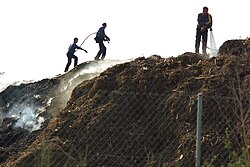
A large compost pile can spontaneously combust if improperly managed.

Spontaneous combustion or spontaneous ignition is a type of combustion which occurs by self-heating (increase in temperature due to exothermic internal reactions), followed by thermal runaway (self heating which rapidly accelerates to high temperatures) and finally, autoignition.[1] It is distinct from (but has similar practical effects to) pyrophoricity, in which a compound needs no self-heat to ignite. The correct storage of spontaneously combustible materials is extremely important, as improper storage is the main cause of spontaneous combustion. Materials such as coal, cotton, hay, and oils should be stored at proper temperatures and moisture levels to prevent spontaneous combustion. Reports of spontaneous human combustion are not considered truly spontaneous, but due to external ignition.[2]

Cause and ignition

[edit]

Spontaneous combustion can occur when a substance with a relatively low ignition temperature such as hay, straw, peat, etc., begins to release heat. This may occur in several ways, either by oxidation in the presence of moisture and air, or bacterial fermentation, which generates heat. These materials are thermal insulators that prevent the escape of heat causing the temperatures of the material to rise above its ignition point. Combustion will begin when a sufficient oxidizer, such as oxygen, and fuel are present to maintain the reaction into thermal runaway.

Thermal runaway can occur when the amount of heat produced is greater than the rate at which the heat is lost. Materials that produce a lot of heat may combust in relatively small volumes, while materials that produce very little heat may only become dangerous when well insulated or stored in large volumes. Most oxidation reactions accelerate at higher temperatures, so a pile of material that would have been safe at a low ambient temperature may spontaneously combust during hotter weather.

Affected materials

[edit]

Confirmed

[edit]

Hay[3] and compost piles[4] may self-ignite because of heat produced by bacterial fermentation, which then can cause pyrolysis and oxidation that leads to thermal runaway reactions that reach autoignition temperature. Rags soaked with drying oils or varnish can oxidize rapidly due to the large surface area, and even a small pile can produce enough heat to ignite under the right conditions.[5][6] Coal can ignite spontaneously when exposed to oxygen, which causes it to react and heat up when there is insufficient ventilation for cooling.[7] Pyrite oxidation is often the cause of coal's spontaneous ignition in old mine tailings. Pistachio nuts are highly flammable when stored in large quantities, and are prone to self-heating and spontaneous combustion.[8] Large manure piles can spontaneously combust during conditions of extreme heat. Cotton and linen can ignite when they come into contact with polyunsaturated vegetable oils (linseed, massage oils); bacteria will slowly decompose the materials, producing heat. If these materials are stored in a way so the heat cannot escape, the heat buildup increases the rate of decomposition and thus the rate of heat buildup increases. Once ignition temperature is reached, combustion occurs with oxidizers present (oxygen). Nitrate film, when improperly stored, can deteriorate into an extremely flammable condition and combust. The 1937 Fox vault fire was caused by spontaneously combusting nitrate film.

Hay

[edit]

Hay is one of the most widely studied materials in spontaneous combustion. It is very difficult to establish a unified theory of what occurs in hay self-heating because of the variation in the types of grass used in hay preparation, and the different locations where it is grown. It is anticipated that dangerous heating will occur in hay that contains more than 25% moisture. The largest number of fires occur within two to six weeks of storage, with the majority occurring in the fourth or fifth week.

The process may begin with microbiological activity (bacteria or mold) which ferments the hay, creating ethanol. Ethanol has a flash point of 14 °C (57 °F), so with an ignition source such as static electricity, e.g. from a mouse running through the hay, combustion may occur. The temperature then increases, igniting the hay itself.

Microbiological activity reduces the amount of oxygen available in the hay. At 100 °C, wet hay absorbed twice the amount of oxygen of dry hay. There has been conjecture that the complex carbohydrates present in hay break down to simpler sugars, which are more readily fermented to ethanol.[9]

Charcoal

[edit]

Charcoal, when freshly prepared, can self-heat and catch fire. This is separate from hot spots which may have developed from the preparation of charcoal. Charcoal that has been exposed to air for a period of eight days is not considered to be hazardous. There are many factors involved, among them the type of wood and the temperature at which the charcoal was prepared.[10]

Coal

[edit]

Extensive studies have been completed on the self-heating of coal. Improper storage of coal is a main cause of spontaneous combustion, as there can be a continuous oxygen supply and the oxidization of coal produces heat that doesn't dissipate. Over time, these conditions can cause self-heating.[11] The tendency to self-heat decreases with the increasing rank of the coal. Lignite coals are more active than bituminous coals, which are more active than anthracite coals. Freshly mined coal consumes oxygen more rapidly than weathered coal, and freshly mined coal self-heats to a greater extent than weathered coal. The presence of water vapor may also be important, as the rate of heat generation accompanying the absorption of water in dry coal from saturated air can be an order of magnitude or more than the same amount of dry air.[12]

Cotton

[edit]

Cotton too can be at great risk of spontaneous combustion.[13] In an experimental study on the spontaneous combustion of cotton, three different types of cotton were tested at different heating rates and pressures. Different cotton varieties can have different self-heating oxidation temperature and larger reactions. Understanding what type of cotton is being stored will help reduce the risk of spontaneous combustion.[14] A striking example of a cargo igniting spontaneously occurred on the ship Earl of Eldon in the Indian Ocean on 24 August 1834.

Oil seeds and oil-seed products

[edit]

Oil seeds and residue from oil extraction will self-heat if too moist. Typically, storage at 9–14% moisture is satisfactory, but limits are established for each individual variety of oil seed. In the presence of excess moisture that is just below the level required for germinating seed, the activity of mold fungi is a likely candidate for generating heat. This was established for flax and sunflower seeds, and soy beans. Many of the oil seeds generate oils that are self-heating. Palm kernels, rapeseed, and cotton seed have also been studied.[15] Rags soaked in linseed oil can spontaneously ignite if improperly stored or discarded.[16]

Copra

[edit]

Copra, the dried, white flesh of the coconut from which coconut oil is extracted,[17] has been classed with dangerous goods due to its spontaneously combustive nature.[18] It is identified as a Division 4.2 substance.

Human

[edit]

There have been unconfirmed anecdotal reports of people spontaneously combusting. This alleged phenomenon is not considered true spontaneous combustion, as supposed cases have been largely attributed to the wick effect, whereby an external source of fire ignites nearby flammable materials and human fat or other sources.[19]

Predictions and preventions

[edit]

There are many factors that can help predict spontaneous combustion and prevent it. The longer a material sits, the higher the risk of spontaneous combustion. Preventing spontaneous combustion can be as simple as not leaving materials stored for extended periods of time, controlling air flow, moisture, methane, and pressure balances. There are also many materials that prevent spontaneous combustion. For example, spontaneous coal combustion can be prevented by physical based materials such as chlorine salts, ammonium salts, alkalis, inert gases, colloids, polymers, aerosols, and LDHs, as well as chemical-based materials like antioxidants, ionic liquids, and composite materials.[20]

References

[edit]

Bibliography

[edit]
[edit]
Revisions and contributorsEdit on WikipediaRead on Wikipedia
from Grokipedia
Spontaneous combustion is the phenomenon in which a combustible ignites without an external ignition source, resulting from self-heating due to exothermic chemical reactions, such as oxidation, that produce faster than it can dissipate through conduction, , or . This typically begins at low temperatures with slow oxidation or microbial activity and escalates via to reach the material's , often leading to smoldering or flaming . Key factors influencing spontaneous combustion include the material's and , which affect heat loss; ambient temperature; moisture content; and oxygen availability, with larger masses more prone to ignition due to reduced surface-area-to-volume ratios. Common causes involve the oxidation of organic or inorganic substances, where from low-temperature accumulates in insulated or piled materials, or biological processes like bacterial in damp organics that raise initial temperatures to 50–75°C before chemical oxidation takes over. Pyrophoric materials, such as finely divided metals (e.g., aluminum or magnesium powders) or white phosphorus, ignite upon exposure to air due to rapid exothermic with oxygen. Hypergolic , where substances ignite on contact with an oxidizer without external , also contribute in specific chemical contexts. Notable examples include seams or stockpiles, where oxidation of and hydrocarbons leads to fires in mines and storage piles, often requiring inert gas injection for prevention; agricultural products like wet hay or , where microbial heating in bales exceeding 130–175°F triggers ignition; and industrial rags soaked in drying oils such as , which polymerize exothermically and can smolder within hours in confined spaces. Other affected materials encompass wood chips, , , and cellulose nitrate, with documented cases including warehouse fires from piles and shipboard incidents from cargo self-heating. In fire investigations, parameters like (typically 60–140 kJ/mol for self-heating reactions in common materials) and (10⁻⁷ to 10⁻⁶ m²/s) are used to predict ignition times and assess origins. Prevention strategies emphasize ventilation to enhance , moisture control to inhibit microbial activity, and segregation of reactive materials.

Overview and Definition

Definition

Spontaneous combustion refers to the phenomenon where a combustible ignites and sustains burning without an external ignition source, such as a spark or , due to internal self-heating from exothermic chemical reactions that lead to and eventual autoignition. This process begins with slow oxidation or other heat-generating reactions within the , where the rate of heat production exceeds the rate of heat dissipation, causing a progressive temperature rise until the reaches its —the minimum temperature at which it can ignite spontaneously in air. The foundational prerequisites for spontaneous combustion include exothermic reactions, which release through chemical interactions like oxidation, and conditions that promote —an uncontrolled escalation in temperature as reaction rates accelerate with rising , outpacing the material's ability to lose to its surroundings. serves as the critical threshold, varying by material but typically requiring confinement or accumulation to trap effectively. This phenomenon applies to solids, liquids, and gases, though it most commonly manifests in solids stored in piled, stacked, or confined forms, such as stockpiles or hay bales, where poor ventilation hinders heat escape and facilitates the buildup necessary for ignition.

Historical Background

The earliest recorded accounts of spontaneous combustion date back to ancient times, with Roman naturalist describing instances of materials igniting without an apparent external source in his Naturalis Historia published in 77 AD. These observations likely referred to organic materials like hay or oily substances that self-heated under certain conditions, though interpretations remained rudimentary and often intertwined with . By the 17th and 18th centuries, European farmers and miners frequently reported cases of haystacks bursting into flames and piles or mine workings smoldering without ignition, attributing them to internal heat buildup from moisture and air exposure. Such events were documented in agricultural records and mining reports across Britain and , prompting initial empirical inquiries into the role of oxidation in confined, damp environments. In the , scientific investigations advanced understanding of the phenomenon, beginning with Humphry Davy's research on risks in coal mines during the early 1800s, which highlighted the dangers of gaseous products leading to ignition. Davy’s work, presented to the Royal Society, influenced safety measures in the burgeoning coal industry. Later in the decade, studies on hay self-ignition in the 1840s by researchers like Ranke measured internal temperatures rising to 300°C due to microbial and chemical processes, transforming the material into char without external . These efforts marked a shift toward experimental validation, using controlled heating tests to replicate field observations and debunk supernatural causes. The phenomenon also permeated culture and commerce, notably in ' 1853 novel , where the dramatic of a character was inspired by contemporary reports of human and material cases, fueling public fascination and debate. Concurrently, rising fire insurance claims in and America—often involving hay barns and storage—spurred insurers to fund research, as companies like those in 19th-century Britain sought to distinguish genuine spontaneous events from , leading to detailed forensic analyses by the mid-1800s. By the early 20th century, explanations evolved from mystical notions—such as divine intervention or inherent "vital heat" in substances—to rigorous chemical and biological models emphasizing low-temperature oxidation and bacterial respiration as primary heat sources. Seminal studies, including those by the U.S. Bureau of Mines in the 1920s, quantified factors contributing to spontaneous combustion in coal, solidifying it as a verifiable physicochemical process rather than an enigma. This transition facilitated preventive engineering, such as improved ventilation in storage, and continues to inform modern risk assessments in agriculture and industry.

Scientific Mechanisms

Heat Generation Processes

Spontaneous combustion arises from exothermic reactions within materials that generate internally, often through slow oxidation where oxygen reacts with the material at ambient temperatures, releasing energy in the form of without an external ignition source. This process is characterized by a gradual increase as the reaction proceeds, with heat production following the Arrhenius law, where the rate accelerates exponentially with . Other exothermic processes, such as in , contribute similarly by breaking down compounds and liberating , though these are typically slower and occur under specific moisture conditions. Heat accumulation is facilitated by factors that impede dissipation, particularly in bulk materials with low thermal conductivity, which act as natural insulators and trap generated within the mass. In piled or confined configurations, conduction—the primary mode of in solids—dominates but is inefficient in porous or fibrous structures, allowing internal temperatures to rise while surface layers remain cooler. plays a lesser role internally but can aid dissipation in open environments through air circulation; however, in confined settings, limited exacerbates heat retention by reducing convective losses. A critical size threshold exists for the material mass, determined by the balance between heat generation (scaling with , proportional to radius cubed) and heat loss (scaling with surface area, proportional to radius squared); beyond this size, self-sustaining temperature rise becomes possible as internal heat buildup outpaces external cooling. The concept of describes the loop where rising temperatures exponentially accelerate the rate, further increasing heat generation and overwhelming dissipation mechanisms. This instability leads to a rapid, uncontrolled temperature escalation, transitioning from steady self-heating to ignition. The Frank-Kamenetskii theory models this phenomenon by nondimensionalizing the heat conduction equation for an in a reactive medium, assuming large and steady-state conditions before . The governing equation is the Poisson equation in dimensionless form: 2θ+δeθ=0\nabla^2 \theta + \delta e^{\theta} = 0 where θ=E(TTa)RTa2\theta = \frac{E (T - T_a)}{R T_a^2} is the dimensionless (with TT the local , TaT_a the ambient , EE the , and RR the ), and boundary conditions θ=0\theta = 0 at the surface. The Frank-Kamenetskii parameter δ\delta is defined as δ=QAρEr2λRTa2exp(ERTa),\delta = \frac{Q A \rho E r^2}{\lambda R T_a^2} \exp\left(-\frac{E}{R T_a}\right), where QQ is the heat of reaction per unit mass, AA is the pre-exponential factor, ρ\rho is the density, rr is the characteristic size (e.g., radius), and λ\lambda is the thermal conductivity. This parameter quantifies the ratio of heat generation to conduction; criticality occurs when δ\delta exceeds a geometry-dependent value δcr\delta_{cr} (e.g., 0.88 for an infinite slab, 2 for an infinite cylinder, 3.32 for a sphere), beyond which no stable steady-state solution exists, leading to thermal runaway. Derivation begins with the dimensional heat balance: λ2T+QρAexp(E/(RT))=0\lambda \nabla^2 T + Q \rho A \exp(-E/(R T)) = 0 at steady state, neglecting convection and assuming zero-order kinetics. Nondimensionalization scales length by rr, temperature rise by RTa2/ER T_a^2 / E (valid for large E/(RTa)E/(R T_a)), and approximates the Arrhenius term via exp(E/(RT))exp(E/(RTa))exp(θ)\exp(-E/(R T)) \approx \exp(-E/(R T_a)) \exp(\theta) using the Frank-Kamenetskii transformation, yielding the dimensionless equation and δ\delta. Criticality is found by solving the eigenvalue problem for the maximum δ\delta admitting a positive solution, marking the bifurcation to instability. This framework highlights how ambient temperature TaT_a influences criticality through the exponential term, lowering the threshold for ignition as TaT_a increases.

Ignition Conditions

Spontaneous combustion ignites when the internal of a reaches its through self-heating, without any external ignition source. The is defined as the lowest at which a substance will spontaneously ignite in air in the absence of an external source, such as a or spark. For organic susceptible to spontaneous combustion, such as and hay, this varies widely depending on the specific composition and conditions; for example, hay can ignite at internal temperatures around 80°C (175°F), while typically requires internal temperatures of 400–450°C under oxidative self-heating. Factors like oxygen availability influence this threshold, as higher oxygen concentrations accelerate oxidation and lower the effective , while moisture content can either promote initial self-heating through microbial activity or inhibit it by enhancing dissipation. Critical parameters for ignition are described by the Semenov theory of thermal explosion, which models the transition from stable self-heating to runaway combustion in a well-mixed system. In this theory, ignition occurs when the rate of heat generation from the exceeds the rate of heat loss to the surroundings, quantified as the condition where the temperature derivative satisfies dTdt>\frac{dT}{dt} > heat loss rate, leading to . The stability boundary is determined by the point of tangency between the heat generation curve (exponential due to Arrhenius kinetics) and the linear heat loss curve (Newtonian cooling), corresponding to the critical Semenov number ψcr=1\psi_{cr} = 1, where ψ=ERTa2QρAVhSexp(ERTa)\psi = \frac{E}{RT_a^2} \cdot \frac{Q \rho A V}{h S} \exp\left(-\frac{E}{RT_a}\right), with EE as , QQ as heat of reaction, ρ\rho as density, AA as , V/SV/S as volume-to-surface ratio, hh as , and TaT_a as ambient temperature. This criterion highlights that ignition depends on the balance of reaction kinetics and , with the critical ignition temperature approximated as TiTa+RTa2ET_i \approx T_a + \frac{RT_a^2}{E}. Environmental triggers play a key role in reaching ignition thresholds by modulating accumulation. High can facilitate initial microbial in organic piles, generating that initiates oxidation, though excessive may later suppress ignition by increasing conductivity. affects oxygen supply and convective cooling; restricted in enclosed or compacted materials promotes buildup, while excessive wind can either accelerate oxidation or dissipate depending on pile . Pile is particularly influential, as larger piles with lower surface-to-volume ratios retain more effectively, allowing ignition at lower ambient temperatures—for instance, stockpiles exceeding 3 meters in height can self-ignite at ambient temperatures as low as 40°C, compared to smaller piles requiring higher ambient conditions. Unlike external ignition, which requires an outside energy source like a spark or open to initiate by rapidly heating the material to its ignition point, spontaneous combustion relies entirely on internal self-heating processes that gradually elevate the beyond the autoignition threshold, often without visible precursors until flames emerge. This distinction underscores that spontaneous ignition transitions seamlessly from smoldering oxidation to flaming once the is exceeded internally, bypassing the need for any discrete ignition event.

Causes of Spontaneous Combustion

Chemical Oxidation

Chemical oxidation serves as a primary abiotic pathway for spontaneous combustion, involving the slow, of susceptible materials with atmospheric oxygen, which generates heat and can lead to if dissipation is insufficient. This process is characterized by its temperature dependence, following the , where the reaction rate constant kk is given by k=Aexp(Ea/RT)k = A \exp(-E_a / RT), with AA as the , EaE_a the , RR the , and TT the absolute temperature; as temperature rises, the rate accelerates exponentially, potentially escalating from low-level heating to ignition. In materials like or organic compounds, initial oxidation occurs at ambient temperatures, releasing small amounts of heat that accumulate if insulated, distinguishing it from rapid combustion. Autoxidation, a key form of chemical oxidation, proceeds via a free-radical comprising , , and termination steps. involves the formation of free radicals, often from the abstraction of a by oxygen or impurities, creating alkyl radicals (R•) that react with O₂ to form peroxy radicals (ROO•). sustains the chain as ROO• abstracts hydrogen from the substrate to yield hydroperoxides (ROOH) and regenerate R•, while also reacting with additional O₂; this cycle amplifies heat release through exothermic peroxide formation. Termination occurs when radicals combine, such as two ROO• forming non-radical products like ketones and oxygen, halting the chain but not before significant heat buildup. This mechanism is particularly relevant in unsaturated compounds, where double bonds facilitate radical stability and . In specific reactions, such as the of , atmospheric oxygen attacks polyunsaturated chains via free radicals, forming peroxides that decompose exothermically and can ignite at temperatures as low as 82°C in the presence of catalysts. Similarly, in , (FeS₂) oxidation generates through the reaction 4FeS₂ + 11O₂ → 2Fe₂O₃ + 8SO₂, lowering the for coal oxidation and increasing overall heat release, thereby accelerating spontaneous combustion. These processes highlight how localized exothermic reactions contribute to self-heating in bulk materials. Factors enhancing oxidation include the presence of metal catalysts, such as transition metals (e.g., iron, ) inherent in substrates, which lower activation energies and promote radical initiation; for instance, alkali and transition metals in catalyze low-temperature oxidation by facilitating in chain propagation. Recent studies on waste piles have also identified oxidation as a contributor, where oxidized polymers in refuse-derived fuels initiate , leading to heat accumulation and fire risks in landfills.

Microbial Activity

Microbial activity contributes to spontaneous combustion through biological decomposition processes in organic materials, where and fungi metabolize nutrients, generating as a byproduct. Thermophilic , such as Bacillus stearothermophilus, play a key role in composting environments by breaking down organic compounds via respiration, elevating temperatures to 70°C or higher during the thermophilic phase. Fungi also contribute in the initial mesophilic stage, facilitating the transition to higher temperatures through enzymatic degradation. In wet organic matter, microbial decomposition occurs primarily through aerobic oxidation and anaerobic fermentation, both of which produce carbon dioxide, water, and significant heat. Aerobic processes involve oxygen-dependent respiration by bacteria and fungi, accelerating breakdown in nutrient-rich piles and leading to rapid heat accumulation. Anaerobic fermentation, common in compacted or sealed environments like silage, relies on bacteria converting sugars to acids and gases, generating heat that can initiate self-heating if oxygen later infiltrates. Escalation to spontaneous combustion requires specific conditions, including high moisture content of 40-60% to support microbial proliferation and nutrient-rich substrates that sustain activity. In such environments, like improperly stored or heaps, microbial heat buildup can exceed 60°C, creating hotspots that propagate if ventilation is limited. For instance, silage heating often results from bacterial in moist, oxygen-poor zones, potentially leading to combustion upon . Similarly, in stored grain, insufficient ventilation and a humid state (high moisture content) are primary causes of self-ignition. Humid conditions promote the proliferation of bacteria and molds, which generate heat through respiration and decomposition processes. Without adequate ventilation to dissipate this heat, temperatures can rise to levels sufficient for spontaneous combustion, particularly in oil-rich grains such as soybeans where equilibrium relative humidity exceeds 70%. However, microbial heat generation typically plateaus around 80°C, as thermophilic populations decline and cannot sustain further increases without transitioning to abiotic chemical oxidation processes. This limitation underscores that while biotic activity initiates self-heating, ignition often requires subsequent chemical escalation in susceptible materials.

Susceptible Materials

Organic and Biological Materials

Organic and biological materials, such as plant-derived fibers and animal waste, are particularly susceptible to spontaneous combustion due to their high organic content, which facilitates microbial and oxidative reactions under certain conditions. These materials often retain , promoting bacterial and fungal activity that generates initial heat, which can escalate to ignition if ventilation is poor or piles are densely packed. Hay and straw are classic examples, where moisture retention above 20% enables microbial respiration, producing heat through the breakdown of carbohydrates. This initial heating, often reaching 100–130°F, transitions to fungal activity up to 160–170°F, followed by chemical oxidation above 175°F, potentially leading to smoldering and if heat accumulates faster than it dissipates. Historical barn fires, such as those reported annually in , have destroyed structures, , and feed, with one incident leaving only remnants of and pipes due to intense combustion. Stored grain, such as wheat, corn, or soybeans in silos or bins, is also highly susceptible to spontaneous combustion, with the main causes being insufficient ventilation and a humid state (high moisture content typically above 14%). Under these conditions, microbial respiration and mold growth generate heat through biological processes, and poor aeration prevents dissipation, allowing temperatures to rise to 135–140°F or higher, potentially leading to ignition. For instance, wet grain from flooding or improper drying has caused overheating and fires in storage facilities, emphasizing the need for proper drying and ventilation systems. Cotton and linens pose risks primarily from oily residues introduced during processing or use, such as vegetable or linseed oils, which undergo peroxidation—a slow oxidation process releasing heat that can ignite if materials are piled while warm. In laundries, improperly cooled, oil-contaminated towels and linens have caused fires in hospitals and commercial facilities, with incidents including smoke emission from stacked folds and ignition in storage crates. A notable warehouse fire in Oak Ridge, Tennessee, in 2016 originated from spontaneous combustion of discarded oily rags in a waste container. Compost piles and heaps from , like or waste, experience bacterial activity that drives aerobic , elevating temperatures to 130–145°F to kill pathogens but risking spontaneous combustion above 170°F in overly large or wet piles. Guidelines recommend maintaining pile heights under 5–6 feet, turning regularly for aeration, and monitoring to prevent excessive heat buildup, as seen in a 2017 Arkansas fire and a New York manure pile ignition. Such incidents contribute to significant agricultural losses, with U.S. structure fires—many from hay spontaneous combustion—causing about $28 million in annual , alongside civilian injuries and deaths.

Carbonaceous and Industrial Materials

Carbonaceous materials, particularly those derived from and , are highly susceptible to spontaneous combustion due to their carbon-rich composition and inherent chemical reactivity. , a primary example, undergoes self-heating primarily through the oxidation of () present within it, which generates exothermic reactions that release heat and can adsorb reactive gases like oxygen, accelerating the process. In stockpiles, this self-heating becomes critical when the pile exceeds a of approximately 3 meters at ambient temperatures around 25°C, as the internal heat buildup outpaces dissipation, leading to ignition. Moisture exacerbates this by facilitating pyrite oxidation, providing a secondary heat source that hastens spontaneous combustion in storage environments. Charcoal, produced through the pyrolysis of wood or other , exhibits similar vulnerabilities owing to its highly structure, which offers a large internal surface area for oxygen adsorption and retention during and after production. This traps residual and promotes low-temperature oxidation, often resulting in fires during bagged storage or transport if not properly ventilated. Guidelines for safe carriage emphasize that charcoal's carbon content poses a significant of spontaneous combustion in confined containers, necessitating modified atmospheres or limited stacking to mitigate self-heating. Industrial wastes such as rubber and plastics are prone to spontaneous combustion through mechanisms like oxidative degradation and thermal depolymerization, where heat breaks polymer chains into volatile monomers that fuel further reactions. Waste tire piles, in particular, self-heat due to the oxidation of rubber components, with studies post-2020 highlighting how shredded tires in high ambient temperatures (>40°C) and poor ventilation accelerate this process, leading to prolonged fires. Recent research on tire stockpiles underscores the role of microbial activity in initial heating followed by chemical oxidation, contributing to environmental hazards in unmanaged sites. For plastics, large waste piles have been observed to spontaneously combust, as seen in a 170,000-ton heap in South Korea where accumulated heat from oxidation ignited the mass. The economic and environmental toll of these incidents is substantial, with global emissions from coal seam and stockpile fires estimated to contribute about 1% to annual fossil fuel-related CO2 emissions, alongside mercury and other pollutants. Monitoring technologies, including for early detection of hot spots in piles and gas sensors tracking CO and C2H4 precursors, have become essential for prevention in industrial settings.

Oily and Seed-Based Products

Oily and seed-based products are particularly susceptible to spontaneous combustion due to the of their high content of unsaturated fatty acids, which form heat-generating peroxides through reactions with atmospheric oxygen. This process, known as , is accelerated in materials rich in double bonds, such as those found in vegetable oils derived from seeds. The heat buildup occurs as peroxides decompose exothermically, and if insulation prevents dissipation, temperatures can reach ignition points around 300–400°C. Oil seeds like and soybeans exemplify this risk because of their polyunsaturated fats. , extracted from seeds, contains up to 60% with multiple double bonds, promoting rapid even at ambient temperatures; studies show that metal catalysts like salts can reduce ignition times to hours by accelerating formation. , a of oil extraction, retains 1–2% residual oil but is prone to self-heating when moisture exceeds 12%, leading to fermentation compounds and eventual combustion, as evidenced by chemical analyses of overheated cargoes. In both cases, the oxidation chain reaction generates volatile hydrocarbons that further insulate and fuel the process. Copra, the dried kernel of coconuts, and fishmeal represent concentrated oil sources from processing. holds 60–65% , primarily , which oxidizes during if moisture lingers above 7%, fostering bacterial activity that initiates heat; paradoxically, over- to below 6% moisture reduces evaporative cooling, allowing oxidation heat to accumulate unchecked in poorly ventilated stores. Fishmeal, produced from like anchovies, contains 6–12% polyunsaturated fish oils that oxidize vigorously, with self-heating starting at 55°C and potentially reaching 200°C without antioxidants; historical production without stabilizers led to frequent cargo ignitions. Both materials require moisture control below 10% for stability, but inadequate concentrates oxidizable , heightening the risk. Cloths or rags soaked in -based paints and varnishes pose a common household and industrial hazard. When such rags are crumpled or folded, the oxidation of the oil's unsaturated bonds releases heat that is trapped within the folds, preventing dissipation and causing ignition within 30 minutes to several hours, depending on ambient conditions. The U.S. (OSHA) mandates hazard communication for linseed oil products, warning of autoignition risks and requiring proper disposal in airtight metal containers to allow cooling. A notable case involved linseed oil-soaked rags igniting in a high-rise building, resulting in three fatalities and underscoring the need for immediate spreading or immersion in post-use. Shipping incidents highlight the scale of risks with these materials in bulk. In the , cargo ships carrying untreated fishmeal suffered multiple fires and sinkings due to unchecked oil oxidation in holds, prompting international regulations for addition. Similarly, and oil seed cakes, such as those from soybeans or sunflowers, have caused container fires through self-heating of residual oils, with incidents like a 2013 crab shell meal blaze (analogous in oil content) demonstrating how poor ventilation in transit exacerbates buildup. These events led to IMDG Code classifications under Class 4.2 for spontaneous combustibles, emphasizing ventilation and temperature monitoring below 55°C during voyages.

Human Spontaneous Combustion

Reported Cases

Reports of alleged human spontaneous combustion (SHC) have been documented since the , with approximately 200 cases recorded worldwide over the past three centuries. These accounts often describe sudden, intense fires that consume the body while leaving surrounding areas largely intact, with no evident external ignition source. Many reported incidents involve elderly or incapacitated individuals, such as those who are alone, intoxicated, or impaired by medications. Investigator and forensic analyst John F. Fischer compiled a list of 30 historical SHC cases spanning from 1725 to 1982, drawing from reports, medical records, and eyewitness testimonies to highlight their anecdotal nature. These cases typically feature the victim's body severely damaged—often reduced to ash or charred remains—while nearby furniture, walls, or personal items show little to no fire damage. The compilation underscores the reliance on incomplete or secondhand evidence in early reports, with patterns emerging of fires starting internally without confirmed accelerants. One prominent example is the 1951 case of Mary Reeser in , where the 67-year-old widow was found mostly incinerated in her apartment chair, leaving only a shrunken , a foot, and minimal ashes; the room's temperature was normal, and no external fire was identified. In 1986, George Mott, a 58-year-old retired in Crown Point, New York, was discovered charred beyond recognition in his bedroom, with the fire confined to his body and causing scant damage to the mattress or walls. A more recent incident occurred in 2010 involving Michael Faherty, a 76-year-old retiree in Galway, Ireland, whose body was found burned on his living room floor near an unlit fireplace, prompting a coroner's . Post-2000 reports remain sparse but include police-investigated claims similar to earlier patterns, such as isolated burns on incapacitated victims without apparent causes. Nickell's work emphasizes that while these cases fuel ongoing interest, they are predominantly anecdotal, with details varying by source and era.

Scientific Explanations and Debunking

Human spontaneous combustion (SHC) is widely regarded as a pseudoscientific , with no verified cases of a human body igniting without an external source. Scientific investigations attribute reported incidents to the "wick effect," where an initial external ignition—such as a , , or dropped —starts a slow-burning process fueled by the body's own . In this mechanism, or nearby fabrics act as a wick, absorbing melted that sustains at relatively low temperatures (around 250–300°C), allowing the to consume the while leaving extremities like hands and feet relatively intact due to lower content. This process can continue for hours or days, often in isolated settings where the victim is immobile, such as the elderly or intoxicated individuals seated in armchairs. Experimental recreations have consistently supported the wick effect while debunking true spontaneity. In a 1998 study by forensic scientist John De Haan, a carcass (anatomically similar to humans) wrapped in a and ignited with a small amount of burned slowly over several hours, reducing soft tissues and bones to ash with minimal damage to surrounding areas, closely mimicking SHC reports. Similar results have been obtained in forensic experiments using animal tissues dressed in and ignited by small external sources, such as or cigarettes, demonstrating localized burning without rapid conflagration. These tests highlight that human bodies, with their high water content (about 60–70%) and low inherent flammability, cannot self-ignite; an external spark is always required to initiate the process. Human further precludes spontaneous ignition, as the body's metabolic processes generate insufficient . Normal core body temperature is maintained around 37°C, with leading to death at approximately 42°C, far below the 600–800°C needed for autoignition of tissues. Calorimetric measurements show basal metabolic production at about 1 W/kg, primarily dissipated through , incapable of accumulating energy for —even during fever or exercise, rates rarely exceed 5–7 W/kg temporarily. No internal biochemical reactions, such as oxidation of fats or gases, produce the localized high temperatures claimed in SHC lore. Forensic analyses of alleged SHC cases reveal external causes, including sparks from electrical faults, accelerants like alcohol-soaked , or open flames, with autopsies identifying discrete ignition points such as charred cigarettes or proximity. For instance, soot patterns and unburned items in the environment indicate a smoldering rather than explosive onset. Reviews by forensic pathologists like Byard confirm that all documented cases align with accidental ignition followed by the wick effect, dismissing SHC as a perpetuated by incomplete investigations and sensationalism. The scientific consensus, as articulated in recent analyses, classifies SHC as pseudoscience, with over 200 historical reports explained by mundane factors rather than paranormal or physiological anomalies.

Prevention and Mitigation

Detection Methods

Detection of spontaneous combustion relies on identifying early self-heating in susceptible materials such as coal or organic piles, where oxidation processes generate heat that can escalate if unchecked. Temperature monitoring is a primary method, employing thermocouples inserted into storage piles or infrared sensors for non-contact scanning to detect hotspots. Thermocouples provide precise internal measurements, while infrared thermography identifies surface anomalies from afar, often integrated into fixed or drone-mounted systems for large-scale monitoring. A temperature exceeding 70°C typically signals the onset of self-heating, prompting immediate intervention to prevent escalation to ignition. Gas detection targets byproducts of oxidation, using sensors for (CO), (CO2), and hydrocarbons, which indicate anaerobic or aerobic heating. Portable sniffers or fixed networks sample air around piles, with CO levels above 50 ppm serving as an early alert for impending . Modern IoT-enabled systems connect these sensors to platforms for analysis and automated alerts, enhancing responsiveness in industrial settings like yards or storage. Visual and olfactory cues offer accessible, low-tech indicators, particularly for on-site operators. Steam or vapor emission from piles suggests internal heating and evaporation, while off-gassing produces acrid, sulfurous odors from volatile organic compounds. Acoustic emissions, such as cracking or popping sounds from material expansion, can also signal stress points, detectable via in advanced setups. These cues are most effective when combined with regular patrols, as they provide immediate, though subjective, evidence of risk. Recent advancements in the 2020s incorporate AI models to predict spontaneous combustion from integrated environmental , including , humidity, and gas readings. algorithms like and Support Vector Machines analyze historical and real-time datasets to forecast self-heating probabilities, achieving accuracies over 90% in applications by identifying patterns in humidity-temperature interactions. These predictive tools, often deployed via IoT networks, bridge gaps in traditional monitoring by enabling proactive alerts before visible signs emerge.

Preventive Measures

Preventive measures for spontaneous combustion focus on minimizing the conditions that promote oxidation, microbial activity, and accumulation in susceptible materials. These strategies emphasize proper storage, handling, and practices to reduce oxygen exposure, control , and limit pile sizes across various settings. In coal storage, stockpiles should be constructed in thin, compacted layers to restrict air ingress, with maximum heights of 5 meters per layer for coarse reject materials and overall voids limited to less than 15% on an air-dry basis. Compaction using rollers, particularly at edges, and covering with a 1-meter-thick layer of inert, non-carbonaceous material further prevent oxygen contact and buildup. should be managed by avoiding repeated and cycles, while ventilation is minimized through low-incline designs and sealing techniques rather than enhanced . For hay and other organic materials, storage begins with baling at contents below 20% for small stacked bales or 18% for large round or square bales to inhibit microbial heating. Stacks should be arranged with adequate spacing—such as a 15-foot around outdoor piles—and ventilated through proper curing with tedders or turners before storage. Material handling protocols are critical for oily and seed-based products. Oily rags saturated with flammable liquids, such as those from or paint thinners, must be spread out to dry completely in well-ventilated areas or stored in covered metal containers designed to contain potential ignition, preventing the oxidation process that generates heat. For seeds like soybeans, inert gas blanketing with or CO₂ in silos reduces oxygen levels below the limiting concentration (typically with a 1-4% safety margin), while maintaining moisture below 13-15% limits microbial and oxidative reactions. Antioxidants or chemical inhibitors can be added to oils during processing to slow auto-oxidation. Industrial protocols for carbonaceous and biological materials include regular in piles, turned weekly to release heat and maintain moisture between 25% and 40%, with depths limited to under 6 feet or aerated static piles to no more than 12 feet. Fire-resistant coatings on storage structures and compaction of piles reduce risks in facilities handling industrial materials. These measures often prove cost-effective, as prevention avoids significant losses from fires, which can exceed millions in facility damage and downtime. Post-2020 guidelines for emphasize integrated in facility design, including supervised storage to prevent spontaneous ignition in wood and illegal dumps, alongside strict of waste tracking to minimize unmanaged accumulations. Staff training on no-smoking zones and moisture monitoring further supports proactive risk reduction in these operations.

References

Add your contribution
Related Hubs
Contribute something
User Avatar
No comments yet.