Recent from talks
Nothing was collected or created yet.
Stokoe notation
View on Wikipedia| Stokoe notation | |
|---|---|
| Script type | alphabet
|
Period | 1960 to present |
| Direction | Left-to-right |
| Languages | ASL |
| Related scripts | |
Child systems | ASL-phabet |
Stokoe notation (/ˈstoʊki/ STOH-kee) is the first[1] phonemic script used for sign languages. It was created by William Stokoe for American Sign Language (ASL), with Latin letters and numerals used for the shapes they have in fingerspelling, and iconic glyphs to transcribe the position, movement, and orientation of the hands. It was first published as the organizing principle of Sign Language Structure: An Outline of the Visual Communication Systems of the American Deaf (1960),[2] and later also used in A Dictionary of American Sign Language on Linguistic Principles, by Stokoe, Casterline, and Croneberg (1965).[3] In the 1965 dictionary, signs are themselves arranged alphabetically, according to their Stokoe transcription, rather than being ordered by their English glosses as in other sign-language dictionaries. This made it the only ASL dictionary where the reader could look up a sign without first knowing how to translate it into English. The Stokoe notation was later adapted to British Sign Language (BSL) in Kyle et al. (1985)[4] and to Australian Aboriginal sign languages in Kendon (1988).[5] In each case the researchers modified the alphabet to accommodate phonemes not found in ASL.
The Stokoe notation is mostly restricted to linguists and academics. The notation is arranged linearly on the page and can be written with a typewriter that has the proper font installed. Unlike SignWriting or the Hamburg Notation System, it is based on the Latin alphabet and is phonemic, being restricted to the symbols needed to meet the requirements of ASL (or extended to BSL, etc.) rather than accommodating all possible signs. For example, there is a single symbol for circling movement, regardless of whether the plane of the movement is horizontal or vertical.
Writing direction
[edit]Stokoe notation is written horizontally left to right like the Latin alphabet (plus limited vertical stacking of movement symbols, and some diacritical marks written above or below other symbols). This contrasts with SignWriting, which is written vertically from top to bottom (plus partially free two-dimensional placement of components within the writing of a single sign).
Symbol usage
[edit]Stokoe coined the terms tab ("tabula" or sign location), dez ("designator" or handshape & orientation), and sig ("signation" or motion & action). These are used to categorize features of sign-language phonemes, somewhat like the distinction between consonant, vowel, and tone is used in the description of oral languages. A sign is written in the order tab-dez-sig: TDs. Compound signs are separated with a double dashed pipe, approximately TDs¦¦TDs.
A serious deficiency of the system is that it does not provide for facial expression, mouthing, eye gaze, and body posture, as Stokoe had not worked out their phonemics in ASL.[6] Verbal inflection and non-lexical movement is awkward to notate, and more recent analyses such as those of Ted Supalla have contradicted Stokoe's set of motion phonemes.[citation needed] There is also no provision for representing the relationship between signs in their natural context, which restricts the usefulness of the notation to the lexical or dictionary level. Nonetheless, Stokoe demonstrated for the first time that a sign language can be written phonemically just like any other language.
In the tables below, the first column is a web-based approximation of the Stokoe symbol using the inventory available in Unicode, and the second is an ASCII substitution for the purpose of citing examples in this article. Proper display of the third column requires the Stokoe font available at the external link below; without that font, you will see the corresponding ASCII character, as used in Mandel (1993).
Tab (Location)
[edit]The tab symbols are a null sign for a neutral location and iconic symbols for parts of the head, arm, and torso. In addition, the dez (handshape) symbols below may be used to indicate that the location is the passive hand in a specific shape.
| Unicode approximation |
ASCII approximation |
Stokoe[a] | Description |
|---|---|---|---|
| Ø | 0 | 0 | neutral location |
| ⩇ | Q | h | face, or whole head (symbol is superimposed ᴖ and ᴗ) |
| ∩ | P | u | forehead, brow, or upper face |
| ⊔ | T | m | eyes, nose, or mid face |
| ∪ | U | l | lips, chin, or lower face |
| Ȝ | } | c | cheek, temple, ear, or side face |
| Π | N | k | neck |
| [ ] | [ ] | [] | torso, shoulders, chest, trunk |
| Ƨ | 7 | i | non-dominant upper arm |
| √ | J | j | non-dominant elbow, forearm |
| ɑ | 9 | a | inside of wrist |
| ɒ | 6 | b | back of wrist |
Given a handshape (dez) ⟨D⟩,[b] ⟨QD⟩ would be D signed at the face, ⟨JD⟩ the same handshape signed at the elbow, and ⟨9D⟩ on the inside of the wrist.
Dez (Handshape)
[edit]The symbols for handshapes are taken from the ASL manual alphabet: ⟨A⟩ represents a fist, the handshape used for fingerspelling "A" (and also "S" and "T", since the difference is not significant outside fingerspelling and initialisms); ⟨B⟩ represents a flat hand, the handshape used for fingerspelling "B" and "4", etc. When a dez involves two hands, two letters are used.
Dez symbols may also be used as tabs. For example, ⟨QB⟩ represents a flat hand, B, located at the face, Q, and <BB> represents a dominant flat hand B acting on a passive flat hand B. The latter is disambiguated from two B hands acting together by using another letter for the tab, such as ⟨ØBB⟩ for two B hands acting in neutral space, or ⟨QBB⟩ for both hands at the face.
Besides the shape of the hands, the dez includes their orientation. This is indicated, when necessary, with subscripts, which are introduced in the next section.
| A | fist (as ASL 'a', 's', or 't') |
| B | flat hand (as ASL 'b' or '4') |
| 5 | spread hand (as ASL '5') |
| C | cupped hand (as ASL 'c', or more open) |
| E | claw hand (as ASL 'e', or more clawlike) |
| F | okay hand (as ASL 'f'; thumb & index touch or cross) |
| G | pointing hand (as ASL 'g' 'd' or '1') |
| H | index + middle fingers together (as ASL 'h,' 'n' or 'u') |
| I | pinkie (as ASL 'i') |
| K | thumb touches middle finger of V (as ASL 'k' or 'p') |
| L | angle hand, thumb + index (as ASL 'l') |
| 3 | vehicle classifier hand, thumb + index + middle fingers (as ASL '3') |
| O | tapered hand, fingers curved to touch thumbtip (as ASL 'o') |
| R | crossed fingers (as ASL 'r') |
| V | spread index + middle fingers (as ASL 'v' or '2') |
| W | thumb touches pinkie (as ASL 'w') |
| X | hook (as ASL 'x') |
| Y | horns (as ASL 'y', or as index + pinkie) |
| 8 | bent middle finger; may touch thumb (as ASL '8', this is a common allophone of Y) |
There are three diacritics that modify the shape of the dez. A dot placed above it shows that a finger not normally seen is prominent, usually because it is involved in the production of the sign. For example, ⟨Ȧ⟩ (ascii 'A) is a fist with the thumb extended, as in ⟨UȦᶠ⟩ not. Three dots or ticks over a letter shows the fingers are flexed, so that ⟨B⃛⟩ (ascii ;B) is a flexed flat hand, and ⟨V⃛⟩ (;V) is two flexed fingers. The forearm tab sign prefixed to the dez (ascii j) shows that the forearms are prominent in the production of the sign, as in ⟨Bɑ jB^ω⟩ tree.
Sig (movement) and dez orientation
[edit]The movement of the hand, or sig, is written with superscripted letters after the dez, as D# (any dez D which closes). Multiple movement sigs are arranged linearly when the movements are sequential, as in TD×∨× (any dez D which touches a tab T, moves down, and touches again),1 but stacked one above the other when signed simultaneously, as in TD×ͮ (a dez which moves down while in contact with the tab).2
A dot placed above the sig indicates that the motion is sharp, as in TD×̇ (sharp contact by the dez D),3 while a dot placed after the sig indicates that the motion is repeated, as in TD×· (repeated contact by the dez; TDx" in ASCII).
A tilde with a two-hand dez, TDDs~, indicates that first one hand performs the sig, then the other. Without the tilde, both hands are understood to act together.
A subset of the sig symbols used for motion are also used to indicate the orientation of the hand. In this use they are subscripted after the dez instead of superscripted, as in D# (any dez D which starts off closed).4 Stokoe analyzed the orientation of the hand as part of the tab, the handshape.
| Movement (sig) | Orientation (dez) | ||||||
|---|---|---|---|---|---|---|---|
| Unicode | ASCII | Stokoe* | Description | Unicode | ASCII | Stokoe* | Description |
| Dʌ | D^ | D^ | moving upward | Dʌ | ^D | D^ | facing or pointing upward |
| Dv | Dv | Dv | moving downward | Dv | vD | Dv | facing or pointing downward |
| Dɴ | Dw | Dʳ | moving up and down | — | |||
| D> | D> | D> | to the dominant side | D> | >D | D> | facing the dominant side |
| D< | D< | D< | to the center or non-dominant side | D< | <D | D< | facing the center or non-dominant side |
| D≷ | Dz | Dᶻ | side to side | — | |||
| D⊤ | Dt | Dᵗ | toward signer | D⊤ | tD | Dt | facing signer |
| D⊥ | Df | Df | away from signer | D⊥ | fD | Df | facing away from signer |
| Dᶦ | Dm | D= | to and from | — | |||
| Dɑ | Da | Da | supinate (turn palm up) | Dɑ | aD | Da | supine (palm facing up) |
| Dɒ | Db | Dᵇ | pronate (turn palm down) | Dɒ | bD | Db | prone (palm facing down) |
| Dω | Dg | Dw | twist wrist back & forth | — | |||
| Dᵑ | Dr | Dⁿ | nod hand, bend wrist | Dŋ | rD | Dn | bent wrist |
| D◽[D′] | D*[D′] | D][D′] | open up (resulting Dez D’ shown in brackets) | D◽ | *D | D] | open |
| D#[D′] | D#[D′] | D#[D′] | close (resulting Dez D’ shown in brackets) | D# | #D | D# | closed |
| Dᴥ | De | De | wriggle fingers (symbol looks like a cursive e) |
— | |||
| D@ | D@ | D@ | circle (symbol is a spiral) |
— | |||
| D⁾⁽ | D)( | D) | approach, move together | D₎₍ | )(D | D) | near |
| D× | Dx | Dx | contact, touch | D× | xD | Dx | touching |
| D≬ | D$ | Dg | link, grasp | D≬ | $D | Dg | linked |
| D‡ | D+ | D+ | cross | D‡ | +D | D+ | crossed |
| Dʘ | Do | Do | enter | Dʘ | oD | Do | inside |
| D÷ | D% | D: | separate | — | |||
| Dʻʼ | D§ or D& | D( | exchange positions | — | |||
* Proper display requires installation of the Stokoe font available at the external link below.
- 1 TDx-v-x in ASCII
- 2 TDxv in ASCII
- 3 TDx! in ASCII
- 4 Closing hand and closed hand would be D# and #D in the ASCII system.
Several linguists, including Kyle & Woll, state that Stokoe's tab conflates two parameters, handshape and orientation, and split off ori (orientation of the hand) as a fourth parameter. Kendon, however, notes how this greatly complicates the phonological description of signs, and prefers to retain orientation as an aspect of the handshape, with changes of orientation analysed as other changes in the hands, rather than as changes in an independent parameter.
Relative location
[edit]When the tab is a hand shape, or the dez consists of two hands, a symbol may be placed between the two letters to indicate their relative position. These include a few of the movement/orientation letters above. In addition, there are symbols to indicate position above, below, next to, and behind: the underscore on the B in B L shows that the L hand is placed under a B hand, with or without contact, etc.
| Unicode | ASCII[a] | Description |
|---|---|---|
| B̲ A | B A | (underline) A under B |
| B̅ A | B A | (overline) A over B |
| BˡB | B|B | B next to B |
| A⌕A | A\A | A behind A |
| B‡B | B+B | B hands or forearms cross |
| F≬F | F$F | F hands (fingers) clasped or linked |
| 5ʘG | 5oG | G hand (finger) within 5 hand (between fingers) |
- ^ The free font does not cover these symbols
Example
[edit]This is the ASL word “Snake” in Stokoe notation:

The first letter, ᴗ (like a U), shows that the word is signed at the lower face (mouth or chin). The second, V⃛ɒ, shows that the hand has the shape of a fingerspelled "V". The V has two diacritics: the three dots ... above it show that the fingers are bent (curled), while the subscript ɒ shows that the hand is held with the back of the hand facing up. The last letters, @
⊥, are a compound sig: the spiral shows a circular motion, and the tack ˔ underneath shows that the motion proceeds outward. This is a mimetic sign for 'snake', mimicking the motion of a fanged snake.[7] It is alphabetized under to the tab U, then by the dez V, then by the sig @; the searcher does not need to know what it means or that it is glossed with the English word snake in order to look it up.
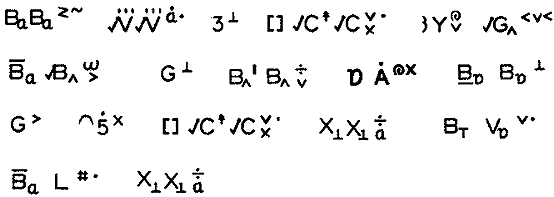
Following is a passage from Goldilocks:

ו
v
v
ו
ɑ
ɑ
- The story "Goldilocks and the Three Bears". Deep in the woods, there is a house sitting on a hill. (If you) go in, (you will see) there Papa Bear reading the paper.
Published use of Stokoe notation
[edit]The first use of Stokoe notation appeared in the ASL Dictionary compiled by Stokoe, Casterline, and Croneberg, for which it was devised. Other indigenous sign language dictionary projects, for example the Dictionary of British Sign Language/English, ed. David Brien, pub. Faber and Faber 1992, and Signs of a Sexual Nature[citation needed] have included Stokoe notation. The notation has also been used to analyze Australian Aboriginal sign languages. These non-ASL projects have had to extend the notation to cover phonemes not found in ASL.
See also
[edit]- ASL-phabet, a simplified notation used in ASL-English dictionaries for Deaf children and Deaf education
- HamNoSys, a phonetic notational system used primarily for linguistic research
- SignWriting, a popular system that arranges symbols in a two-dimensional space rather than in a line
- si5s
References
[edit]- ^ Kyle et al. 1985, p. 88.
- ^ Stokoe 1960.
- ^ Stokoe, Casterline & Croneberg 1965.
- ^ Kyle et al. 1985.
- ^ Kendon 1988.
- ^ Kyle et al. 1985, p. 29.
- ^ Stokoe, Casterline & Croneberg 1965, p. 168.
- Sources
- Kendon, Adam (1988). Sign Languages of Aboriginal Australia: Cultural, Semiotic and Communication Perspectives. Cambridge University Press.
- Kyle, Jim G.; Woll, Bencie; Pullen, Gloria; Maddix, Frank (1985). Sign Language: The Study of Deaf People and Their Language. Cambridge University Press.
- Stokoe, William C.; Casterline, Dorothy C.; Croneberg, Carl G. (1965). A Dictionary of American Sign Language on Linguistic Principles. Washington, DC: Gallaudet College Press.
- Stokoe, William C. (1960). Sign Language Structure: An Outline of the Visual Communication Systems of the American Deaf. Studies in linguistics: Occasional papers (No. 8). Buffalo: Dept. of Anthropology and Linguistics, University of Buffalo.
- David Brien, editor, (1992) Dictionary of British Sign Language/English, Faber and Faber
- Mandel, Mark A. (1993). "ASCII-Stokoe Notation: A Computer-Writeable Transliteration System for Stokoe Notation of American Sign Language". Cracks and Shards. Archived from the original on 2011-08-07. Retrieved 2016-04-29.
External links
[edit]- Free Stokoe font
- Description on the SignWriting site
- The MUSSLAP Project Multimodal Human Speech and Sign Language Processing for Human-Machine Communication.
- Towards a Unicode encoding of Stokoe Notation
Stokoe notation
View on GrokipediaHistory and Development
Origins with William Stokoe
William C. Stokoe Jr., a linguist specializing in English literature, joined the faculty of Gallaudet University in 1955 as a professor of English, marking his initial immersion in the Deaf community and American Sign Language (ASL).[5][6] At the time, prevailing academic and educational views dismissed ASL as a mere collection of iconic gestures or pantomime, lacking the systematic structure of spoken languages.[7][8] Stokoe's close observation of Deaf signers on campus led him to recognize ASL as a fully formed natural language with its own phonological and grammatical organization, challenging these misconceptions and prompting him to apply linguistic analysis to visual communication.[5][6] Motivated by a desire to rigorously examine ASL's underlying structure, Stokoe began developing a notation system in the late 1950s, culminating in its formalization during the early 1960s.[8] This system was specifically designed for transcribing ASL signs on a phonemic level, enabling precise documentation and analysis akin to phonetic transcription in spoken languages.[6] His work, supported by a 1960 National Science Foundation grant, focused on breaking down signs into analyzable components to demonstrate ASL's linguistic validity.[6] Through this analysis, Stokoe identified three prime parameters essential to ASL's phonological system: tab (indicating location), dez (specifying handshape), and sig (denoting movement and orientation).[8][5] This framework, first outlined in his 1960 publication Sign Language Structure, established the foundation for treating ASL as a legitimate linguistic object of study. Subsequent works, such as the 1965 Dictionary of American Sign Language on Linguistic Principles co-authored with colleagues, further disseminated these insights.[7][6]Key Publications and Evolution
William C. Stokoe's seminal monograph, Sign Language Structure: An Outline of the Visual Communication Systems of the American Deaf, published in 1960 as part of the Studies in Linguistics Occasional Papers series by the University of Buffalo, introduced the foundational principles of analyzing American Sign Language (ASL) as a linguistic system. This work outlined the phonemic structure of ASL through parameters such as location, handshape, and movement, challenging prevailing views that sign languages were mere gestures rather than full languages.[9][10] In 1965, Stokoe collaborated with Dorothy C. Casterline and Carl G. Croneberg to produce A Dictionary of American Sign Language on Linguistic Principles, published by Gallaudet College Press, marking the first major application of his notation system. This dictionary employed Stokoe notation to transcribe over 1,000 ASL signs, organizing them according to linguistic criteria and demonstrating the systematic nature of ASL's lexicon. The publication provided empirical evidence for ASL's phonological and morphological complexity, serving as a key resource for linguists studying signed languages.[11][12] During the 1970s, Stokoe notation underwent refinements amid growing interest in sign language linguistics, culminating in the 1978 revised edition of Sign Language Structure: The First Linguistic Analysis of American Sign Language, published by Linstok Press. This update expanded on syntactic structures and lexical organization, incorporating new analyses of ASL's grammatical rules and integrating feedback from emerging research. These developments addressed limitations in the original framework, such as notation for complex movements, and facilitated broader applications in linguistic transcription.[13][14] The publications collectively transformed perceptions of sign languages within linguistics, establishing ASL as a legitimate natural language with phonological, syntactic, and semantic properties comparable to spoken languages. This shift influenced the founding of Deaf studies as a discipline and revolutionized deaf education by promoting bilingual approaches that recognize ASL's role in cognitive and cultural development. Stokoe's work inspired international research on other sign languages and underscored the visual-gestural modality's linguistic validity.[7][6]Core Components
Tab: Location
In Stokoe notation, the "tab" parameter, derived from the Latin word tabula meaning "table" or "place," specifies the spatial location where a sign is articulated, relative to the signer's body or the neutral signing space. This component captures the fixed point of reference for the sign's production, distinguishing it as one of the three primary cheremes—minimal contrastive units analogous to phonemes in spoken languages—that structure signs in American Sign Language (ASL).[15][16] The tab parameter identifies key locations such as the face (including specific areas like the forehead, cheek, or chin), the torso, the non-dominant hand or arm, and the absolute neutral space in front of the body where signs may occur without contact. These locations serve as anchors for the active hand(s), ensuring that variations in placement can create phonemic contrasts between distinct signs. For instance, signs articulated near the face versus the trunk often convey different meanings due to this locative distinction.[17] Stokoe notation employs approximately 12 primary tab symbols, each representing standardized points on or near the body, as detailed in the foundational ASL dictionary. These symbols are iconic where possible, facilitating intuitive recognition of anatomical references. The following table outlines the core tab symbols, their descriptions, and representative ASL examples (glosses):| Symbol | Description | ASL Example (Gloss) |
|---|---|---|
| ∅ | Neutral space (no body contact) | DRIVE |
| ○ | Face or whole head | SLEEP |
| ∧ | Forehead or brow | BECAUSE |
| △ | Mid-face (eye/nose area) | BLIND |
| ∪ | Chin or lower face | REAL |
| ] | Cheek, temple, or ear | HOME |
| ∏ | Neck | THIRSTY |
| [ ] | Trunk (shoulders to hips) | ADDRESS |
| \ | Upper arm | HOSPITAL |
| √ | Elbow or forearm | AUTUMN |
| a | Wrist (supinated, palm up) | DOCTOR |
| ɔ | Wrist (pronated, palm down) | TIME |
Dez: Handshape
In Stokoe notation, the dez parameter, short for "designator," specifies the configuration of the hand or hands forming the core manual articulator of a sign.[15] This active aspect captures the static shape of the fingers and thumb, using uppercase Latin letters, numerals, and a few specialized symbols to denote distinct forms, such as A for a closed fist with the thumb over the fingers or B for an extended flat hand with fingers together and thumb alongside. Originally developed for American Sign Language (ASL), the dez emphasizes the hand's role as the primary mover in sign production, distinguishing it from passive elements.[15] The core handshapes in Stokoe notation consist of approximately 19 basic forms, derived from the phonemic inventory of ASL and selected for their frequency and distinctiveness in sign formation. These include configurations based on finger positions, such as extended (e.g., G for index finger pointed), bent (e.g., C for curved fingers), or clustered (e.g., V for separated index and middle fingers), along with others like 5 (all fingers spread and extended) and O (fingers and thumb forming a circle).[1] This limited set prioritizes phonologically contrastive shapes, allowing efficient representation while grouping similar variants under single symbols to reflect ASL's structural economy.[18] In two-handed signs, the dez typically denotes the handshape of the dominant or active hand, which performs the primary action, while the non-dominant or passive hand may be indicated separately if it contributes a distinct configuration. This distinction underscores the asymmetric roles in sign articulation, with the active hand's dez often written first to highlight its prominence.[15] Orientation, which involves palm or finger direction, is indicated by subscript symbols under the dez.[4] As a chereme—the sign language equivalent of a phoneme—the handshape denoted by dez holds phonemic significance, serving as a minimal unit that can alter a sign's meaning.[19] For instance, the ASL signs "mother" (using an A handshape at the chin) and "sister" (using an I handshape at the chin) differ solely in dez, demonstrating how subtle handshape variations create lexical contrasts.[4] This phonemic role was central to Stokoe's analysis, establishing handshape as one of the three foundational parameters in sign structure.[15]Sig: Movement and Orientation
In Stokoe notation, the "sig" parameter, short for signation, represents the dynamic aspects of a sign, encompassing both movement and orientation of the hand or hands relative to the body. This component captures how the hand travels through space or remains static, distinguishing signs through their kinetic features rather than solely static form. Originally developed by William C. Stokoe in his analysis of American Sign Language (ASL), sig symbols are typically written as superscripts or stacked vertically to indicate sequential or simultaneous motions, allowing for a phonological breakdown of signs into actionable elements.[4][15] Movement types in sig notation include linear paths, which denote straight-line trajectories such as upward (^) or outward (>); arcuate motions, involving curved or circular paths like a full circle (@); inflections, which indicate repetitive or alternating actions such as wiggling (e) or side-to-side oscillation (Z); and holds, represented by the absence of a sig symbol or a static indicator for signs with no motion. These categories emphasize path direction and manner, though distinctions between sharp and soft movements are limited, often marked by diacritics like a dot for tension. Sig may include rotational movements that affect orientation, such as supination (ɑ) or pronation (ɒ), in addition to path movements like toward the signer (T).[4][15] Stokoe's system employs approximately 20-30 sig symbols to encode these elements, focusing on paths, rotations, and interactions between hands. The following table lists representative sig symbols, grouped by category for clarity:| Category | Symbol | Description |
|---|---|---|
| Linear Up/Down | ^ | Upward motion |
| ∨ | Downward motion | |
| N | Up and down (repetitive) | |
| Linear Sideways | > | Rightward/outward motion |
| < | Leftward motion | |
| Z | Side to side | |
| Depth | T | Toward signer |
| ⊥ | Away from signer | |
| I | Back and forth | |
| Arcuate/Circular | @ | Circular motion |
| ω | Twisting or spiral | |
| ɑ | Supinating rotation (palm up) | |
| ɒ | Pronating rotation (palm down) | |
| Inflection/Repetitive | ~ | Alternating or wavy |
| e | Wiggling fingers | |
| η | Nodding or bending | |
| Hand Interaction | ) ( | Convergent (hands approaching) |
| × | Touching or contacting | |
| ÷ | Divergent (hands separating) | |
| # | Closing handshape | |
| ☐ | Opening handshape | |
| Other | t | Crossing hands |
| ¤ | Entering space |
Notation Mechanics
Writing Direction
Stokoe notation employs a horizontal writing direction from left to right, analogous to scripts used for spoken languages, which facilitates linear transcription of signs on a page.[15] This convention aligns the notation with standard textual flow, allowing it to be read sequentially while representing the spatial and temporal aspects of signs from the signer's perspective.[15] Although sign parameters such as location, handshape, and movement occur simultaneously in production, they are notated sequentially in the order of tab (location), dez (handshape, including orientation), and sig (movement).[2][4] For a basic one-handed sign, this results in a tab-dez-sig format, such as the representation of the ASL sign for "mother" as ͜5x, where ͜ denotes the tab, 5 the dez, and x the sig.[2] Two-handed signs extend this by repeating dez or sig symbols, as in TDDs or LHHm, to capture bilateral simultaneity without altering the core sequence.[4] To address simultaneity in more complex structures, such as compound signs or varying elements within a single sign, Stokoe notation incorporates ties, like the caret (^), to link sequential components, and square brackets [] to enclose changes in handshape or secondary features.[4][15] Vertical stacking of sig symbols may also indicate multiple simultaneous movements, with ties or control markers ensuring proper grouping; non-manual features, when included, are similarly bracketed to denote their overlap with manual elements.[15] For instance, a compound like "zoom-off" might be rendered as ɑL[O]⊥#[O], using brackets for handshape transitions.[4] Early adaptations for print relied on typewriters equipped with custom fonts to render the 55 symbols derived from Latin letters, numerals, and punctuation, enabling straightforward mechanical production. In modern contexts, digital fonts and Unicode proposals have enhanced accuracy, supporting superscripted orientations, bracketed groupings, and scalable rendering for computational and publishing applications.[15]Symbol Usage and Relative Location
In Stokoe notation, symbols for the dez parameter, representing handshape and orientation, are primarily selected from Latin letters of the alphabet, such as A, B, C, 5, V, and O, which correspond to common configurations in American Sign Language (ASL) based on the manual alphabet or numerical representations.[4] These letters are chosen for their familiarity and simplicity, allowing quick identification of hand forms like the flat hand (B) or bent finger (G), though some use digits or modified characters for less common shapes.[15] For the sig parameter, denoting movement and action, diacritics and superscript symbols are employed, including arrows like ^ for upward motion, ∨ for downward, > for rightward, and @ for circular paths, which are positioned above or below the dez symbol to indicate direction and type of motion.[4] The tab parameter, indicating location, utilizes numbers, circles, and bracket-like glyphs, such as ❍ for the face, ∩ for the forehead, or ∅ for neutral space, selected to evoke the spatial or bodily reference points efficiently.[15] Relative location rules in Stokoe notation describe signs in relation to the signer's own body, ensuring consistency from the signer's perspective rather than the viewer's.[1] For instance, movements to the right (>) or left (<) are interpreted as directions from the signer's facing position, with the signing space divided into zones like the neutral area in front of the torso or specific body parts such as the chin or shoulder.[4] Symmetry is handled through orientation symbols and modifiers; for symmetric signs performed identically on both sides, a single notation suffices, but asymmetric variations require explicit specification of left or right via additional diacritics or duplicated elements.[15] This body-centric approach maintains notational economy while capturing the egocentric nature of signing. For two-handed signs, conventions designate the non-dominant hand as the tab if it functions passively, such as providing a static base for the dominant hand's action, notated by placing the tab symbol before the dez of the active hand.[15] Hand arrangement is further clarified with symbols like a vertical line (|) for side-by-side positioning or a cross (t) for overlapping hands, ensuring the relative roles—active versus supportive—are unambiguous.[4] These rules build on the standard tab-dez-sig sequence, adapting it for bilateral symmetry or interaction. Challenges in Stokoe notation arise from the dynamic, three-dimensional signing space, where ambiguities occur without accompanying video, as static symbols may not fully convey subtle shifts in position or perspective.[1] Interpretive guidelines, such as prioritizing the signer's viewpoint and using stacked diacritics for simultaneous elements, help mitigate this, but users often rely on contextual knowledge or supplementary diagrams to resolve potential misinterpretations in complex or rapid signs.[15]Practical Applications
Illustrative Examples
To illustrate the application of Stokoe notation, consider the ASL sign for "MOTHER," which is transcribed as ͜5x. Here, the tab (location) is represented by ͜, indicating the chin as the place of articulation; the dez (handshape) is 5, denoting an open spread hand with fingers extended; and the sig (movement and orientation) is x, signifying a brief contact where the thumb touches the chin. This notation captures the essential cheremes of the sign, performed with the dominant hand near the lower face.[2] Another simple sign is "THANK-YOU," transcribed as [chin] Ḃ ⊥ ⊥. The tab is the chin, marked with a curved shape symbol for its location; the dez is Ḃ, an open flat hand with the thumb extended alongside the fingers; and the sig combines ⊥ for palm orientation facing the signer and another ⊥ for outward movement away from the body. The sign involves touching the fingertips to the chin and then moving the hand forward in a salute-like gesture.[20] For compound signs, which involve sequential cheremes blending into a single meaningful unit, the ASL sign "CHAIN" demonstrates how notation handles multiple components over time. It is transcribed as ∅FFI>^~., where the tab is ∅ for neutral space in front of the signer; the dez consists of two F handshapes (curled fingers with [thumb](/page/The_Thumb) over index and middle); the sig includes I for alternating orientations (one palm facing the signer, the other away), > for rightward movement, for grasping action, ^ for linking or hooking, and ~. for repetition and alternation between hands. This represents two hands interlinking and pulling apart repeatedly to evoke connected links. Compound notations like this use separators or stacked symbols to indicate the temporal sequence while preserving the core parameters.[4]
Interpreting Stokoe notation alongside English glosses or descriptive text aids understanding by aligning the linear symbols with the visual-spatial execution of signs. For instance, the gloss "MOTHER" pairs with ͜5x to clarify that the contact (x) occurs simultaneously with the handshape (5) at the specified location (͜), allowing linguists or learners to reconstruct the sign's form without video. Similarly, for "CHAIN," the gloss highlights the repetitive linking (^~.), emphasizing how sequential cheremes fuse into a cohesive lexical item.
A common pitfall in reading Stokoe notation is overlooking the simultaneity of parameters in simple signs, where tab, dez, and sig co-occur rather than unfold sequentially, potentially leading to misinterpretation as linear actions; in compounds like "CHAIN," careful attention to movement modifiers (e.g., ~ for alternation) ensures the temporal flow is captured accurately.[4]
