Hubbry Logo
Khitan large scriptKhitan large scriptMain
Open search
Khitan large script
Community hub
Khitan large script
logo
8 pages, 0 posts
0 subscribers
Be the first to start a discussion here.
Contribute something
Khitan large script
Khitan large script
from Wikipedia
Khitan large script
Script type
DirectionTop-to-bottom and right-to-left
LanguagesKhitan language
Related scripts
Parent systems
Child systems
Jurchen script
Sister systems
Simplified Chinese, Tangut script, Kanji, Hanja, Chữ Hán, Zhuyin
ISO 15924
ISO 15924Kitl (505), ​Khitan large script

The Khitan large script (Chinese: 契丹大字; pinyin: qìdān dàzì) was one of two writing systems used for the now-extinct Khitan language (the other was the Khitan small script). It was used during the 10th–12th centuries by the Khitan people, who had created the Liao Empire in north-eastern China. In addition to the large script, the Khitans simultaneously also used a functionally independent writing system known as the Khitan small script. Both Khitan scripts continued to be in use to some extent by the Jurchens for several decades after the fall of the Liao dynasty, until the Jurchens fully switched to a script of their own. Examples of the scripts appeared most often on epitaphs and monuments, although other fragments sometimes surface.

History

[edit]

Abaoji of the Yelü clan, founder of the Khitan, or Liao, dynasty, introduced the original Khitan script in 920 CE.[1] The "large script", or "big characters" (大字), as it was referred to in some Chinese sources, was established to keep the record of the new Khitan state. The Khitan script was based on the idea of the Chinese script.[2]

Description

[edit]

The Khitan large script was considered to be relatively simple. The large script characters were written equally spaced, in vertical columns, in the same way as the Chinese has been traditionally written. Although the large script mostly uses logograms, it is possible that ideograms and syllabograms are used for grammatical functions. The large script has a few similarities to Chinese, with several words taken directly with or without modifications from the Chinese (e.g. characters , , , 廿, , and , which appear in dates in the apparently bilingual Xiao Xiaozhong muzhi inscription from Xigushan, Jinxi, Liaoning Province).[3] Most large script characters, however, cannot be directly related to any Chinese characters. The meaning of most of them remains unknown, but that of a few of them (numbers, symbols for some of the five elements and the twelve animals that the Khitans apparently used to designate years of the sexagenary cycle) has been established by analyzing dates in Khitan inscriptions.[4]

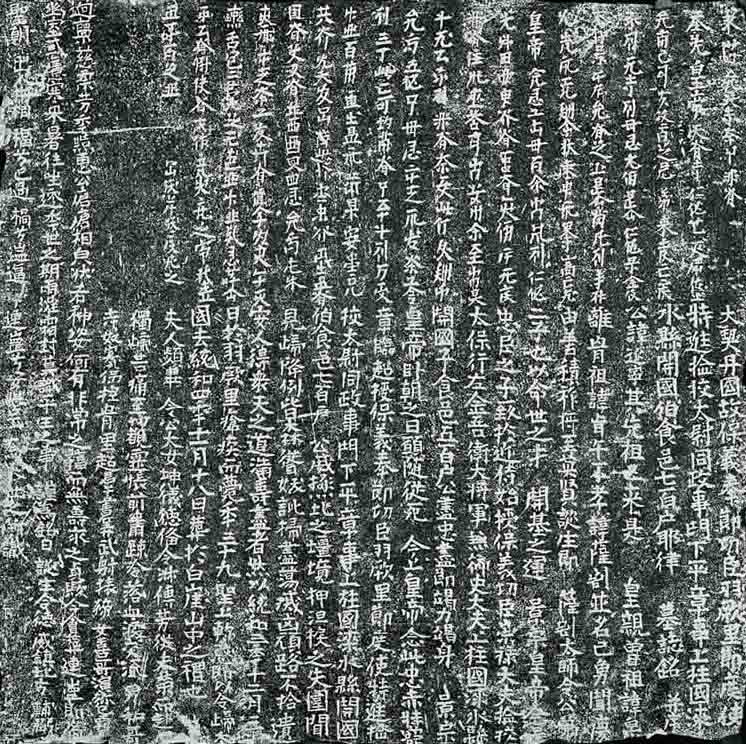
While there has long been controversy as to whether a particular monument belong to the large or small script,[5] there are several monuments (steles or fragments of stelae) that the specialists at least tentatively identify as written in the Khitan large script. However, one of the first inscriptions so identified (the Gu taishi mingshi ji epitaph, found in 1935) has been since lost, and the preserved rubbings of it are not very legible; moreover, some believe that this inscription was a forgery in the first place. In any event, the total of about 830 different large-script characters are thought to have been identified, even without the problematic Gu taishi mingshi ji; including it, the character count rises to about 1000.[6] The Memorial for Yelü Yanning (dated 986 CE) is one of the earliest inscriptions in the Khitan large script.

Direction

[edit]

While the Khitan large script was traditionally written top-to-bottom, it can also be written left-to-right, which is the direction to be expected in modern contexts for the Khitan large script and other traditionally top-to-bottom scripts, especially in electronic text.

Jurchen

[edit]

Some of the characters of the Jurchen scripts have similarities to the Khitan large script. According to some sources, the discoveries of inscriptions on monuments and epitaphs give clues to the connection between Khitan and Jurchen.[7] After the fall of the Liao dynasty, the Khitan (small-character) script continued to be used by the Jurchen people for a few decades, until it was fully replaced with the Jurchen script and, in 1191, suppressed by imperial order.[8][9]

Corpus

[edit]
Folio 9 of manuscript codex Nova N 176

There are no surviving examples of printed texts in the Khitan language, and aside from five example Khitan large characters with Chinese glosses in a book on calligraphy written by Tao Zongyi (陶宗儀) during the mid 14th century, there are no Chinese glossaries or dictionaries of Khitan. However, in 2002 a small fragment of a Khitan manuscript with seven Khitan large characters and interlinear glosses in Old Uyghur was identified in the collection of the Berlin-Brandenburg Academy of Sciences and Humanities.[10] Then, in 2010 a manuscript codex (Nova N 176) held at the Institute of Oriental Manuscripts of the Russian Academy of Sciences in Saint Petersburg was identified by Viacheslav Zaytsev as being written in the Khitan large script.[11]

The main source of Khitan texts are monumental inscriptions, mostly comprising memorial tablets buried in the tombs of Khitan nobility.[12] There are about 17 known monuments with inscriptions in the Khitan large script, ranging in date from 986 to 1176.

In addition to monumental inscriptions, short inscriptions in both Khitan scripts have also been found on tomb murals and rock paintings, and on various portable artefacts such as mirrors, amulets, paiza (tablets of authority given to officials and envoys), and special non-circulation coins. A number of bronze official seals with the seal face inscribed in a convoluted seal script style of Khitan characters are also known.

References

[edit]

Further reading

[edit]
[edit]
Revisions and contributorsEdit on WikipediaRead on Wikipedia
from Grokipedia
The Khitan large script is an ancient logographic created in 920 CE by the of the (907–1125 CE) to record their Para-Mongolic , featuring characters modeled on Chinese graphs with both ideographic and phonetic components for syllables or words. Developed under the order of Emperor Taizu (Yelü Abaoji) with assistance from Yelü Tulübu and Yelü Lubugu, it served as one of two Khitan scripts—the other being the smaller, more phonetic script inspired by Uyghur writing—and was designed for administrative and ceremonial purposes. This script, comprising approximately 2,245 characters (with around 830 attested in surviving artifacts), was employed for inscriptions on stelae, epitaphs, diplomatic correspondence, poetry, and official records across the Liao Empire, which spanned modern-day northern China, Mongolia, and parts of Russia. Its characters often resemble Hanzi but incorporate unique forms to represent Khitan phonology, including archaic features like initial p- and l- sounds not preserved in later Mongolic languages, reflecting the Khitan's nomadic origins and cultural interactions with Chinese and Uyghur influences. Usage persisted into the early Jin Dynasty (1115–1234 CE) but declined after the Liao's conquest, with the script falling into obscurity until its rediscovery in the late 19th and early 20th centuries through archaeological finds like imperial epitaphs. Decipherment remains incomplete, with roughly 10% of characters reliably read and the understood only partially due to the scarcity of texts (around 50-60 major inscriptions) and absence of bilingual materials; ongoing scholarly efforts focus on phonological reconstruction and etymological to link it to broader . As of 2025, a preliminary proposal for its encoding in is under review to facilitate digital study and preservation of this script, highlighting its importance as a key to understanding pre-modern East Asian linguistic diversity.

History

Origins and creation

In 920 AD, during the fifth year of the Shence era, Yelü Abaoji, founder of the and posthumously known as Emperor Taizu, issued an imperial decree ordering the creation of a script to record the . This initiative was assisted by Khitan scholars Yelü Tulübu and Yelü Lubugu, who developed the large script as a logographic system directly modeled on . The resulting script incorporated influences from Chinese logographs through semantic borrowing—where characters represented meaning—and phonetic borrowing, adapting forms to approximate Khitan sounds while maintaining a square, columnar appearance similar to Hanzi. The initial set of characters numbered around 3,000, sufficient to express the complexities of the , which belonged to the para-Mongolic family and differed significantly from Chinese. This substantial corpus allowed for the documentation of administrative, ritual, and literary content in the native tongue. The primary purpose of the Khitan large script was to cultivate a distinct cultural and for the amid their empire's expansion across northern and , countering the pervasive influence of Chinese literary traditions and symbolizing Liao sovereignty. By devising an indigenous writing system, sought to legitimize the dynasty's rule over diverse subjects while preserving Khitan linguistic heritage separate from Han cultural dominance. This effort coincided with the broader formation of the in 907, when unified nomadic tribes and established imperial institutions.

Use during the Liao dynasty

The Khitan large script, created in 920 by imperial decree under Emperor Taizu (Yelü Abaoji), served as a key tool for official communication and cultural expression throughout the (907–1125). It was primarily utilized for monumental and administrative inscriptions, including steles, seals, coins, and edicts, which helped legitimize Khitan rule and preserve historical records in the native language. Unlike everyday writing, which heavily relied on due to the script's logographic complexity and the empire's Sinicized elite, the large script was reserved for formal contexts to emphasize ethnic identity. In the Liao bureaucracy, the script integrated alongside Chinese in dual-language documents, such as administrative records and , to balance Khitan with practical over diverse populations. This bilingual approach appeared in official seals and imperial proclamations, facilitating communication within the northern administration and asserting autonomy from Song China. Usage extended to memorials honoring rulers and , as well as epitaphs that detailed lineages and achievements, thereby embedding the script in elite commemorative practices. Notable examples include the for Yelü Yanning (986 CE), a 19-line inscription with approximately 270 characters documenting an imperial consort's life, and the for Xiao Xiaozhong (1089 CE), featuring 18 lines and over 540 characters on a high official's legacy. The Stone Tablet (1072 CE), with 40 lines, exemplifies its application in temple dedications, blending religious and imperial themes. These artifacts, primarily discovered in and Province, illustrate the script's deployment across Liao territories in northern and , where its prominence peaked during the under emperors like Shengzong.

Decline and legacy

The fall of the Liao dynasty in 1125 CE to the invading Jurchen Jin dynasty marked the beginning of the Khitan large script's decline, as the new rulers suppressed Khitan cultural elements and promoted their own administrative systems. The Jurchens, who had already begun developing their large script in 1120 based directly on the Khitan large script's structure and characters, accelerated this shift by favoring Chinese characters for official use alongside their nascent writing system. This conquest led to the gradual replacement of Khitan scripts in governance, diplomacy, and inscriptions, with the dominance of Chinese further marginalizing the logographic-syllabic Khitan system among remaining Khitan elites. Despite the Liao's collapse, the Khitan large script saw sporadic survival into the late , particularly among Khitan descendants in the Western Liao () state, where it persisted in limited administrative and monumental contexts until that regime's fall in 1218 CE. In the Jin territories, both Khitan scripts continued in use for over 60 years post-1125, with the latest known inscription dating to 1176 CE; however, an imperial edict by Jin Emperor Zhangzong in 1191 CE officially banned Khitan writing, hastening its extinction as a living script by the early . By the rise of the Mongol , the script had ceased all practical application, surviving only in isolated artifacts and historical memory. The legacy of the Khitan large script endures primarily through its direct influence on the Jurchen large script, which adopted numerous graphical and structural elements from its predecessor, thereby bridging nomadic East Asian writing traditions into the 13th century. In modern scholarship, the script has fueled extensive Khitan studies since the late , aiding the reconstruction of the extinct Para-Mongolic and illuminating linguistic connections to Mongolic branches like those of the . Key 20th-century discoveries, such as the 1922 excavation of the Liao Qing yielding over characters, have advanced decipherment efforts, with ongoing research integrating computational methods to revive understanding of Khitan heritage and its role in medieval Eurasian cultural exchanges.

Description

Character structure

The Khitan large script is a logographic writing system in which individual characters primarily represent words or morphemes, akin to the structure of . Over 6,000 character instances are known from surviving inscriptions, though only about 830 unique characters have been identified, with ongoing proposals to encode up to 2,245 in as of 2025 due to the script's incomplete decipherment. These characters were largely derived by modifying existing to adapt them for the , allowing for the expression of Khitan-specific vocabulary and while leveraging the familiarity of Chinese script forms. Character composition in the Khitan large script employs several methods, reflecting its hybrid adaptation of Chinese principles. A common approach involves phono-semantic compounds, where elements from Chinese radicals convey semantic meaning combined with phonetic hints derived from Khitan syllables; for instance, characters might fuse a Chinese radical indicating a category like "person" or "nature" with a sound component adjusted for Khitan pronunciation. Direct borrowings from Chinese characters account for up to 30% of the script, used either for their phonetic value in Khitan words or to denote loanwords, such as 皇帝 for "emperor" or 王 for "king." Additionally, entirely invented forms were created by mimicking Chinese stroke patterns but arranging them in novel ways to represent unique Khitan morphemes, ensuring the script's distinct identity. The complexity of Khitan large script characters is evident in their stroke count, which typically ranges from 1 to 18 strokes per character, with most having fewer than 10 strokes—generally simpler than contemporary in terms of stroke count. For and input methods, characters are grouped by stroke types, such as horizontal, vertical, or curved lines, facilitating and reproduction. Visually, Khitan large script characters exhibit squarer and bolder proportions compared to the more fluid, styles sometimes seen in Chinese writing, emphasizing clarity for inscriptional use on stone monuments. This style features deformed or remodeled versions of , with thicker lines and compact arrangements that distinguish them from fonts while retaining an overall resemblance. Basic character families, such as numerals, illustrate this: the character for "one" consists of a single horizontal stroke, while "five" uses four interconnected strokes forming a cross-like pattern; pronouns, like markers, often build on simple radical bases, such as a form derived from a two-stroke element representing "un" or "ən" for relational indicators.

Writing direction and format

The Khitan large script follows the traditional Chinese orthographic convention of vertical columns, read from top to bottom within each column and from right to left across the page, adapted to represent the . This directionality reflects the script's derivation from Chinese models while accommodating Khitan's linguistic structure. Although vertical writing predominates, rare horizontal variants appear in certain inscriptions, typically proceeding from left to right, deviating from the standard format without establishing a consistent alternative . No standardized form developed for the large script, distinguishing it from more fluid Chinese calligraphic styles. In terms of formatting, employs a block-style arrangement on surfaces, with characters evenly spaced in rigid grids suited to monumental inscriptions. remains minimal, relying primarily on spaces or dividing lines to separate words, phrases, or sections rather than dedicated marks. The logographic character base supports this compact, non-inflected layout. Most surviving examples are carved on stone steles or metal objects like coins and seals, emphasizing its formal, official applications; brush-written instances on paper or wood are exceedingly rare, underscoring the script's association with durable, monumental uses during the .

Linguistic representation

The Khitan large script primarily employs logograms to represent , drawing heavily from for semantic or phonetic value, while incorporating some phonetic indicators to denote . Unlike a full alphabetic system, it functions as a mixed logographic-syllabic script, where individual characters typically correspond to one but convey meaning through ideographic components rather than pure sound-based encoding. For instance, characters may borrow the pronunciation of Chinese to approximate Khitan sounds, such as in transliterations of terms like "" for heavenly concepts. This structure allows for the representation of the Khitan language's core vocabulary without a complete phonetic inventory. The script encodes key traits of the , a Para-Mongolic tongue characterized by agglutinative morphology and . Agglutinative suffixes for grammatical functions, such as case markers and verb conjugations, are attached via sequences of logograms or phonetic elements, reflecting the language's subject-object-verb and postpositional structure. , where vowels in suffixes match those in roots, influences character selection to maintain phonological consistency, as seen in distinctions between velar and uvular stops (e.g., 〈ki〉 versus 〈〉) or preserved archaic initials like p- in 〈po〉 meaning 'time'. These features enable the script to capture the language's synthetic nature, though the exact mapping of suffixes remains partially undeciphered due to the script's reliance on for disambiguation. Bilingual aspects are prominent, with many characters featuring dual Chinese-Khitan readings: semantic borrowings retain Chinese meanings adapted to Khitan contexts (e.g., direct use of Chinese graphs for '' or 'country'), while phonetic loans use Chinese sounds to represent native Khitan syllables. This integration facilitated administration in the , where Chinese influence was strong, and aided partial through comparative analysis. The script organizes semantic categories distinctly, using logograms for nouns (e.g., colors like 'red' rendered as 〈l-iau-qú〉), verbs denoting actions, and particles for grammatical roles, often grouping them by function in inscriptions. Despite these capabilities, the script's linguistic representation has limitations, including incomplete phonetic coverage that omits a full set of consonants and vowels, leading to ambiguities resolved primarily by syntactic or historical context. Only about 10% of the estimated 2,245 characters—as proposed for encoding—have been reliably read, with dual readings and the absence of a comprehensive exacerbating interpretive challenges. As of , a proposal to encode 2,245 Khitan large script characters in is under review by the ISO/IEC JTC1/SC2/WG2 committee. Such gaps highlight the script's dependence on bilingual clues and its incomplete adaptation to Khitan's phonological nuances.

Khitan small script

The Khitan small script, also known as Qidan xiaozì, was created around 924 or 925 AD by the scholar Yelü Diela during the early years of the (907–1125), shortly following the invention of the large script in 920 AD. This development occurred within the same historical context of the Khitan Empire's efforts to establish a written system for their , an extinct Para-Mongolic tongue. Unlike the large script, which drew heavily from , the small script was reportedly inspired by the Uyghur script, aiming to provide a more streamlined and phonetic approach to notation. Structurally, the small script features a compact inventory of approximately 400 to 500 characters, with scholarly estimates placing the total number of distinct graphs between 437 and 448. It operates as a mixed , combining logograms—about 65 graphs known primarily by their semantic value, such as representations for "mountain"—with a predominance of phonograms that capture phonetic elements. The script's syllabic orientation is evident in its graph formations, which reflect Khitan's phonological patterns through structures like V (), C (), CV, VC, CVC, VV, and CVV, often incorporating one to four phonetic units per graph. This design contrasts sharply with the large script's logographic emphasis, where characters more closely mimic Chinese ideographs and number in the thousands, prioritizing semantic representation over sound. The small script's phonetic focus thus enabled greater efficiency in encoding the language's syllables and morphology, including distinctions like velar-uvular contrasts (e.g., /k/ vs. /q/). In usage, the small script coexisted with the large script throughout the Liao period, serving to inscribe the in a variety of media, though no printed texts or extensive manuscripts have survived. It appears predominantly in monumental contexts, with around 33 known inscriptions compared to 17 in the large script, including funerary epitaphs, murals, painted labels, and artifacts like mirrors dated to the 11th–12th centuries. Additional examples include a monumental record from 1134 and graffiti on walls, highlighting its application among the Khitan elite until its suppression in 1191, after which knowledge faded, with (1190–1244) noted as the last known reader. The script's simpler, more phonetic nature made it particularly adaptable for detailed , distinguishing it from the large script's suitability for formal, semantically driven monumental displays.

Jurchen script

The Jurchen script, also known as the Jurchen large script, was created in 1119–1120 by Wanyan Xiyin, a Jurchen statesman, at the order of Wanyan Aguda, the founder of the Jin dynasty. This development directly drew from the , adapting its logographic structure and incorporating modified forms of its characters to represent the , a Southern Tungusic tongue unrelated to the Khitan's para-Mongolic features. The script's creation mirrored the Khitan system's dual large-small approach, with the Jurchen large script emphasizing standalone ideographs while a smaller script emerged later in 1138 for phonetic purposes. Comprising approximately 720–900 characters according to surviving glossaries and inscriptions, the Jurchen script featured simplifications in stroke complexity from its Khitan base, alongside new forms tailored to Jurchen morphology and sounds, such as distinct representations for Tungusic suffixes. Many characters retained visual similarities to Khitan large script glyphs, with evidence of direct borrowing in basic terms like numerals (e.g., the character for "one" as 一), indicating a substantial overlap estimated at dozens to hundreds of shared or derivative forms. Some scholars hypothesize an intermediate influence from the earlier Parhae (Balhae) script, given regional cultural continuities in northeast Asia, though this remains conjectural. As the official writing system of the Jin dynasty (1115–1234), the appeared in imperial edicts, coinage, steles, and administrative records to promote Jurchen literacy and cultural identity amid pressures. It facilitated bilingual governance alongside Chinese, including examinations testing proficiency in Jurchen script composition. By the mid-13th century, following the Mongol conquest, usage declined sharply, with Chinese script supplanting it entirely by the dynasty's end, though sporadic inscriptions persisted into the Ming era.

Corpus and decipherment

Surviving inscriptions and texts

The surviving corpus of the Khitan large script is relatively small, comprising approximately 15 to 20 major monumental inscriptions, primarily on stone, along with numerous fragments and shorter texts on artifacts such as coins, seals, bronze tallies, and charms. These materials, which include , stelae, and official documents used in administration, yield a total of under 10,000 decipherable characters across the main body of texts, though exceptional items like a manuscript codex may contain more. Key artifacts encompass tomb inscriptions from the 10th and 11th centuries, such as the epitaph of Yanning (986 CE), discovered in Chaoyang County, Province, and now held in the Liaoning Provincial Museum, and the epitaph of Xiao Xiaozhong (1089 CE), unearthed in Jinxi County, , and preserved in the Museum. Another prominent example is the stone tablet (1072 CE), originally from Ningcheng County, , and currently housed in the Liao Zhongjing Museum. Buddhist mantra engravings also appear among the surviving texts, often inscribed on stone surfaces or portable artifacts alongside administrative and commemorative content. Additional notable items include ink inscriptions on tomb walls, such as those from Pugu's tomb (d. 1031 CE), and fragments from rock carvings, like the one at Agui Cave in Jarud Banner, . The majority of these inscriptions have been unearthed in regions historically associated with the , including (e.g., Arhorchin Banner, Ningcheng County, and Bairin Left Banner) and Province (e.g., Chaoyang, , and Jianchang). Some artifacts, such as a unique and seals from the Western Liao period, are preserved in , specifically at the Institute of Oriental Manuscripts, in St. Petersburg, originating from Khitan-Liao cultural sites near the borders. Preservation of these materials faces significant challenges, including severe and on exposed stone surfaces, which has rendered many characters illegible or partially damaged. Numerous inscriptions were lost or destroyed during the fall of the , subsequent wars, and modern looting, with some, like the Master Gu stone tablet (1051 CE) from , known only through historical records rather than surviving originals. Today, most extant pieces are protected in , such as the Arhorchin Museum in , , but ongoing environmental degradation and limited archaeological access continue to threaten the corpus.

Decipherment and interpretation

Efforts to decipher the Khitan large script began in the early 20th century, with Russian, Chinese, and Japanese scholars identifying basic characters through recognizable Chinese loanwords and administrative terms, providing the foundation for later phonetic and semantic assignments. A major breakthrough came in the late 20th and early 21st centuries through the research of Daniel Kane, whose 2009 book The Kitan Language and Script synthesized prior findings and mapped over 2,000 characters, emphasizing the script's logographic and syllabic elements derived from Chinese models. Kane's analysis built on contributions from scholars like Chinggeltei, Liu Fengzhu, and Chen Naixiong, who advanced readings of dynastic titles and personal names in epitaphs. This work highlighted the script's use for both native Khitan words and Chinese transcriptions, enabling partial translations of historical texts. Decipherment methods have relied on , drawing parallels with Mongolian (as Khitan is classified as para-Mongolic) and extensive analysis of Chinese influences, including loanwords for numbers, ranks, and place names. Parallel texts from surviving inscriptions, such as steles with adjacent Chinese versions, have been crucial for assigning phonetic values and meanings, often through principles where characters borrow sounds or ideas from Chinese prototypes. As of , the Khitan large script remains only partially deciphered, with many characters understood via loanwords but core vocabulary and eluding full interpretation, leading to a methodological in traditional approaches. Ongoing digital projects, including proposals for encoding and AI-assisted in inscriptions, aim to accelerate progress by analyzing corpus patterns and predicting undeciphered forms.

References

Add your contribution
Related Hubs
Contribute something
User Avatar
No comments yet.