


Community hub
Recent from talks
Contribute something
Nothing was collected or created yet.
3 World Trade Center
View on Wikipedia
Key Information

.jpg)

| World Trade Center |
|---|
| Towers |
| Other elements |
| Artwork |
| History |
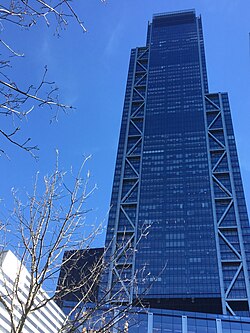
3 World Trade Center (3 WTC; also known as 175 Greenwich Street) is a skyscraper constructed as part of the new World Trade Center in Lower Manhattan, New York City. The tower is located on Greenwich Street along the eastern side of the World Trade Center site. The building was designed by Rogers Stirk Harbour + Partners, and is managed by Silverstein Properties through a ground lease with the Port Authority of New York and New Jersey (PANYNJ), the landowner. It is 1,079 ft (329 m) high, with 80 stories. As of 2025[update], it is the tenth-tallest building in the city.[6]
The current edifice is the second on the World Trade Center site to bear the address 3 World Trade Center. The original building was the Marriott World Trade Center, a 22-story, 825-room hotel located in the southwest corner of the World Trade Center complex. Opened in July 1981 as the Vista International Hotel, it was destroyed during the September 11 attacks in 2001, along with the rest of the World Trade Center.
The current 3 World Trade Center was planned as a skyscraper measuring 1,240 feet (378 m) tall. The building's groundbreaking took place in January 2008, but only the lower stories were built because the skyscraper lacked an anchor tenant. Construction resumed in 2014 after advertising company GroupM was signed on as anchor tenant. The building's concrete core was topped out during August 2016, with the perimeter steel structure following on October 6, 2016. The building opened on June 11, 2018.
Site
[edit]3 World Trade Center is at 175 Greenwich Street, within the new World Trade Center (WTC) complex, in the Financial District neighborhood of Lower Manhattan in New York City. The land lot is bounded by Greenwich Street to the west, Dey Street to the north, Church Street to the east, and Cortlandt Way to the south.[7][8] Within the World Trade Center complex, nearby structures include the National September 11 Memorial & Museum to the west; One World Trade Center to the northwest; World Trade Center Transportation Hub and 2 World Trade Center to the north; and 4 World Trade Center to the south.[9] Outside World Trade Center, nearby buildings include 195 Broadway and the Millennium Hilton New York Downtown hotel to the northeast, as well as One Liberty Plaza to the southeast.[10][11]
Previous buildings
[edit]For most of the 20th century, the site of 3 WTC was occupied by the Cortlandt Building, built in 1907 and one of two office structures that comprised the Hudson Terminal complex.[12] The site was also abutted by several low-rise buildings on Greenwich Street to the west.[13] During the late 19th and early 20th centuries, the adjoining section of Cortlandt Street had been part of Manhattan's Radio Row, which contained many electronics stores.[14] The Hudson Terminal complex was demolished in 1972, when the original World Trade Center was built.[15]
The Port Authority of New York and New Jersey (PANYNJ), which was responsible for the construction of the World Trade Center, had demolished several streets to make way for the towers within the World Trade Center, including parts of Cortlandt, Dey, and Greenwich Streets.[14] The site of the current skyscraper was occupied by 5 World Trade Center at the northeast corner of the World Trade Center site.[16][17] Terrorists destroyed the World Trade Center during the September 11 attacks.[18] Greenwich Street was restored as part of the redevelopment of the World Trade Center,[19] and the block of Cortlandt Street next to 3 WTC was rebuilt as a pedestrian walkway.[20] The intersection of Cortlandt Way and Greenwich Street reopened in 2014, improving access to the National September 11 Memorial.[14]
The 3 World Trade Center address was originally used by the Marriott World Trade Center (originally the Vista International Hotel), a 22-story[21][22] hotel building with 825 rooms.[21] The Vista Hotel was on the western side of the World Trade Center, near the intersection of West Street and Liberty Street.[23][16] Construction began in 1979,[21] and it opened on July 1, 1981.[21][24] The hotel was heavily damaged in the 1993 World Trade Center bombing[25] and reopened in 1994 after repairs.[26] The Host Marriott Corporation acquired the hotel in 1995 for $141.5 million.[27] Forty people in the hotel died when the complex was destroyed during the September 11 attacks.[28] Marriott, which held a long-term lease on the hotel site, surrendered its lease in 2003,[29] allowing the National September 11 Memorial & Museum to be built there.[30]
History
[edit]Site redevelopment
[edit]Larry Silverstein had leased the original World Trade Center from the PANYNJ in July 2001.[31] His company Silverstein Properties continued to pay rent on the site even after the September 11 attacks.[32] In the months following the attacks, architects and urban planning experts held meetings and forums to discuss ideas for rebuilding the site.[33] The architect Daniel Libeskind won a competition to design the master plan for the new World Trade Center in February 2003.[34][35] The master plan included five towers, a 9/11 memorial, and a transportation hub.[30][36] By July 2004, two towers were planned on the southeast corner of the site: the 62-story 3 World Trade Center and the 58-story 4 World Trade Center.[30] The plans were delayed due to disputes over who would redevelop the five towers.[37] The PANYNJ and Silverstein ultimately reached an agreement in 2006. Silverstein Properties ceded the rights to develop 1 and 5 WTC in exchange for financing with Liberty Bonds for 2, 3, and 4 WTC.[38][39]
British architect Richard Rogers of Rogers Stirk Harbour + Partners was hired to design the new 3 World Trade Center, on the eastern part of the World Trade Center site at 175 Greenwich Street, in May 2006.[40] Additionally, Norman Foster and Fumihiko Maki were selected as the architects for 2 and 4 World Trade Center, respectively.[41][42] The plans for 2, 3, and 4 World Trade Center were announced in September 2006.[7][8] 3 World Trade Center would be a 71-story, 1,155-foot-tall (352 m) building with diagonal bracing on its facade for structural reinforcement.[7][43][44] The tentative plans also called for four spires, one at each corner, rising 100 feet (30 m) above the flat roof.[44] The building would have contained 133,000 ft2 (12,400 m2) of retail space in its base; five trading floors; and 2.1×106 ft2 (200,000 m2) of offices across 54 stories.[43] The lowest stories of 3 World Trade Center and several neighboring buildings would be part of a rebuilt Westfield World Trade Center Mall.[45]
As part of the project, Cortlandt Street (which had been closed to make way for the original World Trade Center) was planned to be rebuilt between 3 and 4 WTC.[46] The plans for Cortlandt Street affected the design of the lower stories of both 3 and 4 WTC, as one of the proposals called for an enclosed shopping atrium along the path of Cortlandt Street, connecting the two buildings.[47] The street was eventually rebuilt as an outdoor path.[20] Final designs for 2, 3, and 4 WTC were announced in September 2007.[48][49] The three buildings would comprise the commercial eastern portion of the new World Trade Center, contrasting with the memorial in the complex's western section.[50] At the time, construction of 3 WTC was planned to begin in January 2008.[51] As part of its agreement with the PANYNJ, Silverstein Properties was obliged to complete 3 and 4 WTC by the end of 2011.[52]
Construction
[edit]Initial construction and disputes
[edit]
In 2007, the PANYNJ started constructing the East Bathtub, a 6.7-acre (2.7 ha) site that was to form the foundations of 3 and 4 WTC.[53] The process involved excavating a trench around the site to a depth of 70 feet (21 m), then constructing a slurry wall around the site.[54] The PANYNJ was supposed to give the site to Silverstein Properties at the end of 2007; the contractors would have received a $10 million bonus if they had completed the work early.[55] If Silverstein did not receive the site by January 1, 2008, the PANYNJ would pay Silverstein $300,000 per day until the site was transferred.[53][56] The agency ultimately gave the site to Silverstein on February 17, 2008.[57][58] The PANYNJ paid a $14.4 million penalty for turning over the site 48 days after the deadline.[55]
Investment bank Merrill Lynch & Co. expressed interest in relocating its headquarters to 3 World Trade Center in mid-2008.[52][59] Following this, the PANYNJ voted to extend the deadline for the building's completion to June 2012.[52][60] Merrill had been the first private firm to show interest in leasing significant amounts of space at the World Trade Center, and the announcement raised the possibility that 3 WTC could be redesigned for Merrill's use.[59] The PANYNJ offered to lease the underlying land to Merrill for $510 million, 25 percent lower than the agency's original asking price for the land, and Silverstein offered to sell his stake in the project for $340 million.[61] Merrill balked at Silverstein's offer,[62] and it withdrew from the project in July 2008 after failing to secure a lease on favorable terms.[61][63] Merrill's withdrawal came shortly after the PANYNJ had announced that the World Trade Center redevelopment would be delayed significantly.[61][64] Meanwhile, police officials expressed concern that the building's all-glass design posed a security risk.[65] A study published in early 2009 predicted that 3 WTC would not be fully occupied until 2037, due to the 2008 financial crisis.[66]
By May 2009, the PANYNJ was seeking to reduce the size of 2 and 3 WTC and postpone the construction of 5 WTC, citing the Great Recession and disagreements with Silverstein.[67][68] The developer had requested that the PANYNJ fund two of the towers, but the agency wanted to take control of the 3 WTC site and was willing to provide funding for only one tower.[68][69] The PANYNJ wanted to build 3 WTC only to the fourth story,[67][70] allowing Silverstein to construct a hotel or office building above when market conditions improved.[68] New York City mayor Michael Bloomberg attempted to mediate the dispute with little success.[71] In July 2009, Silverstein wrote a letter to the development's stakeholders, recommending that the dispute go to arbitration.[72][73] Silverstein officially requested arbitration the next month.[74][75] He requested that the PANYNJ pay $2.7 billion in damages.[76][77] An arbitration panel ruled in January 2010 that the agency did not owe him any damages.[76][77] However, the panel also voided a clause that would have forced Silverstein to hand over the towers to PANYNJ if they were not completed by 2014.[77][78] The panel gave Silverstein and the PANYNJ two months to reach an agreement.[79]
As part of the arbitration process, Silverstein requested a $2.6 billion tax-free bond issue for the redevelopment of the World Trade Center site.[80] The New York state government approved the bond issue in December 2009, though the construction of 2 and 3 WTC remained on hold.[81] In February 2010, Silverstein proposed constructing 3 WTC and delaying plans for 2 WTC, a move that was expected to save $262 million in the short term.[82] The next month, the PANYNJ and the city and state governments of New York agreed to fund $600 million for 3 WTC's construction after Silverstein had found tenants for at least 40,000 square feet (3,700 m2) of the space.[83][84] Silverstein would build the first five stories by 2013 if he were unable to finance the project and lease the office space.[85] PANYNJ board members from New Jersey acquiesced to the deal with Silverstein, but only on the condition that the agency also fund a reconstruction of the Bayonne Bridge.[86][87]
Three PureCell fuel cells were delivered at the World Trade Center site in November 2010, providing about 30 percent of 3 WTC's power.[88] In the meantime, the 1,137-foot (347 m) tower had been delayed indefinitely.[89] The investment bank UBS was considering leasing space at 3 WTC in mid-2011[90][91] but ultimately decided against it.[92][93] At the time, although the complex was originally supposed to have been anchored by large financial firms, these companies were generally no longer seeking to expand their space.[94]
Funding compromise and anchor tenant
[edit]
Silverstein Properties and the PANYNJ agreed in early 2012 to complete only the first seven stories of 3 WTC unless tenants could be found by the end of the year.[95][96] The base had been built entirely with insurance proceeds,[97] and the tower stories would only be built after Silverstein met the requirements.[95][96][98] By that February, the ground floor concrete was almost done and the lower podium had reached the 5th floor; the podium was then planned to be completed in September 2012.[99] Owen Steel's president David Zalesne announced in June 2012 that his company had been selected to provide the structural steel for the building.[100] The next month, the concrete core had reached the 8th floor, and all concrete work had halted.[101][102] Media conglomerate Viacom and financial firm Citigroup had both declined to relocate to 3 WTC.[102] The lower podium was completed by November 2012.[103] If Silverstein were unable to finalize a lease by the end of 2013, he would have been required to build a semi-permanent roof above the 7th story.[104]
By late 2012, advertising company GroupM was negotiating to lease 550,000 square feet (51,000 m2) at 3 WTC,[105][106] and law firm White & Case was looking for about 500,000 square feet (46,000 m2).[107][108] Either of these deals would be large enough to qualify the project for up to $600 million in public benefits.[107][108] GroupM signed a letter of intent for the building in mid-2013,[94][109] and the company finalized its lease that December, taking 500,000 square feet (46,000 m2).[110][111][112] The following month, U.S. senator Chuck Schumer obtained $340 million in federal Recovery Zone bonds to finance the project's construction.[113][114]
Silverstein asked the city, state, and PANYNJ in 2014 to refinance the project on terms that were more favorable to him. In exchange, he would contribute a greater share of private capital.[115][116] The PANYNJ postponed a vote on whether to guarantee $1.2 billion of construction loans in March 2014,[117][118] and the vote was delayed again that April.[119][120] Although PANYNJ chairman Scott Rechler supported the subsidy, other PANYNJ board members said the guarantee was wasteful because the majority of the proposed building still did not have tenant commitments.[121] The PANYNJ voted against guaranteeing the construction loans in May 2014,[122][123] but the PANYNJ and Silverstein reached a financing agreement the next month.[124] The large amount of unleased space made it difficult for Silverstein to sell bonds to private investors, so the building was instead mainly funded by the sale of $1.6 billion of tax-exempt bonds, the largest-ever unrated bond deal in the municipal bond market.[125][126] Other sources of funding included $600 million in insurance proceeds, $210 million in cash from the city and state governments of New York, and $55 million in cash from Silverstein Properties.[125] Silverstein sold the municipal bonds at the end of October 2014.[127][128]
Resumption of construction
[edit]Following the financing agreement, the tower crane returned, and the PANYNJ and Silverstein announced that the building would be completed by 2017.[129] Unusual for a high-rise, the building's concrete core was built before the rest of the structure was completed.[130] Fintech company Fundrise sold $5 million of the building's municipal bonds to private investors in January 2015.[131] Work above the second story had begun by the next month.[132][133] That June, the architects eliminated the planned rooftop masts, reduced the building to its final height of 1,079 feet (329 m).[134][135] Nonetheless, by August 2015, the building had reached half of its final height.[136][137] The construction process was complicated by the fact that water started leaking into the construction site in late 2015, delaying the opening of the adjacent Westfield World Trade Center mall.[138][139] The site was completely exposed to the outdoors, and workers were constantly spraying water onto the building's concrete to decrease dust levels, both of which caused water to seep into the building.[138]
On May 20, 2016, the tower's concrete core reached the symbolic height of 1,000 feet (300 m), thus officially reaching supertall status and exceeding the roof height of neighboring 4 World Trade Center.[140] 3 World Trade Center's core was topped out one month later on June 23, 2016.[141][142] In a ceremony held at the base of the building, a 2-ton bucket of concrete was signed by workers, and executives, including developer Larry Silverstein, and was hoisted up with an American flag, which was also used with the topping out of 7 and 4 World Trade Center, to the top of the tower.[142]
On the evening of August 11, 2016, a construction crane struck one of 3 World Trade Center's windows. There was a heavy wind gust at the time,[143] and construction workers were securing the crane when it veered into a 12th-story glass panel, cracking it. No one was injured.[144] On October 6, 2016, the entire building was topped out when the last steel beam was lifted and installed on top.[145] The glass facade was completed in August 2017, at which point several retailers had signed leases for the atrium retail space.[146]
-
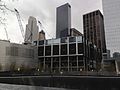 Construction of 3 World Trade Center as of April 2014
 -
 3 World Trade Center under construction on June 10, 2015. The PATH station is visible to the right.
 -
 The PATH Station, 3, and 4 World Trade Center at night in May 2016
 -
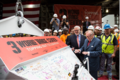 Developer Larry Silverstein and construction workers sign the last bucket of concrete during the topping-off ceremony on June 23, 2016.
 -
 3 World Trade Center under construction on January 26, 2017
 -
 3 World Trade Center under construction on May 8, 2017


Opening and early years
[edit]3 WTC's anchor tenant GroupM had expanded its space to 700,000 square feet (65,000 m2) in January 2016,[147] and GroupM hired the architectural firm to redesign 15 floors in the building for its nine constituent companies.[148] The stock exchange platform IEX leased 45,000 ft2 (4,200 m2) in the building in April 2018.[149] This was followed the next month by global consulting company McKinsey & Company, which leased 186,000 square feet (17,300 m2).[150] The building officially opened on June 11, 2018.[151][152] At the time, the building was 38 percent occupied.[152]
In the first three months of 2019, Silverstein leased space to Hudson River Trading,[153] Casper Sleep,[154] beverage firm Diageo,[155] technology startup Asana Inc.,[156] and mortgage lender Better.com.[157] These five leases totaled 355,000 square feet (33,000 m2).[156] Later that year, ridesharing company Uber leased more than 300,000 square feet (28,000 m2),[158] and law firms Kelley Drye & Warren[159] and Cozen O'Connor also leased space there.[159] Private equity firm Blue Wolf Capital Partners leased space in early 2020,[160] and Uber sought to sublease some of its space by the end of that year.[161] Casper subleased some of its space to advertising company Index Exchange in 2021.[162][163] In addition, the law firm Freshfields Bruckhaus Deringer leased four stories at 3 WTC in August 2022.[164]
Architecture
[edit]3 World Trade Center was designed by Richard Rogers of Rogers Stirk Harbour + Partners.[165][166] The structural engineer for the building was WSP Global.[167] It is 1,079 feet (329 m) tall[134] with 80 above-ground stories.[166][168] The lowest 17 stories of the tower comprise a podium.[169][170] There are five stories of retail, spanning the basement and sub-basement levels as well as the first three above-ground stories.[170]
Facade
[edit]
The facade is composed of double-glazed, low emissivity glass panels.[171] Most of the facade is a curtain wall with 10,000 panels of annealed glass, which are more resistant to shattering compared with traditional glass panels.[169][172] The curtain wall panels span from the floor to the ceiling on each story. They measure 13.5 feet (4.1 m) high on each of the podium stories and 24 feet (7.3 m) high on each of the tower stories.[173] At the base of the building, a cable-net wall surrounds the lobby on three sides. The cable-net wall is composed of panels measuring 5 feet (1.5 m) wide and 10 feet (3.0 m) tall.[174][175]
The eastern and western elevations of the facade contain K-shaped bracing, which is composed of diagonal beams clad in stainless steel. The diagonal beams reinforce the superstructure and remove the need for structural columns at the corner.[174][175] The stainless steel cladding is used to protect the beams from weathering,[174] and it was also intended to complement the glass panels on the facade.[175] The roof of the building is flat, though originally it was planned with several spires.[134][135]
Features
[edit]3 World Trade Center covers 2.5 million square feet (230,000 m2) in total. Each of the building's stories spans 30,000 to 70,000 square feet (2,800 to 6,500 m2).[168][176] The building uses 27,000 short tons (24,000 long tons; 24,000 t) of steel and 145,000 cubic yards (111,000 m3) of concrete.[174] 3 WTC also includes 44 passenger elevators and five service elevators.[175][173] Four of the service elevators are also specifically designed to be used for emergency evacuations.[177] Eight of the passenger elevators serve the first 17 stories exclusively, and there are two passenger and two service elevators within the retail section of the building. There are also four staircases within the podium and two staircases within the upper stories.[170]
Lobby and retail
[edit]There are nine entrances to 3 WTC's lobby.[174] The floor of the lobby is made of Sardinian gray granite.[174][175] The western wall of the lobby is made of Zimbabwe black granite and measures 43 feet (13 m) high.[174] The walls of the elevator banks contain glass panels with a metallic mesh embedded into them. There are also LED wall panels next to the elevators themselves.[172] The lobby's ceiling measures up to 62 feet (19 m) high, though it slopes down to as low as 22 feet (6.7 m).[174] The ceiling is made of a stretched material, behind which are LED lights; at the time of 3 WTC's opening, this was the largest stretched ceiling in the world.[174][176]
One wall of the lobby contains Joystick, a 46-foot-wide (14 m) mural by James Rosenquist, which was originally painted in 2002 and reinstalled at 3 WTC in 2020.[178] Untitled (Fish on Fire, Greenwich Street) 2024, a copper sculpture by Frank Gehry, has been mounted in the lobby of 3 WTC since 2025. The sculpture, measuring 20 by 7 feet (6.1 by 2.1 m) across, can rotate and is illuminated from inside.[179][180]
The rest of the ground, second, and third stories are used as retail space. There are two basement levels, which also contain retail and are part of Westfield World Trade Center mall.[168] The five retail stories are connected by two passenger elevators and four staircases.[170][181] The mall connects to the World Trade Center Transportation Hub, which in turn links with the New York City Subway and PATH trains.[170][181]
Upper stories
[edit]The building has ceiling heights ranging from 13 to 24 feet (4.0 to 7.3 m).[168] There are terraces wrapping around 3 World Trade Center on floors 17, 60, and 76.[166][168] The terrace on floor 17 is 205 feet (62 m) high and is divided into two sections, each measuring 5,500 square feet (510 m2).[173] One of the terraces on floor 17 is shared by all of the building's tenants, while the other is a private terrace.[173][181][182] The terrace on floor 17 was originally designed as a mechanical area with space for financial companies' equipment, but this was scrapped when GroupM became the building's anchor tenant.[182] The terrace on floor 60 is 718 feet (219 m) high, while that on floor 76 is 934 feet (285 m) high.[173]
The air-conditioning systems on each story are controlled separately, thus reducing energy consumption. In addition, the building's filtration systems are able to extract 95 percent of particulates, in addition to ozone and volatile organic compounds.[171] The building contains air intake openings on its upper stories, since the air on higher stories was supposed to be cleaner than the air near ground level.[175] Jaros, Baum & Bolles installed the mechanical, electrical, and plumbing system.[1]
Critical reception
[edit]When 3 WTC was completed in 2018, James Gardner of The Real Deal New York wrote: "I can say with reasonable confidence that it will prove to be the least architecturally interesting of the four main buildings on the hallowed site."[183] In particular, Gardner criticized "the arbitrary asymmetries, the industrial aesthetic in one part but not another, the shift in cladding patterns" in the design.[183]
See also
[edit]References
[edit]Notes
- ^ a b "Three World Trade Center". CTBUH Skyscraper Center.
- ^ "Emporis building ID 252968". Emporis. Archived from the original on December 23, 2015.
- ^ "3 World Trade Center". SkyscraperPage.
- ^ 3 World Trade Center at Structurae
- ^ GmbH, Emporis. "Three World Trade Center, New York City | 252968 | EMPORIS". Emporis. Archived from the original on April 18, 2022. Retrieved June 13, 2018.
- ^ "12 tallest skyscrapers in New York City". am New York. Archived from the original on November 2, 2017. Retrieved October 17, 2017.
- ^ a b c Dunlap, David W. (September 8, 2006). "A First Look at Freedom Tower's Neighbors". The New York Times. ISSN 0362-4331. Archived from the original on August 21, 2022. Retrieved August 13, 2022.
- ^ a b Chung, Jen (September 7, 2006). "Vision of World Trade Center in the Future". Gothamist. Archived from the original on April 22, 2021. Retrieved August 13, 2022.
- ^ "The World Trade Center". Official World Trade Center. May 6, 2019. Archived from the original on March 30, 2020. Retrieved August 14, 2022.
- ^ "185 Greenwich Street, 10007". New York City Department of City Planning. Archived from the original on August 14, 2022. Retrieved March 25, 2021.
- ^ White, Norval; Willensky, Elliot; Leadon, Fran (2010). AIA Guide to New York City (5th ed.). New York: Oxford University Press. p. 37. ISBN 978-0-19538-386-7.
- ^ "A $5,000,000 Tunnel Station". New-York Tribune. April 3, 1907. p. 8. Archived from the original on December 23, 2021. Retrieved September 28, 2020 – via newspapers.com.
- ^ Condit, C.W. (1980). The Port of New York: A history of the rail terminal system from the beginnings to Pennsylvania Station. University of Chicago Press. p. 254. ISBN 978-0-226-11460-6. Retrieved January 11, 2018.
- ^ a b c Dunlap, David W. (August 1, 2014). "At World Trade Center Site, Rebuilding Recreates Intersection of Long Ago". The New York Times. ISSN 0362-4331. Archived from the original on February 28, 2018. Retrieved August 20, 2022.
- ^ "College Works With Firemen in Safety Test". New York Daily News. December 10, 1972. p. 154. Archived from the original on December 23, 2021. Retrieved October 2, 2020 – via newspapers.com.
- ^ a b "The World Trade Center Complex". Port Authority of New York and New Jersey. Retrieved December 20, 2021.
{{cite web}}:|archive-url=is malformed: timestamp (help)CS1 maint: url-status (link) - ^ Gillespie, Angus K. (1999). Twin Towers: The Life of New York City's World Trade Center. Rutgers University Press. p. 62. ISBN 978-0-8135-2742-0.
- ^ "The 9/11 Commission Report" (PDF). National Commission on Terrorist Attacks Upon the United States. July 27, 2004. Archived (PDF) from the original on February 8, 2011. Retrieved September 29, 2015.
- ^ Satow, Julie (July 18, 2012). "Sundered Greenwich Street Will Be Rejoined". The New York Times. ISSN 0362-4331. Archived from the original on August 19, 2022. Retrieved August 19, 2022.
- ^ a b Dunlap, David W. (October 25, 2012). "Missing for 50 Years, a Bit of Cortlandt Street Will Return". City Room. Archived from the original on August 21, 2022. Retrieved August 19, 2022.
- ^ a b c d Lew, H. S.; Bukowski, Richard W.; Carino, Nicholas J. (August 25, 2021). "Design, Construction, and Maintenance of Structural and Life Safety Systems" (PDF). National Institute of Standards and Technology (NIST). Archived from the original on July 29, 2012. Retrieved January 11, 2013.
- ^ Ferretti, Fred (December 12, 1979). "At Trade Center, a Hotel Rises". The New York Times. ISSN 0362-4331. Archived from the original on July 31, 2022. Retrieved July 31, 2022.
- ^ Lyons, Richard D. (January 22, 1989). "Success of Vista Hotel Draws Developers Downtown". The New York Times. ISSN 0362-4331. Archived from the original on July 31, 2022. Retrieved July 31, 2022.
- ^ "Fred R. Conrad Vista International Hotel to Officially Open Its Doors Tomorrow". The New York Times. June 30, 1981. ISSN 0362-4331. Archived from the original on July 31, 2022. Retrieved July 31, 2022.
- ^ McKinley, James C. Jr. (March 15, 1993). "Vista Hotel Is Closed Until Summer, Officials Say". The New York Times. ISSN 0362-4331. Archived from the original on August 21, 2022. Retrieved July 31, 2022.
- ^ Deutsch, Claudia H. (October 31, 1994). "20 Months After Bombing, Vista Hotel to Finally Reopen". The New York Times. ISSN 0362-4331. Archived from the original on March 28, 2022. Retrieved July 31, 2022.
- ^ "Port Authority Sells Hotel". The New York Times. November 10, 1995. ISSN 0362-4331. Archived from the original on January 29, 2022. Retrieved July 31, 2022.
- ^ Dwyer, Jim; Fessenden, Ford (September 11, 2002). "One Hotel's Fight to the Finish; At the Marriott, a Portal to Safety as the Towers Fell". The New York Times. ISSN 0362-4331. Archived from the original on December 3, 2019. Retrieved July 31, 2022.
- ^ Dunlap, David W. (October 24, 2003). "Marriott Ceding Property Where Hotel Stood on the World Trade Center Site". The New York Times. ISSN 0362-4331. Archived from the original on August 21, 2022. Retrieved July 31, 2022.
- ^ a b c Dunlap, David W.; Collins, Glenn (July 4, 2004). "A Status Report: As Lower Manhattan Rebuilds, a New Map Takes Shape". The New York Times. ISSN 0362-4331. Archived from the original on August 13, 2022. Retrieved August 13, 2022.
- ^ Smothers, Ronald (July 25, 2001). "Leasing of Trade Center May Help Transit Projects, Pataki Says". The New York Times. ISSN 0362-4331. Archived from the original on August 21, 2022. Retrieved August 13, 2022.
- ^ Bagli, Charles V. (November 22, 2003). "Silverstein Will Get Most of His Cash Back In Trade Center Deal". The New York Times. ISSN 0362-4331. Archived from the original on August 13, 2022. Retrieved August 13, 2022.
- ^ McGuigan, Cathleen (November 12, 2001). "Up From The Ashes". Newsweek. Vol. 138, no. 20. pp. 62–64. ProQuest 1879160632.
- ^ Libeskind, Daniel (2004). Breaking Ground. New York: Riverhead Books. pp. 164, 166, 181, 183. ISBN 1-57322-292-5.
- ^ Wyatt, Edward (February 27, 2003). "Libeskind Design Chosen for Rebuilding at Ground Zero". The New York Times. ISSN 0362-4331. Archived from the original on August 21, 2022. Retrieved October 27, 2017.
- ^ Frangos, Alex (October 20, 2004). "Uncertainties Soar At Ground Zero". Wall Street Journal. ISSN 0099-9660. Retrieved September 10, 2022.
- ^ Satow, Julie (February 20, 2006). "Ground Zero Showdown: Freedom Tower puts downtown in bind". Crain's New York Business. Vol. 22, no. 8. p. 1. ProQuest 219177400.
- ^ Dunlap, David W. (April 28, 2006). "Freedom Tower Construction Starts After the Beginning". The New York Times. ISSN 0362-4331. Archived from the original on April 15, 2009. Retrieved November 19, 2008.
- ^ Todorovich, Petra (March 24, 2006). "At the Heart of Ground Zero Renegotiations, a 1,776-Foot Stumbling Block". Spotlight on the Region. 5 (6). Regional Plan Association. Archived from the original on June 5, 2008. Retrieved November 19, 2008.
- ^ Pogrebin, Robin (May 3, 2006). "Richard Rogers to Design Tower at Ground Zero". The New York Times. ISSN 0362-4331. Archived from the original on August 13, 2022. Retrieved August 13, 2022.
- ^ "Rogers, Maki to design towers at Ground Zero" (PDF). Architectural Record. Vol. 194, no. 6. June 2006. p. 44. ProQuest 222120847.
- ^ Frangos, Alex (May 18, 2006). "Triplet Towers". Wall Street Journal. ISSN 0099-9660. Retrieved September 10, 2022.
- ^ a b "Designs for three World Trade Center Towers Unveiled" (Press release). Lower Manhattan Development Corporation. September 7, 2006. Archived from the original on May 28, 2013. Retrieved February 19, 2011.
- ^ a b Frangos, Alex (September 8, 2006). "Plans for Three Trade Center Towers Are Unveiled; Details Need to Be Finalized For Designs and Outlays; 'Beacon,' Spires, Simplicity". Wall Street Journal. p. B2. ISSN 0099-9660. ProQuest 398987302.
- ^ Hudson, Kris (January 17, 2008). "At Ground Zero, Optimism Returns". Wall Street Journal. ISSN 0099-9660. Archived from the original on August 13, 2022. Retrieved August 13, 2022.
- ^ Dunlap, David W. (November 24, 2005). "Does Putting Up a Glass Galleria Count as Bringing Back a Street?". The New York Times. ISSN 0362-4331. Archived from the original on March 1, 2018. Retrieved August 13, 2022.
- ^ Dunlap, David W. (July 6, 2006). "Debating the Path of Cortlandt Street". The New York Times. ISSN 0362-4331. Archived from the original on August 13, 2022. Retrieved August 13, 2022.
- ^ Feiden, Douglas; Grace, Melissa (September 7, 2007). "WTC tower sketches are pictures of safety". New York Daily News. Archived from the original on August 13, 2022. Retrieved August 13, 2022.
- ^ Chan, Sewell (September 6, 2007). "Activity Picks Up as 9/11 Anniversary Approaches". City Room. Archived from the original on August 13, 2022. Retrieved August 13, 2022.
- ^ Dunlap, David W. (September 7, 2007). "Developers Unveil Plans for Trade Center Site". The New York Times. ISSN 0362-4331. Archived from the original on August 13, 2022. Retrieved August 13, 2022.
- ^ Drury, Allan (September 11, 2007). "Ground Zero rebuilding may finally be moving". The Journal News. p. C.8. ProQuest 442960978.
- ^ a b c Bagli, Charles V. (May 23, 2008). "Merrill Lynch Weighs Putting Headquarters at Ground Zero". The New York Times. ISSN 0362-4331. Archived from the original on August 13, 2022. Retrieved August 13, 2022.
- ^ a b Collins, Glenn (January 13, 2008). "Between Rock and the River, the Going Is Slow, and Costly". The New York Times. ISSN 0362-4331. Archived from the original on August 13, 2022. Retrieved August 13, 2022.
- ^ Dunlap, David W. (January 24, 2007). "One Steel Cage Up, and Many More to Follow". The New York Times. ISSN 0362-4331. Archived from the original on August 13, 2022. Retrieved August 13, 2022.
- ^ a b Collins, Glenn (February 20, 2008). "Work on Site at Trade Center Is Completed 48 Days Late". The New York Times. ISSN 0362-4331. Archived from the original on August 13, 2022. Retrieved August 13, 2022.
- ^ "Port misses deadline and says 'worst' construction noise is almost over". amNewYork. January 10, 2008. Archived from the original on August 13, 2022. Retrieved August 13, 2022.
- ^ Admin (February 20, 2008). "WTC Site Construction Update, February 2008". 3 World Trade Center. Archived from the original on August 13, 2022. Retrieved August 13, 2022.
- ^ Dupré, Judith (2016). One World Trade Center: Biography of the Building. Little, Brown. p. 236. ISBN 978-0-316-35359-5. Archived from the original on August 13, 2022. Retrieved August 13, 2022.
- ^ a b Frangos, Alex (May 22, 2008). "Merrill Restarts Talks to Move Base to World Trade Center Site; Firm Is One of Few In Private Sector To Express Interest". Wall Street Journal. p. C8. ISSN 0099-9660. ProQuest 433835612.
- ^ Arak, Joey (May 22, 2008). "Freedom's Friends Delayed, But Tower 3 May Get Lynch'd". Curbed NY. Archived from the original on August 21, 2022. Retrieved August 13, 2022.
- ^ a b c Bagli, Charles V. (July 17, 2008). "Merrill Lynch Ends Talks on Moving to Ground Zero". The New York Times. ISSN 0362-4331. Archived from the original on August 13, 2022. Retrieved August 13, 2022.
- ^ Frangos, Alex (June 30, 2008). "Trade Center Rebuilding Faces Big Setback". Wall Street Journal. ISSN 0099-9660. Archived from the original on August 13, 2022. Retrieved August 13, 2022.
- ^ "Merrill Lynch ends World Trade Center talks-report". Reuters. July 17, 2008. Archived from the original on August 13, 2022. Retrieved August 13, 2022.
- ^ Clark, Ryan (July 17, 2008). "Merrill Lynch Abandons WTC". GlobeSt. Archived from the original on August 13, 2022. Retrieved August 13, 2022.
- ^ Smith, Greg B. (February 24, 2008). "Pros fear new towers at World Trade Center site have security gaps". New York Daily News. Archived from the original on August 14, 2022. Retrieved August 14, 2022.
- ^ Gralla, Joan (April 16, 2009). "World Trade Center rebuild faces decades of delays". Reuters. Archived from the original on June 7, 2020. Retrieved August 19, 2022.
- ^ a b "Port Authority wants to dump three of five proposed skyscrapers for WTC site". New York Daily News. May 11, 2009. Archived from the original on April 24, 2014. Retrieved August 13, 2022.
- ^ a b c Agovino, Theresa (May 18, 2009). "Port Authority vs. Silverstein feud heads to Gracie Mansion". Crain's New York Business. Vol. 25, no. 20. p. 4. ProQuest 219150700.
- ^ "Trade Center Developer and Port Authority at Odds Again". The New York Times. July 18, 2009. ISSN 0362-4331. Archived from the original on August 14, 2022. Retrieved August 14, 2022.
- ^ Chung, Jen (May 21, 2009). "What WTC Towers 2 And 3 Look Like As Low-Rises". Gothamist. Archived from the original on August 21, 2022. Retrieved August 14, 2022.
- ^ Bagli, Charles V. (June 9, 2009). "Little Progress Is Seen in Talks on Ground Zero". The New York Times. ISSN 0362-4331. Archived from the original on August 14, 2022. Retrieved August 14, 2022.
- ^ Bagli, Charles V. (July 7, 2009). "Port Authority Is Blamed for Trade Center Delays". The New York Times. ISSN 0362-4331. Archived from the original on August 13, 2022. Retrieved August 13, 2022.
- ^ Brown, Eliot (July 6, 2009). "Silverstein Goes to the Mattresses! Takes Legal Action To End WTC Stalemate". Observer. Archived from the original on August 13, 2022. Retrieved August 13, 2022.
- ^ "Agency report supports Silverstein in World Trade Center dispute". amNewYork. August 13, 2009. Archived from the original on August 13, 2022. Retrieved August 13, 2022.
- ^ Bagli, Charles V. (August 5, 2009). "Developer at Ground Zero Seeks Arbitration". The New York Times. ISSN 0362-4331. Archived from the original on August 14, 2022. Retrieved August 14, 2022.
- ^ a b Bagli, Charles V. (January 27, 2010). "Trade Center Site Developer Set Back". The New York Times. ISSN 0362-4331. Archived from the original on August 14, 2022. Retrieved August 14, 2022.
- ^ a b c "Arbitrators rule against Silverstein at Ground Zero". Crain's New York Business. January 27, 2010. Archived from the original on August 14, 2022. Retrieved August 14, 2022.
- ^ Polsky, Sara (January 27, 2010). "Arbitration Panel Awards Zero Dollars to Silverstein for WTC". Curbed NY. Archived from the original on August 14, 2022. Retrieved August 14, 2022.
- ^ Bagli, Charles V. (March 5, 2010). "Trade Center Financing Rift Still Wide as Deadline Nears". The New York Times. ISSN 0362-4331. Archived from the original on August 16, 2022. Retrieved August 16, 2022.
- ^ Brown, Eliot (November 18, 2009). "Silverstein Wants $2.6 B. in WTC Bonds—But for What?". Commercial Observer. Retrieved September 28, 2022.
- ^ Gralla, Joan. "NY agency OKs tax-free debt for World Trade Center". Reuters. Archived from the original on December 7, 2009. Retrieved December 11, 2009.
- ^ Chung, Jen (February 19, 2010). "Silverstein Proposes To Forget World Trade Center Tower 2". Gothamist. Archived from the original on August 14, 2022. Retrieved August 14, 2022.
- ^ "World Trade Center developer Larry Silverstein and Port Authority reach deal for two new towers". New York Daily News. March 26, 2010. Archived from the original on August 16, 2022. Retrieved August 16, 2022.
- ^ DeStefano, Anthony M.; Wagstaff, Keith; Shallwani, Pervaiz (March 26, 2010). "Tentative WTC site deal reached Three office towers to be built as per agreement Details to be worked out over next 4 months". Newsday. ProQuest 275822215.
- ^ Bagli, Charles V. (March 26, 2010). "Tentative Deal Struck for 2 Ground Zero Towers". The New York Times. ISSN 0362-4331. Archived from the original on August 16, 2022. Retrieved August 16, 2022.
- ^ Feiden, Douglas (September 15, 2010). "New Jersey politicians strike back-room deal with Port Authority for Bayonne Bridge, WTC funding". New York Daily News. Archived from the original on August 16, 2022. Retrieved August 16, 2022.
- ^ Clark, Ryan (August 26, 2010). "Bayonne Bridge, WTC Barter a Done Deal". GlobeSt. Archived from the original on August 16, 2022. Retrieved August 16, 2022.
- ^ Troianovski, Anton (November 1, 2010). "WTC Taps Fuel Cells". Wall Street Journal. ISSN 0099-9660. Archived from the original on May 10, 2015. Retrieved July 31, 2022.
- ^ "When Barack Obama returns to World Trade Center site, he'll see marked construction progress". New York Daily News. May 5, 2011. Archived from the original on August 16, 2022. Retrieved August 16, 2022.
- ^ Bagli, Charles V. (June 8, 2011). "Regretting Move, Bank May Return to Manhattan". The New York Times. ISSN 0362-4331. Archived from the original on June 17, 2022. Retrieved August 16, 2022.
- ^ Brown, Eliot (June 20, 2011). "Banks Search for City Space". Wall Street Journal. ISSN 0099-9660. Archived from the original on July 15, 2011. Retrieved August 16, 2022.
- ^ Brown, Eliot (September 10, 2011). "After the Fall, World Trade Center Rises as Memorial and Workplace: A Twisting Path For Developer And New York". Wall Street Journal. ISSN 0099-9660. Archived from the original on March 8, 2013. Retrieved August 17, 2022.
- ^ "UBS Said to End Talks to Move to NYC's World Trade Center". Bloomberg. July 29, 2011. Retrieved August 17, 2022.
- ^ a b Brown, Eliot (July 9, 2013). "World Trade Center Tower May Rise After New Tenant Signs". Wall Street Journal. ISSN 0099-9660. Archived from the original on July 9, 2013. Retrieved August 19, 2022.
- ^ a b Rosen, Daniel Edward (January 23, 2012). "3 World Trade Center Gambit: Silverstein Could Cut Tower Short". Observer. Archived from the original on June 7, 2022. Retrieved August 19, 2022.
- ^ a b Weichselbaum, Simone; Durkin, Erin (January 23, 2012). "Incredible Shrinking Building Long Story Short: Econ Takes Bite Outta 3 WTC". New York Daily News. p. 8. ProQuest 917654450.
- ^ "Silverstein to call a halt at 3 WTC". Crain's New York Business. January 20, 2012. Archived from the original on August 5, 2022. Retrieved August 17, 2022.
- ^ "Silverstein still hopes to land 3 WTC tenant". Crain's New York Business. January 23, 2012. Archived from the original on August 17, 2022. Retrieved August 17, 2022.
- ^ "Lower Manhattan : 3 World Trade Center (175 Greenwich Street)". Lowermanhattan.info. September 8, 2006. Archived from the original on August 28, 2012. Retrieved August 20, 2012.
- ^ "Business Notebook – Business". TheState.com. Archived from the original on June 28, 2012. Retrieved August 20, 2012.
- ^ Brown, Eliot (July 25, 2012). "New Hitch In Ground Zero Plans: No Takers". Wall Street Journal. ISSN 0099-9660. Archived from the original on October 2, 2013. Retrieved August 19, 2022.
- ^ a b Cameron, Christopher (July 25, 2012). "WTC complex progress stalls amid slow office leasing environment". The Real Deal New York. Archived from the original on August 19, 2022. Retrieved August 19, 2022.
- ^ "WTC Construction Update, November 2012". 3 World Trade Center. November 15, 2012. Archived from the original on November 30, 2020. Retrieved August 19, 2022.
- ^ Geiger, Daniel (May 13, 2013). "World Trade Center site sits empty as rivals lease up". Crain's New York Business. Vol. 29, no. 19. p. 1. ProQuest 1353337479. Archived from the original on August 14, 2022. Retrieved August 19, 2022.
- ^ Geiger, Daniel (October 2, 2012). "GroupM Considers Huge Lease to Anchor 3 WTC". Commercial Observer. Archived from the original on July 6, 2022. Retrieved August 19, 2022.
- ^ "Group M | 3 WTC | Silverstein Properties". The Real Deal New York. October 3, 2012. Archived from the original on September 24, 2021. Retrieved August 19, 2022.
- ^ a b Alesci, Cristina; Levitt, David M. (December 5, 2012). "Silverstein Said Moving Toward Two Deals at Trade Center". Bloomberg. Retrieved August 19, 2022.
- ^ a b Cameron, Christopher (December 5, 2012). "Advertising agency, law firm in lease talks at 3 WTC". The Real Deal New York. Archived from the original on August 19, 2022. Retrieved August 19, 2022.
- ^ Samtani, Hiten (July 9, 2013). "3 WTC". The Real Deal New York. Archived from the original on August 19, 2022. Retrieved August 19, 2022.
- ^ Morris, Keiko (December 24, 2013). "Ad Firm Group M Leases At WTC". Wall Street Journal. ISSN 0099-9660. Archived from the original on August 21, 2022. Retrieved August 19, 2022.
- ^ Chaban, Matt (December 23, 2013). "GroupM signs long lease with Larry Silverstein so 3 World Trade Center can move forward". New York Daily News. Archived from the original on August 13, 2022. Retrieved August 13, 2022.
- ^ "Silverstein signs deal to anchor 3 WTC". Crain's New York Business. December 23, 2013. Archived from the original on July 31, 2022. Retrieved July 31, 2022.
- ^ "3 WTC snags $340M in financing from state program". The Real Deal New York. January 13, 2014. Archived from the original on July 31, 2022. Retrieved July 31, 2022.
- ^ Alberts, Hana R. (January 13, 2014). "3 World Trade Gets Crucial Financing To Rise With Confidence". Curbed NY. Archived from the original on July 31, 2022. Retrieved July 31, 2022.
- ^ Brown, Eliot; Yoon, Al (January 29, 2014). "Silverstein Seeks New Debt Deal for WTC Complex". Wall Street Journal. ISSN 0099-9660. Retrieved July 31, 2022.
- ^ "Silverstein wants refi for stalled 3 World Trade Center". The Real Deal New York. January 29, 2014. Archived from the original on July 31, 2022. Retrieved July 31, 2022.
- ^ "Port Authority to Vote Next Month on WTC Tower Financing". Bloomberg. March 19, 2014. Retrieved July 31, 2022.
- ^ Bagli, Charles V. (March 20, 2014). "Vote Put Off on Trade Center Loan". The New York Times. ISSN 0362-4331. Archived from the original on June 16, 2022. Retrieved August 20, 2022.
- ^ "Port Authority Board Puts Off Vote On Loan For 3 World Trade Center". CBS News. April 23, 2014. Archived from the original on August 21, 2022. Retrieved July 31, 2022.
- ^ Santora, Marc; Bagli, Charles V. (April 23, 2014). "Port Authority Again Delays Vote on 80-Story Tower at World Trade Center Site". The New York Times. ISSN 0362-4331. Archived from the original on July 31, 2022. Retrieved July 31, 2022.
- ^ Bagli, Charles V. (March 17, 2014). "Developer's Skyscraper Is Focus of Latest Dispute at Rebuilt Trade Center". The New York Times. ISSN 0362-4331. Archived from the original on June 16, 2022. Retrieved August 19, 2022.
- ^ Tangel, Andrew; Brown, Eliot (May 29, 2014). "3 World Trade Center Financial Package Delayed". Wall Street Journal. ISSN 0099-9660. Archived from the original on August 21, 2022. Retrieved August 19, 2022.
- ^ "Port Authority abandons 3 WTC financing plan". Crain's New York Business. May 28, 2014. Archived from the original on June 18, 2021. Retrieved August 19, 2022.
- ^ Dailey, Jessica (June 23, 2014). "Yet Another Financing Deal Floated for 3 World Trade Center". Curbed NY. Archived from the original on July 31, 2022. Retrieved July 31, 2022.
- ^ a b Ghigliotty, Damian (November 28, 2014). "With 3 WTC Financing Finally a Done Deal, What Comes Next?". Commercial Observer. Archived from the original on June 25, 2019. Retrieved June 24, 2019.
- ^ Brown, Eliot; Kuriloff, Aaron (October 21, 2014). "World Trade Center Tower Rides a Muni-Bond Revival". Wall Street Journal. ISSN 0099-9660. Archived from the original on October 29, 2014. Retrieved August 20, 2022.
- ^ Clarke, Katherine (October 29, 2014). "New tower to rise at 3 WTC". New York Daily News. p. 2. ProQuest 1617942081.
- ^ Brown, Eliot; Kuriloff, Aaron (October 28, 2014). "World Trade Center Tower Set to Rise After $1.6 Billion Bond Deal". Wall Street Journal. ISSN 0099-9660. Archived from the original on August 21, 2022. Retrieved August 20, 2022.
- ^ Porter, Dave (June 25, 2014). "Deal Reached to Finish 3 World Trade Center Tower". Associated Press. Archived from the original on July 6, 2014. Retrieved August 2, 2014.
- ^ Dunlap, David W. (May 25, 2016). "Skyscraper at Trade Center Rises From the Inside Out". The New York Times. ISSN 0362-4331. Archived from the original on July 2, 2017. Retrieved August 13, 2022.
- ^ Clarke, Katherine (January 27, 2015). "Investors can snag a stake in 3 World Trade Center for just $5,000 with new crowd funding initiative". New York Daily News. Archived from the original on May 18, 2021. Retrieved August 20, 2022.
- ^ Alberts, Hana R. (February 27, 2015). "Glory Be, 3 World Trade Center Finally Started Rising Again". Curbed NY. Archived from the original on November 8, 2020. Retrieved August 20, 2022.
- ^ "World Trade Center Site". Field Condition. February 27, 2015. Archived from the original on August 21, 2022. Retrieved August 20, 2022.
- ^ a b c YIMBY, New York (August 12, 2015). "Three World Trade Center Gets Height Cut, Will Stand 1,079 Feet Tall". New York YIMBY. New York. Archived from the original on August 27, 2017. Retrieved February 5, 2016.
- ^ a b Alberts, Hana R. (June 23, 2015). "3 World Trade Center Tweaks Design, Drops Rooftop 'Masts'". Curbed NY. Archived from the original on October 18, 2021. Retrieved August 20, 2022.
- ^ Rosenberg, Zoe (August 7, 2015). "3 World Trade Center Now Stands at Half of Its Final Height". Curbed NY. Archived from the original on August 21, 2019. Retrieved August 20, 2022.
- ^ "Construction Update: 175 Greenwich Street aka Three World Trade Center Reaches Halfway Point". New York YIMBY. August 7, 2015. Archived from the original on June 21, 2021. Retrieved August 20, 2022.
- ^ a b Dunlap, David W. (November 4, 2015). "Another Setback for World Trade Center Transit Hub: Leaking Water". The New York Times. ISSN 0362-4331. Archived from the original on June 16, 2022. Retrieved August 20, 2022.
- ^ "ICYMI". Crain's New York Business. Vol. 31, no. 45. November 9, 2015. p. 6. ProQuest 1732657765.
- ^ Bindelglass, Evan. "3 World Trade Center Reaches Supertall Territory". New York YIMBY. Archived from the original on September 29, 2017. Retrieved May 26, 2016.
- ^ Warerkar, Tanay (June 24, 2016). "3 World Trade Center finally tops out at 1,079 Feet". Curbed NY. Retrieved October 22, 2022.
- ^ a b "3 World Trade Center Marks Milestone With Topping Out Ceremony". CBS New York. June 23, 2016. Archived from the original on September 15, 2017. Retrieved October 22, 2022.
- ^ "Crane accident smashes 12th-story window at WTC". New York Daily News. August 12, 2016. Archived from the original on August 13, 2016. Retrieved August 13, 2016.
- ^ Bowerman, Mary (August 12, 2016). "Crane breaks window at 3 World Trade Center". USA Today. Archived from the original on August 13, 2016. Retrieved August 13, 2016.
- ^ Warerkar, Tanay (June 24, 2016). "3 World Trade Center finally tops out at 1,079 Feet". Curbed NY. Archived from the original on September 29, 2017. Retrieved September 28, 2017.
- ^ Warerkar, Tanay (August 1, 2017). "3 World Trade Center nears the finish line in the Financial District". Curbed NY. Archived from the original on September 29, 2017. Retrieved September 28, 2017.
- ^ Katz, Rayna (January 5, 2016). "GroupM Expands at 3 World Trade Center". GlobeSt. Archived from the original on July 31, 2022. Retrieved July 31, 2022.
Guerre, Liam La (January 6, 2016). "Ad Firm GroupM Expands Future Offices in Unfinished 3 WTC". Commercial Observer. Archived from the original on July 31, 2022. Retrieved July 31, 2022. - ^ Baird-Remba, Rebecca (January 29, 2019). "How GroupM Created an Office in 3 WTC for Nine Different Companies". Commercial Observer. Retrieved June 30, 2024.
- ^ Mashayekhi, Rey (April 3, 2018). "IEX Moving Within WTC Again, Inks 45K-SF Lease at New 3 WTC". Commercial Observer. Archived from the original on July 31, 2022. Retrieved July 31, 2022.
"Stock exchange IEX leases 45,000 s/f at 3 WTC". Real Estate Weekly. April 4, 2018. Archived from the original on July 31, 2022. Retrieved July 31, 2022. - ^ Guerre, Liam La (May 16, 2018). "McKinsey & Company to Relocate HQ From Midtown East to 3 WTC". Commercial Observer. Archived from the original on July 31, 2022. Retrieved July 31, 2022.
- ^ Matthews, Karen (June 10, 2018). "New World Trade Center to open after years of delays". Associated Press. Archived from the original on June 12, 2018. Retrieved July 31, 2022.
- ^ a b "3 World Trade Center office building set to open after years of delays". ABC7 New York. June 11, 2018. Archived from the original on July 31, 2022. Retrieved July 31, 2022.
- ^ "Fintech firm to double space, swap buildings at World Trade Center". The Real Deal New York. January 7, 2019. Archived from the original on July 31, 2022. Retrieved July 31, 2022.
Kim, Betsy (January 9, 2019). "Fintech Company Moves to 3 WTC from 4 WTC". GlobeSt. Archived from the original on August 21, 2022. Retrieved July 31, 2022. - ^ Baird-Remba, Rebecca (January 7, 2019). "Casper Leaves Midtown South for World Trade Center". Commercial Observer. Archived from the original on July 31, 2022. Retrieved July 31, 2022.
"Mattress startup Casper beds new office at 3 World Trade Center". The Real Deal New York. January 4, 2019. Archived from the original on July 31, 2022. Retrieved July 31, 2022. - ^ Jordan, John (January 11, 2019). "Diageo to Move Primary North America Operations to 3 World Trade". GlobeSt. Archived from the original on August 21, 2022. Retrieved July 31, 2022.
"Diageo inks 87K sf lease at 3WTC". The Real Deal New York. January 10, 2019. Archived from the original on August 21, 2022. Retrieved July 31, 2022. - ^ a b "Better.com takes 44,000 s/f at 3 World Trade Center". Real Estate Weekly. March 14, 2019. Archived from the original on July 31, 2022. Retrieved July 31, 2022.
- ^ Kim, Betsy (March 15, 2019). "Home Mortgage Company Better.com Leases at 3 WTC". GlobeSt. Archived from the original on July 31, 2022. Retrieved July 31, 2022.
Baird-Remba, Rebecca (March 15, 2019). "Digital Mortgage Lender Better.com Heads to 3 WTC". Commercial Observer. Archived from the original on July 31, 2022. Retrieved July 31, 2022. - ^ Baird-Remba, Rebecca (October 23, 2019). "Uber Signs at 3 WTC for Space Topping 300K SF". Commercial Observer. Archived from the original on July 31, 2022. Retrieved July 31, 2022.
"Uber to sign large lease at World Trade Center". Crain's New York Business. September 13, 2019. Archived from the original on July 31, 2022. Retrieved July 31, 2022. - ^ a b Rizzi, Nicholas (September 4, 2019). "Law Firm Kelley Drye & Warren Takes 103K SF at 3 World Trade Center". Commercial Observer. Archived from the original on October 26, 2021. Retrieved July 31, 2022.
Tunberg, Ingrid (September 4, 2019). "Kelley Drye & Warren Lease Space at 3 World Trade Center". GlobeSt. Archived from the original on October 20, 2020. Retrieved July 31, 2022. - ^ Baird-Remba, Rebecca (February 20, 2020). "Blue Wolf Capital Heads to 3 WTC". Commercial Observer. Archived from the original on July 31, 2022. Retrieved July 31, 2022.
"Private equity firm, Blue Wolf Capital Partners inked to 3 WTC". Real Estate Weekly. February 20, 2020. Archived from the original on September 26, 2021. Retrieved July 31, 2022. - ^ "Uber Could Sublet 25% of 3 World Trade Center Office". The Real Deal New York. November 6, 2020. Archived from the original on July 31, 2022. Retrieved July 31, 2022.
- ^ Young, Celia (November 19, 2021). "Advertising Firm Index Exchange Takes Casper Sleep's Offices at 3 WTC". Commercial Observer. Archived from the original on July 31, 2022. Retrieved July 31, 2022.
- ^ "Ad-tech firm takes over Casper's offices". Crain's New York Business. November 17, 2021. Archived from the original on July 31, 2022. Retrieved July 31, 2022.
- ^ Tunberg, Ingrid (August 24, 2022). "3 World Trade Secures New 180K-SF Lease". GlobeSt. Retrieved October 2, 2022.
"Freshfields Signs New 15-Year Lease for 3 World Trade Center in New York". Real Estate Weekly. August 24, 2022. Retrieved October 2, 2022. - ^ Rosenberg, Zoe (January 27, 2017). "3 World Trade Center's glass facade has come a long way". Curbed NY. Archived from the original on June 12, 2018. Retrieved June 6, 2018.
- ^ a b c Fazzare, Elizabeth (June 11, 2018). "Architect Richard Rogers Hopes 3 World Trade Center Will Help Create a "People's Place"". Architectural Digest. Archived from the original on April 7, 2022. Retrieved July 31, 2022.
- ^ "Ground Zero Office Designs Hailed as Hopeful Symbols" Engineering News-Record, September 18, 2006, pg. 12
- ^ a b c d e Warerkar, Tanay (June 7, 2018). "3 WTC, NYC's fifth tallest tower, debuts". Curbed NY. Archived from the original on August 14, 2022. Retrieved July 31, 2022.
- ^ a b Clark, Roger (June 11, 2018). "3 World Trade Center high-rise tower opens". Spectrum News NY1 New York City. Archived from the original on July 31, 2022. Retrieved July 31, 2022.
- ^ a b c d e Fact Sheet 2019, p. 1.
- ^ a b Fact Sheet 2019, p. 2.
- ^ a b Fact Sheet 2019, pp. 3–4.
- ^ a b c d e Fact Sheet 2019, p. 4.
- ^ a b c d e f g h i Fact Sheet 2019, p. 3.
- ^ a b c d e f Cogley, Bridget (June 12, 2018). "Rogers Stirk Harbour + Partners officially completes Three World Trade Center in New York City". Dezeen. Archived from the original on October 19, 2021. Retrieved July 31, 2022.
- ^ a b Kim, Betsy (June 12, 2018). "3 World Trade Center Opens to the Public". GlobeSt. Archived from the original on July 31, 2022. Retrieved July 31, 2022.
- ^ Dunlap, David W. (March 18, 2015). "Considering a Counterintuitive Path to Escape a Fire: The Elevator". The New York Times. ISSN 0362-4331. Archived from the original on April 17, 2022. Retrieved August 20, 2022.
- ^ "Massive James Rosenquist Mural Unveiled in Lobby of 3 World Trade Center the Financial District". New York YIMBY. February 20, 2020. Archived from the original on July 31, 2022. Retrieved July 31, 2022.
- ^ Gannon, Devin (February 27, 2025). "A fish sculpture by Frank Gehry now hangs in the lobby of 3 World Trade Center". 6sqft. Retrieved March 1, 2025.
- ^ Rahmanan, Anna (March 1, 2025). "This giant copper sculpture of a fish by Frank Gehry is now on display at the World Trade Center". Time Out New York. Retrieved March 1, 2025.
- ^ a b c "3 World Trade Center". Architect. June 13, 2018. Archived from the original on March 19, 2022. Retrieved July 31, 2022.
- ^ a b Morris, Keiko (September 11, 2015). "At World Trade Center Towers, Outside Is In". Wall Street Journal. ISSN 0099-9660. Archived from the original on December 3, 2018. Retrieved August 20, 2022.
- ^ a b Gardner, James (June 1, 2018). "Beware: World Trade Weariness". The Real Deal New York. Archived from the original on March 19, 2022. Retrieved August 19, 2022.
Sources
- Fact Sheet (PDF) (Report). 3 World Trade Center. 2019.
External links
[edit]


3 World Trade Center
View on Grokipedia3 World Trade Center is an 80-story supertall skyscraper situated at 175 Greenwich Street within the rebuilt World Trade Center complex in Lower Manhattan, New York City.[1]
Rising to 1,079 feet (329 meters), the tower provides approximately 2.5 million square feet of office and retail space, with construction completing in June 2018.[1][2]
Developed by Silverstein Properties and designed by Rogers Stirk Harbour + Partners under Richard Rogers, it incorporates a stepped profile with exposed steel kinked bracing elements for enhanced structural performance and visual dynamism.[3][2] The structure replaces the original 3 World Trade Center—a 22-story hotel destroyed during the September 11, 2001, terrorist attacks—and forms part of the site's comprehensive redevelopment overseen by the Port Authority of New York and New Jersey.[2]
Development proceeded amid extended delays stemming from negotiations over leasing commitments, financing, and coordination among stakeholders, with groundbreaking occurring in 2014 only after securing major tenants to mitigate risks of vacancy in a competitive office market.[4][5]
Topping out in June 2016, the building achieved LEED Gold certification for its energy-efficient systems and resilient design features, including a triple-height lobby with cable-net glazing and multiple outdoor terraces.[2] As of 2025, 3 World Trade Center ranks among the city's ten tallest buildings and exemplifies engineering adaptations post-9/11, such as fortified bases and redundant structural systems to withstand extreme events.[6][2]
Site and Historical Context
Pre-9/11 Site Usage
The site of 3 World Trade Center formed part of the original World Trade Center complex in Lower Manhattan, redeveloped by the Port Authority of New York and New Jersey starting in the late 1960s on land previously occupied by Radio Row—a cluster of small electronics and surplus goods shops dating to the 1940s—and the Hudson Terminal rail station, which handled up to 80,000 daily passengers before its closure in 1959.[7][8] The specific footprint between the North and South Towers initially served as open plaza space following the towers' completion in 1973.[9] In April 1981, construction completed a 22-story hotel on this plaza location, opening as the Vista International Hotel—the first major hotel built south of Canal Street since the Astor House in 1836—and managed initially by Hilton International.[10][11] The 825-room property, designed by Skidmore, Owings & Merrill, offered guest accommodations, conference facilities, and dining options including the Greenhouse Cafe and Tall Ships Bar & Grill, while connecting to the adjacent towers via skybridges for pedestrian access.[10][7] The hotel rebranded under Marriott management in the 1990s, sustaining significant structural damage from the February 26, 1993, truck bombing at the World Trade Center complex, which killed six people and injured over 1,000; repairs allowed operations to resume shortly thereafter.[10] By September 11, 2001, it functioned primarily as a business traveler hub within the financial district, leveraging its central position amid the complex's office towers and retail concourse.[9]Impact of September 11 Attacks and Initial Cleanup
3 World Trade Center, operating as the 22-story New York Marriott World Trade Center hotel, suffered near-total destruction during the September 11, 2001, attacks due to its position directly between the Twin Towers. At 9:59 a.m., the collapse of the South Tower (2 World Trade Center) crushed the southern half of the hotel, severing upper floors and trapping occupants amid debris and fires fueled by jet fuel and building contents.[12] The subsequent collapse of the North Tower (1 World Trade Center) at 10:28 a.m. demolished the remaining northern section, leaving only the lower stories partially intact but heavily compromised by structural failure, fires, and over 100,000 tons of debris per tower impacting the site.[13] This rendered the building beyond repair, with an estimated 43 fatalities among guests, staff, and rescuers inside the hotel.[12] Initial rescue efforts focused on the hotel's rubble, where firefighters and survivors emerged from voids in the lower levels; for instance, several individuals were extracted in the hours following the collapses, though ongoing instability and fires limited operations.[12] By midday September 11, the site's hazards— including uncontrolled fires smoldering for months and risk of further collapse—prompted engineers to assess 3 World Trade Center's remains as unsafe, initiating phased demolition. Cleanup integrated with broader Ground Zero recovery, involving over 3,000 workers from agencies like the Port Authority, FDNY, and NYPD, who manually sifted debris for human remains (recovering more than 20,000 fragments from the entire site) before mechanized removal using cranes, torches, and excavators. Debris clearance at the 3 World Trade Center footprint proceeded amid site-wide challenges, such as pumping 1 billion gallons of contaminated water and handling 1.8 million tons of steel, concrete, and hazardous materials transported by barge to the Fresh Kills Landfill for forensic processing.[14] The unstable lower structure was dismantled by late 2001, contributing to the progressive lowering of the site's elevation to bedrock level for stability and redevelopment preparation.[7] Operations ran 24 hours daily, costing hundreds of millions and concluding officially on May 30, 2002—eight months and 19 days after the attacks—clearing the parcel for future construction while prioritizing victim identification and evidence preservation.[14]Planning and Development
Redevelopment Framework and Stakeholder Roles
The redevelopment of the World Trade Center site, including 3 World Trade Center, operated under a framework established after the September 11, 2001 attacks, building on pre-existing lease agreements between the Port Authority of New York and New Jersey (PANYNJ) and private developers. The PANYNJ, as the landowner, retained oversight of site-wide infrastructure, transportation elements like the PATH station, and vehicular security, while delegating commercial office tower development to lessees.[15] In April 2001, Larry Silverstein's Silverstein Properties signed a 99-year lease for the entire 10.6 million square foot complex, assuming responsibility for rebuilding in case of destruction, which became operative on July 24, 2001.[16] Silverstein Properties played the central developer role for 3 World Trade Center as part of its commitment to reconstruct Towers 2, 3, and 4 on the site's eastern portion along Church Street. On September 21, 2006, the PANYNJ board approved a series of agreements formalizing Silverstein's development rights for these towers, totaling approximately 7.5 million square feet of office space, subject to funding and tenant commitments.[15] This framework integrated with the broader World Trade Center Memorial and Redevelopment Plan, coordinated initially by the Lower Manhattan Development Corporation (LMDC), which emphasized memorial, cultural, and commercial elements while ensuring coordination with PANYNJ's transportation priorities.[17] Key stakeholder dynamics involved negotiations over insurance proceeds, public subsidies, and zoning variances, with Silverstein financing construction through private capital and leases, while PANYNJ provided ground lease approvals and site preparation. World Trade Center Properties LLC, an affiliate of Silverstein Properties, held the direct ground lease for 3 World Trade Center from the PANYNJ, managing design, construction, and tenancy.[18] Additional roles included architectural firms like Rogers Stirk Harbour + Partners, commissioned by Silverstein in May 2006 for 3 WTC's design, and construction managers such as AECOM Tishman, ensuring compliance with site-wide security and sustainability standards set by the PANYNJ.[2][19]Design Competition and Architectural Selection
In the redevelopment of the World Trade Center site following the September 11, 2001 attacks, Larry Silverstein, through Silverstein Properties, held development rights for towers 2 through 5 under a ground lease with the Port Authority of New York and New Jersey. These towers were to be designed in accordance with the guidelines of the overall master plan, originally conceived by Daniel Libeskind and refined through collaboration with Silverstein's team. Unlike the master plan, which emerged from a 2003 international competition organized by the Lower Manhattan Development Corporation, the architectural selection for individual towers such as 3 World Trade Center involved direct commissioning by Silverstein rather than a public design competition.[20] In May 2006, Silverstein Properties commissioned British architect Richard Rogers and his firm, Rogers Stirk Harbour + Partners (RSHP), to design 3 World Trade Center, located at 175 Greenwich Street on the site's eastern edge. This selection prioritized architectural diversity across the towers, with Rogers' high-tech style—known from projects like the Pompidou Center—chosen to complement designs by Norman Foster for Tower 2 and Fumihiko Maki for Tower 4. The decision reflected Silverstein's strategy to advance construction on Towers 3 and 4 first, given their proximity to planned retail areas, while aiming for approximately 2 million square feet of office space in Tower 3.[2][21] The design for 3 World Trade Center was publicly unveiled by Silverstein on September 7, 2006, alongside the proposals for Towers 2 and 4. RSHP's concept adhered to Libeskind's master plan parameters, including height restrictions and site integration, featuring a terraced form with stacked volumes to create open sky views and mitigate wind loads. Initial concept drawings were targeted for completion within four months of the commission, with foundation work anticipated to begin in 2007, though delays later occurred due to market and funding issues.[20][21]Construction Process
Early Construction and Halts
Construction of the superstructure for 3 World Trade Center began in 2010, led by developer Silverstein Properties in coordination with the Port Authority of New York and New Jersey.[22] Foundation and site preparation work had preceded this phase, dating back to groundbreaking activities in early 2008. By mid-2012, the concrete core had advanced to the eighth floor, representing initial vertical progress on the planned 80-story, 1,079-foot tower.[23] Progress halted shortly thereafter in 2012 due to a lack of anchor tenants and challenges securing financing amid a weak commercial real estate market recovering from the 2008 financial crisis.[24] Silverstein Properties had constructed the lower levels speculatively, but without pre-leased commitments exceeding 30-40%—a threshold often required for such developments—lenders and partners withheld further funding.[25] The structure remained a skeletal eight-story podium for over two years, symbolizing broader delays in the World Trade Center redevelopment tied to economic conditions and stakeholder negotiations.[26]Funding Negotiations and Resumption
In December 2013, Silverstein Properties secured a major anchor tenant in GroupM, the media investment arm of WPP plc, which signed a 20-year lease for approximately 516,000 square feet across multiple floors, representing about 20% of the building's office space.[27][28] This commitment addressed a key sticking point in prior disputes, as the Port Authority of New York and New Jersey had conditioned further support on demonstrated market demand to avoid subsidizing unleased space.[29] Negotiations between Silverstein Properties and the Port Authority intensified in early 2014, focusing on revising the 2010 redevelopment agreement to release escrowed funds while shifting primary financing responsibility to private sources. On June 25, 2014, the Port Authority board approved the modification, permitting Silverstein immediate access to $159 million in insurance proceeds from the 9/11 attacks—previously held in escrow pending full project completion.[30][29] In exchange, Silverstein committed to privately financing the tower's upper portions without Port Authority loan guarantees, planning to raise $1.2 billion through Liberty Bonds and $300 million in equity, supplemented by additional insurance recoveries totaling around $463 million.[31][32] The deal also allocated up to $80 million from the Port Authority for potential base-level cost overruns, while ensuring the agency received over $300 million in projected site revenues and $14 million in savings from avoided delays.[33] This agreement resolved longstanding tensions over risk allocation, with the Port Authority emphasizing fiscal prudence amid criticisms of prior subsidies for the site. Construction resumed promptly in late June 2014, advancing the concrete core and superstructure without further major interruptions, culminating in the core topping out on June 23, 2016.[34][35] Additional leasing, including GroupM's expansion by 170,000 square feet in late 2015, further stabilized financing as vertical progress accelerated.[36]Completion and Technical Milestones
Construction of 3 World Trade Center reached a significant milestone on June 23, 2016, when the topping-out ceremony marked the completion of the building's concrete core at a height of 1,079 feet (329 meters). During the event, developer Larry Silverstein and over 500 union construction workers signed the final bucket of concrete, which was then hoisted to the top of the 80-story structure, symbolizing the structural topping out of the core.[37][38] Following the core completion, installation of the curtain wall facade progressed, fully enclosing the tower by early 2018. This step transitioned the project from structural framing to exterior finishing, enabling interior fit-out work for tenants. The building's design incorporated advanced engineering, including the use of the WOLFFKRAN 700B-US crane model, the first of its kind in New York City, selected for its suitability to the site's spatial constraints and lifting requirements.[39][19] The project achieved substantial completion in June 2018, with the issuance of a temporary certificate of occupancy allowing tenant move-ins. On June 11, 2018, 3 World Trade Center officially opened with a ribbon-cutting ceremony hosted by Silverstein Properties, marking it as the fourth office tower completed in the World Trade Center redevelopment. At opening, approximately 38 percent of the office space was leased, including major tenants such as GroupM occupying nine floors and IEX on the 58th floor.[3][40][41]Architectural and Engineering Features
Structural Design and Materials
The structural system of 3 World Trade Center consists of a central reinforced concrete core surrounded by a perimeter steel frame, designed to provide redundancy, wind resistance, and alignment with post-9/11 building codes emphasizing progressive collapse prevention. The core, constructed via slip-forming techniques, measures approximately 60 feet by 80 feet and houses 44 passenger elevators, six freight elevators, stairwells, and mechanical systems, positioned offset toward Church Street to maximize rentable lobby space on the Greenwich Street side. This configuration transfers gravity loads through the core while distributing lateral forces via the external steel elements.[2] [3] The perimeter structure employs roughly 27,000 tonnes of structural steel, including boxed, wide-flange, and plate-welded columns, girders, and beams fabricated for 80 above-grade levels plus subsurface areas. Distinctive K-shaped bracing at the four corners—externally visible and clad in stainless steel—enhances torsional stiffness, enables column-free corner vistas, and contributes to the building's terraced setback geometry without compromising interior flexibility. Floor plates utilize composite construction with metal decking over steel joists, spanning up to 36,000 square feet per office level (with 20-foot floor-to-ceiling heights on trading floors and 13.5 feet on standard offices).[2] [42] Concrete elements, totaling over 145,000 cubic yards across the core, foundations, and slabs, were supported by custom shoring during pours, with the core's high-strength mix ensuring ductility under dynamic loads. The steel components, detailed by firms like DBM Vircon, incorporate connections tested for blast and impact resilience, reflecting engineering input from WSP Cantor Seinuk to balance efficiency with the site's seismic and wind demands in Lower Manhattan. No specific compressive strengths for the concrete were publicly detailed beyond standard high-performance classifications typical for supertall cores (e.g., 10,000–14,000 psi equivalents in comparable WTC towers).[43] [44]Facade and Exterior Systems
The facade of 3 World Trade Center features a glass curtain wall system with over 10,000 units, primarily annealed glass panels framed by linen-finish stainless steel mullions.[2][18] The glass incorporates a laminated interlayer and low-emissivity coating, enhancing thermal efficiency and resistance to shattering under impact.[18] This system, fabricated and installed by Permasteelisa Group, includes single-skin curtain walls, oversized podium units, and ornamental elements.[45] The exterior structural framework integrates visible K-shaped steel bracing, which shares loads with the curtain wall and defines the building's angular profile and aesthetic.[18][46] Mullions utilize 2205 duplex stainless steel in custom laser-fused square-cornered tube profiles for enhanced strength, corrosion resistance, and compliance with architectural exposed structural steel standards.[47] At the ground level, the lobby employs a high-performance cable-net supported laminated glass wall for transparency and structural efficiency.[2] These elements contribute to the facade's durability, sustainability, and alignment with post-9/11 security requirements for blast resistance.[3]