


Community hub
Recent from talks
Contribute something
Nothing was collected or created yet.
Upanayana
View on Wikipedia

Upanayana (Sanskrit: उपनयन, romanized: upanayana, lit. 'initiation'[a]) is a Hindu educational sacrament,[3] one of the traditional saṃskāras or rites of passage that marked the acceptance of a student by a preceptor, such as a guru or acharya, and an individual's initiation into a school in Hinduism. Some traditions consider the ceremony as a spiritual rebirth for the child or future dvija, twice born. It signifies the acquisition of the knowledge of and the start of a new and disciplined life as a brahmāchārya. The Upanayanam ceremony is arguably the most important rite for Brāhmaṇa, Kṣatriya, and Vaiśya males, ensuring his rights with responsibilities and signifying his advent into adulthood.[4]
The tradition is widely discussed in ancient Samskṛta texts of Hinduism and varies regionally.[5] The sacred thread or yajñopavīta (also referred to as Janeu, Jandhyam, Pūṇūl, Muñja and Janivara[6] Yonya[7]) has become one of the most important identifiers of the Upanayana ceremony in contemporary times, however this was not always the case.[8] Typically, this ceremony should be performed before the advent of adulthood.
Etymology
[edit]According to the given community and its regional language, it is also known by numerous terms such as:-
• upanayanam in Saṃskṛtam (उपनयनम्)
• mekhal in Kashmiri (मेखल)
• janeo in Punjabi (ਜਨੇਓ)
• upnen/upvit in Rajasthani (उपनेन/उपवीत)
• jānoi in Gujarati (જાનોઇ)
• janya in Sindhi (जन्य)
• janev in Bhojpuri (जनेव)
• upnæn in Maithili (উপনৈন)
• munja in Marathi (मुंज)
• munji in Konkani (मुंजी)
• poite in Bangla (পৈতে)
• brataghara or baṛughara in Odia (ବ୍ରତଘର/ବଡ଼ୁଘର)
• logun dioni in Assamese (লগুণ দিওনী)
• bratabandha in Nepali (ब्रतबन्ध)
• chhewar in Newari (छेवार)
• upanayana in Kannada (ಉಪನಯನ)
• upanayanamu in Telugu (ఉపనయనము)
• upanayanam in Malayalam (ഉപനയനം)
• upanayanam or pūṇūl in Tamil (உபநயனம் or பூணூல்).
Upanayana
[edit]Upanayana literally means "the act of leading to or near, bringing", "introduction (into any science)" or "initiation" (as elucidated by Monier-Williams).[9] Upanayana is formed from the root √nī meaning 'to lead'. Nayana is a noun formed from the root √nī meaning 'leading to'. The prefix upa means 'near'. With the prefix the full literal meaning becomes 'leading near (to)'.[10] The initiation or rite of passage ceremony in which the sacred thread is given symbolizes the child drawn towards a school, towards education, by the guru or teacher.[9] The student was being taken to the Gods and a disciplined life.[11][12] As explained by PV Kane, taking (the child) near the acarya (for instruction), or alternately "introducing to studenthood".[13] It is a ceremony in which a teacher accepts and draws a child towards knowledge and initiates the second birth that is of the young mind and spirit.[5]
Variations
[edit]A popular variation is Mauñjibandhana, derived from two words muñja, a type of grass, and bandhana which means to tie or bind.[14] The munja grass is tied around the waist.[14] This word was used by Manu.[15] Another variation is vratabandha(na) meaning "binding to an observance".[16] The word janeu is a condensed version of yagyopaveeta.[17] The ceremony is also known as punal kalyanam (meaning auspicious thread ceremony)[18] and Brahmopadeśa.[19]
Yajnopavita
[edit]The sacred thread or upper garment is called the yajñopavīta (Sanskrit: यज्ञोपवीतम्, romanized: yajñopavītam), used as an adjective, which is derived from the terms yajña (sacrifice) and upavīta (worn).[20][21] The literal meaning would then become "something worn on the body for the sacrifice".[22] Accoutrements offered along with the yajnopavita may include be a daṇḍa (staff) and a mekhala (girdle).[23]
Description
[edit]
Background
[edit]The earliest form of this saṁskāra, whose name there are no records of, may have been to mark the acceptance of a person into a particular community.[15] Indologically, the ritual is present in the Gṛhyasūtras and Dharmasūtras and Dharmaśāstras, as well as a couple of times in the Saṃhitās.[16][24]
Educational courses or training has been referred to in the Chandogya Upaniṣad[b] and in the Yājñavalkya Smṛti; Gharpure (1956) writes that during the Smṛti period, Upanayana may have attained a permanent fixture if the life of students to be as compared to being optional before.[11]
In the Atharvaveda, and later in the Sutras period, the word Upanayana meant taking responsibility of a student, the beginning of an education, a student's initiation into "studentship" and the acceptance of the student by the teacher.[25] Preceptors could include a guru, ācharya, upādhyāya, and ṛtvik.[26]
Gradually, new layers of meaning emerged, such as the inclusion of goddess Sarasvatī or Sāvitrī, with the teacher becoming the enabler of the connection between this goddess and the student.[25] The meaning was extended to include Vedāngas and vows among other things.[c][29]
The education of a student was not limited to ritual and philosophical speculations found in the Vedas and the Upaniṣads. It extended to many arts and crafts, which had their own, similar rites of passages.[30] The Aitareya Brāhmaṇa, Āgamas, and Purāṇas genres of literature in Hinduism describe these as Śilpa Śāstras.[30] They extend to all practical aspects of culture, such as the sculptor, the potter, the perfumer, the wheelwright, the painter, the weaver, the architect, the dancer, and the musician.[d][30] The training of these began from childhood and included studies about dharma, culture, reading, writing, mathematics, geometry, colours, tools, as well as traditions and trade secrets. The rites of passage during apprentice education varied in the respective guilds.[31][32] Suśruta and Charaka developed the initiation ceremony for students of Āyurveda.[33] The Upanayana rite of passage was also important to the teacher, as the student would therefrom begin to live in the gurukula (school).[34]
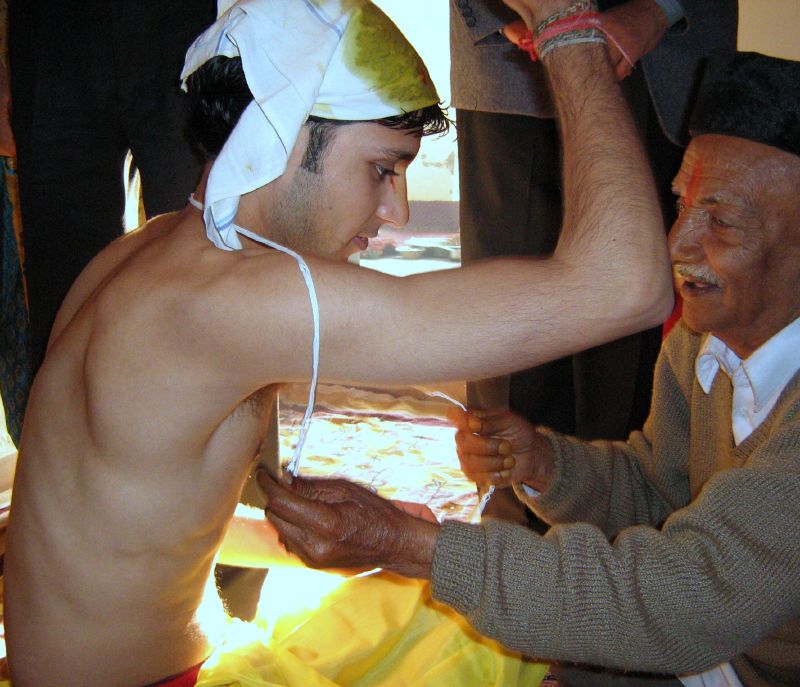
Upanayana became an elaborate ceremony, that includes rituals involving the family, the child and the teacher. A boy receives during this ceremony a sacred thread called the yajnopavita to be worn. The yajnopavita ceremony announces that the child had entered into formal education.[35][36] In the modern era, the Upanayana rite of passage is open to anyone at any age.[1] The Upanayana follows the Vidyārambhaṃ, the previous rite of passage.[14] Vidyārambhaṃ became an intermediary samskāra following the evolution in writing and language.[37] Vidyārambhaṃ now marked the beginning of primary education or literacy while Upanayana went on to refer to spiritual education.[37][38] The Upanayana can also take place at the student's home for those who are home-schooled.[39] Ceremonial bhikṣa as one of the rituals during Upanayana became important, attaining sizeable proportions.[40] The actual initiation occurred during the recitation of the Gāyatrī Mantra.[41] The spiritual birth would take place four days after the initial Upanayana rituals. It was then that the last ritual was performed, the Medhajanana.[42][43] The Samavartanam or convocation ritual marked the end of the course.[44] The Upanayana became a permanent feature around the Upaniṣad period.[45]
Attire includes a daṇḍa or staff and a mekhala or girdle.[46]
Age and varna
[edit]
In Hindu traditions, a human being is born at least twice—once at physical birth and second at intellectual birth through teacher's care. The first is marked through the Jatakarman rite of passage; the second is marked through Upanayanam or Vidyārambha rites of passage.[47][48] A sacred thread was given by the teacher during the initiation to school ceremony and was a symbolic reminder to the student of his purpose at school as well as a social marker of the student as someone who was born a second time (dvija, twice born).[49][50]
Many medieval era texts discuss Upanayana in the context of three of the four varnas (caste, class) — Brāhmaṇas, Kṣatriyas and Vaiśyas.[51] The ceremony was typically performed at age eight among the Brāhmaṇas, at age 11 among the Kṣatriyas, and age 12 among Vaiśyas.[52][53] Apastamba Gryha Sutra (verse 1.1.1.27) places a maximum age limit of 24 for the Upanayana ceremony and start of formal education. However, Gautama Gṛyha Sūtra and other ancient texts state that there is no age restriction and anyone of any age can undertake Upanayanam when they initiate their formal studies of the Vedas.[54]
Śūdras, or the fourth varna, do not have the rite to the Vedic Upanayana or access to Vedas as their vidhi is not mentioned in any of the Dharmashastras. However, texts such as Sushruta Samhita & Dhanurveda prescribe a rite to be initiated for their education regarding these subjects alone. Agamas, particularly Kamika Agama allows Śūdras to wear the sacred thread & get initiated in the Shaiva Mantras.[35][55]
The large variation in age and changes to it over time was to accommodate for the diversity in society and between families.[56]
Vedic period texts such as the Baudhāyana Gṛhyasūtra encouraged the three Varṇas of society to undergo the Upanayana.
Gender and women
[edit]In some texts, some girls belonging to the three varnas undergo upanayana rite of passage.[57][58] In ancient and medieval eras, texts such as Harita Dharmasūtras, Aśvālayana Gṛhya Sutra and Yama Smriti suggest women could begin Vedic studies after Upanayana.[59][60][61][62]
Girls belonging to the three upper varnas who decided to become a student underwent the Upanayana rite of passage, at the age of 8, and thereafter were called Brahmavadinī. They wore a thread or upper garment over their left shoulder.[59] Those girls who chose not to go to a gurukula were called Sadyovadhu (literally, one who marries straight). However, the Sadyovadhu, too, underwent a step during the wedding rituals, where she would complete Upanayana, and thereafter wear her upper garment (saree) over her left shoulder.[59] This interim symbolic Upanayana rite of passage for a girl, before her wedding, is described in multiple texts such as the Gobhila Gṛhya Sūtra (verse 2.1.19) and some Dharmasutras.[63]
Yajnopavita
[edit]
The sacred thread or the yajnopavita has become one of the most important parts of contemporary Upanayana ceremonies. There are accordingly a number of rules related to it.[8] The thread is composed of three cotton strands of nine strands each.[8][49] The strands symbolise different things in their regions. For example, among Tamils, each strand is for each of the Tridevī, the supreme trinity of the Hindu goddesses Sarasvatī, Lakṣmī, and Pārvatī.[64] According to another tradition, each of the nine threads represents a male deity, such as Agni, Bhaga, and Chandra.[65]
The predecessor to the sacred thread was an upper garment (such as a dupatta or an uparane).[66] However, as traditions developed, the upper garment began to be worn continuously. The usage of a thread grew out of convenience and manageability, becoming more popular than alternatives such as a kusa rope.[67]
The ancient Saṁskṛta texts offer a diverse view while describing the yajñopavītam or upavita. The term upavita was originally meant to be any upper garment, as stated in Apastamba Dharmasūtra (verse 2.2.4.22–2.2.4.23) or, if the wearer does not want to wear a top, a thread would suffice.[68] The ancient Indian scholar Haradatta[e] states, "yajñopavītam means a particular mode of wearing the upper garment, and it is not necessary to have the yajñopavīta at all times".[68]
There is no mention of any rule or custom, states Patrick Olivelle, that "required Brāhmaṇas to wear a sacred string at all times", in the Brāhmaṇya literature (Vedic and ancient post-Vedic).[70] Yajñopavīta, textual evidence suggests, is a medieval and modern tradition.[70] However, the term yajnopavita appears in ancient Hindu literature, and therein it means a way of wearing the upper garment during a ritual or rites of passage.[70] The custom of wearing a string is a late development in Hinduism, was optional in the medieval era, and the ancient Indian texts do not mention this ritual for any class or for Upanayana.[68][70]
The Gobhila Gṛhya Sutra (verse 1.2.1) similarly states in its discussion on Upanayana, that "the student understands the yajnopavita as a cord of threads, or a garment, or a rope of kusa grass", and it is its methods of wearing and the significance that matters.[68] The proper manner of wearing the upper garment or thread, state the ancient texts, is from over the left shoulder and under the right arm.[68] yajñopavīta contrasts with Pracinavīta method of wearing the upper garment, the latter a reverse and mirror image of former, and suggested to signify rituals for elders/ancestors (for example, funeral).[70]
The idea of wearing the upper garment or sacred thread, and its significance, extended to women.[59] This is reflected in the traditional wearing of sari over the left shoulder, during formal occasions and the celebration of rites of passage such as Hindu weddings. It was also the norm if a girl undertakes the Upanayana ceremony and begins her Vedic studies as a Brahmavadinī.[59]
The sacred Yajnopavita is known by many names (varying by region and community), such as Bratabandha, Janivaara, Jaanva, Jandhyam, Poita, Pūṇūl, Janeu, Lagun, Yajnopavita, Yagyopavit, Yonya and Zunnar.[71][72]
Scholarly commentary
[edit]Doubts about Upanayanam in old texts
[edit]Scholars[73] state that the details and restrictions in the Upanayana ceremony is likely to have been inserted into ancient texts in a more modern era. Hermann Oldenberg, for example, states that Upanayana — the solemn reception of the pupil by the teacher to teach him the Veda — is joined into texts of Vedic texts at places that simply do not make any contextual sense, do not match the style, and are likely to be a corruption of the ancient texts.[73] For example, in Satapatha Brahmana, the Upanayana rite of passage text appears in the middle of a dialogue about Agnihotra; after the Upanayana verse end, sage Saukeya abruptly returns to the Agnihotra and Uddalaka. Oldenberg states that the Upanayana discussion is likely an insertion into the older text.[73]
Kane, in his History of Dharmasastra reviews,[34] as well as other scholars,[34][74][75] state that there is high likelihood of interpolation, insertion and corruption in dharma sutras and dharma sastra texts on the Upanayana-related rite of passage. Patrick Olivelle notes the doubts in postmodern scholarship about the presumed reliability of Manusmṛti manuscripts.[76] He writes, "Manusmriti was the first Indian legal text introduced to the western world through the translation of Sir William Jones in 1794". This was based on the Calcutta manuscript with the commentary of Kulluka, which has been assumed to be the reliable vulgate version, and translated repeatedly from Jones in 1794 to Doniger in 1991.[76] The reliability of the Manusmṛti manuscript used since colonial times, states Olivelle, is "far from the truth. Indeed, one of the great surprises of my editorial work has been to discover how few of the over fifty manuscripts that I collated actually follow the vulgate in key readings."[76]
Regional variations
[edit]Nepal
[edit]
In Nepal, a ceremony is held which combines choodakarma (tonsure, shave the head) and Upanayana saṃskāra locally known as Bratabandha (Sanskrit vrata = promise, bandhana = bond).[77] In Nepal, The one who wears the sacred thread are called as Tagadhari.
This Sanskara involves the participation of entire family and a teacher who then accepts the boy as a disciple in the Guru–shishya tradition of Hinduism. Gayatri Mantra marks as an individual's entrance to a school of Hinduism. This ceremony ends after the boy goes for his first alms round to relatives and leave for the guru's ashram. Traditionally, these boys were sent to learn in a gurukula system of education but in modern times, this act is only done symbolically.[78]
See also
[edit]
- Judaism
- Bar and Bat Mitzvah, initiation ceremony
- Others
- Izze-kloth, the Apache Native American sacred cord
Footnotes
[edit]- ^ According to the given community and its regional language, it is also known by numerous terms such as mekhal in Kashmiri (मेखल), janeo in Punjabi (ਜਨੇਓ), upnen/upvit in Rajasthani (उपनेन/उपवीत), jānoi in Gujrati (જાનોઇ), janya in Sindhi (जन्य), janev in Bhojpuri (जनेव), munja in Marathi (मुंजा), munji in Konkani (मुंजी), poite in Bangla (পৈতৈ), brataghara in Odia (ବ୍ରତଘର), logun dioni in Assamese (লগুণ দিওনী), bratabandha in Nepali (ब्रतबन्ध), chewar in Newari (छेवार), upanayana in Kannada (ಉಪನಯನ), upanayanamu in Telugu (ఉపనయనము), upanayanam in Malayalam (ഉപനയനം), and upanayanam or pūṇūl in Tamil (உபநயனம் or பூணூல்).[2]
- ^ The story of Uddālaka Āruṇi and Śvetaketu
- ^ Rajbali Pandey compares the Upanayana rite of passage to Baptism, the Christian rite of admission and adoption where the person is born again unto spiritual knowledge, as Upanayana marked the initiation of the student for spiritual studies such as the Vedas.[27] Devdutt Pattanaik would not compare the two.[28]
- ^ Ancient Indian texts assert that the number of the arts is unlimited, but each deploy elements of 64 kalā (कला, techniques) and 32 vidyā (विद्या, fields of knowledge)[30]
- ^ Scholars place Haradatta to 1100 CE or between 1100 and 1300 CE.[69]
References
[edit]- ^ a b Coward & Cook 1996, p. 67.
- ^ "Dr. Shashishekhar Toshkhani: The Literary Works". www.ikashmir.net. Retrieved 7 February 2023.
- ^ Kanitkar & Cole 2010, p. 4.
- ^ Carstairs, G. Morris; Kapur, Ravi L. (1976). The Great Universe of Kota: Stress, Change, and Mental Disorder in an Indian Village. University of California Press. p. 49. ISBN 978-0-520-03024-4.
- ^ a b Kane 1941, pp. 268–287.
- ^ Sastry, C. V. (25 January 2022). Rituals & Practices of Hinduism. Zorba Books. ISBN 978-93-93029-12-6.
- ^ "Yonya (Janeu Holy Thread)". www.kashmiribazaar.in. Retrieved 7 February 2023.
- ^ a b c Ambedkar 1947, p. 158.
- ^ a b Monier-Williams (1899) "upanayana" in Monier-Williams Sanskrit-English Dictionary, 1899. Via Cologne Digital Sanskrit Dictionaries. At Institute of Indology and Tamil Studies, University of Cologne, Germany. pp. 201 (print edition).
- ^ Deshpande 1936, p. 159.
- ^ a b Gharpure 1956, p. 71.
- ^ Altekar 1944, p. 275.
- ^ Kane 1941, pp. 268–269.
- ^ a b c Gharpure 1956, p. 70.
- ^ a b Deshpande 1936, p. 9.
- ^ a b Zotter 2010, p. 17.
- ^ Dwivedi, Bhojraj (2014). Religious Basis of Hindu Beliefs. Diamond Pocket Books. ISBN 9789351650928.
- ^ Coward & Cook 1996, p. 71.
- ^ Harshananda, Swami. Upanayana Sandhyavandana And Gayatrimantrajapa. Ramakrishna Mission. ISBN 978-81-7823-453-3.
- ^ Altekar 1944, p. 294, 297.
- ^ Deshpande 1936, p. 161.
- ^ Kane 1941, p. 279-287.
- ^ "upanayana". Oxford Reference. Oxford University Press. Retrieved 22 June 2022.
- ^ a b Pandey 2013, p. 115.
- ^ Gharpure 1956, p. 71, 74, Preceptors Classified. "He who gives the Vedas is called the Guru; one who performs the Upanayana and gives the Vedas is called the Acharya; one who teaches a portion is an Upadhyaya; and one who performs tho sacrifices is called the Rtvik; those are entitled to respect in the order of priority; but more than all these is the mother most entitled to respect.".
- ^ Pandey 2013, p. 112.
- ^ Pattanaik, Devdutt (2 July 2017). "Is the Hindu thread ceremony same as baptism?". Devdutt. Retrieved 14 June 2022.
- ^ Pandey 2013, p. 115-116.
- ^ a b c d Kramrisch, Stella (1958). "Traditions of the Indian Craftsman". The Journal of American Folklore. 71 (281): 224–230. doi:10.2307/538558. ISSN 0021-8715. JSTOR 538558.
- ^ Elgood, Heather (2000). Hinduism and the Religious Arts. Bloomsbury Publishing. ISBN 978-0-8264-9865-6.
- ^ Kramrisch, Stella (1976). The Hindu Temple. Raymond Burnier. Motilal Banarsidass. ISBN 978-81-208-0223-0.
- ^ Altekar 1944, p. 290.
- ^ a b c Kane 1941, p. 268-287.
- ^ a b Kane 1941, p. 288-300.
- ^ Prasad 1997, p. 119-131.
- ^ a b Altekar 1944, p. 266-267.
- ^ Aiyangar 1949, p. 144, 146, The upanayana marks not the beginning of education, but of Vedic instruction. After the samskara of caula (tonsure) comes a ceremony named vidyarambha, initiation into learning, i.e. literacy. [...] If vidyarambha was the beginning of literacy, upanayana marks the induction into sacred and redeeming lore..
- ^ Gharpure 1956, p. 79.
- ^ Altekar 1944, p. 280.
- ^ Altekar 1944, p. 278.
- ^ Altekar 1944, p. 281.
- ^ Gharpure 1956, p. 75.
- ^ Altekar 1944, p. 287.
- ^ Pandey 2013, p. 123.
- ^ Mookerji 2003, p. 178-179.
- ^ Mary McGee (2007), Samskara, in The Hindu World (Editors: Mittal and Thursby), Routledge, ISBN 978-0415772273, pages 332–356
- ^ Jackson, Kathy Merlock (2005). Rituals and Patterns in Children's Lives. University of Wisconsin Press, Popular Press. pp. 51–52. ISBN 978-0-299-20830-1.
- ^ a b Monier-Williams 1891.
- ^ Raman Varadara, Glimpses of Indian Heritage, ISBN 978-8171547586, page 51
- ^ Pandey 2013, p. 111-117.
- ^ Mookerji 2003, p. 174.
- ^ Monier-Williams 1891, p. 360.
- ^ Mookerji 2003, p. 174-177.
- ^ Hartmut Scharfe (2007), Handbook of Oriental Studies, Brill Academic, ISBN 978-9004125568, pages 102-103, 197-198, 263-276
- ^ Altekar 1944, p. 273.
- ^ "A Village in Bihar, where Girl wear the Sacred Thread 'Janeu'". IANS. Biharprabha News. 10 February 2014. Retrieved 10 February 2014.
- ^ Jaisinghani, Bella (29 May 2009). "Thread ceremony for Thane girl". The Times of India.
- ^ a b c d e Kane 1941, p. 293-295.
- ^ V.L. Manjul (December 2002). Starting Vedic Studies - Backed by scripture, girls get their sacred thread, Hinduism Today. Archived on 15 January 2021.
- ^ C Tripathi (2005), The Evolution of Ideals of Womenhood in Indian Society, ISBN 978-8178354255, page 94
- ^ Kanitkar & Cole 2010, p. 217.
- ^ Oldenberg & Muller, The Grihya-Sutras: Rules of Vedic Domestic Ceremonies 1892, p. 44, Grihya Sutra of Gobhila Verse 2.1.19.
- ^ Arunachalam, M. (1980), Festivals of Tamil Nadu: Volume 3 of Peeps into Tamil culture, Gandhi Vidyalayam, 1980, p. 127,
... boy is invested for the first time with the sacred thread ... the three devis Sarasvati, Savitri and Gayatri ...
- ^ Altekar 1944, p. 298.
- ^ Altekar 1944, p. 276, 296.
- ^ Altekar 1944, p. 296-297.
- ^ a b c d e Kane 1941, p. 290-293.
- ^ Olivelle, Patrick (1999). "Sanskrit Commentators and the Transmission of Texts: Haradatta on Āpastamba Dharmasūtra". Journal of Indian Philosophy. 27 (6): 570. doi:10.1023/A:1004636609126. ISSN 0022-1791. JSTOR 23496389. S2CID 189820541.
- ^ a b c d e Olivelle 1992, p. 9-10.
- ^ Sultān Bāhū, Jamal J. Elias (April 1998), Death before dying: the Sufi poems of Sultan Bahu, University of California Press, 1998, ISBN 978-0-520-21242-8,
... in Punjabi, zunnar, the sacred Yajñopavītam worn by Brahmin Hindus ...
- ^ Shashi Ahluwalia, Meenakshi Ahluwalia (1992), Living faiths in modern India, Indian Publishers' Distributors, 1992
- ^ a b c Oldenberg, The Grihya-Sutras: Rules of Vedic Domestic Ceremonies (1886), p. 7-8.
- ^ Arun Kumbhare (2009), Women of India: Their Status Since the Vedic Times, ISBN 978-1440156007, page 56
- ^ J Sinha (2014), Psycho-Social Analysis of the Indian Mindset, Springer Academic, ISBN 978-8132218036, page 5
- ^ a b c Patrick Olivelle (2004), Manu's Code of Law, Oxford University Press, ISBN 978-0195171464, pages 353-354, 356-382
- ^ Zotter 2010, p. 23-24.
- ^ Shore, Amanda (26 February 2011). "Hindu Bratabandha Ceremony, Nepal". inTravel Magazine. Retrieved 20 May 2014.
Works cited
[edit](arranged by year)
- Sacred Books of the East. Oxford University Press. 1879-1910.
- Oldenberg, Hermann (1886). The Grihya-Sutras: Rules of Vedic Domestic Ceremonies. Vol. xxix. Translated by Oldenberg, Hermann.
- The Grihya-Sutras: Rules of Vedic Domestic Ceremonies. II. Vol. xxx. Translated by Oldenberg, Hermann; Müller, Max. Oxford, Clarendon Press. 1892.
- Monier-Williams, Monier (1891), Religious Thought and Life in India: As based on the Veda and other sacred books of the Hindūs, J. Murray, 1891
- Deshpande, Kamalabai (1936). The Child in Ancient India. Poona.
{{cite book}}: CS1 maint: location missing publisher (link) - Kane, Pandurang Vaman (1941). "VII. Upanayana". History of Dharmasastras. Vol. 2 Part 1. Bhandarkar Oriental Research Institute. pp. 268–287.
- Altekar, Anant Sadashiv (1944). Education In Ancient India. Nand Kishore & Brothers.
- Ambedkar, B. R. (1947). Who Were the Shudras?. Thacker and Co.
- Ambedkar, B. R. (2019) [1979]. Dr. Babasaheb Ambedkar Writings and Speeches. Dr. Ambedkar Foundation. Ministry of Social Justice & Empowerment, Govt. of India. ISBN 978-93-5109-178-3.
- Aiyangar, K.V. Rangaswami (1949). Aspects of the Social and Political. System of Manusmrti. Radha Kumud Mookerji Lectures 1946. Lucknow University.
- Gharpure, J. R. (1956). Teachings of Dharmasastra. Dr Radha Kumar Mukerjee Endowment Lectures No 4. 1949-50-51-52. Lucknow University.
- Olivelle, Patrick (1992). The Samnyasa Upanisads: Hindu Scriptures on Asceticism and Renunciation. Oxford University Press. ISBN 978-0-19-536137-7. ISBN 978-0195070453
- Kanitkar, V. P. (Hemant); Cole, W. Owen (2010) [1995]. Hinduism - An Introduction. Teach Yourself, Hodder Education, Hachette UK.
- Coward, Harold; Cook, Philip Hilton (1996). Religious Dimensions of Child and Family Life: Reflections on the UN Convention on the Rights of the Child. Wilfrid Laurier University Press. ISBN 978-1-55058-104-1.
- Prasad, Ram Chandra (1997). The Upanayana: The Hindu Ceremonies of the Sacred Thread. Motilal Banarsidass. ISBN 978-81-208-1240-6.
- Mookerji, Radha Kumud (2003). Ancient Indian Education: Brahmanical and Buddhist. Motilal Banarsidass. ISBN 978-81-208-0423-4.
- Zotter, Christof (2010). "Notes on the Evolution of an Initiation Ritual. The Vratabandha of the Bāhun and Chetri". In Zotter, Astrid; Zotter, Christof (eds.). Hindu and Buddhist Initiations in Nepal and India. Vol. 10. Wiesbaden: Harrassowitz Verlag. pp. 17–44.
{{cite book}}:|work=ignored (help) - Pandey, Rajbali (2013). Hindu Saṁskāras: Socio-religious Study of the Hindu Sacraments (2nd ed.). Motilal Banarsidass. ISBN 978-8120803961.
Further reading
[edit]- Hastings, James, ed. (1914). Encyclopedia Of Religion And Ethics. T&T Clark. p. 323.
- "Yajnavalkya Smriti with Commentary of Vijnaneswara called the Mitakshara. The Achara Adhyaya Book 1". Sacred Books Of The Hindus. Vol. 21. Translated by Vidyarnava, Rai Bahadur Srisa Chandra. Allahabad. 1918.
{{cite book}}: CS1 maint: location missing publisher (link) - Apte, VM (1959) [1939]. Social and Religious Life in the Grihya Sutras. Popular Book.
- Gonda, J (1965). Change and continuity in Indian religion. Mouton & Co.
- Barua, Bharati (1975). A study of the socioreligious ceremony of Upanayana (investiture with sacred thread) in the Sutras and the Dharmasastras (Thesis). Gauhati University. hdl:10603/67755. via Shodhganga.
- Kakar, Sudhir (1979). Indian Childhood: Cultural Ideals and Social Reality. Oxford University Press. ISBN 978-0-19-561199-1.
- Flood, Gavin (1994). "3. Hinduism". In Holm, Jean; Bowker, John (eds.). Rites of Passage. Pinter Publishers. ISBN 978-0-567-31072-9.
- Bronkhorst, Johannes (1996). "Svetaketu and the upanayana" (PDF). Études Asiatiques / Asiatische Studien. 50 (3): 591–561 – via Université de Lausanne serveur académique lausannois.
- Murthy, H V Narasimha (1997). A critical study of upanayana samskara (Thesis). Mangalore University. hdl:10603/132206. via Shodhganga.
- Kadam, K. N. (1997). The Meaning of the Ambedkarite Conversion to Buddhism and Other Essays. Popular Prakashan. ISBN 978-81-7154-810-1.
- Saraswati, Chandrashekarendra (2008). Introduction to Hindu Dharma: Illustrated. World Wisdom, Inc. ISBN 978-1-933316-48-2.
- Mahadevan, B (June 2014), Thoughts on Sandhyā Vandanam (PDF), Sumathi Samskriti Trust, Bangalore
- Sundareswaran, N. K. (2015). "The upanayana ritual in the Satapathabrahmana". Texts and Rituals: Issues in Indology. Sukṛtīndra Oriental Research Institute. ISBN 978-93-83846-05-4.
- Flueckiger, Joyce Burkhalter (2015). Everyday Hinduism. John Wiley & Sons. ISBN 978-1-4051-6021-6.
- Kajihara, Mieko (2016), "The Upanayana and the 'Repeated Upanayana(s)'", in Koskikallio, Petteri; Parpola, Asko (eds.), Vedic Investigations. Papers of the 12th World Sanskrit Conference held in Helsinki, Finland, 13-18 July 2003, vol. 1, Motilal Banarsidass, pp. 271–296, ISBN 978-81-208-4030-0
- Haas, Dominik A. (2019), Thinking inside the Ritual Box: The Employment of sāvitrīs in the Upanayana, 11th International Indology Graduate Research Symposium
{{citation}}: CS1 maint: location (link) CS1 maint: location missing publisher (link)
- Basava and Upanayana
- Samartha, M. P. (1977). "Basava's Spiritual Struggle". Religious Studies. 13 (3): 335–347. doi:10.1017/S0034412500010118. ISSN 0034-4125. JSTOR 20005425. S2CID 170976283.
- "Correct textbooks or face agitation, say Lingayat maths". The Hindu. 2022. ISSN 0971-751X.
- "Veerashaiva seers endorse lesson on Basaveshwara but with a few modifications". The Hindu. 6 June 2022. ISSN 0971-751X.
- News articles
- "Hyderabad devotees welcome 57-feet tall Ganesh idol". The Asian Age. PTI. 25 August 2017.
Nearly 500 weavers who took part in making the 'kanduva' and 'jandhyam' ...
| Pre-natal |  | |
|---|---|---|
| Childhood | ||
| Educational | ||
| Marriage | ||
| Last | ||
| Related topics | ||
Hindu deities and texts | ||
|---|---|---|
| Gods |  | |
| Goddesses | ||
| Deity groups | ||
| Texts (list) | ||
Upanayana
View on GrokipediaEtymology and Terminology
Derivation and Core Meaning
The term Upanayana derives from the Sanskrit prefix upa-, denoting proximity or approach, combined with ni- (intensifying downward or into) and the root ī (to go) or more commonly parsed as upa + nayana from the root nī (to lead), yielding the literal sense of "leading near" or "bringing close."[9] This etymological structure underscores the ritual's foundational act of escorting the initiate to a preceptor, as evidenced in early Vedic terminology where verbs like upa-nī explicitly denote "making someone one's own student" in contexts of formal discipleship.[9] Scholarly analyses of Grihya Sutras confirm this derivation, linking it to the physical and symbolic conveyance of the pupil toward sacred knowledge rather than mere proximity.[10] At its core, Upanayana signifies the initiatory sacrament (samskara) that admits a male youth into Vedic scholasticism, marking his entry into the brahmacarya phase of disciplined celibate study under a guru's tutelage.[10] This rite embodies a doctrinal "second birth" (dvija), conferring eligibility for mantra recitation—particularly the Gayatri—and investiture with the yajnopavita (sacred thread), which serves as a perpetual emblem of ritual purity and commitment to svadhyaya (self-study of scriptures).[1] In Vedic praxis, as detailed in Sutra literature, the ceremony's essence lies in this causal linkage: the guru's acceptance transmutes the initiate from familial dependency to autonomous pursuit of dharma through memorized transmission of oral lore, historically restricted to upper varnas to preserve textual integrity amid pre-literate pedagogy.[10]Symbolic Terms and Variations
The yajñopavīta constitutes the principal symbolic artifact of the Upanayana rite, comprising three cords twisted into nine strands and secured with a brahmagranthi knot, traditionally fashioned from cotton measuring 96 times the span of four fingers.[11] This thread, draped over the left shoulder (upavītī) for Vedic rituals, embodies the initiate's vow to pursue sacred knowledge and uphold dharma, as prescribed in texts like the Taittirīya Āraṇyaka.[11] Interpretations of the three strands vary across traditions but commonly signify the threefold debts (ṛṇas)—to sages for scriptural wisdom, ancestors for progeny, and deities for cosmic order—or the innate qualities (guṇas) of sattva (purity), rajas (activity), and tamas (inertia).[11][12] Other exegeses link them to mastery over body, speech, and mind, or the cosmic functions of creation, preservation, and dissolution, with the nine strands invoking entities such as the ninefold praṇava (Oṃ).[12][11] Varṇa-specific norms dictate material and hue: cotton in white for Brāhmaṇas, wool in red for Kṣatriyas, and linen in yellow for Vaiśyas, though modern observance frequently standardizes to cotton regardless of caste.[11] The thread's configuration adapts by life stage, with a single set for brahmacārins, multiples for householders, and none for saṃnyāsins; its ritual positioning shifts to the right shoulder (prācīnāvītī) for ancestral rites or around the neck (nivītī) for mundane wear.[11] Regionally, the yajñopavīta assumes diverse designations, including janeu in Hindi-speaking northern India, pūṇūl among Tamils, janivāra in Kannada regions, and lagun in parts of Bihar, while the ceremony itself varies as upanayanam in the south, munji in Maharashtra, or bratabandha in Nepal, incorporating local customs like preparatory tonsure or feasts without altering the thread's investiture.[11][13]Historical Origins
Evidence in Vedic Literature
The concept of upanayana, denoting the initiation of a student into Vedic study under a teacher, finds its earliest attestations in the Vedic Samhitas, where elements of the rite are alluded to or hymned, though not in fully elaborated form as in later ritual manuals. In the Atharvaveda (11.5 and 11.7), hymns explicitly praise the brahmacārin (celibate student) and describe initiation motifs, including the teacher (ācārya) receiving the pupil as akin to a fetus entering the womb (11.7.3), the student's adoption of black antelope skin garb, an unshaven face (11.7.6), carrying fuel sticks (samidh), a girdle (mekhalā), and practicing alms-begging (11.7.4, 11.5.9, 11.7.13). These passages integrate the rite with protective charms against misfortune, emphasizing the student's ritual purity and dependence on the teacher for knowledge transmission.[14][15] The Rigveda-Saṃhitā provides indirect evidence through symbolic parallels and terminology. The term brahmacarya appears twice, denoting the disciplined life of a religious student (10.109.5), while a hymn likens the sacrificial post (yūpa) to an adorned youth encircled in ceremony (3.8.4-5), evoking post-initiation imagery of the novice. Such motifs prefigure the student's ritual investiture and integration into sacred learning, though without explicit procedural detail.[14] In the Brāhmaṇas, ritual elaboration emerges, as in the Śatapatha Brāhmaṇa (Yajurveda tradition, 11.5.4.1-17), which outlines the core ceremony: the teacher inquires the student's name, recites the Sāvitrī mantra for enlightenment, and accepts the pupil's symbolic offerings of body parts to Agni, Death, and the ācārya (11.3.3.3-6), formalizing the transfer of Vedic lore and ethical vows. This marks upanayana as a prerequisite for sacrificial participation and svādhyāya (self-recitation).[14] Upanishadic texts further illustrate the rite's educational function. The Chāndogya Upanishad (Samaveda, 6.1.1-2) recounts Śvetaketu, sent by his father Uddālaka at age twelve for twelve years of study under a guru, returning versed in scriptures but lacking deeper insight—a narrative framing upanayana as the gateway to brahmacarya and intellectual rigor, with the age aligning to Vedic prescriptions for timely initiation. Similar precedents appear in the Bṛhadāraṇyaka Upanishad (Yajurveda), reinforcing the rite's role in transmitting esoteric knowledge. These accounts, while narrative, underscore causal links between initiation, prolonged discipleship, and spiritual qualification, without later symbolic accretions like the yajñopavīta thread, which postdates Samhita-era evidence.[16][9]Development in Later Texts and Practices
In the Smriti literature, particularly the Manusmṛti (composed between approximately 200 BCE and 200 CE), the Upanayana ritual received detailed codification beyond the Vedic Grihya Sūtras, specifying precise timings based on varṇa: the eighth year after conception for Brāhmaṇas, the eleventh for Kṣatriyas, and the twelfth for Vaiśyas, with seasonal prescriptions of spring for Brāhmaṇas, summer for Kṣatriyas, and autumn for Vaiśyas to align with educational readiness and cosmic cycles.[17] These texts emphasized the rite's role as a second birth (dvija), conferring eligibility for Vedic study and ritual performance exclusively among the three upper varṇas, while equating a woman's equivalent initiation to the rites of marriage rather than formal Upanayana, reflecting a consolidation of gender-specific dharma.[18] Other Dharmaśāstras, such as the Yama Smṛti and Hārīta Dharmasūtra, occasionally referenced potential Vedic initiation for females in earlier contexts, but by the Smṛti period, practice had largely restricted the rite to males, prioritizing patrilineal transmission of sacred knowledge.[1] Purāṇic texts, emerging from the Gupta period onward (c. 300–1000 CE), integrated Upanayana into mythological narratives, portraying it as a divine rite performed by figures like Vāsudeva for Rāma and Kṛṣṇa to symbolize their entry into brahmacarya and mastery of Vedic lore, thereby elevating the ceremony's spiritual symbolism while embedding it in devotional frameworks that linked personal initiation to cosmic order and bhakti elements.[19] These accounts expanded Vedic prescriptions with elaborate homologies, such as associating the sacred thread (yajñopavīta) with protective deities and mantra recitation, though the thread itself—central in later iconography—appears as a post-Vedic elaboration rather than a Vedic mandate, with ancient texts focusing more on the guru-disciple bond than material symbols.[5] Medieval commentaries and digests, such as those by Medhātithi on the Manusmṛti (c. 9th century CE), further refined procedural details, including mantric expansions and preparatory purifications, adapting the rite to regional scholastic traditions while reinforcing its exclusivity to dvijas amid social stratification; practices evolved to include optional thread-wearing as a visible caste marker, diminishing emphasis on prolonged gurukula residence in favor of symbolic conferral, a shift observable in texts like the Dharmasindhu that prioritized ritual efficacy over literal Vedic apprenticeship.[17] This development aligned with broader post-Vedic trends toward ritual formalism, where Upanayana served dharma enforcement and social cohesion, though empirical adherence varied, with some communities performing it later (up to age 16 for Vaiśyas) to accommodate practical education.[20]Ritual Description
Preparatory Rites
The preparatory rites for Upanayana, as outlined in traditional Grihya Sutras and subsequent Dharma texts, serve to purify the initiate (the boy, termed vatu), atone for prior irregularities, and invoke divine blessings prior to the core investiture. These steps emphasize ritual cleanliness, familial expiation, and symbolic transition from unregulated childhood to disciplined studenthood, typically occurring a day or hours before the main ceremony.[](https://dharmawiki.org/index.php/Upanayana_(%E0%A4%89%E0%A4%AA%E0%A4%A8%E0%A4%AF%E0%A4%A8%E0%A4%AE%E0%A5%8D) Key preliminary actions include the establishment of a sacred space: a platform or canopy is erected and smeared with cow dung for purification, as prescribed in the Paraskara Grihya Sutra, to create an auspicious environment free of impurities. Deities such as Ganesha, Lakshmi, Dhriti, Medha, and Sarasvati are propitiated through worship to bestow intellect, devotion, and prosperity upon the initiate, ensuring mental and spiritual readiness—though these specific invocations evolve beyond core Vedic sutras into later Smriti practices. Ancestral rites like Nandi Shraddha and Matrukapuja follow, honoring forebears and maternal deities to secure their blessings and mitigate hereditary doshas (flaws).[](https://dharmawiki.org/index.php/Upanayana_(%E0%A4%89%E0%A4%AA%E0%A4%A8%E0%A4%AF%E0%A4%A8%E0%A4%AE%E0%A5%8D)[](https://dharmawiki.org/index.php/Upanayana_(%E0%A4%89%E0%A4%AA%E0%A4%A8%E0%A4%AF%E0%A4%A8%E0%A4%AE%E0%A5%8D)[](https://dharmawiki.org/index.php/Upanayana_(%E0%A4%89%E0%A4%AA%E0%A4%A8%E0%A4%AF%E0%A4%A8%E0%A4%AE%E0%A5%8D) Expiatory measures address the child's past lapses, such as consumption of non-sattvic foods or unregulated speech and actions during infancy. The father or designated male relative (kartru) undertakes a Paada-kricchra vrata—a strict penance involving fasting and austerity—or its substitute of charitable donations like cow or cloth to Brahmins, purifying both himself and the vatu from accumulated sins. Physical preparation for the boy involves bathing, nail clipping, and sometimes body staining with turmeric for sanctity, culminating in overnight silence to foster inner discipline. A symbolic matru bhojana occurs the morning of the rite, where the boy shares a meal from the same leaf as his mother, signifying the cessation of infantile freedoms and entry into regulated life under the guru.[](https://dharmawiki.org/index.php/Upanayana_(%E0%A4%89%E0%A4%AA%E0%A4%A8%E0%A4%AF%E0%A4%A8%E0%A4%AE%E0%A5%8D)[](https://www.indica.today/long-reads/upanayana-samskara/)[](https://www.wisdomlib.org/history/essay/education-in-ancient-india/d/doc1211408.html) These rites underscore causal preparation for Vedic study, rooting in texts like the Atharvaveda (XI.7.3) for elements such as protective coverings with kusha grass during transitional setups, as elaborated in P.V. Kane's History of Dharmashastra. Variations exist across sutra schools (e.g., Apastamba emphasizes familial vows), but the focus remains on holistic purification to render the initiate worthy of sacred knowledge transmission.[21][21][22]Core Ceremony and Yajnopavita Investiture
The core ceremony of Upanayana centers on the investiture of the yajnopavita, a triple-stranded cotton thread worn over the left shoulder and across the right hip, signifying the initiate's readiness for Vedic study and ritual duties. This rite, as prescribed in the Grihya Sutras, follows preparatory purifications and offerings into a consecrated fire (homam). The acharya places the thread on the boy while chanting mantras, including the invocation yajñopavītam paramaṁ pavitraṁ prajāpater yat sahajaṁ purastāt, which attributes purifying and life-sustaining properties to the thread.[21] Prior to the investiture, the initiate receives symbolic items: a danda (staff) for support and authority, a mekhala (girdle of muñja grass) for self-restraint, and an ajina (antelope or deer skin) to sit upon during study, emphasizing austerity and discipline as outlined in texts like the Śatapathabrāhmaṇa. The acharya then imparts the Gāyatrī mantra (also called Sāvitrī), whispering it thrice into the boy's right ear to initiate him into sacred recitation and invoke intellectual illumination.[23][1] The yajnopavita itself comprises three strands, often interpreted in tradition as representing the debts to gods, sages, and ancestors, though primary Vedic texts focus on its role in enabling sacrificial performance rather than explicit symbolism. The thread is not permanent; it is renewed during avani avittam (upakarma) rituals annually, but the initial investiture binds the wearer to lifelong ritual obligations unless entering saṁnyāsa.[24][21]Eligibility and Requirements
Varna and Age Prescriptions
The Upanayana rite is prescribed exclusively for males of the three upper varnas—Brahmana, Kshatriya, and Vaishya—collectively termed dvija or "twice-born," as it initiates them into Vedic study and ritual obligations aligned with their dharmic roles. Shudras, classified as the fourth varna, are ineligible, reflecting scriptural demarcations of varna-specific duties that reserve sacred thread investiture and guru-kula education for those varnas tasked with preserving and transmitting Vedic knowledge.[25][26] Prescribed ages for the ceremony vary by varna, derived from Grihya Sutras and Dharmashastras such as the Manusmriti and Asvalayana Grihya Sutra. For Brahmanas, initiation is ideally in the eighth year from conception (approximately seven years and two months from birth), enabling early immersion in scriptural learning; upper limits extend to the sixteenth year to avoid forfeiture of eligibility. Kshatriyas follow at the eleventh year, balancing martial training with Vedic foundations, with an upper limit of twenty-two years. Vaishyas are initiated at the twelfth year, accommodating economic pursuits alongside ritual duties, up to twenty-four years. These timings ensure the initiate's physical and mental readiness for austerity, as delays beyond varna-specific maxima render one patita (fallen) from dvija status in traditional interpretations.[20][27][21]| Varna | Ideal Age (from birth, approx.) | Upper Age Limit |
|---|---|---|
| Brahmana | 7 years 2 months (8th year from conception) | 16 years |
| Kshatriya | 11 years | 22 years |
| Vaishya | 12 years | 24 years |