


Wallet
View on Wikipedia
A wallet is a flat case or pouch, often used to carry small personal items such as physical currency, debit cards, and credit cards; identification documents such as driving licence, identification card, club card; photographs, transit pass, business cards and other paper or laminated cards. Wallets are generally made of fabric or leather, and they are usually pocket-sized and foldable.
Wallets may include a money clip, coin purse, chain fastener, strap, snap, rein, or zipper. There are specialized wallets for holding passports, wearable ID cards, and checkbooks. Some unusual wallets are worn on the wrist or shoe. Wallets may be used as a fashion accessory, or to demonstrate the style, wealth, or social status of the owner.
Etymology
[edit]The word originated in the late 14th century, meaning "bag" or "knapsack", from uncertain origin (Norman-French golette (little snout)?), or from similar Germanic word, from the Proto-Germanic term "wall", which means "roll" (from the root "wel", meaning "to turn or revolve."[1] (see for example "knapzak" in Dutch and Frisian). The early usage by Shakespeare described something that we would recognise as more like a backpack today.[2] The modern meaning of "flat case for carrying paper money" is first recorded in 1834 in American English.[1]
The ancient Greek word kibisis, said to describe the pouch carried the god Hermes and the sack in which the mythical hero Perseus carried the severed head of the monster Medusa, has been typically translated as "wallet".[3][4]
History
[edit]
Ancient Greece
[edit]The classicist A. Y. Campbell set out to answer the question, "What...in ancient literature, are the uses of a wallet?" He deduced, as a Theocritean scholar, that "the wallet was the poor man's portable larder; or, poverty apart, it was a thing that you stocked with provisions."[5] He found that sometimes a man may be eating out of it directly but the most characteristic references allude to its being "replenished as a store", not in the manner of a lunch basket but more as a survival pack.
Renaissance
[edit]Wallets were developed after the introduction of paper currency to the West in the 1600s. (The first paper currency was introduced in the New World by the Massachusetts Bay Colony in 1690.) Prior to the introduction of paper currency, coin purses (usually simple drawstring leather pouches) were used for storing coins. Early wallets were made primarily of cow or horse leather and included a small pouch for printed calling cards.[citation needed]
In recounting the life of the Elizabethan merchant, John Frampton, Lawrence C. Wroth describes the merchant as, "a young English-man of twenty-five years, decently dressed, ..., wearing a sword, and carrying fixed to his belt something he called a 'bowgett' (or budget), that is, a leathern pouch or wallet in which he carried his cash, his book of accounts, and small articles of daily necessity".[6]
19th century
[edit].jpg)
In addition to money or currency, a wallet would also be used for carrying dried meat, victuals, "treasures", and "things not to be exposed". Wallets originally were used by early Industrial Americans. It was considered "semi-civilized" in 19th century America to carry one's wallet on one's belt. At this time, carrying goods or a wallet in one's pocket was considered uncivilized and uncommon.[7]
In Spain, a wallet was a case for smoking paraphernalia: "Every man would carry a small sheaf of white paper in addition to a small leather wallet which would contain a flint and steel along with a small quantity of so-called yesca, being a dried vegetable fibre which a spark would instantly ignite."[8]
20th century–present
[edit].jpg)
The modern bi-fold wallet with multiple "card slots" became standardized in the early 1950s with the introduction of the first credit cards. Some innovations include the introduction of the velcro-closure wallet in the 1970s. Pocket-sized wallets remain popular to this day.[9]
For cryptocurrencies that only exist in cyberspace as entries in some online ledger, a cryptocurrency wallet is a computing tool whose purpose is to securely keep the owner’s secret key, to authenticate the owner, and to let the owner sign transactions securely. A "hardware wallet" is a single purpose computer to do this even more safely.
Contemporary examples
[edit]Wallets are usually designed to hold banknotes and credit cards and fit into a pocket or handbag. Small cases for securing banknotes which do not have space for credit cards or identification cards may be classified as money clips: this may also be used to describe small cases designed to hold ISO/IEC 7810 cards alone.
- Breast wallet
- Also called a "secretary wallet", this is a wallet in which banknotes are not folded. They are intended for men's breast pocket in a jacket, or for a handbag. Breast wallets will often hold cheques and other monetary documents as they are too large for storage in a pants pocket.
- Bi-fold wallet
- a type of wallet in which the banknotes are folded over once. Credit cards and identification cards may be stored horizontally or vertically.
- Tri-fold wallet
- a wallet with two folds, in which credit cards are generally stored vertically.
- Front pocket wallet
- a case with no currency compartment and very few pockets for cards. Usually banknotes are folded and held in a wallet compartment.
- Money clip wallet
- similar to a front pocket wallet in terms of size, with banknotes usually held in by a clip secured by a strong magnet.
- Long wallet
- a larger wallet typically worn with jeans, fastened by a chain, strap, or leather band. Bills are held flat, and long wallets typically have a coin purse. Popularized by bikers to secure their wallets while riding a motorcycle, smaller chained wallets became popular in 1970s−'80s punk fashion and in the early 1990s with the grunge fashion movement as well as heavy metal fashion. Long wallets are popular with men in cash-based countries like Japan and may reflect Native American aesthetic influence.
- Wallet band
- a type of wallet that uses a continuous elastic band, made of fabric or rubber, to secure cards and/or cash. Wallet bands reduce the bulk of a traditional wallet.
- Wristlet
- a type of wallet that can be secured to the wrist, to keep one's hands free.
- Travel wallet
- used by travelers to hold essential documentation together, such as passports, tickets, boarding passes, foreign currency, traveler's cheques, itinerary, travel insurance, hotel booking information, and other similar items.
- ID case/neck pouch
- thin nylon or leather cases with plastic see-through compartments designed to hold an ID card. Usually worn around the neck, many have extra pockets for holding small items, hence they also function as wallets.
- Shoewallet
- a small pouch attached to a shoe to be used as a wallet. Designed primarily to be worn during exercise.
- Digital wallet
- a computer file for maintaining digital currency.
- Cryptocurrency wallet
- a digital wallet where private keys are stored for cryptocurrencies like Bitcoin.
- Hardware wallet
- a cryptocurrency wallet built as a separate physical device which identifies the owner, and lets the owner sign online transactions in a secure manner.
- Side by side wallet
- divides the contents into two stacks instead of one, so it is half as thick. May be made of very thin fabric. Patented.[further explanation needed][citation needed]
- L-Zip wallet
- a rectangular shaped wallet with a zipper that runs along 2 sides of the wallet.
- Metal wallet
- a slim wallet made from metal, usually aluminum or titanium. Can be found combined with other materials such as wood or leather.
- Credit card holder
- a rectangular shaped wallet for holding credit cards.
- Cardholder zip wallet
- a rectangular shaped wallet with a zipper for coins and credit cardholder.
- Checkbook
- a wallet that can hold standard-sized cheques
- Envelope
- a long wallet that has features similar to an envelope with a covering flap.
- Automatic wallet
- a wallet with a mechanism that ejects inserted cards with a button to display them for use. Also known as a pop-up or cascading wallet.
- Tactical wallet
- a functional wallet that incorporates a ruler, small saw, knife, bottle opener, or other tools. It is a thin, wallet-sized multitool, with similarities to a Swiss army knife.
- RFID blocking wallet
- a wallet acting as a faraday cage around proximity-sensing enabled cards. Can block NFC & RFID signals, preventing portable RFID readers from reading sensitive data.
Materials
[edit]The traditional material for wallets is leather or fabric, but many other flexible flat sheet materials can be used in their fabrication. Non-woven textiles such as Tyvek are used, sometimes including reuse of waterproof maps printed on that material. Woven metals, such as fine mesh made of copper or stainless steel have been incorporated into wallets that are promoted as having electromagnetic shielding properties to protect against unauthorized scanning of embedded NFC and RFID tags. Do-it-yourself websites such as Instructables feature many projects for making wallets out of materials such as denim, Kevlar, or duct tape.
Regional differences
[edit]Some wallets, particularly in Europe where larger value coins are prevalent, contain a coin purse compartment. Some wallets have built-in clasps or bands to keep them closed. As European banknotes, such as euros and pounds, are typically larger than American banknotes in size, they do not fit in some smaller American wallets.
Metaphorical usage
[edit]The term wallet is also used as a synecdoche to refer to an individual's overall personal budget. One of the definitions of "syndecdoche", by Sasse, uses a wallet reference as an example of the meaning of the term ("an abbreviated speech in which the containing vessel is mentioned instead of its contents"), such as when a person holds up their wallet to a person asking for money, while saying "here is $100".[10] A wallet is also used as an example in a definition for the related rhetorical device of metonymy: "If we cannot strike offenders in the heart, let us strike them in the wallet."[11]
Gallery
[edit]-
 A large wallet attached with a leather cord or magnet
 -
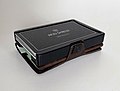 An RFID signal-blocking slim wallet
 -
 A leather wallet
 -
 A Japanese wallet with a coin purse
 -
 A poster seeking innovative suggestions tells readers "An Idea May Mean Wealth In Your Wallet".
.jpg)
_01.jpg)


See also
[edit]References
[edit]- ^ a b "Online Etymology Dictionary entry for "wallet"". Archived from the original on 2007-12-24. Retrieved 2007-09-06.
- ^ "ShakespearesWords.com". www.shakespeareswords.com. Retrieved 2023-05-17.
- ^ "CTCWeb Glossary: K". Archived from the original on 2011-07-12. Retrieved 2007-09-06.
- ^ Apollodorus (1921). "Perseus". In Frazer, James G (ed.). Bibliotheca (Pseudo-Apollodorus). Vol. 2. London: W. Heinemann.
- ^ Campbell, A. Y. (April 1931). "The Boy, the Grapes, and the Foxes". The Classical Quarterly. 25 (2): 91. doi:10.1017/S0009838800013501. JSTOR 637006. S2CID 171946559.
- ^ Wroth, Lawrence C. (August 1954). "An Elizabethan Merchant and Man of Letters". Huntington Library Quarterly. 17 (4): 301–302. doi:10.2307/3816498. JSTOR 3816498.
- ^ Mason, Otis T. (January 1889). "The Beginnings of the Carrying Industry". American Anthropologist. A2 (1): 21–46. doi:10.1525/aa.1889.2.1.02a00030.
- ^ Cushing, Caroline E. W. (1832). "Letter XIV". Letters: Descriptive of Public Monuments, Scenery & Manners in France & Spain. Vol. 2. Newburyport, MA: Allen. OCLC 8401193. Archived from the original on 2017-05-07.
- ^ "A Brief History of Wallets and The People Who Own Them". Brave Soles Life. 2019-02-20. Archived from the original on 2023-05-18. Retrieved 2023-05-18.
- ^ Robert Kolb, Irene Dingel, and Lubomír Batka. The Oxford Handbook of Martin Luther's Theology. OUP Oxford, 2014. p. 328
- ^ "Tropes". /web.cn.edu. Dr. Wheeler. Retrieved 3 April 2020.
External links
[edit] Media related to Wallets at Wikimedia Commons


Wallet
View on GrokipediaEtymology and Definition
Etymology
The word wallet originates from the Middle English term walet, denoting a bag or knapsack, with its earliest recorded use dating to the late 14th century.[3] This form likely derives from Proto-Germanic *wal- or *wall-, meaning "to roll," reflecting the rolled or bundled nature of early portable containers.[8] The etymology is traced through Germanic roots, possibly via an Old Northern French intermediary *walet, emphasizing its association with rolled items carried by travelers.[3] The term's first documented appearance in English literature occurs in Geoffrey Chaucer's The Canterbury Tales (c. 1387–1400), where it describes the Pardoner's bag filled with indulgences: "His walet lay biforn hym in his lappe, Bretful of pardoun, comen from Rome al hoot."[9] This usage marks wallet as one of the words first attested in Chaucer's works, substituting for more common Middle English terms like purs or bagge.[10] During the 14th to 16th centuries, the meaning evolved from a general traveler's pouch—often akin to a knapsack—to a specialized container for money and documents.[3] By the 16th century, wallet specifically referred to a flat bag for coins or valuables, solidifying its modern connotation.[3] In regional variations, American English introduced the synonym billfold in the mid-19th century, coined from "bill" (paper currency) and "fold" to describe a compact, folding case for banknotes.[11] This term gained prevalence in the United States around 1858, reflecting the rise of paper money.[12]Definition and Scope
A wallet is defined as a small, flat, folding case or pouch designed for securely carrying essential personal items such as paper currency, credit cards, debit cards, identification documents, and other compact objects.[2][13][14] This core function emphasizes its role as a portable organizer tailored for everyday use, typically fitting into a pocket or small bag without bulk.[15][1] Unlike purses, which are generally larger handbags or pouches with handles or straps for carrying a broader array of items like cosmetics, keys, and phones—often associated with women's accessories—wallets prioritize compactness and are unisex in modern usage, though traditionally more pocket-oriented for men.[16][17][18] They differ from clothing pockets by providing dedicated, secure compartments that prevent items from falling out or becoming disorganized, and from larger bags by focusing solely on financial and identification essentials rather than general storage.[19] This distinction underscores the wallet's emphasis on portability and quick access for daily transactions, avoiding the added weight or volume of multi-purpose carriers.[20] The scope of wallets encompasses both physical forms, such as leather bifolds or slim cardholders made from materials like leather, plastic, or fabric, and digital variants, including software applications or online services that store payment information, such as credit card details or cryptocurrencies, on mobile devices or computers.[4][21] Physical wallets have evolved into hybrid systems that integrate with digital technologies, like NFC-enabled cards for contactless payments, bridging analog security with electronic convenience.[7] Digital wallets, in particular, function as encrypted apps or services—examples include Apple Pay or Google Wallet—that enable secure, cashless transactions via smartphones, expanding the traditional wallet's utility to virtual environments.[22][23] Fundamentally, wallets serve to protect against loss, theft, or damage through features like secure closures, RFID-blocking materials in physical models to prevent unauthorized scanning, and encryption protocols in digital ones to safeguard data.[4] They facilitate organization by compartmentalizing items for easy retrieval, such as dedicated slots for cards and bills, reducing clutter during transactions.[24] Moreover, wallets streamline payments by enabling quick access to funds, whether withdrawing cash from a physical billfold or authorizing a tap-to-pay via a digital interface, thereby supporting efficient financial interactions in both traditional and modern contexts.[21][7]History
Ancient Origins
The earliest known precursors to wallets in ancient civilizations appeared in Mesopotamia around 3000 BCE, where traders employed woven sacks or rudimentary leather pouches to transport barter goods, cylinder seals for authentication, and early units of value such as silver ingots or barley measures. These simple containers facilitated the burgeoning trade networks of Sumerian city-states like Ur, essential for recording transactions via impressed seals on clay bullae—sealed clay envelopes that protected tokens representing commodities. Although organic materials rarely survive, textual records from cuneiform tablets and artistic depictions underscore their role in economic exchange, predating coined money by millennia.[25][26] In ancient Greece, from approximately 600 to 300 BCE, the concept evolved with practical applications inspired by mythology, notably the kibisis—a versatile pouch or sack associated with Hermes, the god of commerce, travelers, and thieves. In epic tales, such as those in Apollodorus' Library, Hermes or his protégé Perseus used a kibisis to safely contain potent items like the Gorgon's head, portraying it as a deep, protective bag often depicted in art as slung over the shoulder. This mythological archetype paralleled real-world leather money bags carried by merchants following the introduction of electrum coins in Lydia around 600 BCE, which spread rapidly through Greek trade; literary sources like Aristophanes' comedies reference similar pouches (bystis or thylakos) for securing drachmae during market dealings, emphasizing portability for itinerant traders.[27] Roman society adapted these designs into more structured forms between the 1st century BCE and 5th century CE, with the loculus emerging as a common cloth or leather satchel, often secured by a fibula brooch or straps for carrying sesterces, documents, and personal effects. Military and civilian variants, as described in historical texts, featured reinforced flaps and shoulder straps for durability during travel; soldiers' loculi held rations and tools, while urban dwellers used smaller versions for coins. Archaeological evidence from Pompeii, preserved by the 79 CE eruption of Vesuvius, includes leather pouches containing bronze sesterces and wooden money boxes, illustrating their everyday utility in a cash-based economy—such as a bag found crushed under a fleeing victim's body, gripping emergency funds.[28] These ancient pouches and bags symbolized the interconnectedness of trade and mobility in emerging economies, serving not only as secure repositories for wealth but also as markers of social status among merchants and travelers. Excavations at sites like Pompeii reveal their integration into daily life, from market stalls to long-distance routes, underscoring a foundational shift toward portable personal finance that influenced later designs.[29]Medieval to 19th Century
During the medieval period in Europe, from the 12th to 15th centuries, wallets evolved from simple pouches into more specialized accessories known as girdle purses, which were suspended from belts or girdles for easy access while traveling.[30] These were particularly essential for pilgrims undertaking long journeys, such as those to Canterbury or Santiago de Compostela, where they carried coins, religious relics, and personal items; nobility often commissioned ornate versions adorned with embroidery or metal clasps to signify status.[31] Leather girdle purses were favored for their robustness and secured with drawstrings to prevent theft during crowded markets or pilgrimages.[32] In the Renaissance era, spanning the 15th to 17th centuries, Italian innovations transformed these designs into more sophisticated "borsa" folding wallets, featuring internal compartments for organizing documents and coins, reflecting the period's growing commercial complexity.[33] Originating in mercantile hubs like Florence, where the Medici family's banking empire revolutionized finance through bills of exchange and double-entry bookkeeping, these wallets accommodated the increasing use of paper instruments and small ledgers among traders and bankers.[34] The "borsa," often crafted from fine leather or fabric with hinged flaps for folding, symbolized economic mobility and was carried by affluent merchants navigating international trade routes, influenced by Florence's role as Europe's financial capital.[35] The 18th and 19th centuries marked a shift toward practicality amid political upheavals and economic expansion. In Britain, during the Industrial Revolution, the "notecase" emerged as a slim leather holder specifically designed for the rising volume of paper banknotes issued by institutions like the Bank of England, facilitating transactions in burgeoning factories and urban markets.[36] This design prioritized flat storage to fit into coat pockets, aligning with the era's emphasis on efficiency for the growing middle class engaged in commerce and wage labor.[37] In the early 20th century in the United States, money clips became more common, coinciding with the expansion of consumerism driven by industrialization and the proliferation of paper currency.[38] These clips, often integrated into leather cases, provided a secure yet accessible way to hold bills, reflecting the era's economic optimism and the need for portable wealth management among America's emerging industrial workforce.[39]20th Century Evolution
In the early 20th century, wallet designs evolved to accommodate the increasing use of paper currency in the United States, leading to the rise of the bifold style, which folded bills in half for compact storage in pockets.[38] This innovation marked a shift from bulkier coin purses, with the bifold becoming a staple by the 1920s amid growing industrialization and urbanization. Trifold variants soon followed, offering additional compartments for identification and notes, reflecting practical adaptations to modern lifestyles. Concurrently, the patenting of the modern zipper by Gideon Sundback in 1917 as a "separable fastener" introduced secure closure options, initially applied to money belts for military personnel and later integrated into wallet edges for enhanced protection against loss.[40][41] The post-World War II economic boom from the 1940s to 1960s transformed wallets into symbols of consumer affluence, coinciding with the expansion of credit systems. The introduction of the first widespread plastic credit card by Diners Club in 1950 necessitated designs with dedicated slots, evolving the bifold into a multifunctional holder for cards alongside cash.[42] Plastic materials, leveraging mid-century synthetic advancements, began appearing in affordable wallet linings and exteriors, making them more durable and accessible to the growing middle class. This period also saw adaptations for popular apparel like Levi's jeans, whose five-pocket design from the early 1900s facilitated slim wallet fits in front or back pockets, aligning with the casual, mobile American workforce.[43][44] From the 1970s to the 1990s, wallet trends leaned toward minimalism amid economic shifts and fashion influences, with simpler, slimmer profiles emphasizing essential compartments over ornate details. Anti-theft features emerged as precursors to modern RFID technology, including metallic linings and reinforced stitching to deter pickpockets, driven by rising urban crime rates. Luxury brands like Louis Vuitton, expanding their leather goods line since the early 1900s, popularized monogrammed wallets globally, associating them with aspirational middle-class status and travel sophistication. By the 1980s, production of leather wallets largely shifted to Asia, particularly China, due to lower labor costs and established manufacturing hubs, enabling mass-market affordability while maintaining quality for socioeconomic symbols of prosperity.[45][46][47]21st Century Innovations
In the early 2000s, the integration of Near Field Communication (NFC) chips into physical wallets and payment systems marked a significant advancement in contactless transactions, enabling users to tap devices or cards for quick payments without physical insertion. A notable example was the 2006 pilot program by SK Telecom and Philips in Seoul, South Korea, which tested NFC-enabled mobile phones for applications like electronic bus tickets and retail discounts, laying groundwork for embedding such technology in wallet-like accessories.[48] The 2010s saw the emergence of smart wallets incorporating GPS tracking and biometric security features, enhancing loss prevention and access control. In 2012, Tile launched its Bluetooth trackers via Kickstarter, allowing users to attach slim devices to physical wallets for location monitoring through a network of nearby smartphones, which quickly became a standard for item recovery. Biometric locks, such as vein pattern recognition, also debuted in prototypes around the same period, with a 2012 IEEE demonstration showcasing palm vein scanning for secure wallet access to deter theft.[49] Concurrently, mobile wallets exploded in popularity following Apple's introduction of the Passbook app in iOS 6 in September 2012, which evolved into Apple Wallet and enabled digital storage of cards, tickets, and passes, reducing reliance on physical counterparts. Entering the 2020s, blockchain-based cryptocurrency wallets gained prominence, particularly hardware variants designed for secure offline storage of digital assets. Ledger's Nano series, first released in December 2014, exemplified this shift by providing tamper-resistant devices that connect to computers or mobiles for managing cryptocurrencies like Bitcoin, with over 6 million units sold by 2023 amid rising adoption.[50] Parallel to this, sustainable hybrid wallets emerged in response to environmental concerns over leather production and plastic waste, featuring eco-friendly materials like recycled plastics or plant-based leathers combined with digital integrations such as NFC slots or tracker compartments. Brands like Ekster began producing such designs in the mid-2010s, emphasizing carbon-neutral manufacturing to address the estimated 8 kg CO₂e footprint of a typical wallet.[51][52] As of 2025, current trends in wallet innovations include AI-driven fraud detection within digital wallet applications and modular designs blending physical and digital elements. AI systems now analyze transaction patterns in real-time to flag anomalies, with platforms like Feedzai contributing to significant reductions in false positives for mobile payments, enhancing security amid rising cross-border fraud.[53][54] Modular physical-digital wallets, such as those with interchangeable NFC modules or AirTag-compatible slots, allow customization for sustainability and functionality, reflecting consumer demand for versatile, low-impact accessories in a hybrid payment ecosystem.[55][56]Types
Physical Wallets
Physical wallets encompass a range of tangible, non-electronic accessories designed to securely hold currency, cards, and small personal items, with structural variations tailored to different needs and preferences. The most common designs include bifold and trifold wallets, which emerged as standard formats in the 19th century to accommodate the growing use of paper currency by folding bills for compact storage. Bifold wallets consist of two panels that fold in half, typically featuring multiple card slots and a bill compartment, making them ideal for everyday essentials like credit cards and folded notes. Trifold wallets extend this concept with three panels, providing additional space for more cards or documents while maintaining a folded profile, though they can become bulkier when fully loaded. These designs originated from the practical need to organize banknotes introduced during the Industrial era, evolving from earlier simple pouches.[57][38] Specialized physical wallets cater to specific functions beyond basic bill and card storage. Coin purses are compact pouches, often with zippers or snaps, dedicated to holding loose change and sometimes integrated into larger wallets or sold separately for quick access to small denominations. Money clips, a minimalist alternative, use a metal or leather clasp to secure folded bills, occasionally with added card slots, appealing to those seeking simplicity over compartments. Wristlets function as small, zippered pouches with an attached strap for wearing on the wrist, allowing hands-free carrying of cards, cash, keys, and IDs during activities like shopping or travel. Travel wallets incorporate dedicated slots for passports, boarding passes, and foreign currency, often in a larger bifold or envelope style to facilitate international mobility and organization.[58][59][60][61] Sub-varieties of physical wallets address modern concerns like portability and security. Slim "front-pocket" wallets minimize thickness to reduce the bulge in clothing pockets, typically holding 4-8 cards and a few bills in a streamlined design that fits comfortably in front pants pockets, promoting better posture and discretion. Luxury editions often incorporate RFID-blocking materials, such as specialized linings that prevent unauthorized scanning of contactless cards, combining premium leathers like full-grain Italian cowhide with enhanced protection for high-value users. These variants maintain the core folding mechanics while adapting to contemporary lifestyles.[62][63] Physical wallets serve distinct usage contexts, from practical daily needs to formal occasions. Everyday carry (EDC) options, such as bifolds or slim designs, prioritize durability and accessibility for routine tasks like commuting or errands, fitting seamlessly into pockets without impeding movement. In contrast, formal variants like evening clutches adopt a sleek, envelope-shaped profile with minimal compartments for cards and folded bills, often in elegant materials to complement attire at events, emphasizing style over capacity.[64]Digital Wallets
A digital wallet, also known as an e-wallet, is a software application, online service, or electronic device that securely stores users' payment information, such as credit card details, bank accounts, or digital tokens, enabling electronic transactions without physical cards.[21] These wallets facilitate contactless payments, peer-to-peer transfers, and online purchases through devices like smartphones or computers.[65] Digital wallets are broadly categorized into software-based and hardware-based types. Software wallets include mobile applications like Apple Pay and Google Wallet, which integrate with device operating systems to enable quick payments via near-field communication (NFC) or in-app interfaces.[66] Hardware wallets, such as USB-like devices exemplified by Ledger Nano X and Trezor, provide offline storage for cryptocurrencies, often resembling secure USB drives to protect private keys from online threats.[67] Key technologies underpinning digital wallets include tokenization, QR code scanning, and blockchain integration. Tokenization replaces sensitive card data with unique digital tokens during transactions, enhancing security by preventing exposure of actual financial details to merchants or hackers.[68] QR code scanning allows users to initiate payments by scanning merchant-generated codes with their wallet app, enabling fast and low-cost transactions especially in regions with limited NFC infrastructure.[65] For cryptocurrency support, blockchain integration enables secure, decentralized storage and transfer of digital assets, with wallets acting as interfaces to verify transactions on distributed ledgers.[67] Bitcoin wallets represent a specialized subset of digital wallets designed specifically for managing Bitcoin, the pioneering cryptocurrency. These wallets store users' private keys, which are necessary to access and control Bitcoin holdings on the blockchain. In Bitcoin mining, a wallet is required to receive the block rewards—newly minted bitcoins awarded to miners for validating transactions and adding new blocks to the blockchain. Free Bitcoin wallet options, such as Electrum and Exodus, are widely used applications that provide secure storage and transaction functionality at no cost, making them suitable for miners to claim and manage mining rewards.[69][70][71] Prominent digital wallet platforms have shaped the landscape since the late 1990s. PayPal, originating in 1998 as Confinity for secure online money transfers, shifted focus to mobile payments in the 2010s, becoming a cornerstone for e-commerce and peer-to-peer transactions worldwide.[72] Alipay, launched in 2004 by Alibaba Group to support secure e-commerce payments in China, has grown dominant in Asia, processing billions of transactions annually and expanding into lifestyle services like bill payments and investments.[73] Venmo, founded in 2009 as a social payment app, emphasizes peer-to-peer transfers with a feed for sharing transaction details, fostering casual money exchanges among friends and now serving approximately 95 million active users primarily in the U.S.[74] As of 2025, digital wallets have achieved widespread adoption, with approximately 4.8 billion users globally, representing over 50% of the world's smartphone owners.[75] This growth is particularly rapid in emerging markets, where mobile wallets drive financial inclusion in regions like Africa and Latin America, often bypassing traditional banking infrastructure due to high smartphone penetration and low-cost data plans.[76]Materials and Manufacturing
Traditional Materials
Traditional materials for physical wallets have primarily revolved around natural substances valued for their durability, flexibility, and aesthetic appeal, with leather dominating since early modern periods. Building briefly on ancient leather pouches, Renaissance-era advancements in tanning techniques enabled the use of higher-quality hides for more structured wallet designs.[77] Leather, particularly full-grain cowhide, emerged as a cornerstone material during the Renaissance, prized for its exceptional durability derived from retaining the hide's full outer grain layer, which provides natural strength and resistance to tearing. Full-grain cowhide wallets from this period were crafted from cow or horse leather, featuring simple pouch-like structures for carrying cards and notes, reflecting the era's shift toward portable personal items. Suede, another traditional leather variant created from the soft underside of hides like lamb or goat, offered a distinctive napped texture that enhanced tactile comfort and visual appeal in wallet linings and exteriors, though it required careful handling to prevent matting. Exotic skins, such as alligator, added luxury and unique patterning to high-end wallets, but their trade became strictly regulated following the 1973 Convention on International Trade in Endangered Species (CITES), which listed American alligators as protected to curb overexploitation.[77][78][79][80] Common types of leather suitable for wallet making include full-grain leather, which retains the entire outer layer of the hide for maximum durability and develops a rich patina over time, making it ideal for long-lasting wallets.[81][82] Top-grain leather, created by sanding the surface for a smoother finish, offers good durability and a more uniform appearance while being more affordable than full-grain.[82][83] Vegetable-tanned leather, processed using natural tannins, is eco-friendly, ages beautifully with patina, and is particularly suitable for handcrafted wallets due to its workability.[84][82] In the early 20th century, more affordable fabrics like canvas and cotton gained popularity for everyday wallets, especially among working classes, due to their lightweight nature and ease of production. These materials were often treated with wax coatings— a technique originating in the 15th century but widely applied to cotton fabrics by the early 1900s—to impart water resistance and enhance longevity against daily wear, making them suitable for billfolds and coin purses during an era of mass industrialization.[85] Metallic elements complemented these organic materials, with brass clips and steel frames appearing in money clips from the 19th century onward to secure folded bills securely without bulk. Brass provided corrosion resistance and a polished finish, while steel offered robust structural support in slim designs, evolving from earlier European practices of clipping currency to clothing.[86][87] A key advantage of traditional leathers like full-grain cowhide is their development of patina—a natural sheen and deepened color from exposure to skin oils, sunlight, and handling—which enhances beauty over time while increasing suppleness and tear resistance, though initial wear can include scratches that mellow with use. In contrast, suede's softer texture risks faster abrasion without protective treatments, and exotic skins demand ethical sourcing to avoid regulatory issues. Much of this leather is sourced from renowned tanneries in Italy, where vegetable-tanning methods preserve the hide's integrity using centuries-old processes, and in the United States, where custom tanning emphasizes premium bison and cowhides for durable goods.[88][89][90][91][92]Modern and Sustainable Materials
In the realm of contemporary wallet production, synthetic materials such as vegan leather derived from polyurethane (PU) or thermoplastic polyurethanes have gained prominence since the 2010s, offering a cruelty-free alternative that closely mimics the texture and flexibility of animal-derived leather without requiring animal products.[93][94] These materials are produced by coating fabric bases with PU resins, resulting in durable, water-resistant surfaces suitable for everyday wallets, as seen in brands like Oliver Co., which incorporate PU-based vegan leather for slim cardholders and bifolds.[95] While traditional leather excels in long-term durability, these synthetics provide comparable wear resistance at a lower ethical cost.[96] Recycled materials represent another key advancement, with wallets crafted from ocean-bound plastic and upcycled tires addressing waste reduction in modern designs. For instance, brands like VoyagerBlue utilize recycled ocean plastic—sourced from marine debris—to create RFID-shielded wallets that prevent further environmental pollution while maintaining structural integrity.[97] Similarly, Alchemy Goods and Malia Designs produce wallets from reclaimed bicycle and truck tire inner tubes, transforming non-biodegradable waste into robust, waterproof accessories with multiple card slots and bill compartments, thereby diverting tires from landfills.[98][99] These options, pioneered in the mid-2000s by brands such as Alchemy Goods (founded 2004), emphasize circular economy principles by repurposing industrial byproducts into functional consumer goods.[100] Advanced composites like carbon fiber have become staples in 2020s tech-oriented wallets, prized for their exceptional strength-to-weight ratio that enables ultra-slim profiles without sacrificing protection for cards and cash. Ekster and Ridge wallets, for example, employ genuine 3K carbon fiber weaves that resist bending and scratching, often integrating RFID-blocking layers for enhanced security in minimalist designs holding up to 12 cards.[101][102] This material's aerospace-derived properties make it ideal for modern users seeking lightweight alternatives to bulkier leather variants, with production focusing on precision molding for ergonomic fit. Sustainability efforts in wallet materials increasingly incorporate bio-based leathers, such as those grown from mycelium, which offer reduced environmental impacts through lower resource demands. Mycelium-based alternatives, like Bolt Threads' Mylo (developed in the 2010s but with production paused as of 2023 due to funding challenges), are cultivated from fungal networks on agricultural waste, yielding a supple, leather-like material with a carbon footprint up to 90% lower than conventional leather due to minimal water and energy use in controlled growth environments.[103][104][105] Other bio-based options include pineapple leaf fiber leather (Piñatex, commercialized since 2016) and nopal cactus leather (Desserto, since 2019), both using agricultural byproducts to create durable, low-impact materials suitable for wallets and certified for sustainability.[106][107] Patents filed around 2022, including those by Mycorium Biotech and MycoWorks, have advanced scalable production of these bio-materials, enabling their integration into accessories like wallets from brands such as Orchard, which use apple-based leathers certified for ethical sourcing.[108][109][110] Certifications like the Forest Stewardship Council (FSC) further ensure ethical sourcing for complementary bio-fibers in these designs, promoting biodiversity and fair labor in supply chains.[111] Overall, these innovations collectively lower the industry's carbon emissions by prioritizing renewable feedstocks and waste minimization.[112]Design and Functionality
Security Features
Security features in wallets have evolved to address both physical theft and digital vulnerabilities, incorporating materials and technologies designed to safeguard contents from unauthorized access. Physical protections include RFID-blocking fabrics, which emerged in the 2000s as a countermeasure against radio-frequency identification skimming, where thieves use handheld devices to wirelessly read data from contactless credit cards and passports without physical contact. These fabrics, typically embedded with metals like aluminum or copper, create a Faraday cage effect that disrupts RFID signals, preventing data interception from distances up to several inches. Expert reviews and testing in 2025 identified several highly rated wallets featuring effective RFID shielding, complementing the technology's protective capabilities with practical design elements. These models consistently rank high for RFID protection, quality materials, and functionality:- Bellroy Zip Wallet (best overall): Thoughtfully designed with sustainable leather, secure zipper, dedicated sections for cards, cash, and coins, and effective RFID-blocking lining. Priced around $99.[63]
- The Ridge Minimalist Slim Wallet (best ultra-thin/minimalist): Durable military-grade aluminum or titanium, adjustable for 1-12 cards, lightweight, and reliable RFID protection. Priced around $73–$150.[63]
- Ekster Parliament (best smart wallet): Leather with aluminum cardholder that fans out cards, RFID protection, optional tracker add-on, slim and lightweight. Highlighted for modern features.[113]
- Vaultskin Chelsea Slim (best compact): Ultra-slim leather design with easy card access tab, spacious yet pocket-friendly, strong RFID-blocking. Priced around $36.[63]
- Pelican RFID Wallet (best rugged/shell): Waterproof, crushproof aircraft-grade aluminum, scanner-proof for extreme protection.[63]