


Community hub
Recent from talks
Contribute something
Nothing was collected or created yet.
Wind engineering
View on Wikipedia


Wind engineering is a subset of mechanical engineering, structural engineering, meteorology, and applied physics that analyzes the effects of wind in the natural and the built environment and studies the possible damage, inconvenience or benefits which may result from wind. In the field of engineering it includes strong winds, which may cause discomfort, as well as extreme winds, such as in a tornado, hurricane or heavy storm, which may cause widespread destruction. In the fields of wind energy and air pollution it also includes low and moderate winds as these are relevant to electricity production and dispersion of contaminants.
Wind engineering draws upon meteorology, fluid dynamics, mechanics, geographic information systems, and a number of specialist engineering disciplines, including aerodynamics and structural dynamics.[1] The tools used include atmospheric models, atmospheric boundary layer wind tunnels, and computational fluid dynamics models.
Wind engineering involves, among other topics:
- Wind impact on structures (buildings, bridges, towers)
- Wind comfort near buildings
- Effects of wind on the ventilation system in a building
- Wind climate for wind energy
- Air pollution near buildings
Wind engineering may be considered by structural engineers to be closely related to earthquake engineering and explosion protection.
Some sports stadiums such as Candlestick Park and Arthur Ashe Stadium are known for their strong, sometimes swirly winds, which affect the playing conditions.
History
[edit]Wind engineering as a separate discipline can be traced to the UK in the 1960s, when informal meetings were held at the National Physical Laboratory, the Building Research Establishment, and elsewhere. The term "wind engineering" was first coined in 1970.[2] Alan Garnett Davenport was one of the most prominent contributors to the development of wind engineering.[3] He is well known for developing the Alan Davenport wind-loading chain or in short "wind-loading chain" that describes how different components contribute to the final load calculated on the structure.[4]
Wind loads on buildings
[edit]
The design of buildings must account for wind loads, and these are affected by wind shear. For engineering purposes, a power law wind-speed profile may be defined as:[5][6]
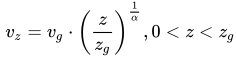
where:
- = speed of the wind at height
- = gradient wind at gradient height
- = exponential coefficient


Typically, buildings are designed to resist a strong wind with a very long return period, such as 50 years or more. The design wind speed is determined from historical records using extreme value theory to predict future extreme wind speeds. Wind speeds are generally calculated based on some regional design standard or standards. The design standards for building wind loads include:
- AS 1170.2 for Australia
- EN 1991-1-4 for Europe
- NBC for Canada
Wind comfort
[edit].jpg)

The advent of high-rise tower blocks led to concerns regarding the wind nuisance caused by these buildings to pedestrians in their vicinity.
A number of wind comfort and wind danger criteria were developed from 1971, based on different pedestrian activities, such as:[7]
- Sitting for a long period of time
- Sitting for a short period of time
- Strolling
- Walking fast
Other criteria classified a wind environment as completely unacceptable or dangerous.
Building geometries consisting of one and two rectangular buildings have a number of well-known effects:[8][9]
- Corner streams, also known as corner jets, around the corners of buildings
- Through-flow, also known as a passage jet, in any passage through a building or small gap between two buildings due to pressure short-circuiting
- Vortex shedding in the wake of buildings
For more complex geometries, pedestrian wind comfort studies are required. These can use an appropriately scaled model in a boundary-layer wind tunnel, or more recently, use of computational fluid dynamics techniques has increased.[10] The pedestrian level wind speeds for a given exceedance probability are calculated to allow for regional wind speeds statistics.[11]
The vertical wind profile used in these studies varies according to the terrain in the vicinity of the buildings (which may differ by wind direction), and is often grouped in categories, such as:[12]
- Exposed open terrain with few or no obstructions and water surfaces at serviceability wind speeds
- Water surfaces, open terrain, grassland with few, well-scattered obstructions having heights generally from 1.5 to 10 m
- Terrain with numerous closely spaced obstructions 3 to 5 m high, such as areas of suburban housing
- Terrain with numerous large, high (10 to 30 m high) and closely spaced obstructions, such as large city centres and well-developed industrial complexes
Wind turbines
[edit]Wind turbines are affected by wind shear. Vertical wind-speed profiles result in different wind speeds at the blades nearest to the ground level compared to those at the top of blade travel, and this, in turn, affects the turbine operation.[13] The wind gradient can create a large bending moment in the shaft of a two bladed turbine when the blades are vertical.[14] The reduced wind gradient over water means shorter and less expensive wind turbine towers can be used in shallow seas.[15]
For wind turbine engineering, wind speed variation with height is often approximated using a power law:[13]

where:
- = velocity of the wind at height [m/s]
- = velocity of the wind at some reference height [m/s]
- = Hellman exponent (aka power law exponent or shear exponent) (~= 1/7 in neutral flow, but can be >1)


Significance
[edit]The knowledge of wind engineering is used to analyze and design all high-rise buildings, cable-suspension bridges and cable-stayed bridges, electricity transmission towers and telecommunication towers and all other types of towers and chimneys. The wind load is the dominant load in the analysis of many tall buildings, so wind engineering is essential for their analysis and design. Again, wind load is a dominant load in the analysis and design of all long-span cable bridges.
See also
[edit]References
[edit]- ^ Hewitt, Sam; Margetts, Lee; Revell, Alistair (2017-04-18). "Building a Digital Wind Farm". Archives of Computational Methods in Engineering. 25 (4): 879–899. doi:10.1007/s11831-017-9222-7. ISSN 1134-3060. PMC 6209038. PMID 30443152.
- ^ Cochran, Leighton; Derickson, Russ (April 2011). "A physical modeler's view of Computational Wind Engineering". Journal of Wind Engineering and Industrial Aerodynamics. 99 (4): 139–153. Bibcode:2011JWEIA..99..139C. doi:10.1016/j.jweia.2011.01.015.
- ^ Solari, Giovanni (2019). Wind Science and Engineering: Origins, Developments, Fundamentals and Advancements. Springer Tracts in Civil Engineering. Cham: Springer International Publishing. doi:10.1007/978-3-030-18815-3. ISBN 978-3-030-18814-6.
- ^ Isyumov, Nicholas (May 2012). "Alan G. Davenport's mark on wind engineering". Journal of Wind Engineering and Industrial Aerodynamics. 104–106: 12–24. Bibcode:2012JWEIA.104...12I. doi:10.1016/j.jweia.2012.02.007.
- ^ Crawley, Stanley (1993). Steel Buildings. New York: Wiley. p. 272. ISBN 978-0-471-84298-9.
- ^ Gupta, Ajaya Kumar and Peter James Moss (1993). Guidelines for Design of Low-Rise Buildings Subjected to Lateral Forces. Boca Raton: CRC Press. p. 49. ISBN 978-0-8493-8969-6.
- ^ Pedestrian wind comfort around buildings: comparison of wind comfort criteria. Table 3
- ^ Pedestrian wind comfort around buildings: comparison of wind comfort criteria. Figure 6
- ^ Wind Effects On Pedestrians. Figure 3
- ^ AIJ guidelines for practical applications of CFD to pedestrian wind environment around buildings
- ^ Pedestrian Wind Environment Around Buildings. p112
- ^ AS/NZS 1170.2:2011 Structural Design Actions Part 2 – Wind actions. Section 4.2
- ^ a b Heier, Siegfried (2005). Grid Integration of Wind Energy Conversion Systems. Chichester: John Wiley & Sons. p. 45. ISBN 978-0-470-86899-7.
- ^ Harrison, Robert (2001). Large Wind Turbines. Chichester: John Wiley & Sons. p. 30. ISBN 978-0-471-49456-0.
- ^ Lubosny, Zbigniew (2003). Wind Turbine Operation in Electric Power Systems: Advanced Modeling. Berlin: Springer. p. 17. ISBN 978-3-540-40340-1.
Further reading
[edit]- Blocken, Bert (2014). "50 years of Computational Wind Engineering: Past, present and future". Journal of Wind Engineering and Industrial Aerodynamics. 129: 69–102. Bibcode:2014JWEIA.129...69B. doi:10.1016/j.jweia.2014.03.008.
- Baker, C.J. (2007). "Wind engineering—Past, present and future". Journal of Wind Engineering and Industrial Aerodynamics. 95 (9–11): 843–870. Bibcode:2007JWEIA..95..843B. doi:10.1016/j.jweia.2007.01.011.
External links
[edit]- "How Tall Buildings Tame the Wind". The B1M. September 12, 2018. Archived from the original on 2021-12-15 – via YouTube.
Wind engineering
View on GrokipediaFundamentals
Definition and Scope
Wind engineering is defined as the rational treatment of the interactions between wind in the atmospheric boundary layer and human activities and structures on the Earth's surface.[4] This multidisciplinary field integrates principles from aerodynamics, meteorology, and structural dynamics to analyze wind effects on built environments, such as buildings and bridges, and natural settings, including terrain influences on airflow.[5] The term "wind engineering" emerged in the early 1970s, formalizing the study of these interactions as a distinct engineering discipline.[6] The scope of wind engineering encompasses both extreme wind events, such as hurricanes and tornadoes, which demand designs for structural safety and disaster mitigation, and moderate winds that affect applications like energy harvesting from wind turbines, atmospheric pollution dispersion, and pedestrian comfort in urban areas.[1] It employs fluid mechanics to model airflow around structures, probabilistic methods for risk assessment of rare high-wind events, and environmental science to evaluate broader impacts like ventilation and contaminant spread.[5] Unlike pure meteorology, which focuses on atmospheric phenomena without engineering applications, or general fluid dynamics unrelated to wind-structure interactions, wind engineering prioritizes practical mitigation strategies for human-built systems.[1] Key applications include assessing wind loads on buildings to ensure stability and optimizing wind turbine placements for efficient energy production, highlighting the field's balance between hazard reduction and resource utilization.[1]Basic Principles of Wind-Structure Interaction
Wind-structure interaction involves the aerodynamic forces exerted by wind on structures, which can lead to static and dynamic responses depending on the structure's geometry, stiffness, and the wind's characteristics. The primary forces include drag, which acts in the direction of the wind flow, lift, which acts perpendicular to it, and moments that induce torsion or bending. These forces are quantified using fundamental aerodynamic equations derived from fluid dynamics principles. The drag force is given by , where is air density, is wind speed, is the drag coefficient, and is the projected area perpendicular to the wind.[7] Similarly, the lift force , with as the lift coefficient, arises from pressure differences across the structure. Moment components, such as pitching or yawing, follow analogous forms involving torque coefficients and lever arms.[8] Coefficients and depend on the structure's shape, Reynolds number, and surface roughness, typically ranging from 0.5 to 2.0 for bluff bodies like buildings or towers.[8] Structures respond to these forces both statically and dynamically, with dynamic effects becoming prominent when wind-induced frequencies match the structure's natural frequencies, leading to amplification. A key mechanism is vortex shedding, where alternating vortices form in the wake of a bluff body, generating periodic pressure fluctuations and oscillatory forces. The shedding frequency is characterized by the Strouhal number , where is the characteristic dimension (e.g., diameter for cylinders); for circular cylinders, across a wide Reynolds number range.[9] This periodicity can cause across-wind vibrations, with amplitude amplification if resonance occurs, potentially increasing displacements by factors of 5–10 compared to static loads. These vibrations can cause perceptible shaking or swaying in buildings, potentially mimicking the sensation of minor tremors or earthquakes, particularly in exposed locations such as ridge tops.[10][11] Resonance risks escalate through aeroelastic effects, where structural motion interacts with the airflow to modify forces. Flutter involves coupled bending-torsion oscillations, often self-excited and leading to rapid amplitude growth, as seen in long-span bridges where low torsional stiffness allows mode coupling at critical wind speeds around 10–20 m/s.[12] Galloping, a low-frequency, large-amplitude transverse oscillation, affects ice-covered or non-streamlined towers and cables, driven by negative aerodynamic damping when the structure's motion enhances lift in a destabilizing manner.[13] These phenomena pose catastrophic risks to flexible structures like suspension bridges or guyed towers, necessitating aeroelastic stability analysis.[13] Mitigating dynamic responses relies on damping mechanisms that dissipate energy from wind-induced vibrations. Structural damping arises from material hysteresis and joint friction, typically 1–2% of critical damping for steel structures.[14] Aerodynamic damping results from the phase lag between motion and opposing forces, providing stabilization for small amplitudes but potentially negative in galloping regimes. Soil damping, relevant for foundation-supported structures, stems from hysteretic energy loss in soil-structure interaction, contributing approximately 0.2–3% of critical damping in monopile wind turbines or towers on soft soils.[15] Turbulence in atmospheric wind profiles introduces variability in these forces and velocity , modulating shedding patterns and overall response.[8]Historical Development
Early Concepts and Milestones
The utilization of wind as a force in engineering dates back to antiquity, where empirical observations informed the design of sailboat aerodynamics. Ancient Egyptians employed square sails on vessels around 4000 BC to harness prevailing northerly winds for navigation along the Nile River, relying on intuitive adjustments to sail orientation for propulsion efficiency. These early practices represented foundational interactions between wind and structures, though without formal aerodynamic theory, designs evolved through trial and error to optimize lift and drag on sails. In the medieval period, wind power was systematically applied to mechanical devices, marking early milestones in wind engineering. Vertical-axis windmills, known as asbads, emerged in Persia during the 7th century CE, featuring vertical sails attached to a central shaft to grind grain and pump water in arid regions like Sistan. These structures demonstrated an understanding of wind capture through multi-bladed rotors, with designs optimized for consistent low-speed winds. By the 12th century, horizontal-axis post mills appeared in Europe, particularly in England and France, adapting Persian concepts to local needs for milling and drainage, with pivoting towers allowing orientation into the wind. The 19th century saw advancements in wind measurement and recognition of its structural impacts, laying groundwork for modern wind engineering. Irish astronomer Thomas Romney Robinson invented the cup anemometer in 1846, a device with hemispherical cups on arms that rotated proportionally to wind speed, enabling precise quantification of wind velocities for the first time. This tool facilitated empirical studies of wind forces on structures. Concurrently, bridge failures highlighted wind's destructive potential; the 1879 Tay Bridge disaster in Scotland, where gale-force winds contributed to the collapse of the iron girder structure during a storm, killing 75 people, underscored vulnerabilities in long-span designs and prompted initial considerations of aerodynamic stability. Similarly, the 1896 destruction of the Brighton Chain Pier by a violent storm revealed oscillatory responses in suspension systems, influencing cautious empirical approaches to wind-resistant framing.[16] Empirical estimation of wind loads on buildings emerged in late 19th-century European codes, driven by observed structural failures. In the UK, the London Building Act of 1894 incorporated provisions for wall thicknesses and foundation depths scaled to building height and exposure, indirectly accounting for wind pressures based on collapses like the 1878 Haymarket building failure due to inadequate iron supports under load. These regulations prescribed conservative material strengths—such as 9-inch brick walls for structures up to 30 feet high—derived from post-failure analyses rather than theoretical models, establishing a precedent for wind-inclusive design without explicit velocity-based formulas.[17] A pivotal pre-1960s event was the 1938 New England Hurricane, which devastated coastal structures and catalyzed wind-resistant code reforms in the US. The Category 3 storm generated winds up to 120 mph, damaging or destroying approximately 57,000 homes and exposing deficiencies in framing and anchoring, leading to enhanced Northeast building codes that mandated stronger connections and elevated foundations to mitigate uplift and lateral forces.[18] Another landmark failure was the 1940 Tacoma Narrows Bridge collapse, where moderate winds of 40-45 mph induced aeroelastic flutter, causing torsional oscillations that destroyed the structure. This event emphasized the need for aerodynamic analysis and wind tunnel testing in bridge design, shifting practices toward considering dynamic wind effects beyond static loads.[1] These disasters shifted empirical practices toward region-specific wind zoning, influencing subsequent standards like those in the Uniform Building Code. These early developments paved the way for later tools, such as wind tunnels in the mid-20th century, to validate empirical observations.Modern Evolution and Key Figures
The discipline of wind engineering emerged as a distinct field in the United Kingdom during the 1960s, marked by the organization of informal meetings and the first international symposium on wind effects on buildings and structures held in Teddington in 1963. This event, led by Kit Scruton, gathered researchers to address the growing need for systematic study of wind-structure interactions amid postwar construction booms and increasing skyscraper designs. The term "wind engineering" itself was coined in the early 1970s by Jack E. Cermak of Colorado State University, formalizing the interdisciplinary approach to wind effects. Pioneering contributions came from Alan G. Davenport, whose 1961 doctoral research introduced the "wind-loading chain" concept, a probabilistic framework linking meteorological wind climate, topographic influences, aerodynamic shapes, dynamic responses, and occupancy factors to predict structural loads accurately. This model revolutionized design by emphasizing statistical variability in winds, influencing global practices for tall buildings like the World Trade Center. Complementing this, Jack E. Cermak advanced experimental methods through his establishment of the Fluid Dynamics and Diffusion Laboratory at Colorado State University in 1959, developing boundary-layer wind tunnels that simulated atmospheric conditions for structural testing on over 500 projects. Institutionally, the field solidified with the formation of the International Association for Wind Engineering (IAWE) in 1975 during the fourth international conference, which standardized terminology and promoted global collaboration. Post-1970s, probabilistic design evolved from Davenport's foundations into load and resistance factor methods adopted in standards like ASCE 7, accounting for wind speed uncertainties and return periods to enhance structural reliability. In the post-2000 era, wind engineering integrated climate change impacts into load predictions, influenced by IPCC assessments of intensifying extreme winds and storms, prompting updates to design codes for non-stationary climates and higher gust probabilities. Studies from the 2010s onward quantified potential increases in design wind speeds by 5-15% in vulnerable regions, urging adaptive strategies in structural resilience planning.Atmospheric Wind Characteristics
Wind Profiles and Boundary Layer
The atmospheric boundary layer (ABL), also known as the planetary boundary layer (PBL), constitutes the lowest portion of the troposphere, typically extending from the Earth's surface to a height of approximately 1-2 km, where frictional interactions with the underlying surface significantly influence wind flow and turbulence.[19][20] This layer is distinguished from the overlying free atmosphere by its responsiveness to surface forcings, such as heat transfer and mechanical drag, leading to a marked vertical gradient in wind speed near the ground.[21] In wind engineering, understanding the ABL is essential for modeling how surface-induced effects propagate upward, affecting structure loading and environmental flows.[22] Wind profiles within the ABL describe the variation of mean horizontal wind speed with height above the surface, providing critical input for engineering analyses. For neutral atmospheric stability, an empirical power law approximation is commonly used: where is the reference wind speed at height , and (or 0.143) serves as a rule-of-thumb exponent for open terrain under equilibrium conditions.[23][24] This form simplifies extrapolation of wind speeds from measurement heights but assumes a constant shear exponent, which varies with site-specific factors. A more theoretically grounded description derives from Monin-Obukhov similarity theory in the surface layer (the lowest 10% of the ABL), yielding the logarithmic law: where is the friction velocity, is the von Kármán constant (originating from Prandtl's mixing-length hypothesis), and is the aerodynamic roughness length representing surface drag.[25][26] The logarithmic profile captures the near-surface shear driven by turbulence production, with validity limited to roughly the lowest 100 m.[27] Several factors modulate these profiles, primarily terrain roughness, which determines —typically 0.01-0.03 m for rural grass-covered areas but escalating to 1-5 m in urban environments due to buildings and trees that enhance drag and alter flow separation.[28][29] Atmospheric stability, influenced by thermal effects such as daytime solar heating (unstable conditions promoting vertical mixing) or nocturnal cooling (stable conditions suppressing it), further distorts profiles; for instance, stability increases the wind shear exponent from about 0.11 in unstable regimes to 0.25 or higher in stable ones over open terrain.[30] Urban-rural contrasts amplify these variations, with denser urban roughness leading to steeper near-surface gradients and reduced wind speeds aloft compared to smoother rural landscapes.[29] Measurement of wind profiles relies on established techniques to validate models and gather site-specific data. Traditional anemometers, including cup and sonic types mounted on meteorological towers, provide point measurements of wind speed and direction at discrete heights, offering high temporal resolution but limited vertical coverage due to tower height constraints.[31] In contrast, Doppler light detection and ranging (LIDAR) systems enable remote sensing of profiles up to several kilometers by emitting laser pulses and analyzing backscattered light from atmospheric aerosols, yielding volume-averaged data with good agreement to anemometer results when calibrated for spatial averaging effects.[32][33] These methods complement each other, with LIDAR particularly valuable for profiling in complex terrain where tower installation is impractical.[34]Turbulence and Gusts
In wind engineering, turbulence refers to the random, irregular fluctuations in wind velocity superimposed on the mean flow within the atmospheric boundary layer (ABL), arising primarily from shear and buoyancy effects that generate eddies across a range of scales.[35] These fluctuations are stochastic in nature and essential for understanding dynamic wind loads on structures, as they contribute to unsteady aerodynamic forces.[36] A key characteristic of atmospheric turbulence is the integral length scale, which represents the average size of the largest energy-containing eddies; horizontally, this scale typically ranges from approximately 100 to 1000 meters in the ABL, influencing the spatial correlation of velocity perturbations and the overall coherence of wind fields over structures.[37] Turbulence intensity, defined as the ratio of the standard deviation of longitudinal velocity fluctuations to the mean wind speed, , commonly falls between 0.1 and 0.2 in the lower ABL, with higher values near the surface due to increased surface roughness and shear.[38] This measure quantifies the relative magnitude of turbulent fluctuations and is critical for assessing fatigue loads in wind-sensitive designs. Turbulence spectra describe the distribution of kinetic energy across frequencies or wavenumbers, with the von Kármán spectrum serving as a foundational model for velocity fluctuations in isotropic turbulence, adapted for anisotropic ABL conditions to capture the energy cascade from large-scale eddies to dissipation.[39] The model assumes a form that peaks at low frequencies corresponding to integral scales and decays in the inertial subrange, providing a basis for simulating turbulent wind fields in structural analysis.[40] Gusts represent short-duration peaks in wind speed exceeding the mean, often 3 to 10 seconds long, and are integral to dynamic response predictions; the gust factor, defined as the ratio of maximum gust speed to mean speed, , typically ranges from 1.5 to 2.0 in design contexts for non-thunderstorm winds, accounting for amplification due to turbulence.[41] Gusts are classified into translational types, such as moving frontal systems that propagate across terrain, and standing types driven by vortex shedding from obstacles, each affecting structures differently based on exposure and geometry.[42] Extreme gust peaks are analyzed using extreme value statistics, with the Gumbel distribution commonly fitted to annual maxima to estimate return periods, enabling probabilistic assessments of rare events in load calculations.[43]Wind Loads and Structural Design
Calculation of Wind Loads on Buildings
Wind loads on buildings are typically resolved into three primary components: along-wind, across-wind, and torsional loads. The along-wind load, which is drag-dominated, induces forces parallel to the prevailing wind direction and arises from the mean and fluctuating components of wind buffeting on the structure's windward face. This component is the most straightforward to predict and is often the dominant force for low- to mid-rise buildings. In contrast, the across-wind load generates oscillations perpendicular to the wind direction, primarily due to lift forces and periodic vortex shedding from the building's edges, which can become significant for tall structures where dynamic excitation aligns with natural frequencies. Torsional moments, meanwhile, result from non-uniform pressure distributions across the building's facade, often exacerbated by geometric asymmetries or incident wind angles, leading to twisting about the vertical axis.[44] The quasi-static method provides a foundational approach for calculating these loads, particularly suitable for rigid or low-rise buildings where dynamic amplification is negligible. Wind pressures are determined using pressure coefficients , obtained from empirical data or wind tunnel experiments and specified in design guidelines, multiplied by the dynamic pressure , where is air density and is the reference wind speed at building height. To account for gust effects, standards apply a gust effect factor that adjusts for turbulence; a common approximation for the peak velocity pressure multiplier is , where is the turbulence intensity and is the peak factor (typically around 3.5 for a 10-minute averaging period based on Gaussian assumptions for wind fluctuations), though exact formulations vary by code.[45] This formulation, rooted in statistical models of atmospheric turbulence, translates time-varying wind into equivalent static loads for structural analysis.[46] Building geometry significantly influences load magnitudes through shape factors, such as the drag coefficient , which quantifies aerodynamic resistance. For rectangular prismatic buildings, values typically range from 1.3 to 2.2 depending on aspect ratios, corner conditions, and flow environment, with values derived from wind tunnel measurements simulating urban boundary layers; in standards like ASCE 7, force coefficients for building components are around 1.3-1.6.[47] [48] Variations in plan shape, height-to-width ratios, or edge tapering can reduce by up to 30% through flow reattachment, thereby lowering overall along-wind loads.[48] For tall or slender buildings, where natural frequencies fall within the wind spectrum, dynamic effects must be incorporated to avoid underestimation of responses. Aeroelastic models, scaled to replicate the structure's mass, stiffness, and damping, are employed in wind tunnel tests to measure full dynamic interactions, including motion-induced aerodynamics like vortex lock-in.[49] Root-mean-square (RMS) response calculations, drawn from random vibration theory, separate the response into background (quasi-static gusts) and resonant components, with the total peak response approximated as , where is the mean, and are RMS background and resonant responses, and are peak factors.[46] This approach, pioneered in early statistical frameworks for wind loading, ensures accurate prediction of across-wind and torsional excitations that can amplify displacements by factors exceeding those from along-wind alone.[46]Design Standards and Codes
Wind engineering design standards and codes provide the regulatory framework for determining wind loads to ensure structural safety and reliability across different regions. In the United States, the American Society of Civil Engineers (ASCE) Standard ASCE/SEI 7-22 specifies wind provisions using a risk-targeted approach, where basic wind speeds are mapped based on mean recurrence intervals (MRIs) tailored to building risk categories; for Risk Category II structures (typical buildings and facilities), the MRI is 700 years, reflecting a low annual probability of exceedance of approximately 0.0014.[50] In Europe, Eurocode 1 Part 1-4 (EN 1991-1-4) defines wind actions with a fundamental basic wind velocity corresponding to a 50-year return period, incorporating a directional factor that accounts for variations in wind severity by direction, with a recommended value of 1.0 unless specified otherwise in national annexes.[51] Similarly, in Australia and New Zealand, AS/NZS 1170.2:2021 outlines wind actions using regional basic wind speeds derived from a 500-year return period (annual probability of exceedance 1/500) for importance level 2 structures (standard buildings), adjusted by multipliers for site-specific conditions and importance.[52] These standards employ a probabilistic approach to characterize wind hazards, where return periods—defined as the mean recurrence interval (MRI) between events exceeding a specified intensity—guide the selection of design wind speeds. Wind speed maps are developed using statistical models of historical meteorological data, estimating exceedance probabilities (e.g., 2% annual probability for a 50-year MRI) to represent rare but severe events, ensuring a consistent reliability level across structures.[53] For instance, in ASCE 7-22, the maps integrate Gumbel or lognormal distributions fitted to extreme wind records, providing contour lines of ultimate-level wind speeds that vary by risk category to target a uniform collapse probability of about 1 in 500-3000 years depending on importance.[50] Code evolution has incorporated refinements from advanced wind climate modeling, with ASCE 7-22 featuring updated wind speed maps that show modest increases, such as up to 7-10% in some hurricane-prone coastal areas, due to improved data assimilation and non-stationary trend analysis, though these do not yet project future climate change scenarios.[54] As of November 2025, future iterations, such as ASCE 7-28 under development, are expected to introduce provisions for non-stationary wind risks influenced by climate variability, including potential adjustments for rising sea levels and intensified tropical cyclones.[55] In parallel, EN 1991-1-4 and AS/NZS 1170.2 have seen amendments for better alignment with observed wind patterns, such as refined shielding effects in urban terrains.[51] To account for site-specific influences, standards include adjustment factors for terrain and height; in ASCE 7-22, the velocity pressure exposure coefficient varies with height above ground and exposure category (e.g., 0.85-1.7 for Exposure C (open terrain with scattered obstructions) at heights from 15 ft to 700 ft). Exposure D typically results in 15–25% higher wind pressures than Exposure C, depending on building height; at low heights (e.g., 15–30 ft), for D is approximately 21% higher (C ≈ 0.85–0.90, D ≈ 1.03), with the percentage difference decreasing for taller buildings as values converge.[56] Wind pressure is directly proportional to (velocity pressure exposure coefficient), the primary factor differing between categories. Higher in more open exposures (e.g., D compared to C) results in higher pressures due to reduced ground friction and elevated near-ground wind speeds. Other factors such as (topographic), (directionality), and (elevation) are generally similar across categories.[56] The topographic factor amplifies speeds over hills or escarpments (up to 2.0 in extreme cases). These factors ensure velocity pressure exposure reflects boundary layer effects, with similar provisions in EN 1991-1-4 using terrain categories I-V and height-dependent roughness lengths.[51] Compliance involves applying these provisions within ultimate limit state (ULS) load combinations, where wind is treated as a variable action with partial safety factors to achieve target reliability; for example, in Eurocode systems, the design load effect uses a factor of 1.5 on characteristic wind actions in fundamental ULS combinations like 1.35G + 1.5Q (where Q includes wind).[57] In ASCE 7-22, strength design combinations such as 1.2D + 1.0W + 0.5L apply a 1.0 factor to wind when it governs, calibrated to match the probabilistic MRI targets.[58] These ensure structures resist collapse under extreme winds, with engineers verifying via site-specific maps and factors before computing loads for elements like walls or roofs.Pedestrian and Environmental Wind Effects
Wind Comfort Criteria
Wind comfort criteria evaluate the suitability of wind conditions at pedestrian level—typically 1.5 to 2 meters above ground—for human activities in urban environments, focusing on speeds that avoid discomfort or safety risks around buildings. These criteria emerged from wind engineering research to guide urban design, ensuring outdoor spaces support activities like walking, standing, or sitting without excessive wind-induced disturbances. Seminal frameworks, such as those by Lawson and Davenport, relate local wind speeds to meteorological data, often using exceedance probabilities to quantify acceptability.[59] The Lawson criteria, introduced by T.V. Lawson in 1978, categorize comfort based on activity-specific wind speed thresholds and their frequency of exceedance, drawing from field observations and human response studies. For sedentary activities like sitting at cafes or benches, wind speeds should remain below 4 m/s for at least 95% of the time to prevent discomfort from debris or chill. Standing areas, such as building entrances or bus stops, tolerate up to 6 m/s for 95% of the time, while leisurely walking paths allow up to 8 m/s, with faster walking permitting 10 m/s or more under similar exceedance limits. These thresholds use the gust equivalent mean (GEM) wind speed, defined as the mean wind plus 40% of the standard deviation, to account for gustiness, and are assessed using meteorological wind data, such as directional hourly means from nearby weather stations at 10 m height, scaled to site conditions via amplification factors. The criteria classify areas into levels like "calm" (low exceedance of low thresholds) to "unacceptable" (frequent high winds), influencing urban planning for habitable spaces.[60] Adaptations of the Beaufort scale provide qualitative benchmarks for pedestrian effects, correlating wind speeds to observable impacts like difficulty walking or umbrella inversion. For instance, Beaufort force 4 (5.5-7.9 m/s) marks the onset of discomfort for standing or light activities, with dust and loose objects becoming problematic, while force 6 (10.8-13.8 m/s) hinders normal walking. These are integrated into comfort assessments to differentiate discomfort—such as nausea or imbalance from sustained 8-10 m/s gusts—from safety hazards like falls, which occur above 15 m/s with exceedance probabilities below 0.02% annually.[61][62] Complementary criteria, like those by Isyumov and Davenport (1975), emphasize safety by limiting exceedances of 9.8 m/s (uncomfortable for fast walking) to no more than 1.5% of the time (approximately once per week), and 15 m/s (safety) to 0.01%, based on early urban wind tunnel data. The Dutch NEN 8100 standard (2006) simplifies this with a uniform 5 m/s hourly mean threshold for all activities, classifying environments by exceedance classes (A-E) from 0.1% to 10%, prioritizing low-wind zones for residential or recreational use. Assessments typically involve simulations at pedestrian height, reporting exceedance frequencies (e.g., ≤5% for comfort thresholds) to ensure less than 5% of annual hours feature winds above activity limits.| Activity | Threshold Wind Speed (m/s) | Max Exceedance (%) | Source |
|---|---|---|---|
| Sitting | <4 | ≤5 | Lawson (1978) |
| Standing | <6 | ≤5 | Lawson (1978) |
| Leisurely Walking | <8 | ≤5 | Lawson (1978) |
| Safety (General) | <15 | ≤0.02 | Isyumov & Davenport (1975) |
| All Activities | <5 (hourly mean) | Varies by class (0.1-10%) | NEN 8100 (2006) |