


Community hub
Recent from talks
Contribute something
Nothing was collected or created yet.
Chernobyl exclusion zone
View on Wikipedia

Key Information


The Chernobyl Nuclear Power Plant Zone of Alienation,[a] also called the 30-Kilometre Zone or simply The Zone,[5]: p.2–5 [b] was established shortly after the 1986 Chernobyl disaster in the Ukrainian SSR of the Soviet Union.[5]: p.4–5 : p.49f.3
Initially, Soviet authorities declared an exclusion zone spanning a 30-kilometre (19 mi) radius around the Chernobyl Nuclear Power Plant, designating the area for evacuations and placing it under military control.[6][7] Its borders have since been altered to cover a larger area of Ukraine: it includes the northernmost part of Vyshhorod Raion in Kyiv Oblast, and also adjoins the Polesie State Radioecological Reserve in neighbouring Belarus. The Chernobyl exclusion zone is managed by an agency of the State Emergency Service of Ukraine, while the power plant and its sarcophagus and the New Safe Confinement are administered separately.
The current area of approximately 2,600 km2 (1,000 sq mi)[8] in Ukraine is where radioactive contamination is the highest, and public access and habitation are accordingly restricted. Other areas of compulsory resettlement and voluntary relocation not part of the restricted exclusion zone exist in the surrounding areas and throughout Ukraine.[9] In February 2019, it was revealed that talks were underway to re-adjust the exclusion zone's boundaries to reflect the declining radioactivity of its outer areas.[10]
Public access to the exclusion zone is restricted in order to prevent access to hazardous areas, reduce the spread of radiological contamination, and conduct radiological and ecological monitoring activities.[11] Today, the Chernobyl exclusion zone is one of the most radioactively contaminated areas on Earth and draws significant scientific interest for the high levels of radiation exposure in the environment, as well as increasing interest from disaster tourists.[12][13] It has become a thriving sanctuary, with natural flora and fauna and some of the highest biodiversity and thickest forests in all of Ukraine, due primarily to the lack of human activity in the exclusion zone since 1986.[14]
Since the beginning of the Russian invasion of Ukraine in February 2022, the Chernobyl exclusion zone has been the site of fighting with neighbouring Russia, which captured Chernobyl on 24 February 2022. By April 2022, however, as the Kyiv offensive failed, the Russian military withdrew from the region.[15] Ukrainian authorities have continued to keep the exclusion zone closed to tourists, pending the eventual cessation of hostilities in the Russo-Ukrainian War.
History
[edit]Pre-1986: Before the Chernobyl nuclear disaster
[edit]Historically and geographically, the zone is the heartland of the Polesia region. This predominantly rural woodland and marshland area was once home to 120,000 people living in the cities of Chernobyl and Pripyat as well as 187 smaller communities,[16] but is now mostly uninhabited. All settlements remain designated on geographic maps but marked as нежил. (nezhyl.) – "uninhabited". The woodland in the area around Pripyat was a focal point of partisan resistance during the Second World War, which allowed evacuated residents to evade guards and return into the woods.[7] In the woodland near the Chernobyl Nuclear Power Plant stood the "Partisan's Tree" or "Cross Tree", which was used to hang captured partisans. The tree fell down due to age in 1996 and a memorial now stands at its location.
1986: Soviet exclusion zones
[edit]
10-kilometre and 30-kilometre radius
[edit]The Exclusion Zone was established on 2 May 1986 soon after the Chernobyl disaster, when a Soviet government commission headed by Nikolai Ryzhkov[8]: 4 decided on a "rather arbitrary"[6]: 161 area of a 30-kilometre (19 mi) radius from Reactor 4 as the designated evacuation area. The 30 km Zone was initially divided into three subzones: the area immediately adjacent to Reactor 4, an area of approximately 10 km (6 mi) radius from the reactor, and the remaining 30 km zone. Protective clothing and available facilities varied between these subzones.[6]
Later in 1986, after updated maps of the contaminated areas were produced, the zone was split into three areas to designate further evacuation areas based on the revised dose limit of 100 mSv.[8]: 4
- the "Black Zone" (over 200 μSv·h−1), to which evacuees were never to return
- the "Red Zone" (50–200 μSv·h−1), where evacuees might return once radiation levels normalized
- the "Blue Zone" (30–50 μSv·h−1), where children and pregnant women were evacuated starting in the summer of 1986
Special permission for access and full military control was put in place in late 1986.[6] Although evacuations were not immediate, 91,200 people were eventually evacuated from these zones.[7]: 104
In November 1986, control over activities in the zone was given to the new production association Kombinat. Based in the evacuated city of Chernobyl, the association's responsibility was to operate the power plant, decontaminate the 30 km zone, supply materials and goods to the zone, and construct housing outside the new town of Slavutych for the power plant personnel and their families.[6]: 162
In March 1989, a "Safe Living Concept" was created for people living in contaminated zones beyond the Exclusion Zone in Belarus, Ukraine, and Russia.[5]: p.49 In October 1989, the Soviet government requested assistance from the International Atomic Energy Agency (IAEA) to assess the "Soviet Safe Living Concept" for inhabitants of contaminated areas.[5]: p.52 "Throughout the Soviet period, an image of containment was partially achieved through selective resettlements and territorial delineations of contaminated zones."[5]: p.49
Post-1991: Independent Ukraine
[edit]
In February 1991, the law On The Legal Status of the Territory Exposed to the Radioactive Contamination resulting from the ChNPP Accident was passed, updating the borders of the Exclusion Zone and defining obligatory and voluntary resettlement areas, and areas for enhanced monitoring. The borders were based on soil deposits of strontium-90, caesium-137, and plutonium as well as the calculated dose rate (sieverts/h) as identified by the National Commission for Radiation Protection of Ukraine.[17] Responsibility for monitoring and coordination of activities in the Exclusion Zone was given to the Ministry of Chernobyl Affairs.
In-depth studies were conducted from 1992 to 1993, completing an update of the 1991 law followed by further evacuations from the Polesia area.[8] A number of evacuation zones were determined: the "Exclusion Zone", the "Zone of Absolute (Mandatory) Resettlement", and the "Zone of Guaranteed Voluntary Resettlement", as well as many areas throughout Ukraine designated as areas for radiation monitoring.[9] The evacuation of contaminated areas outside of the Exclusion Zone continued in both the compulsory and voluntary resettlement areas, with 53,000 people evacuated from areas in Ukraine from 1990 to 1995.[7]
After Ukrainian Independence, funding for the policing and protection of the zone was initially limited, resulting in even further settling by samosely (returnees) and other illegal intrusion.[3][4]
In 1997, the areas of Poliske and Narodychi, which had been evacuated, were added to the existing area of the Exclusion Zone, and the zone now encompasses the exclusion zone and parts of the zone of Absolute (Mandatory) Resettlement of an area of approximately 2,600 km2 (1,000 sq mi).[8] This Zone was placed under management of the 'Administration of the exclusion zone and the zone of absolute (mandatory) resettlement' within the Ministry of Emergencies.
On 15 December 2000, all nuclear power production at the power plant ceased after an official ceremony with then-President Leonid Kuchma when the last remaining operational reactor, number 3, was shut down.[18]
In May 2025, it was reported that around 100 hectares of land in the Chernobyl exclusion zone had contamination drop to a level safe enough to allow farming to commence in those areas.[19][20]
Russian invasion of Ukraine (2022–present)
[edit]The Chernobyl Exclusion Zone was the site of fighting between Russian and Ukrainian forces during the Battle of Chernobyl on 24 February 2022, as part of the Russian invasion of Ukraine.[15] Russian forces reportedly captured the plant the same day.[21]
Facilities at Chernobyl still require ongoing management, in part to ensure the continued cooling of spent nuclear fuel. An estimated 100 plant workers and 200 Ukrainian guards who were at the Chernobyl Nuclear Power Plant when the Russians arrived had been unable to leave. Normally they would change shifts daily and would not live at the site. They had limited supplies of medication, food, and electricity.[22]
According to Ukrainian reports, the radiation levels in the exclusion zone increased after the invasion.[23] The higher levels are believed to be a result of disturbance of radioactive dust by the military activity[22] or possibly incorrect readings caused by cyberattacks.[24]
On 10 March 2022, the International Atomic Energy Agency stated that it had lost all contact with Chernobyl.[25]
On 22 March, the Ukrainian state agency responsible for the Chernobyl exclusion zone reported that Russian forces had destroyed a new laboratory at the Chernobyl nuclear power plant. The laboratory, which opened in 2015, worked to improve the management of radioactive waste, among other things. "The laboratory contained highly active samples and samples of radionuclides that are now in the hands of the enemy, which we hope will harm itself and not the civilized world", the agency said in its statement.[26]
On 27 March, Lyudmila Denisova, then–Verkhovna Rada Commissioner for Human Rights, said that 31 known individual fires covering 10,000 hectares were burning in the zone.[27] These fires caused "...an increased level of radioactive air pollution", according to Denisova. Firefighters were unable to reach the fires due to the Russian forces in the area. These wildfires are seasonal; one fire that was 11,500 hectares in size took place in 2020, and a series of several smaller fires occurred throughout the 2010s.
On 31 March, it was reported that most of the Russian troops occupying Chernobyl withdrew. An Exclusion Zone employee made a post on Facebook suggesting that Russian troops were suffering from acute radiation sickness, based on a photo of military buses unloading near a radiation hospital in Belarus.[28][29] Chernobyl operator Energoatom claimed that Russian troops had dug trenches in the most contaminated part of the Chernobyl exclusion zone, receiving "significant doses" of radiation.[30] BBC News reported unconfirmed reports that some were being treated in Belarus.[30]
On 3 April 2022, Ukrainian forces retook the Chernobyl power plant.[31]
Population
[edit]
The 30-kilometre zone is estimated to be home to 197 Samosely[32] living in 11 villages as well as in the town of Chernobyl.[33] This number is in decline, down from previous estimates of 314 in 2007 and 1,200 in 1986.[33] [needs update]These residents are senior citizens, with an average age of 63.[33] After repeated attempts at expulsion, the authorities have accepted their presence and allowed them to stay with limited supporting services. Residence is now informally permitted by the Ukrainian government.
Approximately 3,000 people work in the Zone of Alienation on various tasks, such as the construction of the New Safe Confinement, the ongoing decommissioning of the reactors, and assessment and monitoring of the conditions in the zone. Employees do not live inside the zone, but work shifts there. Some of the workers work "4-3" shifts (four days on, three days off), while others work 15 days on and 15 days off.[34] Other workers commute into the zone daily from Slavutych. The duration of shifts is counted strictly for reasons involving pension and healthcare. Everyone employed in the Zone is monitored for internal bioaccumulation of radioactive elements.
The town of Chernobyl, located outside of the 10-kilometre Exclusion Zone, was evacuated following the accident but now serves as a base to support the workers within the Exclusion Zone. Its amenities include administrative buildings, general stores, a canteen, a hotel, and a bus station. Unlike other areas within the Exclusion Zone, the town is actively maintained by workers, such as lawn areas being mowed and autumn leaves being collected.
Access and tourism
[edit]
Prior to the COVID-19 pandemic and Russian invasion there were many[35] visitors to the Exclusion Zone annually, and daily tours from Kyiv.[citation needed] In addition, multiple-day excursions can be easily arranged with Ukrainian tour operators. Most overnight tourists stay in a hotel within the town of Chernobyl, which is located within the Exclusion Zone. According to an exclusion area tour guide, as of 2017, there are approximately 50 licensed exclusion area tour guides in total, working for approximately nine companies. Visitors must present their passports when entering the Exclusion Zone and are screened for radiation when exiting, both at the 10 km checkpoint and at the 30 km checkpoint.[35]
The Exclusion Zone can also be entered if an application is made directly to the zone administration department.
Some evacuated residents of Pripyat have established a remembrance tradition, which includes annual visits to former homes and schools.[36] In the Chernobyl zone, there is one operating Eastern Orthodox church, St. Elijah Church. According to Chernobyl disaster liquidators, the radiation levels there are "well below the level across the zone", a fact that president of the Ukrainian Chernobyl Union Yury Andreyev considers miraculous.[37]
The Chernobyl Exclusion Zone has been accessible to interested parties such as scientists and journalists since the zone was created. An early example was Elena Filatova's online account of her alleged solo bike ride through the zone. This gained her Internet fame, but was later alleged to be fictional, as a guide claimed Filatova was part of an official tour group. Regardless, her story drew the attention of millions to the nuclear catastrophe.[38] After Filatova's visit in 2004, a number of papers such as The Guardian[39] and The New York Times[40] began to produce reports on tours to the zone.
Tourism to the area became more common after Pripyat was featured in popular video games[41] S.T.A.L.K.E.R.: Shadow of Chernobyl and Call of Duty 4: Modern Warfare. Fans of the S.T.A.L.K.E.R. franchise, who refer to themselves as "stalkers", often gain access to the Zone.[42]
The terms "The Zone" and "stalker" derive from Arkady and Boris Strugatsky's science fiction novel Roadside Picnic, which predates the accident. The narrative revolves around evacuation and subsequent looting of a mysterious zone in Canada in which normal logic does not hold and dangerous artefacts abound. It in turn served as the basis for the classic film Stalker, the screenplay of which the Strugatskys wrote. The movie, set in a similar "Zone" but now in the Soviet Union, has served as a font for the public imagination of Chernobyl, despite also predating the disaster.
Prosecution of trespassers became more severe after a significant increase in trespassing in the Exclusion Zone. An article in the penal code of Ukraine was specially introduced,[43][44] and horse patrols were added to protect the zone's perimeter.
In 2012, journalist Andrew Blackwell published Visit Sunny Chernobyl: And Other Adventures in the World's Most Polluted Places. Blackwell recounts his visit to the Exclusion Zone, when a guide and driver took him through the zone and to the reactor site.[45]
On 14 April 2013, the 32nd episode of the wildlife documentary TV program River Monsters (Atomic Assassin, Season 5, Episode 1) was broadcast, featuring the host Jeremy Wade catching a wels catfish in the cooling pools of the Chernobyl power plant at the heart of the Exclusion Zone.
On 16 February 2014, an episode of the British motoring TV programme Top Gear was broadcast, featuring two of the presenters, Jeremy Clarkson and James May, driving into the Exclusion Zone.
A portion of the finale of the Netflix documentary Our Planet, released in 2019, was filmed in the Exclusion Zone. The area was used as the primary example of how quickly an ecosystem can recover and thrive in the absence of human interference.[46]
In 2019, Chernobyl Spirit Company released Atomik Vodka, the first consumer product made from materials grown and cultivated in the exclusion zone.[47]
On 11 April 2022, the zone administration department suspended the validity of passes that allowed access to the exclusion zone, for the duration of martial law in Ukraine.[48]
Illegal activities
[edit]The poaching of game, illegal logging, and metal salvage have been problems within the zone.[49] Despite police control, intruders started infiltrating the perimeter to remove potentially contaminated materials, from televisions to toilet seats, especially in Pripyat, where the residents of about 30 high-rise apartment buildings had to leave all of their belongings behind. In 2007, the Ukrainian government adopted more severe criminal and administrative penalties for illegal activities in the alienation zone,[50] as well as reinforced units assigned to these tasks. The population of Przewalski's horse, introduced to the Exclusion Zone in 1998,[41] has reportedly fallen since 2005 due to poaching.[51]
Administration
[edit]Government agencies
[edit] | |
 | |
| Agency overview | |
|---|---|
| Formed | 6 April 2011 |
| Type | State agency |
| Jurisdiction | Chernobyl Exclusion Zone |
| Headquarters | Kyiv, Ukraine |
| Agency executive |
|
| Parent agency | State Emergency Service |
| Website | dazv |
In April 2011, the State Agency of Ukraine on the Exclusion Zone Management (SAUEZM) became the successor to the State Department – Administration of the exclusion zone and the zone of absolute (mandatory) resettlement according to presidential decree.[11] The SAUEZM is, as its predecessor, an agency within the State Emergency Service of Ukraine.
Policing of the Zone is conducted by special units of the Ministry of Internal Affairs of Ukraine and, along the border with Belarus, by the State Border Guard Service of Ukraine.
The SAUEZM is tasked with:[11]
- Conducting environmental and radioactivity monitoring in the zone
- Management of long-term storage and disposal of radioactive waste
- Leasing of land in the exclusion zone and the zone of absolute (mandatory) resettlement
- Administering of state funds for radioactive waste management
- Monitoring and preservation of documentation on the subject of radioactivity
- Coordination of the decommissioning of the nuclear power plant
- Maintenance of a register of persons who have suffered as a result of the disaster
The Chernobyl Nuclear Power Plant is located inside the zone but is administered separately. Plant personnel, 3,800 workers as of 2009[update], reside primarily in Slavutych, a specially-built remote city in Kyiv Oblast outside of the Exclusion Zone, 45 kilometres (28 mi) east of the accident site.
Checkpoints
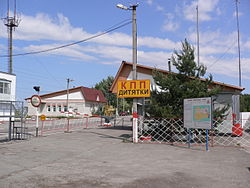
[edit]There are 11 checkpoints.[52]
- Dytiatky, near the village of Dytiatky
- Stari Sokoly, near the village of Stari Sokoly
- Zelenyi Mys, near the village of Strakholissia
- Poliske, near the village of Chervona Zirka
- Ovruch, near the village of Davydky, Narodychi settlement hromada, Korosten Raion
- Vilcha, near the village of Vilkhova
- Dibrova, near the village of Fedorivka
- Benivka, near the city of Pripyat
- The city of Pripyat itself
- Leliv, near the city of Chernobyl
- Paryshiv, between the city of Chernobyl and the border with Belarus (route P56)
Development and recovery projects
[edit]The Chernobyl Exclusion Zone is an environmental recovery area, with efforts devoted to remediation and safeguarding of the reactor site.[53][54] At the same time, projects for wider economic and social revival of the territories around the disaster zone have been envisioned or implemented.[55]
In November 2007, the United Nations General Assembly adopted a resolution calling for "recovery and sustainable development" of the areas affected by the Chernobyl accident. Commenting on the issue, UN Development Programme officials mentioned the plans to achieve "self-reliance" of the local population, "agriculture revival" and development of ecotourism.[56]
However, it is not clear whether such plans, made by the UN and then-President Victor Yushchenko, deal with the zone of alienation proper, or only with the other three zones around the disaster site where contamination is less intense and restrictions on the population are looser (such as the district of Narodychi in Zhytomyr Oblast).
Since 2011, tour operators have been bringing tourists inside the Exclusion Zone[57] (illegal tours may have started even before).[58] Tourists are accompanied by tour guides at all times and are not able to wander too far on their own due to the presence of several radioactive "hot spots". Pripyat was deemed safe for tourists to visit for a short period of time in the late 2010s, although certain precautions must be taken.[59][60]
In 2016, the Ukrainian government declared the part of the exclusion zone on its territory the Chernobyl Radiation and Environmental Biosphere Reserve.[61]
It was reported in 2016 that "A heavily contaminated area within a 10-kilometer radius" of the plant would be used for the storage of nuclear waste.[62] The IAEA carried out a feasibility study in 2018 to assess the prospect of expanding the local waste management infrastructure.[63]
In 2017, three companies were reported developing plans for solar farms within the Chernobyl Exclusion Zone.[64] The high feed-in tariffs offered, the availability of land, and easy access to transmission lines (which formerly ran to the nuclear power station) have all been noted as beneficial to siting a solar farm.[65] The solar plant began operations in October 2018.[66]

In 2019, following a three-year research project into the transfer of radioactivity to crops grown in the exclusion zone conducted by scientists from UK and Ukrainian universities, one bottle of vodka using grain from the zone was produced.[67] The vodka did not contain abnormal levels of radiation because of the distillation process. The researchers consider the production of vodka, and its sales profits, a means to aid economic recovery of the communities most adversely affected by the disaster.[67][68] The project later switched to producing and exporting "Atomik" apple spirit, made from apples grown in the Narodychi District.[69]
Radioactive contamination
[edit]The territory of the zone is polluted unevenly. Spots of hyperintensive pollution were created first by wind and rain spreading radioactive dust at the time of the accident, and subsequently by numerous burial sites for various material and equipment used in decontamination. Zone authorities pay attention to protecting such spots from tourists, scrap hunters, and wildfires, but admit that some dangerous burial sites remain unmapped, and only recorded in the memories of the (aging) Chernobyl liquidators.
Flora and fauna
[edit]
There has been an ongoing scientific debate about the extent to which flora and fauna of the zone were affected by the radioactive contamination that followed the accident.[70][71] As noted by Baker and Wickliffe, one of many issues is differentiating between negative effects of Chernobyl radiation and effects of changes in farming activities resulting from human evacuation.[71]
"Twenty-five years after the Chernobyl meltdown, the scientific community has not yet been able to provide a clear understanding of the spectrum of ecological effects created by that radiological disaster."[71]
Near the facility, a dense cloud of radioactive dust killed off a large area of Scots pine trees; the rusty orange color of the dead trees led to the nickname "The Red Forest" (Рудий ліс).[71] The Red Forest was among the world's most radioactive places; to reduce the hazard, the Red Forest was bulldozed and the highly radioactive wood was buried, though the soil continues to emit significant radiation.[72][73] Other species in the same area, such as birch trees, survived, indicating that plant species may vary considerably in their sensitivity to radiation.[71]

Cases of mutant deformity in animals of the zone include partial albinism and other external malformations in swallows[74][75][76] and insect mutations.[77] A study of several hundred birds belonging to 48 different species also demonstrated that birds inhabiting highly radioactively contaminated areas had smaller brains compared to birds from clean areas.[78]
A reduction in the density and the abundance of animals in highly radioactively contaminated areas has been reported for several taxa, including birds,[79][80] insects, spiders,[81] and mammals.[82] In birds, which are an efficient bioindicator, a negative correlation has been reported between background radiation and bird species richness.[83] Scientists such as Anders Pape Møller (University of Paris-Sud) and Timothy Mousseau (University of South Carolina) report that birds and smaller animals such as voles may be particularly affected by radioactivity.[84]
Møller is the first author on 9 of the 20 most-cited articles relating to the ecology, evolution and non-human biology in the Chernobyl area.[85] However, some of Møller's research has been criticized as flawed.[86] Prior to his work at Chernobyl, Møller was accused of falsifying data in a 1998 paper about asymmetry in oak leaves, which he retracted in 2001.[87][88][89] In 2004, the Danish Committees on Scientific Dishonesty (DCSD) reported that Møller was guilty of "scientific dishonesty". The French National Centre for Scientific Research (CNRS) subsequently concluded that there was insufficient evidence to establish either guilt or innocence.[87][90][91] Strongly held opinions about Møller and his work have contributed to the difficulty of reaching a scientific consensus on the effects of radiation on wildlife in the Exclusion Zone.[70]
More recently, the populations of large mammals have increased due to a significant reduction of human interference.[92][84] The populations of traditional Polesian animals (such as the gray wolf, badger, wild boar, roe deer, white-tailed eagle, black stork, western marsh harrier, short-eared owl, red deer, moose, great egret, whooper swan, least weasel, common kestrel, and beaver) have multiplied enormously and begun expanding outside the zone.[93][94] The zone is considered as a classic example of an involuntary park.[95]
The return of wolves and other animals to the area is being studied by scientists such as Marina Shkvyria (National Academy of Sciences of Ukraine), Sergey Gaschak (Chernobyl Centre in Ukraine), and Jim Beasley (University of Georgia). Camera traps have been installed and are used to record the presence of species. Studies of wolves, which are concentrated in higher-radiation areas near the center of the exclusion zone, may enable researchers to better assess relationships between radiation levels, animal health, and population dynamics.[41][84]
The area also houses herds of European bison (native to the area) and Przewalski's horses (foreign to the area, as the extinct tarpan was the native wild horse) released there after the accident. Some accounts refer to the reappearance of extremely rare native lynx, and there are videos of brown bears and their cubs, an animal not seen in the area for more than a century.[96] Special game warden units are organized to protect and control them. No scientific study has been conducted on the population dynamics of these species.
The rivers and lakes of the zone pose a significant threat of spreading polluted silt during spring floods. They are systematically secured by dikes.
Grass and forest fires
[edit]
It is known that fires can make contamination mobile again.[97][98][99][100] In particular, V.I. Yoschenko et al. reported on the possibility of increased mobility of caesium, strontium, and plutonium due to grass and forest fires.[101] As an experiment, fires were set and the levels of the radioactivity in the air downwind of these fires were measured.
Grass and forest fires have happened inside the contaminated zone, releasing radioactive fallout into the atmosphere. In 1986, a series of fires destroyed 2,336 hectares (5,772 acres) of forest, and several other fires have since burned within the 30 km (19 mi) zone. A serious fire in early May 1992 affected 500 ha (1,240 acres) of land, including 270 ha (670 acres) of forest. This resulted in a great increase in the levels of caesium-137 in airborne dust.[97][102][103][104]
In 2010, a series of wildfires affected contaminated areas, specifically the surroundings of Bryansk and border regions with Belarus and Ukraine.[105] The Russian government claimed that there was no discernible increase in radiation levels, while Greenpeace accused the government of denial.[105]
On 4 April 2020, a fire broke in the Zone on at least 20 hectares of Ukrainian forests. Approximately 90 firefighters were deployed to extinguish the blaze, as well as a helicopter and two aircraft. Radiation is still present in these forests, making firefighting more difficult; authorities stated that there was no danger to the surrounding population. The previous reported fire was in June 2018.[106]
Current state of the ecosystem
[edit]Despite the negative effect of the disaster on human life, many scientists see an overall beneficial effect to the ecosystem. Though the immediate effects of the accident were negative, the area quickly recovered and is today seen as very healthy. The lack of people in the area has increased the biodiversity of the Exclusion Zone in the years since the disaster.[107]
In the aftermath of the disaster, radioactive contamination in the air had a decidedly negative effect on the fauna, vegetation, rivers, lakes, and groundwater of the area. The radiation resulted in deaths among coniferous plants, soil invertebrates, and mammals, as well as a decline in reproductive numbers among both plants and animals.[108]
The surrounding forest was covered in radioactive particles, resulting in the death of 400 hectares of the most immediate pine trees, though radiation damage can be found in an area of tens of thousands of hectares.[109] An additional concern is that as the dead trees in the Red Forest (named for the color of the dead pines) decay, contamination is leaking into the groundwater.[110]
Despite all this, Professor Nick Beresford, an expert on Chernobyl and ecology, said that "the overall effect was positive" for the wildlife in the area.[111]
The impact of radiation on individual animals has not been studied, but cameras in the area have captured evidence of a resurgence of the mammalian population – including rare animals such as the lynx and the vulnerable European bison.[111]
Research on the health of Chernobyl's wildlife is ongoing, and there is concern that the wildlife still suffers from some of the negative effects of the radiation exposure. Though it will be years before researchers collect the necessary data to fully understand the effects, for now, the area is essentially one of Europe's largest nature preserves. Overall, an assessment by plant biochemist Stuart Thompson concluded, "the burden brought by radiation at Chernobyl is less severe than the benefits reaped from humans leaving the area." In fact, the ecosystem around the power plant "supports more life than before".
Infrastructure
[edit]
| |||||||||||||||||||||||||||||||||||||||||||||||||||||||||||||||||||||||||||||||||||||||||||||||||||||||||||||||||||||||||||||||||||||||||||||||||||||||||||||||||||||||||||||||||||||||||||||||||||||||||||||||||||||||||||||||||||||||||||||||||||||||||||||||||||||||||||||||||||||||||||||||||||||||||||||||||||||||||||||||||||||||||||||||||||||||||||||||||||||||||||||||||||||||||||||||||||||||||||||||||||||||||||||||||||||||||||||||||||||||||||||||||||||||||||||||||||||||||||||||||||||||||||||||||||


The industrial, transport, and residential infrastructure has been largely crumbling since the 1986 evacuation. There are at least 800 known "burial grounds" (Ukrainian singular: mohyl'nyk) for the contaminated vehicles with hundreds of abandoned military vehicles and helicopters. River ships and barges lie in the abandoned port of Chernobyl. The port can easily be seen in satellite images of the area.[115] The Jupiter Factory, one of the largest buildings in the zone, was in use until 1996 but has since been abandoned and its condition is deteriorating.

The infrastructure immediately used by the existing nuclear-related installations is maintained and developed, such as the railway link to the outside world from the Semykhody station used by the power plant.[116]
Chernobyl-2
[edit]The Chernobyl-2 site (a.k.a. the "Russian Woodpecker") is a former Soviet military installation relatively close to the power plant, consisting of a gigantic transmitter and receiver belonging to the Duga-1 over-the-horizon radar system.[117] Located 2 km (1.2 mi) from the surface area of Chernobyl-2 is a large underground complex that was used for anti-missile defense, space surveillance and communication, and research.[118] Military units were stationed there.[118]
In popular culture
[edit] |
- Immediately after the explosion on 26 April 1986, Russian photographer Igor Kostin photographed and reported on the event, getting the first pictures from the air, then for the next 20 years he continued visiting the area to document the political and personal stories of those impacted by the disaster, publishing a book of photos Chernobyl: confessions of a reporter.[119]
- In 2014, the official video for Pink Floyd's "Marooned" features scenes of the town of Pripyat.
- In an opening scene of the 1998 film Godzilla, the main character, scientist Nick Tatopoulos, is in the Chernobyl Exclusion Zone, researching the effects of environmental radiation on earthworms.
- British photographer John Darwell was among the first foreigners to photograph within the Chernobyl Exclusion Zone for three weeks in late 1999, including in Pripyat, in numerous villages, a landfill site, and people continuing to live within the Zone. This resulted in an exhibition and book Legacy: Photographs inside the Chernobyl Exclusion Zone. Stockport: Dewi Lewis, 2001. ISBN 978-1-899235-58-2. Visits have since been made by numerous other documentary and art photographers.
- In A Good Day to Die Hard, a 2013 American action thriller film, the protagonists steal a car and drive to Pripyat where a safe deposit box with a file is located, only to find many men loading containers into vehicles while instead they are supposed to only get a secret file. The safe deposit box with the supposed file is a secret passage to a Chernobyl-era vault containing €1 billion worth of weapons-grade uranium. It is turned out that there is no secret file and the antagonists have concocted a scheme to steal the uranium deposit to make big money in the black market.
- In a 2014 episode of Top Gear, the hosts were challenged with making their cars run out of fuel before they could reach the Exclusion Zone.
- Jeremy Wade, of the fishing documentary River Monsters, risks his life to catch a river monster that supposedly lives near or in the cooling ponds of the Chernobyl power plant near Pripyat.
- A large fraction of Martin Cruz Smith's 2004 crime novel Wolves Eat Dogs (the fifth in his series starring Russian detective Arkady Renko) is set in the Exclusion Zone.
- The opening scene of the 2005 horror film Return of the Living Dead: Necropolis takes place within Chernobyl, where canisters of the zombie chemical 2-4-5 Trioxin are found to be held.
- The video game franchise S.T.A.L.K.E.R., released in 2007, recreates parts of the zone from source photographs and in-person visits (bridges, railways, buildings, compounds, abandoned vehicles), albeit taking some artistic license regarding the geography of the Zone for gameplay reasons.[120]
- In the 2007 video game Call of Duty 4: Modern Warfare, two missions, i.e. "All Ghillied Up" and "One Shot, One Kill" take place in Pripyat.
- A 2009 episode of Destination Truth depicts Josh Gates and the Destination Truth team exploring the ruins of Pripyat for signs of paranormal activity.
- In 2011, Guillaume Herbaut and Bruno Masi created the web documentary La Zone, funded by CNC, LeMonde.fr and Agat Films. The documentary explores the communities and individuals that still inhabit or visit the Exclusion Zone.[121]
- The PBS program Nature aired on 19 October 2011, its documentary Radioactive Wolves which explores the return to nature which has occurred in the Exclusion Zone among wolves and other wildlife.[122]
- In the 2011 film Transformers: Dark of the Moon, Chernobyl is depicted when the Autobots investigate suspected alien activity.
- 2011: the award-winning short film Seven Years of Winter[123][124] was filmed under the direction of Marcus Schwenzel in 2011.[125] In his short film the filmmaker tells the drama of the orphan Andrej, which is sent into the nuclear environment by his brother Artjom in order to ransack the abandoned homes.[126] In 2015 the film received the Award for Best Film from the Uranium International Film Festival.[127]
- The 2012 film Chernobyl Diaries is set in the Exclusion Zone. The horror movie follows a tour group that become stranded in Pripyat, and their encounters with creatures mutated by radioactive exposure.
- The 2015 documentary The Russian Woodpecker, which won the Grand Jury Prize for World Documentary at the Sundance Film Festival,[128] has extensive footage from the Chernobyl Exclusion Zone and focuses on a conspiracy theory behind the disaster and the nearby Duga radar installation.
- Markiyan Kamysh's 2015 book, Stalking the Atomic City: Life Among the Decadent and the Depraved of Chornobyl, about illegal pilgrimage in the Chernobyl Exclusion Zone.[129]
- The 2015 documentary The Babushkas Of Chernobyl directed by Anne Bogart and Holly Morris[130] focuses on elderly residents who remain in the Exclusion Zone. These people, a majority of whom are women, are self-sufficient farmers who receive routine visits from officials to check on their health and radiation levels. The film won several awards.[131]
- The five-part HBO miniseries Chernobyl was aired in 2019, dramatizing the events of the explosion and relief efforts after the fact. It was primarily shot in Lithuania.
- In 2019, the Spintires video game released a DLC where players can drive around the Exclusion Zone behind the wheel of a Russian truck to hunt down prize logging sites, while also trying to avoid getting blasted by radiation. The power plant, Pripyat, Red Forest, Kupsta Lake and the Duga Radar have all been recreated, so players can also go on a sightseeing tour from the truck.[132]
- The survival horror video game Chernobylite by The Farm 51 is set in the Chernobyl Exclusion Zone.
- In Chris Tarrant: Extreme Railways Season 5 Episode - "Extreme Nuclear Railway: A Journey Too Far?" (episode 22), Chris Tarrant visits Chernobyl on his journey through Ukraine.
See also
[edit]Notes
[edit]- ^ Ukrainian: Зона відчуження Чорнобильської АЕС, romanized: Zona vidchuzhennia Chornobyl's'koyi AES; Belarusian: Зона адчужэння Чарнобыльскай АЭС, romanized: Zona adchuzhennia Charnobyl'skay AES; Russian: Зона отчуждения Чернобыльской АЭС, romanized: Zona otchuzhdeniya Chernobyl'skoy AES.
- ^ Ukrainian: Чорнобильська зона, romanized: Chornobyl's'ka zona; Belarusian: Чарнобыльская зона, romanized: Charnobyl'skaya zona; Russian: Чернобыльская зона, romanized: Chernobyl'skaya zona.
References
[edit]- ^ Zhytomyr Oblast with its Korosten Raion includes several villages that were evacuated after the Chernobyl disaster, but never became a part of the administrative exclusion zone, which only covers the northern part of Kyiv Oblast's Vyshhorod Raion
- ^ Hjelmgaard, Kim. "Why a babushka in Chernobyl Exclusion Zone refuses to leave home". USA TODAY.
- ^ a b "Чернобыльскую зону "захватывают" самоселы". Ura-inform.com. 28 August 2012. Retrieved 22 October 2012.
- ^ a b "Секреты Чернобыля - "Самоселы"". Chernobylsecret.my1.ru. Retrieved 22 October 2012.
- ^ a b c d e Petryna, Adriana (2002). Life Exposed: Biological Citizens after Chernobyl. New Jersey: Princeton University Press. ISBN 978-0-691-09019-1.
- ^ a b c d e Marples, David R. (1988). The Social Impact of the Chernobyl Disaster. New York: St. Martin's Press. ISBN 978-0-312-02432-1.
- ^ a b c d Mould, R. F. (2000). Chernobyl Record: The Definitive History of the Chernobyl Catastrophe. Bristol, UK: Institute of Physics Publishing. ISBN 978-0-7503-0670-6.
- ^ a b c d e Bondarkov, Mikhail D.; Oskolkov, Boris Ya.; Gaschak, Sergey P.; Kireev, Sergey I.; Maksimenko, Andrey M.; Proskura, Nikolai I.; Jannik, G. Timothy (2011). Environmental Radiation Monitoring in the Chernobyl Exclusion Zone - History and Results 25 Years After. US: Savannah River National Laboratory / Savannah River Nuclear Solutions.
- ^ a b "Zoning of radioactively contaminated territory of Ukraine according to actual regulations". ICRIN. 2004. Archived from the original on 18 February 2013. Retrieved 25 April 2012.
- ^ Chernobyl: The end of a three-decade experiment BBC News. 14 February 2019. Retrieved 15 February 2019.
- ^ a b c "Decree of the President of Ukraine No. 393/2011 On approval of the State Agency of Ukraine of the Exclusion Zone". State Agency of Ukraine on Exclusion Zone Management. 6 April 2011. Archived from the original on 3 December 2013. Retrieved 23 April 2012.
- ^ "Postcard from hell". The Guardian. 18 October 2004. Archived from the original on 28 October 2017. Retrieved 25 April 2012.
- ^ Canales, Katie. "A photographer visited the abandoned towns around Chernobyl more than 20 times over the past 25 years, and the captivating photos show just how suddenly time stopped in its tracks after the disaster". Business Insider.
- ^ "How Chernobyl has become an unexpected haven for wildlife". UNEP. 16 September 2020.
- ^ a b Erin Doherty, Ivana Saric (24 February 2022). "Russian military forces seize Chernobyl nuclear plant". axios.com. Axios. Retrieved 25 February 2022.
- ^ "IAEA Frequently Asked Chernobyl Questions". International Atomic Energy Agency. Archived from the original on 23 February 2011. Retrieved 23 April 2012.
- ^ Nasvit, Oleg (1998). "Legislation in Ukraine about the Radiological Consequences of the Chernobyl Accident" (PDF). Kyoto University Research Reactor Institute. 25: 51–57.
- ^ "IAEA's Power Reactor Information System polled in May 2008 reports shut down for units 1, 2, 3 and 4 respectively". Retrieved 25 April 2012.
- ^ "Chernobyl fields found fit for farming decades after nuclear disaster". Independent.co.uk. 6 May 2025.
- ^ "Chernobyl farmland found fit for farming decades after nuclear disaster". 6 May 2025.
- ^ "Chernobyl nuclear power plant under control of Russian troops, says Ukrainian President". MSN. Retrieved 24 February 2022.
- ^ a b Tobias, Ben (7 March 2022). "Ukraine war: Chernobyl workers' 12-day ordeal under Russian guard". BBC News. Retrieved 11 March 2022.
- ^ "Scientists Track Radioactive Dangers after Russian Attack Chernobyl Plant in Ukraine". Weatherboy. 24 February 2022. Retrieved 25 February 2022.
- ^ Pavel Polityuk and Forrest Crellin (25 February 2022). "Ukraine reports higher Chernobyl radiation after Russians capture plant". .reuters.com. Reuters. Retrieved 25 February 2022.
- ^ Child, David (11 March 2022). "Latest Ukraine updates: UN stresses 'urgent' need for talks | Russia-Ukraine War News". Al Jazeera. Retrieved 13 March 2022.
- ^ AP (23 March 2022). "Russians forces destroy laboratory in Chernobyl nuclear power plant". Business Standard India. Retrieved 23 March 2022.
- ^ "Пожежа біля ЧАЕС: у зоні відчуження через бойові дії горить понад 10 тис га лісу - Денісова". www.unian.ua (in Ukrainian). 27 March 2022. Retrieved 31 March 2022.
- ^ Dozens of Russian troops 'fall ill with radiation poisoning' at Chernobyl
- ^ Russian Troops Suffer 'Acute Radiation Sickness' After Digging Chernobyl Trenches
- ^ a b Ukraine war: Russian troops leave Chernobyl, Ukraine says, BBC News (1 April 2022)
- ^ Rushton, Jimmy. "Ukrainian forces in full control of the Chernobyl nuclear power plant, the district of Pripyat and the area of the State Border of Ukraine with the Republic of Belarus.🇺🇦". Twitter. Retrieved 3 April 2022.
- ^ URA-Inform (28 August 2012). "ChernobylZone squatter captured" (in Russian). URS-Inform. Retrieved 11 December 2012.
- ^ a b c Marples, David (3 May 2012). "Chornobyl's legacy in Ukraine: Beyond the United Nations reports". Kyiv Post. Archived from the original on 21 January 2016. Retrieved 11 December 2012.
- ^ Rothbart, Michael. "After Chernobyl". Retrieved 11 December 2012.
- ^ a b Sylvester, Phil (28 October 2020). "Visiting Chernobyl - How To Stay Safe". www.worldnomads.com. Retrieved 11 November 2022.
- ^ "Сайт г. Припять. Чернобыльская авария. Фото Чернобыль. Чернобыльская катастрофа". Pripyat.com. Archived from the original on 24 October 2015. Retrieved 31 October 2015.
- ^ "The only church open in Chernobyl zone shows the minimum radiation level". Interfax. 20 April 2011. Retrieved 29 April 2014.
- ^ Mycio, Mary (6 July 2004). "Account of Chernobyl Trip Takes Web Surfers for a Ride". Los Angeles Times.
- ^ "Chernobyl: Ukraine's new tourist destination | World news". The Guardian. 18 October 2004. Retrieved 31 October 2015.
- ^ Chivers, C.J. (15 June 2005). "Pripyat Journal; New Sight in Chernobyl's Dead Zone: Tourists". The New York Times. Archived from the original on 24 February 2011.
- ^ a b c Boyle, Rebecca (Fall 2017). "Greetings from Isotopia". Distillations. 3 (3): 26–35. Retrieved 19 June 2018.
- ^ "Славутич-Портал - Сам себе сталкер". Archived from the original on 5 April 2011.
- ^ "Кримінальний кодекс України | від 05.04.2001 No. 2341-III (Сторінка 7 з 14)". Офіційний вебпортал парламенту України (in Russian). Zakon.rada.gov.ua. Retrieved 31 October 2015.
- ^ "Кодекс України про адміністративні правопорушення (ст... | від 07.12.1984 No. 8073-X (Сторінка 2 з 15)" (in Russian). Zakon.rada.gov.ua. Retrieved 31 October 2015.
- ^ Blackwell, Andrew (2012). Visit Sunny Chernobyl: And Other Adventures in the World's Most Polluted Places. Rodale Books. p. 320. ISBN 978-1-60529-445-2.
- ^ Yong, Ed (1 April 2019). "Netflix's Our Planet Says What Other Nature Series Have Omitted". The Atlantic.
- ^ "Chernobyl Just Produced A Vodka With Grain Grown Right In The Exclusion Zone". All That's Interesting. 8 August 2019. Retrieved 3 March 2020.
- ^ "ДАЗВ повідомляє про призупинення дії перепусток" [DAZV informs about the suspension of passes]. Державне агентство України з управління зоною відчуження (in Ukrainian). 11 April 2022. Retrieved 16 September 2023.
- ^ Davies, Thom; Polese, Abel (2015). "Informality and survival in Ukraine's nuclear landscape: Living with the risks of Chernobyl". Journal of Eurasian Studies. 6 (1): 34–45. doi:10.1016/j.euras.2014.09.002.
- ^ Желающие привезти сувениры из Чернобыля станут уголовниками (in Russian). Korrespondent.net. Retrieved 31 October 2015.
- ^ Gill, Victoria (27 July 2011). "Chernobyl's Przewalski's horses are poached for meat". BBC Nature News. Retrieved 31 October 2015.
- ^ "Границы и КПП". Google Maps. Retrieved 15 June 2017.
- ^ "Chernobyl: Has the area recovered since 1986's nuclear disaster?". BBC Science Focus Magazine. 14 July 2019. Retrieved 22 April 2020.
- ^ "Ukraine Tries to Restore Contaminated Land". AP NEWS. Retrieved 22 April 2020.
- ^ "What's going on in Chernobyl today?". World Economic Forum. Retrieved 22 April 2020.
- ^ "UN plots Chernobyl zone recovery". BBC News. 21 November 2007. Retrieved 31 October 2015.
- ^ "Chernobyl's sealed zone to open to tourists | Travel Snitch". 1 May 2013. Archived from the original on 1 May 2013. Retrieved 25 April 2019.
- ^ "Tours of Chernobyl sealed zone officially begin | Travel Snitch". 30 April 2013. Archived from the original on 30 April 2013. Retrieved 25 April 2019.
- ^ "Chernobyl: The end of a three-decade experiment". BBC News. 14 February 2019. Retrieved 22 April 2020.
- ^ Dao, Dan Q. "What To Consider If You Plan On Visiting Chernobyl—And Is It Safe?". Forbes. Retrieved 22 April 2020.
- ^ Orizaola, Germán (8 May 2019). "Chernobyl has become a refuge for wildlife 33 years after the nuclear accident". The Conversation. Retrieved 22 April 2020.
- ^ "Area around Chernobyl plant to become a nuclear dump". The Japan Times Online. 24 March 2016. ISSN 0447-5763. Retrieved 22 April 2020.
- ^ "Mission reviews Chernobyl waste management: Waste & Recycling - World Nuclear News". www.world-nuclear-news.org. 27 July 2018. Retrieved 22 April 2020.
- ^ Geuss, Megan (28 November 2017). "Radioactive land around Chernobyl to sprout solar investments". Ars Technica. Retrieved 28 November 2017.
- ^ "Chernobyl Will Soon Be Generating Solar Power:Nearly 4,000 solar panels, covering an area the size of two football fields, have been installed at the site of the 1986 nuclear disaster". 10 January 2018. Retrieved 16 February 2020.
The new one-megawatt power plant is located just a hundred meters from the new "sarcophagus", a giant metal dome sealing the remains of the 1986 Chernobyl accident, the worst nuclear disaster in the world.[...][the Ukrainian-German company Solar Chernobyl] has spent one million euros on the structure which has about 3,800 photovoltaic panels installed across an area of 1.6 hectares, about the size of two football fields, and hopes the investment will pay for itself within seven years. Eventually, the region is to produce 100 times the initial solar power, the company said.
- ^ "Three decades on, Chernobyl is creating solar power". World Economic Forum. Retrieved 22 April 2020.
- ^ a b "Vodka made in Chernobyl exclusion zone aims to boost economic recovery". Euronews. 9 August 2019.
- ^ Gill, Victoria (8 August 2019). "Chernobyl vodka made in exclusion zone". BBC News. Retrieved 22 April 2020.
- ^ "Atomik Apple Spirit made from Chernobyl apples". Science Museum Group Collection. Retrieved 15 June 2024.
- ^ a b Zimmer, Katarina (7 February 2022). "Scientists can't agree about Chernobyl's impact on wildlife". Knowable Magazine. doi:10.1146/knowable-020422-1. Retrieved 17 February 2022.
- ^ a b c d e Baker, Robert J.; Wickliffe, Jeffrey K. (14 April 2011). "Wildlife and Chernobyl: The scientific evidence for minimal impacts". Bulletin of the Atomic Scientists. Archived from the original on 14 February 2017. Retrieved 20 June 2018.
- ^ Bird, Winifred A.; Little, Jane Braxton (March 2013). "A Tale of Two Forests: Addressing Postnuclear Radiation at Chernobyl and Fukushima". Environmental Health Perspectives. 121 (3): a78 – a85. doi:10.1289/ehp.121-a78. PMC 3621180. PMID 23454631.
- ^ Mycio, M. (2005). Wormwood Forest: A Natural History of Chernobyl. Washington, DC: Joseph Henry Press. ISBN 978-0-309-09430-6.
- ^ Møller, A. P.; Mousseau, T. A. (October 2001). "Albinism and phenotype of barn swallows (Hirundo rustica) from Chernobyl". Evolution. 55 (10): 2097–2104. doi:10.1554/0014-3820(2001)055[2097:aapobs]2.0.co;2. PMID 11761068. S2CID 20027410.
- ^ Møller, A. P.; Mousseau, T. A.; de Lope, F.; Saino, N. (22 August 2007). "Elevated frequency of abnormalities in barn swallows from Chernobyl". Biology Letters. 3 (4): 414–417. doi:10.1098/rsbl.2007.0136. PMC 1994720. PMID 17439847.
- ^ Kinver, Mark (14 August 2007). "Chernobyl 'not a wildlife haven'". BBC News. Retrieved 31 October 2015.
- ^ "Cornelia Hesse Honegger: Aktuelles". Wissenskunst.ch. Archived from the original on 13 February 2012. Retrieved 31 October 2015.
- ^ Møller, Anders Pape; Bonisoli-Alquati, Andea; Rudolfsen, Geir; Mousseau, Timothy A. (2011). "Chernobyl Birds Have Smaller Brains". PLoS ONE. 6 (2) e16862. Bibcode:2011PLoSO...616862M. doi:10.1371/journal.pone.0016862. PMC 3033907. PMID 21390202.
- ^ Møller, A. P.; Mousseau, T. A. (22 October 2007). "Species richness and abundance of forest birds in relation to radiation at Chernobyl". Biology Letters. 3 (5): 483–486. doi:10.1098/rsbl.2007.0226. PMC 2394539. PMID 17698449.
- ^ Møller, A. P.; T. A. Mousseau (January 2009). "Reduced abundance of raptors in radioactively contaminated areas near Chernobyl". Journal of Ornithology. 150 (1): 239–246. Bibcode:2009JOrni.150..239M. doi:10.1007/s10336-008-0343-5. S2CID 34029630.
- ^ Møller, Anders Pape; Mousseau, Timothy A. (2009). "Reduced abundance of insects and spiders linked to radiation at Chernobyl 20 years after the accident". Biology Letters. 5 (3) (published 18 March 2009): 356–359. doi:10.1098/rsbl.2008.0778. PMC 2679916. PMID 19324644.
- ^ Møller, Anders Pape; Mousseau, Timothy A. (March 2011). "Efficiency of bio-indicators for low-level radiation under field conditions". Ecological Indicators. 11 (2): 424–430. Bibcode:2011EcInd..11..424M. doi:10.1016/j.ecolind.2010.06.013.
- ^ Morelli, Federico; Mousseau, Timothy A.; Møller, Anders Pape (October 2017). "Cuckoos vs. top predators as prime bioindicators of biodiversity in disturbed environments". Journal of Environmental Radioactivity. 177: 158–164. Bibcode:2017JEnvR.177..158M. doi:10.1016/j.jenvrad.2017.06.029. PMID 28686944. S2CID 40377542.
- ^ a b c Wendle, John (18 April 2016). "Animals Rule Chernobyl Three Decades After Nuclear Disaster". National Geographic. Archived from the original on 23 February 2021. Retrieved 20 June 2018.
- ^ Mousseau, Timothy A. (3 November 2021). "The Biology of Chernobyl". Annual Review of Ecology, Evolution, and Systematics. 52 (1): 87–109. doi:10.1146/annurev-ecolsys-110218-024827. ISSN 1543-592X. S2CID 238723709.
Table 1
- ^ Smith, J. T. (23 February 2008). "Is Chernobyl radiation really causing negative individual and population-level effects on barn swallows?". Biology Letters. 4 (1): 63–64. doi:10.1098/rsbl.2007.0430. PMC 2412919. PMID 18042513.
- ^ a b Vogel, Gretchen; Proffitt, Fiona; Stone, Richard (28 January 2004). "Ecologists Rocked by Misconduct Finding". Science. Retrieved 17 February 2022.
- ^ Borrell, Brendan (2007). "A Fluctuating Reality: Accused of fraud, Anders Pape Møller has traveled from superstar evolutionary biologist to pariah" (PDF). The Scientist. 21 (1): 26–. Archived from the original (PDF) on 17 February 2022. Retrieved 17 February 2022.
- ^ Møller, Anders P.; de Lope, F. (1998). "Herbivory Affects Developmental Instability of Stone Oak, Quercus rotundifolia". Oikos. 82 (2): 246–252. Bibcode:1998Oikos..82..246M. doi:10.2307/3546964. ISSN 0030-1299. JSTOR 3546964. (Retracted, see doi:10.1034/j.1600-0706.2001.920317.x)
- ^ Higginbotham, Adam (14 April 2011). "Is Chernobyl a Wild Kingdom or a Radioactive Den of Decay?". Wired. Retrieved 17 February 2022.
- ^ Odling-Smee, Lucy; Giles, Jim; Fuyuno, Ichiko; Cyranoski, David; Marris, Emma (1 January 2007). "Where are they now?". Nature. 445 (7125): 244–245. Bibcode:2007Natur.445..244O. doi:10.1038/445244a. ISSN 1476-4687. PMID 17230161. S2CID 4414512.
- ^ Mulvey, Stephen (20 April 2006). "Wildlife defies Chernobyl radiation". BBC News. Retrieved 31 October 2015.
- ^ Lavars, Nick (6 October 2015). "Deer, wolves and other wildlife thriving in Chernobyl exclusion zone". New Atlas. Retrieved 20 June 2018.
- ^ Deryabina, T.G.; Kuchmel, S.V.; Nagorskaya, L.L.; Hinton, T.G.; Beasley, J.C.; Lerebours, A.; Smith, J.T. (October 2015). "Long-term census data reveal abundant wildlife populations at Chernobyl". Current Biology. 25 (19): R824 – R826. Bibcode:2015CBio...25.R824D. doi:10.1016/j.cub.2015.08.017. PMID 26439334.
- ^ "Conflict conservation". The Economist. 8 February 2010. Retrieved 20 June 2018.
- ^ Kinver, Mark (26 April 2015). "Cameras reveal the secret lives of Chernobyl's wildlife". BBC News. Retrieved 12 June 2016.
- ^ a b Dusha-Gudym, Sergei I. (August 1992). "Forest Fires on the Areas Contaminated by Radionuclides from the Chernobyl Nuclear Power Plant Accident". IFFN. Global Fire Monitoring Center (GFMC). pp. No. 7, p. 4–6. Archived from the original on 10 June 2008. Retrieved 18 June 2008.
- ^ "Forest Fire as a Factor of Environmental Redistribution of Radionuclides Originating from Chernobyl Accident" (PDF). Maik.ru. Archived from the original (PDF) on 27 March 2009. Retrieved 31 October 2015.
- ^ Davidenko, Eduard P.; Johann Georg Goldammer (January 1994). "News from the Forest Fire Situation in the Radioactively Contaminated Regions". Archived from the original on 26 April 2009. Retrieved 3 May 2012.
- ^ Antonov, Mikhail; Maria Gousseva (18 September 2002). "Radioactive fires threaten Russia and Europe". Pravda.ru. Archived from the original on 2 May 2009.
- ^ Yoschenko; et al. (2006). "Resuspension and redistribution of radionuclides during grassland and forest fires in the Chernobyl exclusion zone: part I. Fire experiments". Journal of Environmental Radioactivity. 86 (2): 143–163. Bibcode:2006JEnvR..86..143Y. doi:10.1016/j.jenvrad.2005.08.003. PMID 16213067.
- ^ "Transport of Radioactive Materials by Wildland fires in the Chernobyl Accident Zone: How to Address the Problem" (PDF). Archived from the original (PDF) on 27 March 2009. Retrieved 3 May 2012. (416 KB)
- ^ "Chernobyl Forests. Two Decades After the Contamination" (PDF). Archived from the original (PDF) on 29 June 2007. (139 KB)
- ^ Allard, Gillian. "Fire prevention in radiation contaminated forests". Forestry Department, FAO. Retrieved 18 June 2008.
- ^ a b Deutsche Welle (11 August 2010). "Russian fires hit Chernobyl-affected areas, threatening recontamination".
- ^ "Chernobyl: Radioactive forest near nuclear plant catches fire | DW | 04.04.2020". DW.COM.
- ^ Hopkin, Michael (9 August 2005). "Chernobyl ecosystems 'remarkably healthy'". Nature News: news050808–4. doi:10.1038/news050808-4. Retrieved 15 June 2017 – via www.Nature.com.
- ^ WHO. (2005). Chernobyl: the true scale of the accident.
- ^ "Red forest: description of radioactive dead ecosystem | Чернобыль, Припять, зона отчуждения ЧАЭС". chornobyl.in.ua. Archived from the original on 31 May 2019. Retrieved 22 June 2017.
- ^ Onishi, Yasuo; Voitsekhovich, Oleg V.; Zheleznyak, Mark J. (3 June 2007). "Chapter 2.6 - Radionucleotides in Groundwater in the CEZ". Chernobyl - What Have We Learned?: The Successes and Failures to Mitigate Water Contamination Over 20 Years. Springer Science & Business Media. ISBN 978-1-4020-5349-8.
- ^ a b Oliphant, Roland (24 April 2016). "30 years after Chernobyl disaster, wildlife is flourishing in radioactive wasteland". The Telegraph. Archived from the original on 12 January 2022. Retrieved 8 January 2018.
"You could say that the overall affect was positive," said Professor Nick Beresford, an expert on Chernobyl based at the centre for Ecology and hydrology in Lancaster.
- ^ in english: Island
- ^ in english: Town
- ^ in english: Transfer Point
- ^ "Exploring Chernobyl Dead Zone With Google Maps | The Cheap Route". Blog.TheCheapRoute.com. Archived from the original on 14 November 2015. Retrieved 31 October 2015.
- ^ "A journey through the Chornobyl Exclusion Zone". Radioactive Railroad. Retrieved 31 October 2015.
- ^ [1] Archived 21 February 2008 at the Wayback Machine
- ^ a b Wolfgang Spyra. Environmental Security and Public Safety. Springer, 6 March 2007. pg. 181
- ^ Kostin, Igor; Johnson, Thomas (2006), Chernobyl: confessions of a reporter, New York Umbrage Editions, ISBN 978-1-884167-57-7
- ^ "S.T.A.L.K.E.R.: Shadow of Chernobyl". Stalker-game.com. 13 February 2007. Retrieved 31 October 2015.
- ^ ""La Zone", lauréat du Prix France 24 - RFI du webdocumentaire 2011". Le Monde.fr. Lemonde.fr. 22 April 2011. Retrieved 31 October 2015.
- ^ "Video: Radioactive Wolves | Watch Nature Online | PBS Video". Video.pbs.org. Archived from the original on 22 October 2011. Retrieved 31 October 2015.
- ^ "Watch SEVEN YEARS OF WINTER Online | Vimeo On Demand". Vimeo. Retrieved 3 May 2016.
- ^ "The Film Corner with Greg Klymkiw: SEVEN YEARS OF WINTER - Review By Greg Klymkiw - One of the Best Short Dramatic Films I've Seen In Years is playing at the Canadian Film Centre World Wide Short Film Festival 2012 (Toronto) in the programme entitled "Official Selection: Homeland Security"". klymkiwfilmcorner.blogspot.de. 3 June 2012. Retrieved 3 May 2016.
- ^ "IMDb Resume for Marcus Schwenzel". IMDb. Retrieved 3 May 2016.
- ^ "Zoom - Seven Years of Winter". ARTE Cinema. Archived from the original on 26 April 2016. Retrieved 3 May 2016.
- ^ "Award to Seven Years of Winter | International Uranium Film Festival". uraniumfilmfestival.org. Retrieved 3 May 2016.
- ^ Harvey, Dennis (1 February 2015). "Sundance Film Review: 'The Russian Woodpecker'".
- ^ "Stalking the Atomic City by Markiyan Kamysh". Penguin Random House Canada. Retrieved 19 August 2021.
- ^ "The Babushkas Of Chernobyl". www.hoopladigital.com.
- ^ "The Babushkas Of Chernobyl: Awards & Reviews". thebabushkasofchernobyl.com.
- ^ "Spintires - Chernobyl DLC on Steam". store.steampowered.com. Retrieved 18 December 2019.
External links
[edit]
- State Agency of Ukraine on Exclusion Zone Management (SAUEZM) website Archived 23 November 2020 at the Wayback Machine – the central executive body over the zone (formerly under the Ministry of Emergencies of Ukraine)
- Conservation, Optimization and Management of Carbon and Biodiversity in the Chornobyl Exclusion Zone – a project of SAUEZM, UNEP, GEF, and the Ministry of Ecology and Natural Resources of Ukraine
- Chernobyl Radiation and Ecological Biosphere Reserve (in Ukrainian)
- Chernobyl Center – research institution working in the zone
- Official radiation measurements – SUAEZM. Online map (in Ukrainian)
News and publications
[edit]- Wildlife defies Chernobyl radiation - by BBC News, 20 April 2006
- Radioactive Wolves - by PBS Documentary aired in the U.S. on Oct, 19 2011
- Inside the Forbidden Forests 1993 The Guardian article about the zone
- The zone as a wildlife reserve
Images from inside the Zone
[edit]- ChernobylGallery.com - Photographs of Chernobyl and Pripyat
- Lacourphotos.com - Pripyat in Wintertime (Urban photos)
- Images from inside the Zone Archived 21 October 2020 at the Wayback Machine


Kyiv Oblast hromadas (communities) | ||
|---|---|---|
Administrative center: Kyiv | ||
| Bila Tserkva Raion | Bila Tserkva · Fursy · Hrebinky · Kovalivka · Mala Vilshanka · Medvyn · Rokytne · Skvyra · Stavyshche · Tarashcha · Tetiiv · Uzyn · Volodarka |   |
| Boryspil Raion | Boryspil · Divychky · Hora · Pereiaslav · Prystolychna · Studenyky · Tashan · Tsybli · Voronkiv · Yahotyn · Zolochivska | |
| Brovary Raion | ||
| Bucha Raion | Bilohorodka · Borodianka · Borshchahivka · Bucha · Dmytrivka · Hostomel · Irpin · Kotsiubynske · Makariv · Nemishaieve · Piskivka · Vyshneve | |
| Fastiv Raion | ||
| Obukhiv Raion | ||
| Vyshhorod Raion | ||
Urban hromadas are marked in bold script. | ||

Chernobyl exclusion zone
View on GrokipediaHistory
Pre-1986 Nuclear Power Plant Operations and Design Flaws
The Chernobyl Nuclear Power Plant (NPP), located near Pripyat in the Ukrainian Soviet Socialist Republic, began construction in 1970 as part of the Soviet Union's expansion of graphite-moderated RBMK-1000 reactors for electricity generation.[6] Unit 1 achieved criticality and was commissioned on September 26, 1977, followed by Unit 2 on December 1, 1978 (initial synchronization November 17, 1978), Unit 3 on December 29, 1981, and Unit 4 on April 26, 1983 (with fuel loading starting in 1982).[7][8] By 1986, the plant had generated significant electrical output for the Soviet grid, operating under the Ministry of Medium Machine Building with a focus on high-capacity baseload power, though routine maintenance and fuel cycles were standard without major publicized disruptions prior to the accident.[1] The RBMK-1000 design featured a channel-type reactor with 1,661 zirconium-alloy pressure tubes for fuel assemblies, graphite as the neutron moderator, and boiling light water as coolant, producing 3,200 MW thermal power and 1,000 MW electrical per unit.[9] This configuration allowed online refueling and separated steam generation, but inherent flaws compromised inherent safety: a positive void coefficient of reactivity (up to +2.0–2.5 × 10⁻⁴ δk/k at operating conditions), where steam bubble formation in coolant increased neutron multiplication rather than damping it, potentially leading to uncontrolled power excursions.[9][10] Additionally, the control rods included graphite displacers that initially displaced water (a neutron absorber) upon insertion, injecting positive reactivity for several seconds—exacerbated at low operating reactivity margins (ORM) below 15 rods equivalent, with no automated ORM alarm or measurement system, relying instead on manual operator calculations.[9] Further deficiencies included slow emergency rod insertion speeds (0.4 m/s, requiring 18–21 seconds for full travel) inadequate for rapid transients, and the absence of a robust containment structure, with only localized accident localization systems designed for limited ruptures rather than catastrophic releases.[9] These issues violated Soviet safety regulations such as NSR-04-74, which mandated negative reactivity coefficients and effective scram systems, yet persisted due to design prioritization of plutonium production flexibility and cost over Western-style safety margins.[9] Pre-1986 incidents at similar RBMK units, like the 1975 partial meltdown at Leningrad Unit 1 (caused by low ORM and fuel channel rupture, releasing radioactivity without full disclosure to operators) and positive scram effects noted at Ignalina in 1983, highlighted these vulnerabilities but prompted only partial mitigations, such as minor rod modifications, without addressing core instabilities.[9] Operational practices at Chernobyl emphasized production quotas, with documented ORM excursions below safe thresholds during power maneuvers, underscoring how design flaws interacted with procedural tolerances.[9]1986 Disaster and Initial Soviet Containment Efforts
The Chernobyl nuclear disaster occurred at 1:23 a.m. on April 26, 1986, when Unit 4 of the RBMK-1000 reactor at the Chernobyl Nuclear Power Plant underwent a catastrophic failure during a low-power safety test.[3] Operators disabled safety systems and conducted the test under unstable conditions, leading to a power surge, prompt criticality excursion, steam explosion, and subsequent graphite fire that destroyed the reactor core and breached containment structures.[9] This event released approximately 5,200 PBq of radioactive isotopes into the atmosphere over the following ten days, primarily iodine-131, cesium-137, and strontium-90, with plumes dispersing across Europe.[11][2] Immediate casualties included two plant workers killed outright by the explosion's blast, while 28 firefighters, plant operators, and emergency responders succumbed to acute radiation syndrome (ARS) within weeks due to doses exceeding 6 Gy.[12] The graphite-moderated fire burned for ten days, exacerbating radionuclide dispersal until fully extinguished on May 10, 1986, after helicopters dropped over 5,000 tons of boron, sand, clay, and lead to smother flames and absorb neutrons.[3] Soviet authorities initially suppressed information about the incident, delaying public alerts despite elevated radiation detected at the plant site reaching 300 Sv/h near the core.[9] Evacuation efforts commenced on April 27, 1986, with the city of Pripyat—home to about 49,000 residents, including plant workers—relocated by bus over several hours, under instructions to treat it as a temporary measure of three days.[13] By late May 1986, the evacuation expanded to approximately 116,000 people from a 30-km radius around the plant, establishing the initial boundaries of what became the exclusion zone to limit exposure from ground contamination and airborne fallout.[13][2] This response prioritized containment over transparency, with the Soviet government not publicly acknowledging the full scale until after international detection, such as Swedish monitoring stations on April 28.[3] Cleanup operations mobilized roughly 600,000 "liquidators"—military personnel, miners, construction workers, and others—who from late April 1986 cleared radioactive debris, constructed containment barriers, and decontaminated surfaces, often without adequate protective equipment.[14] Key efforts included tunneling under the reactor to install a concrete slab preventing groundwater contamination and initiating the sarcophagus structure on May 20, 1986—a hasty concrete and steel enclosure completed by November to entomb the ruined unit and curb further releases.[3][1] These measures, while stabilizing the site, exposed liquidators to average doses of 120 mSv, with some subgroups receiving up to 200 mSv or more.[14]Expansion of Exclusion Zone Boundaries (1986-1991)
Following the explosion at Reactor 4 of the Chernobyl Nuclear Power Plant on April 26, 1986, Soviet authorities initiated evacuations based on preliminary radiation assessments. Pripyat, the nearest settlement 3 km northwest of the plant, was evacuated on April 27, 1986, displacing approximately 49,000 residents to prevent acute exposure from iodine-131 and other short-lived isotopes concentrated in the area.[1] Ground and helicopter-based dosimetric surveys conducted in the ensuing days detected fallout plumes extending northwest and varying in intensity due to meteorological dispersion, prompting an expansion beyond the initial focus on Pripyat.[15] By May 2, 1986, a government commission under Premier Nikolai Ryzhkov formalized the creation of the Exclusion Zone, initially outlined as a 10 km radius but rapidly extended to approximately 30 km to encompass regions with measured dose rates exceeding 5 mR/h or projected annual exposures above 5 rem for residents.[15] This expansion, completed by May 6, 1986, necessitated the evacuation of an additional 67,000 people from 99 settlements within the zone, totaling 116,000 displacements in 1986 and covering an irregular area of about 2,600 km² centered on the plant.[1] The boundaries were demarcated using empirical radiation mapping rather than a strict circular geometry, prioritizing hotspots identified via aerial gamma-spectrometry that revealed cesium-137 depositions up to 1,000 Ci/km² in forested and low-lying terrains.[15] Military checkpoints were established at key access points, such as Dytiatky, to enforce the prohibition on permanent habitation and unrestricted entry.[1] From 1987 to 1991, ongoing Soviet radiation monitoring refined the zone's contours through detailed soil sampling and bioaccumulation studies in agriculture, incorporating select contaminated pockets beyond the 30 km nominal radius—such as parts of Ivankiv Raion with strontium-90 levels above 1 Ci/km²—into de facto exclusion status via mandatory resettlement decrees.[16] These adjustments affected fewer than 5,000 additional residents annually but ensured boundaries aligned with long-term decay projections and health risk models, which emphasized cumulative doses from groundshine and inhalation over initial underestimations of plume trajectories.[15] By 1991, the zone's management transitioned amid the USSR's dissolution, with total restricted area stabilized at around 2,600 km², reflecting causal priorities of minimizing population exposure to isotopes with half-lives exceeding decades, such as cesium-137 (30 years).[1] No major territorial expansions occurred post-1986 establishment, as further resettlements targeted optional zones outside the core exclusion area based on thresholds like 40 Ci/km² for cesium-137.[16]Ukrainian Independence and Zone Management Reforms (1991-2021)
Following Ukraine's declaration of independence on August 24, 1991, the Chernobyl Exclusion Zone transitioned fully to Ukrainian national administration, ending Soviet centralized control and requiring the establishment of domestic institutions for oversight, monitoring, and containment. This shift occurred amid economic turmoil in the post-Soviet states, with Ukraine assuming responsibility for a 2,600 km² area encompassing highly contaminated territories. Early management focused on enforcing evacuation protocols and basic radiological surveillance, building on Soviet-era boundaries but adapting to independent governance structures.[17] A foundational reform predated formal independence: on February 27, 1991, Ukraine's Supreme Soviet enacted the Law "On the Legal Status of the Territory Exposed to Radioactive Contamination as a Result of the Chernobyl Catastrophe," which legally defined the Exclusion Zone as an area prohibiting permanent human residence due to radiation levels exceeding safe thresholds (typically >15 Ci/km² for cesium-137) and the adjacent Zone of Unconditional Resettlement for mandatory evacuation. The legislation established restrictions on economic activities, agriculture, and construction, while mandating state-funded monitoring and decontamination efforts; it also created categories for affected populations, prioritizing social protections for evacuees and workers. This framework replaced ad hoc Soviet decrees with codified national policy, enabling Ukraine to negotiate international aid independently.[18][17] In the 1990s and early 2000s, management emphasized reactor decommissioning and infrastructure stabilization amid fiscal constraints; Ukraine invested approximately $400 million in safety upgrades to the surviving units before closing the last operational reactor on December 15, 2000, fulfilling commitments under a 1995 memorandum with the European Union and G7 nations for enhanced nuclear safety. Post-shutdown, the State Specialized Enterprise Chernobyl Nuclear Power Plant (SSE ChNPP) was formed in mid-2001 to oversee the site, sarcophagus maintenance, and waste handling, separating plant-specific operations from broader zone administration. The Exclusion Zone itself fell under specialized agencies, including precursors to the State Agency of Ukraine on Exclusion Zone Management (SAUEZM), which coordinates radiation monitoring stations, fire suppression systems, and access permits across the territory. By this period, Ukraine had committed over $1.5 billion cumulatively to zone operations, funding 24/7 surveillance and ecological assessments despite limited domestic resources.[1][19] Reforms from the 2010s onward prioritized long-term sustainability, scientific research, and controlled access, reflecting improved institutional capacity. In 2011, Ukraine formalized organized tourism to the zone, issuing permits through SAUEZM for guided visits to sites like Pripyat, generating revenue for maintenance while enforcing dosimetric limits (e.g., <1 mSv per visit). International collaborations advanced containment, including the Chernobyl Shelter Implementation Plan (initiated 1997) leading to the New Safe Confinement arch installation in 2016, funded by the European Bank for Reconstruction and Development and designed to enclose Unit 4 for 100 years. Additional measures addressed emerging risks, such as constructing the Vector interim spent nuclear fuel storage facility (operational groundwork laid mid-2010s) and enhancing wildlife management protocols amid natural reforestation, which increased forest cover from 41% in 1986 to 59% by 2020. These efforts balanced containment with ecological observation, though self-settlers (samosely)—an estimated 100-200 individuals residing illegally—highlighted ongoing enforcement challenges.[1][19]Russian Military Occupation and Withdrawal (2022)
Russian armed forces captured the Chernobyl Nuclear Power Plant (ChNPP) site and portions of the surrounding Exclusion Zone on 24 February 2022, marking the initial phase of their broader military operations in Ukraine.[20] The occupation, which encompassed the plant's infrastructure and adjacent contaminated territories, lasted until 31 March 2022.[20] During this period, IAEA Director General Rafael Grossi characterized the control of the site by military forces as "very, very dangerous," citing risks to nuclear safety from potential disruptions to monitoring and maintenance protocols.[21] Ukrainian staff at the ChNPP were barred from routine shift rotations, resulting in continuous operations for nearly four weeks amid elevated psychological stress and limited access to external support.[22] On 9 March 2022, military actions severed the site's off-site electrical power connections, compelling reliance on diesel generators to sustain vital functions, including ventilation and cooling for approximately 20,000 spent nuclear fuel assemblies stored in wet and dry facilities.[20][22] This blackout persisted for five days until restoration, during which IAEA monitoring indicated no off-normal radiation levels or releases.[20] Early occupation activities reportedly elevated localized radiation readings, as heavy vehicles traversed highly contaminated sectors like the Red Forest, resuspending radioactive particles and dust.[23] Ukrainian officials documented spikes in gamma radiation at checkpoints, attributing them to soil disturbance, though these returned to baseline within hours.[24] IAEA evaluations post-occupation, including missions from 25–28 April and 30 May–4 June 2022, verified that overall radiation levels stayed within operational norms, with no evidence of widespread radiological escalation or off-site impacts.[22] Damage to physical protection systems and monitoring equipment was noted, but posed no immediate nuclear hazard.[22] Allegations surfaced of Russian personnel incurring acute radiation exposure, including hospitalizations after entrenchment in hotspots exceeding 100 microsieverts per hour, potentially affecting hundreds of troops.[25] Satellite imagery corroborated military positioning in the Red Forest's high-contamination zone.[26] The IAEA, however, could not independently verify claims of significant personnel doses during the occupation.[27] Ukrainian authorities further reported looting of over 1,000 computers, radiation protective gear, and vehicles from the site, though IAEA inspections found no associated radiological risks from such removals, including from the Central Analytical Laboratory.[28][22] Russian forces commenced withdrawal from the ChNPP and Exclusion Zone around 31 March 2022, yielding control back to Ukrainian administration.[20][29] This exit followed intensified Ukrainian resistance elsewhere and coincided with unconfirmed reports linking it to radiation-related health effects among occupiers.[30] IAEA monitoring confirmed stable conditions upon handover, enabling resumed Ukrainian oversight without incident.[22]Post-Occupation Security and Damage Assessment (2022-2025)
Following the withdrawal of Russian forces from the Chernobyl site on March 31, 2022, Ukrainian personnel re-established administrative control over the Exclusion Zone, with the State Agency of Ukraine on Exclusion Zone Management suspending public visits to prioritize safety evaluations and infrastructure repairs.[31][20] Initial damage assessments revealed extensive looting and sabotage, including the removal or destruction of equipment valued at over $135 million, such as radiation monitoring devices, vehicles, and technical assets essential for zone maintenance.[32] The International Atomic Energy Agency (IAEA) deployed a technical support mission in early April 2022 to inspect facilities, finding no immediate critical safety impacts but documenting soil disturbances from heavy military vehicle traffic that raised localized radiation levels in excavated areas without broader environmental release.[33] By May 11, 2022, IAEA remote monitoring of safeguards systems at the Chernobyl Nuclear Power Plant was fully restored, enabling continuous verification of nuclear materials and early detection of anomalies.[27] Ukrainian authorities reported power supply disruptions during the occupation that had compromised cooling systems for spent fuel storage, though emergency diesel generators prevented overheating; post-withdrawal repairs focused on grid reconnection and fortification against further incursions.[34] Forest fires ignited in the zone starting March 11, 2022—likely exacerbated by dry conditions and residual occupation activities—burned limited areas but released negligible radionuclides, with European monitoring stations detecting no significant atmospheric increases.[35] Security protocols were intensified through 2023-2024, incorporating bolstered patrols by the State Agency, drone surveillance, and IAEA's "Seven Indispensable Pillars" framework for risk assessment, emphasizing physical protection and emergency preparedness amid the protracted conflict.[36] A major breach occurred on February 14, 2025, when a Russian drone struck the New Safe Confinement (NSC) arch enclosing Unit 4's remains, inflicting a 15-square-meter hole in the external cladding, internal fires, and approximately 330 additional perforations averaging 30-50 cm each, with total damages estimated at tens of millions of euros.[37][38][39] Emergency response teams extinguished the fires by March 7, 2025, confirming no radiation leaks but highlighting the NSC's vulnerability—designed for seismic and environmental containment, not kinetic impacts—which necessitated accelerated repairs funded partly by international donors.[37][40] As of October 2025, IAEA quarterly reports note sustained stability in core safety parameters, with no evidence of systemic radiation escalation from wartime activities, though aerial threats persist, prompting calls for demilitarization of the zone to avert accidental criticality in the NSC-enclosed reactor debris.[41] Ukrainian assessments attribute ongoing risks to deliberate targeting rather than neglect, underscoring the need for redundant power and monitoring redundancies independent of national grids.[42]Geography and Demarcation
Physical Boundaries and Terrain Features
The Chernobyl Exclusion Zone encompasses approximately 2,600 km² in northern Ukraine, primarily within Kyiv Oblast and extending into Zhytomyr Oblast.[43] Its boundaries form an irregular perimeter roughly corresponding to a 30-kilometer radius from the Chernobyl Nuclear Power Plant, adjusted for fallout dispersion patterns from the 1986 accident rather than a strict circle.[44] This delineation includes fenced perimeters with controlled checkpoints, such as at Dytiatky, to restrict unauthorized access while allowing supervised entry for monitoring and research.[1] The terrain lies within the Polissya Lowland, a flat, glacially shaped region characterized by low elevation, averaging 100-150 meters above sea level, with extensive peat bogs and riverine floodplains.[45] Forests dominate, covering about 70% of the zone—roughly 1,800 km²—with Scots pine (Pinus sylvestris) as the predominant species, alongside birch and oak stands in less sandy soils.[43] [46] Hydrological features include the Pripyat River, which bisects the zone, and tributaries like the Uzh River, fostering wetlands and marshes that comprise significant portions of the landscape.[45] These elements contribute to poor drainage and seasonal flooding, influencing both ecological dynamics and radionuclide migration patterns. Abandoned farmlands and meadows occupy the remaining areas, interspersed with derelict settlements.[45]Key Settlements and Infrastructure Sites
![Pripyat, Ukraine, abandoned city.jpg][float-right] Pripyat, established in 1970 to house workers of the Chernobyl Nuclear Power Plant, grew to a population of approximately 45,000 by 1986 and was evacuated on April 27, 1986, following the reactor explosion two days prior.[47] The city, designed as a model Soviet urban center with amenities including hospitals, schools, and an amusement park under construction, remains largely frozen in time, with decaying residential blocks, administrative buildings, and cultural facilities emblematic of abrupt abandonment.[48] The town of Chernobyl, situated about 18 kilometers southeast of the power plant, functioned as the regional administrative hub with a pre-accident population of around 12,000; unlike Pripyat, it partially retains inhabitants including rotating plant staff and self-settlers who returned despite official prohibitions.[47] Infrastructure here includes government offices, a hotel, and monitoring stations managed by Ukraine's State Agency of Ukraine on Exclusion Zone Management, supporting limited operations within the zone.[44] Smaller villages such as Kopachi, located 4 kilometers south of the plant, were evacuated due to severe contamination and subsequently bulldozed, with only structures like a kindergarten left above ground as memorials to decontamination efforts; populations in such hamlets ranged from hundreds to over a thousand before 1986.[49] Other evacuated settlements include Yaniv and Chystogalivka, now overgrown and inaccessible except for authorized personnel, contributing to the zone's 188 officially listed abandoned communities.[11] Central to the zone's infrastructure is the Chernobyl Nuclear Power Plant itself, comprising four RBMK-1000 reactors, where Unit 4 exploded on April 26, 1986; the site now features the New Safe Confinement arch, installed in 2016 to enclose the original sarcophagus and prevent further radioactive release for at least 100 years.[1] Adjacent facilities include the cooling pond, which spans 11.5 square kilometers and serves as a reservoir for residual heat dissipation, and the Vektor radioactive waste management complex, 17 kilometers northwest, designed to process and store 55,000 cubic meters of treated waste.[1] The Central Spent Fuel Storage Facility, constructed by Holtec International within the zone, handles dry storage for spent nuclear fuel from Ukrainian VVER reactors, enhancing long-term safety protocols.[1] Access to the zone is controlled via checkpoints like Dytiatky, featuring administrative buildings and monitoring equipment to regulate entry for workers, scientists, and permitted tourists.[44]Radioactive Contamination Profile
Primary Isotopes and Deposition Patterns
The primary long-lived radionuclides released from the Chernobyl reactor during the accident on April 26, 1986, were cesium-137 (Cs-137), strontium-90 (Sr-90), and plutonium isotopes (Pu-238, Pu-239, Pu-240, and Pu-241), comprising fission products and actinides from the reactor core.[2] The total atmospheric release included approximately 85 PBq of Cs-137, 10 PBq of Sr-90, 0.015 PBq of Pu-238, 0.013 PBq of Pu-239, 0.018 PBq of Pu-240, and 2.6 PBq of Pu-241, with these quantities representing the dominant contributors to persistent environmental contamination beyond short-lived isotopes like iodine-131.[2][1] Deposition within the Chernobyl Exclusion Zone (CEZ) occurred primarily through atmospheric plumes over 10 days, resulting in heterogeneous patterns driven by isotope volatility, particle size, wind trajectories (predominantly northwest initially), and scavenging by precipitation.[2][50] Cs-137, highly soluble and mobile, exhibited the broadest dispersion, with surface soil levels in the CEZ ranging from 0.037 MBq/m² in outer fringes to over 4 MBq/m² in central areas, accounting for the majority of gamma radiation exposure.[2][51] Sr-90 and plutonium isotopes, conversely, deposited more proximally (<100 km) in refractory fuel particles, yielding Sr-90 concentrations of 0.02–20 MBq/m² in CEZ soils and plutonium totals exceeding 3.7 kBq/m² in near-field sediments, with limited remobilization due to insolubility.[2][52] Hotspots emerged where plumes intersected rain bands or initial fallout concentrated, notably the Red Forest (7 km northwest of the plant), where Cs-137 exceeded 80 MBq/m² and induced lethal doses (>80 Gy) to vegetation, and the Pripyat River floodplain, registering peak Cs-137 at 1,591 Bq/L in water and elevated Sr-90 particulates.[2] These patterns reflect initial eastward and westward traces within the zone, with >80% of CEZ forest cover retaining >1 MBq/m² Cs-137, compounded by "hot particles" up to millimeters in size that fragmented over time, altering local bioavailability.[51][50]| Radionuclide | Release (PBq) | CEZ Deposition Range (MBq/m², soil) | Key Pattern Notes |
|---|---|---|---|
| Cs-137 | 85 | 0.037–>4 (hotspots >80) | Widespread via aerosols; rain-enhanced patches; dominant surface contaminant.[2][51] |
| Sr-90 | 10 | 0.02–20 | Localized in fuel fragments; lower mobility; higher near reactor core.[2] |
| Pu isotopes | ~0.06 (total) | 0.0037–1 | Particle-bound; hotspots in sediments; minimal dispersion beyond 30 km.[2][52] |
Spatial Variation and Hotspot Identification
The spatial distribution of radionuclides in the Chernobyl Exclusion Zone (CEZ) is highly heterogeneous, reflecting the variable atmospheric dispersion of the 1986 reactor release, influenced by wind patterns, precipitation scavenging, and terrain features. Cesium-137 (Cs-137), the primary long-lived contaminant, exhibits deposition densities ranging from under 40 kBq/m² in outer fringes to exceeding 1,480 kBq/m² in inner zones, with hotspots surpassing 10,000 kBq/m² near the power plant.[2] This patchiness arises from initial dry and wet fallout mechanisms, where rainfall enhanced ground deposition in northwestern sectors, while fuel particles concentrated in discrete areas due to incomplete combustion and gravitational settling.[2] Strontium-90 (Sr-90) and plutonium isotopes follow similar but less widespread patterns, with Sr-90 more mobile in aquatic systems.[2] Prominent hotspots include the Red Forest, a 4-10 km² pine stand 1.5-2 km west-northwest of Unit 4, where absorbed doses to trees exceeded 80 Gy, causing acute necrosis and burial of contaminated biomass in shallow trenches.[2] Soil Cs-137 levels here supported initial gamma dose rates up to 10 mSv/h, though current hotspots measured via drone surveys reach 1.2 mSv/h in undisturbed pockets, far above the zone's average of 0.1-1 μSv/h.[53] [54] Other critical areas encompass the reactor pedestal and "lava" formations within the shelter, with neutron-activated metals and corium fragments yielding localized doses over 100 mSv/h as of the early 2000s, and floodplain features like Lake Glubokoye, registering 74 Bq/L Cs-137 and 100-370 Bq/L Sr-90 in 1991 sediments.[2] Identification of hotspots relies on soil sampling grids and aerial gamma spectrometry, as in 1987 surveys within a 60 km radius documenting radial gradients overlaid with sectoral plumes—northwest plumes carrying 40-60% of total Cs-137 release.[50] German Federal Office for Radiation Protection maps from 2022 delineate Cs-137 soil burdens and dose rates across the CEZ, excluding the reactor perimeter, confirming persistent variability despite 36 years of decay and migration.[54] These patterns inform restricted access zones, with "Black Zones" (>200 μSv/h) encompassing most hotspots, underscoring the causal link between release physics and enduring spatial disequilibrium.[2]Long-Term Decay Trends and Monitoring Data
The dominant radionuclides driving long-term contamination in the Chernobyl Exclusion Zone are cesium-137 (¹³⁷Cs, physical half-life 30.17 years) and strontium-90 (⁹⁰Sr, physical half-life 28.8 years), which together account for the majority of ongoing radiological risk due to their moderate half-lives and mobility in the environment.[2] [55] Physical decay alone has reduced their activity concentrations by approximately a factor of 2.5–3 since 1986, as the period elapsed (about 39 years by 2025) exceeds one half-life for both isotopes.[56] However, effective half-lives—incorporating decay plus processes like leaching, soil erosion, and vertical migration—often range from 10–50 years in surface soils and sediments, shortening the observed decline in some hotspots while extending it in stable fuel particles.[57] [58] Long-term monitoring by Ukrainian agencies and international bodies, including the IAEA, has documented steady reductions in gamma dose rates across the zone, from initial post-accident peaks exceeding 1 mSv/h in many areas to averages of 1–10 µSv/h by the 2010s, with further declines attributable to decay and natural attenuation.[59] [2] For instance, ¹³⁷Cs soil inventories, which initially reached 1–10 MBq/m² in heavily contaminated sectors, have halved in accessible monitoring points due to combined decay and dispersion, though subsurface reservoirs and "hot particles" retain higher concentrations.[56] Groundwater studies show natural attenuation controlling radionuclide migration, with ⁹⁰Sr and ¹³⁷Cs levels decreasing via sorption to sediments and dilution, projecting safe thresholds in most aquifers within decades barring disturbances.[58]| Radionuclide | Physical Half-Life | Effective Half-Life in Zone Soils (Typical Range) | Primary Monitoring Trend (1986–2020s) |
|---|---|---|---|
| ¹³⁷Cs | 30.17 years | 15–40 years | Halving every ~25–30 years; hotspots persist due to fuel particles[2] [56] |
| ⁹⁰Sr | 28.8 years | 20–50 years | Similar decay-driven decline; higher mobility in water bodies[58] [2] |
Human Health and Radiation Effects
Acute Impacts from 1986 Incident
The explosion at Chernobyl Nuclear Power Plant's Unit 4 on April 26, 1986, during a low-power safety test, resulted in the immediate deaths of two plant workers from blast trauma and thermal injuries.[1] A further 28 individuals, primarily firefighters and emergency responders exposed to intense radiation while combating the graphite fire, died within weeks from acute radiation syndrome (ARS) caused by doses exceeding 4 gray (Gy).[1][12] These fatalities brought the total direct acute deaths to 30, with victims exhibiting symptoms including vomiting, diarrhea, skin burns, and rapid hematopoietic failure due to whole-body irradiation levels often surpassing 6-16 Gy.[12][3] In total, 134 plant staff and first responders received high radiation doses ranging from 0.8 to 16 Gy, leading to confirmed ARS diagnoses; of these, 28 fatalities occurred by mid-1986, while survivors received treatments such as bone marrow transplants, though long-term outcomes varied.[12][63] Initial exposures stemmed from direct gamma and beta radiation from the exposed reactor core, compounded by inhalation and ingestion of radionuclides like iodine-131 and cesium-137 during fire suppression without adequate protective gear.[1] Soviet authorities' delayed disclosure of the accident's severity limited early medical interventions, potentially exacerbating outcomes for those with moderate ARS doses around 2-4 Gy.[63] To mitigate further acute exposures, evacuation orders were issued starting April 27, 1986, for Pripyat (population approximately 45,000), completed within hours using buses under the pretext of a temporary relocation.[1] By May 14, roughly 116,000 residents from within a 30-kilometer radius had been relocated, prioritizing children and pregnant women to reduce short-term risks from airborne and ground-deposited radioactivity.[1] These measures prevented widespread ARS among civilians, though initial delays—Pripyat residents remained in place for over 36 hours post-explosion—resulted in average population doses of 10-50 millisieverts (mSv), below ARS thresholds but sufficient for potential deterministic effects in sensitive groups.[12] No acute civilian deaths from radiation were recorded, with health impacts limited to elevated minor illnesses attributed to stress and relocation rather than direct irradiation.[63]Long-Term Epidemiological Studies on Exposed Populations
Long-term epidemiological studies have primarily focused on cohorts including cleanup workers (liquidators, approximately 530,000–600,000 individuals with average doses of about 120 mSv), evacuees (around 115,000 with average doses of 30 mSv), and residents of contaminated areas (average additional exposure of 9 mSv over the first two decades post-accident).[12] These studies, coordinated by organizations such as UNSCEAR and national registries in Ukraine, Belarus, and Russia, track cancer incidence, mortality, and non-cancer outcomes through registries and cohort follow-ups spanning decades.[64] Data indicate that while certain risks are elevated in high-dose subgroups, no widespread increase in overall cancer rates or life expectancy reductions has been observed in the general exposed population.[12] The most pronounced effect is an increase in thyroid cancer among those exposed as children or adolescents, with over 6,000 cases diagnosed by 2005 in Belarus, Russia, and Ukraine, largely attributable to radioiodine-131 intake via contaminated milk.[12] Excess relative risk per gray (ERR/Gy) for thyroid cancer ranges from 1.91 to 19 in children, highest in those under 5 years at exposure, with cases continuing to emerge decades later; approximately 5,000 cases overall are linked to Chernobyl radiation.[64] [65] In contrast, adult thyroid cancer risk shows a lower ERR/Gy of about 0.38, and no similar epidemic has materialized in unexposed comparator groups.[64] Among liquidators, studies report elevated leukemia incidence, with a two-fold increase in non-chronic lymphocytic leukemia for those receiving over 150 mGy and ERR/Gy estimates of 3.44–4.8.[64] [11] Evidence for other solid cancers remains inconclusive for the general population, though projections estimate up to 4,000 additional fatal cancers among the most exposed 600,000 individuals; these are statistically challenging to distinguish from background rates.[11] Limited increases in breast cancer have been noted in heavily exposed women, but broad population-level data show no detectable rise in solid tumors.[12] Non-cancer outcomes include higher cataract prevalence in liquidators at doses exceeding 250–700 mGy, and suggestive associations with cardiovascular diseases (ERR 0.41–0.45 for ischemic events).[64] [11] UNSCEAR assessments conclude that, beyond thyroid cancer, the accident has not produced discernible large-scale public health impacts, with most exposed individuals facing risks comparable to natural background radiation; ongoing monitoring is recommended due to latency periods for low-dose effects.[12] Challenges in these studies include dose reconstruction uncertainties and confounding lifestyle factors in post-Soviet populations.[64]Comparative Risks: Chernobyl vs. Other Mortality Causes
The acute mortality from the Chernobyl accident comprised 28 deaths among reactor staff and emergency responders due to acute radiation syndrome in the initial months following the April 26, 1986, explosion.[66] [67] An additional 19 deaths occurred among severely exposed individuals over subsequent years, primarily from radiation-induced complications, though not all were conclusively attributable.[66] Long-term radiation effects have manifested chiefly as elevated thyroid cancer rates among individuals exposed as children or adolescents to iodine-131 fallout, with UNSCEAR estimating around 6,000 attributable cases across Belarus, Russia, and Ukraine by 2011, of which fewer than 20 were fatal at that time.[12] No robust evidence exists for significant increases in leukemia, solid tumors, or overall cancer mortality in liquidators or residents beyond this, per UNSCEAR's epidemiological reviews of cohorts exceeding 100,000 individuals.[12] Projections for excess lifetime cancer deaths among the 600,000 most exposed (including 200,000 liquidators and 116,000 evacuees) range from 2,200 to 4,000, based on linear no-threshold models assuming average doses of 30-120 millisieverts for these groups.[68] For the broader 5 million residents in cesium-137 contaminated areas (>37 kBq/m²), models predict up to 9,000 additional cancers over lifetimes, though these represent less than 1% elevation over baseline rates where natural and lifestyle factors dominate.[69] These risks pale against common mortality causes. For context, a smoker's lifetime fatal cancer risk approximates 20-25% from tobacco-induced polonium-210 and radium-226 exposures alone, exceeding Chernobyl's cesium-137 uptake in contaminated foliage by factors of 1,000 or more per unit mass.[70] Urban air pollution imposes a comparable or greater excess mortality burden on survivors' cohorts than Chernobyl doses, with particulate matter driving cardiovascular and respiratory deaths at rates equivalent to 100-500 millisieverts of protracted radiation.[71] [72] Lifetime road traffic fatality risk hovers at 0.5-1% in industrialized nations, aligning with or surpassing the projected 0.5-0.7% added fatal cancer risk for average evacuees.[72]| Mortality Cause | Approximate Global Annual Deaths | Relative Risk Comparison to Chernobyl-Exposed Cohorts |
|---|---|---|
| Tobacco use | 8 million (including secondhand) | 10-50 times higher per capita lifetime risk than projected Chernobyl cancers[72] |
| Road accidents | 1.3 million | Lifetime odds ~1%, comparable to excess Chernobyl cancer risk for high-exposure groups[72] |
| Air pollution | 7 million | Excess deaths per exposure equivalent to or exceeding Chernobyl's protracted low-dose effects[71] |
Ecology and Biodiversity
Wildlife Population Dynamics Post-Evacuation
Following the 1986 evacuation of approximately 116,000 people from the 4,200 km² Chernobyl Exclusion Zone, wildlife populations experienced a marked rebound, primarily attributable to the cessation of human activities such as agriculture, hunting, and urbanization. Long-term census data indicate abundant mammal communities, with species like gray wolves, red deer, roe deer, and wild boar achieving densities comparable to or exceeding those in uncontaminated reserves, thriving at higher densities in many cases due to the absence of hunting and development and functioning as a de facto wildlife refuge with ongoing biodiversity recovery. For instance, in the Belarusian sector, populations of boar, elk, and roe deer surged between 1987 and 1996, reflecting rapid recolonization in the absence of anthropogenic pressures. Gray wolves exhibit densities approximately 7 times higher than in reference areas alongside cancer-resistant adaptations documented in recent studies. Camera trap surveys conducted from 2013 to 2015 documented high abundances of large mammals across varying radiation levels, showing no significant correlation between radiation dose and species distribution, which supports the dominance of habitat release over acute radiation mortality in driving population growth.[74][75][76][77] Despite this proliferation, empirical studies reveal subtler radiation-induced impacts on population dynamics, particularly affecting reproduction and genetic integrity. Barn swallows (Hirundo rustica) in contaminated areas exhibit reduced body condition, lower clutch sizes, and decreased hatching success correlated with ambient radiation levels, with up to 40% male sterility in high-dose zones. Similarly, bumblebee colonies exposed to Chernobyl-equivalent doses (50-400 µGy/h) display impaired reproduction and delayed growth, though survival rates remain unaffected. Aquatic species, such as fish and crustaceans, show morphological alterations in reproductive organs and elevated mutation rates, potentially constraining long-term viability. These effects, while not preventing overall abundance, suggest that chronic low-dose exposure imposes selective pressures, with taxa like plants and birds evidencing higher mutation loads than mammals. Feral dog populations, descended from abandoned pets, demonstrate resilience through migration and kinship networks spanning the zone, with genetic analyses indicating distinct populations where differentiation arises not primarily from elevated mutations. Collectively, while human evacuation catalyzed a biodiversity surge—evident in over 60 mammal species and thriving bird communities—radiation continues to modulate demographics via reduced fitness in sensitive endpoints, underscoring the zone as a natural experiment in low-dose ecology rather than an unmitigated wildlife haven. Peer-reviewed field data from the past two decades, including helicopter surveys and genetic assays, affirm these patterns, though debates persist on effect magnitudes due to confounding variables like predation and habitat heterogeneity.[78][79][80][81][82]Empirical Studies on Radiation Tolerance in Fauna
Long-term surveys indicate that mammal populations in the Chernobyl Exclusion Zone have recovered substantially since the 1986 accident, with densities of species such as elk, roe deer, and wild boar reaching levels comparable to those in uncontaminated nature reserves elsewhere in Ukraine. Ground and helicopter censuses conducted between 1993 and 2013 across varying radiation levels found no significant correlation between ambient radiation dose rates and mammal abundance, suggesting that chronic exposure has not prevented population booms attributable primarily to the absence of human activity and hunting. Recent studies also document adaptations in fauna, including darker frogs exhibiting no accelerated aging despite radiation exposure.[83][84] However, reanalyses of data from high-contamination areas, such as the Red Forest, reveal scarcer populations of certain mammals like foxes and hares in hotspots exceeding 10 μGy/h, indicating dose-dependent negative effects despite overall abundance.[85] Studies on birds document sublethal impacts from radiation, including elevated frequencies of cataracts and reduced species richness and abundance in areas with higher radionuclide contamination. Field observations from 2007 reported 66% fewer individual birds and 50% fewer species at sites with radiation levels above 1 μGy/h compared to low-radiation controls, after accounting for habitat variables.[86] [87] A meta-analysis of 45 studies across 30 taxa confirmed a strong positive association between radiation exposure and mutation rates, with an effect size of 0.727 explaining over 50% of variance in birds like barn swallows, where de novo mutations in mitochondrial DNA were significantly higher in Chernobyl populations.[81] These genetic effects correlate with impaired reproduction and higher adult mortality, particularly in females, though populations persist without extinction.[88] Invertebrates and lower fauna exhibit variable responses, with some evidence of tolerance to chronic exposure. Nematodes (Oscheius tipulae) collected from sites spanning 2–4,786 mSv/y in 2021 showed no radiation-correlated genomic rearrangements, increased mutations, or reduced tolerance to chemical mutagens like cisplatin, based on whole-genome sequencing of 20 isolates and phenotypic assays on 298 strains.[89] Conversely, abundances of insects, spiders, and soil invertebrates decline in high-radiation zones, mirroring patterns in birds and supporting a broader pattern of reduced biodiversity in contaminated habitats.[90] The scientific debate highlights methodological differences: researchers like Møller and Mousseau emphasize field evidence of fitness costs across taxa, while others, such as Beasley, prioritize census data showing resilience in large mammals, attributing discrepancies to the overshadowing benefits of human evacuation over radiation harms.[85] Overall, while fauna demonstrate capacity to occupy irradiated environments, empirical data reveal persistent genetic and physiological burdens that challenge notions of full tolerance.Vegetation Recovery and Forest Fire Risks
Vegetation within the Chernobyl Exclusion Zone has demonstrated substantial recovery following the 1986 accident, undergoing natural ecological succession with initial die-off of vegetation in high-radiation zones (e.g., Red Forest pines), followed by pioneer colonization by grasses and herbs, then shrubs and forest regrowth, driven primarily by the absence of human land use such as agriculture and commercial forestry. Forest cover increased from 41% in 1986 to 59% by 2020 due to succession and reduced human interference.[91] Satellite-based assessments reveal greening trends across the zone, with normalized difference vegetation index (NDVI) values increasing more pronouncedly in the innermost 30 km radius compared to surrounding areas, indicating enhanced photosynthetic activity and biomass buildup; this shift has coincided with a reduction in grassland extent as forests encroach on former fields.[92] Abandoned agricultural lands have undergone secondary succession, with tree regeneration occurring despite radioactive contamination levels, though elevated deposition correlates with reduced seedling densities and altered community structures favoring radiation-tolerant species.[93] Scots pine (Pinus sylvestris), a dominant species, has exhibited biomass accumulation in surviving stands, with 3D terrestrial laser scanning data from 2021 quantifying increased wood volume accumulation rates 35 years post-accident, even as trees retain high inventories of radionuclides like strontium-90.[94] The initially devastated "Red Forest"—a 10 km² area of pines killed by acute doses exceeding 80 Gy—has partially regenerated through natural seeding and understory species proliferation, though persistent hotspots limit full canopy closure.[95] Empirical observations confirm plant resilience to chronic low-dose exposure, with populations maintaining viability amid genetic mutations and cytogenetic damage, as evidenced by higher chromosomal aberration rates in contaminated samples versus controls.[96] However, soil microbial activity and belowground processes show lingering suppression in high-radiation patches, potentially constraining nutrient cycling and long-term productivity.[97] This unchecked vegetative regrowth has amplified forest fire hazards, as accumulated biomass in unmanaged stands—estimated to hold up to 4.5 PBq of caesium-137—serves as fuel that, upon ignition, volatilizes and resuspends radionuclides into the atmosphere.[98] Wildfires in contaminated forests rank as high-severity events on the International Nuclear and Radiological Event Scale (INES level 5-6) due to potential releases comparable to initial accident fractions, with smoke plumes capable of dispersing particles across Europe; modeling projects 0.3-4.5 PBq of 137Cs redistribution in a severe fire season, elevating stochastic cancer risks for downwind populations by 10-170 attributable cases.[99] The 2020 wildfires, scorching over 5,000 hectares including the Rosoha tract, resulted in measurable atmospheric spikes of 137Cs, 90Sr, and plutonium isotopes, with post-fire erosion facilitating hydrological transport of charred residues into waterways and amplifying secondary contamination.[100][101] Recent analyses indicate that combustion alters radionuclide speciation, enhancing mobility and bioavailability compared to unburned soils, underscoring the need for fire suppression infrastructure amid climate-driven ignition risks.[102] Post-fire vegetation recovery proceeds variably, influenced more by edaphic factors than residual radiation, yet recurrent burns could perpetuate hotspot migration and hinder sustained ecological stabilization.[103]Human Activity and Economy
Resident Self-Settlers (Samosely) and Worker Shifts
Self-settlers, known as samosely in Ukrainian, are individuals who returned to or refused evacuation from villages within the Chernobyl Exclusion Zone following the 1986 disaster, despite official prohibitions on permanent residency. By the late 1980s, approximately 1,200 had resettled in abandoned areas, driven primarily by emotional attachments to ancestral homes, farmlands, and rural lifestyles, as well as difficulties adapting to urban relocation sites where many experienced isolation, poverty, and loss of self-sufficiency.[104][105] Current estimates place their numbers at around 150-200, concentrated in about a dozen villages and the town of Chernobyl, with the population declining due to natural attrition from advanced age rather than evacuation.[106][105] Demographically, samosely are predominantly elderly women—comprising roughly 80% of the group—with an average age exceeding 70 years and many in their 80s or older. Subsistence living involves foraging wild foods, growing produce on contaminated soil, and relying on limited government aid, including periodic deliveries of uncontaminated supplies, though self-produced items often exceed safe radionuclide limits, contributing to chronic low-level exposure. Medical-dosimetric assessments indicate that long-term residence correlates with elevated risks of physical ailments, such as cardiovascular issues and cataracts, alongside psychological effects like depression, though isolating radiation-specific causation from age-related decline remains challenging.[107][108] Cumulative effective doses for early returnees averaged 30% of lifetime post-accident exposure within the first three years, primarily from ingestion pathways, but ambient levels have decayed sufficiently in many areas to permit tolerated habitation absent acute threats.[107] Zone maintenance relies on rotating shifts of administrative and technical personnel, numbering approximately 3,000-4,000, tasked with monitoring radiation, infrastructure upkeep, and decommissioning activities under the State Agency of Ukraine on Exclusion Zone Management. Workers commute from Slavutych, residing in zone facilities during duty periods to minimize external travel risks, with schedules typically structured as 15 days on followed by 15 days off, or variations like four days on and three off, designed to cap annual radiation doses below 20 millisieverts per International Atomic Energy Agency guidelines.[42][109] This rotation mitigates cumulative exposure, as prolonged stays elevate risks of deterministic effects like lens opacities observed in early liquidators receiving over 500 millisieverts.[63] Disruptions, such as the 2022 Russian occupation, forced extensions up to 40 days, heightening fatigue and psychological strain without exceeding dose limits in reported cases.[110][111] Empirical monitoring confirms that controlled shifts maintain health outcomes comparable to general populations when doses remain below stochastic thresholds, underscoring the efficacy of time-limited protocols over permanent residency.[2]Regulated Tourism and Economic Contributions
Access to the Chernobyl Exclusion Zone for tourism purposes is strictly regulated by the State Agency of Ukraine on Exclusion Zone Management, which mandates official permits, mandatory guided tours, and adherence to safety protocols such as avoiding contact with surfaces and restricting food consumption to approved areas.[112] In September 2019, the agency approved 21 designated excursion routes to standardize visits and enhance oversight.[113] Regulated tourism emerged in the early 2000s, transitioning from limited official visits to a more structured industry, with approximately 50,000 visitors recorded in 2017.[114] The 2019 HBO miniseries "Chernobyl" spurred a surge in interest, leading to a reported 40% increase in bookings for at least one tour operator and overall visitor growth of around 35% year-over-year.[115][116] In July 2019, President Volodymyr Zelenskyy issued a decree aimed at formalizing the zone as an official tourist attraction, lifting the filming ban, and curbing corruption such as unofficial bribes collected from visitors.[117][118] These activities generated economic contributions through tour fees paid to licensed operators and the state agency, as well as employment for guides, drivers, and administrative staff involved in tour logistics and zone maintenance.[119] While precise revenue figures remain limited in public disclosures, the sector positioned the exclusion zone as a notable draw for dark tourism, supporting regional economic activity prior to disruptions.[120] Tourism operations were halted following the Russian invasion of Ukraine in February 2022, during which Russian forces briefly occupied parts of the zone, compromising access and safety.[121] As of June 2025, Ukrainian authorities expressed intentions to revive and expand tourism infrastructure post-conflict to capitalize on the site's global recognition while ensuring radiological safety.[121]Illegal Exploitation: Poaching, Looting, and Smuggling
The Chernobyl Exclusion Zone's depopulation and resource abundance have enabled persistent illegal exploitation, including poaching of wildlife, looting of scrap and artifacts from abandoned sites, and smuggling of timber and metals, often yielding substantial illicit profits amid limited enforcement due to the area's vast forests and checkpoints.[122] These activities pose public health risks through the dispersal of contaminated materials and game meat, while undermining zone security protocols managed by Ukrainian authorities.[122] Poaching targets thriving populations of game animals such as wild boars, wolves, deer, and foxes, which have proliferated in the absence of human competition; hunters, often locals or organized groups, capture or kill these for meat sold in black markets in Kyiv and surrounding regions, ignoring elevated cesium-137 levels that render the produce hazardous for consumption.[122] Incidents include regular detections by zone patrols, with poachers using off-road vehicles to evade guards, contributing to a dynamic where human predation rivals radiation as a population control factor for some species.[123] Ukrainian officials have reported confiscations of poached goods, but the practice persists due to high demand for cheap protein and weak deterrence in remote areas.[122] Looting focuses on derelict infrastructure in Pripyat and nearby settlements, where unauthorized entrants known as "stalkers" extract scrap metal from machinery, vehicles, and buildings for resale, as well as personal items like Soviet-era artifacts, gas masks, and documents from evacuated homes.[124] This has stripped many structures, with early post-accident evacuations leaving valuables behind that were later targeted; for instance, metal salvage operations have dismantled abandoned equipment, funneling proceeds through informal networks despite radiation exposure risks to looters.[125] Patrols occasionally arrest intruders, but the zone's 2,600 square kilometers facilitate repeated entries via forest paths or bribes at checkpoints.[122] Smuggling encompasses timber harvested illegally from contaminated forests—often preceded by arson to clear undergrowth and access valuable wood—yielding an estimated $10–30 million annually in exports to Europe and Asia, comprising a significant portion of the zone's underground economy.[126] Scrap metal and looted goods are similarly trafficked, with some contaminated items smuggled abroad, such as to China for recycling; additionally, during the Russian occupation in early 2022, looters exploited chaos to steal radioactive samples and waste from laboratories, including cesium-137 sources, heightening risks of proliferation or environmental release.[127][128] Ukrainian agencies have intensified monitoring post-2022, but smuggling routes via Belarus and porous borders sustain the trade.[122]Administration and Security
Ukrainian Governmental Oversight
The State Agency of Ukraine on Exclusion Zone Management (SAUEZM) serves as the primary governmental body overseeing the Chernobyl Exclusion Zone, coordinating state policies on radioactive waste management, decommissioning activities, and nuclear safety compliance within the area.[129] Established to centralize administration following earlier departmental structures, SAUEZM manages specialized state enterprises responsible for long-term radioactive waste storage and disposal, including facilities like the Radioactive Waste Disposal Site Buryakivka (operational since 1987 with 707,500 m³ capacity) and the Engineering and Natural Safety Development Facility (ENSDF, operational since 2009 with 71,280 m³ capacity).[129] [130] SAUEZM supervises the decommissioning of Chernobyl Nuclear Power Plant Units 1-3 and the transformation of the original Shelter object, ensuring adherence to safety standards set by the State Nuclear Regulatory Inspectorate of Ukraine (SNRIU).[129] It maintains state accounting of radioactive waste through the State Register and State Cadaster, conducting triennial inventories—such as the seventh in 2019—and approves feasibility studies for advanced storage solutions, including a facility for vitrified high-level waste from VVER-440 spent fuel reprocessing via Order No. 81 dated July 1, 2016.[129] Additionally, the agency oversees professional training via the Ukrainian Radiological Training Center, approving multi-year programs like those spanning 2013-2018 and 2019-2024, and conducts periodic knowledge assessments for enterprise leaders in coordination with SNRIU and the Ministry of Health.[129] In the zone's administration, SAUEZM coordinates with entities like the State Enterprise Chernobyl NPP for operational management and supports infrastructure for alternative energy placement, such as solar installations, while ensuring environmental and radiation safety during remediation projects.[130] Post the Russian occupation from March to April 2022, SAUEZM resumed oversight, focusing on restoring damaged equipment and addressing radiation risks exacerbated by military activities, with international aid allocated for nuclear safety enhancements as of December 2024.[131] Recent leadership changes, including a new head appointed in December 2024, have emphasized compliance amid reported violations by deputies and activists.[132] SAUEZM's framework aligns with national programs for waste handling from the 1986 accident and ongoing decommissioning, prioritizing long-term ecological stabilization without permanent human resettlement.[133]Border Checkpoints and Access Protocols
The Chernobyl Exclusion Zone features multiple checkpoints to enforce entry restrictions, with the primary southern access point at Dytiatky, located roughly 110 kilometers north of Kyiv along the main highway. This facility, operated under the oversight of Ukrainian security forces and the State Agency of Ukraine on Exclusion Zone Management (DAZV), requires all visitors to present valid passports for logging and verification before proceeding. Dosimetry screening of individuals and vehicles occurs here to detect external radiation contamination, ensuring compliance with safety thresholds established post-1986 disaster.[134][135][136] Entry protocols mandate advance permits issued by DAZV, typically facilitated by licensed tour operators who submit passport details and itineraries at least 10 working days prior to arrival. Independent access is prohibited; all entrants, including scientists and workers, must be accompanied by authorized guides to prevent deviation from approved routes and mitigate risks from uneven radiation hotspots. Prohibited activities include removing soil, plants, or artifacts, consuming alcohol or unprescribed drugs, and entering without being at least 18 years old, with additional restrictions on pregnant individuals due to potential fetal radiation sensitivity. Upon exit, mandatory whole-body and footwear scans at checkpoints like Dytiatky confirm decontamination, with non-compliant items confiscated or decontaminated on-site.[137][113][138] Secondary checkpoints delineate the 30-kilometer outer zone and 10-kilometer inner zone, serving as control points for monitoring internal movement and enforcing time limits in high-risk areas near the reactor. These are staffed by police and radiation specialists who conduct random Geiger counter checks and log vehicle passages to track potential illegal entries, estimated at around 300 annually before wartime disruptions. The northern boundary abuts Belarus, where cross-border access has historically been minimal and tightly coordinated, though smuggling attempts via less guarded sections have prompted reinforced patrols.[139][140][141] Since Russia's 2022 invasion, which briefly occupied parts of the zone, tourist and non-essential access has been suspended indefinitely as of March 2023, limiting protocols to military, scientific, and decommissioning personnel under escalated security. Official delegations require pre-approved DAZV permits and armed escorts, with drone surveillance and electronic monitoring augmenting physical checkpoints to counter sabotage risks documented in IAEA reports through mid-2025. This militarization reflects causal priorities of territorial integrity over pre-war tourism, prioritizing empirical radiation containment amid geopolitical threats.[142][120][41]