


Community hub
0 subscribers8 pages, 0 posts
Recent from talks
All channels
Be the first to start a discussion here.
Be the first to start a discussion here.
Be the first to start a discussion here.
Be the first to start a discussion here.
Contribute something
Welcome to the community hub built to collect knowledge and have discussions related to 1825.
Nothing was collected or created yet.
from Wikipedia
| Years |
|---|
| Millennium |
| 2nd millennium |
| Centuries |
| Decades |
| Years |

| 1825 by topic |
|---|
| Humanities |
| By country |
| Other topics |
| Lists of leaders |
| Birth and death categories |
| Establishments and disestablishments categories |
| Works category |
| Gregorian calendar | 1825 MDCCCXXV |
| Ab urbe condita | 2578 |
| Armenian calendar | 1274 ԹՎ ՌՄՀԴ |
| Assyrian calendar | 6575 |
| Balinese saka calendar | 1746–1747 |
| Bengali calendar | 1231–1232 |
| Berber calendar | 2775 |
| British Regnal year | 5 Geo. 4 – 6 Geo. 4 |
| Buddhist calendar | 2369 |
| Burmese calendar | 1187 |
| Byzantine calendar | 7333–7334 |
| Chinese calendar | 甲申年 (Wood Monkey) 4522 or 4315 — to — 乙酉年 (Wood Rooster) 4523 or 4316 |
| Coptic calendar | 1541–1542 |
| Discordian calendar | 2991 |
| Ethiopian calendar | 1817–1818 |
| Hebrew calendar | 5585–5586 |
| Hindu calendars | |
| - Vikram Samvat | 1881–1882 |
| - Shaka Samvat | 1746–1747 |
| - Kali Yuga | 4925–4926 |
| Holocene calendar | 11825 |
| Igbo calendar | 825–826 |
| Iranian calendar | 1203–1204 |
| Islamic calendar | 1240–1241 |
| Japanese calendar | Bunsei 8 (文政8年) |
| Javanese calendar | 1752–1753 |
| Julian calendar | Gregorian minus 12 days |
| Korean calendar | 4158 |
| Minguo calendar | 87 before ROC 民前87年 |
| Nanakshahi calendar | 357 |
| Thai solar calendar | 2367–2368 |
| Tibetan calendar | ཤིང་ཕོ་སྤྲེ་ལོ་ (male Wood-Monkey) 1951 or 1570 or 798 — to — ཤིང་མོ་བྱ་ལོ་ (female Wood-Bird) 1952 or 1571 or 799 |

Wikimedia Commons has media related to 1825.
1825 (MDCCCXXV) was a common year starting on Saturday of the Gregorian calendar and a common year starting on Thursday of the Julian calendar, the 1825th year of the Common Era (CE) and Anno Domini (AD) designations, the 825th year of the 2nd millennium, the 25th year of the 19th century, and the 6th year of the 1820s decade. As of the start of 1825, the Gregorian calendar was 12 days ahead of the Julian calendar, which remained in localized use until 1923.
Events
[edit]January–March
[edit]
- January 4 – King Ferdinand I of the Two Sicilies dies in Naples and is succeeded by his son, Francis.
- February 3 – Vendsyssel-Thy, once part of the Jutland peninsula forming westernmost Denmark, becomes an island after a flood drowns its 1 kilometre (0.62 mi) wide isthmus.[1]
- February 9 – After no presidential candidate receives a majority of United States Electoral College votes following the 1824 United States presidential election, the United States House of Representatives elects John Quincy Adams President of the United States in a contingent election.
- February 10 – Gideon Mantell names and describes the second known dinosaur Iguanodon.
- February 10 – Simón Bolívar gives up his title of dictator of Peru and takes the alternative title of El Libertador.[citation needed]
- February 12 – Second Treaty of Indian Springs: The Creek cede the last of their lands in Georgia to the United States government and migrate west.[2]
- March 1 – The outbound British East Indiaman Kent is destroyed by fire in the Bay of Biscay with the loss of more than 80 lives, but over 550 are saved by passing ships.
- March 5 – Capture of the sloop Anne: Roberto Cofresí, one of the last successful pirates in the Caribbean, is defeated by an international naval force.
- March 17 – The Norfolk & Dedham Group is founded as The Norfolk Mutual Fire Insurance Company in the United States.
April–June
[edit]- April 17 – Charles X of France recognizes Haiti, 21 years after it expelled the French following the successful Haitian Revolution, and demands the payment of 150 million gold francs, 30 million of which Haiti must finance through France itself, as down payment.
- May 26 – Two Unitarian Christian bodies, the American Unitarian Association in the United States and the British and Foreign Unitarian Association in the United Kingdom are founded, coincidentally on the same date.
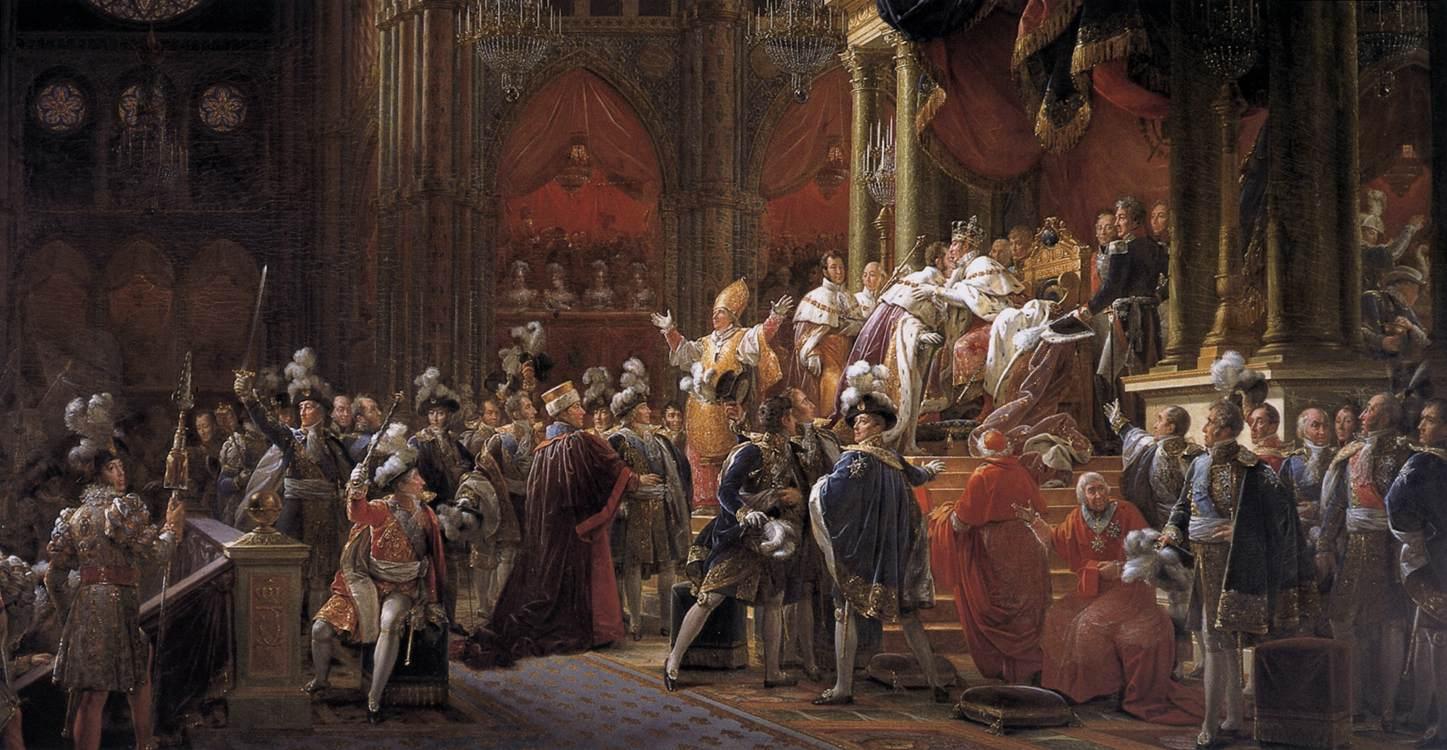
- May 29 – The Coronation of Charles X takes place at the historic site of Reims Cathedral, the last coronation of a French monarch.
- May – History of Brisbane: The Australian city of Brisbane is founded.[3]
- June 2 – The United States Senate ratifies the treaties with the Great Osage and the Little Osage tribes.[4]
- June 3 – The U.S. Senate ratifies the treaty with the Kansas tribe.[4]
- June 9 – The U.S. Senate ratifies the treaty with the Poncas tribe.[4]
- June 15 – A rebellion is started by 200 slaves in the Guamacaro region of Cuba, and is suppressed after 12 hours; in the ensuing months, most who weren't killed in the battle would be hunted down and killed.[5]
July–September
[edit]
- July 6
- The Duke of Schleswig-Holstein-Sonderburg-Beck gains possession of Glücksburg and changes his title to Friedrich Wilhelm, Duke of Schleswig-Holstein-Sonderburg-Glücksburg.[6] The line of Schleswig-Holstein-Sonderburg-Glücksburg later became the royal house of Greece, Denmark and Norway.
- The U.S. Senate ratifies treaties with the Cheyenne tribe.[4]
- A new Combinations of Workmen Act in the United Kingdom makes trade unions legal according to narrowly defined principles.
- July 16 – The U.S. Senate ratifies treaties with the Hunkpapa tribe.[4]
- July 18 – The U.S. Senate ratifies treaties with the Ricara tribes.[4]
- July 30
- Malden Island (an uninhabited island in the central Pacific Ocean) is discovered by George Byron, 7th Baron Byron.[citation needed]
- The U.S. Senate ratifies treaties with the Mandan, Belantae, Eloa and Minnetaree tribes.[4]
- August 4 – The U.S. Senate ratifies treaties with the Ricara tribes.[4]
- August 6 – Bolivia gains its independence from Spain as a republic, at the instigation of Simón Bolívar.[7]
- August 11 – The U.S. Senate ratifies treaties with the Crow tribe.[4]
- August 18 – Scottish adventurer Gregor MacGregor issues a £300,000 loan with 2.5% interest, through the London bank of Thomas Jenkins & Company, for the fictitious Central American republic of Poyais. His actions led to the Panic of 1825, the first modern stock market crash, in England.[citation needed]
- August 22 – The National Mexican Rite is created in Mexico City.[citation needed]
- August 25 – Uruguay is declared independent of the Empire of Brazil by the Thirty-Three Orientals, a militant revolutionary group led by Juan Antonio Lavalleja.[8]
- September 25 – General Hendrik Merkus de Kock lifts the siege of Jogjakarta, the first major action of the Java War.
- September 26 – The U.S. Senate ratifies treaties with the Missouri and Ottoe tribes.[4]
- September 27 – The world's first modern railway, the Stockton and Darlington Railway, opens in England.
- September 30 – The U.S. Senate ratifies treaties with the Pawnee tribe.[4]
- September – The Lady Margaret Boat Club is founded by 12 members of St John's College, Cambridge.
October–December
[edit]
- October 7 – The Miramichi Fire, a forest fire, breaks out in New Brunswick (Canada).
- October 21 – PS Comet II sinks off Gourock (Scotland) with the loss of 62 lives.
- October 26 – The Erie Canal opens, providing passage from Albany, New York to Buffalo and Lake Erie.
- November 7 – The U.S. Senate ratifies the treaty with the Shawnee tribe.[4]
- November 15 – King Joao VI of Portugal promulgates a law recognizing his eldest son, Dom Pedro, as the Emperor of Brazil.[9]
- October–December – Dispute between the United Provinces of the Río de la Plata and the Empire of Brazil over Banda Oriental region led to the Cisplatine War.
- December 1 (O.S.)/November 19 (N.S.) – Nicholas I of Russia succeeds his older brother Alexander I.
- December 9 – The British began the Siege of Bharatpur.
- December 26 (O.S.)/December 14 (N.S.) – Some Imperial Russian Army officers stage the Decembrist revolt against Nicholas's accession in Saint Petersburg, but it is thoroughly suppressed by the government.
Date unknown
[edit]- Bishkek, Kyrgyzstan is founded as a mudfort on the Silk Road
- The Fort Vancouver trading post is established on the lower Columbia River by the Hudson's Bay Company.
- Hans Christian Ørsted reduces aluminium chloride to produce metallic aluminium.
- Minh Mạng outlaws the teaching of Christianity in Vietnam.
- The first horse-drawn omnibuses established in London.
- The United States Postal Service starts a dead letter office.
- London becomes the largest city in the world, taking the lead from Beijing.[10]
Births
[edit]January–June
[edit].jpg)
- January 11 – Clement V. Rogers, Cherokee politician, father of Will Rogers (d. 1911)
- January 25 – George Pickett, American Confederate general (d. 1876)
- January 31 – Miska Magyarics, Slovene poet in Hungary (d. 1883)
- February 8 – Henri Giffard, French engineer, pioneer in airship technology (d. 1882)
- February 10 – Geoffrey Hornby, British admiral (d. 1895)
- March 13 – Hans Gude, Norwegian romanticist landscape painter (d. 1903)[11]
- March 16 – Camilo Castelo Branco, Portuguese writer (d. 1890)
- March 21 – Alexander Mozhaysky, Russian aeronautical pioneer (d. 1890)
- March 22 – Jane Sym, second wife of Canada's second prime minister (d. 1893)
- April 11 – Ferdinand Lassalle, Prussian-German philosopher, socialist and politician (d. 1864)
- April 24 – Robert Michael Ballantyne, Scottish novelist (d. 1894)
- May 4 – Thomas Henry Huxley, English biologist (d. 1895)
- May 8 – George Bruce Malleson, English officer, author (d. 1898)
- May 9 – George Davidson, English-born geodesist, astronomer, geographer, surveyor, and engineer in the United States (d. 1911)
- June 3 – Sophie Sager, Swedish women's rights activist (d. 1902)
July–December
[edit]


- July 2 – Émile Ollivier, French statesman (d. 1913)
- July 19 – George H. Pendleton, American politician (d. 1889)
- July 21 – Práxedes Mateo Sagasta, Spanish politician, eight-time prime minister of Spain (d. 1903)
- August 31 – Robert Dunsmuir, Scottish industrialist, politician (d. 1889)
- September 4 – Dadabhai Naoroji, Indian politician (d. 1917)
- September 11 – Eduard Hanslick, Austrian music critic (d. 1904)
- September 13 – William Henry Rinehart, American sculptor (d. 1874)
- September 17 – Lucius Quintus Cincinnatus Lamar II, American politician, Associate Justice of the Supreme Court of the United States (d. 1893)
- September 25 – Joachim Heer, Swiss politician (d. 1879)
- October 8 – Paschal Beverly Randolph, American occultist (d. 1875)
- October 10 – Paul Kruger, Boer resistance leader (d. 1904)
- October 11 – Maria Firmina dos Reis, Brazilian abolitionist and author (d. 1917)
- October 13 – Charles Frederick Worth, English-born fashion designer, father of haute couture (d. 1895)
- October 25
- Francis March, American comparative linguist (d. 1911)
- Johann Strauss, Junior, Austrian composer (d. 1899)
- November 9 – A. P. Hill, American Confederate general (d. 1865)
- November 29 – Jean-Martin Charcot, French physician, neurologist (d. 1893)
- November 30 – William-Adolphe Bouguereau, French painter and educator (d. 1905)
- December 2 – Emperor Pedro II of Brazil (d. 1891)
- December 18 – Mariano Ignacio Prado, Peruvian general and statesman, twice President of Peru (d. 1901)[12]
- December 30 – Samuel Newitt Wood, American politician (d. 1891)
- December 31 – Elizabeth Martha Olmsted, American poet (d. 1910)
Date unknown
[edit]- Sher Ali Khan, ruler of Afghanistan (d. 1879)
- Juan Williams Rebolledo, Chilean admiral and politician (d. 1910)
Deaths
[edit]January–June
[edit]

- January 4 – Ferdinand I of the Two Sicilies (b. 1751)
- January 8 – Eli Whitney, American inventor (b. 1765)
- February 22 – Eleanor Anne Porden, English poet (b. 1795)
- February 24 – Thomas Bowdler, English physician (b. 1754)
- March 1
- John Brooks (governor), Massachusetts doctor, military officer, governor (b. 1752)
- John Haggin, Indian fighter, one of the earliest settlers of Kentucky (b. 1753)
- March 4 – Hercules Mulligan, tailor, spy during the American Revolutionary War (b. 1740)
- March 6 – Samuel Parr, English schoolmaster (b. 1747)
- March 25 – Antoine Fabre d'Olivet, French writer (b. 1767)
- March 27 – Alexander Lindsay, 6th Earl of Balcarres, British Army general (b. 1752)
- April 23 – Friedrich Müller, German painter, narrator, lyricist and dramatist (b. 1749)
- April 17 – Henry Fuseli, Swiss painter and writer (b. 1741)
- May 7 – Antonio Salieri, Italian composer (b. 1750)
- May 13 – Charles Whitworth, 1st Earl Whitworth, British diplomat (b. 1752)
- May 19 – Claude Henri de Rouvroy, comte de Saint-Simon, French politician (b. 1760)
- May 22 – Laskarina Bouboulina, Greek independence fighter, heroine (shot) (b. 1771)
- May 23 – Ras Gugsa of Yejju, Regent of the Emperor of Ethiopia
- June 11 – Daniel D. Tompkins, 6th Vice President of the United States (b. 1774)
- June 14 – Pierre Charles L'Enfant, French architect (b. 1754)
- June 27 – Domenico Vantini, Italian painter
July–December
[edit].jpg)
.jpg)
- July 12 – Dorothea von Rodde-Schlözer, German scholar (b. 1770)
- July 15 – David Ochterlony, Massachusetts-born general with the East India Company (b. 1758)
- August 3 – Ambrogio Minoja, Italian composer, professor of music (b. 1752)
- August 16 – Charles Cotesworth Pinckney, American politician, soldier (b. 1746)
- August 20 – William Waldegrave, 1st Baron Radstock, British admiral, Governor of Newfoundland (b. 1753)
- September 4 – Frederick Howard, 5th Earl of Carlisle (b. 1748)
- September 26 – José Bernardo de Tagle y Portocarrero, Marquis of Torre Tagle, Peruvian soldier and politician, 2nd President of Peru (b. 1779)[13]
- October 6 – Bernard Germain de Lacépède, French naturalist (b. 1756)
- October 9 – Lucia Pytter, Norwegian philanthropist (b. 1762)
- October 13 – King Maximilian I Joseph of Bavaria (b. 1756)
- November 7 – Charlotte Dacre, English Gothic novelist (b. c. 1772)
- November 14 – Jean Paul, German writer (b. 1763)
- December 1 – Emperor Alexander I of Russia (November 19 on the Russian calendar) b. 1777)
- December 28 – James Wilkinson, American soldier, statesman (b. 1757)
- December 29 – Jacques-Louis David, French painter (b. 1748)
Dates unknown
[edit]- Armand-Marie-Jacques de Chastenet, Marquis of Puységur, French mesmerist (b. 1751)
- Huang Peilie, Chinese bibliophile (b. 1763)[14]
- Maria Angela Ardinghelli, Italian scientific translator (b. 1730)
References
[edit]- ^ Blangstrup, Chr., ed. (1915). "Aggerkanal". Salmonsens Konversationsleksikon (in Danish). Vol. 1 (2nd ed.). Copenhagen: J.H. Schultz Forlagsboghandel. p. 310. Retrieved April 3, 2013.
- ^ "Treaty With The Creeks, 1825", Oklahoma State University Digital Collections, Kapplers: Indian affairs: laws and treaties Vol. 2 (Treaties), pp. 214-217. Retrieved May 16, 2024.
- ^ "Founding of Brisbane". National Museum Australia. 2023-05-04. Retrieved 2024-03-17.
- ^ a b c d e f g h i j k l Niles' Weekly Register, Volume 30, p316
- ^ Manuel Barcia, West African Warfare in Bahia and Cuba: Soldier Slaves in the Atlantic World, 1807-1844 (Oxford University Press, 2014) p97
- ^ Danish: Den 6te Julii har det behaget Hs. Majestæt allernaadigst at tillade Hs. høifyrstelige Durchlauchtighed, Hertug Friederich Wilhelm Paul Leopold til Slesvig-Holsten-Sønderburg Beck, for sig og hans samtlige ægte Descendentere, tillige at føre det Hertugelige Navn og Titel som Hertug af Glücksburg. "Blandede Efterretninger" (PDF). Collegial-Tidende. No. 39. Copenhagen. 16 July 1825. p. 526.
- ^ Morales, Walraud Q. (2010). A Brief History of Bolivia (second ed.). Lexington Associates. ISBN 9780816078776.
- ^ Gotevbe, Victor (2024-08-25). "August 25: Uruguay's Journey to Freedom". Diplomatic Watch. Retrieved 2025-07-13.
- ^ The Annual Register, or A View of the History, Politics, and Literature for the Year 1828 (Baldwin and Cradock, 1829) p428
- ^ Rosenberg, Matt T. "Largest Cities Through History". About.com. Archived from the original on August 18, 2016. Retrieved September 25, 2012.
- ^ Haverkamp, Frode; Gude, Hans Fredrik (1992). Hans Gude (in Norwegian). Oslo: Aschehoug. p. 59. ISBN 82-03-17072-2. OCLC 29047091.
- ^ García Belaúnde, Víctor Andrés (2016). El expediente Prado (in Spanish). Lima: Asociación Civil Mercurio Peruano. p. 451. ISBN 978-612-45288-6-6.
- ^ Basadre, Jorge (2005) [First published 1939]. Historia de la República del Perú (1822 - 1933) [History of the Republic of Peru (1822 - 1933)] (in Spanish). Vol. 1 (9th ed.). Lima: El Comercio. p. 98. ISBN 978-612-306-354-2.
- ^ "Supplement to the Local Gazetteer of Wu Prefecture". World Digital Library. 1134. Retrieved September 6, 2013.
from Grokipedia
Events
January–March
On January 3, Scottish industrialist and social reformer Robert Owen purchased roughly 30,000 acres of land in southwestern Indiana from the Harmony Society, renaming the settlement New Harmony and intending it as an experimental community organized around communal ownership, cooperative labor, and rational planning to eliminate competition and private property.[4] [5] Owen's model presupposed that human behavior could be reshaped through environmental design absent market incentives, yet the venture quickly encountered coordination failures, dependency issues, and declining output, dissolving by 1827 as participants lacked personal stakes in productivity.[6] On January 4, King Ferdinand I of the Two Sicilies died in Naples, leading to the accession of his son, Francis I, who assumed the throne amid ongoing efforts to consolidate Bourbon rule in southern Italy following the Napoleonic Wars.[4] On January 10, the Indiana General Assembly designated Indianapolis as the state's new capital, relocating it from Corydon to a more central location along the White River to facilitate governance and economic growth in the expanding frontier territory.[7] The United States Post Office established its Dead Letter Office in 1825 to systematically handle undeliverable mail, employing staff to search for addresses, return items where possible, or auction unclaimed contents, thereby reducing losses and improving overall postal reliability through formalized administrative processes.[8] On February 9, following the 1824 presidential election where no candidate secured an electoral majority, the House of Representatives convened to decide the presidency under the Twelfth Amendment, with each state's delegation casting a single vote; John Quincy Adams prevailed with 13 state delegations to Andrew Jackson's 7 and Henry Clay's 4, reflecting regional alignments where New England and border states prioritized Adams's nationalist policies.[9] [10] Jackson's allies immediately decried the outcome as influenced by backroom dealings, particularly after Adams nominated Clay as Secretary of State, though the selection adhered to constitutional mechanisms without evidence of vote trading altering state tallies.[11] On March 4, John Quincy Adams was inaugurated as the sixth President of the United States in Washington, D.C., succeeding James Monroe and marking the end of the Virginia dynasty in a ceremony emphasizing continuity in republican governance.[12] On March 5, British and American naval forces captured the pirate schooner Anne—commanded by Benito de Garay—in the Caribbean near Cuba, seizing its crew and arsenal in an action that contributed to suppressing organized piracy in the region by disrupting remaining strongholds post-War of 1812.[13]April–June
In the United States, internal conflicts among the Creek Nation escalated on April 30, 1825, when Upper Creek leader Menawa directed warriors to assassinate William McIntosh, a Lower Creek chief who had signed the Treaty of Indian Springs earlier that year, ceding significant tribal lands to the federal government in exchange for annuities and reservations.[14] This execution, carried out by burning McIntosh's home and shooting him, stemmed from accusations of treason against traditional Creek law prohibiting land sales, highlighting divisions between accommodationist and resistant factions amid pressures for Native American removal.[15] The incident prompted further U.S. negotiations, culminating in the Treaty of Washington that adjusted cessions but accelerated displacement.[16] Progress on the Erie Canal advanced during this quarter, with the Tonawanda section opening on May 3, 1825, allowing initial navigation along the western terminus near the Niagara River.[17] This 1825 milestone in the 363-mile waterway's construction demonstrated engineering innovations like hand-dug channels and feeder systems, reducing freight costs from Buffalo to Albany by enabling barge transport over prior wagon hauls, thus catalyzing grain and merchandise trade between the Great Lakes and Atlantic ports.[17] Such sectional completions underscored the canal's role in exploiting natural topography for economic connectivity without reliance on rivers prone to seasonal fluctuations. In Europe, France's monarchical restoration reached a ceremonial peak on May 29, 1825, when Charles X was anointed and crowned King of France and Navarre at Reims Cathedral in a traditional rite evoking Carolingian and Capetian precedents.[18] The event, featuring sacred oils and regalia, reinforced Bourbon legitimacy following the 1814-1815 return and Congress of Vienna settlements, aiming to anchor conservative order against revolutionary echoes and liberal constitutionalism enshrined in the 1814 Charter.[19] By invoking divine right amid post-Napoleonic stabilization, the coronation sought to consolidate elite support and suppress radicalism, though it later fueled ultraroyalist policies alienating moderates.[18] Urban transport in London saw horse-drawn omnibuses in operation by mid-1825, with a December survey documenting 418 such vehicles serving passenger needs across routes.[20] These enclosed, multi-passenger coaches, pulled by teams of horses, responded to growing metropolitan demand for reliable intra-city movement beyond stagecoaches, laying groundwork for formalized services amid population expansion and road improvements.[20]July–September
In July 1825, the Java War erupted in the Dutch East Indies as Prince Diponegoro, a Javanese noble with religious and anti-colonial motivations, mobilized forces against Dutch authorities amid grievances over land encroachments, taxation, and cultural impositions that disrupted traditional Javanese society.[21] The conflict, rooted in Diponegoro's jihad declaration against perceived infidel rule, escalated with early attacks such as the assault on Selarong Cave starting July 25, marking the onset of a protracted guerrilla campaign that mobilized tens of thousands and strained Dutch resources until 1830.[21] [22] On July 30, 1825, during a return voyage from Hawaii aboard HMS Blonde, British Captain George Anson Byron, 7th Baron Byron, sighted and charted the uninhabited Malden Island (now part of Kiribati) in the central Pacific Ocean, naming it after his navigator Lieutenant Charles Robert Malden; the atoll's discovery highlighted ongoing British exploratory efforts in remote oceanic regions amid post-Napoleonic naval surveys.[22] On August 6, 1825, the Republic of Bolivia formally declared independence from Spanish rule at Chuquisaca (now Sucre), consolidating territories liberated in prior campaigns under Simón Bolívar's forces following the 1824 Battle of Ayacucho; the new state, named in Bolívar's honor, adopted a constitution emphasizing republican governance amid ongoing integration of highland indigenous populations and Andean mining economies.[23] [24] On August 25, 1825, amid resistance to Brazilian annexation, Uruguayan patriots under the Thirty-Three Orientals proclaimed independence from the Brazilian Empire at Florida, initiating the Cisplatine War with Argentina-Brazil intervention that secured recognition by 1828; this declaration stemmed from local gaucho-led revolts against Portuguese-Brazilian centralization, prioritizing autonomy in the Banda Oriental's pastoral economy.[25] [26]October–December
On October 7, the Miramichi Fire swept through New Brunswick, Canada, devastating communities including Douglastown and Newcastle, with estimates of 200 to 500 fatalities and widespread destruction of forests and settlements.[27] This disaster highlighted vulnerabilities in colonial timber-dependent economies, where dry conditions and human activity fueled rapid fire spread.[28] The Erie Canal opened on October 26, spanning 363 miles from Albany to Buffalo, enabling efficient transport of goods between the Great Lakes and the Atlantic Ocean via the Hudson River.[29] Its completion, marked by a ceremonial cannon relay across New York, spurred economic integration of the American interior, reducing freight costs dramatically and boosting westward expansion.[30] In Britain, late 1825 saw mounting pressures from a speculative bubble in Latin American securities and mining ventures, with credit strains emerging as overextended country banks faced liquidity shortages in November and early December.[31] These early indicators of distress stemmed from unchecked lending against inflated asset values, setting the stage for broader financial contraction without yet triggering widespread failures.[32] Tsar Alexander I of Russia died unexpectedly on December 1 in Taganrog from typhus, leaving no direct heir and igniting uncertainty over succession, as his brother Grand Duke Constantine had secretly renounced the throne years earlier.[33] Nicholas I, the third brother, was proclaimed emperor on December 12, promptly securing oaths of loyalty from military units and the Senate to consolidate authority and avert dynastic fragmentation.[34] This rapid assertion of control, amid reports of troop hesitancy, underscored the regime's reliance on disciplined enforcement to maintain stability against latent reformist pressures.[35]Date unknown
In 1825, Danish physicist Hans Christian Ørsted achieved the first isolation of metallic aluminum by reducing aluminum chloride with potassium amalgam, producing a small quantity of the impure metal.[36] This breakthrough, though not widely publicized by Ørsted himself, laid foundational work for later refinements by chemists like Friedrich Wöhler and demonstrated the feasibility of extracting aluminum from its compounds, despite its high reactivity and prior elusiveness.[37] The Cherokee Nation formally adopted Sequoyah's syllabary in 1825, enabling widespread literacy and the codification of their laws in written form.[38] Developed over years by Sequoyah without knowledge of English or formal linguistics, the 85-character system proved highly effective, with thousands of Cherokees mastering it within months of adoption, which supported cultural preservation amid pressures from U.S. expansion.[39] Exact timing within the year remains undocumented in primary records, reflecting limitations in contemporaneous tribal documentation practices.[40]Economic and Technological Developments
Infrastructure and Transportation Advances
The Stockton and Darlington Railway, spearheaded by private investors such as Edward Pease and Quaker businessmen, opened on 27 September 1825, establishing the world's first public railway to utilize steam locomotives for both freight and passenger services. George Stephenson's Locomotion No. 1, constructed by Robert Stephenson & Co., powered the inaugural 26-mile journey from Shildon to Stockton, attaining speeds of 15 miles per hour while hauling coal wagons and an open passenger coach.[41][42][43] This privately financed venture empirically demonstrated steam traction's superiority over horse-drawn systems, slashing coal transport costs by enabling consistent volumes and speeds that boosted regional commerce and industrial output.[44] The Erie Canal's completion in October 1825 activated its full 363-mile length from Albany on the Hudson River to Buffalo on Lake Erie, transforming bulk goods transport by reducing shipping costs from approximately $100 per ton to $10 per ton over the route. Initial operations in the canal's first season carried over 40,000 passengers and freight tonnage exceeding 30,000 tons westward, primarily manufactured goods, alongside substantial eastbound agricultural produce, which catalyzed westward expansion and integrated Great Lakes markets with Atlantic trade.[45][46][47][48] These quantifiable reductions in time and expense—cutting weeks-long overland hauls to days—evidenced the canal's causal role in amplifying economic efficiency and commodity flows, despite its state-backed construction. In 1825, construction commenced on the Thames Tunnel using Marc Isambard Brunel's tunneling shield, patented in 1818, which facilitated the first successful subaqueous bore beneath a major navigable river. The shield's cast-iron frame supported the working face during excavation in water-bearing gravel, permitting miners to advance incrementally while laying brick linings for structural stability, addressing the instability of prior manual methods through compartmentalized protection.[49][50][51] Funded by the private Thames Tunnel Company, this innovation from Rotherhithe to Wapping not only pioneered safe underwater tunneling but also presaged broader applications in urban infrastructure, prioritizing empirical soil mechanics over speculative approaches.[52]Financial Crises and Market Events
The Panic of 1825 originated in Britain as a crisis driven by speculative excesses in Latin American securities, following the independence of several South American nations from Spain and Portugal, which fueled investor optimism in government bonds and mining ventures.[31][53] By mid-1825, bond prices had halved from peak levels, exposing overleveraged banks and triggering a stock market crash that eroded confidence in commercial paper.[31] This overoptimism, amplified by easy credit post-Napoleonic Wars, led to unsustainable leverage rather than inherent monetary policy flaws alone, as evidenced by the rapid proliferation of joint-stock companies and foreign loans exceeding prudent risk assessment.[54] In late November and December 1825, bank runs intensified in London and provincial areas, culminating in the failure of over 100 British banks and more than 1,000 businesses, as depositors withdrew funds amid fears of insolvency tied to Latin American exposures.[55] The Bank of England initially hesitated to serve as lender of last resort, prioritizing its own reserves and exacerbating liquidity shortages, but by December 17, it discounted eligible bills at reduced rates, injecting capital that stemmed the immediate panic.[56][31] This intervention, while stabilizing core markets, highlighted moral hazard in speculative lending, where optimism ignored default risks from nascent Latin American governments, resulting in widespread sovereign bond repudiations.[57] The crisis disrupted global trade flows, as Britain's commercial failures curtailed imports of commodities like cotton and metals, indirectly pressuring U.S. markets through reduced demand despite no direct banking contagion.[58] Recovery ensued through market corrections, including asset liquidations and credit contraction, which restored solvency by early 1826 without requiring structural bailouts, underscoring capitalism's capacity for self-correction amid concurrent infrastructure advances like the Stockton and Darlington Railway's opening on September 27, 1825.[32]Scientific Inventions
In 1825, British electrician William Sturgeon developed the first practical electromagnet, a device that significantly advanced experimental electromagnetism by producing a strong, controllable magnetic field through electric current.[59] Sturgeon, who had transitioned from military service to scientific lecturing, constructed the electromagnet by winding a coil of uninsulated copper wire—approximately 18 turns—loosely around a horseshoe-shaped iron core, which enhanced magnetic strength compared to earlier straight-bar designs.[60] This configuration allowed the 7-ounce (200-gram) device to lift 9 pounds (4 kilograms) of iron when powered by a single voltaic cell, demonstrating empirical improvements in magnetic force generation.[61] Sturgeon publicly demonstrated and detailed his improved electromagnetic apparatus in a presentation to the Society of Arts in London, earning a silver medal for the innovation, which was documented in the society's transactions.[62] The invention relied on basic principles of current-induced magnetism, building on Hans Christian Ørsted's 1820 discovery, but Sturgeon's core-coil design provided verifiable scalability for laboratory use, enabling precise experiments in electrical conduction and magnetic attraction without permanent magnets.[63] Applications at the time were limited to scientific demonstrations, such as moving iron filings or suspending weights, laying groundwork for subsequent 19th-century investigations into electrodynamics while avoiding unsubstantiated claims of immediate industrial transformation.[64] No other major patented scientific inventions emerged in 1825 that matched the electromagnet's empirical impact, though contemporaneous efforts in chemistry and geology, such as refinements in analytical techniques, contributed incrementally to disciplinary progress without yielding discrete, verifiable devices.[65] Sturgeon's work underscored the era's emphasis on reproducible electrical phenomena, prioritizing observable effects over speculative theories.[66]Political Controversies and Shifts
United States Presidential Election Outcome
The 1824 United States presidential election, held between October 26 and December 2, resulted in no candidate securing a majority of the 261 electoral votes required under the Twelfth Amendment, necessitating a contingent election in the House of Representatives among the top three electoral vote recipients: Andrew Jackson (99 votes), John Quincy Adams (84 votes), and William H. Crawford (41 votes).[67] Jackson had also led in the popular vote with approximately 151,271 ballots, or about 42 percent of the roughly 356,000 total votes cast, reflecting a national voter turnout of around 27 percent among eligible white male property holders amid varying state suffrage restrictions.[68] Regional divisions were pronounced, with Jackson dominating in the South and expanding West due to his military reputation and appeals to agrarian interests, while Adams prevailed in the Northeast, where support for commercial and federalist policies held sway.[9] On February 9, 1825, the House—where each state's delegation voted as a single unit—selected Adams as president with 13 state votes to Jackson's 7 and Crawford's 4, adhering to constitutional mechanics intended to prioritize state equality over raw popular tallies in divided outcomes.[67] Henry Clay, eliminated from House consideration with 37 electoral votes, endorsed Adams, whose policy vision aligned with Clay's advocacy for federal internal improvements and protective tariffs; Adams subsequently appointed Clay Secretary of State in January 1825.[10] Jackson supporters immediately decried this as a "corrupt bargain," alleging an explicit quid pro quo, but no contemporaneous evidence—such as correspondence or witness accounts—substantiates a pre-vote pledge, and Clay had openly criticized Jackson's fitness for office, framing his support as principled coalition-building common in multiparty contests.[69] Historians have largely dismissed the charge as partisan rhetoric amplified by Jackson's allies to mobilize resentment, noting that cabinet positions routinely rewarded influential supporters without implying illegality.[11] Adams's ensuing administration pursued ambitious internal improvements, including surveys for roads and canals, harbor enhancements, and proposals for a national observatory and astronomical research, aiming to foster economic integration and scientific advancement.[70] These initiatives faced congressional resistance, particularly from Southern and Western delegations wary of federal overreach favoring Northeastern commerce, and yielded limited legislative success amid accusations of elitism detached from popular majoritarianism.[70] The controversy accelerated party realignment, fracturing the Democratic-Republican consensus of the Era of Good Feelings into Jacksonian Democrats emphasizing states' rights and expanded suffrage against Adams-Clay National Republicans (later Whigs) favoring active federalism, culminating in Jackson's landslide 1828 victory with over 56 percent of the popular vote and near-unanimous electoral support.[71]Decembrist Revolt in Russia
The Decembrist Revolt erupted on December 14, 1825 (O.S.; December 26, N.S.), when liberal-minded Russian army officers, organized in secret societies such as the Northern and Southern Societies, mobilized approximately 3,000 troops in Senate Square, St. Petersburg, to protest Nicholas I's accession and demand constitutional reforms, including limits on autocracy and abolition of serfdom.[72][73] These elites, influenced by Enlightenment ideas encountered during the Napoleonic Wars and disillusioned by Tsar Alexander I's post-1815 conservative turn toward the Holy Alliance and repression of liberal aspirations, sought to exploit the succession crisis following Alexander's unexpected death on November 19, 1825, and the rumored renunciation by Grand Duke Constantine.[74][75] However, the plotters' visions diverged—ranging from constitutional monarchy to republicanism—undermining unity, while their failure to secure broader societal support, particularly among serfs whose emancipation they advocated without grassroots mobilization, exposed the revolt's detachment from empirical realities of Russian society.[76] The uprising faltered due to internal disarray, including the absence of designated leader Prince Sergei Trubetskoy and ineffective appeals to troops, many of whom remained loyal to the dynasty amid Nicholas's decisive countermeasures, such as leveraging false intelligence about Constantine's involvement to delay action.[73][77] Nicholas suppressed the rebellion in St. Petersburg with artillery fire after a standoff, causing around 80 deaths among rebels and civilians, and quashed a simultaneous southern mutiny led by Pavel Pestel with minimal additional resistance, underscoring the military's overall fidelity to autocratic order over conspiratorial agitation.[78] A parallel revolt in the south under Southern Society leaders was similarly crushed, highlighting the plotters' logistical shortcomings and overreliance on elite networks without mass backing.[72] In the aftermath, Nicholas I ordered rigorous investigations, resulting in the execution by hanging of five principal leaders—Pestel, Kondraty Ryleev, Sergei Muravyov-Apostol, Mikhail Bestuzhev-Ryumin, and Peter Kakhovsky—on July 13, 1826, while over 120 others, including nobles and officers, faced exile to Siberian hard labor or demotion, serving as a stark deterrent against future sedition rather than fostering martyrdom.[76][79] This response entrenched post-Napoleonic conservatism, with Nicholas establishing the Third Section secret police to monitor dissent, reinforcing autocratic stability by exposing the fragility of elite-driven challenges absent causal foundations in popular consent or institutional reform.[80] Liberal historiographies, often biased toward narratives of inexorable democratic progress, romanticize the Decembrists' impractical demands—such as radical land redistribution without peasant readiness—as heroic precursors, yet the revolt's swift defeat empirically validated the resilience of traditional authority against isolated intellectual fervor, delaying substantive change until broader upheavals a century later.[81][82]Births
January–June
Eli Whitney, the American inventor best known for developing the cotton gin in 1793, died on January 8 in New Haven, Connecticut, from prostate cancer at age 59.[83] His cotton gin mechanized the separation of cotton fibers from seeds, dramatically increasing processing efficiency from manual labor rates of about one pound per day to over 50 pounds, which spurred cotton production in the American South and contributed to economic expansion through expanded exports reaching 4 million bales by 1860.[84] Whitney also pioneered the concept of interchangeable parts in manufacturing, securing a U.S. Army contract in 1798 to produce 10,000 muskets using standardized components, laying groundwork for modern mass production despite initial production delays due to technological hurdles.[84] Thomas Bowdler, English physician and editor, died on February 24 near Swansea, Wales, at age 70, with no specific cause widely documented beyond natural age-related decline.[85] He gained prominence for publishing The Family Shakespeare in 1807 (expanded 1818), an expurgated edition removing content deemed obscene or profane to make the plays suitable for family reading and mixed audiences, selling thousands of copies and influencing Victorian-era textual editing practices.[86] Bowdler's approach, often conducted with his sister Henrietta Maria, reflected Enlightenment-era efforts to moralize literature without altering core narratives, though it drew criticism for sanitizing Shakespeare's original intent.[87] Antonio Salieri, Italian composer and conductor who served as court composer to Emperor Joseph II, died on May 7 in Vienna at age 74, following a long illness marked by progressive paralysis and senility in his final years. Over his career, Salieri composed 43 operas, including Axur, re d'Ormus (1788) performed across Europe, and held influential positions mentoring composers like Beethoven and Schubert while directing the Vienna Court Opera, producing over 200 performances annually by the 1780s. His rivalry with Mozart, dramatized in later fiction, lacked empirical substantiation of sabotage claims, as archival records show professional competition rather than personal malice, with Salieri's output reflecting stable imperial patronage. Henri de Saint-Simon, French social theorist and founder of Saint-Simonianism, died on May 19 in Paris at age 64 from complications of a chronic illness following a self-inflicted wound during a depressive episode. His writings, such as L'Industrie (1817), advocated industrial organization over feudal remnants, proposing a merit-based society led by scientists and entrepreneurs to direct production for public utility, influencing early socialist thought and figures like Auguste Comte through empirical analysis of post-Revolutionary economic structures. Saint-Simon's legacy persisted via disciples who formalized his ideas into a movement promoting railroads and banking reforms, evidenced by their advocacy for French infrastructure projects in the 1830s. Pierre Charles L'Enfant, French-American engineer and urban planner who designed the initial layout of Washington, D.C., died on June 14 in Prince George's County, Maryland, at age 70, impoverished and unrecognized during his lifetime due to disputes over compensation. Commissioned in 1791, his plan featured radial avenues intersecting a grid with monumental axes aligned to the Capitol and Potomac River, incorporating 160-foot-wide boulevards and public squares to symbolize republican grandeur, though implementation stalled after his dismissal amid conflicts with property owners. L'Enfant's vision, rooted in Versailles precedents adapted for democratic scale, was revived in the 1901 McMillan Plan, confirming its enduring structural influence on the city's development.July–December
Tsar Alexander I of Russia died on December 1, 1825, in Taganrog from typhus contracted during a southern voyage with his wife.[34] [88] At age 47, his sudden passing created a succession crisis, as elder brother Grand Duke Constantine had secretly renounced the throne years earlier, thrusting younger brother Nicholas I into power after a brief interregnum.[89] This transition solidified autocratic rule under Nicholas, who suppressed the ensuing Decembrist revolt with decisive force, contrasting Alexander's earlier liberal flirtations post-Napoleonic Wars that had fostered elite discontent without structural reform.[90] French painter Jacques-Louis David, a central figure in neoclassicism and revolutionary iconography, died on December 29, 1825, in Brussels exile following his post-Napoleon banishment.[91] Aged 77, his demise marked the close of an artistic epoch defined by works like The Death of Marat, which propagandized radical ideals through stark realism and classical form, influencing generations despite his later Bonapartist alignment.[92] German writer Jean Paul (Johann Paul Friedrich Richter), pioneer of Romanticism with ironic novels critiquing Enlightenment rationalism, succumbed on November 14, 1825, at age 62. His death amid Bavaria's cultural shifts underscored the era's pivot from rationalist satire to introspective individualism, though his verbose style limited broader impact compared to contemporaries like Goethe.Date unknown
In 1825, Danish physicist Hans Christian Ørsted achieved the first isolation of metallic aluminum by reducing aluminum chloride with potassium amalgam, producing a small quantity of the impure metal.[36] This breakthrough, though not widely publicized by Ørsted himself, laid foundational work for later refinements by chemists like Friedrich Wöhler and demonstrated the feasibility of extracting aluminum from its compounds, despite its high reactivity and prior elusiveness.[37] The Cherokee Nation formally adopted Sequoyah's syllabary in 1825, enabling widespread literacy and the codification of their laws in written form.[38] Developed over years by Sequoyah without knowledge of English or formal linguistics, the 85-character system proved highly effective, with thousands of Cherokees mastering it within months of adoption, which supported cultural preservation amid pressures from U.S. expansion.[39] Exact timing within the year remains undocumented in primary records, reflecting limitations in contemporaneous tribal documentation practices.[40]Deaths
January–June
Eli Whitney, the American inventor best known for developing the cotton gin in 1793, died on January 8 in New Haven, Connecticut, from prostate cancer at age 59.[83] His cotton gin mechanized the separation of cotton fibers from seeds, dramatically increasing processing efficiency from manual labor rates of about one pound per day to over 50 pounds, which spurred cotton production in the American South and contributed to economic expansion through expanded exports reaching 4 million bales by 1860.[84] Whitney also pioneered the concept of interchangeable parts in manufacturing, securing a U.S. Army contract in 1798 to produce 10,000 muskets using standardized components, laying groundwork for modern mass production despite initial production delays due to technological hurdles.[84] Thomas Bowdler, English physician and editor, died on February 24 near Swansea, Wales, at age 70, with no specific cause widely documented beyond natural age-related decline.[85] He gained prominence for publishing The Family Shakespeare in 1807 (expanded 1818), an expurgated edition removing content deemed obscene or profane to make the plays suitable for family reading and mixed audiences, selling thousands of copies and influencing Victorian-era textual editing practices.[86] Bowdler's approach, often conducted with his sister Henrietta Maria, reflected Enlightenment-era efforts to moralize literature without altering core narratives, though it drew criticism for sanitizing Shakespeare's original intent.[87] Antonio Salieri, Italian composer and conductor who served as court composer to Emperor Joseph II, died on May 7 in Vienna at age 74, following a long illness marked by progressive paralysis and senility in his final years. Over his career, Salieri composed 43 operas, including Axur, re d'Ormus (1788) performed across Europe, and held influential positions mentoring composers like Beethoven and Schubert while directing the Vienna Court Opera, producing over 200 performances annually by the 1780s. His rivalry with Mozart, dramatized in later fiction, lacked empirical substantiation of sabotage claims, as archival records show professional competition rather than personal malice, with Salieri's output reflecting stable imperial patronage. Henri de Saint-Simon, French social theorist and founder of Saint-Simonianism, died on May 19 in Paris at age 64 from complications of a chronic illness following a self-inflicted wound during a depressive episode. His writings, such as L'Industrie (1817), advocated industrial organization over feudal remnants, proposing a merit-based society led by scientists and entrepreneurs to direct production for public utility, influencing early socialist thought and figures like Auguste Comte through empirical analysis of post-Revolutionary economic structures. Saint-Simon's legacy persisted via disciples who formalized his ideas into a movement promoting railroads and banking reforms, evidenced by their advocacy for French infrastructure projects in the 1830s. Pierre Charles L'Enfant, French-American engineer and urban planner who designed the initial layout of Washington, D.C., died on June 14 in Prince George's County, Maryland, at age 70, impoverished and unrecognized during his lifetime due to disputes over compensation. Commissioned in 1791, his plan featured radial avenues intersecting a grid with monumental axes aligned to the Capitol and Potomac River, incorporating 160-foot-wide boulevards and public squares to symbolize republican grandeur, though implementation stalled after his dismissal amid conflicts with property owners. L'Enfant's vision, rooted in Versailles precedents adapted for democratic scale, was revived in the 1901 McMillan Plan, confirming its enduring structural influence on the city's development.July–December
Tsar Alexander I of Russia died on December 1, 1825, in Taganrog from typhus contracted during a southern voyage with his wife.[34] [88] At age 47, his sudden passing created a succession crisis, as elder brother Grand Duke Constantine had secretly renounced the throne years earlier, thrusting younger brother Nicholas I into power after a brief interregnum.[89] This transition solidified autocratic rule under Nicholas, who suppressed the ensuing Decembrist revolt with decisive force, contrasting Alexander's earlier liberal flirtations post-Napoleonic Wars that had fostered elite discontent without structural reform.[90] French painter Jacques-Louis David, a central figure in neoclassicism and revolutionary iconography, died on December 29, 1825, in Brussels exile following his post-Napoleon banishment.[91] Aged 77, his demise marked the close of an artistic epoch defined by works like The Death of Marat, which propagandized radical ideals through stark realism and classical form, influencing generations despite his later Bonapartist alignment.[92] German writer Jean Paul (Johann Paul Friedrich Richter), pioneer of Romanticism with ironic novels critiquing Enlightenment rationalism, succumbed on November 14, 1825, at age 62. His death amid Bavaria's cultural shifts underscored the era's pivot from rationalist satire to introspective individualism, though his verbose style limited broader impact compared to contemporaries like Goethe.Dates unknown
- Sher Ali Khan (d. 1879), third son of Dost Mohammad Khan who served as Emir of Afghanistan from 1863 to 1866 and from 1868 to 1879, attempting limited modernization and resisting British influence during the Great Game.[93]