



Community hub
Recent from talks
Contribute something
Nothing was collected or created yet.
AP Calculus
View on WikipediaAdvanced Placement (AP) Calculus (also known as AP Calc, Calc AB , AB Calc or simply AB) is a set of two distinct Advanced Placement calculus courses and exams offered by the American nonprofit organization College Board. AP Calculus AB covers basic introductions to limits, derivatives, and integrals. AP Calculus covers all AP Calculus AB topics plus integration by parts, infinite series, parametric equations, vector calculus, and polar coordinate functions, among other topics.[1]
AP Calculus AB
[edit]AP Calculus AB is an Advanced Placement calculus course. It is traditionally taken after precalculus and is the first calculus course offered at most schools except for possibly a regular or honors calculus class. The Pre-Advanced Placement pathway for math helps prepare students for further Advanced Placement classes and exams.
Purpose
[edit]According to the College Board:
An AP course in calculus consists of a full high school academic year of work that is comparable to calculus courses in colleges and universities. It is expected that students who take an AP course in calculus will seek college credit, college placement, or both, from institutions of higher learning. The AP Program includes specifications for two calculus courses and the exam for each course. The two courses and the two corresponding exams are designated as Calculus AB and Calculus BC. Calculus AB can be offered as an AP course by any school that can organize a curriculum for students with advanced mathematical ability.[2]
AP Calculus AB is approximately equivalent to the first semester of college calculus, providing students with an opportunity to earn college credit or advanced placement.[3] Research indicates that achieving higher scores on the exam can positively impact college completion rates by facilitating credit toward graduation requirements.[4]
Topic outline
[edit]The material includes the study and application of differentiation and integration, and graphical analysis including limits, asymptotes, and continuity.[5] An AP Calculus AB course is typically equivalent to one semester of college calculus.[6][7]
- Analysis of graphs (predicting and explaining behavior)
- Limits of functions (one and two sided)
- Asymptotic and unbounded behavior
- Continuity
- Derivatives
- Concept
- At a point
- As a function
- Applications
- Higher order derivatives
- Techniques
- Integrals
- Interpretations
- Properties
- Applications
- Techniques
- Numerical approximations
- Fundamental theorem of calculus
- Antidifferentiation
- L'Hôpital's rule
- Separable differential equations
| Score | 2017[8] | 2018[9] | 2019[10] | 2020[11] | 2021[12] | 2022[13] | 2023[14] | 2024[15] | 2025[16] |
|---|---|---|---|---|---|---|---|---|---|
| 5 | 18.7% | 19.4% | 19.1% | 19.5% | 17.6% | 20.4% | 22.4% | 21.4% | 20.3% |
| 4 | 18% | 17.3% | 18.7% | 20.9% | 14.1% | 16.1% | 16.2% | 27.8% | 28.9% |
| 3 | 20.8% | 21% | 20.6% | 21.0% | 19.3% | 19.1% | 19.4% | 15.3% | 15.0% |
| 2 | 22% | 22.4% | 23.3% | 24.1% | 25.3% | 22.6% | 21.7% | 22.7% | 22.8% |
| 1 | 20.4% | 20% | 18.3% | 14.5% | 23.7% | 21.7% | 20.3% | 12.9% | 13.0% |
| % of Scores 3 or Higher | 57.5% | 57.7% | 58.4% | 61.4% | 51.0% | 55.7% | 58.0% | 64.4% | 64.2% |
| Mean | 2.93 | 2.94 | 2.97 | 3.07 | 2.77 | 2.91 | 2.99 | 3.22 | — |
| Standard Deviation | 1.40 | 1.40 | 1.38 | 1.36 | 1.41 | 1.44 | 1.44 | 1.35 | — |
| Number of Students | 316,099 | 308,538 | 300,659 | 266,430 | 251,639 | 268,352 | 273,987 | 278,657 | — |
AP Calculus
[edit]| Part of a series of articles about |
| Calculus |
|---|
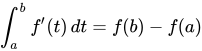
AP Calculus is equivalent to a full year regular college course, covering both Calculus I and II. After passing the exam, students may move on to Calculus III (Multivariable Calculus).[17]
Purpose
[edit]According to the College Board,
Calculus is a full-year course in the calculus of functions of a single variable. It includes all topics covered in Calculus AB plus additional topics... Students who take an AP Calculus course should do so with the intention of placing out of a comparable college calculus course.[2]
The course is designed for students with strong mathematical ability, aiming to provide advanced placement or credit equivalent to two semesters of college calculus.[18]
Topic outline
[edit]AP Calculus includes all of the topics covered in AP Calculus AB, as well as the following:
- Convergence tests for series
- Taylor series
- Parametric equations
- Polar functions (including arc length in polar coordinates and calculating area)
- Arc length calculations using integration
- Integration by parts
- Improper integrals
- Differential equations for logistic growth
- Using partial fractions to integrate rational functions[19][20]
| Score | 2017[21] | 2018[9] | 2019[10] | 2020[22] | 2021[23] | 2022[24] | 2023[25] | 2024[26] | 2025[27] |
|---|---|---|---|---|---|---|---|---|---|
| 5 | 42.6% | 40.4% | 43.0% | 44.6% | 38.3% | 41.2% | 43.5% | 47.7% | 44.0% |
| 4 | 18.1% | 18.6% | 18.5% | 17.6% | 16.5% | 15.6% | 15.9% | 21.1% | 21.9% |
| 3 | 19.9% | 20.7% | 19.5% | 19.4% | 20.4% | 20.1% | 19.0% | 12.1% | 12.8% |
| 2 | 14.3% | 14.6% | 13.9% | 14.1% | 18.2% | 16.4% | 15.2% | 13.9% | 15.2% |
| 1 | 5.3% | 5.6% | 5.2% | 4.3% | 6.6% | 6.8% | 6.3% | 5.2% | 6.2% |
| % of Scores 3 or Higher | 80.6% | 79.7% | 81.0% | 81.6% | 75.2% | 76.9% | 78.5% | 80.9% | 78.6% |
| Mean | 3.79 | 3.73 | 3.81 | 3.84 | 3.62 | 3.68 | 3.75 | 3.92 | — |
| Standard Deviation | 1.28 | 1.28 | 1.27 | 1.25 | 1.33 | 1.33 | 1.32 | 1.27 | — |
| Number of Students | 132,514 | 139,376 | 139,195 | 127,864 | 124,599 | 120,238 | 135,458 | 148,191 | — |
It can be seen from the tables that the pass rate (score of 3 or higher) of AP Calculus BC is higher than AP Calculus AB. It can also be noted that about 1/2 as many take the BC exam as take the AB exam. A possible explanation for the higher scores on BC is that students who take AP Calculus BC are more prepared and advanced in math, often self-selecting into the course due to greater intrinsic motivation and prior achievement.[28] The 5-rate is consistently over 40% (much higher than almost all the other AP exams).[29] In 2025, AP Calculus BC was rated as one of the most satisfying AP exams by students, with an average satisfaction score of 8 out of 10.[30]
AB sub-score distribution
[edit]| Score | 2017[21] | 2018[9] | 2019[31] | 2020[32] | 2021[33] | 2022[34] | 2023[35] |
|---|---|---|---|---|---|---|---|
| 5 | 48.4% | 48.7% | 49.5% | N/A | 46.7% | 48.5% | 46.4% |
| 4 | 22.5% | 20.2% | 23.5% | N/A | 17.7% | 20.9% | 19.6% |
| 3 | 14.1% | 15.9% | 13.2% | N/A | 16.0% | 11.8% | 18.8% |
| 2 | 10.0% | 9.9% | 9.7% | N/A | 13.0% | 12.2% | 8.6% |
| 1 | 4.9% | 5.3% | 4.2% | N/A | 6.6% | 6.7% | 6.6% |
| % of Scores 3 or Higher | 85.0% | 84.8% | 86.2% | N/A | 80.4% | 81.2% | 84.8% |
| Mean | 4.00 | 3.97 | 4.05 | N/A | 3.85 | 3.92 | 3.91 |
| Standard Deviation | 1.21 | 1.23 | 1.18 | N/A | 1.31 | 1.30 | 1.26 |
| Number of Students | 132,505 | 139,376 | 139,195 | N/A | 124,607 | 120,276 | 135,458 |
AP Exam
[edit]The College Board intentionally schedules the AP Calculus AB exam at the same time as the AP Calculus BC exam to make it impossible for a student to take both tests in the same academic year, though the College Board does not make Calculus AB a prerequisite class for Calculus BC. Some schools do this, though many others only require precalculus as a prerequisite for Calculus BC. The AP awards given by College Board count both exams. However, they do not count the AB sub-score piece of the BC exam.[36] AP exam scores, including for Calculus, serve as strong predictors of college performance and are valued in admissions processes at institutions like the University of California system.[37]
Format
[edit]The structures of the AB and BC exams are identical. Both exams are three hours and fifteen minutes long, comprising a total of 45 multiple choice questions and six free response questions. They are usually administered on a Monday or Tuesday morning in May.[38][39]
| Multiple-Choice, Section I Part A | Multiple-Choice, Section I Part B | Free-Response, Section II Part A | Free-Response, Section II Part B | |
|---|---|---|---|---|
| # of Questions | 30 | 15 | 2 | 4 |
| Time Allowed | 60 minutes | 45 minutes | 30 minutes | 60 minutes |
| Calculator Use | No | Yes | Yes | No |
The two parts of the multiple choice section are timed and taken independently.
Students are required to put away their calculators after 30 minutes have passed during the Free-Response section, and only at that point may begin Section II Part B. However, students may continue to work on Section II Part A during the entire Free-Response time, although without a calculator during the later two thirds.
Scoring
[edit]The multiple choice section is scored by computer, with a correct answer receiving 1 point, with omitted and incorrect answers not affecting the raw score. This total is multiplied by 1.2 to calculate the adjusted multiple-choice score.[40]
The free response section is hand-graded by hundreds of AP teachers and professors each June.[41] The raw score is then added to the adjusted multiple choice score to receive a composite score. This total is compared to a composite-score scale for that year's exam and converted into an AP score of 1 to 5.
For the Calculus BC exam, an AB sub-score is included in the score report to reflect their proficiency in the fundamental topics of introductory calculus. The AB sub-score is based on the correct number of answers for questions pertaining to AB-material only.
History
[edit]There was considerable debate about whether or not calculus should be included when the Advanced Placement Mathematics course was first proposed in the early 1950s. AP Mathematics was eventually developed into AP Calculus thanks to physicists and engineers, who convinced mathematicians of the need to expose students in these subjects to calculus early on in their collegiate programs.[42] The AP program originated in the 1950s amid Cold War concerns over educational rigor, with the first AP exams piloted in 1954 and nationally rolled out in 1956, including Mathematics as one of the original ten subjects.[43] AP Calculus was established in 1955 as a single exam covering a full year of college-level calculus; in 1969, the AB exam was introduced for the first semester, while the original became BC.[44] The program grew rapidly from the 1980s, with exam takership increasing fivefold by the mid-1990s, and by 2019, over 450,000 students took AP Calculus annually, representing about 20% of U.S. high school graduates.[45] By the mid-2020s, AP Calculus AB is one of the top ten most popular AP exams.[46]
In the early 21st century, there has been a demand for the creation of AP Multivariable Calculus and indeed, a number of American high schools have begun to offer this class, giving colleges trouble in placing incoming students.[42][47]
See also
[edit]


References
[edit]- ^ "What's the Difference: AP Calculus AB". The Princeton Review. Retrieved October 19, 2025.
- ^ a b "2006, 2007 AP Calculus Course Description" (PDF). College Board. 2005. Archived from the original (PDF) on 2008-07-20. Retrieved 2008-11-29.
- ^ "What's the Difference: AP Calculus AB". The Princeton Review. Retrieved October 19, 2025.
- ^ Goodman, Joshua; Rockoff, Jonah E. (May 2015). "Giving College Credit Where It Is Due: Advanced Placement Exam Scores and College Outcomes". NBER Working Paper No. 21147. doi:10.3386/w21147. Retrieved October 19, 2025.
- ^ "Topic Outline". Calculus AB. College Board. Archived from the original on 2008-12-19. Retrieved 2008-11-29.
- ^ "Course Descriptions" (PDF).
- ^ "What's the Difference: AP Calculus AB". The Princeton Review. Retrieved October 19, 2025.
- ^ College Board. "AP Calculus AB May 2017 Score Distributions" (PDF). Archived from the original (PDF) on 2018-03-26. Retrieved 2017-06-22.
- ^ a b c "Student Score Distributions, AP Exams - May 2018" (PDF). The College Board. Retrieved December 24, 2022.
- ^ a b "Student Score Distributions" (PDF). Retrieved July 9, 2020.
- ^ "Student Score Distributions" (PDF). Retrieved June 9, 2021.
- ^ "STUDENT SCORE DISTRIBUTIONS" (PDF). Retrieved January 12, 2024.
- ^ "STUDENT SCORE DISTRIBUTIONS" (PDF). Retrieved January 12, 2024.
- ^ "STUDENT SCORE DISTRIBUTIONS" (PDF). Retrieved January 12, 2024.
- ^ "2024 AP Score Distributions". Retrieved July 8, 2024.
- ^ "2025 AP Score Distributions". College Board. Retrieved October 19, 2025.
- ^ "What's the Difference: AP Calculus AB". The Princeton Review. Retrieved October 19, 2025.
- ^ "What's the Difference: AP Calculus AB". The Princeton Review. Retrieved October 19, 2025.
- ^ "Topic Outline". Calculus BC. College Board. Archived from the original on 2008-12-19. Retrieved 2008-11-29.
- ^ "What's the Difference: AP Calculus AB vs BC". The Princeton Review. Retrieved October 19, 2025.
- ^ a b "AP Calculus AB and Calculus BC Chief Reader Report May 2017" (PDF). Archived from the original (PDF) on 2018-07-25.
- ^ "STUDENT SCORE DISTRIBUTIONS". Archived from the original (PDF) on August 19, 2013. Retrieved June 9, 2021.
- ^ "STUDENT SCORE DISTRIBUTIONS" (PDF). Retrieved January 12, 2024.
- ^ "The 2022 AP Calculus BC scores". Retrieved 7 July 2022.
- ^ "STUDENT SCORE DISTRIBUTIONS" (PDF). Retrieved January 12, 2024.
- ^ "2024 AP Score Distributions". Retrieved July 8, 2024.
- ^ "2025 AP Score Distributions". College Board. Retrieved October 19, 2025.
- ^ Conrad, Elizabeth K. (2018). A Study of Discrepancies Between Advanced Placement (AP) Calculus AB and BC Exam Scores (Master's thesis). Harvard University. Retrieved October 19, 2025.
- ^ Conrad, Elizabeth K. (2018). A Study of Discrepancies Between Advanced Placement (AP) Calculus AB and BC Exam Scores (Master's thesis). Harvard University. Retrieved October 19, 2025.
- ^ Woodbury, Donna (July 15, 2025). ""No, grazie": AP students not feeling the "amore" for Italian". Deseret News. Retrieved October 19, 2025.
- ^ "STUDENT SCORE DISTRIBUTIONS – AP Exams May 2019" (PDF). College Board. Retrieved 9 July 2020.
- ^ "STUDENT SCORE DISTRIBUTIONS – AP Exams May 2020" (PDF). College Board. Retrieved 20 July 2023.
- ^ "STUDENT SCORE DISTRIBUTIONS – AP Exams May 2021" (PDF). College Board. Retrieved 20 July 2023.
- ^ "STUDENT SCORE DISTRIBUTIONS" (PDF). Retrieved January 12, 2024.
- ^ "STUDENT SCORE DISTRIBUTIONS" (PDF). Retrieved January 12, 2024.
- ^ "2018 AP Exam Dates | The Princeton Review". www.princetonreview.com. Retrieved 2018-08-20.
- ^ Geiser, Saul; Atkinson, Roger (2004). "The Role of Advanced Placement and Honors Courses in College Admissions" (PDF). Research & Occasional Paper Series: CSHE.9.04. Center for Studies in Higher Education. Retrieved October 19, 2025.
- ^ "The Exam". Calculus AB. College Board. Archived from the original on 2008-12-19. Retrieved 2008-11-29.
- ^ "What's the Difference: AP Calculus AB vs BC". The Princeton Review. Retrieved October 19, 2025.
- ^ "2006, 2007 AP Calculus Course Description" (PDF). College Board. 2005. Archived from the original (PDF) on 2008-07-20. Retrieved 2008-11-29.
- ^ "AP: The Grade-Setting Process". College Board. Archived from the original on 2008-12-18. Retrieved 2008-11-29.
- ^ a b Bressoud, David (July 1, 2022). "Thoughts on Advanced Placement Precalculus". MAA Blog. Retrieved September 13, 2022.
- ^ "A Complete History of AP Classes and Controversies". PrepScholar. Retrieved October 19, 2025.
- ^ Bressoud, David M. (March 1, 2020). "Peak AP Calculus, What Comes Next? Part I". Mathematical Association of America. Retrieved October 19, 2025.
- ^ Bressoud, David M. (March 1, 2020). "Peak AP Calculus, What Comes Next? Part I". Mathematical Association of America. Retrieved October 19, 2025.
- ^ Najarro, Ileana (February 28, 2025). "The 10 Most-Requested AP Exams of 2024". Education Week. Archived from the original on June 7, 2025. Retrieved June 7, 2025.
- ^ Bressoud, David M. (March 1, 2020). "Peak AP Calculus, What Comes Next? Part I". Mathematical Association of America. Retrieved October 19, 2025.
External links
[edit]Further reading
[edit]- Nahin, Paul (2014). Inside Interesting Integrals. Springer. ISBN 9781493912766.
AP Calculus
View on GrokipediaOverview
Introduction
AP Calculus is a program developed and administered by the College Board, providing high school students with the opportunity to enroll in college-level calculus courses through two distinct offerings: AP Calculus AB and AP Calculus BC. These courses enable motivated students to engage with rigorous mathematical content typically encountered in introductory university settings, fostering analytical skills applicable to various disciplines.[3][4] The program's primary objectives include cultivating a deep understanding of differential and integral calculus equivalent to first-semester or full-year college coursework, facilitating the potential for college credit or advanced placement based on exam performance, and equipping students for success in STEM fields such as engineering, physics, and economics. By emphasizing conceptual comprehension, problem-solving, and real-world applications, AP Calculus prepares participants for higher education and professional pursuits that rely on mathematical modeling of change.[3][4] In 2024, 278,657 students took the AP Calculus AB exam, with 64.4% achieving a score of 3 or higher, while 148,191 students sat for the AP Calculus BC exam, resulting in an 80.9% pass rate at that threshold. In 2025, the 3+ pass rate for AB was 64% and for BC was 81%. AP Calculus AB aligns with a single semester of college-level calculus, covering foundational topics like limits, derivatives, and integrals, whereas AP Calculus BC encompasses the AB curriculum plus advanced subjects such as parametric equations and series, equivalent to a complete academic year.[5][6][3][4][7]Prerequisites
Students preparing for AP Calculus AB or BC must have a solid foundation in secondary mathematics equivalent to four years of college-preparatory coursework.[1] This typically includes successful completion of Algebra I and II, Geometry, Trigonometry, and Precalculus (or an integrated equivalent program).[8] These courses ensure proficiency in the analytical skills necessary for calculus concepts.[1] Key prerequisite concepts encompass a range of functions and their properties, including linear, polynomial, rational, exponential, logarithmic, trigonometric, inverse trigonometric, and piecewise-defined functions.[1] Students should be adept at graphing these functions, interpreting domain and range, identifying symmetry, zeros, intercepts, and behavior such as increasing or decreasing intervals.[8] Additionally, solving equations and inequalities algebraically, along with basic trigonometric identities and the unit circle for sine and cosine values at key angles (e.g., 0, π/6, π/4, π/3, π/2 and multiples), forms essential groundwork.[1] Recommended skills include strong algebraic manipulation, such as simplifying expressions, factoring, and working with rational functions, as well as an intuitive grasp of rates of change through concepts like slope and average velocity.[8] These build toward the notion of instantaneous rates in calculus limits. To prepare effectively, students should self-assess by reviewing precalculus topics and addressing common gaps, such as mastery of the unit circle or trigonometric identities, through practice problems or diagnostic tests provided by educational resources.[1]AP Calculus AB
Description
AP Calculus AB is an advanced placement course designed to provide high school students with a rigorous introduction to calculus, equivalent to a first-semester college-level course in scope and depth.[1] Its primary purpose is to develop students' mathematical knowledge conceptually, computationally, and creatively, fostering independent thinkers capable of using definitions and theorems to build arguments and justify conclusions.[1] By emphasizing big ideas such as modeling change and approximate change, the course prepares learners for further studies in mathematics, science, engineering, and related fields, enabling them to earn college credit or advanced placement upon successful exam performance.[1] The course typically spans a full academic year in high school, comprising approximately 140–150 class periods of 45 minutes each on a five-day-per-week schedule.[1] It requires prerequisites such as a strong foundation in secondary mathematics, including algebra, geometry, trigonometry, analytic geometry, and elementary functions, with precalculus strongly recommended to ensure understanding of function properties and trigonometry.[1] AP Calculus AB targets motivated, college-bound high school students who aspire to pursue studies in fields requiring calculus.[1] The instructional approach emphasizes conceptual understanding through a multi-representational framework, integrating graphical, numerical, analytical, and verbal methods to express concepts, results, and problems, thereby deepening understanding and promoting clear communication of mathematical reasoning.[1] Minor clarifications to the course framework, effective August 2025, emphasize career preparation alongside college readiness.[2]Curriculum Topics
The AP Calculus AB curriculum covers foundational topics in differential and integral calculus, organized into eight units with the following approximate exam weightings: Limits and Continuity (10–12%), Differentiation: Definition and Fundamental Properties (10–12%), Differentiation: Composite, Implicit, and Inverse Functions (9–13%), Contextual Applications of Differentiation (10–15%), Analytical Applications of Differentiation (15–18%), Integration and Accumulation of Change (17–20%), Differential Equations (6–12%), and Applications of Integration (10–15%).[1] These units emphasize conceptual understanding of rates of change, accumulation, and function analysis, using multiple representations to model real-world change and prepare students for college-level calculus. Limits and continuity form the starting point, where students explore the concept of limits as values functions approach, including one-sided and infinite limits. The limit definition of the derivative is , with continuity requiring . Students estimate limits graphically and numerically, analyze discontinuities, and apply the Intermediate Value Theorem for existence of roots. These tools establish the foundation for differentiation and behavior of functions.[1] Differentiation begins with basic rules: the power rule , product rule , quotient rule , and chain rule for composites . Implicit differentiation solves for derivatives in equations like , yielding , while inverse function derivatives use . These enable analysis of rates of change for polynomials, rationals, exponentials, logarithms, and trigonometric functions.[1] Contextual applications interpret derivatives as instantaneous rates, such as velocity from position or marginal cost in economics. Related rates problems, like inflating spheres where , use implicit differentiation and chain rule. Linearization approximates functions near a point: , supporting tangent line uses for estimation.[1] Analytical applications justify function behavior using derivatives: increasing/decreasing intervals via sign charts, concavity with second derivatives ( for concave up), and inflection points where changes sign. The Mean Value Theorem states for some , linking average and instantaneous rates. Optimization identifies maxima/minima through critical points ( or undefined) and first/second derivative tests, applied to enclosed areas or resource allocation. L'Hôpital's rule resolves indeterminate forms like by . These confirm extrema, symmetry, and end behavior.[1] Integration reverses differentiation, with antiderivatives satisfying . Definite integrals represent net accumulation, approximated by Riemann sums (left, right, midpoint). The Fundamental Theorem of Calculus connects differentiation and integration: if , then , and . Basic integration rules mirror derivatives, including for . Numerical approximations like trapezoidal rule enhance computation when antiderivatives are unavailable.[1] Differential equations introduce modeling with separable equations, solved by . Exponential models yield , representing growth/decay. Slope fields visualize solutions graphically, verifying particular solutions against initial conditions. These address population dynamics or cooling rates.[1] Applications of integration compute accumulated change: areas between curves (for ), volumes of solids via disks/washers , or average value . These extend to particle motion (displacement as integral of velocity) and real-world modeling like work or fluid accumulation.[1]AP Calculus BC
Description
AP Calculus BC is an advanced placement course designed to provide high school students with a rigorous introduction to calculus, equivalent to both the first and second semesters of college-level calculus in scope and depth.[1] Its primary purpose is to develop students' mathematical knowledge conceptually, computationally, and creatively, fostering independent thinkers capable of using definitions and theorems to build arguments and justify conclusions.[1] By emphasizing big ideas such as modeling change and the analysis of functions, the course prepares learners for comprehensive calculus preparation, enabling them to earn college credit or advanced placement upon successful completion.[9] The course typically spans a full academic year in high school, comprising approximately 180–190 class periods of 45 minutes each on a five-day-per-week schedule.[1] It builds directly on the foundation of AP Calculus AB, incorporating all AB topics while extending them with additional content for greater breadth and depth, and is often taken sequentially or concurrently after AB.[1] This structure allows students to progress from introductory concepts to more advanced applications, with the BC exam providing a subscore based on AB material to recognize partial achievement.[9] AP Calculus BC targets motivated, college-bound high school students who have completed four years of secondary mathematics, including algebra, geometry, trigonometry, and functions, and who aspire to pursue deeper studies in mathematics, engineering, or related fields.[1] The instructional approach emphasizes theoretical depth through a multi-representational framework, integrating graphical, numerical, analytical, and verbal methods to express concepts, results, and problems, thereby deepening understanding and promoting clear communication of mathematical reasoning.[1]Curriculum Topics
The AP Calculus BC curriculum encompasses all topics covered in AP Calculus AB, providing a foundation in limits and continuity, differentiation (including definitions, fundamental properties, composite, implicit, and inverse functions), contextual and analytical applications of differentiation, integration and accumulation of change, introductory differential equations, and applications of integration. These shared elements emphasize conceptual understanding of rates of change, accumulation, and function analysis, preparing students for college-level calculus. Building on this base, BC extends into more advanced areas, equivalent to a full two-semester college calculus sequence, with a focus on parametric, polar, and vector representations; infinite series; sophisticated integration techniques; expanded differential equation models; and additional applications such as arc length and numerical methods.[1] A key extension involves parametric equations, polar coordinates, and vector-valued functions, where students learn to define and differentiate these forms to model curves and motion. For parametric equations given by and , the first derivative is , and the second derivative follows via the chain rule as . Arc length of a parametric curve from to is calculated using the integral . Vector-valued functions, such as position vectors , have derivatives representing velocity, with integrals yielding position from velocity data and initial conditions. In polar coordinates, derivatives are expressed as , and areas enclosed by polar curves from to are found via , extending to regions between two curves by subtraction. These topics enable analysis of planar motion and geometric properties beyond rectangular coordinates.[1] Infinite sequences and series form another core BC topic, focusing on convergence and approximation. Students determine convergence or divergence using tests such as the nth-term test (diverges if ), integral test (compares to for positive, decreasing ), comparison tests, alternating series test (converges if terms decrease to zero), and ratio test (converges if ; diverges if >1). Geometric series converge to for . Taylor and Maclaurin series approximate functions around a point (Maclaurin at ) via , with the Lagrange error bound for the remainder after terms given by , where bounds the -th derivative. Power series radius of convergence is identified using the ratio test on coefficients, and functions are represented or manipulated from known series, such as deriving the series for from the geometric series. These tools support error estimation and local approximations.[1] Advanced integration techniques in BC include integration by parts, , for products of functions; linear partial fractions, decomposing into sums like for integration; and improper integrals, evaluated as limits such as or handling discontinuities. These methods handle a broader range of integrands than in AB.[1] Differential equations in BC expand to separable equations solved by , yielding general solutions refined with initial conditions for particular solutions. Models include exponential growth/decay with solution , and logistic growth incorporating carrying capacity , solved via separation. Numerical approximation uses Euler's method, iterating for step size . These address real-world modeling of populations and rates.[1] Applications further include arc length for graphs as and surfaces of revolution, volumes via for rotation about the x-axis. Euler's method provides numerical solutions to initial-value problems when analytical methods are infeasible. These emphasize practical computation and visualization of accumulated change.[1]Exam Structure
Format
The AP Calculus AB and BC exams follow identical structural formats, each lasting a total of 3 hours and 15 minutes and consisting of two main sections: multiple-choice and free-response.[1] The multiple-choice section, which comprises 50% of the exam score, includes 45 questions divided into two parts: Part A with 30 questions (60 minutes, no calculator allowed) and Part B with 15 questions (45 minutes, graphing calculator required).[1] These questions assess conceptual understanding and applications of calculus topics through algebraic, exponential, logarithmic, trigonometric, and general function types, often presented in analytical, graphical, tabular, or verbal formats.[10][11] The free-response section, also weighted at 50%, features 6 questions split into Part A (2 questions, 30 minutes, calculator allowed) and Part B (4 questions, 60 minutes, no calculator).[1] These problems are multi-part and require students to interpret results, justify reasoning, and apply calculus concepts to real-world or mathematical scenarios, emphasizing communication of mathematical ideas.[1] While the formats are parallel for both exams, the BC version incorporates additional questions on topics unique to its expanded curriculum, such as parametric, polar, and vector functions, alongside shared AB content.[1]| Section | Part | Number of Questions | Time Allotted | Calculator Policy |
|---|---|---|---|---|
| I: Multiple Choice | A | 30 | 60 minutes | Not permitted |
| I: Multiple Choice | B | 15 | 45 minutes | Required |
| II: Free Response | A | 2 | 30 minutes | Permitted |
| II: Free Response | B | 4 | 60 minutes | Not permitted |