


Community hub
Recent from talks
Contribute something
Nothing was collected or created yet.
Turtle (submersible)
View on Wikipedia | This article needs additional citations for verification. (September 2017) |
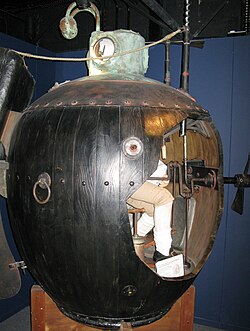
 A cutaway full-sized replica of the Turtle on display at the Royal Navy Submarine Museum, Gosport, UK | |
| History | |
|---|---|
 United States United States | |
| Name | Turtle |
| Namesake | Turtle |
| Builder | David Bushnell |
| Laid down | 1775 251 years ago |
| Launched | 1775 |
| Commissioned | 1775 |
| In service | 1775–1776 |
| Fate | Unknown |
| General characteristics | |
| Class & type | Submarine or Submersible |
| Displacement | 91 kg (201 lb) |
| Length | 3.0 m (9 ft 10 in) |
| Beam | 0.9 m (2 ft 11 in) |
| Propulsion | Hand-cranked propellers |
| Speed | 2.6 kn (4.8 km/h; 3.0 mph) |
| Endurance | 30 min |
| Notes | First submarine with a documented record of use in combat |
Turtle (also called American Turtle) was the world's first submarine,[1] or by modern standards submersible, with a documented record of use in combat. It was built in 1775 by American David Bushnell as a means of attaching explosive charges to ships in a harbor, for use against the Royal Navy during the American Revolutionary War. Connecticut Governor Jonathan Trumbull recommended the invention to George Washington, who provided funds and support for the development and testing of the machine.
Several attempts were made using Turtle to affix explosives to the undersides of British warships in New York Harbor in 1776. All failed, and her transport ship was sunk later that year by the British with the submarine aboard. Bushnell claimed eventually to have recovered the machine, but its final fate is unknown. Modern replicas of Turtle have been constructed and are on display in the Connecticut River Museum, the U.S. Navy's Submarine Force Library and Museum, the Royal Navy Submarine Museum, the International Spy Museum, and the Oceanographic Museum (Monaco).
Development
[edit] | This section relies largely or entirely on a single source. (May 2025) |

American inventor David Bushnell had the idea of a submersible vessel for use in lifting the British naval blockade during the American War of Independence. Bushnell may have begun studying underwater explosions while at Yale College. By early 1775, he had created a reliable method for detonating underwater explosives, a clockwork connected to a musket firing mechanism, probably a flintlock adapted for the purpose.[2]
After the Battles of Lexington and Concord in April 1775, Bushnell began work near Old Saybrook on a small, individually manned submarine designed to attach an explosive charge to the hull of an enemy ship. He wrote to Benjamin Franklin that it would be "Constructed with Great Simplicity and upon Principles of Natural Philosophy."[3]
Little is known about the origin, inspiration, and influences for Bushnell's invention. It seems clear that Bushnell knew of the work of Dutch inventor Cornelis Drebbel.[4] According to Dr. Benjamin Gale, the many brass and mechanical parts of the submarine were built by New Haven inventor Isaac Doolittle,[5] whose shop was just half a block from Yale.[6]
Bushnell is given the overall design credit for the Turtle by Gale and others, but Doolittle was well known as an "ingenious mechanic", engraver, and metalworker.[5] He had designed and manufactured complicated brass-wheel hall-clocks, a mahogany printing-press,[7][8] brass compasses, and surveying instruments. He also owned a brass foundry where he cast bells. At the start of the American Revolution, Doolittle built a gunpowder mill with two partners in New Haven to support the war, and the Connecticut government sent him to prospect for lead.[9]

The design of the Turtle was necessarily shrouded in secrecy,[11] but Doolittle probably designed and crafted the brass and moving parts of the Turtle,[12] including the propulsion system,[13] the navigation instruments,[14] the brass foot-operated water-ballast and forcing pumps,[15] the depth gauge and compass,[16] the brass crown hatch,[17] the clockwork detonator for the mine,[18] and the hand-operated propeller crank and foot-driven treadle with flywheel.[19]
According to a letter from Dr. Benjamin Gale to Benjamin Franklin, Doolittle also designed the mine attachment mechanism, "those Parts which Conveys the Powder, and secures the same to the Bottom of the Ship".[20]
The most historically important innovation in the Turtle was the propeller, as it was the first known use of one in a watercraft. It was described as an "oar for rowing forward or backward", with "no precedent" design.[21] Benjamin Gale described it to Silas Deane as "two oars or paddles" that were "like the arms of a windmill...twelve inches (30 cm) long, and about four (10) wide."[22] Manstan speculates that it was made of brass and was likely designed and forged by Doolittle.[23]
In making the hull, Bushnell enlisted the services of several skilled artisans, including his brother Ezra Bushnell and ship's carpenter Phineas Pratt, both from Saybrook.[24] The hull was "constructed of oak, somewhat like a barrel and bound by heavy wrought-iron hoops."[25] The shape of the hull, Gale informed Silas Deane, "has the nearest resemblance to the two upper shells of a Tortoise joined together."[26]
Turtle was about 10 feet (3.0 m) long (according to the original specifications), 6 feet (1.8 m) tall, and about 3 feet (0.9 m) wide, and consisted of two wooden shells covered with tar and reinforced with steel bands.[27] It dived by allowing water into a bilge tank at the bottom of the vessel and resurfaced by pushing water out through a hand pump. It was propelled vertically and horizontally by hand-cranked and pedal-powered propellers, respectively. It also had 200 pounds (91 kg) of lead aboard, which could be released in a moment to increase buoyancy. It was manned and operated by one person and contained enough air for about 30 minutes. It had a speed in calm water of about 3 mph (2.6 kn; 4.8 km/h).[27]
Six small pieces of thick glass in the top of the submarine provided natural light.[27] The internal instruments had small pieces of bioluminescent foxfire affixed to the needles to indicate their position in the dark. During trials in November 1775, Bushnell discovered that this illumination failed when the temperature dropped too low. He repeatedly requested that Benjamin Franklin suggest possible alternatives, but Franklin did not suggest any and Turtle was sidelined for the winter.[28]
Bushnell's basic design included some elements present in earlier experimental submersibles. The method of raising and lowering the vessel was similar to that developed by Nathaniel Simons in 1729, and the gaskets used to make watertight connections between the internal and external controls may have come from Simons, who constructed a submersible based on a 17th-century Italian design by Giovanni Alfonso Borelli.[29]
Preparation for use
[edit]
Funding was one of Bushnell's central concerns as he planned and constructed the Turtle. Colonial records concerning the Turtle are often short and cryptic, due to efforts to keep it secret from the British, and most of the records that do exist concern Bushnell's request for funds.[30] Bushnell met with Connecticut Governor Jonathan Trumbull during 1771 seeking financial support. Trumbull also sent requests to George Washington and Thomas Jefferson. Jefferson was intrigued by the possibilities, while Washington remained skeptical of devoting funds from the Continental Army, whose funding was already being stretched.
Several setbacks plagued the design process. The mine in particular was delayed several times from its expected completion from 1771 to 1776. Piloting the Turtle, moreover, required great physical stamina and coordination. The operator would have to adjust the bilge in order to keep from sinking while providing propulsion by use of a crank, which worked a propeller on the front of the submarine, and simultaneously directing the submarine with a lever that operated a rudder at the back. The cabin also held air for only 30 minutes of use, after which the operator would have to surface and replenish the air through a ventilator. Training would be needed in order to ensure the project's success due to the complex nature of the machine.
"The boat was moved from Ezra's farm on the Westbrook Road to what is now Ayer's Point in Old Saybrook on the Connecticut River," writes historian Lincoln Diamant.[31] Bushnell did the initial testing of his submarine on the Connecticut River, choosing his brother Ezra as the pilot. In August 1776, Bushnell asked General Samuel Holden Parsons for volunteers to operate Turtle because his brother Ezra was taken ill.[32] Three men were chosen, and the submersible was taken to Long Island Sound for training and further trials.[33] While these trials went on, the British gained control of western Long Island in the August 27 Battle of Long Island, giving them control of New York harbor. Turtle was transported overland from New Rochelle to the Hudson River.
After two weeks of training, Turtle was towed to New York, and Sgt. Ezra Lee prepared to use it to attack HMS Eagle, flagship of the blockade squadron.[34] Destroying this symbol of British naval power by means of a submarine would be a blow to British morale and could threaten the British blockade and control of New York Harbor. The plan was to have Lee surface just behind Eagle's rudder and use a screw to attach an explosive to the ship's hull. Lee would then submerge and make his escape.[35]
Attack on the Eagle
[edit]
At 11:00 pm on September 7, 1776, Sgt. Lee piloted the submersible toward Admiral Richard Howe's flagship HMS Eagle, then maneuvered it out to the anchorage off Governors Island. It took two hours to reach his destination, as it was hard work manipulating the hand-operated controls and foot pedals to propel the submersible. Adding to his difficulties was a fairly strong current and the darkness, which made visibility difficult.
Lee began his mission with only 20 minutes of air, and the darkness, the speed of the currents, and the added complexities all combined to thwart his plan. Once surfaced, Lee lit the fuse on the explosive and tried multiple times to stab the device into the underside of the ship, but he was not able to pierce Eagle's hull. He abandoned the operation when the timer on the explosive was due to go off, and he feared getting caught at dawn. A popular story held that he failed due to the copper lining covering the ship's hull. The Royal Navy had recently begun installing copper sheathing on the bottoms of their warships to protect from damage by shipworms and other marine life; however, the lining was paper-thin and could not have stopped Lee from drilling through it. Bushnell believed that Lee's failure was probably due to an iron plate connected to the ship's rudder hinge.[36] Lee attempted another spot on the hull, but he was unable to stay beneath the ship and eventually abandoned the attempt.
Lee reported that British soldiers on Governors Island spotted the submersible and rowed out to investigate. He then released the charge (called a torpedo), "expecting that they would seize that likewise, and thus all would be blown to atoms."[36] The British were suspicious of the drifting torpedo and retreated back to the island. Lee reported that the charge drifted into the East River, where it exploded "with tremendous violence, throwing large columns of water and pieces of wood that composed it high into the air."[36] It was the first use of a submarine to attack a ship,[29] but the only records documenting it are American. British records contain no accounts of an attack by a submarine or any reports of explosions on the night of the attack on Eagle.[37]
British naval historian Richard Compton-Hall has questioned whether these events even occurred. He claims that the problems of achieving neutral buoyancy would have rendered the vertical propeller useless. The route that Turtle would have taken to attack Eagle was slightly across the tidal stream which would have likely resulted in Lee becoming exhausted.[37] In the face of these and other problems, Compton-Hall suggests that the entire story was fabricated as disinformation and morale-boosting propaganda, and if Lee did carry out an attack it was in a covered rowing boat rather than Turtle.[37]
Despite Turtle's failure, Washington called Bushnell "a Man of great Mechanical Powers, fertile of invention and a master in execution." In retrospect, Washington observed in a letter to Thomas Jefferson: "[Bushnell] came to me in 1776 recommended by Governor Trumbull (now dead) and other respectable characters… Although I wanted faith myself, I furnished him with money, and other aids to carry it into execution. He laboured for some time ineffectually and, though the advocates for his scheme continued sanguine, he never did succeed. One accident or another was always intervening. I then thought, and still think, that it was an effort of genius; but that a combination of too many things were requisite."[38]
Turtle's attack on Eagle reflected both the ingenuity of American forces after the fall of New York and the American tendency to embrace new, sometimes radical, technologies. "What astonishment it will produce and what advantages may be made… if it succeeds, more easy for you to conceive than for me to describe," physician Benjamin Gale wrote to Silas Deane less than a year before Turtle's mission.
Aftermath
[edit]
On October 5, Sergeant Lee again went out in an attempt to attach the charge to a frigate anchored off Manhattan. He reported the ship's watch spotted him, so he abandoned the attempt.
Turtle was lost on October 9, 1776, while aboard the sloop serving as her tender when the Royal Navy frigates HMS Phoenix, HMS Roebuck, and HMS Tartar sank the sloop by gunfire in the Hudson River near Fort Washington on Manhattan[39] and Fort Lee, New Jersey. Bushnell reported salvaging Turtle, but its final fate is unknown.[40] Washington called the attempt "an effort of genius", but "a combination of too many things was requisite" for such an attempt to succeed.[41]
Following Turtle's abortive attack in New York Harbor, Bushnell continued his work in underwater explosives. In 1777, he devised mines to be towed for an attack on HMS Cerberus near New London harbor[42] and to be floated down the Delaware River in an attempt to interrupt the British fleet off Philadelphia.[43] Both attempts failed; On August 13, 1777, a Bushnell floating mine/keg sank a small (captured) schooner/tender to HMS Cerberus, in Black Point Bay, New London, CT killing three sailors and saving 1 man.[44] Regarding the floating mines; the only casualties were two curious young boys who were killed by a mine/keg and alerting the British.[45] The latter attempt occupied a brief, if farcical, place in the literature of the war. Francis Hopkinson's poem "Battle of the Kegs," captured the surprising, if futile, venture: "The soldier flew, the sailor too, and, scared almost to death, sir, wore out their shoes to spread the news, and ran till out of breath, sir."
When the Connecticut government refused to fund further underwater project, Bushnell joined the Continental Army as a captain-lieutenant of sappers and miners, and served with distinction for several years the Hudson River in New York.[46] After the war, Bushnell drifted into obscurity. He visited France for several years, then moved to Georgia in 1795 under the assumed name of David Bush, where he taught school and practiced medicine. He died largely unknown in Georgia in 1824. After the war, inventors such as Robert Fulton were influenced by Bushnell's designs in the development of underwater explosives.[citation needed]
Replicas
[edit]The Turtle was the first submarine used for combat and led to the development of what we know today as the modern submarine, forever changing underwater warfare and the face of naval warfare. As such, the Turtle has been replicated many times to show new audience the roots of submarine technology, how much it has changed, and the influence it has had on modern submarines. By the 1950s, historian of technology Brooke Hindle credited the Turtle as "the greatest of the wartime inventions."[47] The Turtle remains a source of national as well as regional pride, which led to the construction of several replicas, a number of which exist in Bushnell's home state of Connecticut. As Benjamin Gale noted in 1775, the vessel was "constructed with great simplicity," and it has thus inspired at least four replicas.[48] Many of these followed the designs set down by Bushnell, with "precise and comprehensive descriptions of his submarine," which aided the replication process.[49]
The vessel was a source of particular pride in Connecticut. In 1976, a replica of Turtle was designed by Joseph Leary and constructed by Fred Frese as a project marking the United States Bicentennial. It was christened by Connecticut's governor, Ella Grasso, and later tested in the Connecticut River. This replica is owned by the Connecticut River Museum.
In 2002, Rick and Laura Brown, two sculptors from Massachusetts, along with Massachusetts College of Art and Design students and faculty, constructed another replica. The Browns set out to gain a better understanding of human ingenuity while keeping Bushnell's design, materials, and technique authentic. "With it, Yankee ingenuity was born," observed Rick Brown, referring to the latest in a long line of commemoration that perceived the Turtle as something authentically American. Of the temptation to use synthetic and ahistorical materials, Rob Duarte, a MassArts student observed, "It was always a temptation to use silicone to seal the thing. Then you realized that someone else had to figure this out with the same limited resources that we were using. That's just an interesting way to learn. You can't do it any other way than by actually doing it." The outer shell of the replica was hollowed, using controlled fire, from a 12-foot (3.7 m) Sitka spruce. The log was 7 feet (2.1 m) in diameter and shipped from British Columbia. This replica took twelve days to build and was successfully submerged in water. In 2003, it was tested in an indoor test tank at the United States Naval Academy. Lew Nuckols, a professor of Ocean Engineering at USNA, made ten dives, noting "you feel very isolated from the outside world. If you had any sense of claustrophobia it would not be a very good experience."[50] The replica is currently on display at the International Spy Museum in Washington, DC.[51]
In 2003, Roy Manstan, Fred Frese, and the Naval Underwater Warfare Center partnered with students from Old Saybrook High School in Connecticut on a four-year project called The Turtle Project, to construct their own working replica, which they completed and launched in 2007.[52][53]
On August 3, 2007 three men were stopped by police while escorting and piloting a replica based on the Turtle within 200 feet (61 m) of RMS Queen Mary 2, then docked at the cruise ship terminal in Red Hook, Brooklyn. The replica was created by New York artist Philip "Duke" Riley and two residents of Rhode Island, one of whom claimed to be a descendant of David Bushnell. Riley claimed that he wanted to film himself next to the Queen Mary 2 for his upcoming gallery show. Riley's was not an exact replica, however, measuring 8 feet (2.4 m) tall and made of cheap plywood then coated with fiberglass. Its portholes and hatch were collected from a marine salvage company. He also installed pumps to allow him to add or remove water for ballast. Riley christened his vessel Acorn, to note the deviation from Bushnell's original design. The vessel, reported the New York Times, "resembled something out of Jules Verne by way of Huck Finn, manned by cast members from 'Jackass.' The Coast Guard issued Riley a citation for having an unsafe vessel, and for violating the security zone around Queen Mary 2. The NYPD also impounded the submarine. Police Commissioner Raymond W. Kelly, calling this an incident of "marine mischief" assured the public that this was simply an art project and did not, in fact, represent a terrorist threat to the passenger ship.[54]
In 2015, the replica built by Manstan and Frese in 2007 for The Turtle Project was acquired by Privateer Media and used in the television series TURN: Washington's Spies.[55][56] The submarine was shipped to Richmond, where it underwent a full refit and was relaunched for film use in the water. Additional full-scale interior and exterior models were also made by AMC as part of the production.
Also in 2015, Privateer Media used The Turtle Project replica for the Travel Channel series Follow Your Past, hosted by Alison Stewart. Filming took place in August where the submarine was launched with a tether in the Connecticut River in the town of Essex, CT.
-
 1976 functional replica that is now at the Connecticut River Museum
 -
 Cutaway replica at the Submarine Force Library and Museum, Groton, Connecticut
 -
 Cutaway replica at the Oceanographic Museum, Monaco
 -
 2007 functional replica created by Philip "Duke" Riley


Footnotes
[edit]- ^ David Bushnell to Thomas Jefferson, 13 October 1787, with enclosures. "The Submarine Turtle: Naval Documents of the Revolutionary War". history.navy.mil.
{{cite web}}: CS1 maint: multiple names: authors list (link) CS1 maint: numeric names: authors list (link) - ^ Diamant, p. 22
- ^ Roland, Alex (1977). "Bushnell's Submarine: American Original or European Import?". Technology and Culture. 18 (2): 159. doi:10.2307/3103954. JSTOR 3103954. S2CID 112333776.
- ^ Roland, Alex (1977). "Bushnell's Submarine: American Original or European Import?". Technology and Culture. 18 (2): 167. doi:10.2307/3103954. JSTOR 3103954. S2CID 112333776.
- ^ a b Diamant, p. 23
- ^ Manstan, p. 29
- ^ Burns, William E., Science and Technology in Colonial America, Greenwood Publishing Group, 2005, p. 90
- ^ Sanjek, Russell, American popular music and its business: the first four hundred years, Oxford University Press, 1988, p. 364
- ^ Manstan, p. 53
- ^ Rindskopf et al, p. 30
- ^ Manstan, p. 43
- ^ Manstan, pp. 52–53
- ^ Manstan, p. 88
- ^ Manstan, p. 120
- ^ Manstan, pp. 57, 105, 107
- ^ Manstan, pp. 120–123
- ^ Manstan, pp. 109, 110, 112
- ^ Manstan, pp. 131, 136
- ^ Manstan, pp. 194–198
- ^ Mansten, p. 138
- ^ Manstan, p. 150
- ^ Abbot pp. 178–180
- ^ Manstan, p. 93
- ^ Manstan, p. 54
- ^ Milkofsky, Brenda (7 September 2019). "David Bushnell and his Revolutionary Submarine". Connecticuthistory.org.
- ^ Benjamin Gale to Silas Deane, Killingworth, November 9, 1775. "The Submarine Turtle: Naval Documents of the Revolutionary War". history.navy.mil.
{{cite web}}: CS1 maint: multiple names: authors list (link) CS1 maint: numeric names: authors list (link) - ^ a b c Schecter, p. 172
- ^ Diamant, p. 27
- ^ a b Rindskopf et al, p. 29
- ^ Royal R. "Hinman, A Historical Collection, from Official Records", Files, &c. of the Part Sustained by Connecticut, during the War of the Revolution (Hartford, Conn., 1842), pp. 343, 437, 531
- ^ Milkofsky, Brenda. David Bushnell And His Revolutionary Submarine (Connecticut History.org. N.p., 2017).
- ^ Abbot, Thatcher's Journal, p. 185
- ^ Manstan, p. 193
- ^ Manstan, p. 129
- ^ Don Walsh, 2011. "Turtle: David Bushnell's Revolutionary Vessel." Naval History 25, no. 1: 69–70. Academic Search Premier, EBSCOhost
- ^ a b c Schecter, p. 174
- ^ a b c Compton-Hall, pp. 32–40
- ^ "Founders Online: From George Washington to Thomas Jefferson, 26 September 1785". founders.archives.gov.
- ^ Naval History and Heritage Command Dictionary of American Naval Fighting Ships, Turtle I (Submarine) Accessed 12 April 2023
- ^ Diamant, p. 33
- ^ Diamant, p. 34
- ^ Manstan, p. 270
- ^ Manstan, p. 271
- ^ Naval Documents of the American Revolution pp.740-741;746-747
- ^ "Battle of the Kegs 1778". americanrevolution.org. Archived from the original on 2012-10-31.
- ^ Fredriksen, John C., American Military Leaders: From Colonial Times to the Present, ABC-CLIO, 1999, Volume 1, p. 103
- ^ Alex Roland, "Bushnell's Submarine: American Original or European Import," Technology and Culture 18 (April 1977), 158.
- ^ Roland, "Bushnell's Submarine," 159.
- ^ Steven Darian and Amy Price. "David Bushnell: An Inventor Describes His Invention," Technical Communication 35 (November 1988), 344.
- ^ Tom Gidwitz, "The Turtle Dives Again," Archaeology, 58 (May/June 2005): 36–41
- ^ "Bushnell Submarine Turtle". International Spy Museum. Retrieved 2023-03-27.
- ^ Van Nes, Claudia (October 25, 2002). "Plan Salvaged For Submarine Replica". Hartford Courant. Archived from the original on 2017-04-27. Retrieved 2017-04-26.
- ^ "Turtle Reconstruction Image Collection – Index". www.fosa-ct.org.
- ^ Randy Kennedy. "An Artist and his Sub Surrender in Brooklyn," New York Times. August 4, 2007.
- ^ TURN: Washington's Spies
- ^ TURN: Turtle Submarine
References
[edit]
- "Submarine Turtle Naval Documents". Naval History and Heritage Command. Retrieved 26 April 2017.
- Abbot, Henry L. (1966). Beginning of Modern Submarine Warfare under Captain Lieutenant David Bushnell. Hamden, CT: Acrhon Books.
- Coggins, Jack (2002). Ships and Seamen of the American Revolution. Mineola, NY: Courier Dover Publications. ISBN 978-0-486-42072-1. OCLC 48795929.
- Compton-Hall, Richard (1999). The Submarine Pioneers. Sutton Publishing. ISBN 0-7509-2154-4.
- Diamant, Lincoln (2004). Chaining the Hudson: The Fight for the River in the American Revolution. New York: Fordham University Press. ISBN 978-0-8232-2339-8. OCLC 491786080.
- Manstan, Roy R.; Frese, Frederic J. (2010). Turtle: David Bushnell's Revolutionary Vessel. Yardley, Pa: Westholme Publishing. ISBN 978-1-59416-105-6. OCLC 369779489.
- Rindskopf, Mike H; Naval Submarine League (U.S.); Turner Publishing Company staff; Morris, Richard Knowles (1997). Steel Boats, Iron Men: History of the U.S. Submarine Force. Paducah, KY: Turner Publishing. ISBN 978-1-56311-081-8. OCLC 34352971.
- Schecter, Barnet (2002). The Battle for New York. New York: Walker. ISBN 0-8027-1374-2.
- Sleeman, Charles (1880). Torpedoes and torpedo warfare. Portsmouth, UK: Griffin. OCLC 4041073.
- "Turtle I (Submarine)". Dictionary of American Naval Fighting Ships. Navy Department, Naval History and Heritage Command. 19 October 2015. Retrieved 29 June 2010.
- "Connecticut River Museum – David Bushnell's Turtle". Connecticut River Museum. Archived from the original on 2007-11-29. Retrieved 2010-08-27.
- "Makeshift submarine found in East River". WABC-TV. 2007-08-03. Archived from the original on May 30, 2012. Retrieved 2010-08-27.
- "TURN: Washington's Spies – Spycraft Handbook – The Turtle". TURИ: Washington's Spies. AMC. May 2015. Archived from the original on 26 April 2016. Retrieved 27 April 2016.
- "TURN: Turtle submarine". TURИ to a historian. June 4, 2015. Retrieved 27 April 2016.
- Roland, Alex. "Bushnell's Submarine: American Original or European Import."Technology and Culture 18 (April 1977): 157–74.
- Kennedy, Randy. "An Artist and His Sub Surrender in Brooklyn." The New York Times, August 4, 2007.
- Gidwitz, Tom. "The Turtle Dives Again." Archaeology, May/June 2005.
- Darian, Steven, and Amy Price. "David Bushnell: An Inventor Describes His Invention." Technical Communication, vol. 35, no. 4, 1988, p. 344, JSTOR 43087154
- "Submarine Turtle Reconstruction". Friends of the Office of State Archaeology.
- Van Nes, Claudia. "Plan Salvaged For Submarine Replica". Hartford Courant. Archived from the original on 2017-04-27. Retrieved 2017-04-26.
| International | |
|---|---|
| National | |

Turtle (submersible)
View on GrokipediaHistorical Context
Naval Warfare in the American Revolutionary War
The Royal Navy entered the American Revolutionary War with overwhelming superiority, possessing approximately 270 warships in 1776 compared to the Continental Navy's mere 27 vessels.[4] This disparity in numbers, combined with British crews' superior training, gunnery, and tactical aggression, enabled the Royal Navy to dominate maritime operations, including amphibious support for ground forces and enforcement of blockades that crippled colonial trade and supply lines.[5] Britain's naval strategy prioritized control of key coastal ports to isolate rebel armies and economies, leveraging global shipbuilding capacity to maintain fleet strength despite European distractions.[6] The Continental Navy, established by Congress on October 13, 1775, played a limited role due to its small size—peaking at 31 vessels by 1777—and lack of heavy warships capable of challenging British squadrons.[7] American maritime efforts instead relied heavily on over 2,000 privateers commissioned across the colonies, which focused on commerce raiding rather than fleet engagements, capturing hundreds of British merchant vessels but failing to contest naval supremacy.[7] State navies and riverine forces supplemented this, but colonial shipyards produced few ocean-going combatants, leaving harbors vulnerable to uncontested British incursions. In 1776, this imbalance manifested acutely during the New York campaign, where Admiral Richard Howe's fleet of over 30 warships arrived in July, facilitating the transport of 32,000 troops and imposing a de facto blockade on the harbor after the British victory at the Battle of Long Island on August 27.[8] George Washington had anticipated such a blockade, recognizing its potential to sever New York from allied support and strangle Continental communications along the Hudson River.[8] Anchored British flagships, including HMS Eagle, became symbols of this dominance, prompting unconventional American innovations like submersible attacks to target them at rest, as direct confrontation remained infeasible.[9]Design and Construction
Invention and Development
David Bushnell, born August 8, 1742, in Saybrook, Connecticut (now Westbrook), pursued formal education later in life, enrolling at Yale College around 1771 after working as a farmer and displaying an aptitude for natural philosophy and explosives experimentation. While studying mathematics and philosophy there, Bushnell conceived the Turtle submersible in 1775 as a response to the American colonies' need for innovative naval tactics against the superior British fleet during the Revolutionary War, aiming to deliver underwater explosives without surface exposure.[10][11][12] Construction commenced in early 1775 under Bushnell's direction, with assistance from his brother Ezra Bushnell for the hull and local clockmaker and mechanic Isaac Doolittle for the internal mechanisms, including hand-cranked propellers and valves; shipwright Phineas Pratt contributed to the time-keeping devices for underwater navigation. The ovoid vessel, resembling a turtle, was fashioned from a single large oak log sawn in half and hollowed, reinforced with iron hoops, and sealed with tarred oakum and salvaged brass or copper plating to achieve waterproofing, measuring approximately 7.5 feet long and 3 feet wide.[10][12][13] The Turtle incorporated pioneering features such as water ballast tanks for submersion—filled and emptied via hand pumps—and dual screw propellers for propulsion and depth adjustment, powered by the operator's foot treadle and hand cranks, enabling travel at about 1.5 knots submerged for up to 30 minutes before resurfacing for air. Initial trials in the Connecticut River near Saybrook in late 1775 confirmed basic functionality, including submersion to 20 feet and horizontal movement, though Bushnell's personal attempts revealed challenges with operator endurance and equilibrium due to his susceptibility to motion sickness.[3][13][14] Parallel development focused on the explosive delivery system: a wooden keg-shaped "torpedo" containing 100 to 150 pounds of black powder, fitted with a flintlock igniter triggered by a clockwork timer or drill auger to pierce a ship's copper-sheathed hull for attachment. This mine, tested successfully against stationary targets, represented Bushnell's prior work on floating gunpowder kegs, refined for submersible deployment to enhance stealth and reliability against moving vessels.[3][11][13]Technical Specifications and Innovations
The Turtle submersible, constructed primarily from oak timbers six inches thick, was reinforced with iron bands and coated in tar for waterproofing, forming a pear-shaped hull resembling two joined tortoise shells.[3][13] Its dimensions measured approximately 7.5 feet in length and 6 feet in height, with an elliptical hatch secured by brass screws providing access for the single operator.[3] The vessel incorporated 900 pounds of lead ballast, including 200 pounds detachable for emergency surfacing, and featured eight glass-paned brass windows for visibility.[3][13] Propulsion relied on a hand-cranked or foot-treadle-operated screw propeller, approximately 12 inches long and 4 inches broad, enabling forward and backward motion at speeds up to 3 knots in short bursts, though typically around 2 knots.[3][13] A vertical propeller or auxiliary mechanism assisted in depth adjustments, marking the first use of a screw propeller in a submersible for underwater maneuverability.[3] Diving was achieved by admitting seawater through a foot-operated valve into the hull, functioning as a primitive ballast system, with two brass force pumps used to expel water for ascent; a barometer-like depth gauge with a phosphorus-illuminated cork float aided submersion control to depths of about 20 feet.[3][13] Innovations included an early air supply system with two valved pipes and a ventilator, providing roughly 30 minutes of breathable air, supplemented by manual bellows if needed.[3][13] The armament consisted of a detachable "torpedo"—an egg-shaped time bomb containing 150 pounds of gunpowder, armed with a clockwork fuse and attached to enemy hulls via a hand-turned auger or woodscrew drill, representing the first attempt at submersible-delivered explosive ordnance.[3] These features established foundational principles for submarine warfare, including controlled submergence via water ballast and mechanical propulsion independent of surface effects, despite the operator's physical exertion limiting endurance.[3][13]| Key Specifications | Description |
|---|---|
| Hull Material | Oak, iron-reinforced, tarred |
| Dimensions | ~7.5 ft length × 6 ft height |
| Ballast | 900 lbs lead (200 lbs detachable) |
| Propulsion Speed | 2–3 knots |
| Air Supply Duration | ~30 minutes |
| Armament | 150 lbs gunpowder time bomb |