Hubbry Logo
Body planBody planMain
Open search
Body plan
Community hub
Body plan
logo
8 pages, 0 posts
0 subscribers
Be the first to start a discussion here.
Body plan
Body plan
from Wikipedia
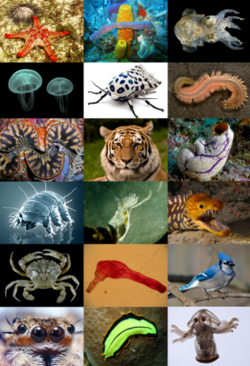
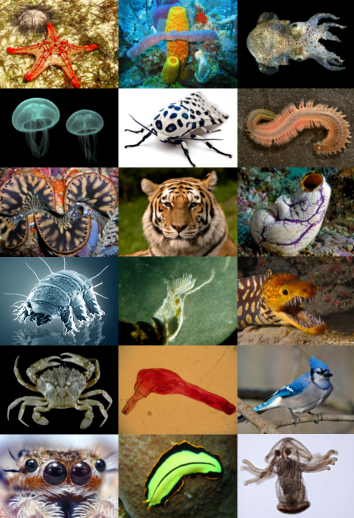
Modern groups of animals can be grouped by the arrangement of their body structures, so are said to possess different body plans.

A body plan, Bauplan (pl.German: Baupläne), or ground plan is a set of morphological features common to many members of a phylum of animals.[1] The vertebrates share one body plan, while invertebrates have many.

This term, usually applied to animals, envisages a "blueprint" encompassing aspects such as symmetry, layers, segmentation, nerve, limb, and gut disposition. Evolutionary developmental biology seeks to explain the origins of diverse body plans.

Body plans have historically been considered to have evolved in a flash in the Ediacaran biota; filling the Cambrian explosion with the results, and a more nuanced understanding of animal evolution suggests gradual development of body plans throughout the early Palaeozoic. Recent studies in animals and plants started to investigate whether evolutionary constraints on body plan structures can explain the presence of developmental constraints during embryogenesis such as the phenomenon referred to as phylotypic stage.

History

[edit]

Among the pioneering zoologists, Linnaeus identified two body plans outside the vertebrates; Cuvier identified three; and Haeckel had four, as well as the Protista with eight more, for a total of twelve. For comparison, the number of phyla recognised by modern zoologists has risen to 36.[1]

Linnaeus, 1735

[edit]

In his 1735 book Systema Naturæ, Swedish botanist Linnaeus grouped the animals into quadrupeds, birds, "amphibians" (including tortoises, lizards and snakes), fish, "insects" (Insecta, in which he included arachnids, crustaceans and centipedes) and "worms" (Vermes). Linnaeus's Vermes included effectively all other groups of animals, not only tapeworms, earthworms and leeches but molluscs, sea urchins and starfish, jellyfish, squid and cuttlefish.[2]

Cuvier, 1817

[edit]
Haeckel's 'Monophyletischer Stammbaum der Organismen' from Generelle Morphologie der Organismen (1866) with the three branches Plantae, Protista, Animalia

In his 1817 work, Le Règne Animal, French zoologist Georges Cuvier combined evidence from comparative anatomy and palaeontology[3] to divide the animal kingdom into four body plans. Taking the central nervous system as the main organ system which controlled all the others, such as the circulatory and digestive systems, Cuvier distinguished four body plans or embranchements:[4]

  1. with a brain and a spinal cord (surrounded by skeletal elements)[4]
  2. with organs linked by nerve fibres[4]
  3. with two longitudinal, ventral nerve cords linked by a band with two ganglia below the oesophagus[4]
  4. with a diffuse nervous system, not clearly discernible[4]

Grouping animals with these body plans resulted in four branches: vertebrates, molluscs, articulata (including insects and annelids) and zoophytes or Radiata.

Haeckel, 1866

[edit]

Ernst Haeckel, in his 1866 Generelle Morphologie der Organismen, asserted that all living things were monophyletic (had a single evolutionary origin), being divided into plants, protista, and animals. His protista were divided into moneres, protoplasts, flagellates, diatoms, myxomycetes, myxocystodes, rhizopods, and sponges. His animals were divided into groups with distinct body plans: he named these phyla. Haeckel's animal phyla were coelenterates, echinoderms, and (following Cuvier) articulates, molluscs, and vertebrates.[5]

Gould, 1979

[edit]

Stephen J. Gould explored the idea that the different phyla could be perceived in terms of a Bauplan, illustrating their fixity. However, he later abandoned this idea in favor of punctuated equilibrium.[6]

Origin

[edit]

20 out of the 36 body plans originated in the Cambrian period,[7] in the "Cambrian explosion".[8] However, complete body plans of many phyla emerged much later, in the Palaeozoic or beyond.[9]

The current range of body plans is far from exhaustive of the possible patterns for life: the Precambrian Ediacaran biota includes body plans that differ from any found in currently living organisms, even though the overall arrangement of unrelated modern taxa is quite similar.[10] Thus the Cambrian explosion appears to have more or less completely replaced the earlier range of body plans.[7]

Genetic basis

[edit]

Genes, embryos and development together determine the form of an adult organism's body, through the complex switching processes involved in morphogenesis.

Developmental biologists seek to understand how genes control the development of structural features through a cascade of processes in which key genes produce morphogens, chemicals that diffuse through the body to produce a gradient that acts as a position indicator for cells, turning on other genes, some of which in turn produce other morphogens. A key discovery was the existence of groups of homeobox genes, which function as switches responsible for laying down the basic body plan in animals. The homeobox genes are remarkably conserved between species as diverse as the fruit fly and humans, the basic segmented pattern of the worm or fruit fly being the origin of the segmented spine in humans. The field of animal evolutionary developmental biology, which studies the genetics of morphology in detail, is rapidly expanding[11] with many of the developmental genetic cascades, particularly in the fruit fly Drosophila, catalogued in considerable detail.[12]

See also

[edit]

References

[edit]
[edit]
Revisions and contributorsEdit on WikipediaRead on Wikipedia
from Grokipedia
A body plan, or Bauplan, refers to a suite of morphological features shared by phylogenetically related animals, particularly at the level of phyla, that define the fundamental structural organization of their bodies during development. This blueprint encompasses the arrangement of tissues, organs, and body axes, emerging through embryonic stages and constraining evolutionary possibilities while enabling diversification within major animal groups. In animals, body plans are notably conserved since the around 540 million years ago, with variations arising from developmental mechanisms studied in (Evo-Devo). Key aspects of animal body plans include symmetry, germ layers, body cavities, and segmentation, which together determine an organism's form and function. Symmetry describes how body parts are arranged relative to axes: asymmetrical plans lack defined planes (e.g., sponges), radial symmetry allows mirroring around a central axis (e.g., jellyfish in phylum Cnidaria), and bilateral symmetry features one sagittal plane dividing mirror-image halves, often with cephalization (e.g., vertebrates). Germ layers, established during gastrulation, include two in diploblastic animals like cnidarians (ectoderm and endoderm) or three in triploblastic ones like most bilaterians (adding mesoderm for muscle and organ support). Body cavities provide internal space: acoelomates have none (e.g., flatworms), pseudocoelomates have a partial fluid-filled cavity (e.g., roundworms in Nematoda), and coelomates feature a true coelom lined by mesoderm (e.g., earthworms in Annelida). Segmentation, seen in phyla like Arthropoda and Chordata, divides the body into repeating units, enhancing flexibility and specialization. These elements not only classify animals into clades like Protostomia and Deuterostomia but also influence ecological roles, from locomotion to predation.

Fundamentals

Definition and Scope

A body plan refers to the fundamental blueprint or architectural organization of an organism's body, defined as a suite of characters shared by a group of phylogenetically related animals at some point during their development. This encompasses the spatial arrangement of tissues, organs, and systems that establish the core structural framework, serving as a template for morphological form across related taxa. The scope of body plans is confined to multicellular animals, known as Metazoa, which are characterized by complex tissue structures and diverse body plans arising from their multicellular organization. Unlike , fungi, or microbes, which exhibit fundamentally different organizational principles such as cell walls or unicellularity, metazoan body plans emphasize hierarchical arrangements of specialized cells into tissues and organs, recognized across approximately 35 living animal . These plans act as archetypes that constrain morphological diversity by channeling developmental variation into conserved patterns, limiting the range of possible forms within each . Representative archetypes include the poriferan body plan of sponges (phylum Porifera), which lacks true tissues and exhibits a simple, asymmetrical or radially organized structure with choanocyte-lined chambers; the radial body plan of (phylum ), featuring a sac-like body with oral-aboral polarity and stinging cells; and the bilaterian body plan, which dominates most metazoans and includes bilateral symmetry with anterior-posterior, dorsal-ventral, and left-right axes, manifested in non-segmented forms like chordates or segmented forms like arthropods. This underlying template is distinct from the broader , which encompasses variable traits such as size, color, or minor adaptations that do not alter the core architectural organization.

Key Structural Features

The body plan of most animals is fundamentally organized along three primary axes that establish spatial polarity and orientation: the anteroposterior (AP) axis, which runs from head to tail; the dorsoventral (DV) axis, extending from back to belly; and the left-right (LR) axis, which differentiates the two sides of the body. These axes provide a for development and function, ensuring that organs, tissues, and appendages are positioned correctly relative to one another. In bilaterian animals, which exhibit bilateral symmetry, these axes are orthogonally arranged to form a near-Cartesian framework that supports complex body organization. A key modular feature in the body plans of certain animal phyla is segmentation, where the body is divided into repeating units that enhance flexibility, locomotion, and specialization. This is evident in annelids, such as earthworms, where segments consist of repeated sets of organs including coelomic cavities, nephridia, and musculature; in , like and crustaceans, where segments bear jointed appendages; and in vertebrates, where somites give rise to the vertebral column and associated structures. Segmentation allows for independent movement and repair, contributing to the adaptive success of these groups. Often, segments fuse into functional units called tagmata through a process known as tagmosis, as seen in where the head (cephalon), , and form specialized regions for sensing, locomotion, and , respectively. This fusion optimizes efficiency by integrating multiple segments into cohesive tagmata, varying across arthropod lineages such as the three tagmata in versus the two in spiders. Appendages represent another critical structural element, evolving to serve diverse roles in locomotion, feeding, and environmental interaction while reflecting phylogenetic constraints. In arthropods, jointed limbs originated from lobopodian ancestors and diversified into biramous structures, enabling walking, swimming, and grasping, as exemplified by the paired legs of and the modified of arachnids. In vertebrates, limbs arose independently through the elaboration of buds in early tetrapodomorphs, adapting for terrestrial support and manipulation, such as the pentadactyl pattern in mammals. These appendages highlight in function despite distinct developmental origins, underscoring their role in expanding ecological niches. Central to understanding body plans is the concept of the Bauplan, or ground plan, which refers to the invariant core blueprint of morphological features shared among related taxa and conserved through both individual development () and evolutionary history (phylogeny). This framework captures essential organizational principles, such as axial patterning and modular elements, that constrain variation while allowing adaptive modifications within phyla. For instance, the Bauplan of arthropods emphasizes an exoskeletal, segmented structure with appended limbs, persisting across diverse forms from trilobites to modern crustaceans. In evo-devo, the Bauplan serves as a foundational unit for analyzing how developmental mechanisms generate phylogenetic diversity without altering fundamental architecture.

Classification

Symmetry and Organization

Body plans in animals are fundamentally classified by their symmetry, which determines the organization of body axes and overall layout. Asymmetry represents the most primitive form, observed in phylum Porifera (sponges), where organisms lack defined body axes or planes of symmetry, resulting in irregular shapes adapted to sessile lifestyles. This asymmetry underscores their basal position in metazoan phylogeny. Radial characterizes non-bilaterian phyla such as (jellyfish, corals, anemones), where the body is organized around a central oral-aboral axis with multiple longitudinal planes of . In these organisms, any plane passing through the oral (mouth) end and aboral (opposite) end divides the body into mirror-image halves, facilitating a lifestyle often involving floating or sessile attachment. For instance, in hydrozoan like Podocoryne carnea, the oral-aboral axis is established early in development by determinants at the animal pole of the egg, polarizing the body such that the oral end derives from the blastula's animal region. This supports efficient prey capture and environmental sensing, with sensory and feeding structures concentrated around the oral pole. Ctenophora (comb jellies) exhibit biradial , organized around an oral-aboral axis with two perpendicular planes of (sagittal and tentacular), blending elements of radial and bilateral organization. This arrangement aids in propulsion via comb plates and supports their pelagic lifestyle. Bilateral defines the clade , encompassing most animal phyla, and introduces a single plane of dividing the body into distinct left and right halves, along with anterior-posterior, dorsal-ventral, and left-right axes. This organization promotes , the concentration of sensory organs and at the anterior "head" end, enhancing directed locomotion and environmental interaction. In bilaterians, such as arthropods and vertebrates, left-right differentiation allows for specialized organ placement, like the heart's consistent positioning, and supports complex behaviors through asymmetric neural control. The evolutionary advantage lies in improved maneuverability, as bilateral forms can execute precise front-back and left-right movements, contrasting with the omnidirectional capabilities of radial . Variations like biradial symmetry occur in certain taxa, blending elements of radial and bilateral organization. Biradial symmetry, a specific variant, features two perpendicular planes of symmetry and is evident in echinoderm classes like Crinoidea (sea lilies), where the body combines radial arms with a bilateral stalk, or in some irregular echinoids with offset anal structures. This hybrid layout supports sessile or slow-moving habits while retaining elements of ancestral bilaterality, illustrating evolutionary flexibility in body plan organization. In adult echinoderms, larval bilateral symmetry transforms into pentaradial patterns during metamorphosis.

Germ Layers and Cavities

The body plan of metazoan animals originates from embryonic germ layers formed during , which establish the foundational tissues and organs. In most animals, these layers comprise the , , and , each differentiating into specific structures. The gives rise to the outer covering of the body, such as the and associated structures, as well as the , including the and sensory organs. The develops into internal supportive and contractile tissues, including skeletal and smooth muscles, the with blood vessels and heart, and components of the excretory and reproductive systems. The forms the lining of the digestive tract and associated glands, as well as parts of the in vertebrates. Cnidarians, such as and corals, exhibit a diploblastic body plan characterized by only two germ layers: an outer and an inner , separated by a gelatinous , which lacks true mesodermal tissues. In contrast, bilaterian animals, including protostomes and deuterostomes, possess a triploblastic organization with the addition of a layer between the and , enabling greater complexity in organ formation and locomotion. This triploblastic condition is associated with bilateral , allowing for more efficient directional movement and sensory integration. Within triploblastic animals, further diversify internal organization by providing space for organ development and fluid-mediated functions. Acoelomate animals, such as flatworms (Platyhelminthes), lack a dedicated , with the space between the gut and body wall filled by a solid mass of al parenchyma, limiting organ independence and relying on for nutrient transport. Pseudocoelomate organisms, exemplified by nematodes (roundworms), feature a pseudocoelom—a fluid-filled cavity not fully lined by —derived from the and serving as a for movement and pressure regulation. Coelomate animals, such as annelids (segmented worms) and vertebrates, possess a true , a fluid-filled cavity entirely lined by , which suspends and cushions internal organs, facilitates independent organ movement, and supports peristaltic locomotion. The evolution of the in triploblastic lineages marked a significant advancement, enhancing organ support, nutrient distribution, waste removal, and muscular coordination for more active lifestyles, as seen in the transition from simpler acoelomate forms to complex coelomate body plans in advanced bilaterians.

Evolutionary Origins

Precambrian and Early Metazoan Plans

The emergence of metazoan body plans traces back to the era, with molecular clock analyses estimating the divergence of the last common ancestor of animals (Metazoa) between approximately 600 and 1000 million years ago (Mya), with recent analyses suggesting origins as late as the early (~600 Ma), during the to periods of the . These estimates, derived from phylogenomic data calibrated against records, suggest that early multicellular animals arose well before the appearance of macroscopic fossils, potentially in low-oxygen environments that limited their size and preservation. Genetic foundations, such as conserved signaling pathways, likely underpinned these initial innovations in cellular organization, though details of their deployment in Precambrian forms remain inferred from modern homologs. The biota, flourishing from about 575 to 542 Mya in the late , provides the earliest direct evidence of complex soft-bodied metazoan body plans, preserved as impressions in marine sediments. These organisms exhibited diverse morphologies, including frond-like rangeomorphs with fractal-branching structures up to 2 meters tall, interpreted as upright, photosynthetic or osmotrophic feeders anchored to the seafloor, and discoidal forms like and , which displayed quilted, leaf-like or segmented appearances suggestive of epithelial tissues. evidence, including steranes from eukaryotic , confirms that at least some Ediacaran taxa, such as , were early animals capable of , marking a shift toward animal-like body . Hypotheses position early metazoan ancestors as resembling modern sponges (Porifera), with simple, asymmetrical, filter-feeding body plans lacking true tissues, or basal cnidarians, featuring radial symmetry and basic diploblastic organization. Some evidence, such as debated demosponge biomarkers dating to ~650 Mya, has been proposed to support sponge-like affinities for early forms, though their specificity to sponges remains contested; more recent analyses as of 2025 have identified C30 and C31 sterols as reliable sponge biomarkers in rocks dating back to approximately 635 Ma. while cnidarian-like traits appear in medusoid impressions. Notably, definitive bilaterian body fossils—characterized by bilateral symmetry and triploblastic structure—are absent from Precambrian deposits prior to the latest Ediacaran, with only rare, debated traces like Kimberella suggesting possible early bilaterian activity around 555 Mya. A key environmental trigger for these early body plans was the Oxygenation Event (NOE), around 800–540 Mya, which elevated atmospheric and oceanic oxygen levels sufficiently to support metazoan multicellularity by enabling aerobic and larger body sizes. This oxygenation, linked to the "" aftermath and glaciations, facilitated the of oxygen-dependent enzymes and tissues, transitioning from unicellular or colonial precursors to structured metazoan forms. Without this shift, the metabolic demands of complex body plans would have been untenable in the prevailing low-oxygen oceans.

Cambrian Diversification

The , spanning approximately 541 to 485 million years ago, represents a pivotal phase in the evolution of animal body plans, marked by the rapid appearance and diversification of bilaterian phyla in the fossil record. Exceptional preservation in lagerstätten such as the in (dating to about 508 million years ago) and the Chengjiang biota in (about 518 million years ago) reveals early representatives of major lineages, including arthropod-like forms such as with its and flaps, annelid precursors like Canadia spinosa exhibiting segmented bodies, and chordate ancestors such as Pikaia gracilens displaying a notochord-like structure. These fossils illustrate the establishment of complex bilaterian architectures, transitioning from simpler forms to diverse morphologies that underpin modern phyla. During this period, the divergence between protostome and deuterostome body plans became evident, distinguished primarily by embryonic cleavage patterns and blastopore fate. Protostomes, including early arthropods and annelids, feature spiral cleavage where cells divide at oblique angles, leading to a mouth forming from the blastopore (mouth-first development). In contrast, deuterostomes, represented by primitive chordates, exhibit radial cleavage with cells aligning directly atop one another, resulting in an anus from the blastopore (anus-first development). Fossil evidence from Chengjiang, such as vetulicolians with deuterostome-like features, supports this split occurring around the early Cambrian, setting the stage for distinct superphyla. Key morphological innovations during the facilitated the occupation of new ecological niches and the proliferation of body plan variants. The development of sclerites—small, mineralized plates providing protective exoskeletons—appeared in early arthropods and lobopodians, enhancing durability against predation. Compound eyes, as seen in radiodonts like with their large, multifaceted visual systems, improved sensory capabilities for hunting in marine environments. Segmented appendages, evident in fossils like with biramous limbs, enabled enhanced locomotion, feeding, and manipulation, driving ecological diversification among bilaterians. These traits, often co-opted from pre-existing genetic toolkits, allowed for rapid adaptive radiations. The tempo of this diversification remains debated, with evidence supporting both punctuated and gradual models, influenced by underlying genetic constraints. Proponents of a punctuated burst highlight the concentration of body plan origins within the first 20 million years of the , as seen in the sudden appearance of disparate morphologies in assemblages, suggesting an explosive event triggered by environmental changes. Others argue for a more gradual buildup, citing estimates placing bilaterian divergences earlier and fossil gradients from small, soft-bodied forms to complex plans. Genetic factors, including conserved regulatory networks like clusters, are thought to have limited novelty by stabilizing emergent plans rather than permitting endless variation, contributing to the relatively static phyla-level diversity post-.

Developmental Mechanisms

Genetic Foundations

The body plan of multicellular organisms is established during embryogenesis through a hierarchical process of differential and , which patterns cells into organized tissues and structures. This involves gene regulatory networks (GRNs) that integrate spatial cues and temporal signals to specify cell fates along embryonic axes. Maternal-effect s, transcribed in the mother's ovaries and deposited into the egg, initiate this patterning by establishing the primary body axes before zygotic transcription begins. In the fruit fly , a model for studying these mechanisms, maternal-effect genes such as bicoid define anteroposterior polarity. The bicoid mRNA localizes to the anterior pole of the , and its translation forms a protein that activates downstream genes in a concentration-dependent manner, promoting anterior structures like the head and while repressing posterior ones. This exemplifies how signaling—diffusible molecules that elicit different responses based on concentration—guides early axis formation across . Zygotic segmentation genes then refine this initial polarity into a segmented body plan. In Drosophila, gap genes respond first to maternal gradients, dividing the embryo into broad regions; pair-rule genes subdivide these into pairs of segments; and segment polarity genes establish boundaries and polarity within each segment. Mutations in these classes disrupt specific patterns: gap gene mutants lack contiguous body regions, pair-rule mutants delete alternating segments, and segment polarity mutants affect intra-segmental organization. A key feature of body plan evolution is the deep conservation of developmental "toolkit" genes—regulatory genes like transcription factors and signaling components—across diverse phyla, despite morphological differences. These shared genes, such as those in Wnt, , and BMP pathways, enable similar patterning logics from comparable genomic toolkits, facilitating evolutionary diversification through regulatory changes rather than novel genes. For instance, homologs of Drosophila segmentation regulators operate in vertebrates to pattern somites, underscoring the ancient origins of these mechanisms.

Hox Genes and Patterning

Hox genes serve as master regulators that specify regional identities along the anterior-posterior axis of animal body plans during development. These genes are organized into clusters on chromosomes, with their linear arrangement mirroring the sequential body regions they control. In the fruit fly , eight are clustered linearly on , corresponding to thoracic and abdominal segments. In humans, the 39 are distributed across four paralogous clusters on different chromosomes, reflecting an expanded that patterns the vertebrate body axis. A key feature of Hox gene function is the colinearity principle, which links the physical order of genes in the cluster to their expression patterns. Spatial colinearity ensures that 3'-located (anterior) genes are expressed in head and anterior regions, while 5'-located (posterior) genes activate in and posterior areas. Temporal colinearity complements this by activating genes sequentially from 3' to 5' during embryogenesis, establishing progressive patterning along the body axis. This coordinated expression is crucial for maintaining proper segment identities and preventing developmental disruptions. Mutations in Hox genes can lead to homeotic transformations, where one body part develops in place of another, dramatically altering the body plan. The classic Antennapedia mutation in Drosophila causes ectopic expression of the Antp gene, resulting in legs growing from the head instead of antennae. Such transformations highlight the precise role of Hox genes in specifying appendage and segment identities, with dominant alleles often linked to chromosomal inversions that misregulate gene expression. The evolutionary expansion of Hox clusters through duplications has paralleled increasing bilaterian complexity. The last common bilaterian ancestor likely possessed a single cluster of proto-, which underwent tandem and whole-genome duplications to generate multiple paralogous genes in vertebrates. This proliferation, including two rounds of genome duplication in early vertebrates, enabled finer-grained patterning of diverse body plans, from segmented to complex chordates. Retention of duplicated clusters correlates with morphological innovations, underscoring ' role in adaptive diversification.

Historical Development

Early Classifications

The foundational efforts to classify body plans emerged in the with Carl Linnaeus's (1735), which established a hierarchical for organizing living organisms based on shared morphological traits such as structural similarities in organs and overall form. This system implicitly grouped animals by resemblances in body organization, dividing the animal kingdom into classes like Mammalia and Aves, though it prioritized reproductive structures and external features over comprehensive body plan analysis. Linnaeus's approach laid the groundwork for later comparative studies by emphasizing observable morphology as a basis for natural affinities, without invoking evolutionary processes. In the early 19th century, advanced this framework in Le Règne Animal (1817), proposing four major embranchements—Vertebrata, , Articulata, and Radiata—classified according to distinct types of body organization and tissue arrangements, such as the presence of a backbone or radial . Cuvier's system stressed functional correlations within these plans, arguing that each embranchement represented a fundamentally separate architectural blueprint incompatible with transitions between them, thereby emphasizing fixed, discontinuous categories derived from anatomical dissections. Richard Owen further developed these ideas in the 1840s through his concept of the , positing ideal, divinely inspired templates that underlay the variations in body plans, as explored in works like On the Nature of Limbs (1849). Owen's archetypes served as abstract models in , highlighting homologies—such as the pentadactyl limb structure across tetrapods—as manifestations of a universal skeletal plan, influencing the shift toward structuralist interpretations of morphology. These early classifications, however, were inherently pre-Darwinian, treating body plans as static, immutable categories ordained by creation rather than shaped by descent with modification, which limited their ability to account for intermediate forms or dynamic change. This static perspective persisted until later theories, such as Haeckel's gastraea in the , began bridging morphology with developmental origins.

Modern Conceptual Advances

In the mid-19th century, advanced the understanding of body plans by integrating Darwinian evolution with embryology through his Gastraea hypothesis, outlined in Generelle Morphologie der Organismen (1866). He proposed that all metazoans descended from a hypothetical common ancestor, the Gastraea, a two-layered organism resembling the gastrula stage of embryonic development, with an outer and inner surrounding a central cavity. This framework posited homology of the primary germ layers across animal phyla, linking ontogenetic stages to phylogenetic ancestry and suggesting that body plan diversity arose through modifications of this ancestral form. Haeckel's ideas marked a shift toward viewing body plans as dynamic outcomes of shared developmental processes rather than static archetypes, influencing subsequent evolutionary morphology. The early 20th century saw a lull in such integrative approaches, but revived the discussion in Ontogeny and Phylogeny (1977), critiquing strict recapitulation while emphasizing as a pivotal mechanism in body plan evolution. refers to evolutionary changes in the timing, rate, or onset of developmental events, which Gould argued could produce major morphological shifts, such as paedomorphosis (retention of juvenile traits in adults) or peramorphosis (extension of growth beyond ancestral patterns), thereby generating novel body plans. He highlighted developmental constraints—biases imposed by the sequential nature of —that limit the range of feasible evolutionary modifications, explaining why certain body plan innovations, like those emerging during the , appear abruptly in the fossil record. Gould's analysis underscored that phylogeny is not merely additive but shaped by alterations in developmental timing, bridging and in ways that anticipated evo-devo. The rise of (evo-devo) in the late 20th and early 21st centuries synthesized these foundations into a modern framework, portraying body plans as products of modular genetic regulatory networks that integrate environmental cues with conserved developmental pathways. Douglas H. Erwin and James W. Valentine contributed significantly to this synthesis in The Cambrian Explosion: The Construction of Animal (2013), drawing on genomic, , and experimental data to demonstrate how body plans emerge from hierarchical modules—discrete genetic circuits controlling cell specification, patterning, and —that were likely assembled prior to the diversification of phyla. They argued that these modules enable both conservation of core architectures (e.g., bilaterian tripartite gut plans) and through reconfiguration, with the record revealing constraints on module integration that stabilized early body plans. This evo-devo perspective reframes body plan evolution as a balance between genetic and historical contingency, resolving tensions between and punctuated change. Contemporary debates in evo-devo focus on the role of modularity in facilitating evolutionary tinkering within body plans, allowing adaptive modifications without wholesale redesign. Modules are semi-autonomous units of gene regulation and morphology that interact loosely, promoting robustness and evolvability; for instance, disruptions in one module (e.g., limb development) rarely cascade to affect the entire plan. A key example is the convergent evolution of segmentation, where similar serial body units have arisen independently in annelids and arthropods through the redeployment of shared toolkit genes like engrailed and pair-rule orthologs, despite divergent mechanisms—teloblastic addition in annelids versus hierarchical patterning in arthropods. This convergence highlights how modular architectures enable parallel solutions to locomotion and environmental challenges, fueling discussions on whether segmentation represents deep homology or true convergence. Such insights continue to refine models of body plan stability and plasticity, informing predictions about macroevolutionary patterns.

References

Add your contribution
Related Hubs
User Avatar
No comments yet.