Hubbry Logo
ConvertibleConvertibleMain
Open search
Convertible
Community hub
Convertible
logo
8 pages, 0 posts
0 subscribers
Be the first to start a discussion here.
Convertible
Convertible
from Wikipedia

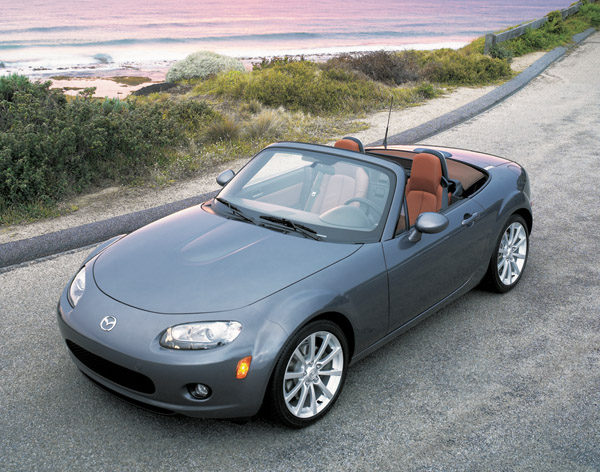
2006–2007 Mazda MX-5/Miata roadster
1951 Hudson convertible[1]
2001 BMW M3 convertible

A convertible or cabriolet (/ˌkæbriˈl/) is a passenger car that can be driven with or without a roof in place. The methods of retracting and storing the roof vary across eras and manufacturers.

A convertible car's design allows an open-air driving experience, with the ability to provide a roof when required. A potential drawback of convertibles is their reduced structural rigidity (requiring significant engineering and modification to counteract the side effects of almost completely removing a car's roof).[2][3]

The majority of convertible roofs are of a folding construction framework with the actual top made from cloth or other fabric. Other types of convertible roofs include retractable hardtops (often constructed from metal or plastic) and detachable hardtops (where a metal or plastic roof is manually removed and often stored in the trunk).

Terminology

[edit]

Other terms for convertibles include cabriolet, cabrio, drop top, drophead coupé, open two-seater, open top, rag top, soft top, spider, and spyder, although companies use many of these terms interchangeably. Thus, nomenclatural consistency is rare.[4] The term cabriolet originated from a carriage cabriolet: "a light, two-wheeled, one-horse carriage with a folding top, capable of seating two persons"; however, the term is also used to describe other convertibles.[5]

In the United Kingdom, the historical term for a two-door convertible is drophead coupe, and a four-door convertible was called an all-weather tourer.[6]

History

[edit]
1897 Daimler Grafton Phaeton

Most of the early automobiles were open-air vehicles without any roof or sides.[7][8][9][10] As car engines became more powerful by the end of the 19th century, folding textile or leather roofs (as had been used on victoria or landau carriages) began to appear on cars.[11][12] Examples of early cars with roofs include the phaeton (a two-seat car with a temporary roof), the brougham or a coupé de ville, having an enclosed passenger compartment at the rear, while the driver sat in front either in the open, or the landaulet, where the driver has a fixed roof and the passenger compartment has a folding roof. Less expensive cars, such as the runabouts, sporting roadsters, or sturdy touring cars, remained either completely open air or were fitted with a rudimentary folding top and detachable clear side curtains.

1928 Ford Model A Roadster

In the 1920s, when steel bodies began to be mass-produced, closed cars became available to the average buyer, and fully open cars began to disappear from the mainstream market.[13] By the mid 1930s, the remaining small number of convertibles sold were high-priced luxury models.[12] In 1939, Plymouth introduced the first mechanically operated convertible roof powered by two vacuum cylinders.[14][15]

Demand for convertibles increased as a result of American soldiers in France and the United Kingdom during World War II familiarizing themselves with small roadster cars, which were not available in the United States at that time.[13] These roadsters included the MG Midget and Triumph Roadster. The convertible design was incorporated into the mass market unibody by Hudson in 1948.[16][17] United States automakers manufactured a broad range of convertible models during the 1950s and 1960s – from economical compact-sized models such as the Rambler American[18] and the Studebaker Lark, to the more expensive models, such as the Packard Caribbean, Oldsmobile 98, and Imperial by Chrysler.[19] Automakers often included a convertible body style as an available body style in a model range.[20][21][22]

Convertibles in the U.S. market peaked in sales around 1965, and fell in popularity over the next five years.[23] Optional air conditioning was gradually becoming more popular, and the availability of sunroofs and T-tops limited the appeal of the open body style. Noise, leaks, and repairs associated with fabric tops also contributed to issues that many customers had.[23] The popularity of convertibles was reduced by the increased travel speeds on roads (resulting in more wind and noise for occupants) and the emergence of more comprehensive vehicle crash safety standards in the United States.[13][24]

The market share of convertibles fell to two or three percent of total sales and the U.S. automakers discontinued the body style from their lineups.[23] American Motors stopped making convertibles after the 1968 model year, Chrysler after 1971, Ford after 1973, and most divisions of General Motors after 1975. Cadillac held out until 1976, when they made about 14,000. The last 200 had a red, white, and blue motif and a dashboard plaque. The very last was offered to the Smithsonian Institution, whose trustees turned it down as it was not at that moment a historic artifact, "Though it might well be in three generations ... or at the Tricentennial."[25] After the last Cadillac Eldorado convertible was made in 1976, the only factory convertibles sold in the United States were imported. Making convertibles on the assembly line was both expensive and time-consuming, thus not worth the problems needed to sell the limited number of cars.[23]

1981 AMC Eagle Sundancer
1985 Chrysler LeBaron convertible

Specialized coachbuilders were contracted to make dealer-available cars such as the Targa top versions of the AMC Concord and Eagle "Sundancer" as well as the Toyota Celica "Sunchaser" as specialty models.[26][27] American Sunroof Company (ASC), which was responsible for popularizing the sunroof option for regular body styles, converted a Buick Riviera into a full convertible that compelled General Motors to market it as part of the 1982 Buick models.[23] Chrysler Corporation also introduced a convertible body style in its 1982 lines that was based on the K-Car. These models were the LeBaron, produced under Chrysler, and the 400, manufactured under Dodge.[28][29] Ford reintroduced a convertible Mustang for 1983, while American Motors Corporation (AMC) added a convertible version of the Renault Alliance in 1984.[30][31]

In 1989, Mazda released the first generation Mazda MX-5 (called "Miata" in North America), which has become the best-selling convertible with over 1 million cars sold.[32] Also in 1989, Toyota released the Toyota Soarer Aerocabin, which uses an electrically operated retractable hardtop roof.[33] A total of 500 were produced.[34]

Models dedicated to the convertible body style include the Mazda MX-5, Porsche Boxster, and Opel Cascada.[35]

Roof types

[edit]

Textile

[edit]
BMW Z8 with a fabric roof in up position

A "soft top" is made from a flexible textile material:

  • Early convertibles used cotton canvas woven so tightly that it was waterproof. Automakers had problems in securing raw materials to fulfill orders after World War II, including canvas in various shades for convertible tops, therefore limiting their manufacture.[36]
  • A cloth-based material has become more common in recent years.[37]

Other materials are also used in the convertible top. By 1955, the most popular materials were latex and butyl rubber fabrics that each accounted for around 35% of the convertible top's weight, with others included vinyl (12%), jute (8%), along with rayon and acrylic fibers (Orlon), amounting to about 1% each in the compositions.[38] Polyvinyl chloride (PVC) material was used for many convertible tops. The material consists of two layers: a top layer made of PVC, which has a specific structure depending on the vehicle model, and a lower layer made of fabric (usually cotton).

The collapsible textile roof section over an articulated folding frame may include linings such as a sound-deadening layer and/or an interior cosmetic lining, to hide the frame.

The folded convertible mechanism with the top is called the stack.[39] Designs that fold down to a lower stack height offer a smoother silhouette for the car with the top down while concealed side rails allow room for three passengers in the back seat such as on the 1967 Rambler Rebel convertible.[40]

Detachable hardtop

[edit]

Rigid removable hardtops, many of which can be stored in a car's trunk/boot, have been available at least since the 1950s.[41][42] These usually provide greater weatherproofing, soundproofing, and durability compared to fabric-based tops; some are available with integrated rear-window defrosters and windscreens. Examples include the Ford Thunderbird (1st-generation and 11th-generation), Mercedes SL (2nd-generation and 3rd-generation), Porsche Boxster, Jeep Wrangler, Ford Mustang Cobra (1995 Only), and Mazda MX-5.

During the 1950s and 1960s, detachable hard-material roofs were offered for various convertible sports cars and roadsters, including the 1955–1957 Ford Thunderbird and Chevrolet Corvette, as well as the 1963–1971 Mercedes-Benz W113 series of two-seaters. Because the convertible top mechanism is itself expensive, the hard roof was customarily offered as an additional, extra-cost option. On early Thunderbirds (and Corvettes through 1967), buyers could choose between a detachable hardtop and a folding canvas top at no additional cost, but paid extra for both.

The metal-framed "Carson top" was a popular addition for the 1930s Ford convertibles or roadsters because it turned these models into an almost instant hardtop.[41] The design mimicked a convertible top, but lacking the bulky folding mechanisms enabled the removable hardtop to have a much lower and more rakish profile.[43]

Improvements in canvas tops have rendered the detachable hard roof less common in part because the top cannot be stored inside the vehicle when not in use, requiring a garage or other storage facility. Some open cars continue to offer it as an option. For example, the Mazda MX-5 has an accessory hardtop, which is compulsory for some auto racing series.

Retractable hardtop

[edit]
A Volvo C70 retractable hard roof with folding segments

A retractable hardtop — also known as "coupé convertible" or "coupé cabriolet" — is a car with an automatically operated, self-storing hardtop (as opposed to the textile-based roof used by traditional convertibles).

The benefits of improved climate control and security are traded off against increased mechanical complexity, cost, weight, and often reduced luggage capacity.[citation needed]

Other design features

[edit]
MG TD open two-seater with tonneau cover over the passenger seat and luggage space

Tonneau cover

[edit]

Folding textile convertible tops often fail to completely hide their internal mechanism or can expose their vulnerable underside to sun exposure and fading. A tonneau cover provides a solution.

Rear window

[edit]

Rear windows are often part of the roof assembly. Traditionally, the rear window in a soft-top was made from plastic; however, more recently some convertibles have used glass for the rear window.[44]

Windblocker

[edit]

A windblocker or wind deflector minimizes noise and rushing air reaching the occupants.[45] According to the engineer responsible for the 2008 Chrysler Sebring, its windblocker reduces wind noise by approximately 11 to 12 dB.[46]

Several convertibles are available with a heating duct to the neck area of the seat, which is often called an "Air Scarf". Examples of cars with this feature include Mercedes-Benz SLK-Class, Mercedes-Benz SL-Class, and Audi A5/S5.

Safety

[edit]

Modern safety features specifically for convertibles include:

Variations

[edit]

Convertibles have offered numerous iterations that fall between the first mechanically simple fabric tops to complex retractable roofs made from hard materials:

Roadster: A roadster (also called spider or spyder) is an open two-seat car with emphasis on sporting appearance or character. Initially, an American term for a two-seat car with no weather protection, usage has spread internationally and has evolved to include two-seat convertibles.

Cabrio coach: A cabrio coach (also called semi-convertible) has a retractable textile roof, similar to a traditional convertible. The difference is that a convertible often has the B-pillar, C-pillar and other bodywork removed. However, the cabrio-coach retains all bodywork to the top of the door frames and just replaces the roof skin with a retractable fabric panel.

An advantage of a cabrio coach is that retaining more of the car's original structure means that structural rigidity is higher (or the vehicle weight is lower) than traditional cabriolets.[48] An example of the cabrio coach is the 2003-10 C3 Pluriel,[48] which has a roof with five possible configurations.[49][50]

Fiat 500 Cabrio with fabric roof and fixed profile

Fixed-profile: In contrast to convertibles where the entire bodywork above the beltline (doors, roof, side pillars, side bodywork) is replaced with a folding or retractable roof, the fixed profile convertible retains portions of fixed bodywork including the doors, side pillars, and side elements of the roof — while a center fabric portion slides back and accordions at the rear. As an example, Citroën's 1948 Citroën 2CV featured rigid bodysides and two doors on each side, along with a sunroof that rolled back on itself and extended to the rear bumper in place of a separate trunk lid. Other fixed-profile convertibles include the 1957 Autobianchi Bianchina Trasformabile, 1957 Vespa 400, 1950 Nash Rambler Landau Convertible Coupe, the Nissan Figaro (1991), the Jaguar XJ-SC (1983), the 1957 Fiat 500 and its 2007 Fiat 500 successor, as well as the Microlino Spiaginno (2024). The 1984 Heuliez-designed Citroën Visa Décapotable used elements of a fixed-profile convertible.

Four-door: Most convertibles have two doors. However, four-door convertibles have been mass-produced. Examples include the 1940-41 Cadillac Series 62, 1931 Chrysler Imperial Dual Cowl Phaeton and 1961-67 Lincoln Continental.[51] Current production four-door convertibles include the Jeep Wrangler Unlimited.[52][53]

Peugeot presented a concept four-door retractable hardtop convertible, the Peugeot 407 Macarena in 2006.[54] Produced by French coachbuilding specialist Heuliez, the Macarena's top can be folded in 60 seconds,[54] with a steel reinforcing beam behind the front seats incorporating LCD screens for the rear passengers into the crossmember.[54]

Off-road: Several off-road vehicles have been produced with removable soft tops.[55] Examples include the Jeep Wrangler, Suzuki Vitara, Suzuki Jimny,[56] Ford Bronco, Land Rover Defender, Mercedes-Benz G-Class[57] as well as early models of the Toyota Land Cruiser and Land Rover Defender. Typically, the soft tops attach to the roll cage or to the installation points on the vehicle's body.

Landaulet: A landaulet (also known as landaulette) is where the rear passengers are covered by a convertible top.[58][59][60] Often the driver is separated from the rear passengers with a partition,[59] as per a limousine.

In the second half of the 20th century, landaulets were used by public figures (such as heads of state) in formal processions. They are now rarely used, for fear of terrorist attacks.

Victoria-Cabriolet: reminiscent of the victoria carriage style, a three-position convertible. No rear side windows and equipped with a soft top that can be raised partway, leaving the area above the front seats folded back.[61] This body style had a short period of popularity, mainly in the 1930s. Other names include Cabriolet/Coupé Milord (or just Milord), Calash (from Calèche), Folding Head DHC, three-position Drop-head Coupé, or Cabriolet toit de 3 positions.[62]

[edit]

Open car and roadster

[edit]

Convertibles

[edit]

Retractable hardtop

[edit]

See also

[edit]

References

[edit]
Revisions and contributorsEdit on WikipediaRead on Wikipedia
from Grokipedia
A convertible is an automobile body style featuring a retractable or removable , typically made of fabric (soft top) or metal (hard top), that allows the vehicle to transition between an enclosed coupe-like configuration and an open-air setup for enhanced enjoyment of scenic drives. This design emphasizes freedom and exhilaration, enabling passengers to feel the wind and sun while driving, though it often comes at the expense of reduced (necessitating added reinforcements and resulting in greater weight, often 100-500 lbs more than equivalent fixed-roof coupes), higher noise levels, potential vulnerability to weather and theft, slower acceleration (typically 0.2-1 second slower to 60 mph), reduced handling sharpness due to increased body flex and lower torsional stiffness, and higher aerodynamic drag with the top down (affecting high-speed performance and top speed) compared to fixed- vehicles. The history of convertibles traces back to the earliest automobiles, which were predominantly open-top designs without roofs, windshields, or enclosed bodies, as seen in vehicles from the late 19th and early 20th centuries. By the , as enclosed cars became more affordable and popular, convertibles shifted from the norm to a luxury exception, with American roads favoring closed vehicles for better weather protection. A pivotal innovation arrived in 1934 with the 601 Eclipse, the first production car to feature a powered that folded into the body, marking the evolution toward more sophisticated roof mechanisms. Post-World War II demand surged in the and , leading American automakers to produce dozens of models—reaching a peak of 33 convertibles across all major brands by 1950—fueled by cultural icons in film and a economic boom that celebrated open-top motoring as a symbol of leisure and status. Convertibles come in various types to balance practicality and style, with soft-top models using flexible or vinyl roofs that manually or electrically fold rearward, offering lighter weight and easier storage but less insulation against elements. In contrast, hard-top convertibles employ rigid metal panels that retract via complex hydraulic systems, providing superior security, , and weatherproofing, though they add significant weight and cost—exemplified by early patents like Ben P. Ellerbeck's 1922 manual design. Other variants include targa tops, which feature a removable central panel while retaining fixed rear sections for partial openness, and roadsters, typically two-seat sports cars with minimalistic convertible designs prioritizing performance over comfort. Despite a decline in popularity from the onward due to regulations, concerns, and the rise of SUVs, convertibles persist as niche offerings from brands like , , and , embodying enduring appeal for enthusiasts seeking the sensory thrill of al fresco driving.

Terminology and Definition

Core Definition

A convertible is an automobile designed with a that enables open-air driving by folding or retracting the roof into the vehicle's body, providing the flexibility to switch between enclosed and exposed configurations. This defining feature sets it apart from traditional fixed-roof vehicles like coupes or sedans, which lack such adaptability and prioritize permanent weather protection. Key characteristics of convertibles include the , which can be soft and flexible, typically fabric-based, or hard and rigid, often constructed from metal or reinforced , allowing for manual or powered operation via hydraulic, electric, or mechanical systems. In operation, the is generally stowed within the trunk or in a compartment behind the seats when retracted, which optimizes but may limit luggage capacity depending on the . However, the retractable nature affects structural , as the contributes significantly to the body's torsional rigidity; without it, manufacturers incorporate reinforcements such as additional frame rails or bulkheads, which can alter and increase overall vehicle mass by compensating for the lost —often resulting in a 50% or greater reduction in rigidity if unaddressed. The term "convertible" originated in early 20th-century automotive terminology around , specifically denoting a with a fold-down top, derived from the Latin convertere ("to turn around" or "transform"), emphasizing the vehicle's transformative capability from closed to open. This underscores the innovative appeal of convertibles as versatile machines blending practicality with recreational driving.

Terminology Variations

The term "convertible" is widely used in to describe automobiles with retractable roofs, but numerous synonyms exist, reflecting historical and cultural influences. "Cabriolet," originating from European carriage designs, is a common alternative, particularly in , and is often interchangeable with "convertible" for vehicles featuring a folding soft top. In , "drop-head coupé" refers to a two-door, four-seat variant with a folding that "drops" into the body, emphasizing luxury models like those from Rolls-Royce. Italian manufacturers frequently use "" or "" for lightweight, open-top two-seaters, a term derived from early 20th-century descriptions of agile, spoked-wheel vehicles resembling the insect's form. "Roadster" typically denotes an open two-seater focused on performance, distinguishing it as a sportier subset of convertibles without fixed weather protection. Regional variations in terminology highlight market preferences and traditions. , "convertible" dominates for mass-produced, accessible models, reflecting a focus on everyday versatility. European nomenclature, such as "cabrio" in or , often connotes premium or luxury variants, aligning with brands like that market "cabriolets" for refined open-air driving. Legal classifications treat convertibles distinctly for regulatory and financial purposes. In the United States, the Environmental Protection Agency (EPA) defines "convertible" as a specific body style under federal emissions and fuel economy testing, grouping it with passenger cars based on interior volume and configuration. Similarly, the categorizes convertibles under M1 (passenger vehicles with at least four wheels and no more than eight seats), subjecting them to the same CO2 emissions standards as closed- sedans without separate roof-based exemptions. providers often place convertibles in higher-risk categories due to roof vulnerability, with premiums elevated for soft-top models compared to retractable hardtops owing to repair costs and exposure. Terminology has evolved from equestrian origins to contemporary precision. The "phaeton," borrowed from open horse-drawn carriages of the , described early motorized vehicles with removable or folding tops for light touring. As automotive engineering advanced in the , terms like "cabriolet" and "roadster" persisted for soft-top designs, while post-2000 innovations popularized "retractable hardtop" to specify power-folding metal roofs that enhance security and all-weather usability.

Historical Development

Early Innovations (Pre-1900)

The origins of convertible designs trace back to 19th-century horse-drawn carriages, where open-air travel was adapted for varying weather through removable or folding tops. Phaetons, popular light four-wheeled carriages from the late 18th and early 19th centuries, typically featured no permanent enclosure but could include optional fabric or leather tops that were manually detached for sporty, exposed driving. These vehicles emphasized speed and elegance, often drawn by one or two horses, and set a precedent for the lightweight, open structures later seen in automobiles. Landaulettes, emerging in the mid-1800s as compact variants of the landau carriage, introduced more versatile convertible elements with a divided folding top that could be lowered from the rear or fully removed to transform the enclosed body into an open one. This design allowed passengers to enjoy fresh air while retaining the option for protection, reflecting early innovations in multi-position roofs crafted from wood frames and canvas coverings. Built by companies like the Burlington Carriage Company in the late 1800s, landaulettes were favored for urban use due to their maneuverability and adaptability. As motorized vehicles developed in the late , carriage-inspired convertible features transitioned to the first automobiles, with 1899 marking key milestones. Early models like the vis-à-vis incorporated optional folding fabric tops that could be manually stowed, providing basic shelter on open chassis. Similarly, et Levassor's 1899 Type A1 Double Phaeton model featured a detachable canopy over its fabric roof, adapting phaeton aesthetics to a 6-hp for two passengers. Pioneering engineers at firms like et Levassor drew on existing patents for roof mechanisms, though specific automotive patents for retraction systems remained limited before 1900, relying instead on manual canvas folds secured by straps or bows. These early motorized convertibles faced significant challenges, including insufficient that rendered frames prone to flexing and vibration, often described as "flimsy" compared to later rigid designs. Operations were entirely manual, requiring users to physically unfasten and fold the lightweight fabric roofs, which offered minimal weatherproofing and could flap noisily at speed. Despite these limitations, such innovations laid the groundwork for the convertible's enduring appeal in blending open-air freedom with basic enclosure.

20th Century Advancements

In the 1920s and 1930s, convertible development emphasized affordability and luxury, with American roadsters gaining widespread appeal and early powered roof mechanisms appearing in high-end models. The Ford Model A roadster, introduced in 1927, exemplified mass-market open-top vehicles, featuring a fold-down top and contributing to the model's overall production of 4,858,644 units through 1931. Luxury marques like incorporated advanced retractable roof mechanisms in custom bodies, such as the manual disappearing top by coachbuilders on the 1929 Model J Torpedo, allowing the top to fold seamlessly into the body. A pivotal innovation in 1934 was the 601 Eclipse, the first production car with a powered that folded into the body using a hydraulic system, enhancing convenience and weather protection. These innovations marked a shift from purely manual tops, enhancing convenience for elite buyers during the era's booming coachbuilding scene. Following , the saw a surge in convertible popularity amid economic prosperity and stylistic exuberance, characterized by chrome-laden designs from and Ford. GM's convertible epitomized the chrome era, with production reaching 42,278 units in 1957 alone, while Ford's Thunderbird convertible hit 21,380 that year. U.S. convertible output peaked during this decade, with select models exceeding 40,000 annual units, driven by post-war optimism and features like power tops on upscale variants. This boom reflected broader manufacturing advances, including improved fabric tops and integrated chassis for better ride quality. The and brought a pivot toward enhanced amid growing regulatory scrutiny, particularly after proposed federal rollover standards in prompted redesigns to mitigate open-top vulnerabilities. British sports cars like the roadster, produced from 1962 to 1980, adapted with reinforced frames and optional roll bars, maintaining appeal through agile handling while totaling nearly 500,000 units. Similarly, Mercedes-Benz's SL series, such as the R107 from to 1989, integrated a rigid safety cell with strengthened A-pillars capable of supporting the vehicle's weight in a rollover, alongside padded interiors and disc brakes. These changes balanced open-air enjoyment with occupant protection, influencing global standards. By the 1970s and , convertibles faced declining demand due to stringent emissions regulations under the 1970 Clean Air Act and fuel crises like the 1973 OPEC embargo, which prioritized fuel-efficient closed-roof designs. U.S. production plummeted, with full-size models largely discontinued by 1976 as manufacturers grappled with mandates. Amid this downturn, innovations persisted, notably in the convertible introduced in 1988, which featured an electronically controlled power-operated top via an ECU-managed hydraulic system for seamless deployment. This automation helped sustain luxury appeal into the , bridging the gap until broader market revivals.

Post-2000 Trends

Following the turn of the millennium, the luxury convertible segment experienced a notable revival, driven by demand for premium open-top vehicles that blended performance with refined comfort. The Z4, launched in 2002 as the E85 model, succeeded the Z3 and contributed to a broader resurgence of sports roadsters by offering inline-six engine options and agile handling tailored for enthusiasts. Similarly, the Audi A5 Cabriolet, introduced in 2009, emphasized sophistication through its multi-layer soft top, which incorporates three layers of fabric including an acoustic version with to minimize wind and road noise while maintaining an open-air experience. Retractable hardtops gained prominence in the post-2000 era, making convertibles more versatile and appealing to a wider audience. The CC, debuted in 2000, popularized affordable versions of this technology as a compact coupe-cabriolet with a folding , outselling rivals like the in some markets due to its accessible pricing and stylish design. advanced the trend with the 2004 R171-generation SLK, featuring an updated Vario-Roof—a patented electro-hydraulic metal folding system that retracted in about 25 seconds, enhancing year-round usability and setting a benchmark for premium convertibles. Stricter safety regulations from organizations like and the (IIHS) influenced convertible design by mandating reinforced structures, such as stronger A- and B-pillars and rollover protection systems, to mitigate risks in crashes without inherent roof support. These standards, evolving through the and , improved overall safety ratings for convertibles, with modern models achieving comparable protection to fixed-roof vehicles. However, the segment faced a decline in the as SUV popularity surged, with U.S. convertible sales dropping from around 140,000 units in 2010 to about 70,000 by 2020, reflecting consumer preferences for versatile, high-riding vehicles over open-top sports cars. Emerging technologies began integrating convertible features with advanced vehicle systems, including infotainment interfaces for roof controls that allow one-touch operation, voice activation, and smartphone connectivity for remote adjustments. Early electric prototypes, such as the S unveiled in 2009 and planned for production around 2011, explored powertrains in a format, aiming to combine zero-emission driving with luxury open-top appeal before the company's challenges halted development. Into the , electric convertibles gained traction, with models like the 2024 SE Convertible offering fully electric power and retractable roofs, and the 6 electric roadster announced in 2022 entering production in 2026 as a high-performance open-top GT. These developments address environmental concerns while sustaining enthusiast interest as of 2025.

Roof Mechanisms

Soft Tops

Soft tops, also known as fabric roofs, consist of flexible, multi-layered coverings that can be folded down to open the vehicle's cabin to the elements. These roofs have been a staple in convertible designs since the early days of automobiles, evolving from simple coverings to sophisticated engineered systems. The materials used in soft tops prioritize durability, weather resistance, and aesthetics. Traditional options include vinyl, which offers a smooth, affordable surface, and , often made from acrylic-coated blends. These fabrics are constructed in multiple layers: an outer weatherproof layer, an insulating core for thermal and acoustic performance, and an inner lining for comfort. For instance, Sonnendeck incorporates insulation to reduce and maintain cabin temperature. Modern synthetics, such as Twillfast—a solution-dyed acrylic fabric—enhance UV resistance, preventing fading and cracking even after prolonged sun exposure. Operation of soft tops involves folding the fabric along a series of bows or ribs that support its structure. Manual versions require the driver to unlatch the front bow from the header, release tension cables, and fold the roof rearward into a stowage compartment, typically in the trunk. Power-operated systems use electric motors to automate this process, with hydraulic or cable-driven mechanisms pulling the top along articulated arms; a rear tensioning bow ensures the fabric remains taut during folding and deployment, preventing sagging or flapping. The entire sequence usually takes 20-30 seconds in modern designs. Soft tops offer several advantages, including their lightweight construction, which adds only about 100-150 kg to the vehicle's overall mass compared to fixed-roof equivalents, improving and handling agility. They are also more affordable to manufacture and replace than rigid alternatives. However, drawbacks include reduced security, as the fabric can be more easily cut or damaged, and increased road noise at speeds due to buffeting against the material. Despite these, multi-layer insulation in contemporary soft tops enables all-season usability by providing better thermal retention and sound dampening than earlier designs. Maintenance is essential to preserve the longevity and performance of soft tops, which typically last 5-10 years under normal conditions. Regular cleaning involves rinsing with fresh water to remove dirt, followed by gentle washing using a pH-neutral soap and soft brush to avoid abrasion; harsh chemicals or automatic car washes with brushes should be avoided. To ensure water resistance, apply a dedicated fabric protectant or waterproofing spray annually, which replenishes the repellent coating and prevents mold growth in humid environments. Inspections for tears, seam leaks, or bow misalignment should occur seasonally, with professional re-treatment recommended every 1-2 years.

Detachable Hardtops

Detachable hardtops feature rigid panels crafted from materials such as fiberglass-reinforced plastic or aluminum, designed to latch securely onto the vehicle's body frame for a weatherproof seal when installed. These tops are fully separable, allowing complete removal to transform the vehicle into an open-air configuration. A key example is the Jeep Wrangler's Freedom Top, a three-piece modular system composed of fiberglass sections that align with the vehicle's roll bar and door frames for stability. Operation of detachable hardtops relies on manual processes, where owners use specialized tools—often provided by the manufacturer—to release latches and lift the panels from their mounts. For instance, the Wrangler's system enables one or two people to remove the front panels in minutes by twisting handles and sliding them out, followed by detaching the larger rear section. Once removed, the panels require separate storage, such as in a garage, on a dedicated , or via ceiling hoists, as there is no onboard folding or retraction mechanism. The primary advantages of detachable hardtops include delivering an unobstructed open-air driving experience and facilitating easy swaps for seasonal conditions, such as replacing a hardtop with a soft top during warmer months. Removing the top also yields notable weight reductions of approximately 50-100 kg, which can improve off-road agility, fuel efficiency, and handling in vehicles like the or . Despite these benefits, detachable hardtops pose practical drawbacks, including the inconvenience of finding adequate storage space for their bulky form, which often necessitates additional equipment like wall mounts or carts. They are also susceptible to or misplacement due to their standalone nature and value as replacement parts, while improper fitting can lead to water leaks or wind noise from compromised seals.

Retractable Hardtops

Retractable hardtops represent an advanced in convertible , featuring powered systems that allow metal panels to fold automatically into the vehicle's trunk or dedicated storage area. These mechanisms enable drivers to switch seamlessly between a secure, coupe-like and an open-air driving experience at the press of a . Introduced prominently in the early 2000s, such roofs utilize electro-hydraulic or electro-mechanical actuators to manage the folding process, typically involving 5 to 10 major moving components for precise operation. The core mechanism relies on and cylinders to unlatch, pivot, and stow the roof panels. For instance, the SL (R230 generation, introduced in 2001) employs a Vario roof system powered by a that activates five cylinders: two to unlatch the roof halves via cables and sliders, two to manage the trunk lid, and one to lock the roof to the frame. This setup allows the two-sheet steel roof to fold in approximately 25 seconds. Similarly, the (produced from 2006 to 2015) features a five-piece folding with a separate hydraulic retracting mechanism, including an independently sliding glass panel, which completes the operation in under 25 seconds. Multi-link hinges and kinematic linkages ensure compact stowage, minimizing interference with the vehicle's body structure. Materials for these roofs prioritize rigidity and durability, often using aluminum or panels reinforced with inner shells and frames. The Mercedes Vario roof, for example, consists of two-sheet construction to maintain structural integrity when closed, while the uses metal panels paired with rubber seals for weatherproofing. These choices provide enhanced resistance to impacts compared to fabric alternatives, though they contribute to the system's overall mass, typically adding 100 to 200 kg to the vehicle's curb weight depending on the design. Key benefits include superior security and weather protection akin to a fixed when deployed, with the added versatility of convertible openness. The solid panels offer better noise insulation and wind reduction at highway speeds, as seen in the Eos's design, which improves cabin comfort without compromising the aesthetic appeal of an open . However, challenges arise from the complexity of the , leading to higher costs and potential reliability issues, such as hydraulic leaks or electrical faults that can cause operational failures. Additionally, the stowed significantly reduces trunk capacity—for the Eos, from 300 liters to 190 liters—while the added weight can impact and handling dynamics.

Structural and Safety Features

Chassis and Body Design

The design of a convertible's and body must compensate for the absence of a fixed , which significantly reduces overall compared to coupes. Engineers employ techniques such as bulkhead bracing at the front and rear firewalls, thickening of the floorpan, and integrated roll hoops to mitigate torsional flex. These measures aim to achieve a target torsional stiffness of approximately 10,000 to 15,000 Nm/deg, as seen in models like the (13,000 Nm/deg) and Convertible (15,500 Nm/deg). The removal of the roof also alters by lowering the center of gravity, which can enhance stability but requires careful balancing to avoid front-heavy bias. In the Miata, a power plant subframe isolates the and transmission, helping maintain a near-ideal 52/48 front/rear distribution in variants while preserving lightweight construction. Material selection plays a critical role in achieving lightness without sacrificing strength; high-strength steel is commonly used for key load-bearing elements, while aluminum spaceframes reduce mass. The Roadster exemplifies this approach with its Audi Space Frame (ASF) construction, incorporating 58 percent aluminum and 42 percent ultra-high-strength steel to minimize weight while doubling torsional over its predecessor to around 19,000 Nm/deg. Despite these reinforcements and the retractable roof mechanism, convertibles incur additional weight—typically ranging from 100 to 500 pounds compared to equivalent fixed-roof coupes—which can slow acceleration (typically 0.2–1 second longer to 60 mph) and reduce handling sharpness due to increased body flex and relatively lower torsional stiffness. To address the inherent handling compromises from reduced body rigidity, manufacturers tune suspensions with stiffer springs and dampers, optimizing camber control and roll resistance. This calibration, as applied in the , leverages the reinforced chassis for precise steering response and improved cornering dynamics despite the open-top configuration.

Safety Enhancements

Modern convertible vehicles have achieved safety levels comparable to fixed-roof cars, with data from the (IIHS) indicating no elevated overall injury risk for late-model convertibles in crashes as of data from 2014-2018, though rollover ejections remain a noted concern despite protective systems. This near-parity stems from engineering advancements addressing the inherent vulnerabilities of open-top designs, particularly in rollover scenarios, where occupant ejection and roof intrusion pose unique threats. Historically, prior to the , the absence of federal safety standards in the United States allowed convertibles to proliferate without mandated protections, fueling public and regulatory scrutiny that nearly eradicated their production by the mid-1970s amid proposed rollover regulations under the National Traffic and Motor Vehicle Safety Act of 1966. Although no outright bans occurred, manufacturers voluntarily phased out convertibles to compliance challenges with emerging passive restraint rules, such as those outlined in FMVSS No. 208, which emphasized occupant protection without relying on user action. Rollover protection systems represent a of convertible enhancements, compensating for the lack of a rigid structure. Unlike fixed- subject to FMVSS No. 216 roof crush resistance standards—effective since 1973 and upgraded to FMVSS No. 216a in 2009—convertibles are exempt, requiring alternative measures like integrated roll hoops or deployable bars to maintain survival space during inversion. For instance, the Boxster employs fixed steel roll bars positioned behind the seats, providing continuous structural reinforcement without pop-up mechanisms in later models, while earlier designs and competitors like the Miata incorporate pyrotechnic pop-up bars that activate in milliseconds upon detecting rollover conditions via sensors monitoring and impact forces. These systems, often combined with reinforcements, have significantly reduced head and neck injury risks in rollover crashes by preventing cabin deformation. Airbag integrations in convertibles have evolved to address the open-air exposure, with side airbags designed to deploy from roof rails, door panels, or seat structures even when the top is retracted. These curtains inflate longitudinally along the vehicle's sides to shield occupants from lateral impacts and ejections, remaining deployed for several seconds in rollovers—longer than standard side bags—to cover multiple rotations, as specified in FMVSS No. 226 for ejection mitigation. Complementing this, seatbelt pretensioners automatically tighten belts upon , minimizing forward movement and enhancing compatibility with curtain deployment; for example, in vehicles like the BMW Z4, these systems integrate with rollover sensors to optimize protection regardless of top position. Crash testing for convertibles highlights distinct challenges, such as evaluating structural integrity without a roof, focusing on side-impact resistance and rollover dynamics rather than crush limits. The IIHS and (NHTSA) conduct moderate overlap frontal, side, and rollover resistance tests, where convertibles often earn strong ratings due to bolstered side structures. These evaluations underscore that, with targeted enhancements, convertibles mitigate unique risks like partial ejections, achieving injury outcomes on par with coupes in real-world data. Modern convertibles increasingly incorporate advanced driver-assistance systems (ADAS), such as automatic emergency braking and lane-keeping assist, which enhance overall safety beyond structural features, as seen in models from onward.

Aerodynamic and Comfort Aids

Convertibles often employ windblockers, typically screens positioned behind the front seats, to mitigate aerodynamic known as buffeting that occurs when the top is down. These devices disrupt the vortex of air flowing over the , redirecting it away from occupants and reducing wind noise by approximately 11 to 12 decibels at speeds. In some implementations, such as those from specialized suppliers, windblockers can achieve up to an 80% reduction in , allowing for more comfortable conversations and less during extended drives. Tonneau covers, consisting of fabric or rigid panels that fit over the stowed mechanism in the trunk or rear compartment, serve dual purposes in enhancing and protecting components. By creating a smoother exterior profile, these covers minimize disruption around the rear of the , contributing to reduced drag and a more streamlined when the top is retracted. Additionally, they shield the folded fabric from dust, UV exposure, and moisture, preserving material integrity and preventing premature wear in storage. Nevertheless, with the top down, aerodynamic drag is generally higher than in fixed-roof coupes, which can impair high-speed performance and reduce attainable top speed. Rear windows in soft-top convertibles frequently incorporate heated or durable elements designed for clear under varying conditions. The heating grid embedded in the glass activates via the vehicle's system, rapidly clearing , , or to maintain unobstructed rearward views, which is essential for safe maneuvering in inclement weather. Defogging functionality typically cycles for 10-15 minutes to avoid overheating, ensuring consistent performance without excessive battery drain. To address thermal discomfort in open-air mode, luxury convertibles feature advanced climate control systems, including enhanced HVAC configurations tailored for top-down operation. These systems often include dedicated "convertible modes" that adjust distribution—directing more conditioned air toward occupants' upper bodies and faces—while integrating heated seats and vents for warmth in cooler conditions. For instance, the GT Convertible employs discreet neck warmers integrated into the seat headrests, which circulate gentle heated air around the and shoulders to counteract without impeding the open-top experience. Similarly, models offer optional Air Collars that provide targeted warm , enhancing comfort during year-round driving.

Vehicle Variations

Two-Seat Roadsters

Two-seat roadsters represent a specialized subset of convertibles, emphasizing compact dimensions, sporty dynamics, and driver engagement through lightweight builds typically under 1,500 kg and rear-wheel-drive configurations that favor precise handling over opulent comfort. These vehicles prioritize agility and balance, often achieving near-perfect 50:50 to deliver responsive steering and minimal body roll during spirited driving. The Miata, launched in 1989, stands as a benchmark in this class, with early models weighing approximately 930 kg and subsequent generations maintaining curb weights below 1,100 kg while upholding a rear-drive setup optimized for cornering prowess. Powertrains in two-seat roadsters commonly feature inline-four engines for their balance of efficiency and pep, though some variants incorporate V6 units to boost without excessively increasing , resulting in top speeds generally ranging from 120 to 150 mph. The Miata employs a 2.0-liter inline-four producing around 181 horsepower, enabling 0-60 mph times under 6 seconds and a governed top speed of about 139 mph in recent iterations (as of 2025). Similarly, the Toyota MR2 Spyder (1999-2005) utilized a 1.8-liter inline-four with 138 horsepower, achieving top speeds near 130 mph while keeping overall weight at roughly 1,000 kg for nimble performance. These engines underscore a "fun-to-drive" philosophy, where power-to-weight ratios—often exceeding 150 hp per ton—create exhilarating dynamics rather than outright speed dominance. Occupying a dedicated enthusiast niche, two-seat roadsters attract drivers valuing affordable, pure motoring experiences over practicality, with the Spyder and exemplifying this appeal through mid-engine layouts and minimalist engineering. The , introduced in 1996, tips the scales at under 900 kg with its aluminum chassis and fiberglass body, paired with for exceptional grip and a top speed around 140 mph in supercharged variants powered by 1.8-liter inline-fours. This segment thrives on cult followings, where models like the Elise's roadster configurations—often equipped with soft tops or removable panels—cater to track-day and weekend enthusiasts seeking unfiltered road feedback. To preserve their lightweight ethos and open-air purity, two-seat roadsters employ design trade-offs such as spartan interiors with basic cloth seats and analog gauges, alongside restricted cargo space—typically limited to a small trunk or frunk accommodating just a weekend's essentials. The Mazda MX-5 Miata, for instance, offers only 4.6 cubic feet of storage behind the seats, intentionally forgoing luxury features to maintain a curb weight under 1,100 kg in base forms. Likewise, the Lotus Elise's cockpit prioritizes structural rigidity and driver focus, with minimal amenities that enhance the visceral, wind-in-the-hair convertible experience across various roof options like manual soft tops.

Multi-Seat Convertibles

Multi-seat convertibles are designed with an extended to incorporate rear seating for four or more passengers, providing greater practicality than two-seat roadsters while maintaining open-air appeal. The convertible, for instance, features a 107.1-inch wheelbase and a 2+2 seating layout suitable for adults in the front and smaller passengers or storage in the rear. The Mercedes-Benz CLE Cabriolet (successor to the E-Class Cabriolet, introduced in 2024) employs a 112.8-inch wheelbase to ensure comfortable four-passenger accommodations, blending luxury underpinnings with a retractable roof. These vehicles involve structural compromises to support additional seating and roof mechanisms, such as a reinforced chassis that increases weight by several hundred pounds for enhanced torsional rigidity and stability. Trunk space is typically reduced, often limited to 10-13 cubic feet when the top is stowed, prioritizing passenger capacity over cargo versatility. Nonetheless, this configuration enables enjoyable top-down family cruising, allowing groups to experience wind-in-the-hair drives on leisurely outings. Luxury iterations of multi-seat convertibles often include upscale amenities like premium leather upholstery and high-fidelity audio systems to elevate comfort during extended journeys. The Cadillac CTS convertible, produced from 2014 to 2019, offered optional semi-aniline leather seats and a Bose 13-speaker system for immersive listening. Performance variants, such as the CTS-V convertible, integrated these features with supercharged V8 power for dynamic yet refined driving. Primarily oriented toward grand touring rather than track-focused agility, multi-seat convertibles emphasize long-haul comfort and versatility for cross-country travel. They hold particular sales appeal in warm climates, where higher temperatures correlate with increased demand for open-top , as evidenced by an 8.5% rise in convertible sales per 20-degree temperature increase.

Hybrid and Electric Models

The integration of hybrid powertrains into convertible vehicles began gaining traction in the late 2010s, with the Roadster serving as a seminal example introduced in 2018. This featured a 1.5-liter turbocharged three-cylinder paired with an , delivering a combined 369 horsepower and enabling up to 18 miles of electric-only range, which allowed for quiet, emission-free open-top driving in urban settings. The multi-stage hybrid system provided seamless transitions between electric and gas power, enhancing the appeal of leisurely cruises with minimal noise intrusion. Full-electric convertibles represent an emerging segment, with production models like the GranCabrio Folgore marking a luxury benchmark; this all-electric employs a tri-motor setup producing 818 horsepower and offers an estimated 288-mile WLTP range (233 miles EPA). Other recent entries include the , a two-seat sports convertible with dual motors delivering 536 horsepower, a 0-62 mph time of 3.2 seconds, and up to 321 miles WLTP range, and the 500e Convertible, a compact four-seater with approximately 118 horsepower and 149-mile range. The 6, announced in 2022 and slated for 2026 production, further advances this category as a 2+2 electric roadster with dual motors generating up to 884 horsepower and a targeted WLTP range exceeding 370 miles, prioritizing aerodynamic efficiency even in its configuration. Conceptual explorations, such as Rivian's removable-roof adaptations for the R1T electric , highlight innovative approaches to convertible utility in off-road contexts, though these remain non-production at present. Developing hybrid and electric convertibles presents unique engineering challenges, particularly in battery placement, which must maintain optimal to preserve handling dynamics in open-top designs lacking a fixed roof's . Low-mounted "" battery architectures help lower the center of , but the added mass from roof mechanisms can still disrupt balance, requiring reinforced elements that increase overall vehicle weight by up to 20%. Additionally, operating with the top down significantly reduces range—often by 15-30% in real-world conditions—due to heightened aerodynamic drag and resistance, which accelerate at speeds. Despite these hurdles, hybrid and electric convertibles offer distinct advantages, including instant electric for responsive, spirited that enhances the thrill of top-down driving without engine roar. The inherent quietness of electric complements open-air experiences, providing serene cruising akin to gliding silently through scenic routes, while in hybrids like the i8 recaptures energy during deceleration for improved efficiency. These models also align with broader trends, delivering zero tailpipe emissions during electric operation and positioning convertibles as viable options in sustainable luxury motoring.

Market and Cultural Aspects

Convertible production and sales experienced a notable peak in the United States during the , driven by prosperity and cultural affinity for open-air motoring, with individual models like the 1955 achieving sales of 19,762 units and contributing to broader category enthusiasm. By the mid-1960s, U.S. convertible sales had climbed to around 500,000 units annually, accounting for approximately 5% of total sales amid a favorable economic climate. However, this era marked the high point, as subsequent decades saw a steady decline influenced by shifting preferences toward enclosed vehicles offering greater practicality. Global convertible sales have continued to decline in the 2020s, reaching 193,000 units in 2023, primarily due to the dominance of SUVs and crossovers that prioritize versatility and family utility over the niche appeal of drop-tops. In select European markets, such as Germany, new registrations fell to around 69,000 units in 2023, contributing to an overall European decline and reflecting broader trends in reduced demand for traditional passenger cars. Despite the overall downturn, leading manufacturers such as Mazda—with the MX-5 Miata as its perennial bestseller—BMW, and Mercedes-Benz continue to dominate production, focusing on performance-oriented models that sustain a dedicated buyer base. Europe maintains roughly 30% of the global convertible top market share, underscoring its role as a stronghold for premium variants. Several economic factors have exacerbated the sales slump, including volatile fuel prices that disproportionately affect the less efficient engines common in convertibles, contributing to a more than 60% drop in U.S. sales from around 180,000 units in 2014 to approximately 70,000 units in 2024 as consumers favor fuel-thrifty alternatives. Convertible demand exhibits seasonality, with lower interest in winter months compared to spring and summer, often leading to increased dealer discounts to stimulate sales. Trade policies, such as the 2018 tariffs, further strained production by elevating material costs—steel prices rose 10-30% on affected imports—impacting economics for niche vehicles like convertibles. In 2024, global sales further declined to approximately 180,000 units, with U.S. figures at around 70,000 units; as of early , data indicates modest stabilization amid electric model introductions. The luxury segment, in particular, has shown signs of niche revival, expanding at an annual compound growth rate of about 5.8% post-2020, fueled by demand for high-end, experiential vehicles amid recovering affluent . Market projections for late 2025 suggest continued modest growth, particularly in electric convertible models following the phase-out of the U.S. federal EV in September 2025, which spurred a Q3 sales surge.

Cultural Significance

Convertibles have long held a prominent place in film and television, often symbolizing freedom, adventure, and rebellion. In the 1986 comedy , the protagonist borrows his father's rare 1961 for a joyous joyride through , with the open-top design amplifying the film's themes of youthful escapism and carefree defiance of authority. Similarly, films frequently feature convertibles to underscore the spy's suave, high-stakes lifestyle; notable examples include the 1957 Ford Fairlane in (2002), which Bond drives through Havana's vibrant streets, and the custom convertible in You Only Live Twice (1967), highlighting elegance amid espionage. These portrayals have cemented convertibles as cinematic icons of liberation and thrill, influencing public perceptions of open-air motoring as an emblem of unbridled excitement. Beyond the screen, convertibles embody a distinctive appeal, evoking leisurely summer cruising along coastal routes and associations with youth and opulence. The sensation of wind-swept drives on scenic byways like California's Pacific Coast Highway captures a sense of relaxed indulgence, often linked to seasonal and sensory immersion in nature. Hollywood celebrities have further reinforced this image, frequently photographed in classic drop-tops such as in a 1955 Ford Thunderbird or modern stars like piloting a Cabriolet, portraying convertibles as markers of effortless glamour and vitality. Convertibles also draw from a rich racing heritage, where open-top prototypes and roadsters have bridged track performance with everyday elegance. Early entries, such as the 1930s roadsters, influenced production models by prioritizing lightweight chassis and aerodynamic efficiency that translated to consumer vehicles like the series. Prestigious events like the Pebble Beach Concours d'Elegance celebrate this legacy annually, showcasing restored convertibles such as the 1957 , which honor their dual roles in competition and style, fostering a global appreciation for automotive artistry. In terms of and status, convertibles have evolved from targeted to women—exemplified by the , a 1955 model with pastel hues and feminine accessories designed to appeal to female buyers as symbols of affluence and independence—to modern inclusivity. Advertisements for the in the mid-1950s prominently featured women in suburban settings, positioning the car as an aspirational blend of beauty and mobility. Today, electric convertibles like the promote broader appeal through sustainable, tech-forward designs that transcend traditional , encouraging diverse drivers to embrace open-air electric motoring as a forward-looking .

Environmental and Regulatory Impacts

Convertibles, due to their open-top design, experience increased aerodynamic drag when the is retracted, resulting in higher fuel consumption compared to closed configurations. Studies indicate this can reduce highway fuel economy by up to 14%, as the absence of the disrupts and increases resistance at speeds above 50 mph. In the United States, standards present challenges for low-volume convertible production, given their typically lower efficiency ratings; however, manufacturers producing fewer than 10,000 vehicles annually can petition the for exemptions or alternative standards. This regulatory framework encourages innovation in efficient designs but can limit niche models without such relief. Material choices for convertible components emphasize sustainability, with soft tops often made from recyclable fabrics like polyester or vinyl, which offer lower production impacts than non-recyclable alternatives. Aluminum used in hardtop frames is highly recyclable, comprising up to 85% recycled content in some cases, though its extraction remains energy-intensive. The ongoing shift to electric and hybrid powertrains further reduces tailpipe emissions, aligning with European Union incentives for zero- and low-emission vehicles through a crediting system starting in 2025. Regulatory measures worldwide address safety and environmental concerns specific to convertibles. In , Australian Design Rules require rollover protection systems, such as reinforced A-pillars or deployable bars, influencing soft-top designs since the , though older models predating stricter enforcement faced limitations. Urban ordinances, enforced in many jurisdictions, restrict vehicle sound levels—typically to 70-80 decibels at 50 feet—to mitigate disturbances, with open configurations amplifying exhaust and wind , prompting drivers to keep tops up in restricted areas. Looking ahead, the automotive sector targets carbon-neutral production by 2030, with initiatives like Group's commitment to 100% carbon-neutral external at all sites, driving sustainable manufacturing for convertible components. These efforts, combined with evolving emissions policies, position convertibles for greener integration into future mobility landscapes.

References

Add your contribution
Related Hubs
User Avatar
No comments yet.