


Community hub
Recent from talks
Contribute something
Nothing was collected or created yet.
Chelsea, Manhattan
View on Wikipedia
Chelsea is a neighborhood on the West Side of the borough of Manhattan in New York City. The area's boundaries are roughly 14th Street to the south, the Hudson River and West Street to the west, and Sixth Avenue to the east, with its northern boundary variously described as near the upper 20s[4][5] or 34th Street, the next major crosstown street to the north.[6][7] To the northwest of Chelsea is the neighborhood of Hell's Kitchen, as well as Hudson Yards; to the northeast are the Garment District and the remainder of Midtown South; to the east are NoMad and the Flatiron District; to the southwest is the Meatpacking District; and to the south and southeast are the West Village and the remainder of Greenwich Village.[8][b] Chelsea was named after an estate in the area which, in turn, was named after the Royal Hospital Chelsea in London which, in its turn, was named after the Chelsea District of London (England).[9]
Key Information


Chelsea contains the Chelsea Historic District and its extension, which were designated by the New York City Landmarks Preservation Commission in 1970 and 1981 respectively.[10] The district was added to the National Register of Historic Places in 1977, and expanded in 1982 to include contiguous blocks containing particularly significant examples of period architecture.
The neighborhood is primarily residential, with a mix of tenements, apartment blocks, two city housing projects, townhouses, and renovated rowhouses, but its many retail businesses reflect the ethnic and social diversity of the population. The area has a large LGBTQ population.[11] Chelsea is also known as one of the centers of the city's art world, with over 200 galleries in the neighborhood. As of 2015,[update] due to the area's gentrification, there is a widening income gap between the wealthy living in luxury buildings and some people living in the two housing projects.
Chelsea is a part of Manhattan Community District 4 and Manhattan Community District 5, and its primary ZIP Codes are 10001 and 10011.[1] It is patrolled by the 10th Precinct of the New York City Police Department.
History
[edit]Early development
[edit]
Chelsea takes its name from the estate and Georgian-style house of retired British Major Thomas Clarke, who obtained the property when he bought the farm of Jacob Somerindyck on August 16, 1750. The land was bounded by what would become 21st and 24th Streets, from the Hudson River to Eighth Avenue.[5] Clarke chose the name "Chelsea" after the Royal Hospital Chelsea in London.[9][12] Clarke passed the estate on to his daughter, Charity, who, with her husband Benjamin Moore, added land on the south of the estate, extending it to 19th Street.[5] The house was the birthplace of their son, Clement Clarke Moore, who in turn inherited the property. Moore is generally credited with writing "A Visit From St. Nicholas" and was the author of the first Greek and Hebrew lexicons printed in the United States.
In 1827, Moore gave the land of his apple orchard to the Episcopal Diocese of New York for the General Theological Seminary, which built its brownstone Gothic, tree-shaded campus south of the manor house. Despite his objections to the Commissioner's Plan of 1811, which ran the new Ninth Avenue through the middle of his estate, Moore began the development of Chelsea with the help of James N. Wells, dividing it up into lots along Ninth Avenue and selling them to well-heeled New Yorkers.[13] Covenants in the deeds of sale specified what could be built on the land – stables, manufacturing and commercial uses were forbidden – as well as architectural details of the buildings.[5] In 1829, Moore leased one of the lots to Hugh Walker who constructed what is now the oldest standing house in Chelsea, completed in 1830.[14]
Industrialization and entertainment district
[edit]The new neighborhood thrived for three decades, with many single family homes and rowhouses, in the process expanding past the original boundaries of Clarke's estate, but an industrial zone also began to develop along the Hudson.[5] In 1847 the Hudson River Railroad laid its freight tracks up a right-of-way between Tenth and Eleventh Avenues, separating Chelsea from the Hudson River waterfront. By the time of the Civil War, the area west of Ninth Avenue and below 20th Street was the location of numerous distilleries making turpentine and camphene, a lamp fuel. In addition, the huge Manhattan Gas Works complex, which converted bituminous coal into gas, was located at Ninth Avenue and 18th Street.[15]
The industrialization of western Chelsea brought immigrant populations from many countries to work in the factories,[16] including a large number of Irish immigrants, who dominated work on the Hudson River piers that lined the nearby waterfront and the truck terminals integrated with the freight railroad spur.[c] As well as the piers, warehouses and factories, the industrial area west of Tenth Avenue also included lumberyards and breweries, and tenements built to house the workers. With the immigrant population came the political domination of the neighborhood by the Tammany Hall machine,[16] as well as festering ethnic tensions: around 67 people died in a riot between Irish Catholics and Irish Protestants on July 12, 1871, which took place around 24th Street and Eighth Avenue.[5][17] The social problems of the area's workers provoked John Lovejoy Elliot to form the Hudson Guild in 1897, one of the first settlement houses – private organizations designed to provide social services.
A theater district had formed in the area by 1869,[5] and soon West 23rd Street was the center of American theater, led by Pike's Opera House (1868, demolished 1960), on the northwest corner of Eighth Avenue. Chelsea was a busy entertainment district between about 1875 and 1900. Sixth Avenue contained the Ladies' Mile shopping district; music publishers opened offices in Tin Pan Alley along 28th Street; and the Tenderloin red-light district occupied the northern section of Chelsea.[18]
Early and mid-20th centuries
[edit]
The neighborhood was an early center for the motion picture industry before World War I. Some of Mary Pickford's first pictures were made on the top floors of an armory building at 221 West 26th Street, while other studios were located on 23rd and 21st Streets.[16]
To accommodate high freight and industrial demand, several railroads had built rail freight terminals on the Manhattan side of the Hudson River,[19]: 2–3 and many freight terminals and warehouses were built in the western part of Chelsea by the late 19th century.[20]: 5 The first of these was the Central Stores, constructed at 11th Avenue between 27th and 28th Streets in 1891.[19]: 2–3 This was followed in 1900 by the Lehigh Valley Railroad's terminal between 26th and 27th Streets, as well as the Baltimore and Ohio Railroad's terminal immediately to the south, completed in the early 1910s.[19]: 2–3 [21] Freight operations on Manhattan's far west side were improved when the elevated West Side Freight Line and the West Side Elevated Highway were built in the 1930s, replacing a surface-level railroad and roadway.[19]: 2–3
London Terrace was one of the world's largest apartment blocks when it opened in 1930, with a swimming pool, solarium, gymnasium, and doormen dressed as London bobbies. Other major housing complexes in the Chelsea area are Penn South, a 1962 cooperative housing development sponsored by the International Ladies Garment Workers' Union, and the New York City Housing Authority-built and -operated Fulton Houses and Chelsea-Elliot Houses.
The 23-story Art Deco Walker Building, which spans the block between 17th and 18th Streets just off of Seventh Avenue, was built in the early 1930s. That structure was converted in 2012 to residential apartments on the top 16 floors, with Verizon retaining the lower seven floors.[22] In the early 1940s, tons of uranium for the Manhattan Project were stored in the Baker & Williams Warehouse at 513–519 West 20th Street. The uranium was removed and a decontamination project at the site was completed during the early 1990s.[23] By the mid-20th century, the western part of Chelsea had various types of light manufacturing businesses. According to the New York City Landmarks Preservation Commission, these ranged "from printing shops and box companies, to milk-bottling plants and electrical wire and cable manufacturers".[20]: 23
Late 20th century to present
[edit]The industrial character of West Chelsea declined in the 1960s and 1970s, as industries started to relocate from Manhattan.[20]: 24 In subsequent years, the area's redevelopment was concentrated around West Chelsea,[24] and some of the old industrial structures were converted to nightclubs.[20]: 24 [18] These included Les Mouches (housed in a former Otis Elevator Company factory) and the Tunnel (housed in the Central Stores building on 11th Avenue).[20]: 24 Many LGBTQ people started moving to Chelsea in the mid-1980s, and upscale restaurants and stores began opening in the neighborhood around the same time.[25] By then, the neighborhood also contained some of New York City's "cutting-edge theaters and performance spaces" according to The New York Times.[18] By the late 1990s, West Chelsea had also begun to attract visual-arts galleries that had relocated from SoHo.[20]: 25 [26]
On September 17, 2016, there was an explosion outside a building on 23rd Street, which injured 29 people; police located and removed a second, undetonated pressure cooker bomb on 27th Street.[27][28] A suspect, Ahmad Khan Rahami, was captured two days later after a gunfight in Linden, New Jersey.[29]
By the late 2010s, the eastern part of Chelsea, which had once been largely industrial, had also attracted upscale residential development.[24]
Demographics
[edit]For census purposes, the New York City government classifies Chelsea as part of a larger neighborhood tabulation area called Hudson Yards-Chelsea-Flat Iron-Union Square.[30] Based on data from the 2010 United States census, the population of Hudson Yards-Chelsea-Flat Iron-Union Square was 70,150, a change of 14,311 (20.4%) from the 55,839 counted in 2000. Covering an area of 851.67 acres (344.66 ha), the neighborhood had a population density of 82.4/acre (52,700/sq mi; 20,400/km2).[31] The racial makeup of the neighborhood was 65.1% (45,661) White, 5.7% (4,017) African American, 0.1% (93) Native American, 11.8% (8,267) Asian, 0% (21) Pacific Islander, 0.4% (261) from other races, and 2.3% (1,587) from two or more races. Hispanic or Latino of any race were 14.6% (10,243) of the population.[32]
The entirety of Community District 4, which comprises Chelsea and Hell's Kitchen, had 122,119 inhabitants as of NYC Health's 2018 Community Health Profile, with an average life expectancy of 83.1 years.[33]: 2, 20 This is higher than the median life expectancy of 81.2 for all New York City neighborhoods.[34]: 53 (PDF p. 84) [35] Most inhabitants are adults: a plurality (45%) are between the ages of 25–44, while 26% are between 45 and 64, and 13% are 65 or older. The ratio of youth and college-aged residents was lower, at 9% and 8% respectively.[33]: 2
As of 2017, the median household income in Community Districts 4 and 5 was $101,981.[36] In 2018, an estimated 11% of Chelsea and Hell's Kitchen residents lived in poverty, compared to 14% in all of Manhattan and 20% in all of New York City. One in twenty residents (5%) were unemployed, compared to 7% in Manhattan and 9% in New York City. Rent burden, or the percentage of residents who have difficulty paying their rent, is 41% in Chelsea and Hell's Kitchen, compared to the boroughwide and citywide rates of 45% and 51% respectively. Based on this calculation, as of 2018[update], Chelsea and Hell's Kitchen are considered to be high-income relative to the rest of the city and not gentrifying.[33]: 7
Culture
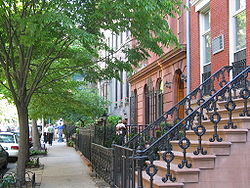
[edit]People of many different cultures live in Chelsea. Chelsea is famous for having a large LGBTQ population, with one of Chelsea's census tracts reporting that 22% of its residents were gay couples,[11] and is known for its social diversity and inclusion.[37] Eighth Avenue is a center for LGBT-oriented shopping and dining, and from 16th to 22nd Streets between Ninth and Tenth Avenues, mid-nineteenth-century brick and brownstone townhouses are still occupied, a few even restored to single family use.[38][39]


The stores of Chelsea reflect the ethnic and social diversity of the area's population. The Chelsea Lofts district – the former fur and flower district – is located roughly between Sixth and Seventh Avenues from 23rd to 30th streets.[citation needed] The McBurney YMCA on West 23rd Street, commemorated in the hit Village People song Y.M.C.A., sold its home and relocated in 2002 to a new facility on 14th Street, the neighborhood's southern border.[40]
By the late 20th and early 21st centuries, Chelsea had become an alternative shopping destination, starring the likes of Barneys CO-OP — which replaced the much larger original Barneys flagship store — Comme des Garçons, Balenciaga boutiques, Alexander McQueen, Stella McCartney, and Christian Louboutin. Chelsea Market, on the ground floor of the former Nabisco Building, is a destination for food lovers. In the late 1990s, New York's visual arts community began a gradual transition away from SoHo, due to increasing rents and competition from upscale retailers for the large and airy spaces that art galleries require,[26] and the area of West Chelsea between Tenth and Eleventh Avenues and 16th and 28th Streets has become a new global centers of contemporary art, home to over 200 art galleries that are home to modern art from both upcoming and established artists.[41] Along with the art galleries, Chelsea is home to the Rubin Museum of Art, with a focus on Himalayan art; the Graffiti Research Lab and New York Live Arts, a producing and presenting organization of dance and other movement-based arts. The community, in fact, is home to many highly regarded performance venues, among them the Joyce Theater, one of the city's premier modern dance emporiums, and The Kitchen, a center for cutting-edge theatrical and visual arts.
.jpg)
Above 23rd Street, by the Hudson River, the neighborhood is post-industrial, featuring the elevated High Line viaduct, which follows the river all through Chelsea. The elevated rail line was the successor to the street-level freight line original built through Chelsea in 1847, which was the cause of numerous fatal accidents, so it was elevated in the early 1930s by the New York Central Railroad. It fell out of use in the 1960s through 1980 and was originally slated to be torn down, but in the early 2000s, it was redesigned and converted into a highly used aerial greenway and rails-to-trails park. [20] With a change in zoning resolution in conjunction with the development of the High Line, Chelsea experienced a new construction boom, with projects by notable architects such as Shigeru Ban, Neil Denari, Jean Nouvel, and Frank Gehry. The neighborhood was quickly gentrifying, with small businesses being replaced by big-box retailers and technology and fashion stores.[7] With this development, more wealthy residents moved in, further widening an already-existing income gap with public-housing residents. In 2015, the average yearly household income in most of Chelsea was about $140,000. On the other hand, in the area's two public-housing developments – the Chelsea-Elliot Houses, between 25th Street, Ninth Avenue, 28th Street, and Tenth Avenue; and Fulton Houses, between 16th Street, Ninth Avenue, 19th Street, and Tenth Avenue – the average income was less than $30,000.[7] At the same time, the area's Puerto Rican enclaves and rent-subsidized housing, especially in Penn South, was being replaced by high-rent studios. This resulted in large income disparities across the neighborhood; one block in particular – 25th Street between 9th and 10th Avenues – had the Elliot Houses on its north side and two million-dollar residences on its south side.[7]
The Chelsea neighborhood is served by two weekly newspapers: the Chelsea-Clinton News and Chelsea Now.[dubious – discuss]
West Chelsea refers to the western portion of Chelsea, previously known as Gasoline Alley,[42] much of which was previously a manufacturing area and has since been rezoned to allow for high-rise residential uses. It is often considered the area of Chelsea between the Hudson River to the west and Tenth Avenue to the east, a portion of which was designated a historic district in 2008.[43] A 2008 article in The New York Times showed the eastern boundary of West Chelsea as Eighth Avenue for the area between 14th and 23rd streets, Ninth Avenue between 23rd and 25th, and Tenth Avenue between 25th and 29th.[44][45]
Landmarks and places of interest
[edit]Culinary
[edit].jpg)
The Chelsea Market, located in a restored historic Nabisco factory and headquarters, is a festival marketplace that hosts a variety of shopping and dining options, including bakeries, restaurants, a fish market, wine store, and many others.[46]
Peter McManus Cafe, a bar and restaurant on Seventh Avenue at 19th Street, is among the oldest family-owned and -operated bars in the city.
The Empire Diner was an art moderne diner at 210 Tenth Avenue at 22nd Street that appeared in several movies and was mentioned in Billy Joel's song "Great Wall of China". Designed by Fodero Dining Car Company, it was built in 1946 and was altered in 1979 by Carl Laanes. The diner closed on May 15, 2010; reopened briefly as "The Highliner", and again re-opened under its original name in January 2014[47] before closing permanently in December 2015 due to failure to pay rent.[48]
Cultural
[edit]Pike's Opera House was built in 1868, and bought the next year by James Fisk and Jay Gould, who renamed it the Grand Opera House. Located on the corner of Eighth Avenue and 23rd Street, it survived until 1960 as an RKO movie theater.[16]
The Irish Repertory Theatre is an Off-Broadway theatrical company on West 22nd Street producing plays by Irish and Irish-American writers.
The Joyce Theater, located in the former Elgin Theater at 175 Eighth Avenue, near 19th Street, is in a 1941 movie house that closed in 1978. The Elgin was completely renovated to create in the Joyce a venue suitable for dance, and was reopened in 1982.[49]
The Kitchen is a performance space at 512 West 19th Street. It was founded in Greenwich Village in 1971 by Steina and Woody Vasulka, taking its name from the original location, the kitchen of the Mercer Arts Center.[50]
The warehouse building at 530 West 27th Street, which was the site of The Sound Factory & Twilo,[51] as well as several other megaclubs in the 1980s and 1990s, was acquired in 2011 by the British theater company Punchdrunk, who converted it into "The McKittrick Hotel", a five-story, 100,000 sq ft (9,300 m2) performance space housing their immersive site-specific theatrical production, Sleep No More. The building, along with those at 532 and 542 West 27th Street, was also the location of several restaurants and event venues, and featured other shows such as 'Speakeasy Magick', featuring Todd Robbins, Jason Suran, and Matthew Holtzclaw.[52][53][54] The McKittrick and associated spaces closed in 2025 following the end of Sleep No More's theatrical run.[55]
New York Live Arts is a dance organization located at 219 West 19th Street between 7th and 8th Avenues.[56]
The Rubin Museum of Art is a museum dedicated to the collection, display, and preservation of the art of the Himalayas and surrounding regions, especially that of Tibet. It was located at 150 West 17th Street between Avenue of the Americas (Sixth Avenue) and Seventh Avenue. While the museum still exists as an institution, its Chelsea building closed on October 6, 2024.[57]

Industrial and commercial
[edit]Google's New York office occupies 111 Eighth Avenue, which takes up the full city block between 15th and 16th Streets and between Eighth and Ninth Avenues. The building was once Inland Terminal 1 of the Port Authority of New York and New Jersey.[58]
The Starrett-Lehigh Building, a huge full-block freight terminal and warehouse on West 26th Street between Eleventh and Twelfth Avenues, was built in 1930–1931 as a joint venture of the Starett real estate firm and the Lehigh Valley Railroad. Designed by Cory & Cory to enable trains to pull into the ground floor of the building, it was one of only a few American buildings included in the Museum of Modern Art's 1932 "International Style" exhibition. It was designated a New York City landmark in 1966.[10]

The Hudson Yards rail-yard development is located at the northern edge of Chelsea, within the Hudson Yards neighborhood. The project's centerpiece is a mixed-use real estate development by Related Companies. According to its master plan, created by master planner Kohn Pedersen Fox Associates, Hudson Yards is expected to consist of 16 skyscrapers containing more than 1.27×10⁶ sq ft (118,000 m2) of new office, residential, and retail space. Among its components will be 6×10⁶ sq ft (560,000 m2) of commercial office space, a 750,000 sq ft (70,000 m2) retail center with two levels of restaurants, cafes, markets and bars, a hotel, a cultural space, about 5,000 residences, a 750-seat school, and 14 acres (5.7 ha) of public open space. The development, located mainly above and around the West Side Yard, will create a new neighborhood that overlaps with Chelsea and Hell's Kitchen.[59]
Residential
[edit]Hotel Chelsea, built 1883–1885 and designed by Hubert, Pirsson & Co., was New York's first cooperative apartment complex[10] and was the tallest building in the city until 1902. After the theater district migrated uptown and the neighborhood became commercialized, the residential building folded and in 1905 it was turned into a hotel.[60] The hotel attracted attention as the place where Dylan Thomas had been staying when he died in 1953 at St. Vincent's Hospital in Greenwich Village, and for the 1978 slaying of Nancy Spungen for which Sid Vicious was accused. The hotel has been the home of numerous celebrities, including Brendan Behan, Thomas Wolfe, Mark Twain, Tennessee Williams and Virgil Thomson,[10] and the subject of books, films (Chelsea Girls, 1966) and music.
_(44520183804).jpg)
The London Terrace apartment complex on West 23rd was one of the world's largest apartment blocks when it opened in 1930, with a swimming pool, solarium, gymnasium, and doormen dressed as London bobbies. It was designed by Farrar and Watmough. It takes its name from the fashionable mid-19th century cottages that were once located there.[16]
Penn South is a large limited-equity housing cooperative constructed in 1962 by the United Housing Foundation and financed by the International Ladies' Garment Workers' Union. The development includes 2,820 apartments and covers six city blocks between 8th and 9th Avenue and 23rd and 29th Street. In 2012, there were 6,000 names on a waiting list of prospective residents looking to purchase a unit in the development.[61] Under the terms of agreements reached with the City of New York in 1986 and 2002, and separately with the United States Department of Housing and Urban Development, Penn South's eligibility for tax abatements offered by the Mitchell-Lama Housing Program has been extended to 2052.[62]
Other
[edit]
The Chelsea Piers were the city's primary luxury ocean liner terminal from 1910 until 1935, when the growing size of ships made the complex inadequate. The RMS Titanic was headed to Pier 60 at the piers and the RMS Carpathia brought survivors to Pier 54 in the complex, which was destroyed in 2018 although ironwork remains. The northern piers are now part of an entertainment and sports complex operated by Roland W. Betts, and the southern piers are part of Hudson River Park.[63] The Hudson River Park, designed as a joint city/state park with non-traditional uses, runs along the Hudson River waterfront from 59th Street to the Battery and comprises most of the associated piers.[64]
Chelsea Park is located between 9th and 10th Avenues, and between 27th and 28th Streets. It contains baseball diamonds, basketball courts and six handball courts.[65]
Chelsea Studios, a sound stage on 26th Street, has been operating since 1914, and numerous movies and television shows have been produced there.[66]
The Church of the Holy Apostles[67] was built in 1845–1848 to a design by Minard Lefever, with additions by Lefever in 1853–1854, and transepts by Charles Babcock added in 1858, this Italianate church was designated a New York City landmark in 1966 and is listed on the National Register of Historic Places. It is Lefever's only surviving building in Manhattan. The building, which featured an octagonal spire,[68] was burned in a serious fire in 1990, but stained glass windows by William Jay Bolton survived, and the church reopened in April 1994 after a major restoration.[10] The Episcopal parish is notable for hosting the city's largest program to feed the poor,[69] and is the second and larger home of the LGBTQ-oriented synagogue, Congregation Beth Simchat Torah.[70]
The General Theological Seminary of the Episcopal Church's college-like close is sometimes called "Chelsea Square". It consists of a city block of tree-shaded lawns between Ninth and Tenth Avenues and West 20th and 21st Streets. The campus is ringed by more than a dozen brick and brownstone buildings in Gothic Revival style. The oldest building on the campus dates from 1836. Most of the rest were designed as a group by architect Charles Coolidge Haight, under the guidance of the Dean, Augustus Hoffman.[71] In 2024, Vanderbilt University entered into a lease with The General Theological Seminary to establish a Vanderbilt campus in New York City. "The leasing arrangement is not a merger with The General Theological Seminary. The Seminary will continue to operate as a separate entity and maintain its distinct identity and programming."[72]
Police and crime
[edit]Chelsea is patrolled by the 10th Precinct of the NYPD, located at 230 West 20th Street.[73] The 10th Precinct ranked 61st safest out of 69 patrol areas for per-capita crime in 2010.[74] As of 2018[update], with a non-fatal assault rate of 34 per 100,000 people, Chelsea and Hell's Kitchen's rate of violent crimes per capita is less than that of the city as a whole. The incarceration rate of 313 per 100,000 people is lower than that of the city as a whole.[33]: 8
The 10th Precinct has a lower crime rate than in the 1990s, with crimes across all categories having decreased by 74.8% between 1990 and 2018. The precinct reported 1 murder, 19 rapes, 81 robberies, 103 felony assaults, 78 burglaries, 744 grand larcenies, and 26 grand larcenies auto in 2018.[75]
Fire safety
[edit]_27.jpg)
Chelsea is served by two fire stations of the New York City Fire Department (FDNY).[76] Engine Company 1/Ladder Company 24 is located at 142 West 31st Street,[77] while Engine Company 3/Ladder Company 12/Battalion 7 is located at 146 West 19th Street.[78] In addition, FDNY EMS Station 7 is located at 512 West 23rd Street.
Health
[edit]Preterm births in Chelsea and Hell's Kitchen are the same as the city average, though teenage births are less common. In Chelsea and Hell's Kitchen, there were 87 preterm births per 1,000 live births (compared to 87 per 1,000 citywide), and 9.9 teenage births per 1,000 live births (compared to 19.3 per 1,000 citywide).[33]: 11 Chelsea and Hell's Kitchen have a low population of residents who are uninsured. In 2018, this population of uninsured residents was estimated to be 11%, slightly less than the citywide rate of 12%.[33]: 14
The concentration of fine particulate matter, the deadliest type of air pollutant, in Chelsea and Hell's Kitchen is 0.0098 mg/m3 (9.8×10⁻⁹ oz/cu ft), more than the city average.[33]: 9 Eleven percent of Chelsea and Hell's Kitchen residents are smokers, which is less than the city average of 14% of residents being smokers.[33]: 13 In Chelsea and Hell's Kitchen, 10% of residents are obese, 5% are diabetic, and 18% have high blood pressure—compared to the citywide averages of 24%, 11%, and 28% respectively.[33]: 16 In addition, 14% of children are obese, compared to the citywide average of 20%.[33]: 12
Ninety-one percent of residents eat some fruits and vegetables every day, which is higher than the city's average of 87%. In 2018, 86% of residents described their health as "good", "very good", or "excellent", more than the city's average of 78%.[33]: 13 For every supermarket in Chelsea and Hell's Kitchen, there are 7 bodegas.[33]: 10
The nearest major hospitals are the Bellevue Hospital Center and NYU Langone Medical Center in Kips Bay.[79][80] In addition, Beth Israel Medical Center in Stuyvesant Town operated until 2025.[81]
Post offices and ZIP Codes
[edit]_X06.jpg)
Chelsea is located within two primary ZIP Codes. The area north of 24th Street is in 10001 while the area south of 24th Street is in 10011.[82] The United States Postal Service operates four post offices in Chelsea:
- James A. Farley Station – 421 8th Avenue; the main post office for New York City[83]
- London Terrace Station – 234 10th Avenue[84]
- Old Chelsea Station – 217 West 18th Street[85]
- Port Authority Station – 74 9th Avenue[86]
In addition, the Centralized Parcel Post and the Morgan General Mail Facility are located at 341 9th Avenue.[87][88] The USPS also operates a vehicle maintenance facility on the block bounded by 11th Avenue, 24th Street, 12th Avenue, and 26th Street.[89] This facility has the ZIP Code 10199.[82]
Education
[edit]
Chelsea and Hell's Kitchen generally have a higher rate of college-educated residents than the rest of the city as of 2018[update]. A majority of residents age 25 and older (78%) have a college education or higher, while 6% have less than a high school education and 17% are high school graduates or have some college education. By contrast, 64% of Manhattan residents and 43% of city residents have a college education or higher.[33]: 6 The percentage of Chelsea and Hell's Kitchen students excelling in math rose from 61% in 2000 to 80% in 2011, and reading achievement increased from 66% to 68% during the same time period.[90]
Chelsea and Hell's Kitchen's rate of elementary school student absenteeism is lower than the rest of New York City. In Chelsea and Hell's Kitchen, 16% of elementary school students missed twenty or more days per school year, less than the citywide average of 20%.[34]: 24 (PDF p. 55) [33]: 6 Additionally, 81% of high school students in Chelsea and Hell's Kitchen graduate on time, more than the citywide average of 75%.[33]: 6
Schools
[edit]
There are numerous public schools in Chelsea, including PS 11, also known as the William T. Harris School; PS 33, the Chelsea School; the O. Henry School (IS 70); Liberty High School For Newcomers; Lab School; the Museum School; and the Bayard Rustin Educational Complex, which houses six small schools.
The Bayard Rustin Educational Complex was founded as Textile High School in 1930, later renamed to Straubenmuller Textile High School, then Charles Evans Hughes High School. In the 1990s, it was renamed the Bayard Rustin High School for the Humanities after civil rights activist Bayard Rustin.[91] The high school closed in 2012 after a grading scandal, but the building had already started being used as a "vertical campus" housing multiple small schools. Quest to Learn, Hudson High School of Learning Technologies, Humanities Preparatory Academy, James Baldwin School, Landmark High School, and Manhattan Business Academy are the six constituent schools in the complex.
Private schools in the neighborhood include Avenues: The World School, a K-12 school; and the Catholic Xavier High School, a secondary school.
Chelsea is also home to the Fashion Institute of Technology, a specialized SUNY unit established in 1944 that serves as a training ground for the city's fashion and design industries.[92] The School of Visual Arts, a for-profit art school,[93] and the public High School of Fashion Industries also have a presence in the design fields.
The neighborhood is also home to the General Theological Seminary of the Episcopal Church, the oldest seminary in the Anglican Communion.[94] The Center for Jewish History, a consortium of several national research organizations, is a unified library, exhibition, conference, lecture, and performance venue, located on 16th Street between Fifth and Sixth Avenues.[95]
Libraries
[edit].jpg)
The New York Public Library (NYPL) operates two branches in Chelsea. The Muhlenberg branch is located at 209 West 23rd Street. The three-story Carnegie library building opened in 1906 and was renovated in 2000.[96] The Andrew Heiskell Braille and Talking Book Library is located at 40 West 20th Street. The current building opened in 1990; the Library of Congress has designated the Heiskell branch as the city's "Regional Library of the National Library Service for the Blind and Physically Handicapped" for Braille media and audiobooks.[97]
Transportation
[edit]The neighborhood is served by the M7, M10, M11, M12, M14 SBS and M23 SBS New York City Bus routes. New York City Subway routes include the 1, 2, and 3 services on Seventh Avenue, the A, C, and E services on Eighth Avenue, and the F, <F>, and M services on Sixth Avenue.[98] The 34th Street – Hudson Yards station on the 7 and <7> trains opened in September 2015 with its main entrance in Chelsea.[99][100]
Notable residents
[edit]- Andy Bey (born 1939), jazz singer and pianist[101]
- Bob Dylan (born 1941), singer-songwriter stayed in the Chelsea Hotel (1961–64).[102]
- Whoopi Goldberg (born 1955), actor, lived in the Chelsea-Elliot Houses.[103]
- Silas Seandel (born 1937), furniture sculptor[104]
- Wallace Shawn (born 1943), actor, lives in Chelsea.[105]
See also
[edit]
References
[edit]Notes
[edit]- ^ These are the boundaries of the historic district, not of the neighborhood. See NYCLPC map of Chelsea Historic District
- ^ Neighborhoods in New York City do not have official status, and their boundaries are not specifically set by the city. (There are a number of Community Boards, whose boundaries are officially set, but these are fairly large and generally contain a number of neighborhoods, and the neighborhood map issued by the Department of City Planning only shows the largest ones.) Because of this, the definition of where neighborhoods begin and end is subject to a variety of forces, including the efforts of real estate concerns to promote certain areas, the use of neighborhood names in media news reports, and the everyday usage of people.
- ^ The film On the Waterfront (1954) recreates this tough world, dramatized in Richard Rodgers' 1936 jazz ballet Slaughter on Tenth Avenue.
Citations
[edit]- ^ a b "NYC Planning | Community Profiles". communityprofiles.planning.nyc.gov. New York City Department of City Planning. Archived from the original on March 23, 2019. Retrieved March 18, 2019.
- ^ a b c "NYC Population FactFinder: Manhattan, Chelsea-Hudson Yards". New York City Department of City Planning. Retrieved July 25, 2024.
- ^ "National Register Information System – (#80001190)". National Register of Historic Places. National Park Service. April 15, 2008.
- ^ See:
- Rachel Klein, Erica Duecy, Carolyn Galgano (2012). Fodor's New York City 2012. Fodor's. p. 14. ISBN 9780679009306. Archived from the original on December 24, 2019. Retrieved February 24, 2018.
Its leafy streets (which stretch from 14th to the upper 20s) are lined with renovated brownstones and spacious art galleries; its avenues (from 6th to the Hudson) brim with restaurants, bakeries, bodegas, and men's clothing stores.
{{cite book}}: CS1 maint: multiple names: authors list (link) - "New York Nabes". The New York Times. 2006. Archived from the original on October 27, 2020. Retrieved February 24, 2018.
The neighborhood stretches from 6th Avenue west to the Hudson River, and from 14th Street to the upper 20s.
- White, Norval; Willensky, Elliot; Leadon, Fran (2010). AIA Guide to New York City (5th ed.). New York: Oxford University Press. p. 483. ISBN 978-0-19538-386-7. "The name was originally given by Captain Thomas Clarke to his estate, staked out in 1750, which extended roughly from the present 19th to 28th Streets, from Eighth Avenue west to the Hudson. The modern place-name covers approximately a similar area, with its eastern boundary at Seventh Avenue and its southern one at 14th Street."
- Fodor's See It New York City Archived May 27, 2016, at the Wayback Machine, p. 299. Fodor's Travel Publications, 2012. ISBN 9780876371367. Accessed October 20, 2015. "Chelsea... The boundaries stretch from 14th to 30th streets and from Sixth Avenue to the Hudson River."
- Brian Silverman (2007). New York City For Dummies. Wiley Publishing, Inc. ISBN 9780470109540. Archived from the original on March 7, 2022. Retrieved July 9, 2018.
Chelsea, which extends from 14th Street to 26th Street and from the Hudson River to Fifth Avenue, is now the city's largest gay community.
- Malbin, Peter. "If You're Thinking of Living In/Chelsea; Strikingly Changed, But Still Diverse" Archived March 16, 2018, at the Wayback Machine, The New York Times, April 16, 2000. Accessed February 24, 2018. "Today, the Chelsea Historic District encompasses parts of West 20th, West 21st and West 22nd Streets between 8th and 10th Avenues, and the neighborhood itself runs, roughly, from 14th Street to 29th Street and from the Avenue of the Americas to the Hudson River."
- Goldstein, Joseph. "New York neighborhood border wars" Archived March 16, 2018, at the Wayback Machine, New York Post, August 8, 2010. Accessed March 15, 2018. "But Chelsea's growth to the north has been more hesitant — and many residents feel that the neighborhood ends with the art galleries and the night clubs in the upper 20s."
- De Avila, Joseph. "Chelsea Shows Art for Living" Archived November 20, 2018, at the Wayback Machine, The Wall Street Journal, January 29, 2011. Accessed April 10, 2018.
- Rachel Klein, Erica Duecy, Carolyn Galgano (2012). Fodor's New York City 2012. Fodor's. p. 14. ISBN 9780679009306. Archived from the original on December 24, 2019. Retrieved February 24, 2018.
- ^ a b c d e f g Regier, Hilda. "Chelsea (i)" in Jackson, Kenneth T., ed. (2010). The Encyclopedia of New York City (2nd ed.). New Haven: Yale University Press. ISBN 978-0-300-11465-2., pp.234–235
- ^ See:
- Sloane, Leonard. "Kids on Skates and in Buggies Give New Bank a Homey Touch" Archived September 9, 2017, at the Wayback Machine, The New York Times, September 4, 1964. Accessed October 20, 2015. "The Chelsea area of Manhattan, from 14th Street to 34th Street on the West Side, is one of the city's oldest sections."
- Bennetts, Leslie. If You're Thinking of Living In: Chelsea" Archived September 9, 2017, at the Wayback Machine, The New York Times, May 2, 1982. Accessed October 2, 2015.
- ^ a b c d Navarro, Mireya. "In Chelsea, a Great Wealth Divide" Archived September 9, 2017, at the Wayback Machine, The New York Times, October 23, 2015. Accessed October 23, 2015. "Today's Chelsea, the swath west of Sixth Avenue between 14th and 34th Streets, could be the poster neighborhood for what Mayor Bill de Blasio calls the tale of two cities."
- ^ Kravitz, Derek (October 23, 2015). "Midtown South: Living Where the Action Is". WSJ. Archived from the original on December 8, 2017. Retrieved February 25, 2018.
- ^ a b Clement Clarke Moore Park Archived October 16, 2016, at the Wayback Machine, New York City Department of Parks and Recreation. Accessed August 8, 2024. "A retired British Army officer, Captain Clarke named his property 'Chelsea' after London's Royal Chelsea Hospital for veterans."
- ^ a b c d e New York City Landmarks Preservation Commission; Dolkart, Andrew S.; Postal, Matthew A. (2009). Postal, Matthew A. (ed.). Guide to New York City Landmarks (4th ed.). New York: John Wiley & Sons. ISBN 978-0-470-28963-1., p.70-72
- ^ a b Venugopal, Arun. "Census Shows Rising Numbers of Gay Couples and Dominicans in New York" Archived September 9, 2017, at the Wayback Machine, WNYC, July 14, 2011. Accessed September 20, 2016. "The largest numbers of same-sex couples live in a corridor of sorts, that stretches from Greenwich Village through Chelsea and into Hells Kitchen and Midtown along the west side of Manhattan. Chelsea, long known for its gay singles scene, also registered the highest proportion of same-sex couples, and, in one census tract bounded by Sixth and Eighth Avenues and 18th and 22nd streets, 22 percent of all couples were same-sex couples."
- ^ Janvier, Thomas Allibone (1894). In Old New York. Harper & Brothers. pp. 167–9.
- ^ Burrows & Wallace, p.447
- ^ McGeehan, Patrick. "When the Real Estate Mogul Tried to Supersize His $8 Million Brownstone", The New York Times, June 7, 2019. Accessed February 24, 2024. "A local community board had tried in vain to stop a similar expansion just seven doors away, in a home that is considered the oldest dwelling in Chelsea.... The plan for renovating the neighborhood's oldest house, at 404 West 20th Street, sparked an even bigger outcry.... The house, which has a brick front wall and about 4,000 square feet of living space, was built in 1830 on a lot leased from Mr. Moore."
- ^ Johnson, Clint. "A Vast and Fiendish Plot" New York Archive (Winter 2012)
- ^ a b c d e Federal Writers' Project (1939). New York City Guide. New York: Random House. (Reprinted by Scholarly Press, 1976, ISBN 040302921X; often referred to as WPA Guide to New York City.), pp. 151–155
- ^ Burrows & Wallace, pp.1003–1008
- ^ a b c Yarrow, Andrew L. (October 16, 1987). "Chelsea: Where the Avant-garde Rubs Shoulders With Old New York". The New York Times. ISSN 0362-4331. Retrieved April 8, 2023.
- ^ a b c d Starrett-Lehigh Building (PDF) (Report). New York City Landmarks Preservation Commission. October 7, 1986. Archived (PDF) from the original on December 20, 2022. Retrieved April 8, 2023.
- ^ a b c d e f g Brazee, Christopher D. and Most, Jennifer L. et al. "West Chelsea Historic District Designation Report" Archived December 21, 2008, at the Wayback Machine New York City Landmarks Preservation Commission (July 15, 2008)
- ^ Cooper, Lee E. (December 10, 1939). "New Era in Sight for Eleventh Ave.; a 'new' Eleventh Avenue Emerges as Work Nears Completion on Street and Railroad Improvements". The New York Times. ISSN 0362-4331. Archived from the original on March 29, 2023. Retrieved March 29, 2023.
- ^ Hughes, C. J. (March 8, 2012). "Dial C for Condos". The New York Times. Archived from the original on March 9, 2012. Retrieved October 4, 2021.
One of those Verizon buildings, a 1929 tan-brick Art Deco high-rise at 212 West 18th Street in Chelsea, is being converted into luxury condominiums. The 53-unit project is called Walker Tower for its architect, Ralph Walker, who also designed several other phone company buildings.... Verizon owns Floors 2 through 7, which contain offices for about a dozen employees who will come to work through a West 17th Street entryway. Mr. Stern owns the condo that encompasses Floors 8 through 23.
- ^ Broad, William J. "Why They Called It the Manhattan Project" Archived May 18, 2017, at the Wayback Machine, The New York Times, October 30, 2007. Accessed October 23, 2015. "After lunch, we headed to West 20th Street just off the West Side Highway.... On its north side, three tall buildings once made up the Baker and Williams Warehouses, which held tons of uranium.... Dr. Norris's 'Traveler's Guide' fact sheet said the federal government in the late 1980s and early 1990s cleaned the buildings of residual uranium."
- ^ a b Jacobson, Aileen (February 14, 2018). "East Chelsea, Manhattan: Once Industrial, Now Residential". The New York Times. ISSN 0362-4331. Retrieved April 8, 2023.
- ^ Malbin, Peter (April 16, 2000). "If You're Thinking of Living In/Chelsea; Strikingly Changed, But Still Diverse". The New York Times. ISSN 0362-4331. Retrieved April 8, 2023.
- ^ a b Holusha, John (October 12, 1997). "West Chelsea: Ex-Garages Attracting Art Galleries From Soho". The New York Times. Archived from the original on May 27, 2015. Retrieved October 4, 2021.
- ^ Simon, Mallory (September 17, 2016). "New York explosion leaves dozens injured". CNN. Archived from the original on September 18, 2016. Retrieved September 17, 2016.
- ^ Schapiro, Rick; Sandoval, Edgar; Hensley, Nicole; Otis, Ginger Adams; Parascandola, Rocco (September 18, 2016). "Explosive fireball erupts from dumpster on Chelsea street injuring 29, secondary pressure cooking device found blocks away". The New York Daily News. Archived from the original on October 31, 2017. Retrieved September 18, 2016.
- ^ Santora, Marc; Rashbaum, William K.; Baker, Al; and Goldman, Adam. "Ahmad Khan Rahami Is Arrested in Manhattan and New Jersey Bombings" Archived September 19, 2016, at the Wayback Machine, The New York Times, September 19, 2016. Accessed September 19, 2016. "The man who the police said sowed terror across two states, setting off bombs in Manhattan and on the Jersey Shore and touching off a furious manhunt, was tracked down on Monday morning sleeping in the dank doorway of a neighborhood bar and taken into custody after being wounded in a gun battle with officers. The frenzied end came on a rain-soaked street in Linden, N.J., four hours after the police issued an unprecedented cellphone alert to millions of people in the area telling them to be on the lookout for Ahmad Khan Rahami, 28, who was described as 'armed and dangerous.'"
- ^ New York City Neighborhood Tabulation Areas*, 2010 Archived November 29, 2018, at the Wayback Machine, Population Division – New York City Department of City Planning, February 2012. Accessed June 16, 2016.
- ^ Table PL-P5 NTA: Total Population and Persons Per Acre – New York City Neighborhood Tabulation Areas*, 2010 Archived June 10, 2016, at the Wayback Machine, Population Division – New York City Department of City Planning, February 2012. Accessed June 16, 2016.
- ^ Table PL-P3A NTA: Total Population by Mutually Exclusive Race and Hispanic Origin – New York City Neighborhood Tabulation Areas*, 2010 Archived June 10, 2016, at the Wayback Machine, Population Division – New York City Department of City Planning, March 29, 2011. Accessed June 14, 2016.
- ^ a b c d e f g h i j k l m n o "Clinton and Chelsea (Including Chelsea, Clinton and Hudson Yards)" (PDF). nyc.gov. NYC Health. 2018. Archived (PDF) from the original on March 23, 2019. Retrieved March 2, 2019.
- ^ a b "2016–2018 Community Health Assessment and Community Health Improvement Plan: Take Care New York 2020" (PDF). nyc.gov. New York City Department of Health and Mental Hygiene. 2016. Archived (PDF) from the original on September 9, 2017. Retrieved September 8, 2017.
- ^ Short, Aaron (June 4, 2017). "New Yorkers are living longer, happier and healthier lives". New York Post. Archived from the original on March 2, 2019. Retrieved March 1, 2019.
- ^ "NYC-Manhattan Community District 4 & 5—Chelsea, Clinton & Midtown Business District PUMA, NY". Archived from the original on March 23, 2019. Retrieved July 17, 2018.
- ^ Calhoun, Ada (December 6, 2013). "The Chelsea". The New York Times. ISSN 0362-4331. Retrieved April 8, 2023.
- ^ New York City Landmarks Preservation Commission "Chelsea Historic District Designation Report" Archived October 19, 2012, at the Wayback Machine NYCLPC (September 15, 1970)
- ^ Dibble., James E. "Chelsea Historic District Extension Designation Report" Archived October 19, 2012, at the Wayback Machine New York Landmarks Preservation Commission (February 3, 1981)
- ^ Geberer, Raanan. "The Original, Gilded YMCA" Archived October 11, 2015, at the Wayback Machine, Chelsea News, September 25, 2015. Accessed October 23, 2015. "The opening shots of the official "YMCA" video, however, might confuse some current Chelsea residents. You see a huge sign, 'McBurney YMCA,' but instead of today's familiar McBurney Y on West 14th Street, you see a different building. The older building, on West 23rd Street between 7th and 8th avenues, is still there, and was the home of the McBurney Y from 1904, when it was built, until 2002, when it moved to 14th Street."
- ^ See:
- "Chelsea Neighborhood Profile". About.com. Archived from the original on April 3, 2015. Retrieved November 3, 2011.
- "Chelsea". NYC.com. Archived from the original on November 3, 2011. Retrieved November 3, 2011.
- "Stylish Traveler: Chelsea Girls" Archived May 24, 2011, at the Wayback Machine, Travel + Leisure, September 2005. Accessed May 14, 2007. "With more than 200 galleries, Chelsea has plenty of variety. Here, eight of them that feature everything from paintings to sculpture, videos to installations."
- "City Planning Begins Public Review for West Chelsea Rezoning to Permit Housing Development and Create Mechanism for Preserving and Creating Access to the High Line" Archived June 11, 2007, at the Wayback Machine, Department of City Planning press release, December 20, 2004. "Some 200 galleries have opened their doors in recent years, making West Chelsea a destination for art lovers from around the City and the world."
- ^ Moss, Jeremiah. Vanishing New York: How a Great City Lost Its Soul. 2017, page 236.
- ^ "Special West Chelsea District Rezoning and High Line Open Space EIS – Chapter 7: Historic Resources" (PDF). Archived (PDF) from the original on February 12, 2017. Retrieved March 16, 2018.
- ^ Hughes, C. J. (January 6, 2008). "Galleries and High-Line Views". The New York Times. Archived from the original on March 17, 2018. Retrieved March 22, 2018.
- ^ West Chelsea map Archived March 16, 2018, at the Wayback Machine, from "Galleries and High-Line Views"
- ^ Martinelli, Katherine. "The Factory That Oreos Built; A new owner for the New York City landmark offers a tasty opportunity to recap a crème-filled history" Archived September 25, 2019, at the Wayback Machine, Smithsonian (magazine), May 21, 2018. Accessed October 2, 2019. "If walls could speak, the brick at New York's Chelsea Market would have more than a few stories to tell. Alphabet (the parent company of Google) purchased the building in March of 2018 for $2.4 billion—an earth-shattering figure even in New York City's real estate market—but this isn't a glittering, 21st-century beacon, a symbol of the ingenuity of Silicon Valley. In reality, the looming brick structure remains largely the same as it did more than a century ago, when it served as headquarters for the iconic snack company Nabisco."
- ^ Preston, Marguerite. "Empire Diner, Amanda Freitag's Revamp of the Retro Icon" Archived October 17, 2014, at the Wayback Machine Eater (January 7, 2014)
- ^ "Chelsea's 'Empire Diner' Forced to Close Again Amid Rent Struggles – Chelsea – DNAinfo New York". Archived from the original on October 16, 2016. Retrieved October 10, 2016.
- ^ Kisselgoff, Anna (July 26, 1981). "Creating A Theater Just for Dance". The New York Times. Archived from the original on March 7, 2022. Retrieved May 4, 2008.
- ^ Rachel Lee Harris (March 29, 2012). "Artists in Dialogue at the Kitchen". The New York Times. Archived from the original on June 23, 2015. Retrieved September 28, 2014.
- ^ "RIP Richard Grant – Founder of NYC After-Hours Institution Sound Factory – VICE". January 22, 2015. Archived from the original on January 16, 2019. Retrieved January 16, 2019.
- ^ Brantley, Ben (April 13, 2011) "Shakespeare Slept Here, Albeit Fitfully" Archived August 27, 2017, at the Wayback Machine The New York Times
- ^ "The McKittrick Hotel website". Archived from the original on March 24, 2017. Retrieved March 22, 2017.
- ^ "The McKittrick Announces Additional Performance of SPEAKEASY MAGICK". Archived from the original on August 24, 2019. Retrieved August 24, 2019.
- ^ "Sleep No More Closes Off-Broadway January 5". Playbill. Archived from the original on February 10, 2025. Retrieved May 15, 2025.
- ^ Taylor, Kate (December 1, 2010). "Dance Theater Merges With Bill T. Jones Troupe". The New York Times. Archived from the original on October 21, 2012. Retrieved December 30, 2012.
- ^ Nasseri, Visuals by Sinna; Aguiar, Text by Annie (October 9, 2024). "Audience Report: Gongs and Goodbyes as the Rubin Museum Shuts Its Doors". The New York Times. ISSN 0362-4331. Retrieved May 15, 2025.
- ^ Weiss, Lois. "Google's Search Ends" Archived March 20, 2017, at the Wayback Machine New York Post (December 3, 2010)
- ^ Volpe, Joseph (May 7, 2014). "New York's next big neighborhood is its smartest". Engadget. Archived from the original on May 8, 2014. Retrieved May 9, 2014.
- ^ Leffel, C. and Lehman, J. The Best Things to Do in New York. New York: Universal Publishing 2006.
- ^ Buckley, Cara. "Soul-Searching at a Defiantly Affordable Co-op" Archived October 7, 2017, at the Wayback Machine, The New York Times, April 19, 2011. Accessed September 1, 2017. "Founded by a labor union in 1962, Penn South has 2,820 units scattered over six blocks, still charges rock-bottom prices and once was so left-leaning that resident Communists pilloried resident Socialists.... The complex, which was sponsored by the International Ladies' Garment Workers Union and is formally known as the Mutual Redevelopment Houses, is one of the last of a breed of New York co-ops built for the working class.... Some 6,000 people are on the now-closed waiting list, and if history is any indication, many will die before getting in."
- ^ History Archived September 2, 2017, at the Wayback Machine, Penn South. Accessed September 1, 2017. "In April 2011 Penn South cooperators again voted in an advisory referendum to extend the contract with the City for an additional 8 years of tax abatement to 2030. In exchange, the City agreed to a package of over $25 million in financial aid to Penn South to help fund the replacement of the heating, ventilating, and air cooling system (HVAC). Most recently, to secure a $189 million refinance with HUD, Penn South shareholders voted to extend our contract for 22 additional years, through 2052."
- ^ Vecsey, Pete. "Piers Without Peer" Archived December 23, 2019, at the Wayback Machine, p. 63, New York (magazine), December 19, 1994. Accessed May 20, 2016.
- ^ Martin, Douglas (July 30, 1998). "Hudson Park Draws Closer To Reality; Proponents Celebrate Approval by Albany". The New York Times. Archived from the original on April 2, 2015. Retrieved March 30, 2015.
- ^ "Chelsea Park". NYC Parks. Archived from the original on February 3, 2018. Retrieved October 30, 2017.
- ^ Fry, Andy. "NYC studios can cater for growing production" Archived June 24, 2016, at the Wayback Machine, KFTV, December 17, 2014. Accessed May 20, 2016. "Another Manhattan-based venue, Chelsea Studios was formed in 1914 and hosted some high-profile productions during the 1950s and 1960s (12 Angry Men, The Phil Silvers Show)."
- ^ "Church of the Holy Apostles website". Archived from the original on August 26, 2009. Retrieved July 25, 2009.
- ^ "Church of the Holy Apostle" Archived November 16, 2009, at the Wayback Machine on New York Architecture
- ^ Quindlen, Anna (November 17, 2007). "Blessed Is the Full Plate". Newsweek. Archived from the original on October 11, 2008. Retrieved November 3, 2011.
- ^ "Congregation Beth Simchat Torah" Archived January 21, 2009, at the Wayback Machine on LGBT Religious Archives Network
- ^ Gray, Christopher. "Streetscapes: General Theological Seminary; Restoration Drive Begun For Chelsea Landmark" Archived October 16, 2016, at the Wayback Machine, The New York Times, May 1, 1988. Accessed May 20, 2016.
- ^ "Vanderbilt explores an enhanced presence in New York City". Vanderbilt University. September 26, 2024. Retrieved June 12, 2025.
- ^ "NYPD – 10th Precinct". www.nyc.gov. New York City Police Department. Archived from the original on March 24, 2017. Retrieved October 3, 2016.
- ^ "Chelsea and Hell's Kitchen – DNAinfo.com Crime and Safety Report". www.dnainfo.com. Archived from the original on April 15, 2017. Retrieved October 6, 2016.
- ^ "10th Precinct CompStat Report" (PDF). www.nyc.gov. New York City Police Department. Archived (PDF) from the original on April 13, 2018. Retrieved July 22, 2018.
- ^ "FDNY Firehouse Listing – Location of Firehouses and companies". NYC Open Data; Socrata. New York City Fire Department. September 10, 2018. Retrieved March 14, 2019.
- ^ "Engine Company 1/Ladder Company 24". FDNYtrucks.com. Archived from the original on October 23, 2018. Retrieved March 14, 2019.
- ^ "Engine Company 3/Ladder Company 12/Battalion 7". FDNYtrucks.com. Archived from the original on October 22, 2018. Retrieved March 14, 2019.
- ^ "Manhattan Hospital Listings". New York Hospitals. Archived from the original on November 15, 2016. Retrieved March 20, 2019.
- ^ "Best Hospitals in New York, N.Y." U.S. News & World Report. July 26, 2011. Archived from the original on May 29, 2019. Retrieved March 20, 2019.
- ^ "Mount Sinai Beth Israel in East Village officially closes after judge dismisses bid to stay open". ABC7 New York. April 9, 2025. Retrieved April 9, 2025.
- ^ a b "Chelsea, New York City-Manhattan, New York Zip Code Boundary Map (NY)". United States Zip Code Boundary Map (USA). Archived from the original on March 23, 2019. Retrieved March 23, 2019.
- ^ "Location Details: James A Farley". USPS.com. Archived from the original on March 7, 2022. Retrieved March 7, 2019.
- ^ "Location Details: London Terrace". USPS.com. Archived from the original on March 7, 2022. Retrieved March 7, 2019.
- ^ "Location Details: Old Chelsea". USPS.com. Archived from the original on March 7, 2022. Retrieved March 7, 2019.
- ^ "Location Details: Port Authority". USPS.com. Archived from the original on March 7, 2022. Retrieved March 7, 2019.
- ^ "Location Details: Centralized Parcel Post". USPS.com. Archived from the original on March 7, 2022. Retrieved March 7, 2019.
- ^ Edwards and Kelcey Engineers (1989). Manhattan General Mail Facility: Environmental Impact Statement. Vol. 1. p. IV-229. Archived from the original on December 26, 2019. Retrieved October 30, 2017.
- ^ Oser, Alan S. (September 18, 1988). "Perspectives: Land Use; Postal Trucks Find a Home on 11th Ave". The New York Times. Archived from the original on March 23, 2019. Retrieved March 23, 2019.
- ^ "Clinton / Chelsea – MN 04" (PDF). Furman Center for Real Estate and Urban Policy. 2011. Archived (PDF) from the original on September 18, 2013. Retrieved October 5, 2016.
- ^ Pollak, Michael (April 11, 2004). "F.Y.I." New York Times. Archived from the original on November 13, 2013. Retrieved October 7, 2009.
- ^ Our History Archived September 8, 2019, at the Wayback Machine, Fashion Institute of Technology. Accessed October 2, 2019.
- ^ Directions Archived October 3, 2019, at the Wayback Machine, School of Visual Arts. Accessed October 2, 2019.
- ^ Our History Archived October 4, 2019, at the Wayback Machine, General Theological Seminary. Accessed October 2, 2019.
- ^ About the Center Archived August 19, 2019, at the Wayback Machine, Center for Jewish History. Accessed October 2, 2019. "The Center for Jewish History in New York City illuminates history, culture, and heritage. The Center provides a collaborative home for five partner organizations: American Jewish Historical Society, American Sephardi Federation, Leo Baeck Institute, Yeshiva University Museum, and YIVO Institute for Jewish Research."
- ^ "About the Muhlenberg Library". The New York Public Library. Archived from the original on March 23, 2019. Retrieved March 23, 2019.
- ^ "About the Andrew Heiskell Braille and Talking Book Library". The New York Public Library. Archived from the original on March 23, 2019. Retrieved March 23, 2019.
- ^ "Manhattan Bus Map" (PDF). Metropolitan Transportation Authority. July 2019. Retrieved December 1, 2020.
- ^ Fitzsimmons, Emma G. (September 10, 2015). "Subway Station for 7 Line Opens on Far West Side". The New York Times. Archived from the original on September 14, 2015. Retrieved September 13, 2015.
- ^ Tangel, Andrew (September 13, 2015). "New Subway Station Opens on NYC's Far West Side". WSJ. Archived from the original on December 16, 2021. Retrieved September 13, 2015.
- ^ Adler, David R. "Andy Bey" Archived June 14, 2021, at the Wayback Machine, JazzTimes, April 25, 2019. Accessed December 14, 2020. "We are sitting in Bey's studio apartment on the western edge of Manhattan's Chelsea district, where he has lived for the last 13 years. "
- ^ Arak, Joey (October 22, 2008). "Meanwhile, at the Hotel Chelsea". Curbed NY. Archived from the original on June 4, 2023. Retrieved October 13, 2023.
- ^ Staff Writer (June 21, 2005). "Whoopi-ing it up for Hudson Guild". amNY – The Villager. Schneps Media. Archived from the original on February 3, 2022. Retrieved February 3, 2022.
- ^ Rohrlich, Marianne. "Currents: Metalwork; On the Train to West Chelsea", October 15, 1998. Accessed February 10, 2025. "Silas Seandel was a pioneer 30 years ago, and he may be one again. In 1967, the designer and metal smith, below left in his workshop, was one of the original tenants at the D.& D. Building in Manhattan, where he sold his handmade sculptural metal furniture to architects and designers. Recently, he relocated his showroom, left, to 551–3 West 22d Street in Chelsea, where he now sells to the public."
- ^ Als, Hilton (Summer 2012). "Wallace Shawn, The Art of Theater No. 17". The Paris Review. Paris, France: The Paris Review Foundation. Retrieved December 17, 2016.
Bibliography
[edit]- Burrows, Edwin G. and Wallace, Mike (1999). Gotham: A History of New York City to 1898. New York: Oxford University Press. ISBN 0-195-11634-8.
External links
[edit]

- Manhattan Community Board 4—The Chelsea & Clinton/Hell's Kitchen Community Board

| International | |
|---|---|
| National | |
| Geographic | |
| Other | |


Chelsea, Manhattan
View on GrokipediaChelsea is a neighborhood on the West Side of the borough of Manhattan in New York City, approximately bounded by West 14th Street to the south, West 30th Street to the north, Sixth Avenue to the east, and the Hudson River to the west.[1] The area originated in 1750 when British Army Captain Thomas Clarke purchased farmland and named his estate after the Chelsea district in London, establishing one of Manhattan's earliest continuously named neighborhoods.[2]
Historically an industrial zone with warehouses and factories, Chelsea underwent significant transformation in the late 20th century through loft conversions, attracting artists and contributing to its emergence as a hub for contemporary art with nearly 300 galleries concentrated in West Chelsea.[3] Notable features include the Chelsea Historic District, designated in 1970 for its Greek Revival row houses, the repurposed elevated rail line now known as the High Line park, and Chelsea Market, a food hall in a former biscuit factory.[4] The neighborhood also encompasses Chelsea Piers, a waterfront sports and entertainment complex, reflecting its evolution from manufacturing to mixed-use development with residential high-rises and cultural institutions.[5]
Geography and Boundaries
Location and Extent
Chelsea occupies a position on the west side of Manhattan, roughly bounded by 14th Street to the south, 30th Street to the north, the Hudson River to the west, and Eighth Avenue to the east.[6][7] These limits are approximate, as New York City neighborhoods lack formal boundaries, leading to overlaps with the Meatpacking District along the southern waterfront below 14th Street and Hell's Kitchen extending northward beyond 30th Street toward Midtown.[7] The neighborhood aligns with Manhattan's grid plan, laid out under the Commissioners' Plan of 1811, which organizes streets numerically from 1st Street northward and avenues east-west. Chelsea sits immediately north of Greenwich Village, which spans south to Houston Street, and south of Midtown Manhattan, generally starting at 34th Street.[8] Administratively, it falls within Manhattan Community Board 4 (CB4), which encompasses Chelsea alongside Clinton and Hell's Kitchen from 14th to 59th Streets west of Fifth Avenue; associated ZIP codes include 10001, 10011, and 10018.[9][10]Physical Features and Urban Layout
Chelsea exhibits a flat topography typical of much of lower Manhattan, with average elevations around 43 feet above sea level, which supports straightforward construction but limits natural slope for stormwater drainage.[11] The neighborhood's adjacency to the Hudson River along its western edge, comprising largely filled land at lower grades, heightens vulnerability to coastal flooding, as identified in New York City planning assessments that note significant risks from storm surges and sea-level rise, thereby constraining ground-level development through mandated elevation requirements and resilient design standards.[12][13] The urban layout adheres to the rectangular grid system formalized in the 1811 Commissioners' Plan for Manhattan, featuring evenly spaced east-west cross-streets from West 14th to West 30th Streets intersected by north-south avenues from Sixth to Twelfth, promoting efficient circulation for vehicles, pedestrians, and utilities.[14] Prominent thoroughfares like West 23rd Street and Tenth Avenue function as vital connectors, handling peak-hour traffic volumes comparable to nearby corridors such as Eighth Avenue's approximately 1,650 vehicles per hour, according to Department of City Planning traffic analyses, which underscore the grid's role in managing daily flows despite periodic congestion from waterfront access points.[15] Zoning frameworks, including the Special West Chelsea District established to balance growth with existing fabric, yield a varied built environment of low-rise industrial warehouses repurposed for lofts, mid-rise structures, and high-rise towers clustered along avenues, enabling densities that adapt to the flat terrain while incorporating flood-resilient features like raised foundations near the river.[16] This mix preserves functional infrastructure from Chelsea's manufacturing past amid newer vertical elements, with regulations permitting floor area ratios that accommodate the neighborhood's infrastructural demands without uniform height mandates across blocks.[17]History
Early Settlement and Development (Pre-1850)
The area encompassing modern Chelsea was predominantly rural farmland during the early 18th century, with sparse European settlement beyond the southern tip of Manhattan. In 1750, retired British Army Captain Thomas Clarke, a veteran of the French and Indian Wars, purchased approximately 100 acres from Dutch landowner Jacob Somerindyke, extending roughly from present-day 19th to 24th Streets between Eighth and Tenth Avenues, with some accounts noting waterfront access to the Hudson River.[18][19] Clarke named the property the Chelsea Estate, honoring London's Royal Hospital Chelsea, a retirement home for military veterans, and developed it as a farmstead and country retreat complete with a mansion house.[20][18] The estate remained under Clarke family control following his death in 1776, passing to his daughter Charity and eventually to grandson Clement Clarke Moore by the early 19th century. Primarily used for agriculture and occasional residence, the land benefited from its proximity to the Hudson River, which served as a vital trade route for goods and passengers, though settlement remained limited due to the area's distance from lower Manhattan's core.[21][22] The completion of the Erie Canal in 1825 enhanced New York Harbor's role as a gateway for western commerce via the Hudson, indirectly boosting accessibility to uptown areas like Chelsea by increasing maritime traffic and economic pressures for northward expansion.[23] As the Commissioners' Plan of 1811 imposed a street grid northward, Moore initiated subdivision of the estate into building lots around 1830, marketing them for "houses of good quality" and requiring buyers to plant street trees to maintain an orderly, residential character.[20] This shift marked the transition from estate farming to initial residential development, attracting early middle-class residents seeking proximity to emerging piers for trade-related employment, though population density stayed low with fewer than a few hundred inhabitants by mid-century amid Manhattan's overall growth from 123,706 in 1820 to 371,223 in 1840.[24][25] Early occupants included artisans and laborers drawn by waterfront access, but verifiable census wards for the precise area yield no granular pre-1850 figures beyond broader ward aggregates indicating modest clusters amid predominant vacancy.[26]Industrialization and Working-Class Era (1850-1940)
During the mid-19th century, Chelsea's transformation into an industrial district accelerated due to its strategic proximity to rail infrastructure along Manhattan's West Side. The Hudson River Railroad completed tracks in 1851 adjacent to the area, facilitating freight transport, while the New York Central Railroad's at-grade lines along Tenth Avenue from 1847 supported warehouse and factory development despite hazardous street-level operations that earned it the moniker "Death Avenue." By the 1870s, expanded rail spurs connected to burgeoning facilities, enabling efficient movement of raw materials and goods, which causally drove manufacturing growth as businesses capitalized on low-cost logistics compared to more distant locations.[23] Warehousing and manufacturing dominated Chelsea's economy, with the Terminal Warehouse Central Stores opening in 1891 to handle commodities like furniture, furs, and woolens for major retailers such as John Wanamaker and Gimbels. Metalworking and printing industries flourished, exemplified by Cornell Iron Works, which peaked at 1,200 employees producing architectural ironwork, and H. Wolff Book Manufacturing Company established in 1910 for printing. In western Chelsea, the Gansevoort Market area became a meatpacking hub, supplying much of New York City's protein needs; by the late 1920s, it hosted around 200 companies involved in slaughtering and distribution, leveraging rail and pier access for livestock import and product shipment. The elevated High Line freight line, completed in 1934, further integrated rail with industries like the Starrett-Lehigh Building, a massive 1931 warehouse linked to the Lehigh Valley Railroad, underscoring Chelsea's role in the city's logistics chain.[23][27] Immigrant laborers, primarily Irish arriving post-Great Famine, followed by Germans and Italians, filled the workforce in these sectors, often enduring grueling conditions including long hours, dangerous machinery, and child labor—as seen in the Conley Foil Company's 1913 roster of 17 child workers among 352 total employees. Housing consisted of cramped tenements built in the 1850s for working-class families, such as two-story structures on West 26th Street, which were frequently demolished for industrial expansion, like the seven razed in 1927 for the R.C. Williams warehouse. By 1890, Irish-born and second-generation residents numbered 35,894 in Chelsea and adjacent Greenwich Village, reflecting dense settlement driven by job proximity.[23][28] Early labor organizing emerged amid these hardships, influenced by citywide garment strikes like the 1909 Uprising of 20,000, which highlighted exploitative practices and spurred union growth in related manufacturing trades, though Chelsea-specific actions focused more on waterfront and metalworkers' grievances over wages and safety. Persistent accidents from rail operations and factory hazards underscored the era's causal trade-offs: industrial prosperity for a working class bearing disproportionate risks without adequate protections.[23]Post-War Transitions and Decline (1940-1980)
Following World War II, Chelsea reached a peak in industrial activity, serving as a hub for manufacturing and warehousing tied to its proximity to piers and rail lines. However, starting in the 1950s, many factories relocated to suburbs and outer boroughs, attracted by lower land costs, reduced taxes, and advancements in trucking enabled by the interstate highway system.[5] [29] This deindustrialization mirrored broader trends in New York City, where manufacturing employment plummeted, contributing to over 600,000 job losses citywide from 1969 to 1976.[30] The manufacturing exodus led to widespread building vacancies and abandonment in Chelsea during the 1960s and 1970s, as industrial spaces sat idle amid rigid zoning regulations that hindered adaptive reuse for residential or commercial purposes. Rent control policies, extended from wartime measures, capped rents far below market rates, disincentivizing property owners from investing in upkeep and exacerbating physical deterioration.[31] [32] Urban decay intensified with the rise of single-room occupancy (SRO) hotels and informal artist squats in vacant lofts and tenements, particularly around the iconic Hotel Chelsea, which housed countercultural figures amid declining conditions.[33] Compounding these economic pressures, New York City's crime surge in the 1960s and 1970s— with homicide rates tripling between 1960 and 1970—fostered abandonment as property owners and residents fled unsafe areas, further eroding Chelsea's stability.[34] [35] Early countermeasures included the New York City Landmarks Preservation Commission's designation of the Chelsea Historic District on March 15, 1970, protecting over 300 19th-century rowhouses from demolition.[22] Yet, these preservation efforts proved limited, as policy constraints like rent controls and inflexible zoning continued to suppress private investment, prolonging vacancy and decay rather than spurring revitalization.[36]Gentrification and Revitalization (1980-Present)
In the late 1980s, Chelsea experienced an influx of artists and art galleries relocating from neighboring SoHo, drawn by affordable industrial lofts and proximity to emerging creative scenes, initiating a process of market-driven revitalization.[37] [2] This artistic pioneer phase transitioned into broader gentrification as rising property values attracted professionals from tech and finance sectors, particularly in adjacent Flatiron and Chelsea office markets, where tech firms expanded amid the early 2000s boom.[38] The neighborhood's appeal grew with infrastructure improvements, including the 2005 West Chelsea rezoning, which permitted higher-density residential development including luxury condominiums while preserving gallery spaces and facilitating the High Line's conversion into a public park.[16] [39] The High Line's opening in 2009 catalyzed further renewal, transforming an abandoned rail structure into an elevated greenway that now draws approximately 8 million visitors annually, spurring billions in private investment and tourism-related economic activity without relying on public subsidies beyond initial park maintenance.[40] This development correlated with substantial property value increases; average sales prices in Chelsea rose by about 180% from 1990 to 2010, reflecting demand from higher-income residents and contributing to a safer environment, as evidenced by a 74.8% drop in overall crimes in the 10th Precinct from 1990 to 2018.[41] Claims of widespread displacement due to gentrification have been contested by empirical studies showing that low-income households in such neighborhoods are often less likely to move compared to similar residents elsewhere in the city, with mobility patterns driven more by personal factors than rising rents alone.[42] Post-COVID shifts, including a surge in remote work, initially pressured office vacancy rates but have stabilized with renewed hybrid models and private-sector initiatives like the Fulton-Elliott-Chelsea Houses redevelopment, a mixed-use project funded through public-private partnerships that replaces aging NYCHA units with modern affordable and market-rate housing while preserving resident affordability.[43] As of 2024, this and similar ventures underscore the viability of market-led renewal, generating thousands of new units and employment opportunities without evidence of the exaggerated harms often attributed to gentrification in less data-driven narratives.[44]Demographics
Population Trends and Density
According to the 2019-2023 American Community Survey estimates from the U.S. Census Bureau, Chelsea had a population of 50,700 residents.[45] The neighborhood covers approximately 0.774 square miles, yielding a population density of about 65,509 people per square mile.[46] This density is comparable to Manhattan's overall figure of roughly 70,500 people per square mile, calculated from the borough's 2020 census population of 1,597,451 across 22.66 square miles of land area.[47] Historical data indicate fluctuations in population size. In the broader Chelsea-Clinton area (Community District 4), the population stood at 83,601 in 1970, reflecting densities from the industrial era when working-class housing supported higher residential concentrations, before declining slightly to 82,164 by 1980 amid post-war shifts.[48] Chelsea's population grew from around 40,000 in 2000 to the current levels by 2020, marking a roughly 27% increase over two decades, consistent with census tabulations for adjacent tabulation areas showing expansion from 55,839 in 2000 to 70,150 in 2010 in the Hudson Yards-Chelsea-Flatiron-Union Square zone.[49] New York City Department of City Planning projections anticipate Manhattan's population reaching 1.83 million by 2030, an 18.8% rise from 2000 levels driven by housing production and migration patterns, implying modest growth or stabilization for high-density neighborhoods like Chelsea through continued urban infill.[50]| Year | Approximate Population (Chelsea) | Notes/Source |
|---|---|---|
| 2000 | ~40,000 | Inferred from growth trends in overlapping census areas[49] |
| 2020 | 50,700 | U.S. Census Bureau ACS estimates[45] |
| 2030 (proj.) | Modest increase expected | Aligned with Manhattan borough projections[50] |