


Community hub
Coacervate
View on Wikipedia

Coacervate (/koʊəˈsɜːrvət/ or /koʊˈæsərveɪt/) is an aqueous phase rich in macromolecules such as synthetic polymers, proteins or nucleic acids. It forms through liquid-liquid phase separation (LLPS), leading to a dense phase in thermodynamic equilibrium with a dilute phase. The dispersed droplets of dense phase are also called coacervates, micro-coacervates or coacervate droplets. These structures draw a lot of interest because they form spontaneously from aqueous mixtures and provide stable compartmentalization without the need of a membrane—they are protocell candidates.
The term coacervate was coined in 1929 by Dutch chemist Hendrik G. Bungenberg de Jong and Hugo R. Kruyt while studying lyophilic colloidal dispersions.[1] The name is a reference to the clustering of colloidal particles, like bees in a swarm. The concept was later borrowed by Russian biologist Alexander I. Oparin to describe the proteinoid microspheres proposed to be primitive cells (protocells) on early Earth.[2] Coacervate-like protocells are at the core of the Oparin-Haldane hypothesis.
A reawakening of coacervate research was seen in the 2000s, starting with the recognition in 2004 by scientists at the University of California, Santa Barbara (UCSB) that some marine invertebrates (such as the sandcastle worm) exploit complex coacervation to produce water-resistant biological adhesives.[3][4] A few years later in 2009 the role of liquid-liquid phase separation was further recognized to be involved in the formation of certain membraneless organelles by the biophysicists Clifford Brangwynne and Tony Hyman.[5] Liquid organelles share features with coacervate droplets and fueled the study of coacervates for biomimicry.[6][7]
Thermodynamics
[edit]Coacervates are a type of lyophilic colloid; that is, the dense phase retains some of the original solvent – generally water – and does not collapse into solid aggregates, rather keeping a liquid property. Coacervates can be characterized as complex or simple based on the driving force for the LLPS: associative or segregative. Associative LLPS is dominated by attractive interactions between macromolecules (such as electrostatic force between oppositely charged polymers), and segregative LLPS is driven by the minimization of repulsive interactions (such as hydrophobic effect on proteins containing a disordered region).
The thermodynamics of segregative LLPS can be described by a Flory-Huggins polymer mixing model (see equation).[8][9] In ideal polymer solutions, the free-energy of mixing (ΔmixG) is negative because the mixing entropy (ΔmixS, combinatorial in the Flory-Huggins approach) is positive and the interaction enthalpies are all taken as equivalent (ΔmixH or χ = 0). In non-ideal solutions, ΔmixH can be different from zero, and the process endothermic enough to overcome the entropic term and favor the de-mixed state (the blue curve shifts up). Low molecular-weight solutes will hardly reach such non-ideality, whereas for polymeric solutes, with increasing interactions sites N and therefore decreasing entropic contribution, simple coacervation is much more likely.

![{\displaystyle \Delta _{mix}G=k_{B}T\left[{\frac {\phi }{N}}\ln \phi +(1-\phi )\ln(1-\phi )\right]+\Delta _{\operatorname {mix} }H}](https://wikimedia.org/api/rest_v1/media/math/render/svg/b61ae732e00d0a6117653cb6d0d18e32638b43f2)

The phase diagram of the mixture can be predicted by experimentally determining the two-phase boundary, or binodal curve. In a simplistic theoretical approach, the binodes are the compositions at which the free energy of de-mixing is minimal (
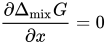

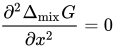
), across different temperatures (or other interaction parameter). Alternatively, by minimizing the change in free energy of de-mixing in regards to composition (), the spinodal curve is defined. The conditions of the mixture in comparison to the two curves defines the phase separation mechanism: nucleation-growth of coacervate droplets (when the binodal region is crossed slowly) and spinodal decomposition.[10][11]
Associative LLPS is more complex to describe, as both solute polymers are present in the dilute and dense phase. Electrostatic-based complex coacervates are the most common, and in that case the solutes are two polyelectrolytes of opposite charge. The Voorn-Overbeek approach applies the Debye-Hückel approximation for simple electrolytes to the enthalpic term in the Flory-Huggins model, and considers two polyelectrolytes of the same length and at the same concentration.[12][13] Kudlay and Olvera de la Cruz, included the chain connectivity and an effective excluded volume in the model, and found that the density of the precipitate after initial decrease can increase with the addition of salt as a result of the redistribution of salt between the precipitate and the supernatant, which is due to an interplay of electrostatic and hardcore interactions.[14] Complex coacervates are a subset of aqueous two-phase systems (ATPS), including segregatively separated systems in which both phases are enriched in one type of polymer.

Coacervates in biology
[edit]Membraneless organelles (MLOs), also known as biomolecular condensates,[15][16] are a form of cell compartmentalization. Unlike classic membrane-bound organelles (e.g. mitochondrion, nucleus or lysosome), MLOs are not separated from their surroundings by a lipid bilayer. MLOs are mostly composed of proteins and nucleic acids, held together by weak intermolecular forces.
MLOs are present in the cytoplasm (e.g. stress granules, processing bodies) and in the nucleus (e.g. nucleolus, nuclear speckles). They have been shown to serve various functions: they can store and protect cellular material during stress conditions,[17] they participate in gene expression[18][19] and they are involved in the control of signal transduction.[20][21]
It is now widely believed that MLOs form through LLPS. This was first proposed after observing that Cajal bodies[22] and P granules[23] show liquid-like properties, and was later confirmed by showing that liquid condensates can be reconstituted from purified protein and RNA in vitro.[21] However, whether MLOs should be referred to as liquids, remains disputable. Even if initially they are liquid-like, over time some of them maturate into solids (gel-like or even crystalline, depending on the extent of spatial ordering within the condensate).[15]
Many proteins participating in the formation of MLO contain so-called intrinsically disordered regions (IDRs), parts of the polypeptide chain that can adopt multiple secondary structures and form random coils in solution. IDRs can provide interactions responsible for LLPS, but over time conformational changes (sometimes promoted by mutations or post-translational modifications) may lead to the formation of higher ordered structures and solidification of MLOs.[10] Some MLOs serve their biological role as solid particles (e.g. Balbiani body stabilised by β-sheet structure[24]), but in many cases transformation from liquid to solid results in the formation of pathological aggregates.[25] Examples of both liquid-liquid phase separating and aggregation-prone proteins include FUS,[26] TDP-43[27][28] and hnRNPA1.[29] Aggregates of these proteins are associated with neurodegenerative diseases (e.g. amyotrophic lateral sclerosis, or frontotemporal dementia).[25]
History
[edit]At the start of the 20th century, scientists had become interested in the stability of colloids, both the dispersions of solid particles and the solutions of polymeric molecules. It was known that salts and temperature could often be used to cause flocculation of a colloid. The German chemist F.W. Tiebackx reported in 1911[30] that flocculation could also be induced in certain polymer solutions by mixing them together. In particular, he reported the observation of opalescence (a turbid mixture) when equal volumes of acidified 0.5% "washed" gelatine solution, and 2% gum arabic solution were mixed. Tiebackx did not further analyse the nature of the flocs, but it is likely that this was an example of complex coacervation.
Dutch chemist H. G. Bungenberg-de Jong reported in his PhD thesis (Utrecht, 1921) two types of flocculation in agar solutions: one that leads to a suspensoid state, and one that leads to an emulsoid state.[31] He observed the emulsoid state under the microscope and described small particles that merged into larger particles (Thesis, p. 82), most likely a description of coalescing coacervate droplets. Several years later, in 1929, Bungenberg-de Jong published a seminal paper with his PhD advisor, H. R. Kruyt, entitled “Coacervation. Partial miscibility in colloid systems”.[32] In their paper, they give many more examples of colloid systems that flocculate into an emulsoid state, either by varying the temperature, by adding salts, co-solvents or by mixing together two oppositely charged polymer colloids, and illustrate their observations with the first microscope pictures of coacervate droplets. They term this phenomenon coacervation, derived from the prefix co and the Latin word acervus (heap), which relates to the dense liquid droplets. Coacervation is thus loosely translated as 'to come together in a heap'. Since then, Bungenberg-de Jong and his research group in Leiden published a range of papers on coacervates, including results on self-coacervation, salt effects, interfacial tension, multiphase coacervates and surfactant-based coacervates.
In the meantime, Russian chemist Alexander Oparin, published a pioneering work in which he laid out his protocell theory on the origin of life.[33] In his initial protocell model, Oparin took inspiration from Graham's description of colloids from 1861 as substances that usually give cloudy solutions and cannot pass through membranes. Oparin linked these properties to the protoplasm, and reasoned that precipitates of colloids form as clots or lumps of mucus or jelly, some of which have structural features that resemble the protoplasm. According to Oparin, protocells could therefore have formed by precipitation of colloids. In his later work, Oparin became more specific about his protocell model. He described the work of Bungenberg-de Jong on coacervates in his book from 1938, and postulated that the first protocells were coacervates.[34]
Other researchers followed, and in the 1930s and 1940s various examples of coacervation were reported, by Bungenberg-de Jong, Oparin, Koets, Bank, Langmuir and others. In the 1950s and 1960s, focus shifted to a theoretical description of the phenomenon of (complex) coacervation. Voorn and Overbeek developed the first mean-field theory to describe coacervation.[12] They estimated the total free energy of mixing as a sum of mixing entropy terms and mean-field electrostatic interactions in a Debye-Hückel approximation. Veis and Aranyi suggested to extend this model with an electrostatic aggregation step in which charge-paired symmetrical soluble aggregates are formed, followed by phase separation into liquid droplets.[35]
In the decades after that, until about 2000, the scientific interest in coacervates had faded. Oparin's theory on the role of coacervates in the origin of life had been replaced by interest in the RNA world hypothesis. Renewed interest in coacervates originated as scientists recognized the relevance and versatility of the interactions that underlie complex coacervation in the natural fabrication of biological materials and in their self-assembly.
Since 2009, coacervates have become linked to membraneless organelles and there has been a renewed interest in coacervates as protocells.
Coacervates hypothesis for the origin of life
[edit]Russian biochemist Aleksander Oparin and British biologist J.B.S. Haldane independently hypothesized in the 1920s that the first cells in early Earth's oceans could be, in essence, coacervate droplets. Haldane used the term primordial soup to refer to the dilute mixture of organic molecules that could have built up as a result of reactions between inorganic building blocks such as ammonia, carbon dioxide and water, in presence of UV light as an energy source.[36] Oparin proposed that simple building blocks with increasing complexity could organize locally, or self-assemble, to form protocells with living properties.[37] He performed experiments based on Bungenberg de Jong's colloidal aggregates (coacervates) to encapsulate proteinoids and enzymes within protocells. Work by chemists Sidney Fox, Kaoru Harada, Stanley Miller and Harold Urey further strengthened the theory that inorganic building blocks could increase in complexity and give rise to cell-like structures.[38]
The Oparin-Haldane hypothesis established the foundations of research on the chemistry of abiogenesis, but the lipid-world and RNA-world scenarios have gained more attention since the 1980s with the work of Morowitz, Luisi and Szostak. However, recently, there has been a rising interest in coacervates as protocells, resonating with current findings that reactions too slow or unlikely in aqueous solutions can be significantly favored in such membraneless compartments.[39][40]
See also
[edit]References
[edit]- ^ Booij, H. L.; Bungenberg de Jong, H. G. (1956), "Colloid Systems", Biocolloids and their Interactions, Vienna: Springer Vienna, pp. 8–14, doi:10.1007/978-3-7091-5456-4_2, ISBN 978-3-211-80421-6
{{citation}}: ISBN / Date incompatibility (help) - ^ Oparin, Aleksandr Ivanovich; Synge, Ann. (1957). The origin of life on the earth / Translated from the Russian by Ann Synge. New York: Academic Press. doi:10.5962/bhl.title.4528. Archived from the original on 5 May 2022. Retrieved 9 July 2021.
- ^ Stewart, R.J.; Weaver, J.C.; Morse, D.E.; Waite, J.H (2004). "The Tube Cement of Phragmatopoma californica: a solid foam". The Journal of Experimental Biology. 207 (26): 4727–34. Bibcode:2004JExpB.207.4727S. doi:10.1242/jeb.01330. PMID 15579565. S2CID 1104838.
- ^ Zhao, H.; Sun, C.; Stewart, R.J.; Waite, J.H. (2005). "Cement Proteins of the Tube-Building Polychaete Phragmatopoma californica". The Journal of Biological Chemistry. 280 (52): 42938–44. doi:10.1074/jbc.M508457200. PMID 16227622. S2CID 7746883.
- ^ Brangwynne, C. P.; Eckmann, C. R.; Courson, D. S.; Rybarska, A.; Hoege, C.; Gharakhani, J.; Julicher, F.; Hyman, A. A. (26 June 2009). "Germline P Granules Are Liquid Droplets That Localize by Controlled Dissolution/Condensation". Science. 324 (5935): 1729–1732. Bibcode:2009Sci...324.1729B. doi:10.1126/science.1172046. ISSN 0036-8075. PMID 19460965. S2CID 42229928.
- ^ Nakashima, Karina K.; Vibhute, Mahesh A.; Spruijt, Evan (3 April 2019). "Biomolecular Chemistry in Liquid Phase Separated Compartments". Frontiers in Molecular Biosciences. 6: 21. doi:10.3389/fmolb.2019.00021. ISSN 2296-889X. PMC 6456709. PMID 31001538.
- ^ Aumiller, William M.; Pir Cakmak, Fatma; Davis, Bradley W.; Keating, Christine D. (4 October 2016). "RNA-Based Coacervates as a Model for Membraneless Organelles: Formation, Properties, and Interfacial Liposome Assembly". Langmuir. 32 (39): 10042–10053. doi:10.1021/acs.langmuir.6b02499. ISSN 0743-7463. PMID 27599198.
- ^ Veis, Arthur (September 2011). "A review of the early development of the thermodynamics of the complex coacervation phase separation". Advances in Colloid and Interface Science. 167 (1–2): 2–11. doi:10.1016/j.cis.2011.01.007. PMC 3476850. PMID 21377640.
- ^ Brangwynne, Clifford P.; Tompa, Peter; Pappu, Rohit V. (November 2015). "Polymer physics of intracellular phase transitions". Nature Physics. 11 (11): 899–904. Bibcode:2015NatPh..11..899B. doi:10.1038/nphys3532. ISSN 1745-2473. S2CID 4643961.
- ^ a b Alberti, Simon; Gladfelter, Amy; Mittag, Tanja (January 2019). "Considerations and Challenges in Studying Liquid-Liquid Phase Separation and Biomolecular Condensates". Cell. 176 (3): 419–434. doi:10.1016/j.cell.2018.12.035. PMC 6445271. PMID 30682370. S2CID 59273868.
- ^ Minton, Allen P. (26 March 2020). "Simple Calculation of Phase Diagrams for Liquid–Liquid Phase Separation in Solutions of Two Macromolecular Solute Species". The Journal of Physical Chemistry B. 124 (12): 2363–2370. doi:10.1021/acs.jpcb.0c00402. ISSN 1520-6106. PMC 7104237. PMID 32118433.
- ^ a b Overbeek, J. T. G.; Voorn, M. J. (May 1957). "Phase separation in polyelectrolyte solutions. Theory of complex coacervation". Journal of Cellular and Comparative Physiology. 49 (S1): 7–26. doi:10.1002/jcp.1030490404. ISSN 0095-9898. PMID 13449108.
- ^ Voorn, Michael Johannes (1956). Complex coacervation. Centen. OCLC 901788902.
- ^ Kudlay, Alexander; Olvera de la Cruz, Monica (2004). "Precipitation of Oppositely Charged Polyelectrolytes in Salt Solutions". J. Chem. Phys. 120 (120): 404–412. Bibcode:2004JChPh.120..404K. doi:10.1063/1.1629271. PMID 15267302.
- ^ a b Boeynaems, Steven; Alberti, Simon; Fawzi, Nicolas L.; Mittag, Tanja; Polymenidou, Magdalini; Rousseau, Frederic; Schymkowitz, Joost; Shorter, James; Wolozin, Benjamin; Van Den Bosch, Ludo; Tompa, Peter (June 2018). "Protein Phase Separation: A New Phase in Cell Biology". Trends in Cell Biology. 28 (6): 420–435. doi:10.1016/j.tcb.2018.02.004. ISSN 0962-8924. PMC 6034118. PMID 29602697.
- ^ Alberti, Simon; Gladfelter, Amy; Mittag, Tanja (January 2019). "Considerations and Challenges in Studying Liquid-Liquid Phase Separation and Biomolecular Condensates". Cell. 176 (3): 419–434. doi:10.1016/j.cell.2018.12.035. PMC 6445271. PMID 30682370.
- ^ Riback, Joshua A.; Katanski, Christopher D.; Kear-Scott, Jamie L.; Pilipenko, Evgeny V.; Rojek, Alexandra E.; Sosnick, Tobin R.; Drummond, D. Allan (March 2017). "Stress-Triggered Phase Separation Is an Adaptive, Evolutionarily Tuned Response". Cell. 168 (6): 1028–1040.e19. doi:10.1016/j.cell.2017.02.027. ISSN 0092-8674. PMC 5401687. PMID 28283059.
- ^ Wheeler, Joshua R; Matheny, Tyler; Jain, Saumya; Abrisch, Robert; Parker, Roy (15 August 2016). "Author response: Distinct stages in stress granule assembly and disassembly". doi:10.7554/elife.18413.018.
{{cite journal}}: Cite journal requires|journal=(help) - ^ Boulay, Gaylor; Sandoval, Gabriel J.; Riggi, Nicolo; Iyer, Sowmya; Buisson, Rémi; Naigles, Beverly; Awad, Mary E.; Rengarajan, Shruthi; Volorio, Angela; McBride, Matthew J.; Broye, Liliane C. (1 October 2018). "Abstract PR09: Cancer-specific retargeting of BAF complexes by a prion-like domain". Cancer Research. 78 (19_Supplement). American Association for Cancer Research: PR09. doi:10.1158/1538-7445.pedca17-pr09. S2CID 86838379.
- ^ Margulies, David (17 May 2016). "Faculty Opinions recommendation of Phase separation of signaling molecules promotes T cell receptor signal transduction". doi:10.3410/f.726273110.793518440.
{{cite journal}}: Cite journal requires|journal=(help) - ^ a b Li, Pilong; Banjade, Sudeep; Cheng, Hui-Chun; Kim, Soyeon; Chen, Baoyu; Guo, Liang; Llaguno, Marc; Hollingsworth, Javoris V.; King, David S.; Banani, Salman F.; Russo, Paul S. (March 2012). "Phase transitions in the assembly of multivalent signalling proteins". Nature. 483 (7389): 336–340. Bibcode:2012Natur.483..336L. doi:10.1038/nature10879. ISSN 0028-0836. PMC 3343696. PMID 22398450.
- ^ Handwerger, Korie E.; Cordero, Jason A.; Gall, Joseph G. (January 2005). "Cajal Bodies, Nucleoli, and Speckles in the Xenopus Oocyte Nucleus Have a Low-Density, Sponge-like Structure". Molecular Biology of the Cell. 16 (1): 202–211. doi:10.1091/mbc.e04-08-0742. ISSN 1059-1524. PMC 539164. PMID 15509651.
- ^ Brangwynne, C. P.; Eckmann, C. R.; Courson, D. S.; Rybarska, A.; Hoege, C.; Gharakhani, J.; Julicher, F.; Hyman, A. A. (21 May 2009). "Germline P Granules Are Liquid Droplets That Localize by Controlled Dissolution/Condensation". Science. 324 (5935): 1729–1732. Bibcode:2009Sci...324.1729B. doi:10.1126/science.1172046. ISSN 0036-8075. PMID 19460965. S2CID 42229928.
- ^ Boke, Elvan; Ruer, Martine; Wühr, Martin; Coughlin, Margaret; Lemaitre, Regis; Gygi, Steven P.; Alberti, Simon; Drechsel, David; Hyman, Anthony A.; Mitchison, Timothy J. (July 2016). "Amyloid-like Self-Assembly of a Cellular Compartment". Cell. 166 (3): 637–650. doi:10.1016/j.cell.2016.06.051. ISSN 0092-8674. PMC 5082712. PMID 27471966.
- ^ a b Alberti, Simon; Dormann, Dorothee (3 December 2019). "Liquid–Liquid Phase Separation in Disease". Annual Review of Genetics. 53 (1): 171–194. doi:10.1146/annurev-genet-112618-043527. ISSN 0066-4197. PMID 31430179.
- ^ Patel, Avinash; Lee, Hyun O.; Jawerth, Louise; Maharana, Shovamayee; Jahnel, Marcus; Hein, Marco Y.; Stoynov, Stoyno; Mahamid, Julia; Saha, Shambaditya; Franzmann, Titus M.; Pozniakovski, Andrej (August 2015). "A Liquid-to-Solid Phase Transition of the ALS Protein FUS Accelerated by Disease Mutation". Cell. 162 (5): 1066–1077. doi:10.1016/j.cell.2015.07.047. ISSN 0092-8674. PMID 26317470. S2CID 14098476.
- ^ Conicella, Alexander E.; Zerze, Gül H.; Mittal, Jeetain; Fawzi, Nicolas L. (September 2016). "ALS Mutations Disrupt Phase Separation Mediated by α-Helical Structure in the TDP-43 Low-Complexity C-Terminal Domain". Structure. 24 (9): 1537–1549. doi:10.1016/j.str.2016.07.007. ISSN 0969-2126. PMC 5014597. PMID 27545621.
- ^ Wang, Ailin; Conicella, Alexander E; Schmidt, Hermann Broder; Martin, Erik W; Rhoads, Shannon N; Reeb, Ashley N; Nourse, Amanda; Ramirez Montero, Daniel; Ryan, Veronica H; Rohatgi, Rajat; Shewmaker, Frank (9 February 2018). "A single N-terminal phosphomimic disrupts TDP-43 polymerization, phase separation, and RNA splicing". The EMBO Journal. 37 (5). doi:10.15252/embj.201797452. ISSN 0261-4189. PMC 5830921. PMID 29438978.
- ^ Molliex, Amandine; Temirov, Jamshid; Lee, Jihun; Coughlin, Maura; Kanagaraj, Anderson P.; Kim, Hong Joo; Mittag, Tanja; Taylor, J. Paul (September 2015). "Phase Separation by Low Complexity Domains Promotes Stress Granule Assembly and Drives Pathological Fibrillization". Cell. 163 (1): 123–133. doi:10.1016/j.cell.2015.09.015. ISSN 0092-8674. PMC 5149108. PMID 26406374. S2CID 18550463.
- ^ Tiebackx, F. W. (April 1911). "Gleichzeitige Ausflockung zweier Kolloide". Zeitschrift für Chemie und Industrie der Kolloide. 8 (4): 198–201. doi:10.1007/bf01503532. ISSN 0372-820X. S2CID 98519794.
- ^ "Remonstrantie der predikanten van Utrecht, overgelevert aen de [...] Staten s'landts van Utrecht, raeckende het poinct van religie". Dutch Pamphlets Online. doi:10.1163/2214-8264_dutchpamphlets-kb0-kb06696. Retrieved 20 June 2025.
- ^ Jong, H. G. Bungenberg; Kruyt, H. R. (January 1930). "Koazervation". Kolloid-Zeitschrift. 50 (1): 39–48. doi:10.1007/bf01422833. ISSN 0303-402X.
- ^ Oparin, A. I. (1924). "The Origin of Life" (PDF). Archived (PDF) from the original on 26 July 2020. Retrieved 30 July 2020.
- ^ Just, Th.; Oparin, A. I.; Morgulis, Sergius (September 1938). "The Origin of Life". American Midland Naturalist. 20 (2): 472. doi:10.2307/2420646. ISSN 0003-0031. JSTOR 2420646.
- ^ Veis, Arthur; Aranyi, Catherine (September 1960). "Phase Separation in Polyelectrolyte Systems. I. Complex Coacervates of Gelatin". The Journal of Physical Chemistry. 64 (9): 1203–1210. doi:10.1021/j100838a022. ISSN 0022-3654.
- ^ Peretó, Juli G., translator, writer of introduction. Inness, Natàlia, translator. Translation of: Oparin, A. I. (Aleksandr Ivanovich), 1894–1980. Proiskhozhedenie zhizni. Translation of: Haldane, J. B. S. (John Burdon Sanderson), 1892–1964. Origin of life. Container of (expression): Oparin, A. I. (Aleksandr Ivanovich), 1894–1980. Proiskhozhedenie zhizni. Catalan. Container of (expression): Haldane, J. B. S. (John Burdon Sanderson), 1892–1964. Origin of life. Catalan. (28 November 2011). L'origen de la vida. Universitat de València. ISBN 978-84-370-8607-1. OCLC 935643436.
{{cite book}}:|last=has generic name (help)CS1 maint: multiple names: authors list (link) CS1 maint: numeric names: authors list (link) - ^ Haldane, J. B. S. (John Burdon Sanderson), 1892–1964. Origin of life. (1929). The rationalist annual, 1829. [publisher not identified]. OCLC 927006170.
{{cite book}}: CS1 maint: multiple names: authors list (link) CS1 maint: numeric names: authors list (link) - ^ FOX, SIDNEY W. (January 1965). "A Theory of Macromolecular and Cellular Origins". Nature. 205 (4969): 328–340. Bibcode:1965Natur.205..328F. doi:10.1038/205328a0. ISSN 0028-0836. PMID 14243409. S2CID 7194753.
- ^ Dzieciol, Alicja J.; Mann, Stephen (1 March 2012). "ChemInform Abstract: Designs for Life: Protocell Models in the Laboratory". ChemInform. 43 (13): no. doi:10.1002/chin.201213265. ISSN 0931-7597.
- ^ Drobot, Björn; Iglesias-Artola, Juan M.; Le Vay, Kristian; Mayr, Viktoria; Kar, Mrityunjoy; Kreysing, Moritz; Mutschler, Hannes; Tang, T-Y Dora (7 September 2018). "Compartmentalised RNA catalysis in membrane-free coacervate protocells". Nature Communications. 9 (1): 3643. Bibcode:2018NatCo...9.3643D. doi:10.1038/s41467-018-06072-w. ISSN 2041-1723. PMC 6128941. PMID 30194374.