Hubbry Logo
Codex CumanicusCodex CumanicusMain
Open search
Codex Cumanicus
Community hub
Codex Cumanicus
logo
8 pages, 0 posts
0 subscribers
Be the first to start a discussion here.
Codex Cumanicus
Codex Cumanicus
from Wikipedia
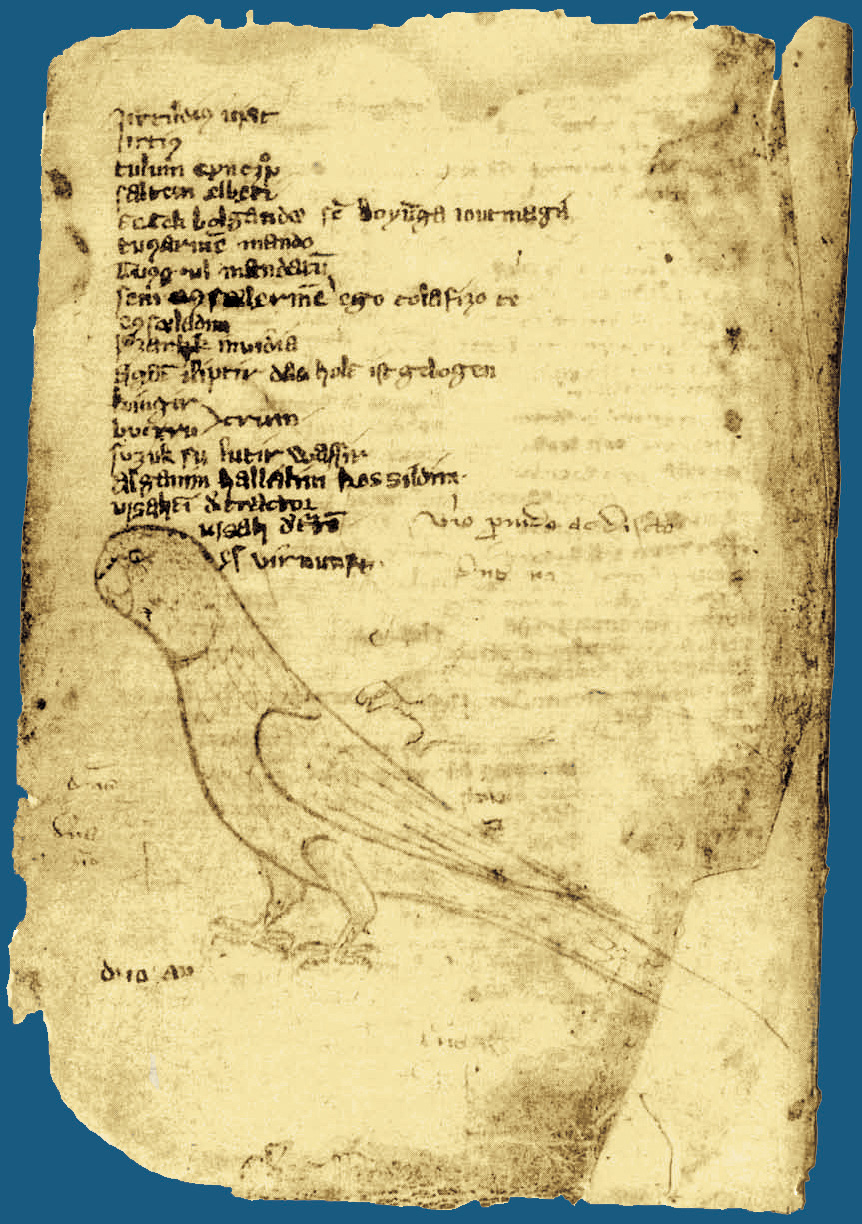
A page from the manuscript, with a drawing of a parrot

The Codex Cumanicus is a linguistic manual of the Middle Ages, designed to help Catholic missionaries communicate with the Cumans, a nomadic Turkic people. It is currently housed in the Library of St. Mark in Venice (BNM ms Lat. Z. 549 (=1597)).

The codex was created in Crimea in 14th century and is considered one of the oldest attestations of the Crimean Tatar language, which is of great importance for the history of Kipchak and Oghuz dialects — as directly related to the Kipchaks (Polovtsy, Kumans) of the Black Sea steppes and particularly the Crimean peninsula.[1]

Origin and content

[edit]

It consists of two parts. The first part consists of a dictionary in Latin, Persian and Cuman written in the Latin alphabet, and a column with Cuman verbs, names and pronouns with its meaning in Latin. The second part consists of Cuman-German dictionary, information about the Cuman grammar, and poems belonging to Petrarch.[2] However the codex referred to the language as "Tatar" (tatar til).[3]

The first part of Codex Cumanicus was written for practical purposes, to help learn the language. The second part was written to spread Christianity among the Cumans and different quotes from the religious books were provided with its Cuman translation. In the same section there are words, phrases, sentences and about 50 riddles, as well as stories about the life and work of religious leaders.[2]

The codex likely developed over time. Mercantile, political, and religious leaders, particularly in Hungary, sought effective communication with the Cumans as early as the mid-11th century. As Italian city-states such as Republic of Genoa began to establish trade posts and colonies along the Black Sea coastline, the need for tools to learn the Cuman language sharply increased.

The earliest parts of the codex are believed to have originated in the 12th or 13th century. Substantial additions were likely made over time. The copy preserved in Venice is dated 11 July 1303 on fol. 1r[4] (see Drimba, p. 35 and Schmieder in Schmieder/Schreiner, p. XIII). The codex consists of a number of independent works combined into one.

Riddles

[edit]

The "Cuman Riddles" (CC, 119–120; 143–148) are a crucial source for the study of early Turkic folklore. Andreas Tietze referred to them as "the earliest variants of riddle types that constitute a common heritage of the Turkic nations."

Among the riddles in the codex are the following excerpts:[full citation needed]

  • Aq küymengin avuzı yoq. Ol yumurtqa.
"The white yurt has no mouth (opening). That is the egg."
  • Kökçä ulahım kögende semirir. Ol huvun.
"my bluish kid at the tethering rope grows fat, The melon."
  • Oturğanım oba yer basqanım baqır canaq. Ol zengi.
"Where I sit is a hilly place. Where I tread is a copper bowl. The stirrup."

Example

[edit]

The codex's Pater Noster reads:

Cuman

Atamız kim köktäsiñ. Alğışlı bolsun seniñ atıñ, kelsin seniñ xanlığıñ, bolsun seniñ tilemekiñ — neçik kim köktä, alay [da] yerdä. Kündeki ötmäkimizni bizgä bugün bergil. Dağı yazuqlarımıznı bizgä boşatqıl — neçik biz boşatırbız bizgä yaman etkenlergä. Dağı yekniñ sınamaqına bizni quvurmağıl. Basa barça yamandan bizni qutxarğıl. Amen!

English

Our Father which art in heaven. Hallowed be thy name. Thy kingdom come. Thy will be done in earth as it is in heaven. Give us this day our daily bread. And forgive us our sins as we forgive those who have done us evil. And lead us not into temptation, But deliver us from evil. Amen.

Crimean Tatar

Atamız kim köktesiñ. Alğışlı olsun seniñ adıñ, kelsin seniñ hanlığıñ, olsun seniñ tilegeniñ — nasıl kökte, öyle [de] yerde. Kündeki ötmegimizni bizge bugün ber. Daa yazıqlarımıznı (suçlarımıznı) bizge boşat (bağışla) — nasıl biz boşatamız (bağışlaymız) bizge yaman etkenlerge. Daa şeytannıñ sınağanına bizni qoyurma. Episi yamandan bizni qurtar. Amin!

Codex Cumanicus sources

[edit]

References

[edit]
[edit]
Revisions and contributorsEdit on WikipediaRead on Wikipedia
from Grokipedia
The Codex Cumanicus is a medieval compiled in the late 13th to early in the Dasht-i Kipchak region, primarily serving as a practical linguistic to facilitate communication between Catholic missionaries, Italian merchants, and the nomadic Turkic-speaking Cuman (Kipchak) people of the Eurasian steppes. Written in multiple languages including Kipchak, Latin, Persian, Italian, and German, it consists of two main parts: a glossary-based for everyday and trade vocabulary, and a collection of Christian religious texts, proverbs, aphorisms, and 47 ancient Turkic riddles that offer insights into Cuman and . The original , housed in the in under the shelfmark Cod. Mar. Lat. DXLIX, represents one of the earliest and most comprehensive written records of the Kipchak language, reflecting the multicultural interactions in amid the Golden Horde's influence and Italian trading colonies. Historically, the codex emerged during a period of intensified European outreach to the Pontic steppes following the Mongol invasions, when Franciscan and Dominican missionaries, such as those inspired by figures like Giovanni da Pian del Carpine, sought to convert and engage with Kipchak communities amid expanding trade routes from Europe to Asia. Its content was shaped by practical necessities—overcoming language barriers for evangelism and commerce—drawing on a multilingual environment that incorporated loanwords from Slavic, Greek, Arabic, and other tongues, while prioritizing Kipchak verbs, nouns, and phrases relevant to daily life, religion, and negotiation. A second copy, transcribed on November 5, 1824, by an unknown scribe and now preserved in the Biblioteca Medicea Laurenziana in Florence (Cod. Ashburnham 1584), spans 118 pages and includes transliterations in red and black ink, preserving the original's structure for scholarly study. First documented in Western scholarship by Giacomo Filippo Tomasini in 1656 and published with transcriptions by Julius von Klaproth in 1828, the codex underscores the Kipchaks' cultural resilience and linguistic diversity post-nomadic era. The manuscript's significance extends beyond as a vital ethnographic source, illuminating Kipchak social customs, beliefs, and interactions with Persian and Latin Christian traditions through its verse and prose elements. For Turkic studies, it provides essential data on Kipchak , , and , including rare graphemes and binary oppositions in conceptualization, making it indispensable for reconstructing the language's historical development. Despite its Christian orientation, the codex captures pre-Islamic elements, such as riddles that blend Turkic oral traditions with adaptations, highlighting the syncretic cultural exchanges in the medieval Black Sea region.

Historical Background

Origins and Dating

The Codex Cumanicus originated in the late medieval period amid the interactions between Latin Christian missionaries and traders with the Turkic-speaking Cuman (Kipchak) communities in the Eurasian steppes. Its earliest components, including linguistic materials reflecting Cuman migrations and the socio-political upheavals of Mongol invasions, likely draw from 12th- and 13th-century sources, though the manuscript itself represents a later compilation. The work was probably produced in the or among Catholic missionary communities along the coast, where Italian (primarily Genoese and Venetian) merchants and German missionaries facilitated trade and evangelization efforts. This regional context is evidenced by the manuscript's vocabulary, which incorporates urban Crimean influences from polyethnic centers like Kaffa (modern Feodosiya) and Solkhat (Eski Krym). The core of the Codex—the "Interpretor’s Book" section, a trilingual glossary (Latin-Persian-Cuman)—was originally compiled around 1293–1295, with the surviving copy dated 11 July 1303, as explicitly noted in a Latin colophon on folio 1r of the manuscript: "MCCCIII die XI Iuly." This date marks the copying, possibly at the St. John monastery near Saray in the , of material based on earlier prototypes from the 1290s used by merchants. Scribal evidence, including multiple hands and annotations, suggests the "Missionaries’ Book" portion—with its religious translations—was added later, around 1330–1340, extending the compilation process into the mid-14th century. Colophons and marginal notes throughout the manuscript provide key chronological markers, indicating iterative stages of revision and expansion between approximately 1294 and 1312, with further additions reflecting ongoing missionary activities. These elements, analyzed by scholars such as Peter B. Golden, underscore the Codex's evolution as a practical tool adapted over decades in response to the dynamic Black Sea frontier. Italian and German missionaries played a pivotal role in its creation, bridging commercial and religious needs in Cuman territories.

Creation Context and Purpose

The Codex Cumanicus was compiled around 1303 by Catholic missionaries, including and Dominicans, such as from and Germans, who were active in the multilingual environment of the steppes. These compilers, often based in Genoese trading colonies, sought to bridge linguistic barriers in a region marked by intense cultural interactions. In the 13th-14th century Black Sea region, the —Turkic nomads who had integrated into the after the Mongol invasions—coexisted with expanding European trade networks and religious outreach efforts. Genoese posts in Caffa (modern , ) served as vital hubs for Italian merchants, while papal missions, spurred by initial Mongol contacts in the 1240s, dispatched and Dominicans to foster and conversion among steppe peoples. This socio-political context of nomadic assimilation, commercial expansion, and Catholic proselytization directly influenced the codex's development as a practical linguistic resource. The codex's primary purpose was twofold: to aid by enabling communication of Christian doctrines to Cuman and other Turkic nomads, and to support mercantile activities by supplying essential vocabulary for transactions involving spices, slaves, textiles, and other commodities. German missionaries contributed translations of religious texts, while Italian merchants focused on trade-oriented terms, reflecting the intertwined goals of spiritual and economic engagement in the Golden Horde's domain.

Manuscript Description

Physical Characteristics

The Codex Cumanicus is a composite manuscript composed of 82 paper leaves, measuring approximately 20 by 14 centimeters, with text written on both sides. This material choice reflects early 14th-century European scribal practices in regions with access to imported , though such manuscripts were less common than those on . The volume's compact size facilitated portability for missionaries and traders navigating the Eurasian steppes. The scriptorium work exhibits multiple hands, indicating contributions from several scribes over time; the initial section (folios 1–35) likely dates to the late 13th or early , while the later portion (folios 36–80) was added around the mid-. Primary texts appear in Latin using Gothic lettering, a prevalent medieval European style characterized by angular, condensed forms for efficient page use. Cuman entries are transliterated into this Latin alphabet to aid non-native speakers, while interspersed employs , creating a multilingual visual layering typical of practical linguistic aids. Rubrications in red ink mark headings, initial letters, and section divisions, providing subtle decorative emphasis without elaborate illuminations. The two core parts—a trilingual and a Cuman-German with supplementary texts—were stitched together in a 14th-century binding, forming a single that underwent subsequent restorations to preserve its integrity. Overall, the manuscript's physical form underscores its utilitarian origins as a field manual, with evident wear from handling but no major losses affecting its core content. It is currently housed in Venice's under the shelfmark Cod. Mar. Lat. DXLIX.

Preservation and Location

The Codex Cumanicus entered the collections of the Venetian Republic in 1362 through a donation by the Italian poet and scholar Francesco Petrarca (Petrarch), who presented it as part of his library to the Republic. This acquisition likely occurred via scholarly or diplomatic networks connecting the Black Sea region to Italian humanists, reflecting Venice's extensive trade interests in the area. Currently housed in the Biblioteca Nazionale Marciana in , , the is cataloged as Cod. Marc. Lat. DXLIX (also designated ms Lat. Z. 549 or 1597). It has endured significant historical upheavals, including the Ottoman-Venetian wars of the 15th to 18th centuries, during which Venice's cultural institutions faced threats but preserved core holdings, and the Napoleonic conquest of 1797, when numerous manuscripts were looted and transported to —though most, including key items from the Marciana, were repatriated following the Bourbon Restoration in 1815. Conservation efforts for the codex align with broader 19th- and 20th-century initiatives at the Marciana Library, where bindings were repaired and the manuscript was microfilmed to ensure longevity amid reorganizations and scholarly access demands. In the 20th century, a high-fidelity facsimile edition was produced in 1936 under the editorship of Kaare Grønbech, facilitating non-invasive study. Modern digitization efforts have made high-resolution scans available online through institutional digital libraries, enhancing global accessibility while minimizing physical handling.

Content Structure

Part I: Multilingual Lexicon

Part I of the Codex Cumanicus serves as a practical multilingual , functioning as a for Franciscan missionaries and Italian merchants to learn and communicate in Cuman, a Kipchak Turkic spoken by nomadic groups in the Black Sea during the late 13th and early 14th centuries. Comprising approximately 110 pages, this section features a trilingual dictionary in Low Latin (or Italo-Latin), Persian, and Cuman, all rendered in the , with the primary aim of enabling everyday interactions and missionary outreach among Cuman populations. The dictionary is structured in two main subsections: an alphabetical listing of Latin verbs with their Cuman equivalents and conjugations (occupying folios 1r–55v (with the verb section forming the initial portion)), followed by thematic groupings of nouns, adverbs, and other terms that cover essential categories for practical use. Examples include body parts such as caput (Latin: "head") corresponding to bas in Cuman, animals like equus ("horse") rendered as at, and numbers such as duo ("two") translated as eki. These thematic sections, encompassing hundreds of entries, prioritize utility for mercantile and religious contexts, such as trade goods, family relations, and basic interrogatives, without any literary or poetic content. Grammatical components enhance the lexicon's instructional value, providing paradigms for Cuman pronouns (e.g., ego "I" as men), full verb conjugations (e.g., "I hear" as eziturmen, with up to 12 forms for some verbs), and sample phrases tailored to dialogues, such as greetings and simple commands. The inclusion of basic religious texts, such as translations of the and the Ten Commandments, underscores its evangelistic purpose. Persian elements, appearing as loanwords like bazar ("market") and ("medicine"), reflect historical Islamic-Cuman interactions through trade and cultural exchange in the Eurasian steppes, where Persian acted as a prior to the codex's compilation. This focused, utilitarian design distinguishes Part I from the subsequent Cuman-German in Part II, which expands on lexical breadth for different audiences.

Part II: Cuman-German Dictionary and Texts

Part II of the Codex Cumanicus, compiled in the mid-14th century (c. 1340–1350), serves as a practical linguistic resource tailored for German-speaking missionaries and traders interacting with Cuman communities, extending the multilingual of Part I by focusing on direct Cuman-German equivalences and functional use. This section, spanning pages 111–164 (approximately 54 pages) in the , includes an extensive Cuman-German with over 1,000 entries, covering everyday vocabulary, religious terminology, and items relevant to such as and spices. The refers to the Cuman as "tatar til," reflecting its broader Kipchak Turkic context among nomadic groups in the Eurasian steppes. The vocabulary list organizes terms thematically, emphasizing utility for cross-cultural exchange; for instance, religious concepts include "tengri" for "" or "heaven," "kurban" for "," and "klisea" for "church," while trade-related words feature "altun" for "," "goltz" for "silver," "gingabel" for "ginger," and "sart" for "." These entries, drawn from the daily lives of , also encompass natural elements like "arpa" for "" and administrative terms such as "soltan" for "" or "prince," including categories such as spices, commercial articles, and administrative terms across the glosses. Such selections highlight the codex's role in facilitating evangelization and mercantile activities in regions from the to the . Accompanying the dictionary are basic grammar paradigms for Cuman, providing paradigms for noun cases and verb conjugations to aid comprehension and composition. Case endings include the genitive "-i" (e.g., "of him/her"), dative "-ga" (e.g., "men-ga" for "to me"), ablative "-dan" (e.g., "mendan" for "from me"), and plural "-lar," as in "atlarning" for "of the horses." Verb forms cover infinitives with "-men" (e.g., "anglarman" for "to understand"), present tense markers like "-ar" (e.g., "anglar" for "understands"), imperatives such as "anglagil" ("understand!"), and past tense "-dim" (e.g., "tiladim" for "I wanted"). These rules are illustrated through sample phrases, including practical conversations like a priest seeking an interpreter ("jarilgap medet etti," meaning "misericordia motus auxilium attulit") or greetings such as "Zubet kharon." Religious texts form a core component, offering short translations and excerpts for liturgical purposes, such as prayers and creeds adapted into Cuman. A prominent example is the Cuman version of the (Pater Noster), which begins "Atamis kim köcta sen. Algiszle bulsun senig atig" ("Our Father who art in heaven, hallowed be thy name"), continuing with phrases like "bulsun senig jurtungda senig karalig" for the establishment of God's kingdom. These snippets, including elements of the and , integrate Christian doctrine with Cuman syntax, such as imperative forms like "bulsun" ("let it be"), to support oral instruction among converts. Early literary elements appear in brief dialogues or hymns, but the emphasis remains on devotional utility rather than extended narrative.

Linguistic Elements

Languages and Scripts Used

The Codex Cumanicus primarily features Latin as its base language, serving as the medium for glossaries, annotations, and religious texts, with Cuman—a Kipchak Turkic —as the central subject of study and translation. , specifically an Eastern dialect, appears in the second part of the manuscript for translations and dialogues, while Persian elements are present in multilingual glossaries, reflecting interactions in Eurasian trade and missionary contexts. The manuscript employs the Latin script throughout, utilizing a Gothic variant for the European languages of Latin and German to ensure readability among clerical and mercantile audiences. Cuman words are rendered via Latin transliteration, adapted to approximate Turkic phonetics, though this transcription is inconsistent—even within sections—due to varying scribal practices and the challenges of representing non-Indo-European sounds like /š/ and /ŋ/ with Latin graphemes. Persian terms in the glossaries are similarly transliterated into Latin letters, rather than original Arabic script, highlighting the manuscript's practical orientation toward Latin-literate users. The in the represents a Kipchak dialect variant, characteristic of the nomadic in the 13th-14th centuries, with evident Oghuz Turkic influences in vocabulary and that suggest cultural exchanges across regions. This lack of standardization in the transliterations mirrors the oral traditions of Cuman speakers, where written forms were emergent and adapted for foreign documentation rather than native literacy.

Grammar and Vocabulary Features

The Cuman language, as documented in the Codex Cumanicus, is agglutinative, characteristic of Turkic languages, where grammatical relations are expressed through the sequential addition of suffixes to roots without fusion or internal change. This structure allows for complex word formation, as seen in verb examples like esiturmen ("I hear") and esiturbis ("we hear"), where person and number markers are appended to the root. Vowel harmony is a prominent feature, ensuring that vowels in suffixes match the frontness or backness of those in the root for phonetic harmony, a trait typical of Kipchak Turkic varieties. Nouns inflect for six cases—nominative, genitive, dative, accusative, locative, and ablative—to indicate grammatical function, with examples in pronouns such as men ("I," nominative) and manga ("to me," dative). Verbs employ tense-aspect markers, distinguishing forms like esitum ("I heard," past) and esitcaymen ("I will hear," future), often combined with person suffixes to convey aspectual nuances such as completed or ongoing action. The vocabulary in the Codex Cumanicus emphasizes themes of religion, daily life, and , reflecting the practical needs of its compilers, likely missionaries and merchants. Religious terms include native Turkic words like ("God"), alongside adaptations for Christian concepts. Daily life lexicon covers body parts (qol, "hand") and (yer, "earth"), while trade-related entries feature terms like naqt ("money"). Borrowings from Persian are evident, particularly in administrative and cultural domains, such as peygambar ("prophet") and possibly numerical terms influenced by Persian trade interactions. Slavic influences appear through loanwords like samala ("pitch," from Russian smola), indicating contacts with Eastern European groups. As an early attestation of Kipchak Turkic, the Codex highlights innovations such as the use of postpositions for locative relations, like birle ("with"), which supplements case suffixes in expressing . Compound words also emerge, blending native roots with borrowed elements, such as verbs incorporating Persian or components, aiding the reconstruction of extinct Kipchak dialects. These features, transcribed primarily in with occasional adaptations for Turkic sounds, underscore the language's adaptability in multilingual contexts.

Literary Components

Riddles and Folklore

The Codex Cumanicus contains a collection of 47 riddles written in the Cuman (Kipchak Turkic) language, primarily located on folios 60a and 60b of Part II, with solutions provided in Latin and German to aid learning. These riddles represent one of the earliest documented examples of written Turkic oral traditions, capturing motifs from medieval Kipchak that emphasize metaphorical descriptions of familiar elements in nomadic life. Unlike contemporary European riddles, which often incorporate moral or allegorical lessons, the Cuman examples focus on direct, observational puzzles without didactic undertones, serving instead as engaging exercises in linguistic and cultural familiarity. The riddles are thematically grouped around everyday objects, human body parts, , animals, , and dwellings, reflecting the practical worldview of the Cuman steppe communities. For instance, motifs involving animals and appear frequently, such as descriptions of or celestial bodies that highlight perceptual cleverness rather than narrative depth. Some riddles lack complete solutions due to manuscript damage from edge , but the preserved ones illustrate a pedagogical role in immersing learners in Cuman idiomatic expression through playful yet insightful wordplay. A representative example is the riddle about the : "Ak küymänïγ ävü yok. Ol jumurtqa," which translates to "The white has no mouth. That is the ," employing the —a central of nomadic —as a for the 's smooth, enclosed form. Another common motif is seen in the "Beš bašlï elči keliyir," meaning "Five-headed comes," with the solution referring to the toes, underscoring bodily features through anthropomorphic imagery drawn from . These puzzles, rooted in oral traditions, demonstrate how the riddles functioned as tools for cultural transmission and among diverse groups interacting with the .

Poems and Religious Translations

The second part of the Codex Cumanicus, compiled by Italian and German Franciscan missionaries around 1303, features a substantial collection of religious texts translated into the to support Catholic evangelization efforts among the nomadic . These materials, presented alongside Latin and versions, encompass prayers, creeds, and hymns designed for liturgical instruction and communal recitation. Key translations include foundational Christian prayers such as the (Pater Noster), the (Ave Maria), and the , adapted directly from biblical and doctrinal sources to make them accessible in the ' vernacular. For example, the Lord's Prayer opens with "Atamïz kim kökte-sen, algïšlï bulsun senïŋ atïŋ, kelsin senïŋ ñanlečin," mirroring the structure of Matthew 6:9-13 while incorporating Cuman grammatical features. The follows similarly, drawing from :28 and 42, and the appears as a full confessional statement on folios 52-53. These pieces, totaling several core prayers, reflect missionary strategies to indigenize Christian devotion for a Turkic-speaking audience. Complementing the prayers are approximately 118 religious songs and , which form the poetic core of this section and showcase rhythmic, suited to oral performance. Notable examples include the Marian Ave, porta paradisi (spanning 69r to 72v), praising the Virgin as the "gate of paradise," and Yesu, nostra redemptio ( 46), a redemption-themed piece evoking spiritual renewal. Other , such as Verbum caro factum est ( 48) and A solis ortus cardine ( 56-57), employ short stanzas with repetitive motifs, bridging Cuman oral epics and scriptural through their devotional imagery. These 10-15 principal poetic compositions, often brief and chant-like, highlight themes of salvation and while adapting to the ' nomadic worldview. Overall, these poems and translations underscore the codex's role in cultural mediation, transforming Latin Christian texts into a form resonant with Cuman linguistic and performative traditions without altering core . Their concise, memorable style facilitated memorization and use in settings, contributing to the gradual of steppe communities.

Significance and Legacy

Historical and Cultural Impact

The Codex Cumanicus played a pivotal role in facilitating trade between Genoese and Venetian merchants and the peoples of the in the region during the late 13th and early 14th centuries. Compiled likely in the Genoese colony of Caffa (modern , ) around 1303, it served as a practical multilingual handbook with glossaries in Latin, Italian, German, Persian, and Cuman (a Kipchak Turkic language), enabling effective communication for commercial exchanges of commodities such as silk, spices, and slaves along key routes from the Black Sea ports like Tana to eastern markets. This tool was essential amid the Mongol-dominated economy of the , where Italian colonies like Caffa became hubs linking Europe with Asia, supporting the Pax Mongolica's trade networks. Beyond commerce, the codex supported papal diplomatic efforts to engage the Golden Horde's rulers, reflecting the broader missionary ambitions of the in the Eurasian steppes. Franciscan friars, active in the region since the mid-13th century, utilized its linguistic resources to translate religious texts and conduct outreach, as evidenced by the establishment of 18 Franciscan monasteries and a Catholic bishopric in the Horde's capital of Sarai by 1315. Papal envoys, such as in 1245, had laid the groundwork for these interactions, and the codex's content— including verb forms and thematic vocabulary—assisted in negotiations aimed at securing protections for Christian interests amid the Horde's Islamic-leaning policies under khans like Özbeg (r. 1313–1341). The provides key evidence of cultural in Cuman society, illustrating the fusion of Christian, Islamic, and shamanistic elements within the multicultural milieu of the Dasht-i Kipchak under influence. Its vocabulary incorporates loanwords like "" (forbidden, from ) and "kurban" (sacrifice, blending Islamic and pre-Islamic Turkic rituals), alongside Latin-script renderings of , highlighting the interplay of religions in Crimean trading communities where Latin, Persian, Turkic, and Slavic influences coexisted. This linguistic and thematic blending underscores the adaptive cultural exchanges among , who, after Mongol subjugation, integrated diverse traditions while maintaining nomadic pastoralist practices. The Codex Cumanicus exerted influence on later European ethnographies of , serving as an early model for documenting languages and customs that informed 15th-century travel accounts of Tatar societies by Venetian and Genoese diplomats. For instance, its detailed glossaries and ethnographic notes on Cuman and practices paralleled the linguistic observations in reports from explorers in the post-Horde .

Linguistic and Scholarly Value

The Codex Cumanicus represents the oldest known extensive written record of the Kipchak Turkic language, providing a foundational corpus for understanding the , morphology, and of this branch from the 13th-14th centuries. This manuscript's linguistic material has been instrumental in reconstructing historical forms of related , particularly through phonetic and lexical parallels that link it to modern descendants like Crimean Tatar, where southern varieties exhibit shared vowel inventories and consonantal shifts traceable to the codex's attestations. Similarly, its preservation of Middle Kipchak vocabulary and grammatical structures has aided philological efforts to trace the evolution of Karaim, a Kipchak variety that retains numerous words and constructions characteristic of the codex, facilitating comparative analyses of dialectal retention in Eastern European Turkic communities. Scholarly engagement with the codex began in earnest with its first printed edition by Géza Kuun in 1880, which made the manuscript's contents accessible for systematic Turkic studies and sparked debates on its implications for Hungarian-Turkic linguistic connections. Subsequent analyses have built on this foundation, with modern research by Turkish linguists in 2025 examining the factors shaping the 's content, such as missionary influences and lexica, to refine understandings of its compilation and dialectal purity. These studies highlight the codex's role in elucidating Kipchak , including case suffixes and verbal converbs that bridge earlier Turkic forms. In , the Codex Cumanicus offers critical evidence of a across Turkic branches, illustrating transitions from Oghuz to Kipchak features in vocabulary and syntax, which informs ongoing debates about the Altaic language hypothesis by providing dated attestations for proto-form reconstructions. Its texts demonstrate shared innovations, such as specific usages, that underscore internal Turkic diversity while challenging broader macro-family proposals through rigorous etymological scrutiny.

Editions and Sources

Primary Manuscript Editions

The first printed edition of the Codex Cumanicus was produced by Géza Kuun in 1880, published in by the as Codex Cumanicus Bibliothecæ ad Templum Divi Marci Venetiarum primum ex integro editit prolegomenis notis et compluribus glossariis instruxit Comes Géza Kuun. This comprehensive work provided the initial full Latin transcription of the alongside parallel Cuman texts, supported by extensive introductory material, annotations, and multiple glossaries to facilitate scholarly access to the multilingual content. A second manuscript copy, transcribed on November 5, 1824, and preserved in the National Central Library of Florence (Cod. Ashburnham 1584), has been reproduced in scholarly studies, including analyses of its 118 pages and ink transliterations. In the 20th century, the Hungarian Academy of Sciences oversaw reproductions of the manuscript, including black-and-white photographic facsimiles captured during examinations in Venice, which preserved visual details of the original paper leaves and scripts for further study. These efforts built on Kuun's foundation, with a notable 1981 reprint of his edition augmented by prolegomena from Lajos Ligeti, enhancing accessibility while maintaining fidelity to the primary source. Digital access to the Codex Cumanicus has expanded through online platforms, with scans of Kuun's 1880 edition available via the since a 2009 upload, allowing global researchers to view the transcribed texts and annotations in high resolution. The original is housed in the Biblioteca Nazionale Marciana in under the shelfmark Cod. Marc. Lat. DXLIX (= Z. 549), consisting of 82 folios.

Modern Studies and Reproductions

In the late 20th century, Peter B. Golden provided a seminal analysis of the Codex Cumanicus, emphasizing its Kipchak Turkic linguistic elements and their implications for understanding Cuman culture in medieval Eurasia. Golden's 1992 study details the manuscript's vocabulary, grammar, and historical context, identifying key Kipchak features such as phonetic shifts and lexical borrowings that reflect nomadic interactions in the Pontic-Caspian steppe. Building on such foundational , 21st-century has increasingly addressed the socio-economic influences on the Cumanicus's content. A 2025 study published on Dergipark examines how regional networks, evangelism, and political upheavals in the 13th-14th century area shaped the manuscript's compilation, including its emphasis on practical vocabulary for and conversion. This work argues that economic factors, such as the Cumans' role in Genoese , directly informed the selection of terms for goods, animals, and daily life. Modern reproductions have enhanced accessibility to the Codex Cumanicus through annotated editions and digital formats. The 2015 Turkish edition by Mustafa Argunşah and Galip Güner, published by Kesit Yayınları, offers a with translations into Turkish and commentary on linguistic variants, serving as a key resource for contemporary scholars. Ongoing research continues to explore linguistic contacts evident in the Codex Cumanicus, particularly debates over Persian loanwords and Cuman-Mongol interactions. Scholars have cataloged Persian lexical influences, such as terms for administration and , reflecting the manuscript's role as a in the Mongol-era Black Sea region. Recent applications of computational tools, including Bayesian phylolinguistics, map dialectal relationships among Kipchak varieties, using the Codex's data to infer evolutionary timelines and contact patterns with Mongol languages.

References

Add your contribution
Related Hubs
User Avatar
No comments yet.