


Community hub
Recent from talks
Contribute something
Nothing was collected or created yet.
The Comedy of Errors
View on Wikipedia
| The Comedy of Errors | |
|---|---|
 | |
| Written by | William Shakespeare |
| Characters |
|
| Date premiered | c. 1592 |
| Original language | Early Modern English |
| Genre | Shakespearean comedy |
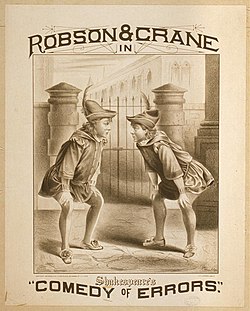
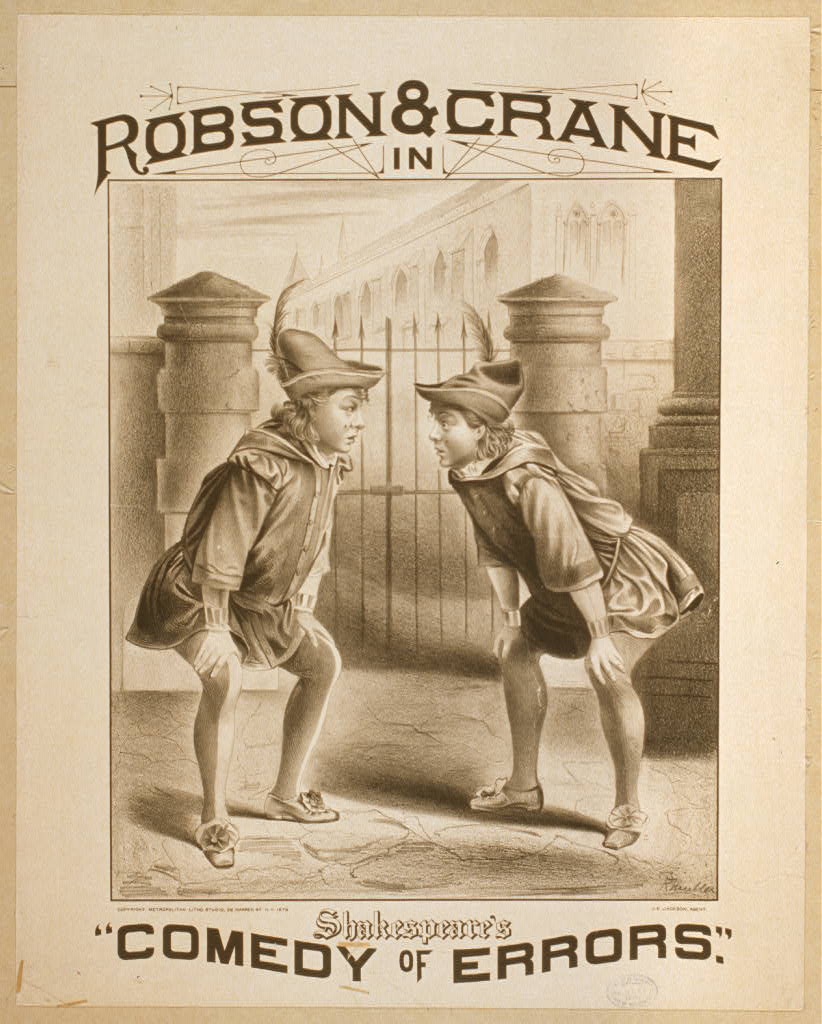
The Comedy of Errors is one of William Shakespeare's earliest plays. It is his shortest and one of his most farcical comedies, with a major part of the humour coming from slapstick and mistaken identity, in addition to puns and word play. It has been adapted for opera, stage, screen and musical theatre numerous times worldwide. In the centuries following its premiere, the play's title has entered the popular English lexicon as an idiom for "an event or series of events made ridiculous by the number of errors that were made throughout".[1]
Set in the Greek city of Ephesus, The Comedy of Errors tells the story of two sets of identical twins who were accidentally separated at birth. Antipholus of Syracuse and his servant, Dromio of Syracuse, arrive in Ephesus, which turns out to be the home of their twin brothers, Antipholus of Ephesus and his servant, Dromio of Ephesus. When the Syracusans encounter the friends and families of their twins, a series of wild mishaps based on mistaken identities lead to wrongful beatings, a near-seduction, the arrest of Antipholus of Ephesus, and false accusations of infidelity, theft, madness, and demonic possession.

Synopsis
[edit]Act I
[edit]Because a law forbids merchants from Syracuse from entering Ephesus, elderly Syracusan trader Aegeon faces execution when he is discovered in the city. He can only escape by paying a fine of a thousand marks. He tells his sad story to Solinus, Duke of Ephesus. In his youth, Aegeon married and had twin sons. On the same day, a poor woman without a job also gave birth to twin boys, and he purchased these as servants to his sons. Soon afterward, the family made a sea voyage and was hit by a tempest. Aegeon lashed himself to the main-mast with one son and one servant, and his wife took the other two infants. His wife was rescued by one boat, Aegeon by another. Aegeon never again saw his wife or the children with her. Recently his son Antipholus, now grown, and his son's servant, Dromio, left Syracuse to find their brothers. When Antipholus did not return, Aegeon set out in search of him. The Duke is moved by this story and grants Aegeon one day to pay his fine.
That same day, Antipholus arrives in Ephesus, searching for his brother. He sends Dromio to deposit some money at The Centaur, an inn. He is confounded when the identical Dromio of Ephesus appears almost immediately, denying any knowledge of the money and asking him home to dinner, where his wife is waiting. Antipholus, thinking his servant is making insubordinate jokes, beats Dromio of Ephesus.
Act II
[edit]Dromio of Ephesus returns to his mistress, Adriana, saying that her "husband" refused to come back to his house, and even pretended not to know her. Adriana, concerned that her husband's eye is straying, takes this news as confirmation of her suspicions.
Antipholus of Syracuse, who complains "I could not speak with Dromio since at first, I sent him from the mart," meets up with Dromio of Syracuse who now denies making a "joke" about Antipholus having a wife. Antipholus begins beating him. Suddenly, Adriana rushes up to Antipholus of Syracuse and begs him not to leave her. The Syracusans cannot but attribute these strange events to witchcraft, remarking that Ephesus is known as a warren for witches. Antipholus and Dromio go off with this strange woman, the one to eat dinner and the other to keep the gate.
Act III
[edit]Inside the house, Antipholus of Syracuse discovers that he is very attracted to his "wife's" sister, Luciana, telling her "train me not, sweet mermaid, with thy note / To drown me in thy sister's flood of tears." She is flattered by his attention but worried about their moral implications. After she exits, Dromio of Syracuse announces that he has discovered that he has a wife: Nell, a hideous kitchen-maid. The Syracusans decide to leave as soon as possible, and Dromio runs off to make travel plans. Antipholus of Syracuse is then confronted by Angelo of Ephesus, a goldsmith, who claims that Antipholus ordered a chain from him. Antipholus is forced to accept the chain, and Angelo says that he will return for payment.
Antipholus of Ephesus returns home for dinner and is enraged to find that he is rudely refused entry to his own house by Dromio of Syracuse, who is keeping the gate. He is ready to break down the door, but his friends persuade him not to make a scene. He decides, instead, to dine with a courtesan.
Act IV
[edit]Antipholus of Ephesus dispatches Dromio of Ephesus to purchase a rope so that he can beat his wife Adriana for locking him out, then is accosted by Angelo, who tells him "I thought to have ta'en you at the Porpentine" and asks to be reimbursed for the chain. He denies ever seeing it and is promptly arrested. As he is being led away, Dromio of Syracuse arrives, whereupon Antipholus dispatches him back to Adriana's house to get money for his bail. After completing this errand, Dromio of Syracuse mistakenly delivers the money to Antipholus of Syracuse. The Courtesan spies Antipholus wearing the gold chain, and says he promised it to her in exchange for her ring. The Syracusans deny this and flee. The Courtesan resolves to tell Adriana that her husband is insane. Dromio of Ephesus returns to the arrested Antipholus of Ephesus, with the rope. Antipholus is infuriated. Adriana, Luciana, and the Courtesan enter with a conjurer named Pinch, who tries to exorcize the Ephesians, who are bound and taken to Adriana's house. The Syracusans enter, carrying swords, and everybody runs off for fear: believing that they are the Ephesians, out for vengeance after somehow escaping their bonds.
Act V
[edit]Adriana reappears with henchmen, who attempt to bind the Syracusans. They take sanctuary in a nearby priory, where the Abbess resolutely protects them. Suddenly, the Abbess enters with the Syracusan twins, and everyone begins to understand the confused events of the day. Not only are the two sets of twins reunited, but the Abbess reveals that she is Aegeon's wife, Emilia. The Duke pardons Aegeon. All exit into the abbey to celebrate the reunification of the family.
Text and date
[edit]
The play is a modernised adaptation of Menaechmi by Plautus. As William Warner's translation of the classical drama was entered into the Register of the Stationers Company on 10 June 1594, published in 1595, and dedicated to Lord Hunsdon, the patron of the Lord Chamberlain's Men, it has been supposed that Shakespeare might have seen the translation in manuscript before it was printed – though it is equally possible that he knew the play in the original Latin.
The play contains a topical reference to the wars of succession in France, which would fit any date from 1589 to 1595. Charles Whitworth argues that The Comedy of Errors was written "in the latter part of 1594" on the basis of historical records and textual similarities with other plays Shakespeare wrote around this time.[2] The play was not published until it appeared in the First Folio in 1623.
Analysis and criticism
[edit]For centuries, scholars have found little thematic depth in The Comedy of Errors. Harold Bloom, however, wrote that it "reveals Shakespeare's magnificence at the art of comedy",[3] and praised the work as showing "such skill, indeed mastery – in action, incipient character, and stagecraft – that it far outshines the three Henry VI plays and the rather lame comedy The Two Gentlemen of Verona".[4] Stanley Wells also referred to it as the first Shakespeare play "in which mastery of craft is displayed".[5] The play was not a particular favourite on the eighteenth-century stage because it failed to offer the kind of striking roles that actors such as David Garrick could exploit.
The play was particularly notable in one respect. In the earlier eighteenth century, some critics followed the French critical standard of judging the quality of a play by its adherence to the classical unities, as specified by Aristotle in the fourth century BC. The Comedy of Errors and The Tempest were the only two of Shakespeare's plays to comply with this standard.[6]
Law professor Eric Heinze, however, argues that particularly notable in the play is a series of social relationships, which is in crisis as it sheds its feudal forms and confronts the market forces of early modern Europe.[7]
Performance
[edit]Two early performances of The Comedy of Errors are recorded. One, by "a company of base and common fellows", is mentioned in the Gesta Grayorum ("The Deeds of Gray") as having occurred in Gray's Inn Hall on 28 December 1594 during the inn's revels. The second also took place on "Innocents' Day", but ten years later: 28 December 1604, at Court.[8]
Adaptations
[edit]
Theatrical
[edit]Like many of Shakespeare's plays, The Comedy of Errors was adapted and rewritten extensively, particularly from the 18th century on, with varying reception from audiences.
Classical adaptations
[edit]- Every Body Mistaken is a 1716 "revival" and directorial adaptation of Shakespeare's play by an anonymous author.[9]
- See If You Like It; or, 'Tis All a Mistake, an anonymous adaptation staged in 1734 at Covent Garden, performed in two acts with text from Plautus and Shakespeare. Shakespeare purists considered it to be the "worst alteration" available.[10][11]
- The Twins, an adaptation by Thomas Hull produced for Covent Garden in 1739, in which Hull played Aegeon. This production was more faithful to Shakespeare's text, and played for several years.[10] This adaptation was performed only once in 1762, and was published in 1770. Hull adapted the play a second time as The Comedy of Errors. With Alterations from Shakespeare. This version was staged frequently from 1779 onward, and was published in 1793.[11] Hull added songs, intensified the love interest, and elaborated the recognition scene. He also expanded roles for women, including Adriana's cousin Hermia, who sang various songs.[9]
- The Twins; or, Which is Which? A Farce. In Three Acts by William Woods, published in 1780. Produced at the Theatre-Royal, Edinburgh.[11] This adaptation reduced the play to a three-act farce, apparently believing that a longer run time should "pall upon an audience". John Philip Kemble (see below) seemed to have extended and based his own adaptation upon The Twins.[9]
- Oh! It's Impossible, by John Philip Kemble, was produced in 1780. This adaptation caused a stir by casting the two Dromios as black-a-moors.[12] It was acted in York, but not printed.[13] Later, nearly 20 years after slavery had been abolished within British domains, James Boaden wrote, "I incline to think [Kemble's] maturer judgement would certainly have consigned the whole impression to the flames.")[14]
Modern adaptations
[edit]- The Flying Karamazov Brothers performed a unique adaptation, produced by Robert Woodruff, first at the Goodman Theater in Chicago in 1983, and then again in 1987 at New York's Vivian Beaumont Theater in Lincoln Center. This latter presentation was filmed and was aired on MTV and PBS.[15]
- The Comedy of Errors adapted and directed by Sean Graney in 2010 updated Shakespeare's text to modern language, with occasional Shakespearean text, for The Court Theatre. The play appears to be more of a "translation" into modern-esque language, than a reimagination.[16] The play received mixed reviews, mostly criticizing Graney's modern interpolations and abrupt ending.[17]
- 15 Villainous Fools, written and performed by Olivia Atwood and Maggie Seymour, a two-woman clown duo, produced by The 601 Theatre Company.[18][19] The play was performed several times, premiering in 2015 at Bowdoin College, before touring fringe festivals including Portland, San Diego, Washington, DC, Providence, and New York City. Following this run, the show was picked up by the People's Improv Theater for an extended run.[20] While the play included pop culture references and original raps, it kept true to Shakespeare's text for the characters of the Dromios.[21]
- A Comedy of Heirors, or The Imposters by feminist verse playwright Emily C. A. Snyder performed a staged reading through Turn to Flesh Productions[22] in 2017, featuring Abby Wilde as Glorielle of Syracuse. The play received acclaim, being named a finalist with the American Shakespeare Center, as part of the Shakespeare's New Contemporaries program,[23] as well as "The Top 15 NYC Plays of '17" by A Work Unfinishing.[24] The play focuses on two sets of female twins, who also interact with Shakespeare's Antipholi. The play is in conversation with several of Shakespeare's comedies, including characters from The Comedy of Errors, Twelfth Night, As You Like It, and Much Ado About Nothing.
Opera
[edit]- On 27 December 1786, the opera Gli equivoci by Stephen Storace received its première at the Burgtheater in Vienna. The libretto, by Lorenzo da Ponte, Mozart's frequent librettist, worked off a French translation of Shakespeare's play, follows the play's plot fairly closely, though some characters were renamed, Aegeon and Emilia are cut, and Euphemio (previously Antipholus) and Dromio are shipwrecked on Ephesus.[25][26]
- Frederic Reynolds staged an operatic version in 1819, with music by Henry Bishop supplemented lyrics from various Shakespeare plays, and sonnets set to melodies by Mozart, Thomas Arne, and others.[9] The opera was performed at Covent Garden under Charles Kemble's management and included several additional scenes from the play, which were considered necessary for the sake of introducing songs. The same operatic adaptation was revived in 1824 for Drury Lane.[10]
- Various other adaptations were performed down to 1855 when Samuel Phelps revived the Shakespearean original at Sadler's Wells Theatre.[27]
- The Czech composer Iša Krejčí's 1943 opera Pozdvižení v Efesu (Turmoil in Ephesus) is based on the play.[28]
Musicals
[edit]The play has been adapted as a musical several times, frequently by inserting period music into the light comedy. Some musical adaptations include a Victorian musical comedy (Arts Theatre, Cambridge, England, 1951), Brechtian folk opera (Arts Theatre, London, 1956), and a two-ring circus (Delacorte Theater, New York, 1967).
Fully original musical adaptations include:
- The Boys from Syracuse, composed by Richard Rodgers and lyrics by Lorenz Hart. The play premiered on Broadway in 1938 and Off-Broadway in 1963, with later productions including a West End run in 1963 and in a Broadway revival in 2002. A film adaptation was released in 1940.
- A New Comedy of Errors, or Too Many Twins (1940), adapted from Plautus, Shakespeare and Molière, staged in modern dress at London's Mercury Theatre.[9][29]
- The Comedy of Errors (1972) adaptation by James McCloskey, music and lyrics by Bruce Kimmel. Premiered at Los Angeles City College and went on to the American College Theatre Festival.
- The Comedy of Errors is a musical with book and lyrics by Trevor Nunn, and music by Guy Woolfenden. It was produced for the Royal Shakespeare Company in 1976, winning the Laurence Olivier Award for best musical on its transfer to the West End in 1977.
- Oh, Brother! is a musical comedy in one act, with music by Michael Valenti and books and lyrics by Donald Driver, which premiered at ANTA Theatre in 1981, also directed by Driver. The musical takes place during a revolution in an oil rich Middle Eastern country on the Persian Gulf in a quaint resort town where its populace of merchants and revolutionaries mix Eastern tradition with Western consumerism.[30] The New York Times gave it a poor review, criticising Driver's heavy handedness, while praising some of the music and performances.[31]
- The Bomb-itty of Errors, a one-act hip-hop musical adaptation, by Jordan Allen-Dutton, Jason Catalano, Gregory J. Qaiyum, Jeffrey Qaiyum, and Erik Weinner, won 1st Prize at HBO's Comedy Festival and was nominated opposite Stephen Sondheim for the Best Lyrics Drama Desk Award in 2001.[32]
- In 1940 the film The Boys from Syracuse was released, starring Alan Jones and Joe Penner as Antipholus and Dromio. It was a musical, loosely based on The Comedy of Errors.
Novel
[edit]In India, Ishwar Chandra Vidyasagar adapted Shakespeare's play in his Bengali novel Bhranti Bilash (1869). Vidyasagar's efforts were part of the process of championing Shakespeare and the Romantics during the Bengal Renaissance.[33][34]
Film
[edit]The film Our Relations (1936) starring Stan Laurel and Oliver Hardy, was adapted from the W. W. Jacobs story "The Money Box", but there are no twins in the Jacobs story. Our Relations owes its central conceit to The Comedy of Errors.[original research?] As in the Shakespeare play, the story revolves around the confusion of two pairs of identical twins: one set of Laurel brothers named "Stan" and "Alf", and one set of Hardy brothers named "Oliver" and "Bert". Stan and Oliver think Alf and Bert were killed at sea. As the story opens, Alf and Bert have just arrived via ship at the same seaport where, unbeknownst to them, their married twin brothers Stan and Oliver live.[citation needed] One nod to the movie's inspiration is a running gag: whenever Stan and Ollie say the same thing at the same time, they immediately perform a childhood ritual that begins: "Shakespeare...Longfellow..."[original research?]
The Three Stooges film A Merry Mix Up (1957) starring Moe Howard, Larry Fine and Joe Besser expands the confusion by telling the story of three sets of identical triplets: Bachelors Moe, Larry and Joe; husbands Max, Louie and Jack; and newly-engaged brothers Morris, Luke and Jeff. The triplets can only be distinguished by their choices of neckties, bow ties, or no tie at all.[citation needed]
The film Start the Revolution Without Me (1970) starring Gene Wilder and Donald Sutherland involves two pairs of twins, one of each of which is switched at birth; one set is raised in an aristocratic, the other in a peasant family, who meet during the French Revolution.
The film Big Business (1988) is a modern take on The Comedy of Errors, with female twins instead of male. Bette Midler and Lily Tomlin star in the film as two sets of twins separated at birth, much like the characters in Shakespeare's play.
The short film The Complete Walk: The Comedy of Errors was made in 2016 and starred Phil Davis, Omid Djalili and Boothby Graffoe.
Indian cinema has made nine films based on the play:
- Bhrantibilas (1963 Bengali film) starring Uttam Kumar
- Do Dooni Char starring Kishore Kumar
- Angoor starring Sanjeev Kumar
- Oorantha Golanta starring Chandra Mohan
- Ulta Palta in the Kannada language starring Ramesh Aravind
- Ulta Palta in the Telugu language starring Rajendra Prasad
- Ambuttu Imbuttu Embuttu in the Tamil language
- Aamait Asal Eemait Kusal in the Tulu language starring Naveen D Padil
- Double Di Trouble (2014 Punjabi Film) directed by Smeep Kang and starring Dharmendra, Gippy Grewal
- Local Kung Fu 2 (2017 Assamese martial arts film)
- Cirkus (2022 movie in Hindi language starring Ranveer Singh)
Television
[edit]- Roger Daltrey played both Dromios in the BBC complete works series directed by James Cellan Jones in 1983.
- A two-part TV adaptation was produced in 1978 in the USSR, with a Russian–Georgian cast of notable stage actors.
- The Inside No. 9 episode "Zanzibar" (season 4, episode 1) was based on The Comedy of Errors
- Season 13 Episode 4 of Bob's Burgers: 'Comet-y of Errors' is also a reference to Shakespeare's play.
See also
[edit]References
[edit]- ^ "Definition of 'Comedy of Errors'". merriam-webster.com. 24 March 2024.
- ^ Charles Walters Whitworth, ed., The Comedy of Errors, Oxford: Oxford University Press, 2003; pp. 1–10. ISBN 9780198129332
- ^ Bloom, Harold, ed. (2010). The Comedy of Errors. Infobase Publishing. ISBN 978-1438134406.
- ^ Bloom, Harold. "Shakespeare: The Comedy of Errors". The New York Times. Retrieved 5 May 2018.
- ^ Billington, Michael (2 April 2014). "Best Shakespeare productions: The Comedy of Errors". The Guardian. Retrieved 15 May 2018.
- ^ Bloom, Harold (2010). Marson, Janyce (ed.). The Comedy of Errors. Bloom's Literary Criticism. New York: Infobase. p. 57. ISBN 978-1-60413-720-0.
It is noteworthy that The Comedy of Errors and Shakespeare's last play, The Tempest, are the only two plays that strictly adhere to the classical unities.
- ^ Eric Heinze, "'Were it not against our laws': Oppression and Resistance in Shakespeare's Comedy of Errors", 29 Legal Studies (2009), pp. 230–263
- ^ The identical dates may not be coincidental; the Pauline and Ephesian aspect of the play, noted under Sources, may have had the effect of linking The Comedy of Errors to the holiday season – much like Twelfth Night, another play secular on its surface but linked to the Christmas holidays.
- ^ a b c d e Shakespeare, William (2009). The Comedy of Errors. Random House Publishing Group. ISBN 978-0-307-41928-6.
- ^ a b c The Gentleman's Magazine. R. Newton. 1856.
- ^ a b c Ritchie, Fiona; Sabor, Peter (2012). Shakespeare in the Eighteenth Century. Cambridge University Press. ISBN 978-1-107-37765-3.
- ^ Galt, John (1886). The Lives of the Players. Hamilton, Adams. p. 309.
oh! it's impossible kemble.
- ^ Dictionary of National Biography. 1892.
- ^ Holland, Peter (2014). Garrick, Kemble, Siddons, Kean: Great Shakespeareans. A&C Black. ISBN 978-1-4411-6296-0.
- ^ Shakespeare, William (16 September 2009). "The Comedy of Errors". Random House Publishing Group. Retrieved 26 June 2025 – via Google Books.
- ^ "The Comedy of Errors". Court Theatre. Retrieved 12 December 2019.
- ^ "Shakespeare Reviews: The Comedy of Errors". shaltzshakespearereviews.com. Retrieved 12 December 2019.
- ^ "Theatre Is Easy | Reviews | 15 Villainous Fools". www.theasy.com. Retrieved 12 December 2019.
- ^ "15 Villainous Fools (review)". DC Theatre Scene. 11 July 2016. Retrieved 12 December 2019.
- ^ "15 Villainous Fools". Liv & Mags. Retrieved 12 December 2019.
- ^ Smith, Matt (29 August 2017). "Review: 15 Villainous Fools". Stage Buddy. Retrieved 10 March 2019.
- ^ "NYC Theatre: Turn to Flesh Productions Reviving Classics with a Modern Twist". 20 February 2024. Retrieved 26 June 2025.
- ^ "A Comedy of Heirors | New Play Exchange". newplayexchange.org. Retrieved 12 December 2019.
- ^ Knapp, Zelda (28 December 2017). "A work unfinishing: My Favorite Theater of 2017". A work unfinishing. Retrieved 12 December 2019.
- ^ Holden, Amanda; Kenyon, Nicholas; Walsh, Stephen, eds. (1993). The Viking Opera Guide. London: Viking. p. 1016. ISBN 0-670-81292-7.
- ^ "Stage history | The Comedy of Errors | Royal Shakespeare Company". www.rsc.org.uk. Retrieved 12 December 2019.
- ^ F. E. Halliday, A Shakespeare Companion 1564–1964, Baltimore, Penguin, 1964; p. 112.
- ^ Neill, Michael; Schalkwyk, David (2016). The Oxford Handbook of Shakespearean Tragedy. Oxford University Press. ISBN 978-0-19-872419-3.
- ^ Shakespeare, William (1962). The Comedy of Errors: Second Series. Cengage Learning EMEA. ISBN 978-0-416-47460-2.
{{cite book}}: ISBN / Date incompatibility (help) - ^ "Oh, Brother – The Guide to Musical Theatre". guidetomusicaltheatre.com. Retrieved 12 December 2019.
- ^ Rich, Frank (11 November 1981). "The Stage: 'Oh, Brother!,' a Musical". The New York Times. ISSN 0362-4331. Retrieved 12 December 2019.
- ^ "The Bomb-itty of Errors | Samuel French". www.samuelfrench.com. Retrieved 12 December 2019.
- ^ Bhattacharya, Budhaditya (2 September 2014). "The Bard in Bollywood". The Hindu. Archived from the original on 2 September 2014.
- ^ "Archived copy" (PDF). Archived from the original (PDF) on 3 September 2014. Retrieved 1 September 2014.
{{cite web}}: CS1 maint: archived copy as title (link)
This article incorporates text from a publication now in the public domain: Chisholm, Hugh, ed. (1911). "Shakespeare, William". Encyclopædia Britannica. Vol. 24 (11th ed.). Cambridge University Press. pp. 772–797. (See p. 778; section Dramas.)

Editions of The Comedy of Errors
[edit]- Bate, Jonathan and Rasmussen, Eric (eds.), The Comedy of Errors (The RSC Shakespeare; London: Macmillan, 2011)
- Cunningham, Henry (ed.) The Comedy of Errors (The Arden Shakespeare, 1st Series; London: Arden, 1907)
- Dolan, Francis E. (ed.) The Comedy of Errors (The Pelican Shakespeare, 2nd edition; London, Penguin, 1999)
- Dorsch, T.S. (ed.) The Comedy of Errors (The New Cambridge Shakespeare; Cambridge: Cambridge University Press, 1988; 2nd edition 2004)
- Dover Wilson, John (ed.) The Comedy of Errors (The New Shakespeare; Cambridge: Cambridge University Press, 1922; 2nd edition 1962)
- Evans, G. Blakemore (ed.) The Riverside Shakespeare (Boston: Houghton Mifflin, 1974; 2nd edn., 1997)
- Foakes, R.A. (ed.) The Comedy of Errors (The Arden Shakespeare, 2nd Series; London: Arden, 1962)
- Greenblatt, Stephen; Cohen, Walter; Howard, Jean E., and Maus, Katharine Eisaman (eds.) The Norton Shakespeare: Based on the Oxford Shakespeare (London: Norton, 1997)
- Jorgensen, Paul A. (ed.) The Comedy of Errors (The Pelican Shakespeare; London, Penguin, 1969; revised edition 1972)
- Levin, Harry (ed.) The Comedy of Errors (Signet Classic Shakespeare; New York: Signet, 1965; revised edition, 1989; 2nd revised edition 2002)
- Martin, Randall (ed.) The Comedy of Errors (The New Penguin Shakespeare, 2nd edition; London: Penguin, 2005)
- Wells, Stanley (ed.) The Comedy of Errors (The New Penguin Shakespeare; London: Penguin, 1972)
- SwipeSpeare The Comedy of Errors (Golgotha Press, Inc., 2011)
- Wells, Stanley; Taylor, Gary; Jowett, John and Montgomery, William (eds.) The Oxford Shakespeare: The Complete Works (Oxford: Oxford University Press, 1986; 2nd edn., 2005)
- Werstine, Paul and Mowat, Barbara A. (eds.) The Comedy of Errors (Folger Shakespeare Library; Washington: Simon & Schuster, 1996)
- Whitworth, Charles (ed.) The Comedy of Errors (The Oxford Shakespeare: Oxford: Oxford University Press, 2002)
Further reading
[edit]- O'Brien, Robert Viking (1996). "The Madness of Syracusan Antipholus". Early Modern Literary Studies. 2 (1): 3.1–26. ISSN 1201-2459.
External links
[edit]
 Quotations related to The Comedy of Errors at Wikiquote
 Works related to The Comedy of Errors at Wikisource
 Media related to The Comedy of Errors at Wikimedia Commons
- The Comedy of Errors at Standard Ebooks
- The Comedy of Errors at Project Gutenberg
 The Comedy of Errors public domain audiobook at LibriVox
- "Modern Translation of the Play" – Modern version of the play
- The Comedie of Errors – HTML version of this title.
- Photos of Gray's Inn Hall – the hall where the play was once performed
- Lesson plans for teaching The Comedy of Errors at Web English Teacher
- Information on the 1987 Broadway production


| International | |
|---|---|
| National | |
| Other | |

The Comedy of Errors
View on GrokipediaSynopsis
Act 1
The play opens in the marketplace of Ephesus, where the Duke of Ephesus oversees the sentencing of Egeon, a merchant from Syracuse, who faces execution for entering the city in violation of a harsh law prohibiting Syracusans due to ongoing trade wars.[8] Egeon recounts his tragic backstory to the Duke: twenty-five years earlier, after marrying Aemilia and fathering twin sons, he purchased another pair of twin boys as servants named Dromio; during a voyage home from Epidamnum, a storm wrecked their ship, separating the family into two boats—one carrying Aemilia with one son and one Dromio, the other with Egeon, his son, and the remaining Dromio.[8] Egeon presumed his wife and the other son had perished and raised his surviving son, Antipholus of Syracuse, and Dromio in Syracuse. Unbeknownst to him, the other Antipholus and Dromio had ended up in Ephesus; now, driven by longing to find his lost son, Egeon has entered Ephesus illegally but lacks the 1,000 marks fine required for mercy.[8] Sympathizing with Egeon's plight, the Duke grants him until the end of the day to raise the sum or face death, urging him to seek help from the merchants of Ephesus.[8] Meanwhile, Egeon's son Antipholus of Syracuse arrives secretly in Ephesus with his servant Dromio of Syracuse, unaware of the local laws and his father's peril; Antipholus expresses wariness about the city, having heard rumors of witchcraft that could explain his long-lost twin's existence.[9] He instructs Dromio to deposit their gold at the Centaur inn and await further orders, then encounters a local merchant who warns him of the anti-Syracusan edict and advises disguise to avoid arrest.[9] The first instance of confusion arises when Dromio of Ephesus, sent by his master Antipholus of Ephesus to summon his Syracusan counterpart to dinner, approaches Antipholus of Syracuse, who mistakes him for his own servant and demands the gold; upon Dromio of Ephesus denying knowledge of it, Antipholus of Syracuse beats him, initiating the play's cascade of mistaken identities among the indistinguishable twins.[9] This encounter underscores the twins' identical appearances, setting the stage for escalating farcical errors as the Syracusans navigate the unfamiliar city.[9]Act 2
In Act 2, Scene 1, set at the house of Antipholus of Ephesus, Adriana expresses frustration to her sister Luciana over her husband Antipholus's prolonged absence, lamenting the strains of marriage and her sense of neglect.[10] Luciana offers counsel on wifely patience and submission, advising Adriana to accept her husband's diversions as natural.[10] Dromio of Ephesus then arrives, reporting that Antipholus denied knowing Adriana and demanded a thousand marks in gold; enraging her, Adriana beats him for failing to bring her husband home and orders him to fetch Antipholus immediately.[10] The action shifts to Act 2, Scene 2, in a public street near the marketplace, where a merchant named Balthazar encounters Antipholus of Syracuse and, confusing him with his Ephesian twin, cordially invites him to dine at the Porpentine inn that evening.[10] Antipholus of Syracuse politely accepts the invitation, though wary of the city's reputed sorcery.[10] Alone briefly, he delivers a soliloquy marveling at the uncanny events in Ephesus, wondering if the place harbors witches that have enchanted him or stolen his servant and money.[10] Dromio of Syracuse soon enters, prompting Antipholus to inquire about the gold sent earlier to the inn; Dromio insists he delivered it safely, but when pressed about the bizarre message of a waiting wife, he denies any knowledge, leading Antipholus to thrash him in bewilderment and accuse him of madness.[10] This confusion intensifies as Adriana and Luciana appear, with Adriana sharply confronting Antipholus of Syracuse as her errant husband, berating him for his tardiness and insisting he return home immediately for the meal she has prepared.[10] Though utterly perplexed by her claims and the unfolding absurdities, Antipholus of Syracuse agrees to accompany her out of curiosity, allowing the mistaken identities to draw the Syracusan visitors deeper into the Ephesian household.[10] Meanwhile, parallel to these events, the Ephesian twins continue their routines unaware, setting the stage for further overlaps in their experiences.[10]Act 3
In Act 3, Scene 1, Antipholus of Ephesus returns home accompanied by his servant Dromio of Ephesus, the goldsmith Angelo, and the merchant Balthazar, intending to dine there after a day in the marketplace.[11] The door is locked from the inside, with voices from within—actually Dromio of Syracuse and the kitchen maid Luce—responding to his calls and adding to the mistaken identities.[12] This marks the first onstage appearance of both Antipholus twins simultaneously, though separated by the door and unaware of each other, heightening the farce through their parallel yet invisible presences.[13] Enraged by the perceived insult, Antipholus of Ephesus threatens to break down the door but ultimately storms off to dine at the Porpentine with the Courtesan instead, inviting Balthazar and Angelo along and vowing to give her the gold chain commissioned from Angelo as a spiteful gift to his wife.[14] The confusions escalate in Act 3, Scene 2, as Angelo encounters Antipholus of Syracuse in a public space and, mistaking him for his Ephesian counterpart, presents the completed gold chain, which Antipholus of Syracuse accepts in bewilderment despite denying any prior order for it.[11] Alone with Luciana, Adriana's sister, Antipholus of Syracuse listens to her counsel on marital obedience, misinterpreting her words as a romantic proposition and declaring his sudden love for her, which introduces a hint of genuine affection amid the farce of doubling. The scene's comedic chaos intensifies when the kitchen maid Nell emerges and claims Dromio of Syracuse as her betrothed, describing his supposed "round" physique in a globe-like metaphor that mocks his leanness and invites physical accusations from the servants.[15] As tensions rise with escalating banter and threats of beatings among the minor characters, Dromio of Syracuse reports urgent news from the ship's captain: a vessel is ready to depart Ephesus that evening, prompting Antipholus of Syracuse to consider fleeing the city's bewildering entanglements.[16] This involvement of Angelo and the servants underscores the midpoint shift toward property-based mix-ups, paralleling the domestic dinner at Adriana's house—where Antipholus of Syracuse unwittingly dines—with the rival meal at the Courtesan's, amplifying the play's themes of mistaken identity through everyday objects and obligations.[11]Act 4
In Act 4 of The Comedy of Errors, the escalating confusions reach their zenith as the twins' identical appearances lead to parallel crises involving arrest, accusations of theft, and attempts at exorcism, drawing in law enforcement, medical practitioners, and supernatural suspicions. The action unfolds across four scenes in Ephesus, amplifying the farce through institutional entanglements that mirror the personal disorders of earlier acts.[17][18][19][20] The act opens in a public street where Antipholus of Ephesus, still furious from being locked out of his home, instructs Dromio of Ephesus to fetch a rope to beat his wife Adriana in retribution. As Dromio departs, Angelo the goldsmith confronts Antipholus, demanding payment for a gold chain commissioned for him, which Antipholus claims he has not yet received. Insisting the debt is due regardless, Angelo summons an officer who arrests Antipholus for non-payment, heightening the merchant's outrage as he attributes the missing chain to the deceptions wrought by his unknown twin from Syracuse. This arrest underscores the economic repercussions of the twins' mistaken identities, intertwining personal vendettas with legal consequences.[17] Meanwhile, at Adriana's house, Dromio of Syracuse arrives breathless and reports that his master (Antipholus of Syracuse) has been arrested for debt, describing the events in confusion. Adriana, distressed by her husband's apparent infidelity and now legal peril, dispatches Luciana to retrieve money from her strongbox, then hands the purse to Dromio of Syracuse to deliver as bail. This scene highlights Adriana's growing desperation, as she grapples with the bewildering behaviors attributed to her husband.[18] In another street scene, Dromio of Syracuse delivers the gold to Antipholus of Syracuse, who remains perplexed by the locals' familiarity and the reference to an arresting sergeant. The Courtesan then enters, demanding the return of her ring, which she gave Antipholus of Ephesus in exchange for the promised chain that was never delivered to her. Mistaking Antipholus of Syracuse for his twin, she accuses him of theft; he, in turn, interprets her pursuit and the surrounding oddities as demonic, fleeing with Dromio while invoking witchcraft and devils. The Courtesan, baffled by his ravings, resolves to inform Adriana that her husband is possessed or mad and has stolen her ring valued at forty ducats, further spreading the web of accusations. This encounter introduces overt supernatural fears, echoing Plautine farcical elements from Menaechmi where madness and divine intervention propel the plot.[19] The act culminates in chaotic convergence on the street, where the arrested Antipholus of Ephesus berates Dromio of Ephesus for returning with a rope instead of bail money, beating him soundly amid the officer's custody. Adriana, Luciana, the Courtesan, and Dr. Pinch—a schoolmaster reputed as a conjurer—arrive; Adriana pays the officer the bail, promising to settle the debt with Angelo directly. However, tensions erupt as Antipholus of Ephesus rails against Adriana for her earlier mistreatment, while the Courtesan accuses him of withholding her chain and ring. As the group attempts to bind Antipholus of Ephesus for exorcism, Antipholus and Dromio of Syracuse enter with swords drawn; the assembly mistakes them for escaped madmen or apparitions, leading to panic. The Syracusans deny knowing Adriana, beat Pinch during his attempted binding, tie him up, and flee toward the priory. In the ensuing melee, the officer arrests the Courtesan for possessing the ring without payment, and the Ephesian pair remains in terror. These parallel plights—arrest for one twin, exorcism for the other—exemplify the interchangeable misfortunes born of duplication, propelling the disorder toward its resolution without yet alleviating the frenzy.[20]Act 5
In the final act, the Duke of Ephesus presides over the marketplace as Egeon faces execution for violating the city's ban on Syracusans, with the Second Merchant urging adherence to the law despite Egeon's poignant acceptance of his fate.[21] An Officer then enters, bringing the bound Antipholus and Dromio of Ephesus, who present the gold chain as evidence against Angelo the goldsmith's accusations of theft and non-payment. Antipholus of Ephesus demands justice and calls for the Abbess of the nearby priory to testify, claiming she unjustly confined him earlier that day.[21] Adriana arrives with Luciana, pleading for her husband's release and attributing his behavior to madness, while the Duke questions the unfolding confusion.[21] The situation escalates when Antipholus and Dromio of Syracuse unexpectedly enter, free and recounting their recent refuge in the priory after fleeing Adriana's household; the sight of two identical pairs of twins stuns the assembly, prompting cries of witchcraft and sorcery from the onlookers.[21] The Abbess emerges to intervene, revealing herself as Aemilia, Egeon's long-lost wife, and discloses that she is the mother of both Antipholi, having survived the shipwreck that separated the family twenty-five years prior.[21] She explains that after the disaster, she and one Antipholus and Dromio arrived in Ephesus, while the other pair ended up in Syracuse with Egeon; earlier that day, Antipholus of Syracuse had fled into the priory for refuge, where she sheltered him without revealing her identity.[21] This rapid exposition confirms the twins' and servants' identities through physical resemblances, shared birthmarks, and recounted memories of their infancy, dispelling all prior misunderstandings.[21] With the truth unveiled, reconciliations swiftly follow: the gold chain is returned to Angelo, who withdraws his complaint, and the Duke forgives Egeon's fine, remitting the thousand-mark penalty and bestowing a bounty on the reunited family to celebrate the restoration of social order.[21] Adriana and Antipholus of Ephesus embrace, mending their strained marriage, while Egeon joyfully reunites with his wife and sons, saving his life in the process.[21] The priory, revealed as the hidden nexus of the plot's secrets, hosts a communal feast to mark the harmony, as all debts and grievances dissolve. The play concludes with light-hearted banter between the Dromios, who jest about their mistreatment and brotherly bond, underscoring the comic resolution.[21]Composition and sources
Date and textual history
Scholars generally date the composition of The Comedy of Errors to 1594, based on its first recorded performance on 28 December 1594 at Gray's Inn in London, as documented in the Gesta Grayorum, an account of the Inn's Christmas revels.[22] This timing aligns with the reopening of London theatres in the spring of 1594 following closures due to plague outbreaks from mid-1592 to early 1594, during which Shakespeare likely focused on non-theatrical writing.[4] Some analyses suggest a slightly earlier composition window of 1592–1593, inferred from the play's stylistic features—such as its reliance on Plautine structure and verse patterns indicative of Shakespeare's developing craft—and potential allusions to contemporary events, though no direct references to the plague appear in the text. The play exists in no quarto editions and was first published in the 1623 First Folio (Mr. William Shakespeares Comedies, Histories, & Tragedies, abbreviated F1), where it opens the comedies section.[5] The F1 text, comprising approximately 1,770 lines, is considered a reliable authority and likely derives from a theatrical manuscript, possibly a prompt-book used in performance or a fair copy prepared for the printers, as evidenced by its consistent act divisions (uncommon in early Shakespeare quartos) and occasional irregularities suggesting stage annotation.[23] Textual variants in F1 are minor but notable, including inconsistencies in stage directions—such as unclear designations for the twin brothers Antipholus of Syracuse and Antipholus of Ephesus—and sporadic errors in speech prefixes, where lines are attributed ambiguously between characters like the twins' servants, Dromio of Syracuse and Dromio of Ephesus.[24] These issues arise partly from compositorial errors during printing, as the play was set by Jaggard's shop, and from the challenges of distinguishing identical twins in a script derived from prompt materials. Modern scholarly editions, including the Arden Shakespeare (third series, ed. Kent Cartwright, 2016), the Oxford Shakespeare (ed. Jonathan Bate and Eric Rasmussen, 2007), and the New Oxford Shakespeare: Modern Critical Edition (eds. Sarah Neville and Emma Smith, 2025), address these through emendations based on contextual analysis and comparative readings, reassigning lines for clarity while preserving F1's theatrical flavor; for instance, Arden's appendix on the text details specific interventions in twin-related attributions.[25][26]Dramatic sources
The primary dramatic source for The Comedy of Errors is the Roman playwright Plautus's Menaechmi (c. 200 BCE), a comedy centered on twin brothers separated in childhood who reunite in the Sicilian city of Epidamnus through a series of mistaken identities and confusions.[27] Shakespeare adapts this core plot by relocating the action to the Greek city of Ephesus, incorporating a chain of escalating errors involving recognition, property disputes, and social disruptions that mirror Plautus's structure of farce driven by visual and verbal misunderstandings.[28] Key similarities include the twins' unknowing encounters leading to accusations of madness and theft, as when the visiting twin is mistaken for his local counterpart by family and servants, heightening the comedic chaos.[29] A secondary influence is Plautus's Amphitruo (c. 200–180 BCE), which provides the motif of doubled master-servant pairs and elements of divine trickery repurposed in Shakespeare's play as human farce.[28] In Amphitruo, the god Jupiter impersonates the master Amphitryon while his slave Mercury poses as the servant Sosia, creating confusions of identity that Shakespeare echoes in the twin Dromios' banter and exclusion scenes, such as barring the master from his home.[29] The play also draws on the ancient romance of Apollonius of Tyre, as retold in John Gower's Confessio Amantis (c. 1390), for the shipwreck motif and family separation framing the twins' backstory, where parents Egeon and Aemilia endure loss at sea akin to Apollonius's trials.[28] Shakespeare innovates beyond these classical models by introducing a narrative frame with Egeon's impending execution and Aemilia's role as abbess, which resolves the errors in themes of reconciliation absent from Plautus's more contained Roman intrigues.[27] He expands female characters like Adriana and Luciana, granting them agency in marital and sibling dynamics that exceed the limited roles in Menaechmi's male-dominated household.[1] Recent scholarship highlights influences from Italian commedia dell'arte troupes touring England in the 1590s, evident in the Dromios' acrobatic, improvisational servant archetypes reminiscent of zanni figures like Arlecchino, who employ physical comedy and witty asides to propel the plot.[30] These elements, blending with Plautine structure, suggest Shakespeare incorporated contemporary European performance styles to enhance the play's farcical energy, as analyzed in studies of cross-cultural theatrical exchanges.[31]Themes and interpretation
Mistaken identity and farce
The central comedic device in The Comedy of Errors revolves around the identical twins—Antipholus of Syracuse and Antipholus of Ephesus, along with their servants Dromio of Syracuse and Dromio of Ephesus—which facilitate a cascade of mistaken identities and escalating confusions as the Syracusans arrive in Ephesus unaware of their counterparts' presence.[32] This doubling creates rapid mix-ups, such as when Adriana mistakes Antipholus of Syracuse for her husband, leading to accusations of infidelity and bizarre invitations to dinner.[1] Soliloquies, notably those delivered by Antipholus of Syracuse, enhance the humor by confiding the characters' growing disorientation to the audience, who possess superior knowledge of the twins' existence, thereby generating dramatic irony and underscoring the play's reliance on perceptual error.[33] Farce permeates the play through physical comedy, including repeated beatings of the Dromios—who endure thrashings for relaying messages to the wrong masters—and frantic pursuits across the stage, such as the chase involving Angelo the goldsmith's chain.[34] Verbal wit amplifies this, as seen in Dromio of Syracuse's extended pun likening the obese kitchen wench Nell to a globe, mapping her body parts onto countries like "America, the Indies" for her buttocks, which mocks fatness through bawdy geographical wordplay.[35] Improbable coincidences, like the simultaneous arrival of the gold chain and the courtesan's ring at key moments, pile up without interim resolution, sustaining a relentless momentum of absurdity until the final act's unraveling.[36] Structurally, the play adheres to a classical five-act progression: Act 1 establishes the setup with Egeon's arrival and the twins' separate entries; Acts 2 through 4 build chaos via compounding errors and pursuits; and Act 5 delivers release through collective recognition and reunion.[37] This disciplined architecture highlights The Comedy of Errors as Shakespeare's sole pure farce, prioritizing mechanical plot contrivances and external confusions over psychological depth or romantic intrigue, in contrast to his later comedies.[1] Drawing briefly from Plautine models like Menaechmi, the structure intensifies the farce by compressing the action into a single day within the confined space of Ephesus.[38] In post-2010 queer theory interpretations, the twins' interchangeable identities invite readings of fluidity in selfhood and desire, where constant substitutions disrupt binary notions of individuality and heteronormative bonds, reframing the farce as a subversive exploration of unstable subjectivities rather than mere slapstick.[39] Scholars argue that this dynamic, evident in mirrored behaviors, anticipates modern conceptions of performative identity, enriching the play's comedic errors with undertones of queer ambiguity.[40]Family reconciliation and social order
The play employs the motif of shipwreck as a powerful metaphor for familial division, with Egeon's opening narrative recounting how a storm at sea tore apart his family, separating him from his wife Aemilia and their newborn twin sons, along with the twins' identical servants, the Dromios.[41] This catastrophe not only scatters the family across distant shores but also underscores the vulnerability of personal bonds to external forces. Scholarly analyses interpret Egeon's separation from his family due to shipwreck and dispersal as evoking themes of diaspora and displacement, mirroring experiences of forced migration and the fragmentation of familial and personal identity across geographical boundaries.[42][43] This sets the stage for a narrative arc that culminates in reunions symbolizing wholeness and restoration. The recognitions in Act 5—Egeon's reunion with Aemilia, revealed as the abbess of Ephesus, and the twins' mutual identification—reaffirm the enduring strength of blood ties, transforming fragmentation into unity and healing the generational rift caused by the initial separation.[1] Within the familial structure, Adriana's jealousy toward her husband, Antipholus of Ephesus, serves as a critique of possessive marriage dynamics, exposing how spousal expectations can strain intimate relationships amid the play's confusions.[44] Her confrontations with Antipholus highlight insecurities rooted in the fear of emotional division, mirroring the broader theme of separation while questioning traditional roles in wedlock. These tensions briefly reference the mistaken identities that exacerbate marital discord, but the play resolves them through reconciliation rather than rupture.[27] Ephesus emerges as a xenophobic merchant city, where rigid laws—such as the decree imposing a thousand-mark fine or death on Syracusan visitors like Egeon—enforce social exclusion and maintain order through fear of the outsider. Egeon's condemnation for illegally entering Ephesus serves as a key plot device highlighting border enforcement and the risks associated with migration and unauthorized border crossing.[42] This hostile environment amplifies the family's plight, positioning their story against a backdrop of communal suspicion and economic protectionism that threatens individual lives for the sake of collective stability. The Duke's intervention, granting mercy upon the unveiling of true identities and family connections, restores social harmony by integrating the reconciled Syracusans into Ephesian society, affirming that personal bonds can transcend legal barriers and renew civic balance.[45] Gender dynamics further illuminate the interplay between family and social order, with Luciana espousing conventional wifely obedience—urging Adriana to yield to her husband's authority as a natural hierarchy—while Adriana asserts a more egalitarian stance, demanding mutual fidelity and respect in marriage.[27] This contrast critiques patriarchal norms, yet the play's resolution favors reconciliation, as Adriana's persistence aids in resolving the chaos and reuniting the household. Feminist rereadings in recent scholarship highlight Adriana's agency in this process, portraying her assertiveness not as mere disruption but as a vital force in mending familial fractures and challenging possessive elements of marriage, thereby contributing to a restored social equilibrium.[46] Overall, the optimistic denouement prioritizes harmony, weaving personal reconciliation into the fabric of societal renewal without lingering on conflict.[44]Language, structure, and character
The Comedy of Errors employs a varied linguistic palette typical of Shakespeare's early comedies, blending rhymed verse, blank verse, and prose to delineate social hierarchies and advance the farce. The play opens with Egeon's formal plea in rhymed couplets, setting a rhythmic, expository tone that evokes classical tragedy before shifting to comedic chaos.[6] Higher-status characters, such as Adriana and the Antipholus brothers, predominantly speak in iambic pentameter verse, which conveys their elevated discourse and emotional depth. In contrast, the servant Dromios deliver their banter in prose, a form associated with everyday speech and lower-class wit, reinforcing class distinctions through linguistic shifts.[47][48] This prose-verse divide, analyzed in studies of Shakespeare's dramatic techniques, underscores social stratification, with prose enabling rapid, pun-laden exchanges that heighten the play's humorous misunderstandings.[49] Abundant wordplay, including puns on themes like identity and possession, propels the plot; for example, the Dromios' quips exploit homophones and double meanings to amplify errors. At 1,777 lines, the play is Shakespeare's shortest, facilitating its brisk, unified pace.[50][51] The structure adheres rigorously to the classical unities of time, place, and action, confining all events to a single day in Ephesus to intensify the escalating confusions.[27] Divided into five acts, it follows a farcical framework derived from Roman models, with parallel plotlines for the twin masters and servants creating symmetrical mishaps that build toward collective resolution. This tight construction, rare in Shakespeare's oeuvre, prioritizes comedic momentum over expansive subplots, allowing errors to accumulate without temporal diffusion.[52] Characters embody stock archetypes from Plautine comedy, adapted to Shakespeare's Roman-inspired world, with limited interiority to serve the farce. The Antipholus twins function as interchangeable everyman figures—sympathetic merchants navigating bewilderment—lacking the psychological complexity of later protagonists.[27] Their wives and associates, like the shrewish Adriana, represent domestic volatility, while Egeon evokes the beleaguered patriarch. The Dromio servants provide primary comic relief as quick-witted slaves, their physicality and verbal agility driving slapstick and banter, governed by single traits for exaggerated effect.[47] This one-dimensionality, a hallmark of early Shakespearean farce, emphasizes situational humor over character evolution.[27]Critical reception
Early criticism (16th–19th centuries)
Early responses to The Comedy of Errors in the 16th and 17th centuries were sparse, reflecting the play's limited circulation beyond performance contexts. The earliest known reference appears in Francis Meres's Palladis Tamia: Wit's Treasury (1598), where Meres praises Shakespeare as "the most excellent in both kinds [comedy and tragedy] for the stage" and lists The Comedy of Errors among his notable comedies, comparing him favorably to classical authors like Plautus.[53] This commendation underscores the play's recognition as a comedic achievement shortly after its likely composition. Additionally, the first documented performance occurred on December 28, 1594, at Gray's Inn, one of the Inns of Court, during Christmas revels, as recorded in the anonymous Gesta Grayorum, which describes the event as part of festive entertainments but notes disruptions due to overcrowding and audience discord.[54] Such mentions highlight the play's appeal in elite legal circles, though broader critical commentary remained rare during Shakespeare's lifetime. In the 18th century, renewed interest emerged through theatrical revivals, particularly at major London theatres like Drury Lane. Critics of the era, including Samuel Johnson in his 1765 Preface to Shakespeare and notes on the plays, acknowledged the work's structural merits—praising its tight plotting derived from Plautus's Menaechmi—while critiquing its "low" humor and "ridiculous" incidents as unbecoming of elevated comedy.[55] Johnson's balanced assessment reflected neoclassical standards that valued unity and decorum, viewing the play's slapstick and puns as juvenile excesses despite its linguistic vigor. This period marked a shift toward editorial and analytical engagement, positioning The Comedy of Errors as an early, experimental piece in Shakespeare's canon. By the 19th century, Romantic and Victorian critics expressed greater ambivalence, often perceiving the play's farce as immature or incompatible with evolving dramatic tastes. Samuel Taylor Coleridge, in his lectures on Shakespeare (circa 1818–1819), described it as "the only specimen of poetical farce in our language, that is, intentionally such," implying its deliberate but rudimentary form distinguished it from more sophisticated comedies, though he appreciated its consonance with Aristotelian principles of unity.[56] Victorian unease with the play's broad humor and chaotic mistaken identities contributed to infrequent productions, exacerbated by practical challenges in casting identical twins for the Antipholus and Dromio roles, which strained theater resources and audiences' suspension of disbelief. Abroad, colonial performances in British India during the mid-19th century began broadening its global reception; for instance, English-language stagings occurred in Calcutta theaters by the 1850s as part of imperial cultural dissemination, while a Bengali prose translation, Bhrantivilas, by Iswarchandra Vidyasagar in 1869 adapted it for local readers, influencing hybrid interpretations amid the Bengal Renaissance.[57] These developments underscored the play's perceived simplicity, limiting its esteem compared to Shakespeare's mature works.Modern scholarship (20th–21st centuries)
In the early twentieth century, scholars like E. K. Chambers underscored the play's deep roots in classical Roman comedy, particularly Plautus's Menaechmi and Amphitruo, viewing The Comedy of Errors as Shakespeare's direct adaptation of Plautine farcical elements such as mistaken identities and twin confusion to suit Elizabethan audiences.[58] Chambers dated the play to around 1592–1594, emphasizing its structural fidelity to Plautine models while noting Shakespeare's innovations in integrating a framing narrative of family separation.[58] Mid-century criticism shifted toward archetypal and structural interpretations, with Northrop Frye analyzing the play within his theory of comedy as a seasonal mythos of renewal, where clownish figures facilitate social reintegration through humiliation and recognition.[59] Frye positioned The Comedy of Errors as embodying the New Comedy tradition's movement from blockage to festive resolution, where errors dissolve into communal harmony.[59] Concurrently, debates framed the work as Shakespeare's "apprentice" piece, with critics like those in mid-century reviews portraying it as an experimental fusion of neoclassical form and vernacular wit, testing plot mechanics before mature comedies like A Midsummer Night's Dream.[60] Late twentieth- and twenty-first-century scholarship introduced intersectional lenses, including feminist critiques that reexamine female characters' agency. Coppélia Kahn, in her analysis of masculine identity, portrays Adriana as a proto-feminist figure whose confrontations with her husband's infidelity expose patriarchal double standards, transforming her from a shrewish wife into a voice critiquing marital inequities and the commodification of women.[61] Postcolonial approaches, informed by Ania Loomba's frameworks, interpret Ephesus as an exotic "other" space—marked by magic, commerce, and xenophobia—that mirrors early modern anxieties about foreign encounters, positioning the twins' confusions as metaphors for colonial misrecognition and cultural dislocation.[62] More recent postcolonial readings have examined Egeon's plight as a Syracusan merchant threatened with execution for illegally crossing into Ephesus, highlighting border enforcement and the risks associated with migration in early modern contexts. The play's framing narrative of family separation through shipwreck and dispersal evokes experiences of diaspora and displacement, with scholars linking these elements to contemporary East-West migrations, immigration themes, and postcolonial concerns regarding identity fragmentation and globalization's "between worlds" dynamics.[63][64] Digital humanities methods, such as character visualization tools, have explored the tangling of identities in the play.[65] Recent scholarship from 2023 to 2025 has increasingly applied neurodiversity paradigms to the play's confusion motifs, viewing the twins' mistaken identities and perceptual chaos as allegories for neurodivergent experiences of sensory overload and social misinterpretation, particularly amid global discussions on mental health equity in literature.[66] This reading reframes the farce not as mere slapstick but as a narrative of neurodiverse resilience, where resolution affirms diverse cognitive pathways to belonging.[66]Performance history
Original and early modern productions
The first recorded performance of The Comedy of Errors occurred on 28 December 1594, the Feast of the Holy Innocents, at Gray's Inn Hall in London, during the society's elaborate Christmas revels.[54] The event, organized by members of the prestigious legal institution, featured entertainments culminating in the play, presented by the Lord Chamberlain's Men; the account in Gesta Grayorum (published 1688) notes the evening's chaos from overcrowding and rowdy behavior among the audience of law students, dubbing it the "Night of Errors," though the performance itself proceeded successfully.[67] The play received a second documented staging on 28 December 1604, again on Innocents' Day, at the court of King James I during the Christmas season at Whitehall Palace.[68] Performed by the King's Men (the former Lord Chamberlain's Men, now under royal patronage), it is listed in the Office of the Revels accounts as "The plaie of Errors" by "Shaxberd," confirming Shakespeare's authorship in contemporary records.[69] No further performances are recorded until after the Restoration, owing to disruptions including the plague outbreak of 1603, which shuttered London theaters until around 1607, and the English Civil War, culminating in the Puritan ordinance of 1642 that banned public playacting until 1660.[2] These closures limited opportunities for revivals, leaving the 1594 and 1604 productions as the only verified stagings in Shakespeare's lifetime.[70] Early modern productions of The Comedy of Errors would have employed the conventions of Elizabethan and Jacobean theater, with minimalist staging to represent Ephesus through simple props like a marketplace stall or abbey doors on an open thrust stage, emphasizing verbal wit and physical action over scenic spectacle.[69] The twin roles—Antipholus of Syracuse and Ephesus, along with their servants Dromio—posed logistical challenges, typically cast with four distinct adult male actors to avoid confusion, though quick changes for minor doubling (such as the two female leads by boy actors) heightened the farce; the audience's foreknowledge of the identical pairs fostered complicity in the escalating mistaken identities.[71]18th–19th century revivals
In the 18th century, revivals of The Comedy of Errors were infrequent and typically involved significant adaptations to align with neoclassical preferences for unity and moral clarity, as well as the patent theaters' demand for shorter, entertaining afterpieces. A notable production occurred at Drury Lane on 1 April 1762 under David Garrick's management, presented as an abridged version that streamlined the plot by cutting subplots and incorporating songs to heighten the comedic and musical appeal, while emphasizing the play's themes of family reunion and reconciliation.[72] This approach reflected Garrick's broader efforts to refine Shakespeare for contemporary audiences, focusing on sentimental and ethical elements over raw farce. Later that month, on 24 April 1762, actor and playwright Thomas Hull premiered his alteration The Twins at Covent Garden, which further condensed the text for theatrical representation and was performed only once, though it was later revived in printed form.[73] These adaptations often introduced musical interludes, as seen in earlier versions like Benjamin Victor's 1743 arrangement at Drury Lane, where songs were added to accompany the farce, a practice that continued into the 1762 productions to suit the era's taste for hybrid entertainments blending dialogue, music, and spectacle.[74] The emphasis on moral family themes served to elevate the play's chaotic mistaken identities into a narrative of restoration and order, appealing to Enlightenment values of rationality and domestic harmony. During the 19th century, full-length productions remained rare, with the play frequently adapted or shortened to meet Victorian standards of propriety, including bowdlerization to remove or soften potentially coarse elements in the dialogue and action.[75] A significant revival took place at Covent Garden in 1833, directed by and starring William Charles Macready, who portrayed key roles in a version that highlighted the play's verbal wit and structural ingenuity while toning down physical comedy for a more refined presentation.[76] Touring companies brought adapted versions to America in the 1840s, such as those featuring actors like John E. Owens, where the farce was performed in regional theaters to capitalize on growing interest in Shakespeare amid the era's cultural exchanges.[77] Practical challenges in staging persisted, particularly with the twin characters, as realistic simultaneous casting was uncommon until the adoption of advanced stage machinery in the late 19th century; earlier revivals relied on a single actor doubling roles or simple disguises, shifting emphasis from slapstick physicality to the play's witty wordplay and plot intricacies. Amateur performances by British societies, including university groups in the 1870s, have often been overlooked in professional histories but contributed to the play's endurance through informal, educational stagings that preserved its farcical essence outside commercial theaters.20th–21st century interpretations
In the early 20th century, productions of The Comedy of Errors began to embrace experimental staging to highlight the play's farcical elements. Theodore Komisarjevsky's 1938 directing at the Royal Shakespeare Company in Stratford-upon-Avon transformed the comedy into a surreal, high-energy spectacle with a "gloriously undisciplined conglomeration of styles," incorporating acrobatic gags, rapid transformations, and a circus-like atmosphere that emphasized playfulness over historical realism.[78][70] This approach marked a departure from traditional Elizabethan settings, influencing subsequent interpretations by underscoring the play's chaotic mistaken identities through visual and physical exaggeration. Mid-20th-century stagings further innovated by integrating modern aesthetics and physicality. Adrian Noble's 1983 Royal Shakespeare Company production demanded intense acrobatics and physical comedy from the actors, who swung, climbed, and bicycled across the stage in a dynamic, circus-inspired environment that amplified the farce's slapstick while maintaining the original text's rhythm.[78] Similarly, the 1990 Royal Shakespeare Company revival under Ian Judge reimagined Ephesus as a 1920s speakeasy with jazz-infused music and flapper-era costumes, blending Prohibition-era multiculturalism with the play's themes of separation and reunion to create a lively, era-specific farce.[79] Entering the 21st century, interpretations increasingly incorporated original practices and contemporary fusions. Shakespeare's Globe's 2023 production, directed by Sean Holmes, set in Ephesus depicted as a ramshackle dockyard with amped-up visual gags and a diverse ensemble that infused the text with wit and pizazz, emphasizing transactional themes and audience interaction in the open-air space.[80] In 2018, Chicago Shakespeare Theater collaborated with the Q Brothers Collective for a hip-hop-infused staging that wove rap rhythms into the dialogue and action, transforming the twins' confusions into a multicultural, rhythmic exploration of identity amid urban chaos.[81] Post-2020, pandemic constraints spurred virtual adaptations, such as the Lion Players' 2021 production on the Rec Room virtual-reality platform, which preserved physical comedy through digital avatars and interactive elements, allowing global audiences to engage with the farce remotely.[82] Modern trends in The Comedy of Errors productions reflect broader cultural shifts, particularly in identity politics and inclusivity. Directors have employed diverse casting to interrogate the play's themes of mistaken identity and belonging, as seen in the Stratford Festival's 2018 revival with a racially diverse, gender-nonconforming ensemble that highlighted queer desire and familial reconciliation through non-traditional pairings.[83][84] Site-specific and global stagings have proliferated, including the Q Brothers' international tours of hip-hop fusions that adapt the text for multicultural venues, and the 2024 revival of the Globe production, co-directed by Sean Holmes and Naeem Hayat, set in Elizabethan London as a bustling dock to underscore the play's chaotic energy in the open-air space.[85] In 2025, the play saw further productions, including at the Old Globe in San Diego (directed by James Vásquez) and the American Shakespeare Center, continuing its tradition of innovative interpretations.[86][87] These approaches contrast earlier conservatisms by prioritizing postmodern experimentation, such as immersive physicality and cross-cultural casting, to make the play resonate with contemporary audiences.Adaptations
Stage adaptations
One of the earliest notable stage adaptations of The Comedy of Errors was the 1716 farce Every Body Mistaken, an anonymous rewriting that streamlined Shakespeare's plot for contemporary audiences while emphasizing comedic mishaps in a London setting.[69] This was followed in 1734 by See If You Like It; or, 'Tis All a Mistake, another London production that further simplified the narrative, reducing the play's complexity to heighten farce and appeal to 18th-century theatergoers' taste for lighter entertainment.[69] The most enduring 18th-century version came from Thomas Hull's adaptation The Twins, first performed in 1762 at Covent Garden and frequently revived thereafter, which retained more of Shakespeare's text but altered character motivations and added sentimental elements to align with neoclassical preferences.[69] In the 20th century, adaptations began incorporating musical and cultural elements to refresh the play's farcical core. Trevor Nunn's 1976 Royal Shakespeare Company production transformed it into a musical comedy, with book and lyrics by Nunn and score by Guy Woolfenden, setting the action in a stylized modern Mediterranean resort to blend slapstick with song and dance for broader accessibility. This approach influenced later works, such as the 2013 Marin Shakespeare Company's country-and-western reinterpretation, which relocated the story to a Texas ranch, infusing twangy music and cowboy motifs to highlight themes of mistaken identity amid rural chaos.[88] Contemporary adaptations often shorten the play or swap gender roles to enhance relevance and inclusivity. The Jeffries/Knight one-act version, first published in the late 20th century, condenses the full text into a 60-minute format while preserving key wit and plot twists, making it suitable for educational and community theaters.[89] Similarly, Christina Anderson's modern-language adaptation, commissioned by the Play On Shakespeare project, updated dialogue for contemporary audiences while retaining the original structure's comedic rhythm; a national tour by The Acting Company in 2025 included a performance at the State Theatre New Jersey on February 19, 2025.[90] These trends reflect a broader movement toward concise, diverse reinterpretations that prioritize accessibility without diluting the play's chaotic humor.Musical, operatic, and literary adaptations
One of the earliest operatic adaptations of The Comedy of Errors is Stephen Storace's Gli equivoci (1786), an opera buffa with libretto by Lorenzo Da Ponte, which closely follows Shakespeare's plot of mistaken identities among twins in Ephesus while incorporating Italian comic traditions.[91] Another significant 19th-century version is Henry Rowley Bishop's The Comedy of Errors (1819), a two-act opera that retained the play's farcical elements but emphasized melodic arias to highlight the chaos of doubled twins and servants.[92] In the 20th century, Czech composer Iša Krejčí's Pozdvižení v Efesu (Turmoil in Ephesus, 1943), with libretto by Josef Bachtík, updated the story for wartime audiences, blending neoclassical music with the original's themes of separation and reunion.[93] Musical theater adaptations have often infused The Comedy of Errors with contemporary rhythms, particularly jazz and blues influences in the mid-20th century, while amplifying the servant characters' physical comedy and witty banter for broader appeal. The landmark example is The Boys from Syracuse (1938), with music by Richard Rodgers, lyrics by Lorenz Hart, and book by George Abbott; this Broadway production, the first musical based directly on a Shakespeare play, relocated the action to ancient Greece with swing-era jazz numbers like "Falling in Love with Love," running for 235 performances and establishing the farce's enduring stage vitality. A 1963 Off-Broadway revival, directed by Christopher Hewett, extended the run to 500 performances, incorporating updated choreography that further emphasized the Dromios' slapstick routines and the twins' romantic entanglements. Later musicals, such as the hip-hop-infused Bomb-itty of Errors (1999, conceived by Don Guillory), retained the focus on servant humor through rhythmic wordplay and beatboxing, premiering Off-Broadway and running through 2000. Literary adaptations in prose form have typically targeted younger audiences, retelling the play's twin confusion and family reconciliation in accessible narratives. E. Nesbit's 1908 prose version in Beautiful Stories from Shakespeare for Children simplifies the plot into a straightforward tale of shipwrecked siblings and comedic mix-ups, preserving the humor of the Dromio servants while omitting Elizabethan complexities for juvenile readers.[94] Modern young adult retellings, such as Samantha Newman's Shakespeare's Tales: The Comedy of Errors (2022), reimagine the story with contemporary illustrations and streamlined prose, emphasizing themes of identity and mistaken love amid the farce.[95] These adaptations highlight the play's core motifs of duality and resolution without the original's verse structure.Film, television, and other media
The Comedy of Errors has been adapted into several film and television productions, often emphasizing the play's farcical elements of mistaken identity through visual humor and cultural localization. One early example is the 1978 Soviet film Komediya oshibok, directed by Vadim Gauzner and produced by Lenfilm, which transposes Shakespeare's twin farce into a modern setting while retaining the core plot of separated siblings reuniting amid chaos. The film features actors like Oleg Basilashvili and Valentina Titova, and it incorporates musical elements to heighten the comedic absurdity, making it a notable Eastern European screen interpretation. In Bollywood cinema, adaptations of the play have frequently used the twin motif for slapstick comedy in Indian contexts, with Angoor (1982), directed by Gulzar, serving as a seminal example that directly draws from Shakespeare's structure but relocates the action to contemporary India, featuring Sanjeev Kumar in dual roles as the twins. This film, along with earlier versions like Bhranti Bilas (1963), highlights trends in cultural transposition, where the ancient Ephesus setting is replaced by Indian locales to explore themes of family and confusion in a familiar cultural framework. Television adaptations have brought the play to broader audiences, particularly through British productions. The 1983 BBC Television Shakespeare series entry, directed by James Cellan Jones, stars Nathaniel Parker as Antipholus of Syracuse and Roger Sloman playing both Dromio twins using innovative visual effects like split-screen and quick cuts to convey the identical servants' mistaken identities. This production, part of the BBC's complete Shakespeare canon, aired on December 25, 1983, and balances the play's physical comedy with a straightforward period setting in Ephesus. Other media adaptations extend the play's reach into radio and experimental formats. BBC radio dramas of the 1930s, such as the 1937 production directed by Val Gielgud with a cast including Malcolm Keen, aired the play in abridged form to capture its rapid-fire dialogue and chases through audio sound effects and voice acting. These early broadcasts, part of the BBC's Shakespeare series, emphasized verbal wit over visual gags.[96] More recent trends in screen adaptations often employ digital visual effects to depict the twins, as seen in the 1983 BBC version's use of editing techniques for the Dromios, allowing a single actor to embody both roles seamlessly. Cultural transpositions continue, with settings shifted to diverse locales; for instance, a 1996 Australian production (though primarily stage-based with some recorded elements) experimented with an outback setting to evoke isolation and confusion in a rugged, modern Australian context, influencing later multimedia interpretations.[97]References
- https://en.wikisource.org/wiki/Dictionary_of_National_Biography%2C_1885-1900/Hull%2C_Thomas