Hubbry Logo
Control cityControl cityMain
Open search
Control city
Community hub
Control city
logo
8 pages, 0 posts
0 subscribers
Be the first to start a discussion here.
Control city
Control city
from Wikipedia
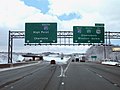
A sign in Oklahoma City, Oklahoma, lists control cities of Wichita, Kansas, and Fort Smith, Arkansas, for Interstate 35 and Interstate 40, respectively.

A control city is a city, locality, or other location posted on a series of traffic signs along a particular stretch of road indicating destinations on that route.[1] Together with route numbers and cardinal directions, these focal points aid the motorist navigating along a highway system. Such cities appear on signs at junctions to indicate where the intersecting road goes and where the road ahead goes. They are also typically used on distance signs.

Different countries have different practices as far as focal points on directional signs are concerned, and the term control city is not used globally. Where a sign contains a number of destinations for a particular direction, not all of those destinations may be considered a control city. In most countries, control cities are perceived to be the destinations on signs that aid longer-distance traffic, as opposed to local traffic. Accordingly, local destinations on a sign, which only appear incidentally, would in a number of countries not be considered control cities.[2]

While a control city may not appear on the signs of every single junction, the control city would at least appear on major junctions.

Description

[edit]

Mostly towns and cities are used as control cities. Other than major towns in a country or region, towns close to major intersections or the end of a particular route are often selected as control city. However, all sorts of other potential destinations can be selected as control city, such as states and regions, frequently visited objects, and names of prominent intersecting roads. Narrow-passes carrying a lot of traffic often also take the role of control city. Examples would be major bridges (the Golden Gate Bridge is a control city within San Francisco), tunnels (e.g. the Holland Tunnel in New York City), or mountain passes (e.g. the Gotthard Pass featuring prominently on signs in Switzerland). In border areas, the border itself regularly features as a control city, e.g. the U.S.-Mexico border for Interstate 5 southbound.

The control city is typically on or close to the route for which it serves as the primary focal point. In exceptional situations, towns along prominent intersecting roads could serve as such, notably when the vast majority of traffic would turn off to that intersecting road. Equally, towns beyond a route's terminus could serve as control city. Particularly when a route merges into another route, a major town along that other route could serve as control city. In the United States, for instance, New Jersey Route 18 southbound says it goes to Point Pleasant but never does. This is because of the stub end at exit 6.

While the vast majority of control cities are sizeable towns, minor towns or even unincorporated localities may feature as control city. This is particularly the case if they are located close to junctions of major roads or near the terminus of a road. Major roads in Poland, for instance, feature many signs that refer to small villages close to the border, since that border marks the route's terminus. Signs in Australia's Northern Territory generally will not refer beyond the state border, with the last control city on the Stuart Highway being SA Border and the same applying on routes heading to Queensland and South Australia. On the other hand, there are also instances where larger cities have not been selected as control city because of the proximity of a bigger city downstream on the road.

A common principle identified in signposting is the principle of continuity. Once a particular destination has featured on a sign, it should feature on all signs that contain forward destinations for that direction. Sometimes particular towns are used on a one-off basis at major intersections, but they would then not be considered the control city for that particular road.

Europe

[edit]

Unlike in the United States, Canada, and the United Kingdom, roads in Continental Europe are not signed with directional banners (east, west, north, and south). The motorist accordingly needs to rely on the combination of the control city and the route number as navigation tools. Possibly as a result of this, control cities tend to feature rather prominently on the route signs of European countries when compared to signage in North America. Routes tend to feature more signs that contain information for the route forward and those signs often contain a larger number of focal points.

In this context, and bearing in mind that in Europe every country has its own style of signposting, the term control city is not always in use, but most countries use concepts that have a similar role to that of a control city in North America.

Some, but not all, countries like Poland and Switzerland label border crossings and foreign cities as control cities with a European abbreviation symbol (D for Germany, NL for the Netherlands, UA for Ukraine, etc.). The border crossing control city in Poland would have priority over other towns along the way even if the signposted border village/town is smaller than many towns along the way or when the particular border crossing is no longer operational due to Poland adopting the Schengen Agreement in 2007.

Distance sign showing the distance to the control cities on the A2 autostrada of Konin, Poznań, Łódź by using the motorway and national road 14, and the German-Polish border crossing of Świecko. The border crossing is no longer operational because Poland adopted the Schengen Agreement in 2007.

Belgium

[edit]

In Belgium, the route network very much centers around the towns of Antwerp, Brussels, and Liège. On roads leading to these towns, the relevant town typically features as the primary focal point of the route and as the most distant focal point on the distance signs placed after each intersection. On other roads, provincial capitals play a comparable role as control city, while larger towns outside Belgium feature on routes leading out of Belgium.

France

[edit]
Following the A1 leads to Lille and Calais, and the A2 leads to Belgium- the E19 directly to Brussels and via other routes to Liège.

All French localities have been divided into five categories for signposting purposes, mostly based on their size (though smaller towns with a strategic position in the road network could be promoted while larger suburban towns could be relegated one category). Towns in categories 3, 4, and 5 feature as the focal points on forward signs and distance signs of motorways. On non-motorways, these towns are signposted against a green background whereas other towns are signposted with black letters against a white background. The towns in category 5 are the biggest towns of France, which are also the pivotal points in the French motorway network.

Signs on, and leading to, French motorways generally refer to some three or four towns on that motorway. In other words, there are no stand-out towns that could be referred to as the French equivalent of a control city. The towns signposted have been picked from the three categories signposted along motorways, with towns in category 5 signposted from the biggest distance out (typically, on any motorway that leads to a town in category 5, the first category 5 town ahead is signposted).

Germany

[edit]

In the German guidelines for directional signage on motorways, the concept of the Hauptfernziel (translating as main distant focal point) has a role that is comparable to that of a control city in North America. This control city appears on roads leading to a motorway and at on-ramps. The Hauptfernziel is also the most distant point that features on distance signs, which are placed after each exit. Directional signage along motorways tends to also refer to towns other than the Hauptfernziel. These could be local focal points (known as Nahziele), but also smaller towns downstream.

Under German guidelines, a town close to a road's terminus should serve as Hauptfernziel, except that towns close to major functions could also take that role. The major towns of Germany typically double as Hauptfernziel on this basis, notwithstanding the fact that motorways often pass by rather than terminate there. A prominent town that does not feature as Hauptfernziel on a major route would be Düsseldorf, which despite being a regional capital sits squeezed between the major junctions at Oberhausen and Cologne and has no major motorway junction itself. On the longer motorways of Germany, the distance between Hauptfernziele is usually some 150 to 200 kilometres (93 to 124 mi), though less in densely populated areas.

Distance signs on motorways also often feature the Hauptfernziel of one or more intersecting motorways. These are separated from towns along the route proper with a horizontal line.

Ireland

[edit]

In the Republic of Ireland, directional banners are used on the M50 (Ó Thuaidh/NORTHBOUND and Ó Dheas/SOUTHBOUND) and on the N40 (Siar/WESTBOUND and Soir/EASTBOUND).

On national roads (which include motorways), the control city is usually a large town at or near the termination of the road. A town on an intersecting road may be used as a control city with its name enclosed in parentheses.

Italy

[edit]

Road signs in Italy normally feature one focal point used per direction of a longer stretch of road. This could be considered the control city of that road. Often, this is the town close to the route's terminus, but it could also be a town close to a major intersection or an otherwise major town. Milan, for instance, has this role along the A4 between Turin and Trieste.

On longer non-motorways, a provincial capital often takes the role of control city despite not being close to the route's terminus or a major intersection. Intersecting routes also feature as control city. This often occurs on beltways and spur routes.

In addition to signs showing a route's single control city, Italian routes generally also feature ancillary signs that feature other towns in a particular direction. Unlike the control city, these other towns are not necessarily to be found on subsequent signs along the route signposted. These towns feature on the directional signage for information purposes only.

Netherlands

[edit]

In the Netherlands, the guidelines for signposting feature a distinction between regular control cities (called hoofddoel) and network cities (called netwerkdoel). The class, a group of ten cities in each part of the country where major roads intersect, is being signposted in addition to regular control cities. The references to network control cities serve to guide long-distance traffic through the country, unlike the reference to the first regular control city which is seldom more than 30 kilometres (19 mi) away. Network control cities can also be towns on an intersecting road. Since 2010, efforts are being made to create even more prominent references to the towns of Amsterdam and Rotterdam; the former drawing many tourists and the latter drawing many professional drivers to its port. On roads not leading to a network control city, the route's terminus is often signposted in addition to the control city.

Scandinavia

[edit]
The E45 and E39 split at Nørresundby in Denmark. The overheads show the destinations and on the bottom, the distance to the nearest exit on the two freeways (400 metres (1,300 ft)).

Each of the Scandinavian countries has its own style of signposting, but their styles reveal similarities. Signs on roads in the countries typically feature one town that takes the role of the control city of that particular road. As distances in Scandinavia are longer and the area is sparsely populated, this can be a town that is several hundred kilometers away. Other than local destinations, signs in Scandinavia do not commonly feature other cities in addition to this major town. On less important roads, the town featuring as control city is often the route's terminus. On the main axes of Scandinavia, notably the main north–south routes E4 and E6, larger towns along the routes have been chosen to also appear as control city.

United Kingdom

[edit]
Jedburgh and Newcastle are primary destinations on the A696.

In the United Kingdom, the term control city is not commonly used. Rather, motorists are referred to a primary destination. Primary destinations are typically towns located close to strategic intersections. In London and other large cities, boroughs and major intersections are also in use as primary destinations, with the financial centre itself being signposted as The city. One particular intersection outside London that made it to primary destination is Scotch Corner, the split between two routes from the South into Scotland.

On signs in the United Kingdom, cardinal directions are not used, but one specific aspect of UK signage is the use of regions as a focal point along roads. These regions, which may appear a cardinal direction (e.g. the North, as appears on the A1), serve to direct long-distance traffic. Primary destinations, on the other hand, are typically relatively nearby. As directional signs typically only contain the first one or two primary destinations, traffic needs to rely on the regional focal points to see the general bearing of the route.

Primary destinations that are not on the designated road are shown in brackets as in the image below:

Sign in Cheshire showing the distances to the primary destinations of the M6 motorway, Warrington and Chester. None of these destinations are located on the A537 road so they are written in brackets.

North America

[edit]

Canada

[edit]
Toronto signed as the control city on A20 in Montreal.

Canada lacks a coherently signed national highway system—even for the Trans-Canada Highway routes—and there is no mutual agreement for designating control cities across provincial boundaries.

Control cities are particularly necessary for highways that do not follow strict linear directions. Ontario's Queen Elizabeth Way, for example, wraps around the western end of Lake Ontario, with segments proceeding both east and west from Hamilton. Compass directions are not used and the control cities of Toronto and (for the opposite direction) Hamilton/Niagara/Fort Erie are the only bearings provided.

Ontario

[edit]

Each of the 400-series highways uses control cities, but the common Ontario practice is to use smaller, closer urban centres as alternatives to out-of-province cities. For example, on Highway 401, Cornwall displaces Montreal as eastbound control city for most of the St. Lawrence valley. Windsor, London, Toronto, Kingston, and Cornwall (with Montreal only signed along the short section between Cornwall and the Quebec border), are control cities while larger cities such as Oshawa and Mississauga are omitted due to them being suburbs of Toronto, although in the latter case this is common in most jurisdictions.

The pattern of control city signage is sometimes inconsistent in Ontario. For example, while Barrie and Newmarket are signed as control cities for Highways 400 and 404 respectively on exit signage along Highway 401 in Toronto; London and Kingston are not shown as control cities on signage along these highways as they approach Highway 401. Along Highway 400, the control cities of Toronto, Barrie, and Parry Sound are consistently signed along its southern section, but Barrie and Parry Sound are omitted in its northern section: e.g; northbound, the control city changes to Sudbury even before the highway reaches Parry Sound, while Toronto is signed in two different sections southbound.

Quebec

[edit]

The Ministère des Transports du Québec typically uses large urban centres as control cities, even if they are far away and/or outside the province. For example, signs in Montreal indicate control cities as far as Toronto and Ottawa on Autoroutes such as 20 and 40 respectively. New York City and Vermont are used as control cities for Autoroutes 15 and 35 respectively. This may cause confusion to motorists unfamiliar with this convention, as the control cities may change at the continuations of these autoroutes into the adjoining jurisdictions; such as Cornwall (and then Kingston) being signed along Highway 401 in Eastern Ontario rather than Toronto.

New Brunswick

[edit]

The New Brunswick Department of Transportation tends to use cities within the province as control cities. The Trans-Canada Highway uses Edmundston, Fredericton, Moncton, and Sackville as control cities from north to south. Places in bordering provinces are used sparingly, and only after they are the only remaining destination on the highway. Route 95, the link between the Trans-Canada Highway and Interstate 95, uses only Houlton, Maine as a control city to the west.

British Columbia

[edit]

British Columbia tends to use cities and towns at or near junctions of numbered highways as control cities regardless of population levels, amenities or otherwise importance of those places which includes the choice of control cities that are outside BC. For example Aspen Grove despite being a very small town is used as a control city because the junction of the Okanagan Connector Hwy 97C and Hwy 5A is located at the edge of town. If a route contains a ferry crossing the name of the ferry terminal can be used in addition to or in place of a control city.

United States

[edit]
North of Baltimore, Maryland, New York City is used instead of closer Philadelphia or Wilmington.
These signs in Petersburg, Virginia on Interstate 95 near the start of Interstate 85 aid long-distance travelers, by listing the cities of Durham, North Carolina, Rocky Mount, North Carolina, Miami, Florida, and Atlanta, Georgia.
The eastbound terminus of U.S. Route 50 in Ocean City, Maryland is an unusual case, giving the distance to the very distant western terminus in Sacramento, California.

The control cities on the Interstate Highway network are selected by the states and contained in the "List of Control Cities for Use in Guide Signs on Interstate Highways,"[3] which is published by the American Association of State Highway and Transportation Officials as Part III of the AASHTO Guidelines for Supplemental Guide Signing.[4] Control cities on other U.S. roads are often selected on the basis of general principles, as opposed to specific lists of towns.

U.S. federal lists are in practice not always followed.[citation needed] This may be the result of towns having gained importance since the list was last updated or in order to have local (intrastate) interests prevail over towns elsewhere. On the other hand, there are also instances where intrastate control cities have been left out so that long-distance focal points could be added. There are also instances where the name of another state has prevailed over the official control city, e.g. the signs in Boston heading to the state of Maine ("All Maine Points" appears twice on northbound I-95 just south of Portsmouth, NH.).

On the U.S. federal list, control cities have often been selected by virtue of being located close to an intersection of two US-interstates. This has resulted in a number of very minor localities having control city status. Some examples:

  • Interstate 8 heading eastbound in California from its starting point in San Diego signs El Centro and Yuma as control cities until the Arizona state line. This may be due to the fact that there are no cities in California or Arizona with a population of more than 200,000 that are along the freeway besides the aforementioned San Diego. Conversely, however, its Arizona route only signs Phoenix and Tucson heading east, while San Diego is the only control city signed heading west. Phoenix lies significantly north of Interstate 8, but may be signed to aid travelers from San Diego to Arizona's capital and largest city. It is omitted after Exit 115 heading eastbound, from where only Tucson is signed until the freeway defaults onto eastbound Interstate 10 (which eventually reaches that city).
  • Interstate 10 heading eastbound from its starting point to the CaliforniaArizona state line uses the following towns as control cities: San Bernardino, Indio, and Blythe. Besides Exit 145 in Indio, there is no mention of Phoenix as a control city during this stretch of freeway despite it being the next city after San Bernardino with a population over 200,000. Conversely, Los Angeles is used as the westbound lanes’ control city as far as the eastern city limits of Phoenix until the East Los Angeles Interchange.
  • Interstate 10 heading eastbound in El Paso uses Van Horn, Texas, a small city west of the western terminus of I-20; the junction of I-10 and US 90 is also near Van Horn. Both Van Horn and San Antonio are used, due to the latter being the next major city along the route.
  • Interstate 10 in Louisiana uses Lake Charles and Lafayette as control cities in both directions. In Texas, Baton Rouge was previously listed as the eastbound control city beginning in Beaumont to the Texas-Louisiana state line. Recently updated signs now list Lake Charles as the eastbound control city starting in Beaumont at the request of the Louisiana Department of Transportation and Development.
  • From New Orleans to the Louisiana-Mississippi state line, I-10 eastbound signs list the smaller communities of Slidell, Louisiana and Bay St. Louis, Mississippi as control cities, rather than Gulfport, one of the two largest cities (with Biloxi) along the Mississippi Gulf Coast.
  • Interstate 49 in Louisiana uses Opelousas, a small city, as a control city northbound from Interstate 10 in Lafayette to the junction of I-49 and US 190, and southbound from Louisiana Highway 1 in Alexandria to US 190. US 190 is heavily traveled between Opelousas and Baton Rouge, even with the presence of I-10, probably the reason why Opelousas is listed as a control city.
  • Interstate 55 heading northbound out of LaPlace, Louisiana uses Hammond, where it crosses Interstate 12. I-12 east from its origin in Baton Rouge to I-55 uses Hammond as the control city, as does I-12 west from its ending at the I-10/Interstate 59 junction in Slidell to I-55. Hammond's use is likely due to its location of Southeastern Louisiana University, the state's third largest public university.
    • On Interstate 55 south in Mississippi, all signs south of Jackson list New Orleans as the control city.
  • Interstate 40 in Arizona uses Flagstaff eastbound from the California state line to the junction of I-40 and Interstate 17, and westbound from the New Mexico state line to I-17. This is because Flagstaff is I-17's northern terminus; I-17 north from Phoenix uses Flagstaff for the same reason as well. Flagstaff is also the gateway to the Grand Canyon National Park.
  • Prior to the completion of I-69 within southern Indiana, northbound approaches south of Bloomington did not have any control city. Instead they simply read "I-69 North". North of Bloomington, however, Indianapolis was used as a control city. This is due to this section of I-69 having been initially built as part of State Road 37, which had Indianapolis as a northbound control city. The entire interstate does currently use Evansville as the control city on the southbound approaches.
    • Likewise in Kentucky, I-69 uses Henderson as a control city due to the fact of the highway currently dead-ending there.
  • Interstate 70 in Missouri often uses several intermediate towns between the large cities at opposite ends of the state along the highway, Kansas City and St. Louis. Columbia is most commonly listed due to its central location within the state and the presence of the state's flagship university, the University of Missouri.
    • In the St. Louis area, Indianapolis is not listed as a control city on eastbound I-70 until the highway crosses into Illinois. Also, Louisville is not listed as a control city on I-64 eastbound until entering Illinois. St. Louis is the control city on I-64 westbound beginning in Louisville, and I-70 westbound beginning in Indianapolis. Once in St. Louis, westbound I-64's control city becomes Wentzville, I-64's national western terminus.
    • In the Kansas City area, Topeka is not listed as a control city on westbound I-70 in Kansas City, Missouri until the highway enters the Downtown Loop. Conversely, St. Louis is listed as the control city on eastbound I-70 beginning with the junction at Interstate 435 in Kansas City, Kansas.
  • Interstate 55 in Missouri also uses intermediate cities as control cities, notably Cape Girardeau, the largest city along the route between St. Louis and Memphis. Most I-55 northbound signs in Tennessee and Arkansas list St. Louis as the control city.
  • Limon, Colorado (population 2,043 as of the 2020 census) is listed as a control city along I-70 eastbound starting in Denver, and westbound starting at the Colorado-Kansas state line. For a brief time, Limon was also used as a control city for 253 miles of I-70 in Kansas westbound from Salina to the state line. The control cities are now Hays from mile markers 253 to 161, and Denver from mile marker 161 to the Colorado state line.
  • Interstate 75 in Michigan uses the Mackinac Bridge as a control point between St. Ignace and Saginaw.
  • The Pennsylvania Turnpike (I-70/76) and PA Route 66 use New Stanton, Pennsylvania as a control city, due to the fact that it is at PA 66's terminus as well as the western end of I-70's concurrency with I-76 on the turnpike. Additionally, Breezewood is used as a control city on westbound I-70 north of Hancock, Maryland, due to a freeway gap in downtown Breezewood where the highway joins the Pennsylvania Turnpike.
  • Interstate 77 in Ohio signs the small in-state city of Marietta (population 13,385 at the 2020 census) south of Akron instead of Charleston, West Virginia, the state capital which is almost four times larger (population 48,864 at the 2020 census) than Marietta.
  • Interstate 80 in Des Moines mostly lists Iowa cities on the state's borders, Council Bluffs westbound and Davenport eastbound, although some newer signs list larger out-of-state cities Omaha westbound and Chicago eastbound.
  • Interstate 84 in Oregon heading eastbound from Portland uses The Dalles, Pendleton, LaGrande, Baker City, and Ontario as control cities. Boise, Idaho isn't signed until the freeway reaches Ontario.
    • Going westbound from Pendleton, Portland becomes the control city on I-84, skipping over The Dalles.
  • Interstate 94 in Michigan uses Marshall, Michigan as a control city between Battle Creek and Jackson.

However, in many other instances, the next major city near or along the route is used as a control city, often skipping over minor localities where two US-interstates meet. For instance:

Some beltways or spurs which run through multiple states have different rules on control cities in each state. One instance is Interstate 435, the beltway in the Kansas City Metropolitan Area. Signs for I-435 in Kansas do not have control cities listed, while in Missouri, one of five control cities is listed, depending upon direction and location: Des Moines, St. Joseph, St. Louis, Topeka and Wichita.

According to Section 2E.07 of the Manual on Uniform Traffic Control Devices, control cities must appear on guide signs:[3]

  1. At interchanges between freeways (example US-1 in gallery)
  2. At separation points of overlapping freeway routes (example US-2 in gallery)
  3. On directional signs on intersecting routes, to guide traffic entering the freeway (example US-3 in gallery)
  4. On pull-through signs (example US-4 in gallery)
  5. On the bottom line of post-interchange distance signs (example US-5 in gallery)

Since the cities on post-interchange distance signs are listed in ascending order of distance, the control city of routes in the United States is typically the most distant locality on the signs of a particular road.

Oceania

[edit]

Australia

[edit]

While the term 'control city' is not often used, highways, motorways and freeways in Australia operate on much the same system as in the United States and Europe. Directional markers are not used, instead the next large towns or cities which are likely to be the destination, or known waypoints for motorists, are used.

  • Within cities major suburbs will usually be used - In the eastern suburbs of Melbourne Chadstone and Dandenong, which are connecting hubs with the national route 1, Princes Highway, are used as route markers, and other roads may consistently rely on specific outer suburbs such as Lilydale or Ringwood for Maroondah Highway or Montrose or Vermont for Canterbury Road. Traveling inbound, depending upon the driver's location in Melbourne's east one of these markers will generally be used along with a marker 'City' referring to the Central Business District. The marker 'City' is only used when within the metropolitan area of a city, outside of the metropolitan area routes traveling towards that city will use the city's full name. Perth uses 'Perth City'.
  • Outside of cities, major regional centers or capital cities will generally be used as markers.
  • The same principle applies to major and secondary surface roads in Australia, with the most major suburb or town, or the road's terminus in either direction being used as the 'control city'. On the main routes connecting Australia's major cities, the next interstate capital is often used signposted in addition to the next regional centre. The Northern Queensland town of Cairns has a similar status.
  • In some circumstances a major infrastructure location, most often Airports, will be used as a destination. In the case of surface roads if they connect to a freeway, motorway or tollway sometimes this connection will be used as a signing point.

VicRoads' Traffic Engineering Manual, Vol 2 part 2.15, pp. 185-209, defined the standard through destinations (as of the publication date) for the freeways and arterial roads in Victoria in map form[1]

Guidelines to control city selection

[edit]

There is no absolute threshold of community size or distance away, or absolute necessity that it has to be a city per se in order to be selected. Even some highways will terminate several miles before the so-called "control city" and "borrow" another route to continue toward there, even if a north–south highway has to externalize its control city to an east–west highway (or vice versa).

For instance, Interstate 75 in Michigan uses the Mackinac Bridge as a "control city", and even U.S. Route 127 in Michigan does it as far south as Mt. Pleasant. Another idiosyncrasy with control cities is there is no absolute rule that the city has to be reached before the control city changes, for instance Interstate 94 in Michigan uses Chicago as a control city as far as the Metro Detroit area, whereas some in-between cities such as Jackson are used within 20 miles (32 km) of there. Other control cities are used where a city can be several miles east of a north–south route, such as U.S. Route 35 using Charleston, West Virginia, as a control city even though the southern junction is at Scott Depot, West Virginia, in which Interstate 64 goes east toward Charleston. Another example is Interstate 65, as Chicago, Illinois is used as a control city north of Indianapolis, Indiana, but I-65 terminates at Interstate 90 and the Indiana Toll Road in Gary, Indiana, 26 miles southeast of Downtown Chicago, and I-90 goes northwest into Chicago via the Toll Road, Chicago Skyway Bridge and Dan Ryan Expressway. In the case of concurrencies, another control city from the overlapping highway can take over, and sometimes two locations are used together.

[edit]

Notes

[edit]
[edit]
Revisions and contributorsEdit on WikipediaRead on Wikipedia
from Grokipedia
A control city is a major destination city or locality designated on guide signs along freeways and expressways, particularly within the U.S. , to provide motorists with orientation toward key population centers and routes. The primary purpose of control cities is to ensure continuity in destination signage, offering consistent reference points that align with standard mapping practices and help drivers maintain their intended path without confusion at . Selection criteria emphasize of significant size and national importance located on or near the route, with states coordinating through the American Association of State Highway and Transportation Officials (AASHTO) to approve lists and any changes, which must demonstrate minimal impact on adjacent jurisdictions. For instance, on , control cities include El Paso, , and , reflecting progressive destinations eastward. Control cities are displayed on specific types of signs, such as those at freeway interchanges, points where routes overlap or separate, pull-through signs for entering , and the bottom line of post-interchange distance signs, where distances are measured to the itself rather than the exit. These signs promote efficient by limiting destinations to one primary route per control city at each junction, reducing visual clutter while prioritizing traveler needs. Although the concept is most formalized , similar destination-based signing practices are employed internationally to guide users on major roadways.

Fundamentals

Definition and Purpose

A control city is a prominent city, , , or border point displayed on traffic signs along a roadway to indicate the primary destination or direction for long-distance travel. These reference points are selected to represent major destinations or population centers on or near the route, providing consistent guidance for motorists over extended distances. Unlike local destinations, which guide short-term exits to nearby services or communities, control cities focus on ongoing major routes, ensuring signage emphasizes continuity rather than immediate turns. The primary purpose of control cities is to aid drivers in orientation, particularly on high-speed roadways like freeways and expressways, by reducing confusion at interchanges and junctions. They support route continuity by appearing repeatedly on guide signs, distance markers, and exit panels, allowing travelers to track progress toward key locations without relying on frequent local signage. This approach enhances safety by minimizing visual clutter and for long-distance drivers, as control cities serve as familiar anchors that align with highway maps and navigation aids. Control cities may include non-urban features when appropriate, such as major landmarks or international borders, to better reflect route endpoints; for instance, bridges like the or directional indicators toward borders are used in certain systems. By improving traffic flow on motorways and interstates, these designations promote efficient long-haul travel.

Historical Development

The roots of control city signage trace back to ancient Roman milestones, which served as early distance and direction markers along roads like the Via Appia constructed in 312 B.C. These stone pillars indicated distances to and maintenance details, laying foundational principles for destination-oriented road guidance. In the , the rise of bicycles and early automobiles in prompted touring clubs to erect warning and directional signs; notably, the Italian Touring Club established one of the first organized signing systems around 1895 to aid motorists. By the early , destination signs emerged in the United States and to support growing automobile travel, with organizations like the (formed in 1902) installing such markers on major routes. In , control city concepts evolved through standardization efforts tied to expanding highway networks. The first edition of the Manual on Uniform Traffic Control Devices (MUTCD), published in 1935, classified guide signs—including those for destinations—with rectangular designs featuring black letters on white backgrounds to direct travelers. This framework gained prominence with the , which authorized the , integrating destination-based signing to enhance long-distance navigation. By the , the MUTCD's fourth edition (1961) emphasized control cities on Interstate guide signs, adopting white letters on green backgrounds and addressing the system's rapid expansion to over 41,000 miles. European development accelerated post-World War II amid a motorway construction boom, with destination signing becoming integral to new infrastructure. Germany's network, initiated in but extensively rebuilt and expanded in the , incorporated directional signs to major cities as part of reconstruction efforts. The opened its first motorway, the M1, in 1959, featuring advance destination signage to guide traffic efficiently. International harmonization advanced through regular meetings of European countries since 1949, culminating in the 1968 Vienna Convention on Road Signs and Signals, which standardized destination-based signing across signatory nations to promote uniform guidance on international routes. The global spread of control city practices extended to regions like during 1970s highway upgrades, where destination signing was refined alongside of road markers in 1974. Projects such as the duplication, starting in the mid-1970s, incorporated standardized guide signs to principal cities, improving interstate connectivity.

Selection Guidelines

General Principles

Control cities for highway signage are selected primarily based on their status as major urban centers with significant and economic importance, ensuring they serve as reliable orientation points for drivers traveling along the route. Preference is given to destinations that align directly with the 's path, providing clear guidance without deviating from the primary corridor. Key design considerations emphasize consistency to aid driver comprehension and reduce confusion. Along a given route, the same control city should be displayed on successive signs until a major junction or route separation occurs, where it may be updated to reflect the next logical destination. In cases where no suitable city fits, such as in rural or sparsely populated areas, cardinal directions (e.g., "North" or "East") are used as fallbacks to maintain directional clarity without referencing specific places. Avoidance rules are critical to prevent signage overload and errors. Destinations must not overlap or create ambiguity, such as listing the same city on multiple routes from one interchange; instead, signs are limited to 2-3 control cities to ensure readability at highway speeds. Signs are also updated periodically to account for infrastructure changes, like new bypasses or route realignments, to keep information current and relevant. International standards promote uniformity in signage practices, with organizations like the American Association of State Highway and Transportation Officials (AASHTO) in the United States providing lists of approved control cities to ensure consistency across interstate highways. Challenges in implementation include balancing signage for local traffic needs against long-distance traveler expectations, where local destinations might clutter signs intended for regional guidance. Additionally, outdated signage remains an issue in some areas; the U.S. AASHTO control city list was last updated in May 2024, with periodic reviews to reflect current demographics and route usage.

Regional Variations

In , destination signing for highways often emphasizes route numbers alongside major cities, with 82% of surveyed countries (as of a 2005 report covering 17 nations) incorporating road numbers on motorway signs and 100% on primary roads to aid . This approach facilitates cross-border travel due to geographic proximity, where international destinations or border points are frequently indicated, sometimes with nationality symbols in 18% of nations such as , , and . North American highway signage, particularly on interstates, features a strong emphasis on cardinal directions (north, south, east, west) in rural areas to orient drivers over long distances between interchanges. Federal standards, outlined in the Manual on Uniform Traffic Control Devices (MUTCD), mandate consistency for interstate routes, requiring states to select control cities from an approved AASHTO list while ensuring uniform interchange numbering and guide sign placement. However, individual states and provinces retain autonomy in finalizing control city choices within these guidelines, allowing adaptations to local traffic patterns. In , particularly , destination signing prioritizes suburban and regional centers in densely populated areas, using direction signs with distances and focal point maps spaced approximately 5 km apart in urban settings to support local . Integration with tourist routes is prominent, as guide signs incorporate facilities, route markers, and branded logos aligned with national programs, often on brown-backed panels for recreational paths. Long-distance borders receive less emphasis, with signage focusing on route-specific regional connectivity rather than international crossings, reflecting the archipelago's island-based . Comparatively, European signage prioritizes multilingual elements to accommodate diverse linguistic regions, with 41% of surveyed countries (as of ) using only their for destinations but often adding foreign equivalents near borders. In contrast, relies predominantly on English with mileage in statute miles, supplemented by bilingual English-Spanish signs in certain areas. Oceanian systems blend urban and rural needs in English, incorporating symbolic elements like tourist logos to balance practical with promotional aspects. Emerging trends since 2020 include the adoption of , such as variable message signs (VMS), which enable dynamic updates to control cities or destinations based on real-time conditions like incidents or congestion, with displayed distances limited to no more than 5 km for driver recall.

Europe

Belgium

In Belgium, the motorway network, designated primarily by European E-road numbers, employs control cities drawn from prominent urban centers to orient drivers on long-distance journeys. functions as the primary control city for central and radial routes, while serves as a key destination for northern and port-related directions on routes like the E19. This approach integrates seamlessly with the EU's E-road numbering system, where national A-road designations are often displayed alongside for local context. Signage incorporates bilingual elements in Dutch and French to accommodate Belgium's linguistic regions, with place names rendered in the dominant language of each area—Dutch (e.g., Antwerpen, Gent) in , French (e.g., Liège, Bruxelles) in , and both in the bilingual Brussels-Capital Region. Control cities shift at regional borders to align with these linguistic conventions, ensuring readability for local and international drivers; for instance, a route heading east might transition from Dutch-labeled signs near to French ones approaching . Policy adjustments in since 2023 require road signs to use the of the destination (e.g., French names for Walloon cities like ), replacing previous Dutch translations to reduce confusion for drivers, particularly international ones. Liège exemplifies the use of control cities for eastern corridors, guiding traffic on the E25 and toward the German border, while directs coastal and western routes on the toward and international ferry links. Belgium's compact geography, spanning just over 30,000 square kilometers, results in frequent changes to control cities along motorways, often every 50-100 kilometers, to reflect nearby urban hubs and maintain navigational precision. This system underscores strong international connectivity, with signs on border-adjacent E-roads highlighting links to France (e.g., via E17 to ) and the (e.g., via E19 to ), facilitating seamless trans-European travel under the Schengen framework.

France

In France, the use of control cities in motorway signage follows a centralized, hierarchical approach dominated by Paris as the primary reference point for the national road network. The autoroute system radiates outward from the capital, with signage on A-roads (autoroutes) primarily directing toward for most routes, supplemented by regional hubs for longer southern or peripheral connections. Localities are classified into five hierarchical levels (V to I) based on population, economic attractivity, and strategic importance, as defined by the Direction des Infrastructures de Transport (DIT); holds the highest Class V status, ensuring it is signposted from the greatest distances, often appearing at the top of blue directional panels that list up to four destinations ordered by decreasing distance. This radial structure aligns with the overall autoroute numbering, where routes like A1 through A19 originate from , facilitating intuitive navigation for long-distance travelers. Regional cities serve as secondary control points, particularly for routes extending beyond the immediate Paris basin; for instance, Lyon and Marseille act as key destinations on southern autoroutes, while Bordeaux is the primary control city for the A10 southward from Paris. On the A1, Lille functions as the main northern control city, guiding traffic toward Belgium and Calais, with distance markers counting down to these hubs. Autoroute numbers are often paired with these cities in signage (e.g., "A10 Bordeaux"), reinforcing the hierarchical system where Paris dominates inbound routes, but outbound signage shifts to the next major pole once a regional city is approached. Tourist destinations, such as coastal or historic sites, may be included as lower-level controls with ministerial approval if they demonstrate significant attractivity, though they rarely supersede primary urban hubs. Recent adaptations in reflect parallels with infrastructure, such as the A6 route to , which mirrors the line, allowing integrated multimodal guidance where control cities like emphasize intermodal connections without altering core radial priorities. This hierarchical model ensures signage continuity across the 11,000+ km network, prioritizing safety and user orientation over exhaustive local details.

Germany

Germany's control city system on the network emphasizes route continuity and efficiency, utilizing consistent major destinations to guide drivers along linear paths with minimal sign changes over long distances. This approach aligns with the engineering principles of the Bundesautobahn (BAB) system, where blue directional signs display prominent cities such as on the A1 or on the A8, maintaining the same control city for hundreds of kilometers to reduce driver confusion during high-speed travel. The system prioritizes clarity and speed, with signage designed for quick legibility at velocities often exceeding 130 km/h, featuring white text on backgrounds and structured layouts that list farthest destinations first. Specific examples illustrate this route-focused practice: serves as a primary eastern control city on routes like the A2 and the Berliner Ring (A10), directing traffic toward the capital from western entry points; similarly, functions as a key control for the on the and A4, anchoring signage for north-south and east-west flows through the industrial heartland. Post-German reunification in 1990, the network expanded significantly, incorporating former East German sections and updating signage to integrate eastern control cities like , with approximately 2,100 km of new or upgraded roadways completed by 2009 to ensure nationwide continuity. These updates enhanced long-haul efficiency by standardizing signs across the unified network, avoiding fragmented local references. Integration with the European E-road network further supports cross-continental travel, as German Autobahns often carry dual designations—such as the overlapping with E35—marked by Sign 410, which displays the green E-road shield alongside the national A-route number for seamless guidance. This harmonization reflects Germany's adherence to the 1968 Vienna Convention on Road Signs and Signals, promoting uniform practices across borders. Following the Schengen Agreement's implementation in 1995, which eliminated routine border checks, the system avoids border-specific signage, focusing instead on uninterrupted route progression to facilitate fluid movement within .

Ireland

In Ireland, control cities on motorways and national primary roads are primarily selected based on their status as major urban centers and terminal destinations along the route, with serving as the dominant control city for radial motorways emanating from the capital. The system emphasizes a hierarchical approach, where up to four destinations are displayed per direction sign, ordered by distance with the furthest at the top, to guide drivers efficiently across the island's network. This Dublin-centric model reflects the country's centralized population and economic structure, connecting the capital to key regional hubs like Cork, Galway, and Limerick via routes such as the M8, M6, and M7. Specific examples illustrate this practice: on the M18/N18 motorway linking Limerick and Galway, Limerick functions as a primary control city for southward directions, while Galway serves northward, with signage providing metric distances in kilometers. Similarly, the uses as a control destination for northbound travel toward the , maintaining continuity with Northern Ireland's road network despite post-Brexit arrangements that preserve open travel without altering core signing protocols. Regional routes incorporate local control cities like Sligo or Westport, as seen on the N4/M4 where Sligo appears above closer destinations to indicate longer-distance guidance. Ireland's control city system is shaped by its island and membership, resulting in a relatively sparse motorway network of approximately 1,000 km, focused on rural connectivity rather than dense interurban links common in . adheres to standards with blue backgrounds for motorways and metric measurements, but retains a UK-influenced layout for directional information, while being bilingual in Irish and English nationwide to reflect policy. This adaptation supports integration, including harmonized road safety directives, while addressing the nation's rural character where motorways prioritize access to peripheral regions over extensive cross-border corridors.

Italy

In Italy, control cities on the autostrada network primarily consist of major metropolitan areas and regional centers that guide long-distance traffic along key corridors, with and functioning as primary reference points on the A1 (Autostrada del Sole), the country's longest motorway stretching approximately 760 kilometers from through , , and to . This selection reflects the A1's role as the backbone of north-south travel, where signage prioritizes these endpoints to indicate progress over extended distances, often displaying distances to or on overhead gantries and advance signs. Regional hubs such as and complement this system; serves as a southern anchor on the A1, while acts as a northwestern control on the A5 and connections to the A4, facilitating industrial and cross-Alpine routing. Examples of control city usage include on central segments of the A1, where signs direct traffic toward this Tuscan hub amid the Apennine foothills, and on the A14 (Autostrada Adriatica), which runs 750 kilometers along the eastern coast from to , using to orient drivers toward Puglia's ports and southern extensions. Toll-integrated signing is a hallmark of Italian autostrade, with green directional panels explicitly marking tolled routes and listing control cities alongside exit information, such as distances to or , to integrate fare collection points with navigation; for instance, on the A1, signs often precede toll plazas by noting upcoming controls like . Unique aspects of Italy's control city practices stem from the peninsula's diverse , where the in the north and Apennines in the center dictate route alignments and city selections to navigate passes and valleys—such as the on the A22 to , influencing or as northern controls, or the Porretta Pass on the A1, where guides traversal of seismic-prone Apennine terrain. Additionally, selections emphasize tourist-heavy destinations, with cities like , , and chosen not only for their population size but also to accommodate high volumes of leisure traffic drawn to sites and coastal attractions, ensuring signage supports seasonal influxes without overwhelming local urban networks.

Netherlands

In the , the control city system for road signage emphasizes a dense network of urban destinations, reflecting the country's high population concentration in the region, which encompasses , , , and surrounding areas with a density of approximately 1,000 persons per square kilometer. This urban-focused approach integrates control cities—known locally as hoofddoelen or main destinations—primarily along A-roads and motorways, where and serve as key primary destinations due to their roles as economic and logistical hubs. For instance, on the A4 motorway connecting the two cities, signage consistently directs traffic toward these centers to facilitate efficient long-distance travel across the flat landscape. The system's design accommodates frequent local integrations, allowing intermediate destinations to appear alongside main control cities on signs to support the high-density in compact urban areas. Utrecht functions as a central hub in this network, appearing as a control city on multiple routes such as the A2, A12, A27, and A28, where it guides converging from northern and southern directions toward the . In the south, emerges as a vital control city for regional links, featured on the A2, A50, A58, A67, and A270, connecting industrial areas to broader European corridors. Near international borders, signage incorporates multilingual elements, often including English alongside Dutch, to aid cross-border drivers from and , enhancing fluidity within the EU's open . This practice ensures seamless navigation without abrupt language shifts, aligning with broader European standardization efforts. The ' extensive canal system parallels and influences road route choices, as seen in historical adaptations where waterways dictated alignments or required restorations to prioritize water management over vehicular paths; for example, in , a 1970s urban motorway built over the historic Catharijnesingel canal was removed in 2020 to revive the waterway, reshaping local traffic patterns. Additionally, the control city signage emphasizes integration with , a hallmark of Dutch , where blue directional signs for motorways coexist with red cyclist-specific signage on adjacent paths, promoting multimodal use in urban settings with over 37,000 kilometers of dedicated cycle routes. This approach supports safe transitions between control city routes and local cycling networks, particularly in high-density zones.

Poland

In Poland, the designation of control cities on motorways (autostrady, designated as A-roads) and expressways (drogi ekspresowe, designated as S-roads) prioritizes major urban centers to facilitate navigation for long-distance drivers, reflecting the country's post-communist infrastructure expansion and integration into the European road network. Warsaw and Kraków frequently serve as principal control cities, guiding traffic along key north-south and east-west corridors; for instance, on the A2 motorway connecting the German border to Warsaw, signs prominently feature Warszawa (Warsaw) alongside Berlin as a transborder destination. Similarly, on the A4 motorway traversing southern Poland, Kraków appears as a core control city for routes linking Wrocław to the east. This system supports efficient routing amid Poland's rapid motorway development, where the length of motorways and expressways grew over 550% from 2004 to 2024, reaching 5,117 kilometers, largely funded by EU cohesion initiatives to enhance connectivity and economic integration. Historically, control cities near western borders emphasized border crossings rather than distant urban destinations, but Poland's accession to the on December 21, 2007, led to the removal of internal border controls and a de-emphasis on such sites. Border controls at the Świecko-Frankfurt an der Oder crossing on the A2, a major checkpoint since 1962, were dismantled following Schengen accession in 2007, shifting signage focus from the border point to inland cities like to promote seamless cross-border travel. This change aligned with broader harmonization efforts, reducing physical barriers and updating directional infrastructure to focus on endpoint cities over administrative divides. Eastern non-Schengen borders, such as those with and , retained stricter controls, but the overall evolution favored domestic hubs like on internal routes. Regional variations highlight specific routes: functions as a key control city for northern corridors on the S7 expressway, directing traffic from toward the Baltic coast and ports; meanwhile, anchors western approaches on the S5 and S8, serving as a gateway for travel between and the Czech border. These selections underscore Poland's strategic emphasis on economic centers post-1990s, when the motorway network expanded from under 300 kilometers in 1989 to over 1,900 kilometers of motorways alone by 2020, driven by structural funds and national development plans that prioritized high-impact connections over peripheral border markers. The Schengen updates further streamlined signage, eliminating routine border references on western and southern routes while maintaining focus on urban destinations to support increased trans-European freight and flows.

Scandinavia

In Scandinavia, encompassing Denmark, Norway, Sweden, and Finland, control city practices within the E-road network prioritize major urban hubs as navigational anchors for cross-border Nordic routes, promoting seamless international travel. Stockholm, Oslo, and Copenhagen function as principal control cities, appearing on directional signage to guide drivers along key arteries such as the E4 (connecting Helsinki to Stockholm and southward) and E20 (linking Copenhagen to Stockholm via Malmö). This approach integrates E-road numbering directly into national systems, often without supplementary local designations in Denmark, Norway, and Sweden, to emphasize the routes' continental scope. The region's signage underscores a rural orientation, reflecting the vast non-urban landscapes traversed by E-roads, with ferry connections explicitly incorporated into alignments where land routes are interrupted by fjords or straits—such as on the E39, which relies on ferry services between Denmark and Norway for continuity. For instance, Helsinki serves as a critical control city for eastern Finnish extensions of routes like the E75, directing traffic toward Russia and the Baltic states, while Bergen anchors signage for coastal Norwegian fjord paths on the E16 and E39, aiding navigation through rugged terrain. These practices align with the UNECE European Agreement on Main International Traffic Arteries (AGR), which permits ferry links as integral components of E-roads to maintain network cohesion. Unique to Scandinavia, signage employs durable, highly reflective materials to endure harsh winter conditions, including snow, ice, and reduced visibility, ensuring legibility in extreme weather prevalent across the Nordic climate. Direction signs typically feature place names in local Scandinavian languages, supplemented by English in high-tourist or international corridor areas to support cross-border drivers. This system benefits from EU/EEA harmonization under the AGR framework, fostering coordinated implementation among member states despite Norway's EEA status precluding full EU integration, while all four countries participate in Schengen border-free travel to minimize disruptions on shared routes.

Switzerland

Switzerland's motorway system, known as the A-roads or Autobahnen, employs a transit-oriented approach to control city selection, emphasizing efficient navigation through its alpine terrain and role as a neutral corridor for cross-border traffic. Primary control cities such as and Genève serve as key reference points on major routes, guiding drivers along the national network that spans approximately 1,900 kilometers. This system prioritizes major urban centers and border hubs to facilitate both domestic travel and international transit, reflecting Switzerland's non-EU status which requires separate vignette tolling and customs considerations at frontiers. Border cities like play a crucial role in signage for transit routes, particularly for traffic entering from or via the A2 and motorways. is frequently listed as a control city on northern approaches, helping direct flows toward central and southern without emphasizing domestic detours. Similarly, Genève anchors western signage on the A1, orienting drivers from toward and beyond, while its proximity to the border underscores Switzerland's function as a seamless passage point despite lacking membership, which influences vignette requirements for foreign vehicles. In central regions, functions as a pivotal control city on intersecting routes like the A1 and A6, providing a stable reference for east-west and north-south movements across the . For the Italian-speaking southern canton of , emerges as the primary control city on the A2, directing traffic from the Gotthard region toward while accommodating local linguistic preferences. Switzerland's non-EU position further shapes these choices, as signage often includes country codes (e.g., "(I)" for ) on southern routes to clarify international boundaries and ease transit for non-Schengen-aligned flows. A distinctive feature of Swiss control city practices is the integration of the country's four official languages—German, French, Italian, and Romansh—into signage, with each canton selecting the appropriate language for destination names and instructions on A-roads. This multilingual approach ensures in linguistically diverse areas, such as using Italian for signage in . Additionally, the system's tunnel-heavy infrastructure, exemplified by the on the A2, relies on consistent control cities like Altdorf northward and southward to guide drivers through alpine passes, where steep gradients and limited alternatives demand precise orientation.

United Kingdom

In the , control cities—known officially as primary destinations—are integral to motorway signage, providing directional guidance on the M-road network by highlighting key urban centers, regional hubs, and ports to aid long-distance travel. serves as the primary control city for southern and central motorways, such as the M1 (northbound to ) and M4 (westbound to ), where it is prominently displayed in white uppercase lettering on blue-background advance direction signs to indicate the forward route. Regional centers like (on the M62 and M60), Birmingham (on the M6 and M42 for the ), and (on the M8 and A90 in ) function as secondary control destinations, emphasizing connectivity across devolved nations and reducing sign clutter by limiting displays to three or four key places per sign. This hierarchy prioritizes the furthest primary destination first on approach signs, ensuring clarity at speeds up to 70 mph (113 km/h). Signage practices on motorways incorporate imperial measurements (miles and yards) alongside English-language place names, with bilingual elements in (English and Welsh) and occasional Scottish Gaelic in the Highlands, reflecting devolved authority over traffic regulations. For instance, the M6 northbound uses Birmingham and as control cities before transitioning to Preston and Carlisle, while the A1(M) in the North East features Newcastle and Durham. Port cities like Dover are emphasized on southeastern routes such as the M20, where signs direct traffic to the and ferry terminals, adapting to the 's island geography by integrating service area and border information. These practices stem from the 1963 Worboys Committee's recommendations, updated in the Traffic Signs Manual, to standardize a non-EU-aligned focused on national radials rather than continental E-road numbering. Post-Brexit adjustments since 2020 have influenced signage at key Channel links, particularly around Dover and the Eurotunnel, with new variable message signs incorporating and EU flags to separate UK and EU-bound traffic lanes amid enhanced border checks under the EU . Implemented via Authorisation 5318 in August 2025, these changes address queue management for non-EU travelers, including and photo requirements, without altering core control city designations but enhancing port-specific directions on motorways like the M20. In devolved nations, Scotland's maintains its primary destinations (e.g., , , ) independently, while prioritizes bilingual signing for cities like and , underscoring the 's decentralized approach to motorway guidance.

North America

Canada

In Canada, control cities on highway guide signs serve as primary destinations to orient drivers along major routes, following standards outlined in the Manual of Uniform Traffic Control Devices for Canada (MUTCDC) published by the Transportation Association of Canada (TAC). These signs emphasize major urban centers and traffic generators, providing distances and directions to facilitate navigation across the country's expansive network. The (TCH), spanning approximately 7,821 kilometers from , to , exemplifies this practice by using control cities such as , , Regina, , , , Montréal, Québec, , , and Halifax to guide long-distance travelers through diverse terrains and provinces. All Canadian highway signage employs metric units for distances and speeds, with kilometers standard since the nationwide of road signs completed in 1977, enhancing uniformity and alignment with international practices. This vast geography, characterized by long stretches between major centers such as the approximately 700-kilometer distance between and , necessitates extended-range control city signage to support cross-country journeys, often spanning multiple time zones and ecosystems from coastal rainforests to prairie plains. Federal-provincial coordination, overseen by in collaboration with provincial ministries, ensures consistent application of these standards while accommodating regional variations. Provincially, Ontario integrates control cities like and on key routes such as Highway 401 (a major east-west corridor parallel to the TCH) and , directing traffic toward these economic hubs and the national capital. In , where signage adheres to French-language requirements under provincial law, control cities such as Montréal and Québec serve as focal points on Autoroutes 20 and 40 (sections of the TCH), with guide signs providing destinations, distances, and directions exclusively in French to reflect the province's linguistic policy. , as Canada's only officially bilingual province, mandates dual-language (English and French) signage on its highways; functions as a prominent control city for Atlantic routes, including TCH segments, aiding connectivity to and . This province-led approach, harmonized through TAC guidelines, balances national cohesion with local needs in a where highways fall under shared jurisdiction.

Mexico

In Mexico, guide signs on and toll roads (autopistas) direct motorists to major cities and population centers, providing orientation similar to control cities, though not formalized under that term. The system is regulated by the Secretariat of Infrastructure, Communications and Transportation (SCT), with signs in Spanish using city names, distances in kilometers, and symbols for services. Major routes like (to ) and Highway 15 (to Guadalajara and Nogales) feature progressive destinations such as , , and to aid navigation across the country's diverse regions.

United States

In the , the control city system for the Interstate Highway network is governed by federal guidelines established by the (FHWA) through the Manual on Uniform Traffic Control Devices (MUTCD), which standardizes to provide clear directional information for motorists. Control cities are major metropolitan destinations selected to guide travelers along freeways and expressways, appearing on guide signs at interchanges, route separations, and directional . These cities are chosen for their national significance and logical progression along routes, with states responsible for implementation while adhering to the national list maintained by the American Association of State Highway and Transportation Officials (AASHTO). The MUTCD specifies that control city legends should be used on the bottom line of post-interchange distance signs and other key guide signs to indicate primary destinations, limited to one per sign to avoid clutter. In rural areas, where interchanges are spaced farther apart, cardinal directions such as "North" or "East" are incorporated adjacent to route markers or exit signs to provide orientation when control cities may be too distant for immediate relevance. For example, on I-95, New York serves as a primary control city for northward travel from the Southeast, while on I-10, is designated for westward routes from the East Coast. functions as a central hub for Midwestern interstates, appearing on routes like I-55 from the South and I-80 from the West, directing traffic toward this major economic center. Similarly, Sacramento is a key control city on I-80 heading west from the Rockies, guiding travelers through California's Central Valley. State variations exist within the federal framework, allowing flexibility to emphasize regional hubs while aligning with the AASHTO list. In , for instance, and are prominently used as control cities on I-45, reflecting their status as the state's largest urban centers and facilitating navigation across the state's expansive network. The MUTCD's 2009 edition formalized these practices with detailed specifications for sign design and placement, including minimum letter sizes for control cities (e.g., 12-18 inches for upper-case letters on overhead signs), and the 11th edition in 2023 updated guidance to enhance visibility and reduce repetition, such as limiting distance signage to every 5 miles. Although the core AASHTO control city list originated in 2001, it has been periodically revised, with a 2024 update incorporating current route alignments. Supplemental guide signs for and traffic generators, such as national parks or airports, may accompany control city signage under MUTCD Section 2E.51, but these are limited to avoid distracting from primary route guidance and must follow AASHTO's supplemental signing guidelines. This integration ensures that while control cities provide the backbone of interstate navigation, additional attractions are highlighted judiciously to support economic and recreational travel without compromising safety.

Oceania

Australia

In , control city signage on national and state highways prioritizes major capital cities to provide directional reassurance for long-distance travelers, particularly on metropolitan (M) routes and freeways. Guidelines from state road authorities, such as in Victoria, mandate the use of prominent destinations like and on the M31 Hume Freeway, and and on the M8 Western Highway, with these cities appearing on reassurance signs at regular intervals to confirm route progress. In metropolitan areas, suburban controls supplement these, incorporating local activity centers or suburbs—such as Dandenong on 's M1 —to guide urban traffic without overwhelming signs. State-specific policies, including those from and the Department of Transport and Main Roads in , align with Austroads standards to ensure consistency, limiting destinations to two or three per sign for clarity. Key examples illustrate this application across urban corridors and intercity links. On Queensland's M1 Pacific Motorway north of , signage directs toward as the primary control city, with distance markers referencing the city center to aid navigation through suburban sprawl and toward the Sunshine Coast. In , southern routes like the M1 South Eastern Freeway (formerly part of the ) use as the anchor control city, transitioning to for interstate reassurance on signs approaching Victoria. Tourist integrations enhance these systems, under tourist signing protocols that balance navigation with visitor guidance. Australia's approach reflects post-1970s infrastructure upgrades, including the nationwide of in 1974, which replaced imperial distances with kilometers on all highways to align with international standards and improve for a growing vehicle fleet. The introduction of alphanumeric route marking, beginning in in 1979 and expanding nationally through the 1990s, further standardized control city usage by associating letters (M for motorways, A/B for arterials) with major destinations, reducing confusion on legacy numbered routes. In remote outback areas with sparse populations, such as the in the , signage relies on fewer intermediate controls—favoring distant capitals like Darwin or —while incorporating hazard warnings for vast, low-service stretches to address the challenges of mainland isolation.

New Zealand

In , destination signing on state highways functions similarly to control cities by directing drivers toward major urban centers and key routes, though it is less formally designated as such and emphasizes route continuity across the country's island geography. The Waka Kotahi NZ Transport Agency (NZTA) outlines these practices in its Manual of Traffic Signs and Markings (MOTSAM), requiring guide signs to prioritize recognizable destinations for long-distance travelers, including tourists navigating unfamiliar terrain. Primary control destinations on State Highway 1 (SH1), the country's longest route spanning both islands, include and as northern and southern anchors on the , with Hamilton serving as a key intermediate point for the central region. On the portion of SH1, acts as a major hub, while provides directional guidance for southern routes. NZTA guidelines ensure consistency through standardized sign types, such as Advance Direction (AD) signs at (displaying up to five destinations with the next stage mandatory), Intersection Direction (ID) signs (limited to two per direction), and Confirmation Direction (CD) signs (including distances, placed 400 meters post-intersection in rural areas). These use green backgrounds with white Modified Series E lettering (initial capitals for place names) and adhere to visibility rules, like 120-meter rural advance warning. Regional towns like and are integrated as control points to maintain logical progression, avoiding overload by capping destinations per sign. Unique to New Zealand's island context, ferry links across Cook Strait serve as pseudo-control elements, with signage directing vehicles to terminals in Wellington (North Island) and Picton (South Island) to connect SH1 seamlessly between islands. This is supported by NZTA infrastructure adjustments, such as proposed SH1 rerouting in Picton to align with ferry access. Place names on signs are predominantly English but incorporate official Māori variants approved by the New Zealand Geographic Board, including macrons for accuracy (e.g., Whangārei), reflecting bicultural naming conventions without bilingual mandates for all legends.

References

Add your contribution
Related Hubs
User Avatar
No comments yet.