


Community hub
Recent from talks
Contribute something
Nothing was collected or created yet.
Corfu (city)
View on WikipediaCorfu (/kɔːrˈf(j)uː/, also US: /ˈkɔːrf(j)uː/) or Kerkyra (Greek: Κέρκυρα, romanized: Kérkyra, pronounced [ˈcercira] ⓘ; Ancient Greek: Κόρκυρα, romanized: Kórkyra, pronounced [kórkyra]; Medieval Greek: Κορυφώ, romanized: Koryfó; Italian: Corfù; Latin: Corcyra) is a city and a former municipality on the island of Corfu, Ionian Islands, Greece. Since the 2019 local government reform, it is part of the municipality Central Corfu and Diapontian Islands.[2] It is the capital of the municipality and of the Corfu regional unit. The city also serves as a capital for the region of the Ionian Islands. The city (with a population of 23,541 residents, while the whole island has a population of 101,600 residents) is a major tourist attraction and Greek regional centre and has played an important role in Greek history since antiquity.
Key Information


History
[edit]The ancient city of Corfu, known as Korkyra, took part in the Battle of Sybota which was a catalyst for the Peloponnesian War, and, according to Thucydides, the largest naval battle between Greek city states until that time. Thucydides also reports that Korkyra was one of the three great naval powers of fifth-century-BC Greece, along with Athens and Corinth.[3] Medieval castles punctuating strategic locations across the city are a legacy of struggles in the Middle Ages against invasions by pirates and the Ottomans. The city has become known since the Middle Ages as Kastropolis (Castle City) because of its two castles.[4]
From 1386 to 1797, Corfu was ruled by Venetian nobility; much of the city reflects this era when the island belonged to the Republic of Venice, with multi-storied buildings on narrow lanes. The Old Town of Corfu has clear Venetian influence.[5] The city was subjected to four notable sieges in 1537, 1571, 1573 and 1716, in which the strength of the city defenses asserted itself time after time, mainly because of the effectiveness of the powerful Venetian fortifications. Writer Will Durant claimed that Corfu owed to the Republic of Venice the fact that it was the only part of Greece never conquered by the Ottomans.[6]
In 2007, the old town of the city was inscribed on the UNESCO World Heritage List.[7][8][9] The municipal unit of Corfu city has a land area of 41.905 km2 (16.180 sq mi)[10] and a total population of 40,047 inhabitants. Besides the city of Corfu/Kérkyra, its largest other towns are Kanáli (population 4,786), Potamós (3,840), Kontókali (1,660), Alepoú (3,149), and Gouviá (838).
Palaiopolis
[edit]
In the city of Corfu, the ruins of the ancient city of Korkyra, also known as Palaiopolis, include ancient temples which were excavated at the location of the palace of Mon Repos, which was built on the ruins of the Palaiopolis. The temples are: Kardaki Temple, Temple of Artemis, and the Temple of Hera. Hera's temple is situated at the western limits of Mon Repos, close to Kardaki Temple and to the northwest.[11] It is approximately 700 m. to the southeast of the Temple of Artemis in Corfu.[11] Hera's Temple was built at the top of Analipsis Hill, and, because of its prominent location, it was highly visible to ships passing close to the waterfront of ancient Korkyra.[11]
Architecture
[edit]

In several parts of the town may be found houses of the Venetian time, with some traces of past splendour. The Palace of St. Michael and St. George, built in 1815 by Sir Thomas Maitland (1759–1824; Lord High Commissioner of the Ionian Islands) is a large structure of white Maltese stone. Near Gastouri stands the Pompeian style Achilleion, the palace built for the Empress Elizabeth of Austria, and purchased in 1907 by the German emperor, William II.
Of the thirty-seven Greek churches the most important are the cathedral, dedicated to Our Lady of the Cave; St. Spiridon's, with the tomb of the patron saint of the island; and the suburban church of St Jason and St Sosipater, reputedly the oldest in the island. [citation needed] The city is the seat of a Greek and a Roman Catholic archbishop; and it possesses a gymnasium, a theatre, an agricultural and industrial society, and a library and museum preserved in the buildings formerly devoted to the university, which was founded by Frederick North, 5th Earl of Guilford (1766–1827, himself the first chancellor in 1824) in 1823, but disestablished on the cessation of the British protectorate.
Based on the ICOMOS evaluation of the old town of Corfu,[8] it was inscribed on the World Heritage List. The ICOMOS experts have noted that "about 70% of the pre-20th century buildings date from the British period" and that "whole blocks were destroyed" in the Old Town by the German World War II blitzes; these were "replaced by new constructions in the 1960s and 1970s". The urban fabric was classified as being predominantly of the Neoclassical period "without special architectural features for which it could be distinguished".[8] However, they note that the layout and structure of the city, including its Venetian fortifications, make Corfu a quintessential example of a fortified maritime city.[8]
Layout
[edit]

The town of Corfu stands on the broad part of a peninsula, whose termination in the Venetian citadel (Greek: Παλαιό Φρούριο) is cut off from it by an artificial fosse formed in a natural gully, with a salt-water ditch at the bottom, that serves also as a kind of marina known as Contra-Fossa. Owing to the limitations of being built inside of fortifications, the cobblestone streets of Corfu, called "kantounia" (καντούνια), are often narrow, sometimes too narrow for vehicular traffic. There is promenade by the seashore towards the bay of Garitsa (Γαρίτσα), and also an esplanade between the town and the citadel called Liston (Λιστόν) where there are many upscale restaurants and European style bistros. The origin of the name Liston has several explanations: many former Venetian cities have a square of that name, coming from a Venetian word meaning evening promenade, but it can also refer to the closed-list aspect of an up-scale area reserved to the nobility registered in the Libro d'Oro.
The citadel was depicted on the reverse of the Greek 500 drachmas banknote of 1983-2001.[12]

Culture
[edit]The city of Corfu has a long tradition in the fine arts. The Philharmonic Society of Corfu is part of that tradition. The Museum of the Philharmonic Society of Corfu presents in detail the musical heritage of the island.
Sports
[edit]Corfu is the only place in Greece where cricket is popular. It was imported into the island during British rule. The Hellenic Cricket Federation is based in Corfu and it is the only Greek sport federation that is based outside Athens.[13] The most Greek cricket clubs are based in Corfu and they star in the Greek Championship. Notable cricket clubs of Corfu are Kerkyraikos G.S. (KGS), founded in 1893, GSK Vyron, founded in 1925 and AO Phaeax founded in 1976.
In other sports, Corfu has two teams with presence in higher divisions. The football club AOK Kerkyra, founded in 1969 originally as "AO Kerkyra", that plays in Alpha Ethniki and the water polo club NAO Kerkyra (NAOK) founded in 1935, with earlier presence in A1 Ethniki Polo.
| Club | Founded | Sports | Achievements |
|---|---|---|---|
| Kerkyraikos G.S. | 1893 | Basketball, Cricket, Track and Field | Panhellenic titles in Cricket, earlier presence in Beta Ethniki Basketball |
| GSK Byron | 1925 | Cricket | Panhellenic titles in Cricket, |
| Olympos Kerkyras | 1934 | Football | Presence in Gamma Ethniki |
| NAO Kerkyra (NAOK)[14] | 1935 | Water Polo, Swimming | Earlier presence in A1 Ethniki Water Polo |
| AOK Kerkyra (originally as AO Kerkyra) | 1969 | Football | Presence in A Ethniki |
| AO Phaeax | 1976 | Basketball, Cricket, Handball | Panhellenic titles in Cricket |
Climate
[edit]Corfu city has a hot-summer Mediterranean climate (Csa). The summers are hot and generally dry but with high relative humidity and daytime temperatures reaching 33 °C (91 °F). The winters are mild and wet, with temperatures around 10 °C (50 °F).
| Climate data for Corfu (1955-2010) HNMS 1 m asl | |||||||||||||
|---|---|---|---|---|---|---|---|---|---|---|---|---|---|
| Month | Jan | Feb | Mar | Apr | May | Jun | Jul | Aug | Sep | Oct | Nov | Dec | Year |
| Record high °C (°F) | 21.0 (69.8) |
23.0 (73.4) |
26.0 (78.8) |
28.0 (82.4) |
34.0 (93.2) |
41.0 (105.8) |
42.8 (109.0) |
40.0 (104.0) |
37.4 (99.3) |
33.0 (91.4) |
27.8 (82.0) |
22.0 (71.6) |
42.8 (109.0) |
| Mean daily maximum °C (°F) | 13.9 (57.0) |
14.1 (57.4) |
16.0 (60.8) |
19.1 (66.4) |
24.0 (75.2) |
28.2 (82.8) |
31.2 (88.2) |
31.5 (88.7) |
27.5 (81.5) |
23.2 (73.8) |
18.7 (65.7) |
15.2 (59.4) |
21.9 (71.4) |
| Daily mean °C (°F) | 9.8 (49.6) |
10.2 (50.4) |
12.1 (53.8) |
15.2 (59.4) |
19.9 (67.8) |
24.2 (75.6) |
26.7 (80.1) |
26.6 (79.9) |
22.7 (72.9) |
18.5 (65.3) |
14.4 (57.9) |
11.2 (52.2) |
17.6 (63.7) |
| Mean daily minimum °C (°F) | 5.3 (41.5) |
5.7 (42.3) |
7.1 (44.8) |
9.6 (49.3) |
13.3 (55.9) |
16.9 (62.4) |
18.9 (66.0) |
19.3 (66.7) |
16.8 (62.2) |
13.7 (56.7) |
10.2 (50.4) |
7.0 (44.6) |
12.0 (53.6) |
| Record low °C (°F) | −6.0 (21.2) |
−4.2 (24.4) |
−4.4 (24.1) |
−0.2 (31.6) |
4.6 (40.3) |
8.7 (47.7) |
10.0 (50.0) |
11.3 (52.3) |
7.2 (45.0) |
2.8 (37.0) |
−2.2 (28.0) |
−2.0 (28.4) |
−6.0 (21.2) |
| Average rainfall mm (inches) | 135.8 (5.35) |
123.1 (4.85) |
99.6 (3.92) |
65.2 (2.57) |
36.5 (1.44) |
15.5 (0.61) |
8.7 (0.34) |
21.7 (0.85) |
87.8 (3.46) |
140.4 (5.53) |
187.1 (7.37) |
189.9 (7.48) |
1,111.3 (43.75) |
| Average rainy days | 14.8 | 13.4 | 12.9 | 12.2 | 7.7 | 4.8 | 3.3 | 3.3 | 7.4 | 11.4 | 14.7 | 16.5 | 122.4 |
| Average relative humidity (%) | 75.6 | 74.1 | 73.1 | 72.5 | 69.2 | 63.2 | 61.7 | 61.7 | 70.3 | 74.9 | 77.5 | 77.1 | 70.9 |
| Mean monthly sunshine hours | 117.7 | 116.8 | 116.0 | 206.5 | 276.8 | 324.2 | 364.5 | 332.8 | 257.1 | 188.9 | 133.5 | 110.9 | 2,545.7 |
| Source 1: InfoClimat extremes 1991-present[15]
Hellenic National Meteorological Service[16] | |||||||||||||
| Source 2: NOAA (extremes and sun 1961−1990)[17] | |||||||||||||
Government
[edit]


Mayor history
[edit]Up until 1866, Corfu had no mayors. This list starts from 1866 and on.[18]
- Nikolaos V. Manesis (1866–1870)
- Christodoulos M. Kiriakis (1870–1879)
- Georgios Theotokis (1879–1885)
- Ioannis Padovas (1885–1887)[19]
- Michael Theotokis (1887–1895)
- Angelos Psoroulas (1895–1899)
- Dimitrios Kollas (1899–1911)
- Ioannis Mavrogiannis (1914–1925)
- Spyridon Kollas (1925–1951)
- Stamatios Desyllas (1951–1955)[20]
- Maria Desylla-Kapodistria (1956–1959), first female mayor in Greece.[20]
- Panagiotis Zafiropoulos (1959–1964)
- Spyros Rath (1964–1967)
- Municipal councils (1967–74)
- Konstantinos Alexopoulos (1974–1975)
- Spyros Rath (1975–1978)
- Ioannis Kourkoulos (1979–1990)
- Chrisanthos Sarlis (1991–2002)
- Alexandros Mastoras (2003–2006)
- Sotirios Micallef (2007–2010)
- Ioannis Trepeklis (2011–2014)
- Kostas Nikolouzos (2014–19)[21]
- Merope Hydraiou (2019–)
International relations
[edit]Twin towns - sister cities
[edit]Corfu is twinned with:[22][23][24][25][26]
 Kruševac, Serbia (1985)
 Paphos, Cyprus (1992)
- Famagusta, Cyprus (1994)
 Meissen, Germany (1996)
- Troisdorf, Germany (1996)
- Asha, Cyprus (1998)
 Brindisi, Italy (1998)
 Vathy, Greece (1998)
- Carovigno, Italy (2000)
 Koper, Slovenia (2000)
 Sarandë, Albania (2001)
- Tremetousia, Cyprus (2001)
- Ioannina, Greece (2002)
 Bethlehem, United States (2013)
 Bar, Montenegro (2017)
- Bari, Italy
- Zemun (Belgrade), Serbia
- Mytilene, Greece


Consulates
[edit]The city hosts consulates from the following countries:


Quarters
[edit]
|
|
Main streets
[edit]
|
|
Media
[edit]- TV: Corfu TV, Start TV
- Newspapers: Kerkyra Simera
People
[edit]Gallery
[edit]-
 Old depiction of Corfu, 1487
 -
 Belltower of the Saint Spyridon Church, patron saint of the city
 -
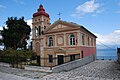 Panagia Mandrakina
 -
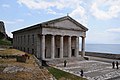 Saint George Temple at the Old Fortress
 -

-
 Achilleion façade
 -
 Carnival in Kerkyra by Charalambos Pachis
 -

-
 Belltower of Annunziata/Lontsiada Catholic church (Evangelistria)
 -
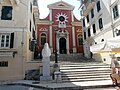 Panagia Spiliotissa Cathedral


See also
[edit]References
[edit]- ^ "Αποτελέσματα Απογραφής Πληθυσμού - Κατοικιών 2021, Μόνιμος Πληθυσμός κατά οικισμό" [Results of the 2021 Population - Housing Census, Permanent population by settlement] (in Greek). Hellenic Statistical Authority. 29 March 2024.
- ^ "Τροποποίηση του άρθρου 1 του ν. 3852/2010" [Amendment of Article 1 of l. 3852/2010] (in Greek). Government Gazette. p. 1164.
- ^ Thucydides, History of the Peloponnesian War 1.36.3
- ^ "Home Page". Municipality of Corfu. Archived from the original on 2017-07-04. Retrieved 2010-03-23.
- ^ Italian Corfu city
- ^ Will Durant. The Renaissance. page 684. MJF Books. New York, 1981 ISBN 1-56731-016-8
- ^ BBC news on UNESCO World Heritage list
- ^ a b c d UNESCO Advisory Body (ICOMOS) report on Corfu History retrieved 3 July 2007
- ^ Old Town of Corfu on UNESCO website retrieved 3 July 2007
- ^ "Population & housing census 2001 (incl. area and average elevation)" (PDF) (in Greek). National Statistical Service of Greece. Archived from the original (PDF) on 2015-09-21.
- ^ a b c Philip Sapirstein (2012). "The Monumental Archaic Roof of the Temple of Hera at Mon Repos, Corfu". Hesperia: The Journal of the American School of Classical Studies at Athens. 81 (1): 31–91. doi:10.2972/hesperia.81.1.0031. JSTOR 10.2972/hesperia.81.1.0031. S2CID 193469029.
- ^ Bank of Greece Archived March 28, 2009, at the Wayback Machine. Drachma Banknotes & Coins: 500 drachmas Archived 2007-10-05 at the Wayback Machine. – Retrieved on 27 March 2009.
- ^ "History". cricket.gr. Retrieved 17 April 2015.
- ^ "NAOK website". naok.gr/. NAOK.
- ^ "Kekira Climate extremes 1991-present". Retrieved 1 March 2023.
- ^ a b "Mean Corfu Climatic Averages". Hellenic National Meteorological Service. Archived from the original on 24 January 2015. Retrieved 1 March 2015.
- ^ "Kekira Climate Normals 1961–1990". National Oceanic and Atmospheric Administration. Archived from the original on 2020-07-13. Retrieved 1 March 2015.
- ^ "History of City Councils from the Municipality of Corfu". Municipality of Corfu. 2005-09-20. Archived from the original on April 9, 2005. Retrieved 2007-03-30.
- ^ "Municipal council of Corfu, 5th period (1883-1887)". Retrieved 17 September 2014.
- ^ a b Municipality of Corfu from the Internet archive Quote:In the elections of 1954 Stamatios Desillas was elected Mayor for a second term and remained in office until his death, Christmas Day 1955. Soon after a bye-election took place in Corfu in which the widow of the deceased Maria Desilla - Kapodistria, was elected Mayor with 5,365 votes in a total of 10,207. Maria Desilla became Mayor of Corfu on 15 April 1956 until 9 May 1959. She was the first female Mayor in Greece.
- ^ "Mayor of Corfu". corfu.gr.
- ^ "Αδελφοποιήσεις Δήμου". corfu.gr (in Greek). Kerkyra. Retrieved 2020-01-10.
- ^ "Sister Cities". bethlehem-pa.gov. City of Bethlehem. Retrieved 2020-01-10.
- ^ "Gradovi pobratimi". bar.me (in Montenegrin). Bar. Archived from the original on 2021-09-05. Retrieved 2020-01-10.
- ^ "MV-U-7/19: KD Okvirni sporazum putovanja". zemun.rs (in Serbian). Zemun. 2019-06-01. p. 7. Retrieved 2020-01-10.
- ^ "Αδελφοποιημένες Πόλεις". mytilene.gr (in Greek). Mytilene. Archived from the original on 2020-01-29. Retrieved 2020-01-10.
- This article incorporates text from a publication now in the public domain: Chisholm, Hugh, ed. (1911). "Corfu". Encyclopædia Britannica. Vol. 7 (11th ed.). Cambridge University Press. pp. 145–146.

External links
[edit]
 Corfu Town travel guide from Wikivoyage
- Municipal website

 Landmarks of Corfu Landmarks of Corfu | ||
|---|---|---|
 Ancient Palaiopolis Ancient Palaiopolis |  | |
 Castles Castles | ||
 Palaces Palaces | ||
 Museums Museums | ||
 Historic structures Historic structures | ||
 Education and Culture Education and Culture | ||
 Churches and Monasteries Churches and Monasteries | ||
 Nature Nature | ||
 Events Events | ||
.jpg)


Corfu (city)
View on GrokipediaGeography and Climate
Geography
Corfu (city), known in Greek as Kérkyra, is positioned on the eastern coast of Corfu Island in the Ionian Sea, off the western shores of mainland Greece. The city lies at coordinates 39°37′N 19°55′E, serving as the capital of the Ionian Islands region and the administrative center of the Municipality of Central Corfu and Diapontian Islands. Its municipal unit encompasses approximately 42 km², encompassing both urban and suburban areas along the coastline.[3][4] The topography of Corfu city features a mix of coastal lowlands and gently rising hills that frame the urban landscape. The Old Port, a historic natural harbor, anchors the eastern side, providing sheltered waters for maritime activities, while Garitsa Bay to the south offers a curved inlet ideal for promenades and small vessels. Surrounding elevations include Analipsis Hill to the north, site of ancient archaeological remains, and Stratia Hill near the southern suburbs, contributing to the city's undulating terrain that rises gradually from sea level to around 100-200 meters in nearby areas. These features create a scenic backdrop, with the urban core nestled between the sea and these modest hills.[5][6] Environmentally, the city boasts prominent coastal elements, including the Kanoni Peninsula extending southward, which culminates in the iconic Vlacherna Monastery and overlooks the tiny Pontikonisi islet, often called Mouse Island due to its small size and cypress-covered profile. This islet, connected by shallow waters, exemplifies the area's karstic coastal morphology. The city's core, including the UNESCO World Heritage-listed Old Town, integrates seamlessly with these natural surroundings, where Venetian fortifications perch on promontories overlooking the bays. Geologically, Corfu city forms part of the Ionian Islands' tectonic framework, dominated by limestone formations from the Paxos and Ionian geotectonic units, with alpine and post-alpine sediments shaping the rugged cliffs and fertile plains. These limestones, often fractured and karstified, influence the local hydrology and scenic white cliffs along the coast.[7][8][9]Climate
Corfu city experiences a hot-summer Mediterranean climate classified as Köppen Csa, characterized by mild, wet winters and hot, dry summers. The average annual temperature is approximately 17.5°C, with annual precipitation totaling around 1,000 mm along the coastal areas. This climate pattern aligns with the broader Ionian region but features a localized microclimate in the city due to its position within a protected bay, which moderates wind exposure and temperature extremes compared to more exposed inland or western parts of the island.[10][11][12] Seasonal variations are pronounced, with summer months of July and August recording average high temperatures up to 31°C and lows around 20°C, while January sees average highs of 14°C and lows near 8°C. Precipitation is concentrated in the winter half of the year, with minimal rainfall during the dry summer period, averaging fewer than 10 rainy days per month from June to August. Dominant winds, known locally as the maistro, blow from the northwest during the summer, providing cooling breezes that typically reach 3-5 Beaufort strength in the afternoons but are somewhat attenuated in the city's eastern bay location. These conditions support a prolonged tourism season, peaking in summer when the mild winds enhance outdoor activities.[13][14][15] Historical weather events in Corfu city include rare snowfalls, which occur sporadically during cold winter snaps, such as minor accumulations noted in broader Ionian episodes in 2019. More frequent are intense rainfall events leading to floods, exemplified by Storm Ballos in October 2021, which caused significant urban flooding and infrastructure damage in the city due to over 200 mm of rain in 24 hours, and a powerful storm in September 2025 that brought 126 mm of rain in one hour, turning parts of the city into a lake and damaging shops and roads.[16][17][18] Climate change is exacerbating these risks, with rising sea levels and increased storm intensity contributing to coastal erosion along the city's shoreline; studies indicate moderate vulnerability in the historic old town area. Compared to the wider Ionian region, Corfu city's bay offers relative protection from erosive wave action, though projected sea-level rise of 0.5-0.7 meters by 2100 threatens low-lying coastal zones regardless.[19]History
Ancient History
The ancient city of Korkyra, the precursor to modern Corfu, was founded as a Corinthian colony around 734 BC on the eastern peninsula of the island, where colonists displaced earlier Eretrian settlers to establish a strategic trading hub with multiple harbors.[20] This settlement quickly grew into one of the most prosperous poleis in the Greek world, leveraging its fertile lands for agriculture—particularly olive and wine production—and its position controlling access to the Adriatic Sea. By the 6th century BC, Korkyra had developed a formidable navy, becoming one of the three premier maritime powers in Greece alongside Athens and Corinth, which enabled it to maintain an isolationist stance while engaging in extensive trade with Etruria and Magna Graecia.[20] During the Greco-Persian Wars of the early 5th century BC, Korkyra pledged naval support to the Greek alliance, outfitting 60 triremes in 480 BC but ultimately contributing minimally due to delays, arriving only after the decisive Battle of Salamis and thus playing no active role in repelling the Persian invasion. Tensions with its mother city Corinth escalated over colonial disputes, culminating in the Battle of Sybota in 433 BC, where Korkyra's fleet, bolstered by Athenian reinforcements, clashed with Corinthian forces off the island's northwestern coast; the inconclusive engagement heightened rivalries and served as a key catalyst for the Peloponnesian War.[21] Korkyra's alliance with Athens endured for much of the conflict, underscoring its strategic naval importance, though the city suffered internal strife and sieges during the war. In 229 BC, following a defeat at the Battle of Paxos, Korkyra endured a brief Illyrian occupation under Demetrius of Pharos, which prompted Roman intervention; the Romans expelled the invaders, establishing the island as a protected naval station and marking the onset of Roman administration that integrated Korkyra into the province of Macedonia by 148 BC.[20] The ancient urban center, known as Palaiopolis and located approximately 2 km south of the modern city, featured an acropolis with defensive walls, temples, and public structures dating from the 6th century BC; excavations have uncovered artifacts such as pottery, inscriptions, and architectural remnants, including the Doric Temple of Artemis (built c. 585 BC) with its notable gorgon pediment, highlighting the site's role as a religious and civic heart.[20] The transition to Roman rule facilitated the spread of Christianity, with Palaiopolis emerging as an early episcopal see; by the 5th century AD, Bishop Jovian constructed a grand five-aisled basilica there, featuring intricate mosaics, sculptures, and a double narthex, which served as a focal point for worship until its partial destruction and rebuilding amid Gothic invasions.[22] As the Western Roman Empire declined, Korkyra fell under Byzantine control around the 4th century AD, with administrative consolidation by the 6th century under Justinian I; the island's early Christian communities adapted Roman infrastructure for basilicas and fortifications, bridging pagan antiquity to Byzantine governance through the 8th century, when Slavic and Arab threats prompted further ecclesiastical developments.[22]Medieval and Modern History
Corfu's medieval history included an early Norman occupation from 1081 to 1085, when forces under Robert Guiscard captured the island as a base against the Byzantine Empire, before it was retaken by Byzantine Emperor Alexios I Komnenos with Venetian aid.[23] Following the Fourth Crusade in 1204, the island was briefly captured by Crusader forces, including Norman elements, before passing to Venetian control from 1209 to 1214, then to the Despotate of Epirus. The Angevin dynasty assumed rule in 1267 when Corfu was granted to Charles of Anjou, establishing a feudal system that emphasized agricultural production from olive groves, vineyards, and salt pans.[24] This period, lasting until 1386, saw intermittent conflicts but relative stability, though Charles sought to impose Catholic influence on the predominantly Orthodox population.[24] Venetian rule commenced in 1386 and endured for over four centuries until 1797, transforming Corfu into a vital strategic outpost and trade hub in the Adriatic Sea. Venice fortified the city extensively to counter Ottoman threats, enhancing the Byzantine-era Old Fortress with walls, bastions, and a contrafossa moat during the 15th century, and constructing the New Fortress between 1576 and 1645 under architects like Ferrante Vitelli to protect the harbor.[25] These defenses repelled multiple Ottoman sieges, including in 1537 and 1716, while the city's role as a commercial entrepôt facilitated trade in olive oil, wine, and silk between Europe and the Levant, fostering economic prosperity and cultural exchange that blended Italian and Greek influences.[8] A devastating plague outbreak in 1629, part of recurring epidemics under Venetian administration, killed thousands and prompted strict quarantine measures, including lazarettos, to safeguard the island's maritime commerce.[26] The French occupation from 1807 to 1815 marked a period of enlightened reforms amid Napoleonic expansion. The short-lived Corfu Republic (1807–1809) introduced democratic institutions and abolished feudal privileges, followed by the Ionian State (1809–1815), a French protectorate that emphasized secular governance.[27] Educational advancements included the introduction of the French Civil Code and the first printing press in modern Greece, promoting literacy and administrative modernization. Infrastructure developments, such as the Liston promenade modeled after Paris's Rue de Rivoli, enhanced urban aesthetics and public spaces.[28] British protectorate rule from 1815 to 1864, as part of the United States of the Ionian Islands, built on these foundations with further institutional and infrastructural progress. The British formalized a parliamentary system, reformed the judiciary along English lines, and expanded education through the founding of the Ionian Academy—Greece's first modern university—in 1824, alongside secondary schools emphasizing classical studies.[29] They also improved sanitation, roads, and the Liston promenade, turning it into a neoclassical social hub lined with cafes.[30] In 1864, under the Treaty of London, Britain ceded the Ionian Islands to Greece as a dowry gift to the new King George I, integrating Corfu fully into the Greek state on May 21 and ending foreign rule.[31] The 20th century brought turmoil and renewal to Corfu. During World War II, Italian forces occupied the island in May 1941 following aerial and naval bombardment, with control passing to German troops in September 1943 after Italy's surrender; the occupation ended in October 1944 amid widespread resistance and deportations, including the near-total annihilation of the Jewish community.[32] Post-war recovery accelerated with Greece's economic stabilization, though the island faced challenges from the Greek Civil War (1946–1949) and natural disasters, including seismic activity in the seismically active Ionian region.[33] Urban growth and tourism emerged as drivers of prosperity from the 1950s onward, leveraging the city's preserved Venetian and neoclassical architecture.[8] In recent decades, Corfu has navigated global challenges while preserving its heritage. The Old Town was inscribed on UNESCO's World Heritage List in 2007 for its unique synthesis of Western and Eastern architectural influences, spanning Venetian fortifications to 19th-century neoclassicism.[8] The Greek debt crisis (2009–2018) impacted the island's tourism-dependent economy, contributing to declines in visitor arrivals amid national drops of around 10% in some years.[34] The COVID-19 pandemic further disrupted tourism, with international arrivals falling over 70% in 2020, before rebounding strongly from 2021 onward. Recovery from 2022 to 2024 saw arrivals surpass pre-pandemic levels, reaching approximately 1.5 million international air arrivals in 2023 and nearly 2 million total tourists in 2024, supported by EU recovery funds and infrastructure upgrades, though overtourism concerns persist as of 2025.[35][2]Government and Administration
Local Government
Corfu serves as the capital of the Corfu regional unit within the Ionian Islands Region of Greece and is the administrative seat of the Municipality of Central Corfu and Diapontia Islands. This structure emerged from the 2011 Kallikratis Programme, which reorganized local government by merging smaller units into larger municipalities, and was refined by the 2019 Kleisthenis I Programme that divided the original Corfu municipality into three entities to enhance administrative efficiency. The municipality has a population of 67,112 (2021 census), including the urban area of Corfu with 40,047 inhabitants in its central municipal unit, as recorded in the 2021 Population-Housing Census conducted by the Hellenic Statistical Authority (ELSTAT).[36] The local government operates through a municipal council comprising 39 elected members, determined by the municipality's population size under Greek law, alongside the directly elected mayor who exercises executive authority over daily operations and policy implementation. Council members and the mayor are elected every five years via universal suffrage among eligible residents, with the council responsible for legislative oversight, budgeting, and approving major initiatives. The mayor, Stefanos Poulimenos (since 2023), leads the executive branch, appointing deputy mayors and coordinating with central government on regional matters.[37][38][39] Key municipal departments handle essential services, including urban planning for sustainable development and infrastructure maintenance, waste management to ensure environmental compliance, and cultural preservation to protect UNESCO-listed sites like the Old Town. A significant portion of the annual budget in recent fiscal years is allocated to tourism infrastructure, supporting enhancements to public facilities, coastal protections, and heritage sites that underpin the local economy. These departments collaborate with regional authorities to integrate national policies on environmental and cultural standards.[37][40][41] Recent initiatives under the 2020-2025 municipal strategic plan emphasize sustainability, targeting overtourism through measures like visitor caps at key sites and promotion of off-season activities, while expanding green spaces via reforestation and park upgrades to cover an additional 10 hectares. These efforts align with Greece's national tourism strategy and EU-funded programs, aiming to balance economic growth with ecological preservation amid rising annual visitor numbers exceeding 1 million. The municipality's 2022 membership in the Global Sustainable Tourism Council further supports these goals by adopting international criteria for responsible tourism management. The HELIX-SMART project, launched in September 2025 under Interreg VI-A Greece-Italy, continues to promote digital innovation and green transitions for small businesses and coastal communities as of November 2025.[42][43][44][45]Historical Mayors
The mayoralty of Corfu (city) dates to 1866, shortly after the Ionian Islands' union with Greece in 1864, marking the transition from British protectorate administration to local elected governance influenced by earlier colonial structures. Early mayors focused on establishing municipal services and infrastructure amid the city's integration into the Greek state. Terms were initially four years, extending to five years from 2011 onward, with elections held periodically except during periods of dictatorship. Significant 19th-century mayors included Nikolaos V. Manesis, the first elected mayor, who served from 1866 to 1870 and oversaw the foundational organization of the municipality, including basic administrative and public works setups. Georgios Theotokis, mayor from 1879 to 1887 across two terms, contributed to local infrastructure development and cultural preservation, drawing on his legal background from the Ionian University; his later national role as prime minister (1905–1909) amplified Corfu's educational advancements through broader reforms.[46] In the 20th century, long-serving mayor Spyridon Kollas held office from 1925 to 1951, spanning economic challenges, World War II occupation, and initial postwar recovery; however, his tenure was marred by collaboration with Italian and German forces, leading to his removal in 1941 and replacement by appointed figures during the Axis control.[47] Postwar reconstruction efforts continued under Stamatios Desyllas (1951–1955), who controversially authorized the demolition of the damaged Municipal Theatre in 1952 despite public opposition, prioritizing safety after wartime destruction.[47] Maria Desylla-Kapodistria succeeded him via a 1956 bye-election, serving until 1959 as Greece's first female mayor, advancing women's roles in local leadership while managing urban recovery.[48] The military junta (1967–1974) suspended elections, appointing mayors like Ilarionas Baklis (1967) and Hector Gerontikos (1967–1973), disrupting democratic processes until the metapolitefsi restoration. Spyros Rath, elected in 1964 and reelected in 1975, bridged the junta era and early democracy, focusing on administrative stabilization.[49] Later 20th-century figures like Ioannis Kourkoulos (1979–1990) emphasized community rebuilding post-junta, while Chryanthos Sarlis (1991–2002) advanced urban renewal projects, including preservation of historic sites amid economic pressures.[50] In recent decades, mayors have prioritized tourism and EU-funded infrastructure. Kostas Nikolouzos (2014–2019) promoted thematic tourism through international outreach, such as events in Moscow, boosting the sector amid waste management crises that highlighted sustainability needs.[51] Meropi Ydraiu (2019–2023) became the second female mayor, advancing gender representation in local governance.[52] The current mayor, Stefanos Poulimenos (since 2023), has focused on securing EU funds for water supply and heritage restoration, including European Regional Development Fund projects for conservation.[38][53]| Mayor | Term | Key Contributions |
|---|---|---|
| Nikolaos V. Manesis | 1866–1870 | Established municipal framework post-union with Greece. |
| Georgios Theotokis | 1879–1887 | Infrastructure and cultural initiatives; influenced education.[46] |
| Spyridon Kollas | 1925–1951 | Oversaw pre- and postwar administration, though controversial during occupation.[47] |
| Maria Desylla-Kapodistria | 1956–1959 | Pioneered female leadership; urban recovery efforts.[48] |
| Spyros Rath | 1964–1967, 1975–1978 | Stabilized governance across junta and democracy transition.[49] |
| Chryanthos Sarlis | 1991–2002 | Urban renewal and historic preservation.[50] |
| Kostas Nikolouzos | 2014–2019 | Tourism promotion and sustainability initiatives.[51] |
| Stefanos Poulimenos | 2023–present | EU-funded infrastructure, including water and heritage projects.[53] |
International Relations
Corfu maintains several international twin town partnerships, fostering cultural, educational, and economic exchanges. The city established a sister city relationship with Bethlehem, Pennsylvania, United States, in 2013, promoting mutual understanding through joint events and tourism initiatives.[54] In 2017, Corfu signed a protocol of friendship and cooperation with Parma, Italy, emphasizing shared Mediterranean heritage and collaborative projects in arts and sustainability.[55] The municipality also holds longstanding ties with other Italian cities, including Bari, Brindisi, Carovigno, and Calimera, primarily to enhance cultural exchanges and historical dialogue.[55] Due to its prominence as a tourist destination, Corfu hosts multiple foreign consulates, supporting diplomatic and consular services for visitors and residents. The British Vice Consulate provides assistance to UK nationals, including emergency support and documentation, reflecting the city's significant British tourist influx.[56] Similarly, honorary consulates for countries such as Germany, Switzerland, Finland, and Ireland operate in the city, handling visa matters, trade promotion, and citizen services.[57][58][59] In total, over 20 foreign representations, mostly honorary, are based in Corfu, underscoring its role as a regional hub for international engagement.[60] The Municipality of Central Corfu and Diapontia Islands actively participates in EU-funded Interreg programs, focusing on cross-border cooperation for environmental sustainability in the Ionian region. Under the Interreg VI-A Greece-Italy 2021-2027 programme, Corfu is involved in initiatives like the HELIX-SMART project, launched in 2025, which promotes digital innovation and green transitions for small businesses and coastal communities.[45] Additional projects, such as ANEMOS for resilient seaports and SHIELD for advanced healthcare management, address climate adaptation and ecosystem protection through Italian-Greek partnerships.[61] Corfu also collaborates with UNESCO on preserving its Old Town, a World Heritage Site since 2007, through restoration efforts coordinated with the Greek Ministry of Culture and local academic institutions like the Ionian University.[8][62] In recent diplomacy, Corfu has strengthened post-Brexit connections with the United Kingdom via its British Vice Consulate, facilitating smoother travel and residency for UK citizens amid evolving EU-UK relations.[56] The city hosted a major regional event in April 2025 on accelerating climate change adaptation in the Adriatic-Ionian area, aligning with broader Mediterranean frameworks adopted in July 2025 to enhance coastal resilience against environmental threats.[63][64]Demographics and Society
Population and Demographics
According to the 2021 Population-Housing Census conducted by the Hellenic Statistical Authority (ELSTAT), the settlement (oikismos) of Kérkyra has a resident population of 23,541, aligning with the urban core. The municipal community (demosi koinotita) of Kerkyraion encompasses 30,737 residents. The municipal unit of Corfu city covers 41.905 km² with 40,047 inhabitants, yielding a population density of 955 inhabitants per square kilometer. The broader municipality of Central Corfu and Diapontian Islands records 67,112 residents.[65][66] The demographic composition of Corfu city is predominantly Greek, with immigration from Albania adding to population diversity; internal migration from rural Corfu areas also affects urban patterns. The population shows an aging profile, consistent with trends in the Ionian Islands region driven by low birth rates and youth emigration. Social indicators reflect high educational attainment, with average household sizes around 2.3 persons, similar to national patterns amid urbanization.[67] Tourism impacts demographics via seasonal influxes, swelling the resident base by tens of thousands in summer, with over 1 million annual visitors to the city and island. Historically, Corfu's population grew from about 28,254 in the town and suburbs in 1907 to a peak of 41,100 in 1981, driven by post-war development and migration. After the 2008 crisis, numbers declined slightly, stabilizing around 30,000–40,000 by 2021 due to emigration and low growth.[68]Neighborhoods and Urban Layout
Corfu (city), also known as Corfu Town or Kerkyra, is divided into several distinct neighborhoods that reflect its layered historical development and modern expansion. The core is the Old Town, a UNESCO World Heritage site encompassing a compact historic center of approximately 70 hectares, characterized by a dense network of narrow, labyrinthine streets known as kantounia (1-3 meters wide) that wind through three low hills: Campiello in the northwest, Agion Pateron centrally, and Agiou Athanassiou in the southeast.[69] This area, shaped primarily during the Venetian period (1386–1797), integrates fortifications, residential quarters, and over 40 churches into an irregular, amphitheatrical layout bounded by the Old Fortress to the north and the New Fortress to the east.[69][70] Adjacent to the Old Town lies the New Town, developed in the late 19th and early 20th centuries following the demolition of Venetian walls after Corfu's incorporation into the Greek state in 1864. This expansion adhered to neoclassical planning principles, featuring straight roads, larger building blocks, and open squares to accommodate a growing population, extending into former suburbs like Garitsa to the south and Sarocco (now part of the urban fabric).[71] Further south, Garitsa emerges as a quieter, seaside neighborhood along Garitsa Bay, with waterfront promenades and residential areas that serve as a transitional zone between the historic core and the broader suburbs.[72] To the southwest, Kanoni forms a hilly peninsula neighborhood, known for its elevated terrain and views, linking to archaeological sites and providing a more suburban, less densely built character.[72] These main quarters—Old Town, New Town, Garitsa, and Kanoni—collectively define the city's spatial divisions, with the Old Town housing around 7,000 residents in its high-density core (as of early 2000s).[69] The urban layout centers on a radial pattern emanating from Spianada Square, a large open esplanade that occupies about one-third of the historic area and originated as a defensive space in the 17th century before evolving into a public green space with French and British neoclassical enhancements.[69] Two primary east-west streets connect the Old Fortress to the Spilia Gate, intersected by a north-south axis that links key gates (Royal, St. Nicholas, Raimonda, and Spilia), while secondary paths in the inner hills form a maze-like network with stairs and small squares like Kremasti Square.[69] Major arteries include Kapodistriou Avenue, a bustling commercial street in the Old Town lined with shops and restaurants, and Ethnikis Antistaseos Avenue, a broader modern thoroughfare facilitating traffic flow to the suburbs and airport.[73][74] In the New Town and outskirts, layouts shift to a more regular grid, contrasting the organic irregularity of the Venetian-era core.[71] Post-1960s developments have spurred suburban growth westward and southward, incorporating planned residential areas in zones like Anemomylos and Vassilika, driven by population increases and tourism.[69] Pedestrian zones proliferate in the Old Town, enhancing accessibility amid narrow alleys that pose challenges for vehicles, while green spaces such as Boschetto Park— a symmetrically designed Renaissance-style garden between the Old Fortress and Spianada—provide oases with flower beds, fountains, and views of the seaward fortifications.[75] Functionally, the city organizes into a vibrant commercial hub in the central Old Town, where shops and tourism dominate, transitioning to residential outskirts in Garitsa, Kanoni, and beyond, with military remnants like the fortresses anchoring the northern and eastern edges.[69][70] The population is predominantly Greek Orthodox, with small Catholic and other religious minorities reflecting historical influences.Notable Residents
Corfu, the capital city of the Ionian Islands, has been the birthplace of numerous influential figures across politics, arts, and sciences, contributing significantly to Greek and international history. Among the most prominent historical figures is Ioannis Kapodistrias (1776–1831), born in the city to an aristocratic family, who rose to prominence as a diplomat in Russian service before becoming the first governor of independent Greece in 1827; he focused on modernizing the nascent state through administrative reforms, agricultural development, and educational initiatives until his assassination in 1831.[76] Georgios Theotokis (1844–1916), also born in Corfu, emerged as a key political leader, serving as Prime Minister of Greece on four occasions between 1897 and 1909, during which he advanced infrastructure projects, electoral reforms, and foreign policy alignments with European powers.[77] Earlier, Nikiforos Theotokis (1731–1800), a Corfu native, distinguished himself as a scholar and theologian, authoring influential mathematical and philosophical treatises while serving as an archbishop in the Russian Empire, bridging Orthodox theology with Enlightenment ideas.[78] In the realm of culture, Corfu's residents have left an indelible mark on music and literature. Nikolaos Mantzaros (1795–1872), born in the city to a noble family of Italian descent, was a foundational figure in the Ionian school of music; he composed the melody for the Greek national anthem, "Hymn to Liberty," based on Dionysios Solomos's poem, and produced over 40 works including cantatas and chamber music that blended Italian operatic styles with Greek themes.[79] Spyridon Xyndas (1812–1896), another Corfu-born composer, pioneered modern Greek opera by creating "The Parliamentary Candidate" in 1867, the first such work with an entirely Greek libretto and text, drawing on local folk traditions while trained in Italian conservatories.[80] Literary contributions include Konstantinos Theotokis (1872–1923), born in Corfu, whose realist novels and plays, such as "The Honor of the Family" and "The Blessed," critiqued class disparities and rural life in the Ionian Islands, influencing 20th-century Greek literature.[81] Albert Cohen (1895–1981), born to a Sephardic Jewish family in Corfu, later emigrated and became a celebrated French-language novelist; his tetralogy "Solal" explored themes of Jewish exile and identity, drawing from his early life in the city's multicultural environment.[82] Modern notables from Corfu span entertainment, royalty, and sports, reflecting the city's ongoing cultural vitality. Rena Vlahopoulou (1923–2004), born in the city, achieved stardom as an actress and singer in Greek cinema and theater, appearing in over 50 films and revues that popularized Ionian folk music and humor during the mid-20th century.[81] Prince Philip, Duke of Edinburgh (1921–2021), was born at Mon Repos villa in Corfu as Prince Philip of Greece and Denmark; he later married Queen Elizabeth II in 1947, serving as her consort for 73 years and championing environmental and youth initiatives through the Duke of Edinburgh's Award program.[83] In sports, Linos Chrysikopoulos (born 1992), a Corfu native, has excelled as a professional basketball player, competing for Panathinaikos and the Greek national team, where he contributed to EuroLeague successes and international tournaments with his forward skills.[84] Dimitrios Grammozis (born 1978), of Greek descent and associated with Corfu through his career with local club A.O. Kerkyra, played as a midfielder in the Greek Super League before transitioning to coaching roles in Germany, including with Schalke 04.[85] Corfu's diaspora has also shaped Greek history, particularly during the War of Independence (1821–1830), when emigrants from the British-protected Ionian Islands, including many from the city, raised funds, supplied arms, and advocated for the cause among European philhellenes, leveraging their education and connections abroad to bolster the revolutionary effort.[86]Culture and Heritage
Architecture and Landmarks
The architecture of Corfu (city), particularly its Old Town, exemplifies a unique fusion of Venetian, neoclassical, and Byzantine influences, shaped by centuries of foreign rule and strategic importance as a fortified port in the Ionian Sea. Venetian dominance from the 15th to 18th centuries introduced Renaissance, Mannerist, and Baroque elements, including arcades, porticos, and robust fortifications designed to protect against Ottoman incursions, creating a dense urban fabric with flat façades and stone balconies. Neoclassical structures emerged during British administration in the early 19th century, featuring Doric and Ionic columns, symmetrical designs, and pilasters that marked the first major expression of this style in Greece. Byzantine remnants, though less prominent due to later overlays, persist in early medieval churches with single-aisled plans, cruciform layouts, and ceramic decorations, reflecting pre-Venetian Christian heritage.[69] Prominent Venetian landmarks include the Old Fortress, constructed primarily in the 15th to 19th centuries with designs by engineers like Michele Sanmicheli in 1558, encompassing a Byzantine core from the 6th century and later British modifications; it features defensive walls, bastions, and the Church of St. George added in 1840, now housing cultural spaces such as archives and a library. The New Fortress, built between 1576 and 1588 under Ferrante Vitelli, presents a pentagonal layout with underground galleries, Tuscan-Doric gateways, and the Panagia Spiliotissa Church from 1739, dominating the northwest of the Old Town and offering scenic vantage points. The arcaded Liston, constructed in the early 19th century with French Napoleonic inspiration but executed in neoclassical style by Ioannis Parmezan, forms a elegant promenade along the Spianada esplanade, its arcade-fronted buildings damaged in 1943 bombings but subsequently restored.[69] Neoclassical architecture is epitomized by the Palace of St. Michael and St. George, erected from 1819 to 1823 by British architect George Whitmore in Regency-Georgian style with a Doric colonnade, originally serving as the residence for British high commissioners and the Ionian Parliament; it now functions as the Museum of Asian Art, showcasing classical antiquities and hosting significant events like the 1994 European Union summit. The Saint Spyridon Church, a key religious landmark dating to 1589–1594 with alterations in 1670, blends Byzantine single-nave design with Venetian Renaissance and Mannerist features, including a tall belfry and painted ceiling by Panagiotis Doxaras; it enshrines the relics of the city's patron saint and holds icons by artists like Spyros Prosalentis. Byzantine influences are evident in sites like Anemomylos, a historic suburb with remnants of a Roman necropolis and early Christian structures integrated into the medieval town fabric. The Archaeological Museum, situated near the ancient site of Paleopolis, preserves artifacts such as the Gorgon pediment from the Temple of Artemis, documenting the transition from ancient to Byzantine eras.[69] Preservation of these architectural treasures has been prioritized since the early 20th century, with statutory protections enacted in 1967 by Greek authorities and comprehensive surveys recording over 1,500 buildings by 1998, leading to repairs on 305 structures through state and EU funding totaling €10.55 million from 1995 to 2005. The Old Town's relative resilience during the 1953 Ionian earthquake, which devastated nearby islands like Zakynthos and Cephalonia, allowed for focused restoration of minor damages and fortifications, such as the Martinengo bastion, commencing in the 1990s. In 2007, UNESCO inscribed the Old Town as a World Heritage Site under criteria (iv) for its outstanding example of a fortified Mediterranean port town, spanning 70 hectares with a 162-hectare buffer zone; this status supports ongoing management plans, including a 2006–2012 urban action initiative with an annual budget of €500,000, ensuring the authenticity and integrity of its Venetian and neoclassical ensemble.[8][69]Cultural Institutions and Events
Corfu hosts several prominent cultural institutions that preserve and promote its rich heritage. The Corfu Reading Society, established in 1836 as the oldest cultural institution in modern Greece, serves as a library and research center with over 30,000 volumes focused on Ionian history and literature, fostering intellectual discourse through events and exhibitions.[87] The Museum of Asian Art, founded in 1927 from a donation of 10,500 artifacts by diplomat Gregory Manos, displays Chinese, Japanese, and Southeast Asian porcelain, textiles, and sculptures, highlighting Corfu's historical trade connections with the East.[88] Complementing these, the Banknote Museum, housed in a historic building in Corfu Town, exhibits over 1,000 Greek banknotes from the 19th century onward, illustrating the island's economic history under British and Ionian State rule.[89] The city's philharmonic societies form a cornerstone of its musical life, with roots in the 19th century. The Corfu Philharmonic Society, founded in 1840, operates as Europe's first music academy modeled on continental prototypes and performs marches, concertos, and opera excerpts during religious and civic events.[90] Cultural events in Corfu blend religious devotion, Venetian influences, and contemporary arts. The feasts of Saint Spyridon, the city's patron saint, feature solemn processions of his relics four times annually, including on Palm Sunday and Easter to commemorate his protection during sieges, and on August 11 to honor his intervention against the 1629 plague, drawing thousands with philharmonic bands and liturgical chants.[91][92] The Corfu Carnival, held in the weeks before Lent, showcases pre-Lenten parades with elaborate floats, costumed revelers, and satirical "mock battles" between opposing groups, reflecting Venetian carnival customs adapted to local folklore.[93] The Corfu International Festival, an annual summer event since 2022, presents multidisciplinary performances in music, theater, dance, and visual arts at historic venues, promoting cultural exchange with international artists.[94] Corfu's literary and musical heritage draws from its Venetian past, where opera traditions introduced in the 17th century evolved into a unique philharmonic culture, with bands rehearsing operatic scores for public serenades and festivals.[95] The annual Corfu Literary Festival, held each September, features author readings, panels, and workshops on literature, history, and music, attracting global participants to discuss Ionian intellectual legacies.[96] In recent years, contemporary initiatives have integrated digital tools into cultural preservation. A 2024 project by the Ionian University developed a virtual exhibition of 3D-modeled Corfu monuments, enhancing accessibility to the city's heritage for global audiences through immersive online platforms.[97] EU-funded efforts, including the 2025 Audiovisual Arts Festival, support digital heritage exchanges and interdisciplinary collaborations, such as the PIONEER+ program hosted on Corfu, which advances innovative cultural policies across Europe.[98][99]Sports and Recreation
Corfu's sports scene is anchored by football, with Athlitikos Omilos Kerkyra (AOK Kerkyra) serving as the island's primary professional club. Founded in 1969, the team competes in the Corfu FCA Second Division (B' EPS Kerkyras) as of the 2025–26 season, following financial difficulties that led to its withdrawal from national leagues after the 2023–24 season; it plays home matches at the Ethniko Stadio Kerkyras, a multi-purpose stadium with a capacity of around 3,000 spectators.[100][101][102] Historical clubs like AO Phaeax, established in 1976 as a multi-sport organization, have contributed to the local football tradition through amateur and youth divisions, fostering community involvement since the mid-20th century.[6] Basketball enjoys popularity in Corfu, particularly through teams such as Faiakas Corfu and Kerkyra, which participate in regional Greek leagues and emphasize community engagement. Water polo thrives due to the city's coastal setting, with the Nautical Athletic Club of Corfu (NAOK) fielding competitive men's and women's teams in the A2 and B divisions, respectively, utilizing facilities like the club's seaside pools for training and matches. Key venues include the Ethniko Stadio Kerkyras for multi-sport events and the Corfu Tennis Club, which offers courts for racket sports alongside broader athletic programs.[103][104][105][106][107] Recreational activities abound, highlighted by sailing at the Corfu Sailing Club in Mandraki Marina, a historic harbor within the Old Fortress that provides mooring for over 100 vessels and hosts regattas for enthusiasts. Hiking trails on nearby Mount Pantokrator, Corfu's highest peak at 906 meters, offer challenging routes like the 7.6-mile point-to-point path via Palies Sinies, featuring panoramic views and moderate to strenuous terrain suitable for experienced walkers. Beaches such as Mon Repos provide serene spots for swimming and sunbathing, with amenities including sun loungers, umbrellas, and snack facilities on this sandy stretch adjacent to the historic estate.[108][109][110][111] Annual events like the Corfu Mountain Trail, held since 2013, draw runners to ultra-distance races up to 103 kilometers across rugged terrain, promoting endurance sports and tourism. The municipality supports youth programs through partnerships, such as Kerkyra United's collaboration with Ajax Amsterdam for football academies, which train local children and position Corfu as a regional hub for athletic development.[112][113]Economy and Infrastructure
Economy
The economy of Corfu is dominated by tourism, services, and port-related activities, which collectively form the backbone of local employment and revenue generation. Prior to the COVID-19 pandemic, the city welcomed around 1.5 million visitors annually, fueling a hospitality sector that supports thousands of jobs in hotels, restaurants, and retail.[114] By 2024, visitor numbers had rebounded to over 2.5 million overnight stays plus 800,000 day-trippers, primarily via cruise ships, underscoring tourism's role as the primary economic driver. In 2025, tourist arrivals increased by approximately 5% over 2024 levels.[1][115] Services, including financial and professional sectors, complement this by catering to both tourists and residents, while the Port of Corfu enhances connectivity as a leading Mediterranean gateway, ranked among Europe's top 10 cruise destinations based on visitor experience and other factors.[116] Agriculture and light manufacturing provide secondary contributions, with olive cultivation from more than 4 million trees producing high-quality oil for local and export markets, and kumquat farming yielding about 140 tons yearly, primarily processed into liqueurs and preserves.[117][118] Light industries focus on niche areas like electrical equipment and lighting production, though they remain small-scale compared to tourism.[119] In the broader Ionian Islands region, which includes Corfu, the unemployment rate was 14.7% in 2023 (higher than the national average of 10.5% that year), though national rates have since declined to around 8% in 2025, highlighting persistent labor market pressures amid seasonal employment fluctuations.[120][121] Regional GDP per capita stood at approximately €18,000 (nominal) or 47.2% of the EU average in PPP terms as of 2023, reflecting a modest economic scale reliant on seasonal inflows.[120] Economic challenges intensified after the 2008 financial crisis, which stalled growth across Greece, and the COVID-19 pandemic, which slashed cruise passenger numbers from 767,673 in 2019 to around 28,000 in 2020, devastating hospitality revenues by over 70% in line with national trends.[114][122][123][124] Recovery efforts have leveraged EU funds, with Greece receiving over €20 billion from the Recovery and Resilience Facility as of October 2025 to bolster infrastructure and tourism resilience in regions like the Ionian Islands.[125][126] Sustainable tourism initiatives, such as the 2025 Corfu Declaration signed by Greek island regions, promote environmental safeguards and balanced development to mitigate overtourism through 2025, supported by EU strategies for climate-resilient growth.[127][128] As an Ionian trade hub, Corfu facilitates exports of artisanal products, notably kumquat liqueur, which local distilleries have shipped to markets in Europe and beyond since 2000, enhancing the city's role in regional commerce.[129] The port's strategic position supports broader shipping logistics, contributing to economic diversification beyond tourism.[130]Transportation and Connectivity
Corfu (city), the capital of the Ionian island, benefits from a well-integrated transportation network that supports its role as a key entry point for tourists and residents. The Ioannis Kapodistrias International Airport (CFU), located approximately 2 kilometers south of the city center, serves as the primary air gateway, handling 4,343,748 passengers in 2024, a 6.8% increase from the previous year. In 2025, airport traffic continued to grow, with a 12.5% year-over-year increase in October.[131][132] Managed by Fraport Greece, the airport features seasonal flights from major European hubs, with peak traffic during summer months.[133] The New Port of Corfu, situated in the heart of the city, functions as the main maritime hub, accommodating ferries to destinations in Italy such as Ancona, Bari, Brindisi, and Venice, as well as frequent services to Albania's Saranda, with up to 10 daily crossings taking about 30 minutes.[134] Operators like Finikas Lines and Ionian Seaways provide reliable passenger and vehicle transport, enhancing regional connectivity.[135] The port also supports cruise operations, with recent expansions including improved docking facilities, enlarged passenger terminal areas, and modernized baggage handling to accommodate growing arrivals—64 cruise ships docked in the first four months of 2025 alone, a 77% increase from 2024.[136][137] These developments, including a completed quay and terminal area upgrade, have boosted capacity to meet demands through 2025.[138][139] Road access to the city relies on ferries from mainland ports like Igoumenitsa, which is directly linked to the Egnatia Odos (A2) motorway, facilitating efficient overland connections from northern Greece and beyond.[140] Within the municipality, the urban road network includes the blue buses operated by ASTIKO KTEL, providing frequent local routes such as line 15 connecting the airport, bus station, city center (San Rocco), and port.[141] These services, along with green intercity buses from KTEL Kerkyras, cover key destinations like Paleokastritsa and Kavos, with real-time tracking available via official apps.[142] The city center is notably pedestrian-friendly, featuring narrow, car-free alleys in the UNESCO-listed Old Town and dedicated bike lanes along waterfront paths to promote sustainable mobility.[143][144] Taxis are readily available at stands near the port and airport, offering 24-hour service for short trips within the urban area.[145] Digital connectivity in Corfu is robust, with fixed broadband median download speeds reaching 118.8 Mbps nationally in the first half of 2025 across major providers like Cosmote, Vodafone, and Nova, supported by widespread 5G and fiber-optic coverage in urban zones.[146] National broadband access reached 88.9% for next-generation networks by mid-2023, including significant fiber deployment on islands like Corfu to enable ultra-high speeds up to 1 Gbps in key areas.[147][148] This infrastructure underpins the city's economic activities, particularly tourism reliant on port operations.[138]Media and Communications
The media landscape in Corfu has evolved significantly since the early 19th century, beginning under British rule when the first printing presses and newspapers emerged in the Ionian Islands. The Corfu Reading Society's collection documents over 150 newspaper and journal titles circulating from 1814 to 1950, reflecting the island's role as an early hub for Greek-language publications during the protectorate period (1815–1864).[149] Print media remains a cornerstone of local journalism, with Enimerosi serving as a prominent daily newspaper focused on Corfu and the Ionian Islands, covering politics, economy, and culture. Regional editions of national papers, such as Ethnos and Kathimerini, also provide tailored content for local readers, often distributed through island-wide networks. Another key outlet is Ta Kerkyraika Nea, a Greek-language paper dedicated to Corfu-specific news and events.[150][151] Broadcasting in Corfu includes a mix of private and public stations that began expanding in the late 20th century alongside Greece's deregulation of airwaves in the 1980s. Radio options feature Antenna Kerkyra (AK 92.6 FM), a local station offering news, current affairs, entertainment, and music since its establishment as part of the broader Antenna network.[152] Other stations like Radiofidelity Corfu and DeeJay 97.5 provide diverse programming, including pop and local content. On television, Corfu Channel has operated as a regional broadcaster since 1992, delivering news, local events, and Ionian-focused reports. The public broadcaster ERT maintains a strong presence through ERT Corfu (99.3 FM and TV), part of the ERT Ionian Islands network, which airs national programming alongside regional news and cultural segments.[153][154] Digital media has grown rapidly in Corfu, particularly after 2010 amid Greece's economic crisis, which accelerated the shift from print and analog broadcast to online platforms for cost efficiency and wider reach. Local portals like enimerosi.com and corfutvnews.gr offer real-time news updates, videos, and community stories, often integrating with social media for tourism promotion—such as sharing beach events and cultural festivals to attract visitors. Social media engagement is high, with outlets using platforms like Facebook and Instagram to disseminate content and interact with audiences, though this occurs within Greece's broader press freedom challenges, where the country ranked 89th out of 180 in the 2025 Reporters Without Borders World Press Freedom Index, citing issues like political interference and economic pressures on independent journalism.[155][156][157][158]References
- https://commons.wikimedia.org/wiki/Category:Streets_in_Corfu